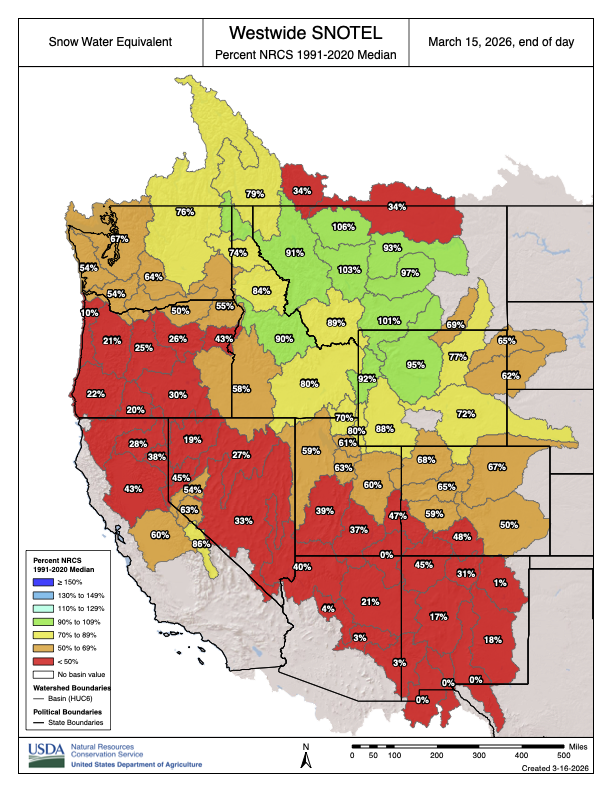
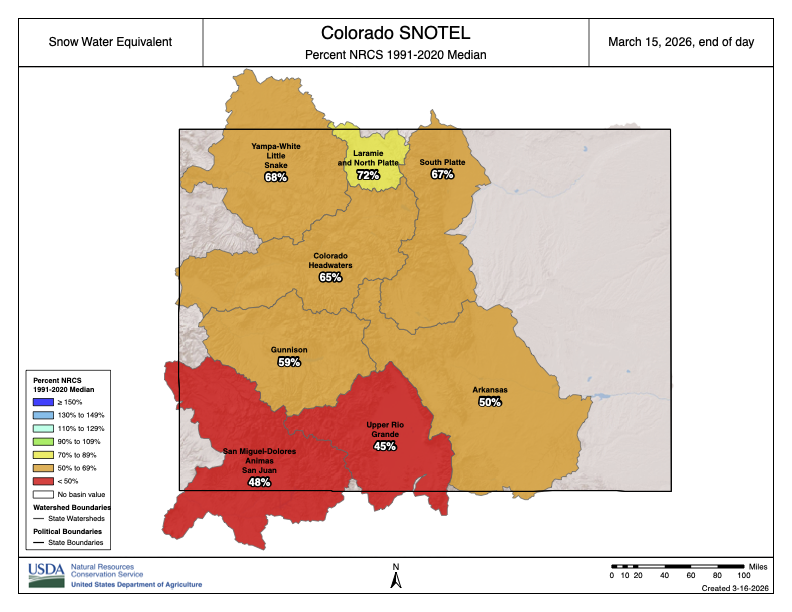
Colorado snowpack basin-filled map March 15, 2026.
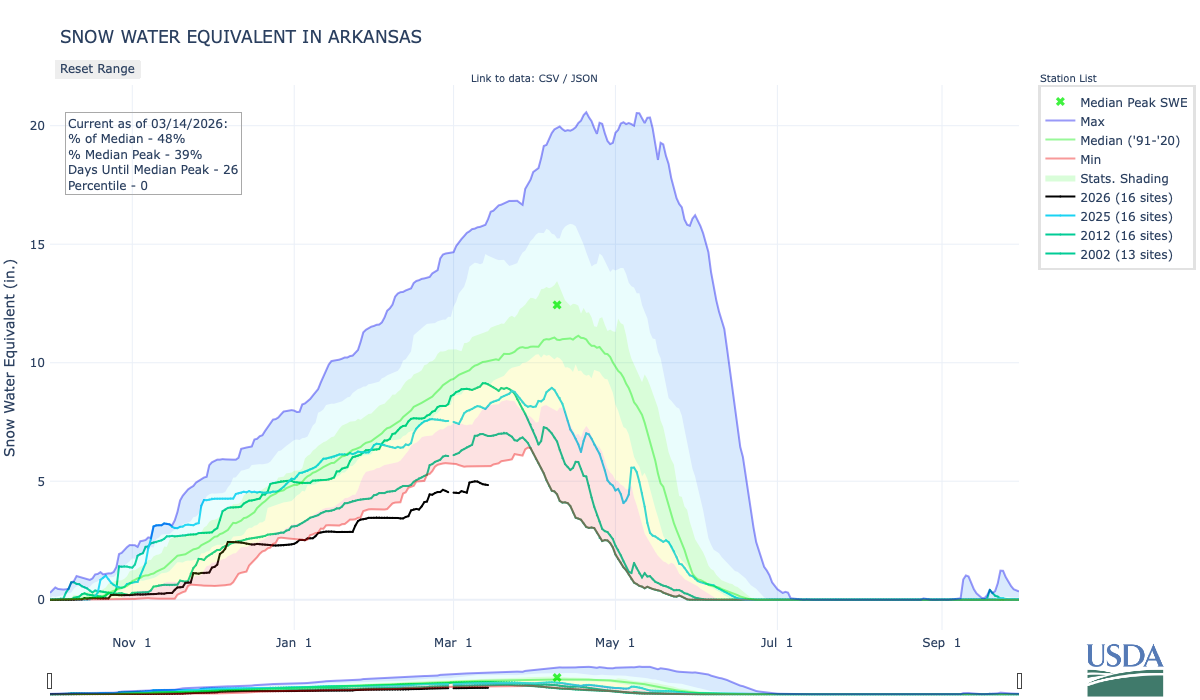
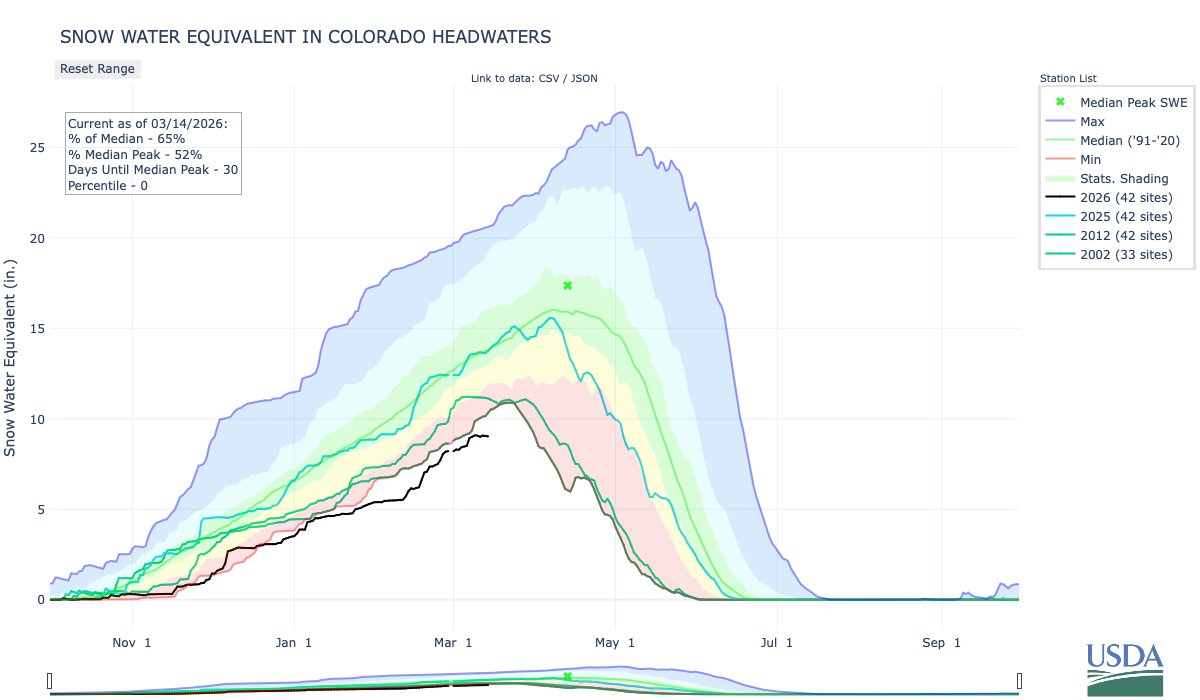
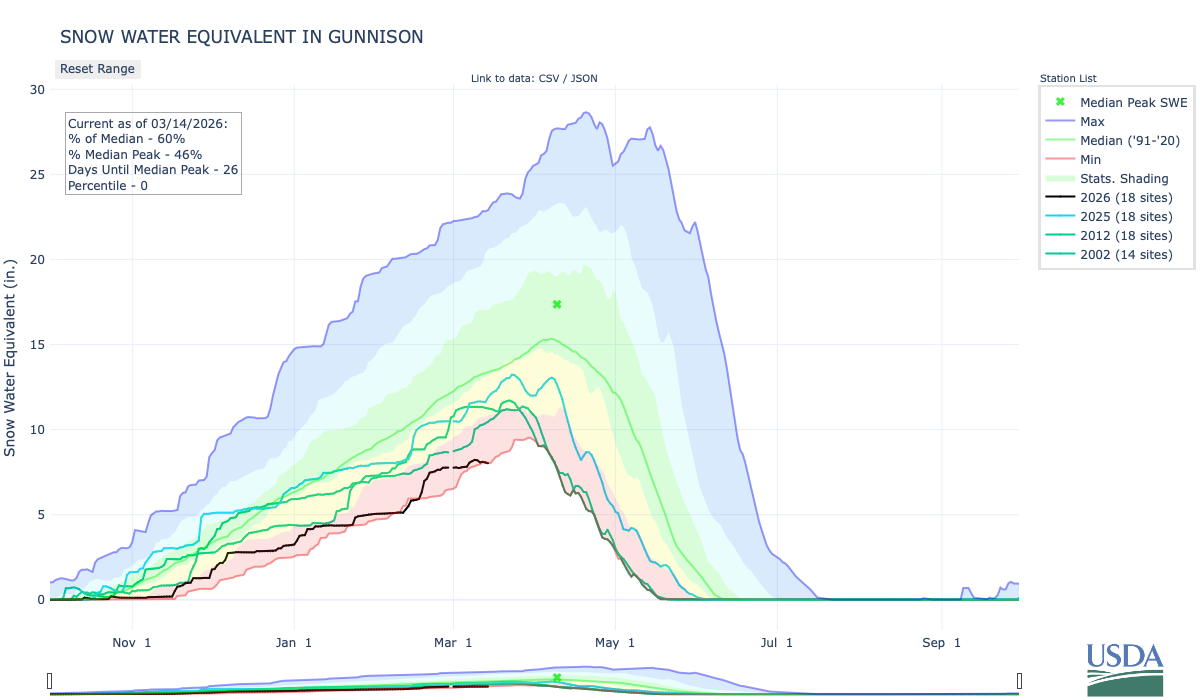
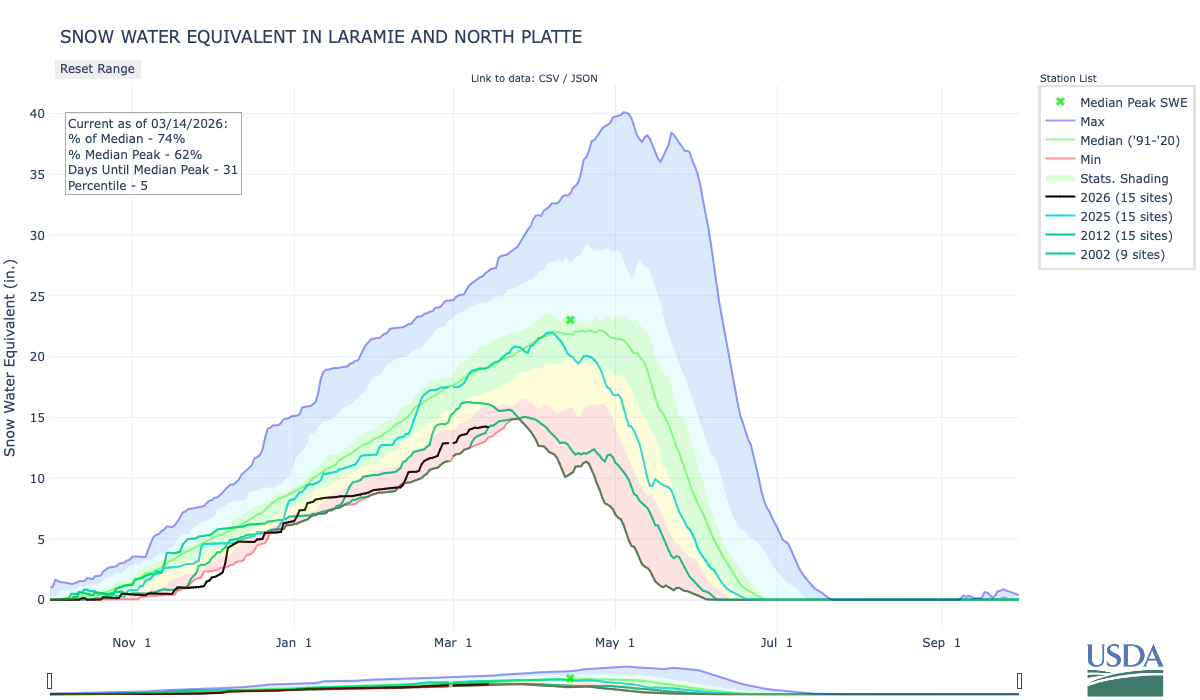
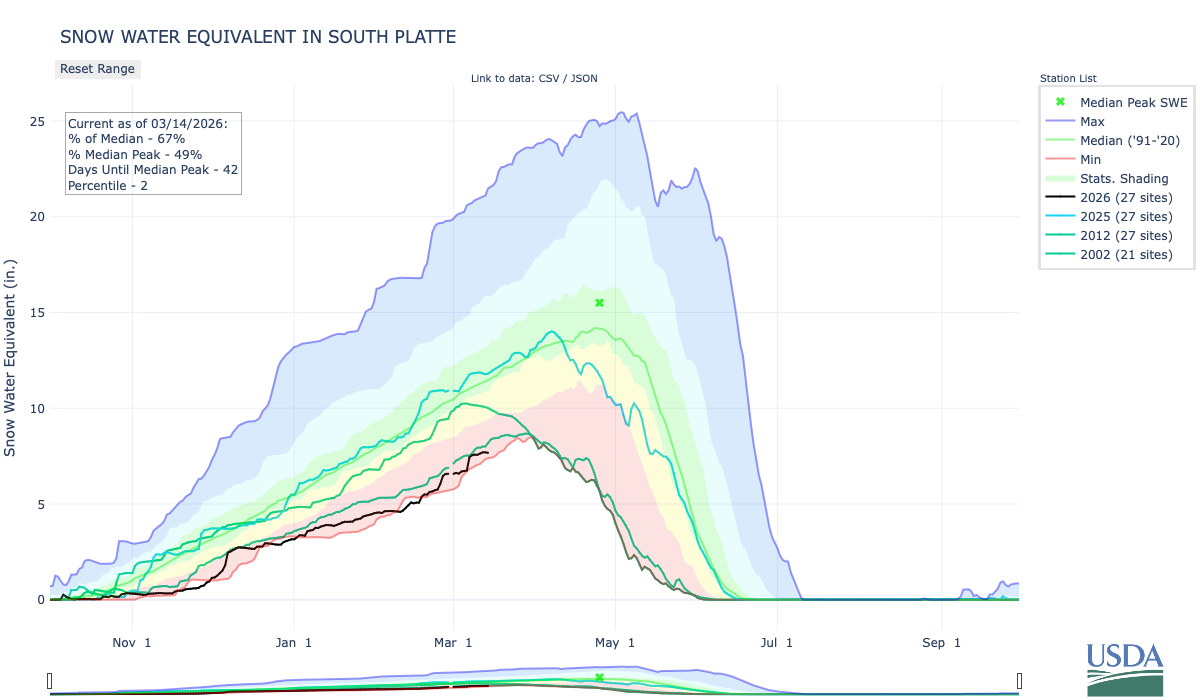
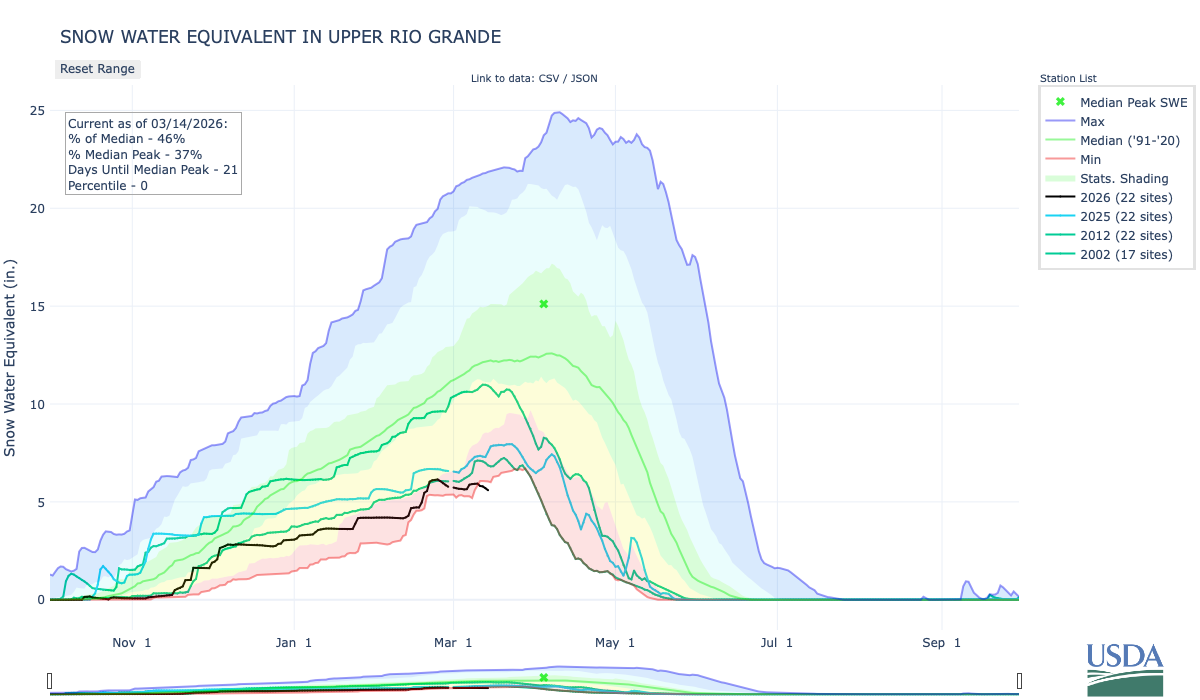
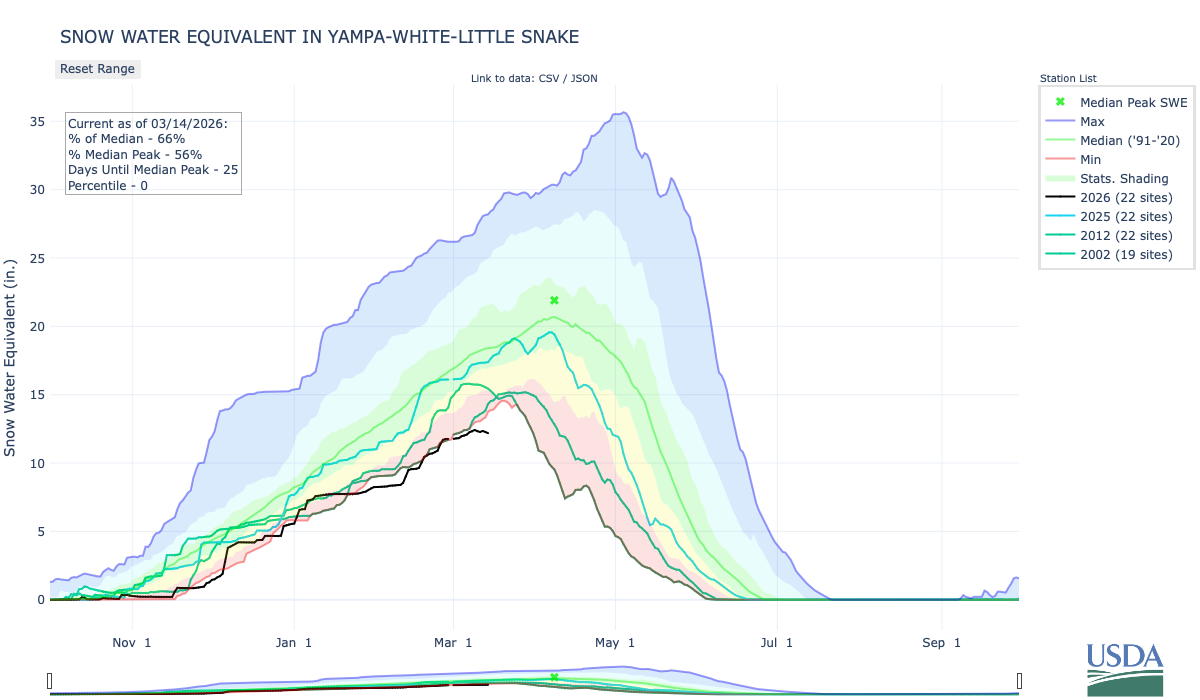
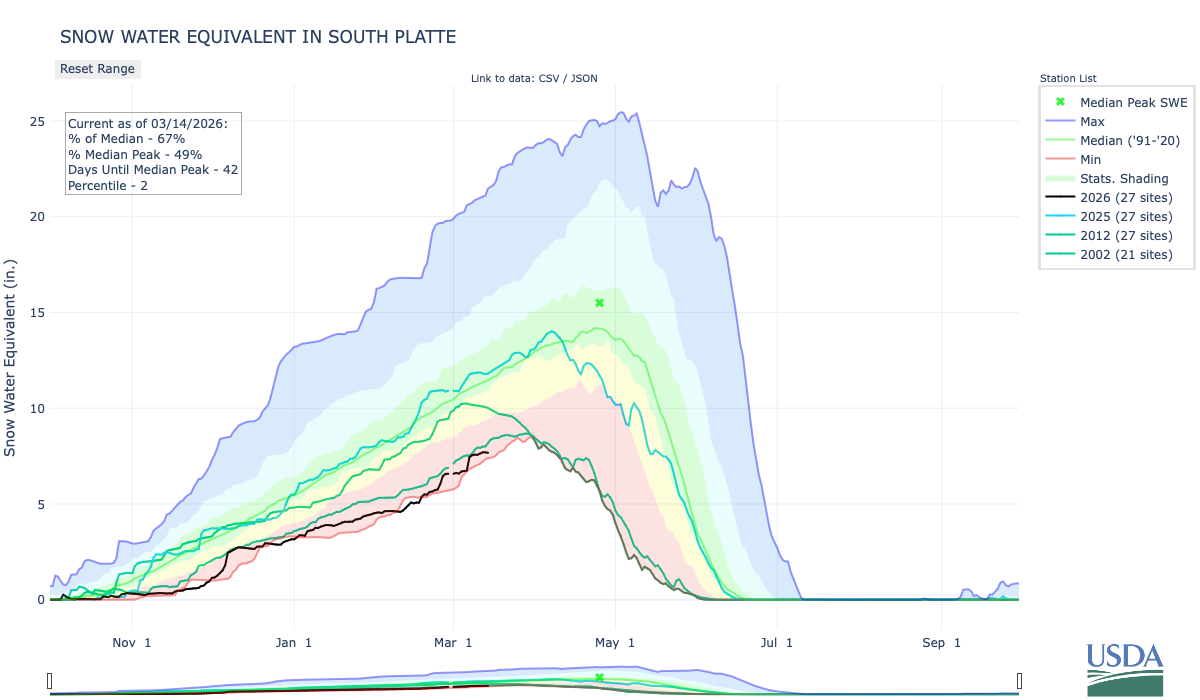
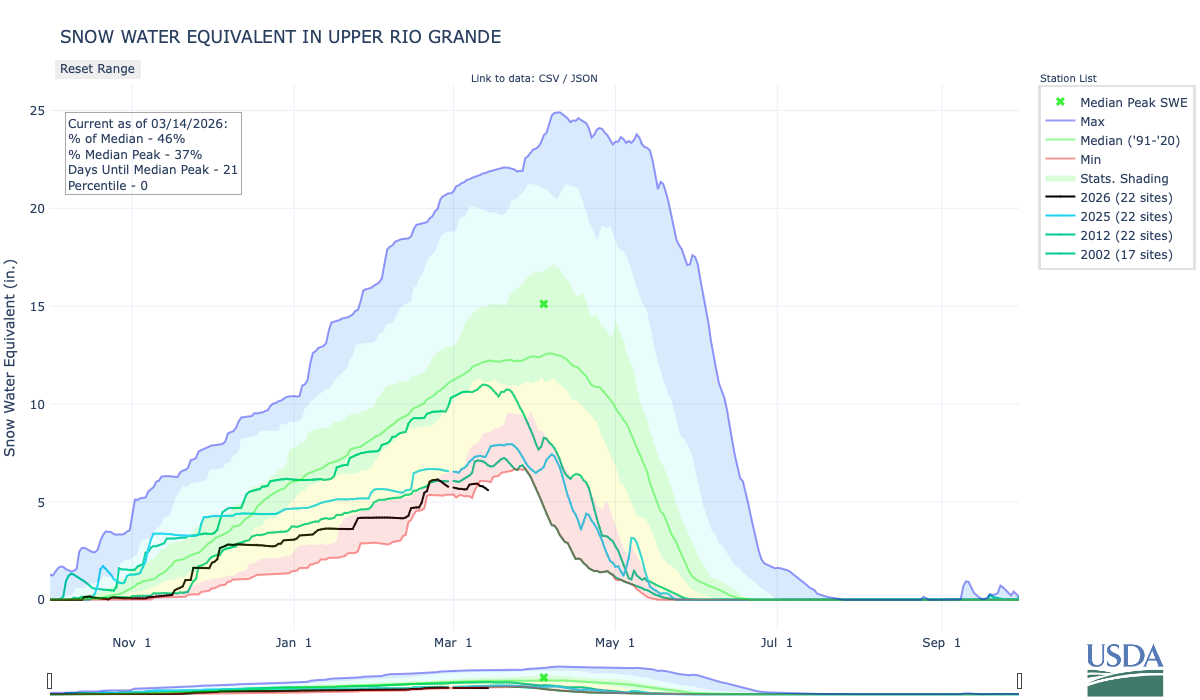
Note that the NRCS graphs have not updated since Saturday, March 14, 2026 and that many of the graphs are showing an early melt-out or sublimation from the warm and windy weather.
Click the link to read the article on The Denver Post website (John Aguilar). Here’s an excerpt:
March 15, 2026
Thornton is first to adopt restrictions; Denver Water, others prepare similar measures
When Thornton enacted a Stage 1 drought declaration last week, it became the first city in metro Denver to place a mandatory twice-weekly limit on outdoor watering for the upcoming hot season. But the northern suburb likely won’t be the last. Metro cities and utilities are starting to lay out various defensive strategies against what has become a crispy-dry 2026, starting with an alarmingly warm and dry winter in Colorado that’s been marked by one of the worst snowpacks in recorded state history. Denver Water, which serves 1.5 million people, could follow a similar track to Thornton’s by month’s end. Aurora Water, which is relied upon by 400,000 people, may be right behind with its own Stage 1 drought declaration in early April…Locally, that also translates to abysmal conditions in the Clear Creek basin, where Westminster gets most of its water. Last week, the Westminster City Council discussed enacting a drought watch — a less severe step than a Stage 1 declaration that would rely on voluntary cutbacks.
…the latest monthly bulletin from the National Weather Service painted a grim weather picture based on conditions in Denver. Last month was the third-warmest and second-driest February in the city, while it was the least-snowiest February on record for Denver, tying 2009’s equally snow-starved February…
What water managers can control sits on the demand side of the water ledger. Thornton gets the bulk of its water from the Upper South Platte River and Clear Creek watersheds, which are both at “record low levels,” according to a memo accompanying last Tuesday’s council meeting. Emily Hunt, Thornton’s interim infrastructure director, says the concern lies not so much with the summer ahead but with the summers to follow, assuming precipitation stays meager. Colorado’s sixth-largest city is presently at 83% of storage capacity across the 19 reservoirs that hold its water. It stores a large portion of the water it consumes in Standley Lake, which is also a water source for Westminster and Northglenn.
“We’re going into the summer with good storage, but with this snowpack, we’re not going to be able to top off our reservoirs the way we normally would,” Hunt said. “We’re basically trying to keep the year in balance so that if the drought continues into next year, we’ll be in pretty good shape.”
Colorado snowpack basin-filled map March 15, 2026.
An early start to the irrigation season in the San Luis Valley is coinciding with the arrival of spring’s first heat wave.
Craig Cotten, Division 3 engineer for Colorado Division of Water Resources, announced a staged approach to opening the water year for producers in the Upper Rio Grande Basin.
The water season will begin on March 16 for surface and groundwater irrigators in the Conejos River area (Water District 22), the Culebra Creek area (Water District 24), the Trinchera Creek area (Water District 35) and the La Jara Creek area. The irrigation season will begin on March 23 for all surface and groundwater irrigation structures in the Rio Grande area (Water District 20).
“I decided to start the irrigation season earlier than the presumptive April 1 date for many valley areas due to the very warm, dry spring and the low current snowpack. We are already seeing an increase in streamflows due to the warmer weather, and it is beneficial for water rights holders to be able to use this water while it is available,” Cotten said in an email exchange with Alamosa Citizen. [ed. emphasis mine]
On the Conejos River and Rio Grande, another reason is that Colorado is projected to meet its compact obligation without needing to deliver water during the irrigation season, Cotten said.
“In order to avoid a significant over-delivery of water to the stateline, I have decided to begin the irrigation season on these rivers prior to April 1.”
The coming week of March 16 could see record-setting temperatures to the official start of spring. The forecast calls for midweek daytime highs in the low- to mid-70s. March has seen 21 of its 31 days establish new record high temperatures since 2004, a heating trend that accentuates the warming winters and spring months.
This March opened with back-to-back days of new daily high records. More heat records could fall in the coming week. The irrigation season can’t open soon enough.
Upper Rio Grande SWE March 14, 2026. Note the early melt-out.
Chart showing water use trends in US and Mexico. Credit: Overconsumption gravely threatens water security in the binational Rio Grande-Bravo basin. Map via Springer Nature.
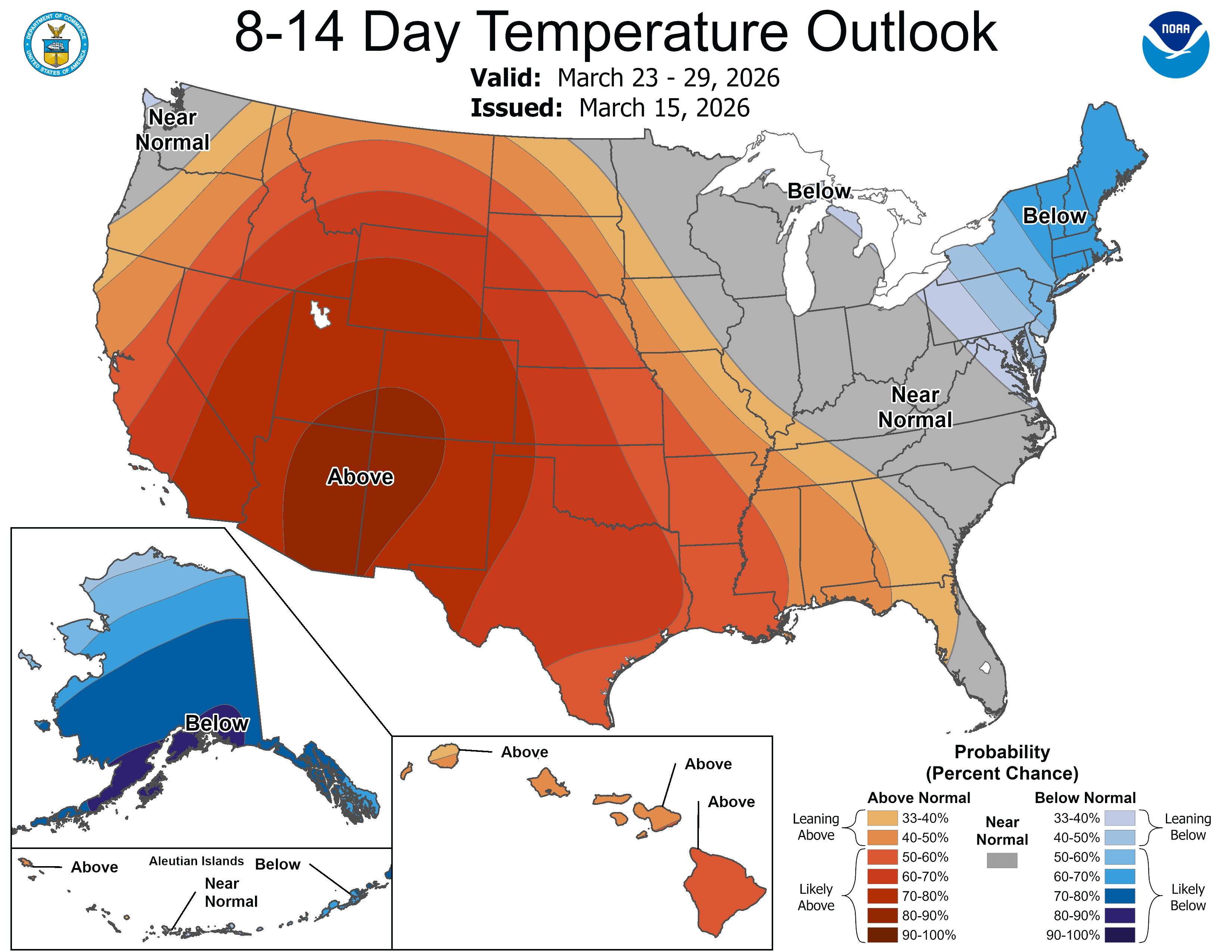
Oh dear. You’d best get your skiing in now, because it looks like the spring melt will hit a lot earlier than usual. A big heat wave is on its way to the West, with the most unseasonably warm temperatures occurring in the Southwest and Four Corners regions, further dimming hopes for a spring snowpack-bolstering miracle. This could mean that mountain snowpack in the Colorado River Basin has already peaked, which would be dire for streamflows.
My apologies for bringing you more doom and gloom climate news. At least it’s cold in Alaska, though.
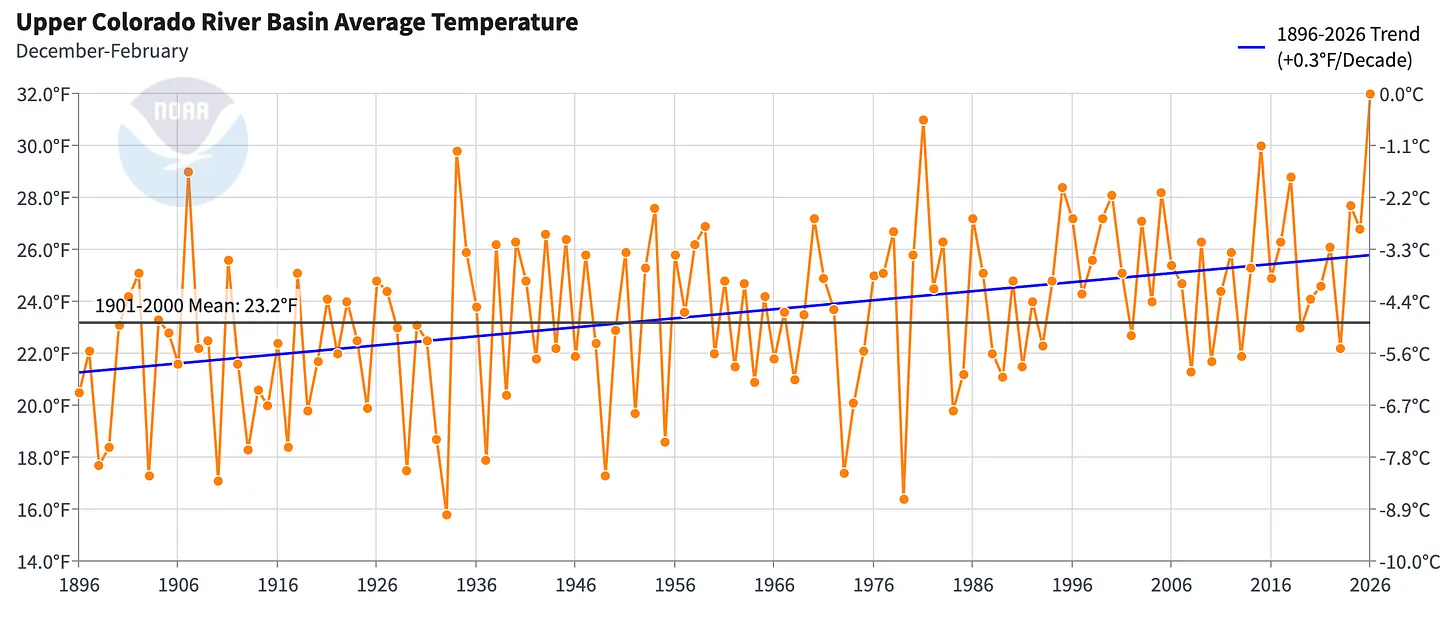
And that’s topping off the warmest winter on record in the Upper Colorado River Basin.
☘️ Annals of Alfalfa 🍀
As the Colorado River shrinks, the “simple” and “obvious” solutions to the crisis seem to multiply.
You know, it’s a lot of: “Whatchya gotta do is …. “
“… stop watering them golf courses.”
“… stop population growth.”
“… keep people from moving to deserts.”
“… shut down dem data centers!”
And then, the most common one: “ … stop raising cattle and hay in the desert.”
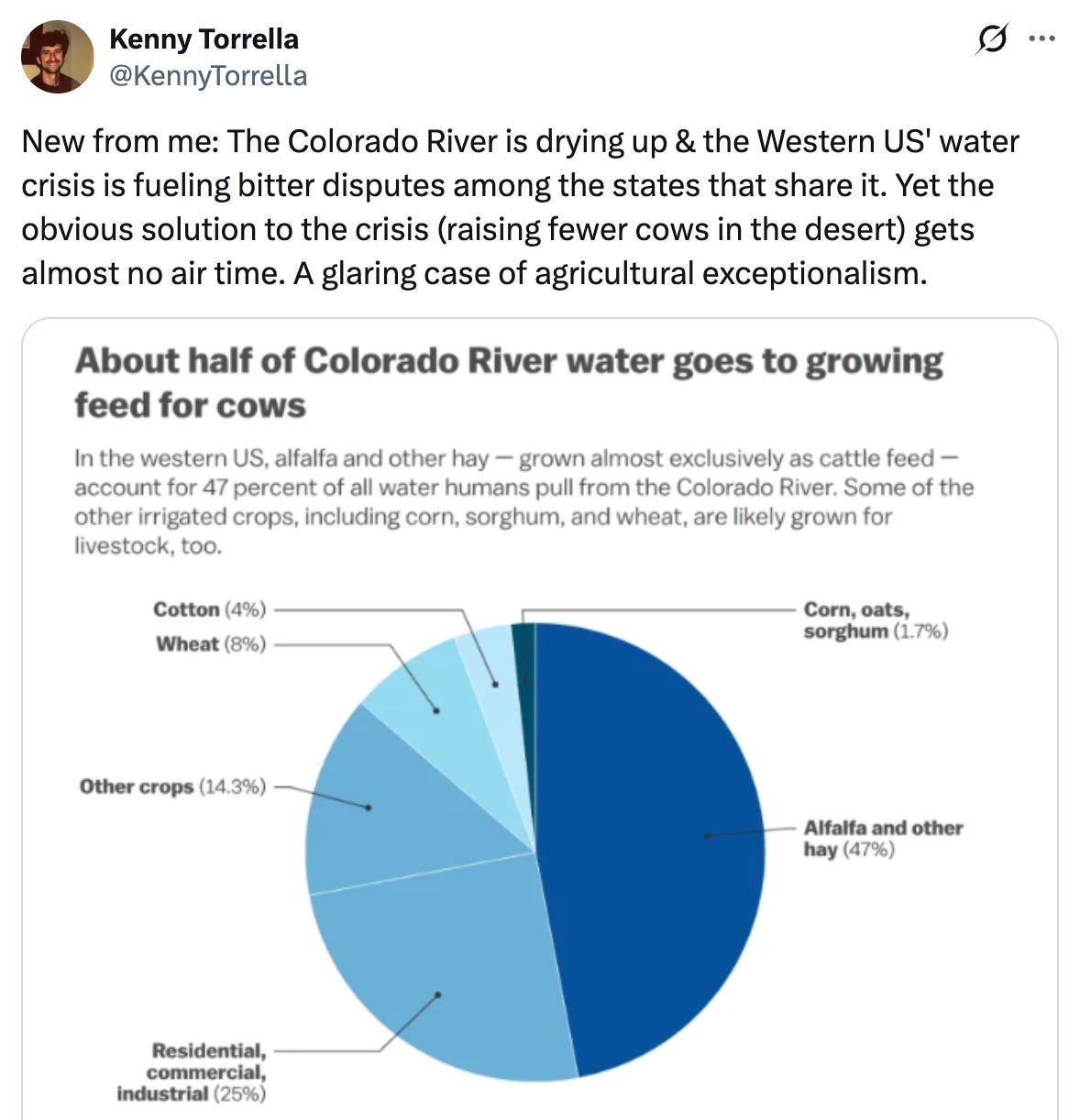
Kenny Torrella, who writes for Vox, brought up that last one on the social media platform Blue Sky recently:
While this fix holds more water (so to speak) than the preceding ones, it is not actually a solution — at least not a workable one.
There is only one obvious remedy for the Colorado River crisis, and that is for its collective users to consume less of the river’s water. Since irrigating alfalfa takes up a larger share of the river’s water than any other single use, it seems to follow that growing less of the crop would leave more water in the river. But this does not account for the way water law works.
Let’s imagine that California could designate alfalfa as an illicit crop and ban cultivation of it and other livestock forage crops. That would force a bunch of big farmers in the Imperial Valley — home of the largest single water user on the entire river — to tear up about 200,000 acres of water-guzzling alfalfa.
Problem solved? Not quite.
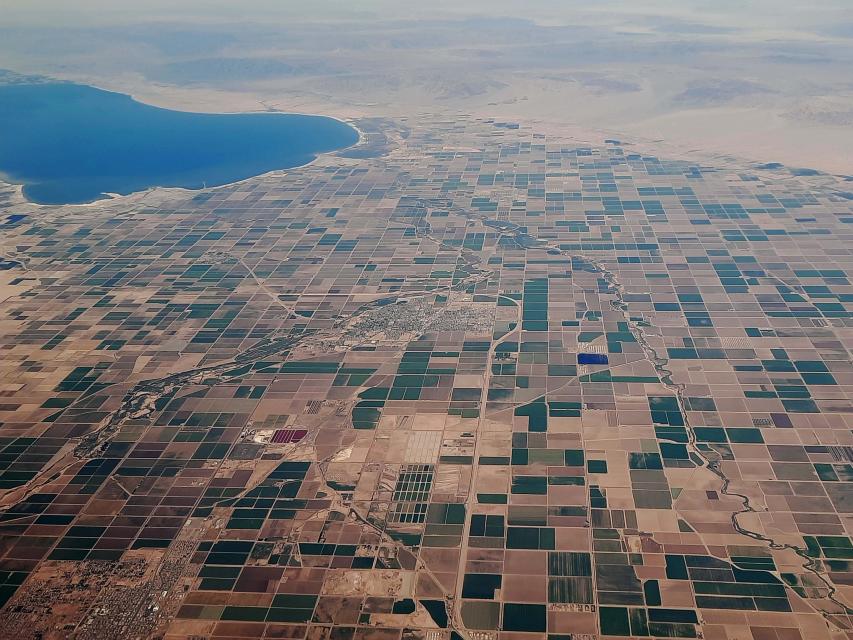
The Salton Sea (pictured above ) straddles the Imperial and Coachella valleys. (Source: Water Education Foundation)
The Imperial Irrigation District has senior rights to use a buttload of Colorado River water for “beneficial use,” which in this case means agriculture. Specific farmers may decide that without alfalfa, they’ll simply throw in the towel and stop irrigating altogether. But there’s no way the irrigation district as a whole is going to stop diverting that water without some sort of compensation, because while farmers pay the irrigation district a negligible amount for water, the irrigation district gets it virtually for free. That means the district is incentivized to continue using all of the water to which it has rights, and rather than leaving it in the river, they would most likely sell it to another farmer growing another crop. The result: No net reduction in water consumption.
Torrella’s claim that alfalfa’s water use gets “almost no air time” is a little off. I’ve written about it at least a zillion times at the Land Desk and at High Country News, but many a mainstream news outlet has done the same. Even the Paris Review had a pieceon it. The reason “growing less alfalfa” doesn’t show up in talks about negotiations over the Colorado River, or as an alternative in the feds’ proposed operating plan, is not because of “agricultural exceptionalism,” but because these aren’t crop-level negotiations.
The two Colorado River basins and the feds are currently looking at the macro level, and trying to hash out which basin will take what level of cuts, how those cuts will be determined, and what if anything will be done to fend off dead pool at Glen Canyon Dam. Only when all of that is settled can the individual states in each basin duke it out over respective consumption cuts, followed by the biggest users within each state. Finally, those users can make decisions about how to use their now smaller share of water, and really just about anything goes so long as it fits the definition of “beneficial use.”
Maybe they’ll continue to grow alfalfa using less water via deficit irrigation, maybe they’ll opt for a higher-value, less water-intensive crop like broccoli, maybe they’ll use it to grow cacti, but what counts is that they’ll be taking less water out of the Colorado River, regardless.
It’s not that the alfalfaphobes are wrong; it probably is a good idea to grow less alfalfa and fewer cows in the desert. For that matter, we should fallow golf courses, restrict urban growth, and take other steps to live within our means. But what’s needed now is an agreement on drastic and immediate cuts in water consumption. What that means for alfalfa or golf courses or Arizona suburbs will be dealt with later.
Now for a little data dump re alfalfa and other irrigated crops in Imperial County, California1:
$238,752,000: Gross value of alfalfa hay harvested in Imperial County, California, in 2024.
183,252: Harvested acres of alfalfa hay in 2024.
$1,300/acre: Per-acre value of alfalfa hay harvested in 2024.
6 acre-feet: Approximate amount of water required to irrigate one acre of alfalfa in the Imperial Valley for a year.
$20/acre-foot: Amount Imperial Valley farmers pay for water.
$134,822,000: Gross value of broccoli harvested in Imperial County in 2024.
$12,136/acre: Per-acre value of broccoli harvested in 2024.
3 acre-feet: Approximate amount of water required to irrigate one acre of broccoli in the Imperial Valley.
$259,861,000: Gross value of head and leaf lettuce harvested in 2024.
$9,012/acre: Per-acre value of head and leaf lettuce harvested in 2024.
2-3 acre-feet: Approximate amount of water required to irrigate one acre of lettuce in the Imperial Valley.
🐟 Colorado River Chronicles 💧
Today’s vocabulary term is: Present Perfected Rights, a term you may be hearing a lot more of in coming months.
Article VIII of the Colorado River Compact states:
Later, the Boulder Canyon Project Act of 1928 decreed that the “dam and reservoir” of the title (which would become Hoover Dam and Lake Mead) shall be used for the “satisfaction of present perfected rights … .”
That’s fine and good, but what are present perfected rights, or PPRs? The Compact never says what that term means. In fact, it wasn’t clearly defined until the Supreme Court laid it out in its 1964 Arizona v. California decision, a key document in the Law of the River:
Clear as mud, right?
Generally speaking, PPRs are the most senior rights on the Colorado River, they predate the Colorado River Compact, and are the last rights subject to curtailment in times of shortage. They are the “first” in the “first in time, first in right” summation of the prior appropriation doctrine, which is the foundation of Western water law.
Arizona v. California goes on to say that “in any year where there is fewer than 7.5 million acre-feet available for use in California, Nevada, and Arizona, the Secretary of the Interior must first supply water to the PPRs in order of priority, regardless of state lines.” Similarly, the Upper Basin’s PPRs will be the last to be cut if curtailments are necessary to meet its non-depletion/minimum-delivery obligation to the Lower Basin.
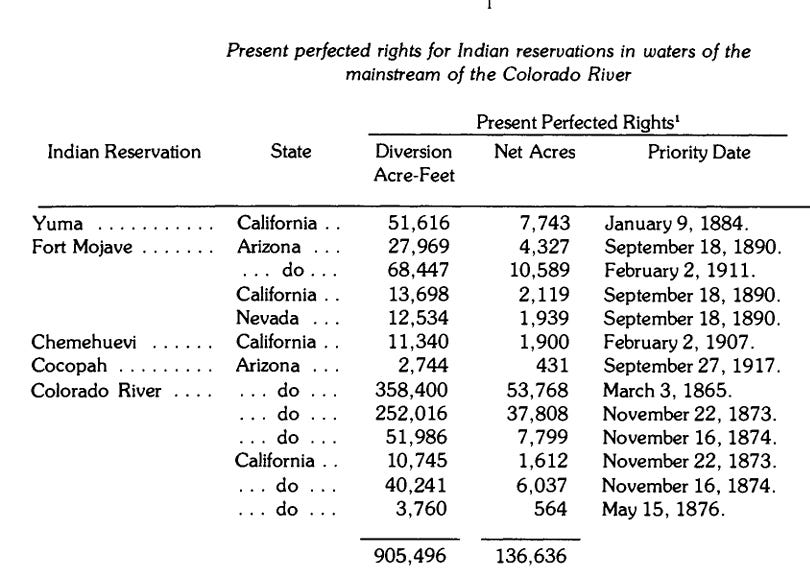
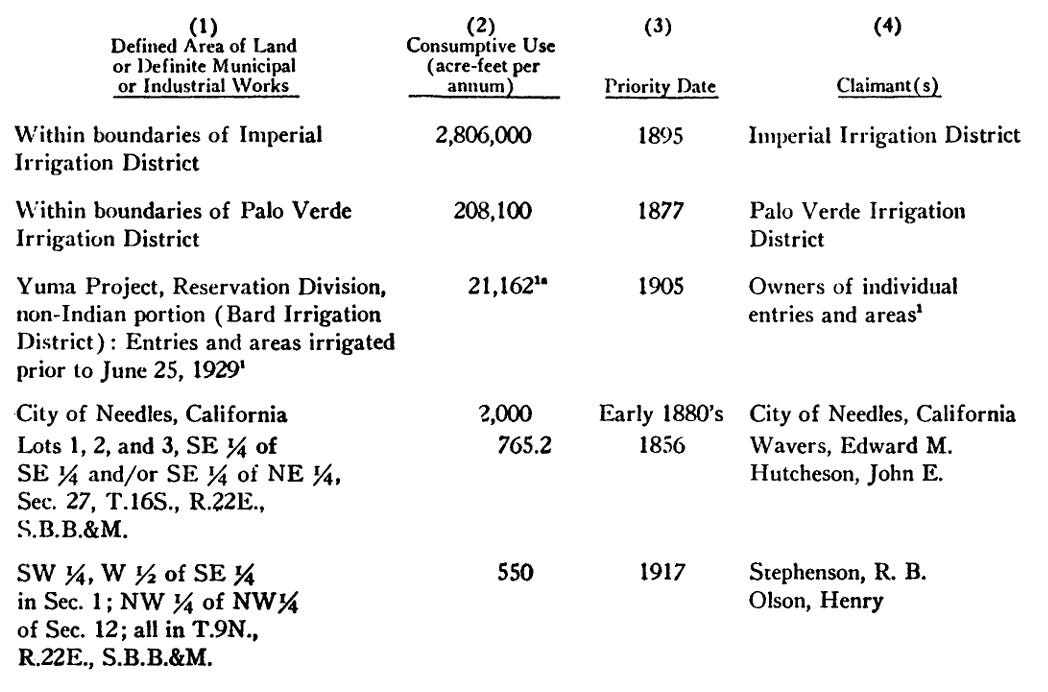
The Supreme Court required the Lower Basin to submit a list of its PPRs, and here they are from the document itself as submitted in 1967. Some of these, especially the tribal rights, were updated and added to later on.
The first set is for tribal nations in the Lower Basin only:
These are the top six non-tribal PPRs in the Lower Basin by order of size of diversion. There are many more smaller PPRs that are not listed here:
🗺️ Messing with Maps 🧭
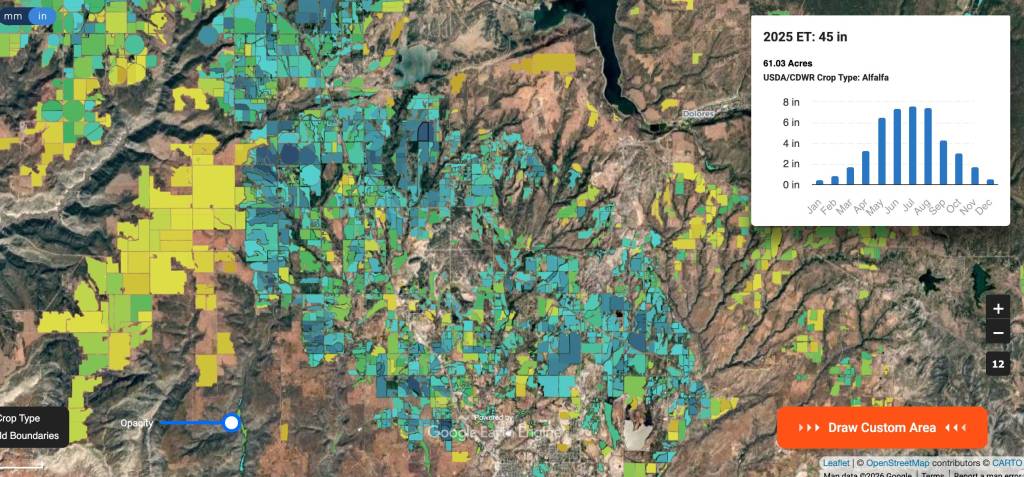
I’m not sure if I’ve featured this one before, but if so, it’s worth re-upping due to its heightened relevance this year. It’s the Open ET mapping tool, with ET standing for evapotranspiration. It uses satellite imagery to calculate evapotranspiration from individual fields, which is an indicator of how much irrigation is being used and what crop is being grown. Hovering over a field will bring up a chart showing ET for each month, the acreage, and the crop type.