
Click the link to read the article on the Tucson.com website (Tony Davis). Here’s an excerpt:
March 14, 2026
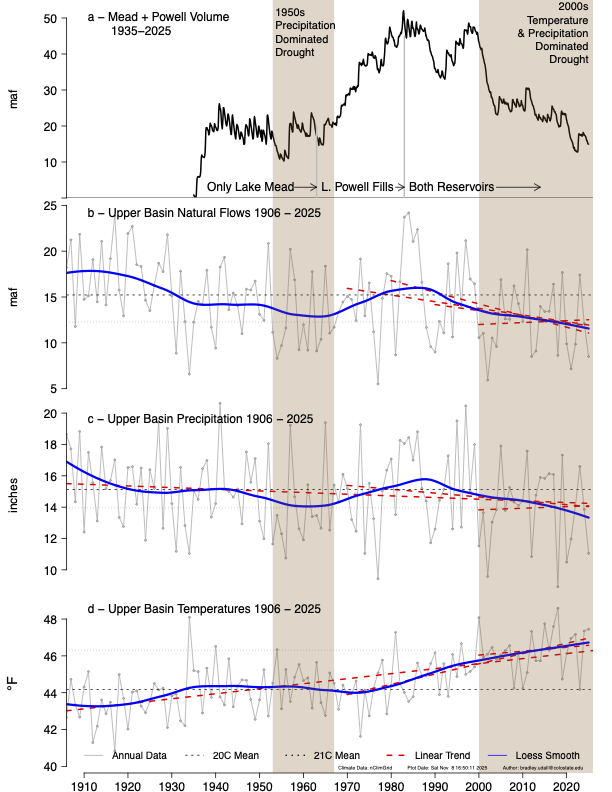
The record-breaking heat in this month’s forecast is likely to help push the Colorado River Basin to the edge of “disaster,” in which drastic cuts in water use will be necessary next year, experts say. The heat is almost certain to slash river flows even more than already expected after the snowpack in key sites above Lake Powell hit record lows this winter. The upshot: Lake Powell is likely to get less than one-third the water from the river that it would in an average April to July. The unusually low flows won’t be bad enough to push the basin into immediate disaster this year. But several experts said it is virtually inevitable that major cuts in river water use will be needed next year in Arizona and other Western states — unless the winter of 2026-27 is far cooler and wetter than the current one.
“We can survive this year, no problem. What’ll be interesting to see is if this year puts enough scare into the states to begin real serious rethinking about how we manage water,” said David Wegner, a retired U.S. Bureau of Reclamation planner and congressional staffer who now sits on a National Academy of Sciences board that reviews water issues.
The Bureau of Reclamation already projected, in February, that Lake Powell is likely to fall below the level at which the turbines at adjoining Glen Canyon Dam can generate electricity — 3,490 feet — by December 2026. Given the trend toward lower snowpack, higher temperatures and less runoff of water into the river, it’s very possible if not likely, that future forecasts will show the lake falling below 3,490 feet sooner than December. But most observers, including Kuhn and Wegner expect the bureau to try to forestall that possibility in advance by releasing extra water from reservoirs upstream of Lake Powell, led by Flaming Gorge reservoir at the Utah-Wyoming border. Powell is at the Arizona-Utah border.
