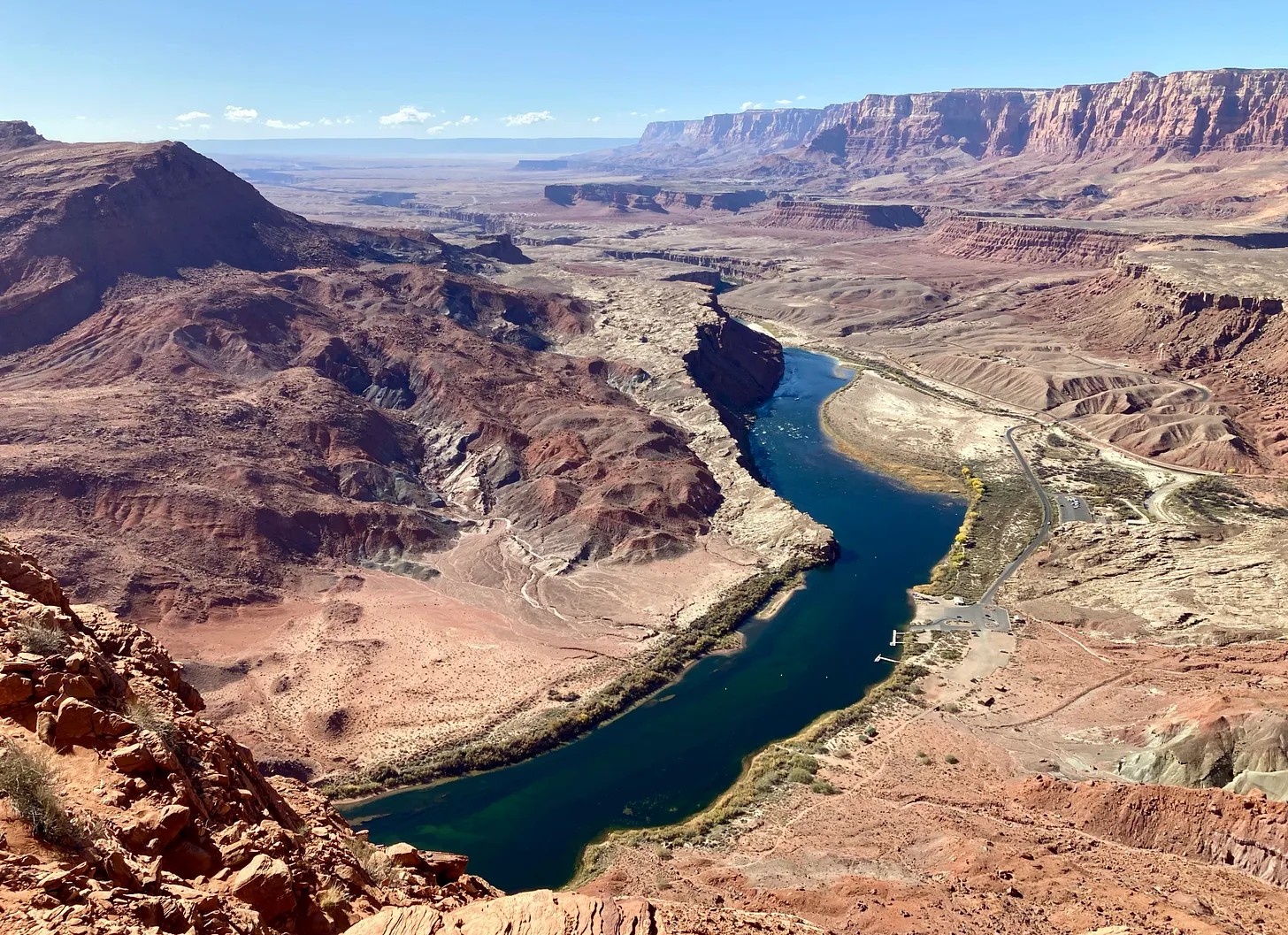
Looking down at the Colorado River, Lees Ferry, and the Paria River. Jonathan P. Thompson photo.
Click the link to read the article on the KJZZ website (Alex Hager). Here’s an excerpt:
July 16, 2026
Sara Porterfield, Colorado River program director with the conservation nonprofit Trout Unlimited, stood on a narrow, rocky river beach, about as close to Glen Canyon Dam as a boat can go.
“This is not a zero sum game,” she said. “Investing in watershed health is not an either-or. We need the system to be healthy from an ecological perspective in order for the rest of it to function.”
The river, Porterfield said, cannot deliver big volumes of clean water if it does not, at least partially, function like a normal, healthy river. For example, if the river’s upper reaches are dried out, they’ll be susceptible to wildfires and wetland degradation, which make it harder for them to hold on to water and release it slowly into the streams where humans have been able to reliably divert and collect it for generations.
“It’s not just plumbing, but it’s also not just water in a river,” Porterfield said as the dam’s hydroelectric generators emitted a whining hum in the background. “We’re not separate from the natural world, we’re part of it. When we recognize that, and we take help to take care of it, we get a lot further than when we’re just thinking about a plumbing system.”
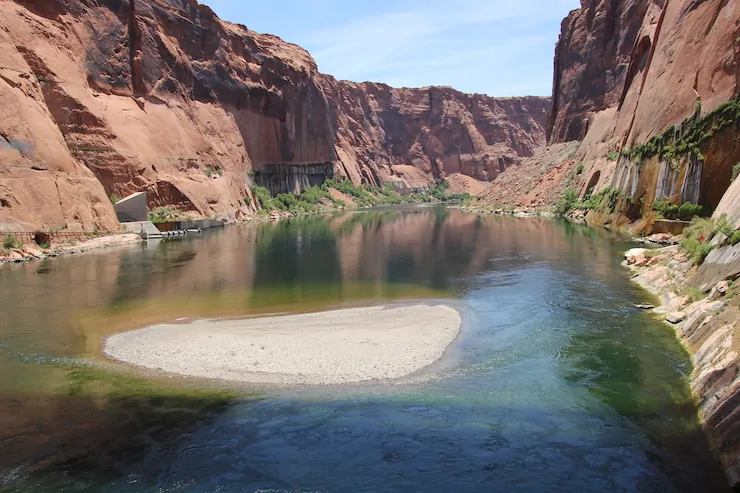
Glen Canyon downstream from Glen Canyon Dam. Photo credit: Allen Best/Big Pivots
Porterfield, who has a Ph.D. in Colorado River history, said calling the river a “plumbing system” is a useful way to think about one of its jobs, but not the whole picture. Environmental advocates say the river can be protected while still flowing through the dams and canals that keep the West wet for humans. Those protections can even be part of the wonky and rigid legal policies that dictate where water goes. John Berggren, a water policy manager at the conservation nonprofit Western Resource Advocates, had some recommendations for the next set of river-sharing rules. An important one, he said, is to get the river out of “crisis mode.”
[…]
“You can be much more proactive and thoughtful and careful and intentional about how you manage the river and include river health,” he said.
Another way to help protect the river’s ecosystems, creatures and flows, Berggren said, is by carefully timing the release of water from reservoirs. For example, policymakers can write flexible rules about where and when water is stored, so water that is flowing downstream to cities and farms can also help make life better for native fish. The water can be used to help the environment without being taken away from humans downstream.
“They’re going to move the water anyway,” he said. “Let’s do it in a way that actually benefits ecological conditions.”
Map of the Colorado River drainage basin, created using USGS data. By Shannon1 Creative Commons Attribution-Share Alike 4.0
Retired farmer Ernie Myers spoke Tuesday to the threats and hostilities he faced as a groundwater irrigator and how he felt like a “whipping boy” for surface water farmers who complained “that I was pumping their water.”
Myers was the first to testify in protest of the Subdistrict 1 Fourth Amended Plan of Water Management as part of the Northeast Water Users Association and Sustainable Water Augmentation Group opposition to the plan.
He served on the Subdistrict 1 board of managers from 2012 to 2016 and told Division 3 Water Court Judge Michael Gonzales that “I was exhausted,” when he stepped down. “They beat me up mentally and financially.”
Myers and his family, along with Asier Artaechevarria, are asking Gonzales to reject the plan, which is designed to recover the unconfined aquifer through a one-for-one pumping mechanism — for every acre-foot of water pumped, an acre-foot of water must be returned to the aquifer — that limits pumping to the amount of natural surface water that comes into the subdistrict.
Groundwater irrigators with little or no natural surface water coming into their fields will have to offset their pumping either by purchasing surface water credits or paying a $500 per acre-foot fee, which Myers and Artaechevarria told the judge would put them out of business.
The plan has been approved by the Subdistrict 1 board of managers, the Rio Grande Water Conservation District board of directors, and the state engineer with the Colorado Division of Water Resources.
Artaechevarria told the court that he didn’t think enough had been done under the current plan of water management to try to make it work. Both Artaechevarria and Myers said they were willing to retire more acreage under the current plan and that the $500 acre-foot fee is beyond the economic means of groundwater irrigators.
“My land would have no value,” Artaechevarria testified, because he wouldn’t be able to market it for sale and wouldn’t be able to pay the mortgage as a result.
“You can see the issue there,” he told the court.
Myers said it was after 2002, when the Upper Rio Grande Basin first experienced historic low flows from a lack of snow runoff, that he first began to feel targeted as a groundwater irrigator and had the feeling that surface water farmers were trying to put him out of business.
“I was pumping their water. I had no right to pump their water. I had a few farmers telling me, ‘I’m third, fourth generation. You’re a newcomer. You came in ’73 with your father. You have no right to do what you’re doing.’”
“And were there actually people saying that they intended to put you out of business?” SWAG’s attorney asked.
“Yes, yes,” testified Myers.
The Division 3 water trial is in its third week at the Alamosa Judicial Center.
Rumors of data centers have local government agencies in the San Luis Valley preparing for the inevitable – an application for a data center.
Costilla County and the town of South Fork are the latest local governments to place moratoriums on artificial intelligence data centers. Though no applications or projects are being proposed, local governments want to give themselves time to create land use codes to address data centers.
A packed room and a packed Zoom at the Costilla County Planning Commission meeting Wednesday morning saw tensions high as the public continues to express opposition to data centers. The commission approved a year-long moratorium. The moratorium will now go to county commissioners for approval.
The town of South Fork’s planning and zoning board is poised to do the same thing during a public hearing Wednesday night’s planning and zoning commission meeting as the town does not have specific zoning regulations that address data centers. The board will use the public hearing for feedback as members begin their work over the next year to devise specific codes.
At Wednesday morning’s Costilla County meeting, planning commissioner Joseph Quintana dispelled rumors and reassured the public that a data center application has not been submitted to the county and that “nobody’s approved anything.”
He said that when the planning commission was first formed the commission came up with a mission plan with a set of goals that were aimed at protecting the environment and the way of life.
“A data center is the antithesis, the complete opposite of what we would want in this community,” he said.
He went on to say, “Our job here is to follow that mission that was established 30 years ago with public comment. So I just want to make sure everybody understands, nobody’s approved a data center that I’m aware of. Nobody’s even applied for a data center here. There’s nobody that’s asked to build one or tried to get a permit or anything like that.”
In June, the Costilla County Commissioners asked the planning commission to address data centers “and get ahead before a problem develops,” Quintana said.
Commissioner Frank Vigil said they wanted the year to create a “thoughtful” ordinance that “reflects the feelings of the general public.”
“Our code doesn’t even have the two words ‘data center’ in it anywhere at all,” said county attorney Carle Turnetzer-Decker. “We were just concerned, I think, the board of county commissioners and the commission here, that if someone did approach us we have absolutely no way to handle it, restrict it, regulate it, do any of that.”
South Fork made a public statement on Tuesday that said, “To dispel rumors that are circulating within the community. The Town instituted a moratorium on Data Centers within the Town of South Fork last month which will last one year. The Town has not had any companies approach the town about data centers. We are simply trying to get ahead of any that may approach the Town. Obviously, there are concerns with them and rest assured your Board of Trustees share your concerns. Please come share your thoughts so we know how best to represent the community in making policy on this.”
Saguache County was the first local government in the Valley to place a moratorium on data centers while it figures out how its land use codes would address any data center application.
Earlier in June, the Rio Grande Basin Roundtable heard from Lindsay Rogers of Western Resources Advocates, who noted how rural markets are becoming targets for data center applications because of the assumption of “less red tape.”
Western Resources Advocates, Rogers said, has a particular interest working in the San Luis Valley as part of a grant process for local policy decision-making around large water users.
“One concern that we have which we’ve seen playing out in other states in our region, is that developers may target rural communities where they feel there may be less red tape to developing these data centers. Our communities may not have the time or resources needed to ensure the proposal fits within their own goals and their own resource availability. So we think it’s really important to think about these policy options proactively before developers come to town instead of responding to them once they’ve arrived.”
Solar panels San Luis Valley. Photo credit: Allen Best/Big Pivots
Richard Hubler, planning director for Alamosa County, said at the roundtable, “There’s a very real possibility, as we move forward, that because of our fiber networks here and our broadband capacity, our cheap land and what may end up being a glut of solar production that we could be a target in the Valley for somebody who says, ‘Hey, there’s more power than the Valley could use there.
“I could take a circle next to that 600 megawatt project and use the other 400 megawatts they may have.’ And we don’t know how to handle that now as a county or as a Valley. I think that this is timely because we really do want to get ahead of it before we have to deal with an application.”
In May, SLV Rural Electric Cooperative CEO Eric Eriksen said the Valley has underutilized energy capacity and that “rural data centers” are the “most relevant for us.” Rural data centers are described as smaller, more efficient facilities that are often housed within buildings no larger than small commercial buildings and operate anywhere from 50 kilowatts up to 50 megawatts.
These centers commonly use air-cooling or closed-loop refrigeration instead of consuming water.
In May, SLV Rural Electric Cooperative CEO Eric Eriksen said the Valley has underutilized energy capacity and that “rural data centers” are the “most relevant for us.” Rural data centers are described as smaller, more efficient facilities that are often housed within buildings no larger than small commercial buildings and operate anywhere from 50 kilowatts up to 50 megawatts.
These centers commonly use air-cooling or closed-loop refrigeration instead of consuming water.
In SLVREC’s position, the agriculture’s energy demand is declining and that company sees “the underutilized capacity” as an opportunity “to serve five, 10, 20, 50 megawatts or more of rural data centers.”
According to SLVREC, there are seven long-haul fiber routes into and out of the Valley, “with terabytes of unused capacity that is ideal for data centers.”
Rio Grande and Pecos River basins. Map credit: By Kmusser – Own work, Elevation data from SRTM, drainage basin from GTOPO [1], U.S. stream from the National Atlas [2], all other features from Vector Map., CC BY-SA 3.0, https://commons.wikimedia.org/w/index.php?curid=11218868