
Click the link to read the article on the Alamosa Citizen website (Owen Woods):
July 15, 2026
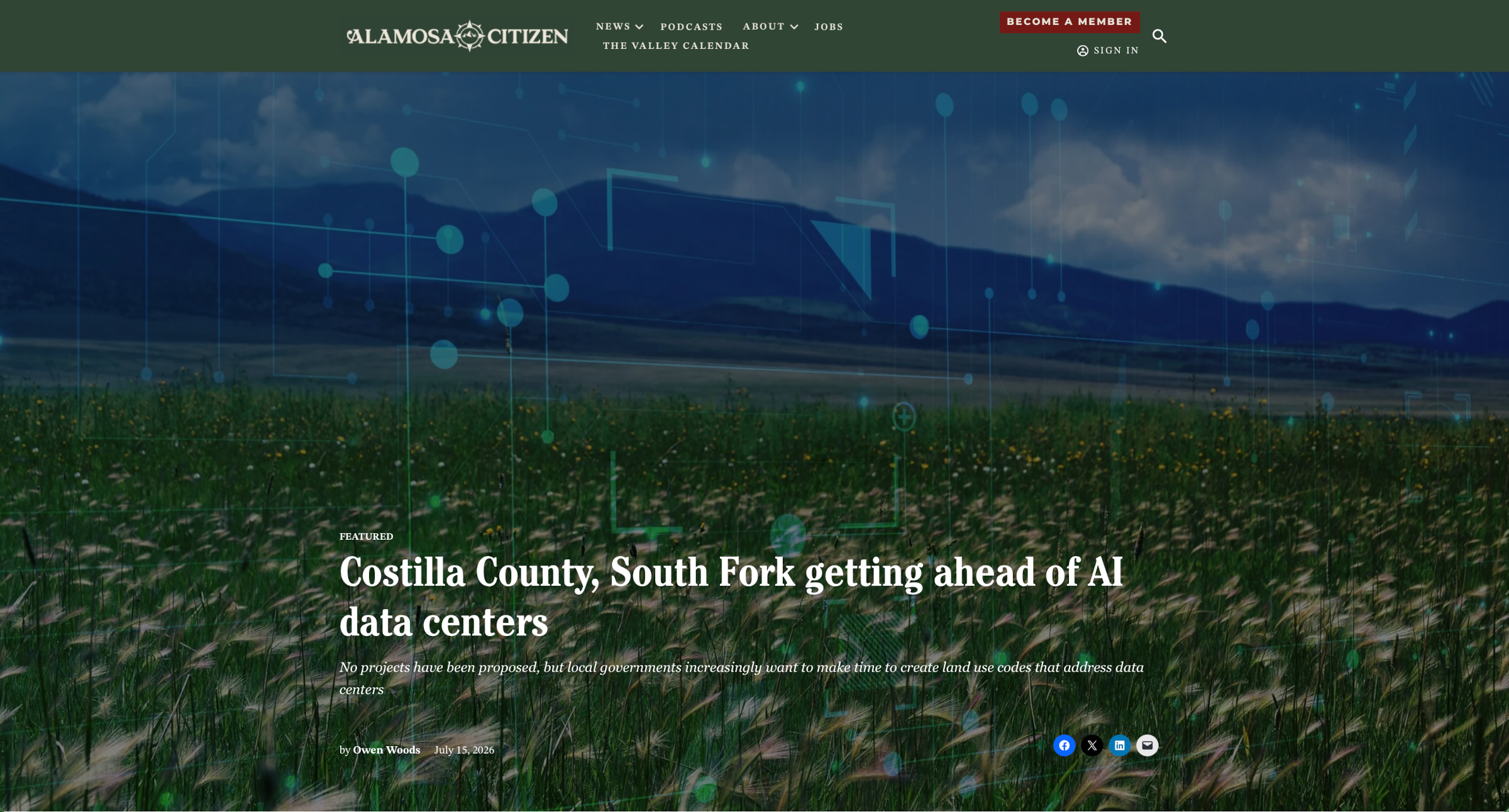
Rumors of data centers have local government agencies in the San Luis Valley preparing for the inevitable – an application for a data center.
Costilla County and the town of South Fork are the latest local governments to place moratoriums on artificial intelligence data centers. Though no applications or projects are being proposed, local governments want to give themselves time to create land use codes to address data centers.
A packed room and a packed Zoom at the Costilla County Planning Commission meeting Wednesday morning saw tensions high as the public continues to express opposition to data centers. The commission approved a year-long moratorium. The moratorium will now go to county commissioners for approval.
The town of South Fork’s planning and zoning board is poised to do the same thing during a public hearing Wednesday night’s planning and zoning commission meeting as the town does not have specific zoning regulations that address data centers. The board will use the public hearing for feedback as members begin their work over the next year to devise specific codes.
At Wednesday morning’s Costilla County meeting, planning commissioner Joseph Quintana dispelled rumors and reassured the public that a data center application has not been submitted to the county and that “nobody’s approved anything.”
He said that when the planning commission was first formed the commission came up with a mission plan with a set of goals that were aimed at protecting the environment and the way of life.
“A data center is the antithesis, the complete opposite of what we would want in this community,” he said.
He went on to say, “Our job here is to follow that mission that was established 30 years ago with public comment. So I just want to make sure everybody understands, nobody’s approved a data center that I’m aware of. Nobody’s even applied for a data center here. There’s nobody that’s asked to build one or tried to get a permit or anything like that.”
In June, the Costilla County Commissioners asked the planning commission to address data centers “and get ahead before a problem develops,” Quintana said.
Commissioner Frank Vigil said they wanted the year to create a “thoughtful” ordinance that “reflects the feelings of the general public.”
“Our code doesn’t even have the two words ‘data center’ in it anywhere at all,” said county attorney Carle Turnetzer-Decker. “We were just concerned, I think, the board of county commissioners and the commission here, that if someone did approach us we have absolutely no way to handle it, restrict it, regulate it, do any of that.”
In South Fork, the town’s board of trustees passed a year-long moratorium in June and added a definition for data centers and zoning determining for its municipal code.
South Fork made a public statement on Tuesday that said, “To dispel rumors that are circulating within the community. The Town instituted a moratorium on Data Centers within the Town of South Fork last month which will last one year. The Town has not had any companies approach the town about data centers. We are simply trying to get ahead of any that may approach the Town. Obviously, there are concerns with them and rest assured your Board of Trustees share your concerns. Please come share your thoughts so we know how best to represent the community in making policy on this.”
Saguache County was the first local government in the Valley to place a moratorium on data centers while it figures out how its land use codes would address any data center application.
Earlier in June, the Rio Grande Basin Roundtable heard from Lindsay Rogers of Western Resources Advocates, who noted how rural markets are becoming targets for data center applications because of the assumption of “less red tape.”
Western Resources Advocates, Rogers said, has a particular interest working in the San Luis Valley as part of a grant process for local policy decision-making around large water users.
“One concern that we have which we’ve seen playing out in other states in our region, is that developers may target rural communities where they feel there may be less red tape to developing these data centers. Our communities may not have the time or resources needed to ensure the proposal fits within their own goals and their own resource availability. So we think it’s really important to think about these policy options proactively before developers come to town instead of responding to them once they’ve arrived.”

Richard Hubler, planning director for Alamosa County, said at the roundtable, “There’s a very real possibility, as we move forward, that because of our fiber networks here and our broadband capacity, our cheap land and what may end up being a glut of solar production that we could be a target in the Valley for somebody who says, ‘Hey, there’s more power than the Valley could use there.
“I could take a circle next to that 600 megawatt project and use the other 400 megawatts they may have.’ And we don’t know how to handle that now as a county or as a Valley. I think that this is timely because we really do want to get ahead of it before we have to deal with an application.”
In May, SLV Rural Electric Cooperative CEO Eric Eriksen said the Valley has underutilized energy capacity and that “rural data centers” are the “most relevant for us.” Rural data centers are described as smaller, more efficient facilities that are often housed within buildings no larger than small commercial buildings and operate anywhere from 50 kilowatts up to 50 megawatts.
These centers commonly use air-cooling or closed-loop refrigeration instead of consuming water.
In May, SLV Rural Electric Cooperative CEO Eric Eriksen said the Valley has underutilized energy capacity and that “rural data centers” are the “most relevant for us.” Rural data centers are described as smaller, more efficient facilities that are often housed within buildings no larger than small commercial buildings and operate anywhere from 50 kilowatts up to 50 megawatts.
These centers commonly use air-cooling or closed-loop refrigeration instead of consuming water.
In SLVREC’s position, the agriculture’s energy demand is declining and that company sees “the underutilized capacity” as an opportunity “to serve five, 10, 20, 50 megawatts or more of rural data centers.”
According to SLVREC, there are seven long-haul fiber routes into and out of the Valley, “with terabytes of unused capacity that is ideal for data centers.”
