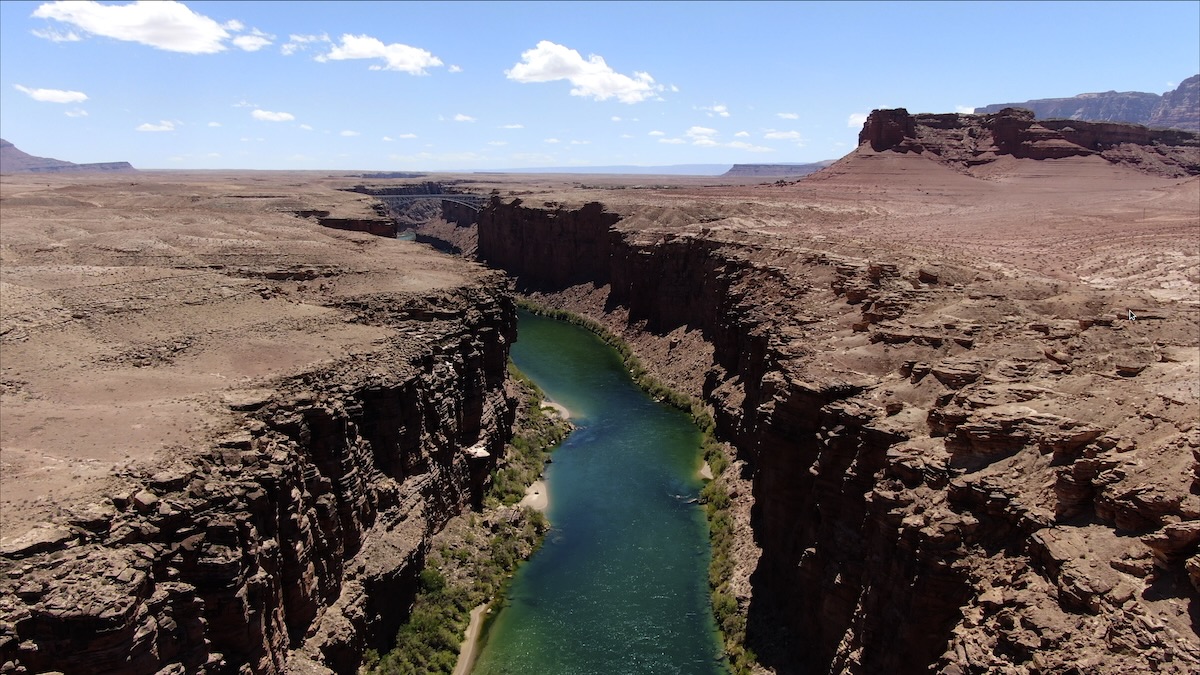
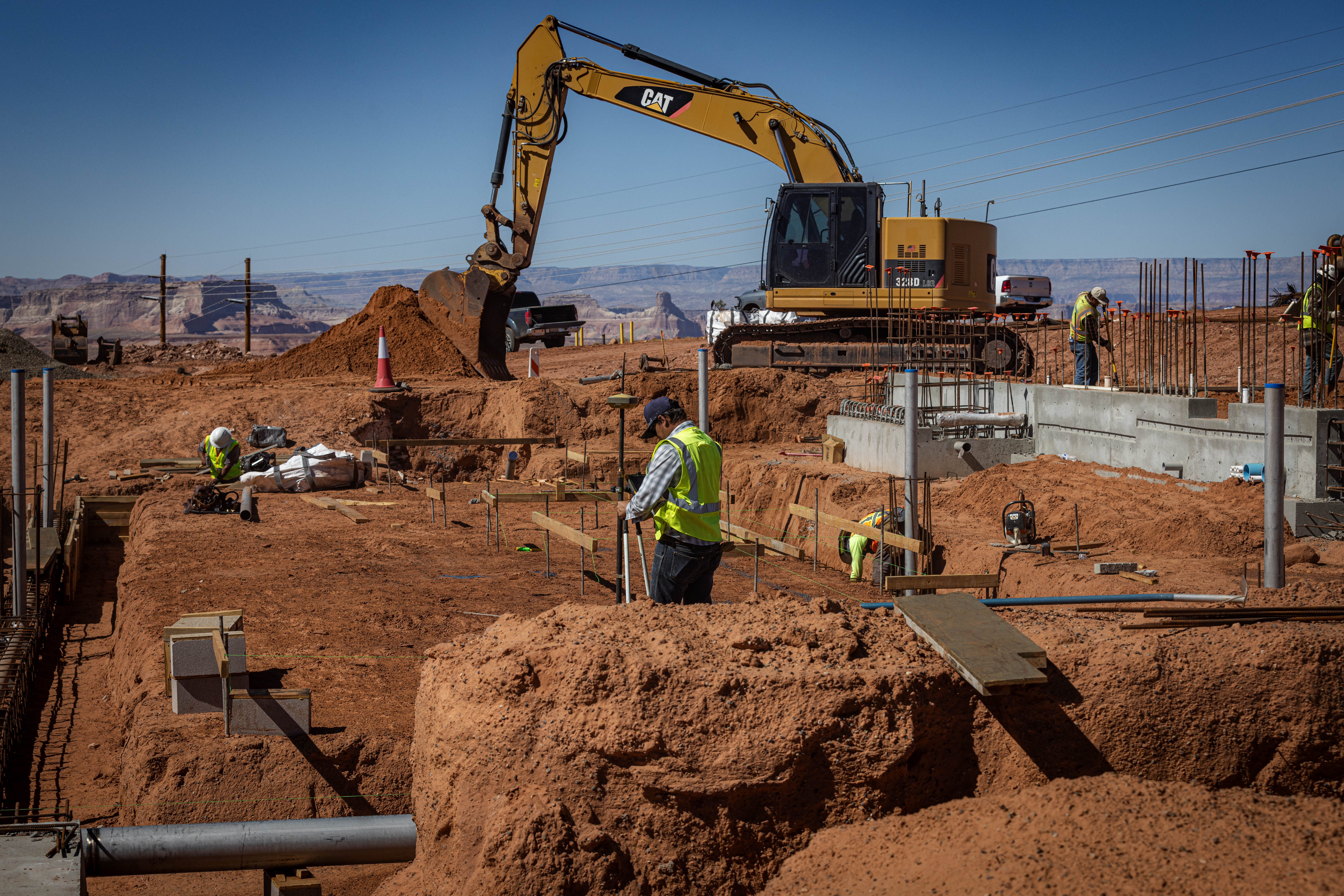
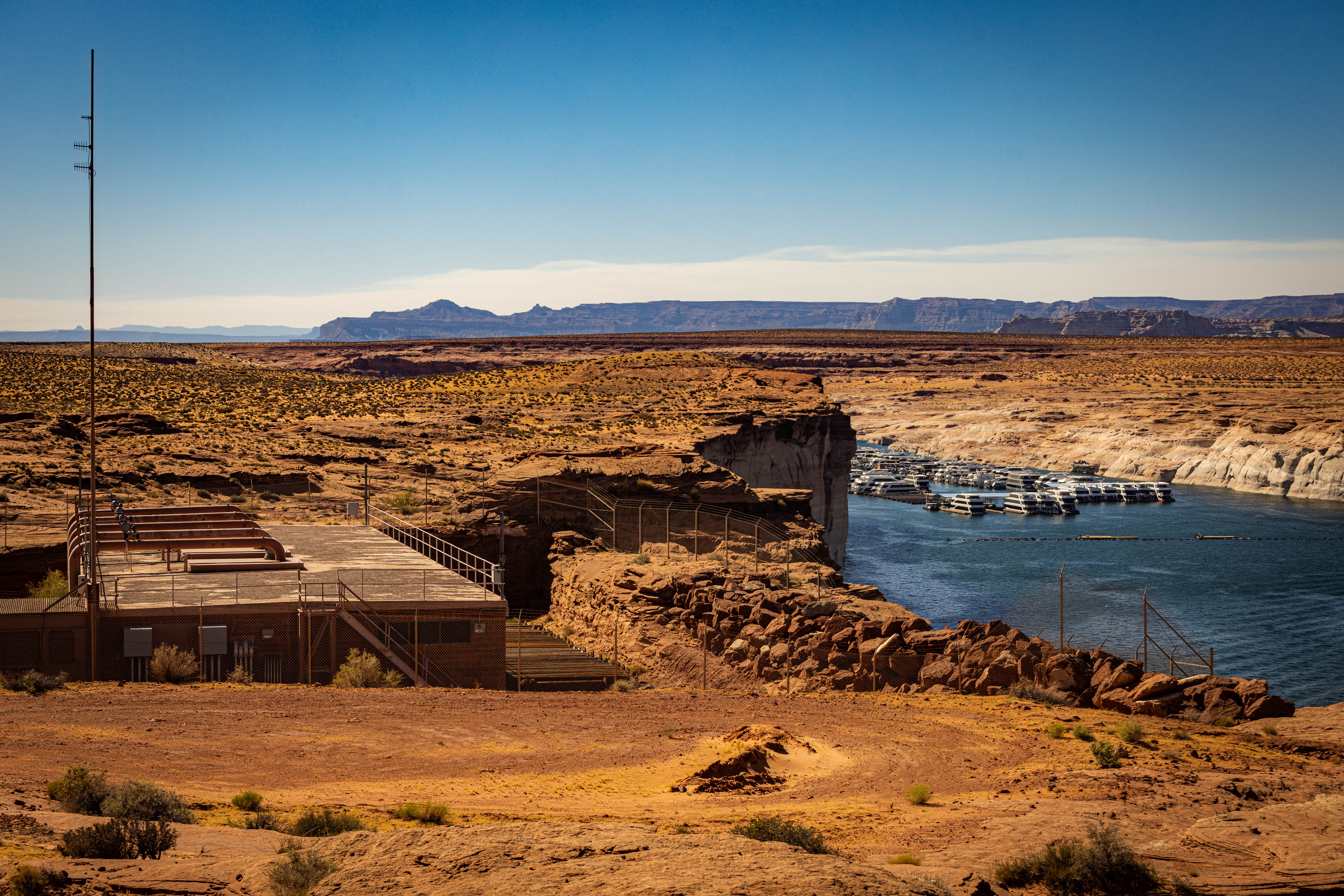
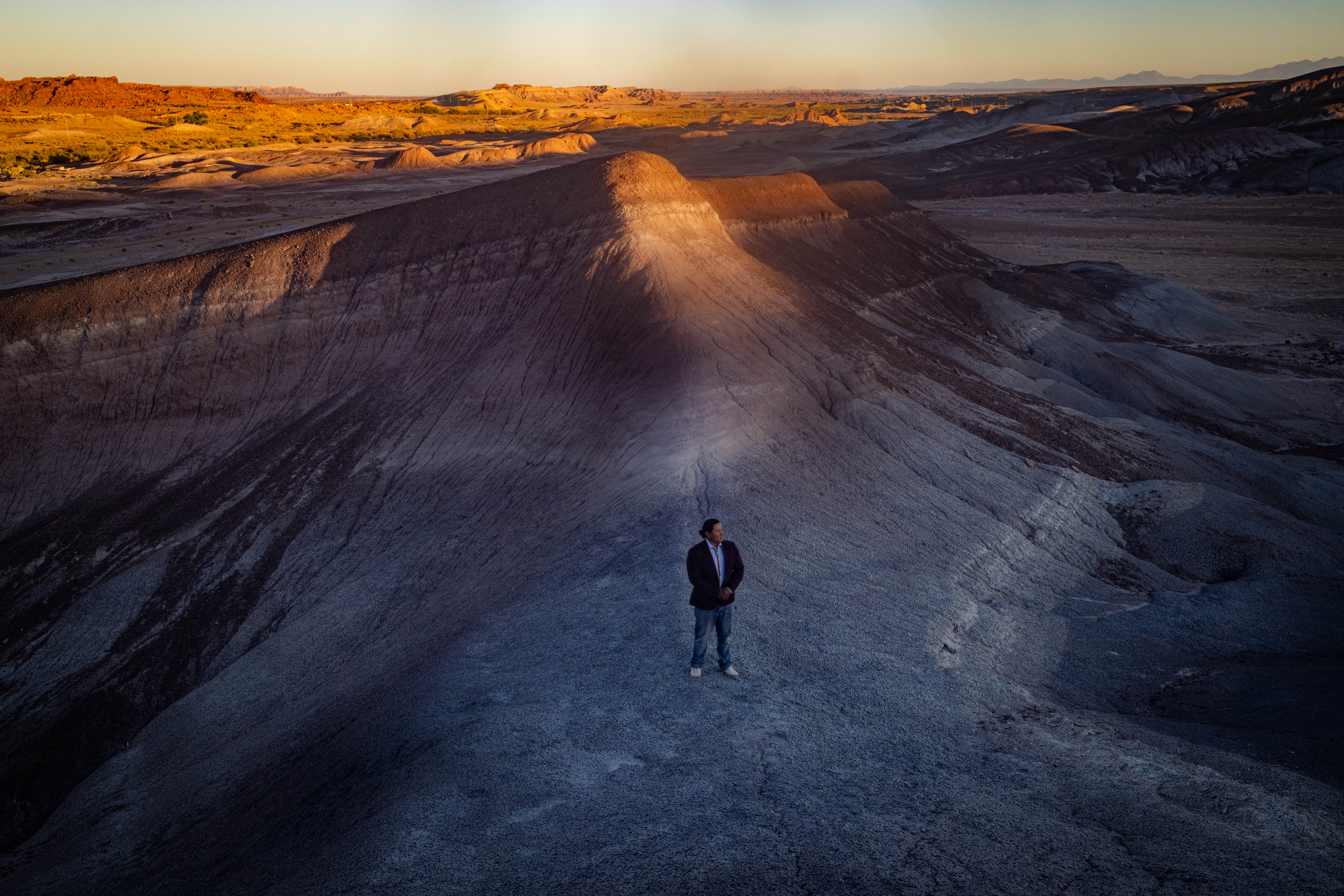
Colorado River south of Lees Ferry. Photo by Robert Marcos
by Robert Marcos, photojournalist
The National Park ServiceOffice of Public Health is actively investigating a cluster of undiagnosed, severe illnesses affecting Colorado River rafters in Grand Canyon National Park. The probe began in early July 2026 after numerous river runners used the “Grand Canyon Private Boaters” Facebook community group to report that members of their respective crews had returned home with highly concerning, unexplained medical symptoms.1
Current Situation and Symptoms
• Affected Trait: The reported cases belong to separate rafting groups traveling the Lee’s Ferry to Diamond Creek corridor between May and late June 2026. 2
• Core Symptoms: Rafters describe enduring severe localized muscle pain, persistent high fevers, intense fatigue, chills, weakness, and fluid in the lungs. 3
• Severity: Some patients have experienced symptoms akin to a severe, month-long summer flu, while others required hospitalization for localized infections or sudden loss of consciousness. 4
Potential Causes Under Investigation
Medical specialists and public health officials are currently tracking data via platforms like the infectious disease platform Beacon to rule out specific diagnoses. Because many rafters slept outside and swam in side canyons, doctors are currently testing for a wide range of potential ailments, including: 5
• Leptospirosis: A bacterial disease often contracted via freshwater exposure.
• Tick and Mosquito-borne Illnesses: Such as West Nile virus, Rocky Mountain spotted fever, dengue fever, or Lyme disease.
• Fungal and Viral Infections: Including Hantavirus or Valley Fever.
• Note on Gastrointestinal Illness: While the Grand Canyon has historically dealt with norovirus outbreaks—including a smaller spike in Norwalk-like viruses linked to portable toilets in June 2026—the current investigation focuses on a distinct respiratory and muscular illness. [1, 2, 3, 4, 5, 6]. The National Park Service has stated that the investigation is ongoing, and they will release official diagnostic findings as soon as lab results become available.
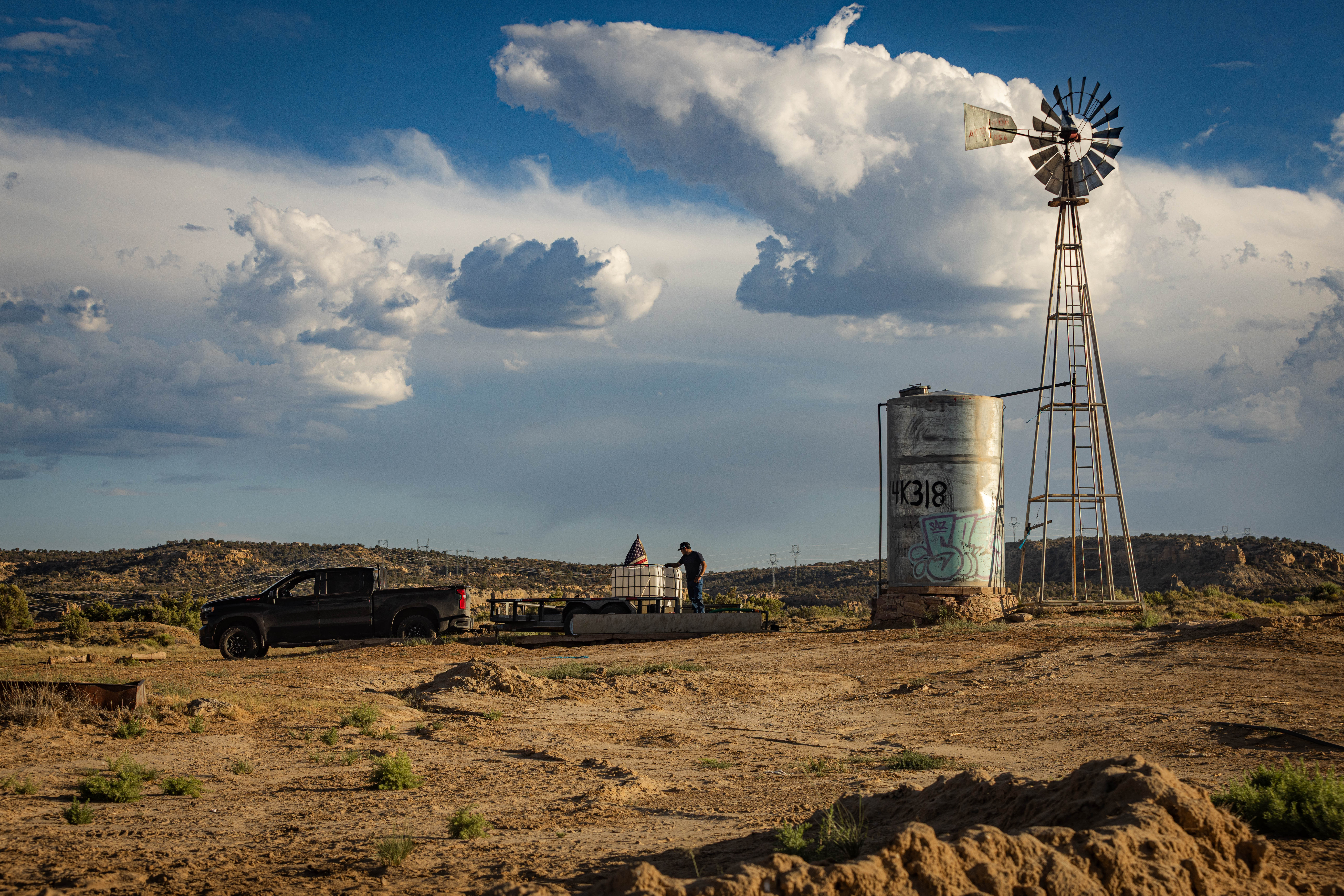
A man fills his water tank at a well a few miles from the Hopi village of Mishongnovi, on the tribe’s northern Arizona reservation.
Click the link to read the article on the Pro-Publica website (Mark Olalde and Alex Hager):
June 29, 2026
ProPublica is a nonprofit newsroom that investigates abuses of power. Sign up for Dispatches, a newsletter that spotlights wrongdoing around the country, to receive our stories in your inbox every week. This story was co-published with KJZZ News-Phoenix.
Reporting Highlights
Certainty on the River: Tribes have negotiated a settlement to resolve the largest outstanding claim to the Colorado River, while providing billions of dollars for water infrastructure.
Upper Hand: Colorado, New Mexico, Utah and Wyoming — the Upper Basin states — are resisting the deal because it allows the Navajo and Hopi to lease water outside their reservations.
Unfulfilled Promise: It has been 118 years since the Supreme Court ruled that the federal government owes tribes water, but many are still fighting to resolve their rights.
These highlights were written by the reporters and editors who worked on this story.
A deal to bring Colorado River water to Native American communities in northern Arizona, where a third of homes lack running water, is being blocked by neighboring states, caught up in a broader battle over how to divide the dwindling river.
The largest tribal water rights settlement in U.S. history — the product of decades of negotiations to secure water for the Navajo Nation, Hopi Tribe and San Juan Southern Paiute Tribe — was on the verge of being realized before Colorado, New Mexico, Utah and Wyoming stepped in to oppose it being codified by Congress.
Those four states, known collectively as the Upper Basin, are at a stalemate with the Lower Basin states of Arizona, California and Nevada over new rules governing how they share the Colorado River, a key water source for nearly 40 million people. Congress and the White House, under both Democratic and Republican leadership, have declined to approve the settlement until all parties reach an agreement.
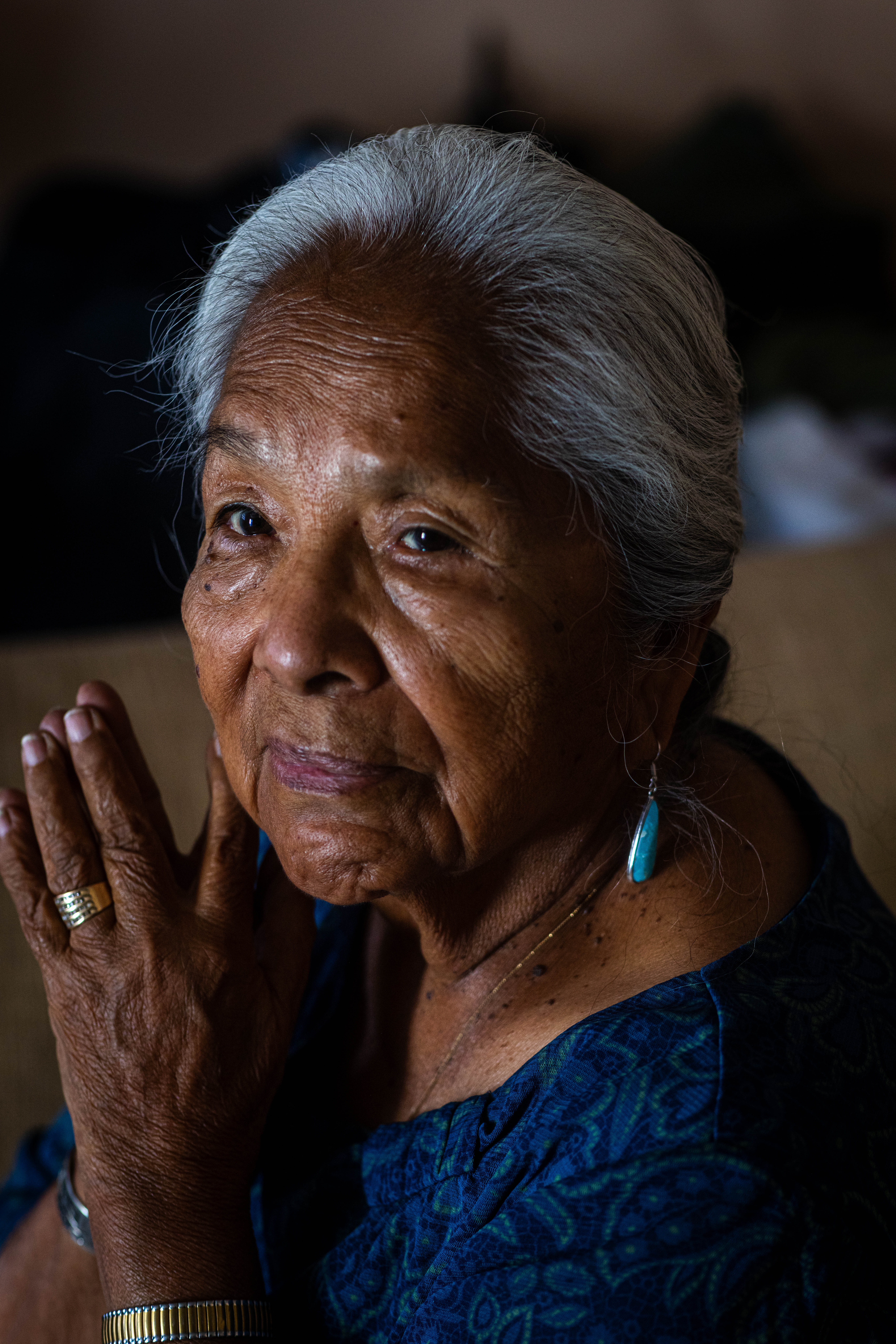
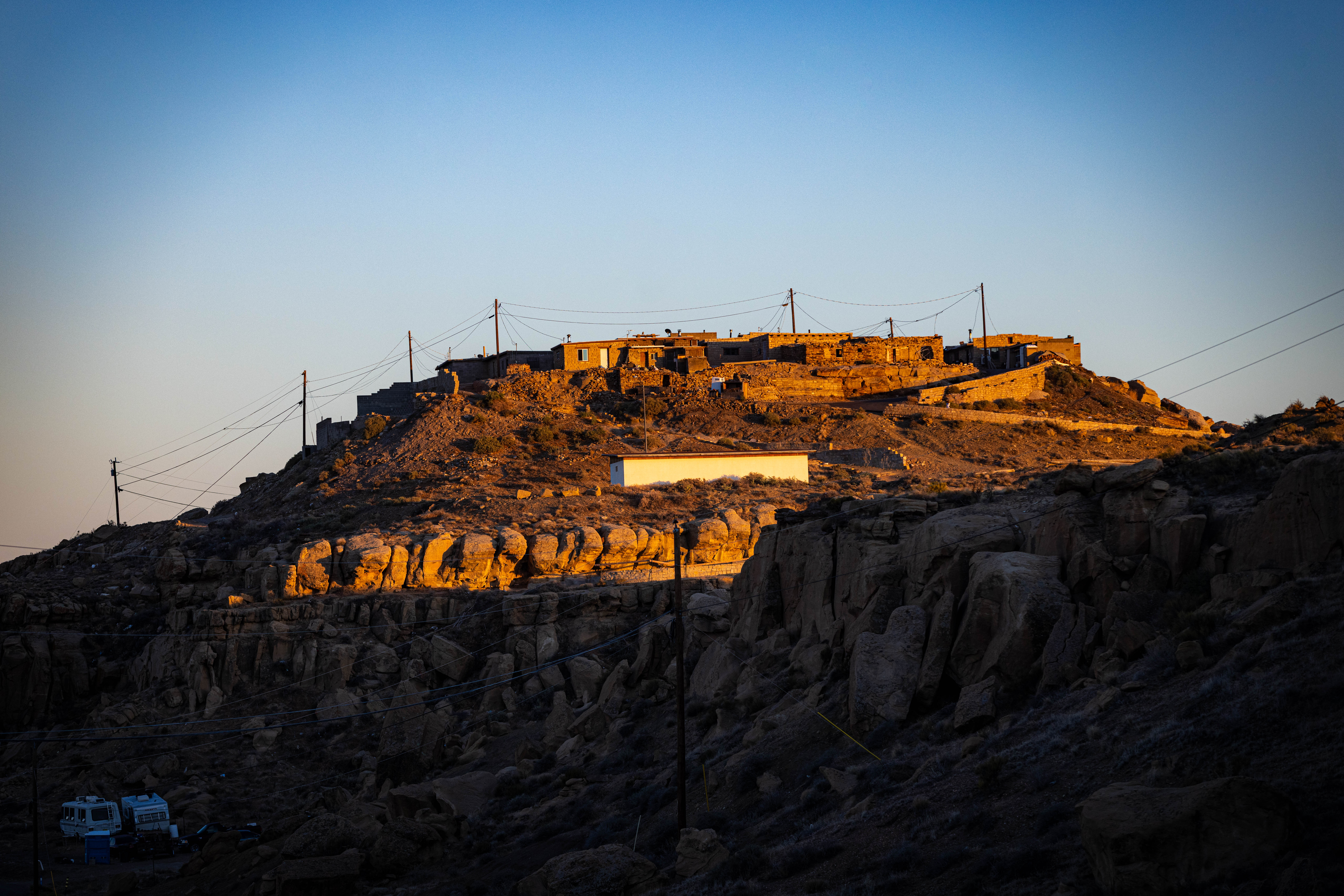
For 83-year-old Marilyn Tewa, the stalemate means her family will continue to go without running water. Tewa serves on the Hopi Tribal Council, where her duties include working on the water rights agreement, but her village of Mishongnovi, on the tribe’s northern Arizona reservation, lacks indoor plumbing.
Every other day, she loads 5-gallon buckets into her pickup and drives 5 miles to a windmill originally built for livestock that draws untreated water from underground.
“That’s what keeps us alive,” Tewa said, tapping the spigot on a May afternoon.
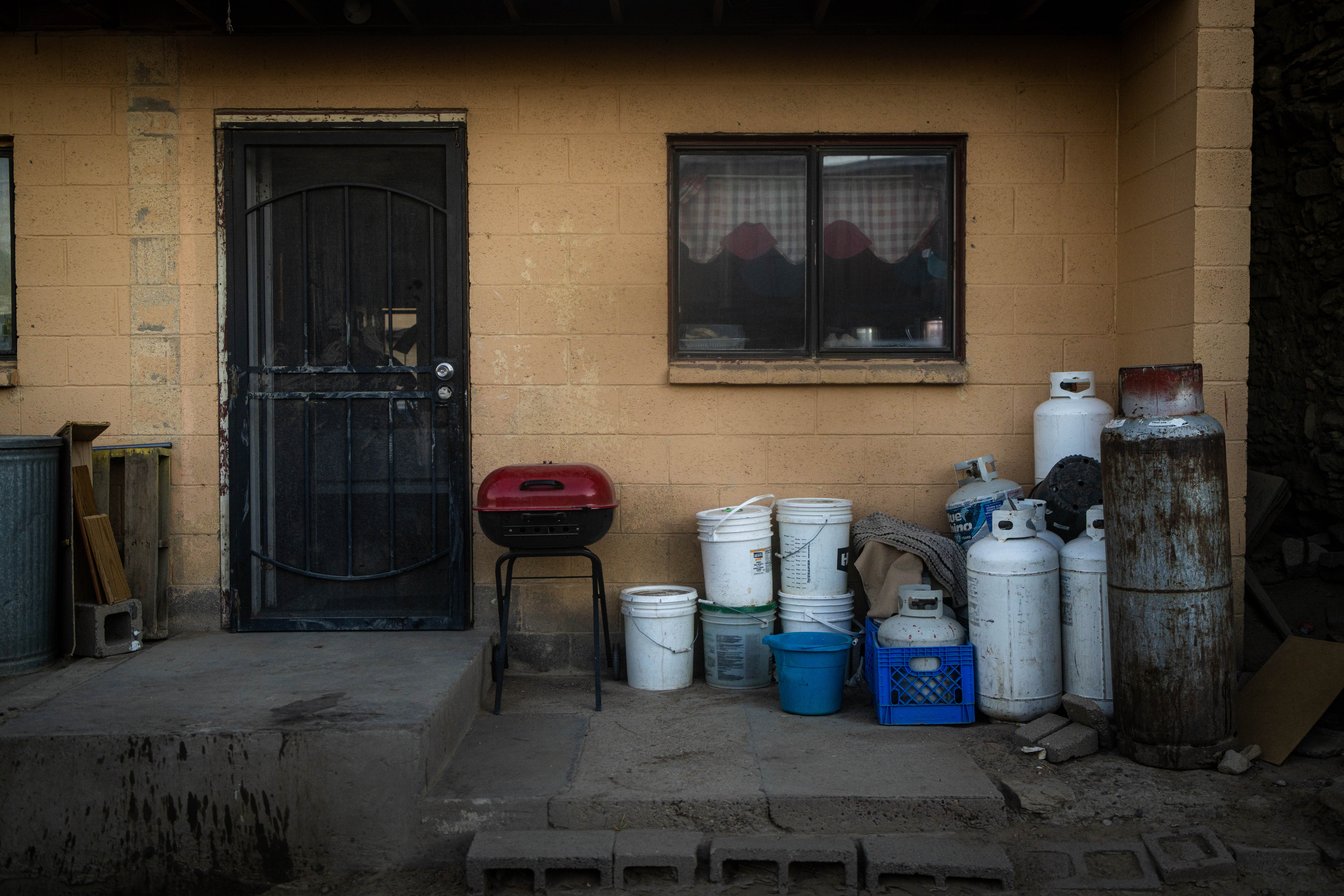
Back home, Tewa bustled about her kitchen while her daughter kneaded dough for dinner. There’s no faucet in the kitchen, which is decorated with a framed American flag and a painting of a katsina, a figure with spiritual significance in Hopi culture. Instead, the family stores water in large plastic containers. Because of the lack of indoor plumbing, the Tewa family and its neighbors use portable toilets that stand among the houses.
If passed into law, the Northeastern Arizona Indian Water Rights Settlement Actwould resolve the largest outstanding claim on the Colorado River while providing about $5 billion in federal funding to build infrastructure to transport the water across the reservations. The legislation would also go beyond water rights, creating a reservation for the San Juan Southern Paiute. The tribe’s effort to secure a permanent homeland was added to the settlement due to their difficulty getting it through Congress independently.
“That’s my prayer,” Tewa said, “that we get this settlement through for all three tribes.”
Marilyn Tewamain sits in her chair inside her home Saturday afternoon. Photo credit: Sharon Chischilly
The tribes need pipes, pumps and treatment plants to use the water secured through the settlement. To defray the cost beyond the federal government’s expected contribution, the Navajo and Hopi plan to lease some of their water rights, almost certainly to growing towns around Phoenix. The towns would pay to use the tribes’ water for a set number of years.
While the Lower Basin states support the settlement, the Upper Basin states have latched onto this provision in particular as they stand in the way of the settlement.
The Colorado River’s upper and lower basins don’t precisely follow state borders. Some states have portions in both sections, and the line dividing the two basins cuts across northeastern Arizona and directly through the Navajo reservation. If water moves across that line, they argue, the rules governing the river give them veto power over the settlement. (It’s an open legal question whether approval from all seven states is necessary.)
The Upper Basin states fear that, in the future, water they currently control might be leased on an open market. They view any monetary transaction that moves water downstream as setting a precedent that could allow the highest bidder — possibly thirsty cities with money such as Los Angeles, Phoenix and Las Vegas — to buy vast quantities of their water.
In an effort to assuage that concern and close the deal, the Navajo and Hopi made major concessions over the volume of water and length of time they could lease. The tribes also offered to leave some of their water in one of the river’s drought-depleted reservoirs to help keep water levels high enough that it could continue flowing downstream. But the Upper Basin has not wavered in its opposition.
Tewa’s family travels 5 miles each way to haul water in 5-gallon plastic buckets from a well initially drilled for livestock. Photo credit: Sharon Chischilly
ProPublica and KJZZ News-Phoenix reached out to the governor, senators and lead negotiator from every Upper Basin state for comment. Utah’s and Wyoming’s lead negotiators deferred to the letter they co-signed. A spokesperson for New Mexico Gov. Michelle Lujan Grisham said in a statement that the tribes addressed most of the state’s concerns but that questions remain as to whether the water that the tribes would lease to Arizona cities could be counted as part of what the Upper Basin states are legally required to send to the Lower Basin. “New Mexico remains committed to finding a workable solution,” the spokesperson said.
A spokesperson for Colorado Gov. Jared Polis also said the state is “committed to finding a path forward” and pointed to the letter that Becky Mitchell, the state’s lead river negotiator, submitted to Congress. Mitchell wrote that the settlement’s leasing provisions violate laws governing the river and that the state was concerned about what the sale of water across the basin would mean for “the security and certainty” of Colorado’s share of the river.
Heather Tanana is an assistant professor at the University of Denver’s law school, where she focuses on federal Indian law. She is also a citizen of the Navajo Nation and said the Upper Basin is “trying to hide behind” how the river has traditionally been managed rather than find a way to give the tribes access to a resource that is rightfully theirs and one that they need to survive.
“It’s a fundamental human rights issue,” she said.
While negotiations drag on, the three tribes continue waiting for water they say will help them to build more housing, grow sustainable economies, better protect public health and preserve cultural practices.
The Hopi believe their ancestors return as clouds to bring the rain that nourishes their corn, but drought is wracking the region. An overreliance on groundwater has dried up springs that have been used for ceremonies and agriculture for centuries. When the settlement brings more water to the reservation, Tewa said, aquifers will have a chance to recharge, restoring the springs.
“I’m speaking on behalf of my children, my grandchildren and their children that haven’t come yet,” she said. “I hope, in the future, that they will have water.”
The village of Mishongnovi, which Tewa represents on the Hopi Tribal Council, sits atop a rocky mesa. Photo credit: Sharon Chischilly
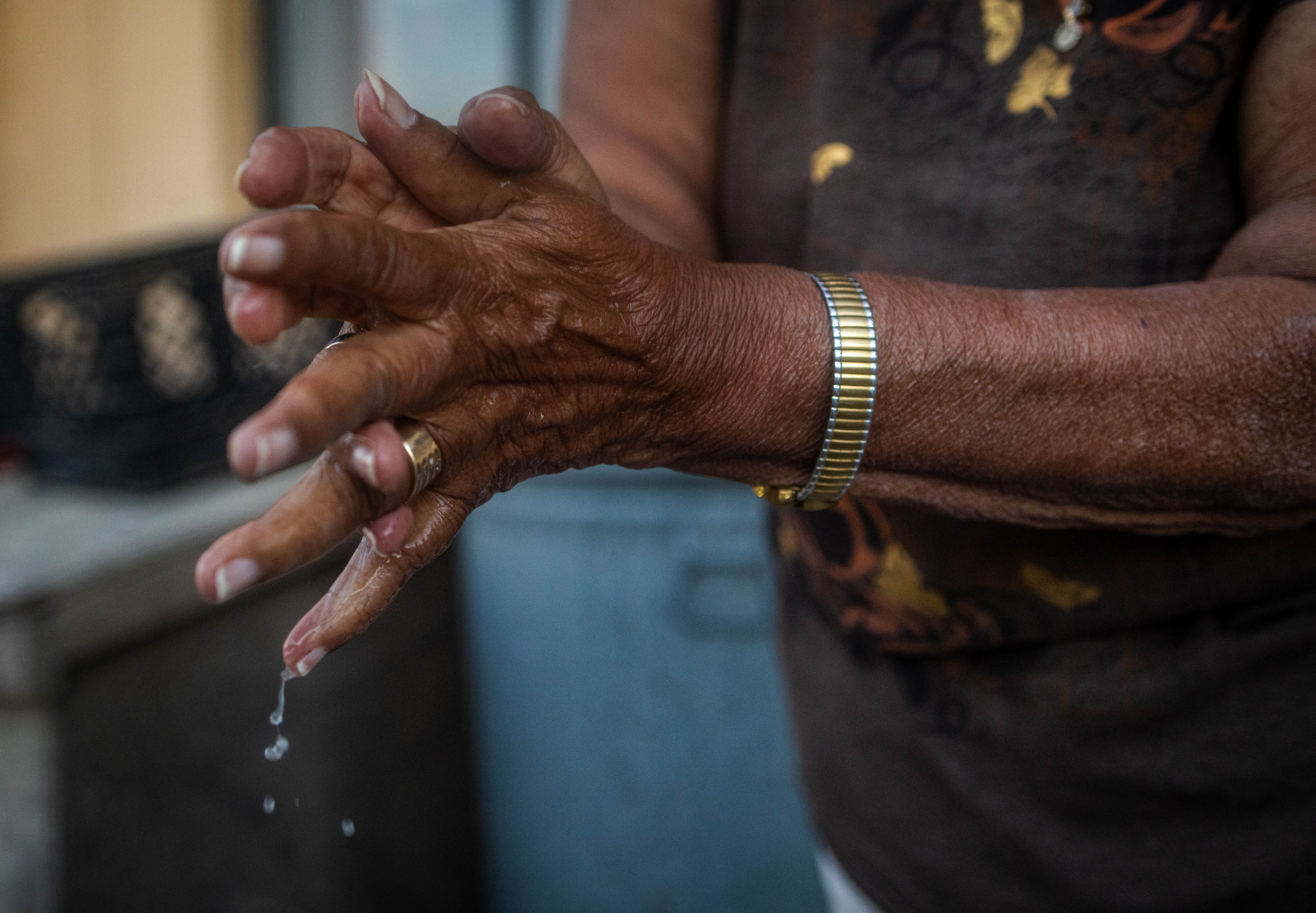
Tewa washes her hands with untreated water she hauled from a well. Photo credit: Sharon Chischilly
Fighting for Water Since Elvis Was on TV
That the settlement even reached Congress seemed like a small miracle to those involved.
If the tribes were to use every drop to which they are entitled, the system of sharing the river that supports more than $1 trillion in annual economic output would collapse.
“Everybody’s getting free Navajo, Hopi and San Juan Southern Paiute water right now. The seven basin states are all benefiting in the absence of a settlement,” said Ethel Branch, a former Navajo attorney general who was involved in the negotiations, adding that the water had been “stolen for over a century.”
In 1908, the Supreme Court ruled that, if the federal government confined tribes to reservations, then it owed them enough water to sustain an agrarian economy on that land. But securing that promised water, referred to as “Winters rights,”has proven arduous.
Tribes were excluded from the compacts that apportioned the river. The Navajo in particular were barred from joining a seminal case quantifying other users’ rights, and members of the tribe themselves rejected a proposed settlement in 2012 when they viewed the deal as unfair. So the tribe went back to the Supreme Court, asking that the justices force the federal government to quickly settle the claims. The Navajo once again lost, with the court’s majority deciding that their treaty with the U.S. didn’t require the government to take any “affirmative steps” to deliver the water it owed the tribe.
“At each turn, they have received the same answer: ‘Try again,’” Justice Neil Gorsuch wrote of the Navajo in his dissent. “When this routine first began in earnest, Elvis was still making his rounds on The Ed Sullivan Show.”
Arizona politicians and tribal leaders have since concluded that they needed to combine all three tribes’ claims to finally settle their rights.
That was no simple feat. The Navajo and Hopi have long had a contentious relationship. Underlining their thorny partnership, leaders of various tribes around the region have accused Navajo, the largest tribal nation in the U.S., of flexing their political strength to the detriment of other tribes.
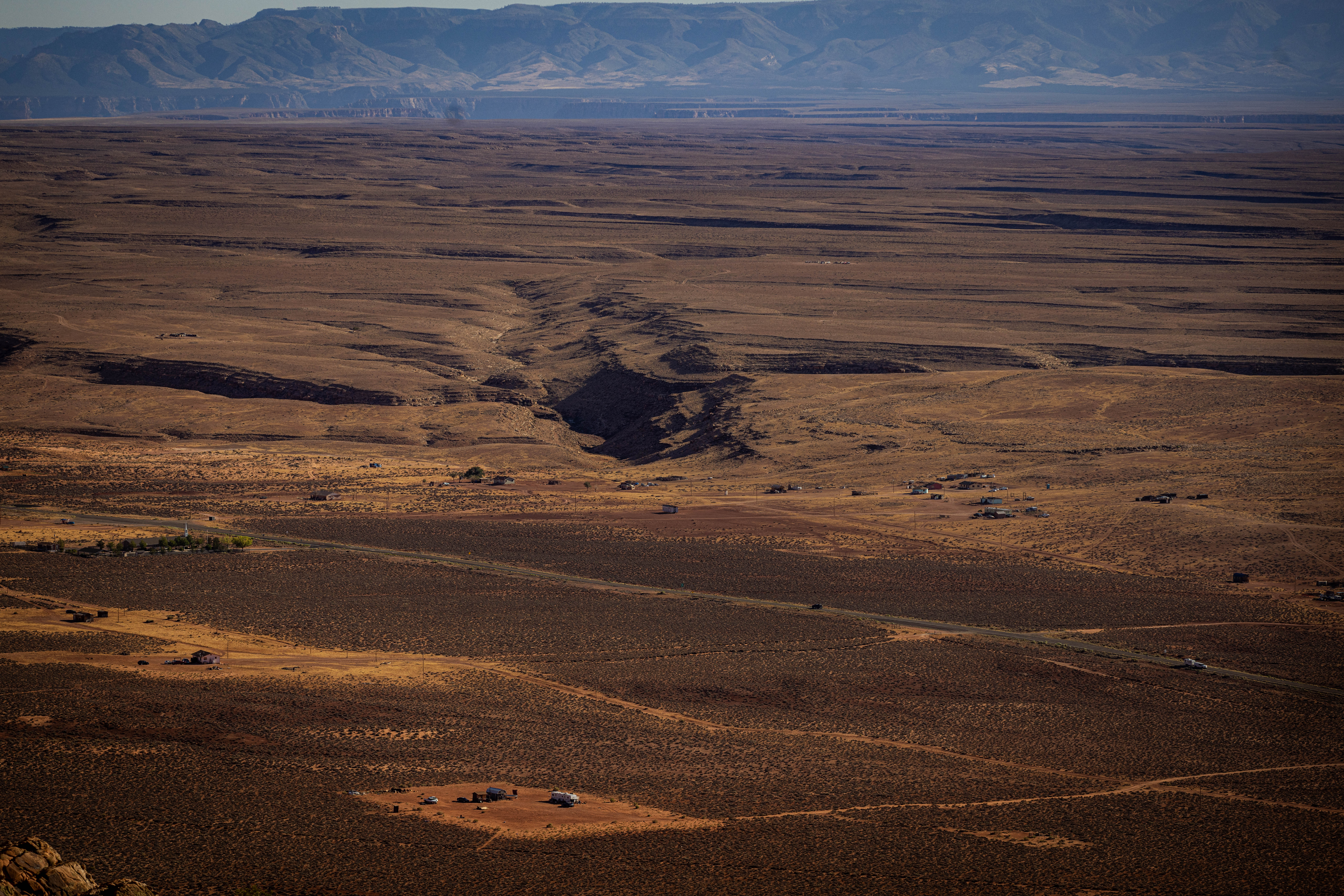
About a third of homes on the Navajo Nation lack the pipes and other infrastructure necessary to deliver running water, including near Page, Arizona, close to a large reservoir on the Colorado River. Photo credit: Sharon Chischilly
But Navajo and Hopi struck a deal, and Arizona moved off its bargaining position. Now in lockstep, the settlement’s supporters turned to Congress, only to hit more roadblocks: The House of Representatives balked at the spiraling price tag to fund the deals; presidential administrations were unwilling to expend political capital on such settlements; and more than a dozen settlements are in the works, clogging the system. (No settlement has been enacted since 2022.)
“Partisanship has gone to a new low in this country, and Indian water settlements have gotten swept up into that,” said Pam Williams, who spent about two decades as director of the Secretary’s Indian Water Rights Office in the Department of the Interior before she retired last year.
In November 2024, as President Donald Trump prepared for his return to the White House, the tribes believed they had an opening to get their settlement through Congress while President Joe Biden was still in office.
Navajo leadership had supported the Democratic presidential ticket and feared the incoming administration would be vindictive toward them.
Every basin state’s lead negotiator, tribes’ staff and a federal representative descended upon the Arizona Department of Water Resources’ offices in Phoenix for what several attendees described as a “Hail Mary.” At the meeting, the Navajo offered a major compromise: limiting how much water they could lease and for how long they could lease it.
But the Upper Basin states showed up with a list of grievances, multiple attendees told ProPublica and KJZZ News-Phoenix, and weren’t interested in negotiating over the Navajo leasing concessions.
“It’s difficult for the Upper Basin to wrap their heads around this settlement,” said Tom Buschatzke, Arizona’s Colorado River lead.
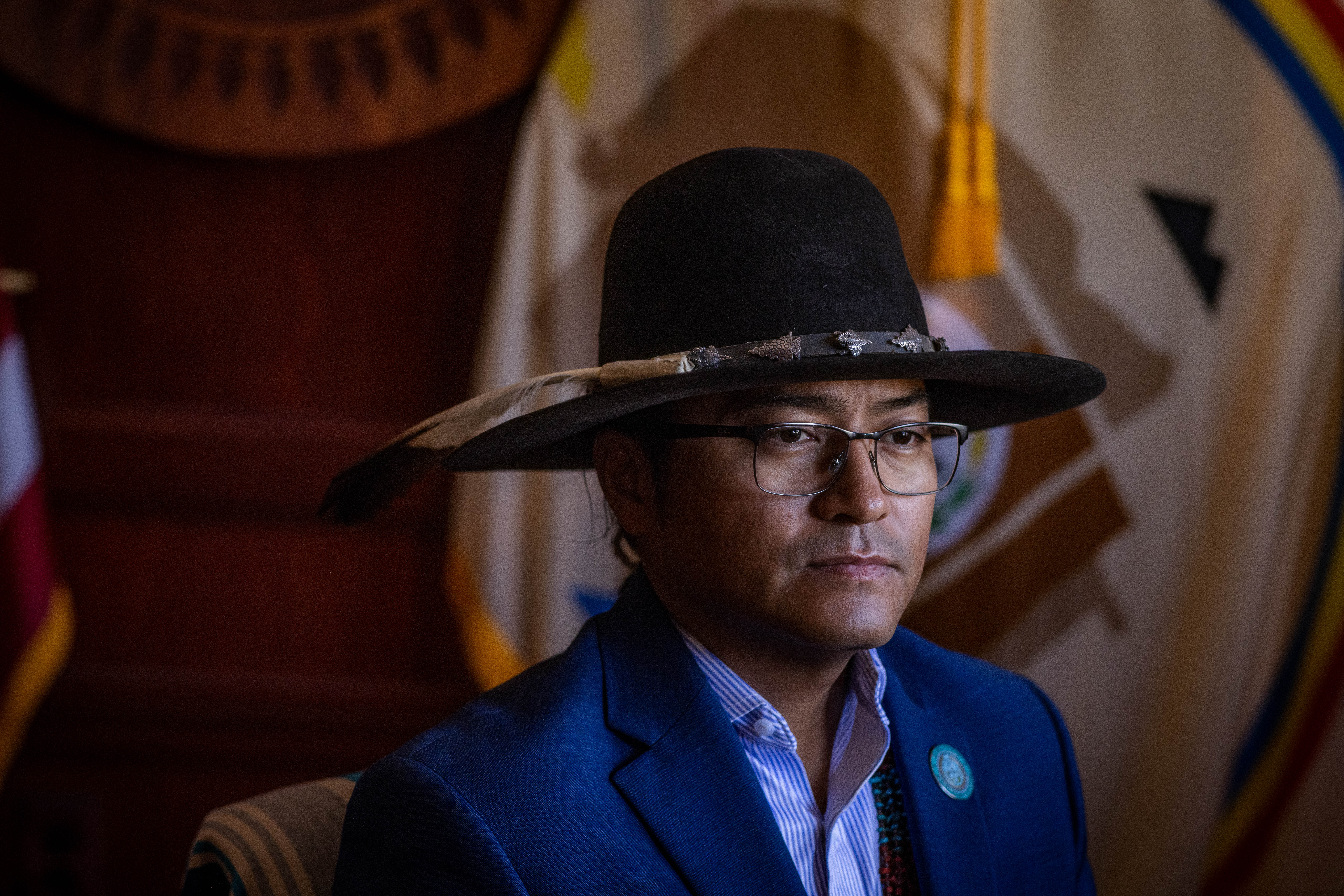
Navajo President Buu Nygren says the fact that his tribe’s reservation straddles the upper and lower divisions of the Colorado River Basin should not be held against the tribe as it negotiates for water. Photo credit: Sharon Chischilly
In March 2026, leaders from the tribes traveled to Washington for a Senate hearing where they made an impassioned plea for Congress to pass a version of the bill that now included the concessions they had offered in the Hail Mary meeting. Sen. Lisa Murkowski, the Alaska Republican who ran the hearing, expressed support for the settlement but worried its $5 billion price tag was too high, a concern echoed by an Interior Department official who testified. (The tribes and department are currently negotiating to shrink that cost.)
All four Upper Basin states submitted comments opposing the settlement. Their main concerns were about the ability to lease across the basin and whether the water for the settlement would be counted against the upper or lower division of the river.
Leasing would last only as long as it’s needed to pay for infrastructure to distribute their newly acquired water, said Navajo President Buu Nygren. It would not set a precedent, he said, because no other tribe straddles both basins.
“We shouldn’t be punished for being in two basins,” Nygren said, “because other tribal nations, other settlements have been able to lease water.”
A construction crew installs pipes at the new LeChee Water Treatment Plant near Lake Powell, along the Arizona-Utah border. Photo credit: Sharon Chischilly
The former Navajo Generating Station’s intakes, which drew water from Lake Powell to cool the coal power plant, sit unused, awaiting funding from the stalled settlement. Photo credit: Sharon Chischilly
“How Precious Water Is to Us”
During the decades that the tribes fought to access their water, they helped quench the thirst of growing cities in the Colorado River Basin.
A water intake plant on Navajo land drew from Lake Powell to cool the nearby Navajo Generating Station. The coal plant powered pumps for the Central Arizona Project, the 336-mile series of canals that sends Colorado River water to Phoenix and Tucson.
The power station shut down in 2019, and the intake plant was handed over to the Navajo for the iiná bá-paa tuwaqat’si pipeline, which means “for life” in Diné and “water is life” in Hopi, to deliver water to the three tribes. But for now, the massive pumps remain mothballed, the building sitting musty and dark like a tomb, and the pipeline remains an engineering schematic, waiting for funding from the stalled settlement.
The irony is not lost on tribal leaders, they told ProPublica and KJZZ News-Phoenix: After helping deliver water beyond their lands, they are now blocked from using that same water and infrastructure to sustain their communities. The insult is compounded, they said, by the fact that water use is drastically lower on reservations.
“It’s not about green-grass lawns or golf courses or swimming pools,” said Crystalyne Curley, speaker of the Navajo Nation Council. “It’s just basically turning on the faucet and getting water to boil eggs for your children or turning on a faucet to wipe and clean the table or washing your hands after butchering a sheep.”
San Juan Southern Paiute Vice President Johnny Lehi Jr. is fighting for the settlement because it would finally ratify a treaty with the Navajo that would create a reservation for his tribe. Photo credit: Sharon Chischilly
For the San Juan Southern Paiute, the settlement is also about having a permanent homeland. They have no reservation but struck a deal with Navajo in 2000 to transfer some of its land. Since the tribes already reached an agreement, it’s an uncontroversial proposition. But, without political clout to get Congress to take it up, the land transfer was pulled into the water settlement.
“During the COVID era, it took a lot of the tribal elders, and there are only a handful that saw the treaty signed and are really wanting to see this before their time is up,” said San Juan Southern Paiute Vice President Johnny Lehi Jr., whose father signed the 2000 agreement. Finally securing a reservation, he said, means the ability to build housing and develop an economy for a tribe that currently rents its government building.
Nearby, on the Hopi reservation, Councilmember Marilyn Fredericks grabbed a pair of hiking poles, donned a hat with a roadrunner pin on it and set out from her village on a recent spring afternoon. To stay fit as she grows older, she walks up and down the hand-carved steps of a terraced garden that used to produce food for her community.
Seven natural springs once fed the garden, but only two still flow. Ponds that stored their excess sit dry, stains on the rock now just a memory of the water. It’s been six years since there was enough to plant.
The settlement would fund a pipeline that would be “our umbilical cord,” Fredericks said. Future generations of Hopi have a right to clean, reliable water, she said. “This is evidence of how precious water is to us.”
Native America in the Colorado River Basin. Credit: USBR
The Colorado State Engineer’s office opened its defense this week of Subdistrict 1’s approved Fourth Amended Plan of Water Management with a history lesson on the origins of the San Luis Valley and the development of irrigated agriculture over the past 174 years when the first water right was issued to the San Luis People’s Ditch.
Featured in the state engineer’s defense was testimony by Matt Seitz of HRS Water Consultants, who took the state Division 3 Water Court through ancient history and into the era of early irrigation and storage practices of farmers in the Valley.
“Yeah, so we covered 25 million years pretty quickly, see how long the rest of it takes here,” he said from the witness stand Tuesday. Seitz stayed on the witness stand for the better part of the week, working to bolster to the state engineer’s defense of the Fourth Amended Plan of Water Management and then under cross-examination from a Sustainable Water Augmentation Group attorney, who worked to show faults in Seitz’ testimony and undermine the case of the state engineer in the eyes of Division 3 Water Court judge Michael Gonzales.
It is Gonzales who will decide this case. He will take in all the testimony around the various takes on the Fourth Amended Plan of Water Management to rule on whether the plan will be implemented.
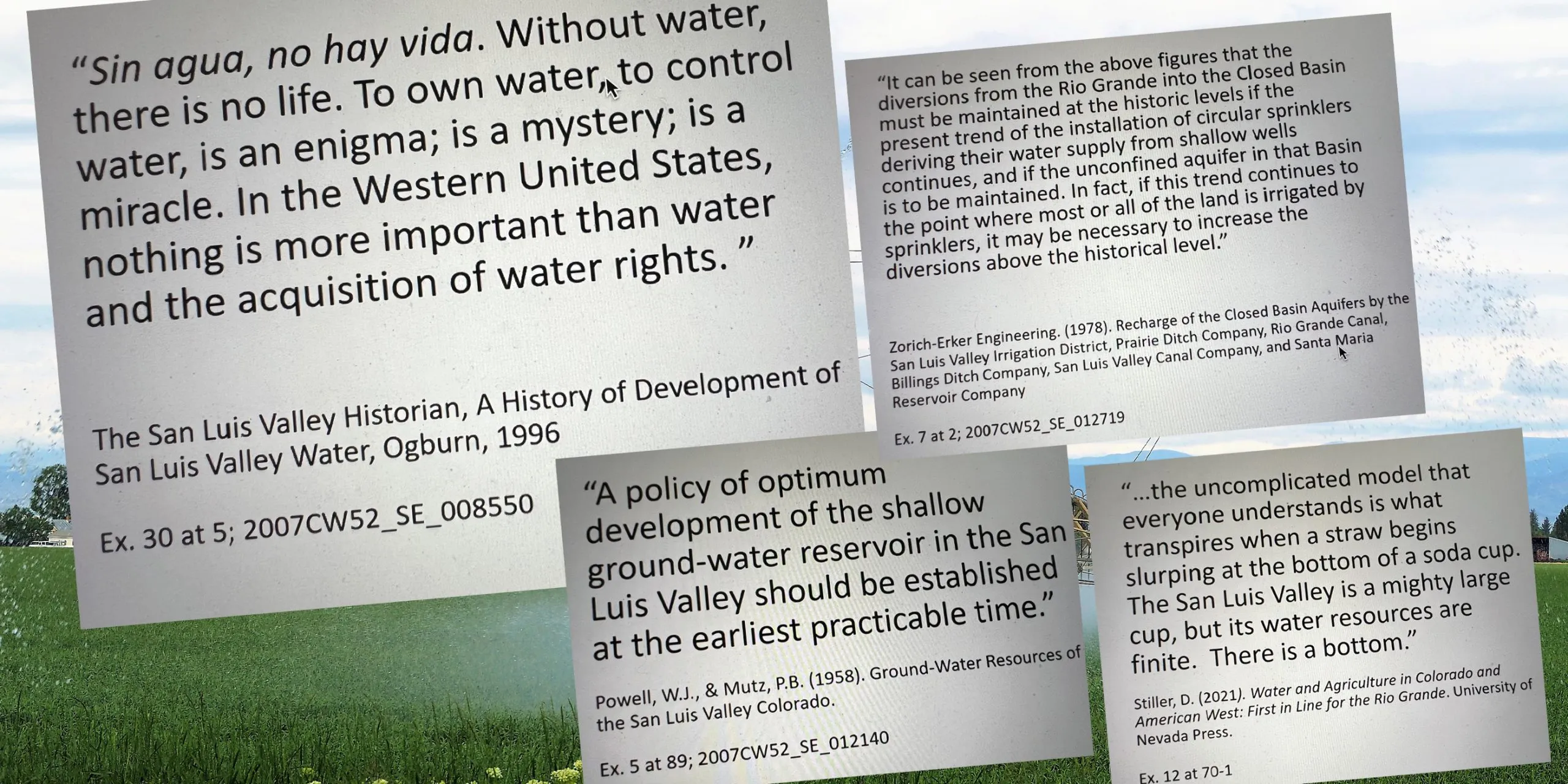
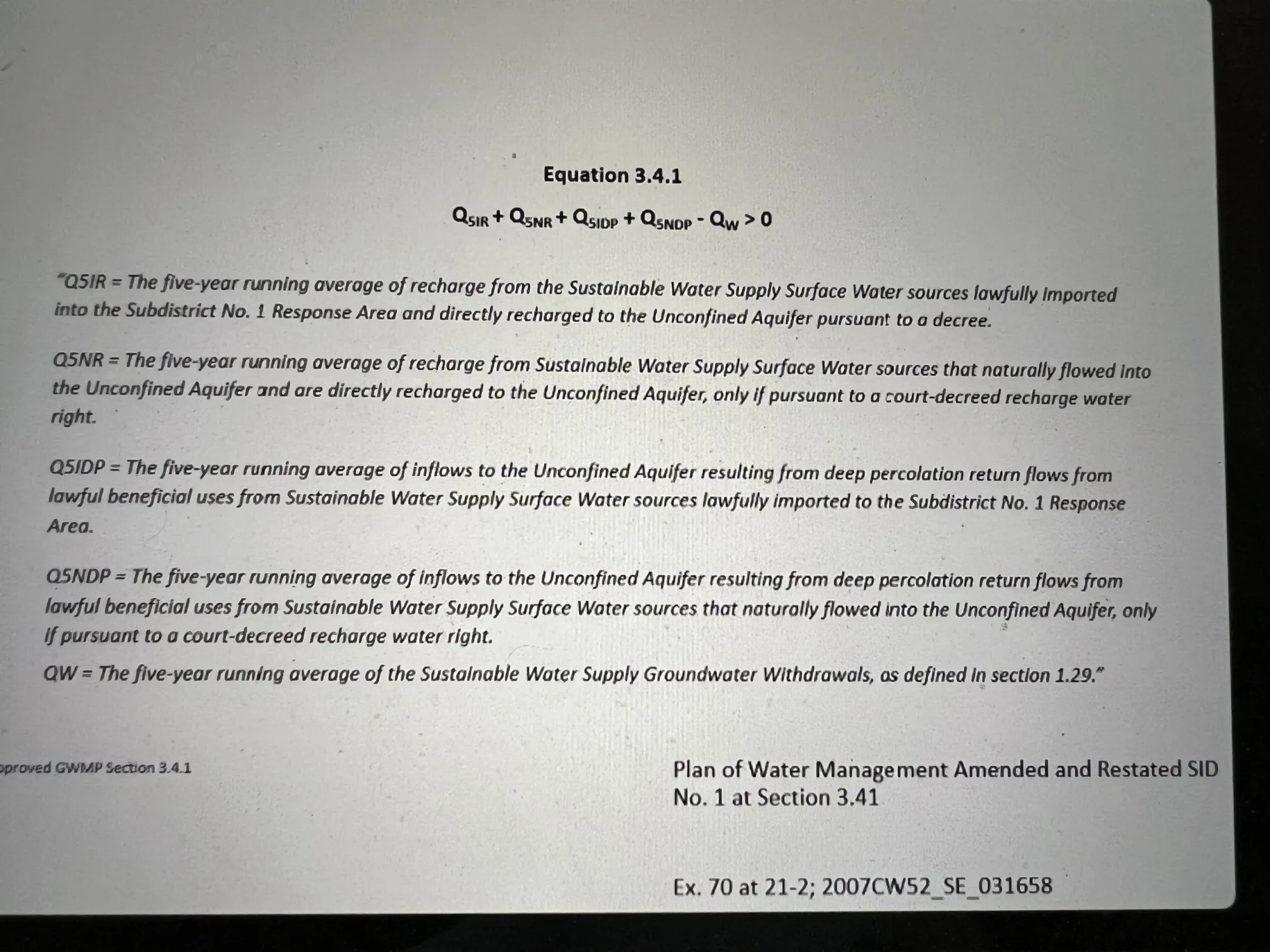
Plan of Water Management Equation
The subdistrict itself is charged with recovering the shallow unconfined aquifer of the Upper Rio Grande Basin and its Fourth Amended Plan of Water Management is the latest attempt to do so. The complexity of the basin’s hydrology has been an early theme.
“I think there’s been a lot of great research over the years,” Seitz said in speaking to the state’s modeling of groundwater in the Upper Rio Grande Basin and other studies on the Valley’s hydrology. “So I think we’ve made some good progress, but there’s a lot of complexity. Again, I’ve been saying that word a lot, but there certainly is and I think we’re on our way, but it’s never going to be fully understood.”
Week 1 of the trial ended with Craig Cotten taking the witness stand. He is witness number three for the state engineer’s defense of the plan, following Cleave Simpson, the general manager of the Rio Grande Water Conservation District who was the lead witness, and then Seitz, the hydrologist consultant who endured four days on the witness stand.
“Wonderful way to start the Fourth of July weekend,” quipped Gonzales as Cotten, the state water division engineer for the San Luis Valley area, stepped into the witness box at 1:50 p.m. on Thursday. He spent the initial two hours testifying to his background and his credentials before Gonzales broke for the Fourth of July weekend.
Cotten is the enforcer of the state’s groundwater management rules in the San Luis Valley. His testimony will reignite the trial when it resumes on Monday for week two of the water trial.
Map of the Rio Grande watershed. Graphic credit: WikiMedia
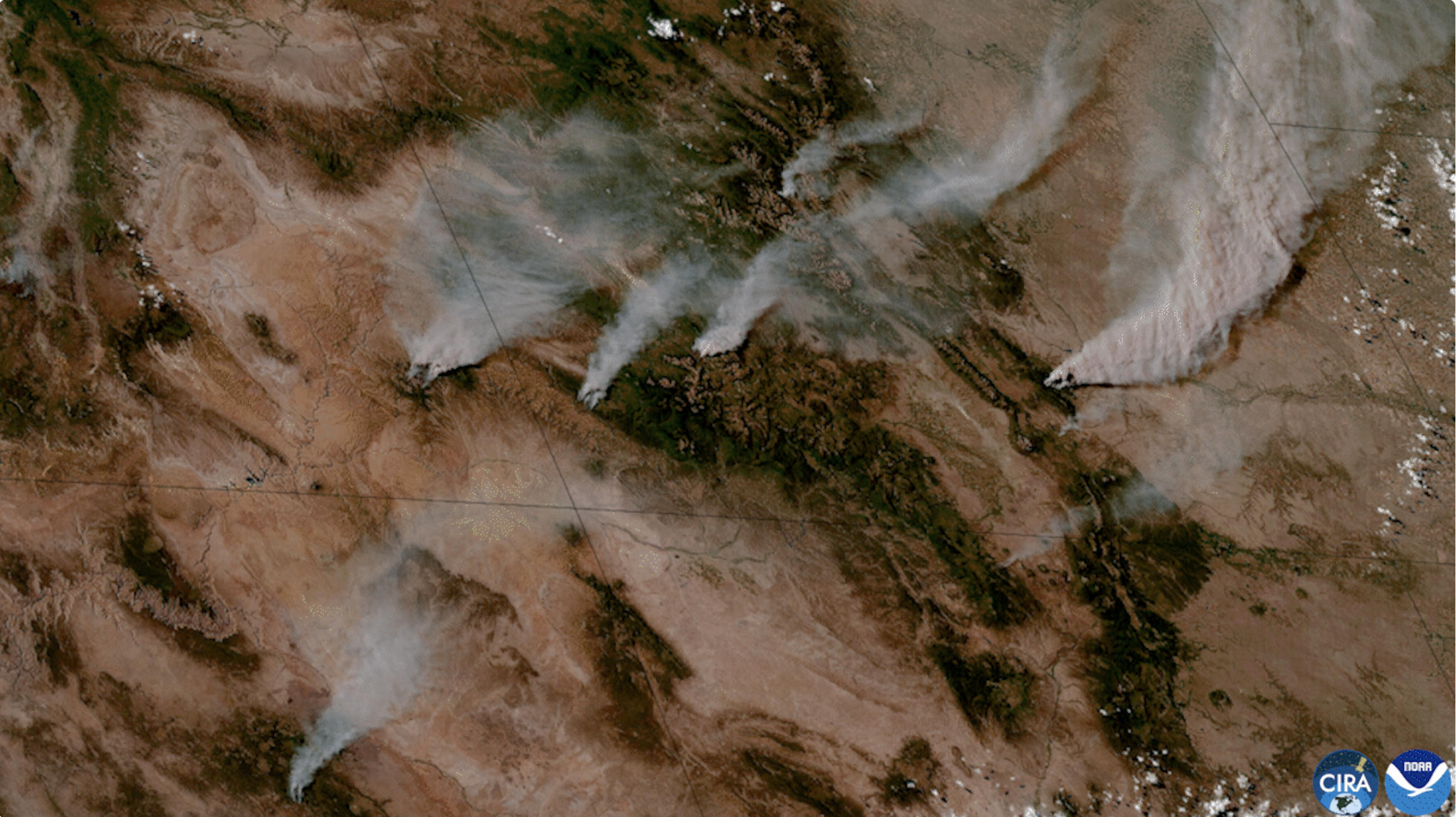
GOES-18 satellite imagery showing wildfire smoke in Colorado and Utah on June 29, 2026. Imagery courtesy of NOAA and CSU/CIRA.
July 3, 2026
For the Interior Rockies, June marks peak wildfire season. This year, the risk of large wildfires is elevated due to record low snowpack and drought. For Colorado and Utah, wildfire activity was relatively quiet through the first half of June. So what led up to the explosion of activity in the last week of June?
THE DELAYED SETUP
Despite record low snowpack, some late season storms in May helped delay meltout and keep fuels a bit more moist than they would have been otherwise. Although precipitation was still below average, and drought conditions persisted, moisture in the air into early June limited the onset of wildfires.
July 3, 2026
For the Interior Rockies, June marks peak wildfire season. This year, the risk of large wildfires is elevated due to record low snowpack and drought. For Colorado and Utah, wildfire activity was relatively quiet through the first half of June. So what led up to the explosion of activity in the last week of June?
THE DELAYED SETUP
Despite record low snowpack, some late season storms in May helped delay meltout and keep fuels a bit more moist than they would have been otherwise. Although precipitation was still below average, and drought conditions persisted, moisture in the air into early June limited the onset of wildfires.
THE SWITCH TO DRY
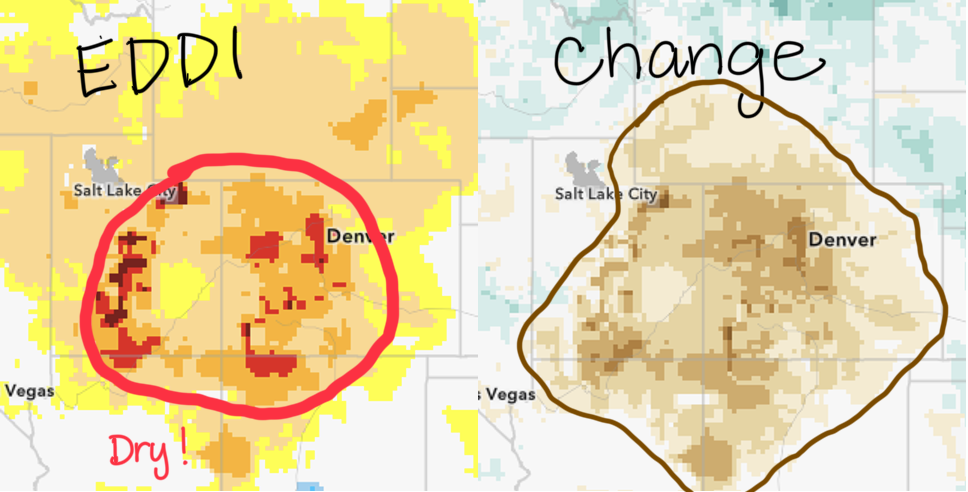
Like flipping a switch, dry air took over the region. The graphic below shows EDDI, a drought index that estimates the dryness of the atmosphere due to a combination of temperature, solar radiation, wind, and humidity. Higher values (denoted in the map with oranges and reds) shows where the atmosphere is much drier than normal as of the end of June. The change map on the right shows the drying trend over the last 30 days. This rapid trend dried out the vegetation, on top of the existing drought conditions, setting the stage for enhanced wildfire activity.
Evaporative Demand Drought Index (EDDI) for the Intermountain West as of June 23, 2026. Map from NOAA’s Climate Prediction Center.
All the ingredients for wildfires are present – hot temperatures, dry air, and windy conditions on top of a drought landscape. Once an ignition occurs, either from human activities or lightning, the wildfires start. But what is needed for large and uncontrollable wildfires?
A CLOSER LOOK AT WILDFIRE METRICS
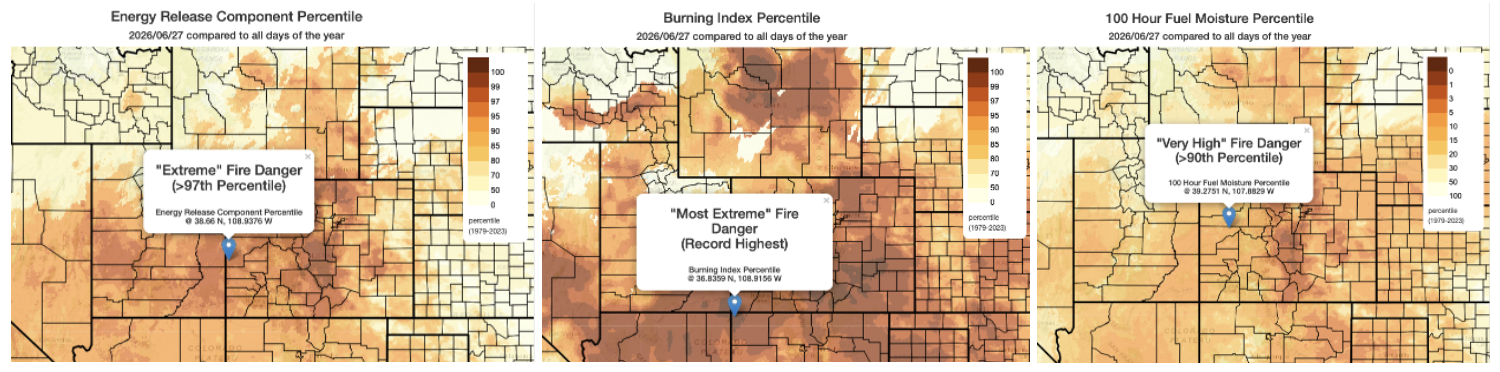
One of the surprising contributors to wildfire activity begins months in advance, where precipitation provides the necessary growth for vegetation that ultimately dries out and becomes fuel for a fire. Prior to the onset of the snowpack season, The Four Corners region received much above average precipitation in October thanks to two tropical systems coming from the Pacific Ocean. Fast forward to spring, drought conditions have dried out that vegetative growth, adding fuel for fires. The graphic below shows 3 different wildfire indices. The first index is the Energy Release Component (ERC), which is a measure of the energy and heat of a wildfire. The second index is the Burning Index, which measures flame length and the difficulty of containing a fire. The third index is 100-hr fuel moisture, which measures the moisture content in dead vegetation. By June 27, all three indices indicated very high or extreme fire danger. The Burning Index was record high for many parts of the Four Corners area.
Wildfire indices for Colorado and Utah as of June 27, 2026. Maps from the Climate Toolbox.
THE STAGE IS SET
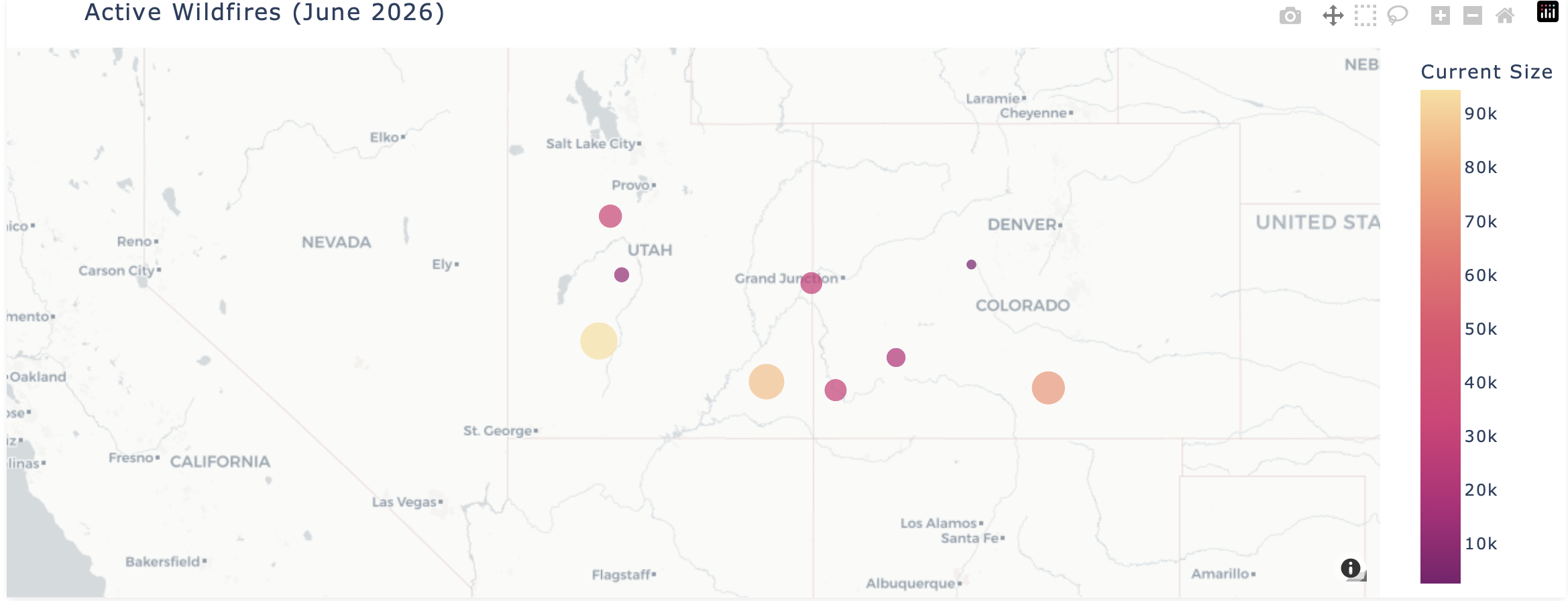
With all the ingredients in place, the last week of June brought a sudden surge of wildfires to Colorado and Utah, with 11 wildfires starting between June 26th and June 29th. Wildfires have now burned more than 400,000 acres in Colorado and Utah. Unfortunately, extreme heat and dry conditions are expected into the middle of July, bringing little relief to the current wildfire situation.
Active wildfires across Colorado and Utah as of July 3, 2026. Data from the National Interagency Fire Center and Watch Duty.