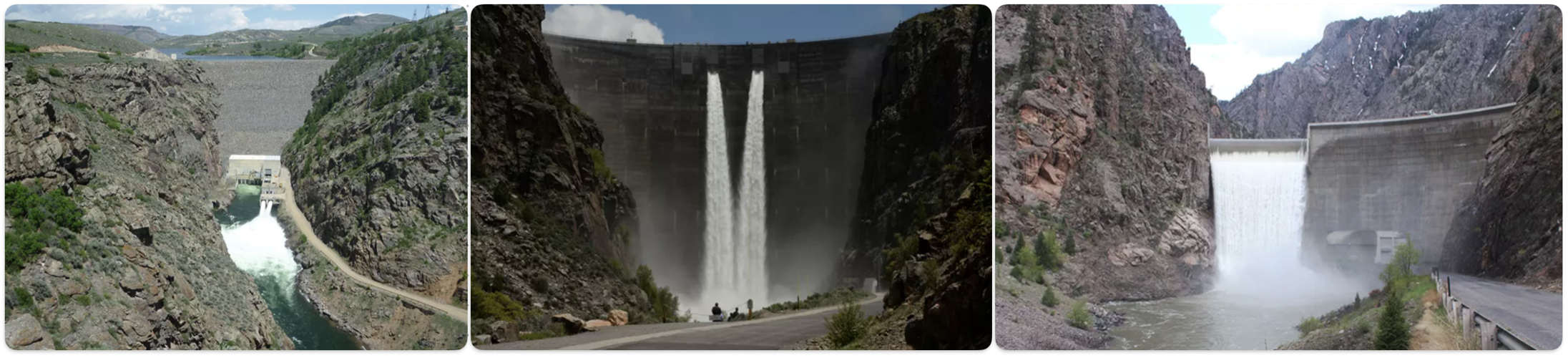
Ruedi Reservoir on the Fryingpan River is operated by the U.S. Bureau of Reclamation. Releases for the Colorado River Endangered Fish Recovery Program have boosted late summer and fall river flows in recent years. Credit: Heather Sackett/Aspen Journalism
Click the link to read the article on The Aspen Times website (River Stingray). Here’s an excerpt:
July 13, 2026
The city of Aspen’s Ruedi Hydroelectric Facility is anticipated to lose hydroelectric power in early August due to current U.S. Bureau of Reclamation reservoir forecasts and operating conditions. The updated reservoir data indicate that the timing has shifted later than previously anticipated, which the city’s Utilities Resource & Portfolio Manager Joshua Mattson confirmed to The Aspen Times. According to him, earlier planning projections that were provided by the U.S. Bureau of Reclamation indicated the reservoir could drop below the hydroelectric power pool threshold in mid- to late July.
“Updated reservoir elevations, inflow and outflow conditions, and U.S. Bureau of Reclamation operational forecasts now indicate the threshold is more likely to be reached in early to mid-August,” Mattson wrote in an email. “The shift reflects actual reservoir conditions improving relative to earlier projections and ongoing changes in reservoir operations and water demand. This remains a forecast and will continue to be evaluated as conditions evolve.”
The hydroelectric power pool represents the minimum reservoir elevation that is required in order to safely operate the hydroelectric turbine and associated equipment, according to an information update provided to Aspen City Council on Monday. When reservoir levels fall below this threshold, city staff will consequently take the Ruedi Hydroelectric Facility offline in order to protect equipment.
“This outage is not related to dam safety; rather, it is the result of hydrologic limitations associated with drought conditions,” the information update states. “The facility is expected to remain offline until reservoir levels recover above the minimum power pool elevation, which is anticipated to occur in spring 2027 as seasonal inflows increase.”
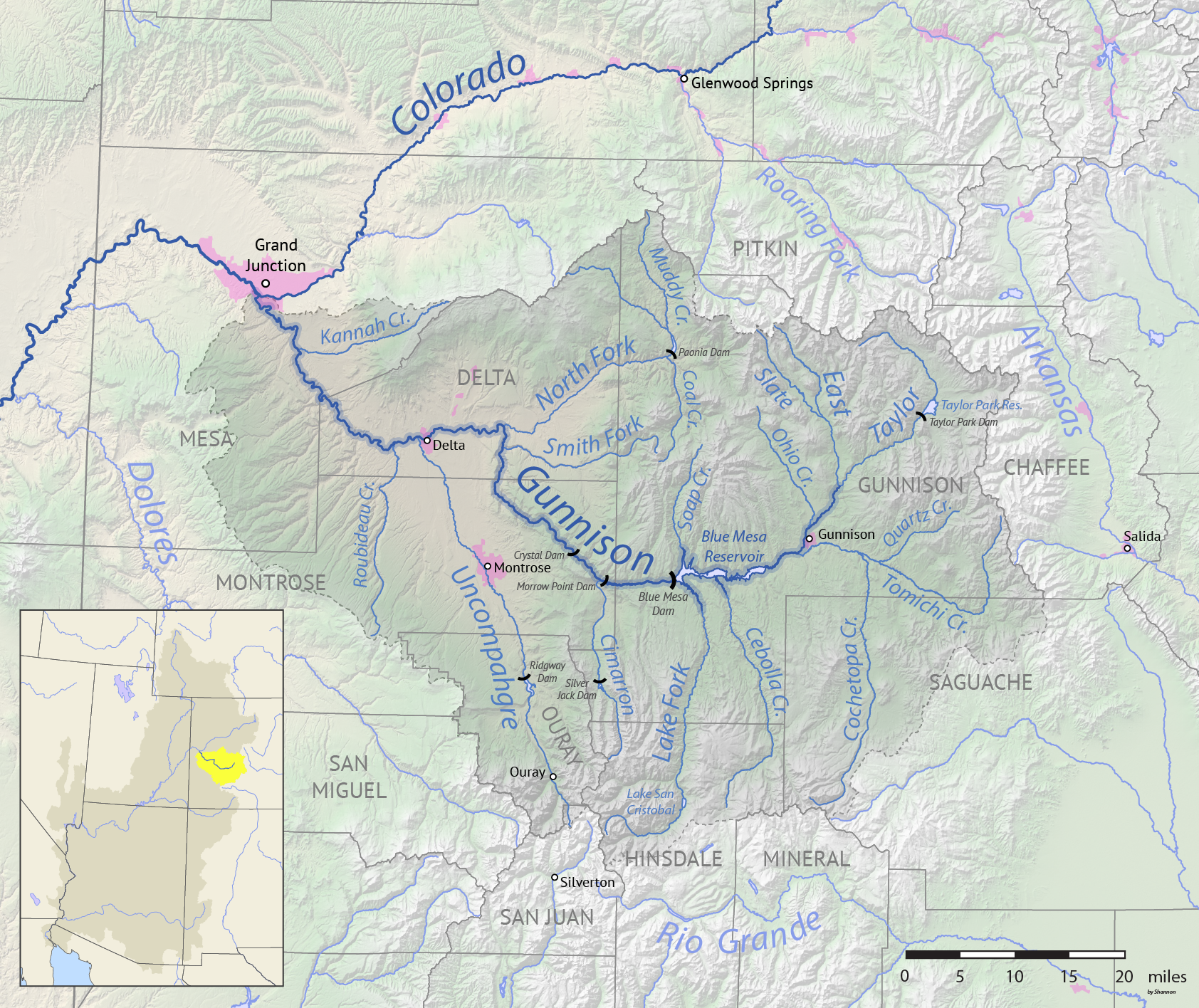
In the 1950s, the U.S. Bureau of Reclamation built the Blue Mesa, Morrow Point and Crystal dams west of Gunnison as part of the massive regional Colorado River Storage Project. The Bureau of Reclamation is currently in the process of replacing all four original valves at Blue Mesa Dam for the first time. (Photos/National Park Service)
The Wayne N. Aspinall Unit, Colorado’s only stake in a federal hydropower system that sells power across the West, is on pace to generate nearly 30% less electricity than its historical average dating to 1978, according to the Bureau of Reclamation. The shortfall is the latest sign of a decades-long decline eroding a system that accounts for about 3% of Colorado’s energy supply.
Aspinall Unit dams
The unit’s three dams on the Gunnison River — including Blue Mesa, Morrow Point and Crystal — make up Colorado’s only piece of the Colorado River Storage Project, a Depression-era network of federal dams selling power to municipalities, cooperatives, tribes and irrigation districts across the West. Blue Mesa Reservoir, the largest body of water entirely within Colorado, is expected to end the year at just 17% of its live storage capacity.
As the river shrinks under the stresses of climate change, so does the unit’s output. And the electricity that the waterway does not help to generate has to come from somewhere else, usually at a higher price.
Nationwide, residential electricity users have already seen an annual price increase of more than 7% in the year ending in March. Judging by Xcel Energy’s recent effort in Colorado to obtain rate increases that might exceed 50% by the end of the decade, additional hits to consumers’ budgets could become the most obvious consequence of the building crisis in the Colorado River Storage Project’s capacity to generate power.
That economic scenario is unfolding as the West braces for a surge in electricity demand from data centers built to power artificial intelligence. On June 18, the Federal Energy Regulatory Commission boosted the effort to hook up those large users when it ordered the nation’s six grid operators to speed transmission connections for AI data centers.
“We are setting the stage for a resilient, reliable, and forward-thinking grid that empowers communities and safeguards consumers by transforming the way large energy users access the grid,” agency chair Laura Swett said.
It’s a lopsided moment, since federal regulators are accelerating new demand onto a grid whose supply side, at least in Colorado, is apparently decaying.
A dangerous threshold
The mechanics of Colorado’s hydroelectricity system are straightforward, even if mostly invisible to consumers. Reclamation operates the dams. The Western Area Power Administration markets the power to “preference customers” at cost-based rates. The Aspinall Unit’s output is pooled with Glen Canyon, Flaming Gorge, and other project dams under the Salt Lake City Integrated Projects Area arrangement, so Colorado utilities hold a share of that pool, not an Aspinall-specific allocation.
Less water also means less pressure, or “hydraulic head,” through the turbines: At full pool, one megawatt-hour at Glen Canyon Dam on the Colorado River takes about 1.9 acre-feet of water and, at today’s lower elevations, roughly 2.9 acre feet, said Jen Pelz of the Flagstaff, Arizona-based Grand Canyon Trust, an environmental organization that advocates for conservation of Colorado Plateau natural resources.
The same mechanism plays out at Blue Mesa. At its current elevation of about 7,446 feet, the reservoir’s generating capacity is approximately 18% below the amount for which it was designed, said Nick Williams, Reclamation’s power manager for the Upper Colorado Basin. Electricity generation stops entirely at 7,393 feet, Blue Mesa’s minimum power pool.
A high desert thunderstorm lights up the sky behind Glen Canyon Dam — Photo USBR
Reclamation moved aggressively this spring to avoid a more dangerous threshold. In April, it projectedinflow at Lake Powell, behind the Glen Canyon Dam, at just 29% of average and warned that without action, the reservoir could fall below its minimum power-pool elevation of 3,490 feet by August. That is the point at which Glen Canyon Dam’s turbines stop generating.
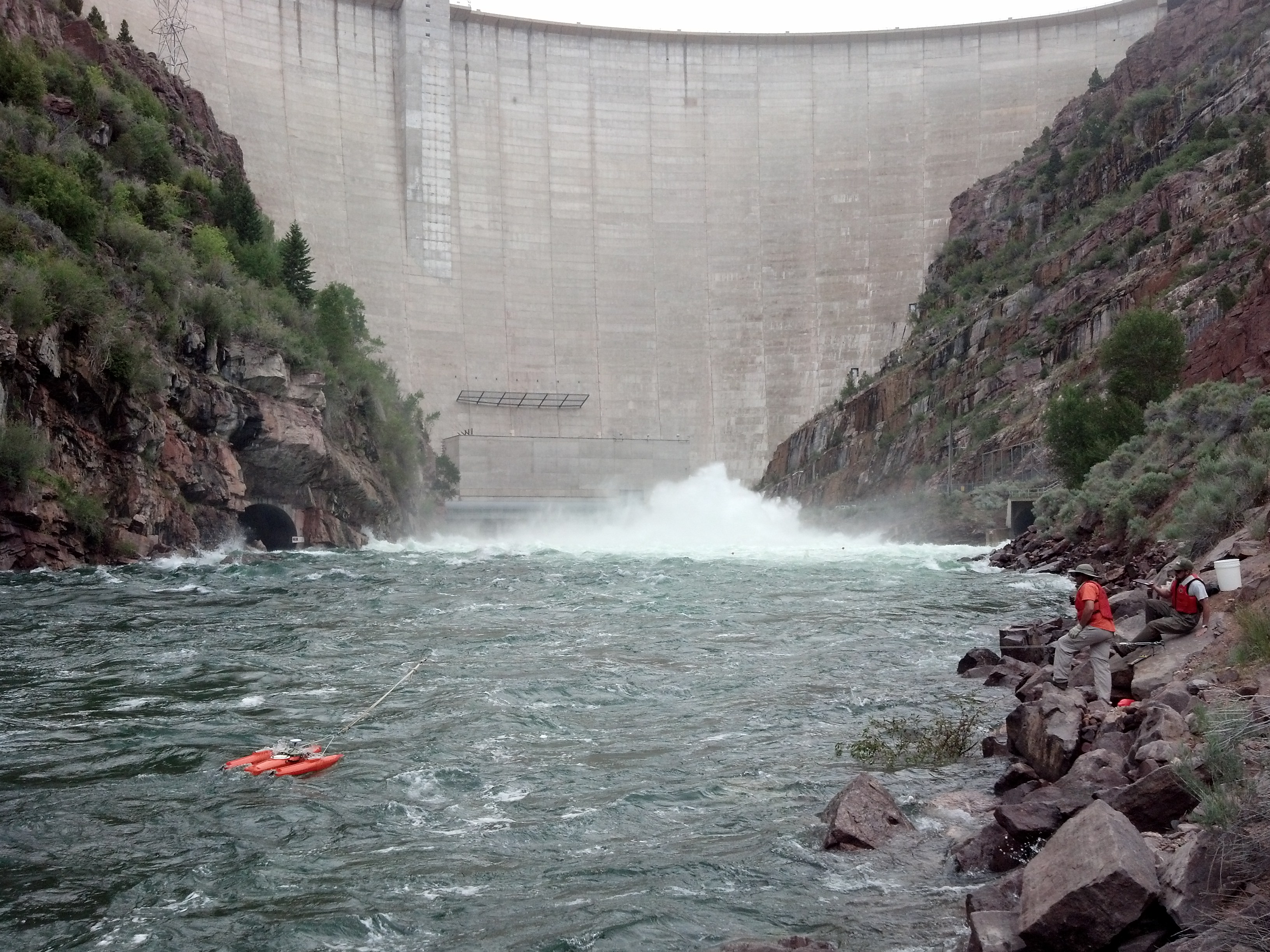
View below Flaming Gorge Dam from the Green River, eastern Utah. Photo credit: USGS
While the agency issued a more optimistic prediction in May, it nevertheless ordered additional emergency releases from Flaming Gorge Reservoir through April 2027 and cut Powell’s release to Lake Mead for the year by roughly 1.5 million acre-feet. That protects Glen Canyon’s generators, partly by drawing down Mead, which has in turn already cut Hoover Dam’s generating capacity by an estimated 5% to 8.5%. The Hoover Dam power production decline is already reflected in the agency’s June forecasts, according to Len Schilling, the Reclamation official overseeing dam operations in the Lower Colorado Basin. None of the agency’s moves solve the shortage. Instead, Reclamation decides, reservoir by reservoir, where the pain lands first.
A test of the cost gap
The clearest documented example of that pain in dollars comes from the Western Area Power Administration’s own numbers. From fiscal 2023 through 2025, the agency paid more per megawatt-hour for replacement power than it charges customers every year and roughly tripled its rate in 2023, narrowing to about 35% above it by 2025, according to a Colorado Newsline analysis of WAPA and federal energy data. WAPA also spent $18.9 million in 2024 and $6.5 million in 2025 on replacement power tied to “Cool Mix,” a protocol that bypasses Glen Canyon’s turbines to protect native fish downstream, according to a Colorado River Research Group report drawing on an Argonne National Laboratory analysis and figures from WAPA.
Platte River Power Authority, which supplies Fort Collins, Loveland, Longmont and Estes Park and holds a direct WAPA allocation, could be the clearest Front Range-based test of that cost gap. A spokesperson for the utility said it could not respond to questions before publication. A recent organization budget cited reduced federal deliveries and rising WAPA rates as adverse financial factors, but current estimated financial consequences for the power authority, and what it will mean for the utility’s customers, remain unclear. WAPA did not respond to requests for comment.
A smaller utility in the state offers a contrasting situation. La Plata Electric Association, the rural cooperative serving Colorado’s southwest corner, relies mostly on the Southwest Power Pool for its electricity supply after joining that regional transmission organization earlier this year. But the association’s chief executive officer, Chris Hansen, said the cooperative still relies on WAPA for a hydropower allocation tied to the Southern Ute Indian Tribe. That WAPA dependence amounts to about 3% of the association’s supply. Hansen said market access and a diversified portfolio buffer the small utility against hydrologic risk.
“Even if that 3% were to double in cost, which is possible, it would have a relatively small impact on our total cost of power purchases,” he said. “So we have low exposure. Other co-ops do not. For us it would be (a) relatively small change.”
Whether joining the Southwest Power Pool can give utilities facing more financial pressure much hedge against rising power costs is not yet clear. Sydney Welter, an energy markets policy advisor at Western Resource Advocates, explained that “with just three months of market operations and without having seen data from Colorado preference customers, I’m not certain what the long-term costs and benefits will be.” While the Brattle Group, an industry watcher, predicted that utilities would save tens of millions of dollars per year by joining power pools, it is not clear whether that is happening.
Rise in demand
Colorado lawmakers considered a bill this year that would have imposed accountability requirements on data centers. Senate Bill 26-102 was killed before the General Assembly adjourned in May, though the issue isn’t likely to fade. Xcel Energy, the state’s largest utility, expects large industrial customers, mostly data centers, to drive roughly two-thirds of its new demand. Nationally, data centers consumed an estimated 4.7% of U.S. electricity, a figure that Lawrence Berkeley National Laboratory projects could reach nearly 12% by 2030. Increasing data center electricity use in Colorado would add pressure to a system that is already experiencing supply reductions caused by the loss of flows at the Aspinall Unit.
That framework also shapes the deeper risk involving a “compact call” to the Lower Basin states demanding delivery of more water from Colorado, New Mexico, Utah and Wyoming. That has never happened in the Colorado River Compact’s history, but it could increase pressure on Western Slope water and power as Front Range cities lease senior water rights across the Continental Divide, according to University of Wyoming law professor Jason Robison.
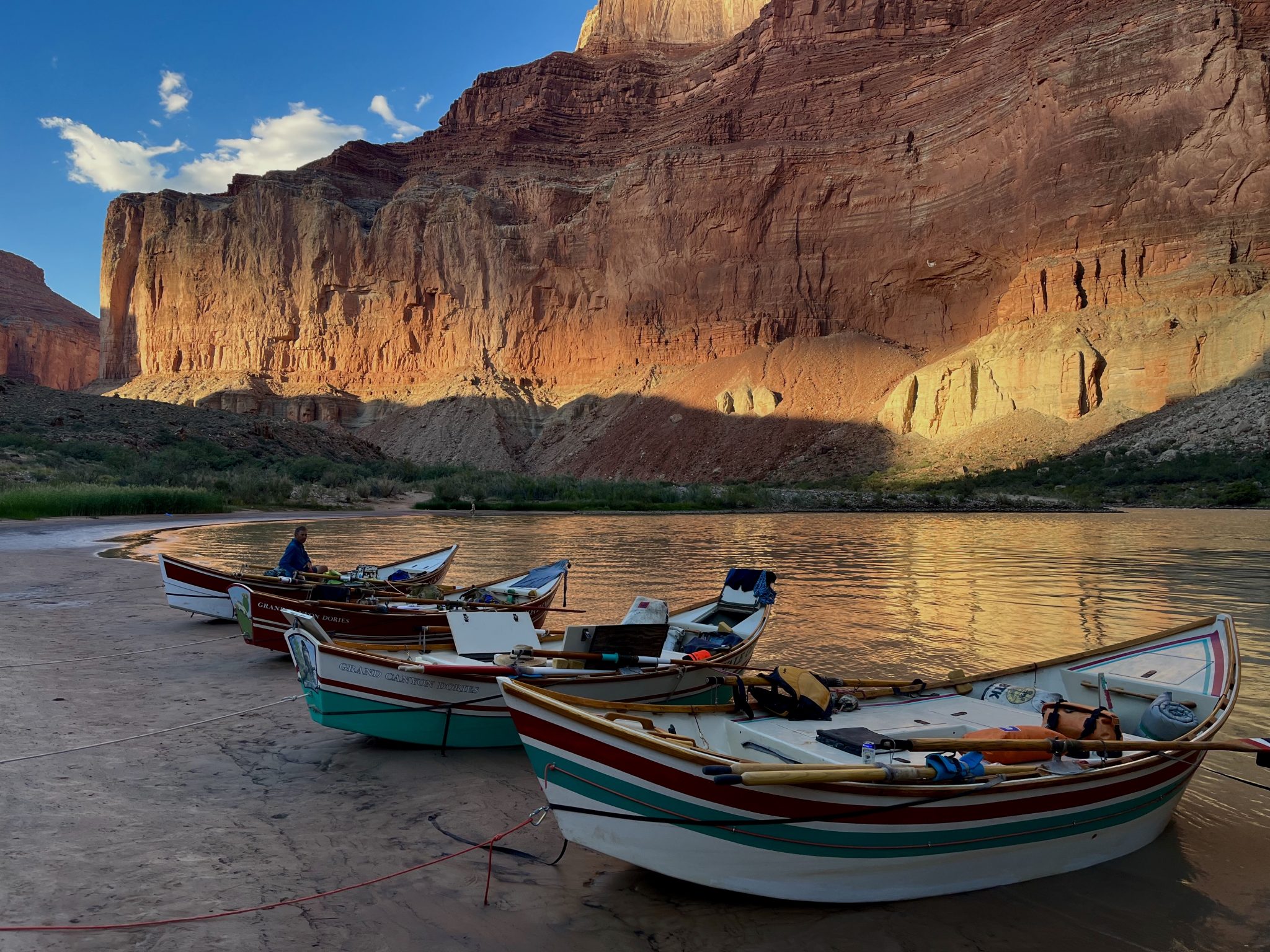
Dories at rest on a glorious Grand Canyon eve. Photo by Brian Richter
No one is predicting a call soon. But Pelz argues the standoff between electricity costs and environmental protection is a false choice: The Grand Canyon Protection Act of 1992 already requires dam operations consistent with the river ecosystem’s long-term sustainability, and Congress could have eased the cost pressure through diversified supply or a dedicated fund, but has not done so in the 30 years since that law was enacted. Reclamation is now studying a broader infrastructure fix at Glen Canyon Dam, with initial findings due in 2027.
That may be too late for the pressures already showing up this year at reservoirs like Blue Mesa.
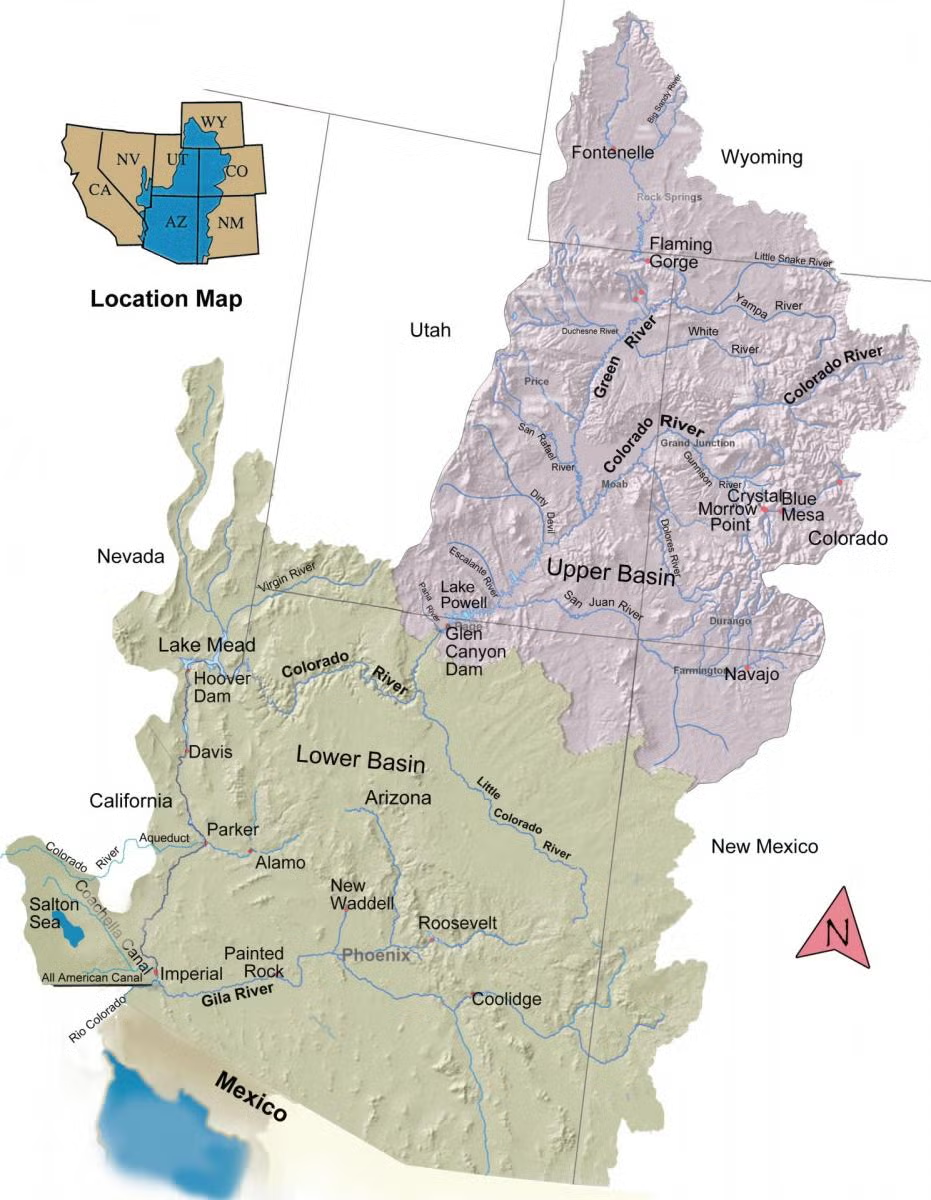
The Colorado River Basin spans seven U.S. states and part of Mexico. Lake Powell, upstream from the Grand Canyon, and Lake Mead, near Las Vegas, are the two principal reservoirs in the Colorado River water-supply system. (Bureau of Reclamation)
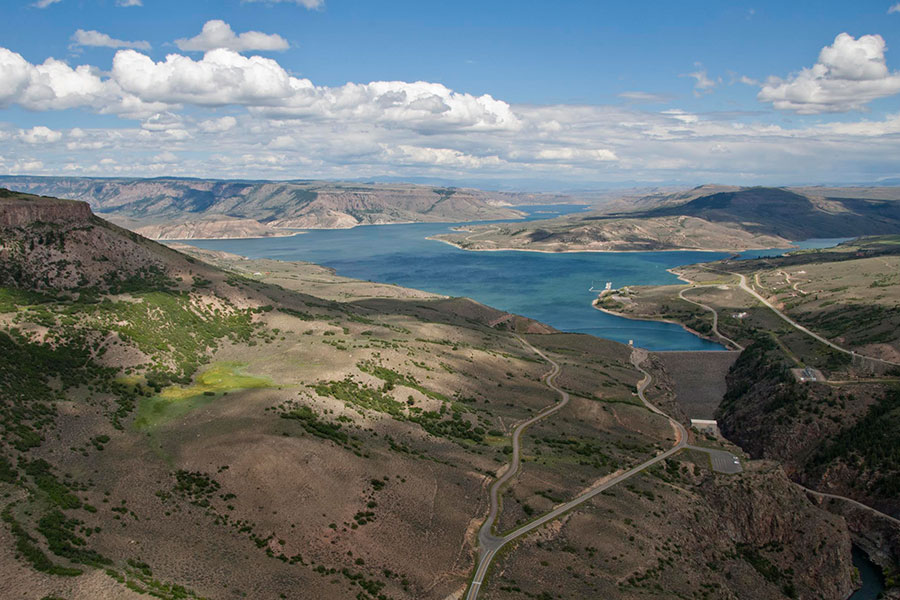
As of July 12, Blue Mesa Reservoir near Gunnison sat only 32% full at 266,000 acre feet of storage water — about 35,000 acre feet less than the historic minimum for that date, down 35%…Severe drought conditions at the reservoir have resulted in critically low storage levels, a limitation on water allocation to the Uncompahgre Valley and its agricultural water users, limited flows for releasing endangered fish species, decreased recreational opportunities on the water that go hand-in-hand with a downturn in the regional recreational economy, and uncertainty over power generation and water usage in the near future. Colorado River District spokeswoman Lindsay DeFrates called it a “crisis”, as the reservoir and the Wayne N. Aspinall Unit — which stores water and generates hydroelectric power through the reservoir as well as the Morrow Point and Crystal Reservoir dams — is one of the upper units that feeds the crucial Lake Powell downstream.
“Everyone’s looking downstream at Lake Powell while we have this happening in our backyard right now,” DeFrates said…
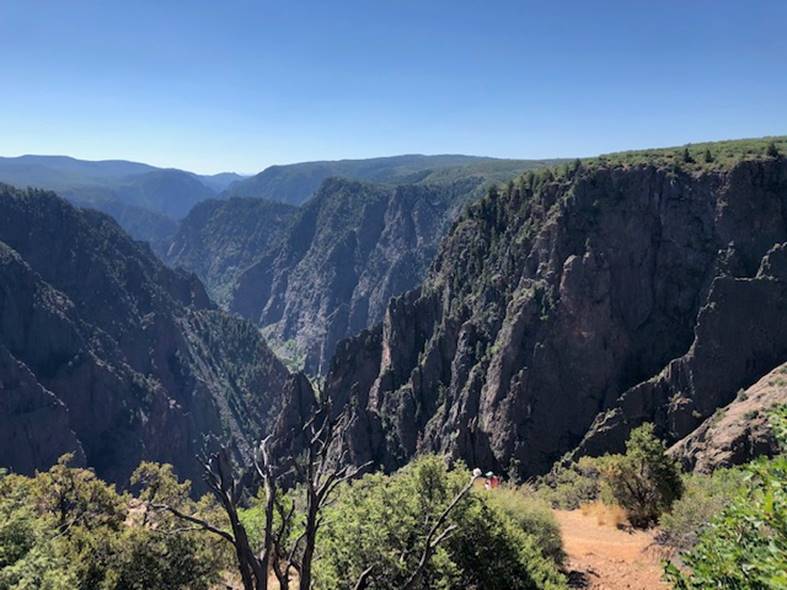
Black Canyon July 2020. Photo credit: Cari Bischoff
When he was the Division 4 assistant engineer for the Colorado Division of Water Resources (DWR), Jason Ullmann would have never entertained the notion that the Black Canyon of the Gunnison National Park’s portion of the river could ever dry up. Now, as the DWR director and Colorado state engineer, he said it’s unlikely to happen this year or next — but it’s “not an impossibility.”
“The actual inflow from April to July this year was the lowest on record. Barring a change in the climate conditions that produce this monsoon everybody’s waiting for, it doesn’t seem like we’re going to have a significant increase in inflow. We’re going to have one of the lowest inflow seasons — if not the lowest — on record at Blue Mesa,” Ullmann said. “Blue Mesa started the year approximately 20 feet below the normal level it would start the year on. The water levels are very low and will continue to drop.”
Colorado River District Senior Water Resources Engineer Caleb Foy compared 2026 to some of the region’s driest years — 1977, 2002, 2012 and 2018 — and said 2026 “takes the gold medal in terms of poor hydrological conditions”, impacting water storage at Blue Mesa Reservoir which, in turn, has multiple impacts downstream…
Foy noted that the reservoir’s storage could drop below the power pool level, which is the minimum amount of water needed to produce hydropower from the dam. According to the U.S. Bureau of Reclamation’s June 2026 24-month study, this drop could happen as soon as February 2027. According to other forecasts, this drop could happen as soon as the end of this summer if the region sees no monsoon conditions and current operations aren’t modified to preserve storage at the reservoir…A reduction in downstream flow would negatively affect downstream diversions, Colorado River flow, the Black Canyon of the Gunnison, and endangered fish species in both the Gunnison and Colorado rivers. The BOR has worked with Fish and Wildlife to temporarily reduce flow targets while trying to minimize negative impacts to endangered fish species. Ullmann said the minimal target flow for the Endangered Fish Recovery Rights is, in a typical year, no lower than 750 cubic feet per second. This year, the target is at 750 cfs — and last week, the flow was as low as 700 cfs. This has been alarming enough to spark conversations between the state and the BOR.
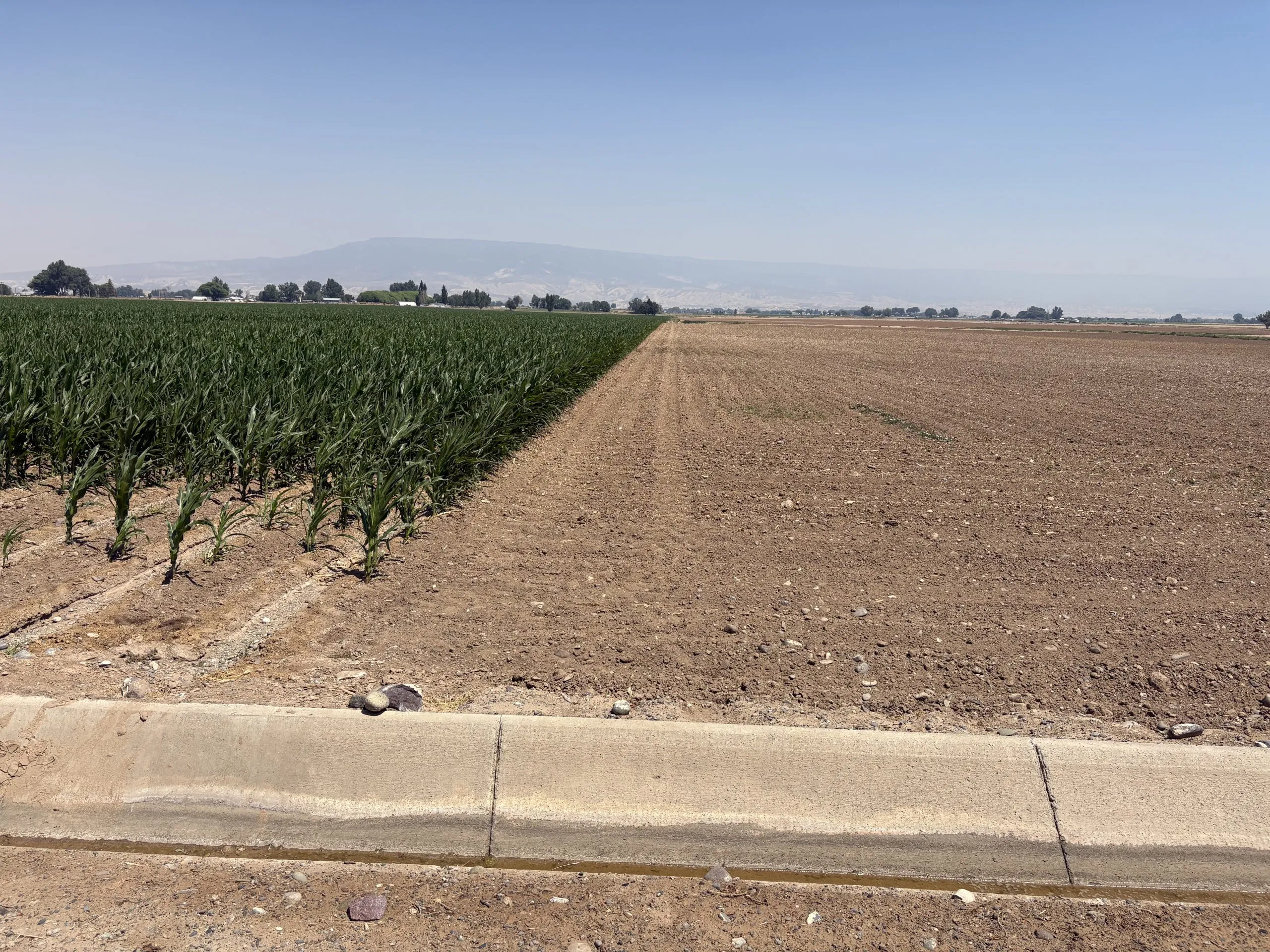
This field in the Uncompahgre Valley Water Users Association district has been fallowed this season (2026) due to a lack of water. The state of Colorado announced Wednesday that it will set up a conservation program using federal dollars, which means more fields on the Western Slope could soon look like this. CREDIT: HEATHER SACKETT/ASPEN JOURNALISM
In the culmination of a process that has been years in the making, Colorado officials Wednesday announced the creation of a state-run water conservation program.
In what officials are calling a “near-term contribution program,” the Upper Basin states (Colorado, New Mexico, Utah and Wyoming) will pay water users to voluntarily cut back in 2027 and 2028, using $100 million in promised funding from the U.S. Bureau of Reclamation. Colorado will now join Utah and Wyoming in setting up a conservation program within their respective states.
The noteworthy, long-expected announcement came at the regular July meeting of the Colorado Water Conservation Board, where board members considered the criteria for the program. A draft list says the program must, among other criteria, avoid negative community impacts; encourage contributions from across the state and water-use sectors; incentivize environmental benefits; encourage tribal participation; and build local drought resiliency. The board is scheduled to finalize the program criteria at its September meeting.
These types of conservation programs have traditionally targeted agricultural water users, often seen as the low-hanging fruit for water savings because they use the majority of Colorado River water. But officials are hoping this program will have participation across all water-use sectors, including municipal and industrial.
“I love that it is called a contribution program because that kind of imagines broader participation and engagement,” said board member Taylor Hawes. “So I think that is good. I think the more flexibility we can have, the better in a program like this.”
But details were scant on exactly how much water Colorado will contribute to the program and how the saved water would be used. And although some experts have begun calling for permanent reductions in water use, it remains — for now — a temporary, short-term program.
“We cannot guarantee a certain amount of water will be conserved in a given year because we don’t know how much water our water users are going to get,” said Amy Ostdiek, interstate section chief at the CWCB. “We have been clear that we just can’t do that.”
In a May letter to federal officials, the Upper Colorado River Commission said it has a goal of saving 100,000 acre-feet by the end of September 2028, which marks the end of water year 2028, but only if sufficient federal funding is available and hydrologic conditions allow. Colorado’s share of the Upper Basin’s allocation is 51.75%, meaning Colorado could be on the hook for 51,750 acre-feet over the next two years.
But Ostdiek said they are not at this time discussing a specific target that Colorado or the Upper Basin would have to contribute in exchange for the $100 million from the Bureau of Reclamation.
“We have felt confident that we can generate up to 100,000 acre-feet by 2028,” Ostdiek said in a Q&A session with the media after her presentation to the CWCB. “But really, what we’re going to be focused on is getting robust participation.”
It’s also unclear exactly how the saved water will be used. Officials said it’s not meant for use by the Lower Basin (California, Arizona and Nevada); it will be for the benefit of the Upper Basin. The water will need to have a home in Upper Basin storage buckets — Lake Powell, Navajo, Blue Mesa or Flaming Gorge reservoirs — but how it will fit into broader reservoir operations is unknown. [ed. emphasis mine]
“I think that is going to be the subject of ongoing discussion, exactly how this water is used and characterized,” Ostdiek said. “I think what we know is that it needs to be credited to or subject to the discretion of the Upper Division states in some way.”
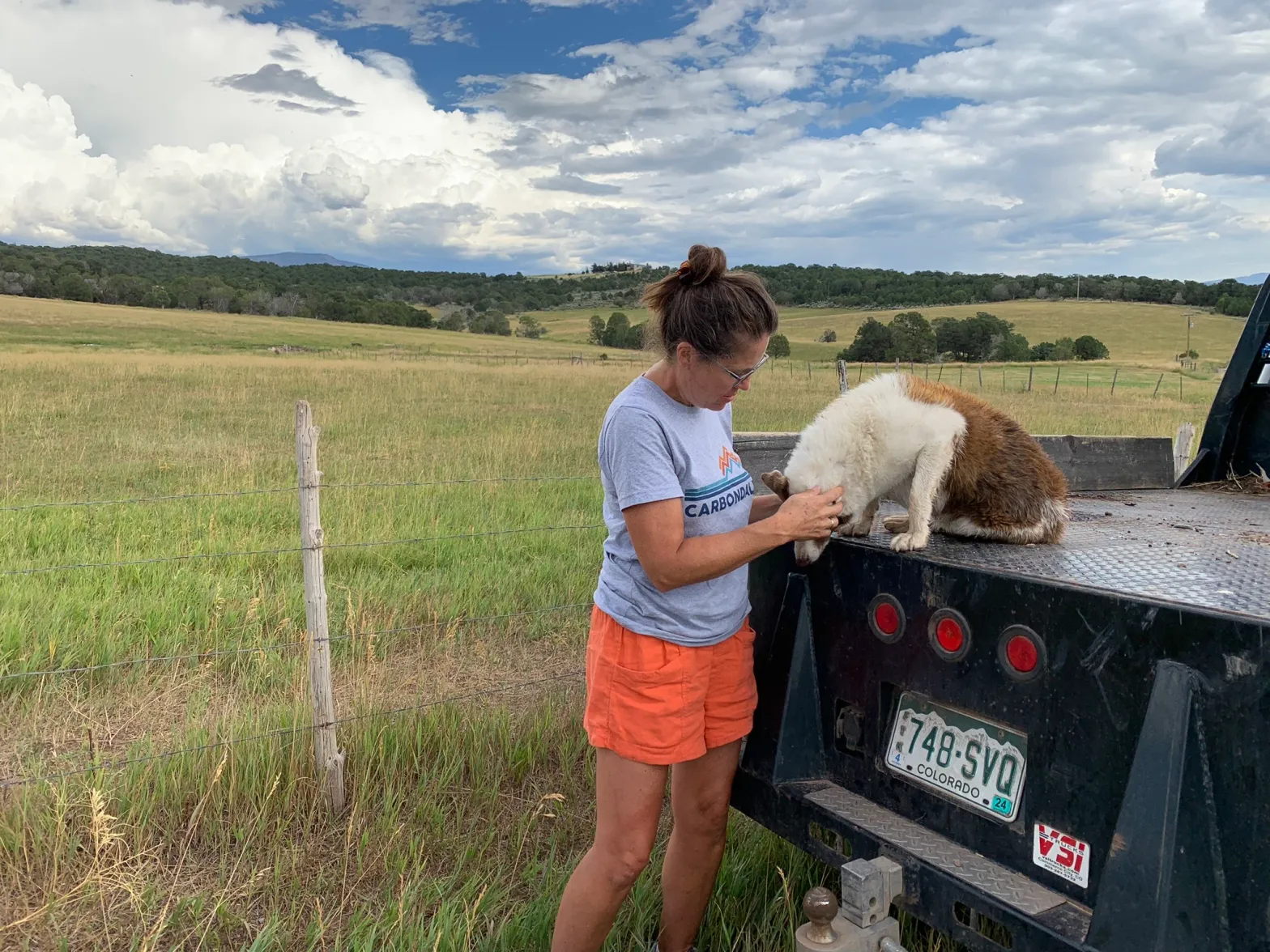
Missouri Heights resident Cassie Cerise pets her dog Dinah on her ranch outside of Carbondale in summer 2023. Cerise enrolled the field behind her in the Upper Colorado River Commission’s System Conservation Program, getting paid to not irrigate it. CREDIT: HEATHER SACKETT/ASPEN JOURNALISM
Conservation concept is not new
These types of programs that pay water users to cut back are not new to Colorado, and officials said they are incorporating the lessons learned from previous demand-management studies beginning in 2019, stakeholder input and pilot programs. The state participated in the 2023 and 2024 System Conservation Pilot Program, as well as an earlier version that ran from 2015 to 2018.
But conservation programs remain controversial. The Grand Valley Water Users Association, one of the largest irrigation districts on the mainstem of the Colorado River, did not allow its members to participate in SCPP for fear of negative impacts to other water users in the district.
All of the projects enrolled in SCPP involved agricultural water users on the Western Slope, a potentially risky situation, according to the Colorado River Water Conservation District. The Glenwood Springs-based agency, which represents 15 counties across the Western Slope, had tried to influence the creation of criteria for participation in SCPP to avoid negative impacts to rural agricultural communities.
Ultimately, only the Upper Colorado River Commission determined who got to participate in SCPP. Now, it seems state officials are taking to heart the River District’s recommendations. River District General Counsel Peter Fleming thanked Ostdiek for including some of the criteria that the district had set forth in its principles about how to create a conservation program.
Fleming encouraged the board members to adopt variable pricing to account for the difference in the value of relatively cheap water on the Western Slope versus more-expensive water on the Front Range. Pueblo Water had wanted to participate in SCPP, but the $509 per acre-foot offered in 2024 to Colorado participants was too far below market value.
“You can see the variable economic values of the water assigned there and the need to have variable pricing in order to encourage widespread participation,” Fleming said.
The River District’s position is that the entire burden of a conservation program shouldn’t be borne by the Western Slope, but must also be shouldered by Front Range water providers, who collectively deplete the Colorado River basin by about 500,000 acre-feet a year.
He added that a program should also have a strong element of local control.
“The River District obviously would like to stay involved in this process,” he said.
The creation of a conservation program for Colorado comes at a critical time for the basin, which remains locked in the grip of a historic drought, with combined storage in Lake Powell and Lake Mead at an all-time low since the reservoirs began filling. Although the Upper Basin has argued that it has never used its entire allocation granted by the 1922 Colorado River Compact (and therefore shouldn’t have to cut back), in the face of dwindling flows and calls for conservation from its downstream neighbors, the four states can no longer avoid reducing their water demand.
The Colorado River basin is also in the midst of a management crisis, with the seven states that share the river still unable to find agreement on a new framework after more than two years of failed negotiations. The current guidelines for how shortages are shared and how reservoirs are operated expire this year, and the feds are poised to step in with their own management plan, expected later this month.
The Upper Basin would need separate parallel agreements with Reclamation alongside the federal management plan to account for and get credit for water saved through the contribution program.
In her presentation, Ostdiek gave a preview of Reclamation’s expected plan, which could allow for a pool in Lake Powell to store up to 3 million acre-feet conserved by Upper Basin states. But board chair Barbara Vasquez worried about overestimating the amount of water that could be contributed given the recent historically dry conditions. Farmers and ranchers across Colorado are now experiencing the fallout from the worst snowpack on record in the form of shortages and fallowed fields.
“So prior programs, we spent a lot of money for very little water conserved. I worry that next year may be even worse than this year, and it’s not willingness, but ability,” Vasquez said. Given the water that’s available, she said, “that might disappoint expectations on the part of the negotiators at the table for the Colorado River.”
Aspen Journalism is a nonprofit, investigative news organization covering water, environment, social justice and more. Visit aspenjournalism.org.
Colorado River “Beginnings”. Photo: Brent Gardner-Smith/Aspen Journalism