

Click the link to read the article on the Outdoors Colorado Magazine website (Dean Miller):
July 10, 2026
By Tuesday morning, June 30, 2026, four CPW aquatics trucks were headed to Leadville. With fire conditions continuing to change and the window to move the fish uncertain, federal hatchery staff and CPW crews began moving fish by hand with dip nets.
Burning pine needles were falling from the sky as Josh Homer finalized evacuation plans for some of Colorado’s most important fish from the path of the Willow Fire on June 29.
Homer, complex manager for the U.S. Fish and Wildlife Service’s Leadville and Hotchkiss national fish hatcheries, was sitting near a pavilion at the Leadville National Fish Hatchery, coordinating with Bryan Johnson, Colorado Parks and Wildlife’s Mount Shavano Hatchery manager, to determine where rare cutthroat trout could safely go.
While they talked, smoldering pine needles landed around Homer. A firefighter approached and told him his team was getting nervous about conditions and was considering pulling out. The Leadville National Fish Hatchery, Colorado’s oldest, had operated since 1889.

Homer made the call to evacuate the fish.
The Willow Fire had started the previous afternoon about two miles northwest of the hatchery. Homer and Johnson had been watching the rapidly changing fire and preparing to move fish they had spent years working together to protect.

Johnson first learned of the fire while driving home from Fort Collins, when a former seasonal employee in Leadville sent him a photograph of smoke. He alerted CPW leadership, lined up drivers and had CPW aquatics trucks disinfected and prepared.
By Tuesday morning, June 30, four CPW aquatics trucks were headed to Leadville. With fire conditions continuing to change and the window to move the fish uncertain, federal hatchery staff and CPW crews began moving fish by hand with dip nets.
One person netted fish from a tank. Nets moved down a line of people to a waiting truck, where the fish were transferred into a transport tank.
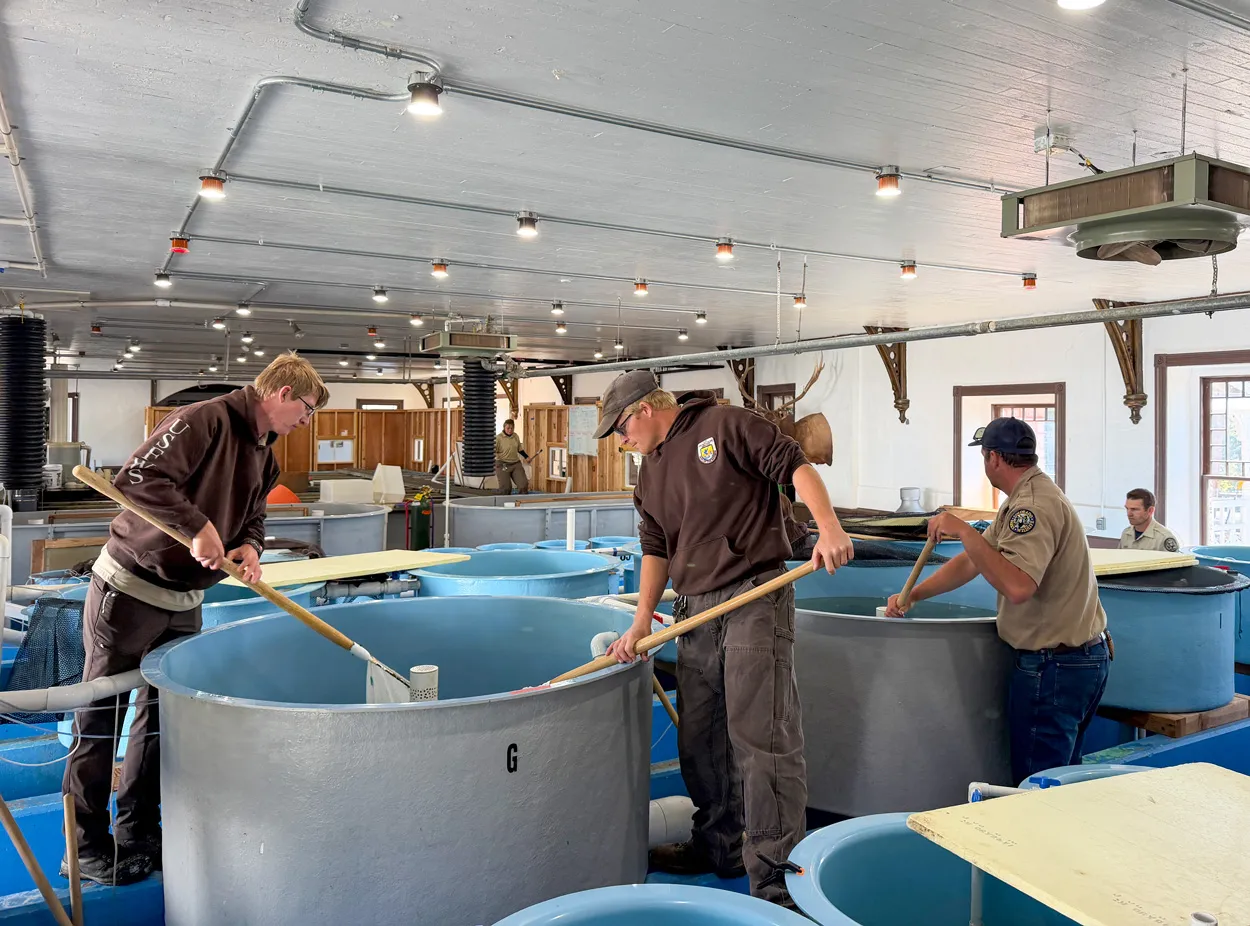
“My big goal was just to get them on trucks,” Johnson said. “Once we had them on trucks, I knew we could take care of them.”
Over the next three days, federal and state crews moved more than 148,000 fish, including rare native broodstocks, to CPW hatcheries and waters across Colorado.

Among the fish facing evacuation were Greenback cutthroat, Colorado’s state fish, and Hayden Creek cutthroat trout.
The greenbacks are a critical broodstock used in ongoing recovery work for a fish struggling to survive in the wild. Broodstock are adult fish kept to produce eggs and future generations. Leadville maintains one of only two broodstocks CPW relies on for the recovery effort.
“If we were to lose that stock, it would have been detrimental to the future survival of this species, period,” Homer said. “I trust CPW implicitly to do what’s best for these fish.”
That trust and the relationships behind the rescue had been built over years.
The federal hatchery maintains the greenback broodstock that produces future generations for recovery efforts. Colorado hatchery teams help manage the brood fish, raise their offspring and move fish to carefully selected waters across the state.

The partnership also had helped save the Hayden Creek cutthroat trout before.
Those fish trace to a population rescued as wildfire burned through their drainage in 2016. Survivors eventually were moved to Leadville, where hatchery professionals worked to raise the population and return fish to waters in the Arkansas River basin.
Now they faced wildfire again.
Johnson’s history with the greenbacks stretched back even further.
“I was there in 2008, the day we picked them up from Bear Creek and brought them into the hatchery,” Johnson said. “We’ve invested a lot of time in this.”
By Homer’s estimate, crews moved roughly 1,500 pounds of greenback cutthroat trout and several hundred pounds of Hayden Creek cutthroat trout by hand. The rainbow trout that followed represented nearly 10,000 more pounds of fish.
Crews estimated more than 90 combined hours physically moving fish Tuesday and another 48 hours Wednesday. That does not include driving time nor unloading at their destinations.


For hatchery crews accustomed to handling fish, the work itself was familiar. The scale and urgency were not.
Moving the fish also required precision. Multiple age classes of greenbacks and Hayden Creek cutthroat trout had to remain separate to protect genetics that hatchery professionals had spent years preserving. Crews assigned specific groups to individual transport tanks and labeled each movement.

“Everything was labeled and everything was moved purposefully to their new homes,” Johnson said.
At the same time, hatchery managers across Colorado were rearranging fish and searching for isolated space to receive the rescued broodstocks. Hatcheries already had been preparing for possible drought, low-water or wildfire rescues. The Willow Fire changed those plans and made the greenbacks the priority.
“When situations like this occur, we prioritize our workload and then we rally to get the job done. This was a prime example of that,” said Jeff Spohn, CPW Aquatic Branch deputy assistant director. “I couldn’t be more proud of the team’s communication, dedication and collaboration with not only our internal CPW staff, but also with our federal partners.”
Approximately 5,000 greenback cutthroat trout and about 1,500 Hayden Creek brood fish were moved from Leadville.
The fish were divided among CPW’s Mount Shavano State Fish Hatchery in Salida, Roaring Judy State Fish Hatchery in Almont, John W. Mumma Native Aquatic Species Restoration Facility in Alamosa, and Durango State Fish Hatchery in Durango. Greenbacks no longer needed for the broodstock were moved to Joe Wright Reservoir near Cameron Pass, where they can provide a recreational fishing opportunity. About 200 retired Hayden Creek brood fish were released into the Arkansas River south of the fire zone.

One group remained on a truck Tuesday night while Johnson cared for the fish and hatchery staff searched for appropriate isolation space. On Wednesday, July 1, Johnson drove them to Durango.
The rescue also included approximately 142,000 rainbow trout from the Leadville hatchery. Rather than risk losing the fish, crews stocked them earlier than planned into available waters.

Just more than three days after the Willow Fire started Sunday afternoon, nearly all fish had been moved from the hatchery.
Homer also praised his hatchery staff, some of whom worked long hours in heavy smoke while worrying whether their own homes might be threatened by the fire.
“I couldn’t be more proud of them,” Homer said. “They’ve done a tremendous job working in these adverse conditions.”
As of July 9, the Willow Fire had burned approximately 4,463 acres and was 16 percent contained. The Leadville National Fish Hatchery had not had any direct impact by fire at the time, and active fires appear to have skirted the property. In a fire-resistant facility at the center of the property, staff continue to care for the brood year 2022 Hayden Creek Cutthroat Trout with a fish relocation truck at the ready.

For CPW hatchery crews, safely evacuating the fish was only the beginning.
The rescued brood fish now are spread among CPW hatcheries, where populations and age classes must remain isolated to protect their genetics. Hatchery staff are monitoring their health and caring for brood fish moved in the middle of spawning.
“We’re going to do whatever it takes to keep these fish healthy,” Johnson said.
When the Willow Fire is no longer a threat and conditions allow, the hope is to return the fish to Leadville.
Until then, some of Colorado’s most important fish remain in the hands of people Homer knows well.
And trusts implicitly.

