Click the link to read the article on the Yale Climate Connections website (Bob Henson):
July 14, 2026
Our planet’s long-term, human-driven heating trend is almost certain to push into new record territory in 2027 – perhaps even this year – as an emerging El Niño event is on track to propel a vast storehouse of oceanic heat into the atmosphere. New results this month from an array of the world’s top climate models have only strengthened the outlook for a potential record-smashing El Niño event, most likely peaking toward year’s end.
In a detailed post at The Climate Brink on Substack, and in summary threads on Blueskyand X, climate scientist Zeke Hausfather, who has contributed to Yale Climate Connections, paints a stark picture of top-end climate models hurtling into truly uncharted territory – and of El Niño conditions now taking shape even more quickly than the jaw-dropping multi-model forecast.
According to Hausfather: “With the July runs now in from 667 ensemble members across 14 different seasonal forecast models, it looks like this year’s El Niño is not only very likely to be the strongest event since reliable records began – it may end up the strongest by a truly mind-blowing margin.”
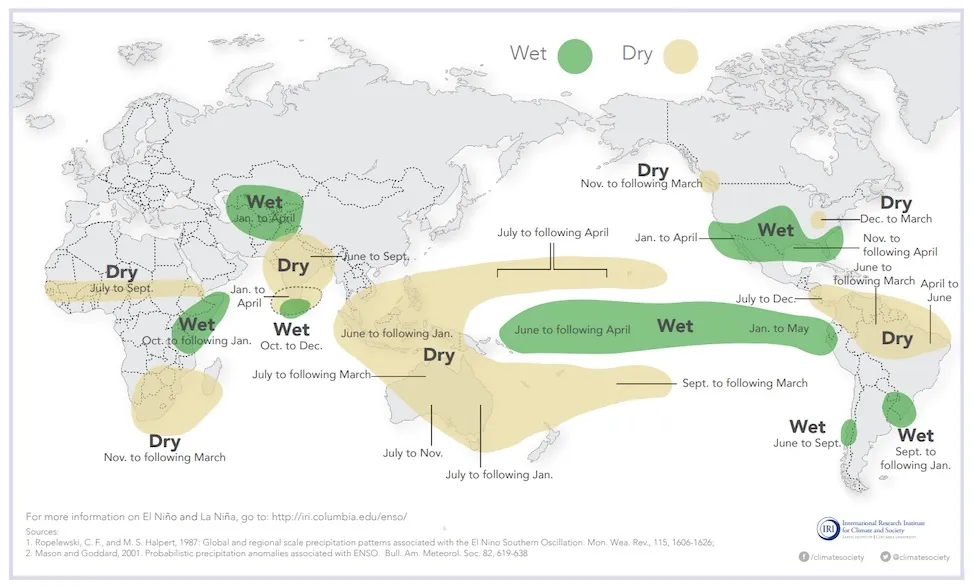
El Niño – a periodic warming of the waters of the eastern tropical Pacific – is the world’s single biggest shaper of global temperature and regional climate over periods of a few months to a year or more. Heat that’s stored in the ocean during the cool counterpart phenomenon, La Niña, rises from the eastern tropical Pacific during El Niño. The result is a spike in global temperature, as well as climatic reverberations that typically include drought over Indonesia and parts of South America and Africa, wet winters over the southern U.S., and a shift away from Atlantic hurricanes toward North Pacific hurricanes and typhoons (a shift already in progress).
Leading models have been predicting a 2026-27 El Niño for months now. What’s startling, as Hausfather outlines, is that the models have come into closer agreement even as their outlooks move further into record-strength territory.
Fig. 1 below shows every El Niño event in reliable data going back to 1877. Each one is assessed against the oceanic climatology of its era in order to distinguish the El Niño warming spikes from longer-term global warming. Pooling all the models, the consensus forecast for 2026-27 is for the El Niño to peak at around 3.6 degrees Celsius (6.5 degrees Fahrenheit) warmer than average. As shown in Fig. 1, that’s almost 1°C above the previous record over the past 149 years – a massive margin for such a broad range of models.
As Hausfather notes, “the models are forecasting something outside the envelope of anything we have ever observed.”
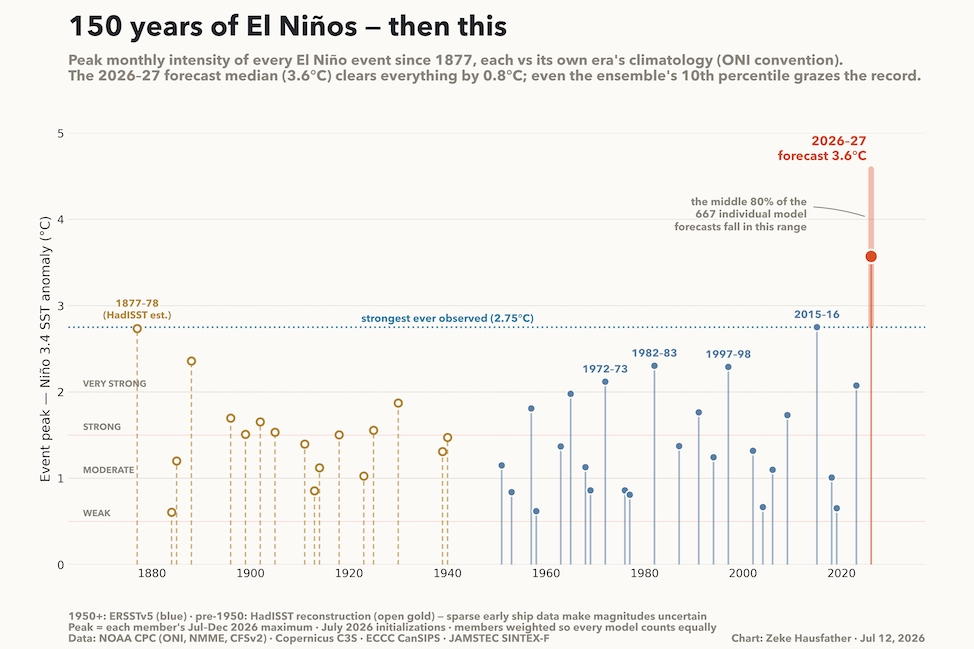
One caution: even though long-term warming is filtered out of the anomalies in the chart above, it’s clear that any El Niño event is now pushing against an ever-warmer ocean and atmosphere. Recent studies suggest this warmer context can influence the strength and even the locations of the seasonal reverberations driven by El Niño.
As a result, NOAA has moved from its original Oceanic Niño Index (ONI) to a Relative Oceanic Niño Index (RONI), which adjusts the strength of each event by the average sea surface temperature across the world’s tropics.
When RONI is used, it shifts the rankings of various El Niño events: For instance, the strongest to date becomes 1982-83, rather than 2015-16 as shown above. Because tropical ocean warming has been so dramatic in recent years, it’s made the RONI forecasts for the upcoming event slightly more muted than the ONI values in Fig. 1 above. Even so, using this updated yardstick, Fig. 2 below shows that the 2026-27 event remains an odds-on favorite to be unprecedented, with roughly a 77% chance of becoming the strongest El Niño on record.
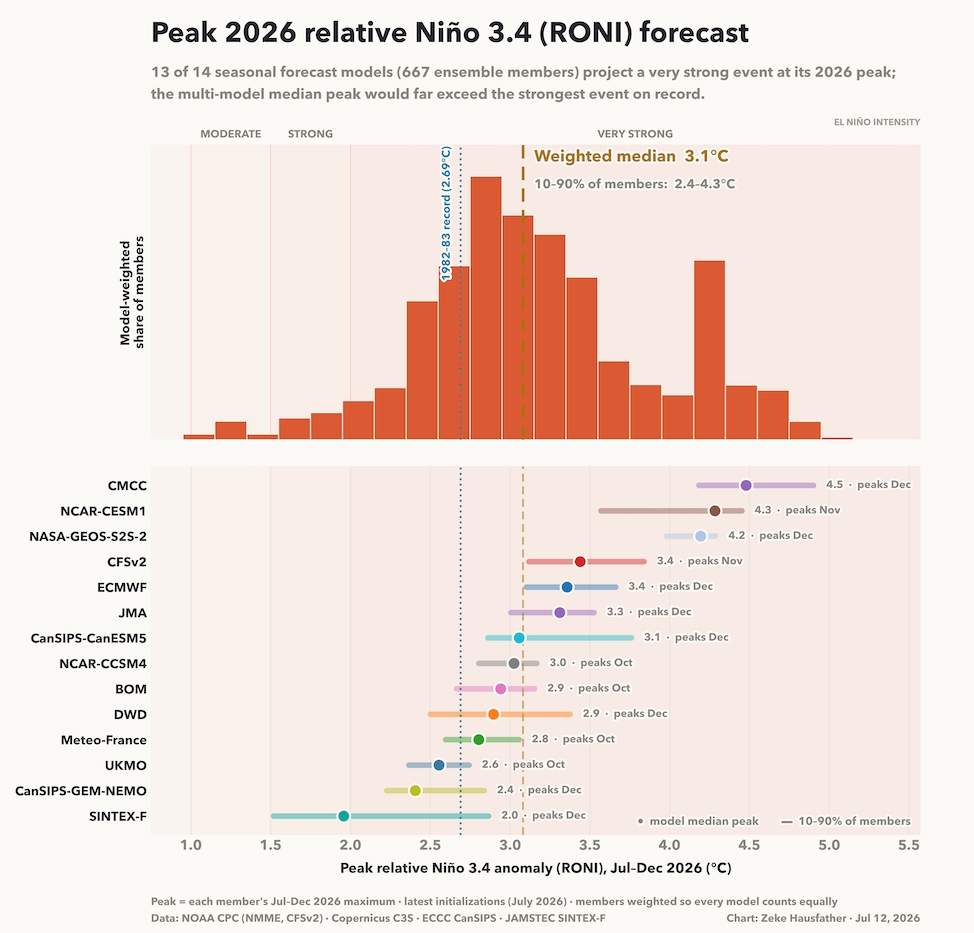
Hausfather notes that the current El Niño has emerged at record speed, adding: “Seasonal forecast systems have real, demonstrated skill at this lead time for ordinary events, but no ensemble has ever forecast (and then verified against) a 3.6°C El Niño, because one has never happened. Model agreement is reassuring, but it is not proof. But the uncertainties can cut both ways, and the observed ocean, not just the models, is already in uncharted waters.”
What can we expect – and what could surprise us?
Just as a model agreement isn’t a guarantee of model skill, even a record-setting El Niño event wouldn’t guarantee the usual impacts on regional weather and climate. However, it would certainly boost the odds of some of the more reliable outcomes, as shown below.
One of the most populous regions where El Niño has profound effects is South Asia and Southeast Asia. The rising motion over the eastern tropical Pacific typically triggers chains of atmospheric effects known as teleconnections. The result is favored areas of rising and sinking air and favored tracks for disturbances as they progress through the subtropical and polar jet streams. As they evolve, these teleconnections are modulated by whatever natural variations happen to be percolating through the global atmosphere.
In the case of Southeast Asia, the effects are most straightforward and reliable. “El Niño moves the precipitation to the east,” says Isla Simpson, a climate scientist at the National Center for Atmospheric Research, or NCAR. “It’s not so much a teleconnection as a feature of the coupled dynamics of El Niño in the tropics.”
As the entire warm pool of the western tropical Pacific, which nurtures rainfall across southeastern Asia, shifts into the El Niño region, areas to the west can be left largely high and dry for months, especially during northern winter. Massive fires have often broken out in Indonesia, fouling the air for tens of millions of people, and bushfires are a particular threat in Australia during El Niño.
During the build-up to El Niño, India’s summer monsoon is often less moist than usual, and that’s exactly what is happening now. India’s nationwide rainfall in the 2026 monsoon through July 13 was about 20% below the long-term average.
t’s easy to see the fingerprints of El Niño on this year’s tropical cyclones north of the equator. The Atlantic is off to its slowest start since 2009: as of July 13, there had been only one named storm, the weak and short-lived Tropical Storm Arthur. The NOAA/NWS National Hurricane Center was predicting no development in the Atlanticfor at least the next week, though there have been fleeting hints of possible development in the Gulf of Mexico more than a week out. Meanwhile, NHC was tracking a crop of four systems in the eastern and central Pacific, including three with greater-than-even odds to develop into at least tropical depressions by Friday, July 17. (None were expected to pose any immediate threat to land areas.)
As for North American weather, the biggest impacts from El Niño tend to be in fall and winter, as the seasonally strengthening polar and subtropical jet streams interact with a peaking El Niño event. Rainfall is boosted across much of the Sun Belt, with unusual dryness becoming more likely over the Midwest and the Pacific Northwest. Strong El Niño events tend to be wetter than average for California as a whole, but these outcomes vary widely, as emphasized by Jan Null of Golden Gate Weather Services.
For the time being, we’re getting a sneak preview of the temperature patterns that often prevail across the United States during El Niño winters: warmer-than-average toward the north and cooler-than-average toward the south. This week’s pattern is being driven by a sprawling upper-level ridge pushing slowly across the northern tier of states. Since it’s midsummer rather than winter, the setup includes scorching conditions spreading east from the Northern Rockies and Northern Plains toward New England. Several all-time record highs were set on Sunday in Montana, including Miles City (115°F), Billings Airport (111°F), Baker (110°F), and Sheridan (109°F), as well as in Utah, where Salt Lake City topped out at 109°F.
Meanwhile, slightly less-hot-than-usual weather has prevailed near the western Gulf Coast, where an upper-level disturbance has been moving slowly westward. The clouds and rain kept temperatures in the 70s and 80s Fahrenheit across parts of southern Texas on Sunday and Monday, which is unusually mild for mid-July, and the pattern has led to some serious localized flooding in Texas and Louisiana. We’re likely to see an uptick in flooding across parts of the southern United States as we move into fall and winter.
What about that weird cooling in the eastern tropical Pacific?
One wild card in play with this highly ambitious El Niño: will it be strong enough to overpower a countervailing influence that’s been surprising scientists and stakeholders alike? That influence is the tendency toward long-term cooling over much of the eastern tropical Pacific since the 1980s. It runs contrary to the warming of almost every other ocean basin on the planet (see our in-depth 2023 report and 2025 update).
The Pacific Decadal Oscillation, an index that reflects broad patterns across the Pacific, has been negative every month since January 2020 – an unprecedented stretch in 216 years of NOAA data.
Another part of this still-not-fully-explained trend: the increased prevalence of La Niña over El Niño events over the last several decades. For physical reasons, La Niña conditions are more likely than El Niño conditions to extend over two or more consecutive winters. With that in mind, over the past 30 years of the RONI dataset (1996-2025), there have been 15 northern winters with La Niña in control, compared to just eight with El Niño in place and seven with neutral conditions. Over the prior 30 years (1966-1995), the count was seven La Niña, 11 El Niño, and 12 neutral.
A 2025 study in the Journal of Climate, led by NCAR’s Clara Deser, analyzed how the atmospheric patterns associated with the recent decades of cooling sea surface temperatures in the eastern tropical Pacific and warming in the tropical Indian and Atlantic Oceans tend to run counter to El Niño, and how this can work to mute the strength of teleconnections. After running models to simulate the 2023-24 El Niño – whose effects were less intense than expected in many areas – Deser and colleagues found that overall warming in the tropical Indian and Western Pacific oceans likely played a role in tempering the broad impacts of the 2023-24 event in North America as well as Europe.
According to Deser and colleagues, “The evolving contributions of natural and anthropogenic influences on background SST trend patterns will undoubtedly interfere with teleconnections driven by El Niño and La Niña events in the future. Thus, historical precedent may no longer be a reliable guide to ENSO teleconnections as anthropogenic warming patterns intensify.” [emphasis added]
Since most long-term climate models still project warming in the eastern tropical Pacific for later this century, it’s also entirely possible that the classic El Niño effects could eventually get amplified rather than muted – which only adds to the complexity of planning for a world of human-caused climate change.
Jeff Masters and Irene Sans contributed to this post.