Judge asks to hear from engineer who approved the Subdistrict 1 Fourth Amended Plan of Water Management: Former State Engineer Kevin Rein’s testimony would be important in deciding whether to allow plan to go into effect, he says — Chris Lopez (AlamosaCitizen.com) #SanLuisValley #RioGrande

Former State Engineer Kevin Rein

Click the link to read the article on the Alamosa Citizen website (Chris Lopez):

July 17, 2026

Colorado Division 3 Water Court Judge Michael Gonzales said from the bench Friday that he wants to hear from former State Engineer Kevin Rein and without his testimony it will be “very hard for this court” and its decision on whether to allow the Fourth Amended Plan of Water Management in Subdistrict 1 to go into effect.

And that’s how Week 3 of the most important water trial in the past 25 years affecting the Upper Rio Grande Basin ended in Alamosa water court – the judge telling the state Division of Water Resources as it defends the plan that he would like to hear from the state engineer who approved the plan.

“Without hearing from Mr. Rein, it’s a concern,” Gonzales said.

Earlier during Friday’s afternoon session, he cautioned attorneys on their tone and their questioning of witnesses in a week when emotions inside the courtroom ran high.

“Let’s everybody cool their jets,” the judge said before he added an extra 10 minutes to the afternoon courtroom break.

The week opened with State Engineer Jason Ullman telling Gonzales that without the Fourth Amended Plan in action, Subdistrict 1 faces widespread curtailment since it will not meet the “sustainable” level of the unconfined aquifer by 2031 when the current plan of water management expires.

In 2018 Rein first alerted the Rio Grande Water Conservation District that broad curtailment could be on the table given the lack of progress in restoring the unconfined aquifer. It was then the subdistrict began working on a fourth amendment to its water management plan, which was ultimately adopted by the Subdistrict 1 board and then the Rio Grande Water Conservation District before Rein gave his sign off.

Ullman, who succeeded Rein as state engineer, told the court as he wrapped up his testimony that in his view the Fourth Amended Plan of Water Management, which features a one-for-one pumping mechanism, is the “most reasonable I can think of that would be likely to cause the aquifer to increase in level.”

The one-for-one features means the subdistrict would offset its groundwater withdrawals by returning an acre-foot of water for every acre-foot pumped during the irrigation season. The new plan also contains an overpumping fee of $500 per acre-foot which groundwater irrigators would pay if they cannot offset their groundwater withdrawals with their own surface water or surface water credits.

“Like I said, I understand that that decision has consequences, but there’s pretty significant consequences to doing something. And at some point as the policy decision makers, we have to make a decision to do something to meet these goals the General Assembly has set out. And I feel like that’s what we’ve done here. The consequences of doing nothing are much more drastic and draconian than the consequences of this plan,” Ullman told the court.

It was Rein’s review and sign off on the Fourth Amended Plan that has come under scrutiny by opponents to the plan. Rein retired at the end of 2023 after approving the plan and conducted this exit interview with Alamosa Citizen. During the conversation for an episode of The Valley Pod, he was reluctant to dive into the details of the plan because it was headed to water court and Judge Gonzales for a legal review.

In this exchange Rein was referring to litigation of the Rio Grande Compact and litigation over the Fourth Amended Plan of Water Management for Subdistrict 1 when he talked on The Valley Pod in December 2023.

San Luis Valley Groundwater

“Without saying too much about that and the groundwater management plan for the subdistrict, from my perspective as a state engineer, there’s one critical aspect of that for both cases and that is the sustainability of the unconfined aquifer. As we know, that’s a difficult component of groundwater management in the Valley because we have a statutorily required sustainability objective. And that has found its way into the rules and into the groundwater management plan for the subdistrict,” he said at the time.

He added that under the existing plan of water management for Subdistrict 1, “it’s going to be very difficult to meet that sustainability objective … And I know that the subdistrict has worked hard toward an alternative in this current plan that I approved and is before the court, and the way that plays out is going to be so important to the irrigators in the Valley.”

Ken Knox, a former employee of state Division of Water Resources who at one point served as acting state engineer for approximately 18 months, criticized Rein during his testimony Friday for not conducting a thorough review and that the plan in sections was “devoid of necessary information” to approve the plan by the state engineer.

Rein’s review was a “dramatic step backwards for professionalism of agency standards,” Knox told the court. He was the final expert witness for the Northeast Water Users Association and Sustainable Water Augmentation Group, who are asking Gonzales to throw the plan out on legal grounds.

Rein’s review was a “dramatic step backwards for professionalism of agency standards,” Knox told the court. He was the final expert witness for the Northeast Water Users Association and Sustainable Water Augmentation Group, who are asking Gonzales to throw the plan out on legal grounds.

The farmers opposing the plan are trying to thread a few legal arguments to persuade Judge Gonzales to reject the plan. Their contention is the Northeast Water Users Association and Sustainable Water Augmentation Group are being asked to bear a disproportionate share of the burden in the aquifer recovery efforts because they are groundwater irrigators. They contend Rein didn’t conduct a full legal review of the sustainability and proportionality rules contained in state statutes governing recovery of the unconfined aquifer and the $500 fee makes the plan beyond the economic means of all the irrigators who hold water rights in the subdistrict.

“My land would have no value,” groundwater farmer Asier Artaechevarria testified, acknowledging that his operations rely 100 percent on groundwater withdrawals.

Ernie Myers, another farmer opposing the plan and who served on the Subdistrict 1 board for a several years, said it was after 2002, when the Upper Rio Grande Basin first experienced historic low flows from a lack of snow runoff, that he first began to feel targeted as a groundwater irrigator and had the feeling that surface water farmers were trying to put him out of business.

“I was pumping their water. I had no right to pump their water. I had a few farmers telling me, ‘I’m third, fourth generation. You’re a newcomer. You came in ’73 with your father. You have no right to do what you’re doing,’” Myers testified.

“And were there actually people saying that they intended to put you out of business?” a SWAG attorney asked.

“Yes, yes,” testified Myers.

Myers was the first to testify on behalf of SWAG and the Northeast Water Users Association. Knox was their final witness, and it was after his testimony that Gonzales made his interest in Rein testifying known.

“Common sense means a great deal to me,” the judge said.

Common sense tells the judge he should hear from the person who approved the plan he’s being asked to give legal approval to. 

The trial resumes Monday with the L Cross Ranch, another legal opponent to the plan, making its arguments before Gonzales.

Rio Grande and Pecos River basins. Map credit: By Kmusser – Own work, Elevation data from SRTM, drainage basin from GTOPO [1], U.S. stream from the National Atlas [2], all other features from Vector Map., CC BY-SA 3.0, https://commons.wikimedia.org/w/index.php?curid=11218868

South Platte River Basin #climate for the week ending July 20, 2026 #SouthPlatteRiver

Below is the Precipitation Accumulation in South Platte graph from the NRCS for July 20, 2026. Precipitation is at 72% of the median (no change one week), and 60% of the water year median (up 1% one week), this morning. There are 72 days left in the water year.

There is a chance for thunderstorms today and Tuesday, and thunderstorms are likely Wednesday, with thunderstorms/showers likely Thursday, Friday, Saturday, and Sunday, in the central mountains. There is a chance for thunderstorms today and Tuesday, showers are likely Wednesday and Thursday, with thunderstorms likely Friday, and showers and thunderstorms likely Saturday and Sunday, in the northern mountains. There is a slight chance for thunderstorms today, a chance for thunderstorms Tuesday and Wednesday, with thunderstorms/showers likely Thursday, and a chance for thunderstorms/showers Friday, Saturday, and Sunday, down here about 5 miles from 17th & Market St in Denver where Soapy Smith operated his illicit gambling and bunco business. From the Denver Center for the Performing Arts:

Denver has had its share of secret societies over the years trying to avoid police investigation, but none was more colorful than a gang of criminals known as “The Soap Gang.” It was led by a handsome, black-bearded scoundrel named Jefferson Randolph Smith. Or “Soapy Smith” as he came to be known. Soapy arrived in Denver in 1886 and started a love affair with the city that lasted 11 years. He was probably the most skilled and accomplished sleight of hand artist and swindler in the West…To operate a con game of this nature, Soapy needed confederates: bunco steers to bring in the marks; cappers, stooges, and shills to get the suckers buying, and strong-arm men in case someone caused trouble. So Soapy formed a secret gang. The Soap Gang was the greatest collection of billwrappers, con artists and thugs in the West. There was Fatty “Shoot-Your-Eyes-Out” Gray, a mean 300-pound bodyguard. “Troublesome Tom” Cady, who carried a sword cane. “Ice Box” Murphy, who got his name when he accidentally blew up what he thought was a safe only to be showered with cold cuts. The “Reverend” Bowers was a pious-looking man who mastered every “secret” handshake of every fraternal organization and would lead his new “friends” directly to Soapy for a plucking. Soapy’s gang became so powerful that no criminal could pull a job in Denver without his permission, and through bribes and extortion, he controlled the police and politicians. He based his operations out of the Tivoli Saloon and Gambling Hall on the corner of 17th and Market. Once when he was hauled into court for operating a crooked game, he spoke in his own defense. “At the Tivoli, I am running an educational institution that provides a cure for gambling. The man who steps into my place has, of course, no chance of winning a cent, because in my games the player cannot win. When he leaves, he is disappointed, naturally, but he has had an experience of the greatest value.” Case dismissed…David H. Waite was elected Governor of Colorado on a reform bill. In a rash move, and knowing the level of corruption that existed, he fired everyone at Denver City Hall and ordered them to leave the building, then located at 14th and Larimer. Insisting the governor had no authority to do that, the politicians refused. Governor Waite called on the state militia. City officials called on Soapy. Within hours, Soapy armed dozens of thugs and placed them in strategic windows, while he took a position in the tower of City Hall with dynamite bombs he intended to throw on any attackers. On March 15, 1894, 300 state troops gathered before the building and trained cannon and Gatling guns on it. The Denver Post reported that Soapy in the tower shouted down to the troops, “I’m closer to heaven than you are, but if you come any closer, you will get there first.” General Brooks, commanding the militia sent a hurried message to Governor Waite. “If a single shot is fired, they will kill me instantly and they will kill you in fifteen minutes. But if you say fire, we’ll fire.” Horrified citizens stormed the Capitol and Governor Waite backed down. “Colonel” Smith, as he now called himself, was the king of the underworld and ruler of Denver.

Portrait of Jefferson Randolph (Soapy) Smith, gambler and con-man. Date: 1890-1898. Denver Public Library Special Collections,

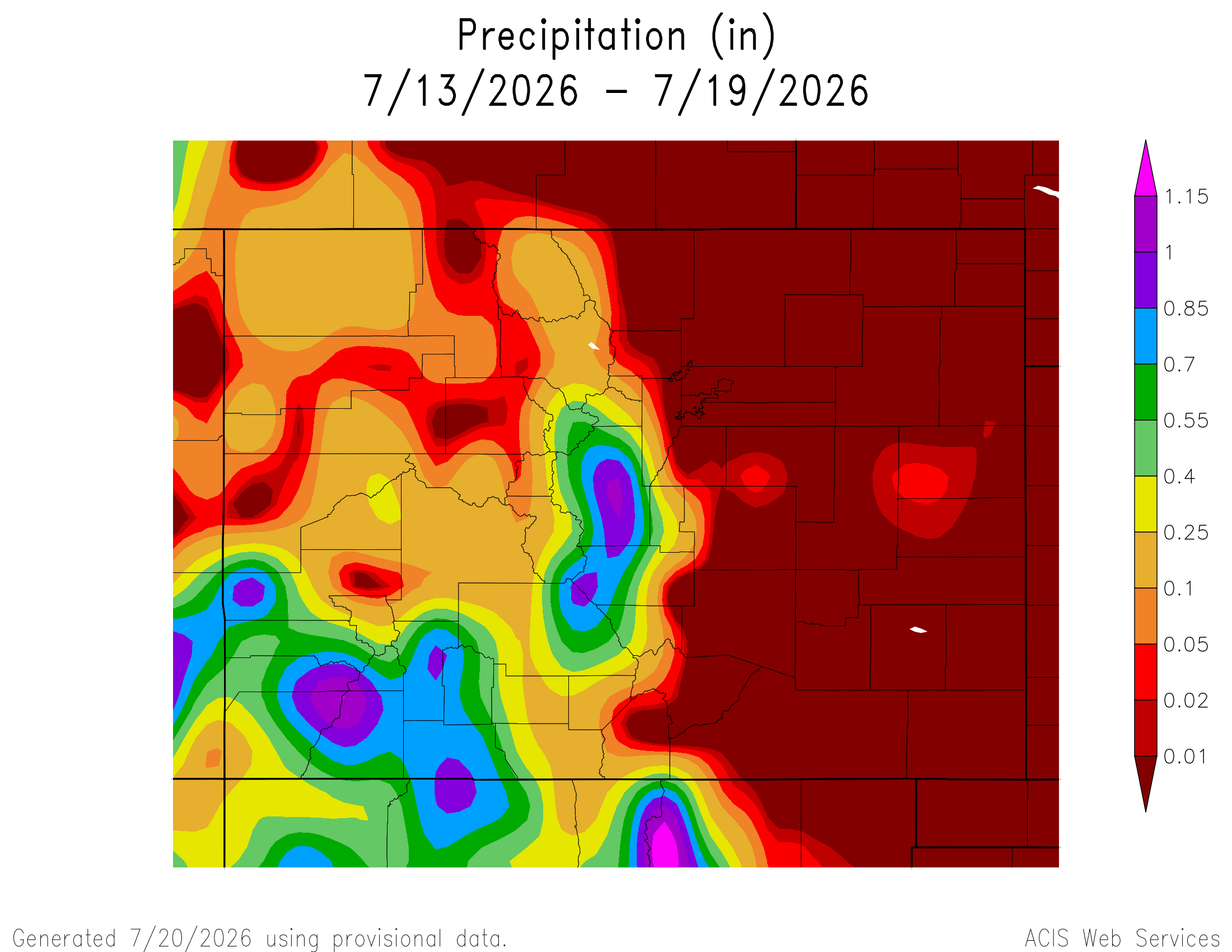
Here’s a look at the 7-Day Colorado precipitation map through July 19, 2026 from the High Plains Regional Climate Center. Precipitation in the South Platte Basin along the Continental Divide of the Americas ranged from 0.10” to 1.15”.

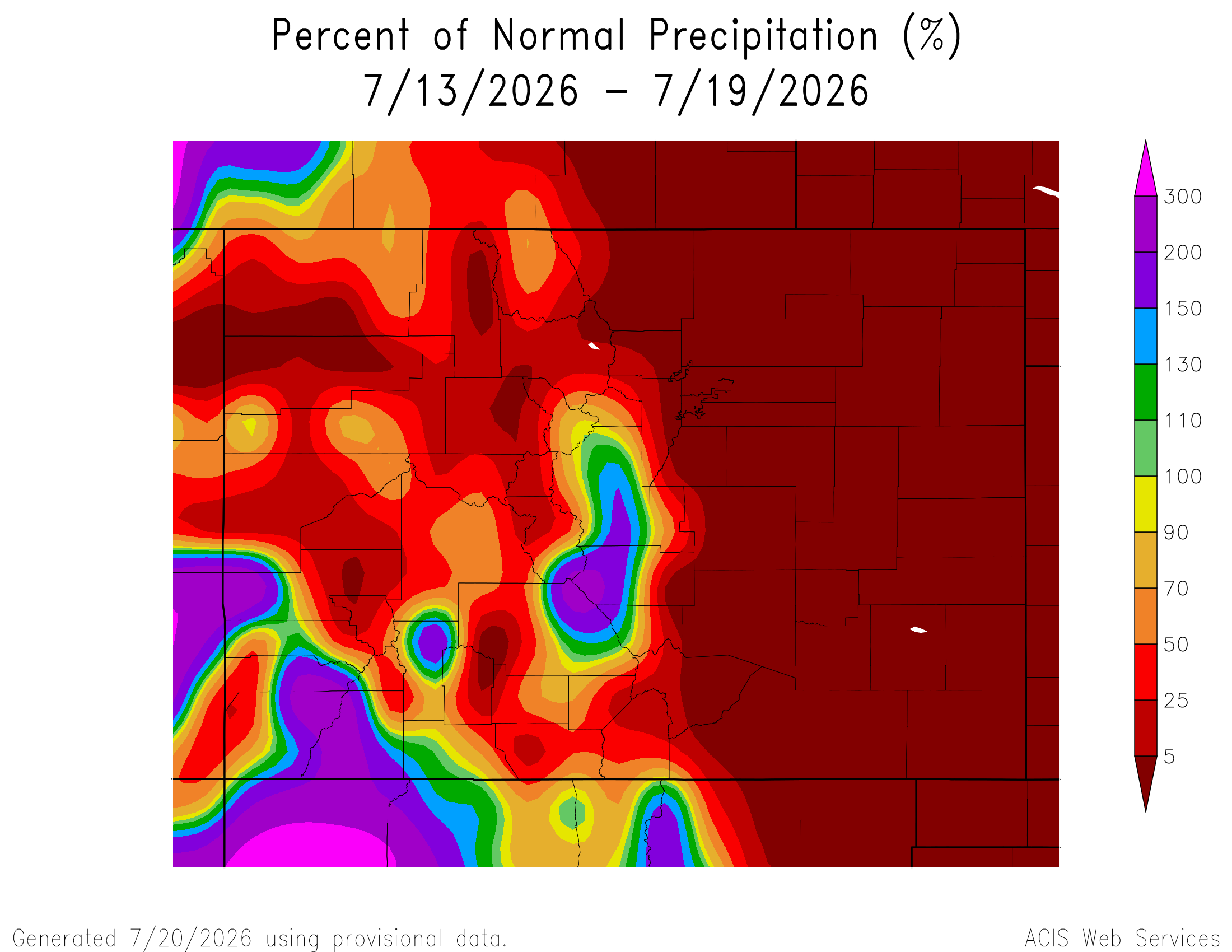
Here’s the 7-Day percent of normal precipitation map through July 19, 2026 from the High Plains Regional Climate Center. Precipitation in the South Platte River Basin along the Continental Divide of the Americas ranged from 25% to 150% of normal.

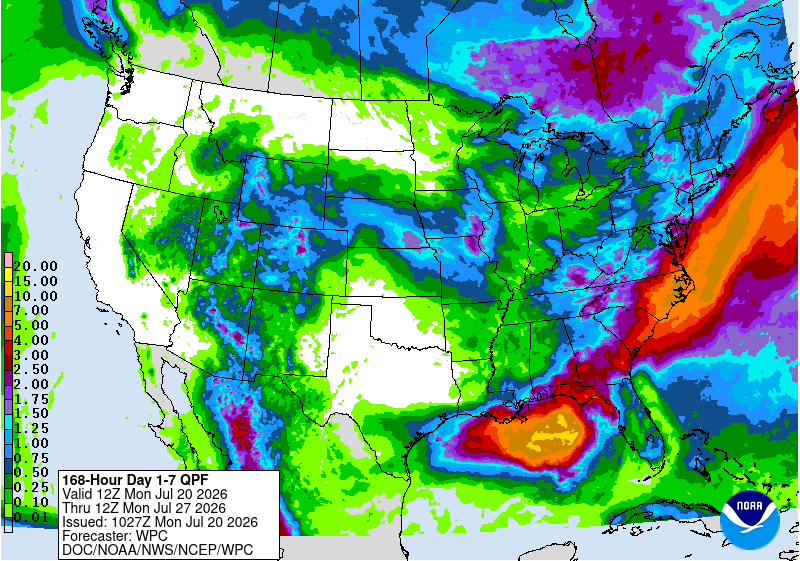
Below is the 7-day Quantitative Precipitation Forecast for the week of July 20, 2026. Precipitation is anticipated for the mountains of the South Platte River Basin and may total up to 1.00″.

Below are the 8-14 day outlooks from the Climate Prediction Center, issued July 19, 2026, for temperature and precipitation, for the week starting July 27, 2026. The CPC expects above normal temperatures and near normal precipitation for the mountains of the South Platte River Basin.

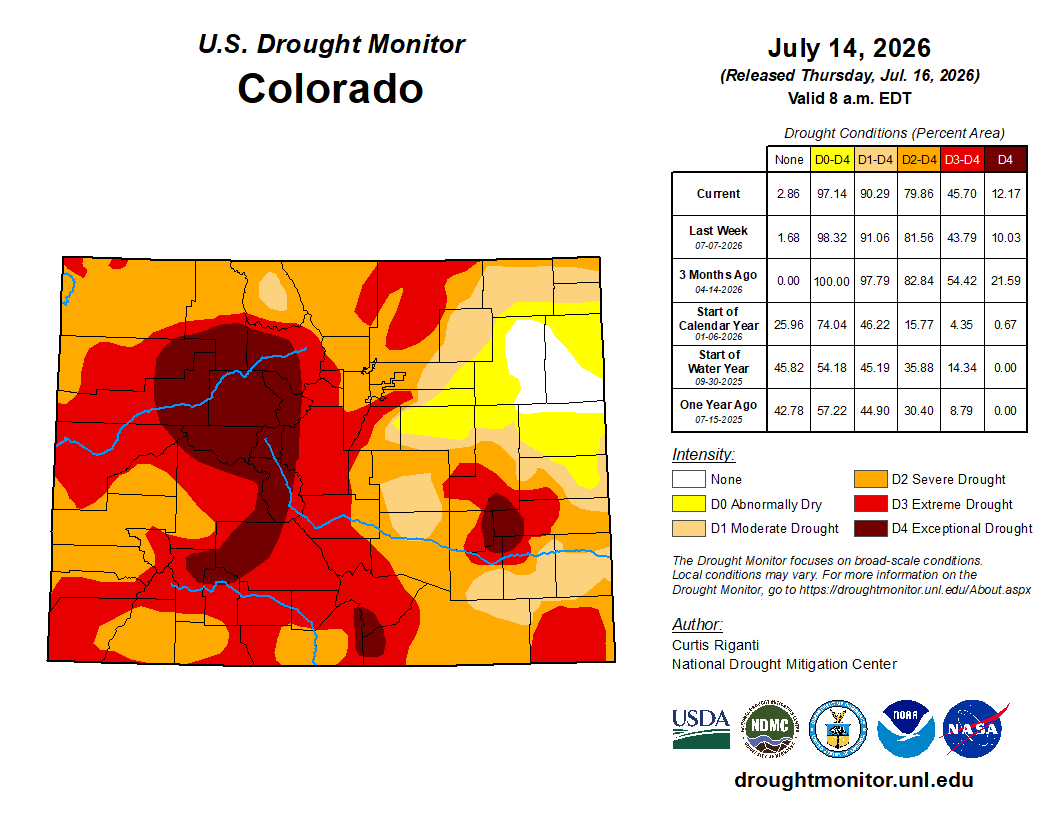
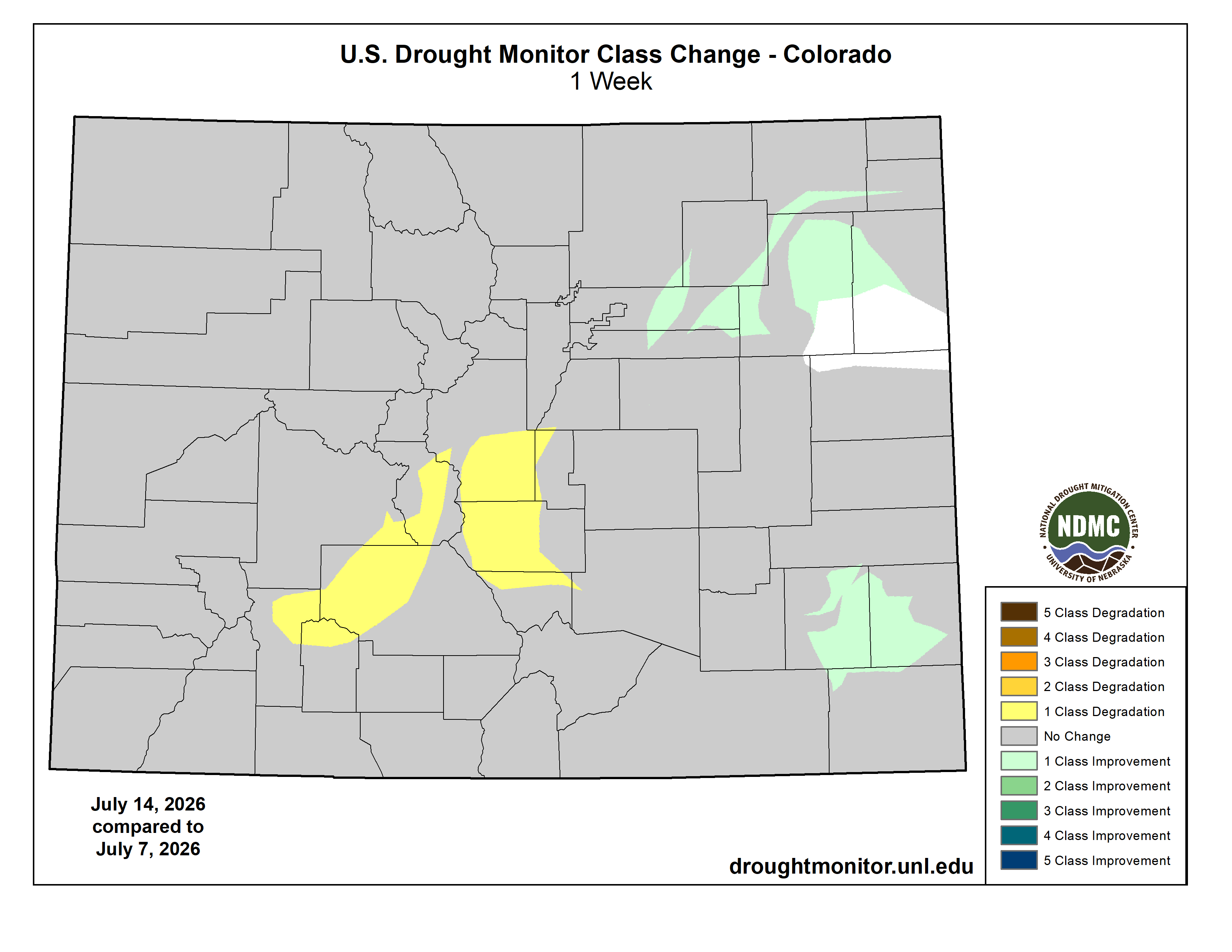
Below is the Colorado Drought Monitor map from June 14, 2026. There were one class degradations in Park and Douglas counties, in the South Platte River Basin. There were one class improvements in Arapahoe, Adams, Weld, Morgan, and Logan counties. Drought and abnormal dryness covers 97.14% of Colorado. The South Platte Basin is experiencing Abnormally Dry, Moderate, Severe, Extreme, and Exceptional drought conditions.

Colorado Drought Monitor map July 14, 2026.

Below is the Colorado Drought Monitor one week change map ending July 14, 2026.

Colorado Drought Monitor one week change map ending July 14, 2026.

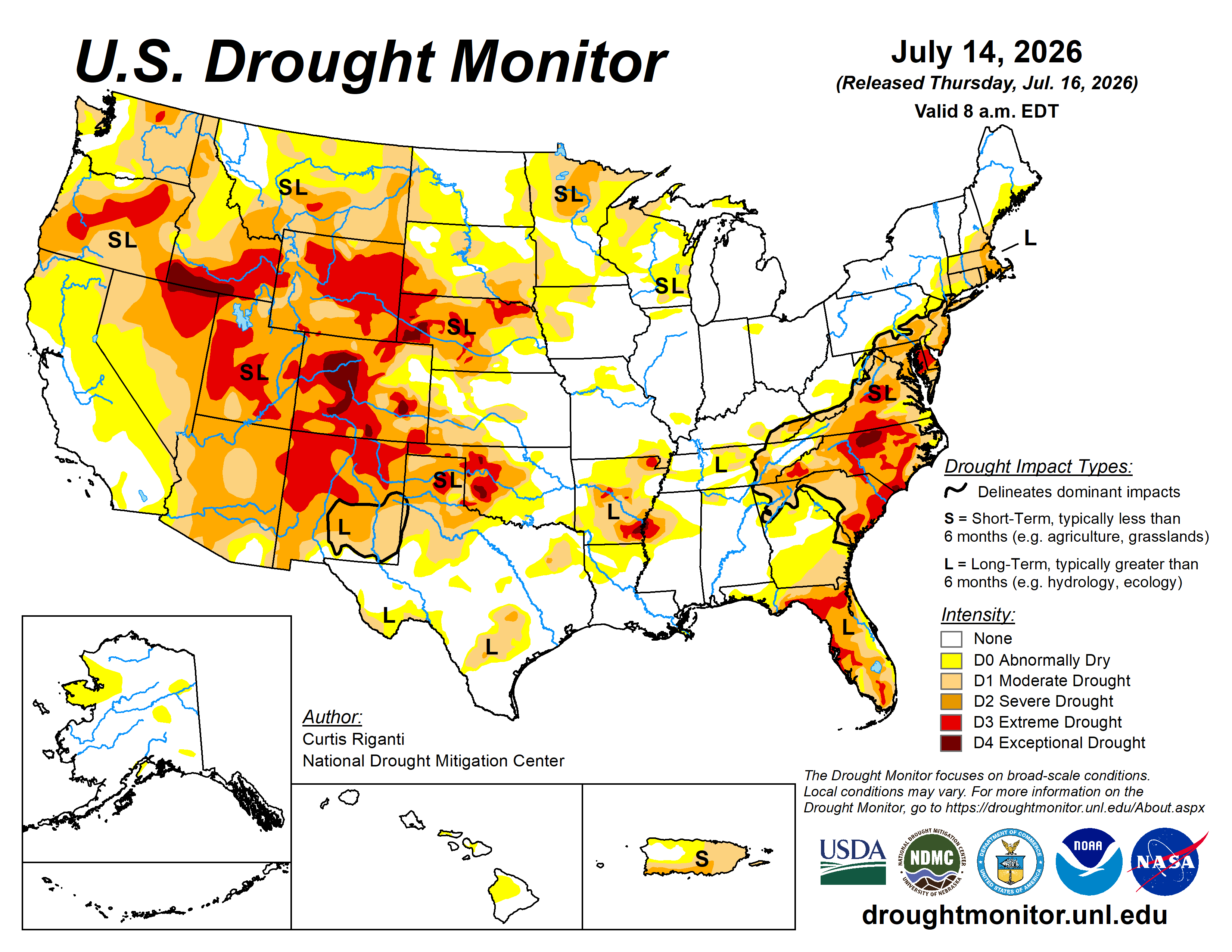
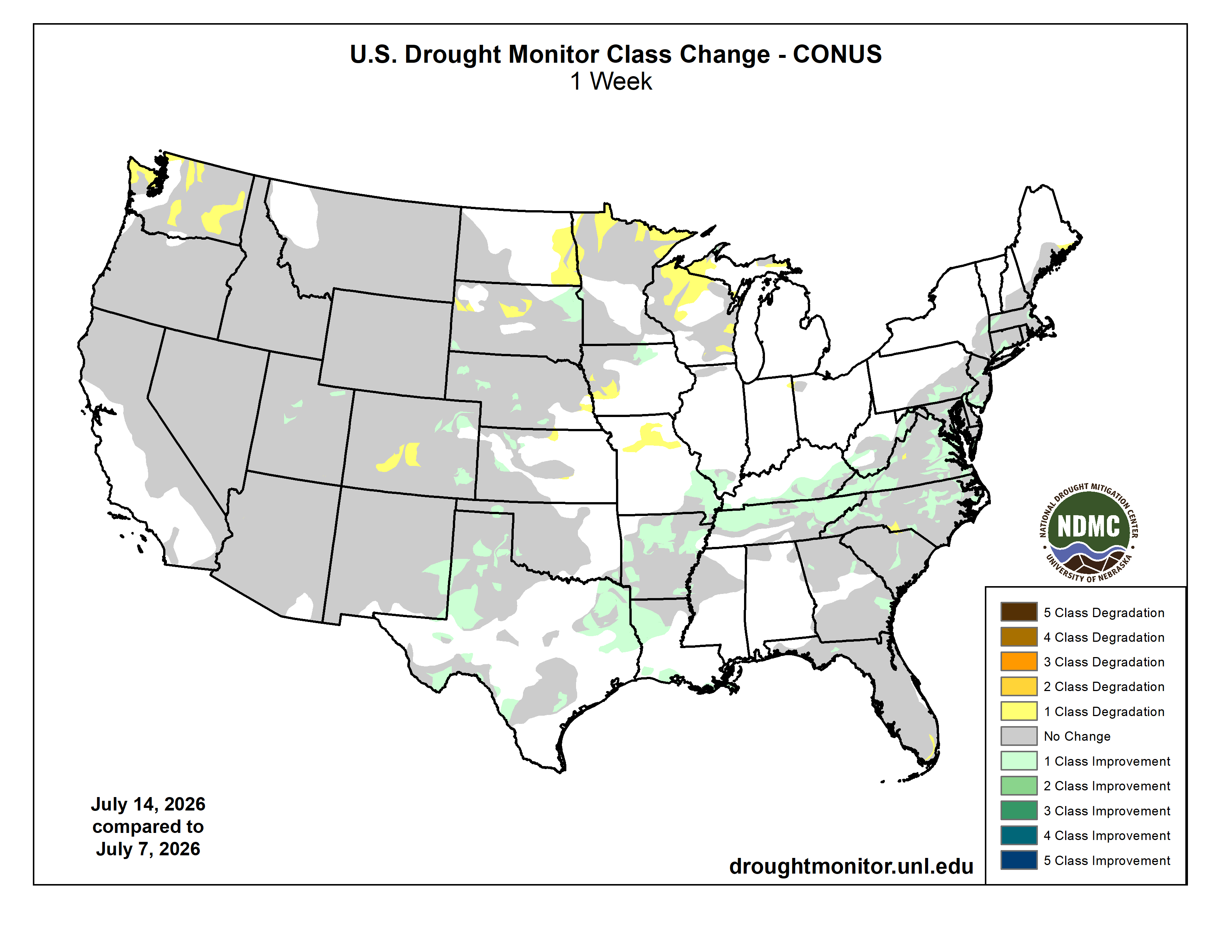
Here’s the US Drought Monitor Map from last week along with the one week U.S. change map.

US Drought Monitor map July 14, 2026.
US Drought Monitor one week change map ending July 14, 2026.

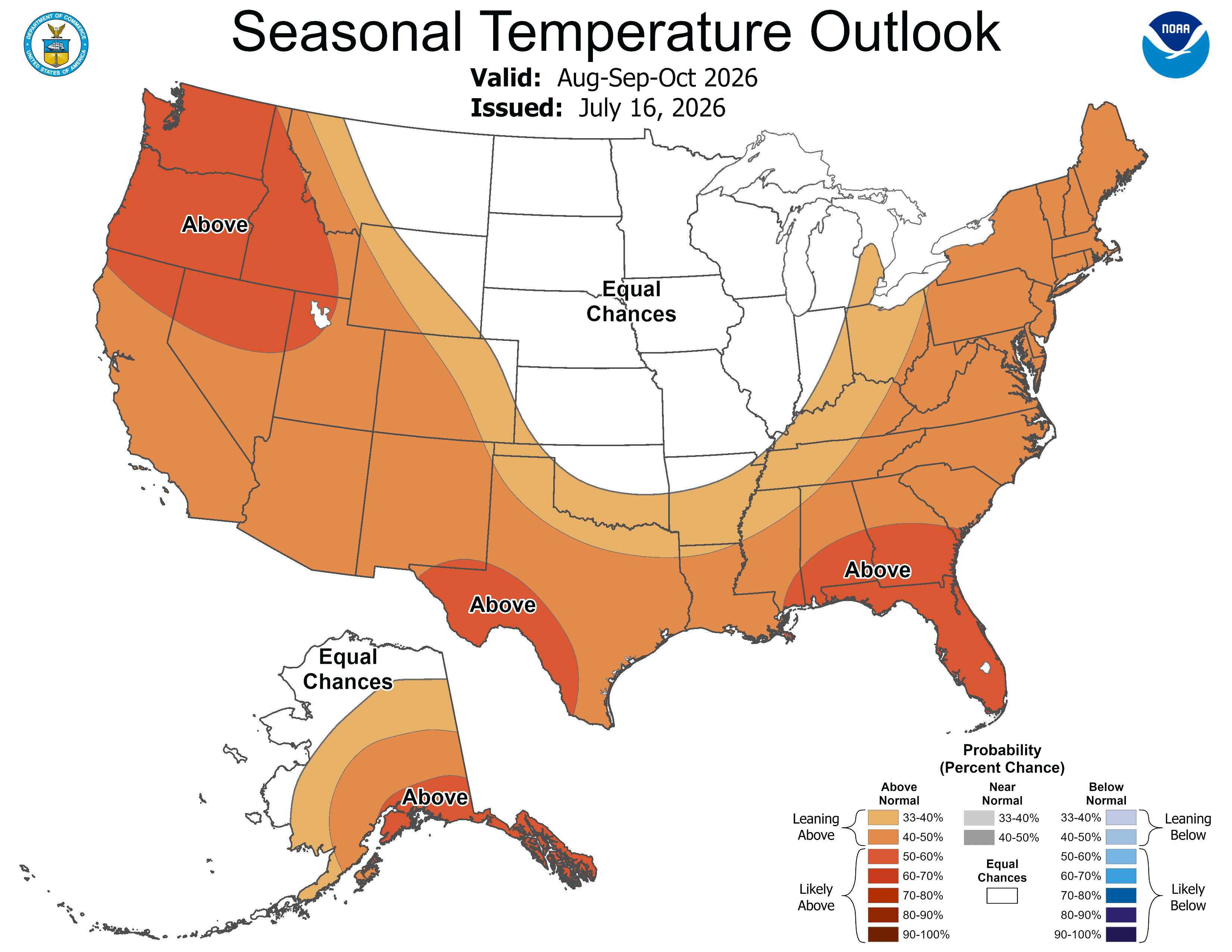
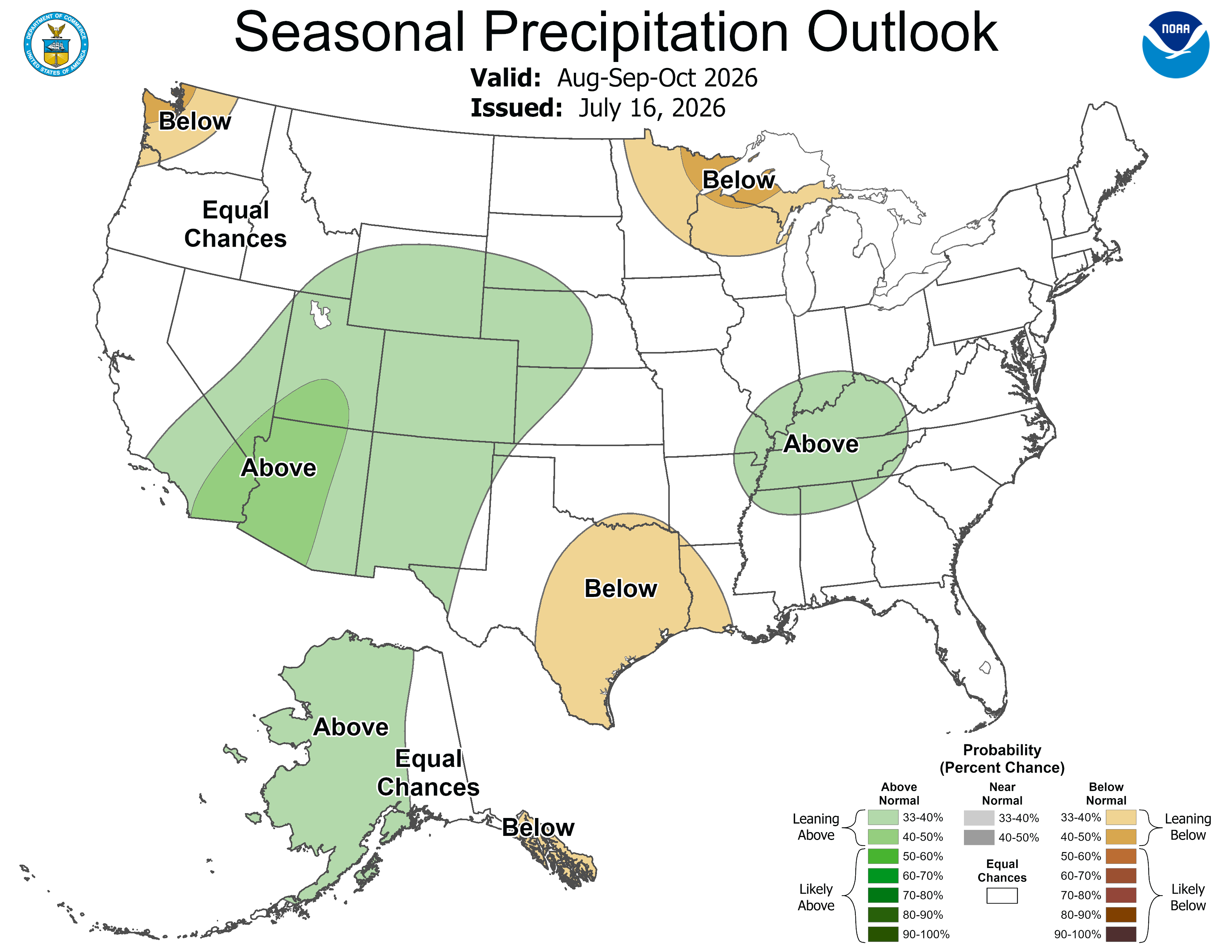
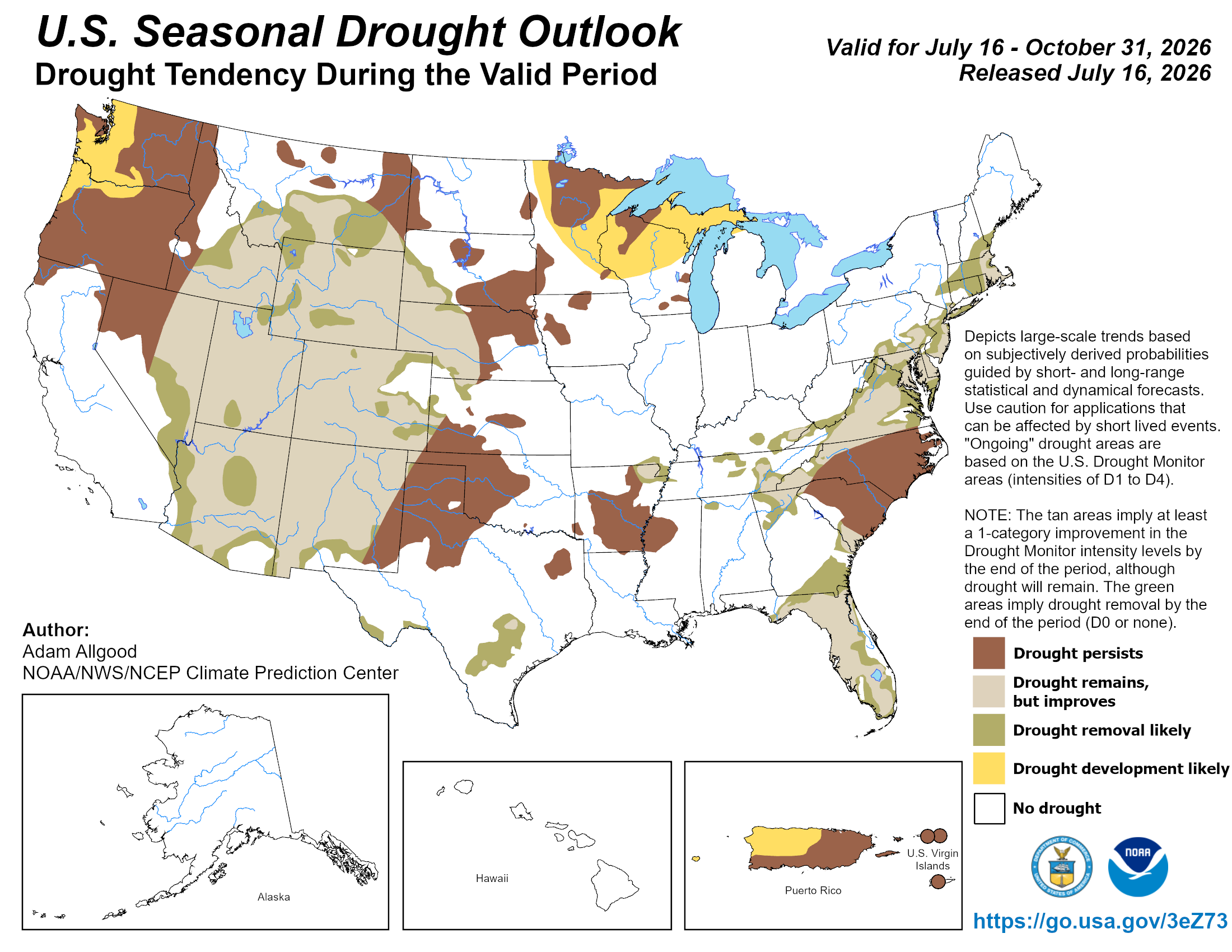
Finally, last week the Climate Prediction Center released their Seasonal Outlooks through the end of the water year (October 31, 2026). They are expecting above normal temperatures, above normal precipitation, and drought removal/improvement in the South Platte River Basin.

Viva North American Monsoon!

Last night’s storm (July 30, 2021) was epic — Ranger Tiffany (@RangerTMcCauley) via her Twitter feed.