Click the link to read the report on the UACW website. Here’s an excerpt:
November 2026
This report was produced by the Initiative on Universal Access to Clean Water for Tribal Communities (UACW), which aims to advance the cause of access to clean drinking water for Native Americans, and the Native American Rights Fund, which focuses on applying laws and treaties to guarantee that national and state governments live up to their legal obligations.
Contributing authors include Davíd Pilz (Fluent Freshwater Insights), Amy McCoy (UACW and Fluent Freshwater Insights), Heather Tanana (UACW and University of Denver), Anne Castle (UACW and Getches-Wilkinson Center, University of Colorado Law School), Daniel Cordalis (Native American Rights Fund), Savannah Hook (Native American Rights Fund), and Keeley Joe (UACW).
UACW focuses energy and actions in the areas of policy, education, research, legislation, and outreach. More information, including a PDF version of this report and previous reports related to universal access to clean drinking water, can be found on UACW’s website: uacw.org…
Executive Summary
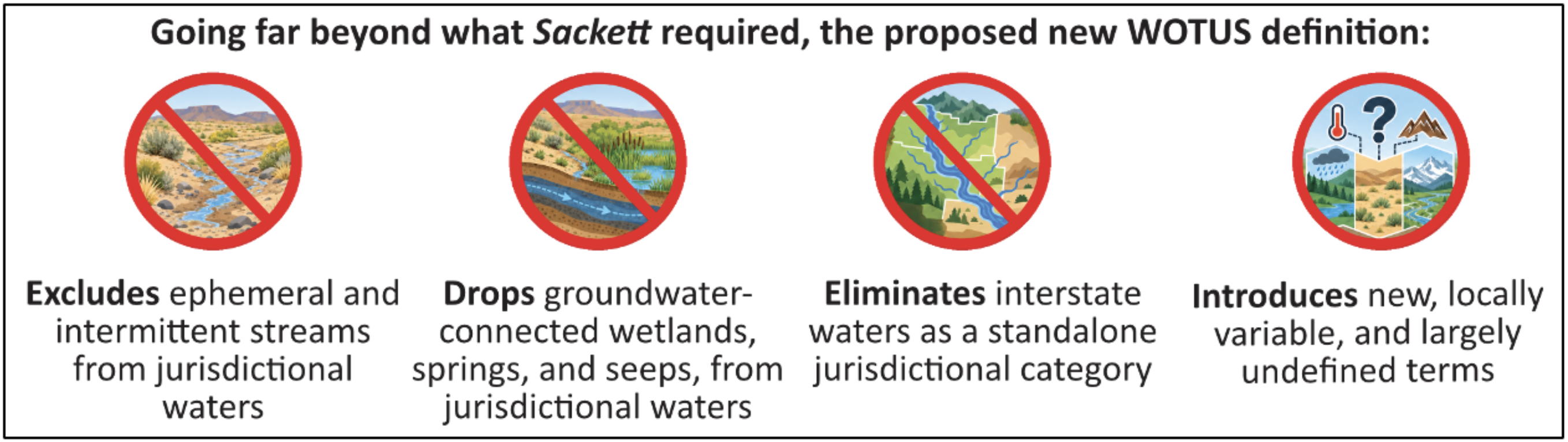
On the heels of the 2023 Supreme Court decision in Sackett v. Environmental Protection Agency, the Environmental Protection Agency and the U.S. Army Corps of Engineers have proposed new rules redefining Waters of the United States (WOTUS), which determines the scope of the Clean Water Act. The rules significantly roll back existing safeguards for waters across the nation, with a disproportionate impact on Tribal Nations.
Tribes depend on ephemeral and intermittent streams, springs, groundwater-fed wetlands, and other hydrologically diverse waters now facing severely reduced protection under the proposed definition. Not only are Tribal waters vulnerable because of their hydrology, but Tribal water uses, including cultural, traditional, and treaty-rights-based uses, are highly sensitive to changes in water quality.
The new WOTUS definition will:
- undermine water-related trust responsibilities and treaty rights;
- jeopardize Tribal drinking water safety, physical health, cultural survival, economic security, and ecological resilience;
- burden Tribes with increased technical complexity and costs;
- limit the ability of Tribes to regulate upstream, off-reservation activities, increasing contamination risk without meaningful recourse;
- require Tribal governments to conduct analyses and contest jurisdictional determinations while already faced with severe capacity constraints; and
- perpetuate historical inequities and expose Tribal waters to long-term degradation.
While the impacts of rolling back the definition of WOTUS will be felt by all who value and depend on clean water, Tribes are likely to feel it first, most keenly, and with the longest-lasting effects.