How Wildfires Reshape Our Landscapes: Insights from Author Dr. Ellen Wohl

East Troublesome Fire. Photo credit: Northern Water

In this interview, Dr. Ellen Wohl describes her book, Landscapes on Fire: Impacts on Uplands, Rivers, and Communities. She explains the importance of an integrated approach to studying wildfires, bringing perspectives from across disciplines to understand how they reshape natural, biological, and human environments. Watch the full interview to find out more about the book. 🔗 Browse or order Landscapes on Fire: http://lite.spr.ly/6006GDM0. 👉 Access Landscapes on Fire via institutional subscription: http://lite.spr.ly/6008GDM2 📚 Explore all AGU books: http://lite.spr.ly/6000GDM4#wildfire#climate#geomorphology#Rivers#EarthScience#STEM#Books#Publishing#AGUPubs

Walking the fine line of ‘all of the above’: Two Republicans from #Colorado add names to letter calling for restraint in gutting of #climate legislation — Allen Best (BigPivots.com) #ActOnClimate

On March 13, 2025 Gabe Evans visited a five-megawatt solar installation near LaSalle. Photo courtesy of Rep. Gabe Evans 

Click the link to read the article on the Big Pivots website (Allen Best):

March 21, 2025

Colorado sends four Democrats and four Republicans to the U.S. House of Representatives. Of them, Jeff Hurd, a Republican from Grand Junction, and Gabe Evans, a Republican from Fort Lupton, will be the most interesting to watch during the next two years.

These two representatives, both new to Congress in January, were among 21 Republican signatories in the House to a letter calling for restraint in efforts to gut the Inflation Reduction Act.

The letter expresses concern about “disruptive changes to our nation’s energy tax structure.” The New York Times and Utility Dive both interpreted the language as a reference to the IRA, the landmark climate legislation adopted in August 2022. President Donald Trump, the Times notes, often talks about repealing the law.

Atlas Public Policy, a research firm, reported in February that 80% of funds authorized by the law have gone to Congressional districts represented by Republicans.

Hurd, an attorney who formerly was chief counsel for the Delta-Montrose Electric Association, essentially replaced Lauren Boebert in the Third Congressional District. Boebert was almost certainly headed for defeat had she tried to run against Aspen’s Adam Frisch a second time in the Western Slope-dominated and Republican-leaning district after squeaking out just 50.6% of votes in the strongly Republican-leaning district. With a new home in Windsor, she easily won election in Colorado’s Fourth Congressional District.

While Boebert inevitably echoes Trump, Hurd signaled his measured distance from MAGA hat-wearing positions when he criticized Trump’s blanket pardon of rioters who had invaded the U.S. Capitol on Jan. 6, 2021. At the same time, his bill, Productive Public Lands Act, rhymes with Trump’s drill-baby-drill slogan. Never mind that the United States has already been setting records for oil and gas extraction.

As long as he can survive Republican primaries. Hurd can probably return to Washington for a good many terms. His drill bill is likely part of that political dance.

Evans has a more tricky path to negotiate. He narrowly beat the incumbent Democrat, Yadira Caraveo, in the Eighth Congressional District. The district extends from the edge of Denver to the farm country of northern Colorado. Although a former police officer in Arvada, he nonetheless refrained from criticizing Trump’s pardons of  the rioters, as Denver TV newscaster Kyle Clark pointed out.

Most of Weld County lies in his district. The county delivers 82% of Colorado’s crude oil and 56% of its natural gas extraction. The district also has the Vestas factory in Brighton that produces nacelles for wind turbines. Vestas has 1,800 employees in Colorado between that factory and another in Windsor. Evans’ district also has many solar energy installations.

On March 13, Evans visited the Vestas factory, a five-megawatt solar installation near LaSalle, and an oil installation. Bayswater, operator of the latter, proclaims itself a producer of “some of the cleanest energy molecules in the country and world.”

Invited to tag along, Channel 4 gave Evans the time to say that he favored an “all-of-the-above safe, affordable, secure energy supply to bring costs down to consumers and jobs back to the United States.”

That “all-of-the-above energy approach” was a key element of the letter signed by Evans and Hurd. Combined with a robust advanced manufacturing sector, the approach “will support the United States’ position as a global energy leader,” the letter said. “Both our constituencies and the energy industry alike remain concerned about disruptive changes to our nation’s energy tax structure.”

Tax credits adopted over the last decade “allowed energy developers to plan with these tax incentives in mind. These timelines have been relied upon when it comes to capital allocation, planning, and project commitments, all of which would be jeopardized by premature credit phase outs or additional restrictive mechanisms such as limiting transferability.”

The Evans all-of-the-above tour was arranged by a former Republican state senator, Greg Brophy. Brophy grows watermelons north of Wray and operates an organization called The Western Way. Brophy has been a strong supporter of renewable energy for eastern Colorado and also has a presence on the Western Slope.

Brophy told me that he has organized a similar tour for another member of Congress from Colorado, but it has not been scheduled. He declined to identify the representative.

What if Trump succeeds in rolling back the federal energy tax credits? Energy Innovation, a think tank, estimates increased average household energy costs in Colorado of $180 per year by 2030.

Will other Republicans in Colorado’s congressional delegation join Evans and Hurd? After all, renewable energy didn’t start out as a partisan issue.

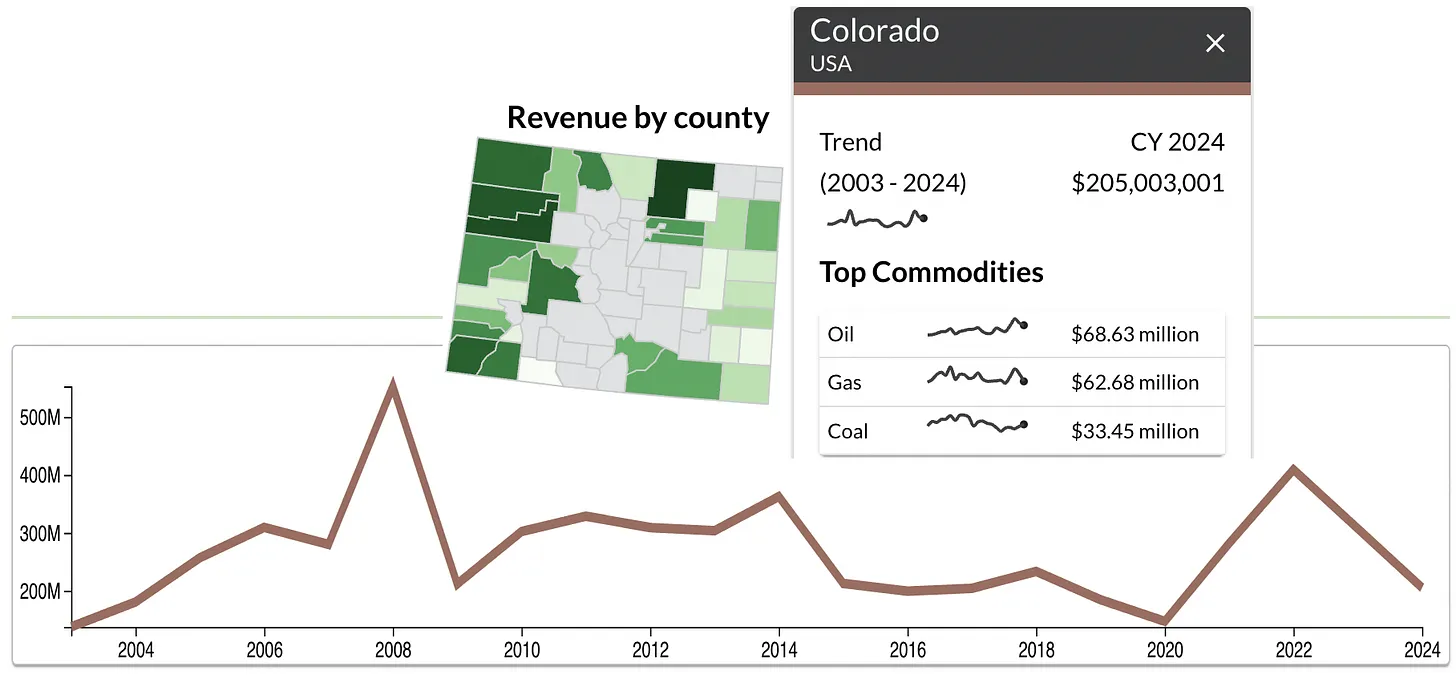
Colorado’s energy industry has had a slightly rougher go of it, mainly because it specializes in natural gas, not crude oil, and methane prices have been low since the 2009 crash. Note to Jeff Hurd: Revenues were substantially higher under Biden than under Trump I. Just sayin’. Source: ONRR via The Land Desk/Jonathan P. Thompson

We see the climate change in #NewMexico — Laura Paskus (WritersOnTheRange.org) #ActOnClimate

Click the link to read the article on the Writers on the Range website (Laura Paskus):

March 10, 2025

Here in New Mexico, our growing season has lengthened since the 1970s, even as stream flows have decreased. Fire season starts earlier, lasts longer, and in some years, ignites the forests into record-breaking blazes, like the gargantuan Hermits Peak-Calf Canyon and Black fires in 2022.

If you look at the last century in New Mexico, stretches of higher temperatures have lengthened; heat waves are hotter and nights, consistently warmer.

Rising heat and expanding aridity harm ecosystems and wildlife and hotter days are dangerous for anyone outside, especially people without housing or access to cool spaces. Extreme heat even interacts with certain medications people need for their physical and mental health. 

It should be no surprise that we’re facing another crackly-dry spring, summer, and fall. Fans watching the March 2 Oscars on Albuquerque TV saw flashing red-flag fire warnings. The next day, high winds and dust storms blasted the state; near Deming, a haboob of fast-moving dust shut down highways.

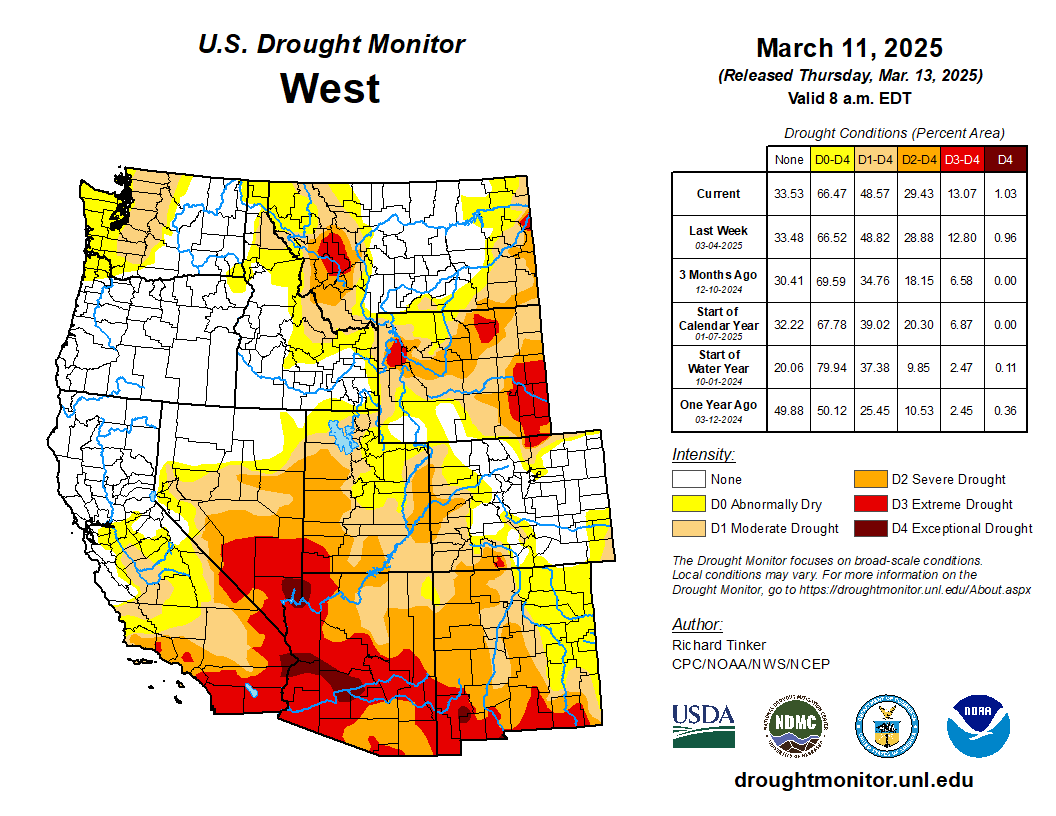
West Drought Monitor map March 11, 2025.

As of early March, 92 percent of New Mexico was experiencing drought, with almost 30 percent of the state in severe to extreme drought, according to the U.S. Drought Monitor.

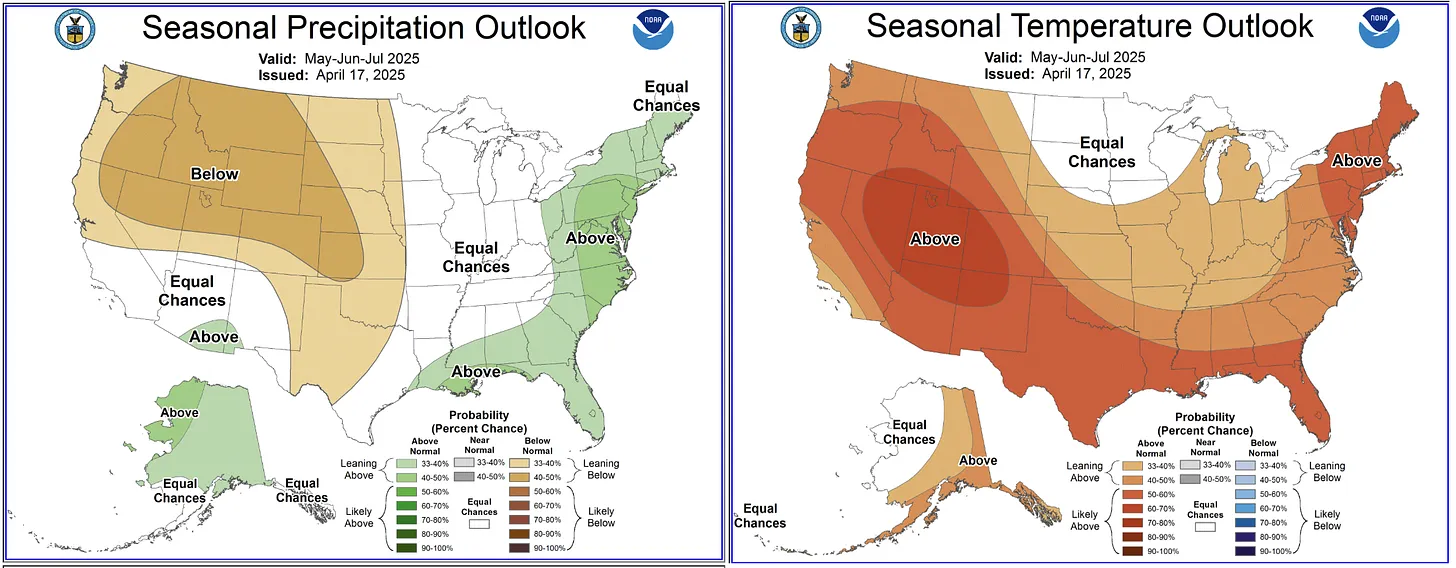
Arizona is in even worse shape: 100 percent of the state is in drought, with 87 percent in severe to exceptional drought. And the interior West’s three-month outlook is for warm, dry conditions — especially in Arizona and New Mexico.

Here in New Mexico, the Middle Rio Grande Conservancy District—which supplies water for farms—is warning runoff season will be short and river flows, low. The district’s leaders are urging farmers to plan for extended periods between irrigation deliveries and say that without summertime monsoons, they will not meet everyone’s needs this year.

During the 1900s—including during the infamous 1950s drought and earlier in this century—armers could often still expect full water allocations in a dry year.

Now, when farmers don’t receive water—and the Rio Grande dries for long stretches—it’s not only because there isn’t enough snow melting off the mountains.  It’s also because consistently dry soils suck up any moisture, making both forests and croplands thirstier.

Not only that, but decades of persistent drought and warming temperatures have desiccated reservoirs along the Rio Grande and its tributary, the Chama River.

On the Chama River, Heron Reservoir is 14 percent full; its neighbors, El Vado and Abiquiu, are at 14 percent and 51 percent respectively. Further down the watershed, on the Rio Grande in southern New Mexico, Elephant Butte Reservoir is only 13 percent full, and its neighbor, Caballo, nine percent full. 

In New Mexico, some water users, including the irrigation district, rely on water piped from the Colorado River watershed into the Chama and then the Rio Grande. This year, most of that supplemental water won’t be there.

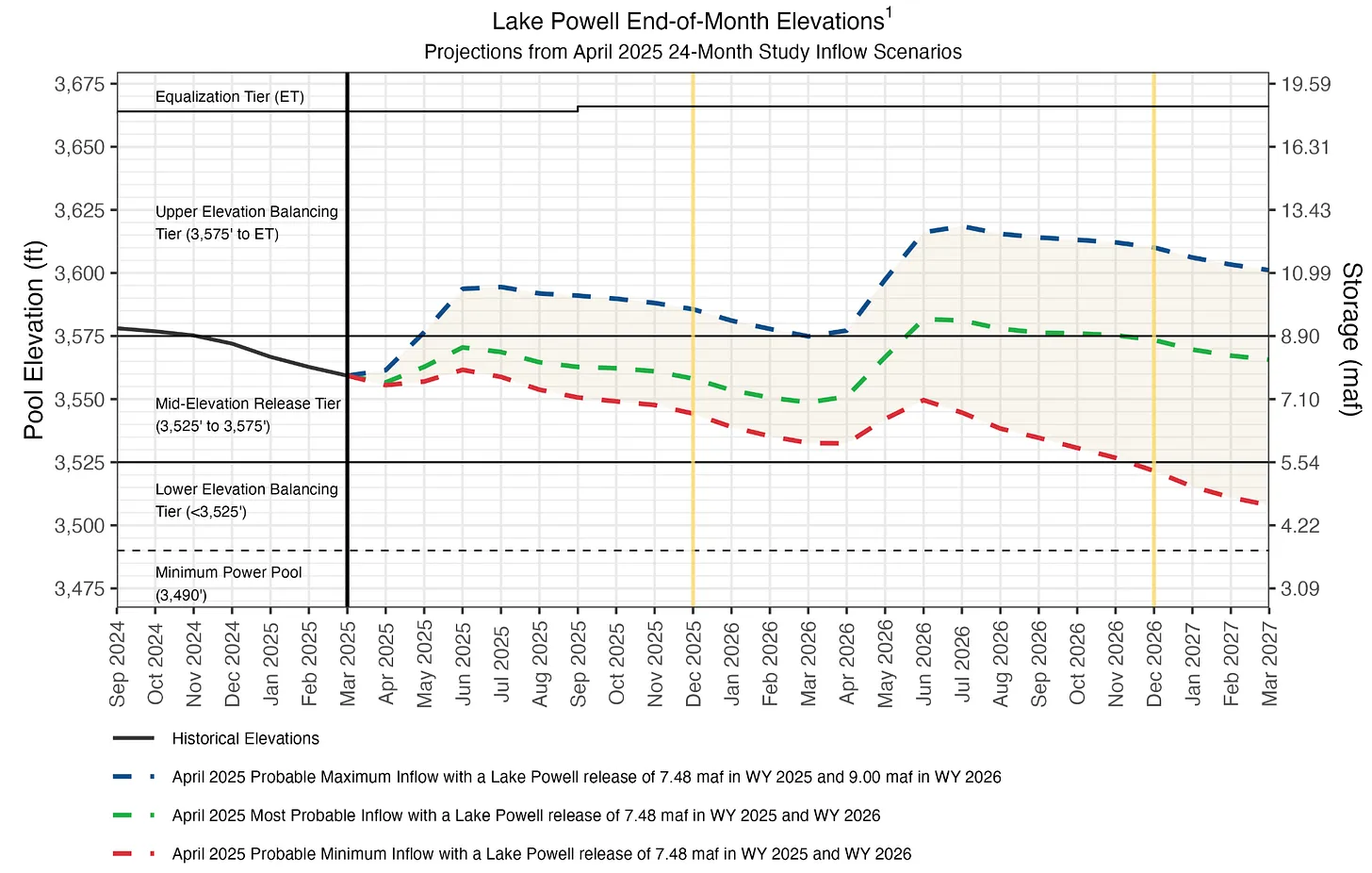
The view upstream on both watersheds is also troubling, especially in Arizona, New Mexico and southern Utah where the snowpack is “below to well-below median.” Last month, the Colorado River’s two largest reservoirs, Lake Powell and Lake Mead, were 34 percent full, the lowest they’d been in early February for the last 30 years of records.

I’m alarmed by many things happening right now, including the disappearance of climate data from federal websites and the gutting of federal workforces and budgets. We need wildland firefighters, scientists, and the staffers who kept our parks and public lands functioning.

But as a reporter who has covered climate change and its impacts in my state for more than two decades, I take the long view along with a local view.

We have known for decades that the planet is steadily warming and that the impacts of climate change would intensify. And we must resist focusing solely on the current chaos of the federal government. [ed. emphasis mine]

Laura Paskus. Photo credit: Writers on the Range

There’s never been a better time to become immersed in local politics or organizing, and to hold state and local leaders accountable for action on climate.

We can collaborate on local solutions and work together to better deal with the crises we face. Really, we have no choice.

Laura Paskus is a contributor to Writers on the Range, writersontherange.org, an independent nonprofit dedicated to spurring lively conversation about Western issues She is longtime reporter based in Albuquerque and the author of At the Precipice: New Mexico’s Changing Climate and Water Bodies.

#Colorado West Slope Letdown: U.S. Representative Lauren Boebert left, MAGA stuck around — Jonathan P. Thompson (LandDesk.org)

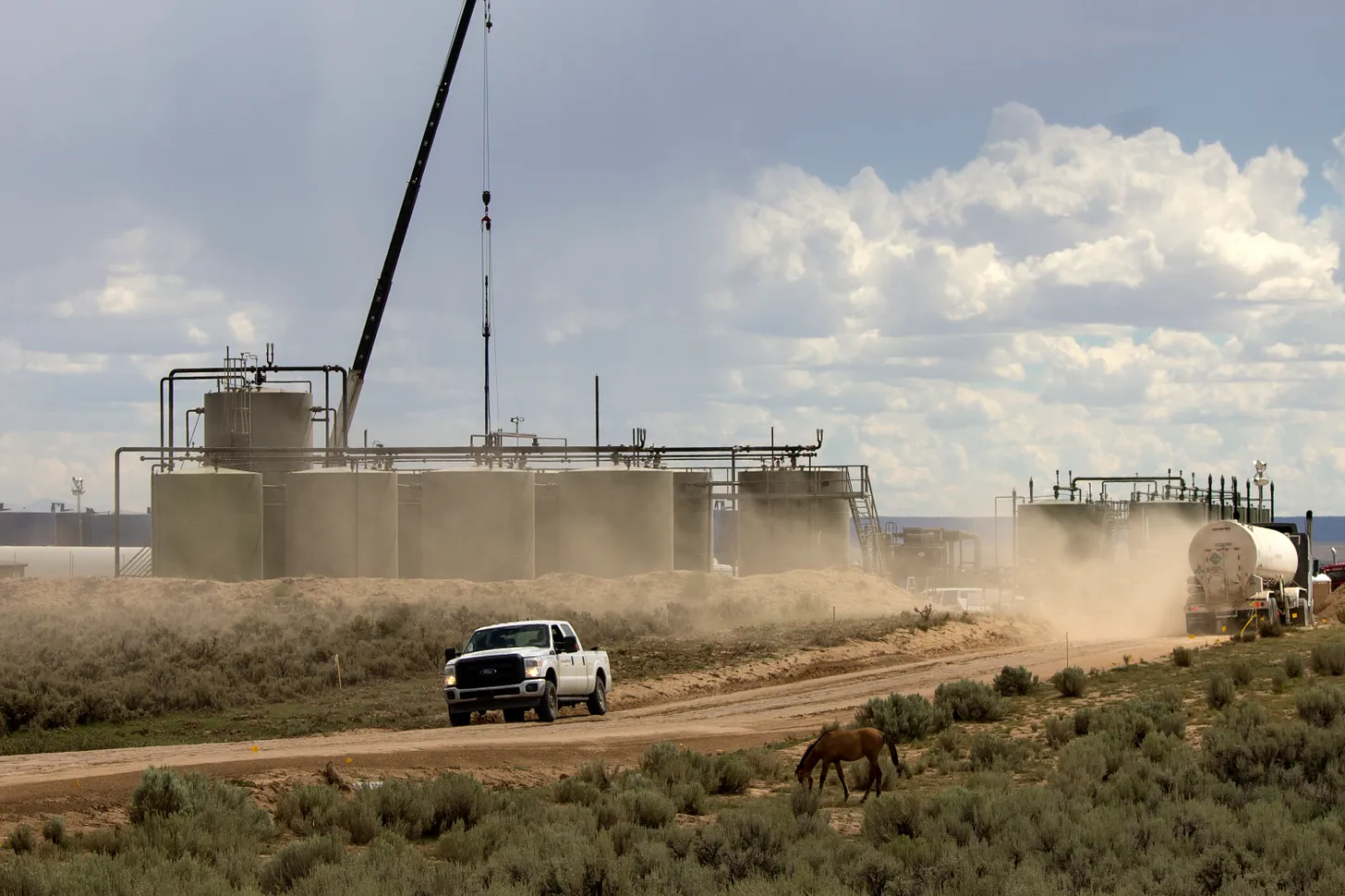
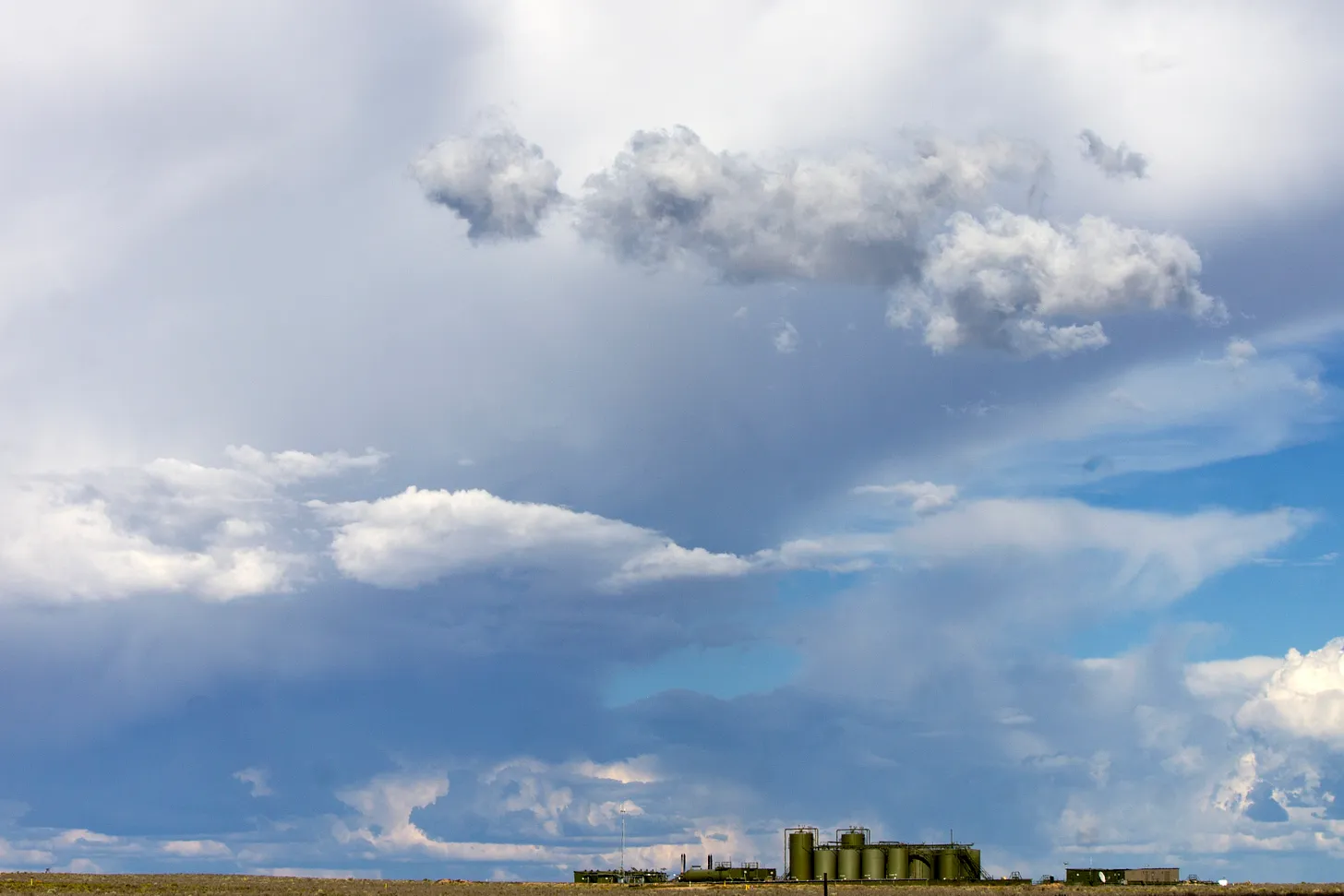
Sky with oil and gas infrastructure, Greater Chaco Region. Jonathan P. Thompson photo.

Click the link to read the article on The Land Desk website (Jonathan P. Thompson):

March 15, 2025

Data Dump: Setting baselines to monitor “energy dominance” under Trump

When Republican Jeff Hurd was elected to represent Colorado’s third congressional district, I believe I heard a bipartisan, collective sigh of relief. Democrats may have been sad that their candidate didn’t win, but at least the new guy wasn’t Lauren Boebert. And, many of us hoped, Hurd would represent a return of the independent and pragmatic Western politician of old to western and southern Colorado.

We were wrong.

So far, Hurd’s performance in office has pretty much followed Boebert’s lead, politically, albeit without the gun-slinging and other outrageous antics. When one of his aides showed up to meet with constituents in Dolores, she fled after seeing the size of the crowd assembled there. Hurd, himself, chickened out from attending a town hall in Grand Junction for similar reasons. Instead of apologizing for refusing to listen to the people he represents, he accused the crowd of being George Soros-funded activists — a false and worn-out, right-wing anti-semitic trope that really needs to be retired. In fact, the folks were his constituents, including members of Indivisible and the League of Women Voters. These weren’t exactly molotov cocktail hurling radicals.

And when CPR’s Ryan Warner asked him about the mass federal employee firings that have hit his district especially hard, Hurd gave mealy mouthed answers, saying efficiency is good, acknowledging he had no idea how many employees had lost their jobs, and lamenting the possibility that some good people may have been terminated, too, though it was also clear that he wasn’t going to do anything about it, especially if it meant questioning or, God forbid, standing up to Musk and Trump.

Hurd introduced a bill that would move the Bureau of Land Management headquarters to Grand Junction because it’s better to have management staff on the ground, yet he has not pushed back on DOGE’s plans to close federal offices throughout his district, including the Bureau of Reclamation and Army Corps of Engineers offices in Durango. He has teamed up with Boebert to criticize Colorado for importing “foreign wolves” into the state and has parroted MAGA’s anti-immigrant hysteria in regards to Denver’s tolerance.

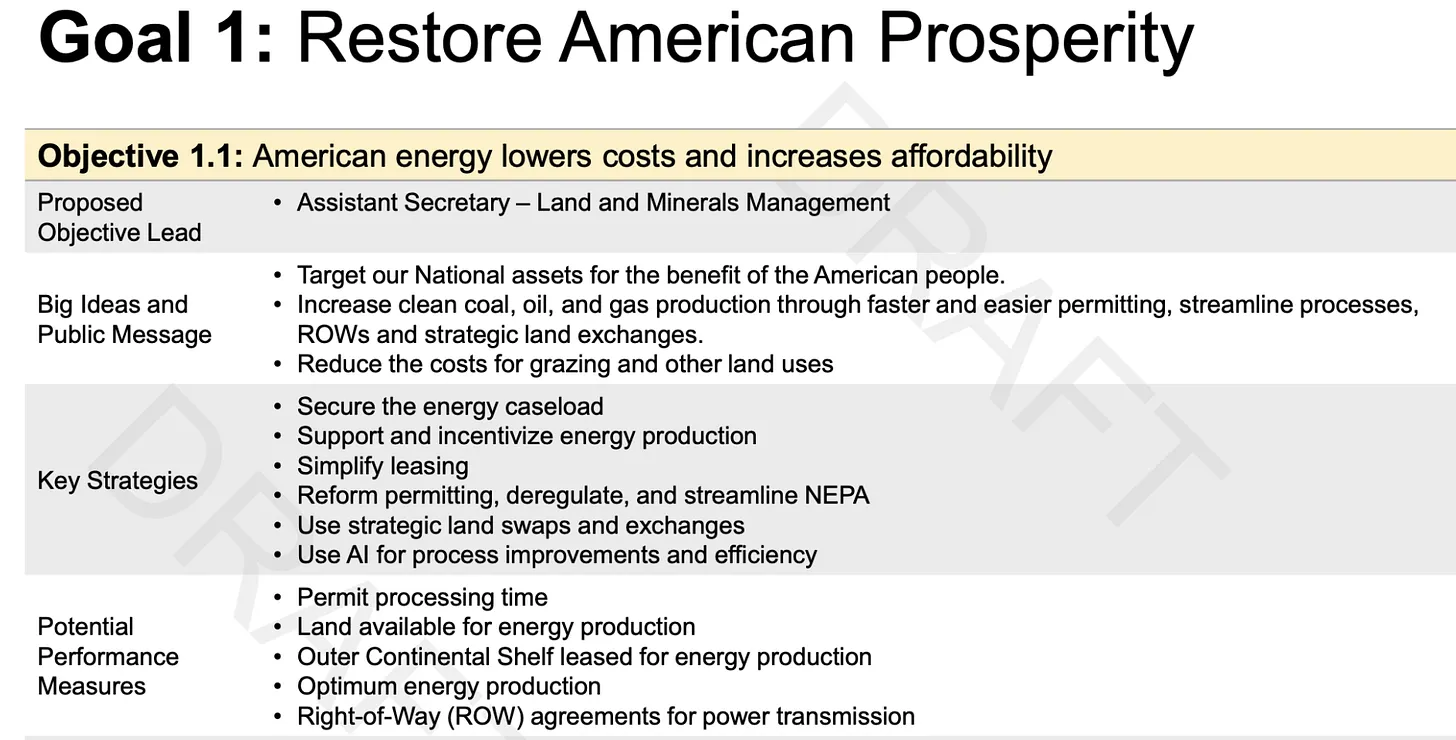
Now Hurd has introduced the Productive Public Lands Act to “unlock resource development on some of our most productive lands.” It would toss Biden-era Bureau of Land Management resource management plans — which he claims “locked up access to viable lands” — and replace them with fossil fuel-friendly ones with the aim of putting “us on a path to energy dominance.” Talk about inefficient: Those RMPs took years to develop and are the result of extensive studies, public input, and compromise. Trashing them is a perfect example of government waste. [ed. emphasis mine]

Note to Rep. Hurd: Public lands are not locked up. Quite to the contrary. Unfortunately Hurd — like his predecessor — has chosen to let MAGA ideology and disinformation blind him to the facts. Still, I’ve got to try, so here I go again: The United States is producing more oil and gas — much of it from public lands — than it ever has before, and is the world’s leader in hydrocarbon production. Read that again. Then again. And keep doing so until it penetrates your thick skull so that you can stop wasting all of our time with your “war on energy” nonsense.

While drilling has shifted away from Colorado and is now centered on the Permian Basin, it has nothing to do with BLM regulations or resource management plans. It’s because western Colorado is rich in natural gas, not so much in oil, and there’s far less money in natural gas production than there is in crude oil. Nevertheless, oil, gas, coal, and carbon dioxide production from federal lands in Colorado (much of which are on the Western Slope) generated $205 million in revenue last year. Locked up? I don’t think so.

***

As long as I’m on the topic of “energy dominance,” I figured it would be a good time to set out some baseline data for tracking the progress of Trump’s “drill, baby, drill” agenda. As has been established, the Trumps and Hurds of the world believe that energy production from federal lands has been “locked up,” and that by “unleashing” it — i.e. rescinding environmental protections — the oil and gas industry will bring in a battalion of drill rigs, send oil and gas production through the roof, and bring down prices at the pump to make it cheaper to drive those gas-guzzling behemoths that now dominate the roadways.

It’s too early in Trump’s term to determine whether that’s actually happening or not, so let’s just check in on where we are and what has happened over the last four years. And we’ll keep updating these graphs periodically. Land Desk readers have seen some of these before. Sorry about that.

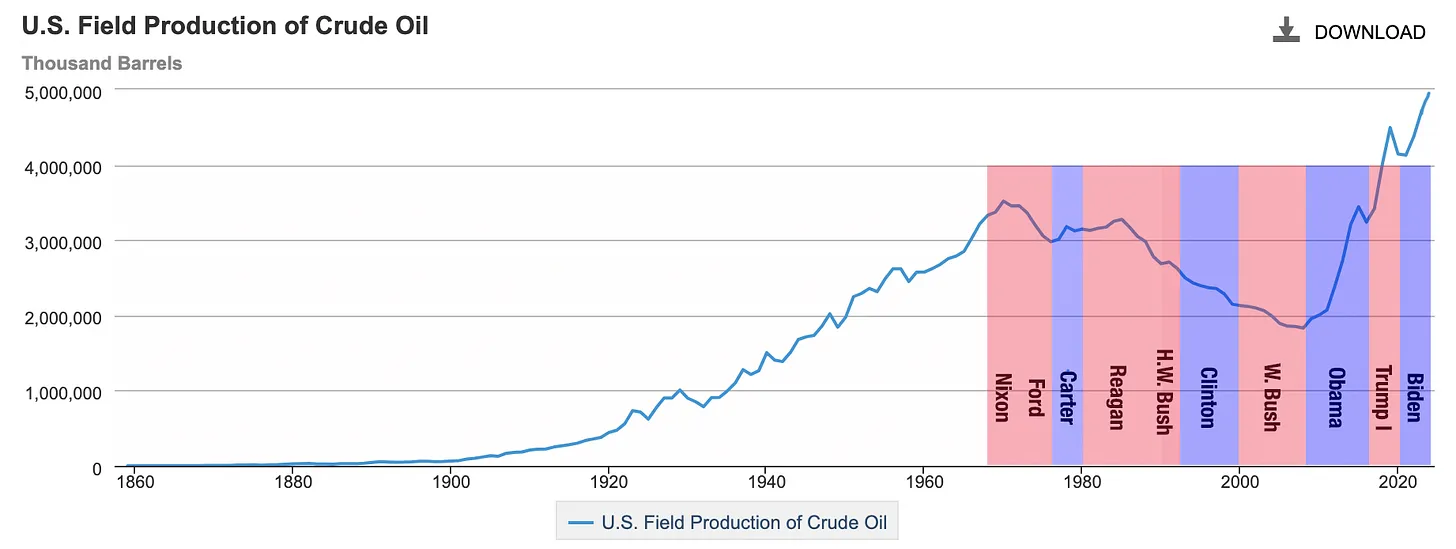
This one shows U.S. crude oil production. It was in steady decline until about 2009, kicking back up again just as Obama took office. Is that because Obama slashed regulations on drilling? No. It’s because that’s when horizontal drilling-multistage hydraulic fracturing, i.e. fracking, came into its own and oil prices increased. Production dipped at the end of Obama’s second term because OPEC decided to wage a price war on U.S. producers, glutting the market with crude in hopes of driving some U.S. companies out of business. And it dipped again at the end of Trump’s first term because of COVID. In December, while Biden was still in office, U.S. fields produced 418 million barrels of crude, an all-time record high. Source: Energy Information Administration.

Production goes up after drilling activity increases. Drilling activity generally responds to crude oil prices. When prices are high, it’s more profitable to develop new oil and gas wells, so the drilling rigs are dusted off and head out into the fields. When prices are low, they are folded up and hauled back to the storage yard.

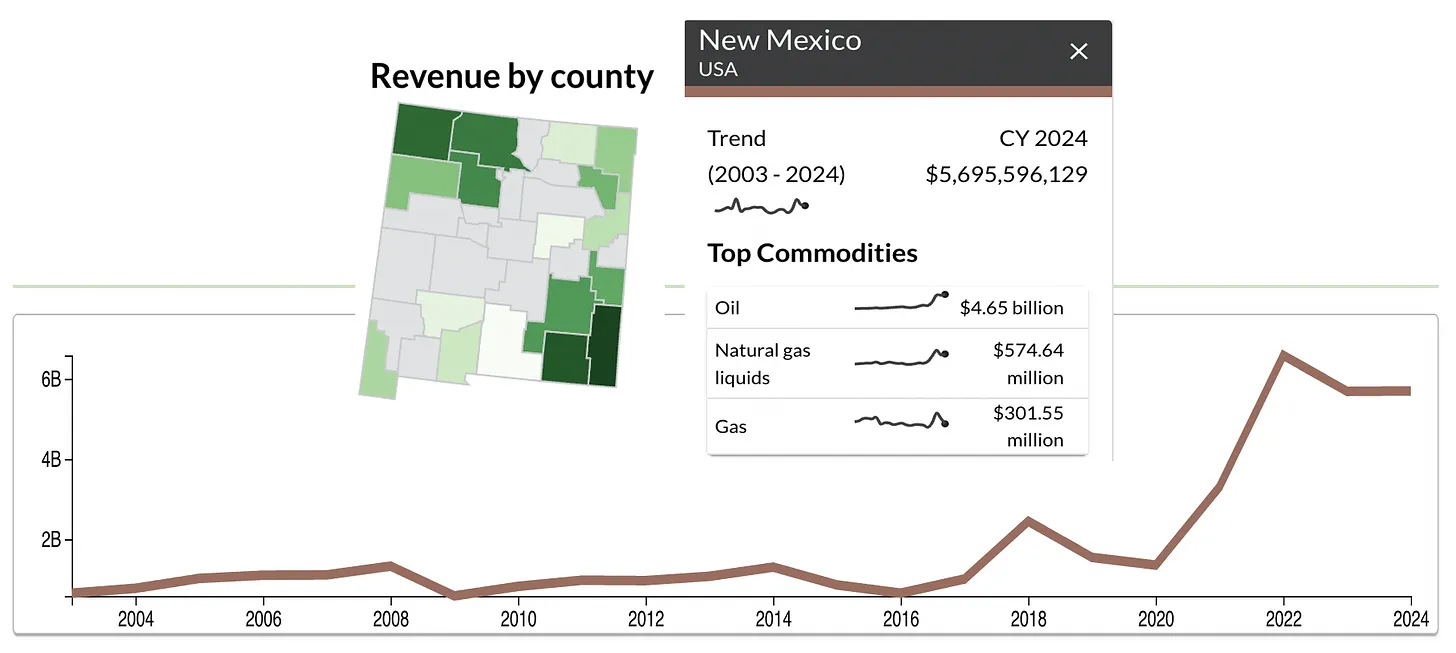
And lest you think that maybe all of that production is coming from private or state lands since, after all, the federal land has all been “locked up” by Biden’s purported war on energy, check out the revenues from federal land resource production for New Mexico and Colorado. Funny how they shot up right after Biden was elected, no?

Oil production from federal lands in New Mexico generated $4.65 billion last year, down slightly from 2022 but still significantly more than during any other time during the last two decades. Source: Office of Natural Resource Revenue.

Colorado’s energy industry has had a slightly rougher go of it, mainly because it specializes in natural gas, not crude oil, and methane prices have been low since the 2009 crash. Note to Jeff Hurd: Revenues were substantially higher under Biden than under Trump I. Just sayin’. Source: ONRR

The best way to get a feel for drilling activity is to check out the weekly rig count. So here it is. But a note to all you statisticians out there: The time intervals are uneven on this graph, in part due to my own laziness. But it still gives a fairly accurate picture of drilling activity over time, so it works.

This gives a good illustration of the level of drilling activity and where it’s taking place. This shows the OPEC price war dip in 2015 and 2016 and the COVID dip in 2020. Again, these are driven almost entirely by the price of crude oil, which is determined by the global market. North Dakota dominated for a while, but never recovered from the 2015 crash. Instead, activity moved to the Permian Basin in New Mexico and Texas. The rig count for Western states remained remarkably stable during the Biden administration. Source: Baker-Hughes.

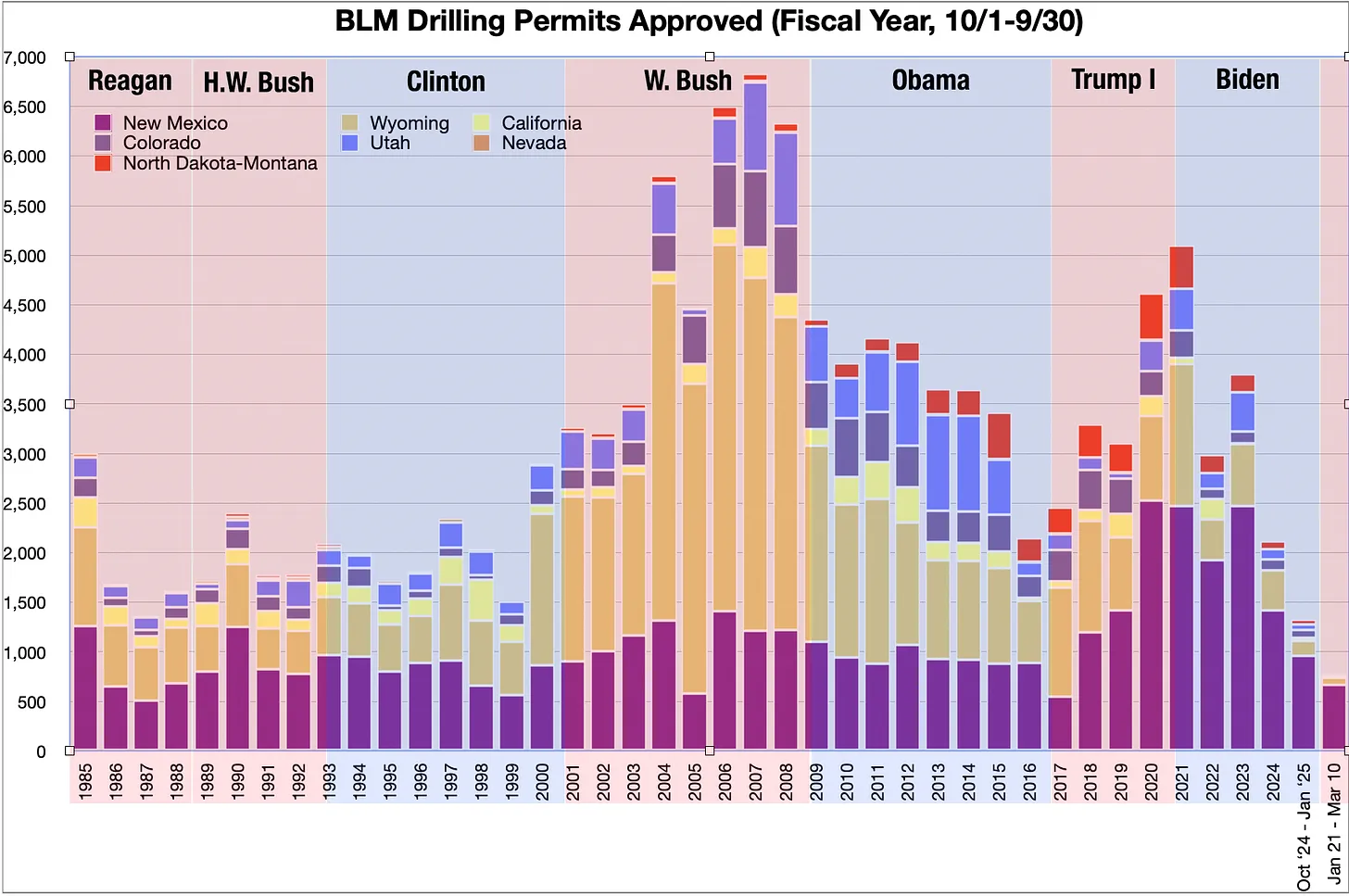
The thing about production and rig counts, though, is they don’t really reflect White House policy. So how about the number of drilling permits approved by the Bureau of Land Management?

On average, Biden’s BLM issued around the same number of drilling permits as Trump I. This may have something to do with policy, but it is also driven by how many firms apply for permits and how well-equipped and staffed the field offices are to process those applications. Note that during the last four months of Biden’s term, the BLM issued over 1,300 permits. So far, the Trump II administration has issued 774 permits in just over two months. Source: BLM.

Now that we have a snapshot of where we’ve been and where we are in terms of oil and gas development, we can track where we might be headed under Trump 2.0. My guess? We’re going to see all of the above indicators begin falling soon. Sure, rig counts are staying steady, meaning production will continue to rise for a few more months. But after that, lower oil prices are likely to kick in, dimming companies’ enthusiasm for drilling, which will hit the rig count first and then production.

Graphic credit: The Land Desk

Oil prices are dropping — they hit sub-$70/bbl this week for the first time since 2021 — because OPEC decided to start pumping more crude and because the economy is struggling, which will likely dampen demand. The economy is struggling because markets are reacting unfavorably to the chaos Trump, Musk, and company are wreaking from the White House. Turns out that tariffs, trade wars, and haphazard termination of critical federal employees is bad for the economy. Gasoline prices will likely fall, too, except in places that rely on Canadian crude, where they might increase. So there is that. Of course, if you lose all your money in the plummeting stock market, it won’t really matter much, I suppose.


Speaking of tariffs, remember when I wrote about Trump’s trade wars and predicted that American whiskey and bourbon makers would be casualties? Turns out I was right. Kentucky distillers, especially the small ones, are already feeling the pain, and even large ones are smarting from Canada’s retaliatory moves. I suppose Trump will claim the Canadians started the trade war, just as he’s ridiculously asserting Ukraine invaded Russia.

📸 Parting Shot 🎞️
St. Joseph’s Church, San Fidel, New Mexico. Jonathan P. Thompson photo.

#Colorado lawmakers eye new task force to boost water funding — Jerd Smith (Fresh Water News)

Republican House members recite the Pledge of Allegiance as Colorado lawmakers returned to the Capitol January 8, 23025, for opening day at the General Assembly. Photo credit: Fresh Water News

Click the link to read the article on the Fresh Water News website (Jerd Smith):

March 13, 2025

Colorado lawmakers, worried that a key source of money for water projects is too easily tapped for other programs, want to create a special task force to examine ways to stabilize and boost funding for things like new water pipelines and conservation programs.

Under Senate Bill 40, a nine-member panel would examine new options to replace severance tax money that is collected on nonrenewable resources, such as oil and gas and some minerals, and is highly variable. A portion of the revenue is used to help Colorado address looming water shortages.

According to state forecasts, by 2050 those shortages could be as high as 740,000 acre-feet of water, under a worst-case planning scenario, or much lower if growth slows and climate change impacts are less than expected. One acre-foot of water equals nearly 326,000 gallons, enough water to serve at least two urban homes for one year.

Like other Western states, Colorado is racing to shore up aging water systems and make existing supplies stretch further as drought and rising temperatures shrink water supplies.

The bill comes as lawmakers wrestle with how to cut $1.2 billion from a state purse hurt by slowing growth and revenue caps. 

The measure, sponsored by Sen. Dylan Roberts, D-Frisco, Sen. Cleave Simpson, R-Alamosa, Rep. Karen McCormick, D-Longmont, and Rep. Matthew Martinez, D-Monte Vista, is stalled in the Senate appropriations committee until the legislature completes its budget work, Roberts said.

Roberts said the current budget crisis and previous fiscal storms have resulted in severance tax revenue being tapped to help resolve budget shortfalls in nonwater programs, a situation that hits hard at the state’s ongoing efforts to ensure there is enough water to go around.

“The joint budget committee has swept severance taxes in the past. Not too often, but I worry that it will become a common practice. I and my cosponsors want to get the best minds together on how we better plan for the future,” he said.

Lawmakers plan a new tax force to find ways to replace the state’s reliance on severance taxes. Credit: Colorado Legislative Council

The Colorado Water Conservation Board is the state’s primary water planning agency, and helps fund an array of water projects and planning initiatives. Its revenues come from interest on loans, money from the state’s general operating fund, sports betting tax revenues, and severance tax revenues, among other sources.

Late last year, Gov. Jared Polis proposed a budget that largely shielded water programs from major cuts, but it is lawmakers who will make the final decision on how the state’s budget will be balanced this year.

The severance tax has generated $412 million for the CWCB over the past 10 years, according to Kirk Russell, the CWCB’s finance section chief. Most of that goes into a revolving loan fund that helps finance such things as irrigation ditch repairs and pipelines. It isn’t typically used to finance the water agency’s operating budget.

But he said the severance tax fund experiences “a great deal of variability” from year to year.

A bright spot in the funding picture, according to Roberts, is the growth in revenue collected from gambling on sports. According to the Colorado Division of Gaming, sports betting has generated $98 million in revenue since May 2020, when sports betting became legal in Colorado. The majority of that money is now used to help fund the Colorado Water Plan.

Roberts said lawmakers are open to considering a range of options to stabilize water funding, and he said there may be potential to expand the revenue generated by sports betting. In January, the program hit a new high, generating $4.4 million. The previous high occurred in January 2024, when $4.1 million was generated, according to the Division of Gaming.

If the bipartisan task force measure is approved, members would be selected this summer and a final report would be due back to lawmakers by July 15, 2026.

#Colorado Will Require Oil and Gas Companies to Increase Water Recycling for Fracking — Jake Bolster and Martha Pskowski (InsideClimateNews.org) #ActOnClimate

Directional drilling from one well site via the National Science Foundation

Click the link to read the article on the Inside Climate News website (Jake Bolster and Martha Pskowski):

March 13, 2025

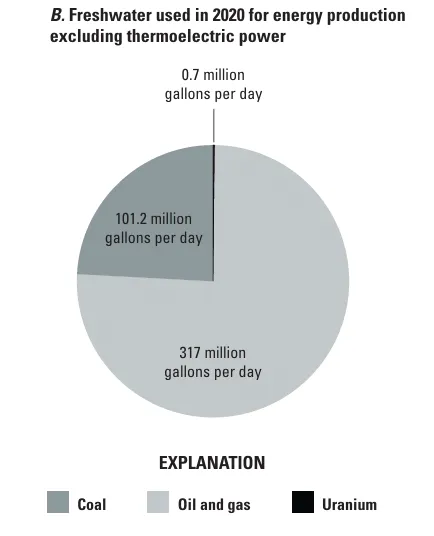
Freshwater use in oil and gas drilling has come under scrutiny in Colorado as the state faces a historic drought. On Wednesday, March 12, state regulators announced new rules that will require drillers to use more recycled water in their operations and, hopefully, relieve pressure on scarce freshwater resources.

As Colorado continues to produce fossil fuels at record pace, the Centennial State has become awash in a caustic, brackish and chemically-laden fluid known as produced water, a byproduct of the drilling and fracking process. 

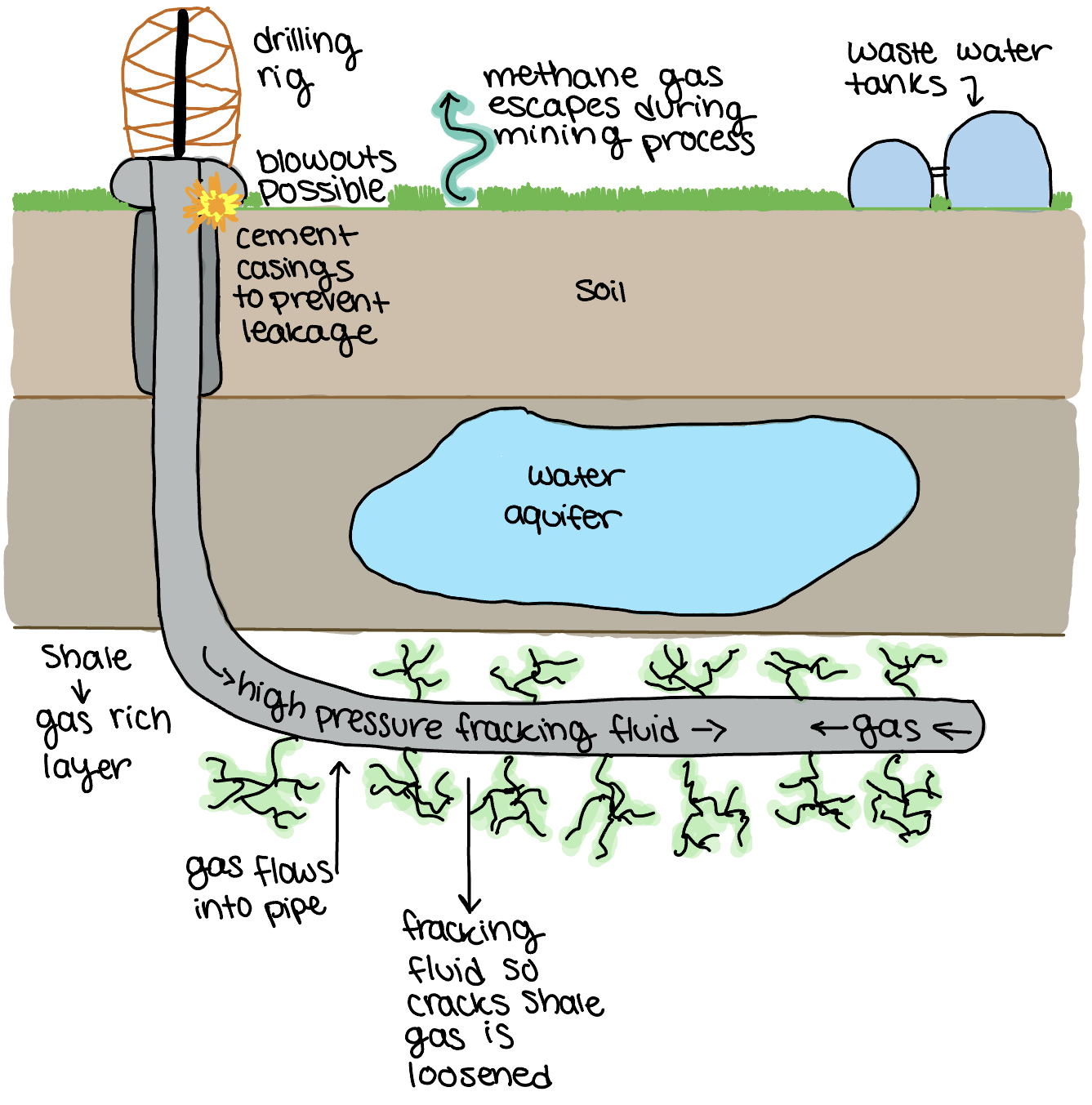
Diagram of Hydraulic Fracking Machinery and Process. By Emiliawilkinson – Own work, CC BY-SA 4.0, https://commons.wikimedia.org/w/index.php?curid=132536012

This water can have high levels of salts, metals and other contaminants, making it more difficult and expensive to treat for reuse than for disposal. Oil and gas companies in Colorado typically dispose of produced water by pumping it back into old, out-of-service wells and other geological formations using injection wells, permanently severing it from the hydrological cycle. Meanwhile, freshwater demand for oil and gas production in Colorado is forecasted to rise in the coming decade as the industry drills deeper vertically and farther horizontally.

The oil and gas industry, whose activity in Colorado accounts for almost 4 percent of U.S. total crude oil output, uses about 11 billion gallons of fresh water annually in Colorado, according to data collected by the Colorado Energy and Carbon Management Commission (ECMC). That’s comparable to the amount of water stored behind a small dam, but accounts for less than one percent of all fresh water used in the state. 

“Things are changing quickly” for Colorado as climate change intensifies, said Harmony Cummings, a director of the Green House Connection Center, an environmental nonprofit party to the rulemaking. “How low the reservoirs are is terrifying to me.”

Turning Waste Into a Resource

In 2023, the Colorado state legislature passed HB23-1242 (Water Conservation In Oil And Gas Operations: Concerning water used in oil and gas operations, and, in connection therewith, making an appropriation), which required the ECMC to adopt rules “requiring a statewide reduction in usage of fresh water and a corresponding increase in usage of recycled or reused water in oil and gas operations.”

The bill also created Colorado’s Produced Water Consortium, a body of 31 people including regulators, industry representatives, environmentalists and scientists. The group is studying how produced water that comes to the surface during drilling can be reused in other oil and gas operations to reduce freshwater consumption, and its reports served as the basis for its recommendations to the ECMC. 

“The consortium started out with everyone coming in with an agenda,” said Hope Dalton, the consortium’s director. “Then they began to learn from each other and trust each other and really work to create these data-informed recommendations…I think the recommendations are very solid.”

Produced water is a catch-all term for water that flows out of oil and gas wells after conventional drilling or hydraulic fracturing, or fracking. This liquid waste can contain drilling chemicals injected into wells, toxic hydrocarbons like benzene, a known carcinogen, and water dislodged from deep underground that carries sediments, salts, metals like barium, manganese and strontium, and Naturally Occurring Radioactive Materials (NORM).

Oil and gas evaporation pond

The Produced Water Consortium compiled data on existing water practices in Colorado’s oil and gas industry to inform the rule-making. It found that water diverted for fracking in Colorado totals about 26,000 acre feet a year, or 0.17 percent of the state’s total water use. One acre-foot is 325,851 gallons of water, meaning the oil and gas industry holds rights to about 8.5 billion gallons of freshwater annually.

Between July 2023 and March 2024, according to the consortium’s findings, operators reported to the state that they disposed of 87 percent of their produced water and recycled the remaining 13 percent. Companies reported that 93.2 percent of produced water disposal was into underground injection wells. Much smaller volumes of water are disposed of in pits or discharged into state surface water bodies. The initial data on recycling rates is self-reported by the companies and only reflects the short period of time that reporting has been required.

The Denver-Julesburg basin, or DJ Basin for short, along Colorado’s Front Range is home to a vast majority of the industry’s development and water demand. It is also home to the vast majority of the state’s population, including the metro areas of Denver, Boulder and Fort Collins. From 2019 to 2024, an average of two new fracking wells were completed daily in the DJ Basin, five-and-a-half times the industry’s rate in other basins in the state, according to ECMC data.

Niobrara Shale Denver Julesberg Basin

Companies in the DJ Basin account for almost three quarters of the industry’s total water use, according to ECMC data from 2022. In the DJ Basin, only 0.4 percent of that water is recycled. The Western Slope, which is more rural, has fewer drilling companies but a much higher rate of recycling produced water for operations, sometimes as high as 100 percent.

Under Colorado’s new regulations, by the beginning of 2026, oil companies must use at least 4 percent recycled produced water across their operations in the state. In 2030, that requirement increases to a minimum of 10 percent. 

The ECMC will convene again in 2028 to draft new benchmarks beyond 2030. If a consensus fails to emerge, minimum averages of 20 percent recycled water in 2034 and 35 percent in 2038, as recommended by the Consortium, will become law.

If an operator is unable to meet these thresholds, they would be allowed to purchase “credits” for excess produced water recycled by other operators, but only if those credits would be used in the same basin.

“Increasing recycling doesn’t necessarily equate to a decrease in freshwater” use, said Cummings. If the rate of fracking in Colorado rises faster than the produced water recycling thresholds, it’s possible that produced water reuse and freshwater use could both go up, she said.

Other new rules require oil and gas companies to make quarterly reports on what freshwater is used for, the total amount of water and produced water used in each basin, and figures on emissions from truck traffic, among other statistics. Operators will also be required to report how they would meet produced water reuse thresholds. The ECMC could issue penalties to companies that don’t comply with the new rules.

But Cummings worried those penalties aren’t onerous enough. There are “no real teeth” in the enforcement mechanisms, said Cummings, who spent eight years working in the oil and gas industry. If given the proper combination of regulation and incentives, she is confident companies could recycle produced water at greater rates than Colorado is requiring.

“I’ve seen them do incredible projects when profits are on the other side of that,” she said.

On DOGE and Keystone XL and lost jobs — Jonathan P. Thompson

Photo credit: Jonathan P. Thompson/The Land Desk

Click the link to read the article on The Land Desk website (Jonathan P. Thompson):

February 28, 2025

🤯 Crazytown Chronicle 🤡

The last thing I want to do is devote every dispatch to the madness and inanity flooding out of the White House. Seriously. Nevertheless, today I feel the need to devote some words to responding to Land Desk reader and frequent commenter Dennis Pierce’s comment on Tuesday’s dispatch, which read:

I’m glad Pierce brought that up, because I think it’s an important and valid point and one worthy of discussion — especially considering that Trump recently announced that he wants Keystone XL built “NOW!” Pierce’s comment was similar — though more accurate than — a post widely shared on Facebook that said:

I’ll get to the factual problems here in a minute, but first let’s just clarify what these folks are trying to say, which is a little bit of what-about-ism, but also: If you’re so worried about jobs, how could you celebrate the Keystone XL’s cancellation or, for that matter, the closure of a coal power plant or mine? After all, that hurts real people, too.

It’s a valid point.

But DOGE’s rampage is very, very different than Biden’s Keystone XL cancellation.

First off, Biden didn’t fire anyone. He cancelled a permit for the Keystone XL pipeline, which led the developer, TC Energy, to abandon the project and lay off about 1,000 temporary construction workers. While DOGE is slashing jobs as an end in itself, Biden cancelled the permit because:

  • When the Trump administration approved the permit in 2019, it was defying a court order to take a “hard look” at the pipeline and the effects of current oil prices (they were super low at that point), potential increases in greenhouse gas emissions (the oil carried by the pipeline would emit 178 million tons of carbon dioxide annually when burned), new data on oil spills (the XL’s sister pipeline, the Keystone, had already experienced nearly 1,500 spills during its first seven years of operation), and potential effects on cultural resources (the diluted bitumen carried by the pipe is harder to clean up than conventional crude).
  • The line would cross huge swaths of tribal and private lands. Many of those tribal nations and landowners didn’t want the line on their lands, and Indigenous advocates and the Rosebud Sioux Tribe and the Fort Belknap Indian Community had sued the administration to stop the line.
  • The line would have cut through sage grouse habitat and the 378 miles of new power lines needed to run pumping stations would have crossed whooping crane habitat, thereby imperiling the endangered birds.
  • The line was being built by a Canadian company to carry Canadian crude from the tar sands to U.S. refineries. That oil wasn’t needed — the market was glutted in early 2021 — and it would have competed against U.S. producers, damaging the oilfield-reliant economies in the Permian Basin and elsewhere.

Had TC Energy gone forward with the project, it would have created about 6,000 jobs over the three-year development phase. Those jobs, of course, never came to be. While that’s a lot, its nothing near the 14,000 that social media posters are throwing around. Nor is it even close to the job toll DOGE has racked up so far. The Keystone jobs were temporary; after the three years they would all go away, leaving just 20 to 35 permanent, full-time workers to operate the line. So comparing the Keystone cancellation to the current chainsaw-butchering of the federal workforce is way off.

But the larger point stands: When Biden cancelled Keystone XL, he also put a lot of folks out of well-paying jobs that, even though they were only temporary, could not easily be replaced. That hurt real people. And it was naive, even a bit callous, for Keystone XL opponents to suggest that the laid off workers could get jobs in the clean energy industry, or that fossil fuel workers in general could simply learn to code — as Biden said in 2019. A few years before, Hillary Clinton was skewered for telling an Ohio audience that “we’re going to put a lot of coal miners and coal companies out of business.”

It’s almost as bad as Musk. Right? Not quite. Clinton followed up that statement with this: “We’re going to make it clear that we don’t want to forget those people. Those people labored in those mines for generations, losing their health, often losing their lives to turn on our lights and power our factories. Now we’ve got to move away from coal and all the other fossil fuels, but I don’t want to move away from the people who did the best they could to produce the energy that we relied on.”

Policies aimed at reducing fossil fuel use and cutting climate-altering and human health-harming pollutants will and do have an economic impact. Closing a coal mine or power plant can be devastating, both economically and culturally, for the communities that rely on them, even if it does improve the lives of people who live nearby by cleaning up the air and water.

While some environmental groups and the politicians that support them don’t care about those job losses — their goal is to protect the environment, human costs be damned — these days most green groups not only care, but fight just as forcibly for a just transition as they have to make facilities clean up their acts. For example:

  • After the Mohave coal plant and its associated mine on Black Mesa shut down at the end of 2005, the Grand Canyon Trust helped spearhead the creation of a Just Transition Coalition that then pushed regulators to require Southern California Edison to invest revenues from the sale of sulfur credits into economic and clean energy development benefitting the Navajo Nation and Hopi Tribe. The plant had sullied the air for years, and the coal mine was rapidly depleting the Navajo aquifer by using huge volumes of water to slurry the coal across Arizona to the plant.
  • Tó Nizhóní Ání is leading the effort to push Arizona utilities to help fund a just transition for the communities most affected by the December 2019 closure of the Navajo Generating Station and the Kayenta coal mine on Black Mesa, as well as the imminent shutdown of the Four Corners power plant.
  • When Public Service Company of New Mexico announced it would shut down the San Juan Generating Station in 2022, environmental groups and Democratic state lawmakers passed the Energy Transition Act, which allows PNM to issue bonds to fund the power plant’s abandonment, which included about $40 million for local economic development and displaced worker assistance and another $30 million for coal mine reclamation, which kept some workers employed. The Act also required PNM to build some of the replacement power facilities in the same area. The San Juan solar installation employed hundreds of workers during its construction and helped replace property tax revenues for the Central Consolidated School District.

And while Biden may have been a little oblivious about the ease of switching careers, he not only showed empathy toward those who are losing their jobs in the energy transition (he never brandished a chainsaw or insulted the folks who lost their jobs), but also pushed through legislation — i.e. the Infrastructure and Jobs and the Inflation Reduction acts — which poured billions of dollars into clean energy development and manufacturing and abandoned mine and oil and gas well cleanup programs, creating hundreds of thousands of jobs in the process.

The new New Deal is a pretty good dealJonathan P. Thompson November 24, 2021 Read full story

That’s in contrast to the Trump administration, which is not only slashing jobs at a frenzied rate, but has also frozen and even tried to claw back funding from those job-creating laws, which is not only illegal, but also jeopardizes thousands of jobs in the private sector.

I suppose Trump believes that if he can convince some company to come back and build Keystone XL, perhaps by promising them a blank check to tear up the environment and private and tribal lands, then it will replace a fraction of those lost jobs. At least for a little while.

That may be a little more difficult than he thinks, however. The pipeline’s original developer is no longer interested in the project. And anyone else looking to build it would run up against another one of Trump’s harebrained policies. On the same day that he posted about reviving Keystone XL, Trump also announced that he was going ahead with tariffs against imports from Mexico and Canada, including on the oil that a future Keystone XL would carry. That diminishes if not destroys the economic case for anyone who might be considering building the pipeline. It’s typically oblivious behavior from the oligarchs running our country.

***

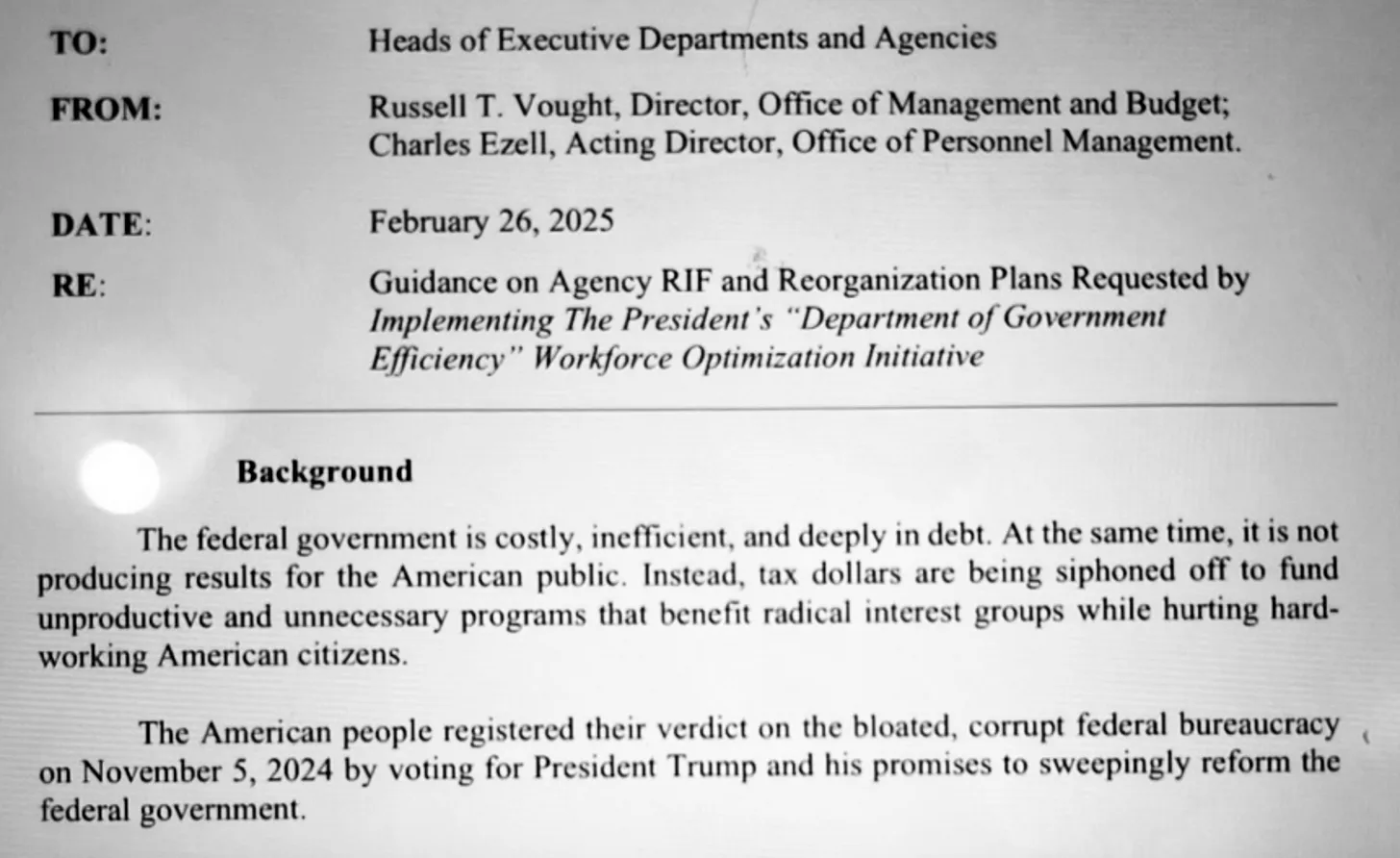
When reports started coming in that the Trump administration was unfreezing its hold on seasonal National Park Service employees or rehiring some federal workers it had fired only days earlier, I began to think — or at least hope — that the bloodshed was almost over. Mmmm … nope. Two days ago Russel Vought, the Director of the Office of Management and Budget, sent a memo to all federal agencies ordering them to “promptly undertake preparations to initiate large-scale reductions in force.”

Here’s the way he introduced the memo:

Which is a long way of saying that Russell Vought is an a&%hole. He’s also an architect of Project 2025. It’s funny, because I remember a few months ago when a certain commenter chiding me for predicting that Trump would follow Project 2025 if elected. Well, guess what: The Trump administration is following Project 2025 to the letter. That includes eviscerating public agencies, like the National Oceanic and Atmospheric Administration, where 800 employees were fired yesterday and more may lose their jobs today. This is bad. Very bad.

***

If you’re in the Durango area and you’d like to support public employees, you’ve got options! On March 3, at 3 p.m., there will be a peaceful demonstration to support public lands employees, many of whom were illegally fired under the Trump administration’s cuts to federal agencies, outside the San Juan National Forest Headquarters at 15 Burnett Ct in Durango. There will be concurrent events in Bayfield and Dolores (see flier below). Attendees are invited to bring thank-you cards and small gifts for remaining staff and participate in sign-waving to show solidarity. This event will support both the San Juan National Forest Headquarters and the local Bureau of Land Management (BLM) office, which have each lost employees in these cuts.

And beer! Ska Brewing in Durango is rolling out a special stout today to support forest service workers — or help them drown their sorrows (20% alcohol … holy cow). Check out the logo:

Colorado College’s 15th annual (February 2025 State of the Rockies Project Conservation in the West Poll

A bunch of Utah public lands. Jonathan P. Thompson photo.

Click the link to read the release on the State of the Rockies Project website (Cyndy Hines and Jacob Hay):

Westerners Who Prefer Public Land Conservation Over Energy Development Reaches All Time High

Fifteenth annual Conservation in the West Poll reveals there is no mandate from voters in the West to roll back public lands protections or expand oil and gas development

COLORADO SPRINGS—Colorado College’s 15th annual State of the Rockies Project Conservation in the West Poll released today shows Western voters continue to support strong conservation and protection policies as a new presidential administration takes power, promising rollbacks, budget cuts, and expanded energy development.

The poll, which surveyed the views of voters in eight Mountain West states (Arizona, Colorado, Idaho, Montana, Nevada, New Mexico, Utah, and Wyoming), found Westerners prefer public land conservation over oil and gas development at the highest margins measured in the poll’s 15-year history.

Western voters continue to express concern about issues related to land, water, and wildlife. Strong majorities of Western voters – including self-identified “MAGA” voters – support policies that focus on the protection and conservation of public lands and oppose policies that would open public lands up to drilling, mining, or other development.

Given a choice between protection and development, 72 percent of Westerners prefer their elected officials to place more emphasis on protecting clean water sources, air quality, and wildlife habitat while providing opportunities to visit and recreate on public lands. By contrast, only 24 percent prefer their elected officials to prioritize the production of more domestic energy by maximizing the amount of national public lands available for responsible oil and gas production. Self-identified MAGA voters are split on the question, with 51 percent favoring an emphasis on protecting public lands and 44 percent wanting to maximize oil and gas production on public lands.

The first Trump administration reduced the size of national monuments, an unpopular decision in the West at the time. Reducing or removing national monument protections are even more unpopular now, with 89 percent of voters opposing the idea, compared to 80 percent when the question was asked in
January 2017.
Similarly, proposals to give state governments control over national public lands are more unpopular now,
with 65 percent of Westerners in opposition, compared to 2017 when 56 percent were opposed.

“The consensus favoring public lands conservation remains consistent and strong in the West,” said Katrina Miller-Stevens, Former Director of the State of the Rockies Project and an Associate Professor at Colorado College. “Westerners do not want to see a rollback of national monument protections and there is no mandate for oil and gas development. Voters from all political ideologies are united in support of public land conservation in the West.”

Proposals to reduce protection and expand energy development on public lands are deeply unpopular in
the West:

  • 72 percent oppose removing protections for parts of existing national public lands to allow more drilling, mining and other development.
  • 63 percent oppose reducing protections for some of the rare plants and animals under the Endangered Species Act.
  • 60 percent oppose expanding the amount of national forest and other public lands available to private companies for logging.

Instead, Westerners are supportive of initiatives to protect public lands and natural resources from the impacts of development:

  • 92 percent support keeping the requirement that oil and gas companies, rather than taxpayers, pay for all of the clean-up and land restoration costs after drilling is finished.
  • 88 percent support continuing to require oil and gas producers that operate on public lands to use updated equipment and technology to prevent leaks of methane gas during the extraction process and reduce the need to burn off excess natural gas into the air.
  • 71 percent support only allowing oil and gas companies the right to drill in areas of public lands where the likelihood of actually producing oil is high.
  • 84 percent support maintaining or increasing the royalty rates that oil companies pay for producing oil and gas on national public lands.
  • 89 percent support managing public lands to ensure there are more outdoor places free of light pollution to see the stars at night.
  • 86 percent support ensuring Native American Tribes have greater input into decisions made about areas within national public lands that contain sacred or culturally significant places to their Tribes

With hiring freezes and a reduction of the federal workforce underway, Westerners are clear about who they prefer to make decisions about public lands, water, wildlife and other natural resources. 87 percent prefer these decisions be made by career professionals such as rangers, scientists, fire fighters, and other specialists in the field, compared to just 9 percent who prefer decisions be made by new political appointees.

Overall, voters gave positive marks – ranging from 61 percent approval to 86 percent approval – for the federal agencies charged with protecting public lands and the environment, including the U.S. Forest Service, National Park Service, Environmental Protection Agency, U.S. Fish and Wildlife Service, and Bureau of Land Management. Three-quarters of Western voters – including bipartisan majorities – are opposed to reducing funding to these agencies. More than two-thirds (69 percent) of MAGA voters oppose funding reductions for these federal agencies as well.

Despite 81 percent expressing serious concern about the rising cost of living, Westerners do not want to sacrifice public lands to build more housing. 82 percent of Westerners prefer building more housing within or close to existing communities, compared with 14 percent who favor selling off public lands to develop housing on natural areas.

Westerners value the natural beauty of their states, with more than three-in-ten naming nature as the thing they like most about living in the West. 67 percent of Westerners report visiting national public lands three or more times in the past year, and 24 percent visited them more than 10 times.

That connection translates into concern around the loss of habitat and natural areas, wildlife declines, pollution, and inadequate water supplies. All the land, water, and wildlife issues tested in the poll are viewed as extremely or very serious problems by more than half of Western voters, with a level of concern that is consistent with prior years.

Against that background of concern, voters support a variety of efforts to reduce or mitigate the impacts of climate change:

  • 72 percent support the federal government taking action to reduce the carbon pollution that contributes to climate change.
  • 71 percent support the federal government taking action to ensure the reliability of water supplies that may be threatened by climate change.
  • 91 percent support allowing private landowners the ability to conserve their lands as working farms, ranches, natural areas, and wildlife habitat through voluntary land conservation easements.
  • 92 percent support promoting nature-based solutions to improve water quality, such as conserving forests and lands along rivers, lakes, and streams.
  • 94 percent support allowing trained fire teams to use controlled burns to remove growth in forests that could fuel wildfires when and where it is safe to do so

This is the fifteenth consecutive year Colorado College gauged the public’s sentiment on public lands and conservation issues. The 2025 Colorado College Conservation in the West Poll is a bipartisan survey conducted by Republican pollster Lori Weigel of New Bridge Strategy and Democratic pollster Dave Metz of Fairbank, Maslin, Maullin, Metz & Associates. The survey is funded by the William and Flora Hewlett Foundation.

The poll surveyed at least 400 registered voters in each of eight Western states (AZ, CO, ID, MT, NV, NM, UT, & WY) for a total 3,316-voter sample, which included an over-sample of Black and Native American voters. The survey was conducted between January 3-17, 2024 and the effective margin of error is +2.46% at the 95% confidence interval for the total sample; and at most +4.9% for each state. The full survey and individual state surveys are available on the State of the Rockies Project website.


About Colorado College
Colorado College is a nationally prominent four-year liberal arts college that was founded in Colorado Springs in 1874. The College operates on the innovative Block Plan, in which its 2,200 undergraduate students study one course at a time in intensive three and a half-week segments. For the past eighteen years, the college has sponsored the State of the Rockies Project, which seeks to enhance public understanding of and action to address socio-environmental challenges in the Rocky Mountain West through collaborative student-faculty research, education, and stakeholder engagement.

About Fairbank, Maslin, Maullin, Metz & Associates
Fairbank, Maslin, Maullin, Metz & Associates (FM3)—a national Democratic opinion research firm with offices in Oakland, Los Angeles and Portland, Oregon—has specialized in public policy oriented opinion research since 1981. The firm has assisted hundreds of political campaigns at every level of the ballot –from President to City Council—with opinion research and strategic guidance. FM3 also provides research and strategic consulting to public agencies, businesses and public interest organizations nationwide.

About New Bridge Strategy
New Bridge Strategy is a Colorado-based, woman-owned and operated opinion research company specializing in public policy and campaign research. As a Republican polling firm that has led the research for hundreds of successful political and public affairs campaigns, New Bridge has helped coalitions bridging the political spectrum in crafting winning ballot measure campaigns, public education campaigns, and legislative policy efforts.

About Hispanic Access Foundation
Hispanic Access Foundation, a 501(c)(3) non-profit organization, connects Latinos with partners an opportunities to improve lives and create an equitable society. Our vision is that one day every Hispanic individual in America will enjoy good physical health and a healthy natural environment, a quality education, economic success, and civic engagement in their communities with the sum of improving the future of America. For more information visit www.hispanicaccess.org.

New Poll Finds Broad Support for #Conservation and Action on #ClimateChange Across the West — Jake Bolster (InsideClimateNews.org)

People walk through the Red Cliffs National Conservation Area, designated during Obama administration, in Washington County, Utah. Credit: Bob Wick/BLM

Click the link to read the article on the Inside Climate News website (Jake Bolster):

February 19, 2025

Colorado College’s annual survey included residents of 8 Western states, the majority of whom identified as politically conservative or moderate.

As oil and gas production in the U.S. continues to reach record highs, the margin of Westerners who support public land conservation over increased oil and gas development also continues to climb. 

In a new “Conservation in the West Poll” released today by Colorado College, 72 percent of respondents from eight Western states said they would prefer their member of Congress to emphasize protecting clean air, water and wildlife habitat while boosting outdoor recreation over maximizing the amount of public land used for oil and gas drilling. 

The figure marks a two-percent increase from last year’s poll, and only 24 percent of those surveyed expressed interest in more oil and gas drilling and mining on public lands. The 48-point margin in favor of conservation is the highest in the poll’s fifteen-year history. 

“The consensus favoring public lands conservation remains consistent and strong in the West,” said Katrina Miller-Stevens, an associate professor at Colorado College and the former director of the State of the Rockies Project, which runs the annual polls, in a statement. “Westerners do not want to see a rollback of national monument protections and there is no mandate for oil and gas development. Voters from all political ideologies are united in support of public land conservation in the West.” 

Colorado College worked with Lori Weigel of New Bridge Strategy, a Republican pollster, and Dave Metz of Fairbank, Maslin, Maullin, Metz & Associates, a Democratic pollster, to survey 3,316 respondents, most of whom identified as politically conservative or independent. The poll, funded by the William and Flora Hewlett Foundation, included at least 400 voters each from Arizona, Colorado, Idaho, Nevada, New Mexico, Montana, Utah and Wyoming. Just under 40 percent of the survey-takers said they supported President Donald Trump’s “Make America Great Again” platform. 

The results come at a time when politicians in the nation’s capital and across the West are drumming up expansive, divisive plans for public lands. 

Last Friday, the Trump administration fired over 5,400 employees across the departments of the Interior and Agriculture, most of whom worked for the National Park Service and U.S. Forest Service. The date of the firings have led them to be called a “Valentine’s Day Massacre,” a reference to the murders in Chicago nearly a century ago by gangsters working for Al Capone. 

Since taking office, Trump has appointed people with close ties to the oil and gas industry to lead key federal agencies overseeing public lands. His secretary of the interior, Doug Burgum, who ordered last week’s Interior Department firings, was previously the governor of North Dakota, where he joined industry lawsuits to halt or overturn Biden-era regulations on oil and gas production. The Associated Press reported that he has relationships with several oil and gas executives and lobbyists.

Kathleen Sgamma, who, as Trump’s nominee to lead the Bureau of Land Management would be responsible for stewarding hundreds of millions of acres of public lands, has spent close to two decades lobbying for oil and gas companies across the West.

Lawmakers in Utah and Wyoming have demanded the federal government give control of public lands in their states, including areas protected by the National Park Service, the U.S. Fish and Wildlife Service, the Bureau of Land Management and the U.S. Forest Service, back to state legislatures. Neither initiative went very far—Utah’s was rejected by the courts and Wyoming’s failed to make it out of the state’s Senate after a series of dramatic revotes. 

“A lot of the actions that the Trump administration has taken or has proposed to take are pretty far out of step with what Westerners want to see in terms of our public lands,” said Rachael Hamby, policy director at the Center for Western Priorities. “Westerners care about public lands a lot and want to see them protected.”

No more than 40 percent of residents in any of the eight states offered approval for state-based land grabs, and an overwhelming majority of Westerners—87 percent—supported career officials at various federal departments making decisions regarding public lands; only nine percent wanted to see elected representatives appoint new officials “who come from other industries and may have different perspectives” on public land, water and wildlife decisions.

Nearly three-quarters of Westerners agreed with federal efforts to combat climate change, though state-by-state levels of approval varied widely. Of the respondents from New Mexico, which has voted for Democrats in all but one presidential election since 1992, 77 percent backed federal action to combat climate change; in Wyoming, the only state where a majority of respondents said they supported President Trump’s “Make America Great Again” agenda, 52 percent of those surveyed said they agreed with federal action on climate change.

Just under 90 percent of those surveyed expressed a desire to keep national monument designations implemented in the last decade in place. The new administration has begun to review those monument designations, and Trump shrunk some of them during his first term.

Other measures enjoying broad support across the West included giving private landowners the ability to conserve their land through conservation easements, using nature-based solutions to improve water quality and allowing the use of controlled burns to thin overgrown forests and lower the threats posed by wildfires.

As a new administration sets a different direction for public lands, Hamby warned that diverging from Westerners’ preferences would carry consequences. 

“If elected officials are straying too far from what their constituents want to see,” she said, “they’re going to have to answer to their voters.”

Messing with Maps: Pipeline edition — Jonathan P. Thompson (LandDesk.org)

Click the link to read the article on the Land Desk website (Jonathan P. Thompson):

February 11, 2025

🗺️ Messing with Maps 🧭

Detail of a 1931 New Mexico oil and gas map showing part of the San Juan Basin, where commercial drilling began in earnest in the early 1920s. Note that there were already pipelines running from Bloomfield to Albuquerque, from the Ute Dome to Durango and from the Rattlesnake Dome to Gallup.

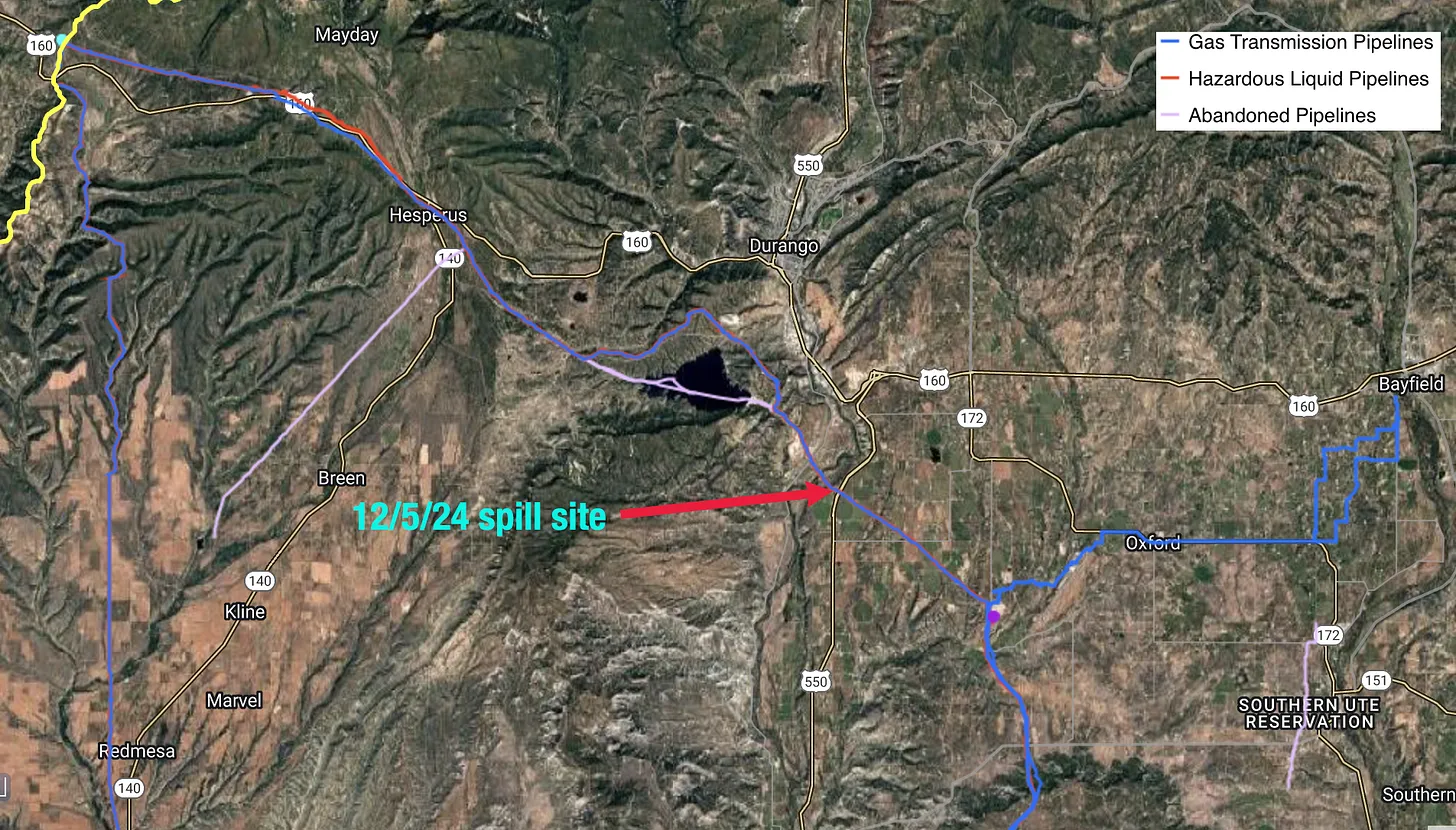
On the afternoon of December 5, 2024 at least seven homes were evacuated in rural La Plata County, Colorado, after a major pipeline ruptured and spilled some 23,000 gallons of gasoline 1Two months later, lingering fumes and contamination kept at least one of the evacuated households from returning home, according to the Durango Herald.

The spill tainted nine domestic wells with benzene concentrations of up to 300 parts per billion; the carcinogen’s maximum allowable level is 5 parts per billion. And the nearby Rainbow Springs trout farm suffered an 80,000 fingerling die-off in the days following the spill, according to the Herald, though a conclusive link between the two has yet to be made.

Graphic credit: The Land Desk

That a bunch of hydrocarbons broke free from their confines in that part of the country didn’t shock me: La Plata County is in the San Juan Basin, where oodles of natural gas has been pumped from the ground over the last century or so, and leaks, breaches, and spills have been frequent — sometimes with deleterious results. But I was a bit taken aback to read that the material that spilled was gasoline that came from a major, interstate pipeline.

In fact, several Facebook commenters expressed their doubts, saying it must have been drip condensates or liquid natural gas, instead, coming from one of the lines associated with the gas fields or the processing plant nearby. But the Herald reporter got his info directly from the pipeline operator (and they should know). And I double-checked the Pipeline and Hazardous Materials Safety Administration incident report, which said Enerprise Products’ Four Corners Lateral Loop pipeline, which was installed in 1980, had spilled 544 barrels (or 22,848 gallons) of non-ethanol gasoline.

Curiously, both Energy Information Administration and PHMSA records show that only natural gas-carrying lines pass through the county. But apparently the line now carries auto fuel from Texas to New Mexico, Colorado, and Wyoming, where it helps keep pump prices affordable, or so the pipeline operator told the Herald.

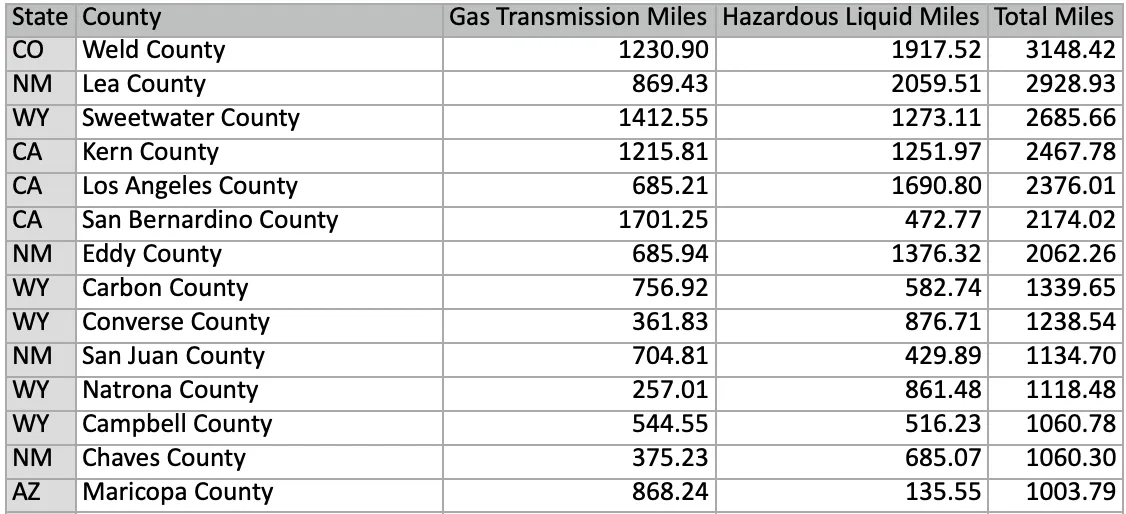
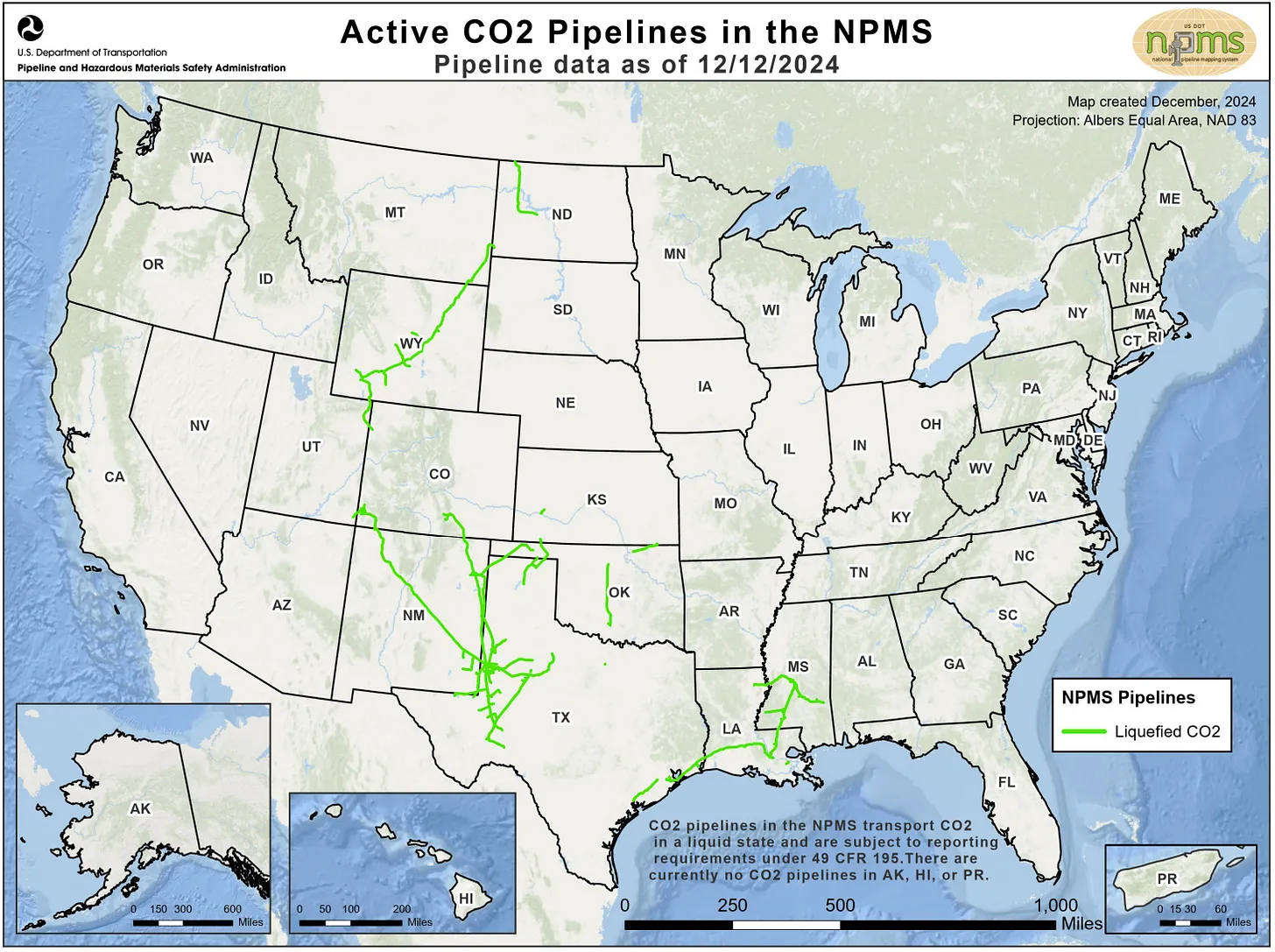
It’s one of seven natural gas, carbon dioxide, or hazardous liquids pipelines — totaling 225 miles — that cross La Plata County. The Western states contain about 93,024 miles of these long-distance methane and petroleum carrying lines (this does not include local gathering systems that web their way through the oil and gas fields or natural gas distribution lines that run through towns and cities).

The top 15 counties in the Western U.S. in terms of gas transmission and hazardous liquid pipeline mileage. Source: PHMSA.

That’s one of those things about pipelines. You might be subtly aware they exist, thanks to the strips of land that have been cleared of vegetation and the signs warning you not to dig there. But the fact that there are large quantities of flammable, sometimes explosive, climate-altering substances rushing beneath your feet on their way to distant destinations is not something that is often at the top of one’s mind. At least not until they leak, rupture, or explode.

Graphic credit: The Land Desk

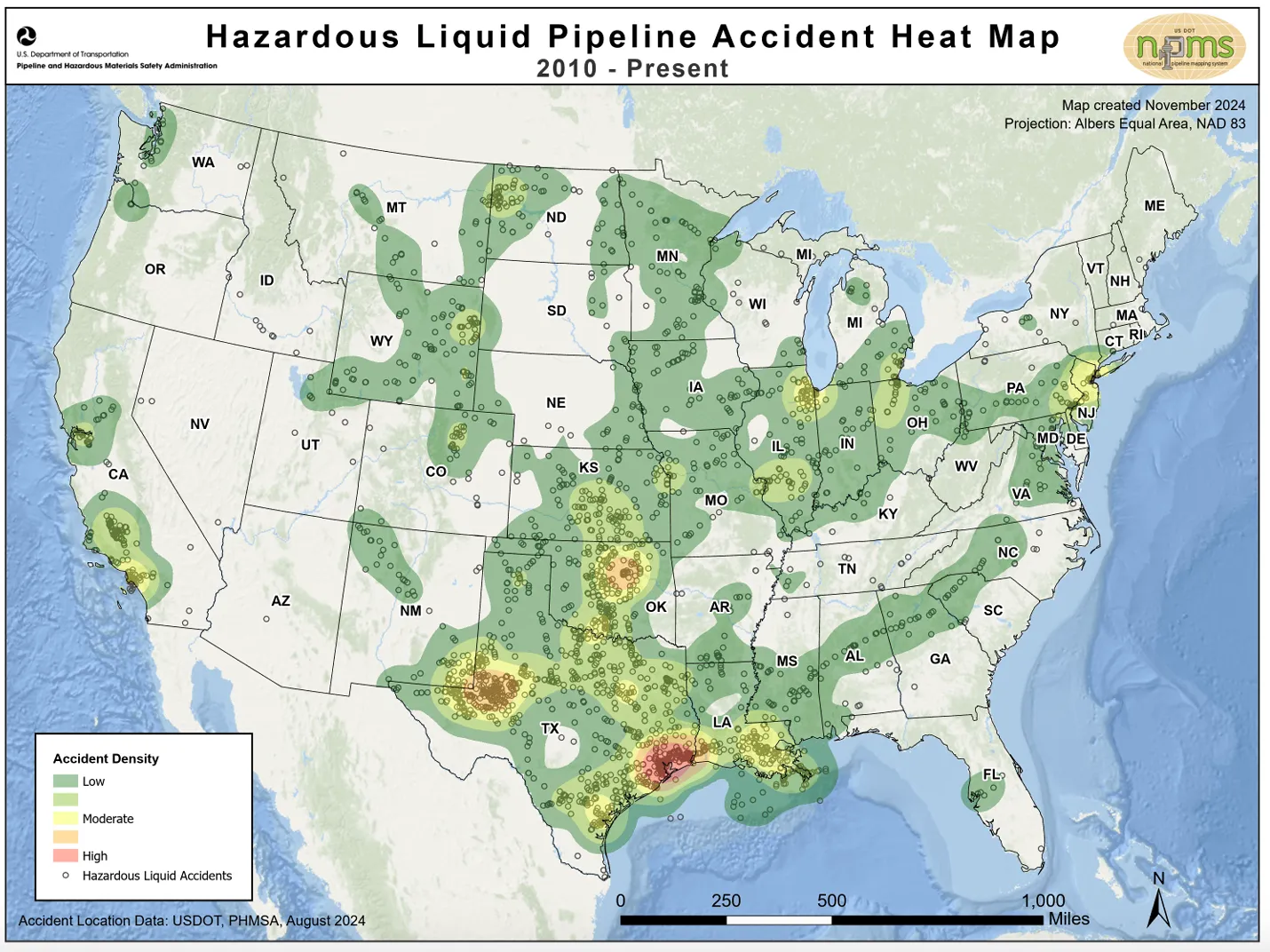
And they do, more often than most of us would hope. Usually the cause is corrosion, a failed weld, or some other type of equipment or material failure, though excavation-caused ruptures are also up there. Cars and trucks run into pipelines and break them, floods or seismic activity can tear them apart, and sometimes lightning strikes them.

Natural gas is composed mostly of methane, a potent greenhouse gas with about 86 times the atmospheric warming potential than carbon dioxide. So every release is contributing to climate change. A major breach or a slow leak that goes undetected can emit massive amounts of methane; in April, a construction worker breached a pipeline that released 118,000 MCF (thousand cubic feet) of natural gas before it was shut off 2. Plus, when the stuff builds up it can explode, which makes gas line leaks especially dangerous. Crude oil and gasoline spills, meanwhile, can harm wildlife, waterways, and people, and even carbon dioxide pipeline ruptures can be fatal.

So it’s good to have strong regulations around pipelines, as well as a well-staffed agency to enforce those regulations. It’s also nice to know where the major pipelines are around you. And for now, at least, you can find out by consulting the PHMSA’s National Pipeline Mapping System. Just enter your state and county and you get a map of the big hazardous liquid and natural gas transmission lines. You can also do an accident query and see where there have been accidents near you. One drawback is that the system limits how far you can zoom in on the map, apparently because they’re worried about saboteurs using it to locate targets. Here’s what the zoomed in map looks like. This is about the same view as the opening image from 1931.

Graphic credit: The Land Desk

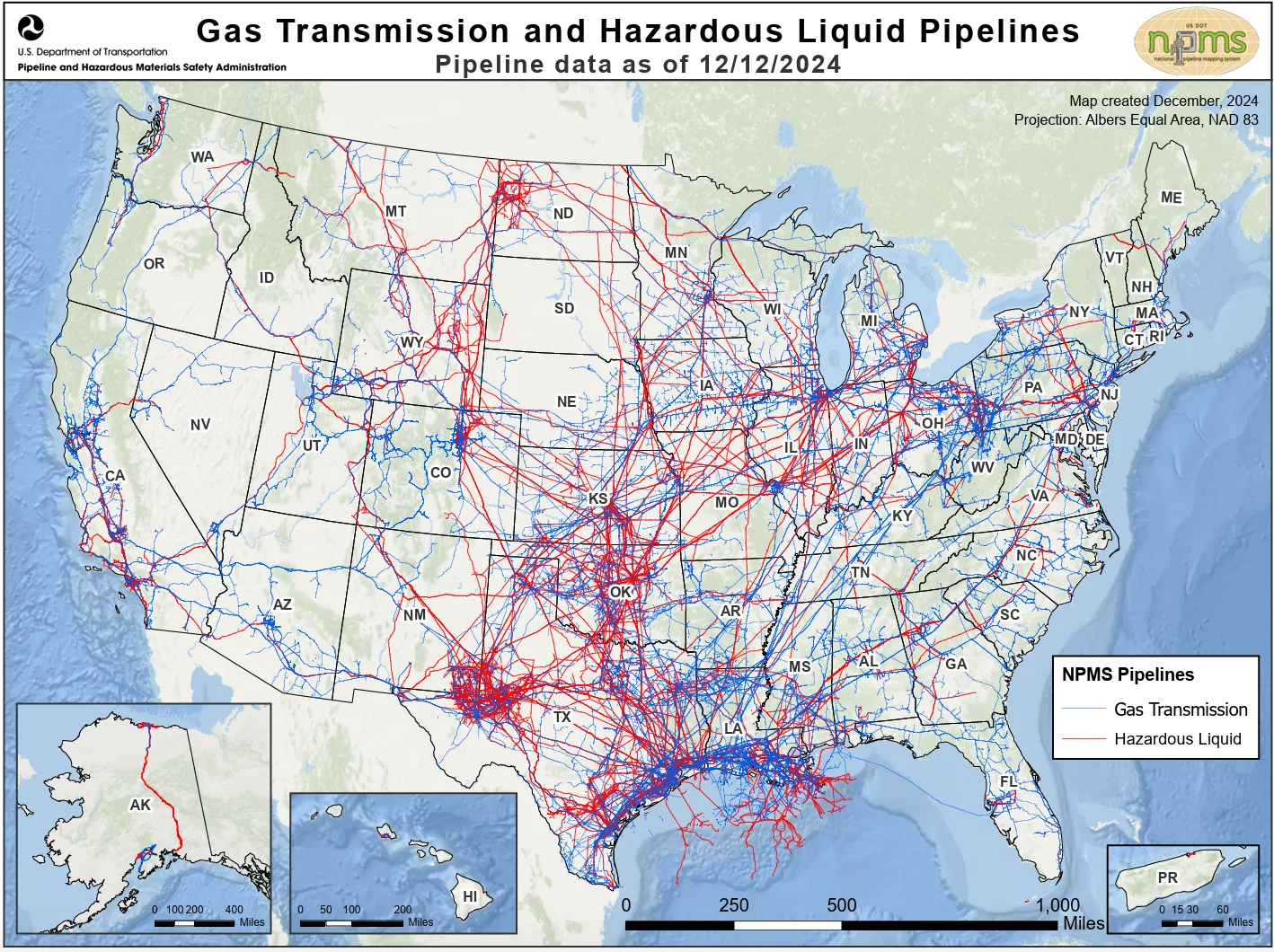
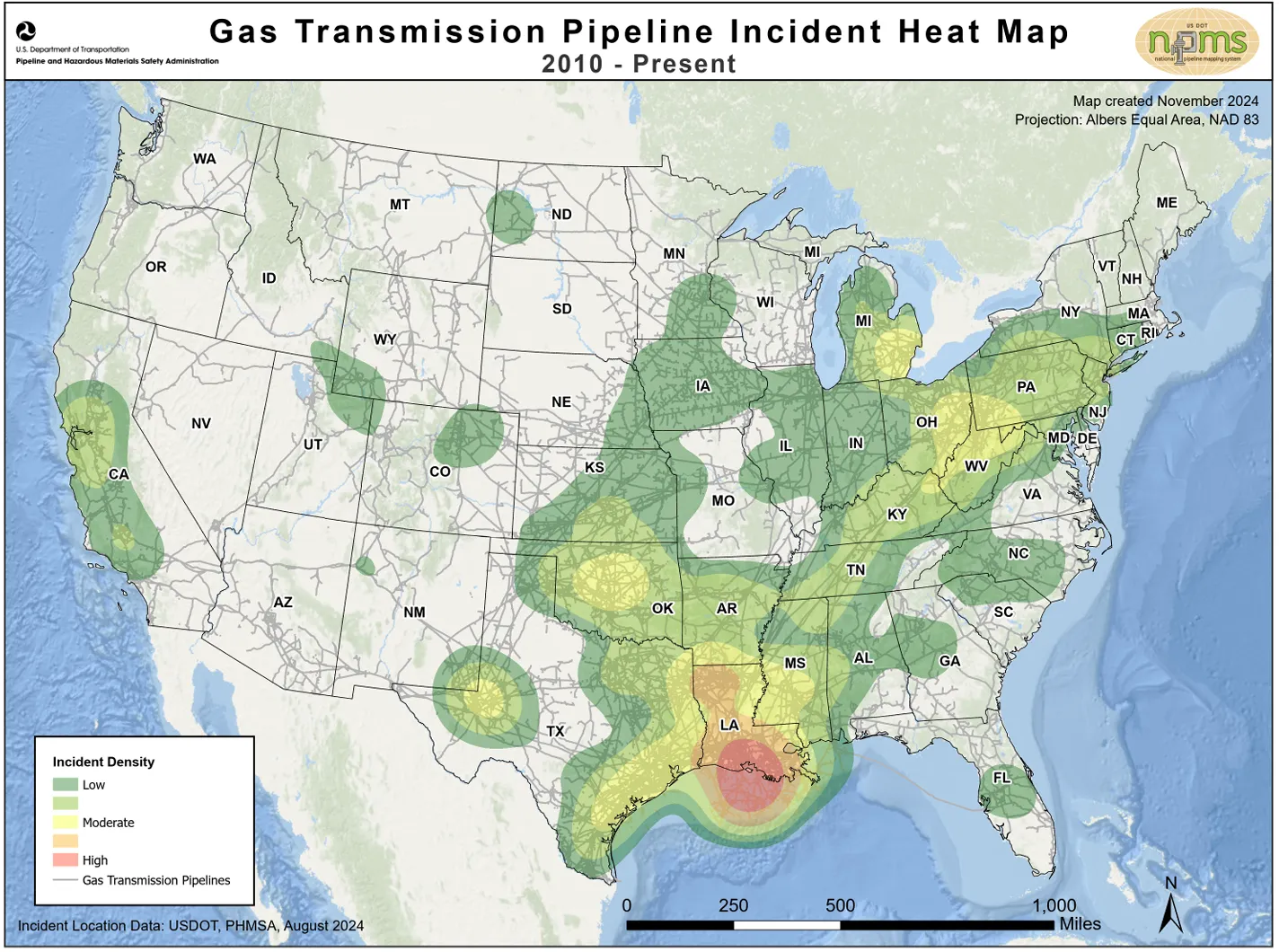
Here are some zoomed out maps to give you a sense of where the pipelines are concentrated, with the highest densities in the Permian Basin and Louisiana.

Graphic credit: The Land Desk

DATA DUMP:

  • 122 Number of U.S. interstate natural gas transmission system incidents, accidents, and spills in 2024, resulting in 7 injuries.
  • 1.82 million MCF Volume of natural gas released during those incidents.
  • Corrosion The leading cause of natural gas transmission pipeline incidents.
  • 13, 28 Number of fatalities and injuries, respectively, resulting from natural gas distribution system incidents nationwide in 2024.
  • 309,560 MCF Volume of natural gas released during distribution system incidents.
  • $549,000 Total damages, as of early February, resulting from the Enterprise pipeline spill in La Plata County in December.
  • 192 Number of incidents reported on Enterprise Products Operating pipelines between 2017 and 2025.
  • 294 Number of incidents in interstate hazardous liquid pipelines nationwide in 2024.
  • 80 Number of hazardous liquids incidents in 2024 that occurred in pipelines that were installed prior to 1985. Ten of the damaged lines were installed prior to 1940.
  • 16,708 Barrels of crude oil spilled in 2024 pipeline incidents.
  • 3,333 Barrels of refined petroleum products spilled or lost in 2024 pipeline incidents.
  • $70 million Total damages resulting from hazardous liquid (crude oil, gasoline, and other products) pipeline incidents in 2024.

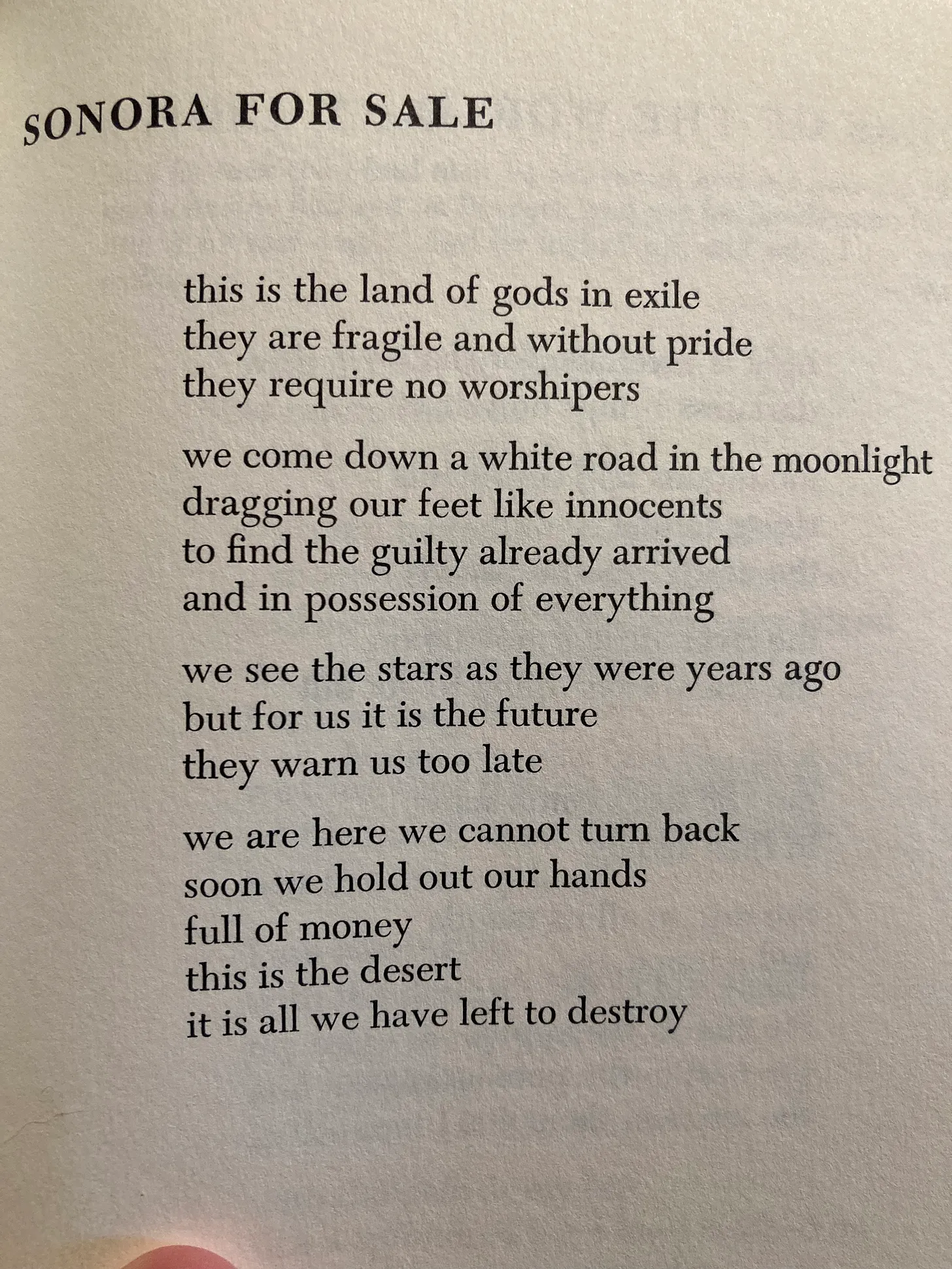
Parting Poem

Now for something completely different, I’d like to leave you with this lovely poem by Richard Shelton. It’s from his Selected Poems, 1969-1981, which is easily my most read book, as I come back to it time after time. No one captures the essence of the desert like Shelton.

1 Which is about enough gasoline to fuel the ol’ Silver Bullet (the Land Desk’s official mascot) for another 800,000 miles or so.

2 The average U.S. residence uses about 65 MCF of natural gas per year.

Webinar: Turning Waste into Resource – New Rules for Reusing Produced Water in Oil and Gas — Water Education #Colorado (Caitlin Coleman) #fossilfuel

Produced water. Graphic credit: U.S. Department of Energy

Feb 13, 2025

This webinar, aired on February 11, 2025, focuses on produced water. We cover some basics about water in the oil and gas industry, learn about proposed new rules focused on reusing that water (which are expected to be adopted in early 2025) — and the negotiations that have surrounded them, hear about the Colorado Produced Water Consortium, and explore opportunities and challenges as the industry and environmentalists look at what it means to stretch freshwater use and to reuse more water. With speakers: Harmony Cummings, the Green House Connection Center Hope Dalton, Colorado Produced Water Consortium Josh Kuhn, Conservation Colorado John Messner, Colorado Energy and Carbon Management Commission Grant Tupper, Select Water Solutions

The #SaltonSea’s weirdness is what’s appealing — Dennis Hinkamp (WriterOnTheRange.org) #ColoradoRiver #COriver #aridification

Bales of straw along the banks of the Salton Sea, Hinkamp photo

Click the link to read the article on the Writers on the Range website (Dennis Hinkamp):

February 3, 2025

Fascinating and fetid, the Salton Sea in southern California lures me back, every year.

Driving south from Utah, I take bits of historic Highway 66 and then skirt Joshua Tree National Park to cruise through little known Box Canyon to Mecca, California. When the landscape opens up, I see the beautiful wreck of the Salton Sea, created by the collision of geology and bad luck.

Southern Pacific passenger train crosses to Salton Sea, August 1906. Photo via USBR.

The sea occupies a much smaller footprint of what used to be Lake Cahuilla, which disappeared in the late 1500s. Then, in a wild spring runoff in 1905, the Colorado River blew out a diversion dam and for three years, and the mighty Colorado drained into the Salton Sink. Agriculture runoff replenished the shallow lake over the following decades, though recently lined canals, courtesy of San Diego, in the Imperial Valley resulted in diminished flows. Its run as a bombing range ended in the 1970s.

If the lake were to completely dry up there would be a horror to behold. While at shrinking Lake Mead a few gangster cadavers showed up in the mud, the Salton Sea contains crashed planes and practice bombs, the targets simulations during the 1940s for the real atomic bombs dropped on Japan.

The lake is bracketed by opulent Palm Springs to the north and the arty squalor of Slab City to the south, home to about 150 full-time residents but temporary home to as many as 4,000 in the winter. In between there are hot springs RV resorts, date palm groves, geothermal energy plants and the town of Bombay Beach sitting atop the San Andreas fault.

Is the diminished sea worth saving? It’s too late to ask the question because, like the great Salt Lake, the cost of not saving it is likely higher than the rescue. Like many invasive species around the West, there is no easy way to get rid of it. Yet most of its fish are already dead and migrating birds have little to eat.

Dust is the issue, and most conservation programs attempt to mitigate dust.

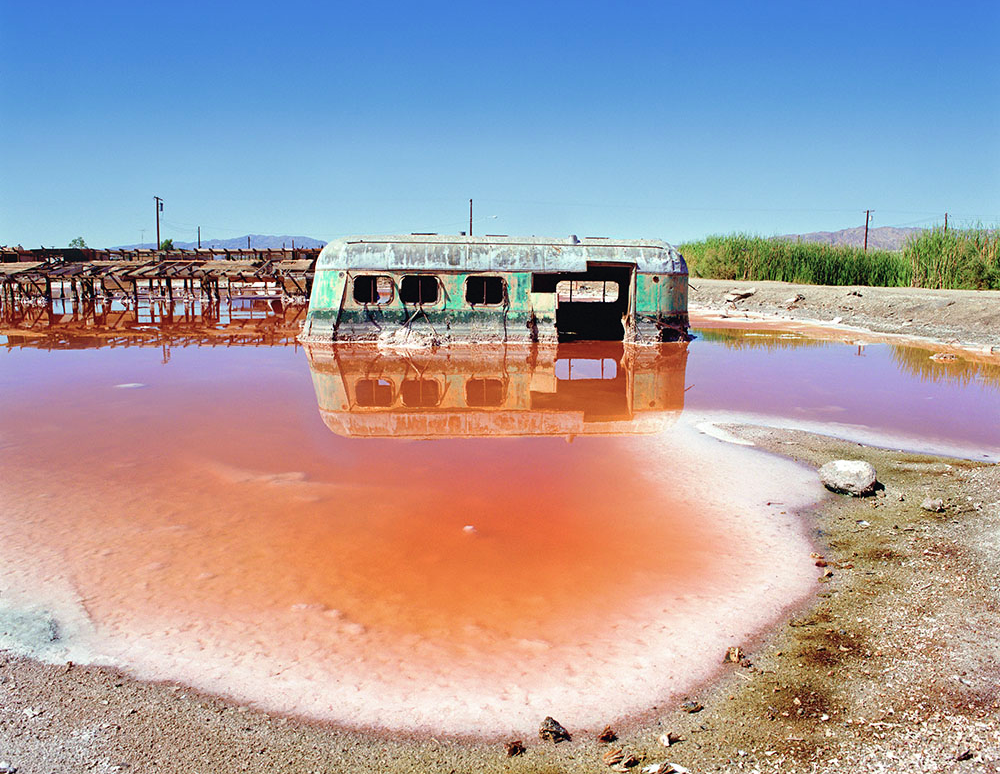
The 1950s and 60s brought out the excesses of post-war revelers to the Salton Sea. You can see the salt-encrusted remains of former resorts and second homes of the Los Angeles fancy people. You can imagine the ghosts of boat races and cocktails.

Those folks even named the local wildlife refuge after swinging Sony Bono, but what came next was toxic salinity and decay as less water came in and the water that remained increased in salinity.

Still, the sea persists. Its salt-encrusted shores circle about 340 square miles of sea. A silo-full of conspiracy theories features the Salton Sea: The military may have accidently dropped a real bomb that did not explode, and the bomb might even be under the water along with hundreds of other dummy bombs and fallen planes. Bodies may still sit in the planes. We know for certain that Slab City is what’s left of a decommissioned military base built about 70 years ago.

Most of the people I meet around the lake seem happy. The place brings pleasure to pre-apocalyptic people like me and those creating outsider art on the actual beach near Bombay Beach. Thousands of Canadians migrate there each winter because the highest temperatures rarely top 80 degrees.

I look forward to my week at the hopefully named Fountain of Youth Spa RV Resort. I joke that I have been coming there since 1906 so it must be working.

It attracts so many Canadians that the resort hosts U.S. vs. Canada Games featuring geezer sports of pickleball, horseshoes, bocce and karaoke. Poutine and box wine flow freely, and people sometimes stay up into the double-digit hours of the evening.

Dennis Hinkamp. Photo credit: Writers on the Range

The Salton Sea will likely remain a curiosity and hiding place for the weird until some real monster beneath the sea emerges, which could be a rush to start mining lithium made by the sea.

On the other hand, the San Andreas fault might just swallow the whole thing in one glorious gulp. Meanwhile, it’s my refuge, my winter solace away from anxious headlines, and just strange enough to be hospitable.  

Dennis Hinkamp is a contributor to Writers on the Range, writersontherange.org, the independent nonprofit dedicated to spurring lively conversation about the West. He writes in Utah.

Map of the Salton Sea drainage area. By Shannon – Background and river course data from http://www2.demis.nl/mapserver/mapper.asp and some topography from http://seamless.usgs.gov/website/seamless/viewer.htm, CC BY-SA 4.0, https://commons.wikimedia.org/w/index.php?curid=9707481

Copernicus: January 2025 was the warmest on record globally, despite an emerging #LaNiña — World Meteorological Society #ActOnClimate

Surface air temperature anomaly for January 2025 relative to the January average for the period 1991-2020. Data source: ERA5. Credit: C3S/ECMWF.  ​​​​

Click the link to read the report on the Copernicus website:

February 6, 2025

January 2025 – Surface air temperature and sea surface temperature highlights


Global Temperatures

  • January 2025 was the warmest January globally, with an average ERA5 surface air temperature of 13.23°C, 0.79°C above the 1991-2020 average for January.
  • January 2025 was 1.75°C above the pre-industrial level and was the 18th month in the last nineteen months for which the global-average surface air temperature was more than 1.5°C above the pre-industrial level.
  • The last 12-monthsperiod (February 2024 – January 2025) was 0.73°C above the 1991-2020 average, and 1.61°C above the estimated 1850-1900 average used to define the pre-industrial level.

*Datasets other than ERA5 may not confirm the 18 months above 1.5°C highlighted here, due to the relatively small margins above 1.5°C of ERA5 global temperatures observed for several months and differences among the various datasets. 

Europe and other regions

  • The average temperature over European land for January 2025 was 1.80°C, 2.51°C above the 1991-2020 average for January, the second warmest after January 2020, which was 2.64°C above average.
  • European temperatures were most above the 1991-2020 average over southern and eastern Europe, including western Russia. In contrast, they were below average over Iceland, the United Kingdom and Ireland, northern France, and northern Fennoscandia.
  • Outside Europe, temperatures were most above average over northeast and northwest Canada, Alaska, and Siberia. They were also above average over southern South America, Africa, and much of Australia and Antarctica.
  • Temperatures were most notably below average over the United States and the easternmost regions of Russia, Chukotka and Kamchatka. The Arabian Peninsula and mainland Southeast Asia also had below-average temperatures.

Sea surface temperature 

  • The average sea surface temperature (SST) for January 2025 over 60°S–60°N was 20.78°C, the second-highest value on record for the month, 0.19°C below the January 2024 record.
  • SSTs were below average over the central equatorial Pacific, but close to or above average over the eastern equatorial Pacific, suggesting a slowing or stalling of the move towards La Niña conditions. SSTs remained unusually high in many other ocean basins and seas.
Monthly global surface air temperature anomalies (°C) relative to 1850–1900 from January 1940 to January 2025, plotted as time series for each year. 2025 is shown with a thick red line, 2024 with a thick orange line, 2023 with a thick yellow line, and all other years with thin grey lines. Data source: ERA5. Credit: Copernicus Climate Change Service /ECMWF.

According to Samantha Burgess, Strategic Lead for Climate at ECMWF:

“January 2025 is another surprising month, continuing the record temperatures observed throughout the last two years, despite the development of La Niña conditions in the tropical Pacific and their temporary cooling effect on global temperatures. Copernicus will continue to closely monitor ocean temperatures and their influence on our evolving climate throughout 2025.”

January 2025 – Hydrological highlights


  • January 2025 saw predominantly wetter-than-average conditions over regions of western Europe, as well as parts of Italy, Scandinavia and the Baltic countries; heavy precipitation led to flooding in some regions.
  • Conversely, drier than average conditions established in northern UK and Ireland, eastern Spain, and north of the Black Sea.
  • Beyond Europe, it was wetter than average in Alaska, Canada, central and eastern Russia, eastern Australia, south-eastern Africa, southern Brazil, with regions experiencing floods and associated damage.
  • Drier than average conditions established in southwestern United States and northern Mexico, northern Africa, the Middle East, across Central Asia and in eastern China as well as in much of southern Africa, southern South America and Australia.

January 2025 – Sea Ice highlights


  • Arctic sea ice reached its lowest monthly extent for January, at 6% below average, virtually tied with January 2018.
  • In the Arctic region, sea ice concentration anomalies were well below average in the eastern Canadian sector, including Hudson Bay and the Labrador Sea, and in the northern Barents Sea.
  • Antarctic sea ice extent was 5% below average and thus relatively close to average compared to other recent years. This contrasts with the record or near-record values observed in 2023–2024.
  • In the Antarctic region, sea ice concentrations were above average in the Amundsen Sea and generally mixed in other ocean sectors.

More information about climate variables in January and climate updates of previous months as well as high-resolution graphics can be downloaded here.

Other useful links:

Answers to frequently asked questions regarding temperature monitoring can be found here.

Follow near-real-time data for the globe on Climate Pulse here.

More on trends and projections on Climate Atlas here.

The #ColoradoRiver is salty. But where does salinity come from, and what’s being done about it?: Among river disputes, salinity is an issue that all seven basin states agree is worth solving together — The Summit Daily #COriver #aridification

Colorado River. For over 50 years, stakeholders throughout the Colorado River basin have worked to address challenges caused by salinity. Photo credit: Abby Burk via Audubon Rockies

Click the link to read the article on the Summit Daily website (Ali Longwell). Here’s an excerpt:

February 6, 2024

Since 1974, the seven Colorado River basin states — Arizona, California, Colorado, Nevada, New Mexico, Utah and Wyoming — have coordinated efforts to implement salinity control in the waterway as part of the Colorado River Basin Salinity Control Forum. The forum was created by the U.S. Congress, flowing funding through the Bureau of Reclamation to reduce the salt load in the river and research the issue…While salinity is naturally occurring, there are a few reasons that states and river stakeholders have long kept an eye on it.A baseline amount of salinity is OK. Too much salinity can have adverse effects on drinking water, water infrastructure and treatment, appliance wear, aquatic life, the productivity of certain agricultural crops (including wine grapes, peaches and other salt-sensitive products) and more. The U.S. Bureau of Reclamation estimates that salinity causes between $500 and $750 million annually in damages and could exceed $1.5 billion per year if future increases are not controlled…

Much of the Upper Basin geology — specifically Mancus and Mesa Verde shale formations — was created when it was covered by an inland sea, [David] Robbins added. Therefore, they contain salt deposits that through natural erosion and runoff, make their way to the rivers and downstream. In Colorado, natural salinity sources include the geothermal hot springs in Glenwood Springs; shale cliffs and evaporating salt deposits in the Eagle and Roaring Fork valleys; and the salt domes in Paradox Valley in Montrose County along the Dolores River. Human activity can also exacerbate challenges by accelerating the release of compounds from these natural geologic materials and increasing the salt load in the river and tributaries, according to the 2009 U.S. Geological Survey report. This includes activities like mining, farming, petroleum exploration and urban development.  For example, with some agricultural irrigation practices, by adding more water to the soil that naturally contains salts, “increases the rate of dissolution above the natural signal,” [Dave] Kanzer said.  The use of road salts — solid and liquid — to clear snow and ice can also lead to increased salt loads as the salt dissolves and makes its way into snowmelt and streams. 

Photo credit: Glass of Bubbly

The West’s Sacred Cow: Public land grazing makes it through another administration unreformed — Jonathan P. Thompson (LandDesk.org)

Detail of a 1941 grazing districts map.

Click the link to read the article on the LandDesk.org website (Jonathan P. Thompson):

January 31, 2025

🌵 Public Lands 🌲

The Joe Lott-Fish Creek grazing allotment sprawls across nearly 78,000 acres of U.S. Forest Service land in western Utah. It contains a variety of ecosystems, ranging from arid juniper-piñon forests in the lower elevation sections that straddle I-70, to aspen and conifer glades, to 11,000-foot peaks, as well as several streams.

Until just over a decade ago, the primary grazing permittee was Missouri Flat LLC, which was allowed to run 744 cow-calf pairs on the land. Another rancher had a maximum herd of 40. The cattle were supported by 14 cattle ponds and troughs.

Sometime between 2013 and 2016, Missouri Flat’s permit was taken over by Pahvant Ensign Ranches. Over a period of about three years around the same time, the Fishlake National Forest upped the maximum number of cattle allowed to graze the allotment by 604, to a total of 1,388 cow-calf pairs, without notifying the public until 2021. The Forest Service said favorable conditions following the 2010 Twitchell Fire justified the increase, but they didn’t provide any scientific backing for the decision. Then, last April, the Forest Service approved a proposal to add 17 water troughs and 13 miles of new pipeline to the Pahvant Ensign allotment, granting the project a “categorical exclusion,” meaning it isn’t subjected to the usual environmental review.

“Functionally,” wrote Mary O’Brien, a botanist and longtime defender of public lands, ecosystems, and pollinators, “Joe Lott-Fish Creek Allotment is being transformed into a private ranch.”

O’Brien brought the story of the Joe Lott allotment to my attention several months ago. She wanted to show me, in part, that while environmentalists tend to focus on the Bureau of Land Management when pushing back on public lands livestock grazing, they shouldn’t forget that grazing is also widespread on Forest Service lands. And that the Forest Service is no better at managing it than the BLM.

I also find it to be a sort of snapshot of how public lands grazing — under any agency — has come to be the West’s untouchable sacred cow, something that neither Democrats nor Republicans dare to mess with or reform, no matter how obsolete the current regulations or how much harm is being done. I’m not just talking about the Biden or Trump administrations, either: This bipartisan inaction has been going on since the Taylor Grazing Act was passed in 1934.

Data Dump: Cows, cows, cows… (Jonathan P. Thompson): https://www.landdesk.org/p/data-dump-cows-cows-cows

When the white colonial-settlers invaded the Western U.S. in the 19th century, they brought along oodles of cattle and sheep. In some places, the settlers were even preceded by the giant herds of big-time cattle companies and their minders. A good portion of southeastern Utah, for example, was once blanketed by grass that reached an elk’s belly. But then the huge livestock operations, including New Mexico and Kansas Land and Cattle Company and the Carlisle outfit, brought in tens of thousands of head of sheep and cattle beginning in the 1870s. Before long the Hole-in-the-Rock Mormon settlers also got into the livestock business, pasturing their cows and sheep on Elk Ridge near the Bears Ears buttes.

By the 1890s, as many as 100,000 sheep and cattle were chomping their way across San Juan County, reducing large swaths of the formerly abundant grasslands to denuded, dusty, gullied, flash-flood-prone wastelands. Plus, the sheepmen and the cattlemen were constantly fighting over who got access to what portion of range, a conflict that had disastrous outcomes. At one point, allegedly out of spite, the Carlisle livestock concern turned out thousands of sheep on the upper branches of Montezuma Creek, Monticello’s source for drinking water. Bacteria from the sheep feces contaminated the water, leading to a typhoid outbreak in Monticello that killed eleven people.

This sort of free-for-all and its consequences was not unique to the region; it was being repeated all over the West. The destruction and chaos inspired the federal government to try to get a handle on things, and in 1891 Congress passed the Forest Reserve Act (which would later become the Forest Service), giving the president the authority to withdraw areas from the public domain where grazing and other activities would be regulated. In response to the typhoid outbreak, Monticello residents petitioned the feds to create a forest reserve in the La Sal and Abajo Mountains. This would become the Manti-La Sal National Forest.

That still left millions of acres in the virtually lawless public domain, where livestock operators continued to run cattle and sheep without restraint. Finally, in 1934 Congress passed the Taylor Grazing Act to “stop injury to the public grazing lands by preventing overgrazing and soil deterioration,” to impose order, and to stabilize the livestock industry. A new agency, the Grazing Service (which was merged with the General Land Office to become the BLM in 1946), would manage a permitting and fee system on about 140 million acres of land, mostly sagebrush country, in the arid West. The lands were divided into grazing districts, each of which had an advisory board mostly made up of ranchers within that district, thus giving it an element of home rule and easing concerns that the federal landlord was taking too much control.

Nearly 12 million animals were permitted to graze on Taylor Act land across the West that year, yielding just $1 million in revenue—meaning ranchers were paying, on average, just eight cents per year to fatten up each of their bovines or ungulates on taxpayer-owned grass. Seventy-five percent of the revenue went back to the states and grazing districts, where the advisory boards determined how it would be spent. Nearly all of the funds went to so-called range improvement projects, which ultimately benefitted the ranchers, such as killing predators and rodents and construction of stock trails and diversion dams.

Still, even though many ranchers were in denial regarding the true causes of the ruination of the range—they attributed it to drought—they were generally ambivalent towards the act because it imposed order on the chaos that resulted from competing uses of the public domain. But the good feelings would soon vanish as the cattlemen felt threatened by proposals to designate new national monuments on public lands, including on a 4.5-million-acre swath roughly following the Colorado River in southern Utah. Back then, after all, grazing was generally prohibited in national monuments and parks.

And in the mid-1940s, when the Bureau of Land Management endeavored to raise grazing fees, the National Wool Growers Association and the American National Livestock Association gathered in Salt Lake City and launched a revolt with the backing of Western lawmakers. They demanded not only that grazing fees be capped, and national monument and park designations be halted, but also that all of the lands governed by the Taylor Act be transferred to the states or privatized. It was an early version of the Sagebrush Rebellion that is now being repeated by Utah and Wyoming. In a 1947 Harpers column, Bernard DeVoto reminded his readers, “Cattlemen do not own the public range now; it belongs to you and me,” adding that because federal grazing fees were so much lower than those for private land, they amounted to a subsidy.

The land-grab legislation that grew out of this revolt died. And grazing fees were raised, jumping from the original five cents per animal-unit-month1 for cattle to eight cents. The revolt did halt the giant Utah national monument, however, and the BLM continued to bow to the demands of the livestock industry.

It looked like things might change in the 1970s, however, when Congress passed the Federal Lands Policy Management Act, or FLPMA, which required the BLM to manage public land for multiple uses, including recreation and conservation. And in 1977, then President Jimmy Carter named Cecil Andrus as Interior Secretary. Andrus came into office with a bang, noting in a 1977 speech: “The initials BLM no longer stand for Bureau of Livestock and Mining. The days when economic interests exercised control over decisions on the public domain are past. The public’s lands will be managed in the interest of all the people because they belong to all the people. For too long, much of the land where the deer and the antelope play has been managed primarily for livestock often to the detriment of wildlife.”

A sign on Cedar Mesa in Bears Ears National Monument illustrating the way one BLM field office sees livestock grazing. Photo courtesy of Rose Chilcoat.

And yet, public land grazing reform has been minimal, at best, in the ensuing five decades. The grazing fee, is only one small piece of the public lands grazing controversy, but it’s good proxy for the situation as a whole. In 1978, Congress established a formula for setting grazing fees, but also said they couldn’t drop below $1.35 per AUM (or $6.82 in 2024 dollars, if you were to adjust for inflation). While the fee climbed as high as $2.31 in 1981, it has remained at or near the minimum nearly every year since (in 2024 it was $1.35 once again). Nearly everyone agreed that the forage was worth far more than that, and the data made clear that fees would have to be substantially higher for the grazing program to pay for itself.

Cows, climate, and public land grazing: And more (Jonathan P. Thompson): https://www.landdesk.org/p/cows-climate-and-public-land-grazing

And yet, efforts to increase the fee and bring it in line with market rates have consistently flopped. The Clinton administration proposed upping the base charge to $3.96 per AUM (along with a host of other reforms). That sparked widespread outrage amongst ranchers and Western politicians, yet went nowhere. Obama wanted to tack an administrative charge on top of the regular fee. It never happened.

Early in its term, the Biden administration launched a review of and promised reforms to the public lands grazing program. For conservationists, this was an opportunity for the feds to re-implement environmental reviews before renewing lapsed grazing leases, to allow leases to be bought out and permanently retired, to use rangeland health to determine whether grazing can continue on a specific allotment, and to consider grazing’s impacts on climate change. While the administration made admirable moves to set aside public lands and regulate oil and gas drilling, it quietly smothered any effort to reform grazing.

Instead, the administration not only kept grazing fees at $1.35 during all four years, but it also included active grazing lands under its “30 by 30” program. And, in creating the management plans for Grand Staircase-Escalante and Bears Ears national monuments, it essentially leaves livestock grazing untouched. In fact, in the case of Bears Ears, the land may have had more protection from livestock before it became a monument. The same amount of land is available to grazing now, and the plan only makes vague prescriptions to manage grazing in a way that “ensures consistency with protection of monument objects.” It’s a good goal, but is totally subjective, and leaves plenty up to overworked monument managers and rangeland conservationists. That’s in spite of the fact that numerous studies have found that unfettered grazing not only damages soil, native plants, riparian areas, and wildlife habitat, but also takes a big toll on cultural and archaeological resources. If a national monument plan is not going to close all sensitive areas to grazing, it should at least set tangible, science-based minimum land health standards.

This same sort of willful ignorance of grazing’s impacts is repeated across BLM-managed national monuments, including Canyon of the Ancients in southwestern Colorado.

Bears Ears final management plan drops as lawsuit drags on (Jonathan P. Thompson): https://www.landdesk.org/p/bears-ears-final-management-plan

So why do politicians of all stripes bend over for these public lands ranchers? I suppose it could be that Big Beef is throwing around its financial and political heft and buying off policymakers in Washington D.C. Maybe. But I suspect the multi-administration inaction has more to do with culture and myth — the old Cowboy Myth, to be specific — and their leeriness of being seen as harming it.

There’s a widespread perception — which is partly accurate — that the folks grazing their cattle on public lands are small-time family farmers who are carrying on a multi-generational tradition and livelihood and producing the nation’s food — even though only about 2% of U.S. beef comes from public lands cows. They’re also sustaining a certain rural culture, i.e. cowboy culture.

Running cattle in Bears Ears National Monument, where grazing will go on largely as it did before the monument was established. Jonathan P. Thompson photo.

Keeping federal grazing fees low, and regulations lax, is therefore a sort of social or cultural subsidy — socialism, if you will. It’s not meant to support the livestock industry, per se, or even food production. Rather, it supports a certain culture. A 1947 amendment to the Taylor Grazing Act appears to codify this concept, directing fees to be set partly according “to the extent to which such [grazing] districts yield public benefits over and above those accruing to the users of the forage resources for livestock purposes.” If you try to raise the fees to match private or state fees, you’ll make ranching too expensive for family ranchers, and make it an exclusive domain for the wealthy and corporations. If you look to make the program pay for itself, you’re monetizing public lands at the expense of rural culture and communities. Or so the argument goes.

For an Obama or Biden, who are already portrayed as coastal elites, to do anything that might be construed as damaging or stifling that culture or livelihood — or devaluing those “public benefits” — does not make for good optics. They instead have used their political capital to (hesitantly) push back against Big Oil, while trying to get folks to forget about grazing.

I’m all for this type of socialism, especially when it’s supporting family farmers, and for pushing back against the notion that public lands programs have to pay for themselves2. I also support the idea of considering public benefits above and beyond the value of the forage or anything else on public lands. But if you do, you also have to consider the public costs of whatever that use is, whether it’s a new trail, an oil and gas well, or a grazing lease renewal. And grazing’s costs on the land and climate can be every bit as high as an oil well or a surge in recreational use.

The Joe Lott-Fish Creek story I opened this piece with also demonstrates that the beneficiaries of the public lands grazing socialism and subsidies aren’t always struggling families. The biggest leaseholder on that allotment, Pahvant Ensign Ranches, is owned by the Ensign Group, which is in turn owned by the Freed and Robinson families. The Ensign Group is a Utah-based investment firm, whose stated mission is to “build and manage a portfolio of primarily real estate-based businesses that are profitable, durable, environmentally sensitive, and of high reputation in their respective fields.”

So, yes, we, the taxpayers, are subsidizing family farmers and ranchers. But our taxes are also helping out the Robinson-Freed families. They are the nation’s 33rd largest landholder, according to the Land Report, and own 350,000 acres in Utah, Idaho, and elsewhere, run more than 10,000 head of cattle, and hold grazing permits on more than 1 million acres of private and public lands.


1 The amount of forage required to feed a cow and her calf for one month.

2 If Elon Musk’s DOGE initiative is honest — and I’m not saying it is — it will seemingly have no choice but to kill the public lands grazing program, since it spends far more money on rangeland improvements (for grazers’ sake) than it brings in from grazing fees.

Water, water everywhere … ?: USGS water assessment, data center water use, and some good news — Jonathan P. Thompson (LandDesk.org)

Photo credit: Jonathan P. Thompson/Land Desk

Click the link to read the article on the Land Desk website (Jonathan P. Thompson):

January 28, 2025

In the closing days of the Biden administration, the U.S. Geologic Survey released its National Water Availability Assessment Report, which is a whopper of a study not only on how much water Americans use and for what, but also on the quality of that water and whether and by how much demand is exceeding supply.

Most of what it says won’t be too surprising to Land Desk readers. Demand exceeds supply in swaths of the Southwest, and climate change threatens to exacerbate the imbalance. Irrigated agriculture is by far the biggest water guzzler nationwide, with Western farms consuming more than those in any other region. Municipal water consumption is staying fairly flat, even as populations increase. Thermoelectric power plants withdraw massive amounts of water, but then return much of it to the water body, keeping consumptive use relatively low.

I’m not going to try to sum up the report for you, though. Rather, I’ll give you a few of the more interesting morsels of data and maps and charts from the assessment, in no particular order, and you can make of them what you will.

This little chart sums up most of the consumption part of the report. The most surprising thing to me about this was that, in the West, groundwater withdrawals in equal or exceed surface water withdrawals for irrigation and public supplies. That means that for every gallon sucked out of the Colorado River or its tributaries, there’s roughly another gallon being pumped up from wells — and in a lot of places, like parts of Arizona, groundwater use isn’t monitored or regulated. Note that these are withdrawals, not consumptive use (which is the difference between withdrawals and water that is returned to its source). Source: USGS
This is a more detailed breakdown of agricultural water use in the West. The top number in each area is millions of gallons per day; the bottom number is millions of cubic meters per month. Notice that about 60-70% of total withdrawals are counted as consumptive use, with the remainder being returned to the water system as runoff. Source: USGS
This is a good one because it clearly shows the effects of drought on water consumption, i.e. we tend to use more water when there’s less of it available.
In this assessment, the USGS looked at how much water is used for coal and uranium mining and hydraulic fracturing oil and gas wells. They found that in 2020, fracking used about 317 million gallons per day. Since then drilling has increased, especially in the arid Permian Basin, so those numbers have likely shot up as well.
This is a striking one from the climate change chapter, showing how the number of extreme and very extreme fires has grown over time.

This is just a small sampling of what’s in the assessment. If you want to read more, check it out here.


The USGS assessment doesn’t break out data centers’ water use, but I imagine if the agency survives the current administration intact, it may get there in a decade or so. The computer processing centers suck up massive amounts of electricity to process those Google searches, Facebook posts, Twitter rants, and, especially, AI queries — not to mention for “mining” cryptocurrency. Less known is that they also can use large quantities of water to keep the processors cool.

A new report out of the Berkeley Lab is mostly focused on quantifying current and forecasting future energy use by data centers. But it also talks water. And the numbers are alarming: In 2023, U.S. data centers directly1 consumed about 66 billion liters (or 17.4 billion gallons) of water. The report’s authors expect that figure to double — at least — by 2028.

Hyperscale data centers are the type that power AI. Source: 2024 United States Data Center Energy Usage Report, by Arman Shehabi et al, Lawrence Berkeley National Laboratory, December 2024.

That is a crap-ton of water, for sure, especially given the large number of data centers located in the Phoenix and Las Vegas areas, neither of which has a lot of liquid to spare. But some perspective is warranted here. As Len Necefer points out in an All At Once By Dr. Len dispatch warning against AI-alarmism, data centers still use a heck of a lot less water than, say, growing hay or fracking oil and gas wells.

66 billion liters is 53,507 acre-feet (sounds a lot less alarming, yeah?). For some context, alfalfa and other hay growing in the Great Salt Lake Basin alone consumes about 900,000 acre-feet per year, and hydraulic fracturing gulps up about 353,000 acre-feet (a little over Nevada’s total allotment of Colorado River water) annually.

I’m still frightened by the invasion of the data centers, however. In his last days in office, Biden signed an executive order opening up federal sites and public land to new AI data centers and accompanying “clean” energy installations (which includes nuclear and even natural gas and coal, so long as they capture carbon). And Trump is now encouraging data center developers — i.e. tech-broligarchs like Musk and Bezos — to burn coal to power their AI bots (and Trump and Melania both issued their own cryptocoins).


A Dog Day Diatribe on AI, cryptocurrency, energy consumption, and capitalism: https://www.landdesk.org/p/a-dog-day-diatribe-on-ai-cryptocurrency — Jonathan P. Thompson


🤯 Crazytown Chronicle 🤡

Look, I don’t like writing about Trump any more than you like reading about him. Believe me. But he is the president, and the things he does and says sometimes have consequences. He also just makes stuff up. Like this “Truth” Social post:

Whaaaaaaat!?! I guess all that water assessment stuff is irrelevant, now, eh? I mean, here we’ve all been fretting about the Colorado River, and little did we know that Trump could make it all irrelevant by sending the military in to turn some valve somewhere and deliver all the water from the Pacific Northwest directly to the fire hydrants of L.A.

The first person who sends me a genuine picture of the giant faucet and who can mark on a map where the military turned the water on and where the pipelines or canals that carry it go gets a free Land Desk t-shirt.

But, in all seriousness, as Dr. Genevieve Guenther pointed out on her BlueSky social media feed, it’s kind of scary what’s being implied here (aside from the pure fabrication): A president is suggesting sending the military into a blue state to force his policy preferences on them. Not good.

(On that note, we’re over at BlueSky, too: @landdesk.bsky.social)

😀 Good News Corner 😎

And, finally, even the commissioners of Garfield County — or at least two out of three of them — realized it was a really bad idea to rename the Burr Trail after Trump. After a heated public hearing, they voted not to name any road in the county after him, for now.

The Burr Trail as it approaches the western boundary of Capitol Reef National Park. Jonathan P. Thompson photo.

U.S. Supreme Court kills #Utah land grab — Jonathan P. Thompson

A bunch of Utah public lands. Jonathan P. Thompson photo.

Click the link to read the article on the Landdesk.org website (Jonathan P. Thompson):

January 14, 2025

The latest public-land grab attempt is dead — at least for now. On Monday, the U.S. Supreme Court refused to hear Utah’s lawsuit attempting to seize control of 18.5 million acres of “unappropriated” federal lands in the state. This effectively ends Utah’s bid to take its case directly to the Supreme Court1, albeit not before it had spent over $1 million of the state taxpayer’s cash on legal expenses and a goofy PR campaign that included this bizarre ad aimed at inducing nostalgia for an era that never really was.

One might hope that this defeat at the hands of a conservative court would teach Utah’s elected officials to give up and be grateful for the abundance of public land in their state, which is actually the envy of folks everywhere. But alas, I kind of doubt they’d be that wise, because, well … Utah. So after licking their wounds, they’re likely to come back with some other strategy for purloining public lands.

Perhaps they’ll follow the lead of the Wyoming legislature, which just introduced a resolution “demanding that the United States Congress … extinguish federal title in those public lands and subsurface resources in this state that derive from former federal territory.” Which is to say that Wyoming is ordering the U.S. — i.e. all Americans — to surrender public lands within the state, with the exception of Yellowstone National Park, to the state, thus opening it up to be privatized.

Yes, the hard-right Freedom Caucus has taken control of the Wyoming legislature and, according to reporting by WyoFile, they plan to introduce “bold policies that probably have never had the opportunity to see the light of day” and that are based upon “godly principles.”

This would include public land grabs and repealing gun-free zones because, you know, Jesus was all about AR-15s. And it includes the — I kid you not — “Make Carbon Dioxide Great Again” law that would bar the state from designating or treating carbon dioxide as a pollutant. It would also nix Gov. Mark Gordon’s efforts to establish the state as a leader in carbon capture and sequestration technology and actually would relinquish any primacy over carbon storage to the feds. Go figure.

And just in case Congress isn’t cowed by the threat of a Wyoming-lawmaker-led revolt, then Rep. Harriet Hageman will step in with her own federal legislation. While it doesn’t attempt to transfer public land, it is aimed at neutering the Bureau of Land Management by nullifying management plans that have been years in the making. Hageman recently introduced a bill that would block implementation of the Rock Springs and Buffalo field office resource management plans.

Stay tuned. I’m sure we haven’t heard the last of these shenanigans.


⛏️ Mining Monitor ⛏️

The Paradox Valley in western Colorado. The proposed Mustang, née Piñon Ridge, uranium mill would be located on the far side of the valley (center right in the picture). Jonathan P. Thompson photo.

For the past few years, Western Uranium & Vanadium, based in Canada and Nucla, Colorado, has been making a lot of noise about plans to bring its Sunday Mine Complex in the Uravan Mineral Belt into production. It’s also proposing to establish a new uranium mill just outside Green River, Utah — thereby furthering the industrialization of the melon-farming town. So far, however, the mine has not produced any ore, nor has the mill progressed beyond the “baseline data collection” stage.

But that hasn’t stopped the company from keeping the hype going. Yesterday it announced it would begin data collection at the former Piñon Ridge uranium mill site in the Paradox Valley, which it’s now calling the Mustang Mineral Processing Facility.

You may recognize the Piñon Ridge name. Back in 2007, Energy Fuels — the current owner of the White Mesa Uranium Mill — purchased the site and proposed building a uranium mill there. At the time, George Glasier, who currently helms Western Uranium & Vanadium, was Energy Fuel’s CEO. A lot of locals were not so psyched about having a new radioactive site in their midst, and opposition to the proposed mill was fierce.

twisted saga ensued, finally ending when the state revoked the mill’s permit in 2018. In the interim, Glasier had stepped down from the helm of Energy Fuels, which had acquired the White Mesa Mill, started his own company, and purchased the Piñon Ridge project. Last year, Western U&V acquired the Piñon Ridge project from Glasier’s company. And now Glasier seems to think he can get a newly designed mill permitted (he has yet to apply for a permit). Or maybe he’s just fishing for more investors’ dollars. In any case, the folks who led the resistance to the mill last time are ready to push back once again if necessary.


📖 Reading Room 🧐

Here come those Santa Ana winds again …

The National Weather Service has issued an extreme fire danger bulletin for a good chunk of the greater Los Angeles metro area, including a “particularly dangerous situation” alert, through tomorrow as the Santa Ana winds kick up again. This as the Palisades and Eaton fires continue to burn, having already taken 24 lives and an estimated 12,300 structures.

It’s been stunning to watch the destruction from afar and heartbreaking to imagine the collective sense of loss rippling across the sprawling metropolis of 18 million. The immensity of it all, the rate at which the fires spread, and the way the Santa Anas send flaming embers into the air to spawn their own blazes miles away is horrifying. Equally baffling is the way the tragedy seems to have opened up a firehose of stupidity, finger-pointing, and grandstanding, issuing forth from the President-elect, Elon Musk, political pundits, and and even Rep. Marjorie Taylor Greene, who asked: “Why don’t they use geoengineering like cloud seeding to bring rain down on the wildfires in California? They know how to do it.”2

I considered spending a bunch of words explaining how and why these folks are wrong. But even acknowledging their existence and repeating their inane lies makes me vomit a bit in my mouth, and trying to debunk even a fraction of the claims is to play a futile game of whack a mole, though that’s not stopping California’s government from trying. As an antidote, I’ve been reading some smart things about the fires, the Santa Ana winds, and Los Angeles, and I figured it would be nice to share some of them with you.

Start out with Joan Didion’s essay on the Santa Ana winds, in which she reminds us that this month’s raging Santa Anas aren’t entirely unprecedented. A two-week long Thanksgiving-time Santa Ana event in 1957 included 100-mph gusts that toppled oil derricks, propelled heavy objects through the air (some of which killed people), and drove a blaze through the San Gabriels for well over a week. She writes:

Then check out the opening lines of Raymond Chandler’s Red Wind (and how can you stop reading after this!?):

And the late Mike Davis’s “The Case for Letting Malibu Burn” should be required reading in these times. And yes, it’s quite a bit more nuanced than the title might suggest. Davis gives a good history of post-colonial fires in the Malibu area and explains how in 1930 Frederick Law Olmsted, Jr., called for turning 10,000 acres there into a public park (that could have burned in natural cycles, without destroying homes).

Alas, that didn’t happen. Instead, Malibu was developed, and fires roared through there in 1930, 1935, 1936, 1937, and 1938. The city had the opportunity to acquire 17,000 acres for just $1.1 million and turn it into a preserve in 1938 — it passed up the chance. Housing came, instead, along with more destructive fires. He writes:

Each fire, then, was followed by reconstruction on a larger, more exclusive scale. Malibu went from being a ranching, rural area, to a bohemian enclave, to a high-end suburb. “Two kinds of Californians will continue to live with fire:,” Davis writes, “those who can afford (with indirect public subsidies) to rebuild and those who can’t afford to live anywhere else.”

Joshua Frank mentions Davis’s essay in a poignant piece for CounterPunch in which he asks folks to stop their victim-blaming and have a bit of compassion, even if they don’t like L.A.. He writes:

At his Public Lands Media Substack, George Wuerthner talks about how these are really urban wildfires, not forest fires, and so the old mitigation and prevention techniques don’t necessarily apply.

He argues that prescribed burns and thinning wouldn’t have worked, because the fires started in the chaparral, which has a natural fire regime of about 30 to 100 years. Prescribed burns tend to eliminate native species that are then replaced by more flammable grasses.

In an interview with the Los Angeles Times, fire experts Jack Cohen and Stephen Pyne also talk about how these fires don’t fit into conventional notions of wildfire. In both the Palisades and Eaton fires, there were unburned trees sitting right next to homes that had been totally destroyed. Cohen:

Here’s hoping for an ember-free day for Los Angeles.


1 This was corrected from saying it effectively ended their legal bid. As reader Slickrock Stranger pointed out, that’s not necessarily the case. Utah could still take its case to the lower courts and keep losing until it ends up at the Supreme Court (which could again decline to hear the case, or something else). But SCOTUS did shoot down this particular strategy of going straight to the Supreme Court for a decision.

2 Oh, that’s right, because “they” modified the weather so that Hurricane Helene would wreck the southeast and keep all those Republicans from voting. Yeah. No. First off, Marge, while the theory behind cloudseeding is legit, there is scant evidence that it significantly increases precipitation. And, even so, it only works if there are already moisture-laden clouds present to seed. Thus the name. Now, maybe if They sent a hurricane to L.A. blowing inland from the Pacific, it would cancel out the Santa Anas, which blow toward the ocean, and then we’d be fine. Alas, They can’t control the weather.

Gen Z Fears Clean Water Shortages, Displacement Due to #ClimateChange — Walton Family Foundation

Click the link to read the release on the Walton Family Foundation website (Mark Shields):

January 28, 2025

74% of Gen Zers say climate change threatens the clean water supply in the U.S.

WASHINGTON, D.C. — Jan. 28, 2025 — The Walton Family Foundation and Gallup released a new report today examining Gen Z’s experiences with climate change and water issues, shedding light on their concerns about climate events and the potential impact on their generation’s future. The research finds water issues top the list of Gen Z’s climate worries, with individual perspectives shaped by diverse experiences and beliefs.

Of 12 climate-related issues measured in the study, majorities of Gen Zers express “some” or “a great deal” of worry about nine, including five related to water. This is true regardless of location, with water pollution and the health of fish and oceans ranking among the top three concerns in every U.S. Census region. While a majority of Gen Zers nationwide (61%) have reported experiencing a water-related climate issue in the past two years, water-related problems are more commonly reported by those in the Central and Western U.S.

When considering how these issues may affect their future, Gen Zers report concern about the availability of clean water and the potential need to relocate. Those who have experienced climate-related events at a higher rate are more likely to worry about these impacts . T here are notable differences across demographic groups. Hispanic (36%) and Black (34%) Gen Zers are more likely than their White (27%) peers to have experienced unsafe tap water . They are also more likely to believe there will not be enough clean water for their generation to live in the future (41% of Hispanic and 34% of Black Gen Zers, compared with 24% of W hite Gen Zers). Adult Gen Zers are significantly more likely to worry about needing to move due to climate change compared with their 12- to 17-year-old counterparts (40% vs. 27%, respectively).

Denver School Strike for Climate, September 20, 2019.

There is large-scale unity among young people on the importance of protecting water quality. Seventy-four percent of Gen Zers say it is “very important” to protect oceans, lakes and rivers from pollution, with another 19% saying it is “somewhat important.” Gen Z acknowledges the adverse effects of climate change on water resources: 74% of Gen Zers say climate change impacts the amount of clean water available in the U.S. “somewhat” (47%) or “a great deal” (27%). There is solid bipartisan agreement on the inadequacy of current water protection efforts: M ajorities of both Democratic (88%) and Republican (63%) Gen Z adults say the U.S. is “probably” or “definitely” not doing enough to protect water.

“Gen Z is united in their deep concern for water protection and availability, recognizing it as a critical issue that touches us all — regardless of where we live or who we are,” said Moira Mcdonald, Environment Program Director at the Walton Family Foundation. “As we look to the future, there’s a growing sense of urgency. Young people fear inheriting a world where clean water is scarce and climate change continues to worsen. We need to work on solutions to ensure clean, safe water remains accessible for generations to come.”

Looking ahead, Gen Zers are pessimistic about the trajectory of climate change — 67% believe climate change will worsen in their lifetime. And rates of pessimism are about 10 percentage points higher among those who have recently experienced a climate-related issue such as flooding, drought or unsafe tap water. Among voting-age Gen Zers, majorities of both Democrats and Republicans believe it is very or somewhat unlikely that climate change will be stopped.

Methodology

Results are based on a Gallup Panel™ web survey conducted Aug. 6-14, 2024, with a sample of 2,832 12- to 27-year-olds from across the U.S. The Gallup Panel is a probability-based panel of U.S. adults. Data were weighted to match demographic targets of age, gender, education, race, Hispanic ethnicity and Census region for 12- to 27-year-olds, using the most recent five-year population estimates from the American Community Survey.

Twelve- to 17-year-old children, as well as some 18-year-olds, were reached through adult members of the Gallup Panel who indicated they had at least one child aged 18 or younger living in their household. The remaining 18- to 27-year-old respondents are members of the Gallup Panel.

For the total sample of 2,832 respondents, the margin of sampling error is +/-2.9 percentage points at the 95% confidence level. Margins of error for subgroups are higher; selected subgroups are reported below. All margins of error reported are adjusted to account for the design effect.

Trump unravels US climate agenda as he promises to ‘drill, baby, drill’ — Joseph Winters & Naveena Sadasivam (Grist.org)

John Kerry, then U.S. secretary of state, with China’s special representative on climate change, Xie Zhenhua, at the 2015 Paris climate conference. FRANCOIS MORI / AP PHOTO

Click the link to read the article on the Grist website (Joseph Winters & Naveena Sadasivam):

January 20, 2025

Within hours of being sworn into office on Monday, President Donald Trump announced a spate of executive orders and policies to boost oil and gas production, roll back environmental protections, withdraw from the Paris climate accord, and undo environmental justice initiatives enacted by former president Joe Biden.

Conventional wisdom — and political donations — would indicate that Republicans are friendlier than Democrats to the oil and gas industry. And, in fact, that’s probably true: Democrats are more likely to pass regulations on drilling; Republicans are more likely to give oil corporations massive tax cuts. But in spite of all of that, Over the last fifty years, Republican presidents have been more likely to oversee crude oil production declines, while production has generally increased under Democrats, with the exception of the Clinton administration. In fact, the current surge in production began during Obama’s first year, and has continued through Biden’s entire term. This doesn’t mean that Democrats spur production. What it means is that more regulations don’t hamper production, and rescinding those regulations — and corporate tax cuts — don’t spur production. There are many forces in play, and the occupant of the White House is merely one of them, and a relatively insignificant one at that. Source: EIA, Land Desk.

Trump has called climate change a “hoax,” and appointed oil industry executives and climate skeptics to his Cabinet. His first-day actions represent a complete remaking of the country’s climate agenda, and set the tone for his administration’s approach to energy and the environment over the next four years.

‘Drill, baby, drill

Among the most significant actions Trump took Monday was declaring “an energy emergency,” which he framed as part of his effort to rein in inflation and reduce the cost of living. He pledged to “use all necessary resources to build critical infrastructure,” an unprecedented move that could grant the White House greater authority to expand fossil fuel production. He also signed an executive order “to encourage energy exploration and production on federal lands and waters, including on the Outer Continental Shelf,” and another expediting permitting and leasing in Alaska, including in the Arctic National Wildlife Refuge. 

“We will have the largest amount of oil and gas of any country on Earth, and we are going to use it,” Trump said during his inaugural address. “We are going to drill, baby, drill.”

The U.S. Strategic Petroleum Reserve can store 714 million barrels of crude oil, but currently holds about 395 million. Under his administration, he said, the cache will be filled “up again right to the top.” He also said the country will export energy “all over the world.”

“We will be a rich nation again,” he said, standing inside the Capitol Rotunda, “and it is that liquid gold under our feet that will help.”

Richard Klein, a senior research fellow for the international nonprofit Stockholm Environment Institute, noted that fossil fuel companies extracted record-high amounts of oil and gas during the Biden administration. Even if it is technologically possible to boost production further, it’s unclear whether that will reduce prices. 

Dan Kammen, a professor of energy at the University of California, Berkeley, said it is a “direct falsehood” that increasing fossil fuel extraction would drive down inflation. He agreed that the U.S. should declare a national energy emergency — but for reasons exactly the opposite of what Trump had in mind. “We need to quickly move to clean energy, to invest in new companies across the U.S.,” Kammen told Grist.

Denver Water’s sustainability operations include generating energy from solar power panels installed on the roof of its Administration Building, parking garage and over its visitor’s parking lot at its Operations Complex near downtown. Photo credit: Denver Water.

Exiting the Paris Agreement (again)

Trump delivered on his promise to once again withdraw from the 2015 Paris Agreement, the United Nations pact agreed upon by 195 countries to limit global warming that the new president referred to on Monday as a “rip-off.” In addition to signing an executive order saying the U.S. would leave the agreement — titled Putting America First in International Environmental Agreements — Trump also signed a letter to the United Nations to set the departure in motion. Due to the rules governing the accord, it will take one year to formally withdraw, meaning U.S. negotiators will participate in the next round of talks in Brazil at the end of the year. By this time next year, however, the U.S. could join Iran, Libya, and Yemen as the only nations that aren’t part of the accord. 

“It simply makes no sense for the United States to voluntarily give up political influence and pass up opportunities to shape the exploding green energy market,” Ani Dasgupta, president and CEO of the nonprofit World Resources Institute, said in a statement. Only 2 in 10 Americans support quitting the Paris Agreement, according to a poll by the Associated Press.

Trump’s announcement came just 10 days after the National Oceanic and Atmospheric Administration declared 2024 Earth’s hottest year on record, one marked by life-threatening heat waves, wildfires, and flooding around the world. Experts say things will only get worse unless the U.S. and other countries do more to limit greenhouse gas emissions. 

“Much of the very fabric of life on Earth is imperiled,” climate scientists wrote last October. They noted then, even before Trump’s election, that global policies were expected to cause temperatures to climb 2.7 degrees Celsius (6.9 degrees Fahrenheit) by 2100. One analysis by Carbon Brief estimated that a second Trump administration would result in an extra 4 billion metric tons of climate pollution, negating all of the emissions savings from the global deployment of clean energy technologies over the past five years — twice over.

Coyote Gulch’s Leaf in Byers Canyon on the way to Steamboat Springs August 21, 2017.

Reversing course on electric vehicles 

Trump also took action to revoke “the electric vehicle mandate,” in keeping with his campaign promise to support autoworkers.

“In other words, you’ll be able to buy the vehicle of your choice,” he said during his inaugural address — even though there is no national mandate requiring the sale of electric vehicles and consumers are free to purchase any vehicle of their liking. [ed. emphasis mine] The Biden administration did promote the technology by finalizing rules that limit the amount of tailpipe pollution over time so that electric vehicles make up the majority of automobiles sold by 2032. Under Biden, the U.S. also launched a $7,500 tax credit for consumer purchases of EVs manufactured domestically and planned to funnel roughly $7.5 billion toward building charging infrastructure across the country. 

“Rolling back incentives to build electric vehicles in the United States is going to cost jobs as well as raise the price of travel,” said Costa Samaras, a professor of civil and environmental engineering at Carnegie Mellon University who served as a senior policy leader in the Biden White House. “Fueling up an electric vehicle costs between one-third and one-half as much as driving on gasoline, not to mention the benefits for reducing air pollution. Ultimately, to lower the price of energy for U.S. consumers, we need to diversify the sources of energy that we’re using and ensure that these are clean, affordable, and reliable.”

Youth activists rally for climate justice in front of the US Capitol in Washington,DC (photo from earlier in the year). Image: Lorie Shaull,CC BY-SA 2.0, via Wikimedia Commons

Rescinding environmental justice initiatives

Trump signed a single executive order undoing nearly 80 Biden administration initiatives, including rescinding a directive to federal agencies to incorporate environmental justice into their missions. The Biden-era policy protected communities overburdened by pollution and directed agencies to work more closely with them.  

That move was part of a broader push that Trump described as an attempt to create a “color-blind society” by stopping the government from “trying to socially engineer race and gender into every aspect of public and private life.” Klein said the objective was “embarrassing.” Kammen said it was a “huge mistake” to move away from environmental justice priorities.

Cheyenne Ridge, located between Burlington and Cheyenne Wells, near the Kansas border, is one of many wind projects on Colorado’s eastern plains. Soon, new transmission will enable far more wind and solar projects. Photos/Allen Best Photo credit: Allen Best/The Mountain Town News

Blocking new wind energy 

Trump officially barred new offshore wind leases and will review federal permitting of wind projects, making good on a promise to “end leasing to massive wind farms that degrade our natural landscapes and fail to serve American energy consumers.” The move is likely to be met with resistance from members of his own party. The top four states for wind generation — Texas, Iowa, Oklahoma, and Kansas — are solidly red, and unlikely to acquiesce. Even Trump’s pick for Interior secretary, Doug Burgum, refused to disavow wind power during a hearing last week, saying he would pursue an “all of the above” energy strategy.

Many state and local policymakers, including the members of America Is All In, a climate coalition made up of government leaders and businesses from all 50 states, pledged to take up the mantle of climate action in the absence of federal leadership.

“Regardless of the federal government’s actions, mayors are not backing down on our commitment to the Paris Agreement,” said Phoenix Mayor Kate Gallego, in a statement. “Our constituents are looking to us to meet the moment and deliver meaningful solutions.”

Trump Ticker: “Unleashing energy” edition: Looking at the discombobulated slew of early-term executive orders — Jonathan P. Thompson (LandDesk.org)

Click the link to read the article on the Land Desk website (Jonathan P. Thompson):

Januray 24, 2025

Trump Ticker

After last year’s presidential election, I — and many others — predicted that a second Trump term would be even more destructive than the first because this time the administration would be better prepared, and would not be plagued by the same incompetence, legal shoddiness, or misdirection as last time.

I was wrong. During his first few days in office, Trump issued dozens of executive orders, resolutions, pardons, and other “presidential actions.” Some were mere bluster. Others blatantly unconstitutional. Almost none displayed any evidence of forethought or, well, thought. It’s more like a hastily sketched, grievance-laden wish list penned on the back of a faux-silk napkin by lobbyists, ideologues, and oligarchs at one of Trump’s Mar-a-Lago soirees. The list, so far, is the product of greed, spite, right-wing ideology, and power-hunger. Rather than approaching policy — if you can call it that — with more competence and intelligence than before, it appears that Trump and friends are relying on the sheer volume of action to overwhelm any legal challenges.

I’m not going to even try to list them all here. Rather, I’ll take a look at a small sampling that fit under the Land Desk’s usual beat.

Declaring a National Energy Emergency: It takes a few paragraphs to even figure out what is meant by “energy” or, for that matter, “emergency” here. The preamble makes it sound as if the nation’s collective gasoline pumps could run dry at any moment. But that can’t be it, because the U.S. is pumping more crude oil than ever before from the Permian Basin and other fields, it is the largest petroleum producer in the world, and it is a net exporter of petroleum products. There is no danger of any sort of fossil fuel shortage. Surely they know that, right?

Then at paragraph six, we finally get a hint:

Okay, then, they’re talking about electricity. Yeah, that actually makes some sense. No, there’s not an electricity shortage. But the growing number of power-sucking AI and cryptocurrency-mining data centers, electric vehicles, and electrified buildings are significantly increasing demand for power, which threatens to strain the grid and raise electricity prices for everyone else.

That’s why, for better or worse, the Biden administration encouraged utility-scale solar and wind facilities on federal lands, subsidized enhanced geothermal research and development, and subsidized and fast-tracked huge transmission projects — despite hefty opposition and environmental and cultural impacts — such as SunZia. And it’s why both the Biden and California’s Newsom administrations poured billions of dollars into keeping Diablo Canyon nuclear plant running.

In the West, utilities and grid operators are trying to address these issues by creating a regional transmission organization and day-ahead and real-time power markets. These will help get power from where it’s generated to where it’s needed.

Trump’s order, on the other hand, does nothing tangible to address growing electricity demand, strain on the grid, or aging infrastructure. One of the only specific actions is to order the Secretary of Energy to consider allowing the year-round sale of E15 gasoline to meet nationwide fuel shortages. Huh? Did these guys just dust off some order from the 1970s energy crises and add new dates, or what?

Anyway, the good thing about this one is that it will probably have minimal on-the-ground effects, though it may give agencies some cover to ignore rules and regulations. As one energy analyst told RTO Insider, “They are press releases on fancier paper … directions to the agencies, but they’re not specific legal actions.”

Conventional wisdom — and political donations — would indicate that Republicans are friendlier than Democrats to the oil and gas industry. And, in fact, that’s probably true: Democrats are more likely to pass regulations on drilling; Republicans are more likely to give oil corporations massive tax cuts. But in spite of all of that, Over the last fifty years, Republican presidents have been more likely to oversee crude oil production declines, while production has generally increased under Democrats, with the exception of the Clinton administration. In fact, the current surge in production began during Obama’s first year, and has continued through Biden’s entire term. This doesn’t mean that Democrats spur production. What it means is that more regulations don’t hamper production, and rescinding those regulations — and corporate tax cuts — don’t spur production. There are many forces in play, and the occupant of the White House is merely one of them, and a relatively insignificant one at that. Source: EIA, Land Desk.

Unleashing American Energy: Anyone who has been paying attention knows that if American energy is on a “leash,” it’s a very long and flimsy one. I really hate having to repeat this, but a lot of folks seem to be immune to facts: America is producing more oil and natural gas than ever before. Period. Eliminating environmental protections will not increase production, nor will it decrease prices. It will only increase profits for the petroleum corporation. This is not rocket science.

Among the “action” items in this order:

  • “… eliminate the electric vehicle mandate.” That one’s pretty easy, since there is no federal electric vehicle mandate and there never was one. The administration will consider axing federal EV incentives, and looks to revoke California’s waiver allowing it to phase out gasoline-powered vehicle sales.
  • “Safeguarding the American people’s freedom to choose from a variety of goods and appliances.” Again, Trump’s tiny hands are swatting at straw men. Go into any Home Depot and you will find a virtually unlimited variety of washers, driers, lightbulbs, shower heads, ranges, and toilets. You may or may not be able to find efficient ones, but you can certainly find wasteful ones.
  • Immediate review of all agency actions that potentially burden the development of domestic energy resources. This one’s funny because in another first-day order, Trump halts all offshore wind leasing and blocks the approval of the Lava Ridge wind facility in Idaho. Isn’t that burdening energy resources?
  • Terminates the American Climate Corps.
  • “Unleashing Energy Dominance through Efficient Permitting” and “to expedite and simplify the permitting process.”
  • Gets rid of analyzing the social cost of carbon and other greenhouse gases.
  • Terminates the “Green New Deal” (there is no such thing, by the way) and “immediately pauses the disbursement of funds appropriated through the Inflation Reduction Act and Infrastructure Investment and Jobs Act.” Again, Trump’s orders contradict one another, demonstrating their shoddiness: Billions upon billions of dollars in these acts were aimed at building up energy infrastructure and addressing grid and power shortfalls. And nearly $1 billion of it was just loaned to the Rhyolite Ridge lithium mine in Nevada, which would advance Trump’s quest to increase domestic critical mineral production. This throws all of that into doubt.
  • Restarts reviews of proposed LNG export projects. Again, the U.S. is currently exporting more LNG than ever before and if the volume continues to increase it will lead to higher natural gas prices in the U.S. That, in turn, will lead to higher electricity prices. Just saying.
  • “Restoring America’s Mineral Dominance” by removing “undue burdens” on domestic mining. Are you kidding me?
  • Orders the Interior and Agriculture secretaries to review any mineral withdrawals, which would include the Thompson Divide in Colorado and around Chaco Culture National Historical Park in New Mexico.

Unleashing Alaska’s Extraordinary Resource Potential: Trump wants to “maximize the development and production of the natural resources” within Alaska by expediting oil and gas leasing and revoking restrictions on drilling in the Arctic National Wildlife Refuge and National Petroleum Reserve and to rescind protections on subsistence resource values. And he wants to reopen the Tongass National Forest’s roadless areas to logging. Basically, Trump wants Alaska to be corporations’ natural resource colony.

While this might conjure horrifying images of a battalion of drill rigs pummeling the Arctic tundra, it’s probably not worth worrying too much yet. The oil and gas industry hasn’t shown all that much interest in drilling in ANWR — a lease sale earlier this month drew zero bids — and petroleum company officials say they would prefer to focus on more accessible hot spots like the Permian Basin, which Biden basically offered up as a sacrifice zone.

The state’s elected officials mostly are bubbling with joy over the orders, but they aren’t all on board with Trump’s renaming of Denali, the nation’s highest peak. Trump has switched its title back to Mount McKinley, after the 25th U.S. president known for … well, not much, aside from implementing tariffs — one of Trump’s pet policies and a sure way to increase U.S. consumer prices.

Sens. Lisa Murkowski and Dan Sullivan, both Republicans, are against the name change.

It’s not an executive order, yet, but Trump and some Republicans in Congress have threatened to withhold federal aid for victims of the Los Angeles fires unless California changes its water policies. And no, they’re not talking about the Imperial Valley alfalfa farmers guzzling up a monster’s share of the Colorado River. Truth is, they don’t really know what they’re talking about.

Basically, Trump has bought into his own lie that diverting water from the northern part of the state to SoCal would have enabled firefighters to easily extinguish the flames. And that Newsom’s environmental policies are to blame. This is patently false. And even if it were true, it’s inexcusable and morally wrong for a president to withhold aid based on a state’s political leanings. In his Los Angeles Times Boiling Point column, journalist Sammy Roth hits the nail on the head:

Heartless and cruel, indeed.


On that note, I’d urge all of you who have not yet done so to watch the Right Rev. Mariann Edgar Budde’s sermon at the Washington National Cathedral as part of the inauguration ceremonies.

As one might expect a reverend to do, she calls for unity and asks the Trump administration to have mercy on those less fortunate than them. Basically, she’s asking the president to practice compassion and empathy, sort of like Jesus — or any other civil and decent human being — might do.

At no point did Budde condemn Trump, or call him a fascist, or burn him in effigy, or make fun of his orange makeup or small hands. She just asked him to show a bit of mercy. And yet, the reaction from Trump and his supporters has been rather ugly and angry. Trump demanded that she apologize to him, while others condemned Budde for uttering, well, Christian teachings. Silly me: I thought that was her job.

How do President Trump’s Executive Orders Impact Your Clean Water? — Leda Hua (AmericanRivers.org)

Merrimack River, New Hampshire | Merrimack River Watershed Council

Click the link to read the article on the American Rivers website (Leda Hua):

January 22, 2025

Following his inauguration, President Trump issued a number of executive orders focused on climate and energy—actions that could have major impacts on the rivers and clean water that all Americans depend on. President Trump has said he wants our country to have “the cleanest water,” which is why we must prevent any actions that harm our rivers and drinking water sources.   

That’s why we need a responsible national energy strategy that is considerate of our water resources. Responsible energy development means meeting the needs of people without damaging the environment that our health and water wealth depend on.  

No matter who you are or where you live, we all need clean, safe, reliable drinking water. Most of our country’s water comes from rivers. Public opinion research shows that Republican, Democrat, and Independent voters of all ages and races overwhelmingly support protections for clean water.  Clean water is a basic need, a human right, and a nonpartisan issue we can all agree on. 

The details and implementation of these executive orders will matter as we pursue the dual goals of energy and water security. 

We cannot return to days where polluters were allowed to devastate rural and urban communities and their natural resources. But these executive orders eliminate efforts to safeguard communities from environmental harm, putting their drinking water at risk.  

In addition to protecting Americans from pollution, we also need to help families and businesses prepare for increasingly extreme weather. As Asheville, North Carolina and other communities in the Southeast continue to recover from Hurricane Helene, and thousands in Los Angeles are without homes following recent catastrophic fires, we should be bolstering policies to fight climate change and working to strengthen communities in the face of severe floods, droughts, and fires.  

Created by Imgur user Fejetlenfej , a geographer and GIS analyst with a ‘lifelong passion for beautiful maps.’ It highlights the massive expanse of river basins across the country – in particular, those which feed the Mississippi River, in pink.

EVs 31.5% of all #Colorado new-car sales during Q4 2024: The latest news from Colorado’s transition in vehicles — Allen Best (BigPivots.com) #ActOnClimate

EVs charging at Tri-State. Photo credit: Allen Best/Big Pivots

Click the link to read the article on the Big Pivots website (Allen Best):

January 24, 2025

EVs and plug-in hybrids constitute 31.5% of all new-car sales during Q4

During the fourth quarter of 2024, electric vehicles and plug-in hybrids constituted 31.5% of all new car sales in Colorado, according to the Colorado Automobile Dealers Association.

As of mid-January, according to Atlas Public Policy, Colorado had 169,117 EVs and plug-in hybrids on the road. Colorado has a goal of 940,000 EVS by 2030.

Pueblo gets $11.5 million for 260 EV charging ports

Pueblo is getting $11.5 million in federal grants for installation of 260 EV charging ports near low- and moderate-income neighborhoods.

Pueblo has plenty of low- and moderate-income neighborhoods. It also has a new city administration that in December requested that the city scrap the resolution adopted in 2017 that called for 100% renewable energy by 2035. The ostensible reason given by the mayor was a dislike of the EV fleet for vehicles.

The grant was among 11 announced by the U.S. Department of Transportation totaling $112 million. The money is coming from the Bipartisan Infrastructure Law.

Denver, Greeley, and Commerce City are also getting transportation grants. The single biggest grant will go to southeastern Colorado, where 12 individual passing lanes are to be created between Pueblo and the Kansas state lane. Total aid: $40 million.

The Roaring Fork Transportation Authority is to get a little over $1 million to help create a new alignment for the VelociRFTA Bus Rapid Transit lane through Glenwood Springs to I-70.

Easier to get EV chargers in multifamily housing

Colorado is now allowing for property developers, managers and contractors seeking state grants to install EV charging stations to apply once for multiple locations.

The applications are due no later than Feb. 14. Eligible projects include multifamily housing, work places, tourist destinations and community charging. The standard grants are for up to $250,000, with up to six level-2 charging ports per application.

More information here.See the full list of grants here.

Coyote Gulch’s Leaf in the hotel parking lot upon arriving in Grand Junction May 21, 2023.

Article: The 2024 state of the #climate report: Perilous times on planet Earth, “This is a global emergency beyond any doubt” — BioScience

Unusual climate anomalies in 2023 and 2024. Ocean temperatures (a, b) are presently far outside their historical ranges. These anomalies reflect the combined effect of long-term climate change and short-term variability. Sources and additional details about each variable are provided in supplemental file S1. Each line corresponds to a different year, with darker gray representing later years. All of the variables shown are daily estimates. Credit: BioScience

Click the link to access the article on the BioScience website (William J Ripple, Christopher Wolf, Jillian W Gregg, Johan Rockström, Michael E Mann, Naomi Oreskes, Timothy M Lenton, Stefan Rahmstorf, Thomas M Newsome, Chi Xu, Jens-Christian Svenning, Cássio Cardoso Pereira, Beverly E Law, Thomas W Crowther). Here’s the opening few paragraphs:

We are on the brink of an irreversible climate disaster. This is a global emergency beyond any doubt. Much of the very fabric of life on Earth is imperiled. We are stepping into a critical and unpredictable new phase of the climate crisis. For many years, scientists, including a group of more than 15,000, have sounded the alarm about the impending dangers of climate change driven by increasing greenhouse gas emissions and ecosystem change (Ripple et al. 2020). For half a century, global warming has been correctly predicted even before it was observed—and not only by independent academic scientists but also by fossil fuel companies (Supran et al. 2023). Despite these warnings, we are still moving in the wrong direction; fossil fuel emissions have increased to an all-time high, the 3 hottest days ever occurred in July of 2024 (Guterres 2024), and current policies have us on track for approximately 2.7 degrees Celsius (°C) peak warming by 2100 (UNEP 2023). Tragically, we are failing to avoid serious impacts, and we can now only hope to limit the extent of the damage. We are witnessing the grim reality of the forecasts as climate impacts escalate, bringing forth scenes of unprecedented disasters around the world and human and nonhuman suffering. We find ourselves amid an abrupt climate upheaval, a dire situation never before encountered in the annals of human existence. We have now brought the planet into climatic conditions never witnessed by us or our prehistoric relatives within our genus, Homo (supplemental figure S1; CenCO2PIP Consortium et al. 2023).

Last year, we witnessed record-breaking sea surface temperatures (Cheng et al. 2024), the hottest Northern Hemisphere extratropical summer in 2000 years (Esper et al. 2024), and the breaking of many other climate records (Ripple et al. 2023a). Moreover, we will see much more extreme weather in the coming years (Masson-Delmotte et al. 2021). Human-caused carbon dioxide emissions and other greenhouse gases are the primary drivers of climate change. As of 2022, global fossil fuel combustion and industrial processes account for approximately 90% of these emissions, whereas land-use change, primarily deforestation, accounts for approximately 10% (supplemental figure S2).

Our aim in the present article is to communicate directly to researchers, policymakers, and the public. As scientists and academics, we feel it is our moral duty and that of our institutions to alert humanity to the growing threats that we face as clearly as possible and to show leadership in addressing them. In this report, we analyze the latest trends in a wide array of planetary vital signs. We also review notable recent climate-related disasters, spotlight important climate-related topics, and discuss needed policy interventions. This report is part of our series of concise annual updates on the state of the climate.

Screenshot from “The 2024 state of the climate report: Perilous times
on planet Earth”

The American Oil Industry’s Playbook, Illustrated: How Drillers Offload Costly Cleanup Onto the Public — Mark Olalde, illustrations by Peter Arkle (ProPublica.org) #ActOnClimate

Abandoned gas well located in Lower Rio Grande Valley National Wildlife Refuge. By Hillebrand, Steve, USFWS – https://digitalmedia.fws.gov/digital/collection/natdiglib/id/13540/rec/9, Public Domain, https://commons.wikimedia.org/w/index.php?curid=113189594

Click the link to read the article on the ProPublica website:

by Mark Olalde, illustrations by Peter Arkle, special to ProPublica

December 30, 2024

ProPublica is a Pulitzer Prize-winning investigative newsroom. Sign up for The Big Story newsletter to receive stories like this one in your inbox.

Series: Unplugged:Will Taxpayers Foot the Oil Industry’s Cleanup Bill?

More in this series

In December 1990, officials in the federal agency tasked with regulating offshore oil and gas drilling received a memo with a dire warning: America faced a ticking time bomb of environmental liability from unplugged oil and gas wells, wrote the agency’s chief of staff. Those wells and their costly cleanup obligations were being concentrated in the hands of cash-strapped drillers at the same time as production was shrinking. (The document, unearthed by public interest watchdog organization Documented, was shared with ProPublica and Capital & Main.)

More than three decades later, little action has been taken to heed that warning, and the time bomb is threatening to explode.

More than 2 million oil and gas wells sit unplugged across the country. Many leak contaminants like brine, methane and benzene into waterways, farmland and neighborhoods. The industry has already left hundreds of thousands of old wells as orphans, meaning companies walked away, leaving taxpayers, government agencies or other drillers on the hook for cleanup.

America’s oil fields are increasingly split between a small number of wells producing record profits and everything else. Researchers estimate roughly 90% of wells are already dead or barely producing.

Consider the Permian Basin, the world’s most productive oil field, stretching from West Texas across southeastern New Mexico.

“The Permian is the oil patch’s Alamo — that’s where it’s retreating to,” Regan Boychuk, a Canadian oil cleanup researcher, said of the oil industry. “That’s their last stand.”

Even here, many wells sit idle and in disrepair. It’s time to plug them, according to a growing chorus of researchers, environmentalists and industry representatives.

The question of who pays for cleanup remains unanswered. Time and again, oil companies have offloaded their oldest wells. Their tactics are not written down in one place or peddled by a single law firm — but companies follow an unmistakable pattern. The strategy, which is legal if followed properly, has become such a tried-and-true endeavor that researchers and environmentalists dubbed it “the playbook.”

Clark Williams-Derry, an analyst with clean-energy-focused think tank the Institute for Energy Economics and Financial Analysis, studies fossil fuel companies’ cleanup costs. “There’s almost a cheerleading squad for shedding your liabilities, like a snake sheds its skin and just slithers away,” he said.

Should you want to become an oil executive and try this strategy yourself, here’s how it works …

As you launch your business, begin by collecting subsidies, tax breaks and other incentives from the government to guarantee you can pump oil and gas profitably. Globally, fossil fuel subsidies total in the trillions each year, according to organizations such as the International Monetary Fund.

Next, start pumping and profiting.

As you set up your business, create layers of shell companies. Down the road, they’ll provide a firewall between you and your liabilities — key among them, cleanup costs.

Once oil and gas production slows, sell low-producing wells. Smaller drillers operating on thinner margins, known in the business as “scavenger companies,” will be happy to take them off your hands.

Rinse and repeat by selling wells as their profits slow to a trickle. They’ll be sold again to ever-smaller companies that teeter on the edge of insolvency. Maintenance and environmental stewardship will usually fall by the wayside as companies eke out a profit. Studies show that the number of environmental violations rises as wells pass to less-capitalized drillers. But these wells aren’t your problem any longer.

Pull any remaining profits before regulators hit you with violations and fines for your remaining wells that aren’t pumping and may be leaking.

Then, idle the wells — pausing production, but not plugging them or cleaning up — and walk away. Regulators are typically tasked with ensuring that as much oil as possible is pumped out of the ground, so rules allow wells to sit idle, instead of being plugged, in case prices surge and it becomes profitable to restart them. However, a study in California found that, after wells are inactive for only 10 months, there’s a 50-50 chance they will never produce again.

Regulators will likely grow tired of asking you to clean up your wells, but you can make the case for leaving them unplugged for now. Pitch grand plans, as other drillers have — maybe repurposing the wells for bitcoin mining, carbon sequestration or the synthesis of hydrogen fuel — that require the wells to remain open.

When regulators’ patience has reached its limit, remind them what will happen if they come down hard on you. Fines or other extra costs could force your business into bankruptcy, leaving your unplugged wells as orphans and taxpayers on the hook. Ask them if they want to be responsible for that catastrophe.

“The root of the problem is there’s no regulator of the oil industry across North America,” Boychuk said, adding that “the rule of law has never applied to oil and gas.”

When regulators finally act, declare bankruptcy. The Bankruptcy Code is meant to protect businesspeople like you who took risks. More than 250 oil and gas operators in the U.S. filed for bankruptcy protection between 2015 and 2021, according to law firm Haynes Boone. (Industry groups estimate there are several thousand oil companies in the country.)

Regulators only require oil and gas companies to set aside tiny bonds that act like a security deposit on an apartment. Because you didn’t clean up your wells, you’ll lose that money, but it’s a fraction of the profits you’ve banked or the cost of the cleanup work. ProPublica and Capital & Main found that bonds typically equal less than 2% of actual cleanup costs.

And as you finalize your exit, the labyrinth of shell corporations you set up should act as corporate law intends, protecting you from future responsibility. Such companies, little more than stacks of paper, will be responsible for your liabilities, not you. Even if regulators know who is behind a company, it becomes increasingly difficult to penetrate each layer of a business to go after individual executives.

“It’s the essence of corporate law,” Williams-Derry said.

Now that you’ve offloaded your wells, you’re free to start fresh — launch a new oil company and buy some of your old wells for pennies on the dollar, a proven option. Maybe you leave oil entirely — that’s also tried-and-true. Or become a vintner and open a winery just down the road from the wells you left as orphans — you wouldn’t be the first.

For its part, the oil industry downplays the so-called playbook and the country’s orphan well epidemic. “There’s a general trend, which is there are very few orphan wells,” said Kathleen Sgamma, who has been among oil companies’ most vocal proponents as president of the Western Energy Alliance, an industry trade group. Plus, she said, companies’ bonds and states’ orphan well funds help pay for plugging.

But those tasked with addressing the reality of the country’s orphan wells disagree. “We have a welfare system for oil and gas. I hope you understand that,” said New Mexico Commissioner of Public Lands Stephanie Garcia Richard, who oversees the state’s public lands. New Mexico has already documented more than 1,700 orphan wells across the state. “We have oil and gas welfare queens.”

In New Mexico, Garcia Richard is trying to hold accountable one of the myriad drillers that have followed key steps in the playbook, the oil company known as Siana.

Siana is made up of two related entities — Siana Oil and Gas Co. LLC and Siana Operating LLC — based in Midland and Conroe, Texas. The company operated 11 wells in southeastern New Mexico in the heart of the Permian Basin.

In reality, Siana is the corporate shield for a man named Tom Ragsdale. After he aggregated his few wells, he generated cash through a trickle of oil and gas production and set up a business injecting other companies’ wastewater into his wells to dispose of it. But the state worried that Ragsdale’s operations were polluting the environment and that he was refusing to pay royalties and rental fees he owed the state, according to State Land Office staff.

Ragsdale did not respond to repeated requests for comment from ProPublica and Capital & Main. He also did not appear for a pretrial conference after the state brought legal action against Siana, court records show, and a state court judge ruled against his companies.

Siana was responsible for at least 16 spills, according to New Mexico Oil Conservation Division data, mainly spilling what’s called produced water, a briny wastewater that comes to the surface alongside oil and gas. “Corrosion” and “Equipment Failure” were among the causes.

The State Land Office hired an engineering firm to study the damage. The firm produced a damning 201-page report in 2018, finding oil and salt contamination exceeding state limits at Siana’s most polluted site. At high enough levels, these substances can kill plants, harm wildlife and impact human health.

The State Land Office estimated that cleaning up that site alone would cost about $1 million.

In 2020, New Mexico won a judgment against Ragsdale’s companies that, with interest, is now worth more than $3.5 million. But it won’t cover the cleanup cost. Between a small bond and the judgment, the state has been able to recover a mere $50,000 or so from Siana and related entities.

When the state tried to collect the rest, Ragsdale placed Siana Oil and Gas in bankruptcy protection in June 2023. Although he listed the company as having millions in assets at the time of the bankruptcy, the company had only $20,500 in a bank account. Court records show Siana is responsible for between $1 million and $10 million in liabilities, including money owed to the state of New Mexico, other oil companies, various counties and others.

Stickers plastered around Siana’s drill sites — on which the company’s name is misspelled — provide phone numbers to call in case of leaks or other emergencies. None went to Ragsdale or Siana employees. A man named William Dean answered one number. He owned a local oil field services company called Dean’s Pumping that was contracted to work on Siana’s wells, but Ragsdale stopped paying its bills, ultimately owing his company tens of thousands of dollars, Dean said.

“He was trying to half-ass things,” Dean said of Ragsdale. “I don’t know what happened to Tom.”

Siana’s bankruptcy case is ongoing, but Ragsdale has been largely unresponsive even in those proceedings.

Siana is, Garcia Richard said, “an exemplar of how our system has failed.” Although he was very nearly free of his old wells, Ragsdale flouted the playbook and ignored the bankruptcy judge’s demands that he participate in the case. In an unusual move, the judge in late September issued a warrant for Ragsdale’s arrest to compel him to hand over certain data. The U.S. Marshals Service was investigating Ragsdale’s whereabouts but had not taken him into custody as of mid-December, according to an agency representative.

The day after the judge issued the arrest warrant, the bankruptcy trustee filed a complaint alleging Ragsdale had committed fraud, siphoning about $2.4 million from Siana to purchase real estate in Houston.

That money could have gone toward cleaning up the mess left to New Mexico taxpayers.

ProPublica and Capital & Main visited Siana’s 11 wells in late 2023. At one drill site, methane leaked from a wellhead that had also stained the surrounding land black from spilled oil. The air was sour with the smell of toxic hydrogen sulfide. A nearby tank that held oil for processing was rusted through. Another had leaked an unidentified liquid. There appeared to be hoofprints where cattle had tracked through the polluted mud.

ProPublica and Capital & Main found oil spills at multiple Siana wells. At others, the idle pump jacks stood silent — corroded skeletons at the end of the line, the detritus of another run through the playbook.

Efforts to reform the system that has shielded oil companies from liability have been haphazard. When the federal government rewrote its rule setting bond levels on federal public land earlier this year, a simple math error meant the government would ask oil companies to set aside around $400 million less in bonds than it would’ve otherwise. And when states have tried to pass reforms, they’ve been stymied by state legislators’ and regulators’ chummy relationships with the industry.

As an ever-greater share of wells go offline and the economy transitions to cleaner forms of energy, policymakers face a choice: Do they focus attention on propping up or cleaning up the industry?

Sgamma of the Western Energy Alliance gives voice to one path forward. “Any time a well goes into an orphan status, it’s not a good thing,” Sgamma said, yet her group has been instrumental in killing efforts to address the orphan well epidemic and the oil industry’s contributions to climate change. Her organization is suing to halt the federal rule that sought to bring bonding levels closer to true plugging costs.

Sgamma co-authored the energy section of Project 2025, the conservative policy paper with deep ties to the first Trump administration that lays out policy priorities for a conservative White House. The plan would “Stop the war on oil and natural gas,” reopen undeveloped habitat from Alaska to Colorado for drilling, increase the number of sales for oil leases on public lands and shrink federal environmental agencies. President-elect Donald Trump has repeatedly indicated this closely aligns with his vision for pumping America’s “liquid gold.” He has begun staffing his administration with pro-oil and gas figures.

The future for which Sgamma is fighting sees a resilient American oil and gas industry, able to “take a lot of punches” while continuing to grow unabated.

Or there’s the future Garcia Richard, who oversees New Mexico’s public land, envisions. She has paused the leasing of public land to drillers until the Legislature forces oil companies to pay state taxpayers higher royalties that reflect fair market rates. She directed her staff to aggressively pursue companies like Siana. And her office is preparing to raise required bonding levels. As she talked about this work, she held up the literal rubber stamp that imparts the State Land Office’s seal on documents, suggesting that’s not how business is done anymore. She also held up a small notebook where she tracks the numerous companies her office is pursuing for polluting the state’s land and water.

In her future, Garcia Richard said, oil drillers wouldn’t behave like Siana and Ragsdale. “A good-acting company is a company that understands there’s a cost of doing business that shouldn’t be borne by the landowner, shouldn’t be borne by the taxpayers,” she said. But in the modern American oil industry, she added, the playbook and the still-burning fuse of the cleanup time bomb represent little more than “Wild West behavior.”

#Colorado to start regulating emission of 5 air toxics that make people sick: The new regulations will be rolled out in phases over the course of 2025 and into 2026 — The #Denver Post

Metro wastewater plant in Denver.

Click the link to read the article on The Denver Post website (Noelle Phillips). Here’s an excerpt:

January 13, 2025

Five new compounds soon will be listed as priority toxic air contaminants in Colorado and, over the next two years, the state’s Department of Public Health and Environment and Air Quality Control Commission will determine out how to regulate them. The state’s Air Pollution Control Division will recommend five compounds to be regulated to the commission during its two meetings that begin Thursday. The creation of the list of toxic air contaminants is the result of a years-long effort from environmentalists and public health advocates who want the state to do more to protect people from the pollution that can cause cancers, such as leukemia and lymphoma, and lung diseases, such as asthma, and can harm women’s reproductive health. For years, environmentalists have complained that air pollution permits issued by the federal and state governments allow companies to pollute with little attention given to how much of those contaminants are dangerous to human health…

The five toxic air contaminants being proposed for regulation are:

  • Acrolein, which is created when fossil fuels are burned by wood-burning, industrial boilers and reciprocating engines, and it is also used to make a polymer for paints, coatings and adhesives. Acute, short-term inhalation can cause eye and respiratory tract irritation. It is not considered a cancer risk.
  • Benzene, a carcinogen released when fossil fuels are burned, including in car exhaust and oil and gas extraction and production. It also is created by cement manufacturing, waste disposal and wood burning. Acute exposure may cause drowsiness, dizziness and headaches, as well as eye, skin and respiratory tract irritation, and unconsciousness at high levels. Chronic inhalation has caused cancer, various blood disorders and affects women’s reproductive organs, the Environmental Protection Agency has reported.
  • Ethylene oxide, which is used to make other products such as antifreeze, textiles, adhesives, plastics and detergents. It’s used to sterilize medical equipment, including at Terumo BTC in Lakewood to sanitize medical equipment. It causes cancers in humans, including lymphoma, myeloma, leukemia and breast cancer.
  • Hydrogen sulfide, highly toxic gas that smells like rotten eggs. It is released by wastewater treatment facilities, meat processing facilities, petroleum refining, manufacturing of asphalt and roofing material and places where large quantities of manure are stored. It can cause people to pass out due to high exposure. Low exposure can cause headaches, memory loss, balance problems and fatigue. It is not considered a carcinogen but data is limited on how it affects children’s health or women’s reproductive health, according to the EPA.
  • Hexavalent chromium is a by-product of industrial processes such as metal fabricating and by burning coal for electricity. It can leak into water systems and into the air. It can cause cancer and impact the respiratory system, kidneys, liver, skin and eyes, the EPA’s website says.

Supreme Court rejects #Utah, #Wyoming claims on federal public lands — Angus M. Thuermer Jr. (WyoFile.com)

US Flag at Hoover Dam as the Olympic Torch passed over the dam in 1996

Click the link to read the article on the WyoFile.com website (Angus M. Thuermer Jr.):

January 14, 2025

It took the U.S. Supreme Court 12 words and one period to dismiss more than 300 pages of legal arguments in which Utah, Wyoming and other Western states sought to establish control and ownership of millions of acres of federally managed public land.

Utah, Wyoming’s lone U.S. Rep. Harriet Hageman, state legislators, Gov. Mark Gordon and many others sought an emergency hearing to argue that the federal government illegally owns property that rightfully belongs to Western states. Wyoming and other parties filed briefs of their own supporting the Beehive State’s assertion that federal ownership was detrimental to those commonwealths.

The filings appear to be unappreciated by the justices.

“The motion for leave to file a bill of complaint is denied,” the court said in an order filed Monday.

Utah’s petition generated another 424 pages of legal entreaties by its supporters and critics, a count that includes rebuttals by the United States and the Ute Tribe.

Utah claimed the federal government could not own and control “unappropriated lands,” which are those not specifically designated for use by an enumerated federal power. Utah targeted 18.5 million acres of Bureau of Land Management property belonging to all Americans.

Beehivers first said they wanted the court to “dispose” of the BLM property, then clarified that the state just wanted the court to say it is unconstitutional for the government to hold “unappropriated” acreage.

Hageman claimed that federal ownership is an occupation equivalent to a casus belli, a situation that justifies war or conflict between nations. “[T]he standard is whether the federal government’s actions would amount to an invasion and conquest of that land if—assuming a counterfactual—Utah were a separate sovereign nation,” Hageman’s filing states.

Twenty-six Wyoming lawmakers also saddled up for Utah, urging the court to take up the case and saying their support does not mean they will not seek other federal property for the Equality State. The perturbed posse said its claims could extend to “all former federal territorial lands … now held by the United States … [including] parks, monuments, wilderness, etc.”

Six of the sympathetic signatories — Sens. Tim French (R-Powell), Larry Hicks (R-Baggs), Bob Ide (R-Casper), John Kolb (R-Rock Springs), Dan Laursen (R-Powell) and Cheri Steinmetz (R- Lingle) — voted for a draft bill that would allocate $75 million for the Legislature, independent of the executive branch or other state entities, to litigate against the federal government. Senate File 41 “Federal acts-legal actions authorized” will be considered when the Legislature convenes today.

Gordon was more reserved in Wyoming’s official state plea, alleging “harms that federal ownership … uniquely imposes on western States on a daily basis” as a reason for the Supreme Court to immediately take up the case.

AI has an environmental problem. Here’s what the world can do about that — United Nations Environment Programme #ActOnClimate

Click the link to read the article on the UN Environment Programme website:

September 21, 2024

There are high hopes that artificial intelligence (AI) can help tackle some of the world’s biggest environmental emergencies. Among other things, the technology is already being used to map the destructive dredging of sand and chart emissions of methane, a potent greenhouse gas.  

But when it comes to the environment, there is a negative side to the explosion of AI and its associated infrastructure, according to a growing body of research. The proliferating data centres that house AI servers produce electronic waste. They are large consumers of water, which is becoming scarce in many places. They rely on critical minerals and rare elements, which are often mined unsustainably. And they use massive amounts of electricity, spurring the emission of planet-warming greenhouse gases.  

“There is still much we don’t know about the environmental impact of AI but some of the data we do have is concerning,” said Golestan (Sally) Radwan, the Chief Digital Officer of the United Nations Environment Programme (UNEP). “We need to make sure the net effect of AI on the planet is positive before we deploy the technology at scale.”  

This week, UNEP released an issue note that explores AI’s environmental footprint and considers how the technology can be rolled out sustainably. It follows a major UNEP report, Navigating New Horizons, which also examined AI’s promise and perils. Here’s what those publications found. 

First of all, what is AI? 

AI is a catch-all term for a group of technologies that can process information and, at least superficially, mimic human thinking. Rudimentary forms of AI have been around since the 1950s. But the technology has evolved at a breakneck pace in recent years, in part because of advances in computing power and the explosion of data, which is crucial for training AI models. 

Why are people excited about the potential of AI when it comes to the environment? 

The big benefit of AI is that it can detect patterns in data, such as anomalies and similarities, and use historic knowledge to accurately predict future outcomes. That could make AI invaluable for monitoring the environment, and helping governments, businesses and individuals make more planet-friendly choices. It can also enhance efficiencies. UNEP, for example, uses AI to detect when oil and gas installations vent methane, a greenhouse gas that drives climate change.  

Advances like those are fostering hope that AI could help the world tackle at least some aspects of the triple planetary crisis of climate changenature and biodiversity loss, and pollution and waste

So how is AI problematic for the environment? 

Most large-scale AI deployments are housed in data centres, including those operated by cloud service providers. These data centres can take a heavy toll on the planet. The electronics they house rely on a staggering amount of grist: making a 2 kg computer requires 800 kg of raw materials. As well, the microchips that power AI need rare earth elements, which are often mined in environmentally destructive ways, noted Navigating New Horizons.  

The second problem is that data centres produce electronic waste, which often contains hazardous substances, like mercury and lead.  

Third, data centres use water during construction and, once operational, to cool electrical components. Globally, AI-related infrastructure may soon consume six times more water than Denmark, a country of 6 million, according to one estimate. That is a problem when a quarter of humanity already lacks access to clean water and sanitation.  

Finally, to power their complex electronics, data centres that host AI technology need a lot of energy, which in most places still comes from the burning of fossil fuels, producing planet-warming greenhouse gases. A request made through ChatGPT, an AI-based virtual assistant, consumes 10 times the electricity of a Google Search, reported the International Energy Agency. While global data is sparse, the agency estimates that in the tech hub of Ireland, the rise of AI could see data centres account for nearly 35 per cent of the country’s energy use by 2026.

Driven in part by the explosion of AI, the number of data centres has surged to 8 million from 500,000 in 2012, and experts expect the technology’s demands on the planet to keep growing. 

Some have said that when it comes to the environment, AI is a wildcard. Why is that?  

We have a decent handle on what the environmental impacts of data centres could be. But it’s impossible to predict how AI-based applications themselves will affect the planet. Some experts worry they may have unintended consequences. For example, the development of AI-powered self-driving cars could cause more people to drive instead of cycling or taking public transit, pushing up greenhouse gas emissions. Then there are what experts call higher-order effects. AI, for example, could be used to generate misinformation about climate change, downplaying the threat in the eyes of the public. 

Is anybody doing anything about the environmental impacts of AI? 

More than 190 countries have adopted a series of non-binding recommendations on the ethical use of AI, which covers the environment. As well, both the European Union and the United States of America have introduced legislation to temper the environmental impact of AI. But policies like those are few and far between, says Radwan. 

“Governments are racing to develop national AI strategies but rarely do they take the environment and sustainability into account. The lack of environmental guardrails is no less dangerous than the lack of other AI-related safeguards.” 

How can the world rein in the environmental fallout from AI? 

In the new issue note, UNEP recommends five main things. Firstly, countries can establish standardized procedures for measuring the environmental impact of AI; right now, there’s a dearth of reliable information on the subject. Secondly, with support from UNEP, governments can develop regulations that require companies to disclose the direct environmental consequences of AI-based products and services. Thirdly, tech companies can make AI algorithms more efficient, reducing their demand for energy, while recycling water and reusing components where feasible. Fourthly, countries can encourage companies to green their data centres, including by using renewable energy and offsetting their carbon emissions. Finally, countries can weave their AI-related policies into their broader environmental regulations.

UNEP is focused on helping the world better navigate the environmental challenges of tomorrow. To do that, we have ramped up our work on strategic foresight, scanning the horizon for emerging threats to the planet. This process culminated in the development of Navigating New Horizons – A Global Foresight Report on Planetary Health and Human Wellbeing, which was published earlier this year.  Produced in collaboration with the International Science Council, it examined eight global shifts accelerating the triple planetary crisis of climate change, nature and biodiversity loss, and pollution and waste. 

2024’s extreme ocean heat breaks records again, leaving 2 mysteries to solve — Annalisa Bracco (The Conversation) #ActOnClimate

Click the link to read the article on The Conversation website (Annalisa Bracco):

January 9, 2025

The oceans are heating up as the planet warms.

This past year, 2024, was the warmest ever measured for the global ocean, following a record-breaking 2023. In fact, every decade since 1984, when satellite recordkeeping of ocean temperatures started, has been warmer than the previous one.

A warmer ocean means increased evaporation, which in turn results in heavier rains in some areas and droughts in others. It can power hurricanes and downpours. It can also harm the health of coastal marine areas and sea life – coral reefs suffered their most extensive bleaching event on record in 2024, with damage in many parts of the world.

Warming ocean water also affects temperatures on land by changing weather patterns. The EU’s Copernicus Climate Change Service announced on Jan. 10 that data showed 2024 had also broken the record for the warmest year globally, with global temperatures about 2.9 degrees Fahrenheit (1.6 Celsius) above pre-industrial times. That would mark the first full calendar year with average warming above 1.5 C, a level countries had agreed to try to avoid passing long-term.

Many regions of the world were much warmer than the 1991-2020 average in 2024, including large areas of ocean. C3S / ECMWF, CC BY

Climate change, by and large, takes the blame. Greenhouse gases released into the atmosphere trap heat, and about 90% of the excess heat caused by emissions from burning fossil fuels and other human activities is absorbed by the ocean.

But while it’s clear that the ocean has been warming for quite some time, its temperatures over the past two years have been far above the previous decades. That leaves two mysteries for scientists.

It’s not just El Niño

The cyclic climate pattern of the El Niño Southern Oscillation can explain part of the warmth over the past two years.

During El Niño periods, warm waters that usually accumulate in the western equatorial Pacific Ocean move eastward toward the coastlines of Peru and Chile, leaving the Earth slightly warmer overall. The latest El Niño began in 2023 and caused global average temperatures to rise well into early 2024.

Sea surface temperatures have been running well above average when compared with all years on record, starting in 1981. The orange line is 2024, dark grey is 2023, and red is 2025. The middle dashed line is the 1982-2011 average. ClimateReanalyzer.org/NOAA OISST v2.1, CC BY

But the oceans have been even warmer than scientists expected. For example, global temperatures in 2023-2024 followed a similar growth and decline pattern across the seasons as the previous El Niño event, in 2015-2016, but they were about 0.36 degrees Fahrenheit (0.2 Celsius) higher at all times in 2023-2024.

Scientists are puzzled and left with two problems to solve. They must figure out whether something else contributed to the unexpected warming and whether the past two years have been a sign of a sudden acceleration in global warming.

The role of aerosols

An intriguing idea, tested using climate models, is that a swift reduction in aerosols over the past decade may be one of the culprits.

Aerosols are solid and liquid particles emitted by human and natural sources into the atmosphere. Some of them have been shown to partially counteract the impact of greenhouse gases by reflecting solar radiation back into space. However, they also are responsible for poor air quality and air pollution.

Many of these particles with cooling properties are generated in the process of burning fossil fuels. For example, sulfur aerosols are emitted by ship engines and power plants. In 2020, the shipping industry implemented a nearly 80% cut in sulfur emissions, and many companies shifted to low-sulfur fuels. But the larger impact has come from power plants reducing their emissions, including a big shift in this direction in China. So, while technologies have cut these harmful emissions, that means a brake slowing the pace of warming is weakened.

Is this a warming surge?

The second puzzle is whether the planet is seeing a warming surge or not.

Temperatures are clearly rising, but the past two years have not been warm enough to support the notion that we may be seeing an acceleration in the rate of global warming.

Analysis of four temperature datasets covering the 1850-2023 period has shown that the rate of warming has not shown a significant change since around the 1970s. The same authors, however, noted that only a rate increase of at least 55% – about half a degree Celsius and nearly a full degree Fahrenheit over one year – would make the warming acceleration detectable in a statistical sense.

Chart: The Conversation/CC-BY-NDSource: NOAAGet the dataEmbed Download imageCreated with Datawrapper

From a statistical standpoint, then, scientists cannot exclude the possibility that the 2023-2024 record ocean warming resulted simply from the “usual” warming trend that humans have set the planet on for the past 50 years. A very strong El Niño contributed some natural variability.

From a practical standpoint, however, the extraordinary impacts the planet has witnessed – including extreme weather, heat waves, wildfires, coral bleaching and ecosystem destruction – point to a need to swiftly reduce carbon dioxide emissions to limit ocean warming, regardless of whether this is a continuation of an ongoing trend or an acceleration.

Can “Floating Pools” be the template for future management of the #ColoradoRiver? — Jack Schmidt and Eric Kuhn (InkStain.net) #COriver #aridification #CRWUA2024

Attendees of the Colorado River Water Users Association watch negotiators Estevan López of New Mexico and Becky Mitchell of Colorado speak on a panel Thursday, December 5, 2024, at the Paris Hotel and Casino. The Upper and Lower basin states are at an impasse about how cuts will be shared and reservoirs operated after 2026. CREDIT: LUKE RUNYON/THE WATER DESK

Click the link to read the article on the InkStain.net website (Jack Schmidt and Eric Kuhn):

January 9, 2024

The press coverage of the December 2024 Colorado River Water Users Association (CRWUA) meeting mostly focused on the ongoing stalemate between representatives of the Upper and Lower Division States over their competing proposals for how the Colorado River Systems’ big reservoirs will be operated after the 2007 Interim Guidelines terminate in 2026.  The headlines included words such as “turbulent”, “bitter”, “bluster”, and “spar”. Indeed, there was tension in the air, and the potential for interstate litigation was a topic of much discussion both on the formal agenda and in the hallways where, traditionally, progress is often made between competing interests.

While the press focus on the tension and divisiveness was unavoidable, I believe that there were good reasons for some guarded optimism.

For the ongoing effort to renegotiate the post-2026 operating guidelines, a consortium of seven environmental NGOs has also made a detailed proposal.  Their proposal is referred to as the “Cooperative Conservation” proposal. One of the four action alternatives that Reclamation will analyze, Alternative #3, is patterned after the NGO submittal.  At CRWUA, John Berggren of Western Resource Advocates, who along with Jennifer Pitt and others prepared the proposal, made a presentation on the proposal.  Like the other submitted proposals, the cooperative conservation alternative proposes sophisticated operational rules for Lakes Mead and Powell based on combined system storage and actual hydrology. Where the Cooperative Conservation proposal breaks new ground is the concept of a Conservation Reserve Pool, and this idea could lead the basin toward a practical on-the-ground solution. Indeed, the Gila River Indian Community introduced at CRWUA a similar concept in the form of a Federal Protection Pool made up of stored water in both Lake Powell and Lake Mead. These proposals, taken separately, together, or in some combined and moderated form, might serve as a catalyst for compromise.

As proposed, both the Conservation Reserve Pool and the Federal Protection Pool would be filled with water conserved by reductions in consumptive use and perhaps augmentation from programs in both basins and this water could be stored anywhere in the system. This water would be “operationally neutral” and thus invisible to the underlying system management operating rules. From an accounting perspective, this Pool would “float” above other water in the reservoirs. Floating Pools operate separately from and above the prior appropriation system of water allocation on the Lower River and are invisible to the rules that dictate annual releases from Glen Canyon Dam. Thus, these proposals impart important operational flexibility.  In many ways, Floating Pools split the baby—they incentivize innovative conservation measures that allow participants to find value they would not have been able to realize under the prior appropriation system—yet they insulate the prior appropriation system and thus are more protective of higher-priority water users than operationally non-neutral ICS.  It’s a stretch to say there is something here for everyone, but there may be enough to kick-start otherwise stalled conversations.

In their proposal, the Lower Division States have offered to take up to 1.5 maf/year of mainstem shortages. Where the two basins remain deadlocked is what happens in those years when shortages exceed the amount the Lower Division States are willing to accept.  The Lower Division States have proposed that the two basins share the additional required shortages up to a maximum shortage of 3.9 maf/year.  The Upper Division States have said, “No, because we already suffer large hydrologic shortages in dry years, and we have not used our full compact entitlement; the Lower Division should cover all of the shortages.” In their presentation, however, the Upper Division Commissioners (UCRC members) left the door open for continuing discussions between the two divisions. In his remarks, New Mexico Commissioner Estevan Lopez stated that under what he referred to as “parallel activities”, the Upper Division States might be willing to discuss conserving “100,000, maybe 200,000 acre-feet per year.”
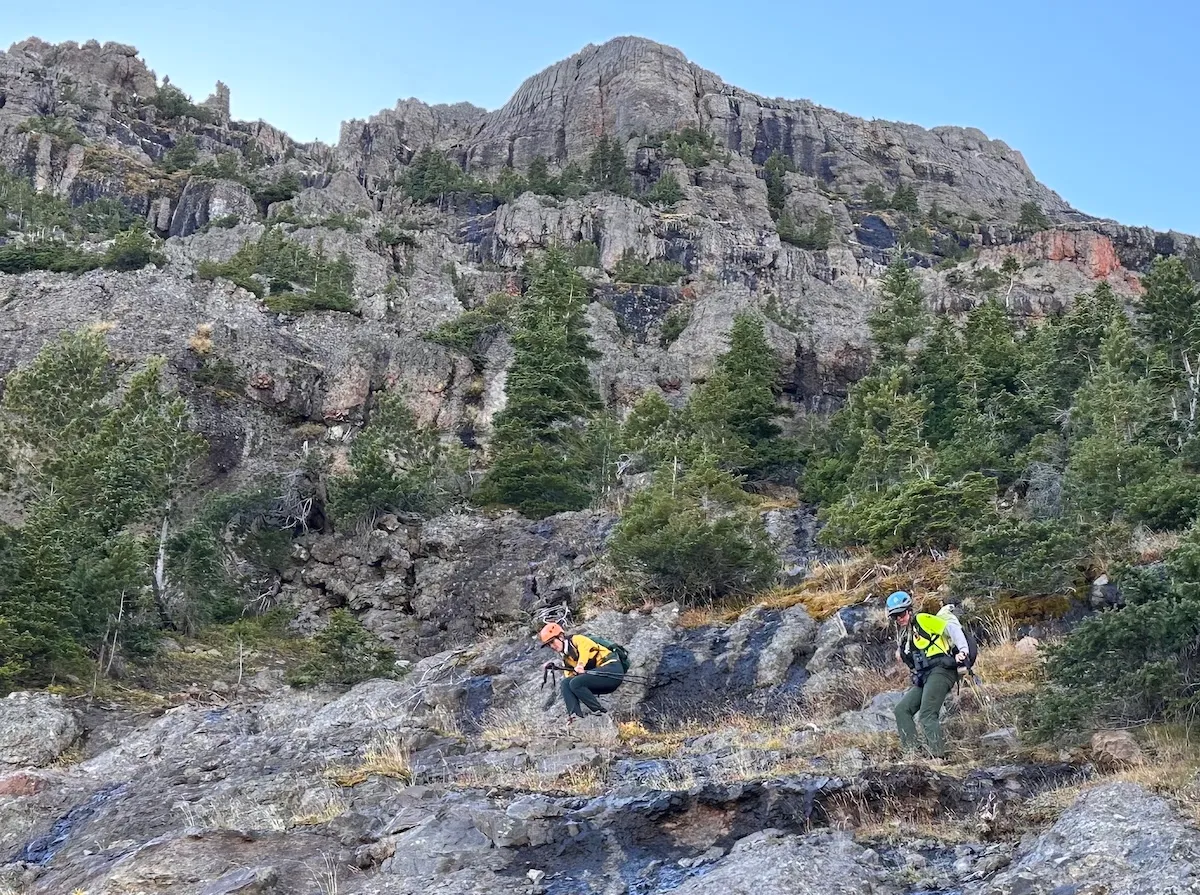
Water in Floating Pools could be used for a variety of purposes including environmental management, fostering binational programs, and supplementing scheduled water deliveries. During his CRWUA presentation, John Berggren mentioned an obvious use for this pool.  Water stored in the Pool by conserved consumptive use programs in the Upper Division States could be used as an Upper Division contribution during years when mainstem shortages to the Lower Division States exceed a negotiated amount.  Of course, the Lower Basin is unlikely to accept Upper Basin creation of Floating Pools made up of water for which there is no current consumptive use. This water is already “system water” and is now being used by existing Lower Basin water agency. Thus, it would be necessary to develop a program to account for and certify savings in the Upper Basin.  Further, the thorny problem of shepherding (legally protecting the conserved water so that it ends up in system storage) needs to be overcome. For a perspective on this issue, see Heather Sacket. Undeveloped Tribal water is a controversial sticking-point in this regard, with strong feelings and strong arguments on all sides.

If the Upper Division States were to conserve 200,000 acre-feet per year for five years and deposit that saved water in a conservation reserve “Floating Pool”, something like 900,000 acre-feet could be available for shortage sharing (after accounting for reservoir evaporation). (We use 900,000 af as an example only, how much water the Upper Division States would have to contribute and maintain in a Floating Pool would have to be negotiated between the two divisions.)  In their presentation, the Lower Division principals pointed out that had their proposal been in place beginning in 2007, there has yet to be a year when shortage sharing would have been required. Note, this conclusion is very sensitive to “initial conditions.” In 2007, total storage in Lake Mead and Lake Powell was about 8 maf more than it is today. If the 21st century hydrology continues, shortages greater than 1.5 maf/year are likely to occur.

What would the Upper Division States get in return?  During the term of the new post-2026 operating guidelines (which we all assume will also be “interim”), the Upper Division would benefit by the Lower Division agreeing to remove the threat of litigation over a “compact call.” For a perspective on the potential impacts of a “call” in Colorado see The Risks and Potential Impacts of a Colorado River Compact Curtailment on Colorado River In-Basin and Transmountain Water Rights Within Colorado.

Carefully crafted with appropriate guardrails, Floating Pool concepts can be a catalyst for compromise between the two divisions that give both parties something they need.

How do Floating Pool alternatives fit with the Schmidt, Kuhn, Fleck management approach?  Based on our conversations with the authors of the cooperative conservation proposal, we believe the two approaches agree — that our management proposal fits on top of and complements their proposal quite well.  In my presentation at CRWUA, I emphasized that, like future hydrology, there is great uncertainty in the future needs of the river’s ecosystem and society’s values.  It’s almost a certainty that in the future, prescribed annual releases from Glen Canyon Dam will cause an unacceptable and unanticipated outcome to some river or reservoir resource. When that happens, our flexible management approach and accounting system keeps the basins “whole.”
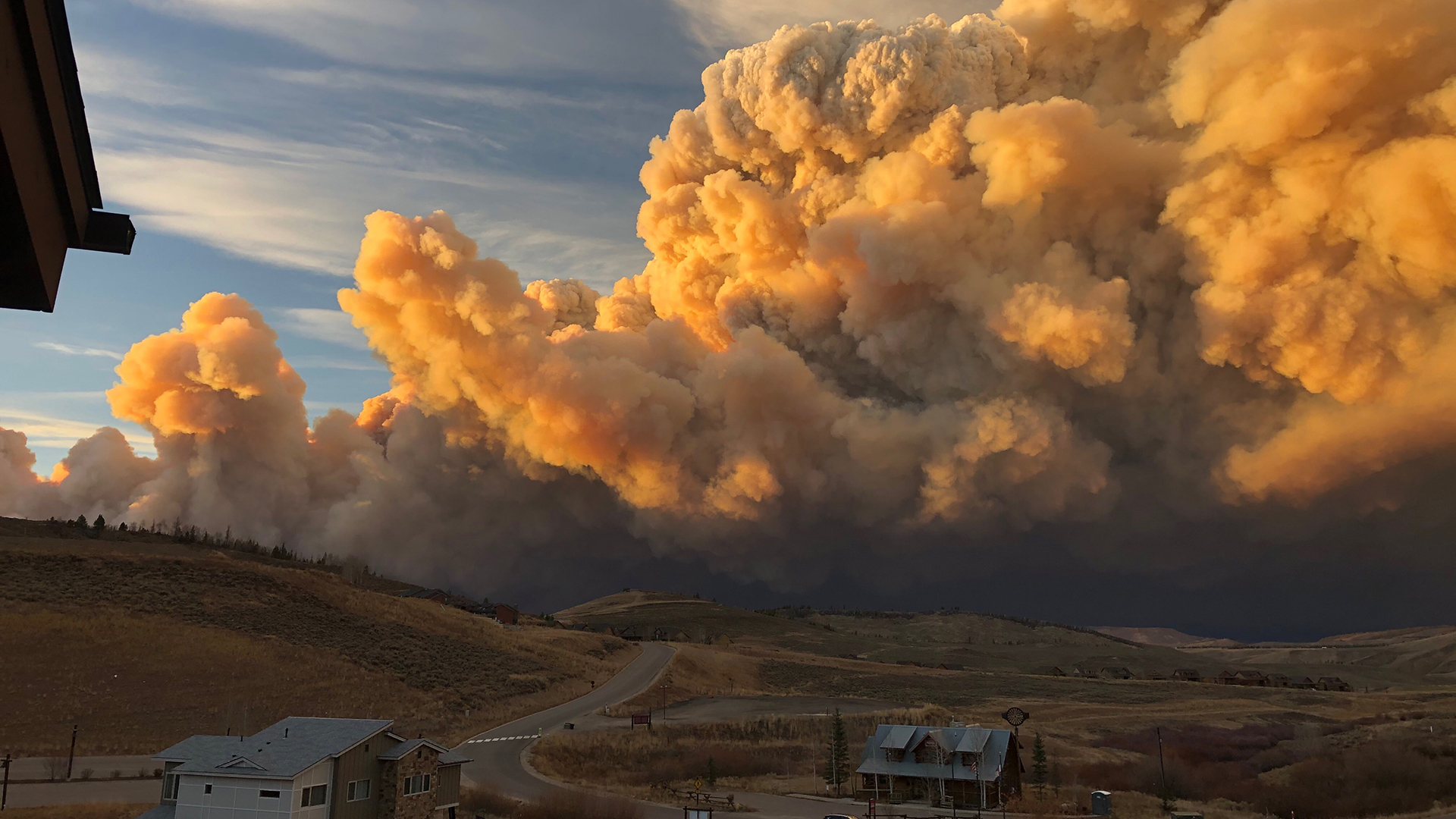
Is using the concept of Floating Pools as a catalyst to break the stalemate between the two basins without warts? – of course not.  There are important considerations regarding the use of undeveloped water—Tribal or otherwise, and the devil is in the details when it comes to developing appropriate guardrails for annual and total accumulation in such a Pool, the number and type of participants, annual debits, and other important qualifications. Even conserving 100,000 acre-feet per year in the Upper Division States, with acceptable verification, could be a stretch, especially if there is less federal money in the future, as there almost certainly will be.  Finally, it might put off addressing fundamental problems with the law of the river until the new post-2026 operating rules again expire. When they do, the 1922 Compact and 1944 Treaty with Mexico will still be in place, and these agreements collectively allocate 17.5 maf/year of consumptive use on a river that is only producing 13-13.5 maf/year of water at the international boundary (and runoff continues to decline).  What the Floating Pool concept might accomplish is to significantly reduce the temptation and threat of unpredictable interstate litigation, keep the basin’s stakeholders talking to each other, and give us time to move toward more foundational change in how the river is managed.

Map of the Colorado River drainage basin, created using USGS data. By Shannon1 Creative Commons Attribution-Share Alike 4.0

Global Warming Surges Well Past 1.5-Degree Mark in 2024: International agencies coordinate release of annual climate data to highlight the past year’s “exceptional”—and dangerous—climate conditions — Bob Berwyn (Inside #Climate News)

Sunset September 10, 2024 in the San Luis Valley. Photo credit: Alamosa Citizen

Click the link to read the article on the Inside Climate News website (Bob Berwyn):

January 9, 2024

Nearly all major global climate datasets agree that, in 2024, human-caused global warming for the first time pushed Earth’s average surface temperature to more than 1.5 degrees Celsius above the pre-industrial average for a full calendar year, a level that countries around the world had agreed to do all they could to avoid.

And when last year is averaged with 2023, both years together also exceed that level of warming, which was noted as a red line marking dangerous climate change by 196 countries in the 2015 Paris Agreement. A 2018 special report by the Intergovernmental Panel on Climate Change showed that warming beyond that limit threatens to irreversibly change major parts of the physical and biological systems that sustain life on Earth, including forests, coral reefs and rainforests, as well as oceans and their major currents.

The temperature figures were seen as so significant that the new annual climate data for 2024 was presented Thursday night as part of the first-ever internationally coordinated release by several institutions that track global temperatures, in part to mark the “exceptional conditions experienced in 2024,” according to a report published today by Copernicus, the European Union’s climate change service. 
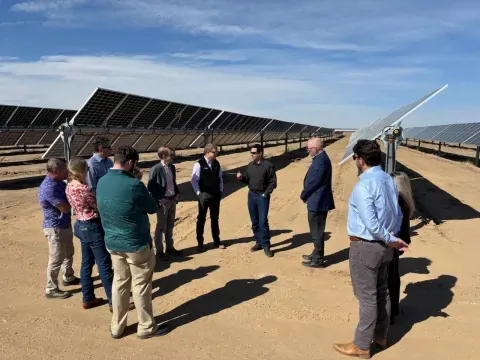
On Friday, the National Oceanic and Atmospheric Administration, NASA and the World Meteorological Organization will follow up with similar reports, all of which will emphasize not only the record global temperatures, but also the record amount of water vapor in the atmosphere that contributed to severe and record flooding in some parts of the world last year, and also helped supercharge tropical cyclones and hurricanes.

Rather than being fatigued by the barrage of news about heat records and other climate extremes, people should see the information as an opportunity to be thankful that we are not flying blind into dangerous climate change, said Carlo Buontempo, director of the Copernicus Climate Change Service

Thanks to international science, “We do know something about what’s happening,” he said. “We can make some predictions about what’s coming in the future. So rather than being overwhelmed … we should also take this as an opportunity to do something about it, to react to and to inform our decisions in the best possible way with facts and evidence.”

Even with those facts, he added, “We are facing a very new climate and new challenges that our society is not prepared for. … This is a monumental challenge for society.”

According to the Copernicus data, 2024 didn’t just edge past the previous record-warm year, 2023, but surged more than a tenth of 1 degree Celsius all the way to 1.6 degrees Celsius (2.8F) above the pre-industrial level. That was one of the biggest year-on-year jumps on record, said Samantha Burgess, co-director of Copernicus. 

She said some of the other global datasets may actually still show the 2024 warming relative to the pre-industrial 1850-1900 average at just below 1.5 degrees Celsius (2.7F), but that the global synthesis of six major datasets by the World Meteorological Organization will also come out to more than 1.5.

Still, she said, that doesn’t mean the limit set by the Paris Agreement has been broken, because it refers to a long-term average over 10 to 30 years. 

If the 1.6 degrees Celsius of warming over the pre-industrial average doesn’t seem like a huge deal to some people, she said human bodies provide a good analogy.

“The temperature of the human body is around 37 [degrees Celsius],” she said. “If we have a fever at 39 degrees, it doesn’t sound like much, but the body responds in very negative ways, and we feel terrible. We’re feverish, and the body is doing everything possible to fight that infection.

“The reality is that at a global average change of 1.5 degrees, the frequency and the intensity of extreme events gets more likely,” she said. “Extreme events like wildfires, heat waves, severe storms, droughts, are likely to get more frequent, and they’re likely to be more intense. This is why, when you’ve got this small number but over a very large global average, it’s incredibly important.”

The Copernicus scientists said that the world’s oceans, in particular, were one of the biggest factors driving Earth’s overall annual temperature to a new record. That ocean warmth also had direct impacts like a global wave of coral bleaching and reef die-offs, as well as mass die-offs of marine mammals and seabirds

On land, the persistently high global fever of the last few years led to deadly heat waves, with more than 47,000 heat-related deaths in Europe alone during 2023. Final figures for the number of such deaths in 2024 are yet to be calculated.

The new data on record warmth comes at a time when some governments and companies are already rolling back previous climate action pledges. The internationally coordinated release of global climate data could also be seen as an acknowledgment that global warming isn’t going to slow down and wait for humanity to solve other vexing social, political and economic problems.

Asked if those rollbacks in the face of record heat are worrying to him as a climate scientist, Buontempo said that, “From a physical point of view, the mechanism is well explained. What drives this warming temperature is, to a very large extent, increasing greenhouse gases.”

If the goal is to stabilize the global temperature, then governments need to move toward reducing emissions to zero “in the most rapid possible way,” he said.

What will the future of the warming stripes be?2024 could be the start of a stabilisation of global temperatures, or it might appear to be a cool year.Which one of these stories becomes reality depends on our choices today, and every day until then.We are likely to regret not acting sooner.

Ed Hawkins (@edhawkins.org) 2025-01-10T11:13:06.384Z

Looming questions about data centers — Allen Best (@BigPivots) #ActOnClimate

QTS Data Center Aurora June 2024. Photo credit: Allen Best/Big Pivots

Click the link to read the article on the Big Pivots website (Allen Best):

January 2, 2025

Gov. Polis and many utilities say that data centers can benefit just about everybody in Colorado. But others fear impacts to rates and potential setbacks in reduction of emissions.

Under the umbrella of the energy transition were dozens of interesting, important stories in Colorado during 2024, including:

  • Tri-State Generation and Transmission Association got the lifeline it so desperately needed to make the transition from coal in the form of $679 million in assistance from the federal government. Sen. Michael Bennet — a key partner in the Inflation Reduction Act sausage-making in D.C. in 2022 — was there to commemorate it. And United Power, itself independent of Tri-State on May 1, is getting $261.6 million.
  • Pueblo talked a lot about nuclear — and inexplicably began cleaving itself from the renewable energy that had been very nearly the sole bright spot of its economy in recent years.
  • Holy Cross Energy achieved 90% renewable generation for a month this fall.
  • United Power broke ground on a natural gas plant, and Platte River Power Authority and everybody else laid plans similar plans for natural gas.
  • Seeds were planted for geothermal to become a viable part of Colorado’s energy story in Vail, Steamboat and easily a dozen other places across Colorado.

Important stories — these and many others in this energy transition. But easily surpassing them was the story of data centers and their voracious hunger for energy. Could their looming demand  derail Colorado’s decarbonization plans? Defenders say no, but they are not convincing. And will interests of ratepayers be protected?

Figuring out the public policy to balance public interests and private gain will be a major issue in the 2025 legislative session.

Three years ago, few people outside of Virginia’s data center alley were talking about data centers. In 2019, there was a half- or less-baked idea of a cryptocurrency mill in Pueblo. Later came a crypto outfit near Montrose.

The era of hyperscale data centers — hyperscale is often defined as having “massive” power needs — arrived in early 2022 when Microsoft purchased a 260-acre parcel in Aurora, south of DIA, for $63.5 million.

In February 2023, Mile High CRE, an online news site about commercial development, described the purchase as the first in metropolitan Denver for a hyperscale data center.

“Denver has an edge over more established markets like Silicon Valley or Northern Virginia in that cost of power, cost of land, and cost of construction are lower, environmental risks are not as high, and the central location grants access to a plethora of networks,” it said. What Colorado lacked, the article added, was a competitive incentive package.

In February 2024, State Sen. Kevin Priola introduced a bill that would have extended more tax breaks to data center developers. Big Pivots did write about that in a column that got broad play across Colorado. See: “Why do data center need tax breaks in Colorado? They’re coming anyway.” A few weeks later came news that the data center subsidy bill was postponed. It never got one committee hearing.

Colorado already has one hyperscale data center. It’s in Aurora, and Mark Jaffee of the Colorado Sun broke the story about QTS in October 2023. (Big Pivots was too busy on a series about water and urban landscapes to chase it).

Two guest columnists in Big Pivots weighed in on the value of data centers. Morey Wolfson, a one-time staffer at the Colorado Energy Office and at the PUC, in September argued against subsidies. Jeff Ackermann, a former chair of the PUC as well as director of the state energy office, in October argued that data centers can have upsides. Meanwhile, the Economist, the New York Times and the Washington Post began writing frequently about data centers — including this story from last week: “Energy hungry AI firms bet on these moonshot technologies.”

Xcel Energy in October delivered the statistics that made this a compelling Colorado story. The electrical utility, responsible for more than half of electrical sales in Colorado, said it needed a staggering 12,500 to 14,000 megawatts of new generation to meet rising demand. To put that into perspective, Rush Creek, Xcel’s wind farm between Limon and Colorado Springs, has a capacity of 600 megawatts.

After average annual growth of 0.7% during the preceding five years, said Xcel, it projected 4% growth compounded annually from 2023 to 2031.

Data centers lie at the center of this projected growth, 62% for energy growth overall and 72% for peak demand, according to Xcel’s Jack Ihle. In an Oct. 15 filing with Colorado regulators, he also said the same base-case forecast saw electric vehicles producing 19% and building electrification 12% of its new demand.

Even without this new demand, Xcel has had trouble getting renewable energy across the finish line. These are projects approved through the electric resource plan from 2021. Supply chain issues have something to do with that.

How will Xcel be able to meet burgeoning demand? And does this imperil Colorado’s drive to meet its 2030 goal of 50% economy wide reduction in emissions? The state’s existing modeling already showed the state falling short, and that was without the data centers becoming a major part of the equation. Now comes speculation — and, at this point it is merely that, speculation — that Xcel may find it necessary to keep Comanche 3, its newest and largest coal-fired unit, operating beyond 2030.

That speculation is not completely out of the blue. That is indeed what has happened in Virginia.

Here, I have described Xcel Energy. But data centers could be part of the stories of Tri-State and its members as well as Platte River Power Authority, Black Hills Energy and perhaps others. Even Fort Morgan — a town of 12,000 northeast of Denver, which is supplied by electricity by the Municipal Energy Agency of Nebraska. A Wyoming company, Prometheus Energy, says it intends to create a data center there as well as in Pueblo in 2026, according to one report.

Chris Hansen, one of Colorado’s most important state legislators in the energy transition, told Big Pivots in November that one of his larger disappointments in leaving the Legislature to manage La Plata Electric was that he wouldn’t be able to advance legislation to address the data center issue and help Colorado avoid the problems of Virginia. Hansen has handed the work off to State Rep. Kyle Brown, a Democrat from Louisville. Brown has a background in health care, and he will never have the adroit voice of a Chris Hansen or a Steve Fenberg, but he has demonstrated in his two years that he is a capable, solid legislator.

Yesterday, Gov. Jared Polis was in my neighborhood, and I got in a few minutes to talk with him about passenger rail and data centers. I asked him explicitly whether the growth in demand from data centers would imperil Colorado’s goal of achieving 50% economy wide decarbonization.

No, he said. Done right, growth in data centers can be a win-win for consumers and the utilities.

“Data centers are a broad category of electricity users, but I would say in the right time, in the right place, data centers can play a very important role in improving the reliability and sustainability of the grid, just like if they’re in the wrong place at the wrong time, they can add transmission costs,” he replied. “It’s really about what, when and where, and how that factors into grid resiliency as we move towards clean energy.”

I persisted with a question about the need for legislation. He did not answer directly:

“If there’s a way to bring in more data centers working with some of the larger providers in areas that make sense, that help us reduce costs for Colorado consumers and improve grid resiliency, then we should explore those.”

I suspect Xcel would be happy with his phrasing. However, we are already seeing upward price pressures in renewables because of supply chain and other issues. If that upward migration coupled with rapid growth in demand produces sharply higher consumer costs, there could be strong pushback. That could delay Colorado’s progress toward its decarbonization goals. The debate in the PUC proceedings about Xcel’s just transition electric-resource plan in coming months should be lively. That applies, too, to the debates in the Colorado Legislature.

There’s lots of good journalism to be had here for Big Pivots going into 2025. It’s one of many good stories across Colorado deserving deeper dives.

Xcel was reluctant to go forward with its first major wind farm, completed in 2004, but now has much wind — and will add far more in the next few yeas. Photo near Cheyenne Wells, Allen Best

Report: When Risks Become Reality: Extreme Weather In 2024 — World Weather Attribution #ActOnClimate

Click the link to access the report on the World Weather Attribution website:

December 27, 2024

When Risks Become Reality: Extreme Weather in 2024 is our annual report, published this year for the first time.


Every December, people ask us how severe the year’s extreme weather events were. To answer this question, we’ve partnered with Climate Central to produce a report that reviews some of the most significant events and highlights findings from our attribution studies. It also includes new analysis looking at the number of dangerous heat days added by climate change in 2024 and global resolutions for 2025 to work toward a safer, more sustainable world.

Key messages

  • Extreme weather reached dangerous new heights in 2024. This year’s record-breaking temperatures fueled unrelenting heatwaves, drought, wildfire, storms and floods that killed thousands of people and forced millions from their homes. This exceptional year of extreme weather shows how dangerous life has already become with 1.3°C of human-induced warming, and highlights the urgency of moving away from planet-heating fossil fuels as quickly as possible.
  • Climate change contributed to the deaths of at least 3,700 people and the displacement of millions in 26 weather events we studied in 2024. These were just a small fraction of the 219 events that met our trigger criteria, used to identify the most impactful weather events. It’s likely the total number of people killed in extreme weather events intensified by climate change this year is in the tens, or hundreds of thousands. 
  • Globally, climate change added on average 41 additional days of dangerous heat in 2024 that threatened people’s health, according to new analysis by Climate Central. The countries that experienced the highest number of dangerous heat days are overwhelmingly small island and developing states, who are highly vulnerable and considered to be on the frontlines of climate change. The analysis highlights the wide reaching impacts of extreme heat that are underreported and not well understood.  
  • Many extreme events that took place in the beginning of 2024 were influenced by El Niño. However, most of our studies found that climate change played a bigger role than El Niño in fueling these events, including the historic drought in the Amazon. This is consistent with the fact that, as the planet warms, the influence of climate change increasingly overrides other natural phenomena affecting the weather.  [ed. emphasis mine]
  • Record-breaking global temperatures in 2024 translated to record-breaking downpours. From Kathmandu, to Dubai, to Rio Grande do Sul, to the Southern Appalachians, the last 12 months have been marked by a large number of devastating floods. Of the 16 floods we studied, 15 were driven by climate change-amplified rainfall. The result reflects the basic physics of climate change — a warmer atmosphere tends to hold more moisture, leading to heavier downpours. Shortfalls in early warning and evacuation plans likely contributed to huge death tolls, while floods in Sudan and Brazil highlighted the importance of maintaining and upgrading flood defences. 
  • The Amazon rainforest and Pantanal Wetland were hit hard by climate change in 2024, with severe droughts and wildfires leading to huge biodiversity loss. The Amazon is the world’s most important land-based carbon sink, making it crucial for the stability of the global climate. Ending deforestation will protect both ecosystems from drought and wildfire, as dense vegetation is able to absorb and retain moisture. 
  • Hot seas and warmer air fueled more destructive storms, including Hurricane Helene and Typhoon Gaemi. Individual attribution studies have shown how these storms have stronger winds and are dropping more rain. Research by Climate Central found that climate change increased the intensity of most Atlantic hurricanes between 2019 and 2023 – of the 38 hurricanes analysed, 30 had wind speeds that were one category higher on the Saffir-Simpson scale than they would have been without human-caused warming, while our analysis found that the risk of multiple Category 3-5 typhoons hitting the Philippines in a given year is increasing as the climate warms. 

Figure 1: World Weather Attribution studies in 2024.

Resolutions for 2025

  • A faster shift away from fossil fuels – The burning of oil, gas and coal are the cause of warming and the primary reason extreme weather is becoming more severe. Last year at COP28, the world finally agreed to ‘transition away from fossil fuels,’ but new oil and gas fields continue to be opened around the world, despite warnings that doing so will result in a long term commitment to more than 1.5°C and therefore costs to people around the world. Extremes will continue to worsen with every fraction of a degree of fossil fuel warming. A rapid move to renewable energy will help make the world a safer, healthier, wealthier and more stable place. 
  • Improvements in early warning – Weather disasters in 2024 highlighted the importance of early warning systems, which are one of the cheapest and most effective ways to minimise fatalities. Warnings need to be targeted, given days ahead of a dangerous weather event, and outline clear instructions on what people need to do. Most extreme weather is well forecast, even in developing nations. Every country needs to implement, test and continually improve early warning systems to ensure people are not in harm’s way.
  • Real-time reporting of heat deaths – Heatwaves are the deadliest type of extreme weather. However, the dangers of high temperatures are underappreciated and underreported. In April, a hospital in Mali reported a surge in excess deaths as temperatures climbed to nearly 50°C. Reported by local media, the announcement was a rare example of health professionals raising the alarm about the dangers of extreme heat in real-time. Health systems worldwide are stretched, but informing local journalists when emergency departments are overwhelmed is a simple way to alert the public that extreme heat can be deadly.
  • Finance for developing countries – COP29 recently discussed ways to increase finance for poor countries to help them cope with the impacts of extreme weather. Developing countries are responsible for a small amount of historic carbon emissions, but as our research has highlighted this year, are being hit the hardest by extreme weather. Back-to-back disasters, like the Philippines typhoons, or devastating floods that followed a multi-year drought in East Africa, are cancelling out developmental gains and forcing governments to reach deeper and deeper into their pockets to respond and recover from extreme weather. Ensuring developing countries have the means to invest in adaptation will protect lives and livelihoods, and create a stabler and more equitable world. 

#Colorado’s environmental efforts could be in grave peril: 2024 is likely to be hottest year on record. It’s no time for science deniers to be in charge of country’s future — Pete Kolbenschlag (Colorado Newsline) #ActOnClimate

An aerial view of Assignation Ridge in the Thompson Divide area of Colorado. (Courtesy of EcoFlight)

Click the link to read the commentary on the Colorado Newsline website (Pete Kolbenschlag):

December 31, 2024

Some people say that the movement toward renewable energy cannot be stopped by a single regressive administration. But Colorado could be badly harmed if its efforts to transition to clean energy are put on hold. Millions of dollars in investments for rural co-ops, community-based solar, and grid hardening could be in jeopardy, striking a heavy blow to our more resilient future. Worse still, that’s only one piece of what could be coming under a new federal regime.

Colorado’s public lands and water supplies are also in grave peril under the incoming Congress and president. This is despite decades of hard, locally-driven work to secure protections for vital headwaters, hunting lands, forests and habitat, many from a century-long history of extraction. And it’s regardless of rapid warming, persistent drought and an imperiled Colorado River system with no good solutions in sight.

Healthy natural systems guard against ecological collapse. But now various environmental tipping points, that moment in a system where it moves into a new norm and change becomes irreversible, appear at their most precarious moments. During 2024 humans pumped out more climate-choking pollution than ever before. That’s almost 10 years after the acclaimed Paris Agreement, which our president-elect and his cabinet have vowed to abandon.

Global warming presents a clear and present danger to all our livelihoods and well-being. And the United States is already the No. 1 oil and gas producer in the world and a top polluter behind only China. 2024 is likely to be the hottest year ever recorded. Without the sufficient response we careen toward calamity. To meet this moment, the incoming administration and Congress have pledged to pollute more and care less.

That is bad news not only for our lands and water supplies, but for the economic future, too. Our ledgers will already never be free of climate risk. Which is why the debate at the global climate summits is now about who ends up with the bill for loss and damages done and coming. That matters here, too: A recent study correlates rising insurance costs with climate vulnerability and puts much of Colorado in the dark red hazard zone.

In a state where housing is increasingly unaffordable, putting science deniers in charge of our future is just a bad idea. Moving federal agency offices or installing Colorado-based cabinet-members won’t matter if the new administration is just rearranging deck chairs to ensure its patrons have the best seats to watch this escalating disaster.

In fact, fossil fuel “dominance” could make a mess of Colorado, as it does most places it asserts itself. This puts at risk our lands and communities with oil trains, backdoor schemes to subsidize legacy polluters, policies that favor extraction over conservation, and more pipelines for more fracked gas exports. The alternative to slamming head on into a worst future is to stop the harm now and to make systems more resilient to coming disruptions. That means less fossil energy and more conservation of natural places. [ed. emphasis mine]

Milkweed, sweet peas, and a plethora of other flora billow from Farmer’s Ditch in the North Fork Valley of western Colorado. Jonathan P. Thompson photo.

Standing up for Colorado’s liveable future means fighting the expansion of fossil fuel infrastructure and defending places Coloradans have fought for decades to protect – such as Thompson Divide, the Dolores River canyons, or the forests and public lands surrounding critical watersheds and farmlands in places like the North Fork Valley.

That will best limit the extent of further harm and will better secure our natural capital as a hedge against future disruption. By investing in ecological systems through resilient watersheds and healthy lands we guard against uncertainty. By defending these cherished places, we will keep intact critical sources of sustenance and enjoyment for the future and return dividends to those who live, work, and visit here today.

The Dolores River, below Slickrock, and above Bedrock. The Dolores River Canyon is included in a proposed National Conservation Area. Photo: Brent Gardner-Smith/Aspen Journalism.

Critical water quality permits designed to protect streams remain backlogged, but numbers are improving — Jerd Smith (Fresh Water News)

Metropolitan Wastewater Reclamation District Hite plant outfall via South Platte Coalition for Urban River Evaluation

Click the link to read the article on the Water Education Colorado website (Jerd Smith):

January 2, 2024

Colorado health officials say a massive permit backlog that has left hundreds of water systems in administrative limbo has shrunk in the past year, though more work remains.

Last year, 75% of wastewater discharge permits had expired. This year that figure has dropped to 50%, according to the Colorado Department of Public Health and Environment (CDPHE), with 1,384 permits classified as expired. The permits regulate and set standards for removing pollutants from wastewater before it is discharged to streams.

The state’s Water Quality Control Division has wrestled with the problem for several years. In the past two years the state has provided several million dollars to help eliminate the backlog. Major dischargers, such as the City of Aurora and Metro Water Recovery, are among those that have been impacted by the problem.

Under the federal Clean Water Act, entities that discharge fluids into streams, including wastewater treatment plants and factories, must get approval from water quality regulators to ensure what they’re putting into the waterways does not harm them.

Though holders of expired permits are legally allowed to continue discharging, the expiration means dischargers face major uncertainty about what future requirements may be and how much it will cost to meet them, according to the CDPHE.

Protecting streams from pollutants is a tough problem and is getting more difficult as populations grow and climate change reduces the amount of water flowing in rivers, intensifying contamination. Emerging toxins, such as PFAS, also now require treatment. PFAS make up a large class of chemicals used in everything from firefighting foam to Teflon. They are known as “forever chemicals” because they last decades in the environment and the human body. The EPA has just begun setting regulatory standards for them.

The agency has hired a consultant to help it examine new ways of managing the permitting process. It expects to have recommendations for new procedures by midyear 2025, CDPHE spokesperson John Michael said.

“We are committed to finding solutions to address more of the backlog,” he said via email.

The agency is under the gun to do so, in part, because its performance lags the standards set by the EPA, which state that 75% of all discharge permits under the National Pollutant Discharge Elimination System, or NPDES, should be current.

“Timely issuance and reissuance of NPDES permits are important because they can provide greater certainty to the business community and ensure that permits improve environmental protection by reflecting the most recent scientific information,” said Marisa Lubeck, a spokesperson for EPA’s Region 8, which includes Colorado.

“The EPA has encouraged and continues to encourage CDPHE to decrease its NPDES permit backlog, and we are aware the state has acquired additional resources to help with this effort,” Lubeck said via email.

States across the country have wrestled with monitoring and renewing the discharge permits. According to a 2024 EPA analysis, Colorado had the largest permit backlog nationwide, with 81% expired. The average nationwide is 22%. The EPA’s estimate is higher because the state’s method for classifying permits differs from the federal government’s, according to the EPA.

With the new funding, the CDPHE has hired additional staff to address the problem and to shore up long-term finances for the regulatory work by increasing fees the state can charge for the permits.

Colorado State Sen. Barbara Kirkmeyer, a Republican from Brighton and a member of the legislature’s Joint Budget Committee, said she remains concerned that the health department hasn’t fully resolved the problems.

“The bottom line is that there are still a lot of permits in that backlog,” Kirkmeyer said.

And she said cities and wastewater utilities continue to complain about the permitting process, calling it cumbersome and time-consuming.

The Colorado Wastewater Utility Council, which represents municipalities and wastewater treatment providers, did not respond to a request for comment.

More by Jerd Smith

Wastewater Treatment Process

Atlantic Ocean is headed for a tipping point − once melting glaciers shut down the Gulf Stream, we would see extreme climate change within decades, study shows

Too much fresh water from Greenland’s ice sheet can slow the Atlantic Ocean’s circulation. Paul Souders/Stone via Getty Images

February 9, 2024

René van Westen, Utrecht University; Henk A. Dijkstra, Utrecht University, and Michael Kliphuis, Utrecht University

Superstorms, abrupt climate shifts and New York City frozen in ice. That’s how the blockbuster Hollywood movie “The Day After Tomorrow” depicted an abrupt shutdown of the Atlantic Ocean’s circulation and the catastrophic consequences.

While Hollywood’s vision was over the top, the 2004 movie raised a serious question: If global warming shuts down the Atlantic Meridional Overturning Circulation, which is crucial for carrying heat from the tropics to the northern latitudes, how abrupt and severe would the climate changes be?

Twenty years after the movie’s release, we know a lot more about the Atlantic Ocean’s circulation. Instruments deployed in the ocean starting in 2004 show that the Atlantic Ocean circulation has observably slowed over the past two decades, possibly to its weakest state in almost a millennium. Studies also suggest that the circulation has reached a dangerous tipping point in the past that sent it into a precipitous, unstoppable decline, and that it could hit that tipping point again as the planet warms and glaciers and ice sheets melt.

In a new study using the latest generation of Earth’s climate models, we simulated the flow of fresh water until the ocean circulation reached that tipping point.

The results showed that the circulation could fully shut down within a century of hitting the tipping point, and that it’s headed in that direction. If that happened, average temperatures would drop by several degrees in North America, parts of Asia and Europe, and people would see severe and cascading consequences around the world.

We also discovered a physics-based early warning signal that can alert the world when the Atlantic Ocean circulation is nearing its tipping point.

The ocean’s conveyor belt

Ocean currents are driven by winds, tides and water density differences.

In the Atlantic Ocean circulation, the relatively warm and salty surface water near the equator flows toward Greenland. During its journey it crosses the Caribbean Sea, loops up into the Gulf of Mexico, and then flows along the U.S. East Coast before crossing the Atlantic.

Two illustrations show how the AMOC looks today and its weaker state in the future
How the Atlantic Ocean circulation changes as it slows. IPCC 6th Assessment Report

This current, also known as the Gulf Stream, brings heat to Europe. As it flows northward and cools, the water mass becomes heavier. By the time it reaches Greenland, it starts to sink and flow southward. The sinking of water near Greenland pulls water from elsewhere in the Atlantic Ocean and the cycle repeats, like a conveyor belt.

Too much fresh water from melting glaciers and the Greenland ice sheet can dilute the saltiness of the water, preventing it from sinking, and weaken this ocean conveyor belt. A weaker conveyor belt transports less heat northward and also enables less heavy water to reach Greenland, which further weakens the conveyor belt’s strength. Once it reaches the tipping point, it shuts down quickly.

What happens to the climate at the tipping point?

The existence of a tipping point was first noticed in an overly simplified model of the Atlantic Ocean circulation in the early 1960s. Today’s more detailed climate models indicate a continued slowing of the conveyor belt’s strength under climate change. However, an abrupt shutdown of the Atlantic Ocean circulation appeared to be absent in these climate models. https://www.youtube.com/embed/p4pWafuvdrY?wmode=transparent&start=0 How the ocean conveyor belt works.

This is where our study comes in. We performed an experiment with a detailed climate model to find the tipping point for an abrupt shutdown by slowly increasing the input of fresh water.

We found that once it reaches the tipping point, the conveyor belt shuts down within 100 years. The heat transport toward the north is strongly reduced, leading to abrupt climate shifts.

The result: Dangerous cold in the North

Regions that are influenced by the Gulf Stream receive substantially less heat when the circulation stops. This cools the North American and European continents by a few degrees.

The European climate is much more influenced by the Gulf Stream than other regions. In our experiment, that meant parts of the continent changed at more than 5 degrees Fahrenheit (3 degrees Celsius) per decade – far faster than today’s global warming of about 0.36 F (0.2 C) per decade. We found that parts of Norway would experience temperature drops of more than 36 F (20 C). On the other hand, regions in the Southern Hemisphere would warm by a few degrees.

Two maps show US and Europe both cooling by several degrees if the AMOC stops.
The annual mean temperature changes after the conveyor belt stops reflect an extreme temperature drop in northern Europe in particular. René M. van Westen

These temperature changes develop over about 100 years. That might seem like a long time, but on typical climate time scales, it is abrupt.

The conveyor belt shutting down would also affect sea level and precipitation patterns, which can push other ecosystems closer to their tipping points. For example, the Amazon rainforest is vulnerable to declining precipitation. If its forest ecosystem turned to grassland, the transition would release carbon to the atmosphere and result in the loss of a valuable carbon sink, further accelerating climate change.

The Atlantic circulation has slowed significantly in the distant past. During glacial periods when ice sheets that covered large parts of the planet were melting, the influx of fresh water slowed the Atlantic circulation, triggering huge climate fluctuations.

So, when will we see this tipping point?

The big question – when will the Atlantic circulation reach a tipping point – remains unanswered. Observations don’t go back far enough to provide a clear result. While a recent study suggested that the conveyor belt is rapidly approaching its tipping point, possibly within a few years, these statistical analyses made several assumptions that give rise to uncertainty.

Instead, we were able to develop a physics-based and observable early warning signal involving the salinity transport at the southern boundary of the Atlantic Ocean. Once a threshold is reached, the tipping point is likely to follow in one to four decades.

A line chart of circulation strength shows a quick drop-off after the amount of freshwater in the ocean hits a tipping point.
A climate model experiment shows how quickly the AMOC slows once it reaches a tipping point with a threshold of fresh water entering the ocean. How soon that will happen remains an open question. René M. van Westen

The climate impacts from our study underline the severity of such an abrupt conveyor belt collapse. The temperature, sea level and precipitation changes will severely affect society, and the climate shifts are unstoppable on human time scales.

It might seem counterintuitive to worry about extreme cold as the planet warms, but if the main Atlantic Ocean circulation shuts down from too much meltwater pouring in, that’s the risk ahead.

This article was updated on Feb. 11, 2024, to fix a typo: The experiment found temperatures in parts of Europe changed by more than 5 F per decade.

René van Westen, Postdoctoral Researcher in Climate Physics, Utrecht University; Henk A. Dijkstra, Professor of Physics, Utrecht University, and Michael Kliphuis, Climate Model Specialist, Utrecht University

This article is republished from The Conversation under a Creative Commons license. Read the original article.

Happy New Year! 2024’s biggest conservation wins for the West — @HighCountryNews

A salmon on the Klamath River is captured just downstream from Wards Canyon, California, to have a radio-tag device attached to its fin on its way upstream. This device will transmit location data to scientists in the Upper Basin, demonstrating information about the salmon’s return to its historic reaches in the freed river. Paul Robert Wolf Wilson/High Country News

Click the link to read the article on The High Country News website (Kylie Mohr):

December 25, 2024

Climate change and encroaching development continue to threaten biodiversity. At the same time, Westerners saw dozens of success stories in 2024. Two national monuments were expanded in California, while conservation gained equal footing with mining and drilling under the Bureau of Land Management’s Public Lands RuleAlaska saw half of the National Petroleum Reserve-Alaska protected from new oil and gas leases, and the previous approval for the Ambler Road project in the Brooks Range was rescinded. Elsewhere in the region, fish returned to their former habitats and swam off the Endangered Species List, while wolf and gray whale populations continued to grow.

Fall-run Chinook Salmon, Oct. 16, 2024, photo by Mark Hereford, ODFW.

Salmon return to once-dammed reaches of the Klamath River

For over a century, dams blocked salmon from returning to their spawning grounds near the headwaters of the Klamath River. But the removal of four of the river’s six dams was completed this year, and in October, biologists saw several hundred chinook salmon above the dam sites. While scientists had expected salmon to return eventually, the appearance of so many fish so soon surprised and delighted the tribes who had ardently campaigned to remove the dams.

Fences come down

Every year, migrating elk, deer, pronghorn and moose are slowed, injured, and even killed by the West’s thousands of miles of barbed-wire fencing. Groups like the National Wildlife Federation (NWF) are working hard to remove barbed wire or replace it with more permeable barriers. According to the Mountain Journal, since 2021, the NWF and its partners have removed 40 miles of fencing from the High Divide region along the Montana-Idaho border. Sublette County, Wyoming, another leader in the wildlife-friendly fencing movement, has worked with state and federal partners to remove or improve more than 700 miles of fencing since 2017.

Gray whale populations rebound

Between December 2023 and mid-February 2024, researchers from the National Oceanic and Atmospheric Administration estimated that 19,260 gray whales migrated along the Pacific Coast — a 33% increase from the previous season. “The numbers are trending up,” NOAA spokesman Michael Milstein told the Oregon Capital Chronicle. “The indications are consistent that the whales have gone from a decline to a recovery.”

The fence line separating sagebrush and historic pastureland marks the north end of of the state of Wyoming’s school trust parcel in Grand Teton National Park, a tract known as the Kelly Parcel. (Mike Koshmrl/WyoFile)

Wyoming parcel approved for sale to Grand Teton National Park

Last year, it looked like an iconic parcel of state trust land outside Jackson, Wyoming, might be sold to a developer, prompting outrage from locals and conservationists. Known as the Kelly parcel, the land offers panoramic views of the Tetons and provides important habitat for migrating pronghorn and other wildlife species. But by law, state trust land must generate revenue for public schools. In November, Wyoming’s top-five state elected officials approved the sale of the parcel to the adjacent Grand Teton National Park for $100 million. The state will likely use the proceeds to purchase oil and gas-rich land in the Powder River Basin.

Wolves part of the pack discovered last summer in Tulare County called the Yowlumni Pack. The pack was found in the Sequoia National Forest near the Tule River Tribe of California’s reservation and ancestral lands. California Department of Fish and Wildlife

Wolf populations boom

An estimated 70 wolves are now living in California, an increase of 26 animals from last year. Two new wolf packs formed in Northern California this year, too. Meanwhile, Colorado saw the formation of its first pack since wolves were reintroduced last year.

Washington river gets legal rights — and other ballot wins

In Everett, Washington, voters approved a ballot initiative that grants the Snohomish River watershed the rights to exist, regenerate and flourish. City residents, agencies and organizations can now sue on behalf of the watershed, and any recovered damages will be used to restore the ecosystem. Also in Washington, voters upheld the 2021 Climate Commitment Act by voting no on Initiative 2117. The act caps and reduces carbon emissions for the state’s largest carbon emitters and raises money for conservation, climate and wildfire resilience statewide. In California, voters passed a $10 billion climate bond that will fund climate resilience projects, protect clean drinking water and help prevent wildfires.

Bear River Massacre site restored

One of the deadliest massacres of Native people in U.S. history happened near what’s now Preston, Idaho, in January 1863. Over 150 years later, the Northwestern Band of the Shoshone Nation is reclaiming the site of the massacre, a place their people once lived, celebrated and danced. Along the Bear River, the tribe is replacing thirsty invasive vegetation with native plants and restoring degraded agricultural fields to wetlands. Eventually, they hope to return an estimated 13,000 acre-feet of water to the parched Great Salt Lake annually. “For thousands of years, this wasn’t a massacre site,” Brad Parry, the tribe’s vice chairman, told High Country News. “We want to make this a place to come to again.”

Volunteers plant native vegetation along the banks of Battle Creek at the Bear River Massacre site in Preston, Idaho. Russel Albert Daniels/High Country News

Apache trout removed from Endangered Species List

In September, after 50 years on the federal endangered species list, Arizona’s state fish — the Apache trout — was declared recovered and removed from the list. The first American sportfish to achieve delisting, it owes its recovery to the White Mountain Apache Tribe as well as to federal and state agencies and nonprofits. In a statement, Interior Secretary Deb Haaland paid tribute to “the transformational power that collaborative conservation efforts — grounded in Indigenous Knowledge — can have on fish and wildlife.”

Extra wetland habitat created for birds

California’s Central Valley is vital to migrating birds, but its wetlands have been almost destroyed by agricultural and urban development. BirdReturns, a program that started in 2014, pays the valley’s rice farmers to create “pop-up” wetland habitat by flooding fields earlier in the fall and leaving them flooded later in the spring. Since its inception, BirdReturns has created 120,000 acres of temporary bird habitat.

Tribally led projects win big

TheAmerica The Beautiful Challenge funds voluntary conservation and restoration projects around the country, consolidating funding from federal agencies and the private sector. Numerous projects led by tribes in the West received money from the program this year, including the Summit Lake Paiute Tribe, which received $2.5 million for fish passage and riparian restoration projects in Nevada; the Pueblo of Jemez, which received $2.1 million for stream and wetland restoration in New Mexico; the Native Village of Tazlina, which received $2 million to incorporate Indigenous knowledge of migratory birds into state and regional meetings and management in Alaska; the Hoopa Valley Tribe, which received $4.5 million to remove invasive barred owls across Northern California; and the Eastern Shoshone Tribe, which received $3 million to expand the Yellowstone Bison Conservation Transfer Program.

This story is part of High Country News’ Conservation Beyond Boundaries project, which is supported by the BAND Foundation. 

Our imperiled public lands: President-elect Trump, a Republican-dominated Congress and #Utah launch an all-out assault on environmental protection — Jonathan P. Thompson (High Country News)

Welcome to the Landline, a monthly newsletter from High Country News about land, water, wildlife, climate and conservation in the Western United States. Sign up to get it in your inbox. Screenshot from the High Country News website.

Click the link to read the article on the High Country News website (Jonathan P. Thompson):

December 26, 2024

In mid-November, 10 days after 77 million of our fellow Americans chose Donald J. Trump to be their next president, I found myself at the old Navajo Bridge, which spans Marble Canyon and the Colorado River downstream from Lees Ferry in northern Arizona. I got out of my car, stretched and ambled toward the pedestrian bridge, which mirrors the newer one for automobiles.

As I reached the bridge, I noticed some onlookers looking intently downstream with binoculars. I followed their gaze to see a trio of giant, bald-headed, feathered creatures perched on the steel beams of the automobile bridge, looking a bit like the flying monkeys in the old Wizard of Oz film. They were California condors, maybe 10 in all, apparently waiting for an afternoon carrion snack to float by on the slow-moving emerald waters far below.

I wandered back and forth on the bridge for the next hour or so, stopping frequently to snap another photo, meditate vertiginously on the river and limestone cliffs or to gaze again in awe at the magnificent, uncanny creatures. Politics and the election results became irrelevant, at least for a moment, and it was with a newfound sense of serenity that I finally got back into the car and headed north.

Condors 6Y and 2A (I’m sure they have their own, more interesting names, but …) at the Navajo Bridge. According to condorspotter.com, 6Y is a male born in March 2019 at the Oregon Zoo. And 2A is a female hatched at the World Center for Birds of Prey in May 2021. Jonathan P. Thompson photo.

My mental calm was quickly shattered, however, as news trickled out about Trump’s Cabinet picks and plans. It is becoming increasingly clear that we are entering a perilous political era in which the federal government’s role is fundamentally altered. This includes a multi-pronged assault on our public lands and the rules, regulations, laws and agencies designed to protect them. Those condors on the Colorado River could be among the many victims.

Judging from the record of Trump’s first term, his campaign platform, his Cabinet picks so far and Project 2025, the right wing’s “presidential playbook,” it’s clear that he will once again attempt to dismantle the administrative state — and he’ll likely be better at it this time. The destruction will include gutting federal agencies, replacing experienced staffers with Trump loyalists and eviscerating protections for human health and the environment. The goal is to shrink the government, slash spending on safety nets and social programs to fund more tax cuts for the wealthy, and (of course) remove regulatory barriers standing in the way of ever-growing corporate profits. With the likes of Elon Musk buying his way into the administration, it promises to be a government of the billionaires, by the billionaires, and for the billionaires.

Trump actually summed up this ethos better than I ever could in a social media post, when he vowed to give anyone who invested at least $1 billion “in the United States of America … fully expedited approvals and permits, including, but in no way limited to, all Environmental approvals. GET READY TO ROCK!!!” He seemed to be responding to global mining corporation Rio Tinto, which is behind the proposed Resolution Copper Mine at Oak Flat in Arizona, urging the new administration to weaken environmental laws and expedite permitting for big mines.

During his first term, Trump made his hostility toward public lands clear as he reduced national monuments and rolled back regulations on fossil fuel extraction. This time, he promises a repeat performance, backed by a GOP-dominated Congress, a conservative-leaning Supreme Court and an army of professional ideologues who have been eagerly preparing for this moment for the last four years.

We can expect him to try to shrink or entirely rescind national monuments — particularly Bears Ears, Grand Staircase-Escalante and the Baaj Nwaavjo I’tah Kukveni-Ancestral Footprints of the Grand Canyon — potentially reopening hundreds of thousands of acres of uranium-rich lands to new mining claims during a time when the domestic uranium industry is experiencing a revival.

He will likely reward petroleum companies for donating generously to his campaign by implementing his “drill baby drill” policies. He’ll open up more public land to oil and gas leasing, including in the Alaskan Arctic, and rescind drilling bans on Thompson Divide in western Colorado and around Chaco Culture National Historical Park in New Mexico. He’ll roll back new EPA rules aimed at reducing greenhouse gas and mercury pollution from coal power plants.

If Trump’s hunger for “energy dominance” and corporate freedom don’t come for your public lands, the “Cult of Efficiency” probably will. Musk donated $277 million to Trump’s campaign. In return, he has been chosen to co-chair the so-called Department of Government Efficiency, or DOGE, where he has vowed to slash some $2 trillion in allegedly “wasteful” spending.

What this will actually mean remains unclear. But Trump’s suggestion that he may try to privatize the U.S. Postal Service because it’s not “profitable” and must be “subsidized” gives a good indication of what Musk’s quasi-department will be targeting. The USPS is designed to provide a public good, not a profit, and its priorities are fulfilling that mission, not maximizing efficiency. After all, how could delivering a letter to some remote rural backwater for some 50 cents ever be efficient?

And if the USPS is a problem, then what about public lands and the agencies that manage them? Sure, they provide ecological benefits, stewardship of and free access to millions of acres of stunning landscapes, wildlife habitat and so much more. And yet, they are “subsidized” to the tune of tens of billions of dollars each year, making them ripe for Musk’s chopping block. Utah, with the support of other conservative states, has offered to make Musk’s job easier with a lawsuit seeking to seize control of the “unappropriated” federal land in its midst. Because those states can’t afford to manage those lands at a loss, they would almost certainly sell them off to private interests.

And what about those condors? For years, industry and conservative politicians have tried to weaken the Endangered Species Act because it stood in the way of development and profits. Project 2025 calls for an escalation of these efforts, which now have more support in Congress — and from the efficiency cult.

The federal government has spent at least $35 million so far on the California condor program. It’s an effort that has so far paid off by helping to bring the species back from the brink of extinction; the wild population is up to almost 600 from an 1980s low of just 22 birds. Public goods such as species restoration simply don’t fit into narrow Musk’s profit-focused vision. And the condor remains fragile, threatened by lead poisoning, power lines, wind turbines and avian influenza, and it is not yet self-sustaining.

In the weeks since the election, I’ve seen a number of pundits, politicians and even advocates calling on land, water and air defenders to take a more conciliatory approach, to forge alliances with oil and gas companies, to abandon calls to “keep it in the ground,” to work with Republicans to speed up permitting reform in order to expedite renewable energy development, even if it does mean more fossil fuel development as well. Yet if ever there was a time not to give in, this is it. America’s public lands are under unprecedented attack from nearly every front. Now we need to be even more vigilant and fierce in our defense of it. [ed. emphasis mine]

Out on that bridge, something compelled me to hang my body a little too far over the rail so I could gaze straight through the empty space toward the river. My vertigo was overcome by the thrill of seeing, just below me on a steel girder, a juvenile condor, its pink beak jutting from a thatch of dark brown feathers. That, I thought, is certainly worth fighting for.

Condors perched on steel girders some 450 feet above the Colorado River. Jonathan P. Thompson photo.

Youth Climate Activists Get Major Win in #Montana Supreme Court — The New York Times #ActOnClimate

Youth plaintiffs walking and chatting outside the courthouse summer 2023. Photo credit: Robin Loznak via Youth v. Gov

Click the link to read the article on The New York Times website (Karen Zraick). Here’s an excerpt:

December 18, 2024

The court agreed that the state’s energy policies violated Montanans’ constitutional right to a clean environment.

The Montana Supreme Court on Wednesday upheld a landmark victory for youth climate activists, affirming a decision by a lower court last year that the state’s energy policies violated their constitutional rights to a clean environment. Many of the 16 young people who brought the case, Held v. Montana, testified during the trial about the extreme weather they had witnessed in their home state, which is a major player in oil, gas and coal. They argued that a state law barring consideration of climate in setting energy policy was unconstitutional. The burning of fossil fuels produces the greenhouse gases that are dangerously warming the world. Rikki Held, 23, the named plaintiff in the case, was among those who testified. On Wednesday, she hailed the court’s decision. “This ruling is a victory not just for us, but for every young person whose future is threatened by climate change,” she said…

The plaintiffs were represented by lawyers from the nonprofits Our Children’s Trust and Western Environmental Law Center. Nate Bellinger, the activists’ lead counsel, said the decision showed that “the future of our children cannot be sacrificed for fossil fuel interests.”

[…]

Patrick Parenteau, professor of law emeritus and senior fellow for climate policy at the Environmental Law Center at Vermont Law and Graduate School, said that Montana was among a handful of states with environmental provisions in its constitution, and perhaps has the strongest of them. He said he expected to see similar lawsuits filed in other states now. Mr. Parenteau said the strong language in the opinion last year by Judge Kathy Seeley of Montana District Court had cleared the path for the decision to be upheld. Because the matter is squarely within the bounds of state law, he added, he did not see a pathway to appeal to the United States Supreme Court.

“It’s a landmark because it’s the first court in the U.S. to recognize a constitutional right to a stable climate,” he said. But it could run up against political realities, as the fossil fuel industry continues to receive strong support from state officials.

Why we need the interstate highways of electricity — Allen Best (@BigPivots) #ActOnClimate

Colorado Springs. Photo credit: Allen Best/Big Pivots

Click the link to read the article on the Big Pivots website (Allen Best):

December 19, 2024

Transmission line in southeast Colorado a cause for guarded optimism among utility leaders

Interstate highways have transformed Colorado and America altogether. People growing up in the 1950s rarely had fresh fruit or vegetables in winter. Now, broccoli beheaded yesterday in a field near Yuma, Ariz., can be on a store shelf in metro Denver within a day or two. Much of that journey will be on an interstate highway.

High-voltage transmission lines are our four-lane highways of electricity. They worked well enough when giant coal plants provided most of our electricity. Now, as Colorado and other states strive to replace fossil fuels with renewables, new connections must be built, to knit us together across broader areas.

A federal agency this week delivered cause for cautious optimism. The Department of Energy has picked three transmission corridors among 10 national candidates for advanced work. One of them, the Southwestern Grid Connector Corridor, would begin in southeast Colorado near Lamar, and work south into New Mexico and then somewhat west.

The 2021 Bipartisan Infrastructure Law authorized the secretary of energy to designate any geographic area as a national interest electric transmission corridor. The energy department has found that absence of transmission harms consumers. With more transmission, we can share low-cost renewable generation across broader areas. We need an electric grid larger than one weather system and covering more than one time zone.

The existing transmission network is akin to our highways of 50 to 60 years ago. We have transmission, but it’s as if Interstate 70 stopped at the state line. In fact, transmission lines do. Colorado is in the Western electrical grid of 10 states and some adjoining areas. This grid, however, is better understood as a collection of 34 different islands connected by narrow causeways.

“A cautious hurrah,” said Mark Gabriel, the CEO of United Power when I asked his reaction. The Brighton-based electrical cooperative supplies 113,000 members from the foothills to Weld County’s oil and gas fields, including many new industrial centers along I-76.

“Anything that promotes additional transmission is a good thing,” said Gabriel. “However, the challenge remains in actually getting something constructed in a reasonable period of time to make a difference.”

Gabriel pointed out that more than $40 billion in transmission projects have been announced. “Only a fraction are actually being built.”

Permitting has been the bane of many transmission projects. For example, it took 18 years before the TransWest Express Transmission project that will ferry wind-generated electricity from southern Wyoming to Utah and West Coast markets finally broke ground in 2023. It nicks the corner of northwest Colorado.

A bill being negotiated in Congress would ease federal permitting requirements to allow more rapid creation of transmission lines. Other provisions of the Energy Permitting Reform Act of 2024 would also benefit oil and gas extraction.

Tri-State Generation and Transmission, the wholesale provider for 17 of Colorado’s 22 electrical cooperatives, pointed to the need for streamlined permitting in its reaction to the transmission line in southeastern Colorado.

Transmission doesn’t come cheap. And just as interstate highways have their unsavory aspects — my companion and I can routinely hear I-70 roaring a mile away — transmission lines have their downsides. Who wants one in their backyard?

Baca County has Colorado’s best wind resource and it gets plenty of sunshine. Lacking has been transmission. Top photo transmission in Colroado Springs. Photo credit: Allen Best/Big Pivots

Some want to believe nuclear energy will solve all of our problems. The Pueblo City Council, while saying nice things about nuclear, intends to scrap a goal of 100% renewables by 2035. Maybe nuclear will be an answer, but recent projects have had eye-bulging costs. Natural gas has problems, too, as was evident in Winter Storm Uri of February  2021 when costs soared.

Chris Hansen, as a state legislator from Denver, sponsored key legislation to push transmission planning in Colorado. Now in Durango as CEO of La Plata Electric, he has started working on guiding his electrical cooperative to 97% emission-free electricity in the next decade. Transmission, he says, will be crucial.

Capacity of existing transmission lines can be expanded by reconductoring and other technology. But we altogether need to be better connected east and west, north and south.

One crucial question, says Hansen, is whether Denver-based Chris Wright, the choice of Donald Trump to be secretary of energy, will support continued transmission planning. His Colorado-based career has been in oil and gas. Wright sees renewables as a distant solution.

Southeastern Colorado brims with renewable energy potential. Baca County has Colorado’s best wind, according to a 2017 study by the National Renewable Energy Laboratory. It also has strong solar. That’s why corn grows so well there — assuming it has water. The water of the Ogallala Aquifer won’t last, but the solar and wind almost certainly will. What it lacks now is a farm-to-market transmission highway.

Photocatalytic C–F bond activation in small molecules and polyfluoroalkyl substances — Nature

A whistleblower and watchdog advocacy group used an EPA database of locations that may have handled PFAS materials or products to map the potential impact of PFAS throughout Colorado. They found about 21,000 Colorado locations in the EPA listings, which were uncovered through a freedom of information lawsuit. Locations are listed by industry category. (Source: Public Employees for Environmental Responsibility analysis of EPA database)

Click the link to access the article on the Nature website (Xin LiuArindam SauAlexander R. GreenMihai V. PopescuNicholas F. PompettiYingzi LiYucheng ZhaoRobert S. PatonNiels H. Damrauer & Garret M. Miyake). Here’s the abstract:

November 20, 2024

Organic halides are highly useful compounds in chemical synthesis, where the halide serves as a versatile functional group for elimination, substitution, and cross-coupling reactions with transition metals or photocatalysis1-3. However, the activation of carbon-fluorine bonds, the most commercially abundant organohalide and found in PFAS, or “forever chemicals”, are much rarer. Current approaches based on photoredox chemistry for activation of small molecule carbon-fluorine (C–F) bonds are limited by the substrates and transition-metal catalysts needed4. A general method for the direct activation of organofluorines would have significant value in organic and environmental chemistry. Here, we report an organic photoredox catalyst system that can efficiently reduce C–F bonds to generate carbon-centered radicals, which can then be intercepted for hydrodefluorination (swapping F for H) and cross-coupling reactions. This system enables the general use of organofluorines as synthons under mild reaction conditions. We extend this method to the defluorination of polyfluoroalkyl substances (PFAS) and fluorinated polymers, a critical challenge in the breakdown of persistent and environmentally damaging forever chemicals.

Three-quarters of Earth’s land became permanently drier in last three decades — United Nations Convention to Combat Desertification #aridification

Click the link to read the release on the UN website (Fragkiska Megaloudi, Gloria Pallares, Terry Collins):

December 9, 2024

  • Aridity: The ‘existential crisis’ redefining life on Earth
  • Five billion people could be affected by 2100

Even as dramatic water-related disasters such as floods and storms intensified in some parts of the world, more than three-quarters of Earth’s land became permanently drier in recent decades, UN scientists warned today in a stark new analysis.

Some 77.6% of Earth’s land experienced drier conditions during the three decades leading up to 2020 compared to the previous 30-year period, according to the landmark report from the UN Convention to Combat Desertification (UNCCD).

Over the same period, drylands expanded by about 4.3 million km2 – an area nearly a third larger than India, the world’s 7th largest country – and now cover 40.6% of all land on Earth (excluding Antarctica).

In recent decades some 7.6% of global lands – an area larger than Canada – were pushed across aridity thresholds (i.e. from non-drylands to drylands, or from less arid dryland classes to more arid classes).

Most of these areas have transitioned from humid landscapes to drylands, with dire implications for agriculture, ecosystems, and the people living there. 

And the research warns that, if the world fails to curb greenhouse gas emissions, another 3% of the world’s humid areas will become drylands by the end of this century. 

In high greenhouse gas emissions scenarios, expanding drylands are forecast across the Midwestern United States, central Mexico, northern Venezuela, north-eastern Brazil, south-eastern Argentina, the entire Mediterranean Region, the Black Sea coast, large parts of southern Africa, and southern Australia.

The report, The Global Threat of Drying Lands: Regional and global aridity trends and future projections, was launched at the 16th conference of UNCCD’s nearly 200 Parties in Riyadh, Saudi Arabia (COP16), the largest UN land conference to date, and the first UNCCD COP to be held in the Middle East, a region profoundly affected by impacts from aridity.

“This analysis finally dispels an uncertainty that has long surrounded global drying trends,” says Ibrahim Thiaw, UNCCD Executive Secretary. “For the first time, the aridity crisis has been documented with scientific clarity, revealing an existential threat affecting billions around the globe.” 

“Unlike droughts—temporary periods of low rainfall—aridity represents a permanent, unrelenting transformation,” he adds. “Droughts end. When an area’s climate becomes drier, however, the ability to return to previous conditions is lost.  The drier climates now affecting vast lands across the globe will not return to how they were and this change is redefining life on Earth.”

The report by UNCCD Science-Policy Interface (SPI) — the UN body for assessing the science of land degradation and drought — points to human-caused climate change as the primary driver of this shift. Greenhouse gas emissions from electricity generation, transport, industry and land use changes warm the planet and other human activities warm the planet and affect rainfall, evaporation and plant life, creating the conditions that increase aridity.

Global aridity index (AI) data track these conditions and reveal widespread change over the decades. 

For the first time, the aridity crisis has been documented with scientific clarity, revealing an existential threat affecting billions around the globe. The report points to human-caused climate change as the primary driver of this shift. Greenhouse gas emissions from electricity generation, transport, industry and land use changes warm the planet and other human activities warm the planet and affect rainfall, evaporation and plant life, creating the conditions that increase aridity. Credit: UN

Aridification hotspots

Areas particularly hard-hit by the drying trend include almost all of Europe (95.9% of its land), parts of the western United States, Brazil, parts of Asia (notably eastern Asia), and central Africa.

  • Parts of the Western United States and Brazil: Significant drying trends, with water scarcity and wildfires becoming perennial hazards.
  • Mediterranean and Southern Europe: Once considered agricultural breadbaskets, these areas face a stark future as semi-arid conditions expand.
  • Central Africa and parts of Asia: Biologically megadiverse areas are experiencing ecosystem degradation and desertification, endangering countless species.

By contrast, less than a quarter of the planet’s land (22.4%) experienced wetter conditions, with areas in the central United States, Angola’s Atlantic coast, and parts of Southeast Asia showing some gains in moisture.

The overarching trend, however, is clear: drylands are expanding, pushing ecosystems and societies to suffer from aridity’s life-threatening impacts.

The report names South Sudan and Tanzania as nations with the largest percentage of land transitioning to drylands, and China as the country experiencing the largest total area shifting from non-drylands into drylands.

For the 2.3 billion people – well over 25% of the world’s population – living in the expanding drylands, this new normal requires lasting, adaptive solutions. Aridity-related land degradation, known as desertification, represents a dire threat to human well-being and ecological stability. 

And as the planet continues to warm, report projections in the worst-case scenario suggest up to 5 billion people could live in drylands by the century’s end, grappling with depleted soils, dwindling water resources, and the diminishment or collapse of once-thriving ecosystems.

Forced migration is one of aridity’s most visible consequences. As land becomes uninhabitable, families and entire communities facing water scarcity and agricultural collapse often have no choice but to abandon their homes, leading to social and political challenges worldwide. From the Middle East to Africa and South Asia, millions are already on the move—a trend set to intensify in coming decades.

Map of Africa. Credit: Geology.comq

Aridity’s devastating impact

The effects of rising aridity are cascading and multifaceted, touching nearly every aspect of life and society, the report says.

It warns that one fifth of all land could experience abrupt ecosystem transformations from rising aridity by the end of the century, causing dramatic shifts (such as forests becoming grasslands and other changes) and leading to extinctions among many of the world’s plants, animals and other life.

  • Aridity is considered the world’s largest single driver behind the degradation of agricultural systems, affecting 40% of Earth’s arable lands
  • Rising aridity has been blamed for a 12% decline in gross domestic product (GDP) recorded for African countries between 1990–2015
  • More than two thirds of all land on the planet (excluding Greenland and Antarctica) is projected to store less water by the end of the century, if greenhouse gas emissions continue to rise even modestly
  • Aridity is considered one of the world’s five most important causes of land degradation (along with land erosion, salinization, organic carbon loss and vegetation degradation)
  • Rising aridity in the Middle East has been linked to the region’s more frequent and larger sand and dust storms
  • Increasing aridity is expected to play a role in larger and more intense wildfires in the climate-altered future—not least because of its impacts on tree deaths in semi-arid forests and the consequent growing availability of dry biomass for burning
  • Rising aridity’s impacts on poverty, water scarcity, land degradation and insufficient food production have been linked to increasing rates of sickness and death globally —especially among children and women
  • Rising aridity and drought play a key role in increasing human migration around the world—particularly in the hyper-arid and arid areas of southern Europe, the Middle East and North Africa and southern Asia. 

Report marks a turning point

For years, documenting the rise of aridity proved a challenge, the report states. Its long-term nature and the intricate interplay of factors such as rainfall, evaporation, and plant transpiration made analysis difficult. Early studies produced conflicting results, often muddied by scientific caution.

The new report marks a turning point, leveraging advanced climate models and standardized methodologies to deliver a definitive assessment of global drying trends, confirming the inexorable rise of aridity, while providing critical insights into its underlying drivers and potential future trajectory.

Recommendations

The report offers a comprehensive roadmap for tackling aridity, emphasizing both mitigation and adaptation. Among its recommendations:

  • Strengthen aridity monitoring
    Integrate aridity metrics into existing drought monitoring systems. This approach would enable early detection of changes and help guide interventions before conditions worsen. Platforms like the new Aridity Visual Information Tool provide policymakers and researchers with valuable data, allowing for early warnings and timely interventions. Standardized assessments can enhance global cooperation and inform local adaptation strategies.
  • Improve land use practices
    Incentivizing sustainable land use systems can mitigate the impacts of rising aridity, particularly in vulnerable regions. Innovative, holistic, sustainable approaches to land management are the focus of another new UNCCD SPI report, Sustainable Land Use Systems: The path to collectively achieving Land Degradation Neutrality, available at https://bit.ly/3ZwkLZ3. It considers how land-use at one location affect others elsewhere, makes resilience to climate change or other shocks a priority, and encourages participation and buy-in by Indigenous and local communities as well as all levels of government. Projects like the Great Green Wall—a land restoration initiative spanning Africa—demonstrate the potential for large-scale, holistic efforts to combat aridity and restore ecosystems, while creating jobs and stabilizing economies.
  • Invest in water efficiency
    Technologies such as rainwater harvesting, drip irrigation, and wastewater recycling offer practical solutions for managing scarce water resources in dry regions.
  • Build resilience in vulnerable communities
    Local knowledge, capacity building, social justice and holistic thinking  are vital to resilience. Sustainable land use systems encourage decision makers to apply responsible governance, protect human rights (including secure land access) and ensure accountability and transparency. Capacity-building programmes, financial support, education programmes, climate information services and community-driven initiatives empower those most affected by aridity to adapt to changing conditions. Farmers switching to drought-resistant crops or pastoralists adopting more arid-tolerant livestock exemplify incremental adaptation.
  • Develop international frameworks and cooperation
    The UNCCD’s Land Degradation Neutrality framework provides a model for aligning national policies with international goals, ensuring a unified response to the crisis. National Adaptation Plans must incorporate aridity alongside drought planning to create cohesive strategies that address water and land management challenges. Cross-sectoral collaboration at the global level, facilitated by frameworks like the UNCCD, is essential for scaling solutions.

Comments

“For decades, the world’s scientists have signalled that our growing greenhouse gas emissions are behind global warming. Now, for the first time, a UN scientific body is warning that burning fossil fuels is causing permanent drying across much of the world, too—with potentially catastrophic impacts affecting access to water that could push people and nature even closer to disastrous tipping points.  As large tracts of the world’s land become more arid, the consequences of inaction grow increasingly dire and adaptation is no longer optional—it is imperative.” – UNCCD Chief Scientist Barron Orr

“Without concerted efforts, billions face a future marked by hunger, displacement, and economic decline. Yet, by embracing innovative solutions and fostering global solidarity, humanity can rise to meet this challenge. The question is not whether we have the tools to respond—it is whether we have the will to act.” –  Nichole Barger, Chair, UNCCD Science-Policy Interface

“The report’s clarity is a wake-up call for policymakers: tackling aridity demands more than just science—it requires a diversity of perspectives and knowledge systems. By weaving Indigenous and local knowledge with cutting-edge data, we can craft stronger, smarter strategies to slow aridity’s advance, mitigate its impacts and thrive in a drying world.” – Sergio Vicente-Serrano, co-lead author of the report and an aridity expert with Spain’s Pyrenean Institute of Ecology

“This report underscores the critical need to address aridity as a defining global challenge of our time. By uniting diverse expertise and leveraging breakthrough technologies, we are not just measuring change—we are crafting a roadmap for resilience. Tackling aridity demands a collaborative vision that integrates innovation, adaptive solutions, and a commitment to securing a sustainable future for all.” – Narcisa Pricope, co-lead author, professor of geosciences and associate vice president for research at Mississippi State University, USA.

“The timeliness of this report cannot be overstated.  Rising aridity will reshape the global landscape, challenging traditional ways of life and forcing societies to reimagine their relationship with land and water.  As with climate change and biodiversity loss, addressing aridity requires coordinated international action and an unwavering commitment to sustainable development.” – Andrea Toreti, co-lead author and senior scientist, European Commission’s Joint Research Centre

By the Numbers: 

Key global trends / projections

  • 77.6%: Proportion of Earth’s land that experienced drier climates from 1990–2020 compared to the previous 30 years.
  • 40.6%: Global land mass (excluding Antarctica) classified as drylands, up from 37.5% over the last 30 years.
  • 4.3 million km²: Humid lands transformed into drylands in the last three decades, an area one-third larger than India
  • 40%: Global arable land affected by aridity—the leading driver of agricultural degradation.
  • 30.9%: Global population living in drylands in 2020, up from 22.5% in 1990
  • 2.3 billion: People living in drylands in 2020, a doubling from 1990, projected to more than double again by 2100 under a worst-case climate change scenario.
  • 1.35 billion: Dryland inhabitants in Asia—more than half the global total.
  • 620 million: Dryland inhabitants in Africa—nearly half of the continent’s population.
  • 9.1%: Portion of Earth’s land classified as hyperarid, including the Atacama (Chile), Sahara (Africa), Namib (Africa), and Gobi (China/Mongolia) deserts.
  • 23%: Increase in global land at “moderate” to “very high” desertification risk by 2100 under the worst-case emissions scenario
    • +8% at “very high” risk
    • +5% at “high” risk
    • +10% at “moderate” risk

Environmental degradation

  • 5: Key drivers of land degradation: Rising aridity, land erosion, salinization, organic carbon loss, and vegetation degradation
  • 20%: Global land at risk of abrupt ecosystem transformations by 2100 due to rising aridity
  • 55%: Species (mammals, reptiles, fish, amphibians, and birds) at risk of habitat loss from aridity. Hotspots: (Arid regions): West Africa, Western Australia, Iberian Peninsula; (Humid regions): Southern Mexico, northern Amazon rainforest

Economics

  • 12%: African GDP decline attributed to aridity, 1990–2015
  • 16% / 6.7%: Projected GDP losses in Africa / Asia by 2079 under a moderate emissions scenario
  • 20M tons maize, 21M tons wheat, 19M tons rice: Expected losses in global crop yields by 2040 due to expanding aridity
  • 50%: Projected drop in maize yields in Kenya by 2050 under a high emissions scenario
Los Cedros, the iconic cloud forest reserve in Ecuador’s Western Andes, which is under concession for copper and gold mining to Canadian company Cornerstone and Australian BHP. Photo credit: The Rainforest Project

Water 

  • 90%: Rainfall in drylands that evaporates back into the atmosphere, leaving 10% for plant growth
  • 67%: Global land expected to store less water by 2100, even under moderate emission scenarios
  • 75%: Decline in water availability in the Middle East and North Africa since the 1950s
  • 40%: Predicted Andean runoff decline by 2100 under a high emissions scenario, threatening water supplies in South America
Just above the horizon here, a haboob (dust storm) can be seen heading north. This was shot at what remains of the Salton Sea Naval Test Station. Photo credit: slworking2/Flickr

Health

  • 55%: Increase in severe child stunting in sub-Saharan Africa under a medium emissions scenario due to combined effects of aridity and climate warming
  • Up to 12.5%: Estimated rise in mortality risks during sand and dust storms in China, 2013–2018
  • 57% / 38%: Increases in fine and coarse atmospheric dust levels, respectively, in the southwestern U.S. by 2100 under worst case climate scenarios
  • 220%: Projected increase in premature deaths due to airborne dust in the southwestern United States by 2100 under the high-emissions scenario
  • 160%: Expected rise in hospitalizations linked to airborne dust in the same region
The General Sherman sequoia tree is wrapped in fire-resistant foil to protect it from the KNP Complex fire. (National Park Service)

Wildfires and forests

  • 74%: Expected increase in wildfire-burned areas in California by 2100 under high emission scenarios
  • 40: Additional annual high fire danger days in Greece by 2100 compared to late 20th century levels

Notes to editors:

Aridity versus drought

Highly arid regions are places in which a persistent, long-term climatic condition lacks available moisture to support most forms of life and atmospheric evaporative demand significantly exceeds rainfall. 

Drought, on the other hand, is an anomalous, shorter-term period of water shortage affecting ecosystems and people and often attributed to low precipitation, high temperatures, low air humidity and/or anomalies in wind. 

While drought is part of natural climate variability and can occur in almost any climatic regime, aridity is a stable condition for which changes occur over extremely long-time scales under significant forcing. 

Media contactspress@unccd.int

Fragkiska Megaloudi, +30 6945547877 (WhatsApp) fmegaloudi@unccd.int   

Gloria Pallares, +34 606 93 1460 gpallares@unccd.int

Terry Collins, +1-416-878-8712 tc@tca.tc

Anthropogenic warming has ushered in an era of temperature-dominated droughts in the western United States — Science Advances

Fig. 1. Contributions of P′ and PET′ to the WUS drought.
(A) Drought severity time series of 12-month moving cumulative P′−PET′, P′, and −PET′ during 1948–2022 averaged over the WUS (with cosine latitude weighting); the thin lines represent 12-month cumulative values, while the thick lines are their 20-year moving average; the yellow-shaded area represents drought periods identified when average P′−PET′ falls below its 30th percentile value for the 1948–1999 climatological period (marked by the gray dashed horizontal line); the vertical dotted line separates 1948–1999 (P1) and 2000–2022 (P2). We multiply PET′ by −1 for direct comparison with P′. (B) Time series of drought coverage and contributions from P′ and −PET′; thin lines represent total areas within the WUS (11 contiguous US states, 3.12 × 10⁶ km2 in total) that are in drought condition (local P′−PET′ below the 30th percentile value for any grid point; black) and those where PET′ (red line) or P′ (blue line) alone was strong enough to cause drought (Materials and Methods); thick lines are their 20-year moving average. (C) Map of averaged PET′ contribution to drought severity, i.e., −PET′/(P′−PET′), during drought periods in P1; the thick black line marks the boundary of the WUS region. (D) Same as (C), but for drought periods in P2. (E) Change of PET′ contribution from P1 to P2, i.e., the difference between (D) and (C); gray dotted areas indicate insignificant change (P ≥ 0.05; P values are adjusted using the false discovery rate (FDR) criterion of αFDR < 0.05).

Click the link to access the article on the Science Advances website (Yizhou ZhuangRong FuJoel LisonbeeAmanda M. SheffieldBritt A. Parker, and Genoveva Deheza). Here’s the abstract:

Historically, meteorological drought in the western United States (WUS) has been driven primarily by precipitation deficits. However, our observational analysis shows that, since around 2000, rising surface temperature and the resulting high evaporative demand have contributed more to drought severity (62%) and coverage (66%) over the WUS than precipitation deficit. This increase in evaporative demand during droughts, mostly attributable to anthropogenic warming according to analyses of both observations and climate model simulations, is the main cause of the increased drought severity and coverage. The unprecedented 2020–2022 WUS drought exemplifies this shift in drought drivers, with high evaporative demand accounting for 61% of its severity, compared to 39% from precipitation deficit. Climate model simulations corroborate this shift and project that, under the fossil-fueled development scenario (SSP5-8.5), droughts like the 2020–2022 event will transition from a one-in-more-than-a-thousand-year event in the pre-2022 period to a 1-in-60-year event by the mid-21st century and to a 1-in-6-year event by the late-21st century.

Udall/Overpeck 4-panel Figure Colorado River temperature/precipitation/natural flows with trend. Lake Mead and Lake Powell storage. Updated through Water Year 2024. Credit: Brad Udall

An Abrupt Decline in Global Terrestrial Water Storage and Its Relationship with Sea Level Change — Springer Nature Link

Click the link to access the report on the Springer Nature Link website (Matthew RodellAnne BarnoudFranklin R. RobertsonRichard P. AllanAshley Bellas-ManleyMichael G. BosilovichDon ChambersFelix LandererBryant LoomisR. Steven NeremMary Michael O’NeillDavid Wiese & Sonia I. Seneviratne). Here’s the abstract:

November 4, 2024

As observed by the Gravity Recovery and Climate Experiment (GRACE) and GRACE Follow On (GRACE-FO) missions, global terrestrial water storage (TWS), excluding ice sheets and glaciers, declined rapidly between May 2014 and March 2016. By 2023, it had not yet recovered, with the upper end of its range remaining 1 cm equivalent height of water below the upper end of the earlier range. Beginning with a record-setting drought in northeastern South America, a series of droughts on five continents helped to prevent global TWS from rebounding. While back-to-back El Niño events are largely responsible for the South American drought and others in the 2014–2016 timeframe, the possibility exists that global warming has contributed to a net drying of the land since then, through enhanced evapotranspiration and increasing frequency and intensity of drought. Corollary to the decline in global TWS since 2015 has been a rise in barystatic sea level (i.e., global mean ocean mass). However, we find no evidence that it is anything other than a coincidence that, also in 2015, two estimates of barystatic sea level change, one from GRACE/FO and the other from a combination of satellite altimetry and Argo float ocean temperature measurements, began to diverge. Herein, we discuss both the mechanisms that account for the abrupt decline in terrestrial water storage and the possible explanations for the divergence of the barystatic sea level change estimates.

Article Highlights

  • Global terrestrial water storage, excluding glaciers and ice sheets, declined abruptly between May 2014 and March 2016, with a corollary increase in sea level
  • A series of droughts, possibly linked to global warming, has since helped to prevent global terrestrial water storage from recovering
  • Also around 2015, two independent estimates of barystatic sea level began to diverge, but we find no evidence of a connection with the terrestrial water storage decline
Illustration of the NASA’s Gravity Recovery and Climate Experiment Follow-On (GRACE-FO) spacecraft, which will track changes in the distribution of Earth’s mass, providing insights into climate, Earth system processes and the impacts of some human activities. GRACE-FO is a partnership between NASA and the German Research Centre for Geosciences. Credits: NASA/JPL-Caltech

100 years of average September-October-November temperature anomalies over land areas through 2024…@zacklabe.com‬ #ActOnClimate

100 years of average September-October-November temperature anomalies over land areas through 2024… Data from NOAAGlobalTemp v6.0.0: http://www.ncei.noaa.gov/products/lan&#8230;

Zack Labe (@zacklabe.com) 2024-12-16T12:55:28.802Z

On Biden’s Energy Dominance: The U.S. is the globe’s biggest oil and gas producer — without the drill, baby, drill BS — Jonathan P. Thompson #ActOnClimate

Pumpjack in the Aneth Oil Field in southeastern Utah. Jonathan P. Thompson photo.

Click the link to read the article on The Land Desk website (Jonathan P. Thompson):

November 27, 2024

📈 Data Dump 📊

The Land Desk is taking a break from its regularly scheduled programming to set something straight. It has come to our attention that one or more of our readers don’t realize that under the Biden administration the United States has become the planet’s leading oil and gas producing powerhouse. Well, it has, mostly on the strength of a drilling frenzy on public, private, and state land in the Permian Basin of New Mexico and Texas. 

For those who pay attention, this shouldn’t come as a surprise. But apparently it is news to those who have been duped by President-elect Trump’s claims that his “drill, baby, drill” agenda will bring an end to Biden’s alleged “war on energy” and make America energy-dominant again. There is no war on energy, and under the Biden administration the U.S. has been more “energy dominant” than ever before. In fact, it is the globe’s leading producer (and consumer) of petroleum and natural gas. 

The United States’ crude oil and petroleum production surpassed both Saudi Arabia’s and Russia’s in 2013, during the Obama administration, and has continued climbing ever since. Now the U.S. produces more crude oil than any nation in history. This is largely due to advances in drilling technology opening up new sources of hydrocarbons, but is also driven by global oil prices. Source: U.S. Energy Information Administration.

This is not something to celebrate, or for the outgoing administration to take pride in — all that oil and gas gets burned, adding more greenhouse gases to the atmosphere and exacerbating the climate crisis. It’s just the facts, which include: 

  • U.S. oilfields are producing more crude oil and natural gas than ever before, and production continues to increase steadily, particularly from the Permian Basin. 
  • 13.4 million barrels per day: Crude oil production from U.S. oil fields in August 2024. In August 2008 it was 5 million barrels per day.
  • The U.S. is the globe’s leading producer of crude oil, extracting as much crude oil and other petroleum liquids as Saudi Arabia and Russia combined. 
  • 21.91 million barrels/day; 11.13 million b/d; 10.75 million b/d: U.S.; Saudi Arabia; and Russia crude oil and other petroleum liquid production in 2023. They are the world’s top three producers.
  • The U.S. is even more methane-dominant, producing 25% of the globe’s natural gas.
Natural gas production and consumption for various regions. Source: Statistical Review of World Energy.
  • The U.S. is exporting more liquefied natural gas, crude oil, and petroleum products than ever before, becoming one of the world’s leading exporters of hydrocarbons.
The United States exports nearly as much LNG, or liquefied natural gas, as all Middle Eastern producers combined. Source: Statistical Review of World Energy.
  • The U.S. is a net exporter of crude oil and other petroleum products, making it more “energy independent” than it has been since the early 1900s — if you fall for that sort of thing.
While the U.S. continues to import millions of barrels of crude oil each day, it exports substantially more petroleum products as a whole, making it a net exporter to the tune of over 5 million barrels per day. Source: Energy Information Administration.
  • The U.S. also continues to import large volumes of crude oil, because oil is a global commodity and many of the nation’s refineries are equipped to handle “sour” crude from the Middle East. 
  • Oil and gas corporations have enjoyed tremendous profits during the Biden administration.
ExxonMobil pulled in $13.2 billion in operating profit during the third quarter of this year. Source: Tradingeconomics.com

Whether this is because of or in spite of or totally unrelated to the Biden administration’s policies is open to debate. Biden revived or implemented a handful of new regulations on oil and gas drilling during his term, some of which have only just begun to take effect. And the Bureau of Land Management offered less acreage for federal oil and gas leasing than previous administrations. But the agency also handed out about as many drilling permits, on average, as the Obama and Trump administrations. 

That the oil and gas industry was able to reap such bounty regardless is partially due to the fact that, intentionally or not, Biden’s policies were crafted to allow drilling to continue at a rapid pace while still giving the taxpayers a better return and protecting more fragile areas. This included designating (intentionally or not) the Permian Basin as a de facto oil and gas sacrifice zone. A huge majority of the drilling permits issued under Biden were for federal land on the New Mexico side of the Permian Basin, and the Environmental Protection Agency delayed its response to rising pollution in the area, allowing drilling to go on unfettered. Nearly all of the domestic crude oil and natural gas production growth of the last several years has come from the Permian Basin. 

The Biden administration issued around the same number of drilling permits, on average, as the Obama and first Trump administrations. But it handed out far more permits in New Mexico’s Permian Basin than ever before. Source: BLM.

The incoming Trump administration has announced plans to roll back Biden-era environmental protections and expedite oil and gas drilling permitting and leasing on federal lands shortly after taking office. This will almost certainly include opening up more acreage in Wyoming, Utah, and Alaska to leasing. And they’ll try to issue more drilling permits in those places, too. 

But even if companies lease more land or pull more permits in Wyoming, they won’t necessarily put them to use— most oil and gas leasing is speculative, anyway, meant to build up a corporation’s land-holdings to entice more investment. And petroleum firms currently are sitting on thousands of unused federal drilling permits. These days the industry has shown little interest in developing areas outside of the Permian Basin, and the Biden administration has more or less let it run rampant down there, leading to the current state of U.S. energy dominance. 

Oil and gas production from the Permian Basin will continue to increase for the foreseeable future regardless of who is in the White House. But you shouldn’t expect Trump’s “drill, baby, drill” agenda to further increase drilling or oil and gas production — or to lead to lower gasoline prices. In fact, Trump’s threatened tariffs on Canada will actually increase gas prices in some parts of the U.S., because we get quite a bit of crude oil from them. Besides, his policies are not really aimed at bolstering production or bringing down your prices. They are intended to cut costs for petroleum corporations, thereby increasing their profits, which are already ridiculously high. And it will come at the expense of human health and the environment. [ed. emphasis mine]


⛏️Mining Monitor ⛏️
Drilling material near Slick Rock, Colorado. Jonathan P. Thompson photo.

My email box has been hopping with press releases from various lithium and uranium mining companies tooting their horn about their latest acquisition or exploratory drilling campaign in the Four Corners Country, which tends to get my hackles up. And yet, among the noise is still very little news about actual mining. I have to admit I’m a bit surprised by the lack of ore production, given all of the hype over the last few years. 

I did visit one of the more contentious exploratory drilling projects just outside Slick Rock, Colorado. They weren’t drilling when I was there, but a flatbed trailer loaded down with drilling material was on hand, right next to the radioactive-symbol signs warning folks of the presence of a uranium mill tailings repository. Anfield, one of the bigger companies operating in the area, is behind that project. 

Anyway, here’s a sampling of the hype — and a bit of whatever the opposite of hype is:

  • Thor Energy says it has begun drilling at its Wedding Bell Project, which sits right near the San Miguel-Montrose county line in the Uravan Mineral Belt in western Colorado. The area has seen heavy prospecting (and a bunch of road-building) in the past. 
  • Pegasus Resources says it has secured drilling permits — contingent upon posting a reclamation bond — for its Energy Sands and Jupiter claims along the San Rafael Swell, west of Green River, Utah, and just north of I-70 where it intersects the Swell. They’re planning on drilling 48 exploratory wells on 50’x50’ pads. 
  • C2C Metals acquired five groups of uranium mining claims in the Uravan Mineral Belt, including the Eula Belle and Mum-Whitney claims in Montrose County and the Norther, Spud Patch, and Dulaney extension in San Miguel County. The claims cover a total of about 5,400 acres. 
  • American Battery Materials says it has received the “necessary agency approvals” — pending the posting of a financial bond — to reenter an old oil and gas well in the Lisbon Valley of southeastern Utah to search for lithium. 
  • And then there’s the anti-hype: Even as all of these projects appear to be ramping up the exploratory phase, one of the few companies that’s actually producing lithium is shutting down. That’s right. U.S. Magnesium, which extracts lithium and magnesium and other materials from Great Salt Lake brine, is idling its operations and laying off 186 employees, according to KUER. They cite “deteriorating market conditions for lithium carbonate.” That is, the price for the stuff isn’t high enough to make mining it profitable. 
  • More information and locations of most of these projects can be found at the Land Desk’s Mining Monitor Map.

📸 Parting Shot 🎞️

I guess this sort of thing was inevitable? The Family Farm Alliance is now offering “Make Alfalfa Great Again” hats. It makes me wonder what that would mean, exactly? Maybe they want to genetically engineer it to use less water? Hmmm…

Credit: Family Farm Alliance via The Land Desk

Global Atlas Expands Reach of NOAA Microplastics Database

Virtually indestructible plastic on a black rock beach in Hawaii. Photo credit: Eric Johnson/NOAA

Click the link to read the release on the NOAA website:

November 19, 2024

Marine microplastics are an urgent issue. Much of the world population consumes seafood as a source of protein, and microplastics can threaten this sustainable food source. 

With further research, scientists can gauge how microplastics impact human health, fishing industries, and our marine ecosystems. 

Understanding the existing distributions and quantities of microplastics in the global ocean is a vital first step towards combating microplastic pollution. This requires scientists, researchers, and decision-makers to have access to large-scale, long-term comprehensive microplastics data.

Atlas of Ocean Microplastics

Debuting in 2024, the Atlas of Ocean Microplastics (AOMI) is a database of ocean surface microplastics data created by Japan’s Ministry of the Environment, AMOI is created in collaboration with researchers, research institutions, and governments around the world. Data from the NCEI Marine Microplastics Product are available through AMOI, which is in keeping with NCEI’s commitment to data findability, accessibility, interoperability, and reuse of digital assets (FAIR Principles). AOMI is also sharing microplastics data with NCEI’s Marine Microplastic database, making both databases more complete to best serve users. 

Since the data are from many different publicly-available sources, AOMI quality controls the data and adds a comparability grade to each data according to the Guidelines for Harmonizing Ocean Surface Microplastic Monitoring Methods. AOMI also visualizes where the data was collected and thus the distribution of ocean surface microplastics around the globe on an interactive map

AOMI is available to the public. Users can view and download all data for free, and filter the data according to their own purposes and uses. 

Marine Microplastics Unraveled

Microplastics, including those found in the marine environment, are pieces of plastic or fibers less than 5 mm—smaller than a sesame seed. Any plastic product, including single-use plastics like bottles and plastic bags, along with plastics in items like cosmetics, can eventually become marine pollution.

There are many different types of microplastics, including beads, fragments, pellets, film, foam, and fibers. 

Some microplastics are made to be small for a specific purpose. These primary microplastics can be plastic pellets that are melted and used to create larger plastic items, or the microbeads that may be found in personal care products, such as toothpaste, face washes, and cosmetics. 

Secondary microplastics come from larger pieces of plastics, such as beverage bottles, bags, and toys. Sun, heat, wind, and waves can cause these plastics to become brittle and break into smaller and smaller pieces that may never fully go away. Microplastics are also created when pieces of plastic break off during use. For example, particles of synthetic tires can break off during regular use and through wear and tear. 

Similarly, our clothing, furniture, and fishing nets and lines may produce plastic microfibers, another type of secondary microplastics. These fibers are extremely common on shorelines across the United States, and are made of synthetic materials, such as polyester or nylon. Through general wear or washing and drying, these tiny fibers break off and shed from larger items.

No matter where we live on the globe, we all have a role to play in taking action in reducing plastic waste through more responsible behaviors to help keep our environment clean. Products like the AOMI and the NCEI Marine Microplastics Product give everyone access to microplastic concentration data that can guide future work and help visualize our progress. 

Trump 2.0: What to expect regarding public lands and the environment: Time to prepare for another four years of “drill, baby, drill” — Jonathan P. Thompson (LandDesk.org) #ActOnClimate

Just a nice picture of a spectacular place. Jonathan P. Thompson photo.

Click the link to read the article on The Land desk website (Jonathan P. Thompson):

November 8, 2024

On Nov. 5, more than 73 million Americans — or just over half of those who voted — chose to send Donald J. Trump to the White House for a second time. Trump garnered a smaller percentage of votes in my southwestern Colorado hometown. Still, four out of ten Durangatans opted for a candidate who stands diametrically opposed to the values I hold dear. And some of those folks are friends or people I admire. 

Surely many of them disapprove of Trump’s behavior and many of his policies, but voted for him anyway simply because he’s a Republican, because he’s not the status quo or Joe Biden or Kamala Harris or a Clinton, because they’re fed up with “wokeness,” because they believe he’ll lower the price of eggs and gasoline, or because he’s the only viable white male on the ballot. Others may have chosen him or not voted at all to protest Biden’s tacit support for the atrocities in Gaza, or his failure to end oil and gas drilling on federal land, or because they believe that Democrats and Republicans are all cut from the same power-hungry cloth. 

I suppose I should be reassured by this, and feel happy for these Trump voters since their side won — as if it were a football game and the Cowboys had crushed the Broncos. But this isn’t a sporting event. And as much as the media may treat elections as horse races, they are not. They have consequences, potentially huge ones, and regardless of why someone may have voted the way they did, the results are the same. This election was a referendum on civility and decency, on compassion and the rule of law, on human rights and equality; and all of those things lost. Corporate power, fear, vindictiveness, and the oligarchy won.

So no, it’s not going to be “okay.” And no, I’m not going to feel happy for folks who voted for Trump, because even though their “team” may have won, they will likely end up losers — unless they are oil companies or billionaires, that is. 

Beauty will persevere, regardless of who is in the White House. Jonathan P. Thompson photo.

When Trump was elected in 2016, it was a shock, of course, but also a bit of a mystery: No one knew what kind of president he’d be or what sort of policies he’d push. Now we have a far clearer sense of what the next four years might look like. 

I’m not convinced Trump will carry out all the threats he made on the campaign trail. Call me a pollyanna, but I doubt he’ll rule as an all-out fascist dictator, as some fear. He probably won’t try to prosecute Liz Cheney and Joe Biden, or sic the military on the “enemies within,” or overtly punish members of the media. His pledge to round up and deport 11 million human beings who came to the U.S. to escape persecution or pursue economic betterment will run up against reality: The nation can’t afford to live without immigrants, whether they are here legally or not. 

But judging from Trump’s platform, promises, and his first-term record, we do know he and his minions will set out to dismantle the administrative state, which is to say gut federal agencies, replace experienced staffers with Trump loyalists, and remove government protections on human health, the environment, and worker safety. Elon Musk, who bought himself a cabinet-level position in the administration, will do his damnedest to slash $2 trillion in government spending, which will include unraveling the already frail social safety net. 

While that image might appeal to those of you with an anarchist or libertarian bent, I can assure you these guys aren’t doing this in the name of Liberty or Freedom. The administrative state may be bloated, inefficient, sometimes ineffective, and often irritating, but its aim is to protect Americans and keep corporations in check. And when Trump and company look to destroy it, they are doing so to clear the way for the super-rich to become even wealthier, for the corporations to pull in more profit, and for Trump and his cronies to evade accountability for wrongdoings — all at the expense of you and me. A Trump administration will be a government by the narcissistic oligarchs, for the narcissistic oligarchs. 

Shiprock and a moody sky. Jonathan P. Thompson photo.

Meanwhile, the MAGA movement’s theocratic strain will decimate the liberties of women, people of color, and LGBTQ+ people. Conservative congress members will push for a federal abortion ban, and Trump may go along with it to pay back his christian-nationalist voters. Trump will give Netanyahu the green light to decimate Gaza and the people who live there, and will similarly step aside and let Putin have his way with Ukraine.

Then there’s the question of what another Trump administration will mean for public lands, the environment, energy development, and the West’s air and water. Again, we can determine a lot by what he did — or attempted to do — during his first administration, along with plans laid out in Trump’s own Agenda 47 and Project 2025. Trump tried to distance himself from the latter during the election, but it was crafted by dozens of his former staffers and associates and is generally seen as the playbook for a second Trump administration. Trump’s public lands agenda will become clearer as he starts to line up cabinet appointments in the coming months. But regardless, I fear our public lands and environment and climate — and by extension all of us humans — are going to suffer. [ed. And countless species will suffer]

First dusting of snow on the Abajos and a windmill. Jonathan P. Thompson photo.

The following is a list of potential Trump targets relating to public lands and the environment. It’s important to remember that a president doesn’t have the power to kill just any rule and regulation with the stroke of a pen, but that didn’t stop Trump from trying to do so during his first administration. 

  • Trump will work to implement his “drill baby drill” and “energy dominance” policies by opening up more public land to oil and gas leasing and removing regulations on public land drilling. He is likely to roll back Biden’s leasing reforms, which included higher royalty rates — to get a better deal for taxpayers — and stricter reclamation bond requirements to help ensure companies would clean up their messes. 
  • Biden banned new oil and gas leasing on lands around Chaco Culture National Historical Park and on the Thompson Divide in western Colorado. Trump and whomever he appoints as Interior secretary will almost certainly try to reverse these bans. In the short-term, lifting the ban wouldn’t be too harmful: There is little interest in drilling either of these places currently. But if oil and gas prices climb, all bets could be off for these special places. 
  • The Biden administration’s public lands rule, which aims to put conservation on a par with extractive uses, will probably go on the chopping block. If Trump doesn’t kill it, Congress will. 
  • After being closed to drilling for decades, in 2017 Congress and Trump mandated oil and gas leasing in the Arctic National Wildlife Refuge. The Biden administration revoked the leases, then issued a new environmental review, offering the bare minimum of acreage required by law. Expect Trump to significantly expand the acreage available for drilling. 
  • The first Trump administration revoked or attempted to revoke the Obama administration’s methane emissions regulations. They’ll probably try the same with Biden’s rules.
  • New EPA rules aimed at reducing coal plants’ greenhouse gas and mercury pollution are in Trump’s crosshairs. If they are revoked, it would allow the Colstrip power plant in Montana to continue spewing toxic and planet-warming emissions for years to come. 
  • Trump will end the Bureau of Land Management’s proposal to end new federal coal leasing in the Powder River Basin. The ban wouldn’t come into play until current leases are depleted decades from now. Chances are the market for coal will dry up before then, making both the leasing ban and the rollback fairly irrelevant. 
  • Trump dramatically shrunk Grand Staircase-Escalante and Bears Ears National Monuments during his first term, in part to curry favor with the late Sen. Orrin Hatch, the Utah Republican who held a lot of sway in Washington. Sen. Mike Lee, the Utah Republican and Trump acolyte, may push for a repeat. It would be even more consequential now: high uranium prices have unleashed a flurry of new mining claims and exploratory drilling on all sides of Bears Ears National Monument. 
  • Trump is likely to shrink or revoke the Baaj Nwaavjo I’tah Kukveni-Ancestral Footprints of the Grand Canyon National Monument, thereby re-opening more than a half-million acres of uranium-rich lands to new mining claims. The Avi Kwa Ame National Monument in Nevada seems to be safer, simply because the only corporations interested in developing the land are solar and wind companies — and Trump’s no fan of clean energy. 
  • Project 2025 calls for revoking the Antiquities Act, which has been used by presidents to protect natural and cultural sites as national monuments since 1906, with many going on to become national parks, the list includes: El Morro National Monument, Petrified Forest National Park, Muir Woods National Monument, Grand Canyon National Park … I could go on and on. 
  • You can forget about mining law reform under a Trump administration and GOP-controlled Senate. And global mining corporation Rio Tinto, which is behind the proposed Resolution copper mine at Oak Flat in Arizona, is already urging the incoming Trump administration to weaken environmental laws and expedite permitting for mines. 
  • Trump and the GOP dominated Congress will work to weaken the Endangered Species Act. 
  • The list, unfortunately, goes on …

During his first term, Trump’s mission was hampered by his own lack of preparation, his incompetence, and his chaotic approach. This time he and an army of professional ideologues are prepared to march into the White House with Project 2025 in hand to lay waste to government as we know it. And they will have the support of a GOP-dominated Congress and a conservative Supreme Court. 

It’s depressing and scary and discouraging. But it is not hopeless. The Biden administration prepared for this possibility by working to make regulations — and national monuments — more resilient to future challenges. Democratic leaders in Western states are already preparing to defend their environmental laws and climate programs against inevitable Trump administration attacks. And environmental groups such as the Center for Biological Diversity, Earthjustice, the Western Environmental Law Center, and many others are ready to challenge Trump at every turn. 

Meanwhile, the Land Desk vows to stay on top of it all, and keep its special community of readers informed. 

EVs near 28% of all sales in #Colorado: Big bag of incentives puts state slightly ahead of schedule in pursuit of goal of its 2030 goal of 940,000 EVs as some efforts moves to fleets — Allen Best (@BigPivots) #ActOnClimate

Coyote Gulch’s Leaf charging at the City of Vail Lionshead parking structure May 24, 2023.

Click the link to read the article on the Big Pivots website (Allen Best):

November 1, 2024

Electric vehicles and plug-in hybrids constituted 27.8% of all new car sales in Colorado during this year’s third quarter, according to sales figures compiled by the Colorado Automobile Dealers Association.

That puts Colorado second in the nation in proportion of sales, behind only California.

It also puts Colorado slightly ahead of the trajectory it identified as being necessary to have 940,000 EVs or hybrids on its roads by 2030. It had 151,000 as of October. It needs 157,000 by year’s end to stay on its pace, and Mike Salisbury, the Colorado Energy Office’s director of transportation, said the state will likely exceed that target by several thousand.

Clearly, the combination of tax credits offered by Colorado and the federal government have put wind into the sales of EVs and hybrids. New incentives that went into effect in January were particularly important in understanding Colorado’s climbing sales.

This latest milestone can be viewed against the backdrop of stories earlier this year by various national media about sluggish EV sales.

The flip side of that story of slowing sales is that lower-priced models are just now starting to arrive in significant numbers. Tesla, still the dominant brand, is getting more competition.

Notable is the expansion of General Motors in the market. As the New York Times noted this week, GM long had the Bolt compact, but it now has nine electric models that appeal to a wide range of consumers. And more are on the way, including a battery-powered version of its popular Cadillac Escalade SUV.

Bonnie Trowbridge, the executive director of Drive Clean Colorado, has been assisting in electrification of fleets. It’s easier, she explains, to make the argument for one fleet operator of 100 vehicles than 100 individual car owners. As such, electrifying fleets will have a much larger carbon impact.

Amazon has been electrifying its delivery vehicles. And Drive Clean Colorado has received an EPA grant to support the replacement of 21 old diesel trucks used for food delivery to restaurants with electric delivery vehicles. Of those, 15 will be the longer trucks and the remaining six the shorter snub-nosed trucks at the back doors of restaurants.

Colorado, the state government, also has been pushing ahead with EVs in its fleets, and some municipalities are doing the same.

What may be more surprising is how laggard even California and Colorado are in comparison with the EV adoption in China and other countries.

EVs in the United States altogether constitute about 11% of all new-car sales. The world average is about 25%. In China, EVs are on track to be 45% of all new car sales this year, according to Marc Peterson, a retired executive with General Electric who spoke recently at a Monday Zoom session organized by Phil Nelson.

That same point was made by Bloomberg Finance in a chart reproduced here.

“The Chinese market is driving the world automotive market,” said Peterson, who is the co-coordinator in Utah for Citizens Climate Lobby.

Peterson reported that EVs now cost less in every U.S. state except West Virginia and Maine. In Utah, where he lives, the average cost of ownership of an EV across five years saves its owner $7,113.

Trowbridge, at Drive Clean Colorado, points out that China and some European countries have reached an inflection point in their adoption of EVs. Instead of driving the adoption with incentives, some places are using regulation to preclude use of internal-combustion engine vehicles in highly polluted places such as cities.

Could she imagine that happening in Colorado?

Trowbridge paused before answering.

A layer of smog covers the skyline of Denver. (Courtesy of EcoFlight)

“We haven’t reached any of our attainment goals for NOX (nitrous oxide) and other pollutants, so we are going to have to contend with the federal government pretty soon. It’s really unhealthy for Coloradans, and a lot of that centers on transportation,” she said.

“I don’t know that it would be necessary for passenger vehicles, but perhaps for trucks and other fleet-type vehicles,” she added, referring to potential regulations in the near future.

#Wyoming backs #Utah’s quest to seize BLM land, may want other federal property: Cheyenne says its support for Western states to take over federal land could extend to national parks, forests and wilderness areas — Angus M. Thuermer Jr. @WyoFile

An oil and gas drilling rig in Wyoming BLM’s High Desert District. (Wyoming BLM/FlickrCC)

Click the link to read the article on the WyoFile website (Angus M. Thuermer Jr.):

October 25, 2024

Wyoming is backing an effort by Utah to wrest ownership of U.S. Bureau of Land Management land from the federal government, arguing that states could “develop the land to attract prospective citizens.”

In an amicus brief filed Tuesday, Wyoming, Idaho, Alaska and the Arizona Legislature expressed support for Utah’s quest to take its case straight to the U.S. Supreme Court. Utah wants to own BLM land that’s currently the property of all Americans, saying among other things that the federal holdings deprive the Beehive State of an equal footing with other states.

Gov. Mark Gordon announced the Wyoming plea this week. Wyoming’s U.S. Rep. Harriet Hageman lent her name to a separate amicus brief supporting Utah, teaming with U.S. Sens. Mitt Romney, Mike Lee and other Western members of Congress.

Twenty-six Wyoming legislators also asked Tuesday to join the action if the Supreme Court agrees to take up the issue. Those 10 state senators and 16 representatives (see list below) say they might not stop after gaining state ownership of BLM’s property which is largely sagebrush and desert prairie steppe.

Wyoming legislators’ could extend their claims to “all former federal territorial lands … now held by the United States … [including] parks, monuments, wilderness, etc.,” their brief states.

Oregon Buttes near South Pass are in a BLM wilderness study area in Sweetwater County. (Ecoflight)

The federal government has until Nov. 21 to respond to what conservationists call a “land grab.”

“This lawsuit is as frivolous as they come and a blatant power-grab by a handful of Utah politicians whose escalating aggression has become an attack on all public lands as we know them,” Jocelyn Torres, an officer with the Conservation Lands Foundation, a Colorado nonprofit, said in a statement.

Unappropriated

Utah and its allies argue that BLM lands are “unappropriated” and should be the property of Western States. Because of the federal government’s “indefinite retention” of 18.5 million BLM acres, “Utah is deprived of basic and fundamental sovereign powers as to more than a third of its territory,” its bill of complaint states.

Sagebrush rebellion efforts like Utah’s legal gambit have popped up — and fallen short — repeatedly since the movement arose in the 1970s. They’ve been countered in part by western states ceding — in their constitutions at statehood — ownership of federal property to the government and all Americans.

“The people inhabiting this state do agree and declare that they forever disclaim all right and title to the unappropriated public lands lying within the boundaries thereof,” the Wyoming Constitution states. Further, Western states received federal property at statehood — two square miles in many surveyed 36-square-mile townships in Wyoming — to support schools and other institutions.

“Only Congress can transfer or dispose of federal lands,” the Lands Foundation said.

Gov. Gordon sees it differently.

“Wyoming believes it is essential for the states to be recognized as the primary authority when it comes to unappropriated lands within our borders,” he said in a statement Thursday.

The BLM manages 28% of the land in Wyoming, the brief states, most of it “unappropriated.”

Leaving vexing legal complexities to Utah, Wyoming’s brief focuses on “harms that federal ownership of unappropriated lands uniquely imposes on western States on a daily basis,” the amicus filing states. “In short, western States’ sovereign authority to address issues of local concern is curtailed, and billions of dollars are diverted away from western States.”

A ruling in favor of Utah would “begin to level the playing field … and restore the proper balance of federalism between western States and the federal government,” the brief states.

If Utah prevails, Western states “would then have a fair chance to develop the land to attract prospective citizens,” Wyoming contends. Ownership of federal BLM land would let Wyoming and its allies “use and develop land … and reinvest more of the revenue generated.”

Wyoming’s 29-page brief concludes with the assertion that “[g]ranting the relief requested in Utah’s bill of complaint would make clear that western States are not second-class sovereigns.”

Legislators may want more

Wyoming lawmakers say that Wyoming expected at statehood that Congress would some day “dispose” of the BLM lands in question as it had done with other states. Instead, lawmakers argue the federal government is exercising an unconstitutional police power in holding onto the property.

Turning the BLM land over to Wyoming would create a boom, lawmakers assert. “Developing natural resources in Wyoming could create thousands of jobs, generate billions of dollars in economic activity, and significantly boost the State’s economy,” the 10-page brief states.

Hageman and her D.C. legal allies say the U.S. Supreme Court has no choice but to hear the case.

The federal government denies Utah “basic sovereign powers,” Hageman and the other states’ congressional delegates say. 

“[W]hat the United States is doing to Utah is not directly analogous to one sovereign nation’s physical invasion of another, the brief states.” But existing federal control is just as serious as war, the brief contends, and needs to be addressed now.

The Supreme Court has never required states “to make a showing that war is actually justified,” when considering whether to immediately address a complaint like Utah’s,” Hageman’s brief states. “Instead, the standard is whether the federal government’s actions would amount to an invasion and conquest of that land if … Utah were a separate sovereign nation.”

Here’s a list of the Wyoming legislators who filed a brief in support of Utah.

Senators

Bo Biteman (R-Ranchester), Brian Boner (R-Douglas),

Tim French (R-Powell), Larry Hicks (R-Baggs), Bob Ide (R-Casper), John Kolb (R-Rock Springs), Dan Laursen (R-Powell), Troy McKeown (R-Gillette), Tim Salazar (R-Riverton), Cheri Steinmetz (R-Lingle).

Representatives

Bill Allemand (R-Midwest), John Bear (R-Gillette), Jeremy Haroldson (R-Wheatland), Scott Heiner (R-Green River), Ben Hornok (R-Cheyenne), Christopher Knapp (R-Gillette), Chip Neiman (R-Hulett), Pepper Ottman (R-Riverton), Sarah Penn (R-Lander), Rachel Rodriguez-Williams (R-Cody), Daniel Singh (R-Cheyenne), Allen Slagle (R-Newcastle), Scott Smith (R-Lingle), Tomi Strock (R-Douglas), Jeanette Ward (R-Casper), John Winter (R-Thermopolis).

Sagebrush has succesfully matured in one of Grand Teton National Park’s oldest reclamation sites, pictured. (Mike Koshmrl/WyoFile)

Enforcement finally comes to the San Juan Basin gaspatch: An energy sacrifice zone no more? We’ll see — Jonathan P. Thompson (LandDesk.org) #ActOnClimate

Photo credit: Jonathan P. Thompson/The Land Desk

Click the link to read the article on The Land Desk website (Jonathan P. Thompson):

October 22, 2024

😱 Methane Madness 🛢️

The News: Last week the Land Desk reported that Hilcorp Energy had agreed to pay $9.4 million in penalties for air pollution violations in the San Juan Basin of northwestern New Mexico. It is, as one Farmington-area advocate told me, “a big deal.” It marks the culmination of years of on-the-ground efforts to get Hilcorp to clean up its act, and it potentially heralds a new era in which federal and state regulators actually enforce environmental laws in an area often treated like an energy sacrifice zone. 

The Four Corners methane hotspot is yet another environmental climate and public health disaster served to our community by industry. But now that we’ve identified the sources we can begin to hold those responsible accountable for cleaning up after themselves. The BLM methane rule and EPA methane rule are more clearly essential than ever. Photo credit: San Juan Citizens Alliance (2018)

The Context: A decade ago, scientists revealed that satellites had detected unusually high concentrations of methane over the San Juan Basin, one of the nation’s most prolific natural gas fields. This was alarming because methane, the primary ingredient in natural gas, is a potent greenhouse gas, with 86 times the warming potential of carbon dioxide over a 20-year period. The plume was named the Four Corners Methane Hot Spot, and garnered national attention. 

While coal mines and natural geologic seeps contributed to the plume, the prime culprit was no mystery: The vast oil and natural gas industry infrastructure, which is woven like rebar into the landscape here, and burps and leaks methane and other hydrocarbons and volatile organic compounds from valves, pipes, compressors, and newly completed wells. At the time, ConocoPhillips’ San Juan Basin operations were emitting an estimated 277,514 metric tons of methane each year, making them the Basin’s — and the nation’s — largest methane emitter. 

In other words, ConocoPhillips was a major contributor to this slow-moving environmental disaster, which didn’t go over so well with some of its shareholders. While it did upgrade some of its equipment in an effort to reduce emissions, the corporation ultimately chose to sell out of the Basin. In 2017 Hilcorp, a private Houston-based company, purchased all of ConocoPhillips’ San Juan Basin assets for about $3 billion. In doing so, Hilcorp not only acquired more than 11,000 oil and gas wells, many of them low-producing and high-emitting, but also the status of being one of the worst methane polluters in the country. 

The San Juan Basin has one of the highest methane emission intensities in the nation, which is the ratio of emissions to overall production. Source: Ceres.

The transfer raised concerns. Private companies like Hilcorp are less transparent than public ones, and Hilcorp has established almost no local presence, letting ConocoPhillips sleek glass and steel office building sit empty. And while a public corporation is beholden to its shareholders, Hilcorp’s levers are pulled by its founder and CEO, Jeffery Hildebrand, net worth $12.6 billion

Hildebrand is known for buying up Aspen real estate, including a ranch once owned by John Denver, and for contributing millions of dollars to Donald Trump’s presidential campaigns and to other Republican candidates. Hildebrand recently hosted a Trump fundraiser in Houston that was attended by Alaska Gov. Mike Dunleavy. Hilcorp bought up most of BP’s assets in Alaska, making it one of the state’s major oil and gas operators. Dunleavy is trying to lure energy-intensive data centers to the state to establish a better business case for the construction of a multi-billion-dollar natural gas pipeline

According to self-reported data, Hilcorp’s San Juan Basin facilities’ emissions have remained more or less steady since the 2017 transfer. But multiple studies have found that the EPA’s and industry’s estimates are far lower than actual emissions. And it is now known that Hilcorp failed to report some emissions — those from oil and gas well completions — as required by state law. 

Hilcorp remains the largest methane emitter in the country. Source: Ceres.

More than 120 of Hilcorp’s wells sit on Don and Jane Schreiber’s Devil’s Spring Ranch, located in the Blanco Canyon area east of Farmington. They’ve been pushing back against the industry and the land managers that seemed inclined to do its bidding for years — often to no avail. They’ve cooperated with Earthworks, the mining watchdog group, which has documented leaking Hilcorp facilities on and around the Schreibers’ ranch. Last week’s announcement signaled that the work was not in vain. 

While many of Hilcorp’s 11,406 San Juan Basin wells emit methane, the EPA’s and New Mexico Environment Department’s enforcement action focuses just on well completion operations — which are the post-drilling steps, including hydraulic fracturing, that put a well into production — at 192 of Hilcorp’s wells. According to the federal agency’s complaint, Hilcorp “vented all of the flowback gas emissions, including methane and VOC, directly to the atmosphere during flowback … .” (“Flowback” is when hydraulic fracturing fluids, water, sand, and associated gases surge back out of the well following fracturing). 

This violated rules requiring operators to capture the flowback gases and pipe them, reuse them, or inject them back underground. The activity resulted in excess emissions of more than 500 tons of VOC (or volatile organic compounds, which are health hazards and ozone precursors) and 1,200 tons of methane. Meanwhile, Hilcorp didn’t report the completions properly or at all, again violating state and federal rules. 

The $9.4 million penalty is more or less pocket change for a company like Hilcorp. But the consent decree also requires the firm to take extra measures to minimize emissions during completion and flowback and to properly classify its wells and report activity and emissions. The company is also required to hire an approved independent third-party verifier to conduct a compliance verification program for every well-completion it conducts for the next three years. If Hilcorp fails to live up to these terms, it will be penalized. Hilcorp must also carry out a mitigation project to replace nearly 1,300 low- and intermittent-bleed pneumatic controllers with non-emitting devices on its San Juan Basin facilities located on tribal lands. 

Methane Madness: Part I — Jonathan P. Thompson May 14, 2021

Methane producers in Southwest Colorado (a coalbed methane well and cattle). Jonathan P. Thompson photo.

Methane, it’s all the rage these days. Or maybe it would be better to say that it’s the outrage, since that’s what this greenhouse gas, consisting of one part carbon and four parts hydrogen, is causing. The alarm and outrage have surged in the wake o…

Read full story


📸 Parting Shot 🎞️

A break in last weekend’s storm brings out the whites, yellows, and oranges on the San Juan Mountain slopes south of Ouray. Jonathan P. Thompson photo.
Snow and hail and sleet and rain bring out the snowplows on Molas Pass during last weekend’s storm. The storm brought a lot of moisture to the whole area, with heavy, wet snow in the high country. It wasn’t a lot of accumulation, but enough for Wolf Creek Ski Area to plan on opening this weekend. Jonathan P. Thompson photo.

The Land Desk is a reader-supported publication, which means we need you to help us keep on keeping on by becoming a paid subscriber. Plus you get premium content and the key to the paywall (i.e. access to the treasure trove of Land Desk archives).