A salmon on the Klamath River is captured just downstream from Wards Canyon, California, to have a radio-tag device attached to its fin on its way upstream. This device will transmit location data to scientists in the Upper Basin, demonstrating information about the salmon’s return to its historic reaches in the freed river. Paul Robert Wolf Wilson/High Country News
Click the link to read the article on The High Country News website (Kylie Mohr):
December 25, 2024
Climate change and encroaching development continue to threaten biodiversity. At the same time, Westerners saw dozens of success stories in 2024. Two national monuments were expanded in California, while conservation gained equal footing with mining and drilling under the Bureau of Land Management’s Public Lands Rule. Alaska saw half of the National Petroleum Reserve-Alaska protected from new oil and gas leases, and the previous approval for the Ambler Road project in the Brooks Range was rescinded. Elsewhere in the region, fish returned to their former habitats and swam off the Endangered Species List, while wolf and gray whale populations continued to grow.
Fall-run Chinook Salmon, Oct. 16, 2024, photo by Mark Hereford, ODFW.
Salmon return to once-dammed reaches of the Klamath River
For over a century, dams blocked salmon from returning to their spawning grounds near the headwaters of the Klamath River. But the removal of four of the river’s six dams was completed this year, and in October, biologists saw several hundred chinook salmon above the dam sites. While scientists had expected salmon to return eventually, the appearance of so many fish so soon surprised and delighted the tribes who had ardently campaigned to remove the dams.
Fences come down
Every year, migrating elk, deer, pronghorn and moose are slowed, injured, and even killed by the West’s thousands of miles of barbed-wire fencing. Groups like the National Wildlife Federation (NWF) are working hard to remove barbed wire or replace it with more permeable barriers. According to the Mountain Journal, since 2021, the NWF and its partners have removed 40 miles of fencing from the High Divide region along the Montana-Idaho border. Sublette County, Wyoming, another leader in the wildlife-friendly fencing movement, has worked with state and federal partners to remove or improve more than 700 miles of fencing since 2017.
Gray whale populations rebound
Between December 2023 and mid-February 2024, researchers from the National Oceanic and Atmospheric Administration estimated that 19,260 gray whales migrated along the Pacific Coast — a 33% increase from the previous season. “The numbers are trending up,” NOAA spokesman Michael Milstein told the Oregon Capital Chronicle. “The indications are consistent that the whales have gone from a decline to a recovery.”
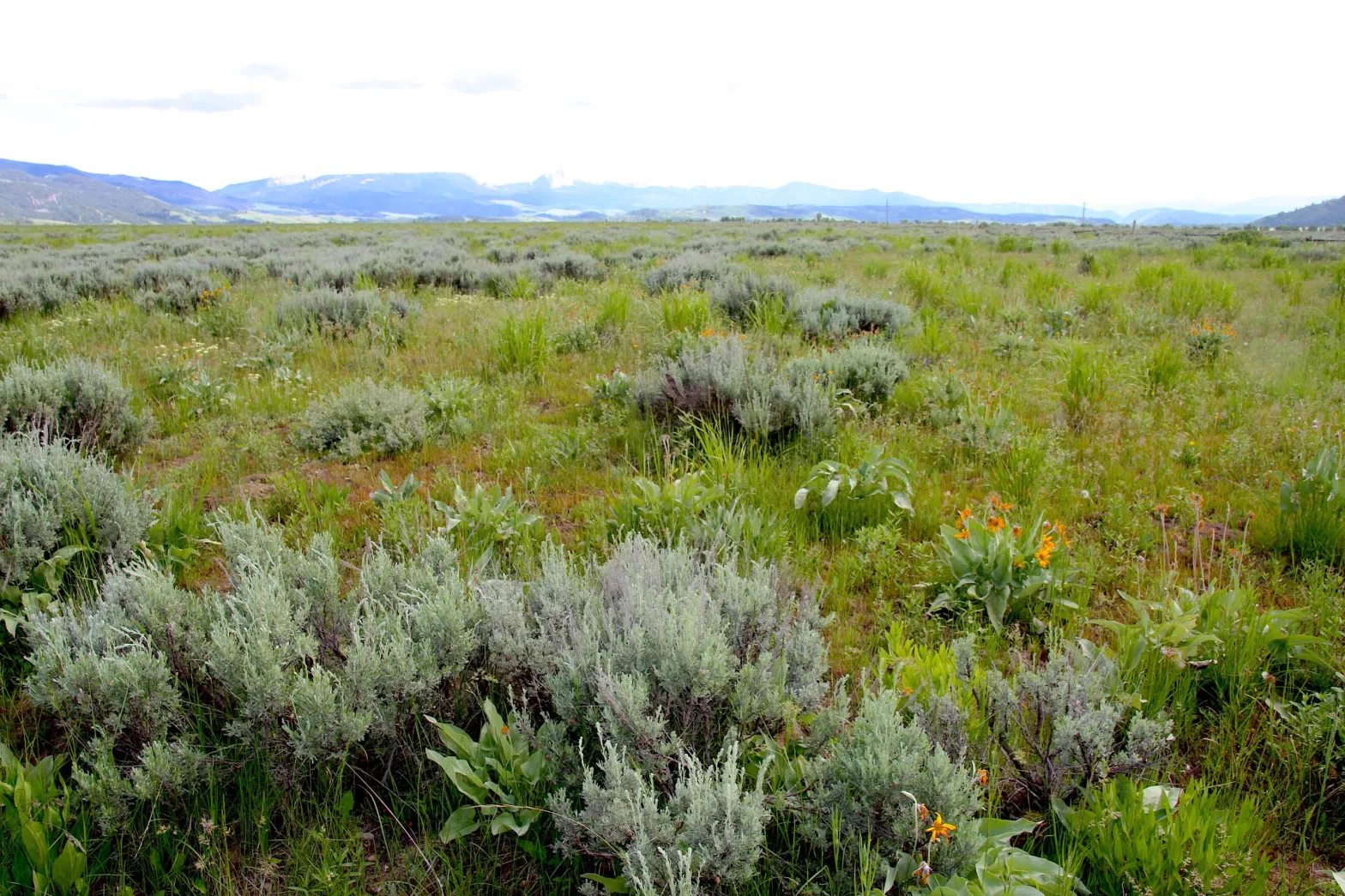
The fence line separating sagebrush and historic pastureland marks the north end of of the state of Wyoming’s school trust parcel in Grand Teton National Park, a tract known as the Kelly Parcel. (Mike Koshmrl/WyoFile)
Wyoming parcel approved for sale to Grand Teton National Park
Last year, it looked like an iconic parcel of state trust land outside Jackson, Wyoming, might be sold to a developer, prompting outrage from locals and conservationists. Known as the Kelly parcel, the land offers panoramic views of the Tetons and provides important habitat for migrating pronghorn and other wildlife species. But by law, state trust land must generate revenue for public schools. In November, Wyoming’s top-five state elected officials approved the sale of the parcel to the adjacent Grand Teton National Park for $100 million. The state will likely use the proceeds to purchase oil and gas-rich land in the Powder River Basin.
Wolves part of the pack discovered last summer in Tulare County called the Yowlumni Pack. The pack was found in the Sequoia National Forest near the Tule River Tribe of California’s reservation and ancestral lands.California Department of Fish and Wildlife
Wolf populations boom
An estimated 70 wolves are now living in California, an increase of 26 animals from last year. Two new wolf packs formed in Northern California this year, too. Meanwhile, Colorado saw the formation of its first pack since wolves were reintroduced last year.
Washington river gets legal rights — and other ballot wins
In Everett, Washington, voters approved a ballot initiative that grants the Snohomish River watershed the rights to exist, regenerate and flourish. City residents, agencies and organizations can now sue on behalf of the watershed, and any recovered damages will be used to restore the ecosystem. Also in Washington, voters upheld the 2021 Climate Commitment Act by voting no on Initiative 2117. The act caps and reduces carbon emissions for the state’s largest carbon emitters and raises money for conservation, climate and wildfire resilience statewide. In California, voters passed a $10 billion climate bond that will fund climate resilience projects, protect clean drinking water and help prevent wildfires.
Bear River Massacre site restored
One of the deadliest massacres of Native people in U.S. history happened near what’s now Preston, Idaho, in January 1863. Over 150 years later, the Northwestern Band of the Shoshone Nation is reclaiming the site of the massacre, a place their people once lived, celebrated and danced. Along the Bear River, the tribe is replacing thirsty invasive vegetation with native plants and restoring degraded agricultural fields to wetlands. Eventually, they hope to return an estimated 13,000 acre-feet of water to the parched Great Salt Lake annually. “For thousands of years, this wasn’t a massacre site,” Brad Parry, the tribe’s vice chairman, told High Country News. “We want to make this a place to come to again.”
Volunteers plant native vegetation along the banks of Battle Creek at the Bear River Massacre site in Preston, Idaho. Russel Albert Daniels/High Country News
Apache trout removed from Endangered Species List
In September, after 50 years on the federal endangered species list, Arizona’s state fish — the Apache trout — was declared recovered and removed from the list. The first American sportfish to achieve delisting, it owes its recovery to the White Mountain Apache Tribe as well as to federal and state agencies and nonprofits. In a statement, Interior Secretary Deb Haaland paid tribute to “the transformational power that collaborative conservation efforts — grounded in Indigenous Knowledge — can have on fish and wildlife.”
Extra wetland habitat created for birds
California’s Central Valley is vital to migrating birds, but its wetlands have been almost destroyed by agricultural and urban development. BirdReturns, a program that started in 2014, pays the valley’s rice farmers to create “pop-up” wetland habitat by flooding fields earlier in the fall and leaving them flooded later in the spring. Since its inception, BirdReturns has created 120,000 acres of temporary bird habitat.
Tribally led projects win big
TheAmerica The Beautiful Challenge funds voluntary conservation and restoration projects around the country, consolidating funding from federal agencies and the private sector. Numerous projects led by tribes in the West received money from the program this year, including the Summit Lake Paiute Tribe, which received $2.5 million for fish passage and riparian restoration projects in Nevada; the Pueblo of Jemez, which received $2.1 million for stream and wetland restoration in New Mexico; the Native Village of Tazlina, which received $2 million to incorporate Indigenous knowledge of migratory birds into state and regional meetings and management in Alaska; the Hoopa Valley Tribe, which received $4.5 million to remove invasive barred owls across Northern California; and the Eastern Shoshone Tribe, which received $3 million to expand the Yellowstone Bison Conservation Transfer Program.
Welcome to the Landline, a monthly newsletter from High Country News about land, water, wildlife, climate and conservation in the Western United States.Sign up to get it in your inbox. Screenshot from the High Country News website.
In mid-November, 10 days after 77 million of our fellow Americans chose Donald J. Trump to be their next president, I found myself at the old Navajo Bridge, which spans Marble Canyon and the Colorado River downstream from Lees Ferry in northern Arizona. I got out of my car, stretched and ambled toward the pedestrian bridge, which mirrors the newer one for automobiles.
As I reached the bridge, I noticed some onlookers looking intently downstream with binoculars. I followed their gaze to see a trio of giant, bald-headed, feathered creatures perched on the steel beams of the automobile bridge, looking a bit like the flying monkeys in the old Wizard of Oz film. They were California condors, maybe 10 in all, apparently waiting for an afternoon carrion snack to float by on the slow-moving emerald waters far below.
I wandered back and forth on the bridge for the next hour or so, stopping frequently to snap another photo, meditate vertiginously on the river and limestone cliffs or to gaze again in awe at the magnificent, uncanny creatures. Politics and the election results became irrelevant, at least for a moment, and it was with a newfound sense of serenity that I finally got back into the car and headed north.
Condors 6Y and 2A (I’m sure they have their own, more interesting names, but …) at the Navajo Bridge. According to condorspotter.com, 6Y is a male born in March 2019 at the Oregon Zoo. And 2A is a female hatched at the World Center for Birds of Prey in May 2021. Jonathan P. Thompson photo.
My mental calm was quickly shattered, however, as news trickled out about Trump’s Cabinet picks and plans. It is becoming increasingly clear that we are entering a perilous political era in which the federal government’s role is fundamentally altered. This includes a multi-pronged assault on our public lands and the rules, regulations, laws and agencies designed to protect them. Those condors on the Colorado River could be among the many victims.
Judging from the record of Trump’s first term, his campaign platform, his Cabinet picks so far and Project 2025, the right wing’s “presidential playbook,” it’s clear that he will once again attempt to dismantle the administrative state — and he’ll likely be better at it this time. The destruction will include gutting federal agencies, replacing experienced staffers with Trump loyalists and eviscerating protections for human health and the environment. The goal is to shrink the government, slash spending on safety nets and social programs to fund more tax cuts for the wealthy, and (of course) remove regulatory barriers standing in the way of ever-growing corporate profits. With the likes of Elon Musk buying his way into the administration, it promises to be a government of the billionaires, by the billionaires, and for the billionaires.
Trump actually summed up this ethos better than I ever could in a social media post, when he vowed to give anyone who invested at least $1 billion “in the United States of America … fully expedited approvals and permits, including, but in no way limited to, all Environmental approvals. GET READY TO ROCK!!!” He seemed to be responding to global mining corporation Rio Tinto, which is behind the proposed Resolution Copper Mine at Oak Flat in Arizona, urging the new administration to weaken environmental laws and expedite permitting for big mines.
During his first term, Trump made his hostility toward public lands clear as he reduced national monuments and rolled back regulations on fossil fuel extraction. This time, he promises a repeat performance, backed by a GOP-dominated Congress, a conservative-leaning Supreme Court and an army of professional ideologues who have been eagerly preparing for this moment for the last four years.
We can expect him to try to shrink or entirely rescind national monuments — particularly Bears Ears, Grand Staircase-Escalante and the Baaj Nwaavjo I’tah Kukveni-Ancestral Footprints of the Grand Canyon — potentially reopening hundreds of thousands of acres of uranium-rich lands to new mining claims during a time when the domestic uranium industry is experiencing a revival.
He will likely reward petroleum companies for donating generously to his campaign by implementing his “drill baby drill” policies. He’ll open up more public land to oil and gas leasing, including in the Alaskan Arctic, and rescind drilling bans on Thompson Divide in western Colorado and around Chaco Culture National Historical Park in New Mexico. He’ll roll back new EPA rules aimed at reducing greenhouse gas and mercury pollution from coal power plants.
If Trump’s hunger for “energy dominance” and corporate freedom don’t come for your public lands, the “Cult of Efficiency” probably will. Musk donated $277 million to Trump’s campaign. In return, he has been chosen to co-chair the so-called Department of Government Efficiency, or DOGE, where he has vowed to slash some $2 trillion in allegedly “wasteful” spending.
What this will actually mean remains unclear. But Trump’s suggestion that he may try to privatize the U.S. Postal Service because it’s not “profitable” and must be “subsidized” gives a good indication of what Musk’s quasi-department will be targeting. The USPS is designed to provide a public good, not a profit, and its priorities are fulfilling that mission, not maximizing efficiency. After all, how could delivering a letter to some remote rural backwater for some 50 cents ever be efficient?
And if the USPS is a problem, then what about public lands and the agencies that manage them? Sure, they provide ecological benefits, stewardship of and free access to millions of acres of stunning landscapes, wildlife habitat and so much more. And yet, they are “subsidized” to the tune of tens of billions of dollars each year, making them ripe for Musk’s chopping block. Utah, with the support of other conservative states, has offered to make Musk’s job easier with a lawsuit seeking to seize control of the “unappropriated” federal land in its midst. Because those states can’t afford to manage those lands at a loss, they would almost certainly sell them off to private interests.
And what about those condors? For years, industry and conservative politicians have tried to weaken the Endangered Species Act because it stood in the way of development and profits. Project 2025 calls for an escalation of these efforts, which now have more support in Congress — and from the efficiency cult.
The federal government has spent at least $35 million so far on the California condor program. It’s an effort that has so far paid off by helping to bring the species back from the brink of extinction; the wild population is up to almost 600 from an 1980s low of just 22 birds. Public goods such as species restoration simply don’t fit into narrow Musk’s profit-focused vision. And the condor remains fragile, threatened by lead poisoning, power lines, wind turbines and avian influenza, and it is not yet self-sustaining.
In the weeks since the election, I’ve seen a number of pundits, politicians and even advocates calling on land, water and air defenders to take a more conciliatory approach, to forge alliances with oil and gas companies, to abandon calls to “keep it in the ground,” to work with Republicans to speed up permitting reform in order to expedite renewable energy development, even if it does mean more fossil fuel development as well. Yet if ever there was a time not to give in, this is it. America’s public lands are under unprecedented attack from nearly every front. Now we need to be even more vigilant and fierce in our defense of it. [ed. emphasis mine]
Out on that bridge, something compelled me to hang my body a little too far over the rail so I could gaze straight through the empty space toward the river. My vertigo was overcome by the thrill of seeing, just below me on a steel girder, a juvenile condor, its pink beak jutting from a thatch of dark brown feathers. That, I thought, is certainly worth fighting for.
Condors perched on steel girders some 450 feet above the Colorado River. Jonathan P. Thompson photo.
The court agreed that the state’s energy policies violated Montanans’ constitutional right to a clean environment.
The Montana Supreme Court on Wednesday upheld a landmark victory for youth climate activists, affirming a decision by a lower court last year that the state’s energy policies violated their constitutional rights to a clean environment. Many of the 16 young people who brought the case, Held v. Montana, testified during the trial about the extreme weather they had witnessed in their home state, which is a major player in oil, gas and coal. They argued that a state law barring consideration of climate in setting energy policy was unconstitutional. The burning of fossil fuels produces the greenhouse gases that are dangerously warming the world. Rikki Held, 23, the named plaintiff in the case, was among those who testified. On Wednesday, she hailed the court’s decision. “This ruling is a victory not just for us, but for every young person whose future is threatened by climate change,” she said…
The plaintiffs were represented by lawyers from the nonprofits Our Children’s Trust and Western Environmental Law Center. Nate Bellinger, the activists’ lead counsel, said the decision showed that “the future of our children cannot be sacrificed for fossil fuel interests.”
[…]
Patrick Parenteau, professor of law emeritus and senior fellow for climate policy at the Environmental Law Center at Vermont Law and Graduate School, said that Montana was among a handful of states with environmental provisions in its constitution, and perhaps has the strongest of them. He said he expected to see similar lawsuits filed in other states now. Mr. Parenteau said the strong language in the opinion last year by Judge Kathy Seeley of Montana District Court had cleared the path for the decision to be upheld. Because the matter is squarely within the bounds of state law, he added, he did not see a pathway to appeal to the United States Supreme Court.
“It’s a landmark because it’s the first court in the U.S. to recognize a constitutional right to a stable climate,” he said. But it could run up against political realities, as the fossil fuel industry continues to receive strong support from state officials.
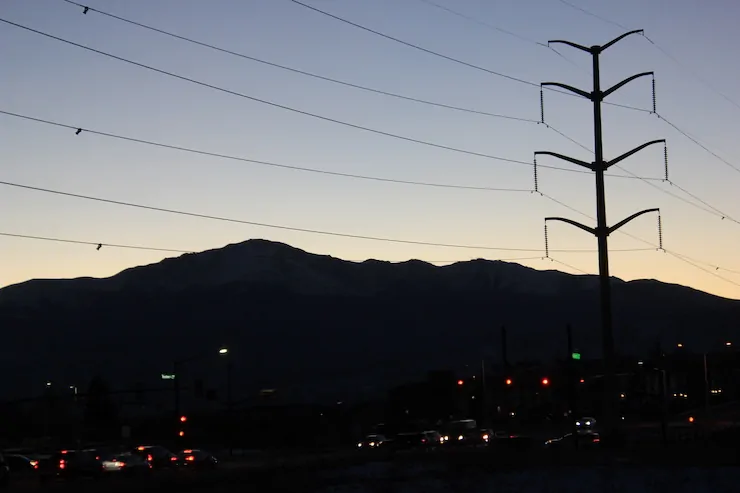
Colorado Springs. Photo credit: Allen Best/Big Pivots
Click the link to read the article on the Big Pivots website (Allen Best):
December 19, 2024
Transmission line in southeast Colorado a cause for guarded optimism among utility leaders
Interstate highways have transformed Colorado and America altogether. People growing up in the 1950s rarely had fresh fruit or vegetables in winter. Now, broccoli beheaded yesterday in a field near Yuma, Ariz., can be on a store shelf in metro Denver within a day or two. Much of that journey will be on an interstate highway.
High-voltage transmission lines are our four-lane highways of electricity. They worked well enough when giant coal plants provided most of our electricity. Now, as Colorado and other states strive to replace fossil fuels with renewables, new connections must be built, to knit us together across broader areas.
A federal agency this week delivered cause for cautious optimism. The Department of Energy has picked three transmission corridors among 10 national candidates for advanced work. One of them, the Southwestern Grid Connector Corridor, would begin in southeast Colorado near Lamar, and work south into New Mexico and then somewhat west.
The 2021 Bipartisan Infrastructure Law authorized the secretary of energy to designate any geographic area as a national interest electric transmission corridor. The energy department has found that absence of transmission harms consumers. With more transmission, we can share low-cost renewable generation across broader areas. We need an electric grid larger than one weather system and covering more than one time zone.
The existing transmission network is akin to our highways of 50 to 60 years ago. We have transmission, but it’s as if Interstate 70 stopped at the state line. In fact, transmission lines do. Colorado is in the Western electrical grid of 10 states and some adjoining areas. This grid, however, is better understood as a collection of 34 different islands connected by narrow causeways.
“A cautious hurrah,” said Mark Gabriel, the CEO of United Power when I asked his reaction. The Brighton-based electrical cooperative supplies 113,000 members from the foothills to Weld County’s oil and gas fields, including many new industrial centers along I-76.
“Anything that promotes additional transmission is a good thing,” said Gabriel. “However, the challenge remains in actually getting something constructed in a reasonable period of time to make a difference.”
Gabriel pointed out that more than $40 billion in transmission projects have been announced. “Only a fraction are actually being built.”
Permitting has been the bane of many transmission projects. For example, it took 18 years before the TransWest Express Transmission project that will ferry wind-generated electricity from southern Wyoming to Utah and West Coast markets finally broke ground in 2023. It nicks the corner of northwest Colorado.
A bill being negotiated in Congress would ease federal permitting requirements to allow more rapid creation of transmission lines. Other provisions of the Energy Permitting Reform Act of 2024 would also benefit oil and gas extraction.
Tri-State Generation and Transmission, the wholesale provider for 17 of Colorado’s 22 electrical cooperatives, pointed to the need for streamlined permitting in its reaction to the transmission line in southeastern Colorado.
Transmission doesn’t come cheap. And just as interstate highways have their unsavory aspects — my companion and I can routinely hear I-70 roaring a mile away — transmission lines have their downsides. Who wants one in their backyard?
Baca County has Colorado’s best wind resource and it gets plenty of sunshine. Lacking has been transmission. Top photo transmission in Colroado Springs. Photo credit: Allen Best/Big Pivots
Some want to believe nuclear energy will solve all of our problems. The Pueblo City Council, while saying nice things about nuclear, intends to scrap a goal of 100% renewables by 2035. Maybe nuclear will be an answer, but recent projects have had eye-bulging costs. Natural gas has problems, too, as was evident in Winter Storm Uri of February 2021 when costs soared.
Chris Hansen, as a state legislator from Denver, sponsored key legislation to push transmission planning in Colorado. Now in Durango as CEO of La Plata Electric, he has started working on guiding his electrical cooperative to 97% emission-free electricity in the next decade. Transmission, he says, will be crucial.
Capacity of existing transmission lines can be expanded by reconductoring and other technology. But we altogether need to be better connected east and west, north and south.
One crucial question, says Hansen, is whether Denver-based Chris Wright, the choice of Donald Trump to be secretary of energy, will support continued transmission planning. His Colorado-based career has been in oil and gas. Wright sees renewables as a distant solution.
Southeastern Colorado brims with renewable energy potential. Baca County has Colorado’s best wind, according to a 2017 study by the National Renewable Energy Laboratory. It also has strong solar. That’s why corn grows so well there — assuming it has water. The water of the Ogallala Aquifer won’t last, but the solar and wind almost certainly will. What it lacks now is a farm-to-market transmission highway.
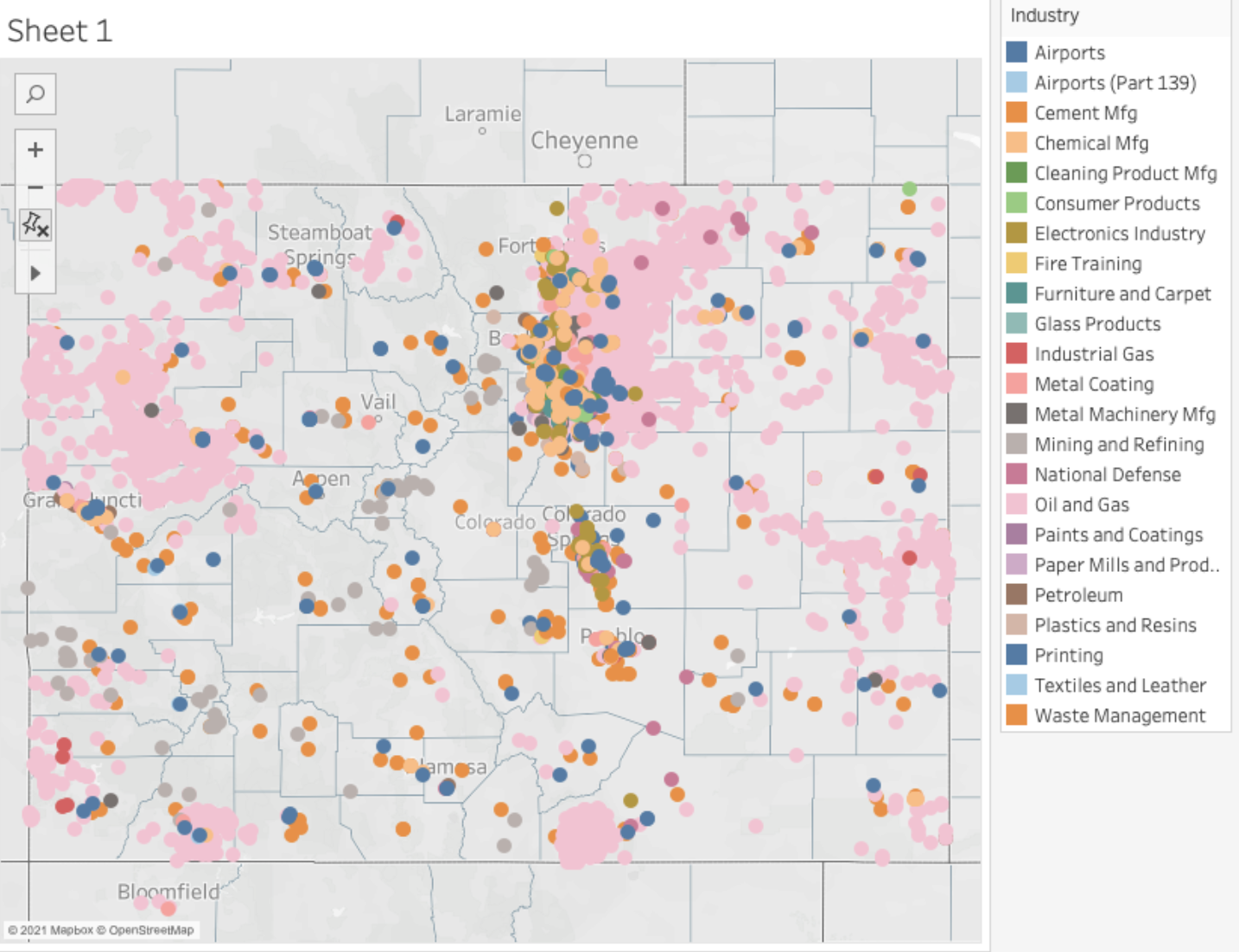
A whistleblower and watchdog advocacy group used an EPA database of locations that may have handled PFAS materials or products to map the potential impact of PFAS throughout Colorado. They found about 21,000 Colorado locations in the EPA listings, which were uncovered through a freedom of information lawsuit. Locations are listed by industry category. (Source: Public Employees for Environmental Responsibility analysis of EPA database)
Organic halides are highly useful compounds in chemical synthesis, where the halide serves as a versatile functional group for elimination, substitution, and cross-coupling reactions with transition metals or photocatalysis1-3. However, the activation of carbon-fluorine bonds, the most commercially abundant organohalide and found in PFAS, or “forever chemicals”, are much rarer. Current approaches based on photoredox chemistry for activation of small molecule carbon-fluorine (C–F) bonds are limited by the substrates and transition-metal catalysts needed4. A general method for the direct activation of organofluorines would have significant value in organic and environmental chemistry. Here, we report an organic photoredox catalyst system that can efficiently reduce C–F bonds to generate carbon-centered radicals, which can then be intercepted for hydrodefluorination (swapping F for H) and cross-coupling reactions. This system enables the general use of organofluorines as synthons under mild reaction conditions. We extend this method to the defluorination of polyfluoroalkyl substances (PFAS) and fluorinated polymers, a critical challenge in the breakdown of persistent and environmentally damaging forever chemicals.
Click the link to read the release on the UN website (Fragkiska Megaloudi, Gloria Pallares, Terry Collins):
December 9, 2024
Aridity: The ‘existential crisis’ redefining life on Earth
Five billion people could be affected by 2100
Even as dramatic water-related disasters such as floods and storms intensified in some parts of the world, more than three-quarters of Earth’s land became permanently drier in recent decades, UN scientists warned today in a stark new analysis.
Some 77.6% of Earth’s land experienced drier conditions during the three decades leading up to 2020 compared to the previous 30-year period, according to the landmark report from the UN Convention to Combat Desertification (UNCCD).
Over the same period, drylands expanded by about 4.3 million km2 – an area nearly a third larger than India, the world’s 7th largest country – and now cover 40.6% of all land on Earth (excluding Antarctica).
In recent decades some 7.6% of global lands – an area larger than Canada – were pushed across aridity thresholds (i.e. from non-drylands to drylands, or from less arid dryland classes to more arid classes).
Most of these areas have transitioned from humid landscapes to drylands, with dire implications for agriculture, ecosystems, and the people living there.
And the research warns that, if the world fails to curb greenhouse gas emissions, another 3% of the world’s humid areas will become drylands by the end of this century.
In high greenhouse gas emissions scenarios, expanding drylands are forecast across the Midwestern United States, central Mexico, northern Venezuela, north-eastern Brazil, south-eastern Argentina, the entire Mediterranean Region, the Black Sea coast, large parts of southern Africa, and southern Australia.
The report, The Global Threat of Drying Lands: Regional and global aridity trends and future projections, was launched at the 16th conference of UNCCD’s nearly 200 Parties in Riyadh, Saudi Arabia (COP16), the largest UN land conference to date, and the first UNCCD COP to be held in the Middle East, a region profoundly affected by impacts from aridity.
“This analysis finally dispels an uncertainty that has long surrounded global drying trends,” says Ibrahim Thiaw, UNCCD Executive Secretary. “For the first time, the aridity crisis has been documented with scientific clarity, revealing an existential threat affecting billions around the globe.”
“Unlike droughts—temporary periods of low rainfall—aridity represents a permanent, unrelenting transformation,” he adds. “Droughts end. When an area’s climate becomes drier, however, the ability to return to previous conditions is lost. The drier climates now affecting vast lands across the globe will not return to how they were and this change is redefining life on Earth.”
The report by UNCCD Science-Policy Interface (SPI) — the UN body for assessing the science of land degradation and drought — points to human-caused climate change as the primary driver of this shift. Greenhouse gas emissions from electricity generation, transport, industry and land use changes warm the planet and other human activities warm the planet and affect rainfall, evaporation and plant life, creating the conditions that increase aridity.
Global aridity index (AI) data track these conditions and reveal widespread change over the decades.
For the first time, the aridity crisis has been documented with scientific clarity, revealing an existential threat affecting billions around the globe. The report points to human-caused climate change as the primary driver of this shift. Greenhouse gas emissions from electricity generation, transport, industry and land use changes warm the planet and other human activities warm the planet and affect rainfall, evaporation and plant life, creating the conditions that increase aridity. Credit: UN
Aridification hotspots
Areas particularly hard-hit by the drying trend include almost all of Europe (95.9% of its land), parts of the western United States, Brazil, parts of Asia (notably eastern Asia), and central Africa.
Parts of the Western United States and Brazil: Significant drying trends, with water scarcity and wildfires becoming perennial hazards.
Mediterranean and Southern Europe: Once considered agricultural breadbaskets, these areas face a stark future as semi-arid conditions expand.
Central Africa and parts of Asia: Biologically megadiverse areas are experiencing ecosystem degradation and desertification, endangering countless species.
By contrast, less than a quarter of the planet’s land (22.4%) experienced wetter conditions, with areas in the central United States, Angola’s Atlantic coast, and parts of Southeast Asia showing some gains in moisture.
The overarching trend, however, is clear: drylands are expanding, pushing ecosystems and societies to suffer from aridity’s life-threatening impacts.
The report names South Sudan and Tanzania as nations with the largest percentage of land transitioning to drylands, and China as the country experiencing the largest total area shifting from non-drylands into drylands.
For the 2.3 billion people – well over 25% of the world’s population – living in the expanding drylands, this new normal requires lasting, adaptive solutions. Aridity-related land degradation, known as desertification, represents a dire threat to human well-being and ecological stability.
And as the planet continues to warm, report projections in the worst-case scenario suggest up to 5 billion people could live in drylands by the century’s end, grappling with depleted soils, dwindling water resources, and the diminishment or collapse of once-thriving ecosystems.
Forced migration is one of aridity’s most visible consequences. As land becomes uninhabitable, families and entire communities facing water scarcity and agricultural collapse often have no choice but to abandon their homes, leading to social and political challenges worldwide. From the Middle East to Africa and South Asia, millions are already on the move—a trend set to intensify in coming decades.
Map of Africa. Credit: Geology.comq
Aridity’s devastating impact
The effects of rising aridity are cascading and multifaceted, touching nearly every aspect of life and society, the report says.
It warns that one fifth of all land could experience abrupt ecosystem transformations from rising aridity by the end of the century, causing dramatic shifts (such as forests becoming grasslands and other changes) and leading to extinctions among many of the world’s plants, animals and other life.
Aridity is considered the world’s largest single driver behind the degradation of agricultural systems, affecting 40% of Earth’s arable lands
Rising aridity has been blamed for a 12% decline in gross domestic product (GDP) recorded for African countries between 1990–2015
More than two thirds of all land on the planet (excluding Greenland and Antarctica) is projected to store less water by the end of the century, if greenhouse gas emissions continue to rise even modestly
Aridity is considered one of the world’s five most important causes of land degradation (along with land erosion, salinization, organic carbon loss and vegetation degradation)
Rising aridity in the Middle East has been linked to the region’s more frequent and larger sand and dust storms
Increasing aridity is expected to play a role in larger and more intense wildfires in the climate-altered future—not least because of its impacts on tree deaths in semi-arid forests and the consequent growing availability of dry biomass for burning
Rising aridity’s impacts on poverty, water scarcity, land degradation and insufficient food production have been linked to increasing rates of sickness and death globally —especially among children and women
Rising aridity and drought play a key role in increasing human migration around the world—particularly in the hyper-arid and arid areas of southern Europe, the Middle East and North Africa and southern Asia.
Report marks a turning point
For years, documenting the rise of aridity proved a challenge, the report states. Its long-term nature and the intricate interplay of factors such as rainfall, evaporation, and plant transpiration made analysis difficult. Early studies produced conflicting results, often muddied by scientific caution.
The new report marks a turning point, leveraging advanced climate models and standardized methodologies to deliver a definitive assessment of global drying trends, confirming the inexorable rise of aridity, while providing critical insights into its underlying drivers and potential future trajectory.
Recommendations
The report offers a comprehensive roadmap for tackling aridity, emphasizing both mitigation and adaptation. Among its recommendations:
Strengthen aridity monitoring Integrate aridity metrics into existing drought monitoring systems. This approach would enable early detection of changes and help guide interventions before conditions worsen. Platforms like the new Aridity Visual Information Tool provide policymakers and researchers with valuable data, allowing for early warnings and timely interventions. Standardized assessments can enhance global cooperation and inform local adaptation strategies.
Improve land use practices Incentivizing sustainable land use systems can mitigate the impacts of rising aridity, particularly in vulnerable regions. Innovative, holistic, sustainable approaches to land management are the focus of another new UNCCD SPI report, Sustainable Land Use Systems: The path to collectively achieving Land Degradation Neutrality, available at https://bit.ly/3ZwkLZ3. It considers how land-use at one location affect others elsewhere, makes resilience to climate change or other shocks a priority, and encourages participation and buy-in by Indigenous and local communities as well as all levels of government. Projects like the Great Green Wall—a land restoration initiative spanning Africa—demonstrate the potential for large-scale, holistic efforts to combat aridity and restore ecosystems, while creating jobs and stabilizing economies.
Invest in water efficiency Technologies such as rainwater harvesting, drip irrigation, and wastewater recycling offer practical solutions for managing scarce water resources in dry regions.
Build resilience in vulnerable communities Local knowledge, capacity building, social justice and holistic thinking are vital to resilience. Sustainable land use systems encourage decision makers to apply responsible governance, protect human rights (including secure land access) and ensure accountability and transparency. Capacity-building programmes, financial support, education programmes, climate information services and community-driven initiatives empower those most affected by aridity to adapt to changing conditions. Farmers switching to drought-resistant crops or pastoralists adopting more arid-tolerant livestock exemplify incremental adaptation.
Develop international frameworks and cooperation The UNCCD’s Land Degradation Neutrality framework provides a model for aligning national policies with international goals, ensuring a unified response to the crisis. National Adaptation Plans must incorporate aridity alongside drought planning to create cohesive strategies that address water and land management challenges. Cross-sectoral collaboration at the global level, facilitated by frameworks like the UNCCD, is essential for scaling solutions.
Comments
“For decades, the world’s scientists have signalled that our growing greenhouse gas emissions are behind global warming. Now, for the first time, a UN scientific body is warning that burning fossil fuels is causing permanent drying across much of the world, too—with potentially catastrophic impacts affecting access to water that could push people and nature even closer to disastrous tipping points. As large tracts of the world’s land become more arid, the consequences of inaction grow increasingly dire and adaptation is no longer optional—it is imperative.” – UNCCD Chief Scientist Barron Orr
“Without concerted efforts, billions face a future marked by hunger, displacement, and economic decline. Yet, by embracing innovative solutions and fostering global solidarity, humanity can rise to meet this challenge. The question is not whether we have the tools to respond—it is whether we have the will to act.” – Nichole Barger, Chair, UNCCD Science-Policy Interface
“The report’s clarity is a wake-up call for policymakers: tackling aridity demands more than just science—it requires a diversity of perspectives and knowledge systems. By weaving Indigenous and local knowledge with cutting-edge data, we can craft stronger, smarter strategies to slow aridity’s advance, mitigate its impacts and thrive in a drying world.” – Sergio Vicente-Serrano, co-lead author of the report and an aridity expert with Spain’s Pyrenean Institute of Ecology
“This report underscores the critical need to address aridity as a defining global challenge of our time. By uniting diverse expertise and leveraging breakthrough technologies, we are not just measuring change—we are crafting a roadmap for resilience. Tackling aridity demands a collaborative vision that integrates innovation, adaptive solutions, and a commitment to securing a sustainable future for all.” – Narcisa Pricope, co-lead author, professor of geosciences and associate vice president for research at Mississippi State University, USA.
“The timeliness of this report cannot be overstated. Rising aridity will reshape the global landscape, challenging traditional ways of life and forcing societies to reimagine their relationship with land and water. As with climate change and biodiversity loss, addressing aridity requires coordinated international action and an unwavering commitment to sustainable development.” – Andrea Toreti, co-lead author and senior scientist, European Commission’s Joint Research Centre
By the Numbers:
Key global trends / projections
77.6%: Proportion of Earth’s land that experienced drier climates from 1990–2020 compared to the previous 30 years.
40.6%: Global land mass (excluding Antarctica) classified as drylands, up from 37.5% over the last 30 years.
4.3 million km²: Humid lands transformed into drylands in the last three decades, an area one-third larger than India
40%: Global arable land affected by aridity—the leading driver of agricultural degradation.
30.9%: Global population living in drylands in 2020, up from 22.5% in 1990
2.3 billion: People living in drylands in 2020, a doubling from 1990, projected to more than double again by 2100 under a worst-case climate change scenario.
1.35 billion: Dryland inhabitants in Asia—more than half the global total.
620 million: Dryland inhabitants in Africa—nearly half of the continent’s population.
9.1%: Portion of Earth’s land classified as hyperarid, including the Atacama (Chile), Sahara (Africa), Namib (Africa), and Gobi (China/Mongolia) deserts.
23%: Increase in global land at “moderate” to “very high” desertification risk by 2100 under the worst-case emissions scenario
+8% at “very high” risk
+5% at “high” risk
+10% at “moderate” risk
Environmental degradation
5: Key drivers of land degradation: Rising aridity, land erosion, salinization, organic carbon loss, and vegetation degradation
20%: Global land at risk of abrupt ecosystem transformations by 2100 due to rising aridity
55%: Species (mammals, reptiles, fish, amphibians, and birds) at risk of habitat loss from aridity. Hotspots: (Arid regions): West Africa, Western Australia, Iberian Peninsula; (Humid regions): Southern Mexico, northern Amazon rainforest
Economics
12%: African GDP decline attributed to aridity, 1990–2015
16% / 6.7%: Projected GDP losses in Africa / Asia by 2079 under a moderate emissions scenario
20M tons maize, 21M tons wheat, 19M tons rice: Expected losses in global crop yields by 2040 due to expanding aridity
50%: Projected drop in maize yields in Kenya by 2050 under a high emissions scenario
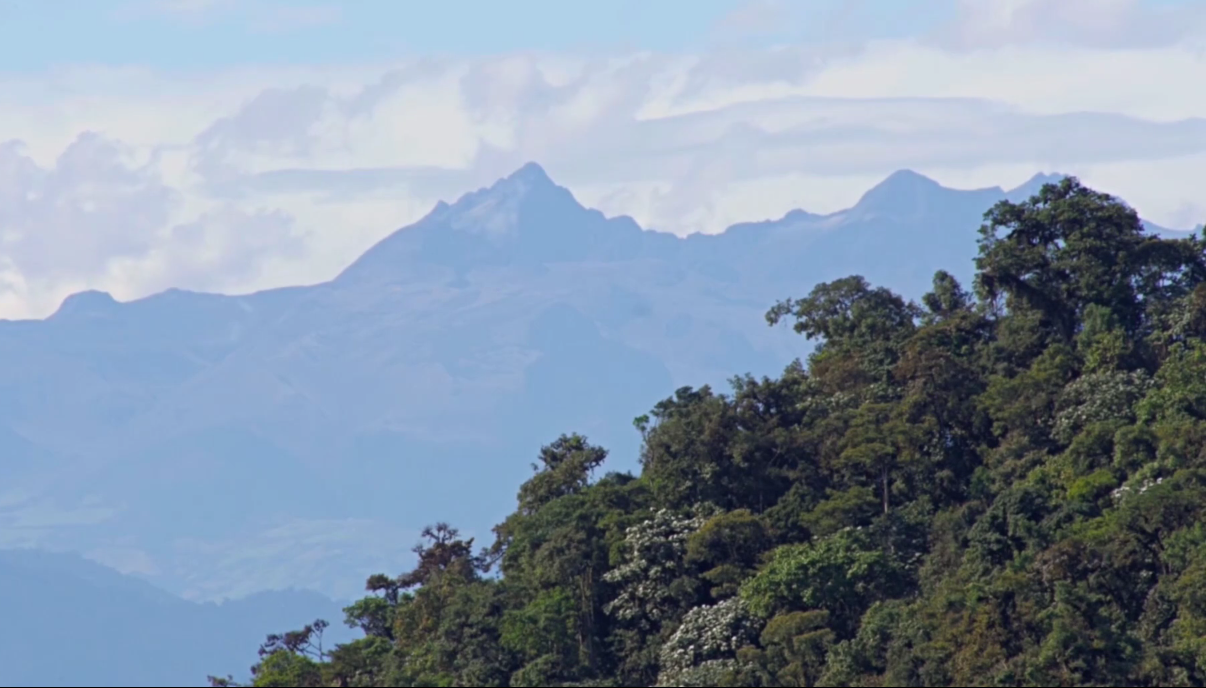
Los Cedros, the iconic cloud forest reserve in Ecuador’s Western Andes, which is under concession for copper and gold mining to Canadian company Cornerstone and Australian BHP. Photo credit: The Rainforest Project
Water
90%: Rainfall in drylands that evaporates back into the atmosphere, leaving 10% for plant growth
67%: Global land expected to store less water by 2100, even under moderate emission scenarios
75%: Decline in water availability in the Middle East and North Africa since the 1950s
40%: Predicted Andean runoff decline by 2100 under a high emissions scenario, threatening water supplies in South America
Just above the horizon here, a haboob (dust storm) can be seen heading north.
This was shot at what remains of the Salton Sea Naval Test Station. Photo credit: slworking2/Flickr
Health
55%: Increase in severe child stunting in sub-Saharan Africa under a medium emissions scenario due to combined effects of aridity and climate warming
Up to 12.5%: Estimated rise in mortality risks during sand and dust storms in China, 2013–2018
57% / 38%: Increases in fine and coarse atmospheric dust levels, respectively, in the southwestern U.S. by 2100 under worst case climate scenarios
220%: Projected increase in premature deaths due to airborne dust in the southwestern United States by 2100 under the high-emissions scenario
160%: Expected rise in hospitalizations linked to airborne dust in the same region
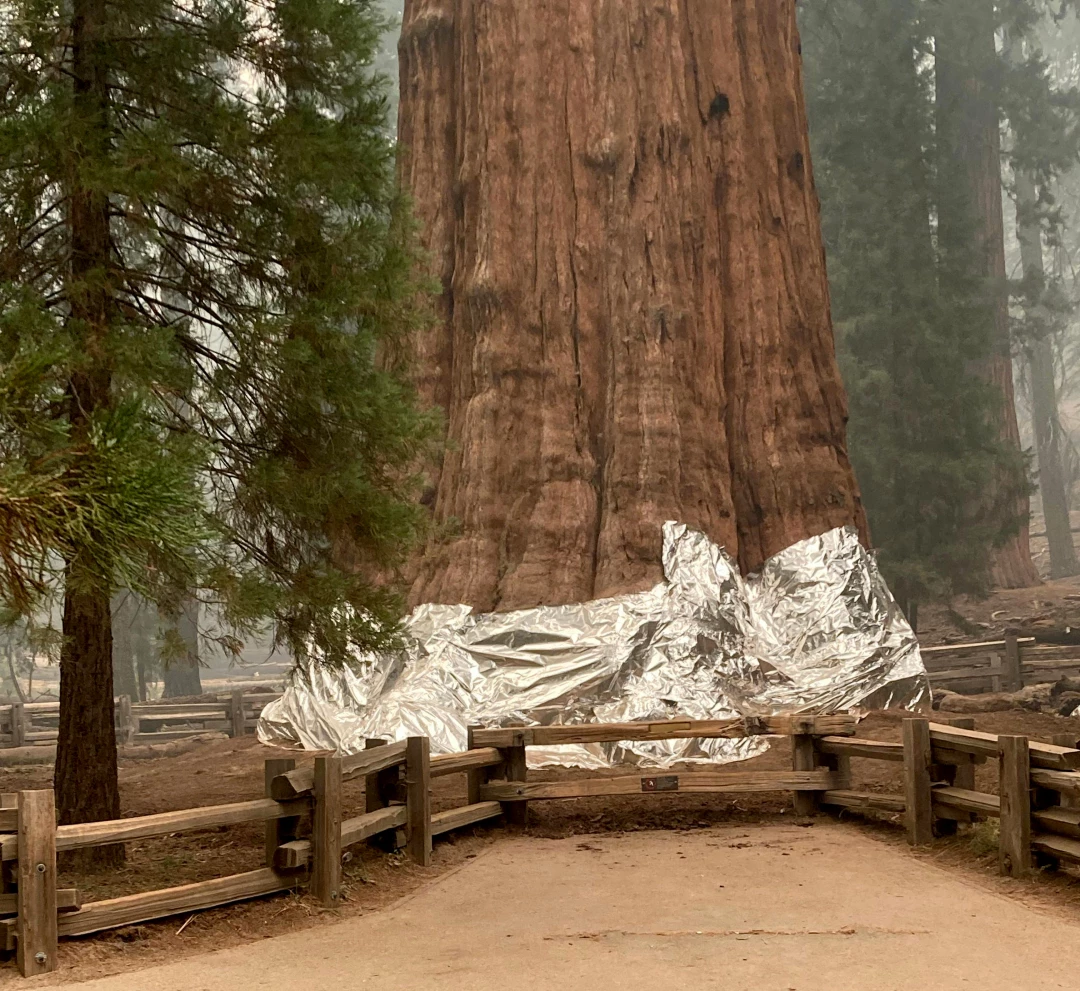
The General Sherman sequoia tree is wrapped in fire-resistant foil to protect it from the KNP Complex fire. (National Park Service)
Wildfires and forests
74%: Expected increase in wildfire-burned areas in California by 2100 under high emission scenarios
40: Additional annual high fire danger days in Greece by 2100 compared to late 20th century levels
Notes to editors:
Aridity versus drought
Highly arid regions are places in which a persistent, long-term climatic condition lacks available moisture to support most forms of life and atmospheric evaporative demand significantly exceeds rainfall.
Drought, on the other hand, is an anomalous, shorter-term period of water shortage affecting ecosystems and people and often attributed to low precipitation, high temperatures, low air humidity and/or anomalies in wind.
While drought is part of natural climate variability and can occur in almost any climatic regime, aridity is a stable condition for which changes occur over extremely long-time scales under significant forcing.
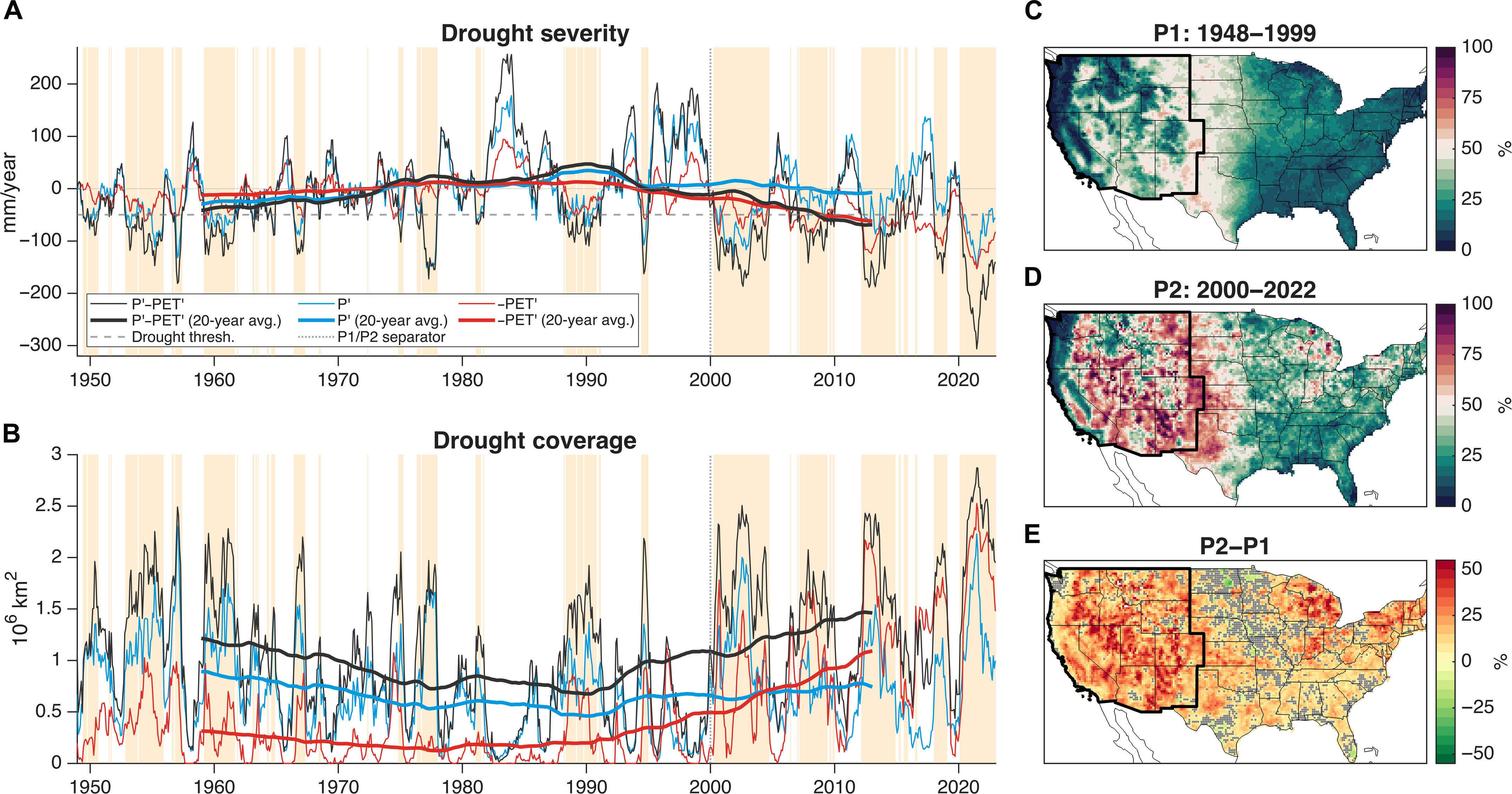
Fig. 1. Contributions of P′ and PET′ to the WUS drought. (A) Drought severity time series of 12-month moving cumulative P′−PET′, P′, and −PET′ during 1948–2022 averaged over the WUS (with cosine latitude weighting); the thin lines represent 12-month cumulative values, while the thick lines are their 20-year moving average; the yellow-shaded area represents drought periods identified when average P′−PET′ falls below its 30th percentile value for the 1948–1999 climatological period (marked by the gray dashed horizontal line); the vertical dotted line separates 1948–1999 (P1) and 2000–2022 (P2). We multiply PET′ by −1 for direct comparison with P′. (B) Time series of drought coverage and contributions from P′ and −PET′; thin lines represent total areas within the WUS (11 contiguous US states, 3.12 × 10⁶ km2 in total) that are in drought condition (local P′−PET′ below the 30th percentile value for any grid point; black) and those where PET′ (red line) or P′ (blue line) alone was strong enough to cause drought (Materials and Methods); thick lines are their 20-year moving average. (C) Map of averaged PET′ contribution to drought severity, i.e., −PET′/(P′−PET′), during drought periods in P1; the thick black line marks the boundary of the WUS region. (D) Same as (C), but for drought periods in P2. (E) Change of PET′ contribution from P1 to P2, i.e., the difference between (D) and (C); gray dotted areas indicate insignificant change (P ≥ 0.05; P values are adjusted using the false discovery rate (FDR) criterion of αFDR < 0.05).
Historically, meteorological drought in the western United States (WUS) has been driven primarily by precipitation deficits. However, our observational analysis shows that, since around 2000, rising surface temperature and the resulting high evaporative demand have contributed more to drought severity (62%) and coverage (66%) over the WUS than precipitation deficit. This increase in evaporative demand during droughts, mostly attributable to anthropogenic warming according to analyses of both observations and climate model simulations, is the main cause of the increased drought severity and coverage. The unprecedented 2020–2022 WUS drought exemplifies this shift in drought drivers, with high evaporative demand accounting for 61% of its severity, compared to 39% from precipitation deficit. Climate model simulations corroborate this shift and project that, under the fossil-fueled development scenario (SSP5-8.5), droughts like the 2020–2022 event will transition from a one-in-more-than-a-thousand-year event in the pre-2022 period to a 1-in-60-year event by the mid-21st century and to a 1-in-6-year event by the late-21st century.
Udall/Overpeck 4-panel Figure Colorado River temperature/precipitation/natural flows with trend. Lake Mead and Lake Powell storage. Updated through Water Year 2024. Credit: Brad Udall
As observed by the Gravity Recovery and Climate Experiment (GRACE) and GRACE Follow On (GRACE-FO) missions, global terrestrial water storage (TWS), excluding ice sheets and glaciers, declined rapidly between May 2014 and March 2016. By 2023, it had not yet recovered, with the upper end of its range remaining 1 cm equivalent height of water below the upper end of the earlier range. Beginning with a record-setting drought in northeastern South America, a series of droughts on five continents helped to prevent global TWS from rebounding. While back-to-back El Niño events are largely responsible for the South American drought and others in the 2014–2016 timeframe, the possibility exists that global warming has contributed to a net drying of the land since then, through enhanced evapotranspiration and increasing frequency and intensity of drought. Corollary to the decline in global TWS since 2015 has been a rise in barystatic sea level (i.e., global mean ocean mass). However, we find no evidence that it is anything other than a coincidence that, also in 2015, two estimates of barystatic sea level change, one from GRACE/FO and the other from a combination of satellite altimetry and Argo float ocean temperature measurements, began to diverge. Herein, we discuss both the mechanisms that account for the abrupt decline in terrestrial water storage and the possible explanations for the divergence of the barystatic sea level change estimates.
Article Highlights
Global terrestrial water storage, excluding glaciers and ice sheets, declined abruptly between May 2014 and March 2016, with a corollary increase in sea level
A series of droughts, possibly linked to global warming, has since helped to prevent global terrestrial water storage from recovering
Also around 2015, two independent estimates of barystatic sea level began to diverge, but we find no evidence of a connection with the terrestrial water storage decline
Illustration of the NASA’s Gravity Recovery and Climate Experiment Follow-On (GRACE-FO) spacecraft, which will track changes in the distribution of Earth’s mass, providing insights into climate, Earth system processes and the impacts of some human activities. GRACE-FO is a partnership between NASA and the German Research Centre for Geosciences.
Credits: NASA/JPL-Caltech
100 years of average September-October-November temperature anomalies over land areas through 2024… Data from NOAAGlobalTemp v6.0.0: http://www.ncei.noaa.gov/products/lan…
The Land Desk is taking a break from its regularly scheduled programming to set something straight. It has come to our attention that one or more of our readers don’t realize that under the Biden administration the United States has become the planet’s leading oil and gas producing powerhouse. Well, it has, mostly on the strength of a drilling frenzy on public, private, and state land in the Permian Basin of New Mexico and Texas.
For those who pay attention, this shouldn’t come as a surprise. But apparently it is news to those who have been duped by President-elect Trump’s claims that his “drill, baby, drill” agenda will bring an end to Biden’s alleged “war on energy” and make America energy-dominant again. There is no war on energy, and under the Biden administration the U.S. has been more “energy dominant” than ever before. In fact, it is the globe’s leading producer (and consumer) of petroleum and natural gas.
The United States’ crude oil and petroleum production surpassed both Saudi Arabia’s and Russia’s in 2013, during the Obama administration, and has continued climbing ever since. Now the U.S. produces more crude oil than any nation in history. This is largely due to advances in drilling technology opening up new sources of hydrocarbons, but is also driven by global oil prices. Source: U.S. Energy Information Administration.
This is not something to celebrate, or for the outgoing administration to take pride in — all that oil and gas gets burned, adding more greenhouse gases to the atmosphere and exacerbating the climate crisis. It’s just the facts, which include:
U.S. oilfields are producing more crude oil and natural gas than ever before, and production continues to increase steadily, particularly from the Permian Basin.
13.4 million barrels per day: Crude oil production from U.S. oil fields in August 2024. In August 2008 it was 5 million barrels per day.
The U.S. is the globe’s leading producer of crude oil, extracting as much crude oil and other petroleum liquids as Saudi Arabia and Russia combined.
21.91 million barrels/day; 11.13 million b/d; 10.75 million b/d: U.S.; Saudi Arabia; and Russia crude oil and other petroleum liquid production in 2023. They are the world’s top three producers.
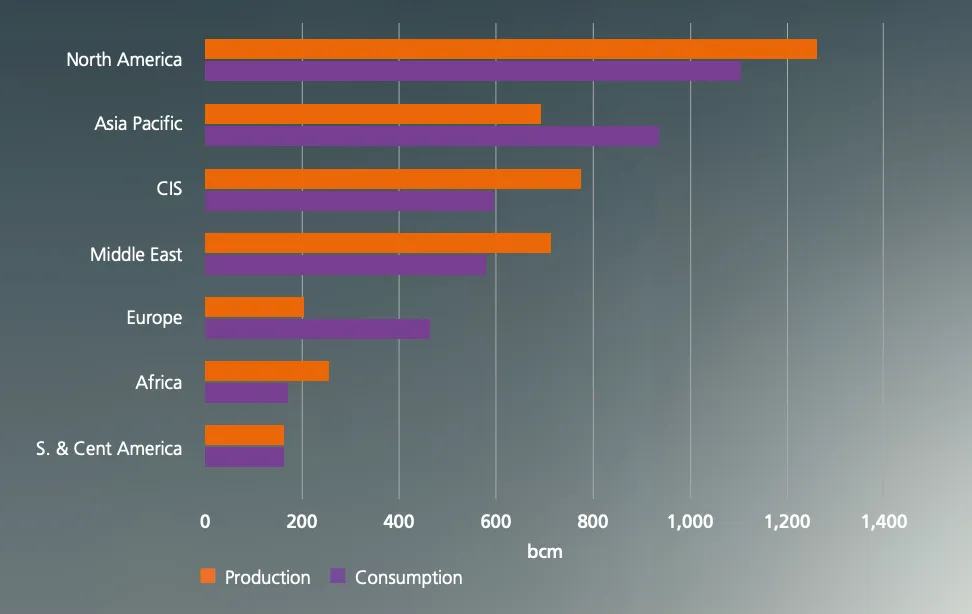
The U.S. is even more methane-dominant, producing 25% of the globe’s natural gas.
Natural gas production and consumption for various regions. Source: Statistical Review of World Energy.
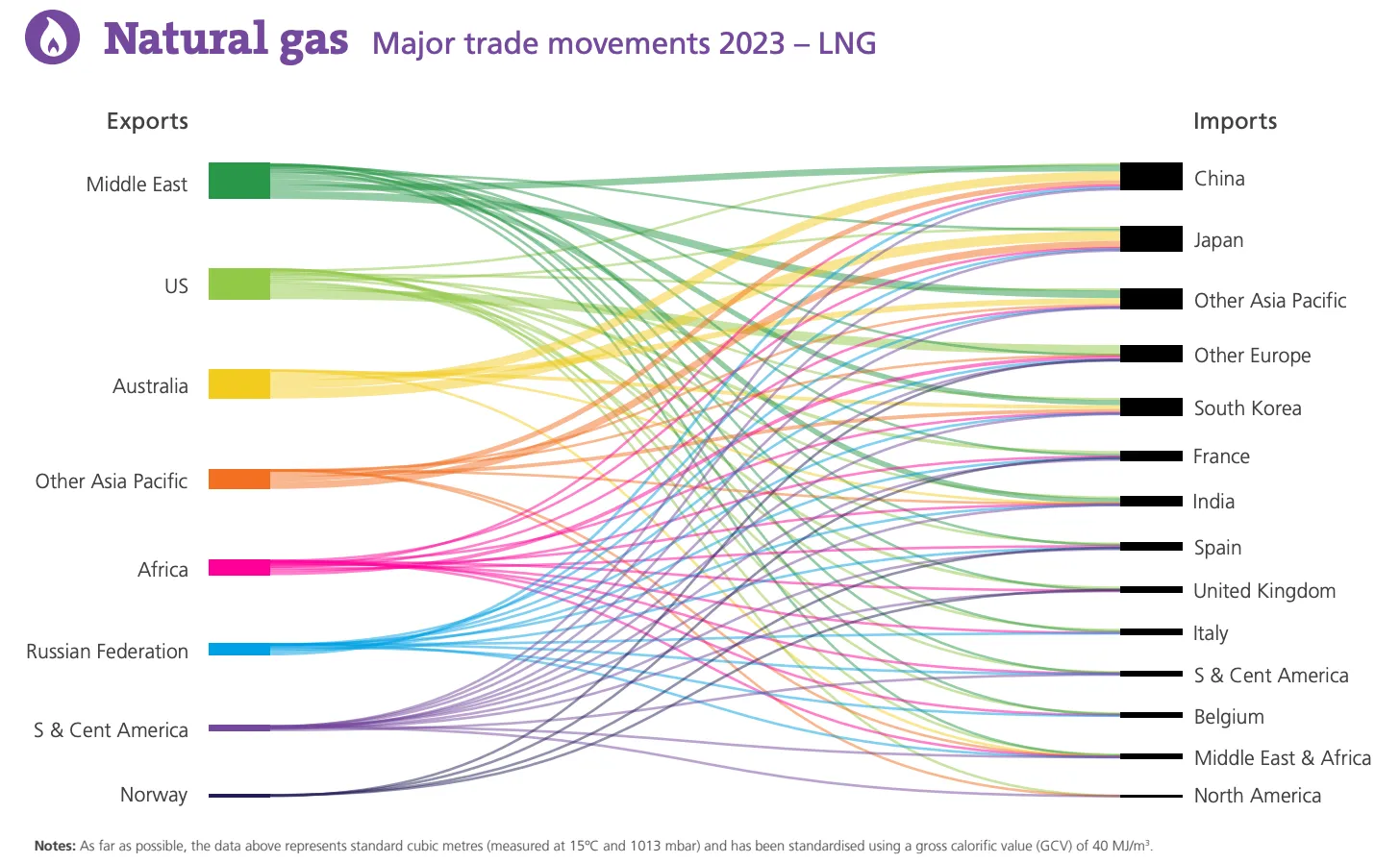
The U.S. is exporting more liquefied natural gas, crude oil, and petroleum products than ever before, becoming one of the world’s leading exporters of hydrocarbons.
The United States exports nearly as much LNG, or liquefied natural gas, as all Middle Eastern producers combined. Source: Statistical Review of World Energy.
The U.S. is a net exporter of crude oil and other petroleum products, making it more “energy independent” than it has been since the early 1900s — if you fall for that sort of thing.
While the U.S. continues to import millions of barrels of crude oil each day, it exports substantially more petroleum products as a whole, making it a net exporter to the tune of over 5 million barrels per day. Source: Energy Information Administration.
The U.S. also continues to import large volumes of crude oil, because oil is a global commodity and many of the nation’s refineries are equipped to handle “sour” crude from the Middle East.
Oil and gas corporations have enjoyed tremendous profits during the Biden administration.
ExxonMobil pulled in $13.2 billion in operating profit during the third quarter of this year. Source: Tradingeconomics.com
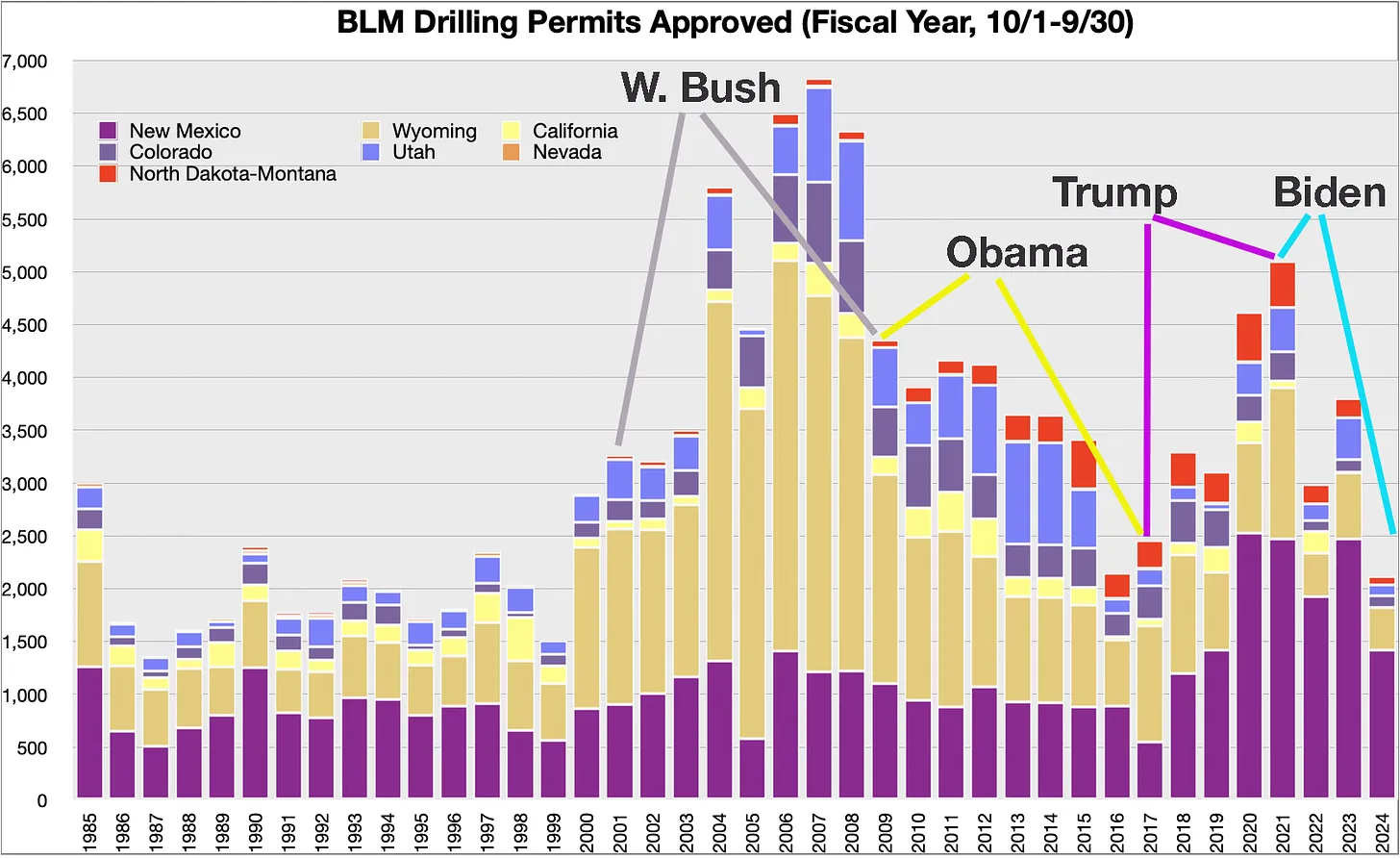
Whether this is because of or in spite of or totally unrelated to the Biden administration’s policies is open to debate. Biden revived or implemented a handful of new regulations on oil and gas drilling during his term, some of which have only just begun to take effect. And the Bureau of Land Management offered less acreage for federal oil and gas leasing than previous administrations. But the agency also handed out about as many drilling permits, on average, as the Obama and Trump administrations.
That the oil and gas industry was able to reap such bounty regardless is partially due to the fact that, intentionally or not, Biden’s policies were crafted to allow drilling to continue at a rapid pace while still giving the taxpayers a better return and protecting more fragile areas. This included designating (intentionally or not) the Permian Basin as a de facto oil and gas sacrifice zone. A huge majority of the drilling permits issued under Biden were for federal land on the New Mexico side of the Permian Basin, and the Environmental Protection Agency delayed its response to rising pollution in the area, allowing drilling to go on unfettered. Nearly all of the domestic crude oil and natural gas production growth of the last several years has come from the Permian Basin.
The Biden administration issued around the same number of drilling permits, on average, as the Obama and first Trump administrations. But it handed out far more permits in New Mexico’s Permian Basin than ever before. Source: BLM.
The incoming Trump administration has announced plans to roll back Biden-era environmental protections and expedite oil and gas drilling permitting and leasing on federal lands shortly after taking office. This will almost certainly include opening up more acreage in Wyoming, Utah, and Alaska to leasing. And they’ll try to issue more drilling permits in those places, too.
But even if companies lease more land or pull more permits in Wyoming, they won’t necessarily put them to use— most oil and gas leasing is speculative, anyway, meant to build up a corporation’s land-holdings to entice more investment. And petroleum firms currently are sitting on thousands of unused federal drilling permits. These days the industry has shown little interest in developing areas outside of the Permian Basin, and the Biden administration has more or less let it run rampant down there, leading to the current state of U.S. energy dominance.
Oil and gas production from the Permian Basin will continue to increase for the foreseeable future regardless of who is in the White House. But you shouldn’t expect Trump’s “drill, baby, drill” agenda to further increase drilling or oil and gas production — or to lead to lower gasoline prices. In fact, Trump’s threatened tariffs on Canada will actually increase gas prices in some parts of the U.S., because we get quite a bit of crude oil from them. Besides, his policies are not really aimed at bolstering production or bringing down your prices. They are intended to cut costs for petroleum corporations, thereby increasing their profits, which are already ridiculously high. And it will come at the expense of human health and the environment. [ed. emphasis mine]
⛏️Mining Monitor ⛏️
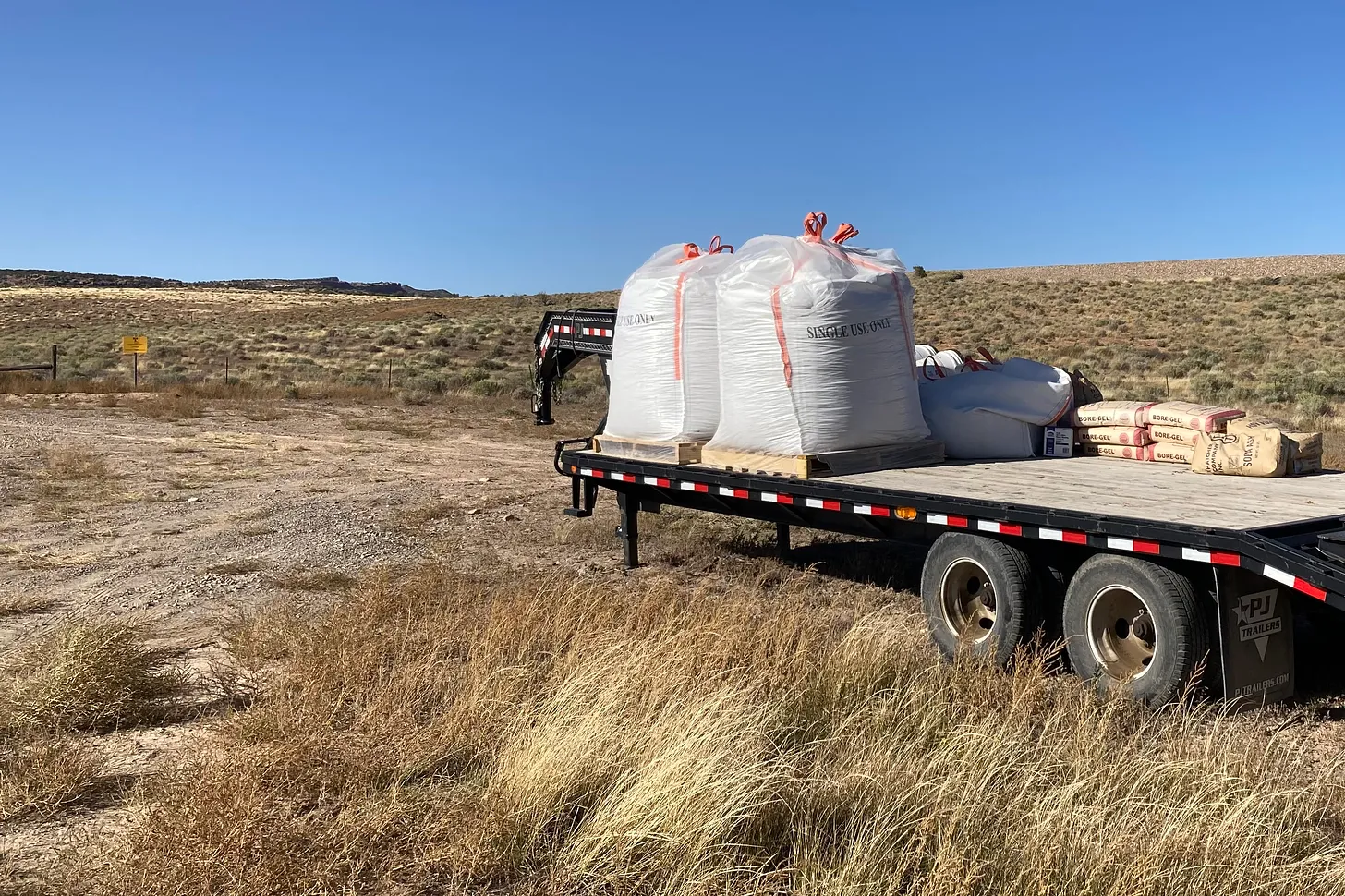
Drilling material near Slick Rock, Colorado. Jonathan P. Thompson photo.
My email box has been hopping with press releases from various lithium and uranium mining companies tooting their horn about their latest acquisition or exploratory drilling campaign in the Four Corners Country, which tends to get my hackles up. And yet, among the noise is still very little news about actual mining. I have to admit I’m a bit surprised by the lack of ore production, given all of the hype over the last few years.
I did visit one of the more contentious exploratory drilling projects just outside Slick Rock, Colorado. They weren’t drilling when I was there, but a flatbed trailer loaded down with drilling material was on hand, right next to the radioactive-symbol signs warning folks of the presence of a uranium mill tailings repository. Anfield, one of the bigger companies operating in the area, is behind that project.
Anyway, here’s a sampling of the hype — and a bit of whatever the opposite of hype is:
Thor Energy says it has begun drilling at its Wedding Bell Project, which sits right near the San Miguel-Montrose county line in the Uravan Mineral Belt in western Colorado. The area has seen heavy prospecting (and a bunch of road-building) in the past.
Pegasus Resources says it has secured drilling permits — contingent upon posting a reclamation bond — for its Energy Sands and Jupiter claims along the San Rafael Swell, west of Green River, Utah, and just north of I-70 where it intersects the Swell. They’re planning on drilling 48 exploratory wells on 50’x50’ pads.
C2C Metals acquired five groups of uranium mining claims in the Uravan Mineral Belt, including the Eula Belle and Mum-Whitney claims in Montrose County and the Norther, Spud Patch, and Dulaney extension in San Miguel County. The claims cover a total of about 5,400 acres.
American Battery Materials says it has received the “necessary agency approvals” — pending the posting of a financial bond — to reenter an old oil and gas well in the Lisbon Valley of southeastern Utah to search for lithium.
And then there’s the anti-hype: Even as all of these projects appear to be ramping up the exploratory phase, one of the few companies that’s actually producing lithium is shutting down. That’s right. U.S. Magnesium, which extracts lithium and magnesium and other materials from Great Salt Lake brine, is idling its operations and laying off 186 employees, according to KUER. They cite “deteriorating market conditions for lithium carbonate.” That is, the price for the stuff isn’t high enough to make mining it profitable.
I guess this sort of thing was inevitable? The Family Farm Alliance is now offering “Make Alfalfa Great Again” hats. It makes me wonder what that would mean, exactly? Maybe they want to genetically engineer it to use less water? Hmmm…
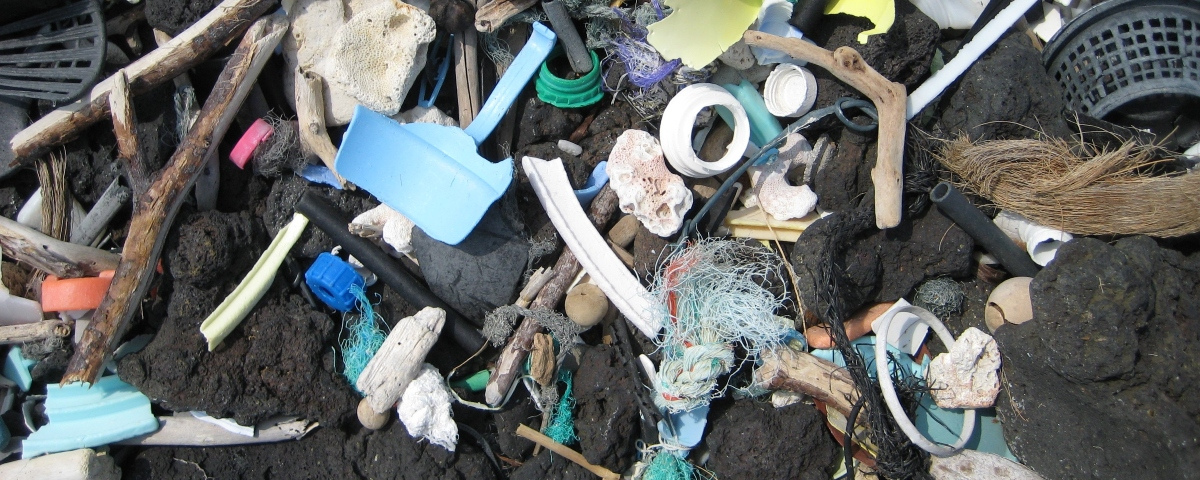
Virtually indestructible plastic on a black rock beach in Hawaii. Photo credit: Eric Johnson/NOAA
Click the link to read the release on the NOAA website:
November 19, 2024
Marine microplastics are an urgent issue. Much of the world population consumes seafood as a source of protein, and microplastics can threaten this sustainable food source.
With further research, scientists can gauge how microplastics impact human health, fishing industries, and our marine ecosystems.
Understanding the existing distributions and quantities of microplastics in the global ocean is a vital first step towards combating microplastic pollution. This requires scientists, researchers, and decision-makers to have access to large-scale, long-term comprehensive microplastics data.
Atlas of Ocean Microplastics
Debuting in 2024, the Atlas of Ocean Microplastics (AOMI) is a database of ocean surface microplastics data created by Japan’s Ministry of the Environment, AMOI is created in collaboration with researchers, research institutions, and governments around the world. Data from the NCEI Marine Microplastics Product are available through AMOI, which is in keeping with NCEI’s commitment to data findability, accessibility, interoperability, and reuse of digital assets (FAIR Principles). AOMI is also sharing microplastics data with NCEI’s Marine Microplastic database, making both databases more complete to best serve users.
Since the data are from many different publicly-available sources, AOMI quality controls the data and adds a comparability grade to each data according to the Guidelines for Harmonizing Ocean Surface Microplastic Monitoring Methods. AOMI also visualizes where the data was collected and thus the distribution of ocean surface microplastics around the globe on an interactive map.
AOMI is available to the public. Users can view and download all data for free, and filter the data according to their own purposes and uses.
Marine Microplastics Unraveled
Microplastics, including those found in the marine environment, are pieces of plastic or fibers less than 5 mm—smaller than a sesame seed. Any plastic product, including single-use plastics like bottles and plastic bags, along with plastics in items like cosmetics, can eventually become marine pollution.
There are many different types of microplastics, including beads, fragments, pellets, film, foam, and fibers.
Some microplastics are made to be small for a specific purpose. These primary microplastics can be plastic pellets that are melted and used to create larger plastic items, or the microbeads that may be found in personal care products, such as toothpaste, face washes, and cosmetics.
Secondary microplastics come from larger pieces of plastics, such as beverage bottles, bags, and toys. Sun, heat, wind, and waves can cause these plastics to become brittle and break into smaller and smaller pieces that may never fully go away. Microplastics are also created when pieces of plastic break off during use. For example, particles of synthetic tires can break off during regular use and through wear and tear.
Similarly, our clothing, furniture, and fishing nets and lines may produce plastic microfibers, another type of secondary microplastics. These fibers are extremely common on shorelines across the United States, and are made of synthetic materials, such as polyester or nylon. Through general wear or washing and drying, these tiny fibers break off and shed from larger items.
No matter where we live on the globe, we all have a role to play in taking action in reducing plastic waste through more responsible behaviors to help keep our environment clean. Products like the AOMI and the NCEI Marine Microplastics Product give everyone access to microplastic concentration data that can guide future work and help visualize our progress.
On Nov. 5, more than 73 million Americans — or just over half of those who voted — chose to send Donald J. Trump to the White House for a second time. Trump garnered a smaller percentage of votes in my southwestern Colorado hometown. Still, four out of ten Durangatans opted for a candidate who stands diametrically opposed to the values I hold dear. And some of those folks are friends or people I admire.
Surely many of them disapprove of Trump’s behavior and many of his policies, but voted for him anyway simply because he’s a Republican, because he’s not the status quo or Joe Biden or Kamala Harris or a Clinton, because they’re fed up with “wokeness,” because they believe he’ll lower the price of eggs and gasoline, or because he’s the only viable white male on the ballot. Others may have chosen him or not voted at all to protest Biden’s tacit support for the atrocities in Gaza, or his failure to end oil and gas drilling on federal land, or because they believe that Democrats and Republicans are all cut from the same power-hungry cloth.
I suppose I should be reassured by this, and feel happy for these Trump voters since their side won — as if it were a football game and the Cowboys had crushed the Broncos. But this isn’t a sporting event. And as much as the media may treat elections as horse races, they are not. They have consequences, potentially huge ones, and regardless of why someone may have voted the way they did, the results are the same. This election was a referendum on civility and decency, on compassion and the rule of law, on human rights and equality; and all of those things lost. Corporate power, fear, vindictiveness, and the oligarchy won.
So no, it’s not going to be “okay.” And no, I’m not going to feel happy for folks who voted for Trump, because even though their “team” may have won, they will likely end up losers — unless they are oil companies or billionaires, that is.
Beauty will persevere, regardless of who is in the White House. Jonathan P. Thompson photo.
When Trump was elected in 2016, it was a shock, of course, but also a bit of a mystery: No one knew what kind of president he’d be or what sort of policies he’d push. Now we have a far clearer sense of what the next four years might look like.
I’m not convinced Trump will carry out all the threats he made on the campaign trail. Call me a pollyanna, but I doubt he’ll rule as an all-out fascist dictator, as some fear. He probably won’t try to prosecute Liz Cheney and Joe Biden, or sic the military on the “enemies within,” or overtly punish members of the media. His pledge to round up and deport 11 million human beings who came to the U.S. to escape persecution or pursue economic betterment will run up against reality: The nation can’t afford to live without immigrants, whether they are here legally or not.
But judging from Trump’s platform, promises, and his first-term record, we do know he and his minions will set out to dismantle the administrative state, which is to say gut federal agencies, replace experienced staffers with Trump loyalists, and remove government protections on human health, the environment, and worker safety. Elon Musk, who bought himself a cabinet-level position in the administration, will do his damnedest to slash $2 trillion in government spending, which will include unraveling the already frail social safety net.
While that image might appeal to those of you with an anarchist or libertarian bent, I can assure you these guys aren’t doing this in the name of Liberty or Freedom. The administrative state may be bloated, inefficient, sometimes ineffective, and often irritating, but its aim is to protect Americans and keep corporations in check. And when Trump and company look to destroy it, they are doing so to clear the way for the super-rich to become even wealthier, for the corporations to pull in more profit, and for Trump and his cronies to evade accountability for wrongdoings — all at the expense of you and me. A Trump administration will be a government by the narcissistic oligarchs, for the narcissistic oligarchs.
Shiprock and a moody sky. Jonathan P. Thompson photo.
Meanwhile, the MAGA movement’s theocratic strain will decimate the liberties of women, people of color, and LGBTQ+ people. Conservative congress members will push for a federal abortion ban, and Trump may go along with it to pay back his christian-nationalist voters. Trump will give Netanyahu the green light to decimate Gaza and the people who live there, and will similarly step aside and let Putin have his way with Ukraine.
Then there’s the question of what another Trump administration will mean for public lands, the environment, energy development, and the West’s air and water. Again, we can determine a lot by what he did — or attempted to do — during his first administration, along with plans laid out in Trump’s own Agenda 47 and Project 2025. Trump tried to distance himself from the latter during the election, but it was crafted by dozens of his former staffers and associates and is generally seen as the playbook for a second Trump administration. Trump’s public lands agenda will become clearer as he starts to line up cabinet appointments in the coming months. But regardless, I fear our public lands and environment and climate — and by extension all of us humans — are going to suffer. [ed. And countless species will suffer]
First dusting of snow on the Abajos and a windmill. Jonathan P. Thompson photo.
The following is a list of potential Trump targets relating to public lands and the environment. It’s important to remember that a president doesn’t have the power to kill just any rule and regulation with the stroke of a pen, but that didn’t stop Trump from trying to do so during his first administration.
Trump will work to implement his “drill baby drill” and “energy dominance” policies by opening up more public land to oil and gas leasing and removing regulations on public land drilling. He is likely to roll back Biden’s leasing reforms, which included higher royalty rates — to get a better deal for taxpayers — and stricter reclamation bond requirements to help ensure companies would clean up their messes.
Biden banned new oil and gas leasing on lands around Chaco Culture National Historical Park and on the Thompson Divide in western Colorado. Trump and whomever he appoints as Interior secretary will almost certainly try to reverse these bans. In the short-term, lifting the ban wouldn’t be too harmful: There is little interest in drilling either of these places currently. But if oil and gas prices climb, all bets could be off for these special places.
The Biden administration’s public lands rule, which aims to put conservation on a par with extractive uses, will probably go on the chopping block. If Trump doesn’t kill it, Congress will.
After being closed to drilling for decades, in 2017 Congress and Trump mandated oil and gas leasing in the Arctic National Wildlife Refuge. The Biden administration revoked the leases, then issued a new environmental review, offering the bare minimum of acreage required by law. Expect Trump to significantly expand the acreage available for drilling.
The first Trump administration revoked or attempted to revoke the Obama administration’s methane emissions regulations. They’ll probably try the same with Biden’s rules.
New EPA rules aimed at reducing coal plants’ greenhouse gas and mercury pollution are in Trump’s crosshairs. If they are revoked, it would allow the Colstrip power plant in Montana to continue spewing toxic and planet-warming emissions for years to come.
Trump will end the Bureau of Land Management’s proposal to end new federal coal leasing in the Powder River Basin. The ban wouldn’t come into play until current leases are depleted decades from now. Chances are the market for coal will dry up before then, making both the leasing ban and the rollback fairly irrelevant.
Trump dramatically shrunk Grand Staircase-Escalante and Bears Ears National Monuments during his first term, in part to curry favor with the late Sen. Orrin Hatch, the Utah Republican who held a lot of sway in Washington. Sen. Mike Lee, the Utah Republican and Trump acolyte, may push for a repeat. It would be even more consequential now: high uranium prices have unleashed a flurry of new mining claims and exploratory drilling on all sides of Bears Ears National Monument.
Trump is likely to shrink or revoke the Baaj Nwaavjo I’tah Kukveni-Ancestral Footprints of the Grand Canyon National Monument, thereby re-opening more than a half-million acres of uranium-rich lands to new mining claims. The Avi Kwa Ame National Monument in Nevada seems to be safer, simply because the only corporations interested in developing the land are solar and wind companies — and Trump’s no fan of clean energy.
Project 2025 calls for revoking the Antiquities Act, which has been used by presidents to protect natural and cultural sites as national monuments since 1906, with many going on to become national parks, the list includes: El Morro National Monument, Petrified Forest National Park, Muir Woods National Monument, Grand Canyon National Park … I could go on and on.
You can forget about mining law reform under a Trump administration and GOP-controlled Senate. And global mining corporation Rio Tinto, which is behind the proposed Resolution copper mine at Oak Flat in Arizona, is already urging the incoming Trump administration to weaken environmental laws and expedite permitting for mines.
Trump and the GOP dominated Congress will work to weaken the Endangered Species Act.
The list, unfortunately, goes on …
During his first term, Trump’s mission was hampered by his own lack of preparation, his incompetence, and his chaotic approach. This time he and an army of professional ideologues are prepared to march into the White House with Project 2025 in hand to lay waste to government as we know it. And they will have the support of a GOP-dominated Congress and a conservative Supreme Court.
It’s depressing and scary and discouraging. But it is not hopeless. The Biden administration prepared for this possibility by working to make regulations — and national monuments — more resilient to future challenges. Democratic leaders in Western states are already preparing to defend their environmental laws and climate programs against inevitable Trump administration attacks. And environmental groups such as the Center for Biological Diversity, Earthjustice, the Western Environmental Law Center, and many others are ready to challenge Trump at every turn.
Meanwhile, the Land Desk vows to stay on top of it all, and keep its special community of readers informed.
Coyote Gulch’s Leaf charging at the City of Vail Lionshead parking structure May 24, 2023.
Click the link to read the article on the Big Pivots website (Allen Best):
November 1, 2024
Electric vehicles and plug-in hybrids constituted 27.8% of all new car sales in Colorado during this year’s third quarter, according to sales figures compiled by the Colorado Automobile Dealers Association.
That puts Colorado second in the nation in proportion of sales, behind only California.
It also puts Colorado slightly ahead of the trajectory it identified as being necessary to have 940,000 EVs or hybrids on its roads by 2030. It had 151,000 as of October. It needs 157,000 by year’s end to stay on its pace, and Mike Salisbury, the Colorado Energy Office’s director of transportation, said the state will likely exceed that target by several thousand.
Clearly, the combination of tax credits offered by Colorado and the federal government have put wind into the sales of EVs and hybrids. New incentives that went into effect in January were particularly important in understanding Colorado’s climbing sales.
This latest milestone can be viewed against the backdrop of stories earlier this year by various national media about sluggish EV sales.
The flip side of that story of slowing sales is that lower-priced models are just now starting to arrive in significant numbers. Tesla, still the dominant brand, is getting more competition.
Notable is the expansion of General Motors in the market. As the New York Times noted this week, GM long had the Bolt compact, but it now has nine electric models that appeal to a wide range of consumers. And more are on the way, including a battery-powered version of its popular Cadillac Escalade SUV.
Bonnie Trowbridge, the executive director of Drive Clean Colorado, has been assisting in electrification of fleets. It’s easier, she explains, to make the argument for one fleet operator of 100 vehicles than 100 individual car owners. As such, electrifying fleets will have a much larger carbon impact.
Amazon has been electrifying its delivery vehicles. And Drive Clean Colorado has received an EPA grant to support the replacement of 21 old diesel trucks used for food delivery to restaurants with electric delivery vehicles. Of those, 15 will be the longer trucks and the remaining six the shorter snub-nosed trucks at the back doors of restaurants.
Colorado, the state government, also has been pushing ahead with EVs in its fleets, and some municipalities are doing the same.
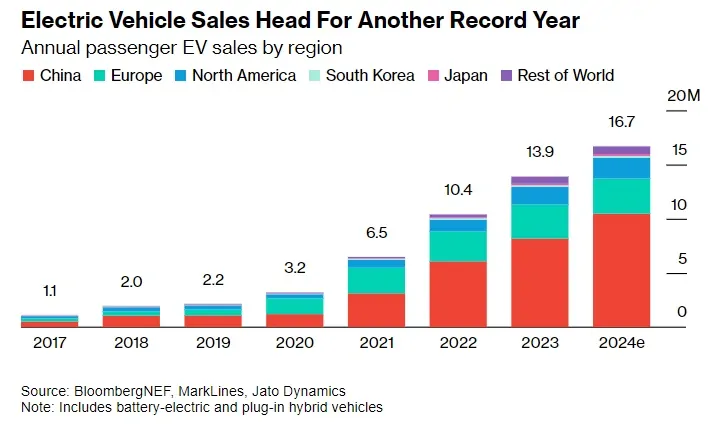
What may be more surprising is how laggard even California and Colorado are in comparison with the EV adoption in China and other countries.
EVs in the United States altogether constitute about 11% of all new-car sales. The world average is about 25%. In China, EVs are on track to be 45% of all new car sales this year, according to Marc Peterson, a retired executive with General Electric who spoke recently at a Monday Zoom session organized by Phil Nelson.
That same point was made by Bloomberg Finance in a chart reproduced here.
“The Chinese market is driving the world automotive market,” said Peterson, who is the co-coordinator in Utah for Citizens Climate Lobby.
Peterson reported that EVs now cost less in every U.S. state except West Virginia and Maine. In Utah, where he lives, the average cost of ownership of an EV across five years saves its owner $7,113.
Trowbridge, at Drive Clean Colorado, points out that China and some European countries have reached an inflection point in their adoption of EVs. Instead of driving the adoption with incentives, some places are using regulation to preclude use of internal-combustion engine vehicles in highly polluted places such as cities.
Could she imagine that happening in Colorado?
Trowbridge paused before answering.
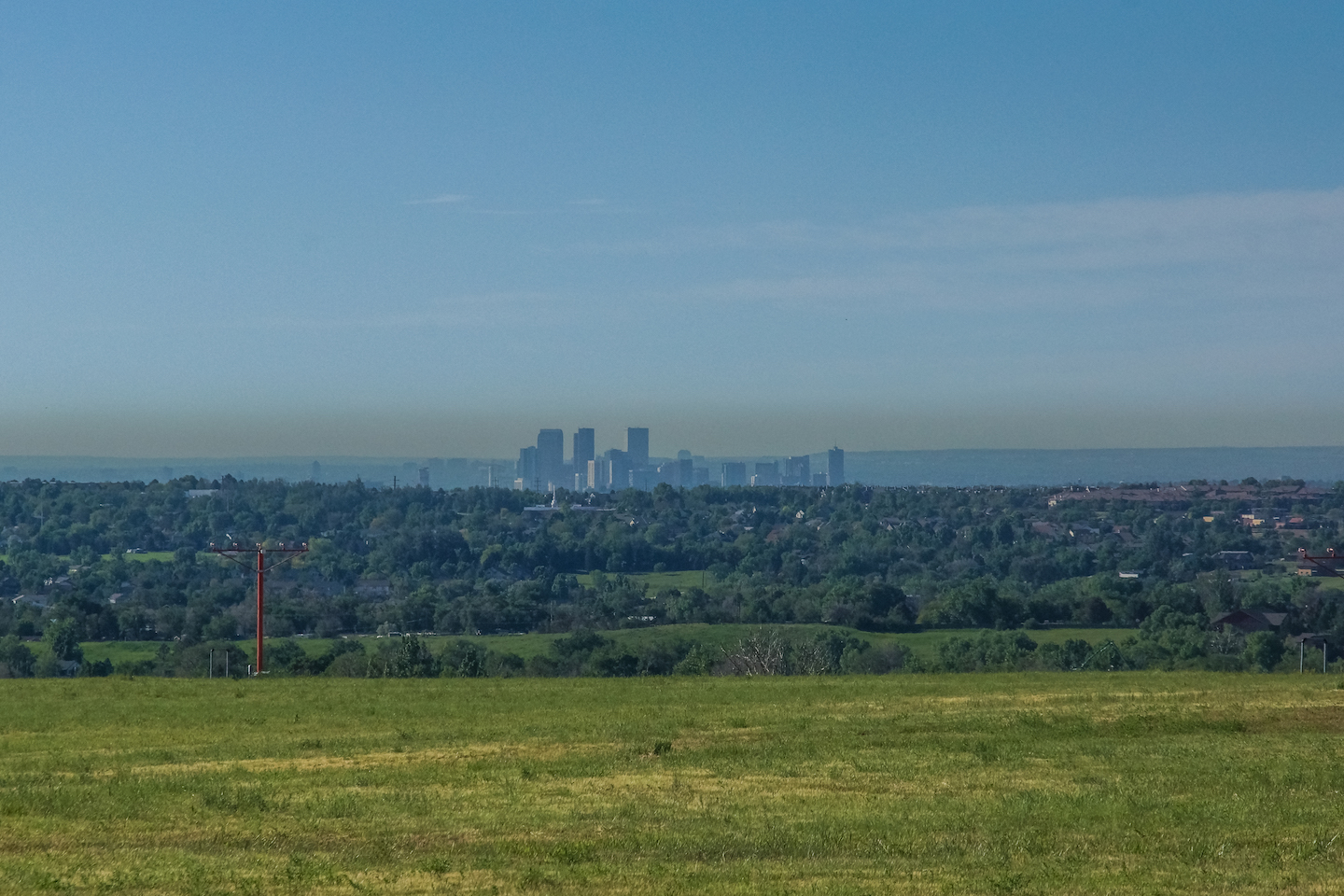
A layer of smog covers the skyline of Denver. (Courtesy of EcoFlight)
“We haven’t reached any of our attainment goals for NOX (nitrous oxide) and other pollutants, so we are going to have to contend with the federal government pretty soon. It’s really unhealthy for Coloradans, and a lot of that centers on transportation,” she said.
“I don’t know that it would be necessary for passenger vehicles, but perhaps for trucks and other fleet-type vehicles,” she added, referring to potential regulations in the near future.
An oil and gas drilling rig in Wyoming BLM’s High Desert District. (Wyoming BLM/FlickrCC)
Click the link to read the article on the WyoFile website (Angus M. Thuermer Jr.):
October 25, 2024
Wyoming is backing an effort by Utah to wrest ownership of U.S. Bureau of Land Management land from the federal government, arguing that states could “develop the land to attract prospective citizens.”
In an amicus brief filed Tuesday, Wyoming, Idaho, Alaska and the Arizona Legislature expressed support for Utah’s quest to take its case straight to the U.S. Supreme Court. Utah wants to own BLM land that’s currently the property of all Americans, saying among other things that the federal holdings deprive the Beehive State of an equal footing with other states.
Gov. Mark Gordon announced the Wyoming plea this week. Wyoming’s U.S. Rep. Harriet Hageman lent her name to a separate amicus brief supporting Utah, teaming with U.S. Sens. Mitt Romney, Mike Lee and other Western members of Congress.
Twenty-six Wyoming legislators also asked Tuesday to join the action if the Supreme Court agrees to take up the issue. Those 10 state senators and 16 representatives (see list below) say they might not stop after gaining state ownership of BLM’s property which is largely sagebrush and desert prairie steppe.
Wyoming legislators’ could extend their claims to “all former federal territorial lands … now held by the United States … [including] parks, monuments, wilderness, etc.,” their brief states.
Oregon Buttes near South Pass are in a BLM wilderness study area in Sweetwater County. (Ecoflight)
The federal government has until Nov. 21 to respond to what conservationists call a “land grab.”
“This lawsuit is as frivolous as they come and a blatant power-grab by a handful of Utah politicians whose escalating aggression has become an attack on all public lands as we know them,” Jocelyn Torres, an officer with the Conservation Lands Foundation, a Colorado nonprofit, said in a statement.
Unappropriated
Utah and its allies argue that BLM lands are “unappropriated” and should be the property of Western States. Because of the federal government’s “indefinite retention” of 18.5 million BLM acres, “Utah is deprived of basic and fundamental sovereign powers as to more than a third of its territory,” its bill of complaint states.
Sagebrush rebellion efforts like Utah’s legal gambit have popped up — and fallen short — repeatedly since the movement arose in the 1970s. They’ve been countered in part by western states ceding — in their constitutions at statehood — ownership of federal property to the government and all Americans.
“The people inhabiting this state do agree and declare that they forever disclaim all right and title to the unappropriated public lands lying within the boundaries thereof,” the Wyoming Constitution states. Further, Western states received federal property at statehood — two square miles in many surveyed 36-square-mile townships in Wyoming — to support schools and other institutions.
“Only Congress can transfer or dispose of federal lands,” the Lands Foundation said.
Gov. Gordon sees it differently.
“Wyoming believes it is essential for the states to be recognized as the primary authority when it comes to unappropriated lands within our borders,” he said in a statement Thursday.
The BLM manages 28% of the land in Wyoming, the brief states, most of it “unappropriated.”
Leaving vexing legal complexities to Utah, Wyoming’s brief focuses on “harms that federal ownership of unappropriated lands uniquely imposes on western States on a daily basis,” the amicus filing states. “In short, western States’ sovereign authority to address issues of local concern is curtailed, and billions of dollars are diverted away from western States.”
A ruling in favor of Utah would “begin to level the playing field … and restore the proper balance of federalism between western States and the federal government,” the brief states.
If Utah prevails, Western states “would then have a fair chance to develop the land to attract prospective citizens,” Wyoming contends. Ownership of federal BLM land would let Wyoming and its allies “use and develop land … and reinvest more of the revenue generated.”
Wyoming’s 29-page brief concludes with the assertion that “[g]ranting the relief requested in Utah’s bill of complaint would make clear that western States are not second-class sovereigns.”
Legislators may want more
Wyoming lawmakers say that Wyoming expected at statehood that Congress would some day “dispose” of the BLM lands in question as it had done with other states. Instead, lawmakers argue the federal government is exercising an unconstitutional police power in holding onto the property.
Turning the BLM land over to Wyoming would create a boom, lawmakers assert. “Developing natural resources in Wyoming could create thousands of jobs, generate billions of dollars in economic activity, and significantly boost the State’s economy,” the 10-page brief states.
Hageman and her D.C. legal allies say the U.S. Supreme Court has no choice but to hear the case.
The federal government denies Utah “basic sovereign powers,” Hageman and the other states’ congressional delegates say.
“[W]hat the United States is doing to Utah is not directly analogous to one sovereign nation’s physical invasion of another, the brief states.” But existing federal control is just as serious as war, the brief contends, and needs to be addressed now.
The Supreme Court has never required states “to make a showing that war is actually justified,” when considering whether to immediately address a complaint like Utah’s,” Hageman’s brief states. “Instead, the standard is whether the federal government’s actions would amount to an invasion and conquest of that land if … Utah were a separate sovereign nation.”
Here’s a list of the Wyoming legislators who filed a brief in support of Utah.
Senators
Bo Biteman (R-Ranchester), Brian Boner (R-Douglas),
Tim French (R-Powell), Larry Hicks (R-Baggs), Bob Ide (R-Casper), John Kolb (R-Rock Springs), Dan Laursen (R-Powell), Troy McKeown (R-Gillette), Tim Salazar (R-Riverton), Cheri Steinmetz (R-Lingle).
Representatives
Bill Allemand (R-Midwest), John Bear (R-Gillette), Jeremy Haroldson (R-Wheatland), Scott Heiner (R-Green River), Ben Hornok (R-Cheyenne), Christopher Knapp (R-Gillette), Chip Neiman (R-Hulett), Pepper Ottman (R-Riverton), Sarah Penn (R-Lander), Rachel Rodriguez-Williams (R-Cody), Daniel Singh (R-Cheyenne), Allen Slagle (R-Newcastle), Scott Smith (R-Lingle), Tomi Strock (R-Douglas), Jeanette Ward (R-Casper), John Winter (R-Thermopolis).
Sagebrush has succesfully matured in one of Grand Teton National Park’s oldest reclamation sites, pictured. (Mike Koshmrl/WyoFile)
The News: Last week the Land Desk reported that Hilcorp Energy had agreed to pay $9.4 million in penalties for air pollution violations in the San Juan Basin of northwestern New Mexico. It is, as one Farmington-area advocate told me, “a big deal.” It marks the culmination of years of on-the-ground efforts to get Hilcorp to clean up its act, and it potentially heralds a new era in which federal and state regulators actually enforce environmental laws in an area often treated like an energy sacrifice zone.
The Four Corners methane hotspot is yet another environmental climate and public health disaster served to our community by industry. But now that we’ve identified the sources we can begin to hold those responsible accountable for cleaning up after themselves. The BLM methane rule and EPA methane rule are more clearly essential than ever. Photo credit: San Juan Citizens Alliance (2018)
The Context: A decade ago, scientists revealed that satellites had detected unusually high concentrations of methane over the San Juan Basin, one of the nation’s most prolific natural gas fields. This was alarming because methane, the primary ingredient in natural gas, is a potent greenhouse gas, with 86 times the warming potential of carbon dioxide over a 20-year period. The plume was named the Four Corners Methane Hot Spot, and garnered national attention.
While coal mines and natural geologic seeps contributed to the plume, the prime culprit was no mystery: The vast oil and natural gas industry infrastructure, which is woven like rebar into the landscape here, and burps and leaks methane and other hydrocarbons and volatile organic compounds from valves, pipes, compressors, and newly completed wells. At the time, ConocoPhillips’ San Juan Basin operations were emitting an estimated 277,514 metric tons of methane each year, making them the Basin’s — and the nation’s — largest methane emitter.
In other words, ConocoPhillips was a major contributor to this slow-moving environmental disaster, which didn’t go over so well with some of its shareholders. While it did upgrade some of its equipment in an effort to reduce emissions, the corporation ultimately chose to sell out of the Basin. In 2017 Hilcorp, a private Houston-based company, purchased all of ConocoPhillips’ San Juan Basin assets for about $3 billion. In doing so, Hilcorp not only acquired more than 11,000 oil and gas wells, many of them low-producing and high-emitting, but also the status of being one of the worst methane polluters in the country.
The San Juan Basin has one of the highest methane emission intensities in the nation, which is the ratio of emissions to overall production. Source: Ceres.
The transfer raised concerns. Private companies like Hilcorp are less transparent than public ones, and Hilcorp has established almost no local presence, letting ConocoPhillips sleek glass and steel office building sit empty. And while a public corporation is beholden to its shareholders, Hilcorp’s levers are pulled by its founder and CEO, Jeffery Hildebrand, net worth $12.6 billion.
According to self-reported data, Hilcorp’s San Juan Basin facilities’ emissions have remained more or less steady since the 2017 transfer. But multiple studies have found that the EPA’s and industry’s estimates are far lower than actual emissions. And it is now known that Hilcorp failed to report some emissions — those from oil and gas well completions — as required by state law.
Hilcorp remains the largest methane emitter in the country. Source: Ceres.
More than 120 of Hilcorp’s wells sit on Don and Jane Schreiber’s Devil’s Spring Ranch, located in the Blanco Canyon area east of Farmington. They’ve been pushing back against the industry and the land managers that seemed inclined to do its bidding for years — often to no avail. They’ve cooperated with Earthworks, the mining watchdog group, which has documented leaking Hilcorp facilities on and around the Schreibers’ ranch. Last week’s announcement signaled that the work was not in vain.
While many of Hilcorp’s 11,406 San Juan Basin wells emit methane, the EPA’s and New Mexico Environment Department’s enforcement action focuses just on well completion operations — which are the post-drilling steps, including hydraulic fracturing, that put a well into production — at 192 of Hilcorp’s wells. According to the federal agency’s complaint, Hilcorp “vented all of the flowback gas emissions, including methane and VOC, directly to the atmosphere during flowback … .” (“Flowback” is when hydraulic fracturing fluids, water, sand, and associated gases surge back out of the well following fracturing).
This violated rules requiring operators to capture the flowback gases and pipe them, reuse them, or inject them back underground. The activity resulted in excess emissions of more than 500 tons of VOC (or volatile organic compounds, which are health hazards and ozone precursors) and 1,200 tons of methane. Meanwhile, Hilcorp didn’t report the completions properly or at all, again violating state and federal rules.
The $9.4 million penalty is more or less pocket change for a company like Hilcorp. But the consent decree also requires the firm to take extra measures to minimize emissions during completion and flowback and to properly classify its wells and report activity and emissions. The company is also required to hire an approved independent third-party verifier to conduct a compliance verification program for every well-completion it conducts for the next three years. If Hilcorp fails to live up to these terms, it will be penalized. Hilcorp must also carry out a mitigation project to replace nearly 1,300 low- and intermittent-bleed pneumatic controllers with non-emitting devices on its San Juan Basin facilities located on tribal lands.
A break in last weekend’s storm brings out the whites, yellows, and oranges on the San Juan Mountain slopes south of Ouray. Jonathan P. Thompson photo.
Snow and hail and sleet and rain bring out the snowplows on Molas Pass during last weekend’s storm. The storm brought a lot of moisture to the whole area, with heavy, wet snow in the high country. It wasn’t a lot of accumulation, but enough for Wolf Creek Ski Area to plan on opening this weekend. Jonathan P. Thompson photo.
The Land Desk is a reader-supported publication, which means we need you to help us keep on keeping on by becoming a paid subscriber. Plus you get premium content and the key to the paywall (i.e. access to the treasure trove of Land Desk archives).
Colorado’s Eagle County and a coalition of environmental groups are urging the U.S. Supreme Court to reject what they called an attempt to “dramatically remake” federal environmental law by the backers of a controversial oil-by-rail project in eastern Utah.
First proposed in 2019, the 88-mile Uinta Basin Railway would connect Utah’s largest oil field to the national rail network, allowing drillers there to ship large volumes of the basin’s “waxy” crude oil to Gulf Coast refineries — with the vast majority of the traffic routed through Colorado.
Eagle County and five environmental groups sued to overturn the railway’s 2021 approval by federal regulators, and in a decision last year the U.S. Court of Appeals for the D.C. Circuit sided with the plaintiffs, finding “numerous” and “significant” violations of the National Environmental Policy Act in regulators’ analysis of the project’s risks. The Seven County Infrastructure Coalition, a group of Utah county governments backing the project, appealed that ruling to the Supreme Court, which agreed to hear the case this year.
In separatebriefs filed Friday, attorneys for both Eagle County and the environmental groups urged the court, where conservatives hold a 6-3 majority, to affirm the Court of Appeals decision.
“Petitioners are asking this Court to impose limits on NEPA that have no basis in its text whatsoever,” Eagle County’s attorneys wrote in their filing. “They ask this Court to give agencies broad permission not to study the consequences of their actions.”
The Court of Appeals’ August 2023 ruling found that Surface Transportation Board regulators had violated NEPA by failing to analyze a wide range of “reasonably foreseeable upstream and downstream impacts” of the railway’s construction, including increased air pollution and the “downline” risk of train derailments and wildfires in Colorado and elsewhere. If the lower court’s decision is ultimately upheld, the project would be remanded back to the STB for a more thorough environmental review.
“It’s disgraceful that the railroad’s backers want federal agencies to turn a blind eye to those harms,” said Wendy Park, a senior attorney at the Center for Biological Diversity, one of the groups that sued to block the project, in a press release Friday. “A robust environmental review that takes a hard look at all the train’s threats is crucial for protecting communities near and far from this railway.”
At an estimated capacity of up to 350,000 barrels exported per day, the Uinta Basin Railway would rank among the largest sustained efforts to transport oil by rail ever undertaken in the U.S., singlehandedly more than doubling the nationwide total in 2022, and causing a tenfold increase in hazmat rail traffic through environmentally sensitive and densely populated areas in Colorado.
In their petition for Supreme Court review, the railway’s backers argued that federal agencies conducting NEPA reviews must be limited to considering “proximate effects of the action over which the agency has regulatory authority.”
“There is simply no role under NEPA’s text and this Court’s precedents for stymying development projects based on environmental effects that are so wildly remote in geography and time,” attorneys for the Seven County Infrastructure Coalition wrote in an Aug. 28 brief.
A long list of conservative advocacy organizations and fossil fuel industry groups have filed amicus briefs in support of the Seven County Infrastructure Coalition’s argument. Among them is a filing by Anschutz Exploration Corporation, the oil and gas company owned by conservative Colorado billionaire Phil Anschutz, whose ties to Supreme Court Justice Neil Gorsuch have repeatedly come under scrutiny.
In their response brief, Eagle County’s attorneys argued that adopting the petitioners’ view of NEPA’s requirements would “change it beyond recognition.”
“NEPA makes clear that agencies must study the ‘reasonably foreseeable’ environmental consequences of their actions,” they wrote. “And the environmental consequences of, for example, a derailment of an oil-laden train next to the river are eminently foreseeable.”
Oral arguments in the case, Seven County Infrastructure Coalition v. Eagle County, are scheduled to be heard on Dec. 10.
President Joe Biden signs H.R. 5376, the “Inflation Reduction Act of 2022”, Tuesday, August 16, 2022, in the State Dining Room of the White House. (Official White House Photo by Cameron Smith)
President Joe Biden’s signature climate change law passed Congress by the narrowest of margins, without a single Republican in favor. GOP leaders have attacked the bill and promised to repeal it.
Yet despite the law’s hyper-partisan creation story, the Inflation Reduction Act, or IRA, could prove difficult to roll back, whatever the outcome of next month’s election.
The IRA was the nation’s largest single investment in reducing climate-warming pollution, with an array of programs that are beginning to shower the economy with grants, loans and tax incentives. The total sum is expected to reach into the hundreds of billions of dollars over a decade, funding that will leverage much more in private investment. And by design, the money is flowing throughout the country, with most of it being spent in conservative-leaning states.
One report by E2, a pro-environment business group, identified at least 334 “clean energy and clean vehicle” projects announced since the law’s enactment, with the potential to create 110,000 jobs. Those projects were spread across 40 states, with nearly 60 percent in congressional districts represented by Republicans.
Another assessment, by the Rhodium Group, examined total “clean technologies and infrastructure” investment by businesses and consumers in the two years after the bill’s enactment, and found it had climbed to nearly $500 billion, a 71 percent increase from the two preceding years.
“This is a huge investment. We are really seeing its impacts,” said Jackie Wong, a senior advisor to the NRDC Action Fund, an environmental political advocacy group that has endorsed Kamala Harris. “This isn’t just about climate. This is also about public health and about jobs and about revitalizing American manufacturing.”
Trump and his advisers and spokespeople have said he would seek to roll back the law’s spending, a step Wong said “would be devastating for climate and economic health.”
And yet all the spending that has begun going out helps explain why there might not be much appetite in Congress for a wholesale repeal. In August, 18 House Republicans sent a letter to Speaker Mike Johnson urging caution in any efforts to reform or repeal the law, noting that its tax credits for clean energy “have spurred innovation, incentivized investment, and created good jobs in many parts of the country—including many districts represented by members of our conference.”
The law’s design—which created, expanded or extended a wide array of tax credits for everything from wind and solar power generation to battery manufacturing, electric vehicles, clean hydrogen production and sustainable aviation fuel—has made it broadly popular among businesses big and small. Now that those credits are in place, industry leaders expect them to last, said Frank Maisano, a senior principal at Bracewell LLP, a law and lobbying firm that represents clients across the energy industry.
“They think this is not going away because of the good things it can do,” Maisano said. He added that the bill included policies that have generally drawn bipartisan support, and that while it may get tweaked, “I don’t think Congress is going to go back on these things that are happening in their districts.”
But if a full repeal is unlikely, many of the law’s supporters worry that a second Trump administration or a Republican-controlled Congress could use executive authority, hearings or oversight to constrain or reshape spending in ways that would undermine the law’s goals.
The tax credits, for example, require guidance issued by the Treasury Department to help define which projects are eligible. In the case of a clean hydrogen tax credit, a Trump administration could issue guidance that would skew the credit toward more polluting fossil fuel projects. For electric vehicles or wind and solar generation, new guidance could restrict how many vehicles or projects qualify for the credits or could simply cast uncertainty over the programs’ future, discouraging private investment.
Derek Sylvan, strategy director at the Institute for Policy Integrity at New York University, said the tax credits have the potential to drive tremendous emissions cuts with hundreds of billions of dollars in benefits. But many, like the hydrogen credit, have the potential to be skewed in favor of fossil fuels or other polluting technologies.
“That could be really huge,” Sylvan said. “You could imagine that for any particular tax credit, if that changes and suddenly a lot of funds are going to activities that have pretty limited or even negative climate benefits, that could certainly undermine the climate impacts of the IRA.”
A study published last year in Science estimated that the IRA is expected to slash the nation’s climate pollution 43 percent to 48 percent below 2005 levels by 2035, compared to an expected reduction of 27 percent to 35 percent without the legislation.
This graph shows the globally averaged monthly mean carbon dioxide abundance measured at the Global Monitoring Laboratory’s global network of air sampling sites since 1980. Data are still preliminary, pending recalibrations of reference gases and other quality control checks. Credit: NOAA GML
Many of the IRA’s programs came in the form of grants, loans or direct spending that has already been committed. One of the largest is the Greenhouse Gas Reduction Fund, a $27 billion “green bank” program. Most of that money was awarded in August to nonprofits, which will now be able to lend the funds directly to emissions-cutting projects or distribute them to a network of green banks around the country. Some of its programs are intended to benefit communities that have limited access to financing for things like rooftop solar or energy-efficiency retrofits.
Reed Hundt, chief executive of the Coalition for Green Capital, one of the recipients, said the fund differs from tax credits because his group can choose projects that will have outsized climate impacts. It is also looking to fund projects in rural and often conservative states that might be less likely to get commercial loans for renewable energy projects, Hundt said.
The Greenhouse Gas Reduction Fund money has been obligated, meaning it would take violating a contract to pull it back. But a hostile administration or Congress could use hearings, oversight or staff cuts to make it harder for the banks to spend the money, said Kyle Kammien, policy director of the Green For All program at Dream.org, an advocacy group focused on green jobs and criminal justice.
“In some ways it’s safe, but you could see how political levers could make it less effective or slow it down,” Kammien said.
For other programs, simply cutting staffing at agencies could make it harder to spend money that’s already been obligated.
Still, the architects of the IRA designed it with elections in mind, said Kate Gordon, a former senior adviser to U.S. Energy Secretary Jennifer Granholm and now chief executive of California Forward, an economic development nonprofit. The bill’s timelines, its broad distribution of funding across the economy and the country, were all meant to make it more popular and durable.
“It brings a lot more people and places into the conversation versus your typical government policy that says, ‘We are going to build a big thing,’” Gordon said. She told the story of a visit she made to a summit in Wyoming organized by the state’s governor and senators, neither of whom had voted for the IRA.
“They didn’t vote for it for political reasons, I’m sure, but they were 100 percent in in taking advantage of it,” Gordon said. She compared the IRA to President Barack Obama’s health care legislation, which was attacked for years but has remained in place.
“My gut is that there will be a lot of talk about repealing things,” she said, “and not a lot of action.”
This summer, the Biden administration offered Wyoming $35 million to help the state plug and clean up abandoned oil and gas wells. When Wyoming turned down the cash, it seemed hard to believe.
It could cost the state more than twice that amount to reclaim its 1,000 or so defunct wells that remain unplugged. Economists have also warned that market forces will continue to diminish the state’s main revenue source—severance taxes on fossil fuels.
That’s not all. Last year, Wyoming turned down federal money for electric vehicle charging stations. Then, when Governor Mark Gordon refused to take part in the EPA’s pollution reduction program, the state lost tens of millions of dollars in federal funding.
Meanwhile, the state is spending millions of taxpayers’ dollars on lawsuits seeking to eviscerate Biden administration rules aimed at protecting the environment and human health and mitigating harmful effects of climate change.
It’s all part of a disturbing shift among Western Republicans and the states they dominate. They are veering away from the more pragmatic conservatism of Teddy Roosevelt or even Ronald Reagan, and into the hard right, anti-government quagmire.
Governor Gordon has been swept up in this shift. Gordon was born in New York City and grew up on the family ranch in Kaycee, Wyoming. He registered as a Republican at age 18, attended Vermont’s Middlebury College, then came back to Wyoming to continue ranching. At the same time, he pushed back on the coalbed-methane drilling boom that was ravaging his state, a fact missing from his official biographies.
Gordon’s activism included serving on environmental groups’ boards and he went on record attacking the energy industry for turning Buffalo into “the place that stinks on the way to Casper.” Nevertheless, he later worked for an oil company as its conservation director.
He still straddled the fence politically, donating to both Republican and Democratic candidates and committees on a state and national level during the 1990s and early 2000s. But he was not an anomaly; this sort of ideological flexibility was once common in Western states.
When Gordon ran for Congress as a moderate in 2008, he said both the Republican Party and the Sierra Club had “gotten off track,” with the GOP moving too far to the right and abandoning Roosevelt-style conservationism. He said environmentalists also became less willing to compromise, particularly on public-land grazing issues.
Gordon ended up losing the primary to hardliner Cynthia Lummis—now a U.S. senator—after she attacked Gordon for his environmental ties and bipartisan tendencies. But Gordon stuck to his relatively moderate stance when he ran for governor in 2018 and defeated hardliner Harriet Hageman—who would later unseat Liz Cheney.
As governor, Gordon has acknowledged human-caused climate change and supported clean-energy development, while also looking to keep the fossil fuel industry afloat by pushing carbon capture rather than closing coal plants or regulating drilling.
He was forceful and eloquent in condemning the January 6, 2021 attack on the Capitol, tweeting: “Interfering with the peaceful transfer of power is an affront to the very Constitution that has made our country what it is. I believe America will not—cannot—stand for this assault on our democracy.”
This centrism has played well with voters. Gordon easily won a second term in 2022. But the radical right-wing, climate-denying branch of Wyoming’s legislature, the Freedom Caucus, has relentlessly blasted him for it.
In purple states, such as Arizona, the radicalization of the GOP has been met with backlash from moderates, who can seek refuge in a growing Democratic Party. But in Wyoming, newcomers fleeing more liberal states are turning the legislature a deeper shade of red, lending power and members to the Freedom Caucus.
The Wyoming governor has struggled to hold his ground. His rhetoric on Biden’s purported “war on fossil fuels”—and the state’s legal challenges to common-sense environmental protections—have grown more strident, even though Gordon knows full well that market forces, not regulations, are behind the industries’ decline.
The intent here is not to heap criticism on Gordon; he gets enough of that from his party members. Rather it is to lament the imminent extinction of the moderate, conservation-leaning, pragmatic Western Republican.
Jonathan Thompson
Think of all those missed opportunities. In today’s political climate, Gordon either must adapt or be thrown out of office, and that’s not good for Wyoming or the West.
Jonathon Thompson is a contributor to writersontherange.org, an independent nonprofit dedicated to spurring lively conversation about the West. He is the editor of The Land Desk and a longtime Western author and writer.
[3:00am EDT Oct 10] A Flash Flood Emergency continues over portions of west-central Florida.
Hurricane #Milton continues to move ENE across the Florida Peninsula. http://hurricanes.gov/#Milton
Click the link to read the newsletter on The Crucial Years website (Bill McKibben). Here’s an excerpt:
October 9, 2024
Since I couldn’t sleep, I figured I might as well write. I couldn’t sleep because of the picture in my mind—that tightly coiled ball of physics we’re calling Hurricane Milton as it tracks mercilessly across the Gulf of Mexico, headed toward a landfall tonight along the west coast of Florida. It scares me, for two reasons.
The first is the unrivaled speed with which it spun up, from tropical storm to Category 5 monster inside a day. This “rapid intensification” has become an increasingly common feature of hurricanes, because the heat content in the ocean is so high that the old models no longer suffice. We live, more and more, in a world of instant chaos: where wildfires can “blow up” in a matter of minutes because the fuels that feed them are so desiccated, where “flash” floods can, in minutes, turn a record rain into a street clogged with bobbing cars. These things have always been possible, but now they are common: we have in our minds the idea that the world changes at a geologic pace, moving in stately fashion through epochs and eras. But right now—as carbon dioxide accumulates more quickly in the atmosphere than at any point in the last 500 million years—”geologic pace” is measured in months. Hell, glaciers—our metaphor for moving slowly—disappear from one winter to the next.
And the second reason is: this speeded up physics is increasingly crashing into the heart of the civilizations that we’ve built. Given the size of the planet, it’s more likely than not that a disaster will happen in somewhere sparsely populated—the boreal forests of Canada burned last summer, displacing Indigenous people of the north but mostly avoiding cities. Even Hurricane Helene last week came ashore in the Big Bend country north of Cedar Key, where people are thin on the ground. But just as California’s wildfires eventually and inevitably started taking out whole towns, Milton is aimed at one of the most built-up and vulnerable landscapes on earth. I think—from this morning’s bearings—that the very worst outcome may be dodged: if the hurricane comes in just south of Tampa Bay, its counterclockwise winds will work to drive the storm surge off that body of water. But if so it will mean sheer agony for somewhere further south, somewhere almost as overbuilt. Sarasota? Port Charlotte? And in very short order that will mean deep trouble for the insurance industry, already tottering in Florida
(It’s worth noting, if only in passing, that the two places Americans of my age thought of as refuges, idylls, dreams of the easy life were California and Florida. No longer).
We’ve spent some time in recent years worrying that there was too much fear-mongering and doom-saying in the way we talked about climate change—that it was wearing people out. And indeed there’s truth there—if we’re going to do what we must, the story in the years ahead needs to be as much about the adventure of turning our planet solar as the dread that we’ll turn our planet Venus.
But there are important moments when fear is a crucial resource. A week ago, in the wake of Helene, the veteran climate activist and North Carolina native Anna Jane Joyner wrote this dispatch from New York’s “Climate Week”
And yesterday, on air, the veteran Florida weatherman John Morales let his fear show through. As Cara Buckley recounted in the Times,
This kind of fear is entirely useful—there are, I have no doubt, people who left their homes and drove north towards Georgia after hearing the break in Morales’ voice. He saved lives. And he did it entirely honestly. “You know what’s driving that,” he said to viewers. “I don’t need to tell you. Global warming. Climate change.” It’s honest fear, driven by deep understanding.
Bill McKibben, right, conferring with Land Institute founder Wes Jackson at the 2019 Prairie Festival, has strongly motivated many, including some CRES members. Photo/Allen Best
Gore has been talking about carbon emissions for more than 40 years. Now he includes a “hope budget.”
At a congressional hearing on the greenhouse effect in 1981, Al Gore, then a member of the House of Representatives from Tennessee, remarked that it was hard to come to terms with the fact that rising carbon dioxide emissions could radically alter our world. “Quite frankly, my first reaction to it several years ago was one of disbelief,” he said. “Since then, I have been waiting patiently for it to go away, but it has not gone away.”
Gore’s hearings didn’t spark the epiphany he’d hoped among his fellow members of Congress. More than four decades later, the problem still hasn’t resonated with many of them, even as the devastating weather changes scientists warned about have become reality. Wildfires have turned towns to ash, and the rains unleashed by storms like Hurricane Helene have left even so-called climate havens like Asheville, North Carolina, in a post-apocalyptic state, with power lines tossed around like spaghetti.
“I’ll have to admit to you that I’ve been surprised at how difficult it’s been to implement the kinds of policies that will solve the climate crisis,” Gore said in an interview with Grist.
So he isn’t exactly surprised that the issue is on the back burner this election season. When asked about their plans to fight climate change in the presidential debate last month, Vice President Kamala Harris assured voters she wasn’t against fracking for natural gas, while former President Donald Trump went on a tangent about domestic vehicle manufacturing. The subject took on a more prominent role in the vice presidential debate last Tuesday, when the Republican, Senator J.D. Vance of Ohio, hedged by calling global warming “weird science” while not actually dismissing it, and the Democrat, Governor Tim Walz of Minnesota, envisioned America “becoming an energy superpower for the future.” And that was about it.
“Since the struggle for votes is almost always focused on undecided voters, most of them in the center of the political spectrum, it’s not at all unusual to see immediate, visceral issues like jobs and the economy take the foreground,” Gore said.
As told in the documentary An Inconvenient Truth, Gore’s interest in climate change was first sparked at Harvard University, where Gore took a population studies class taught by the Roger Revelle, a climate scientist who had played a pivotal role in setting up experiments to measure rising levels of carbon dioxide in the atmosphere. It was the 1960s, a decade in which the American public first started learning about the dangers of burning fossil fuels. Gore was stunned by the evidence Revelle presented, but “never imagined for a second that it would take over my life.”
He’s spent the decades since advocating for climate action. As vice president under President Bill Clinton in the 1990s, he unsuccessfully pushed to pass the Kyoto Protocol, the first international attempt to push countries to limit their greenhouse gas emissions. Six years after he lost the presidential election to George W. Bush in 2000, An Inconvenient Truth, the documentary that turned his traveling climate change slideshow into a hit, launched the issue into the national conversation. Today, he leads the educational nonprofit The Climate Reality Project, which trains people how to mobilize their neighbors to elect climate champions, counter greenwashing, and advance green solutions.
Coyote Gulch graduation March 4, 2017. @ClimateReality #ActOnClimate
As a prominent Democrat, Gore’s impassioned advocacy has been blamed for making climate change seem like a liberal thing to care about. To Gore, that’s an example of attacking the messenger without looking at the deeper reasons why climate change is politically contentious in the first place. “Even when Pope Francis, for goodness’ sake, speaks out on it, they attack him and say that he’s meddling in partisanship.” If there’s anyone to blame for polarization, he said, it’s the fossil fuel industry, which has tried to take control of the conversation about climate change.
“This is the most powerful and wealthiest business lobby in the history of the world, and they spare no effort and no expense to try to block any progress,” Gore said. “Whoever sticks his or her head up above the parapet draws fire from fossil fuel polluters, and they use their legacy networks of economic and political power to try to block any solutions of any sort that might reduce the consumption of fossil fuels.”
In his decades of talking to the public about climate change, he says he’s learned a few things. You have to keep in mind a “time budget” that people will give you to speak with them, as well as a “complexity budget” so that you avoid dumping facts and numbers onto people. Finally, he says, you need to allot a “hope budget” so they don’t get too overwhelmed and depressed.
Electricity generation in 2022 (dark blue) from key fuel sources and countries, terawatt-hours (TWh). Red bars indicate estimated electricity generation from the renewables built in 2019-2023 and set to be built in 2024-2028, according to the IEA’s “main case” forecast. Source: Carbon Brief analysis by Simon Evans of figures from the IEA Renewables 2023 and Renewables 2022 reports, the IEA world energy outlook 2023 and the Ember data explorer.
Even while progress has been slower than he’d hoped, Gore sees signs that things are moving in the right direction. Last year, 86 percent of new electricity generation installed worldwide came from renewables, for example. Not to mention that Congress, where climate legislation had long gone to die, finally managed to pass a landmark climate law in 2022, the Inflation Reduction Act, which aims to drastically trim U.S. emissions through green incentives and rebates.
“It’s the kind of challenge that is so compelling — once you pick it up, you can’t put it back down again — because it really requires any person of conscience, I think, to keep working on it until we get the kind of progress that’s needed.”
The year 2023 marked the driest year for global rivers in over three decades, according to a new report coordinated by the World Meteorological Organization (WMO), which signaled critical changes in water availability in an era of growing demand.
Key messages
2023 was driest year for global rivers in 33 years
Glaciers suffer largest mass loss in 50 years
Climate change makes hydrological cycle becomes more erratic
Early Warnings for All must tackle water-related hazards
WMO calls for better monitoring and data sharing
State of Global Water Resources report. Photo credit: WMO
The last five consecutive years have recorded widespread below-normal conditions for river flows, with reservoir inflows following a similar pattern. This reduces the amount of water available for communities, agriculture and ecosystems, further stressing global water supplies, according to the State of Global Water Resources report.
Glaciers suffered the largest mass loss ever registered in the last five decades. 2023 is the second consecutive year in which all regions in the world with glaciers reported iceloss.
With 2023 being the hottest year on record, elevated temperatures and widespread dry conditions contributed to prolonged droughts. But there were also a significant number of floods around the world. The extreme hydrological events were influenced by naturally occurring climate conditions – the transition from La Niña to El Niño in mid-2023 – as well as human induced climate change.
“Water is the canary in the coalmine of climate change. We receive distress signals in the form of increasingly extreme rainfall, floods and droughts which wreak a heavy toll on lives, ecosystems and economies. Melting ice and glaciers threaten long-term water security for many millions of people. And yet we are not taking the necessary urgent action,” said WMO Secretary-General Celeste Saulo. [ed. emphasis mine]
“As a result of rising temperatures, the hydrological cycle has accelerated. It has also become more erratic and unpredictable, and we are facing growing problems of either too much or too little water. A warmer atmosphere holds more moisture which is conducive to heavy rainfall. More rapid evaporation and drying of soils worsen drought conditions,” she said.
“And yet, far too little is known about the true state of the world’s freshwater resources. We cannot manage what we do not measure. This report seeks to contribute to improved monitoring, data-sharing, cross-border collaboration and assessments,” said Celeste Saulo. “This is urgently needed.”
The State of Global Water Resources report series offers a comprehensive and consistent overview of water resources worldwide. It is based on input from dozens of National Meteorological and Hydrological Services and other organizations and experts. It seeks to inform decision makers in water-sensitive sectors and disaster risk reduction professionals. It complements WMO’s flagship State of the Global Climate series.
The State of the Global Water Resources report is now in its third year and is the most comprehensive to date, with new information on lake and reservoir volumes, soil moisture data, and more details on glaciers and snow water equivalent.
The report seeks to create an extensive global dataset of hydrological variables, which includes observed and modelled data from a wide array of sources. It aligns with the focus of the global Early Warnings for All initiative on improving data quality and access for water-related hazard monitoring and forecasting,and providing early warning systems for all by 2027.
Currently, 3.6 billion people face inadequate access to water at least a month per year and this is expected to increase to more than 5 billion by 2050, according to UN Water, and the world is far of track Sustainable Development Goal 6 on water and sanitation.
Highlights
Hydrological extremes
The year 2023 was the hottest year on record. The transition from La Niña to El Niño conditions in mid-2023, as well as the positive phase of the Indian Ocean Dipole (IOD) influenced extreme weather.
Africa was the most impacted in terms of human casualties. In Libya, two dams collapsed due to a major flood in September 2023, claiming more than 11,000 lives and affecting 22% of the population. Floods also affected the Greater Horn of Africa, Democratic Republic of Congo and Rwanda, Mozambique and Malawi.
Southern USA, Central America, Argentina, Uruguay, Peru and Brazil were affected by widespread drought conditions, which led to 3% gross domestic product loss in Argentina and lowest water levels ever observed in Amazon and in Lake Titicaca.
River discharge
The year 2023 was marked by mostly drier-than-normal to normal river discharge conditions compared to the historical period. Similar to 2022 and 2021, over 50% of global catchment areas showed abnormal conditions, with most of them being in deficit. Fewer basins showed above normal conditions.
Large territories of Northern, Central and South America suffered severe drought and reduced river discharge conditions in 2023. The Mississippi and Amazon basins saw record low water levels. In Asia and Oceania, the large Ganges, Brahmaputra and Mekongriver basins experienced lower-than-normal conditions almost over the entire basin territories.
The East coast of Africa had above and much above-normal discharge and flooding. North Island of New Zealand and the Philippines exhibited much above normal annual discharge conditions. In Northern Europe, the entire territory of the UK and Ireland saw above-normal discharge, also Finland and South Sweden.
2023: Half of the globe had dry river flow conditions. Credit: WMO
Reservoirs and lakes
The inflows into reservoirs showed a similar pattern to the global river discharge trends: India, North, South and Central America, parts of Australia experiencing below-normal inflow conditions. The basin-wide reservoir storage varied significantly, reflecting the influence of water management, with much above-normal levels in basins like the Amazon and Parana, where river discharge was much-below-normal in 2023.
Lake Coari in the Amazon faced below-normal levels, leading to extreme water temperature. Lake Turkana, shared between Kenya and Ethiopia, had above-normal water volumes, following much above-normal river discharge conditions.
Groundwater Levels
In South Africa, most wells showed above-normal groundwater levels, following above-average precipitation, as did India, Ireland, Australia, and Israel. Notable depletion in groundwater availability was observed in parts of North America and Europe due to prolonged drought. In Chile and Jordan groundwater levels were below normal, with the long-term declines due to over-abstraction rather than climatic factors.
Soil moisture and evapotranspiration
Levels of soil moisture were predominantly below or much below normal across large territories globally, with North America, South America, North Africa, and the Middle East particularly dry during June-August. Central and South America, especially Brazil and Argentina, faced much below-normal actual evapotranspiration in September-October-November. For Mexico, this lasted almost the entire year because of drought conditions.
In contrast, certain regions, including Alaska, northeast Canada, India, parts of Russia, parts of Australia and New Zealand experienced much above-normal soil moisture levels.
Snow water equivalent
Most catchments in the Northern Hemisphere had below to much-below normal snow water equivalent in March. Seasonal peak snow mass for 2023 was much above normal in parts of North America and much-below normal in Eurasian continent.
Glaciers
Glaciers lost more than 600 Gigatonnes of water, the worst in 50 years of observations, according to preliminary data for September 2022 – August 2023. This severe loss is mainly due to extreme melting in western North America and the European Alps, where Switzerland’s glaciers have lost about 10% of their remaining volume over the past two years. Snow cover in the northern hemisphere has been decreasing in late spring and summer: in May 2023, the snow cover extent was the eighth lowest on record (1967–2023). For North America the May snow cover was the lowest in the same period
Summer ice mass loss over the past years indicated that glaciers in Europe, Scandinavia, Caucasus, Western Canada North, South Asia West, and New Zealand have passed peak water (maximum melt rate of a retreating glacier; leading to reduced water storage and availability afterwards), while Southern Andes (dominated by the Patagonian region), Russian Arctic, and Svalbard seem to still present increasing melt rates.
Retreating Glaciers: Glaciers suffer largest mass loss in 50 years. Credit: WMO
Notes to Editors
The State of Global Water Resources report contains input from a wide network of hydrological experts, including National Meteorological and Hydrological Services, Global Data Centres, global hydrological modelling community members and supporting organizations such as NASA and the German Research Centre for Geosciences (GFZ).
The number of river discharge measurement stations increased from 273 in 14 countries to 713 in 33 countries, and the groundwater data collection expanded to 35459 wells in 40 countries, compared to 8,246 wells in 10 countries in the previous year (Figure 1). However, despite improvements in observational data sharing, still Africa, South America, and Asia remain underrepresented in hydrological data collection, highlighting the need for improved monitoring and data sharing, particularly in the Global South.
The report seeks to enhance the accessibility and availability of observational data (both through better monitoring and improved data sharing), further integrate relevant variables into the report, and encourage country participation to better understand and report water cycle dynamics.
Future reports are anticipated to include even more observational data, supported by initiatives like the WMO’s Global Hydrological Status and Outlook System (HydroSOS), the WMO Hydrological Observing System (WHOS), and collaboration with global data centers.
The World Meteorological Organization (WMO) is a specialized agency of the United Nations responsible for promoting international cooperation in atmospheric science and meteorology.
WMO monitors weather, climate, and water resources and provides support to its Members in forecasting and disaster mitigation. The organization is committed to advancing scientific knowledge and improving public safety and well-being through its work.
Megan Hill is an assistant professor of chemistry and leader of the Hill Lab in Colorado State University’s College of Natural Sciences. Her research leverages organic chemistry to design advanced polymeric materials for applications in sustainability, catalysis and soft materials. She recently sat down with SOURCE to answer some common questions.
What are microplastics?
Given their name, they are micro-sized bits of plastic. There are even smaller nanoplastics that are below that (.5 mm in diameter) threshold (about the size of a grain of rice). They are pieces of plastic that have broken down but never fully degraded.
How long has synthetic, mass-produced plastic been around?
Let’s say about 100 years. Chemists spent a lot of time and effort optimizing polymerization techniques, eventually making catalysts that enabled extremely fast, cheap and easy production of plastic materials. Once the industry realized how useful these lightweight, durable and cheap materials were, then it just kind of exploded. It’s much more complex than that because there was government assistance in making these types of products more affordable. Within the last 10 to 20 years, people started to realize, “Wow, this stuff is still around, and it doesn’t seem like it’s going away anytime soon.”
Dr. Megan Hill at Colorado State University where she teaches. “There’s not a future that is without plastic, but there should be a future with much less and better plastic.” Photo credit: Colorado State University
Have we had better living through chemistry, i.e. plastics, in the past century?
You absolutely have to take that into account. Plastics make cars and airplanes lighter, reducing the amount of fuel that is needed. Wind turbines are made from epoxy resins, crosslinked polymer networks. Polyethylene is used in hip replacements, and Kevlar is something that saves people’s lives. These are all plastic materials.
What are the unintended consequences?
We’ve never had to deal with materials that have such a long lifetime. Every material that we’ve worked with in the past has been environmentally degradable over at least long periods of time. People didn’t realize how long it would actually take these materials to degrade. But now we are facing the fact that nearly every piece of plastic that has ever been made still exists, except for a small percentage that has been incinerated.
Is it bad that microplastics are found in virtually every part of human bodies?
We still have a lot to learn about how microplastics affect our health. Initially, it was thought that it wouldn’t be that big of an issue because particles have to be really small to pass through your esophagus or digestive tract, so we assumed microplastics would not persist in the body. But as these particles have become smaller and smaller, now they’re accumulating in tissues and throughout our bodies. We are still not sure what this means to our health. Plastics are designed to be inert, so the chemical structures are not likely interacting with anything in our body, but they are foreign objects that your body will likely react to. There’s still a lot unknown about the severity or what might actually happen as these particles accumulate more in animals and then humans as it goes up the food chain.
Dr. Megan Hill in the chemistry lab at Colorado State University where she teaches. Photo credit: Colorado State University
What’s an example of your lab’s research in polymers?
One area of research our lab focuses on is integrating reversible or degradable bonds into polymer networks and backbones. By making some of the bonds reversible, we can improve the ability for the materials to be broken and reformed, without compromising their material properties — a big problem plastic recycling is currently facing. Another CSU group has pioneered polymer materials that can be chemically recycled, a route that enables polymers to be broken down to their starting materials so they can be remade into the high-quality materials that are needed in industry.
What does it mean for a polymer to be sustainable?
It means finding starting materials that aren’t derived from oil. [ed. emphasis mine] It means using processes that are less energy intensive. It means thinking about the end-of-life of the materials we are making. We still aren’t exactly sure how long it’s OK for something to persist in the environment, and the answer will certainly depend on several different circumstances, but it needs to be addressed. Something I find hopeful and inspiring is how the whole polymer community, and chemistry community, has refocused our attention on these issues. I wouldn’t say that anyone’s doing research now without thinking about the end fate of the materials they are making, which is something that people just didn’t consider before.
What are some positive developments?
Scientists have teamed up and come up with some really promising solutions. They have developed new recycling methods, they have engineered enzymes that are more efficient at breaking down plastics, they have developed catalysts that can convert plastics into useful chemicals, etc. There is also funding for researchers to develop sustainable materials, figure out creative methods to tackle the abundance of plastic waste, and for people to start companies. So I see a very bright future in this. It would help if the government would make plastic a little more expensive or have some sort of incentives to get companies to stop using it. It’s incredibly difficult for individual consumers to avoid all the plastic that is cheap and easy.
What can people do to help?
Every little action helps. Support companies that try to steer away from plastics, vote for politicians who support research, and if you can, spend or give a little extra money to show it’s something you care about.
Top 10 sources of plastic pollution in our oceans.
View of Shoshone Hydroelectric Plant construction in Glenwood Canyon (Garfield County) Colorado; shows the Colorado River, the dam, sheds, a footbridge, and the workmen’s camp. Creator: McClure, Louis Charles, 1867-1957. Credit: Denver Public Library Digital Collections
The 2024 Annual Water Seminar was hosted by the Colorado River District at Colorado Mesa University. The event featured many big names in the community including John Marshall, Andy Mueller, David Payne, Merrit Linke, Bart Miller, Cleave Simpson, and many more…Their goal was to highlight the challenges the Western Slope faces now and will face in the future. These challenges pertain to the ever-present climate change crisis and bureaucracy…
According to Andy Mueller, the general manager of the Colorado River Water Conservation District, one of those bureaucratic obstacles is an agreement that was signed in the 1920s. This limits our entitlement to around 55% of the flow of the Colorado River. Another issue he tells us is communities in the Lower Basin—areas in California and Arizona—are keen on securing water. And with a growing population on the Front Range, Mueller says there is a heightened emphasis on securing the Shoshone Water Rights. “We are concerned that if we do not lock in the Shoshone Water Rights, we will see more water leave the Colorado River Basin, and there will be less water for the population and environment on the Western Slope.”
The Shoshone Water Plant is expected to have a $99 million price tag and is slated to increase the amount of available water to farmers and consumers. So far, we are told $56 million has been raised.
“New plot using the nClimGrid data, which is a better source than PRISM for long-term trends. Of course, the combined reservoir contents increase from last year, but the increase is less than 2011 and looks puny compared to the ‘hole’ in the reservoirs. The blue Loess lines subtly change. Last year those lines ended pointing downwards. This year they end flat-ish. 2023 temps were still above the 20th century average, although close. Another interesting aspect is that the 20C Mean and 21C Mean lines on the individual plots really don’t change much. Finally, the 2023 Natural Flows are almost exactly equal to 2019. (17.678 maf vs 17.672 maf). For all the hoopla about how this was record-setting year, the fact is that this year was significantly less than 2011 (20.159 maf) and no different than 2019” — Brad Udall
Click the link to read “Climatologist: Warming of state almost certain to continue” on the Grand Junction Daily Sentinel website. Here’s an excerpt:
September 21, 2024
On the heels of Grand Junction’s hottest summer on record, Colorado’s state climatologist advised Friday that the state’s warming trend over recent decades is all but certain to continue in coming ones. Russ Schumacher, also director of the Colorado Climate Center at Colorado State University, said at an event at Colorado Mesa University that temperatures in Colorado and globally have been warming and the projection is for continued warming in the future, “and there is very high confidence in that.”
Colorado statewide annual temperature anomaly (F) with respect to the 1901-2000 average. Graphic credit: Becky Bolinger/Colorado Climate Center
There’s less certainty about what the future holds for precipitation levels in the future in the state, other than that they will continue to be highly variable. But increasing temperatures will have water-related impacts even if precipitation patterns don’t change much, he said during the Colorado River District’s annual water seminar. He said seven of Colorado’s nine warmest years on record, averaged across the state, have occurred since 2012 and the warming trend has been particularly notable in the summer and fall. This year’s climatological summer, from June through August, tied for the sixth-warmest on record in the state, and the nine hottest summers all have been since 2000, he said. The average summer temperature at the Grand Junction Regional Airport this year was the hottest on record, he said…lows in the Colorado River have been declining since 2000. Annual flows at Lees Ferry below Lake Powell averaged 15 million acre feet during the 20th century but have averaged about 12.5 million acre feet since 2000, which has had some very dry years, he said…
The Colorado Climate Center addressed the impacts of climate change in the state in a report it issued in January. It projects that by 2050, under a medium-low carbon emissions scenario, Colorado statewide annual temperatures will warm between 2.5 to 5.5 degrees Fahrenheit compared to a 1971-2000 baseline, and 1 to 4 degrees compared to today.
Shumacher said that although there’s less certainty how climate change will affect precipitation in the state, warmer temperatures along with wind and low humidity result in increased evaporative demand, with dry air pulling moisture from trees, soils, crops and surface waters. That means there are times even when precipitation levels are higher that the water doesn’t go as far. Higher evaporative demand also increases the odds of drought happening and makes droughts more intense…At the Colorado River at Dotsero, peak flows already are declining and there has been about a 25% decline in flows in July and August, he said. Climate projections for the river at Dotsero show increased streamflows in the spring as runoff happens earlier due to earlier snowmelt, but then big declines in flows in July and August, “which is when you really need (water), especially if you don’t have storage,” Schumacher said. The changing climate also is expected to result in a continued trend of more and bigger wildfires, and possibly cause more extreme precipitation and flooding, among other hazards. But Schumacher said it’s important to remember that what is projected to happen in the Colorado Climate Center report isn’t all locked in, as it is a trajectory based on where things are headed now in terms of carbon emissions and the climate policies currently in place.
The upcoming election may be the most important one of your lifetime. It is no less than a referendum on our climate and our future. It is that serious and urgent.
According to a study by the nonprofit Climate Central, large fires that burn 1,000 acres or more have tripled in the Western U.S. between 1970 and 2015. Last year was the warmest on record, a trend that is expected to continue. The country has been warming more rapidly than the global average since the late 1970s, and the West and Alaska have been at the forefront of that trend.
Concerns about the economy, housing, transportation infrastructure, farming, public health are climate issues, too — and increasingly so. Any vote this election, whether local or national, will be a vote on the climate.
I’m not trying to fan your doomsday fears. Quite the opposite: I want to try to drive us all into action. We must move from climate despair to climate repair, even though that can feel so abstract and seemingly insurmountable.
One reason climate repair feels out of reach involves the kind of people we’ve been choosing to represent us. Currently, there are 123 climate deniers in the U.S. Congress who have received lifetime fossil fuel contributions totaling $52,071,133, according to data analyzed by the Center for American Progress policy institute. If you happen to live in Wyoming, Montana, Utah, Colorado, Idaho, Arizona, California, Nevada or Oregon, you have elected officials who may be single-handedly blocking the way to climate-friendly policies. Three-fourths of the congressional representatives of Western states publicly claim that climate change isn’t real and are therefore unwilling to invest any time and resources in climate solutions.
These public officials aren’t just refusing to work on solutions to our climate reality — they are outright denying that a problem exists. If that doesn’t make you mad, it should. But what are you going to do about it? Anger, like repair, can be abstract and insurmountable; anger can even be harmful unless we can channel it toward change. Toward votes.
I’ve been thinking a lot about this since last year, when the Pew Research Center found that half of people living in the West said that climate change is going make life in their region harder over the next three decades. As someone who has lived in the Southwest for most of my adult life, I have witnessed those rising temperatures and longer wildfire seasons and worsening drought conditions, and I share in this collective fear.
But here’s what else last year’s Pew data pointed to: Younger adults are more likely than older adults to expect adverse impacts from climate change in their communities. Whether they lean Democratic or Republican or are unaffiliated, people between 18 and 29 years old say that they are more concerned about climate impacts than the rest of us. The older we get and the farther we live from the reality of wildfires and the floods, the less alarmed we seem to be about climate change.
This shouldn’t surprise anyone. Young people have been carrying the climate action torch these last few years, filing lawsuits against Big Oil and protesting fossil fuel-friendly public officials. And now, just two months before the presidential election, polls are showing that the teenagers and the 20- and 30-year-olds will continue to lead the rest of us.
Earlier this summer I spoke with Magaly Saenz, a 33-year-old small-business owner who runs Tres Leches Café in Phoenix with her partner. In her free time, she volunteers with Chispa Arizona, a grassroots group that invites local Latinos into environmental justice actions and conversations. She also volunteers with the Sierra Club and The Wilderness Society, advocating for the protection of Arizona public lands.
“Historically, when our (the Democratic) party is in office, when we have a majority in the House and in the Senate, we get very complacent and we make excuses (for public officials),” she told me. “We’ll say, ‘At least they’re not that guy.’” So, Magaly said, when she compared them to other politicians that were even worse on climate issues, she generally let it go. Magaly told me that she used to be the kind of person who thought of voting as a document you sign every four years. She would cast her vote, but didn’t push to get measures into the ballot to begin with. Then, five years ago, she began volunteering and protesting, talking with other Latino families and encouraging them to do the same. Her coffee shop has become a hub for grassroots political activism, a place where people come to brainstorm about the best ways to use their civic muscle.
“Younger generations are looking at (most politicians today) and saying, ‘Nope.’ They’re lighting a lot of fires,” she said. “And hopefully this will inspire other people to run for office.”
There is already some change underway: The number of climate deniers in Congress continues to go down — from 150 four years ago, around the time Magaly became politically engaged, to 123 today. If we want to see more public officials embrace climate repair in the way we need, we need to take that one basic first step: Vote for the right people. Do your part. (If you aren’t yet registered to vote, you can do it here: https://www.usa.gov/register-to-vote .)
“Encounters” is a serial column exploring life and landscape during the climate crisis.
After less than two years of careful mitigation efforts and demolition work, the former Martin Drake Power Plant has been taken to ground level. Thank you to @CSUtilities and the Utilities Board for their leadership in helping to chart a bright future for our city. (1/2) pic.twitter.com/Lrr09EgrEl
Thank you to Colorado Springs Utilities and the Utilities Board for their leadership in helping to chart a bright future for our city. A changing energy future means a fresh outlook on what is possible, including new opportunities. I appreciate Utilities’ work and diligence in implementing the right balance of clean energy, cost management and reliability while also prioritizing the needs of our community.
The entrance to the Colorado State Land Board’s Lowry Ranch property in Arapahoe County is pictured on May 16, 2024. (Chase Woodruff/Colorado Newsline)
Colorado regulators on Wednesday gave the go-ahead to a sweeping oil and gas drilling plan on a large tract of state-owned land east of Aurora, with several conditions aimed at addressing concerns from nearby residents opposed to the project.
On a 3-1 vote, members of the Colorado Energy and Carbon Management Commission approved the 32,000-acre “comprehensive area plan” proposed by Denver-based Civitas Resources, which aims to streamline permitting for 156 new oil and gas wells at seven drilling locations in Arapahoe County. But they moved to require that Civitas use emissions-reducing electric drilling equipment, and left the door open to denying permits for proposed well pads nearest to several southeast Aurora subdivisions.
“I do see concerns with the CAP, and I do think there’s additional work that could have and probably should have been done,” said ECMC Commissioner Mike Cross. “But I still do think that it does meet our rules, and is approvable.”
Most of the area in Civitas’ CAP proposal consists of the sprawling Lowry Ranch property, a former U.S. Air Force missile launch site and gunnery range acquired by the Colorado State Land Board in the 1960s. Limited drilling has taken place on the property since the Land Board first issued a lease for oil and gas development in 2012, but the CAP’s approval could fast-track drilling in the area for the next six years.
Save the Aurora Reservoir, a community activist group formed to oppose the project, made their case against its approval in a two-day hearing last week, citing concerns about increased noise, truck traffic, air pollution and wildfire risk. They also worry about the proximity of the Lowry Landfill Superfund Site, on the northwest corner of the project area. Civitas agreed not to drill under the Superfund site at the Environmental Protection Agency’s request.
“We are devastated by the Commission’s decision,” Marsha Goldsmith Kamin, STAR’s president, said in a press release. “This is without doubt the wrong decision for the health, safety, and environment of our community.”
The approval also drew condemnations from state and national environmental groups, including the Sierra Club, which called the plan “reckless.”
“The grassroots efforts in Aurora have been powerful, passionate and persistent,” Ben Jealous, the Sierra Club’s executive director, said in a statement. “Members of this community deserve access to healthy air and clean water, and shouldn’t have to live in fear of fracked gas operations beneath their homes and schools.”
The 26,500-acre Lowry Ranch, a former U.S. Air Force missile site and bombing range, was acquired by the Colorado State Land Board in the 1960s. (Colorado Newsline illustration/State Land Board map)
Two-year process
Civitas first submitted its CAP application in 2022. Jamie Jost, an attorney representing Civitas, told commissioners Wednesday that the company’s proposal had “evolved for the better” over the course of two years of community outreach and feedback, “including input and influence from STAR.”
“It’s a comprehensive area plan that’s the result of thousands of hours of consultation, cooperation and collaboration with multiple federal, state and local governmental stakeholders, oil and gas operators, mineral owners, community groups and citizens,” Jost said of the proposal.
But Jost also criticized the testimony from STAR and its expert witnesses during last week’s hearings, accusing the group of spreading “misinformation intended to incite fear.” Civitas was particularly adamant throughout the proceedings that STAR’s fears about induced seismic activity — a phenomenon that has been documented elsewhere but is considered a low risk in the geological formations drilled in northeast Colorado — are unfounded.
In a statement, Kait Schwarz, director of the Colorado branch of the American Petroleum Institute, called it “disappointing and revelatory” that environmental groups continue to offer “significant resistance” to drilling proposals following the passage of stricter laws and regulations in recent years.
“Our operators are proud to produce in Colorado, yet it is disheartening to encounter such opposition even when the regulations and requirements are strictly adhered to,” Schwartz said. “This application and decision should serve as a model for addressing future projects.”
None of the drilling sites proposed in the Lowry Ranch CAP would be closer than 3,000 feet from the nearest subdivision — satisfying the 2,000-foot setback requirement adopted by the ECMC in 2020 — but the plan’s opponents say it’s still far too close to neighborhoods, schools, recreation areas like the Aurora Reservoir and environmentally hazardous sites like the Lowry Landfill.
The Lowry Landfill superfund site east of Aurora in Arapahoe County is pictured on May 16, 2024. (Chase Woodruff/Colorado Newsline)
Commissioner John Messner was the lone vote against the plan’s approval. Trisha Oeth, the commission’s newest member, did not take part in the proceedings because they began prior to her appointment to the panel by Gov. Jared Polis in June.
Messner objected to the “vague and noncommittal efforts” made in the proposal to minimize the project’s cumulative impacts on public health and the environment.
“The CAP application as a whole, as presented, does not meet the intent and requirements of our rules, and has not shown that it is protective,” Messner said.
ECMC staff recommended the Lowry Ranch plan’s approval earlier this year. It’s the fourth CAP considered by the commission since its 2020 rules overhaul, and Wednesday’s vote marks the fourth consecutive approval. But Commissioner Brett Ackerman said prior to the vote that “this one felt close.” Commissioners debated whether to delay a decision on the plan, but ultimately moved forward with an approval with the attached conditions.
“Like Commissioner Cross, I do not believe it’s perfect,” Ackerman said. “Like Commissioner Messner, I do have some concerns that it can more closely comply with the intent and specificity of our regulations with a little more work.”
Civitas will still be required to seek ECMC approval for each proposed drilling location in the plan through a process known as an “oil and gas development plan,” or OGDP. That process could include revisions to the proposed sites as a result of a required “alternative locations analysis,” commissioners said Wednesday.
“In order of the things that cause me the most concern, first and foremost would be the proximity of the primary line of well pads to the line of residential developments,” said Ackerman. “They feel a little deaf to some of the concerns of the nearby residents, as opposed to promoting maybe a couple of opportunities for working together with those residents to minimize impacts.”
a Schematic fold-bifurcation diagram of a model tipping element with global mean temperature (GMT) as a forcing parameter and two stable states separated by the unstable manifold. The red arrows indicate the feedback direction of the entire system if a forcing occurs. This means, that if the system is pushed across the unstable manifold, it will move towards the opposite stable equilibrium state. b Illustrative time-evolution of one sample model run of each tipping element: Greenland Ice Sheet (GIS), West Antarctic Ice Sheet (WAIS), Atlantic Meridional Overturning Circulation (AMOC), Amazon Rainforest (AMAZ), including the threshold for state evaluation (dashed grey line). Credit: Nature Communications
Under current emission trajectories, temporarily overshooting the Paris global warming limit of 1.5 °C is a distinct possibility. Permanently exceeding this limit would substantially increase the probability of triggering climate tipping elements. Here, we investigate the tipping risks associated with several policy-relevant future emission scenarios, using a stylised Earth system model of four interconnected climate tipping elements. We show that following current policies this century would commit to a 45% tipping risk by 2300 (median, 10–90% range: 23–71%), even if temperatures are brought back to below 1.5 °C. We find that tipping risk by 2300 increases with every additional 0.1 °C of overshoot above 1.5 °C and strongly accelerates for peak warming above 2.0 °C. Achieving and maintaining at least net zero greenhouse gas emissions by 2100 is paramount to minimise tipping risk in the long term. Our results underscore that stringent emission reductions in the current decade are critical for planetary stability. [ed. emphasis mine]
Opening ceremony Summer Olympics Paris 2024. Photo credit: Olympics.com
Click the link to read the article on the Heated website (Emily Atkin). Here’s an excerpt:
August 1, 2024
I haven’t had time to analyze media coverage of the 2024 Olympic Games. So I’m not sure how many stories about Tuesday’s dangerous heat in Paris mentioned that the high temperatures were fueled by climate change. But just in case you didn’t see, here’s an important stat: Fossil fuels, deforestation, and animal agriculture made outdoor temperatures at Tuesday’s Olympics about 5.2°F degrees hotter than they would have normally been.
The reason we know this is because of incredible recent advancements in attribution science, which uses observational data and statistical methods to figure out how likely and severe an extreme weather event would be today, compared to how it would have played out in a world un-warmed by human activities. Specifically, the 5.2°F number comes from a “super rapid analysis” published Wednesday by World Weather Attribution (WWA), an international group dedicated to conducting and communicating attribution science. It found the heat wave that’s plagued France and other Mediterranean countries this July would have been anywhere from 4.5°F (2.5°C) to 5.9°F (3.3°C) cooler in a pre-climate-changed world. The average of that range is 5.2°F.
I spell all this out because I want to make it clear: If we want the summer Olympics to continue to exist and be safe for athletes, we need to rapidly reduce emissions from these sectors. I’ve said it before, but I’ll say it again: It’s not enough to say that “climate change” is screwing with the things we love. Communicators have to also be clear about why climate change is happening, so it’s equally clear what must be done.
Three years ago, climate researchers shocked drought-weary Californians when they revealed that the American West was experiencing its driest 22-year period in 1,200 years, and that this severe megadrought was being intensified by global warming. Now, a UCLA climate scientist has reexamined the data and found that, even after two wet winters, the last 25 years are still likely the driest quarter-century since the year 800.
”The dryness still wins out over the wetness, big time,” said UCLA professor Park Williams.
The latest climate data show that the years since 2000 in western North America — from Montana to California to northern Mexico — have been slightly drier on average than a similar megadrought in the late 1500s. Williams shared his findings with the Los Angeles Times, providing an update to his widely cited 2022 study, which he co-authored with scientists at Columbia University’s Lamont-Doherty Earth Observatory. The new findings reveal that even the unusually wet conditions that drenched the West since the start of 2023 pale in comparison to the long stretch of mostly dry years over the previous 23 years. And that dryness hasn’t been driven by natural cycles alone. Williams and his colleagues have estimated that a significant portion of the drought’s severity — roughly 40% — is attributable to warming driven by the burning of fossil fuels and rising levels of greenhouse gases. The warming that has occurred in the region, an increase of more than 2.5 degrees Fahrenheit since recordkeeping began more than a century ago, has intensified the dry conditions, making the latest megadrought significantly more severe than it would be without climate change.
But are we still in a megadrought? How will we know when the megadrought is finally over? Williams said those questions will take some time to answer, and the conclusions will only become clear in hindsight.
“Based on the definition of megadrought that we’ve been using, which involves looking at the past 10 years to see if dry or wet conditions prevailed, we can only see the termination of a megadrought in hindsight,” Williams said. “If the next few years are on average wet, that will mark the end of the megadrought. If they’re dry, the megadrought will continue.”
Atmospheric carbon dioxide concentrations (CO2) in parts per million (ppm) for the past 800,000 years. On the geologic time scale, the increase to today’s levels (orange dashed line) looks virtually instantaneous. Graph by NOAA Climate.gov based on data from Lüthi et al., 2008, via the NOAA NCEI Paleoclimatology Program.
Coal fired plant near Hayden with the Yampa River 2015. Photo credit: Ken Nuebecker
Click the link to read the article on the Big Pivots website (Allen Best):
August 17, 2024
Will there be a water bonus as we close coal plants? In the short term, yes. It’s harder to say in the long term. Here’s why.
Use it or lose it. That’s a basic premise of Colorado water law. Those with water rights must put the water to beneficial use or risk losing the rights to somebody who can. It’s fundamentally anti-speculative. But Colorado legislators this year created a major exception for two electric utilities that draw water from the Yampa River for coal-burning power plants. They did so through Senate Bill 24-197, which Gov. Jared Polis signed into law in Steamboat Springs in late May.
The two utilities, Xcel Energy and Tri-State Generation and Transmission Association, plan to retire the five coal-burning units — two at Hayden and three at Craig — they operate in the Yampa River Basin by late 2028. These units represent Colorado’s largest concentration of coal plants, 1,874 megawatts of generating capacity altogether. That’s 40% of Colorado’s total coal-fired electrical generation. Together, they use some 19,000 acre-feet of water each year.
What will become of those water rights when the turbines cease to spin? And what will replace that power? The short answer is that the utilities don’t know. That’s the point of the legislation. It gives the utilities until 2050 to figure out their future.
While the legislation is unique to the Yampa Valley, questions of future water use echo across Colorado as its coal plants — two units at Pueblo, one near Colorado Springs, one north of Fort Collins, and one at Brush — all will close or be converted to natural gas by the end of 2030.
This story was originally published in the July 2024 issue of Headwaters Magazine. Photo above of the Hayden Generating Station and the Yampa River was taken by Ken Neubecker in spring 2015. All other photos by Allen Best unless otherwise noted.
Both Xcel and Tri-State expect that at least 70% of the electricity they deliver in 2030 will come from wind and solar. The final stretch to 100%? That’s the hard question facing utilities across Colorado — and the nation and world.
Natural gas is expected to play a continued role as backup to the intermittency of renewables. Moving completely beyond fossil fuels? No one technology or even a suite of technologies has yet emerged as cost-effective. At least some of the technologies that Xcel and Tri-State are looking at involve water.
Fossil fuel plants use less than 1% of all of Colorado’s water. Yet in a state with virtually no raw water resources left to develop, even relatively small uses have gained attention. Colorado’s power future will have implications for its communities and their water, but how exactly that will look remains unknown.
Emissions Goals
The year 2019 was pivotal in Colorado’s energy transition. State lawmakers adopted legislation that specified a 50% economy-wide reduction in greenhouse gas emissions by 2030 and 100% by 2050. A decade before, that bill would have been laughed out of the Colorado Capitol. Even in 2019, some thought it unrealistic. But proponents had the votes, and a governor who had run on a platform of renewable energy.
Something approaching consensus had been achieved regarding the risks posed by climate change. Costs of renewables had plummeted during the prior decade, 70% for wind and 89% for solar, according to the 2019 report by Lazard, a financial analyst. Utilities had learned how to integrate high levels of renewables into their power supplies without imperiling reliability. Lithium-ion batteries that can store up to four hours of energy were also dropping in price.
Colorado lawmakers have adopted dozens of laws since 2019 intended to dramatically reduce greenhouse gas emissions. Photo credit: Allen Best/Big Pivots
Tied at the legislative hip to the targets adopted in 2019 were mandates to Colorado’s two investor-owned electric utilities, Xcel Energy and Black Hills Energy. By 2030 they must reduce emissions by at least 80% compared to 2005 levels. Both aim to do even better.
Xcel, the largest electrical utility in Colorado, was already pivoting. In 2017, it received bids from wind and solar developers in response to an all-sources solicitation that caused jaws across the nation to drop. In December 2018 shortly after the election of Gov. Polis, Xcel officials gathered in Denver to boldly declare plans to reduce emissions by 80% by 2030. Platte River Power Authority, the provider for Fort Collins and three other cities in the northern Front Range, later that month adopted a highly conditioned 100% goal. In January 2020, Tri-State announced its plans to close coal plants and accelerate its shift to renewables — it plans to reduce emissions by 89% by 2030. In December 2021, Holy Cross Energy, the electrical cooperative serving the Vail and Aspen areas, adopted a 100% goal for 2030. It expects to get to 91% by 2025.
Colorado Springs Utilities burned the last coal at the Martin Drake power plant along Fountain Creek in August 2022. Photo credit: Allen Best/Big Pivots
Colorado’s emissions-reduction goals are economy wide, not just for power production. In practice, this means replacing technologies in transportation, buildings and other sectors that produce greenhouse gas emissions with low- or no-emissions energy sources. As coal plants have closed, transportation has become the highest-emitting sector. Colorado had 126,000 registered electric vehicles and hybrids as of June but hopes to have 940,000 registered by 2030. Buildings pose a greater challenge because most of us don’t replace houses the way we do cars or cell phones. Solutions vary, but many involve increased use of electricity instead of natural gas.
A final twist that has some bearing on water is Colorado’s goal of a “just transition.” House Bill 19-1314 declared that coal-sector workers and communities were not to be cast aside. Efforts would be made to keep them economically and culturally whole.
Possible Water Dividends
The Cherokee Generating Station north of downtown Denver is now a natural gas-fired power plant.
Where does this leave water? That’s unclear and, as the 2024 legislation regarding the Yampa Valley spelled out, it is likely to remain unclear for some time. The law prohibits the Division 6 water judge — for the Yampa, White and North Platte river basins — from considering the decrease in use or nonuse of a water right owned by an electric utility in the Yampa Valley.
In other words, they can sit on these water rights through 2050 while they try to figure what technologies will emerge as cost competitive. Xcel Energy and Tri-State will not lose their water rights simply because they’re not using them during this time as would, at least theoretically, be the case with other water users in Colorado.
Conversion of the Cherokee power plant north of downtown Denver from coal to natural gas provides one case study of how energy shifts can affect water resources. Xcel converted the plant to natural gas between 2010 and 2015. Its capacity is now 928 megawatts.
Richard Belt, a water resources consultant for Xcel, says that when Cherokee still burned coal, it used 7,000 to 8,000 acre-feet of water per year; since 2017, when natural gas replaced coal, it uses 3,000 to 3,500 acre-feet per year.
Does that saved water now flow downstream to farmers in northeastern Colorado?
“If the wind is really blowing, there could be some water heading downstream on certain days,” Belt answered. In other words, there’s so much renewable energy in the grid that production from the gas plant at times is not needed. A more concrete way to look at this conversion, Belt says, is to step back and look at Xcel’s water use more broadly across its system. It also has the Rocky Mountain Energy Center, a 685-megawatt combined-cycle natural gas plant along Interstate 76 near Keenesburg that it bought in 2009 and began operating in 2012. With the plant came a water contract from Aurora Water.
Xcel has been renegotiating that contract, which it projects will be effective in early 2025. The new contract will allow Xcel to take water saved at Cherokee and instead use it at the Rocky Mountain Energy Center. That will allow it to use 2,000 acre-feet less of the water it has been leasing from Aurora each year. Belt says it will save Xcel customers around $1 million a year in water costs.
“Another way to look at this dividend is that we’re going to hand [Aurora] two-thirds of this contract volume, around 2,000 acre-feet a year, and they can use that water within their system,” Belt explains.
Other coal-burning power plants have also closed in recent years, with water dividends of their own. One small coal plant in southwestern Colorado at Nucla, operated by Tri-State, was closed in 2019. In 2022, Xcel shut down one of its three coal units at the Comanche Generating Station in Pueblo.
Colorado Springs Utilities stopped burning coal at its Martin Drake coal-fired plant in 2021, which is located near the city’s center, and replaced it with natural gas. It used some 2,000 acre-feet of water per year in the early 2000s, and was down to only 14 acre-feet per year in 2023. Colorado Springs Utilities — a provider of both electricity and water — delivers 70,000 to 75,000 acre-feet of water annually to its customers. Whatever water savings were achieved in that transition will be folded into the broader operations. The city’s remaining coal plant, Ray Nixon, burns both coal and natural gas. The city delivers about 2,000 acre-feet per year to Nixon to augment groundwater use there.
The 280-megawatt Rawhide coal-fired power plant north of Fort Collins is to be shut down by 2030. Platte River Power Authority, which owns and operates the plant, had not yet chosen a replacement power source as of June 2024. Platte River delivers electricity to Estes Park, Fort Collins, Longmont and Loveland.
The Cherokee plant along the South Platte River north of downtown Denver uses significantly less water since tis conversion from coal to natural gas. Photo credit: Allen Best/Big Pivots
That leaves just the 505-megawatt Pawnee among Colorado’s existing coal plants. The plant near Brush is to be retrofitted to burn natural gas by 2026. The water dividend? Xcel is trying to keep its options open.
The one commonality among all the possible power-generating technologies that Xcel may use to achieve its goal of emissions-free energy by 2050 is that, with the exception of some battery technologies, they all require water, says Belt. And that, he says, means it would be unwise to relinquish water without first making decisions about the future.
That’s why this year’s bill was needed. Colorado’s two biggest electrical providers, Xcel and Tri-State, both with coal plants retiring in the Yampa Valley, have questions unanswered.
The Future of Energy
Strontia Springs Dam and Reservoir, located on the South Platte River within Waterton Canyon. It is ranked #32 out of 45 hydroelectric power plants in Colorado in terms of total annual net electricity generation. Photo by Milehightraveler/iStock
What comes next? Obviously, lots more wind and solar. Lots. The graph of projected solar power in Colorado through this decade looks like the Great Plains rising up to Longs Peak. Construction of Xcel’s Colorado Power Pathway, a 450-mile transmission line looping around the Eastern Plains, will expedite renewables coming online. Tri-State is also constructing new transmission lines in eastern Colorado. The plains landscape, San Luis Valley, and other locations could look very different by the end of the decade.
Very little water is needed for renewables, at least once the towers and panels are put into place.
You may well point out that the sun goes down, and the wind doesn’t always blow. Storage is one holy grail in this energy transition. Lithium-ion batteries can store energy for four hours. That works very effectively until it doesn’t. Needed are new cost-effective technologies or far more application of known technologies.
One possible storage method, called iron-rust, will likely be tested at Pueblo in 2025 by a collaboration between Xcel and Form Energy, a company that proclaims it will transform the grid. It could provide 100 hours of storage. Tri-State’s electric resource plan identifies the same technology.
Granby Dam was retrofitted at a cost of $5.1 million to produce hydroelectricity effective May 2016. It produces enough electricity for about 570 homes. Photo/Northern Water
Other potential storage technologies involve water. Pumped-storage hydropower is an old and proven technology. It requires vertical differences in elevation, and Colorado has that. In practice, finding the right spots for the two reservoirs, higher and lower, is difficult.
Xcel Energy’s Cabin Creek project between Georgetown and Guanella Pass began electrical production in 1967. In this closed-loop system, water from the higher reservoir is released through a three-quarter-mile tunnel to the second reservoir 1,192 feet lower in elevation. This generates a maximum 324 megawatts to help meet peak demands or to provide power when it’s dark or the wind stops blowing. When electricity is more freely available, the water can be pumped back to the higher reservoir. Very little water is lost.
Near Leadville, the U.S. Bureau of Reclamation has a pumped-storage hydropower project at Twin Lakes, the Mt. Elbert Power Plant, with a more modest elevation difference. The plant can generate up to 200 megawatts of electricity.
Graphic credit: Joan Carstensen
A private developer with something similar in mind has reported reaching agreements with private landowners along the Yampa River between Hayden and Craig. With private landowners, the approval process would be far easier than if this were located on federal lands. Cost is estimated at $1.5 billion.
Belt points out that the Federal Energy Regulatory Commission has streamlined the permitting process for pumped-storage hydro but that technology remains expensive and projects will take probably 10 to 12 years to develop if everything goes well.
“During that 10 to 12 years, does something new come along? And if you’re committed to pumped storage, then you can’t pivot to this new thing without a financial impact,” he says, explaining a hesitancy around pumped storage.
Green hydrogen is another leading candidate in the Yampa Valley and elsewhere. It uses electrolysis to separate the hydrogen and oxygen in water. Renewable energy can be used to fuel the electrolysis. That’s why it is called green hydrogen as distinct from blue hydrogen, which uses natural gas as a catalyst. A news story in 2023 called it a “distant proposition.” Costs remain high but are falling. Tax incentives seek to spur that innovation.
Gov. Polis’ administration remains optimistic about hydrogen. It participated in a proposal for federal funding that would have created underground hydrogen storage near Brush. That proposal was rejected, but Will Toor, the chief executive of the Colorado Energy Office, has made it clear that green hydrogen and other emerging technologies remain on the table. Xcel says the same thing. “It’s not something we are going to give up on quite yet,” says Belt. The water savings from the conversion of coal to natural gas could possibly play into those plans.
Gov. Jared Polis stopped by the Good Vibes River Gear in Craig in March 2020 prior to attending a just transition workshop. Photo credit: Allen Best/Big Pivots
Polis is bullish on geothermal, both kinds. The easier geothermal uses the relatively constant 55 degree temperatures found 8 to 10 feet below ground to heat and cool buildings. The Colorado Capitol has geothermal heating, but the most famous example is Colorado Mesa University, where geothermal heats and cools about 80% of the campus. This technology may come on strong in Colorado, especially in new construction.
Can heat found at greater depths, say 10,000 feet or from particularly hot spots near the surface, be mined to produce electricity? California generates 10.1% from enhanced geothermal, Nevada 5.1%, and Utah 1.5%. Colorado generates zero. At a June conference, Polis said he thought geothermal could produce 4% to even 8% of the state’s electricity by 2040. Geothermal for electric production would require modest water resources.
Nuclear? Those plants, like coal, require water. Many smart people believe it may be the only way that civilization can reduce emissions as rapidly as climate scientists say is necessary to avoid catastrophic repercussions. Others see it as a way to accomplish just transition as coal plants retire.
Costs of traditional nuclear remain daunting. Critics point to projects in other states. In Georgia, for example, a pair of reactors called Vogtle have been completed but seven years late and at a cost of $35 billion, more than double the project’s initially estimated $14 billion price tag. The two reactors have a combined generating capacity of 2,430 megawatts.
New reactor designs may lower costs. The Nuclear Regulatory Commission in 2023 certified design of a small-modular reactor by NuScale. It was heralded as a breakthrough, but NuScale cancelled a contract later that year for a plant in Idaho, citing escalating costs.
With a sodium fast reactor, integrated energy storage and flexible power production, the Natrium technology offers carbon-free energy at a competitive cost and is ready to integrate seamlessly into electric grids with high levels of renewables. Graphic credit: http://NatriumPower.com
Greater optimism has buoyed plans in Wyoming by the Bill Gates-backed TerraPower for a 345-megawatt nuclear plant near the site of a coal plant at Kemmerer. It has several innovations, including molten salt for energy storage and a design that allows more flexible generation, creating a better fit with renewables. Ground was broken in June for one building. An application for the design is pending with the U.S. Nuclear Regulatory Commission. Gates has invested $1 billion and expects to invest many billions more in what he estimates will be a $10 billion final cost. He also hopes to see about 100 similar plants and reduced costs. Other companies with still other designs and ideas say they can also reduce costs. All these lower-cost nuclear solutions exist in models, not on the ground. Uranium supply remains problematic, at least for now, but more difficult yet is the question of radioactive waste disposal.
Into The Future
The potential for nuclear is balled up in the issue of just transition. Legislators in 2019 said that coal communities would not be left on their own to figure out their futures. What this means in practice remains fuzzy.
Consider Pueblo. Xcel Energy on August 1 is scheduled to submit to the Colorado Public Utilities Commission what is being called the Pueblo Just Transition Electric Resource Plan. Through that plan, Xcel must determine to what extent it can, through new generating sources, leave Pueblo economically whole after it closes the coal plants. Existing jobs will be lost, although others in post-closure remediation of the site will be gained. What, then, constitutes a just transition for Pueblo?
What will Xcel propose in October for Pueblo as it makes plans for the retired of the last of the Comanche coal-burning units in 2030? Photo credit: Allen Best/Big Pivots
A task force assembled by Xcel Energy in January delivered its conclusions after nearly a year of study: “Of all of the technologies that we studied, only advanced nuclear generation will make Pueblo whole and also provide a path to prosperity,” concluded the task force. They advised that a natural gas plant with carbon capture would be a distinctly secondary choice.
What will happen with the water in Pueblo? Xcel Energy has a take-or-pay water contract with Pueblo Water for 12,783 acre-feet per year for the Comanche Generating Station. It must pay for the water even if it does not take it. Pueblo Water has a similar take-or-pay contract for 1,000 acre-feet annually for the 440-megawatt natural gas plant operated by Black Hills Energy near the Pueblo airport.
The draw of these water leases from the Arkansas River isn’t that notable, says Chris Woodka, president of the Pueblo Water board, even in what he describes as a “small year,” with low flows in the river. These water leases constitute some 5% or less of the river’s water, Woodka says. Xcel could tap that same lease for whatever it plans at Pueblo. And if it has no use? “We haven’t had many conversations around what we would do if that lease goes away, because it is so far out in the future.”
Xcel and Tri-State both own considerable water rights in the lower Arkansas Valley, near Las Animas and Lamar. Neither utility has shared plans for using the water, as the ideas of coal or nuclear power plants that initially inspired the water purchases never moved forward. Water in both cases has been leased since its acquisition to Arkansas Basin agricultural producers in order to maintain an ongoing beneficial use.
Yampa River. Photo credit: Yampa River Integrated Water Management Plan website
Why don’t Tri-State and Xcel lease their water in the Yampa River as they do in the Arkansas? Jackie Brown, the senior water and natural resources advisor for Tri-State, explains that there is no demand for additional agricultural water in the Yampa Basin. About 99% of all lands capable of supporting irrigated agriculture already get water. This is almost exclusively for animal forage. This is a valley of hay.
However, the Yampa River itself needs more water. The lower portion in recent years has routinely suffered from low flows during the rising heat of summer. Some summers, flows at Deerlodge, near the entrance to Dinosaur National Monument, have drooped to 20 cubic feet per second. Even in Steamboat, upstream from the power plants, fishing and other forms of recreation, such as tubing, have at times been restricted.
One question asked in drafting the legislation this year was whether to seek protection with a temporary instream flow right for some of the 45 cfs that Tri-State and Xcel together use at the plants at Craig and Hayden. The intent would have been to protect the delivery of some portion of that water to Dinosaur National Monument through 2050. That idea met resistance from stakeholders.
Instead, a do-nothing approach was adopted. Those framing the bill expect that most of the time, most of the water will flow downstream to Dinosaur anyway. In most years, no demands are placed on the river from November through the end of June. The challenge comes from July through October. The amount of water, used formerly by coal plants, that reaches Dinosaur will depend upon conditions at any particular time. Have the soils been drying out? Has the summer monsoon arrived?
The Yampa River at Deerlodge Park July 24, 2021 downstream from the confluence with the Little Snake River. There was a ditch running in Maybell above this location. Irrigated hay looked good. Dryland hay not so much.
“Even if you’re adding even half of that [45 cfs], it is a big deal,” says Brown. “If you can double the flow of a river when it’s in dire circumstances it’s a big deal.”
A study conducted by the Colorado River Water Conservation District several years ago examined how much water released from Elkhead Reservoir, located near Hayden, would reach Dinosaur. The result: 88% to 90% did.
Brown says river managers will be closely studying whether the extra water can assist with recovery of endangered fish species and other issues. “There’s a lot of learning to be done. My key takeaway is that that’s really going to contribute to the volume of knowledge that we have and the future management decisions that are made.”
A larger takeaway about this new law is that it gives Colorado’s two biggest electrical providers time. Xcel and Tri-State don’t know all the answers as we stretch to eradicate emissions from our energy by mid-century. Many balls are in the air, some interconnected, each representing a technology that may be useful or necessary to complement the enormous potential of wind and solar generation now being created. All of these new technologies will require water. Some water in the conversion from coal is being saved now, but it’s possible it will be needed in the future.
No wonder Xcel’s Belt says its “imprudent in a very water-constrained region to let go of a water asset that you may not get back, until you know how some of these balls are going to land.”
The coal mining industry reacted with outrage when the Bureau of Land Management recently announced plans to stop issuing new coal leases on the eastern plains of Wyoming and Montana.
From its headquarters in Washington, D.C., the National Mining Association predicted “a severe economic blow to mining states and communities,” while the industry’s political allies likened the move to declaring “war” on coal communities.
The truth is that coal has been steadily falling from its past dominance as energy king for nearly two decades. Domestic coal consumption dropped to 512 million tons in 2022, down 55 percent since its 2007 peak.
With the downward trajectory expected to continue, the Biden administration’s decision to end coal leasing in the Powder River Basin—the nation’s largest coal-producing region—reflects clear market trends. And far from killing coal, the administration’s plan allows mining to continue as the market transitions.
Billions of tons of previously leased federal coal remain available for mining from 270 tracts across the nation, which combined cover an area larger than Rocky Mountain National Park. One Montana mine has enough coal to keep operating until 2060. Taken together, economic effects related to ending new coal leasing in the Powder River Basin may not be felt until the 2040s and beyond.
Coal companies are well aware that U.S. energy markets have rapidly changed, a fact they soberly tell investors: “Over the last few years, customers have shifted to long-term supply agreements with shorter durations, driven by the reduced utilization of (coal) plants and plant retirements, fluidity of natural gas pricing and the increased use of renewable energy sources,” Wyoming’s largest coal producer, Peabody Energy, disclosed in its 2023 financial filing.
Even with declining markets, the Biden administration did not come to the decision on its own. Arguing that BLM’s past reviews of coal’s contributions to climate change were inadequate, a coalition of environmental groups sued the government and won. That forced the agency to revisit whether more coal leasing was warranted.
“For decades, mining has affected public health, our local land, air, and water, and the global climate,” said Lynne Huskinson, a retired coal miner. She’s a member of the Powder River Basin Resource Council, a Wyoming landowners’ group that was among the plaintiffs.
Now, she said, “we look forward to BLM working with state and local partners to ensure a just economic transition for the Powder River Basin as we move toward a clean energy future.”
Huskinson lives in Gillette, Wyoming, where a dozen highly mechanized strip mines sprawl across the grasslands of the Powder River Basin. The Wyoming mines alone produce 40 percent of U.S. coal while employing less than 10 percent of the nation’s 44,000 coal workers.
The Basin’s mines have leased 8 billion tons of federal coal since the 1990s, a cheap and plentiful supply for the industry. The leasing process allows companies to nominate desired tracts, and then bid with little or no competition. Winning bidders often pay less than $1 a ton for coal, plus a nominal annual rent and a royalty after final sale.
There is little question that leasing helped launch and sustain the region’s energy boom. But in his 2022 decision, Judge Brian Morris of the Federal District Court of Montana cast his eye toward the future. Morris wrote that federal law required BLM to consider “long-term needs of future generations” that included “recreation, range, timber, minerals, watershed, wildlife and fish, and natural scenic, scientific, and historical values.”
The judge also gave the federal agency an out: “Coal mining represents a potentially allowable use of public lands, but BLM is not required to lease public lands.”
Morris’ words cleared the way for BLM to stop leasing, a decision that dovetails with a Colorado College poll that found most residents in eight Rocky Mountain states—including Wyoming and Montana—want Congress to prioritize conservation over energy development on public lands.
Peter Gartrell
The legal wrangling will likely continue, with the BLM reviewing protests from the coal industry and its political allies that lay the groundwork for more lawsuits. For now, though, it seems the Biden administration’s decision to keep coal in the ground not only follows the market and the law, but public opinion, too.
Peter Gartrell is a contributor to Writers on the Range, writersontherange.org, an independent nonprofit dedicated to spurring lively conversation about the West. He is a consultant in Washington, D.C., and covered coal leasing issues as a journalist and congressional staffer.
A truck-and-shovel crew removes overburden at the North Antelope Rochelle mine in Wyoming’s Powder River Basin in January 2020, as a coal shovel works below. (Alan Nash/WyoFile)
An aerial view of Assignation Ridge in the Thompson Divide area of Colorado. Project 2025 calls to restore mining claims and oil and gas leases in the Thompson Divide withdrawal area. (Courtesy of EcoFlight)
Written by former members of the Trump administration and other conservative leaders, Mandate for Leadership exhorts its readers to “go to work on Day One to deconstruct the Administrative state.” Among many other measures, it calls for radical reductions in the federal workforce and in federal environmental protections, and for advancing a “Trump-era Energy Dominance Agenda.”
The full text of Mandate for Leadership is below, preceded by an agency-by-agency overview of the proposals that could have the greatest impact on Western land, water and wildlife — as well as on Westerners themselves.
DEPARTMENT OF THE INTERIOR (p. 517)
The Project 2025 recommendations for the Department of the Interior were primarily authored by attorney William Perry Pendley, a vociferous opponent of protections for public lands and wildlife. As acting director of the Bureau of Land Management during the Trump administration, he transformed the agency into what one high-level employee described as a “a ghost ship,” in which “suspicion,” “fear” and “low morale” abounded.
Energy Policy
Pendley notes that the energy section was written “in its entirety” by Kathleen Sgamma of the Western Energy Alliance, an oil and gas industry group; Dan Kish of the Institute for Energy Research, a think tank long skeptical of human-caused climate change; and Katie Tubb of The Heritage Foundation. They recommend reviving the “Trump-era Energy Dominance Agenda” by:
reinstating a dozen industry-friendly orders issued by the Trump administration’s secretaries of the Interior (p. 522);
expanding oil and gas lease sales onshore and offshore (p. 522);
and weakening the National Environmental Policy Act, which requires environmental reviews of federally funded projects, by restoring Trump-era changes that set time limits for reviews, allowed agencies to skip some reviews altogether and eliminated any consideration of a project’s climate impacts (p. 533).
Land Conservation
The project aims to undo large landscape protections by:
The Cascade-Siskiyou National Monument was expanded via proclamation from President Obama in 2017, making the new monument approximately 112,000 acres. Bob Wick/Bureau of Land Management
Wildlife
Pendley expresses particular hostility toward the U.S. Fish and Wildlife Service, whose work he described as “the product of ‘species cartels’ afflicted with group-think, confirmation bias, and a common desire to preserve the prestige, power, and appropriations of the agency that pays or employs them.” He recommends:
delisting the grizzly bear in the Greater Yellowstone and Northern Continental Divide Ecosystems (p. 534);
ending the reintroduction of “experimental populations” outside a species’ historic range (p. 534);
abolishing the Biological Resources Division of the U.S. Geological Survey — which will be difficult to do, as it no longer exists as such and is now part of the National Park Service(p. 534);
The free-market advocate behind Project 2025’s section on the USDA has long railed against the subsidies and food stamp programs administered by the agency. As a fellow at The Heritage Foundation, Daren Bakst penned a lengthy report, Farms and Free Enterprise, that objects to many aspects of the farm bill, which funds annual food assistance and rural development programs. His vision, documented in the report, is present throughout Project 2025’s proposed agency overhaul.
Agency Organization
Project 2025 seeks to limit regulation in favor of market forces by:
reducing annual agency spending, including subsidy rates for crop insurance and additional programs that support farmers for lost crops (p. 296);
eliminating the Conservation Reserve Program, which pays farmers to enrich and protect parts of their land from agricultural production (p. 304);
removing climate change and equity from the agency’s mission (p. 290, 293);
and working with Congress to undo the federal labeling law, which requires consumer products to disclose where they were made and what they contain, as well as encouraging voluntary labeling (p. 307).
Forestry
The project will reduce forests on public lands by:
and rescinding the Biden administration’s Roadless Rule for the Tongass National Forest, which preserves 9.37 million acres of the world’s largest temperate rainforest and puts a cap on logging in the region (p. 531).
Logging within the Cougar Park timber sale in Kaibab National Forest in 2018. The timber project was part of an initiative intended to treat more than 2.4 million acres of ponderosa pine forest across northern Arizona. Dyan Bone/U.S. Forest Service
ENVIRONMENTAL PROTECTION AGENCY (p. 417)
Prior to serving as the EPA’s chief of staff during the Trump administration, Mandy Gunasekara was famous for handing Republican Sen. James Inhofe a snowball to disprove the existence of human-caused climate change. At the EPA, she played a key role in the United States’ withdrawal from the Paris Agreement and in the dismantling of the Obama-era Clean Power Plan. Gunasekara’s vision for the EPA is characterized by staff layoffs, office closures and the embrace of public comment over peer-reviewed science.
Agency Organization
The plan will diminish the agency’s scope of work by:
reducing full-time staff and cutting “low-value” programs (p. 422);
eliminating all research that is not explicitly authorized by Congress (p. 436);
restructuring scientific advisory boards and engaging the public in ongoing scrutiny of the agency’s science — potentially opening the door to a wave of pushback against the international consensus on climate change (p. 422, 436-438);
eliminating the use of catastrophic climate change scenarios in drafting regulation (p. 436);
relocating a restructured American Indian Office to the West (p. 440);
partially shifting personnel from headquarters to regional offices (p. 430);
and striking the regulations, including a program to reduce methane and VOC emissions, that enable the EPA to work with external groups to help enforce laws (p. 424).
Natural Resources
The project would jeopardize clean air and water by:
limiting California’s effort to reduce air pollution from vehicles by ensuring that its standards and those of other states avoid any reference to greenhouse gas emissions or climate change (p.426);
supporting the reform of the Endangered Species Act to ensure a full cost-benefit analysis during pesticide approval (p. 434-435);
repealing some regulations imposed by the Biden administration to limit hydrofluorocarbons, a particularly potent greenhouse gas (p. 425);
and undoing the expansion of the Good Neighbor Program, which requires states to reduce their nitrogen oxide emissions, beyond power plants to include industrial facilities like iron and steel mills (p. 424).
Earthjustice is suing Suncor on behalf of GreenLatinos, the Sierra Club and 350 Colorado
Commerce City has been pummeled so long by toxins spewed by local energy companies — including Suncor Energy — that some residents have almost grown used to the bad water and air that surround them every day, City Councilor Renee M. Chacon said this week. Chacon hopes a lawsuit filed in U.S. District Court this week will make Suncor answer for its environmental abuses. The suit asks a federal judge to force the Suncor refinery to comply with the Clean Air Act, mitigate and offset harm done to the public for violating the federal law and assess fines for each violation of the Clean Air Act up to $121,275 per day. The lawsuit lists 28 specific claims against Suncor and claims that “Suncor consistently and continuously violates the air pollution limits imposed by regulations and conditions of its air permits.” Chacon said in a news release that fines may not be a big enough punishment for Suncor.
“Commerce City has been the sacrifice zone for corporations like Suncor for so long, the abuse to my community has been normalized and even expected to happen for Colorado’s economy,” said Chacon, who is also a member of the activist group GreenLatinos. “No more normalizing this level of cumulative pollution for any community, Suncor should be prosecuted for more than just fines, especially in a state that has acknowledged environmental justice should be a human right to access clean air, land, water, and a better quality of life for all.”
The complaint claims that Suncor has repeatedly violated the Clean Air Act by failing to control hazardous emissions from its Commerce City refinery, resulting in long-lasting harm to surrounding communities in north Denver. Earthjustice filed the lawsuit on behalf of GreenLatinos, the Sierra Club, and 350 Colorado. Before filing the lawsuit, Earthjustice and its clients documented over 9,000 instances of Clean Air Act violations, according to the lawsuit. That includes exceeding federal limits of airborne particulate matter, toxic emissions like benzene and formaldehyde, and other dangerous pollutants.
Proposed Uinta Basin rail project in #Utah could result in surge of hazardous shipments along Colorado River
Colorado’s attorney general recently left open the possibility he will take a formal role in a case before the U.S. Supreme Court to help block a proposal that would send a massive surge of oil trains along the Colorado River.
“The proposed plan to run two-mile-long trains filled with hundreds of thousands of barrels of waxy crude oil along the Colorado River daily poses an extreme risk to this critical water source and the communities, industries, and farmers that rely on it,” Weiser wrote in an email statement to Colorado Newsline. “This proposal was rightfully tossed out by an appellate court. I am presently considering all options to protect the Colorado River — that includes weighing in with the U.S. Supreme Court as it reviews the case.”
The U.S. Court of Appeals for the D.C. Circuit last year ruled the U.S. Surface Transportation Board, which is the primary federal regulatory agency overseeing U.S. rail projects, erred under the National Environmental Policy Act and ordered the agency to fix significant problems with the proposed 88-mile rail spur’s environmental impact statement.
The appeals court found the STB failed to properly weigh both the upstream and downstream impacts of oil production, including accident data, downline fire risks and the impact to endangered fish from predicted oil spills in the Colorado River.
The seven Utah counties surrounding the Uinta Basin oil fields, which formed the Seven County Infrastructure Coalition, petitioned the Supreme Court to hear the case in March. The Seven County Infrastructure Coalition v. Eagle County case will be heard during the high court’s next session, which begins in October.
Weiser — a former Supreme Court clerk to justices Byron White and Ruth Bader Ginsburg, former dean of the University of Colorado law school, and former U.S. Justice Department attorney in the anti-trust division — has been one of the top state officials critical of the Uinta Basin Railway project.
“I am disappointed the Supreme Court heard (the Uinta Basin) case. We won an important decision,” Weiser said in a phone interview last week. “I have been a vocal critic of the idea of taking what seems to me a high-risk move through a fragile ecosystem by allowing there to be the shipping of oil in railway cars that could lead to the sort of ecological harms we’ve seen happen elsewhere.”
Weiser points to the environmental devastation of Norfolk Southern railroad’s East Palestine, Ohio, chemical train derailment last year.
“It doesn’t take much for a single incident to create extraordinary and lasting damage, and that, too, is a good basis for prohibiting (the Uinta Basin) project for going forward, so we’ll continue to make that case,” Weiser said. “I worry that a Supreme Court that is not interested in protecting our land, air and water could be less sympathetic to this point. We did see that lack of sympathy in the case involving the Clean Water Act.”
Weiser said the only silver lining in that case was that conservative Justice Brett Kavanaugh sided with the liberal minority, joining Justices Sonia Sotomayor, Elena Kagan and Ketanji Brown Jackson in dissenting against the ruling.
“We were successful in that case with Justice Kavanaugh, but obviously we were still a vote short,” Weiser said. “I’m worried about all of our environmental statutes if the mindset is, ‘How do we gut any environmental protections?’ We as a society are going pay a price for that, whether that’s coming from the Supreme Court or a second Trump administration.”
From an antitrust standpoint, Weiser says consolidation in the railroad industry has opened up new risks of harm, because less competition leads companies to be less committed to reliable, safe service and adequate staffing. While federal legislation is stalled, Colorado lawmakers took up the issue last session and set up a new state rail safety office.
“Part of the challenge from a competition standpoint is the Surface Transportation Board I believe has had the sole authority to evaluate mergers in rail, and they’ve been willing to approve mergers in rail that really highly concentrated that industry,” Weiser said, specifically referring to the U.S. Justice Department objecting to the Union Pacific merger with Southern Pacific in 1996.
“I think the system of oversight that does not allow the Justice Department to stop anti-competitive mergers is problematic, and it’s problematic that the Surface Transportation Board took action in this case and did not take the Department of Justice competition concerns more seriously,” Weiser added. Now Union Pacific controls most east-west freight through Colorado and is currently negotiating with the state for a new lease at the state-owned Moffat Tunnel.
Eagle County officials have said they hope the state will take a more active role in the Uinta Basin Railway battle going forward, citing $450,000 in legal fees.
Democratic Colorado Gov. Jared Polis, in a rare statement on the Utah oil-train project, which has united the state’s Democratic lawmakers in opposition, said that if the Supreme Court greenlights the Uinta Basin Railway this fall, it will have “profound implications across the West.”
“It’s a legal case that we’re following, of course,” Polis said recently in Vail, as quoted in the Colorado Times Recorder. “We’re actively monitoring it. It would have a major impact on our state for sure, in terms of transportation. I don’t have any say over it. It’s not up to the governor. It’s a pending court case, so we’re aggressively monitoring it, and it would have profound implications across the West.”
More than 350 prominent climate advocates on Tuesday endorsed Vice President Harris for president, a sign that environmental leaders believe hercampaign will energize like-mindedvoters in a way that President Biden could not. In a letter shared first with The Washington Post, big names in the environmental movement — including former U.S. climate envoy John F. Kerry, former secretary of state Hillary Clinton and Washington Gov. Jay Inslee (D)— wrote that Harris has long prioritized climate action and would continue to do so as president.
“We know that protecting our planet for ourselves and future generations requires the kind of bold leadership that Kamala Harris has demonstrated her whole life,” they wrote. “We are proud to support her and be in the fight against climate change with her.”
Inslee, whose ambitious climate proposals during his 2020 presidential campaign influenced Biden’s climate policies, said Harris could help mobilize young voters, a crucial Democratic constituency. Polls show that climate change is a top concern for young people, who are more likely than older generations to face raging wildfires, rising seas and stronger storms in their lifetimes.
“Her candidacy instantly lit an electric spark under young people across the country,” Inslee said. “That’s going to bode well for our fortunes.”
Kerry, who left the Biden administration in March, said in an interview that Harris was a “terrific ally” on climate policy. He noted that she was an early advocate of the United States reaching net-zero emissions by mid-century, and she delivered a forceful speech at the U.N. Climate Change Conference in Dubai last fall.
Three years ago, climate researchers shocked drought-weary Californians when they revealed that the American West was experiencing its driest 22-year period in 1,200 years, and that this severe megadrought was being intensified by global warming. Now, a UCLA climate scientist has reexamined the data and found that, even after two wet winters, the last 25 years are still likely the driest quarter-century since the year 800.
”The dryness still wins out over the wetness, big time,” said UCLA professor Park Williams.
The latest climate data show that the years since 2000 in western North America — from Montana to California to northern Mexico — have been slightly drier on average than a similar megadrought in the late 1500s…Williams shared his findings with the Los Angeles Times, providing an update to his widely cited 2022 study, which he coauthored with scientists at Columbia University’s Lamont-Doherty Earth Observatory. The new findings reveal that even the unusually wet conditions that drenched the West since the start of 2023 pale in comparison to the long stretch of mostly dry years over the previous 23 years. And that dryness hasn’t been driven by natural cycles alone. Williams and his colleagues have estimated that a significant portion of the drought’s severity — roughly 40% — is attributable to warming driven by the burning of fossil fuels and rising levels of greenhouse gases. The warming that has occurred in the region, an increase of more than 2.5 degrees Fahrenheit since recordkeeping began more than a century ago, has intensified the dry conditions, making the latest megadrought significantly more severe than it would be without climate change…Scientists and policy experts widely agree that adapting to aridification driven by climate change in the western U.S. will require major changes in how limited water supplies are managed for farms, cities and the environment.
“Regardless of what happens in the next few years, which will be dictated mostly by the randomness of weather, as the atmosphere continues to warm we should expect it to continue to degrade our water supply,” Williams said. “A warmer atmosphere is a thirstier atmosphere, and without a compensating increase in precipitation, which has not occurred, humans and ecosystems will be left with less water.”
Atmospheric carbon dioxide concentrations (CO2) in parts per million (ppm) for the past 800,000 years. On the geologic time scale, the increase to today’s levels (orange dashed line) looks virtually instantaneous. Graph by NOAA Climate.gov based on data from Lüthi et al., 2008, via the NOAA NCEI Paleoclimatology Program.
Visitors walk past a sign reading ‘Stop: Extreme Heat Danger’ in Death Valley National Park during a heat wave on July 7, 2024. Etienne Laurent/AFP via Getty Images
A month into summer 2024, the vast majority of the U.S. population had already experienced at least one extreme heat wave, and millions of people were under heat alerts, with forecasts warning of more ahead.
Globally, the planet had its hottest day in at least eight decades of recordkeeping on July 21 – and then broke the record again on July 22, according to the European Union’s Copernicus Climate Change Service.
The extreme heat is part of a longer trend: Each of the past 13 months has been the hottest on record for that month globally, including the hottest June, the EU service reported in early July. It also found that the average temperature for the previous 12 months had been at least 1.5 C (2.7 F) warmer than the 1850-1900 pre-industrial average.
The 1.5 C warming threshold can be confusing, so let’s take a closer look at what that means. In the Paris climate agreement, countries worldwide agreed to work to keep global warming under 1.5 C, however that refers to the temperature change averaged over a 30-year period. A 30-year average is used to limit the influence of natural year-to-year fluctuations.
So far, the Earth has only crossed that threshold for a single year. However, it is still extremely concerning. We study weather patternsinvolving heat. The world appears to be on track to cross the 30-year average threshold of 1.5 C within 10 years.
Heat is becoming a global problem
Several countries have experienced record heat across the Americas, Africa, Europe and Asia in 2024. In Mexico and Central America, weeks of persistent heat starting in spring 2024 combined with prolonged drought led to severe water shortages and dozens of deaths.
Muslim pilgrims spent hours in extreme temperatures and humidity during the Hajj in June 2024 in Saudi Arabia. Over 1,000 people died in the heat. AP Photo/Rafiq Maqbool
Hospitals in Karachi, Pakistan, were overwhelmed amid weeks of high heat, frequent power outages, and water shortages in some areas. Neighboring India faced temperatures around 120 F (48.9 C) for several days in April and May that affected millions of people, many of them without air conditioning.
Although heat waves are a natural part of the climate, the severity and extent of the heat waves so far in 2024 are not “just summer.”
A scientific assessment of the fierce heat wave in the eastern U.S. in June 2024 estimates that heat so severe and long-lasting was two to four times more likely to occur today because of human-caused climate change than it would have been without it. This conclusion is consistent with the rapid increase over the past several decades in the number of U.S. heat waves and their occurrence outside the peak of summer.
These record heat waves are happening in a climate that’s globally more than 2.2 F (1.2 C) warmer – when looking at the 30-year average – than it was before the industrial revolution, when humans began releasing large amounts of greenhouse gas emissions that warm the climate.
Global surface temperatures have risen faster per decade in the past 30 years than over the past 120. NOAA NCEI
While a temperature difference of a degree or two when you walk into a different room might not even be noticeable, even fractions of a degree make a large difference in the global climate.
At the peak of the last ice age, some 20,000 years ago, when the Northeast U.S. was under thousands of feet of ice, the globally averaged temperature was only about 11 F (6 C) cooler than now. So, it is not surprising that 2.2 F (1.2 C) of warming so far is already rapidly changing the climate.
If you thought this was hot
While this summer is likely be one of the hottest on record, it is important to realize that it may also be one of the coldest summers of the future.
Actions to reduce warming can limit a wide range of hazards and create numerous near-term benefits and opportunities. National Climate Assessment 2023
There is much that humanity can do to limit future warming if countries, companies and people everywhere act with urgency. Rapidly reducing fossil fuel emissions can help avoid a warmer future with even worse heat waves and droughts, while also providing other benefits, including improving public health, creating jobs and reducing risks to ecosystems.
This term, the court’s conservative supermajority handed down several rulings that chip away at the power of many federal agencies. But the environmental agency has been under particular fire, the result of a series of cases brought since 2022 by conservative activists who say that E.P.A. regulations have driven up costs for industries ranging from electric utilities to home building. Those arguments have resonated among justices skeptical of government regulation. On Friday [June 28, 2024], the court ended the use of what is known as the Chevron doctrine, a cornerstone of administrative law for 40 years that said that courts should defer to government agencies to interpret unclear laws. That decision threatens the authority of many federal agencies to regulate the environment and also health care, workplace safety, telecommunications, the financial sector and more…
But more remarkable have been several decisions by the court to intervene to stop environmental regulations before they were decided by lower courts or even before they were implemented by the executive branch. On Thursday, the court said the E.P.A. could not limit smokestack pollution that blows across state borders under a measure known as the “good neighbor rule.” In that case, the court took the surprising step of weighing in while litigation was still pending at the United States Court of Appeals for the District of Columbia Circuit.
Iron Fen. Photo credit from report “A Preliminary Evaluation of Seasonal Water Levels Necessary to Sustain Mount Emmons Fen: Grand Mesa, Uncompahgre and Gunnison National Forests,” David J. Cooper, Ph.D, December 2003.
The court also acted in an unusually preliminary fashion last year when it struck down a proposed E.P.A. rule known as Waters of the United States that was designed to protect millions of acres of wetlands from pollution, acting before the regulation had even been made final…Similarly, in a 2022 challenge to an E.P.A. climate proposal known as the Clean Power Plan, the court sharply limited the agency’s ability to regulate greenhouse gas emissions from power plants, even though that rule had not yet taken effect.
That kind of intervention has little in the way of precedent. Usually, the Supreme Court is the last venue to hear a case, after arguments have been made and opinions have been rendered by lower courts…Collectively, those decisions now endanger not only many existing environmental rules, but may prevent future administrations from writing new ones, experts say…
Comanche Generating Station. Photo credit: Allen Best/Big Pivots
Click the link to read the article on the Big Pivots website (Allen Best):
June 26, 2024
In one sense, Adam Frisch was an anomaly on the agenda of an energy conference held in Pueblo last Friday. He’s a Democrat, making a second run for Congress after narrowly losing in 2022 to Lauren Boebert in Colorado’s Republican-leaning 3rd Congressional District. The district’s largest city, Pueblo, once was reliably Democratic but has become a political toss-up.
Republican legislators, both current and former, were present at the conference, but I didn’t notice any Democratic legislators, even from Pueblo. Why that is, it’s hard to say.
Credit Frisch with knowing how to play to his crowd. He tipped his hat to natural gas several times even as he talked about how geothermal would use much the same skills sets and machinery.
He talked extensively about domestic energy mining and energy production. “There’s no green energy without mining, just none,” he said. He suggested that even now, burning wood may produce more energy than solar – although he did acknowledge Colorado has far more solar capacity than the national average. He took swipes at the “Colorado Capitol,” a reference to the Democrats who have run the show since the 2018 election and who have passed dozens of bills with the intent of pushing and pulling Colorado into a giant pivot that will dramatically reduce greenhouse gas emissions.
For the conference on the Pueblo campus of Colorado State University, Frisch dressed in a style that suggested allegiance to his party: blue jeans, blue shirt and blue sports jacket. But he has some tip-toeing to do in this Congressional district. He’s an Aspen resident, a member of the city council when that city’s municipal utility, Aspen Electric, succeeded in achieving 100% renewables. And Frisch by no means disavows climate change.
“Whether I’m in Durango or Boulder or up in Rangely, Colorado, I would say the same thing, that there is a climate crisis,” he said at the outset of his remarks in the conference’s opening session. “It’s hotter and drier. Everybody knows this. People are planting at different times, they’re harvesting at different times, they’re hunting at different times. But we need to figure out if we truly want to try to solve this problem.”
When running as an “outsider,” it’s useful to point to perceived hypocrisies among the elites. In Colorado, the prime candidate is Boulder.
“I need to poke fun a little bit at my former zip code, because in 2019 Boulder County, of the 3,147 counties in the country, (had) on a per-capita basis the most greenhouse gas emissions per person in the country.”
Congressional candidate Adam Frisch explains why generation will be important. Photo/Allen Best
True? Well, not really. It wasn’t Boulder County but one zip code within the county that spawned many stories in 2020. And it wasn’t total greenhouse gas emissions per capita, but only those provoked by buildings. For that matter, the University of Michigan researchers reported that were able to include only two-thirds of the nation’s counties in the study.
With those caveats in mind, they did find that the buildings in zip code 80510 produced 23,811 pounds of carbon dioxide per person. That zip code is in and around Allenspark, along the road between Boulder and Estes Park. It’s a place of knotty-pined cabins that burn a lot of propane gas as well as newer and some very large homes that likely use electricity.
The methodology of the researchers also examined the sources of electricity, and by that measure the heavy coal in the electrical mix bumped the figures higher. That area is served by a member cooperative of Tri-State Generation and Transmission or Xcel Energy, and in 2019 both were still very heavily invested in coal — including coal burned at Pueblo.
One other detail: that same study found that a zip code in San Francisco, the bastion of woke politics, actually had the nation’s lowest per-capita greenhouse gas emissions for buildings.
Details, details, details
That was par for the day. Just as important as who was at this energy summit and the information they shared was who was not there and what was not said.
The event was sponsored by Action Colorado, formerly known as Colorado 22, a reference to the counties of southwestern Colorado and the San Luis Valley that are included. Think of it as patterned after the much older Club 20.
The morning agenda had various speakers, but most notable was a defense of natural gas in buildings. The afternoon was almost entirely about the promise of nuclear energy.
Interspersed through the day were speakers from the International Brotherhood of Electrical Workers, or IBEW. They told about their lives and about their work. They spoke very well, very effectively. I spent eight years in Toastmasters trying to smooth my tongue of rusted iron into moments of silver. These guys were like professionals as they talked about growing up on ranches, about the dangers of working with electricity, about building better lives for themselves and their families.
The background question for the day’s conversation was what will happen when the last of Pueblo’s three coal-burning units becomes quiet. One of the three coal-burning units at Comanche Generating Station has closed, another will in 2025, and the third is to become silent no later than Jan. 1, 2031, as per the decision by the Colorado Public Utilities Commission.
(In my message to Big Pivots subscribers of June 13, I vaguely and imprecisely referred to 2030. To add some confusion, Gov. Jared Polis last week said 2029.)
What will replace the tax base and jobs in Pueblo and Pueblo County?
President Joe Biden visited the CW Wind factory in Pueblo, the world’s largest manufacture of towers for wind turbines, in November 2023. Photo/Allen Best
Pueblo is a river town, bisected by the Arkansas River. It’s a transportation hub for both highways and rail. It is above all a place that makes things. I am sure it has Ph.D.s among its 111,000 residents, but it has blue-collar DNA. Work gloves could be the city’s logo.
The steel mill was first and maybe even now remains foremost, hulks of rust rising above I-25 even as a new mill is now taking shape. The mill began producing rail in 1882, and that’s still the primary product, if the lengths have been extended to quarter-mile sections. It was called CF&I when I was young, and although I have no personal memories, Pueblo was still a rich ethnic stew in the mid-20th century, a cauldron of immigrants who labored under a film of coal smoke. You don’t have to go far to find people whose fathers and grandfathers and perhaps great-grandfathers had walked to the mill, lunch buckets in hand, from their houses in the Bessemer and other close-by neighborhoods.
That includes the former mayor, Nick Gradisar, and the fellow I had lunch with at the conference, Joseph Griego. Gradisar, a former board chair for Action Colorado, the organization sponsoring this conference, had a vison of pivoting Pueblo to a green-energy economy. He was handily defeated in the election last year.
Some of that pivot, however, had already started before he even became mayor.
On Saturday morning, after the conference, I awoke in our motel room on Pueblo’s north side soon after daybreak and set out to get photographs. I drove south on I-25, pausing during shift change at the gates of the steel mill, which is now owned by EVRAZ North America. Based in London, majority ownership was held by Russian oligarchs, cronies of Putin, most notably Roman Abramovich, who alone owned between a quarter and a third of the company. Evraz said in 2022 after the Russian invasion of Ukraine that it would sell its North American assets, but nothing has come of that. As best I can tell, Putin cronies still have a stake in Pueblo.
Continuing south out of the city, I turned off from I-25 at the Stem Beach turnoff, then headed northeast on Lime Creek Road, putting Greenhorn Mountain in the rearview mirror.
Greenhorn was originally Cuerno Verde, the name given by Spanish colonizers to two leaders, the father and son, of a band of Comanches. They were known for their distinctive headdress.
The younger Cuerno Verde was killed there in 1779 by the Spanish troops led by Juan Batiste de Anza and their Apache, Ute and Pueblo allies. And with the Comanche weakened, the Great Plains in Colorado with their plentiful bison became more available to some other immigrants, the Cheyenne and Arapahoe.
The alignments of what became Colorado were, in the 18th century, as convoluted as they are in the 21st century, but the conflicts for the time being now draw only figurative blood. By that measure, these disagreements about the energy transition are mild indeed even if one former legislator at the Pueblo conference described the politics he left behind at the Colorado Capitol as “toxic.”
The Lime Creek Road constitutes Pueblo’s industrial alley. First in this sequence is the former wind turbine factory formerly owned by the Danish company Vesta but purchased in 2021 by CS Wind, a South Korean company. The factory produces towers that are 90 meters tall and weigh 240 tons. President Joe Biden was there last November to give a pep talk about the clean energy agenda.
A little farther along is a turnoff to another set of gray industrial buildings rising up from the plains, the GCC cement plant and limestone quarry, one of two remaining cement plants in Colorado with the recent closure of a plant at Lyons.
The day before, a speaker at the conference – in the morning, non-nuclear session — representing a company called Carbon America, had spoken about the hopes to sequester carbon dioxide under cap rock in a geologic formation northeast of Pueblo. Two potential partners exist in the Pueblo area, this one and another near Florence. They manufacture cement from lime.
Carbon America sees carbon dioxide created in this process –none of it through combustion — as being one market for carbon sequestration along with the almost pure stream of carbon dioxide being emitted by corn ethanol plants. The company’s office is about a mile from my own in suburban Denver.
As I continued north, the three giant smokestacks of Comanche 3 rose higher. Before I got there, though, I first saw the low-rising rows of solar panels, a virtual sea of them amid the cacti.
The first solar farm, located directly east of the coal plant, was developed by Eric Blank, who has now become the chair of the Colorado Public Utilities Commission. Then, in 2021, completion of a far larger array of solar panels was completed. This project, Bighorn, was on land owned by Evraz around Comanche Station. It can generate 300 megawatts of direct current or 240 megawatts of alternating current. Through the artifice of credits, the solar production allows the steel mill to proclaim it has solar-made steel. (It also matters that the plant works with recycled steel, which requires less heat).
Still heading toward Comanche, I drove under transmission lines. whether generated by solar or for by coal units. However electricity is generated, it must be transmitted to metro Denver and wherever else. Will a nuclear plant transmit electricity at Comanche sometime in the 2030s?
The Pueblo area has Colorado’s two remaining limestone quarries and cement kilns, including this one along Lime Creek Road. Photo/Allen Best
The tone for the conference was set by the panel that followed Adam Frisch.
The panel consisted of representatives of three of Colorado’s four privately-owned utilities that sell methane, the primary constituent in natural gas, to consumers for building heat and water cooling.
Curbing methane emissions from Colorado’s buildings may be Colorado’s most difficult nut to crack. We don’t swap out buildings the way we do cars or cell phones.
Ken Fogle is a marketing vice president for Atmos Energy, one of Colorado’s two regulated gas-only utilities, meaning that they don’t also sell electricity. Black Hills Energy does sell both electricity and gas, but not necessarily in the same place. It was represented by Tom Henley, the senior public affairs director. And there was Michael Sapp, the state public affairs director for Xcel Energy, with sells both gas and electricity, and in largely the same areas.
The Monday prior to the conference, the Colorado PUC commissioners had issued their formal 141-page decision about Xcel’s proposed clean heat plan. The PUC commissioners rejected a lot of Xcel’s ideas.
The plan was in response to legislation adopted in 2021 that said that the gas utilities needed to figure out how to start reducing emissions from the natural gas they delivered to their customers for heating of space and water. It’s one of maybe a half-dozen bills taking aim at methane, a powerful greenhouse gas that the Environmental Defense Fund says is responsible for about 30% of today’s global warming driven by human action.
“For those of you don’t know, natural gas has been kind of under the microscope, shall we say, for a number of years now down at the state capitol,” said Black Hills’ Henley.
The panelists in Pueblo said they thought the clean-heat legislation adopted in 2021 required too much, too soon. A major grievance is that the legislation required a 4% reduction in emissions by 2025 compared to a 2015 baseline – but ignoring the role of population growth. In effect, said several panelists, this means a 20% reduction.
Nobody argued whether climate change is real or the role of greenhouse gas emissions in causing climate change. That debate has, at least formally, passed. The argument is whether the reduction goals are realistic.
It’s a legitimate question. But this was not a panel created to further the dialogue. Instead, aided by softball questions, the remarks drifted toward preserving the status quo. These are companies who don’t want to change their business models in light of the evidence of climate change.
“How do we support legislators who favor an all-of-the-above energy mix,” they were asked.
“We’ve got to talk to people that are electing their officials to make sure they know what their officials are doing in Denver,” said Fogle, the Atmos representative. “I don’t think a lot of folks would agree with what’s happening in Denver when you go to these places like the Western Slope or Southeastern Colorado. I don’t think they’d agree with what’s happening in Denver. So you got to get the people involved and activate the base.”
Then another question. “Dems control the House, Senate and governor’s office, how do you navigate policies that are aimed at mandated, forced beneficial electrification, and what strategies do you try to deploy to work with that agenda?”
The key strategy that emerged in the remarks of panelists is to emphasize cost of adopting other technologies that will end the need for natural gas in buildings. Going electric is expensive, and natural gas is affordable. And there’s truth to that. Staying the course is the cheapest alternative. Cost can matter.
Ironically, along the way in this discussion about natural gas, there was a plug for nuclear. But when the agenda moved to nuclear that afternoon that cost almost entirely disappeared from the conversation.
That seems to be a pattern.
Former PUC commissioner Frances Koncilja explains the task force perspective as to what Pueblo needs after all the units in the Comanche Generating Station close. Photo/Allen Best
While some reading this might conclude otherwise, I am actually neutral about nuclear as a long-term solution. As I’ve written before, one of the leading climate change scientists, James Hansen, has embraced the need for nuclear. I know people in Boulder County – yes, in that place that many want to see as a hotbed of cross-breeding of privilege and wokeism — who believe it is necessary.
It would certainly solve a lot of problems. Even now, 20% of U.S. power comes from nuclear power plants.
Then there’s the matter of Colorado’s declared intention of not leaving behind coal communities in this transition. Frances Koncilja, a former PUC commissioner, in 2023 co-chaired a task force created by Xcel Energy that produced a report in January. The Pueblo Innovative Energy Solutions Advisory Committee Report heartily recommended a nuclear power plant to replace Comanche.
Pueblo County has done its part to reduce emissions, she said. Pueblo County will be responsible for a 36% reduction in greenhouse gas emissions by Xcel Energy and 20% statewide from the electric sector.
She emphasized the obligation of Colorado. “Just transition means that coal communities should not only be no worse off with the closure of coal facilities but also replace the coal generation with high-paying and highly-skilled jobs and lost tax base so that coal communities have an opportunity to prosper, grow and reimagine their local economies.”
Koncilja did not specifically cite the 2019 law, which in my read is a little more fuzzy than how she summarized it. Colorado does not owe Pueblo a one-for-one replacement.
The law says the “effects of coal plant closures on works and communities have the potential to be significant if not managed correctly.” It also mentions the state’s intention to “assist workers and communities impacted by changes in Colorado’s coal economy.” It also mentions a “moral commitment.”
The Pueblo Innovative Energy Solutions Advisory Committee she co-chaired recommended nuclear because of the 300 jobs with a salary range of $60,000 to $200,000 and annual tax payments of $95 million. In 2021, Xcel and its two co-owners of Comanche 3, one of the coal-burning units, collectively paid $31 million.
She also pointed to strong comparisons in wealth to other counties in Colorado, specifically Aspen/Pitkin County, Vail/Eagle County, Boulder County and Denver.
Exploitation of fossil fuels has left Pueblo far, far behind these other locations.
One unit of Comanche Generating Station has ceased operation and the other two will before 2031 gets underway. Photo/Allen Best
The afternoon was rich with speakers with a wealth of information about different types of nuclear technology that are in some stage of development. There were many details, but almost entirely absent were those most useful for relevancy in Pueblo and Colorado altogether. That begins with cost.
One speaker said his company’s technology will be able to deliver electricity for 3 cents a kilowatt-hour – making it competitive with renewables. But, of course, it has not been deployed yet.
When the representative from nuclear powerhouse Westinghouse concluded, she took several questions. The first was: What is the cause of the most significant pushback you get?” Cost, she replied.
Cost infamously rose to $35 billion, more than double original projections, on the two Vogtle units that have come on line recently in Georgia.
But what about the advanced nuclear designs? True enough, the Nuclear Regulatory Commission in early 2023 approved the design of small modular reactors. But NuScale, the company that had sought the approval for deployment at Idaho Falls, just a few months later cancelled the order. The problem? Escalating costs.
Can Bill Gates disprove us naysayers? He was in Wyoming on Monday to help break ceremonial ground for a nuclear plant near the site of a coal plant at Kemmerer. The company has a pending application with the U.S. Nuclear Regulatory Commission for the plant design. Gates and company hope for completion in 2030, a brisk pace.
Gates has put in $1 billion into TerraPower and the U.S. Department of Energy has $2 billion promised for the project. Gates, in an interview on Face the Nation on Sunday morning (see transcript), said he expects to invest several billion more. He estimated completion price at $10 billion. He also said he hopes to 100 projects using the same nuclear technology “to really make an impact.”
A sea of solar panels exists around Comanche Generation Station along with many transmission lines that export the power to Xcel Energy’s customers. Photo/Allen Best
In a seminar several weeks before, Duane Highley, chief executive of Tri-State Generation and Transmission, said he thought the price will not be bent down until about 2035 or beyond to a point where it can be justified for his members in places like the San Luis Valley and the corn-and-millet and wheat-and-ranch country of eastern Colorado.
To be fair, Highley said the cost of geothermal for electrical production is no better at this point. The comparison may not be the most useful. The technologies compete in two different cost arenas. Simply put, nuclear is a bigger gamble, the entry bid at a higher level.
But the larger point is that we have a whole host of technologies competing to be the final answer to 100% emissions-free energy — and nuclear is just one.
So why the bandwagon for nuclear? Will Colorado really throw cost considerations out the window and became the test lab for advanced nuclear technologies?
Highley, in his interview,(which you can read elsewhere in this issue), said he wished the federal government would bankroll the next-generation nuclear technology, such as for use on military bases. That would get us over this gigantic hump of price.
It would still leave us with puddles of radioactive waste hither and thither with that huge issue unresolved. Our past recklessness in places such as Rocky Flats, between Arvada and Boulder, leaves many uncomfortable.
And finally, there is this question: Why do nuclear advocates in Colorado think they can continue to make their case without addressing these hard questions.
The best I can figure is that nuclear has become a stand-in for coal and a political statement that borders on religion. Because Aspen, Boulder and Denver likes renewables, we need to be for nuclear. That’s why I found the talking points of the congressional candidate from Aspen so interesting. (And, to be honest, speaking to a Pueblo crowd and leading with the fact that you’re from Boulder likely would not be the wisest way to introduce yourself).
But what was Xcel Energy up to in creating this task force? What did it truly hope to accomplish? A mere distraction, a way to gain leverage against the Democratic majority at the Colorado Capitol?
I’m still scratching my head. I probably will be still until Xcel submits its proposal to the PUC in five weeks.
Attorney General Phil Weiser released the following statement regarding today’s U.S. Supreme Court decision overruling 40 years of regulatory law precedent:
“Under 40 years of precedent known as the Chevron doctrine, the Supreme Court has given reasonable deference to federal agencies to implement statutes passed by Congress, notably, when a statute is unclear. As the court has consistently acknowledged, it is impossible for Congress to legislate every detail needed to carry out and enforce complex laws.
“With today’s opinion in Loper Bright Enterprises v. Raimondo, the Supreme Court appoints itself as the super regulator. The court says that it knows better than highly trained experts when it comes to protections for the air we breathe, the water we drink, public lands, worker safety, food and drug safety, public safety, disaster relief, public benefits, or any other regulation that affects American lives. [ed. emphasis mine] The court’s decision in this case threatens to create regulatory uncertainty for businesses, government agencies, and everyday Americans. As a result, it promises not only confusion, but also higher costs and greater harms. Rather than clarifying the scope of the Chevron doctrine, the court chose to sow chaos and uncertainty.
“Today’s decision does not impact state regulations promulgated under Colorado state law. The Department of Law will continue to work with state agency partners to implement and enforce state regulations.”
The U.S. Supreme Court struck down a precedent Friday that had for decades limited judicial power to strike executive branch regulations, in a decision immediately criticized for potentially undermining decisions by scientists and agency experts.
The 6-3 and 6-2 decisions in two cases brought by fishing operators in New Jersey and Rhode Island challenged a National Oceanic and Atmospheric Administration rule and overturned the principle known as Chevron deference.
That precedent gave federal agencies broad discretion to use their judgment to resolve any ambiguity Congress left in a federal statute.
The court’s six conservatives reasoned that courts “routinely confront statutory ambiguities” that have nothing to do with the authority of regulatory agencies, Chief Justice John Roberts wrote in the majority opinion.
“Of course, when faced with a statutory ambiguity in such a case, the ambiguity is not a delegation to anybody, and a court is not somehow relieved of its obligation to independently interpret the statute,” Roberts wrote.
Under the 40-year-old precedent, courts gave up their interpretive role and deferred to agencies, Roberts wrote.
But they shouldn’t, he added. Judges should apply their own legal reasoning to reach a sound decision.
“Courts instead understand that such statutes, no matter how impenetrable, do — in fact, must — have a single, best meaning.”
1984 ruling overturned
The decision overturned Chevron v. Natural Resources Defense Council, a 1984 Supreme Court ruling that said courts must defer to federal agencies’ expertise when considering legal challenges to a rule. The 1984 ruling significantly raised the bar for overturning an agency rule.
The precedent strengthened the executive branch under presidential administrations of both parties, but experts worry its reversal will strip agencies of the power to enact regulatory safeguards across a broad spectrum of issues including clean air and public health.
In a dissenting opinion, the court’s three liberals — not including Justice Ketanji Brown Jackson in one of the cases, after she recused herself because she’d heard the case as an appeals court judge before joining the Supreme Court — said the majority erred by misunderstanding the roles of three branches of government.
Congress knows it cannot “write perfectly complete regulatory statutes,” Justice Elena Kagan wrote in a dissent. Interpretation of those statutes is a given, and Congress usually prefers a “responsible agency” instead of a court.
Agencies are more politically accountable and have greater technical expertise in a given issue than courts, she wrote.
“Put all that together and deference to the agency is the almost obvious choice,” Kagan wrote.
Kagan went on to criticize the decision as a power grab by the judiciary at the expense of agency experts.
“A rule of judicial humility gives way to a rule of judicial hubris,” she wrote. “In one fell swoop, the majority today gives itself exclusive power over every open issue — no matter how expertise-driven or policy-laden — involving the meaning of regulatory law.”
Liberals see a weakening of safeguards
Liberal groups and elected Democrats worried the reversal will strip agencies of the power to enact strong regulatory safeguards across a broad spectrum of issues, especially climate and environmental regulations.
“It weakens our government’s ability to protect us from the climate crisis, threats to worker safety, public health, clean air and water, safe medicines and food, a sound financial system, and more,” Manish Bapna, president of the environmental group NRDC Action Fund, wrote in a statement.
“Today’s reckless but unsurprising decision from this far-right court is a triumph for corporate polluters that seek to dismantle common-sense regulations protecting clean air, clean water and a livable climate future,” Wenonah Hauter, the executive director of the advocacy group Food & Water Watch, said in a statement.
Rachel Weintraub, the executive director of the Coalition for Sensible Safeguards, a group that advocates for strong federal regulations, said in an interview before the decision was released that Chevron deference has allowed a host of regulations affecting consumer safety, labor, environmental protections and other issues.
“The important role that government plays in ensuring the health and safety of our families and the fairness of our markets could be undermined here,” she said.
The ruling takes power away from the experts on a particular subject of a federal regulation — traffic engineers at the Department of Transportation, disease experts at the Food and Drug Administration or scientists at the Environmental Protection Agency, for example — and gives it to the federal judiciary, Weintraub said.
U.S. Rep. Raúl Grijalva, an Arizona Democrat who is the ranking member on the U.S. House Natural Resources Committee, called the ruling a gift to polluters and the fossil fuel industry.
“For 40 years, Congress has passed laws with the understanding that the interpretation of those laws is for the courts, but the implementation laid in the hands of the scientific and policy career experts at our federal agencies,” Grijalva said in a statement.
“But now, thanks to this extremist power-grab, our most fundamental protections will be at the whim of individual judges — many of whom are far-right ideologues — regardless of their lack of expertise or political agenda.”
Conservatives applaud rollback
Republicans in Congress and conservative activists praised the decision for weakening the administrative state, saying it would return power to the legislative branch.
“The Constitution vests Congress with the sole authority to make law,” Senate Republican Leader Mitch McConnell of Kentucky said in a statement. “After forty years of Chevron deference, the Supreme Court made it clear today that our system of government leaves no room for an unelected bureaucracy to co-opt this authority for itself.”
Rep. Bruce Westerman, an Arkansas Republican who chairs the House Natural Resources Committee, said Friday’s ruling should spur Congress to write more prescriptive laws.
“Congress has sidestepped our legal duties for far too long and today’s ruling puts us back in the driver’s seat when it comes to rulemaking and regulatory authority,” Westerman said in a written statement. “We’re no longer going to let federal agencies fill in the details when it comes to the policies we enact.”
Roman Martinez, an attorney who argued on behalf of the Rhode Island fishing operators, called the ruling a “win for individual liberty and the Constitution.”
“The Court has taken a major step to shut down unlawful power grabs by federal agencies and to preserve the separation of powers,” Martinez said in a statement distributed by the conservative public relations firm CRC Advisors. “Going forward, judges will be charged with interpreting the law faithfully, impartially, and independently, without deference to the government.”
No plans to reopen old cases
In the majority opinion, Roberts said the court did not plan to reopen cases that had been decided by Chevron “despite our change in interpretive methodology.”
Even prior to Friday’s decision, the court had used Chevron less often. During the oral argument, Roberts cited a study that the court had relied on the precedent sparingly over the past 14 years.
The court’s conservative majority has shown a willingness to move away from deference to agency decision-making, demanding more explicit congressional instruction.
In West Virginia v. EPA in 2022, for example, the court ruled that the EPA lacked the authority under the Clean Air Act to regulate greenhouse gas emissions.
Daniel Wolff, an administrative law attorney at the law firm Crowell & Moring, downplayed the effect the ruling would have on the administrative state.
Congress at times explicitly directs agencies to craft regulations, and those rules will still be subject to the same standard that they were written reasonably, Wolff said in an interview prior to the decision.
Rules with solid legal and statutory foundations would survive under either standard, he said.
“Rolling back Chevron is simply going to mean agencies don’t get the benefit of the doubt in the case of a tie,” Wolff said. “They have to come into the court and persuade the court that they have the better reading of the statute.”
Fishing operators
The cases decided Friday was brought by herring fishing operators from New Jersey and Rhode Island who challenged a NOAA rule requiring the operators to pay for the federal monitors who regularly join fishing boats to ensure compliance with federal regulations.
The fishing operators said the rule forced them to hand over up to 20% of their profits.
After a lower court relied on Chevron deference to rule in favor of NOAA, oral arguments at the Supreme Court in January focused almost entirely on Chevron.
PLUS: Biden has not issued more drilling permits than Trump
🥵 Aridification Watch 🐫
Credit: Jonathan P. Thompson/The Land Desk
The latest Lower Colorado River Accounting Report is out from the Bureau of Reclamation, and it holds some good news: The biggest guzzlers of the river’s water are using less of it.
Last year, the Lower Basin states of California, Nevada, and Arizona consumed1 5.78 million acre-feet, or nearly 900,000 acre-feet less than in 2022. That’s a huge amount of water that’s staying in — or being returned to — the river rather than getting gulped up by crops or lawns or power plants or swimming pools.
Still more impressive is that consumptive use has decreased by nearly 1.8 million acre-feet since 2003, or a 23% drop, even as the population of the region served by the river has ballooned. Both agriculture and municipal users appear to be taking a portion of the cuts. The predominantly agricultural Imperial Irrigation District, the river’s single biggest user, slashed consumption by 160,000 acre-feet from the previous year, indicating that federal compensation programs for fallowing fields are working. Nevada, where virtually no water is used for farming, is taking less of its already paltry share of the river by cracking down on waste.
The river’s largest water users have cut consumption over the past decade, some more dramatically than others. Source: USBR.
Whether these cuts will be enough isn’t yet clear — they don’t include any changes in Upper Basin use. Federal officials have said 2 million to 4 million acre-feet of reductions will be necessary to offset the effects of climate change-exacerbated aridification and to keep Lake Mead and Powell viable. Others think even deeper cuts will be necessary if the river continues to shrink.
The river has carried less than 10 million feet during nine of the last 22 years. In 2002 and 2023 it only held about 5 million acre-feet — which wouldn’t have been enough to serve just the Lower Basin.
Estimated natural flow of the Colorado River at Lee’s Ferry (the dividing line between the Upper Basin and the Lower Basin). The natural flow is basically the total amount of water the river delivers each year, or the volume that would pass by Lee’s Ferry if there were no upstream diversions. Source: USBR.
***
On a related note: Those Summer Solstice storms and flash floods gave a bit of a boost to Lake Powell. On June 21, the average inflow to the reservoir was about 31,000 cubic feet per second — a pretty good volume resulting from the tail-end of the spring runoff. Two days later, it popped up to more than 51,000 cfs, bringing the surface elevation up to 3,583 feet above sea level and a bit further out of the dead pool danger zone. It’s still a long, long ways from full, however.
From the Lake Powell Water Database.
It’s likely the floods delivered another gift to Lake Powell: a herd of rafts belonging to a boating party that happened to set up camp along the banks of the San Juan River above Mexican Hat just before the storm hit. They had tied up their boats and set up their tents right at the mouth of Lime Creek. Pretty soon a wall of hot chocolate-colored water came barreling down the wash, taking gear and all of the boats with it. Thankfully, no one was hurt…
🌵 Public Lands 🌲
Credit: Jonathan P. Thompson/The Land Desk
Here we go again: Another media outlet is trying to make hay out of the question of who issued more oil and gas drilling permits, Biden or Trump. And here I go once again, allowing myself to get dragged into this little tiff, which has received so many words in the news and yet is ultimately about as consequential as a hypothetical Jell-O wrestling match between the two main presidential contenders. So why bother with it this time? Because people seem to care. Also, there’s a funny new twist.
As you may recall, about a year after Biden took office, environmental groups began scolding the administration for issuing more oil and gas drilling permits than the Trump administration did during its first year. The trope has been dusted off and repeated every January since, including early this year, as more evidence that Biden is still failing to live up to campaign-era statements that he would end drilling on federal land. Since this statistic is losing Biden support among young, climate-minded folks, the administration has generally played it down or denied it.
Now, the Washington Free Beacon, which is not exactly a legitimate news organization, is claiming that Biden, himself, is bragging about issuing more permits than Trump. Furthermore, the Beacon is arguing that Biden’s boasts are false and based on misleading data — and that Trump actually issued more permits.
So which is it? Before I get to the big reveal, let me say this: This whole comparison is stupid. Seriously. It’s all part of the horse-race politics our society has embraced.
This is being portrayed almost as if Biden and Trump are sitting on opposite ends of the Oval Office in a race to sign the most (or least) drilling permits, with the winner (or loser) getting the most votes. Of course, that’s not how it works. Neither the president, nor their cabinet members, nor the director of the Bureau of Land Management actually sign off on these things. They’re issued at the field or district office level. Those bureaucrats, sitting in Carlsbad or Farmington or Buffalo or what have you, can only approve a permit if an oil and gas company applies for one. And a lot of factors wholly unrelated to who is in the White House dictate whether a company wants to drill in a specific place or not.
So what I’m saying is that the numbers I’m about to present to you are less an indication of how oil and gas-friendly or climate-friendly a president is, than a sign of how healthy the oil and gas market is. So take them with a grain of salt.
But for now, the “winner” … or, rather, the administration that issued the most drilling permits per month, on average, is … Donald J. Trump (by a hair). Which means (though it pains me to say it): The enviros were wrong and the Free Beacon is right.
14,543: Total number of drilling permits issued by the Bureau of Land Management during the Trump administration (1/21/2017 to 1/20/2021)
302: Monthly average of drilling permits issued by the BLM under Trump (total permits/48 months).
11,964: Total number of drilling permits issued by the Bureau of Land Management during the first 41 months of the Biden administration. (1/21/2021 to 6/20/2024)
292: Monthly average of drilling permits issued by the BLM under Biden (total permits/41 months).
The bar for 2024 includes permits issued until 6/20/2024.Data is from the BLM’s Approved APDs Report database. During fiscal year 2021, more than 5,000 permits were issued, 2,030 of which were handed out by the Trump administration between Oct. 1, 2020, and Jan. 20, 2021.
So there you have it. Biden’s BLM has issued 10 fewer permits per month, on average, than Trump’s. I suppose this is notable, given the extreme differences in approach and policy between the two: Trump’s “Energy Dominance” vs. Biden’s campaign pledge to end drilling on federal lands.
But campaign promises, vapid slogans, and even the number of drilling permits issued are far less meaningful than actual policy. And in that realm, Biden has done pretty well on environmental and public lands issues, implementing new protections and pollution-fighting regulations, getting massive amounts of funding for clean energy and abandoned well cleanup from the Infrastructure and Inflation Reduction Acts, establishing new national monuments, extending Endangered Species Act protections to more critters in the path of energy development, and leasing less land to oil and gas companies than any administration in recent memory.
And let me add that if you’re a climate and/or environmentally minded person or just value public lands and are still on the fence when it comes to Biden or Trump, then you’re not paying attention. A second Trump administration will be a far bigger disaster for our lands, air, water, and climate than the first one. Last time, Trump’s and his cabinet’s incompetence mitigated the damage, somewhat. This time right-wing think tanks (an oxymoron, perhaps?) are preparing a “playbook” to guide a second Trump administration in eviscerating environmental and public health protections, rescinding national monuments, and generally opening up public lands to corporate pillaging and profiteering. [ed. emphasis mine]
1 Consumption = Consumptive Use = Total Diversions – Return Flows. So Nevada may pull more than 400,000 acre-feet from Lake Mead, but because it returns more than half of it to the reservoir in the form of treated effluent, its consumptive use is less than 200,000 acre-feet.
Judge Robert R. Gunning, a district court judge hearing the case in Boulder, rejected requests from both companies to dismiss the lawsuit on Friday. The ruling allows the case to proceed, setting the stage for a trial that will consider whether fossil fuel companies should pay some of the costs related to climate-related disasters like floods and wildfires. Boulder County first filed the lawsuit in 2018 in cooperation with the City of Boulder and San Miguel County. The complaint argues Exxon Mobil and Suncor Energy spent decades misleading the public about the dangers of unchecked fossil fuel consumption. The lawsuit further demands the companies pay unspecified financial damages to fund local efforts to recover from recent climate-related disasters and brace for more frequent climate-fueled catastrophes in the future…The lawsuit cites the 2010 Fourmile Canyon fire and 2013 floods as examples of climate disasters in Boulder County. The case was filed before the Marshall fire swept through the area in the winter of 2021, incinerating more than 1,000 homes and causing more than $2 billion in damage in what is now considered the most destructive wildfire in state history…
The Boulder climate damage lawsuit has also been delayed by both companies’ attempts to push the case into federal court. Those efforts failed last year after the U.S. Supreme Court declined to hear the lawsuit, clearing a path for the case to proceed in state court. The recent ruling comes as more than 20 state and local governments have filed similar lawsuits against fossil fuel companies. Boulder is among the first to prevail against motions to dismiss from Exxon Mobil and other defendants, joining Honolulu and Annapolis, Md., along with the states of Massachusetts and Delaware.
Atmospheric carbon dioxide measured at NOAA’s Mauna Loa Atmospheric Baseline Observatory peaked in May 2024 at a monthly average of 426.9 parts per million, establishing another high mark in the 66-year record of observations on the Hawaiian volcano. Credit: NOAA
Click the link to read the article on the NOAA website (Theo Stein):
June 6, 2024
Carbon dioxide is accumulating in the atmosphere faster than ever — accelerating on a steep rise to levels far above any experienced during human existence, scientists from NOAA and the Scripps Institution of Oceanographyoffsite link at the University of California San Diego announced today.
This graph shows the full record of monthly mean carbon dioxide measured at Mauna Loa Observatory, Hawaii. The carbon dioxide data on Mauna Loa constitute the longest record of direct measurements of CO2 in the atmosphere. They were started by C. David Keeling of the Scripps Institution of Oceanography in March of 1958 at the NOAA Weather Station on Mauna Loa volcano. NOAA started its own CO2 measurements in May of 1974, and they have run in parallel with those made by Scripps since. (Image credit: NOAA Global Monitoring Laboratory)
CO2 measurements sending ominous signs
Scientists at Scripps, the organization that initiated CO2 monitoring at Mauna Loa in 1958 and maintains an independent record, calculated a May monthly average of 426.7 ppm for 2024, an increase of 2.92 ppm over May 2023’s measurement of 423.78 ppm. For Scripps, the two-year jump tied a previous record set in 2020.
From January through April, NOAA and Scripps scientists said CO2 concentrations increased more rapidly than they have in the first four months of any other year. The surge has come even as one highly regarded international reportoffsite link has found that fossil fuel emissions, the main driver of climate change, have plateaued in recent years.
“Over the past year, we’ve experienced the hottest year on record, the hottest ocean temperatures on record and a seemingly endless string of heat waves, droughts, floods, wildfires and storms,” said NOAA Administrator Rick Spinrad, Ph.D. “Now we are finding that atmospheric CO2 levels are increasing faster than ever. We must recognize that these are clear signals of the damage carbon dioxide pollution is doing to the climate system, and take rapid action to cut fossil fuel use as quickly as we can.”
Ralph Keeling, director of the Scripps CO2 program that manages the institution’s 56-year-old measurement series, noted that year-to-year increase recorded in March 2024 was the highest for both Scripps and NOAA in Keeling Curve history.
“Not only is CO2 now at the highest level in millions of years, it is also rising faster than ever,” said Keeling. “Each year achieves a higher maximum due to fossil-fuel burning, which releases pollution in the form of carbon dioxide into the atmosphere. Fossil fuel pollution just keeps building up, much like trash in a landfill.”
These graphs compare the rise of atmospheric carbon dioxide (CO2) in Mauna Loa and global records.The decadal average rate of increase of CO2 in the graphs on the right are depicted by the black, horizontal lines. (Image credit: NOAA Global Monitoring Laboratory)
Like a giant heat-trapping blanket
Like other greenhouse gases, CO2 acts like a blanket in the atmosphere, preventing heat radiating off of the planet’s surface from escaping into space. The warming atmosphere fuels extreme weather events, such as heat waves, drought and wildfires, as well as heavier precipitation and flooding. About half of the carbon dioxide humans release into the air stays in the atmosphere. The other half is absorbed at Earth’s surface, split roughly equally between land and ocean.
The record two-year growth rate observed from 2022 to 2024 is likely a result of sustained high fossil fuel emissions combined with El Nino conditions limiting the ability of global land ecosystems to absorb atmospheric CO2, said John Miller, a carbon cycle scientist with NOAA’s Global Monitoring Laboratory. The absorption of CO2 is changing the chemistry of the ocean, leading to ocean acidification and lower levels of dissolved oxygen, which interferes with the growth of some marine organisms.
A longstanding scientific partnership
For most of the past half century, continuous daily sampling by both NOAA and Scripps at Mauna Loa provided an ideal baseline for establishing long-term trends. In 2023, some of the measurements were obtained from a temporary sampling site atop the nearby Mauna Kea volcano, which was established after lava flows cut off access to the Mauna Loa Observatory in November 2022. With the access road still buried under lava, staff have been accessing the site once a week by helicopter to maintain the NOAA and Scripps in-situ CO2 analyzers that provide continuous CO2 measurements.
Scripps geoscientist Charles David Keeling initiated on-site measurements of CO2 at NOAA’s Mauna Loa weather station in 1958. Keeling was the first to recognize that CO2 levels in the Northern Hemisphere fell during the growing season, and rose as plants died in the fall. He documented these CO2 fluctuations in a record that came to be known as the Keeling Curveoffsite link. He was also the first to recognize that, in addition to the seasonal fluctuation, CO2 levels rose every year.
NOAA climate scientist Pieter Tans spearheaded the effort to begin NOAA’s own measurements in 1974, and the two research institutions have made complementary, independent observations ever since.
While the Mauna Loa Observatory is considered the benchmark climate monitoring station for the northern hemisphere, it does not capture the changes of CO2 across the globe. NOAA’s globally distributed sampling network provides this broader picture, which is very consistent with the Mauna Loa results.
The Mauna Loa data, together with measurements from sampling stations around the world, are incorporated into the Global Greenhouse Gas Reference Network, a foundational research dataset for international climate scientists and a benchmark for policymakers attempting to address the causes and impacts of climate change.
The U.S. Supreme Court on Monday accepted a last-ditch appeal from the backers of a controversial oil-by-rail project in eastern Utah, agreeing to review a lower-court ruling that sided with a Colorado county and environmental groups who accused federal regulators of failing to adequately analyze the proposal’s downstream risks.
In an August 2023 ruling, the U.S. Court of Appeals for the D.C. Circuit found that the Surface Transportation Board’s approval of the 88-mile Uinta Basin Railway contained “numerous” and “significant” violations of the National Environmental Policy Act, and ordered the STB to correct deficiencies in the project’s environmental impact statement. The Seven County Infrastructure Coalition, a group of Utah county governments backing the project, appealed the ruling to the Supreme Court in March.
In a list of case orders released Monday morning, the court issued a so-called writ of certiorari and agreed to review the case. With the Supreme Court set to enter its summer recess next week, arguments in the case, Seven County Infrastructure Coalition v. Eagle County, will be heard during the court’s next term, which begins in October.
An ambitious multibillion-dollar scheme first formally proposed in 2019, the Uinta Basin Railway aims to connect Utah’s largest oil field to the national rail network, allowing drillers there to ship large volumes of the basin’s “waxy” crude oil to Gulf Coast refineries. At an estimated capacity of up to 350,000 barrels exported per day, it would rank among the largest sustained efforts to transport oil by rail ever undertaken in the U.S., singlehandedly more than doubling the nationwide total in 2022, and causing a tenfold increase in hazmat rail traffic through environmentally sensitive and densely populated areas in Colorado.
Colorado’s Eagle County joined five environmental groups in suing the STB over its 2021 approval of the project, arguing the agency’s analysis had violated NEPA. A three-judge Court of Appeals panel agreed, directing the STB to further scrutinize downstream risks of increased oil-train traffic in Colorado, wildfire hazards, impacts on communities along the Gulf Coast and more.
“It’s disappointing the Supreme Court took up this case but the appellate court’s decision on this destructive project is legally sound and should ultimately stand,” said Wendy Park, an attorney with the Center for Biological Diversity, one of the environmental groups that sued to block the project. “The proposal for the Uinta Basin Railway cut corners from the start but federal laws are now catching up with this climate and environmental catastrophe.”
In its March 4 petition to the Supreme Court, the Seven County Infrastructure Coalition argued that the lower court’s ruling conflicted with existing case law, and that analysis of such “distant effects” would exceed the STB’s authority.
“Agencies need a manageable line to guide their NEPA studies, and this Court is now the only place to find one,” the coalition wrote.
In a reply brief, Eagle County and the environmental groups wrote that the lower court “correctly concluded the Board has authority to consider the reasonably foreseeable effects of oil production and refining that the Railway would induce.”
Keith Heaton, the Seven County Infrastructure Coalition’s executive director, told a committee of Utah lawmakers in February that while he believed the project had “a very good case before the Supreme Court,” his organization was prepared for a do-over of the NEPA process if necessary. The project is a public-private partnership between Heaton’s group, the Rio Grande Pacific Corporation and the private equity firm Drexel Hamilton Infrastructure Partners.
“Worst case scenario is we can always go back and re-do the environmental impact statement,” Heaton said.
Even with federal approval, however, critics have expressed widespread doubts about the partnership’s chances of securing the billions in financing necessary to build and operate the rail line. Backers have signaled their intent to apply for $1.9 billion in special tax-exempt infrastructure bonds that must be approved by the Department of Transportation, a move that also drawn staunch opposition from Colorado lawmakers.
“The fossil fuel industry’s insistence on a doomed project at the expense of taxpayers underscores that it’s only interested in protecting its own bottom line,” said Luis Miranda, director of the Sierra Club’s Utah chapter. “The Uinta Basin Railway threatens public health, as well as treasured landscapes and waterways. A derailment would carry immeasurable harm.”
Despite bipartisan agreement on a handful of key reforms, Colorado’s 2024 legislative session highlighted the deep divides and entrenched interests that define some of the state’s thorniest and longest-running environmental challenges.
Colorado Democrats and environmental groups began the year with an ambitious plan to crack down on ozone pollution from the oil and gas industry. It was the most significant new attempt to regulate drilling since a sweeping health and safety overhaul passed by Democrats in 2019, and the opposition it drew from deep-pocketed industry groups was similarly intense.
In an eleventh-hour deal brokered by Gov. Jared Polis, proponents abruptly changed course, agreeing to drop most of the proposed regulations in favor of a new fee on oil and gas production to fund public transit and conservation projects. Other bills approved by lawmakers this session, which ended Wednesday [May 8, 2024], aim to establish or expand protections for disproportionately impacted communities, drinking water supplies and wild streams and wetlands.
“The 2024 legislative session was a win for the climate, for Colorado consumers, and for equity,” Elise Jones, executive director of the Southwest Energy Efficiency Project, said in a statement. “In particular, lawmakers approved unprecedented funding for bus and rail service across the state, and adopted a package of climate-friendly land use bills to enable more affordable and abundant housing opportunities in Colorado’s cities along transit lines, while reducing transportation pollution and traffic congestion.”
Separately from the package of ozone reforms, lawmakers for the first time considered a bill that sought to put an end date on oil and gas extraction in Colorado as part of the state’s efforts to address climate change. Similar plans to phase out drilling are underway in states like California and in countries around the world, but Colorado’s Senate Bill 24-159 likely never stood a chance; facing a veto threat from Polis, a Democrat, and lacking support from key Democratic lawmakers, it died in its first committee hearing in March.
One of two bills introduced late in the 2024 session as part of the compromise on oil and gas issues, SB-229 will make a relatively minor set of reforms to the way state agencies issue permits and enforce regulations on oil and gas operations. It will give Colorado’s Energy and Carbon Management Commission more explicit power to penalize operators and address the problem of orphaned wells, and codify a mandate on oil and gas producers to reduce emissions of so-called ozone precursors, which Polis first issued in an executive order last year.
Beginning in July 2025, this bill will levy new fees on oil and gas production in Colorado. The per-unit fees will be adjusted quarterly based on benchmark prices, but will roughly equate to a surcharge of about 0.5% per barrel of crude oil, and will raise between $100 million and $175 million in a typical year. The revenue will fund projects to offset the impacts of oil and gas pollution, with 80% allocated to public transit projects and the remainder used by Colorado Parks and Wildlife for land acquisition and habitat projects.
SB-230’s fees will substantially increase the share of oil and gas production revenue collected by the state, while doing little to offset its exceptionally low rates of conventional taxes on the industry, a Newsline analysis found.
Sponsored by Democratic state Reps. Manny Rutinel of Commerce City and Elizabeth Velasco of Glenwood Springs, HB-1338 directs the Colorado Department of Public Health and Environment to carry out the recommendations of the state’s Environmental Justice Action Task Force. Those measures include increased oversight of the state’s only petroleum refinery, the Suncor facility in Commerce City, and the creation of a “rapid response” inspection team to act quickly to address air quality complaints.
Sponsored by Democratic House Speaker Julie McCluskie of Dillon and Republican state Sen. Barbara Kirkmeyer of Weld County, HB-1379 reestablishes protections for certain streams and wetlands following a 2023 Supreme Court decision that excluded them from the federal Clean Water Act. The bill creates a new CDPHE permitting program to regulate dredge and fill activities that impact those waters, with a variety of exemptions, including for many agricultural operations.
Another bipartisan water bill, SB-197 would implement several conservation proposals endorsed by last year’s Colorado River Drought Task Force, including the expansion of a program for the temporary loaning of water rights to the Colorado Water Conservation Board to protect the environment.
SB-81 expands the state’s ban on products containing cancer-causing PFAS, so-called “forever chemicals,” to include new categories of items like nonstick cookware, ski wax and artificial turf.
It was signed into law by Polis on May 1.
Land use and transportation
For the second legislative session in a row, climate and environmental advocates lined up in support of a push to steer Colorado land-use policy towards more abundant, higher-density housing development. Proponents say the reforms are a critical step towards meeting the state’s clean transportation and energy goals, but they’ve run into stiff opposition from local governments and homeowners who object to the state interfering in local zoning and development policies.
Following the defeat of a sweeping package of land-use reforms in the 2023 legislative session, sponsors revived several of its components in piecemeal fashion this year.
The most ambitious of 2024’s housing bills, HB-1313 sets goals for Colorado’s most populous cities to increase housing density in areas nearest to public transit stations. It establishes a $35 million fund to support infrastructure in communities that meet the goals, but a controversial provision that would’ve withheld state highway funding from local governments that failed to comply was stripped from the bill prior to its passage by the Senate.
Accessory dwelling units, sometimes called “granny flats,” are housing units built on a property with an existing single-family home. HB-1152 would legalize the construction of ADUs across virtually all residential areas in Colorado’s most populous cities and suburbs, prohibiting local governments from restricting their construction on any land zoned for single-family residential development.
HB-1007 bars local governments from regulating the number of unrelated people who can live together in a housing unit, except for standards enforced based on building or fire codes. Low occupancy limits in cities like Boulder — which prohibited more than three unrelated people from living together until last year, when it raised the limit to five — have been a flashpoint in local battles over housing affordability.
The bill was signed into law by Polis on April 15.
HB-1304 would prohibit local governments from enacting minimum parking requirements for new housing developments in areas nearest to transit service. Critics of such ordinances say they inflate the cost of constructing new housing units while exacerbating traffic congestion and vehicle pollution.
Polis signed the bill into law on May 10.
Senate Bill 24-184: Support surface transportation infrastructure development
As the state ramps up efforts to win federal funding for a new passenger rail system along the Front Range, SB-184 would create a new revenue stream for rail infrastructure spending by levying a new fee of up to $3 per day on rental cars. Transportation officials said the $58 million raised annually by the new fee will help the state “compete effectively” for federal passenger rail grants.
NEWS: The Bureau of Land Management cancelled 25 Trump-era oil and gas leases totaling more than 40,000 acres in the Lands Between, an area in southeastern Utah rich with cultural resources between Bears Ears and Hovenweep/Canyon of the Ancients National Monuments.
CONTEXT: There is a place known as the Great Sage Plain or, in more recent times, the Lands Between, a place of mesas and sagebrush and broad canyons spread that spread out north of the San Juan River and west of the Utah-Colorado state line. The beauty is more subtle here than in the serpentine gorges to the west, but it’s also ubiquitous, found in lichen-splattered stone, in the way the light plays across rain-soaked sagebrush, in the lascivious dusk bloom of the sacred datura.
And human history is omnipresent here, layers upon layers of reminders of those who came before. Cultural sites abound, some obvious, many barely discernible. The Lands Between is one of the most archaeologically rich swaths of land in the nation. And yet, the place is often ignored and more often abused.
In 2018, as part of its marauding quest for “energy dominance,” the Trump administration offered up thousands of acres in the Lands Between for oil and gas leasing. Tribal nations with ancestral ties to the land, environmental groups, and historic preservation advocates protested nearly all of the parcels. The administration cast the protests aside, however, and in March and December of that year, energy company representatives logged onto EnergyNet.com and bid between $2 and $91 per acre for the right to drill, with companies like Wasatch Energy, Kirkwood Oil & Gas, and Ayers Energy walking away with the spoils.
Friends of Cedar Mesa (now Bears Ears Partnership), sued the Trump administration, alleging that the BLM violated federal environmental law by issuing the leases. Early last year the BLM agreed to re-evaluate the leases, and launched a new environmental assessment process. That process culminated this week with the cancellation of 25 of 28 of the leases under review, with three leases affirmed.
BLM map of the contested and canceled leases.
Reasons for the decision included:
More than 900 National Register-eligible historic sites were identified within the leases, along with hundreds more within the half-mile buffer zone around the leases;
Twelve of the leases lie within the Alkali Ridge Area of Critical Environmental Concern and contain a total of 806 documented cultural resources, including Three Kiva Pueblo.
“Recent concerns brought forth by the Pueblo of Acoma, including the need to conduct a ‘more comprehensive review’, and a ‘structured consultation process with the Pueblo of Acoma and other tribes, ensuring that tribal expertise and cultural knowledge guide the evaluation and management of these lands.’
Detail of a site on the eastern edge of the Lands Between. Jonathan P. Thompson photo
While compelling, I was most interested in “topographic anomalies” identified by LiDAR, or a sort of laser-based radar used more and more frequently in archaeology, especially to find ancient “roads” such as the ones that radiate out from Chaco Canyon. The agency was tipped off to these anomalies by Winston B. Hurst’s draft report titled: “LiDAR’s Gifts: Firstlook Insights into Puebloan Roads and Berm-Swale Field Systems in Utah and Neighboring Sections of the Northern San Juan Region.” Hurst identified a number of these features within the lease areas and their five-mile buffer zones.
In its record of decision cancelling the leases, the BLM writes that the anomalies, which potentially are berm-swale fields, ancient roads, or other architectural features with unknown function, warrant more study, and adds:
So there you have it. It’s probably not a good idea to go in and wreck these significant cultural objects with well pads and drilling rigs and pipelines and roads. And the BLM seems to understand that, at last.
“Acoma is deeply grateful for the BLM’s decision to cancel these leases, which affirms the importance of this landscape for the Pueblo of Acoma and other Pueblos and Tribes. This landscape is a living testament to our ancestors and our ongoing cultural traditions. Preserving these areas from development allows us to maintain our deep connection to our history and educate future generations about their rich cultural heritage,” said Governor Randall Vicente of the Pueblo of Acoma in a written statement.
But the fight’s not over yet. Acoma is also challenging leases in the same area sold in 2019.
Read more about the Lands Between, national monuments, and the inadequacy of “identify and avoid”. But first, subscribe to get a taste of these delicious archives:
Valley of the Gods from Cedar Mesa. Valley of the Gods was included in the original Bears Ears National Monument but taken out by President Trump. Now President Joe Biden is expected to restore the original boundaries. Photo credit: Jonathan P. Thompson/The Land Desk