
Click the link to read the newsletter on The Crucial Years website (Bill McKibben). Here’s an excerpt:
October 9, 2024
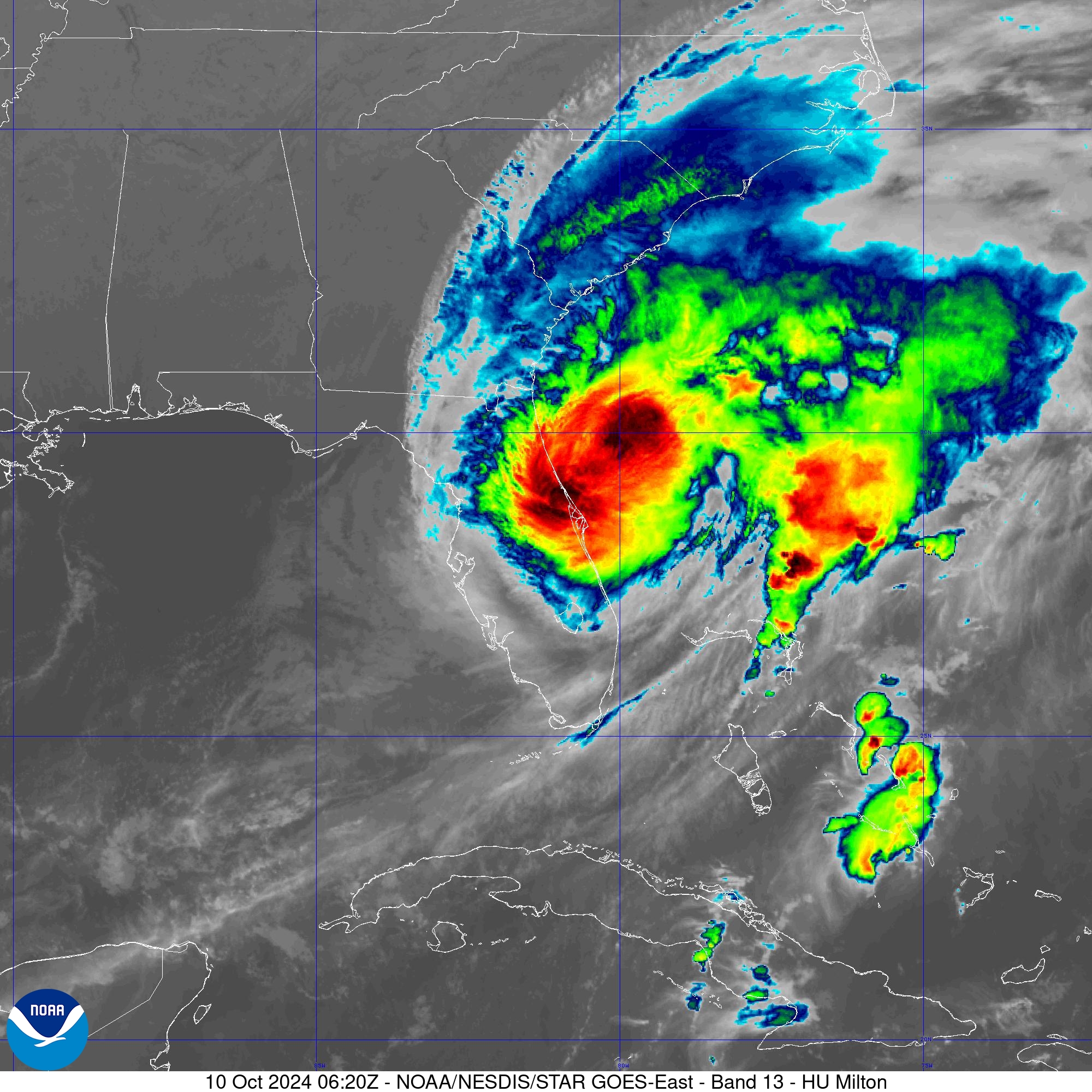
Since I couldn’t sleep, I figured I might as well write. I couldn’t sleep because of the picture in my mind—that tightly coiled ball of physics we’re calling Hurricane Milton as it tracks mercilessly across the Gulf of Mexico, headed toward a landfall tonight along the west coast of Florida. It scares me, for two reasons.
The first is the unrivaled speed with which it spun up, from tropical storm to Category 5 monster inside a day. This “rapid intensification” has become an increasingly common feature of hurricanes, because the heat content in the ocean is so high that the old models no longer suffice. We live, more and more, in a world of instant chaos: where wildfires can “blow up” in a matter of minutes because the fuels that feed them are so desiccated, where “flash” floods can, in minutes, turn a record rain into a street clogged with bobbing cars. These things have always been possible, but now they are common: we have in our minds the idea that the world changes at a geologic pace, moving in stately fashion through epochs and eras. But right now—as carbon dioxide accumulates more quickly in the atmosphere than at any point in the last 500 million years—”geologic pace” is measured in months. Hell, glaciers—our metaphor for moving slowly—disappear from one winter to the next.
And the second reason is: this speeded up physics is increasingly crashing into the heart of the civilizations that we’ve built. Given the size of the planet, it’s more likely than not that a disaster will happen in somewhere sparsely populated—the boreal forests of Canada burned last summer, displacing Indigenous people of the north but mostly avoiding cities. Even Hurricane Helene last week came ashore in the Big Bend country north of Cedar Key, where people are thin on the ground. But just as California’s wildfires eventually and inevitably started taking out whole towns, Milton is aimed at one of the most built-up and vulnerable landscapes on earth. I think—from this morning’s bearings—that the very worst outcome may be dodged: if the hurricane comes in just south of Tampa Bay, its counterclockwise winds will work to drive the storm surge off that body of water. But if so it will mean sheer agony for somewhere further south, somewhere almost as overbuilt. Sarasota? Port Charlotte? And in very short order that will mean deep trouble for the insurance industry, already tottering in Florida
(It’s worth noting, if only in passing, that the two places Americans of my age thought of as refuges, idylls, dreams of the easy life were California and Florida. No longer).
We’ve spent some time in recent years worrying that there was too much fear-mongering and doom-saying in the way we talked about climate change—that it was wearing people out. And indeed there’s truth there—if we’re going to do what we must, the story in the years ahead needs to be as much about the adventure of turning our planet solar as the dread that we’ll turn our planet Venus.
But there are important moments when fear is a crucial resource. A week ago, in the wake of Helene, the veteran climate activist and North Carolina native Anna Jane Joyner wrote this dispatch from New York’s “Climate Week”

And yesterday, on air, the veteran Florida weatherman John Morales let his fear show through. As Cara Buckley recounted in the Times,

This kind of fear is entirely useful—there are, I have no doubt, people who left their homes and drove north towards Georgia after hearing the break in Morales’ voice. He saved lives. And he did it entirely honestly. “You know what’s driving that,” he said to viewers. “I don’t need to tell you. Global warming. Climate change.” It’s honest fear, driven by deep understanding.
