Myth: Cutting agricultural water use in #Colorado could prevent looming water shortages. But is it worth the cost? — Jerd Smith (Fresh Water News)

A powerful sprinkler capable of pumping more than 2,500 gallons of water per minute irrigates a farm field in the San Luis Valley June 6, 2019. Credit: Jerd Smith via Water Education Colorado

Click the link to read the article on the Water Education Colorado website (Jerd Smith):

October 3, 2024

You’ve heard the news: Farmers and ranchers use roughly 80% of the water in Colorado and much of the American West.

So doesn’t it make sense that if growers and producers could just cut a bit of that, say 10%, we could wipe out all our water shortages? We probably couldn’t water our lawns with wild abandon, but still, wouldn’t that simple move let everyone relax on these high-stress water issues?

Not exactly. To do so would require drying up thousands of acres of productive irrigated lands, causing major disruptions to rural farm economies and the agriculture industry, while wiping out vast swaths of open space and habitat that rely on the industry’s sprawling, intricate irrigation ditches, experts said.

This story is the second offering in a five-part series on myths and misconceptions about Colorado water. It is part of a collaboration between Fresh Water News, the Colorado Sun, Aspen Journalism, KUNC, and the CU Water Desk. Other stories in the series include a look at whether cities are using too much water; how real is the fear around the “use it or lose threat” in Colorado Water lawCan’t we just pipe water in from the East; and still to come, whether Colorado needs a desalination plan.

Take a look at the numbers in Colorado. The state produces more than 13.5 million acre-feet of water every year, but only about 40% of that stays here, according to the Colorado Water Plan. The rest flows downhill to satisfy the needs of other states across the country.

Of the 5.34 million acre-feet that is used here at home, 4.84 million is used by ranchers and farmers to grow cows, lamb, pigs, corn, peaches, onions, alfalfa and a rich list of other items that produce the food we eat here in Colorado, the U.S. and internationally.

All told, the agriculture industry is one of the largest in the state, and includes 36,000 farms employing 195,000 people, according to the Colorado Department of Agriculture, and generates $47 billion annually in economic activity.

But here is the hard part. Thanks to crumbling infrastructurechronic drought and climate-driven reductions in streamflows, the industry is already facing annual water shortages of hundreds of thousands of acre-feet. That number could soar as stream flows continue to shrink and populations continue to grow, according to the water plan.

An acre-foot equals enough water to serve two to four urban households, or a half acre of corn.

“Already, statewide there are irrigated crop producers who don’t receive water in some years,” said Daniel Mooney, a Colorado State University agricultural economist.

“If we had to cut another 10%, those people who are already at the margins would be impacted. I would say we can’t afford to do that.”

Out in the fields, just as cities are trying to cut water use inside and out, ranchers and growers are trying to cut back as well because they don’t have as much as they once did.

That too is challenging, according to Greg Peterson, executive director of the Colorado Agricultural Water Alliance.

Peterson spends most of his days working with farmers and ranchers, helping them find money to experiment with new crops and new tilling techniques that help keep water in the soil.

These hay bales stand ready to be collected on a ranch outside of Carbondale. Upper Colorado River Basin officials are working on a memorandum of understanding with the U.S. Bureau of Reclamation so water saved as part of conservation programs can be tracked and stored in Lake Powell. Credit: Heather Sackett/Aspen Journalism

Despite years of work, the transition from farming and ranching in water-rich Colorado, to water-short Colorado is still evolving.

Peterson cites one crop experiment, where a new type of grass, or forage, was grown to replace alfalfa, a water guzzler.

Twenty farmers in the pilot program switched crops, saving an acre-foot of water per acre of land. Initially, they got $200 a ton for the new grass crop. Today, that same crop is selling for $90 a ton.

“We flooded the market,” Peterson said. “So now we need to look at hiring a marketer to find new markets. Changing what they grow might be the easiest thing to do.”

Finding funding to create new lines of production and new markets is also needed, Peterson said.

In the quest to help farmers stretch existing water supplies, the state and the federal government have spent millions of dollars helping pay for lining irrigation ditches and piping water underground, among other things. But that doesn’t create new water.

Delta County farmer Paul Kehmeier stands atop a diversion structure that was built as part of a project to improve irrigation infrastructure completed between 2014 and 2019. Kehmeier served as manager for the ditch-improvement project, which was 90% funded by the Bureau of Reclamation and serves 10 Delta County farms with water diverted from Surface Creek, a tributary of the Gunnison River. Lining and piping ditches, the primary methods used to prevent salt and selenium from leaching into the water supply, are critical to the protection of endangered fish in the Gunnison and Colorado river basins. Photo credit: Natalie Keltner-McNeil/Aspen Journalism

The only way to do that, really, agriculture experts say, is to dry up farm and ranch lands, a practice that has caused deep pain and economic suffering in rural communities across the state, particularly on the Front Range where cities continue to buy up large parcels of irrigated land in order to take the water for their own uses.

Colorado has lost roughly 32% of irrigated lands since 1997, according to the National Agricultural Statistics Service. New state policies designed to make it easier and more lucrative to share water between agricultural producers and cities through long-term, temporary leases, rather than having the water permanently removed, have done little to slow the loss of irrigated agriculture, according to Jim Yahn, manager of the North Sterling Irrigation Company in the northeastern corner of the state.

Such deals often require a trip to Colorado’s special water courts, where the legal right to use the water must be changed from agricultural to industrial or municipal use.

“We can recoup money from leasing,” Yahn said. “But it’s whether you want to take the step. It’s scary because when you go into water court, you never know how a judge might rule.”

Yahn was referring to the amount of water associated with water rights. If growers haven’t tracked their water use annually and lack adequate records, a judge could determine that there is less water associated with that water right than originally believed.

Perry Cabot, a Grand Junction-based agricultural research scientist, has been studying farm water use for decades, testing new ways to help growers stretch water supplies and examining leasing programs that pay growers well and slake the thirst of city dwellers and industry.

Leasing water almost always means drying up land, even if only on a temporary basis. Alfalfa, Cabot said, is one of the few crops that tolerates fallowing well, but it has to be done carefully.

“It is not unrealistic to expect a 10% reduction in use (in a growing season). But that means less hay,” he said.

Milkweed, sweet peas, and a plethora of other flora billow from Farmer’s Ditch in the North Fork Valley of western Colorado. Jonathan P. Thompson photo.

But then what do cows eat in the winter, Cabot asked. “They are not going to go to Florida. So then do you sell them and buy them back next year (when you have the water to grow hay again). No.”

Agriculture experts say the simplest and most destructive way to cut agricultural water use enough to make up for looming shortages would be to continue drying up large swaths of farm and ranch lands that are already struggling.

“Is it possible? Yes.” irrigator Jim Yahn said. “But is that more important than growing food and supporting local economies? And it’s not just food. What about the open spaces and habitat that our irrigation systems create?”

Sept. 20, at a Grand Junction water conference sponsored by the Colorado River District, Bob Sakata was handing out T-shirts that say “Without the farmer you would be hungry, naked and sober.” Sakata is agricultural water policy adviser to the Colorado Department of Agriculture. 

He’s been thinking about ways to keep farmers whole even as water supplies shrink, including paying farmers for the benefits their open spaces and lush habitats provide all Coloradans.

And he warned against taking the cost of agricultural water cuts lightly. “We’ve lost 1 million irrigated acres in this state,” he said. “That is scary.” 

More by Jerd Smith. Jerd Smith is editor of Fresh Water News. She can be reached at 720-398-6474, via email at jerd@wateredco.org or @jerd_smith.
The downballot issues driving the West’s 2024 elections: From #climate and public lands to shifting political allegiances, the region faces critical choices at the ballot box — Jonathan P. Thompson (@HighCountryNews)

Click the link to read the article on the High Country News website (Jonathan P. Thompson):

October 1, 2024

This November, most of the nation will be transfixed by the presidential contest between Vice President Kamala Harris and former President Donald Trump. But there’s also plenty to see downballot in the West.

SHIFTING AFFILIATIONS

Arizona has long been home to old-fashioned Barry Goldwater-style conservatives. But MAGA hijacked the state Republican Party, alienating its more moderate members. Republican John Giles, for example, the mayor of Mesa, endorsed Kamala Harris. The shift gives Rep. Ruben Gallego, a progressive-turned-moderate Democrat, an edge over election-denying Trump acolyte Kari Lake, R, in the race to replace Sen. Kyrsten Sinema, who veered from left to right politically before finally dropping her “D” in 2022. Democrats might even win control of the state Legislature for the first time in decades. 

• It’s a long shot, but Utah could get its first Democratic governor since 1985, largely because of GOP infighting. Incumbent Gov. Spencer Cox, a Republican who purports to champion civility, won his party’s primary by nearly 40,000 votes. But his MAGA opponent, Utah state Rep. Phil Lyman, challenged the results in court, and, when that failed, launched a write-in candidacy. Lyman — who has blasted Cox for being insufficiently right-wing — could draw enough Republican votes to give Utah House Minority Leader Brian King, a Mormon bishop, a fighting chance. And Cox’s flip-flopping on Trump might damage him: He refused to vote for him in 2016 and 2020 but recanted after the attempt on Trump’s life, saying that the former president was saved to unify the nation.

• In-migration and demographic shifts are nudging some red Western states toward purple and blue. But Wyoming’s incomers are turning that GOP stronghold an even deeper shade of MAGA-red. In the August Republican primaries, the “Freedom Caucus” continued to infiltrate the state Legislature. These new right-wing lawmakers gained notoriety for outright climate-change denial and for slamming Republican Gov. Mark Gordon for championing carbon capture to help preserve the state’s still-dominant but ailing coal industry, despite Gordon’s numerous lawsuits against the Biden administration over fossil fuel and public-land regulations. 

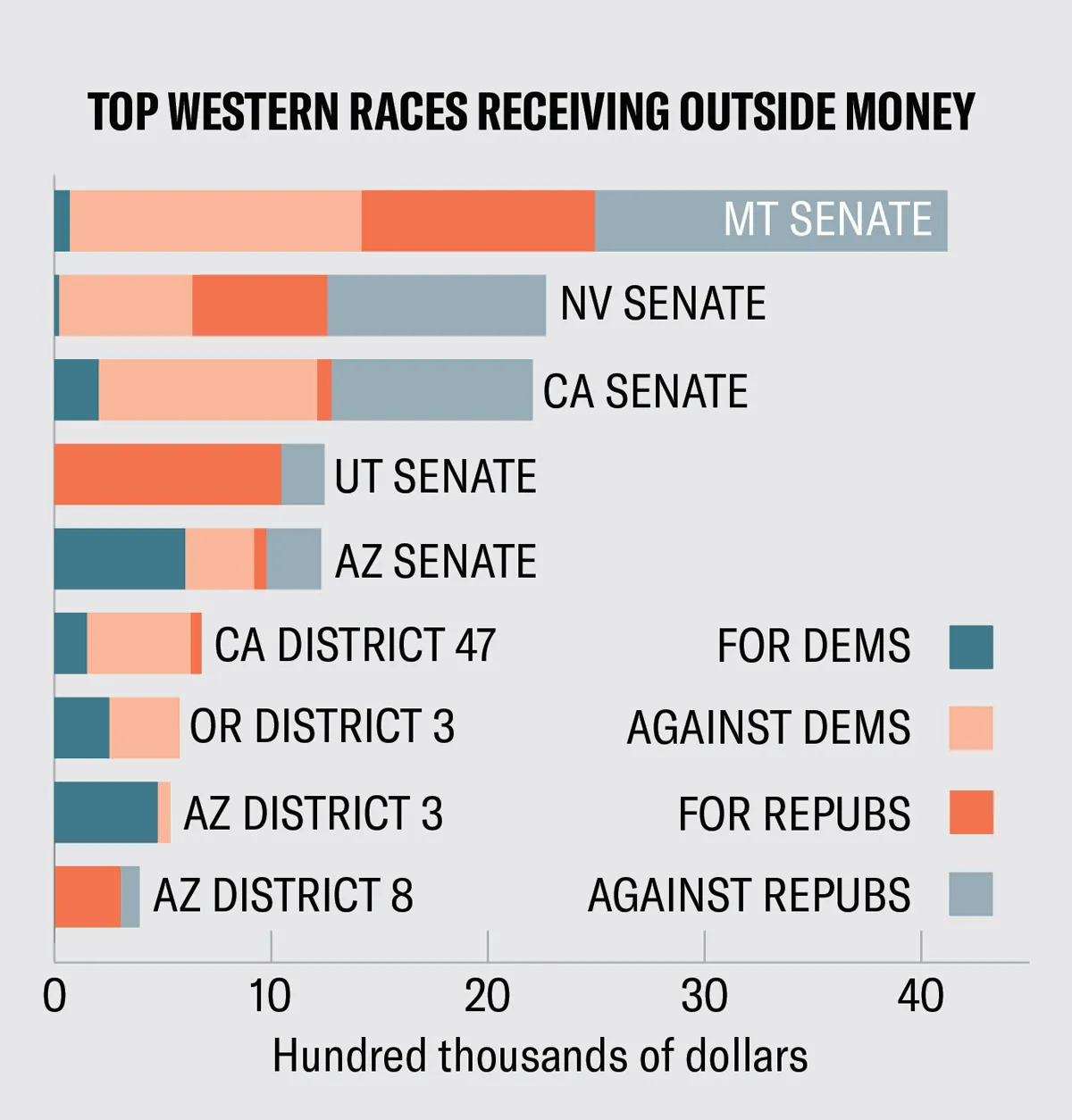
Outside cash is pouring into Montana, not only to buy real estate, but to purchase candidates and influence the race for a U.S. Senate seat, in which Democrat incumbent Sen. Jon Tester seeks to hold off Republican Tim Sheehy. Sheehy’s main benefactors are PACs bankrolled by Wall Street high rollers and the Koch brothers. Tester’s dough comes from Democratic Party-affiliated PACs, but he got a louder boost in August, when members of Pearl Jam played at his fundraiser in Missoula. Credit: High Country News

ENERGY AND CLIMATE AT THE POLLS

• Incumbent Democratic Rep. Mary Peltola is taking on Republicans Nick Begich and Trump-endorsed Lt. Gov. Nancy Dahlstrom to represent Alaska. But Big Oil is poised to win no matter what. Since becoming the first Alaska Native in Congress in 2022, Peltola has taken a pro-drilling stance at odds with President Joe Biden’s energy policies. She successfully pushed the administration to approve ConocoPhillips’ massive Willow drilling project, and the oil corporation and its employees gratefully donated $16,400 to her campaign and another $300,000 to the Center Forward Committee PAC, which in turn contributed the same amount. 

• Montana’s first congressional district will see a rematch between incumbent Rep. Ryan Zinke, a MAGA Republican and Trump’s former Interior secretary, and Democrat Monica Tranel, an attorney who has worked in the energy and utility sectors. The candidates diverge on almost every issue, but one of the biggest involves climate change and energy: It’s Zinke’s drill your way to “energy dominance” versus Tranel’s all-in on the renewable energy transition.

• In New Mexico, the nation’s second-largest oil-producing state, the race for the U.S. Senate pits the Democratic incumbent, clean energy booster Sen. Martin Heinrich, against Republican Nella Domenici, daughter of the late Sen. Pete Domenici, a decidedly old-school fossil fuel enthusiast. Heinrich supported tighter regulations on public-lands drilling and methane emissions, but he alienated some of his base with a bipartisan bill to streamline permitting for renewable energy and transmission projects while expediting oil and gas drilling and liquefied natural gas exports.

• In Utah, two climate champions — of different degrees — are vying to replace retiring Republican Sen. Mitt Romney. Republican Rep. John Curtis launched the Conservative Climate Caucus, acknowledges human-caused climate change, supports clean energy and was endorsed by environmental group EDF Action — yet received only a 6% score from the League of Conservation Voters (LCV), perhaps because he’s reluctant to regulate fossil fuels. He’s heavily favored to defeat Democrat Caroline Gleich, an environmental advocate and ski mountaineer, who’s been endorsed by the LCV and Protect Our Winters Action Fund.

• The clean energy transition goes head-to-head with the fossil-fuel status quo in Montana and Arizona in the battle for several seats on those states’ obscure but influential utility regulatory commissions.

• In Washington, fossil fuel fans sparked two initiatives aimed at stifling the energy transition. One would repeal the 2021 climate law and carbon auctions that have so far raised more than $2 billion to fund climate-related projects, while another bans local and state governments from restricting natural gas hookups or appliance sales. California is asking voters to approve a $10-billion bond to fund parks, environmental protection and water and energy projects, while two southern Oregon coastal counties will inquire whether voters support or oppose offshore wind development. 

A REFERENDUM ON WESTERN LANDS

• If you thought nuclear weapons testing and uranium mining ended when the Cold War did, think again: A slew of long-idled mines on the Colorado Plateau are slated to reopen. And now, Project 2025, the right wing’s “playbook” for a second Trump administration, looks to return nuclear weapons testing to Nevada — perhaps creating a whole new generation of “downwinders” sickened by exposure to nuclear fallout, even as U.S. House Republicans terminate RECA, the program that compensates them. 

• All this could play an indirect role in elections in downwinder states like Nevada, Utah, Idaho and Arizona. And it’s a major issue in Utah’s House District 69, home to dozens of mines and Energy Fuels’ White Mesa Mill, the nation’s only active uranium processing center, which processes ore from the corporation’s Pinyon Plain Mine near the Grand Canyon. Davina Smith — who favors tougher environmental and public lands protections — hopes to become the first Diné woman to serve in the Utah Legislature. Her opponent, Blanding Mayor Logan Monson, supports the industry. 

• Arizona’s 2nd Congressional District, home to 12 tribal nations and the Pinyon Plain Mine, may also feel some fallout from the nuclear renaissance. Former Navajo Nation President Jonathan Nez, a Democrat who has condemned the uranium industry’s lethal legacy, is challenging incumbent Republican Rep. Eli Crane to represent the district. 

• When incumbent Rep. Lauren Boebert, the gun-slinging MAGA Republican, abandoned the race for Colorado’s 3rd Congressional District late last year to run in a redder district, it turned one of the nation’s most closely watched races into a run-of-the-mill contest where it’s hard to distinguish between Democrat Adam Frisch and Republican Jeff Hurd, two moderates. Frisch, who narrowly lost to Boebert in 2022, is a self-proclaimed pragmatist who has taken progressive stances on abortion, social issues and labor but veers to the right on public lands. Like Hurd, he opposes national monument designation for the Lower Dolores River and claims Biden administration policies are hampering oil and gas drilling. And Frisch echoed Utah Republicans when he slammed the new public-lands rule, which puts conservation on a par with other uses, saying it would “seriously harm western Colorado’s economy and way of life.”

OTHER BALLOT INITIATIVES 

• Nevada, Montana, Colorado and Arizona all have ballot initiatives that would make abortion a constitutional right. Colorado’s would also repeal a constitutional provision banning the use of public funds for abortion.

• Coloradans will vote on whether to ban trophy hunting of mountain lions, bobcats and lynx. A separate initiative would levy an excise tax on firearm and ammunition sales to fund crime victim, education and mental health programs. 

• A ballot measure would give Oregon residents a “rebate,” or basic income, of $1,600 per year, and an Arizona initiative tackles homelessness by allowing property owners to apply for property tax refunds if local government doesn’t crack down on unhoused people via camping and panhandling rules. 

• A Wyoming ballot initiative creates a specific residential property tax category that opens the way to lowering property taxes for owner-occupied primary residences — and charging higher ones for unoccupied second or third homes.

SOURCES: OpenSecrets, Federal Election Commission, Ballotpedia, Grand Junction Daily Sentinel, Colorado Newsline, Arizona Agenda, Utah News Dispatch, KJZZ, Politico. Data for the charts was collected by Colorado College State of the Rockies Project 2024 from Arizona, Colorado, Idaho, Montana, Nevada, New Mexico, Utah and Wyoming.

Data visualization by Cindy Wehling/High Country News

This article appeared in the October 2024 print edition of the magazine with the headline “Downballot.”

World Meteorolgical Organization report highlights growing shortfalls and stress in global water resources #ActOnClimate

Click the link to read the release on the World Meterorological Organization website (Clare Nullis):

October 7, 2024

The year 2023 marked the driest year for global rivers in over three decades, according to a new report coordinated by the World Meteorological Organization (WMO), which signaled critical changes in water availability in an era of growing demand. 

Key messages

  • 2023 was driest year for global rivers in 33 years
  • Glaciers suffer largest mass loss in 50 years
  • Climate change makes hydrological cycle becomes more erratic
  • Early Warnings for All must tackle water-related hazards
  • WMO calls for better monitoring and data sharing
State of Global Water Resources report. Photo credit: WMO

The last five consecutive years have recorded widespread below-normal conditions for river flows, with reservoir inflows following a similar pattern. This reduces the amount of water available for communities, agriculture and ecosystems, further stressing global water supplies, according to the State of Global Water Resources report.

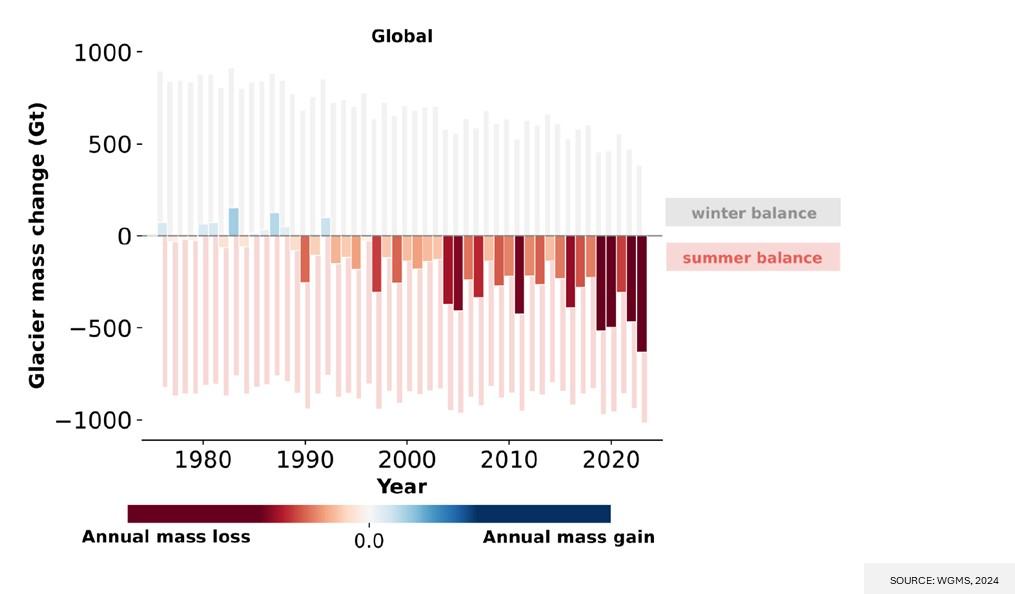
Glaciers suffered the largest mass loss ever registered in the last five decades. 2023 is the second consecutive year in which all regions in the world with glaciers reported iceloss.

With 2023 being the hottest year on record, elevated temperatures and widespread dry conditions contributed to prolonged droughts. But there were also a significant number of floods around the world. The extreme hydrological events were influenced by naturally occurring climate conditions – the transition from La Niña to El Niño in mid-2023 – as well as human induced climate change.

“Water is the canary in the coalmine of climate change. We receive distress signals in the form of increasingly extreme rainfall, floods and droughts which wreak a heavy toll on lives, ecosystems and economies. Melting ice and glaciers threaten long-term water security for many millions of people. And yet we are not taking the necessary urgent action,” said WMO Secretary-General Celeste Saulo. [ed. emphasis mine]

“As a result of rising temperatures, the hydrological cycle has accelerated. It has also become more erratic and unpredictable, and we are facing growing problems of either too much or too little water. A warmer atmosphere holds more moisture which is conducive to heavy rainfall. More rapid evaporation and drying of soils worsen drought conditions,” she said.

“And yet, far too little is known about the true state of the world’s freshwater resources. We cannot manage what we do not measure. This report seeks to contribute to improved monitoring, data-sharing, cross-border collaboration and assessments,” said Celeste Saulo. “This is urgently needed.”

The State of Global Water Resources report series offers a comprehensive and consistent overview of water resources worldwide. It is based on input from dozens of National Meteorological and Hydrological Services and other organizations and experts. It seeks to inform decision makers in water-sensitive sectors and disaster risk reduction professionals. It complements WMO’s flagship State of the Global Climate series.

The State of the Global Water Resources report is now in its third year and is the most comprehensive to date, with new information on lake and reservoir volumes, soil moisture data, and more details on glaciers and snow water equivalent.

The report seeks to create an extensive global dataset of hydrological variables, which includes observed and modelled data from a wide array of sources. It aligns with the focus of the global Early Warnings for All initiative on improving data quality and access for water-related hazard monitoring and forecasting,and providing early warning systems for all by 2027.

Currently, 3.6 billion people face inadequate access to water at least a month per year and this is expected to increase to more than 5 billion by 2050, according to UN Water, and the world is far of track Sustainable Development Goal 6 on water and sanitation.

Highlights

Hydrological extremes

The year 2023 was the hottest year on record. The transition from La Niña to El Niño conditions in mid-2023, as well as the positive phase of the Indian Ocean Dipole (IOD) influenced extreme weather.

Africa was the most impacted in terms of human casualties. In Libya, two dams collapsed due to a major flood in September 2023, claiming more than 11,000 lives and affecting 22% of the population. Floods also affected the Greater Horn of Africa, Democratic Republic of Congo and Rwanda, Mozambique and Malawi.

Southern USA, Central America, Argentina, Uruguay, Peru and Brazil were affected by widespread drought conditions, which led to 3% gross domestic product loss in Argentina and lowest water levels ever observed in Amazon and in Lake Titicaca.

River discharge

The year 2023 was marked by mostly drier-than-normal to normal river discharge conditions compared to the historical period. Similar to 2022 and 2021, over 50% of global catchment areas showed abnormal conditions, with most of them being in deficit. Fewer basins showed above normal conditions.

Large territories of Northern, Central and South America suffered severe drought and reduced river discharge conditions in 2023. The Mississippi and Amazon basins saw record low water levels. In Asia and Oceania, the large Ganges, Brahmaputra and Mekongriver basins experienced lower-than-normal conditions almost over the entire basin territories.

The East coast of Africa had above and much above-normal discharge and flooding. North Island of New Zealand and the Philippines exhibited much above normal annual discharge conditions. In Northern Europe, the entire territory of the UK and Ireland saw above-normal discharge, also Finland and South Sweden.

2023: Half of the globe had dry river flow conditions. Credit: WMO

Reservoirs and lakes

The inflows into reservoirs showed a similar pattern to the global river discharge trends: India, North, South and Central America, parts of Australia experiencing below-normal inflow conditions. The basin-wide reservoir storage varied significantly, reflecting the influence of water management, with much above-normal levels in basins like the Amazon and Parana, where river discharge was much-below-normal in 2023.

Lake Coari in the Amazon faced below-normal levels, leading to extreme water temperature. Lake Turkana, shared between Kenya and Ethiopia, had above-normal water volumes, following much above-normal river discharge conditions.

Groundwater Levels

In South Africa, most wells showed above-normal groundwater levels, following above-average precipitation, as did India, Ireland, Australia, and Israel. Notable depletion in groundwater availability was observed in parts of North America and Europe due to prolonged drought. In Chile and Jordan groundwater levels were below normal, with the long-term declines due to over-abstraction rather than climatic factors.

Soil moisture and evapotranspiration

Levels of soil moisture were predominantly below or much below normal across large territories globally, with North America, South America, North Africa, and the Middle East particularly dry during June-August.  Central and South America, especially Brazil and Argentina, faced much below-normal actual evapotranspiration in September-October-November. For Mexico, this lasted almost the entire year because of drought conditions.

In contrast, certain regions, including Alaska, northeast Canada, India, parts of Russia, parts of Australia and New Zealand experienced much above-normal soil moisture levels. 

Snow water equivalent

Most catchments in the Northern Hemisphere had below to much-below normal snow water equivalent  in March. Seasonal peak snow mass for 2023 was much above normal in parts of North America and much-below normal in Eurasian continent.

Glaciers

Glaciers lost more than 600 Gigatonnes of water, the worst in 50 years of observations, according to preliminary data for September 2022 – August 2023. This severe loss is mainly due to extreme melting in western North America and the European Alps, where Switzerland’s glaciers have lost about 10% of their remaining volume over the past two years. Snow cover in the northern hemisphere has been decreasing in late spring and summer: in May 2023, the snow cover extent was the eighth lowest on record (1967–2023). For North America the May snow cover was the lowest in the same period

Summer ice mass loss over the past years indicated that glaciers in Europe, Scandinavia, Caucasus, Western Canada North, South Asia West, and New Zealand have passed peak water (maximum melt rate of a retreating glacier; leading to reduced water storage and availability afterwards), while Southern Andes (dominated by the Patagonian region), Russian Arctic, and Svalbard seem to still present increasing melt rates.

Retreating Glaciers: Glaciers suffer largest mass loss in 50 years. Credit: WMO

Notes to Editors

The State of Global Water Resources report contains input from a wide network of hydrological experts, including National Meteorological and Hydrological Services, Global Data Centres, global hydrological modelling community members and supporting organizations such as NASA and the German Research Centre for Geosciences (GFZ).

The number of river discharge measurement stations increased from 273 in 14 countries to 713 in 33 countries, and the groundwater data collection expanded to 35459 wells in 40 countries, compared to 8,246 wells in 10 countries in the previous year (Figure 1). However, despite improvements in observational data sharing, still Africa, South America, and Asia remain underrepresented in hydrological data collection, highlighting the need for improved monitoring and data sharing, particularly in the Global South.

The report seeks to enhance the accessibility and availability of observational data (both through better monitoring and improved data sharing), further integrate relevant variables into the report, and encourage country participation to better understand and report water cycle dynamics.

Future reports are anticipated to include even more observational data, supported by initiatives like the WMO’s Global Hydrological Status and Outlook System (HydroSOS), the WMO Hydrological Observing System (WHOS), and collaboration with global data centers.

The World Meteorological Organization (WMO) is a specialized agency of the United Nations responsible for promoting international cooperation in atmospheric science and meteorology.

WMO monitors weather, climate, and water resources and provides support to its Members in forecasting and disaster mitigation. The organization is committed to advancing scientific knowledge and improving public safety and well-being through its work.

For further information, please contact:

  • Clare Nullis WMO media officer cnullis@wmo.int +41 79 709 13 97
  • WMO Strategic Communication Office Media Contactmedia@wmo.int