Part I: #ColoradoRiver Compact curtailments? Manager of Western Slope Colorado River District contends #Colorado should begin planning for potential curtailment of diversions. State official says first things first — Allen Best (@BigPivots) #COriver #aridification

Colorado River headwaters-marker. Photo credit: Allen Best/Big Pivots

Click the link to read the article on the Big Pivots website (Allen Best):

October 20, 2024

Andy Mueller, the general manager of the Colorado River District, delivered a strong message at the organization’s annual seminar in September. It was time, he declared, for Colorado to plan for potential curtailment of Colorado River diversions as necessary to comply with the compact governing the river among the seven basin states.

Colorado transmountain diversions via the State Engineer’s office

Compact curtailment, sometimes described as a compact call, means that those with water rights junior to or filed since the Colorado River Compact of 1922 would be vulnerable to having no water. That could potentially include most of Colorado’s Front Range cities, which get roughly half of their water from the Colorado River and its tributaries. It could also include some towns and cities on the Western Slope and even some farmers and ranchers on the Western Slope as well as some ag users reliant upon transmountain diversions.

The precise trigger for such a call, reduced flows to lower-basin states, is open to argument. An ambiguous clause in the compact could be hotly debated, and likely will be, if river flows continue to decline. Mueller spoke of legal saber rattling by lower basin states.

This is not entirely a new subject. Colorado has been talking about the potential for compact curtailment for about 20 years but has not pursued it. The state government disputes the immediate need. What almost everyone can agree upon, however, is that it will be foolish to assume that the near-average or better river flows of the last two years will prevail.

Reservoir levels in the basin have been sagging for most of the 21st century. Most dramatic was the runoff in 2002 when the river yielded only 3.8 million acre-feet. Delegates of the seven basin states who had gathered near Santa Fe in 1922 to apportion the river assumed average flows of at least five times that much.

“New plot using the nClimGrid data, which is a better source than PRISM for long-term trends. Of course, the combined reservoir contents increase from last year, but the increase is less than 2011 and looks puny compared to the ‘hole’ in the reservoirs. The blue Loess lines subtly change. Last year those lines ended pointing downwards. This year they end flat-ish. 2023 temps were still above the 20th century average, although close. Another interesting aspect is that the 20C Mean and 21C Mean lines on the individual plots really don’t change much. Finally, the 2023 Natural Flows are almost exactly equal to 2019. (17.678 maf vs 17.672 maf). For all the hoopla about how this was record-setting year, the fact is that this year was significantly less than 2011 (20.159 maf) and no different than 2019” — Brad Udall

Flows in 2003 and 2004 were only marginally better. Slowly, there was acceptance of extended drought unknown in the 20th century. In 2017, a study by Brad Udall and Jonathon Overpeck identified warming temperatures as just as important as drought in explaining the declines. They called it aridification.

By May 2022, the situation looked grim at Powell, the reservoir that the upper basin uses to fulfill its commitment to lower basin states as specified by the compact to the lower-basin states. Water levels had receded so much that tracks laid into the canyon wall to construct Glen Canyon Dam emerged. They had been underwater since the reservoir began filling in the mid-1960s.

It might have worsened. Modeling evaluated the risk of Powell having too little water to generate electricity by the next year. Some talked about potential for the reservoir to have too little water to pass any downstream, what is called dead storage.

Snow fell in prodigious quantities in the winter of 2022-2023 in Steamboat Springs and  some other locations along the headwaters of the Colorado River and its tributaries, temporarily averting crisis on the Colorado River. Photo/Allen Best

Instead of further decline, snow fell in prodigious quantities during the next winter of 2022-2023 across parts of Colorado, which is responsible for 55% of total flows in the river, as well as in Wyoming and other upstream locations. Stock fences were entirely buried in some places of the Yampa Valley.

The runoff that resulted was the third-best in the Colorado River in the 21st century. Five more consecutive runoffs of the same magnitude would fill Powell and all the other reservoirs in the Colorado River Basin, according to Utah State University’s Jack Schmidt.

What if, instead of epochal snows in the Rockies, pitiful runoffs parallel to those of 2002 to 2004 return?

“Let’s hope for the best and plan for the worst,” Mueller said at the seminar in Grand Junction held by the River District. The Glenwood Springs-based district — its official title is the Colorado River Water Conservation District — was created in 1938 to represent the interests of 15 of the 20 counties on the Colorado River drainage.

Several people who heard Mueller’s remarks applauded them. Colorado, they say, should not wait until the very last minute before devising a strategy. Curtailing water use will be a very difficult and lengthy process. Better to get on it now.

But there is also another level to the discussion, one of moral and ethical questions, according to one long-time Colorado Rive observer

“How do we, as a community of two nations, seven states and Mexico, and 30 sovereigns (Native American tribes) — how do we come together to recognize that this is a shared resource, and climate change is changing the resource. We need to understand how to collaboratively share the resource in a way that will be necessary to live in a climate-altered world,” says John Fleck, an Albuquerque-based author of several books, including “Water is for Fighting Over: And Other Myths about Water in the West.”

Colorado and other upper basin states, he observes, are saying it’s not their problem because they have met their commitments.

”That is morally wrong to me,” he said in an interview. As a practical matter, it’s also “seems really dumb” because in the political and legal system the upper basin states are unlikely to win that argument in a drier 21st century. “That just ain’t gonna work.”

The Colorado River Compact of 1922 apportions waters between the upper and lower basins. Lee Ferry, just a few miles below Glen Canyon, along the Utah-Arizona border, divides the two. Water from the river is also exported outside the basin to agricultureal areas of eastern Colorado and cities of the Front Range as well as southern California, Albuquerque and other places. Map credit: AGU

The 1922 compact apportioned 7.5 million acre-feet for the upper basin states – Colorado as well as New Mexico, Utah and Wyoming — and 7.5 million acre-feet for the three lower basin states of Arizona, California and Nevada. The compact assumed deliveries to Mexico would be required by a future compact, and they also realized significant evaporation. Altogether, they assumed more than 20 million acre-feet flows in the river. That has rarely happened.

The debated clause is called the “non-depletion obligation.” It says the upper basin states must allow river flows of 75 million acre-feet over a rolling 10-year average at Lee Ferry. Lee Ferry is in Arizona, just below Glen Canyon and a few miles above the Grand Canyon.

Colorado’s position is two-fold. It argues that the lower basin overuse remains the primary problem coupled with climate change. And Colorado and its siblings in the upper basin didn’t create either.

“We take the position that we are not the cause of trending lower flows over the past 20 years,” said Jason Ullman, the state water engineer in a statement from the Colorado Department of Water Resources in response to a query by Big Pivots. “Climate change and aridification impact snowpack and soil moisture, which in turn reduce flows into the Colorado.”

Colorado and other upper-basin states altogether use between 3.5 and 4.5 million acre-feet annually compared to roughly 10 million acre-feet by the lower-basin states.

Denver Water, which provides water for the city and many of its suburbs, warns that compact curtailment planning might distract Colorado from negotiations with other states. Photo/Allen Best

“This is why Colorado believes that the responsibility to bring the river back into balance primarily lies with the lower basin and the need to bring uses within their compact apportionment with a plan to use less during times of shortage,” Ullman said.

Mueller, in his remarks at Grand Junction, didn’t disagree with that stance. But he insisted that Colorado needs to prepare a backup plan if the state must releases more water downstream, forcing the curtailment of its diversions.

“I think the best thing our state can do is, while continuing to make a very good case that we’re not the cause of this and that climate change is causing it, we need to be prepared in the event it occurs,” said Mueller

River District directors had recently asked Ullmann to “please get moving with compact curtailment rules,” he said.

The state needs to come up with the “right funds, have the right personnel, and get moving with our compact curtailment rules,” said Mueller.

This, he added, should not be seen as a sign of weakness by Colorado in the interstate negotiations, but rather as a sign “that we’re smart, that we’re helping our water users and our communities plan for the future.”

Colorado and other basin states are in the midst of negotiating new guidelines that govern operation of the two big reservoirs, Mead and Powell. The first set of guidelines were adopted by the states and the Bureau of Reclamation in 2007.

The regulations were abetted by the  drought contingency plan, which brought cuts in water use to the lower basin and new water management tools to the upper basin.

The 2007 guidelines expire at the end of 2026. The states must come up with a new agreement that recognizes the shifted realities by the end of 2025.
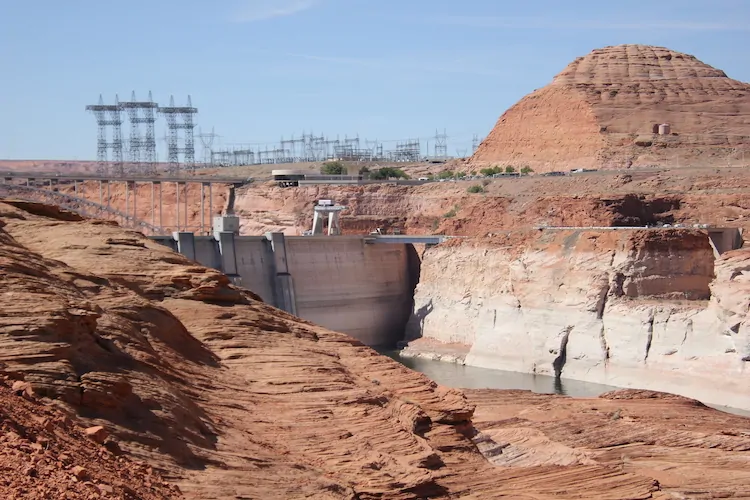
Lake Powell was at 22% of capacity in May 2022 when this photograph was taken, revealing a ledge near the dam that had been used to construct Glen Canyon Dam. Photo/Allen Best
Lake Powell was at 22% of capacity in May 2022 a few weeks prior, a track used in that construction emerged from the receding waters, the first time it had been above water since Powell filled in the 1960s. Photo/Allen Best

State government does not absolutely reject the need for compact compliance rules, but the statement attributed to Ullman cites these negotiations.

“It would be imprudent to undertake any rule-making for compact compliance without knowing the terms of any seven-state consensus regarding operating guidelines that includes releases from Powell. Therefore, it is the position of the state engineer that undertaking compact compliance rule-making now would be premature.”

That sounds like no. But there’s more.

The state engineer has the exclusive authority to make and enforce regulations that enable Colorado to meet its compact commitments.

“Colorado recognizes that the first critical step in being able to administer to the compact, if necessary, is the ability to accurately measure diversions,” said Ullman in the written statement. “The state engineer is pursuing measurement rules for diversions to establish accuracy standards and better define where measurement is necessary. The goals of this effort include increasing the consistency of water right measurement so that Colorado sends only what is required to maintain compact compliance and not more.”

How much Colorado might have to curtail would depend upon findings of the Upper Colorado River Commission, which is governed by a 1948 compact.

The state engineer has adopted rules for one of the four water divisions on the Western Slope, and work is progressing in a second district. The engineer plans to also adopt measurement rules in the other two districts.

What do the big Front Range diverters with post-compact water rights have to say?

Denver Water’s entire collection system. Image credit: Denver Water.

Denver Water falls in line behind the state position. It has major diversions from the Colorado River tributaries in Grand and Summit counties.

“We recognize interest from some in rules for compact administration, but it’s very important that this effort be undertaken at the right time, with thoughtful collaboration among water interests statewide. We know that the State Engineer laid out a potential process a few years ago, with the first step being a focus on measurement rules. If and when it becomes necessary to take further action, we trust the State Engineer to so do. In the meantime, we think it’s critical that states, including Colorado, should keep their focus on the post-2026 guidelines being negotiated now, and not be distracted during a process of the greatest importance to Colorado’s future.”

Northern Water, operator of the Colorado Big-Thompson diversions from the Colorado River headwaters in Grand County, says it will defer to the state. “Northern Water looks to the State of Colorado as the leader on matters related to interstate water agreements,” said public information officer Jeff Stahla.
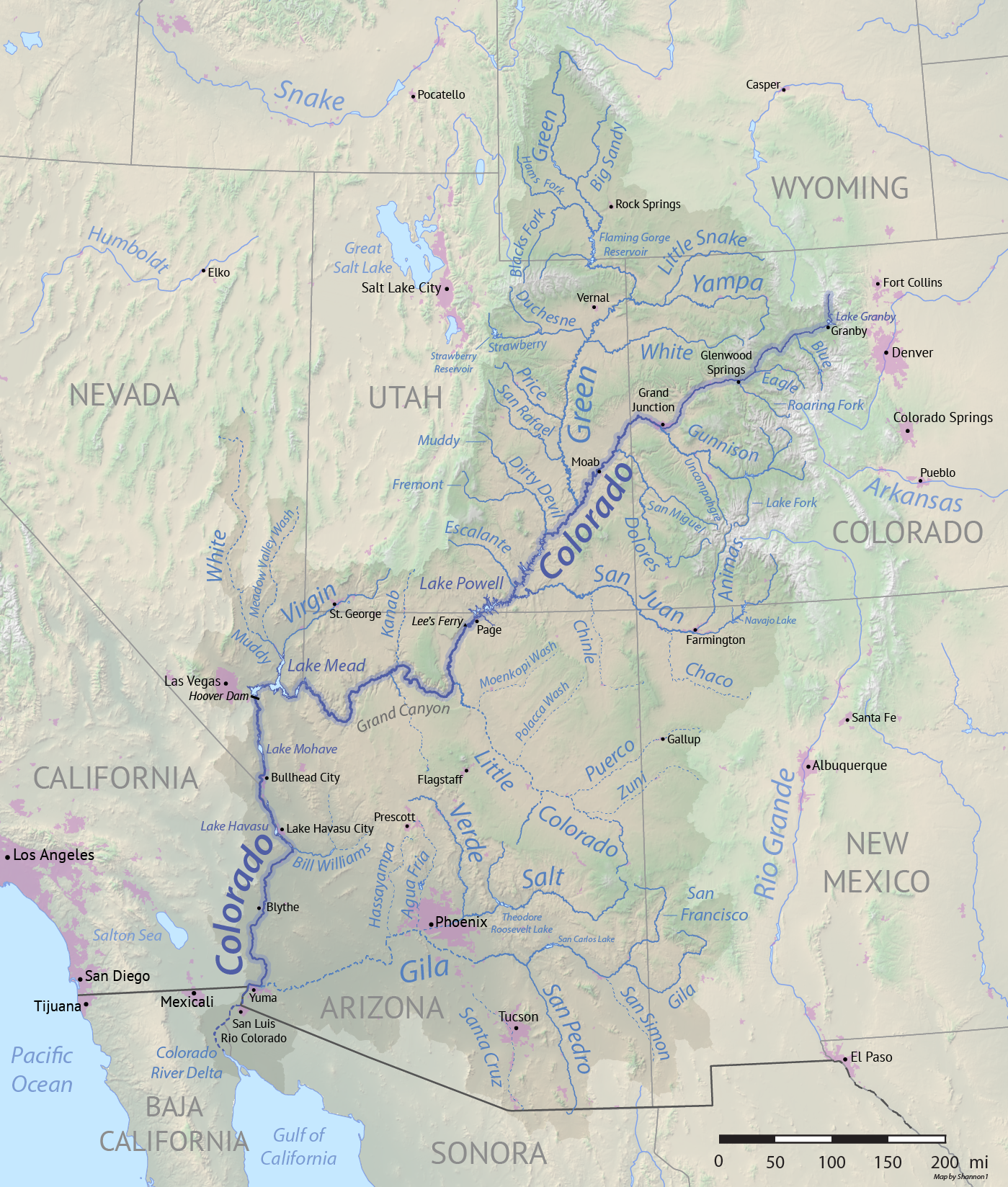
Map of the Colorado River drainage basin, created using USGS data. By Shannon1 – Own work, CC BY-SA 4.0, https://commons.wikimedia.org/w/index.php?curid=65868008

Eagle County, environmental groups file Supreme Court briefs opposing Utah oil train project: Uinta Basin Railway’s approval was overturned by a lower court — #Colorado Newsline #ActOnClimate

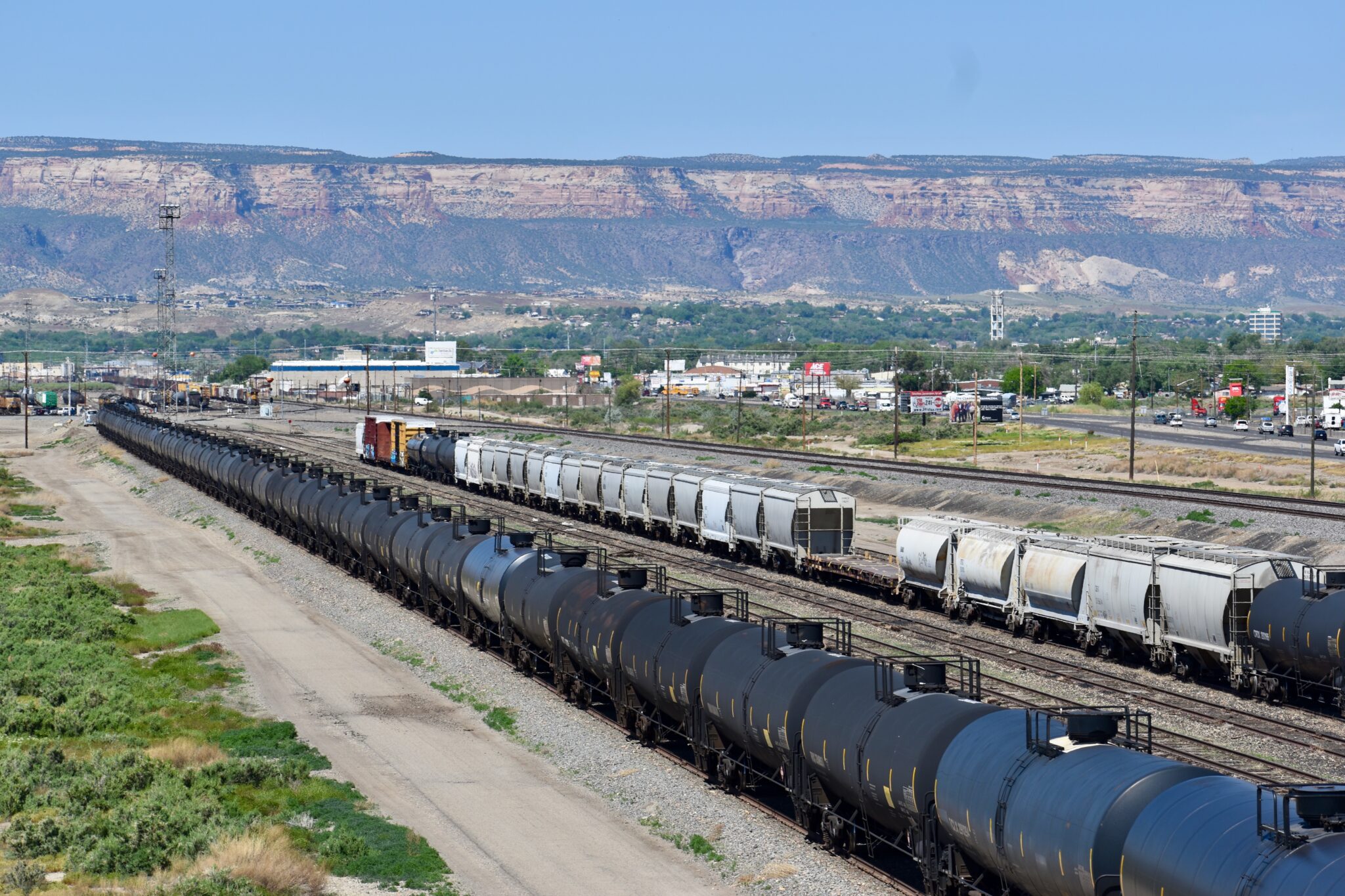
Freight trains sit idle in rail yards in Grand Junction on May 16, 2023. (Chase Woodruff/Colorado Newsline)

Click the link to read the article on the Colorado Newsline website (Chase Woodruff):

October 21, 2024

Colorado’s Eagle County and a coalition of environmental groups are urging the U.S. Supreme Court to reject what they called an attempt to “dramatically remake” federal environmental law by the backers of a controversial oil-by-rail project in eastern Utah.

First proposed in 2019, the 88-mile Uinta Basin Railway would connect Utah’s largest oil field to the national rail network, allowing drillers there to ship large volumes of the basin’s “waxy” crude oil to Gulf Coast refineries — with the vast majority of the traffic routed through Colorado.

Eagle County and five environmental groups sued to overturn the railway’s 2021 approval by federal regulators, and in a decision last year the U.S. Court of Appeals for the D.C. Circuit sided with the plaintiffs, finding “numerous” and “significant” violations of the National Environmental Policy Act in regulators’ analysis of the project’s risks. The Seven County Infrastructure Coalition, a group of Utah county governments backing the project, appealed that ruling to the Supreme Court, which agreed to hear the case this year.

In separate briefs filed Friday, attorneys for both Eagle County and the environmental groups urged the court, where conservatives hold a 6-3 majority, to affirm the Court of Appeals decision.

“Petitioners are asking this Court to impose limits on NEPA that have no basis in its text whatsoever,” Eagle County’s attorneys wrote in their filing. “They ask this Court to give agencies broad permission not to study the consequences of their actions.”

The Court of Appeals’ August 2023 ruling found that Surface Transportation Board regulators had violated NEPA by failing to analyze a wide range of “reasonably foreseeable upstream and downstream impacts” of the railway’s construction, including increased air pollution and the “downline” risk of train derailments and wildfires in Colorado and elsewhere. If the lower court’s decision is ultimately upheld, the project would be remanded back to the STB for a more thorough environmental review.

“It’s disgraceful that the railroad’s backers want federal agencies to turn a blind eye to those harms,” said Wendy Park, a senior attorney at the Center for Biological Diversity, one of the groups that sued to block the project, in a press release Friday. “A robust environmental review that takes a hard look at all the train’s threats is crucial for protecting communities near and far from this railway.”

At an estimated capacity of up to 350,000 barrels exported per day, the Uinta Basin Railway would rank among the largest sustained efforts to transport oil by rail ever undertaken in the U.S., singlehandedly more than doubling the nationwide total in 2022, and causing a tenfold increase in hazmat rail traffic through environmentally sensitive and densely populated areas in Colorado.

In their petition for Supreme Court review, the railway’s backers argued that federal agencies conducting NEPA reviews must be limited to considering “proximate effects of the action over which the agency has regulatory authority.”

“There is simply no role under NEPA’s text and this Court’s precedents for stymying development projects based on environmental effects that are so wildly remote in geography and time,” attorneys for the Seven County Infrastructure Coalition wrote in an Aug. 28 brief.

A long list of conservative advocacy organizations and fossil fuel industry groups have filed amicus briefs in support of the Seven County Infrastructure Coalition’s argument. Among them is a filing by Anschutz Exploration Corporation, the oil and gas company owned by conservative Colorado billionaire Phil Anschutz, whose ties to Supreme Court Justice Neil Gorsuch have repeatedly come under scrutiny.

In their response brief, Eagle County’s attorneys argued that adopting the petitioners’ view of NEPA’s requirements would “change it beyond recognition.”

“NEPA makes clear that agencies must study the ‘reasonably foreseeable’ environmental consequences of their actions,” they wrote. “And the environmental consequences of, for example, a derailment of an oil-laden train next to the river are eminently foreseeable.”

Oral arguments in the case, Seven County Infrastructure Coalition v. Eagle County, are scheduled to be heard on Dec. 10.

Election Throws Uncertainty Onto Biden’s Signature #Climate Law — Inside Climate News

President Joe Biden signs H.R. 5376, the “Inflation Reduction Act of 2022”, Tuesday, August 16, 2022, in the State Dining Room of the White House. (Official White House Photo by Cameron Smith)

Click the link to read the article on the Inside Climate News website (Nicholas Kusnetz):

October 19, 2024

President Joe Biden’s signature climate change law passed Congress by the narrowest of margins, without a single Republican in favor. GOP leaders have attacked the bill and promised to repeal it.

Yet despite the law’s hyper-partisan creation story, the Inflation Reduction Act, or IRA, could prove difficult to roll back, whatever the outcome of next month’s election.

The IRA was the nation’s largest single investment in reducing climate-warming pollution, with an array of programs that are beginning to shower the economy with grants, loans and tax incentives. The total sum is expected to reach into the hundreds of billions of dollars over a decade, funding that will leverage much more in private investment. And by design, the money is flowing throughout the country, with most of it being spent in conservative-leaning states.

One report by E2, a pro-environment business group, identified at least 334 “clean energy and clean vehicle” projects announced since the law’s enactment, with the potential to create 110,000 jobs. Those projects were spread across 40 states, with nearly 60 percent in congressional districts represented by Republicans.

Another assessment, by the Rhodium Group, examined total “clean technologies and infrastructure” investment by businesses and consumers in the two years after the bill’s enactment, and found it had climbed to nearly $500 billion, a 71 percent increase from the two preceding years.

“This is a huge investment. We are really seeing its impacts,” said Jackie Wong, a senior advisor to the NRDC Action Fund, an environmental political advocacy group that has endorsed Kamala Harris. “This isn’t just about climate. This is also about public health and about jobs and about revitalizing American manufacturing.”

Trump and his advisers and spokespeople have said he would seek to roll back the law’s spending, a step Wong said “would be devastating for climate and economic health.”

And yet all the spending that has begun going out helps explain why there might not be much appetite in Congress for a wholesale repeal. In August, 18 House Republicans sent a letter to Speaker Mike Johnson urging caution in any efforts to reform or repeal the law, noting that its tax credits for clean energy “have spurred innovation, incentivized investment, and created good jobs in many parts of the country—including many districts represented by members of our conference.” 

The law’s design—which created, expanded or extended a wide array of tax credits for everything from wind and solar power generation to battery manufacturing, electric vehicles, clean hydrogen production and sustainable aviation fuel—has made it broadly popular among businesses big and small. Now that those credits are in place, industry leaders expect them to last, said Frank Maisano, a senior principal at Bracewell LLP, a law and lobbying firm that represents clients across the energy industry.

“They think this is not going away because of the good things it can do,” Maisano said. He added that the bill included policies that have generally drawn bipartisan support, and that while it may get tweaked, “I don’t think Congress is going to go back on these things that are happening in their districts.”

But if a full repeal is unlikely, many of the law’s supporters worry that a second Trump administration or a Republican-controlled Congress could use executive authority, hearings or oversight to constrain or reshape spending in ways that would undermine the law’s goals.

The tax credits, for example, require guidance issued by the Treasury Department to help define which projects are eligible. In the case of a clean hydrogen tax credit, a Trump administration could issue guidance that would skew the credit toward more polluting fossil fuel projects. For electric vehicles or wind and solar generation, new guidance could restrict how many vehicles or projects qualify for the credits or could simply cast uncertainty over the programs’ future, discouraging private investment.

Derek Sylvan, strategy director at the Institute for Policy Integrity at New York University, said the tax credits have the potential to drive tremendous emissions cuts with hundreds of billions of dollars in benefits. But many, like the hydrogen credit, have the potential to be skewed in favor of fossil fuels or other polluting technologies.

“That could be really huge,” Sylvan said. “You could imagine that for any particular tax credit, if that changes and suddenly a lot of funds are going to activities that have pretty limited or even negative climate benefits, that could certainly undermine the climate impacts of the IRA.”

A study published last year in Science estimated that the IRA is expected to slash the nation’s climate pollution 43 percent to 48 percent below 2005 levels by 2035, compared to an expected reduction of 27 percent to 35 percent without the legislation.

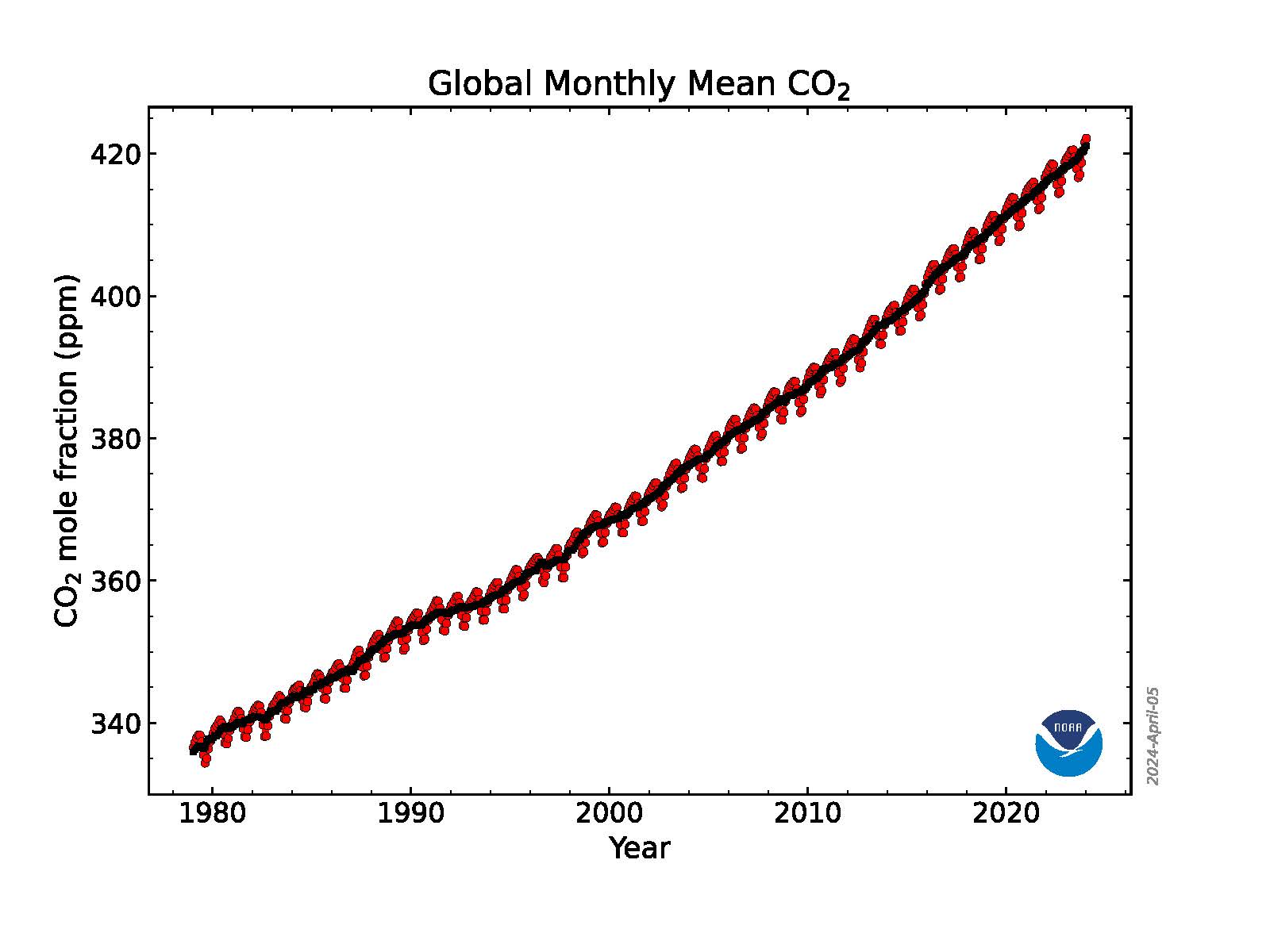
This graph shows the globally averaged monthly mean carbon dioxide abundance measured at the Global Monitoring Laboratory’s global network of air sampling sites since 1980. Data are still preliminary, pending recalibrations of reference gases and other quality control checks. Credit: NOAA GML

Many of the IRA’s programs came in the form of grants, loans or direct spending that has already been committed. One of the largest is the Greenhouse Gas Reduction Fund, a $27 billion “green bank” program. Most of that money was awarded in August to nonprofits, which will now be able to lend the funds directly to emissions-cutting projects or distribute them to a network of green banks around the country. Some of its programs are intended to benefit communities that have limited access to financing for things like rooftop solar or energy-efficiency retrofits.

Reed Hundt, chief executive of the Coalition for Green Capital, one of the recipients, said the fund differs from tax credits because his group can choose projects that will have outsized climate impacts. It is also looking to fund projects in rural and often conservative states that might be less likely to get commercial loans for renewable energy projects, Hundt said.

The Greenhouse Gas Reduction Fund money has been obligated, meaning it would take violating a contract to pull it back. But a hostile administration or Congress could use hearings, oversight or staff cuts to make it harder for the banks to spend the money, said Kyle Kammien, policy director of the Green For All program at Dream.org, an advocacy group focused on green jobs and criminal justice.

“In some ways it’s safe, but you could see how political levers could make it less effective or slow it down,” Kammien said.

For other programs, simply cutting staffing at agencies could make it harder to spend money that’s already been obligated.

Still, the architects of the IRA designed it with elections in mind, said Kate Gordon, a former senior adviser to U.S. Energy Secretary Jennifer Granholm and now chief executive of California Forward, an economic development nonprofit. The bill’s timelines, its broad distribution of funding across the economy and the country, were all meant to make it more popular and durable.

“It brings a lot more people and places into the conversation versus your typical government policy that says, ‘We are going to build a big thing,’” Gordon said. She told the story of a visit she made to a summit in Wyoming organized by the state’s governor and senators, neither of whom had voted for the IRA.

“They didn’t vote for it for political reasons, I’m sure, but they were 100 percent in in taking advantage of it,” Gordon said. She compared the IRA to President Barack Obama’s health care legislation, which was attacked for years but has remained in place.

“My gut is that there will be a lot of talk about repealing things,” she said, “and not a lot of action.”

Upper #YampaRiver Conservancy launches watershed data dashboard — Steamboat Pilot & Today

Screenshot from the Yampa River Dashboard

Click the link to read the release on the Steamboat Pilot & Today website:

The Upper Yampa Water Conservancy has launched a new website gathering historic, current and forecasted watershed data from the Yampa River Basin last week. The new website, the Yampa River Dashboard, provides a centralized location to access watershed data as a way to assist local water managers and the public with timely information related to recreation, water quality standards, flood irrigation and reservoir management.

“The new Yampa River Dashboard is an essential tool for the City in our ongoing efforts to monitor, protect and enhance the health of the Yampa River,” said Julie Baxter, water resources manager for the City of Steamboat Springs, in a statement. “The dashboard is also a valuable resource for community members, offering updated information on river conditions.”

The conservancy is encouraging both water professionals and the public to utilize the new tool.  Whether looking for recreational opportunities, timing flood irrigation, managing reservoir releases, or looking for water quality standards, users can find the data needed to make more informed decisions about the Yampa River.

Navajo Dam operations update: Bumping down to 450 cfs October 22, 2024

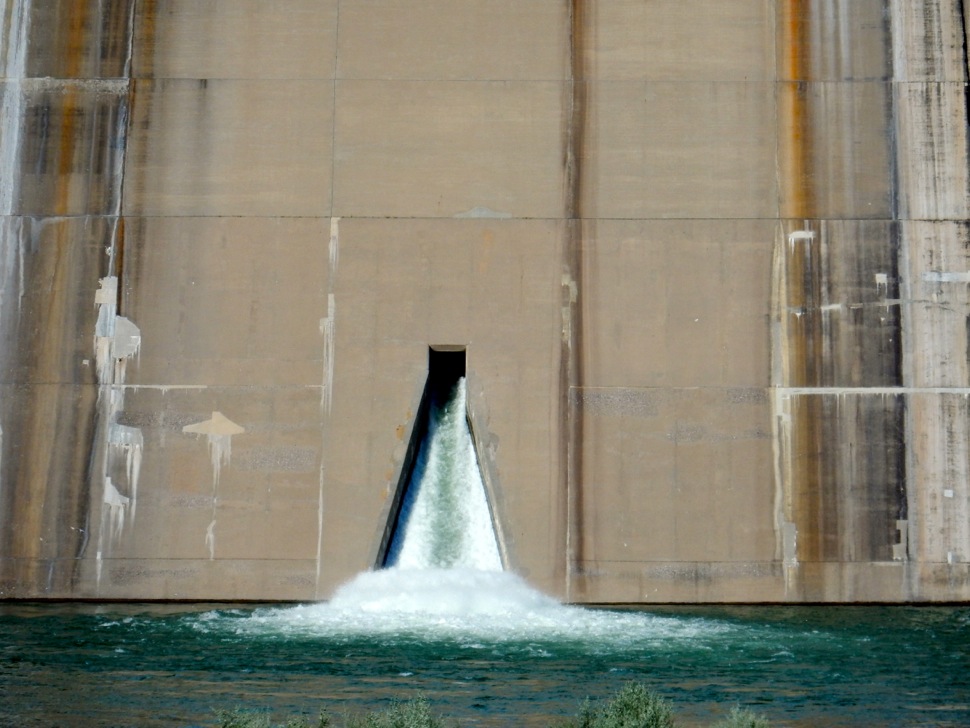
The outflow at the bottom of Navajo Dam in New Mexico. Photo: Brent Gardner-Smith/Aspen Journalism

From email from Reclamation’s Western Colorado Area Office:

With forecast sufficient flows in the critical habitat reach, the Bureau of Reclamation has scheduled a decrease in the release from Navajo Dam from 550 cubic feet per second (cfs) to 450 cfs for Tuesday, October 22nd, at 7:00 AM. Reclamation is still currently utilizing the 4×4 for the release point due to a maintenance project. This project will continue throughout October and November.

Releases are made for the authorized purposes of the Navajo Unit, and to attempt to maintain a target base flow through the endangered fish critical habitat reach of the San Juan River (Farmington to Lake Powell).  The San Juan River Basin Recovery Implementation Program recommends a target base flow of between 500 cfs and 1,000 cfs through the critical habitat area.  The target base flow is calculated as the weekly average of gaged flows throughout the critical habitat area from Farmington to Lake Powell.