#Drought news October 10, 2024: Dryness was exacerbated by high temperatures averaging at least 5 deg. F above normal last week in the High Plains region, and more than 10 deg. F above normal in most of #Colorado and #Wyoming,

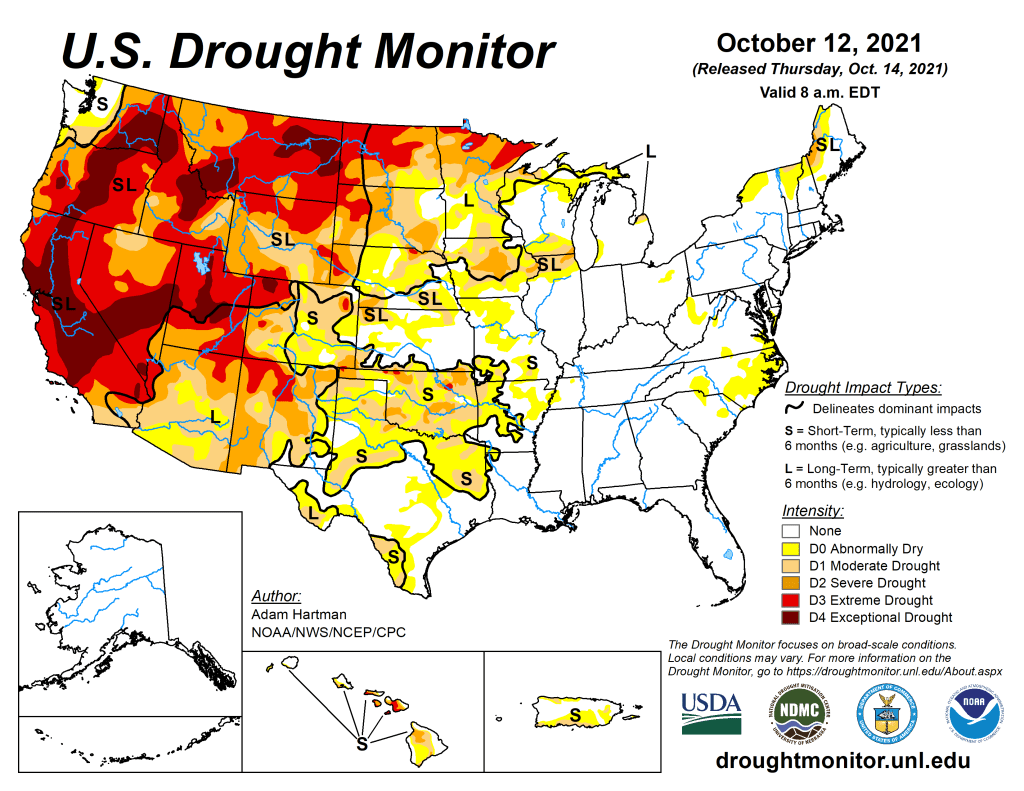
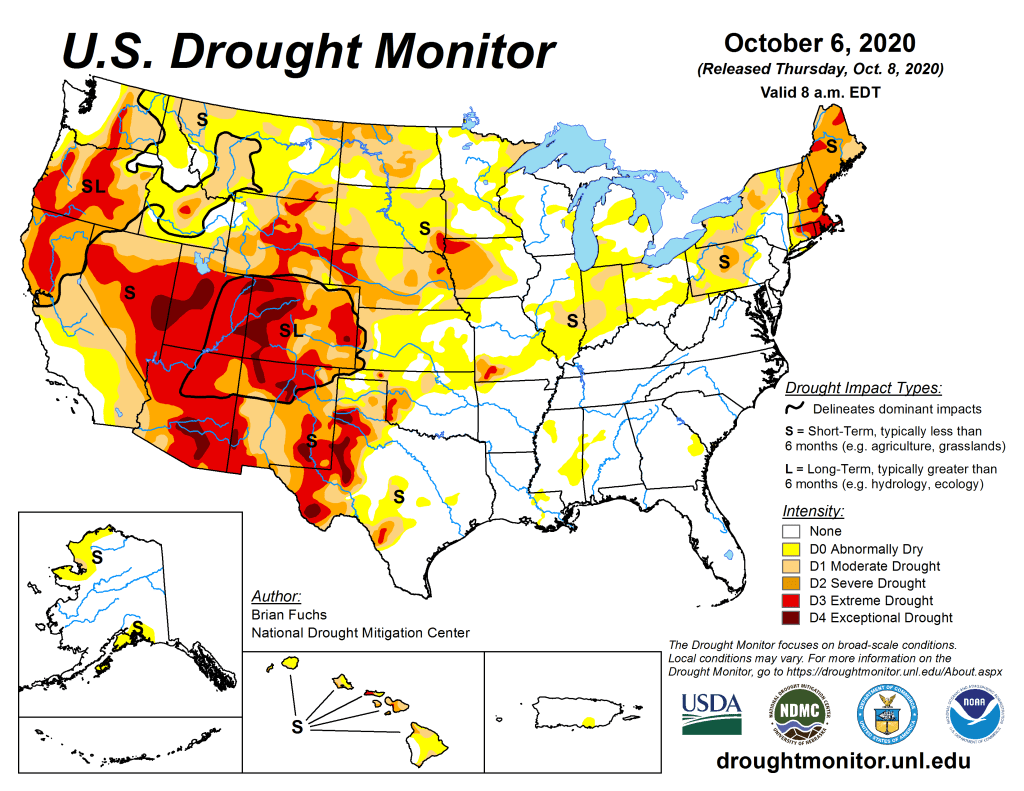
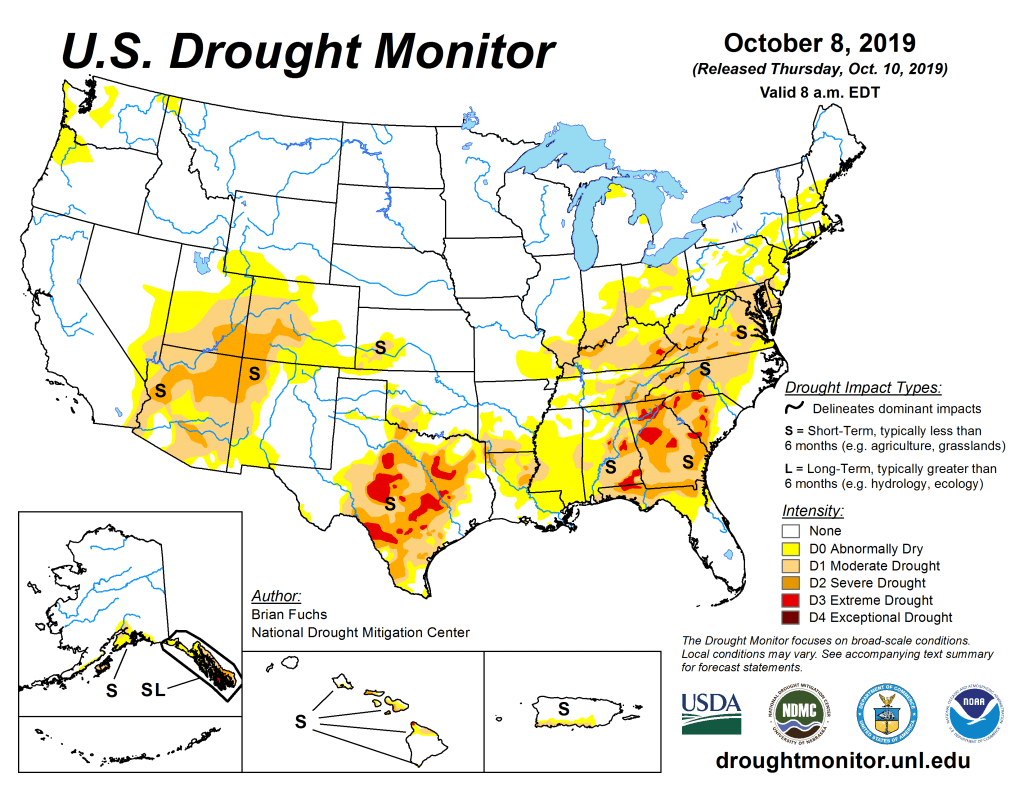
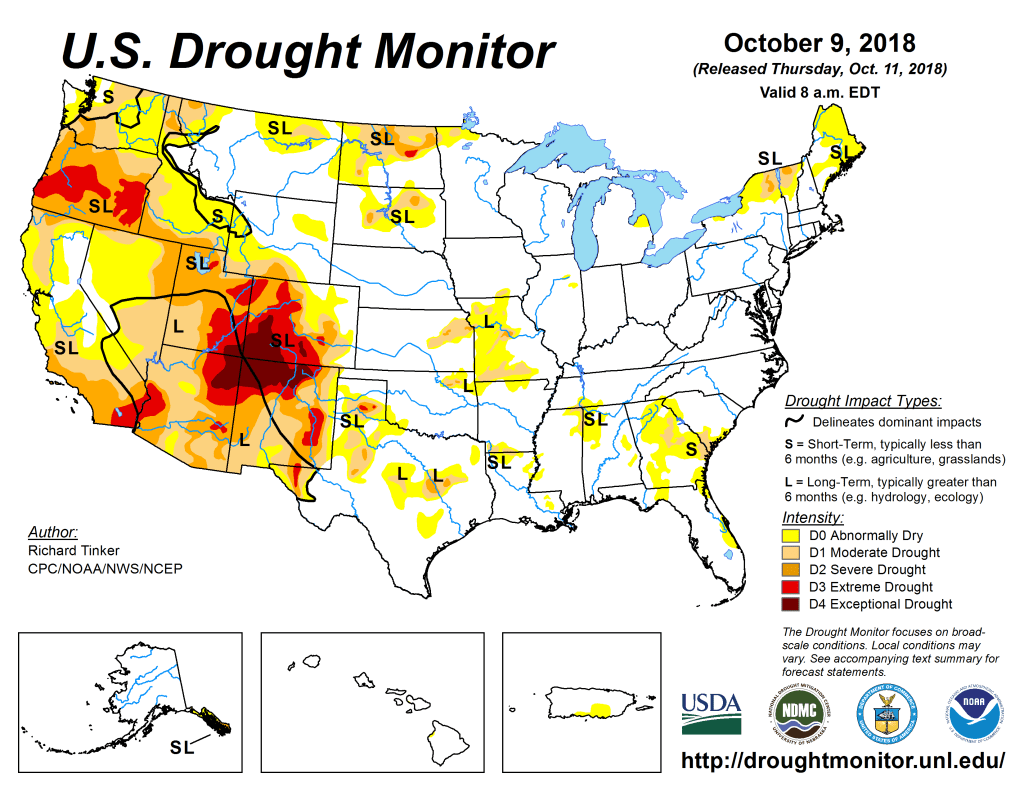
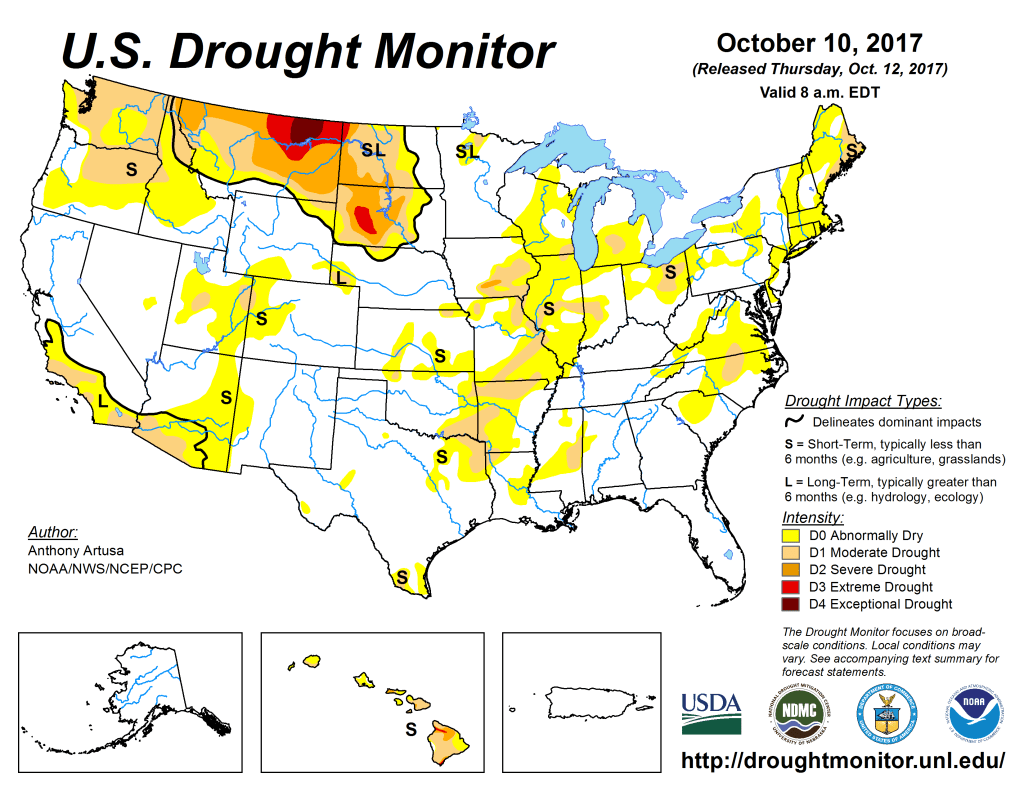
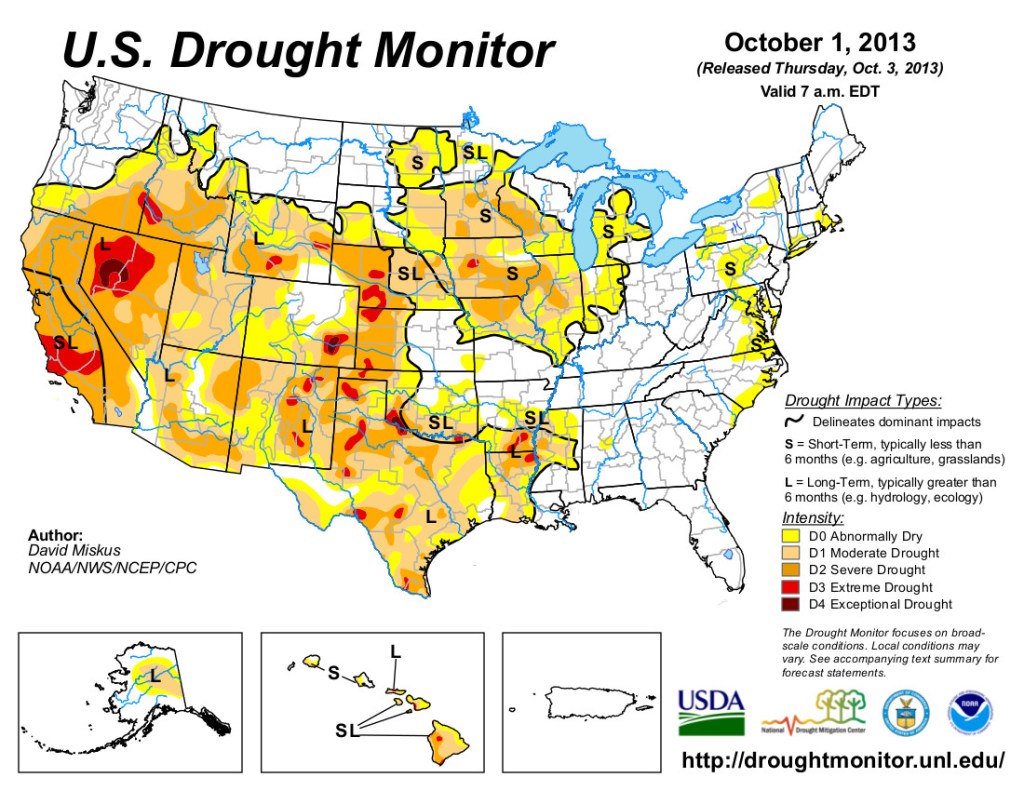
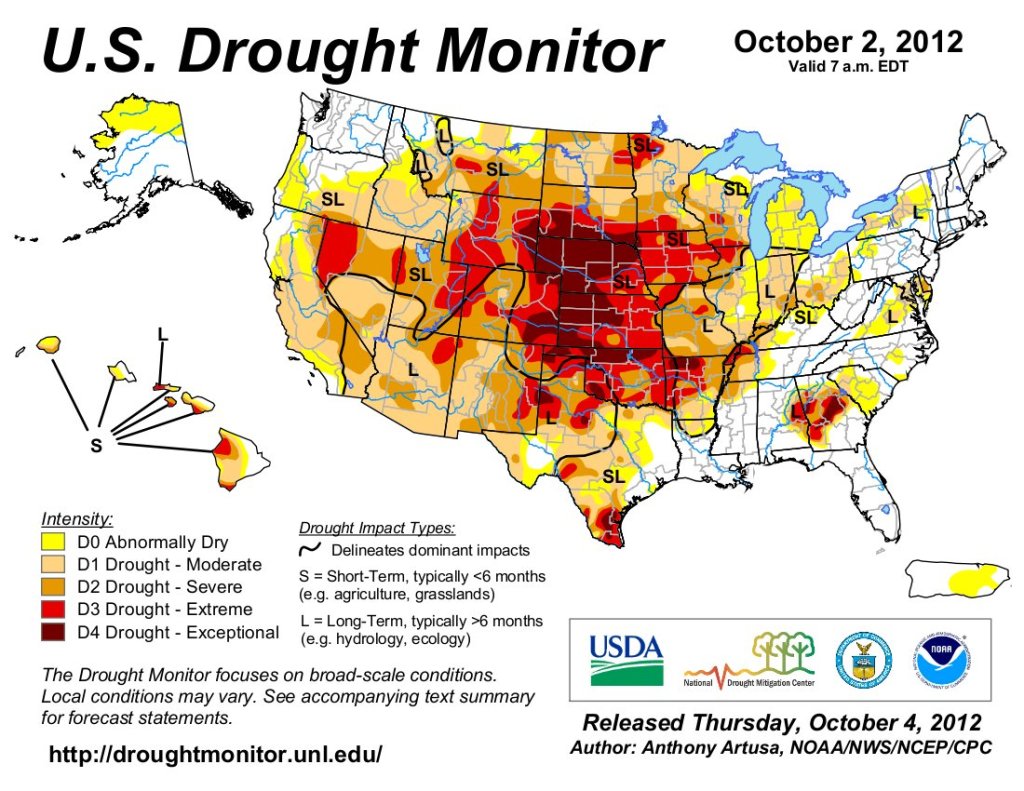
Click on a thumbnail graphic to view a gallery of drought data from the US Drought Monitor website.
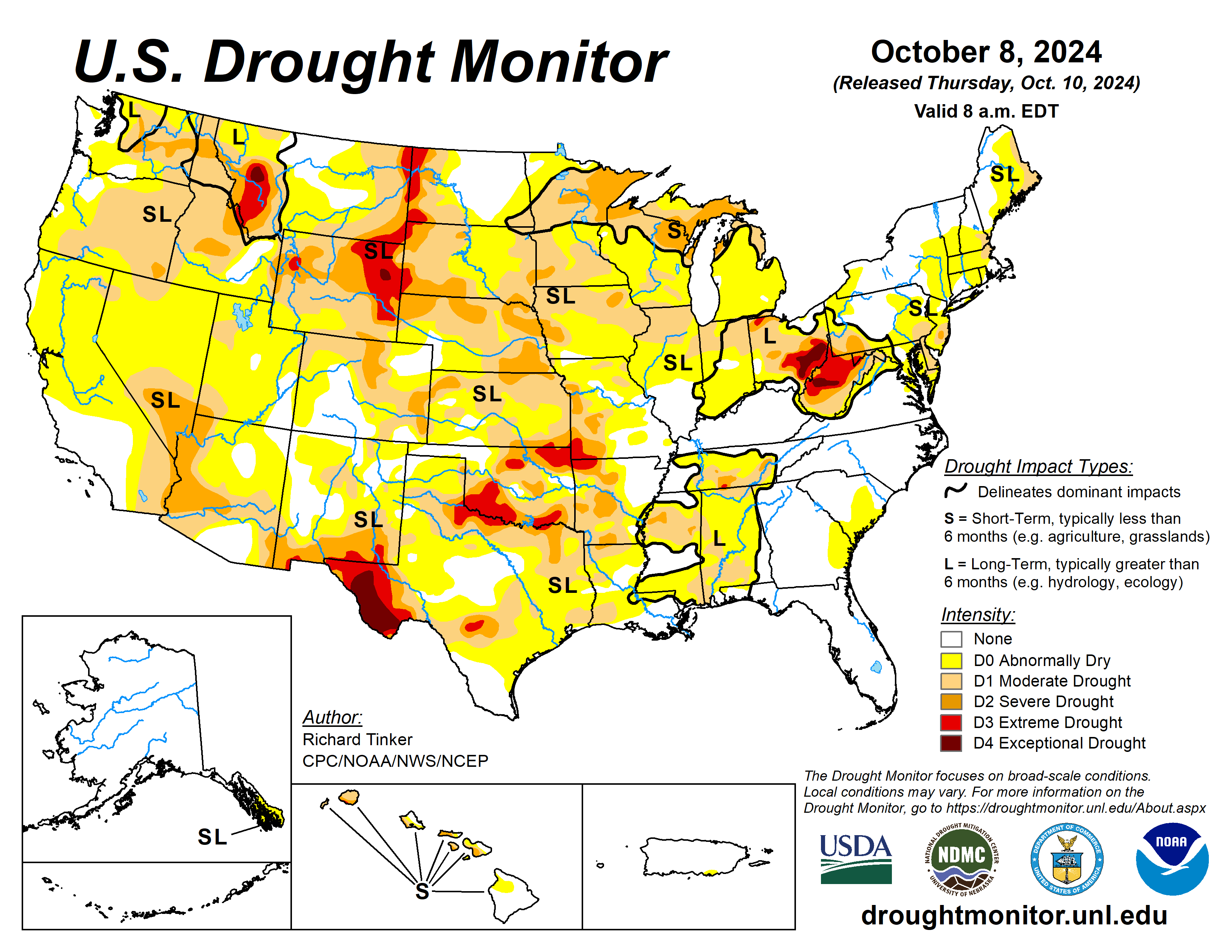
Click the link to go to the US Drought Monitor website. Here’s an excerpt:

This Week’s Drought Summary

After the intense rains from Hurricane Helene tapered off, this past week was extremely dry over a large majority of the contiguous 48 states. Rainfall totals exceeding 2 inches were limited to much of the Florida Peninsula, the immediate central Gulf Coast, the Louisiana Bayou, and Deep South Texas. Several small, isolated locations across these areas reported as much as 5 inches of rain. Significant rainfall was hard to find in other areas. Several tenths of an inch, with isolated totals up to 1.5 inches, fell on Maine, southeastern New England, the central Appalachians and foothills, southeastern Virginia, the Upper Peninsula of Michigan, southeastern Iowa, west-central Illinois, and the Pacific Northwest from the Washington and northern Oregon Cascades to the Pacific Coast. The remainder of the country recorded at most 0.25 inch of precipitation, with a vast majority of the area measuring no precipitation for the week. This abetted recovery in places devastated by the intense rains and flooding associated with Hurricane Helene, but also caused dryness and drought to persist or intensify. Rapid deterioration was starting to take place in parts of the Lower Mississippi Valley and southern Great Plains while deterioration proceeded at a slower pace in other parts of the Nation affected by dryness and drought. In addition, unseasonably high temperatures accentuated the dryness in many areas, particularly in the Southwest…

High Plains

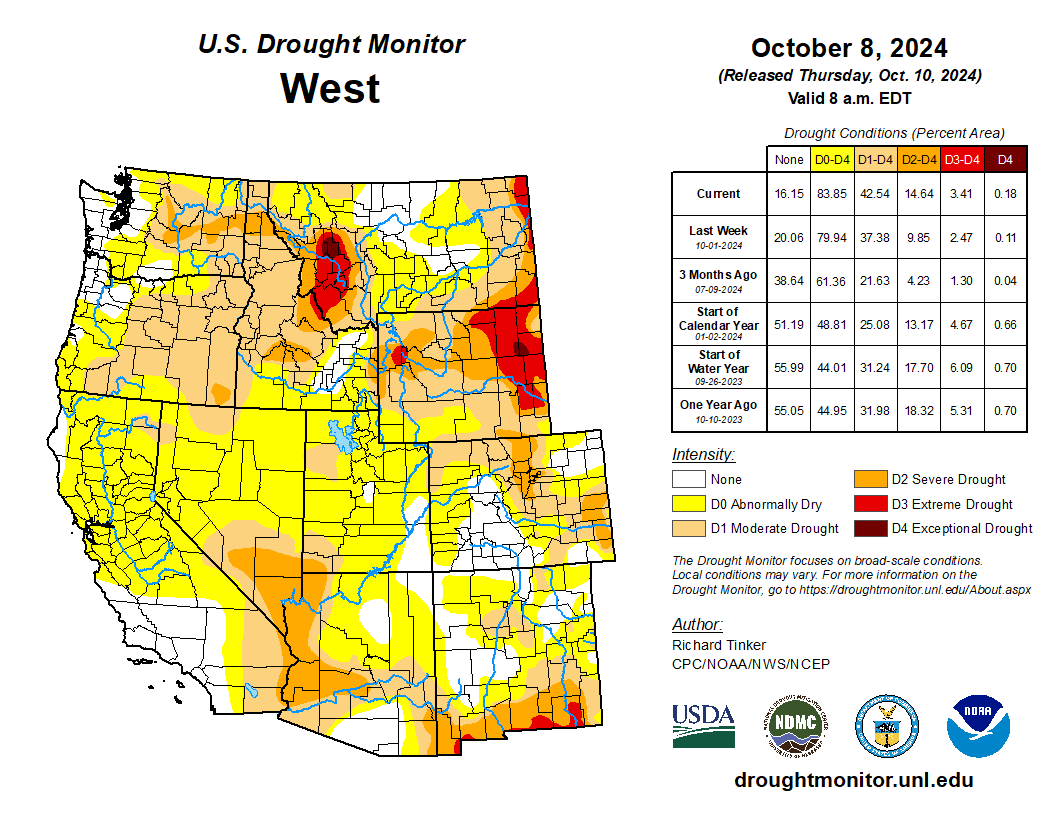
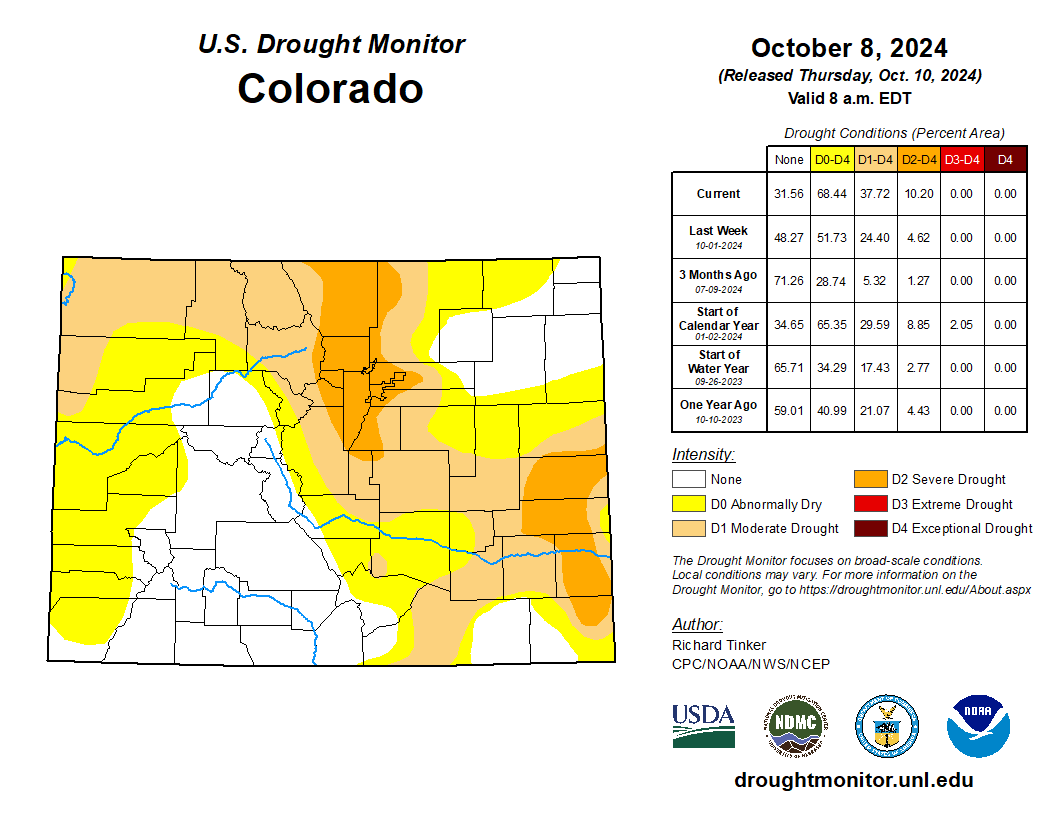
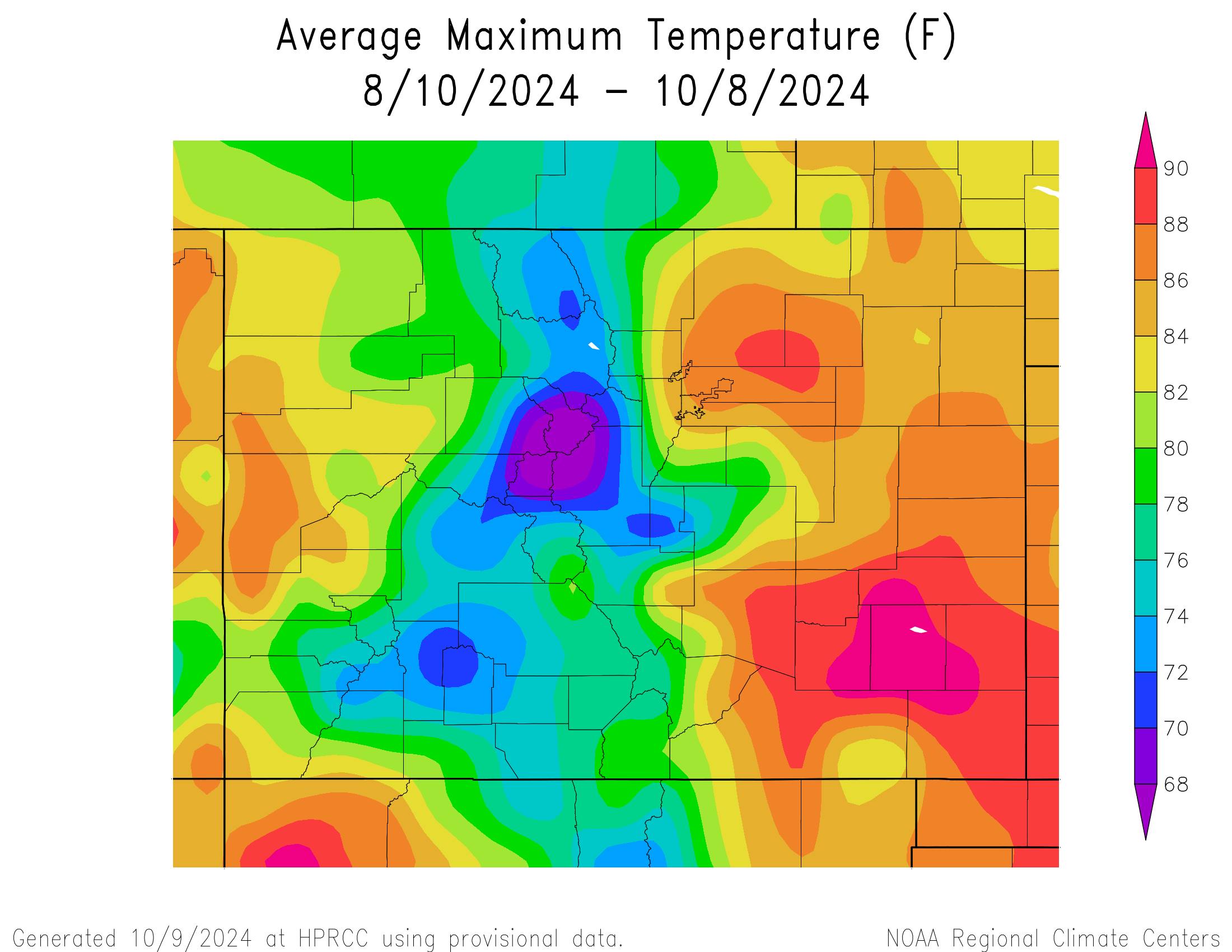
It was very warm and almost bone dry throughout the region for the second successive week. As a result, D0 to D3 conditions all expanded broadly, and most of the region is currently experiencing some degree of dryness or drought. The only areas free of abnormal dryness are central and eastern North Dakota, a few parts of southwestern Nebraska and western Kansas, northeastern Colorado, and parts of southern and western Colorado. A small patch of exceptional drought (D4) was introduced in east-central Wyoming, and extreme drought (D3) expanded across a large part of eastern Wyoming, much of the western tier of the Dakotas, and a couple small patches in southeastern Kansas. Since early June, precipitation has totaled less than half of normal through most of east-central and northeastern Wyoming, and shorter-term deficits of varying intensities envelop most of the High Plains Region. In addition, dryness was exacerbated by high temperatures averaging at least 5 deg. F above normal last week region-wide, and more than 10 deg. F above normal in most of Colorado and Wyoming, plus a few other scattered patches…
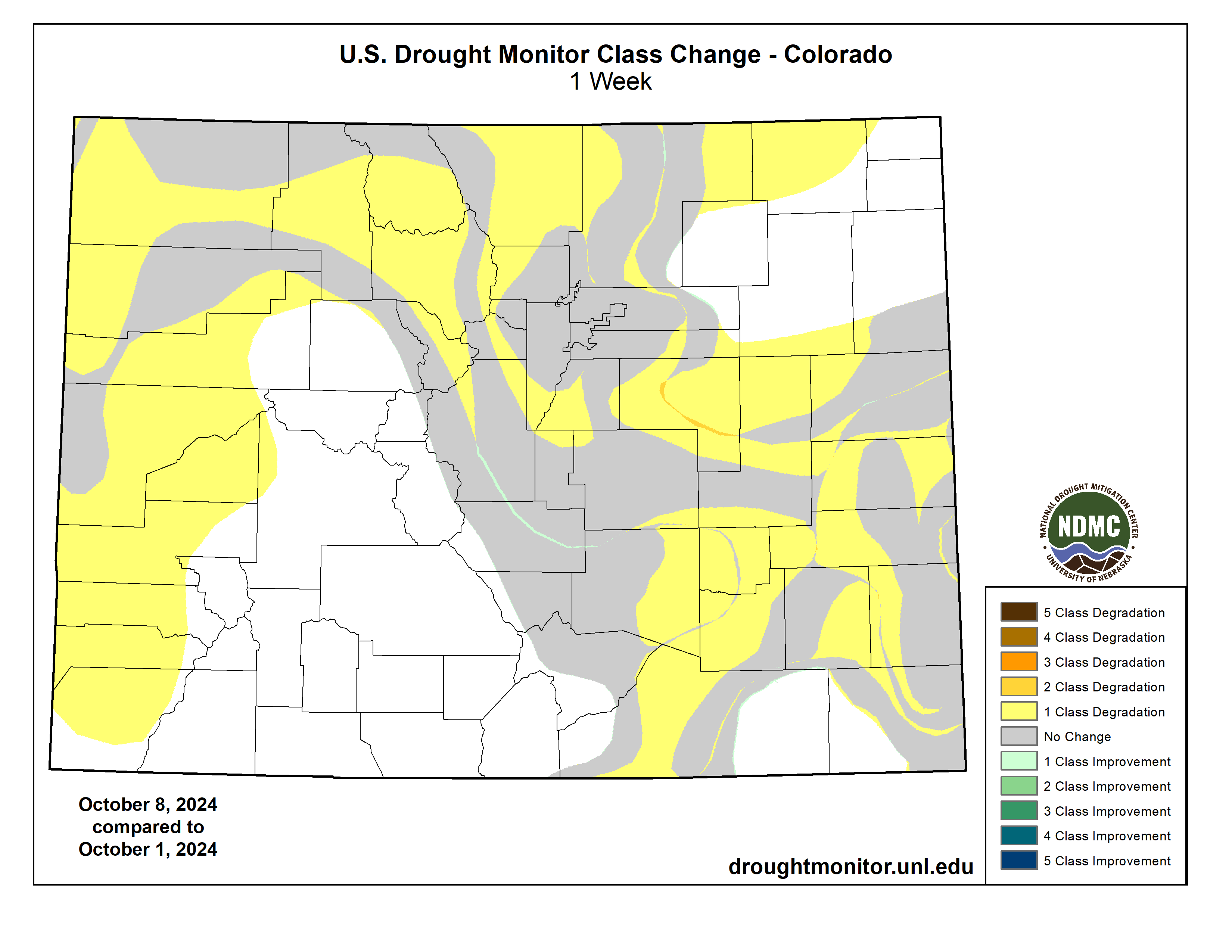
Colorado Drought Monitor one week change map ending October 8, 2024.

West

For the last couple of weeks, several tenths of an inch to over an inch of precipitation fell from the Cascades of Washington and northern Oregon westward to the Pacific Ocean, allowing temperatures to climb only slightly above normal and bringing an end to abnormal dryness in a small section of northwestern Washington where precipitation has been most significant. Slightly-elevated temperatures extended eastward through the state of Washington and some adjacent areas, but the rest of the West Region was significantly warmer than normal, with many areas reporting record or near-record heat for this time of year. Areas from southern Montana, central Idaho, and southern Oregon southward through the Great Basin, California, Arizona, and western New Mexico reported high temperatures averaging over 10 deg. F above normal, with most of California and the adjacent Southwest enduring almost summerlike heat 15 to 20 deg. F above normal for this time of year. For the past 2 months, high temperatures have averaged 4 to 8 deg. F above normal over central and eastern Montana, and through most of Arizona and some adjacent areas, including southern Nevada. A few locations in eastern Montana averaged more than 8 deg. F higher than normal. Drought tends to move slowly this time of year in the West Region, where light precipitation often doesn’t keep up with water loss to evapotranspiration and human usage, but the excessive heat has caused drought conditions to intensify at a quicker rate than usual. This past week, much of the West south and east of the Cascades saw conditions deteriorate sufficiently to justify an increase in the Drought Monitor classification, with a large D2 expansion in the Southwest as well as parts of eastern Washington and Idaho. D2 to D4 conditions (severe to exceptional drought) also covered western Montana, unchanged over the past several weeks. On the southern tier of the West Region, D2 and D3 conditions increased slightly in coverage over southern New Mexico. The area with some improvement was found in central Idaho due to the sustained effects of precipitation a few weeks back…

South

Over 2 inches of rain soaked Deep South Texas and the Louisiana Bayou, but amounts decreased rapidly moving away from these areas, and a vast majority of the region saw no measurable rain during the week. As a result, conditions began to quickly deteriorate over a large part of the region. Dryness and drought of most intensities (D0 to D3) expanded in coverage across large parts of Oklahoma and adjacent Texas, western and eastern Texas, and parts of Louisiana. In Mississippi, a re-assessment of 90- to 180-day precipitation totals and some unfavorably low agricultural statistics, such as reduced hay production, led to the re-introduction of some D2 in west-central and east-central Mississippi, although most locations in that state changed little from last week. Dryness and drought in Tennessee worsened in a few areas, but most locations were not declining as quickly as some areas farther west on the other side of the Mississippi River. Currently, exceptional drought (D4) covers a sizeable portion of western Texas, and extreme drought (D3) was assessed in the rest of western Texas, much of the Red River Valley (South), parts of northern Oklahoma, and northwestern Arkansas. Much of Oklahoma outside the Panhandle, adjacent Texas, and western Arkansas are 4 to 8 inches below normal rainfall since early June. Less than half or normal rain has fallen during this period across and near the Red River Valley (South). Daily high temperatures averaging over 10 deg. F above normal across most of Oklahoma and some adjacent locations worsened the rate of deterioration…

Looking Ahead

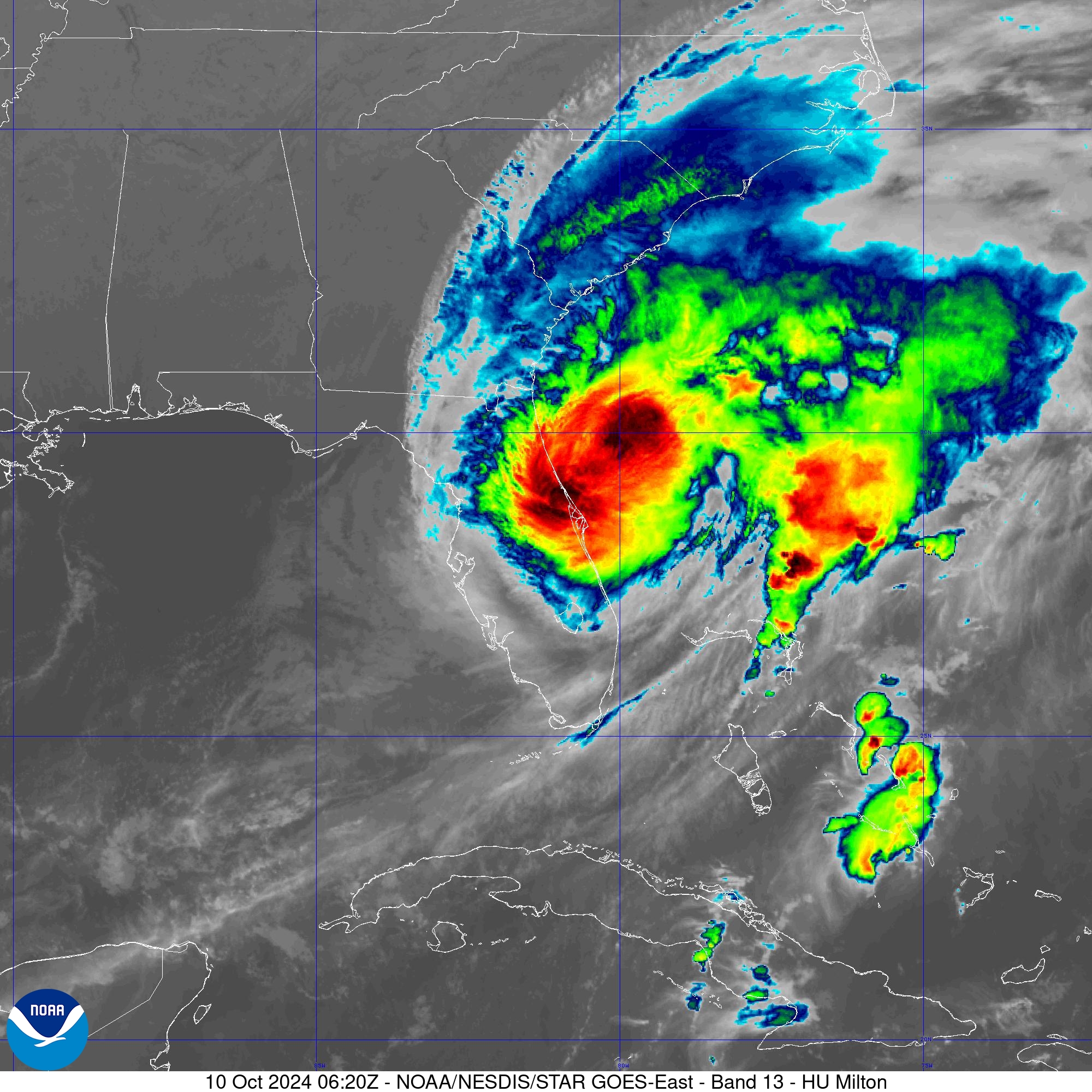
During the next five days (October 10 – 14), Hurricane Milton will contribute to excessive rainfall across much of the central and northern Florida Peninsula, but most other parts of the Nation should expect little precipitation, if any. Between 10 and 15 inches of rain are expected in part of the northeastern Florida Peninsula, and totals of at least 5 inches are expected from St. Petersburg and Cedar Key northward to the Florida Big Bend and the south side of Jacksonville. To the north and south of this band, precipitation totals will be considerably lower. Near or less than an inch is expected over most of the southern Florida Peninsula. Farther north, there will be a tight gradient between heavy rain and little or none, with totals over 0.25 inch no farther north than just north and west of the Florida Big Bend through extreme southeastern Georgia. Elsewhere, a frontal system is expected to drop 0.5 to 1.0 inch of rain from the northern and eastern Great Lakes through northwest Pennsylvania, upstate New York, and central and northern New England. Light to locally moderate totals (0.1 to 0.5 inch) are forecast aross the Upper Ohio Valley and southern New England, and across northwestern California from San Francisco to the Oregon border. Little or no precipitation is expected across the remainder of the contiguous U.S., including most areas impacted by dryness and drought. Near or slightly less than normal precipitation is expected in far southeastern Alaska. Meanwhile, temperatures are anticipated to be above normal from most of Texas and the High Plains westward to the Pacific Coast. Daily maximum temperatures are forecast to average 10 to 16 deg. F above normal across the northern halves of the Rockies and Intermountain West. In contrast, most locations east of the Mississippi River are expected to average cooler than normal, with highs averaging 4 to 6 deg. F below normal through most of the Appalachians, eastern Great Lakes, and New England.
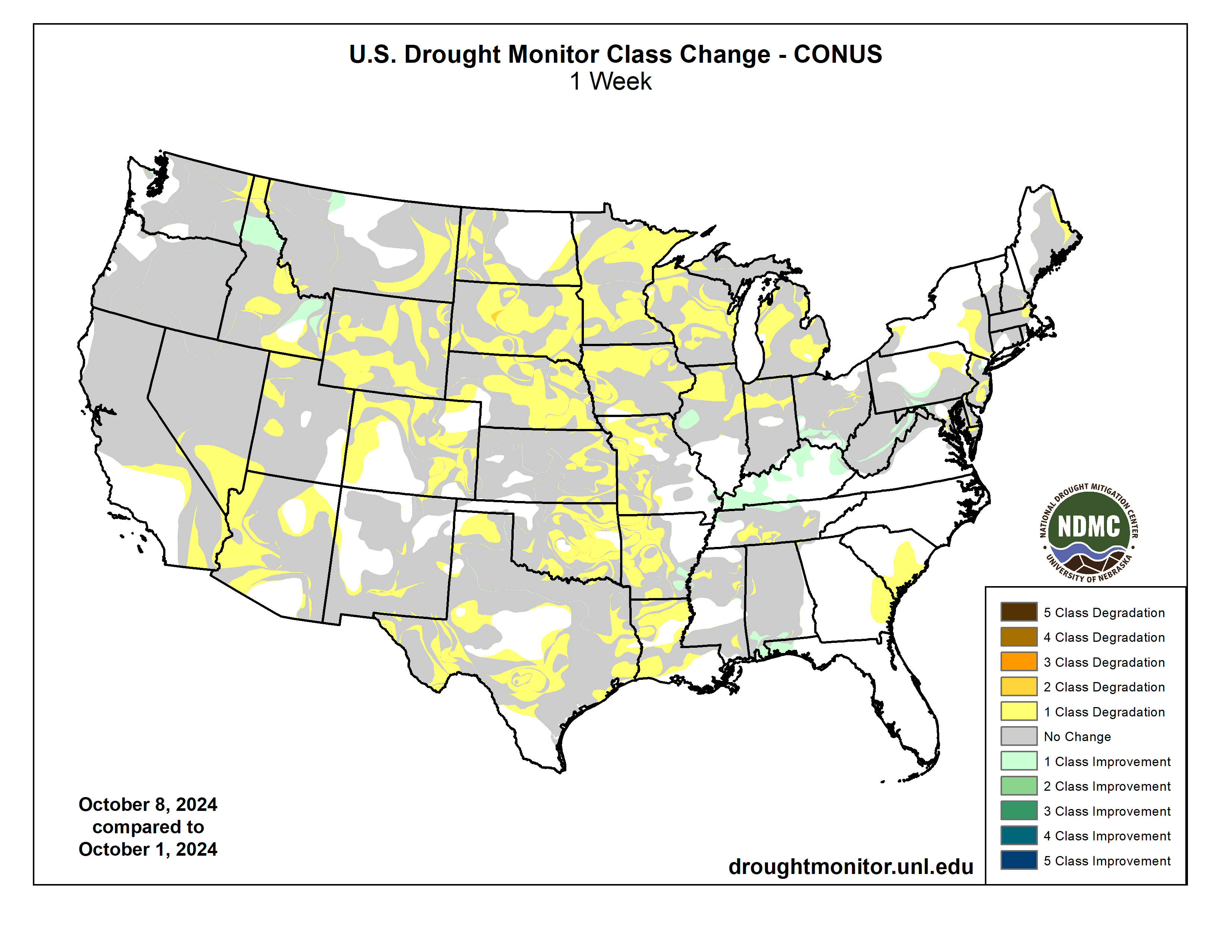
US Drought Monitor one week change map ending October 8, 2024.

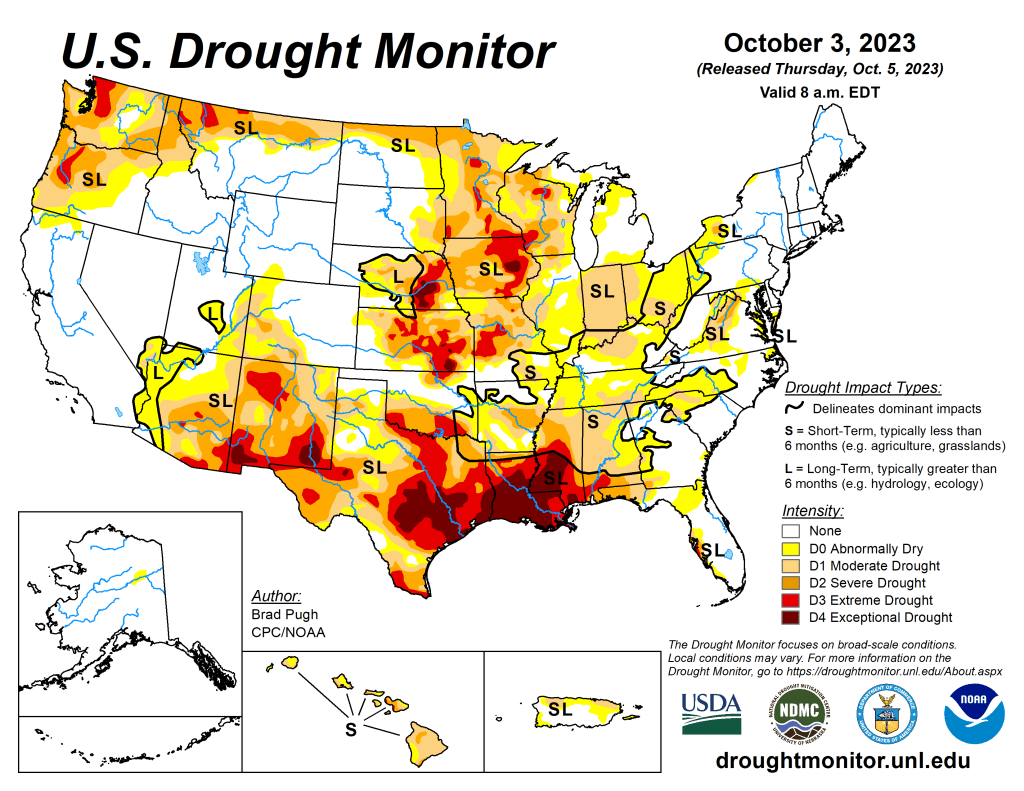
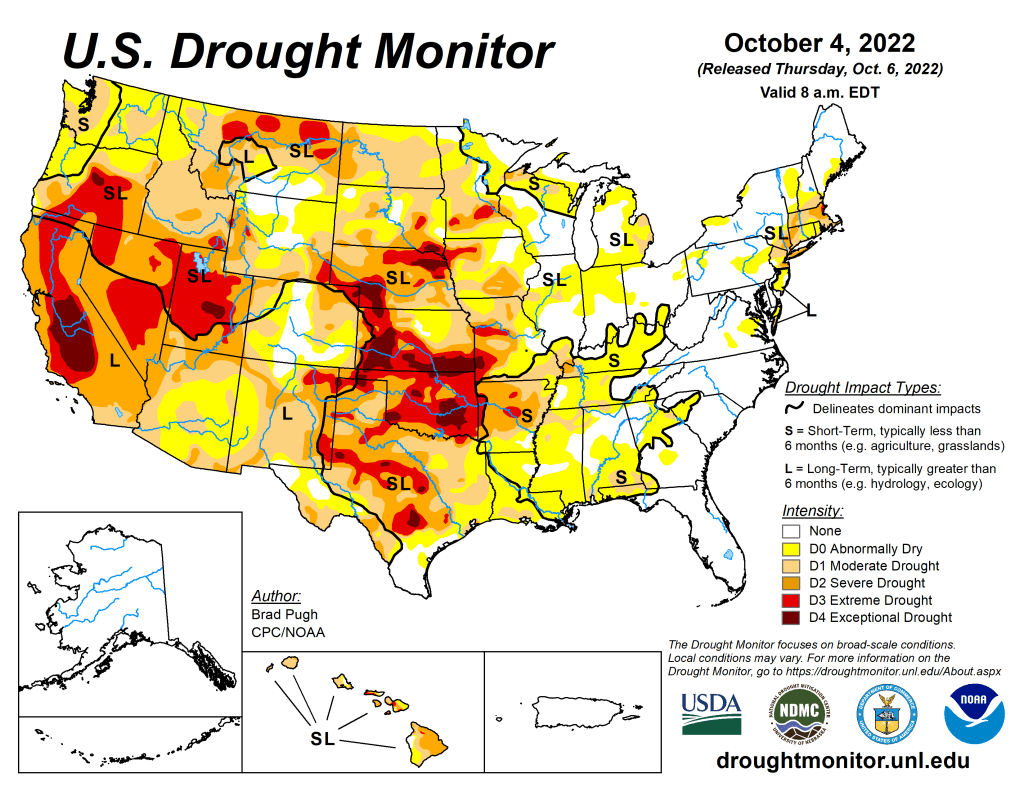
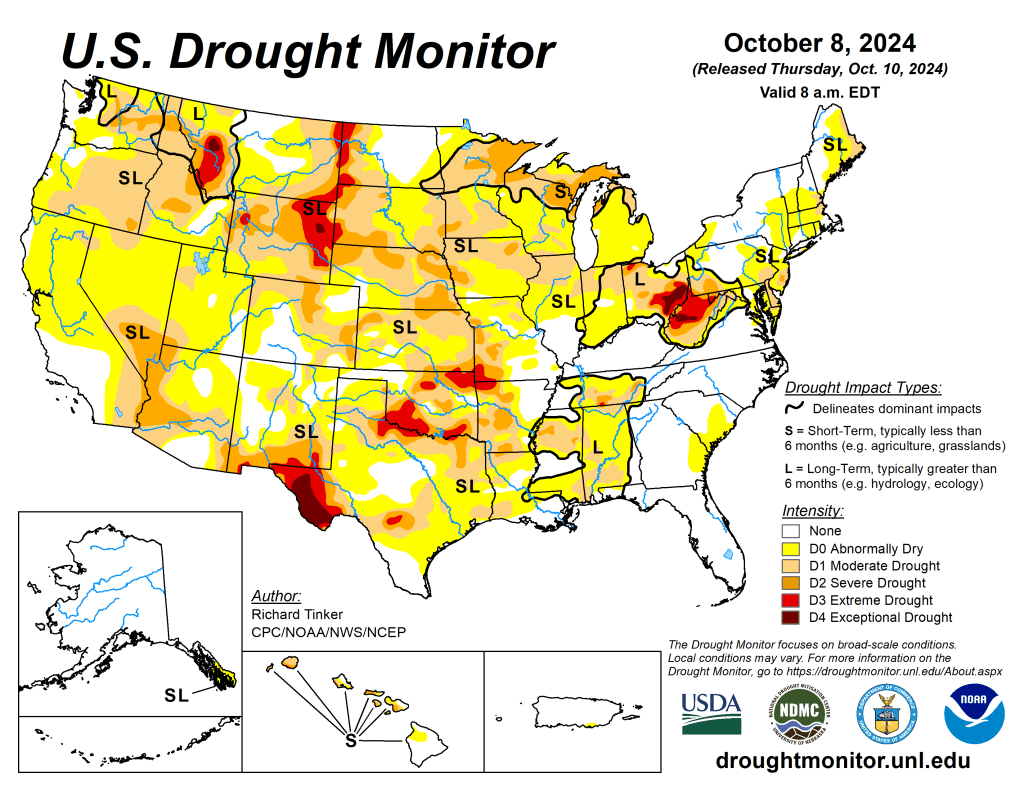
Just for grins here’s a slideshow of early October US drought Monitor maps for the past few years.
Fear: When It Helps, When It Hurts — Bill McKibben #ActOnClimate

[3:00am EDT Oct 10] A Flash Flood Emergency continues over portions of west-central Florida. Hurricane #Milton continues to move ENE across the Florida Peninsula. http://hurricanes.gov/#Milton

Click the link to read the newsletter on The Crucial Years website (Bill McKibben). Here’s an excerpt:

October 9, 2024

Since I couldn’t sleep, I figured I might as well write. I couldn’t sleep because of the picture in my mind—that tightly coiled ball of physics we’re calling Hurricane Milton as it tracks mercilessly across the Gulf of Mexico, headed toward a landfall tonight along the west coast of Florida. It scares me, for two reasons.

The first is the unrivaled speed with which it spun up, from tropical storm to Category 5 monster inside a day. This ā€œrapid intensificationā€ has become an increasingly common feature of hurricanes, because the heat content in the ocean is so high that the old models no longer suffice. We live, more and more, in a world of instant chaos: where wildfires can ā€œblow upā€ in a matter of minutes because the fuels that feed them are so desiccated, where ā€œflashā€ floods can, in minutes, turn a record rain into a street clogged with bobbing cars. These things have always been possible, but now they are common: we have in our minds the idea that the world changes at a geologic pace, moving in stately fashion through epochs and eras. But right now—as carbon dioxide accumulates more quickly in the atmosphere than at any point in the last 500 million yearsā€”ā€geologic paceā€ is measured in months. Hell, glaciers—our metaphor for moving slowly—disappear from one winter to the next.

And the second reason is: this speeded up physics is increasingly crashing into the heart of the civilizations that we’ve built. Given the size of the planet, it’s more likely than not that a disaster will happen in somewhere sparsely populated—the boreal forests of Canada burned last summer, displacing Indigenous people of the north but mostly avoiding cities. Even Hurricane Helene last week came ashore in the Big Bend country north of Cedar Key, where people are thin on the ground. But just as California’s wildfires eventually and inevitably started taking out whole towns, Milton is aimed at one of the most built-up and vulnerable landscapes on earth. I think—from this morning’s bearings—that the very worst outcome may be dodged: if the hurricane comes in just south of Tampa Bay, its counterclockwise winds will work to drive the storm surge off that body of water. But if so it will mean sheer agony for somewhere further south, somewhere almost as overbuilt. Sarasota? Port Charlotte? And in very short order that will mean deep trouble for the insurance industry, already tottering in Florida

(It’s worth noting, if only in passing, that the two places Americans of my age thought of as refuges, idylls, dreams of the easy life were California and Florida. No longer).

We’ve spent some time in recent years worrying that there was too much fear-mongering and doom-saying in the way we talked about climate change—that it was wearing people out. And indeed there’s truth there—if we’re going to do what we must, the story in the years ahead needs to be as much about the adventure of turning our planet solar as the dread that we’ll turn our planet Venus.

But there are important moments when fear is a crucial resource. A week ago, in the wake of Helene, the veteran climate activist and North Carolina native Anna Jane Joyner wrote this dispatch from New York’s ā€œClimate Weekā€

And yesterday, on air, the veteran Florida weatherman John Morales let his fearĀ show through.Ā As Cara BuckleyĀ recountedĀ in the Times,

This kind of fear is entirely useful—there are, I have no doubt, people who left their homes and drove north towards Georgia after hearing the break in Morales’ voice. He saved lives. And he did it entirely honestly. ā€œYou know what’s driving that,ā€ he said to viewers. ā€œI don’t need to tell you. Global warming. Climate change.ā€ It’s honest fear, driven by deep understanding.

Bill McKibben, right, conferring with Land Institute founder Wes Jackson at the 2019 Prairie Festival, has strongly motivated many, including some CRES members. Photo/Allen Best

The sweaty September scourge strikes again: September, once the sweet harbinger of autumn, sets another heat record. The rising heat affects @DenverWater supplies — News on Tap #ActOnClimate

Click the link to read the article on the Denvver Water website (Todd Hartman):

October 4, 2024

Last year in this space, we asked ā€œWhatever happened to the September swoon?ā€ as we noted the fact that Septembers — once the month for a gentle, luscious cooldown as we eased into autumn — have become August 2.0.

Story update for 2024: September was hot. Again. Breaking-records hot for Denver, in fact.

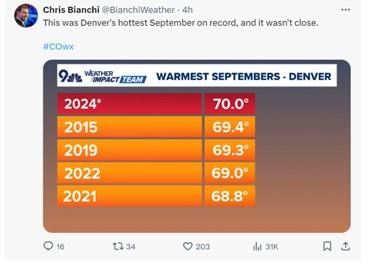
Chris Bianchi, a meteorologist at 9News, included this list of hottest Septembers in recent years in a tweet on X.

National Weather Service data shows September’s average temperature (across both the daytime and nighttime) for Denver was 70 degrees. That beats the old record of 69.4 degrees set back in 2015, not even 10 years ago.

Experts suggest the rising average temperatures are a key indicator for climate change in Colorado, as the trend seems to have solidified. Four of the last six Septembers have been the four hottest on record.

These hot Septembers are creating ripples for the environment and for water managers.

“The hot September trend is concerning. It means less natural streamflow in the rivers that provide Denver Water’s supply as more water is lost to evaporation and taken up by thirstier plants,ā€ said Nathan Elder, Denver Water’s manager of supply. 

That’s also affecting Denver Water’s collection system. Natural streamflow in September has fallen below the system’s long-term average every year since 2014.

Hot Septembers also mean Denver Water customers are using more water on their landscaping during the month. Since 2017, customers’ outdoor usage during September has been roughly 20% higher compared to September usage between 2000 and 2016.

So, what do we do about it? It’s another reason we make water conservation and efficiency a high priority for the 1.5 million people we serve. 

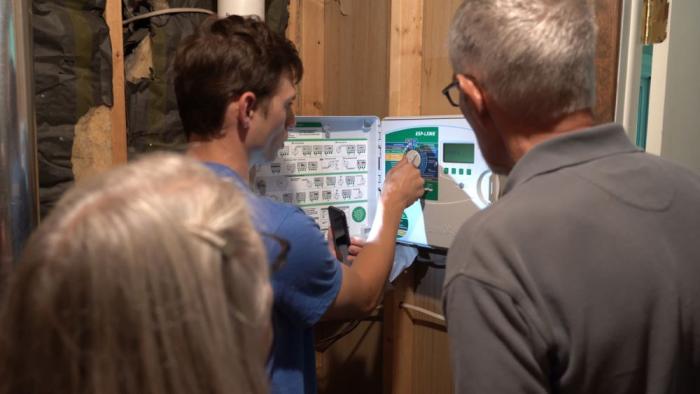
Oct. 1 marked the end ofĀ summer watering rules, so first and foremost it’s time to dial back on the watering and let your lawn and plants prepare for winter dormancy.Ā 

Denver Water’s annual summer watering rules ended Oct. 1, meaning it’s time to dial it back on the watering to allow your lawn and landscapes to ease into winter dormancy. Photo credit: Denver Water.

Better yet, start to think about long-term landscape changes that would reduce your need for higher summer watering. Purchasing a Garden In A Box kit through Resource Central is one great avenue to explore.

Small steps are a perfect way to start, too. There’s no need to tear out all your grass or make giant changes all at once. Taking it slow and learning as you go works too.

You can learn about waterwise plants and landscape transformation on our TAP news site. Try these links for a small sample: Myths and tips about waterwise plantsFive water-wise favorites from Plant Select!Creating a ColoradoScape.

Meanwhile, we can hope October doesn’t follow September’s hot trend.

Trout restocked in #YampaRiver following wildlife area aquatic restoration project — Steamboat Pilot & Today

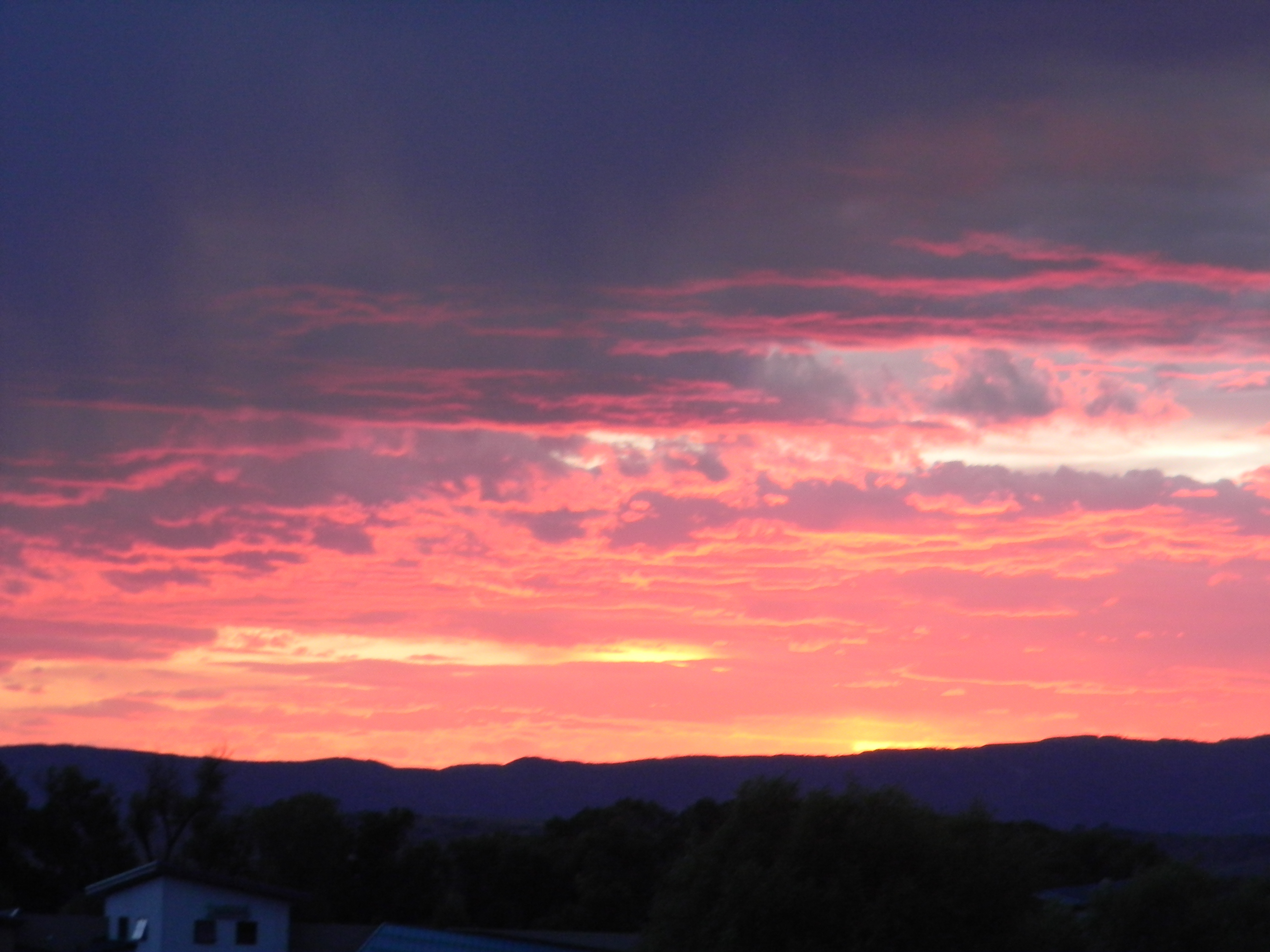
Sunset over the Yampa River Valley August 25, 2016.

Click the link to read the article on the Steamboat Pilot & Today website (Suzie Romig). Here’s an excerpt:

October 8, 2024

As volunteers with Trout Unlimited Yampa Valley Fly Fishers, husband and wife Steve Randall and Kathy McDonald were happy to help with the release of some 20,000 rainbow trout fingerlings into the Yampa River on Monday…Randall and other volunteers helped Colorado Parks & Wildlife staff carry, release and disperse into the Yampa River many tubs of squirming 3-inch trout raised at the fish hatchery in Glenwood Springs. The small fish were dispersed where CPW supervised $500,000 is aquatic habitat improvement work this summer at the upstream reach of Chuck Lewis State Wildlife Area…

Randall called it ā€œso coolā€ to see the newly restored section of the river that before was full of ā€œold cars, junk and eroded streambanks silting in different places.ā€

[…]

CPW Aquatic Biologist Billy Atkinson said with rapid initial grown of young trout, the released fingerlings should be 10 inches and ready to challenge anglers in about two years. Standing along the river in waders, Atkinson explained that a previous restoration project in 2008 in the river section was not successful for sustained habitat for bigger fish and not structurally sound. The previous project failed so much so that the river was threatening to reroute and cut west away from the fixed point of a bridge downstream, he said. The redesigned restoration project that started in mid-July included constructing multiple rock structures to direct stream energy away from banks, adding bank full bench features with coir fiber wrapped sod and willow vegetation mats, adding an inner berm design feature to help fish during lower flows, regrading vertical eroding banks and removing transverse and mid-channel bars to reshape the channel bed to appropriate dimensions. The project is intended to prevent further degradation that would result in more costly maintenance, additional loss of habitat and continued contributions of excessive gravel to the river system, according to CPW.

Yampa River Basin via Wikimedia.