
Click the link to access the article on the Nature Communications website (Tessa Möller, Annika Ernest Högner, Carl-Friedrich Schleussner, Samuel Bien, Niklas H. Kitzmann, Robin D. Lamboll, Joeri Rogelj, Jonathan F. Donges, Johan Rockström & Nico Wunderling). Here’s the abstract:
August 1, 2024
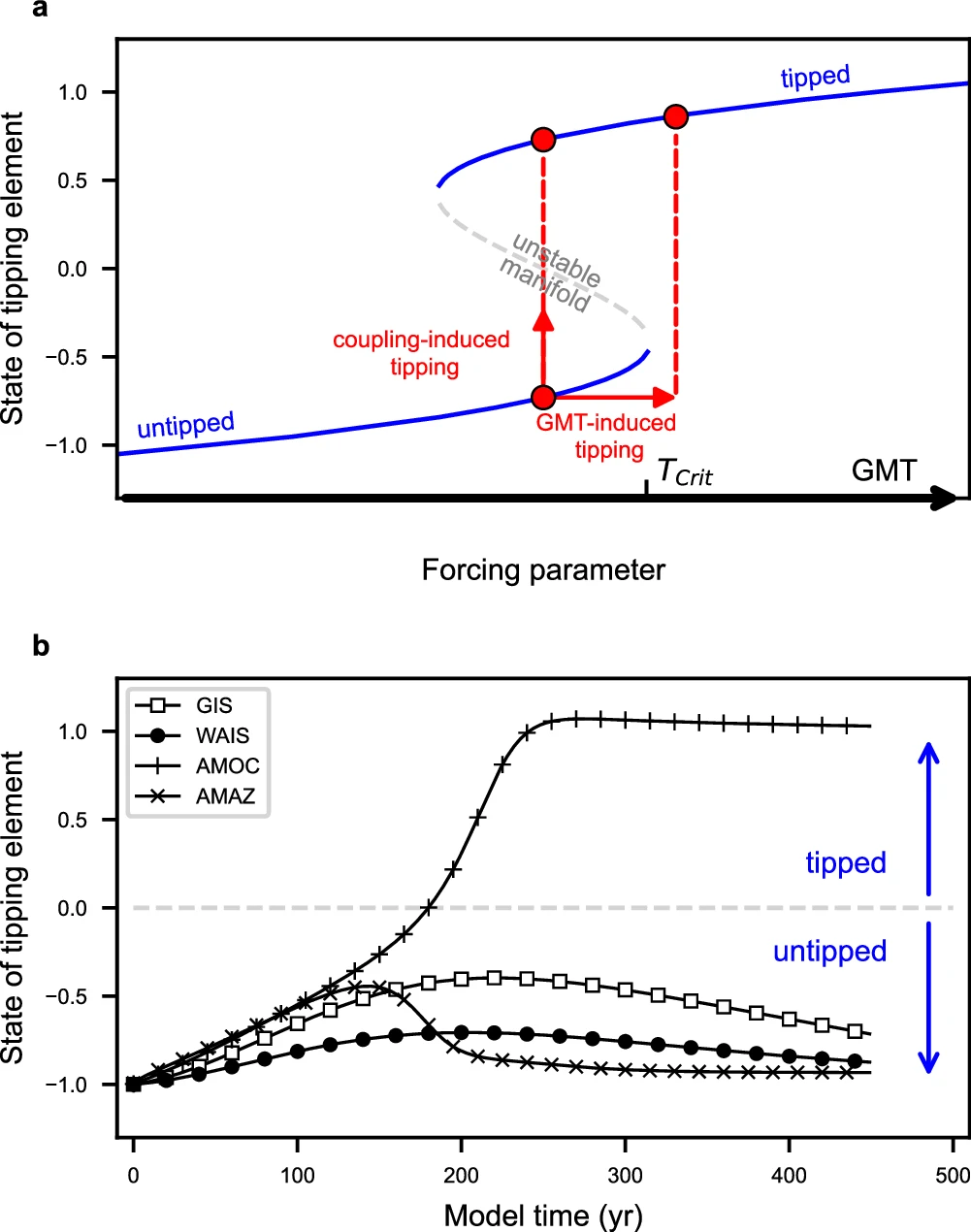
Under current emission trajectories, temporarily overshooting the Paris global warming limit of 1.5 °C is a distinct possibility. Permanently exceeding this limit would substantially increase the probability of triggering climate tipping elements. Here, we investigate the tipping risks associated with several policy-relevant future emission scenarios, using a stylised Earth system model of four interconnected climate tipping elements. We show that following current policies this century would commit to a 45% tipping risk by 2300 (median, 10–90% range: 23–71%), even if temperatures are brought back to below 1.5 °C. We find that tipping risk by 2300 increases with every additional 0.1 °C of overshoot above 1.5 °C and strongly accelerates for peak warming above 2.0 °C. Achieving and maintaining at least net zero greenhouse gas emissions by 2100 is paramount to minimise tipping risk in the long term. Our results underscore that stringent emission reductions in the current decade are critical for planetary stability. [ed. emphasis mine]