The search for enduring solutions on the #ColoradoRiver — Kathryn Sorensen, Sarah Porter and John Fleck (InkStain.net) #COriver #aridification

Colorado River “Beginnings”. Photo: Brent Gardner-Smith/Aspen Journalism

Click the link to read the article on the InkStain website (Kathryn Sorensen, Sarah Porter and John Fleck):

August 16, 2024

Colorado River Basin governance is increasingly struggling with a deep question in water management: When we reduce our use of water, who gets the savings?

If I install more efficient irrigation equipment, should I get credit for the saved water to expand my acreage, or save the water in an upstream reservoir as a hedge against next year’s drought? If I tear out lawns, can I use the saved water to help build the next subdivision, or save the water in an upstream reservoir as a hedge against that next year of drought?

Or should the savings contribute, not to my own resilience and well-being, but to the resilience and the well-being of the system as a whole by simply reducing overall water use?

In a deeply insightful 2013 book, British scholar Bruce Lankford bestowed the unfortunately wonky name of “the paracommons” to this question, and it dogs water policy management around the world.

This issue has been lurking in Colorado River management for a long time. Should we create legal structures that allow users to bank the savings for their own use later? Or should the reductions benefit the health of the system as a whole? There are advantages and disadvantages to both approaches, and we need to design new rules for managing the Colorado River with our eyes open on this question.

Assigned Water

In a new paper, we explore the implications of the two paths for the management of a post-2026 Colorado River.

One is to incentivize conservation by giving water users the chance to bank saved water for later use. Known most commonly as Intentionally Created Surplus (ICS), and more broadly in a series of increasingly creative implementations as “Assigned Water,” this creates short term savings.

The other involves permanent reductions – “System Water.” Water use is reduced for the benefit of the Colorado River as a whole.

In more than a decade of experimentation with these policy tools, we have seen the results. Investment in Assigned Water, attractive to water managers because of the allure of getting their water back, has crowded out investment in the more durable System Water reductions that will be needed to bring the Colorado River into balance.

As we develop new operating rules for the river, we need to be mindful of the differences involved.

Assigned Water does not solve the problem of overallocation because when it is deployed we are borrowing against our own bank.  Enduring solutions on the river can only be found by addressing overallocation.

  • Assigned Water creates critically important operational flexibility; it allows its owner to either forgo water deliveries in one year—or pay someone else to—and take delivery of that water during another potentially desperate time.
  • Assigned Water is generally insulated from shortage, forfeiture and abandonment.
  • Protection from shortage and forfeiture has value; Assigned Water creates individual resilience for its owner. Because of this, the availability of Assigned Water appears to crowd out investment in collective resilience in the form of System Water.
  • In conversations about post-2026 operations negotiators are contemplating extending, enlarging and/or enhancing Assigned Water and/or creating an operationally neutral form called Top Water. In any form, Assigned Water lives outside of the existing priority system.  In this regard, the conversation involves the reallocation of water in Lakes Powell and Mead.

Critics of the West’s priority system of water delivery can rejoice—nearly 40% of the water in Mead in 2023 was Assigned Water, meaning that Assigned Water is replacing priority to a significant degree. But is the priority system like capitalism in that it has its warts but the alternatives are far worse?  As the expansion of the rights of municipal water providers, irrigation districts, foreign nations and tribes to own even more and different kinds of Assigned Water is contemplated for a post-2026 world, consideration should also be given to how these changes may also inure to the benefit of environmental non-governmental organizations, hedge funds and water speculators. Those who share John Wesley Powell’s fears will understand the implications because the expansion of Assigned Water in Lakes Powell and Mead may bring about the ultimate divorce of priority-based water rights from arid lands in the Colorado River Basin.

There are important elements of transparency and fairness at play.  The large, powerful players on the River received Assigned Water through negotiations not available to others—meaning, there was no open bidding process or invitation to smaller entities to acquire this valuable water. Apparently, there still isn’t.  Thought ought to be given to those other stakeholders—smaller cities, farmers, tribes and others—who have made investments and built economies based on the priority system.  Imagine a restaurant that operates on a first-come-first-serve basis and a hungry patron who waits patiently in line for the doors to open only to be told that the rules changed while he was waiting and all of the reservations have been claimed through a process from which he was excluded.

It is helpful to continue to deploy a tool as flexible and alluring as Assigned Water, particularly in the form of operationally neutral Top Storage, so there’s no need to throw the baby out with the bath water. A reasonable path forward may be to allow the creation of Top Storage with appropriate guardrails while including a 50% cut for System Water. Post 2026, Assigned Water will be so valuable that entities likely will be willing to take a big haircut to get it, and such a required contribution solves the problem of developing enduring funding for System Water to a significant degree.  Maybe ultimately environmental non-governmental organizations, hedge funds and water speculators get a piece, but if so, it will be at the price of protecting and respecting the priority system upon which so many depend.


Map credit: AGU

Article: Achieving net zero greenhouse gas emissions critical to limit climate tipping risks — Nature Communications #ActOnClimate

a Schematic fold-bifurcation diagram of a model tipping element with global mean temperature (GMT) as a forcing parameter and two stable states separated by the unstable manifold. The red arrows indicate the feedback direction of the entire system if a forcing occurs. This means, that if the system is pushed across the unstable manifold, it will move towards the opposite stable equilibrium state. b Illustrative time-evolution of one sample model run of each tipping element: Greenland Ice Sheet (GIS), West Antarctic Ice Sheet (WAIS), Atlantic Meridional Overturning Circulation (AMOC), Amazon Rainforest (AMAZ), including the threshold for state evaluation (dashed grey line). Credit: Nature Communications

Click the link to access the article on the Nature Communications website (Tessa MöllerAnnika Ernest HögnerCarl-Friedrich SchleussnerSamuel BienNiklas H. KitzmannRobin D. LambollJoeri RogeljJonathan F. DongesJohan Rockström & Nico Wunderling). Here’s the abstract:

August 1, 2024

Under current emission trajectories, temporarily overshooting the Paris global warming limit of 1.5 °C is a distinct possibility. Permanently exceeding this limit would substantially increase the probability of triggering climate tipping elements. Here, we investigate the tipping risks associated with several policy-relevant future emission scenarios, using a stylised Earth system model of four interconnected climate tipping elements. We show that following current policies this century would commit to a 45% tipping risk by 2300 (median, 10–90% range: 23–71%), even if temperatures are brought back to below 1.5 °C. We find that tipping risk by 2300 increases with every additional 0.1 °C of overshoot above 1.5 °C and strongly accelerates for peak warming above 2.0 °C. Achieving and maintaining at least net zero greenhouse gas emissions by 2100 is paramount to minimise tipping risk in the long term. Our results underscore that stringent emission reductions in the current decade are critical for planetary stability. [ed. emphasis mine]

#FossilFuels made the Olympics 5 degrees hotter: So did deforestation and animal agriculture — Heated #ActOnClimate

Opening ceremony Summer Olympics Paris 2024. Photo credit: Olympics.com

Click the link to read the article on the Heated website (Emily Atkin). Here’s an excerpt:

August 1, 2024

I haven’t had time to analyze media coverage of the 2024 Olympic Games. So I’m not sure how many stories about Tuesday’s dangerous heat in Paris mentioned that the high temperatures were fueled by climate change. But just in case you didn’t see, here’s an important stat: Fossil fuels, deforestation, and animal agriculture made outdoor temperatures at Tuesday’s Olympics about 5.2°F degrees hotter than they would have normally been.

The reason we know this is because of incredible recent advancements in attribution science, which uses observational data and statistical methods to figure out how likely and severe an extreme weather event would be today, compared to how it would have played out in a world un-warmed by human activities. Specifically, the 5.2°F number comes from a “super rapid analysis” published Wednesday by World Weather Attribution (WWA), an international group dedicated to conducting and communicating attribution science. It found the heat wave that’s plagued France and other Mediterranean countries this July would have been anywhere from 4.5°F (2.5°C) to 5.9°F (3.3°C) cooler in a pre-climate-changed world. The average of that range is 5.2°F.

And the idea that fossil fuels, deforestation, and animal agriculture caused this 5.2°F increase comes from basic climate science. Approximately 75 percent of current anthropogenic CO2 emissions come from fossil fuels, and anywhere from 13 to 20 percent come from agriculture, forestry and land use (AFOLU), according to the IPCC. In the AFOLU category, 45 percent of emissions come from deforestation, and 41 percent of global deforestation comes from beef production.

I spell all this out because I want to make it clear: If we want the summer Olympics to continue to exist and be safe for athletes, we need to rapidly reduce emissions from these sectors. I’ve said it before, but I’ll say it again: It’s not enough to say that “climate change” is screwing with the things we love. Communicators have to also be clear about why climate change is happening, so it’s equally clear what must be done.

Wildfires can create their own weather, further spreading the flames − an atmospheric scientist explains how — #Colorado State University

West Fork Fire June 20, 2013 photo the Pike Hot Shots Wildfire Today

Click the link to read the article on the Colorado State University website (Kyle Hilburn):

August 2024

Editor’s note: Kyle Hilburn, a research scientist in the Department of Atmospheric Science at Colorado State University, wrote this piece for The Conversation in August 2024. Colorado State University is a contributing institution to The Conversation, an independent collaboration between editors and academics that provides informed news analysis and commentary to the general public. See the entire list of contributing faculty and their articles here.

Wildfire blowups, fire whirls, towering thunderstorms: When fires get large and hot enough, they can actually create their own weather.

In these extreme fire situations, firefighters’ ordinary methods to directly control the fire don’t work, and wildfires burn out of control. Firefighters have seen many of these risks in the enormous Park Fire burning near Chico, California, in summer 2024.

But how can a fire create weather?

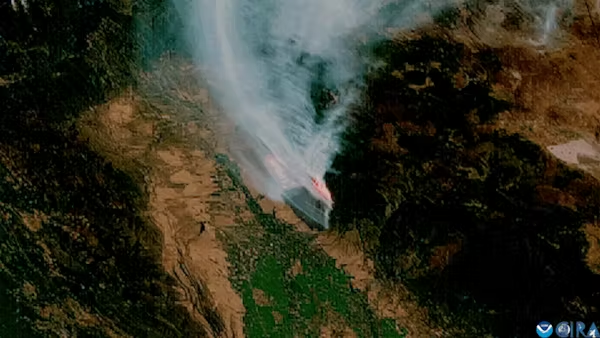
Satellite images shows how the Park Fire near Chico, Calif., created intense pyrocumulonimbus plumes, visible in white, in July 2024. CSU/CIRA and NOAA

I’m an atmospheric scientist who uses data collected by satellites in weather prediction models to better anticipate extreme fire weather phenomena. Satellite data shows fire-produced thunderstorms are much more common than anyone realized just a few years ago. Here’s what’s happening.

The wildfire and weather connections

Imagine a wildland landscape with dry grasses, brush and trees. A spark lands, perhaps from lightning or a tree branch hitting a power line. If the weather is hot, dry and windy, that spark could quickly ignite a wildfire.

When vegetation burns, large amounts of heat are released. This heats the air near the ground, and that air rises like a hot air balloon because hot air is less dense than cool air. Cooler air then rushes in to fill the void left by rising air.

This is how wildfires create their own wind patterns.

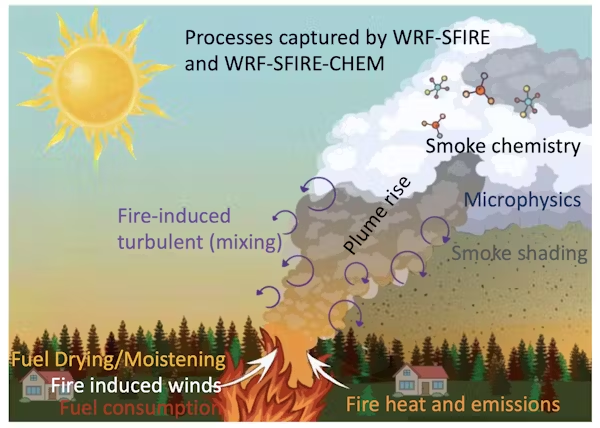
Fires create their own wind patterns and weather as their heat rises. The illustration is based on a coupled fire-atmosphere computer model, WRF-SFIRE-CHEM. Adam Kochanski/San Jose State University/WIRC

What happens next depends on the stability of the atmosphere. If the temperature cools rapidly with elevation above the ground, then the rising air will always be warmer than its surroundings and it will keep rising. If it rises high enough, the moisture will condense, forming a cloud known as a pyrocumulus or flammagenitus.

If the air keeps rising, at some point the condensed moisture will freeze.

Once a cloud has both liquid and frozen water particles, collisions among these particles can lead to electrical charge separation. If the charge buildup is large enough, an electrical discharge – better known as lightning – will occur to neutralize the charges.

Whether a fire-induced cloud will become a thunderstorm depends on three key ingredients: a source of lift, instability and moisture.

Dry lightning

Wildfire environments typically have limited moisture. When conditions in the lower atmosphere are dry, this can lead to what’s known as dry lightning.

No one living in a wildfire-prone environment wants to see dry lightning. It occurs when a thunderstorm produces lightning, but the precipitation evaporates before reaching the ground. That means there is no rain to help put out any lightning-sparked fires.

Fire whirls

As air rises in the atmosphere, it may encounter different wind speeds and directions, a condition known as wind shear. This can cause the air to spin. The rising air can tilt the spin to vertical, resembling a tornado.

These fire whirls can have powerful winds that can spread flaming ash, sparking new areas of fire. They usually are not true tornadoes, however, because they aren’t associated with rotating thunderstorms.

Timelapse footage shows ‘fire tornado’ form in California wildfire. Timelapse video from 25 July captured California’s Park fire creating what appears to be a ‘fire tornado’. Subscribe to Guardian News on YouTube ► http://bit.ly/guardianwiressub The fire, burning northeast of Chico California, forced thousands of residents in Butte County, about 100 miles northeast of Sacramento, to evacuate their homes. The fire, which stretched over four counties, was believed to be caused by arson, after authorities say a man was seen pushing a burning car into a ravine. Firefighters battle California’s seventh largest wildfire on record as thousands under threat ► https://www.theguardian.com/world/art… The Guardian publishes independent journalism, made possible by supporters. Contribute to The Guardian today ► https://bit.ly/3uhA7zg

Decaying storms

Eventually, the thunderstorm triggered by the wildfire will begin to die, and what went up will come back down. The downdraft from the decaying thunderstorm can produce erratic winds on the ground, further spreading the fire in directions that can be hard to predict.

When fires create their own weather, their behavior can become more unpredictable and erratic, which only amplifies their threat to residents and firefighters battling the blaze. Anticipating changes to fire behavior is important to everyone’s safety.

Satellites show fire-created weather isn’t so rare

Meteorologists recognized the ability of fires to create thunderstorms in the late 1990s. But it wasn’t until the launch of the GOES-R Series satellites in 2017 that scientists had the high-resolution images necessary to see that fire-induced weather is actually commonplace.

Today, these satellites can alert firefighters to a new blaze even before phone calls to 911. That’s important, because there is an increasing trend in the number, size and frequency of wildfires across the United States.

Climate change and rising fire risks

Heat waves and drought risk have been increasing in North America, with rising global temperatures more frequently leaving dry landscapes and forests primed to burn. And climate model experiments indicate that human-caused climate change will continue to raise that risk.

As more people move into fire-risk areas in this warming climate, the risk of fires starting is also rising. With fires come cascading hazards that persist long after the fire is out, such as burn-scarred landscapes that are much more susceptible to landslides and debris flows that can affect water quality and ecosystems.

Communities can reduce their vulnerability to fire damage by building defensible spaces and firebreaks and making homes and property less vulnerable. Firefighters can also reduce the surrounding fuel loads with prescribed fire.

It’s important to remember that fire is a natural part of the Earth system. As fire scientist Stephen J. Pyne writes, we as humans will have to reorient our relationship with fire so we can learn to live with fire.

For Southern Paiute Tribe, water settlement will bring land for a permanent home — AZCentral.com #ColoradoRiver #COriver #aridification

The Powell-Ingalls Special Commission meeting with Southern Paiutes. Photo credit: USGS

Click the link to read the article on the AZCentral.com website (Arlyssa D. Becenti). Here’s an excerpt:

For the San Juan Southern Paiute Tribe, the Northeastern Indian Water Rights Settlement Act means more than water — it means finally claiming land they can call home. Although the tribe has lived in their current home base for hundreds of years, they were only federally recognized in 1989, and the land they lived on, in northern Arizona and southern Utah, was incorporated into the Navajo Nation. The Paiutes are the only federally recognized tribe in Arizona without a reservation or land.

In 2000, leaders from the Navajo Nation and the San Juan Southern Paiute Tribe signed a historic treaty, the first intertribal treaty in 160 years. The treaty granted the Paiutes approximately 5,400 acres of land, divided into two parcels, that was occupied by Paiute families. The treaty has never been ratified by Congress, and nearly a quarter century later, the land still has not been granted to the Paiutes. That could change if Congress approves and President Joe Biden signs the water settlement, which would finally allocate these parcels to the San Juan Paiute Tribe…

“With this water settlement, of course water being a precious commodity to this day and it is worth everyone fighting for, what this settlement will actually helps us do get our reservation secured,” said San Juan Paiute President Robbin Preston Jr., “so that all our tribal members can say ‘yes, i do have a home.’”

We’re About to Drink Toilet Water. Why That’s a Good and Safe Thing to Do — Voice of San Diego

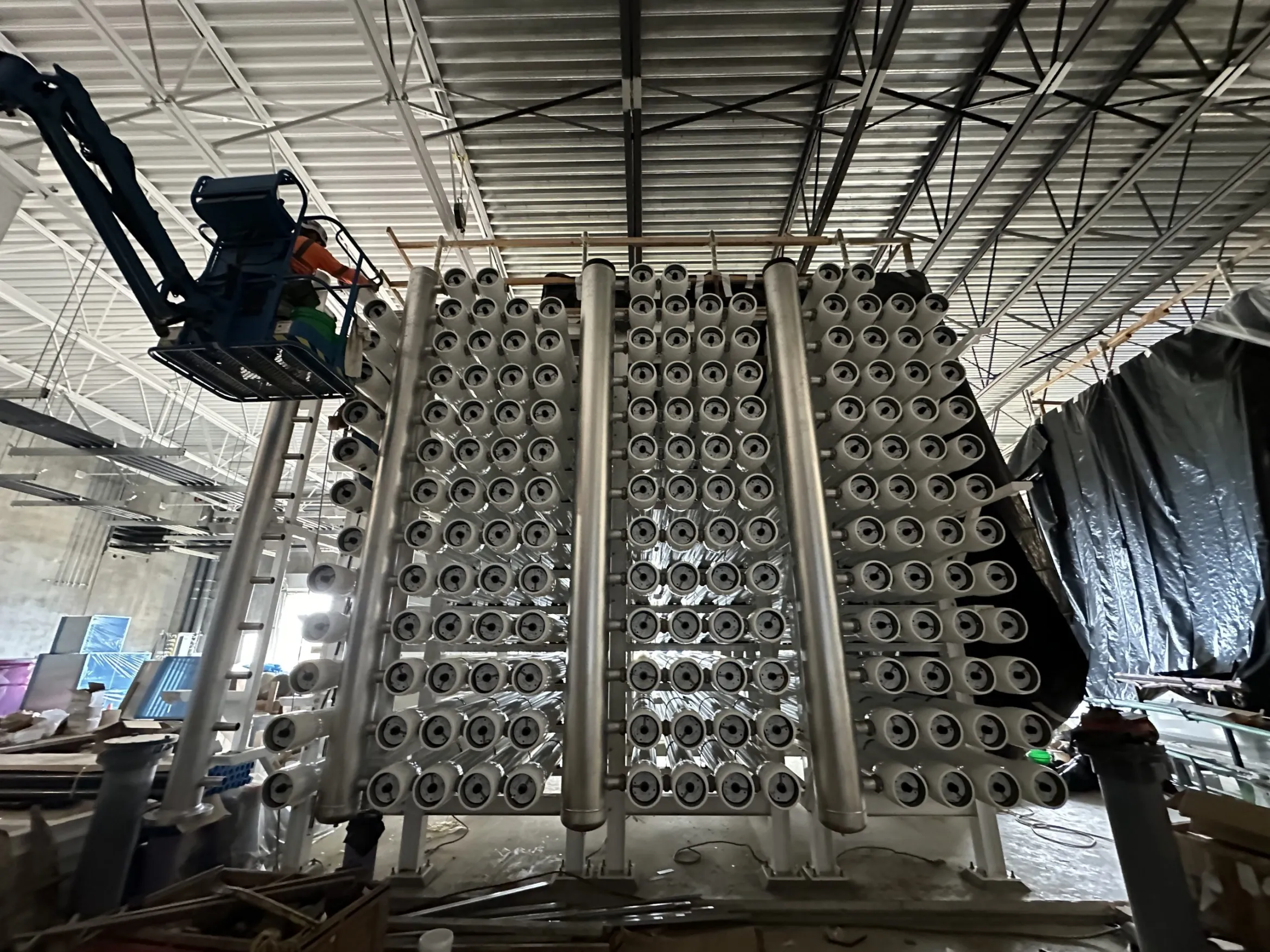
A set of filtration membranes being installed at the city of San Diego’s new Pure Water facility on June 11, 2024. / MacKenzie Elmer

Click the link to read the article on the Voice of San Diego website (MacKenzie Elmer) This story was first published by Voice of San Diego. Sign up for VOSD’s newsletters here:

July 30, 2024

The science behind the city of San Diego’s multibillion dollar effort to recycle wastewater into drinking water. 

Try driving up Morena Boulevard in Mission Valley, or north through Bay Park and Clairemont, and chances are you’ll be bottlenecked by an army of orange traffic cones demarking a huge construction project that will consume northern San Diego for years to come.  

The city of San Diego is currently building a massive wastewater-to-drinking water recycling system – but it must tear up the streets to do it. The new pipe route tunnels from Morena Pump Station near the San Diego International Airport, then 10 miles north to University City and then another 8 miles to Miramar Reservoir, the final stop for all our transformed toilet water.  

But wait – why is San Diego drinking its own sewage in the first place? And how is that even possible? 

Right now, San Diego depends largely on water imported from hundreds of miles away, a plant in Carlsbad that makes ocean water drinkable and the small amount of rain that falls locally. But that imported water is growing less dependable as climate change and overuse zap the Colorado River and Sierra Nevada snowpack of its reliability.  

That’s why San Diego is very proud of its recycling project, called Pure Water, which will turn 42 million gallons of wastewater into 34 million gallons of drinking water per day once the first phase is complete around 2027. But the project is actually a compromise the city made after years of wrangling over sewage, of which unlike drinkable water, the city often has too much. 

A bit of history: In the 1930s, San Diego dumped its sewage into San Diego Bay which began to corrode the hulls of Navy ships and drove tourists away. In 1963, the city, with support from neighboring cities, opened the Point Loma Wastewater Treatment Plant which cleaned wastewater one way, but soon fell short of what the 1972 Clean Water Act required.  

San Diego was on the hook to make billions of dollars in upgrades to Point Loma, even though it argued dumping treated wastewater should be OK because, as the saying goes, “the solution to pollution is dilution.” Congress agreed to give the city a pass on the Clean Water Act requirements for a decade until it failed to reapply for a waiver, setting off a wave of litigation. That’s about the time San Diego offered to do something different: Make its wastewater drinkable.  

Filtration membranes at the city of San Diego’s new wastewater-to-drinking water facility on June 11, 2024. / MacKenzie Elmer

That seemed to settle qualms from environmentalists angered by Point Loma’s ocean pollution and the feds that were upset over continued Clean Water Act waivers. And here we are. 

Pure Water officials told me the water produced on the other side of the multi-step recycling process is so clean, the city must add minerals back in at the end. And there’s the added bonus of San Diego having to buy less imported water – one of the city’s biggest monthly bills. Pure Water is supposed to provide over half the city’s water needs when it’s complete.  

So instead of billions in upgrades to Point Loma, the city’s spending billions on Pure Water, about $1.5 billion just for the first of its two phases. 

Beyond the miles of new pipeline and pumps yet to be built to round out the system, an expansion of the existing North City Water Reclamation Facility in Miramar is the heart of the purification process. Juan Guerreiro, the director of the city of San Diego’s Public Utilities Department, gave me and our social media journalist, Bella Ross, a tour of the construction. 

The North City reclamation plant, and its sister plant in South Bay, were built about 25 years ago to divert some of the waste being sent to Point Loma, clean it, and use it for irrigation. The massive expansion effort is underway while the North City plant is still doing its 24/7 job.  

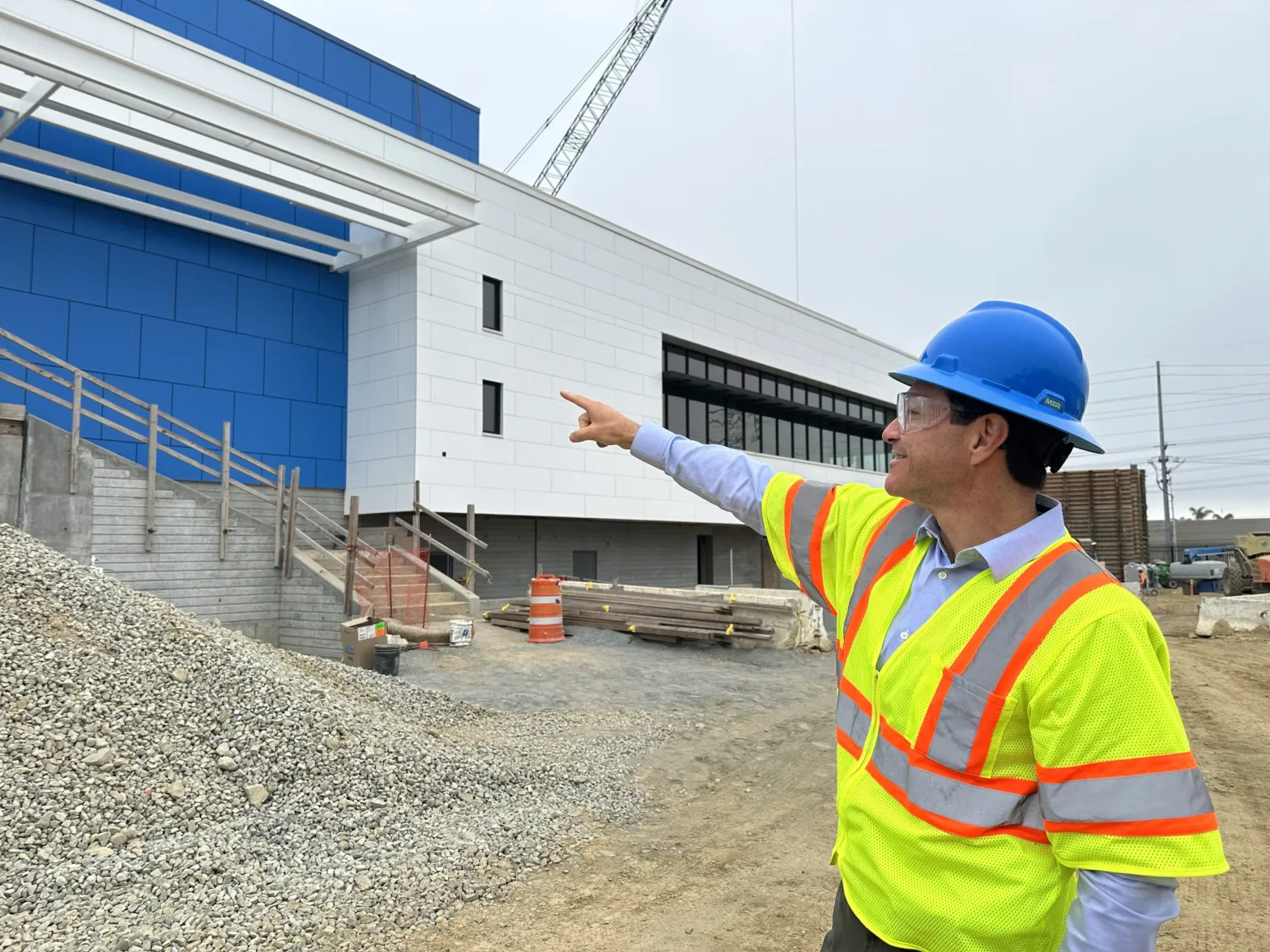
Juan Guerreiro, the director of the city of San Diego’s Public Utilities Department, points to the new Pure Water North City facility under construction on June 11, 2024. / MacKenzie Elmer

“It’s like open heart surgery. You’re running the plant producing recycled water while it’s being expanded,” Guerreiro said. 

That plant already strains out all the solids, adds bacteria to eat up bad gunk, chlorinates and then runs water through coal filters – like a big Brita filtration system. You could probably drink the end product, but it wouldn’t pass California’s drinking water standards. Pure Water adds five extra treatment steps, including shooting every water molecule through a filter membrane with pores that are 500,000 times smaller than a human hair.  

After all that energy-intensive cleaning, the city dumps the purified water in the Miramar Reservoir where San Diego stores much of its untreated drinking water already. But wait, isn’t it kind of a shame to dump that extra-purified water into a reservoir filled with yet untreated drinking water, then treat it again? 

In an abundance of caution, California requires the treated wastewater-turned-drinking water be stored in an “environmental buffer” like a reservoir or an underground aquifer, instead of pumping it straight to public taps. It’s a kind of “just in case” measure for a lot of these new recycling projects. Orange County built a similar wastewater-to-drinking water system in 2008 that injects the treated water into underground aquifers. San Diego doesn’t have many aquifers so the next best buffer is the reservoir. 

City of San Diego digging a megatrench to transport treated water from its new Pure Water facility on June 11, 2024. / MacKenzie Elmer

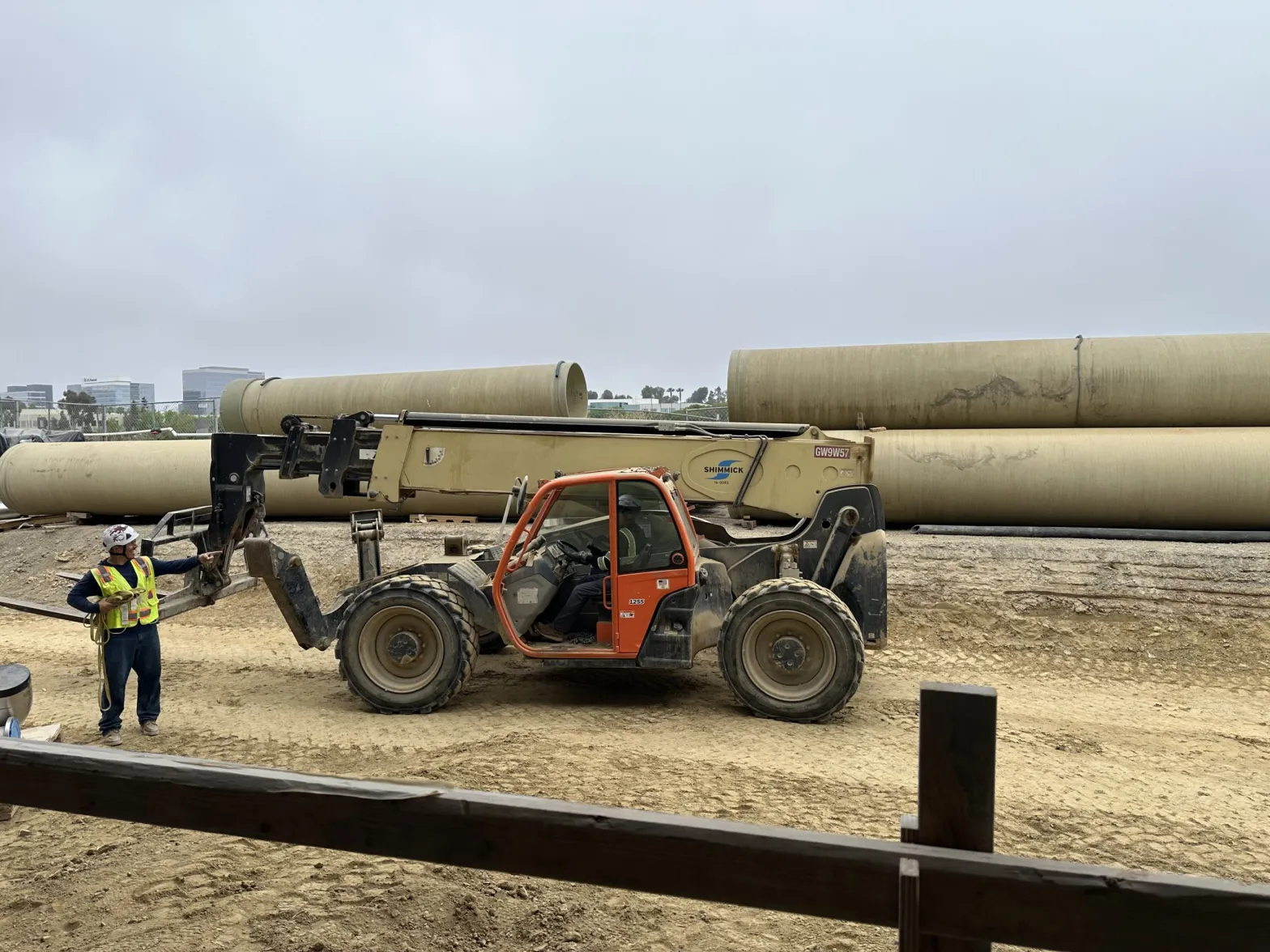
Building Pure Water is a massive undertaking that involves building what officials called a “mega trench” artery connecting the North City Reclamation facility and the new Pure Water facility underneath Eastgate Mall road. But the city is also building a Pure Water education center on site to cure any skeptics of their suspicion of the process. 

Now, students, don your lab goggles and learn how Pure Water is done:  

  1. How it works now: Someone in the city of San Diego flushes their toilet. The waste flows through pipes in a building then out to the street into a large sewer main. Eventually it hits a pump station which shoots the sewage to its traditional final destination: The Point Loma Wastewater Treatment Plant.  
  2. How it will work once Pure Water is complete: Everything is the same at the start, except a new pump station off Morena Boulevard and north of Interstate 8 will be responsible for diverting 32 million gallons of wastewater away from Point Loma and sending it northward to the reclamation plant.  
Workers erect a massive retaining wall at the city of San Diego’s new Pure Water facility on June 11, 2024. / MacKenzie Elmer
  1. Once it makes its miles-long journey to the plant, the sewage moves through the first steps of a typical treatment process, starting with what’s called primary. That phase gets rid of the most obvious gross stuff. The water sits still in a settling tank so fats, oils, grease and plastic float to the top where that gunk is skimmed off and sent to disposal. Organic solids (fecal matter, etc.) sink to the bottom and separate from the water.  
  2. That water is not ready to drink yet. Its next stop is secondary treatment, where the wastewater moves into huge concrete bathtubs and pumped through with air and microbes that eat up a lot of the organic stuff still floating around. The microbes burp out ammonia, carbon dioxide gases and water. If that bacteria begins to die during this process, it’s a signal to treatment plant staff that something toxic and unusual may have been illegally dumped into the sewage system. (That happened once back in 2016 when a port-a-potty company called Diamond Enviornmental Services got caught dumping its outhouse contents into the city’s wastewater system. The FBI raided the company’s offices. Some of its executives got prison time.) 
  3. The wastewater moves to more settling tanks where that well-fed bacteria clump together, die and sink to the bottom. Cleaner water remains at the top inch of the surface, which then flows out onto the city’s prized Pure Water, five-step purification process – and reportedly exceed — drinking water standards. 
  4. The reclaimed water first goes through ozone and biologically active carbon filtration. Any pharmaceuticals or personal care products one might worry survived the primary and secondary treatment get broken down by ozone and become food for additional biology in the carbon filter. Ozone, when dissolved in water, turns into a kind of biocide that kills bacteria, parasites, viruses and other bad stuff.  
  5. By this stage, the water is ready to be shot at high speed through a membrane filter, which looks like a large PVC pipe filled with straws that contain ultra-small pores. The idea is any microscopic grime or grit still floating around won’t be able to make it through those pores. 
Juan Guerreiro, director of the city’s Public Utilities Department, holds a piece of the new Pure Water filtration system at the North City Water Reclamation Facility in Miramar. Ally Berenter and Anna Vacchi Hill with the city of San Diego on June 11, 2024. / MacKenzie Elmer

Next, the water goes through reverse osmosis, another kind of filter with even smaller pores, about the size of a water molecule. This helps remove any excess salts or minerals. “The water that comes through reverse osmosis is some of the cleanest we’ve seen compared to distilled water quality,” said Doug Campbell, the assistant director of the city’s Public Utilities Department’s wastewater branch. It cleans the water so well, Campbell said, minerals must be added back to the water later.  

A filtration membrane that’s part of the city of San Diego’s wastewater-to-drinking water system called Pure Water on June 11, 2024. / MacKenzie Elmer

There’s one more step, the water gets flashed by ultraviolet light at the most lethal wavelength for germs or microorganisms. “UV light is really good at harming organic things. So if any viruses, parasites or bacteria make it through the other steps, then the UV light will quickly destroy it,” said Campbell said.  

Aspinall Unit Operations update August 20, 2024: 500 cfs through Black Canyon #GunnisonRiver

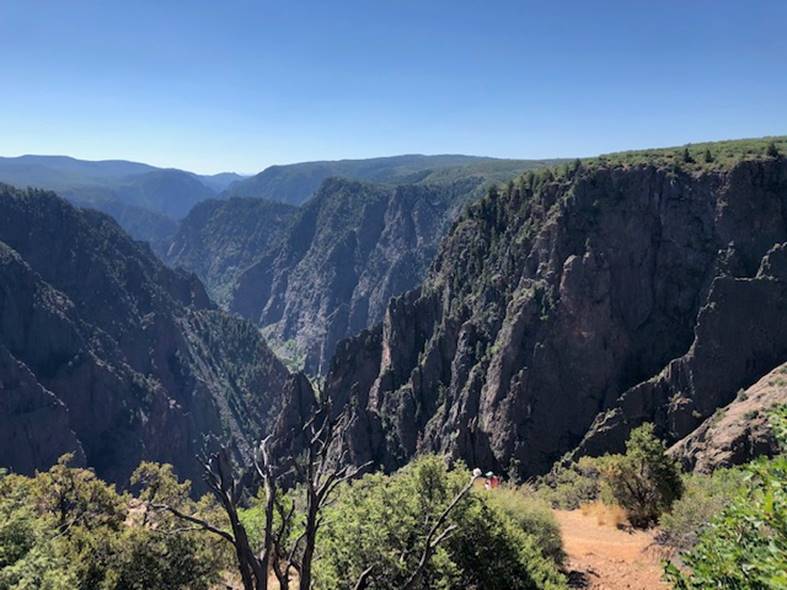
Black Canyon July 2020. Photo credit: Cari Bischoff

From email from Reclamation (Erik Knight):

Releases from the Aspinall Unit will be decreased from 1650 cfs to 1550 cfs on Tuesday, August 20th.  Releases are being decreased as flows on the lower Gunnison River are well above the baseflow target of 1050 cfs. Further reductions in the release at Crystal may occur soon if river levels remain well above the target.

Flows in the lower Gunnison River are currently above the baseflow target of 1050 cfs. River flows are expected to remain above the baseflow target for the foreseeable future.

Pursuant to the Aspinall Unit Operations Record of Decision (ROD), the baseflow target in the lower Gunnison River, as measured at the Whitewater gage, is 1050 cfs for August through December.

Currently, Gunnison Tunnel diversions are 1050 cfs and flows in the Gunnison River through the Black Canyon are around 600 cfs. After this release change Gunnison Tunnel diversions will still be 1050 cfs and flows in the Gunnison River through the Black Canyon will be around 500 cfs. Current flow information is obtained from provisional data that may undergo revision subsequent to review.

This scheduled release change is subject to changes in river flows and weather conditions. For questions or concerns regarding these operations contact:

Erik Knight at (970) 248-0629, e-mail eknight@usbr.gov