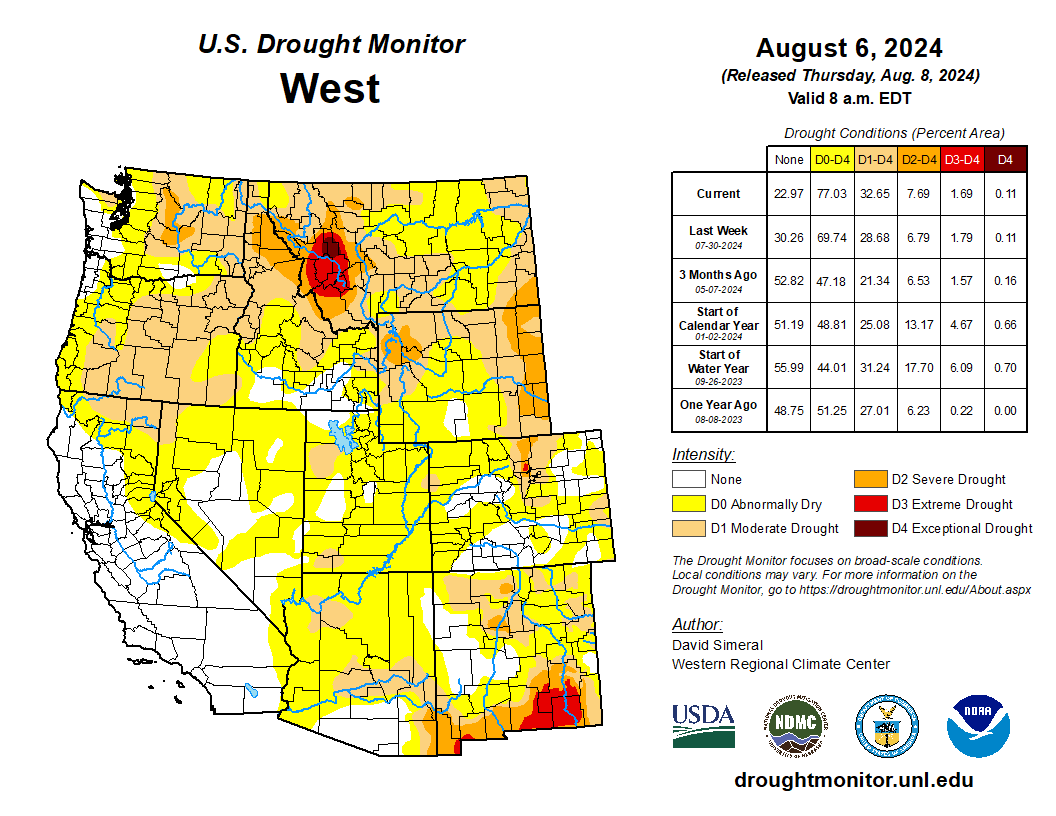
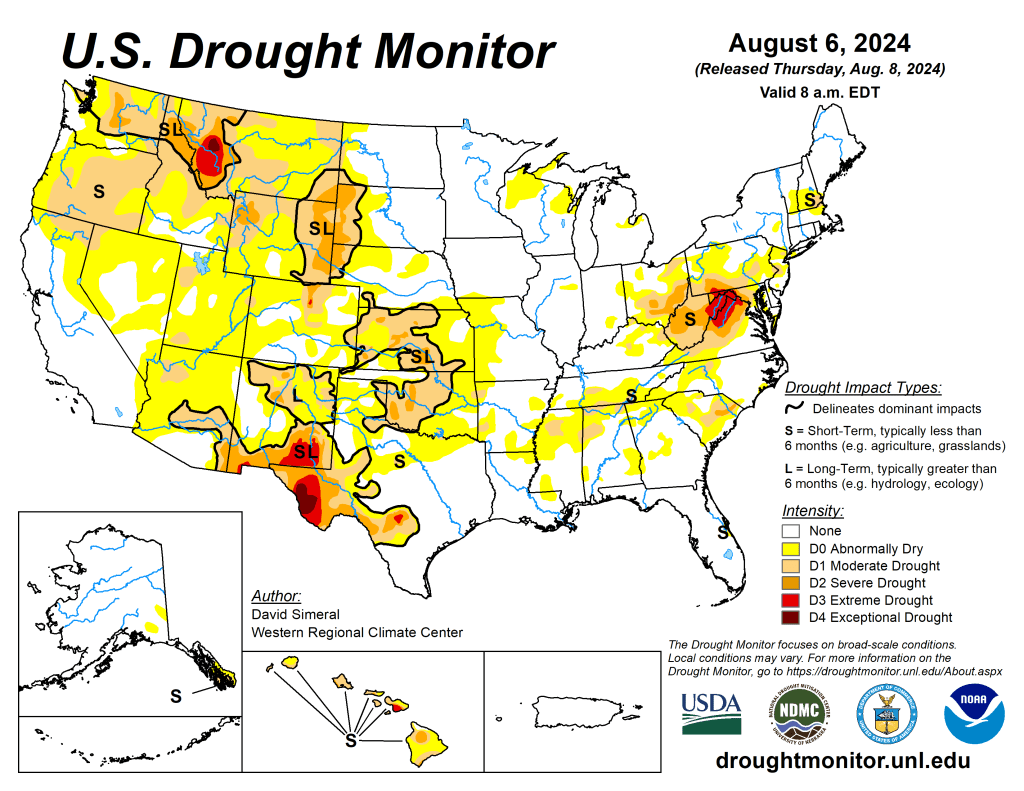
#Drought news August 8, 2024: All states within the High Plains region saw degradations in response to a combination of factors including below-normal precipitation (past 30-60-day period), above-normal temperatures (+4 to 10 degrees F during the past 14 days), high evaporative demand, and intensifying flash drought conditions in recent weeks

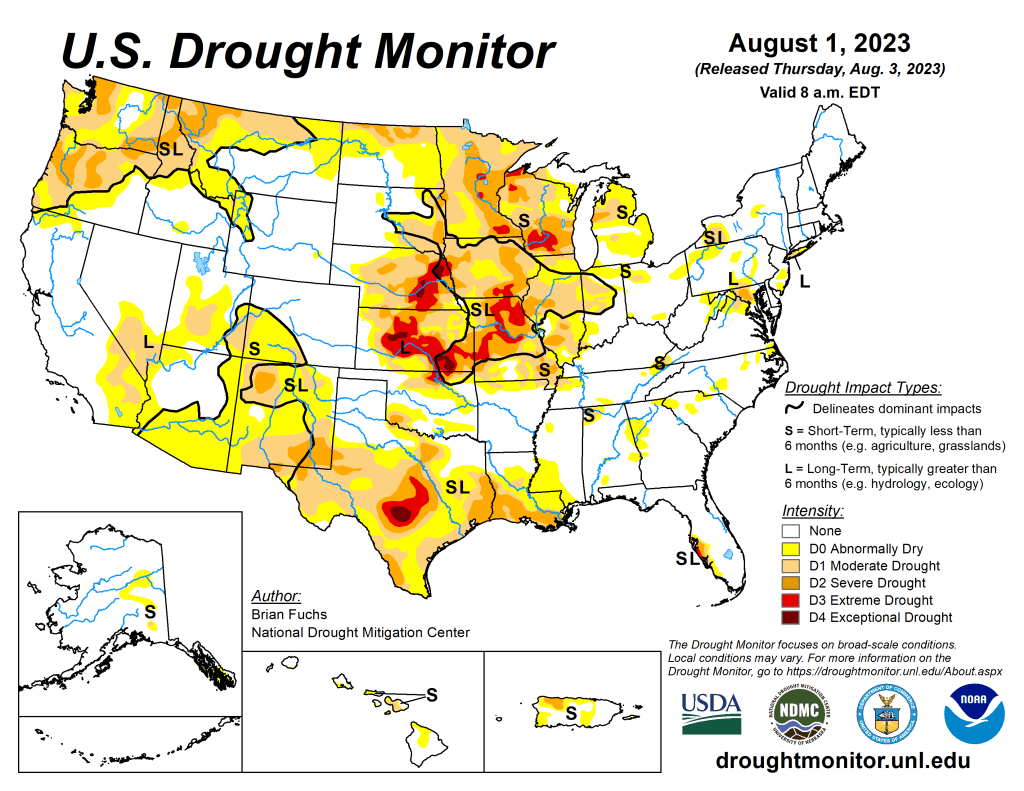
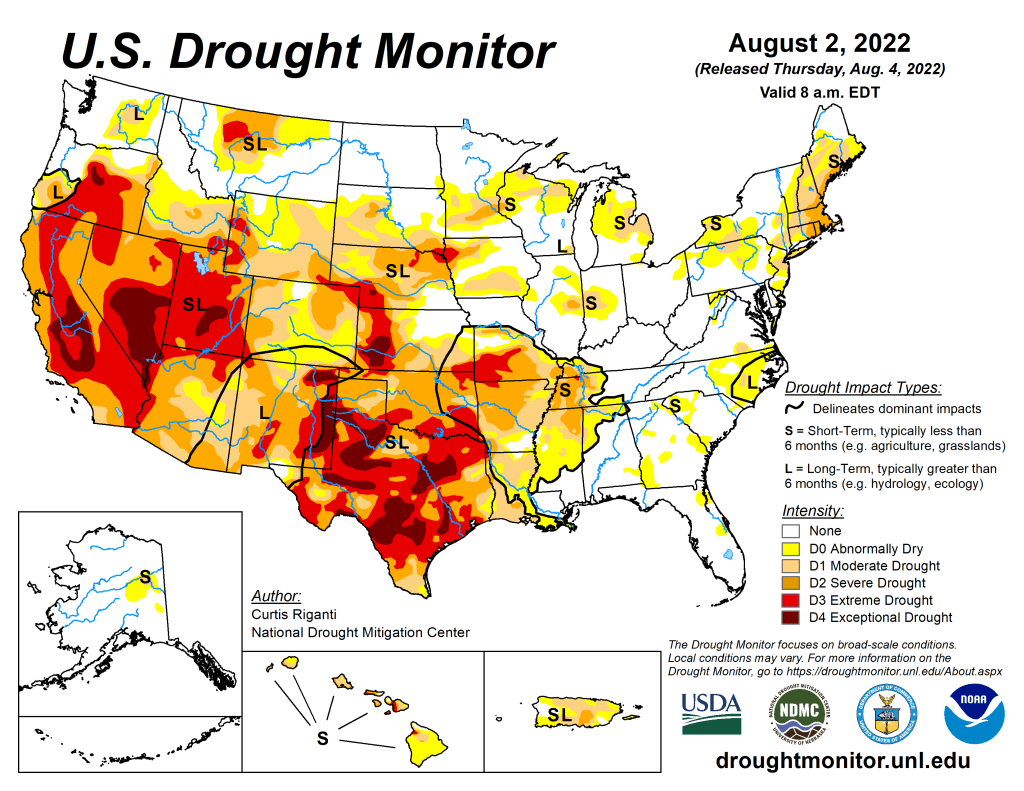
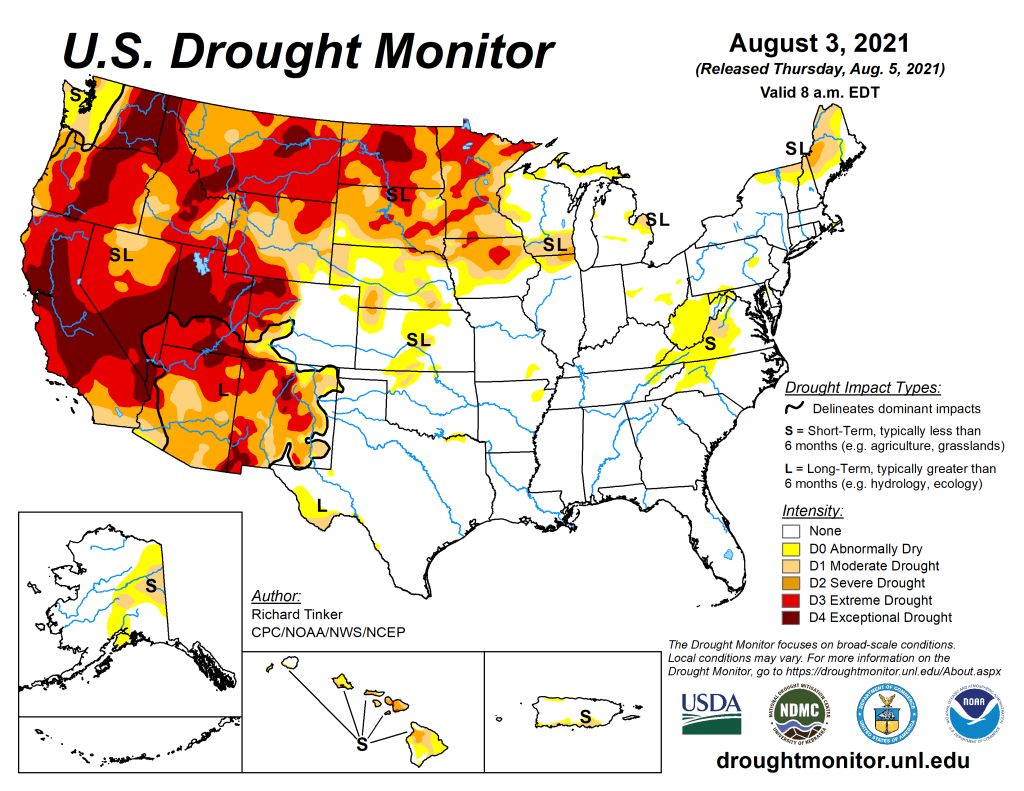
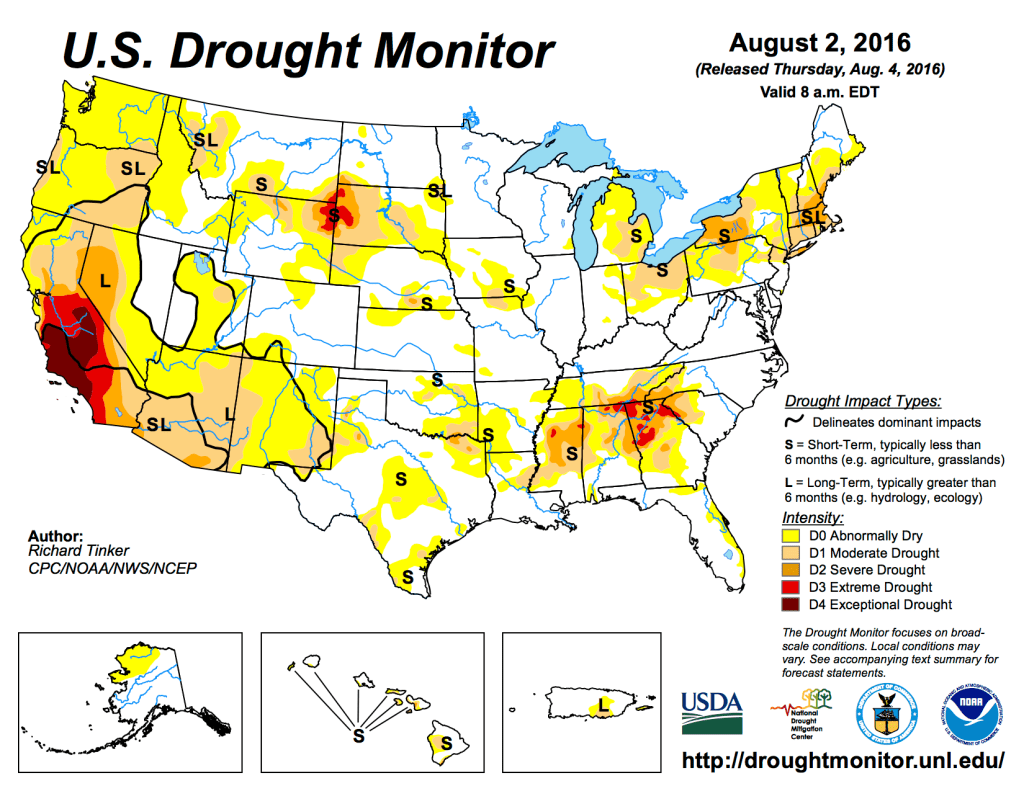
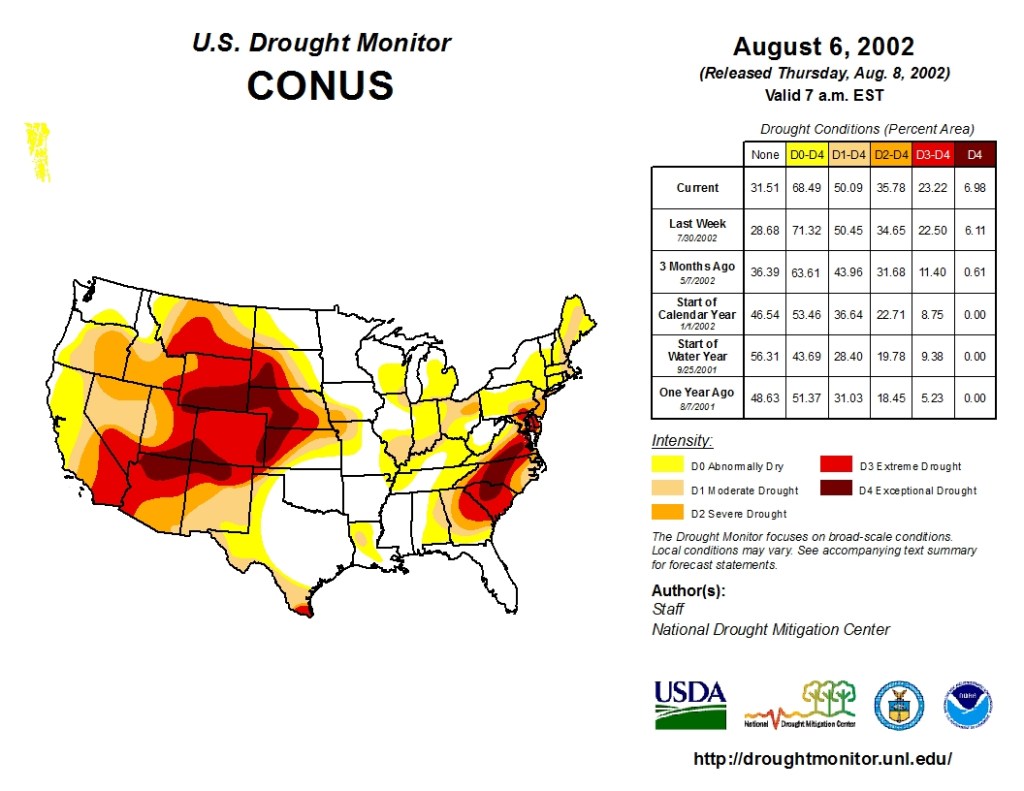
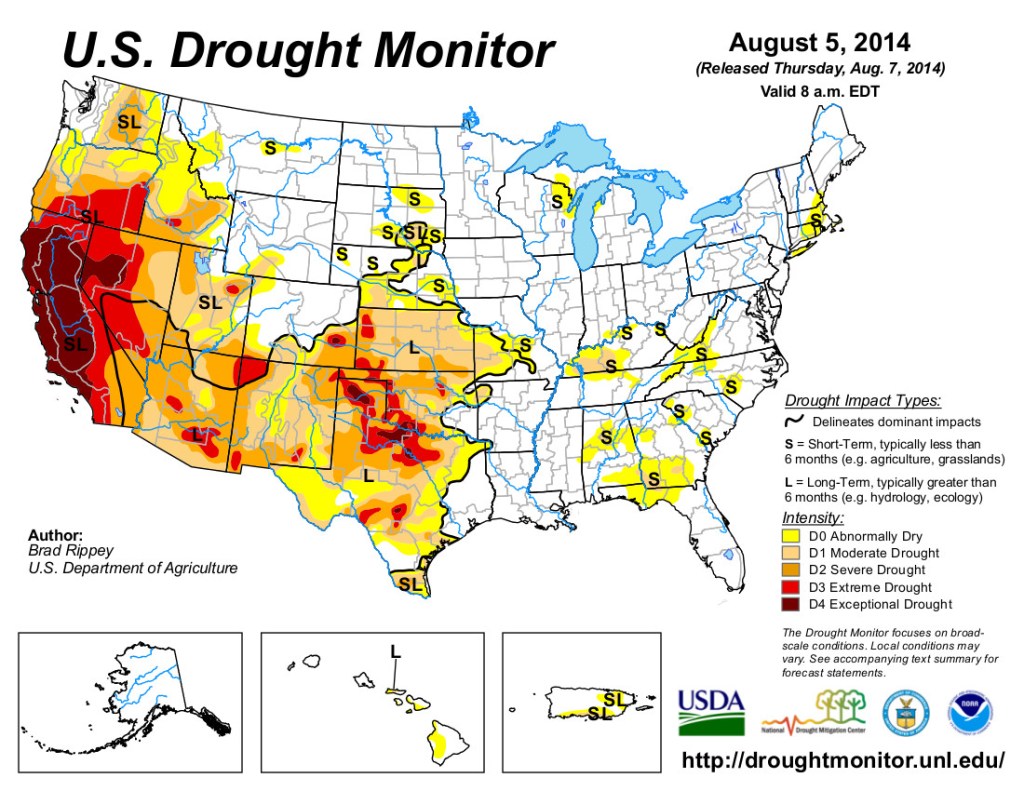
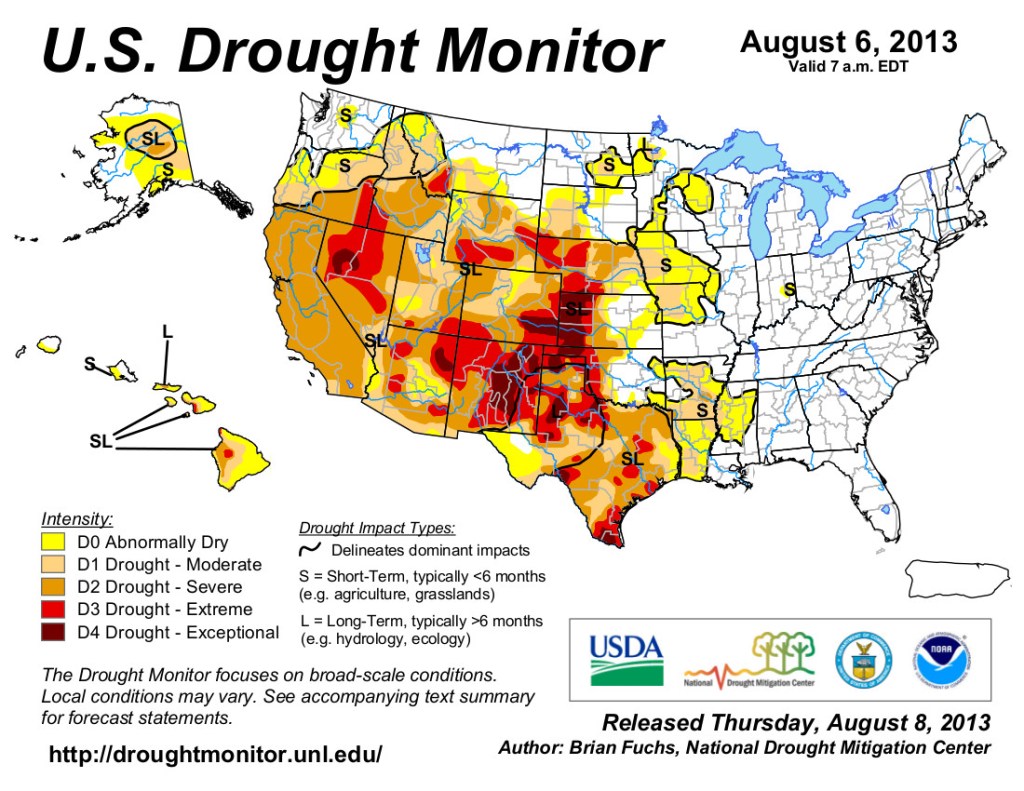
Click on a thumbnail graphic to view a gallery of drought data from the US Drought Monitor website.
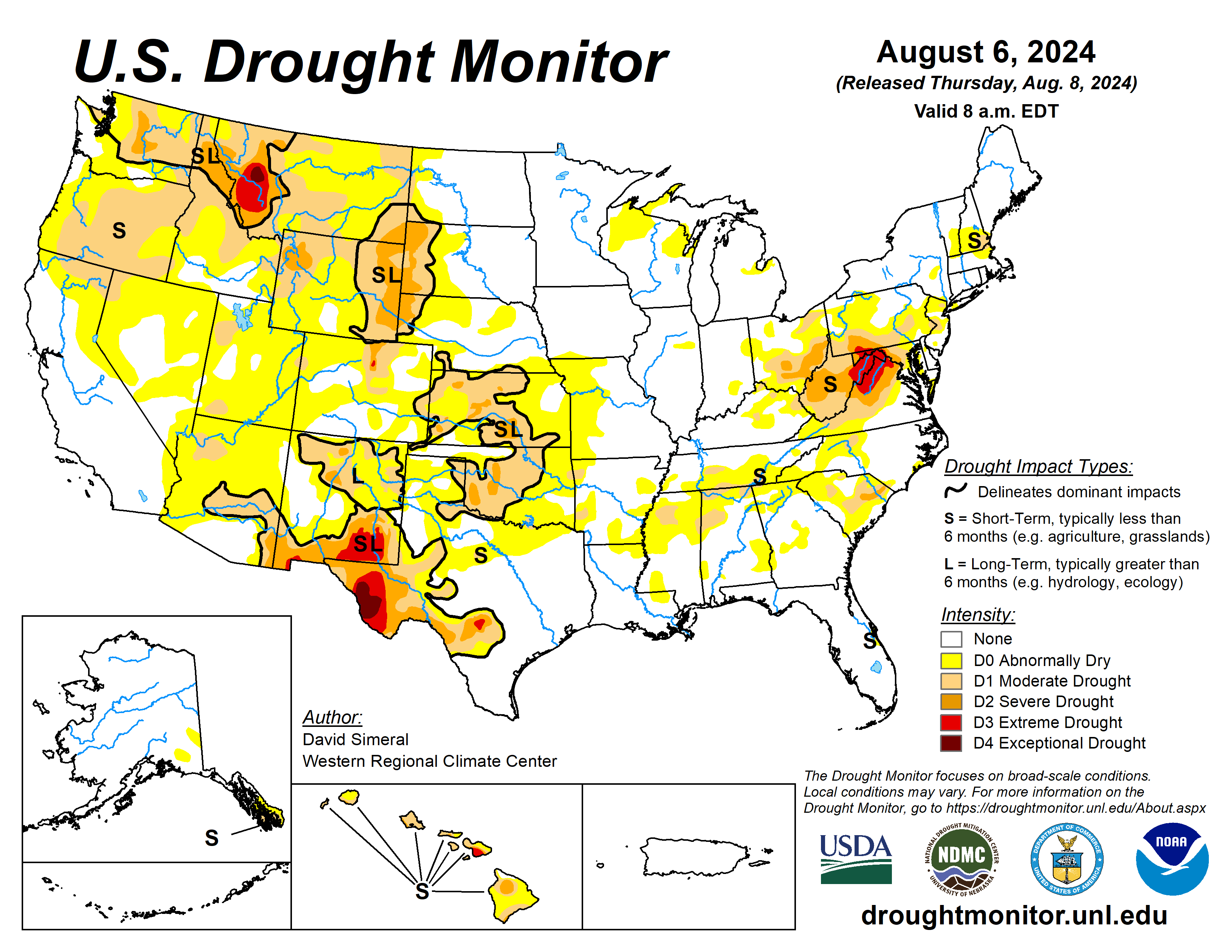
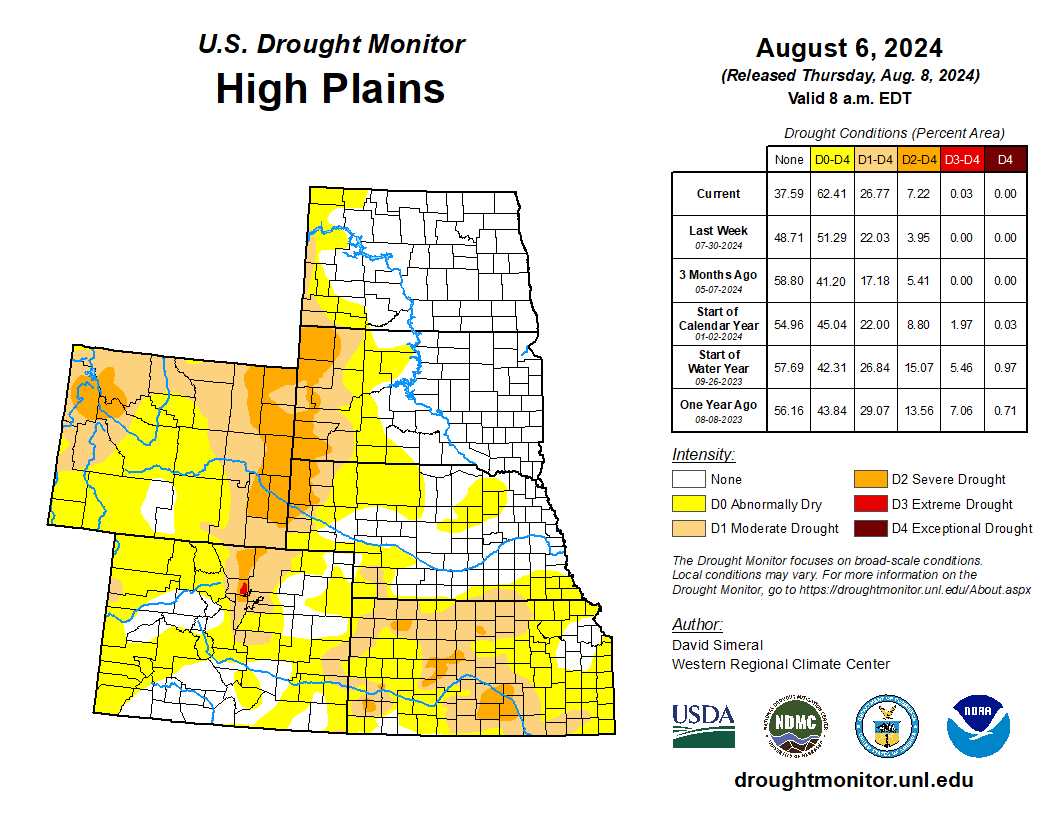
Click the link to go to the US Drought Monitor website. Here’s an excerpt:

This Week’s Drought Summary

This U.S. Drought Monitor (USDM) week saw widespread improvement in drought-related conditions on the map across areas of the Southeast, Mid-Atlantic, and in areas of the Midwest. Elsewhere, hot and dry conditions prevailed in areas of the West, Plains, and the South during the past 14-to-30-day period, leading to the expansion and intensification of drought on this week’s map with particular concern over the developing flash drought situation in areas of the Plains states. In the Southeast, Hurricane Debby (Category 1) made landfall Monday morning in Florida’s Big Bend region bringing a powerful storm surge, strong winds, torrential rains, and severe flooding to much of Florida’s Gulf Coast region from southwest Florida to the north-central region. Rainfall accumulations ranged from 2 to 20+ inches across affected areas with the heaviest accumulations logged in the greater Sarasota area. The impacts of Hurricane Debby, which weakened to a tropical storm shortly after making landfall, were also felt across the coastal zones and plains of Georgia and South Carolina with heavy rainfall (up to 15 inches according to radar estimates) and flooding. On the map, some drought-related improvements were made this week in the Carolinas in association with the remnant moisture from Hurricane Debby. However, it is noteworthy that this week’s drought depiction is representative of rainfall that fell until the data cutoff at 8 a.m. ET on Tuesday and additional improvements are expected on next week’s map. Elsewhere, light-to-moderate rainfall accumulations (2 to 4 inches) were observed across areas of the Northeast, Midwest, and in isolated areas of the Northern Plains. Out West, some monsoon-related storm activity was observed in isolated areas of the Four Corners states and Nevada as well as some light shower activity in areas of Idaho and Montana. In terms of reservoir storage in areas of the West, California’s reservoirs continue to be near or above historical averages for the date (August 6) with the state’s two largest reservoirs (Lake Shasta and Lake Oroville) at 111% and 116% of their averages, respectively. In the Southwest, Lake Powell is currently 39% full (64% of typical storage level for the date) and Lake Mead is 33% full (53% of average) with the total Lower Colorado system 44% full as of August 5 (compared to 44% full at the same time last year), according to the U.S. Bureau of Reclamation. In Arizona, the Salt River Project is reporting the Salt River system reservoirs 85% full, the Verde River system 64% full, and the total reservoir system 83% full (compared to 91% full a year ago). In New Mexico, the state’s largest reservoir along the Rio Grande is currently 11% full (25% of average). In the Pacific Northwest, Washington’s Franklin D. Roosevelt Lake is 93% full (121% of average for the date) and Idaho’s American Falls Reservoir on the Snake River is 50% full (84% of average)…

High Plains

On this week’s map, all states within the High Plains region saw degradations in response to a combination of factors including below-normal precipitation (past 30-60-day period), above-normal temperatures (+4 to 10 degrees F during the past 14 days), high evaporative demand, and intensifying flash drought conditions in recent weeks. Moreover, within the past 30 days, numerous agricultural impacts have been reported by extension agents as well as by local farmers and ranchers to the National Drought Mitigation Center’s (NDMC) Condition Monitoring Observer Reports (CMOR) system. Impact reports include crop stress, critically low soil moisture, water hauling, and reduced forage, with the highest concentration of reports coming in from western portions of the Dakotas, western Nebraska, and eastern portions of Montana and Wyoming. According to the USDA (August 4), statewide topsoil moisture rated by percent short to very short is as follows: Kansas 55%, Nebraska 49%, South Dakota 32%, North Dakota 25%, Montana 68%, Wyoming 83%, and Colorado 58%….
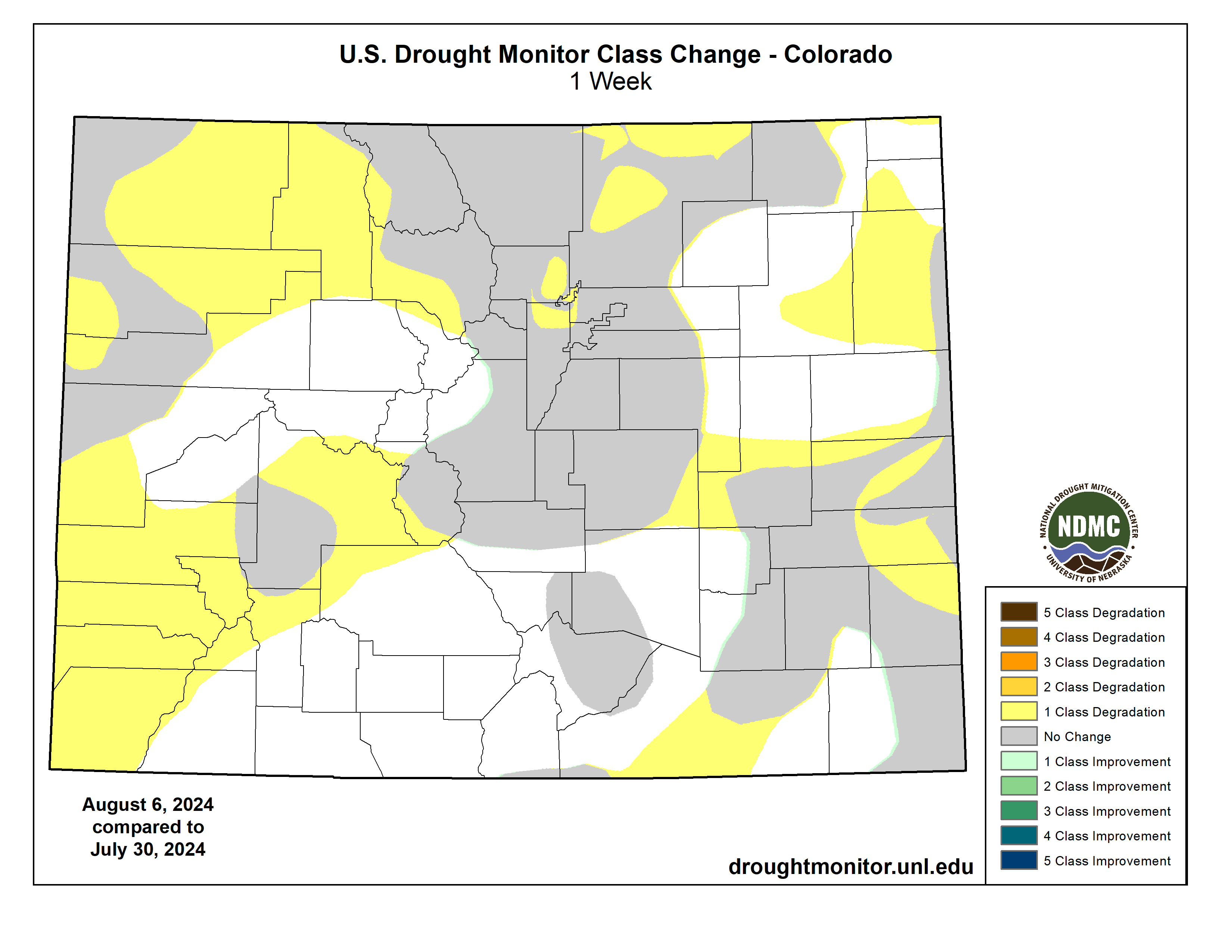
Colorado Drought Monitor one week change map ending August 6, 2024.

West

Out West, the overall hot and dry pattern observed during the past 30-60-day period continued to desiccate many parts of the region leading to the addition of numerous areas of Abnormally Dry (D0) as well as expansion of areas of drought (primarily Moderate Drought D1) in the Pacific Northwest, California, Intermountain West, and the Southwest. Furthermore, the hot and dry weather continued to exacerbate fire conditions with numerous large fires burning across the region, including California’s Park Fire (northeast of Chico, CA), which has burned ~414,890 acres and was only 34% contained, according to the U.S. Forest Service on August 7. In terms of wildland fire potential for the remainder of August 2024, the National Interagency Fire Center’s Significant Wildland Fire Potential Outlook is forecasting above-normal fire potential across areas of Washington, Idaho, Montana, California, Nevada, and Utah. Looking at statewide reservoir storage (August 1), reservoir storage (as compared to the 1991-2020 median) is above normal in Arizona, Idaho, Nevada, Oregon, and Utah with below-normal levels in Colorado, Montana, New Mexico, Washington, and Wyoming, according to the National Resources Conservation Service…

South

Across the region, dry conditions prevailed this week as well as above-normal temperatures with the greatest anomalies (+4 to 8 degrees F) observed in the Texas Panhandle and Trans-Pecos regions as well as in areas of southeastern Oklahoma, and southern portions of Louisiana and Mississippi. On the map, deterioration occurred in northern and western portions of Texas, eastern Oklahoma, southern Arkansas, and Mississippi, while near- to above-normal precipitation during the past 30-day period led to widespread improvements across Tennessee. In Oklahoma, the rapidly declining soil moisture and escalating fire danger are heightening concerns about widespread flash drought, according to the Oklahoma Climatological Survey. In Texas, Water for Texas (August 7) is reporting statewide reservoirs currently at 76.7% full with numerous reservoirs in the eastern part of the state in good condition, while many reservoirs in the western half of the state are experiencing below-normal levels. In terms of topsoil conditions across the region, the USDA (week August 4) is reporting the statewide topsoil moisture rated by percent short to very short as follows: Tennessee 29%, Mississippi 39%, Arkansas 47%, Louisiana 22%, Oklahoma 59%, and Texas 67%…

Looking Ahead

The NWS Weather Prediction Center (WPC) 7-Day Quantitative Precipitation Forecast (QPF) calls for moderate-to-heavy rainfall accumulations ranging from 4 to 10 inches across areas of the Eastern Seaboard from Georgia to New England. Lesser accumulations, ranging from 1 to 2 inches, are expected across areas of the Four Corners states as well as in the Central Plains and southwestern portion of the Midwest. Elsewhere in the conterminous U.S., generally dry conditions are forecasted. The Climate Prediction Center (CPC) 6-10-day Outlook calls for a moderate-to-high probability of above-normal temperatures across much of the Four Corners States, much of the Plains states, the South, and Southeast. Conversely, below-normal temperatures are expected across much of California, eastern portions of the Midwest, and the Northeast. In terms of precipitation, there is a low-to-moderate probability of above-normal precipitation across the Pacific Northwest, Intermountain West, areas of the Desert Southwest, Central and Northern Plains, and in Alaska. Below-normal precipitation is expected across most of the South, Southeast, and western portions of the Great Basin.
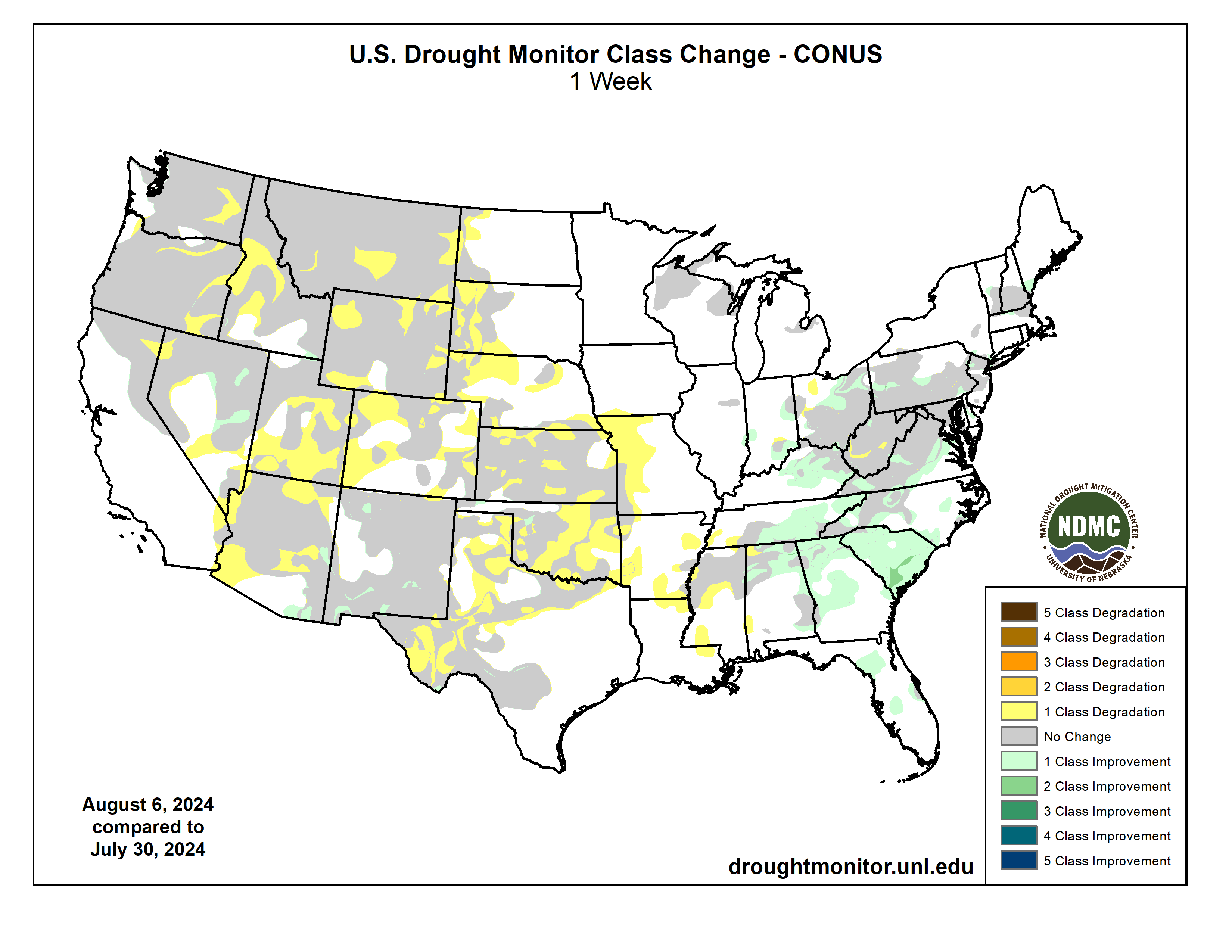
US Drought Monitor one week change map ending August 6, 2024.

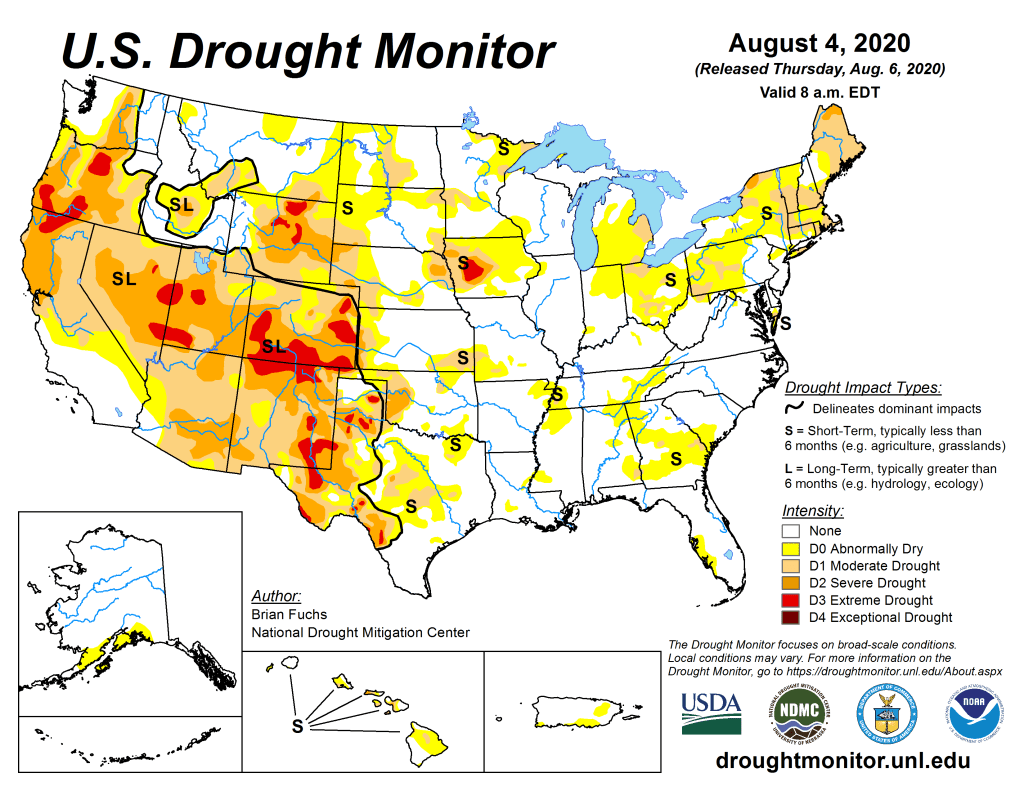
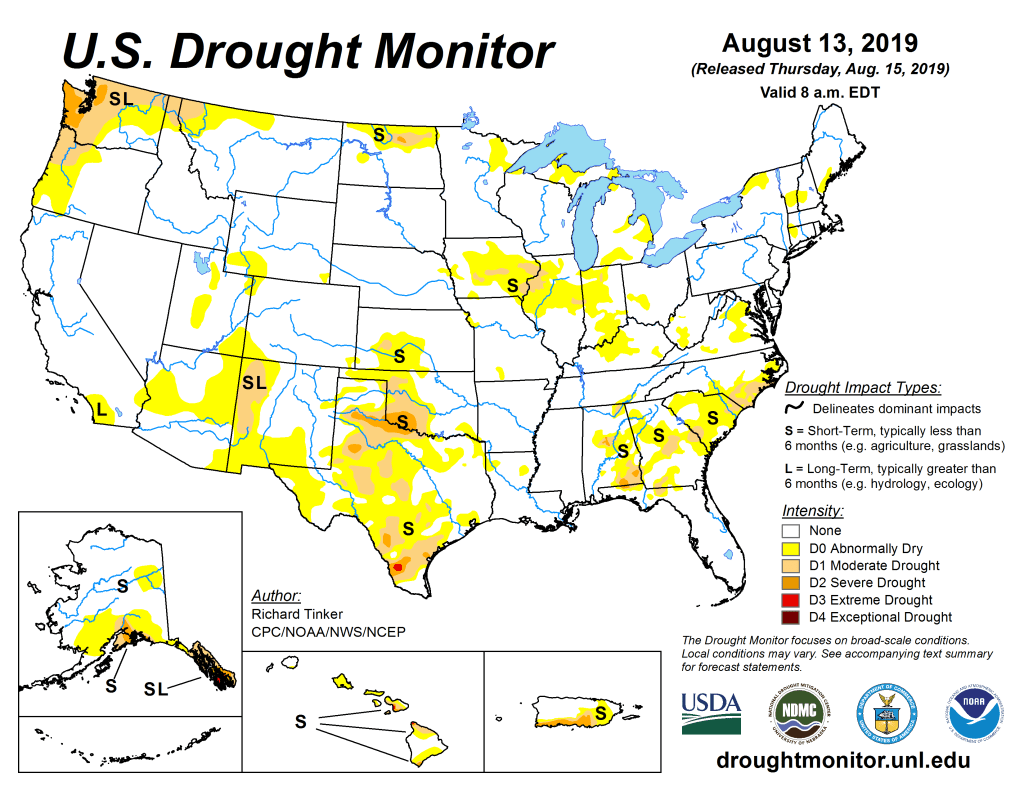
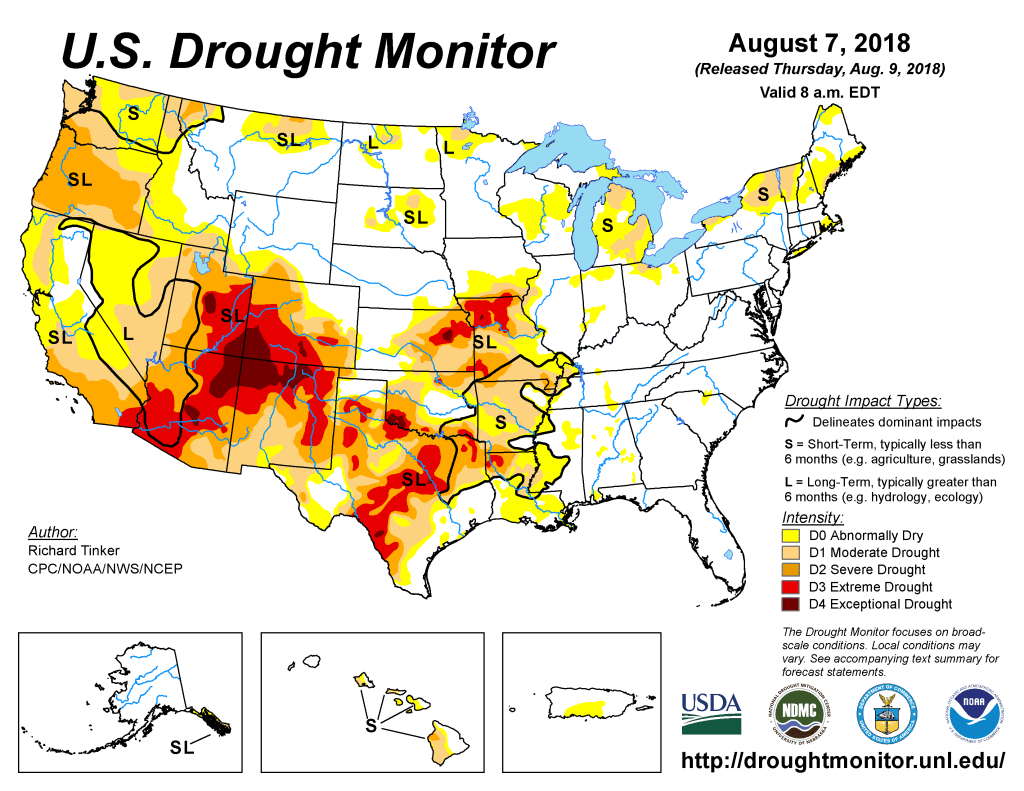
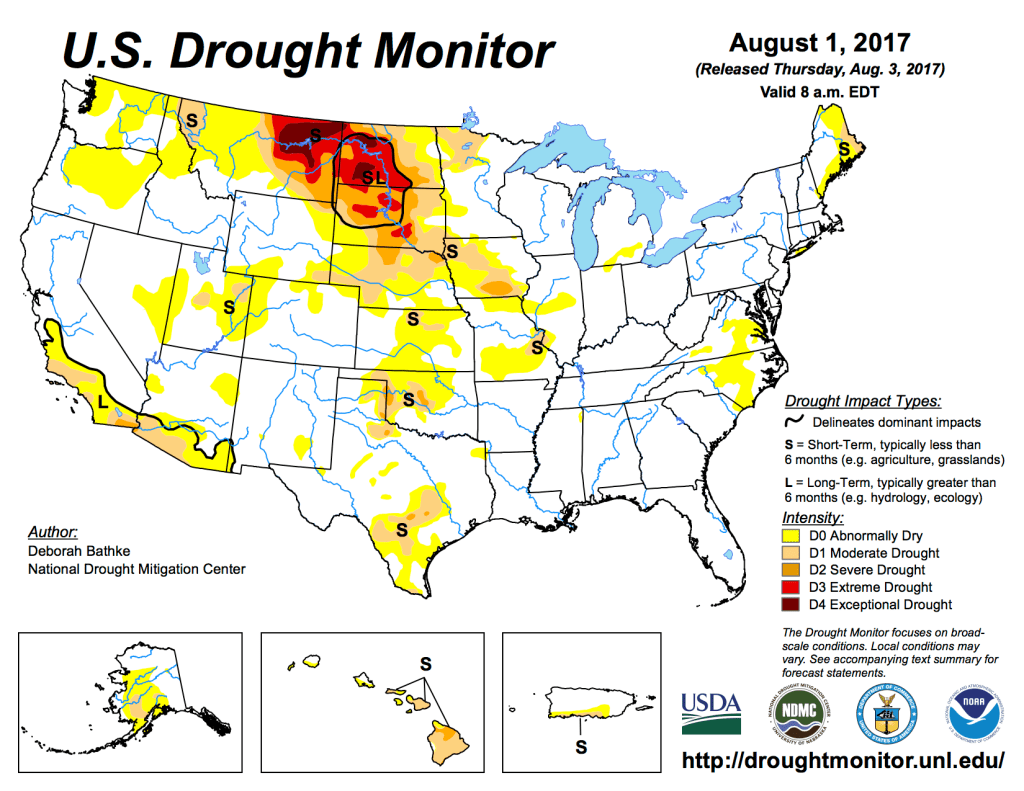
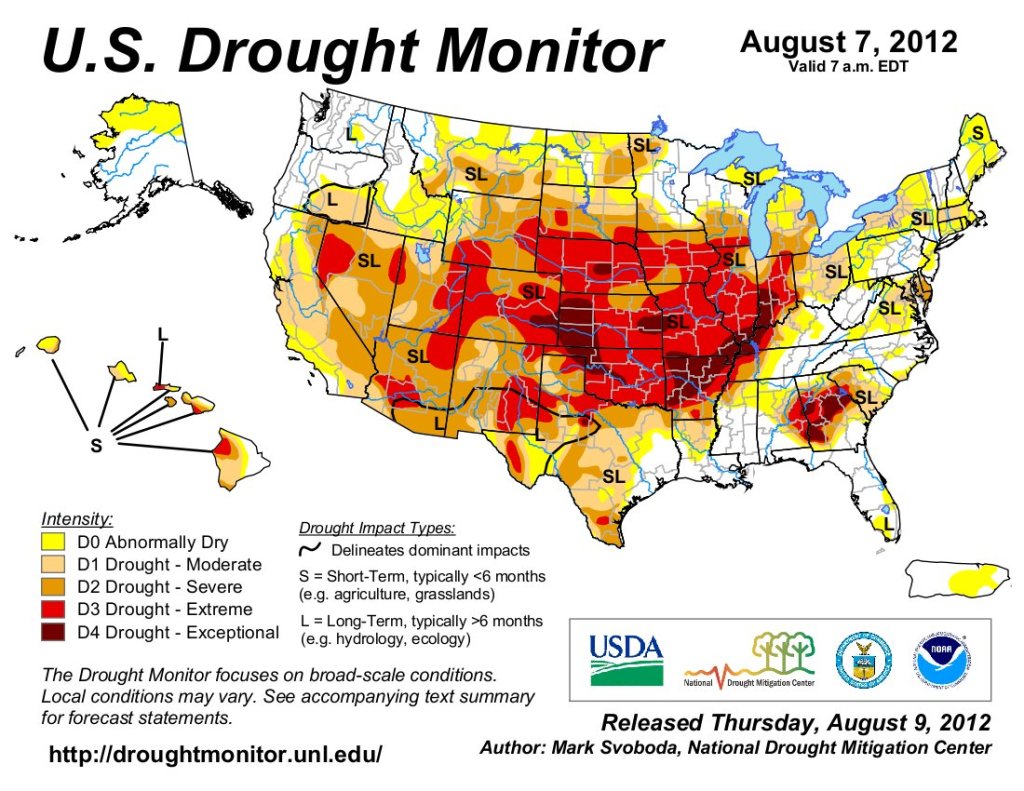
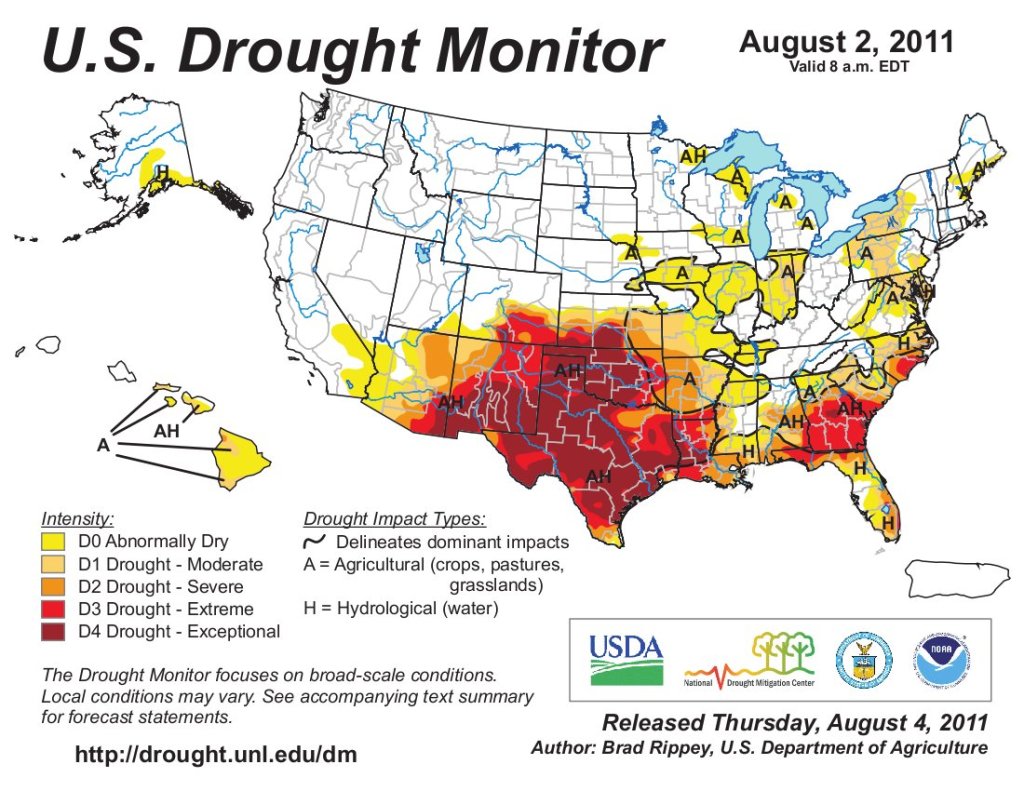
Just for grins here’s slideshow of early August US Drought Monitor maps for the past few years.
Article: Economic Evaluation of Water Management Alternatives in the Upper #GreenRiver Basin of #Wyoming — MDPI

Green River Basin

Click the link to access the article on the MDPI website (Spencer Blevins, Kristiana M. Hansen, Ginger B. Paige, Anne MacKinnonĀ and Christopher T. Bastian). Here’s the abstract:

Water use efficiency measures are generally recommended to reduce water use. Yet, flood irrigation practices in high-elevation mountain valleys of the Colorado River Basin headwaters generate return flows, which support late-season streamflow and groundwater recharge. Return flows support the ecosystem and provide recreational benefits. This study provides a framework for quantifying how land-use changes and associated return flow patterns affect the economic value of water across uses in a hydrologically connected, shallow alluvial aquifer system. This study first investigates how return flow patterns could change under three alternatives to flood irrigation: an increased use of center pivots, increased residential development, and conversion to pasture. The brown trout was used as an indicator species to track eco-hydrology, return flow, and capacity for recreational activities under each alternative. Estimates from the non-market valuation literature coupled with predicted changes in brown trout productivity approximate associated changes to recreational angler value. Recreational angler values are highest under the flood irrigation alternative. The inclusion of recreational angler values with agricultural values alters the magnitude of returns but not the rankings. These results highlight the potential heterogeneity of conclusions to be drawn regarding water use efficiency, depending on the economic value of water in different uses and the degree of hydrologic connectivity. This study also highlights data gaps and modeling needs for conducting similar future analyses.

#Colorado Attorney General Phil Weiser weighs formal role as U.S. Supreme Court reviews oil-train case — Colorado Newsline #ActOnClimate #COriver #ColoradoRiver

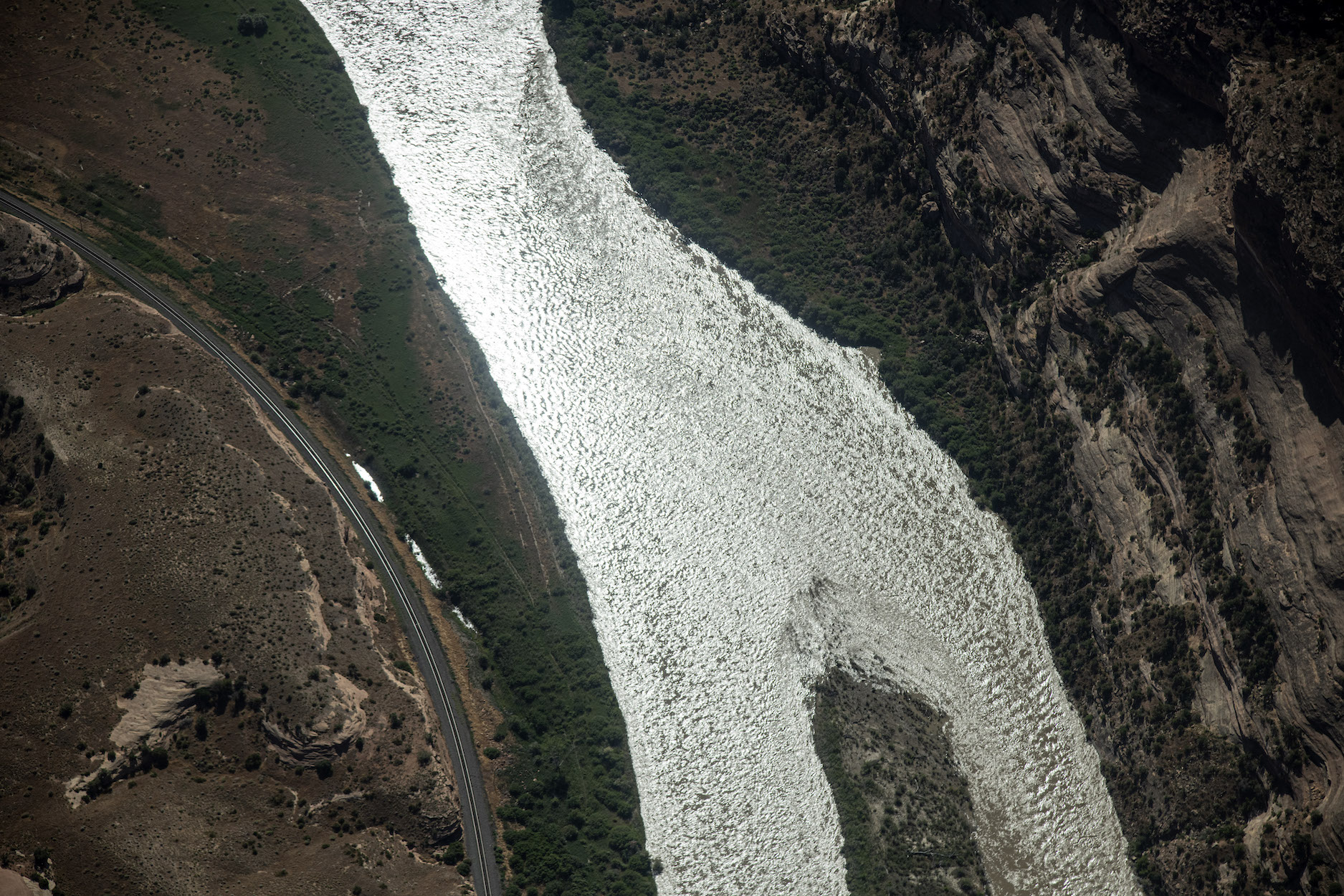
The Colorado River flows through Ruby and Horsethief canyons area near Mack, June 9, 2023. (William Woody for Colorado Newsline)

Click the link to read the article on the Colorado Newsline website (David O. Williams):

August 6, 2024

Proposed Uinta Basin rail project in #Utah could result in surge of hazardous shipments along Colorado River

Colorado’s attorney general recently left open the possibility he will take a formal role in a case before the U.S. Supreme Court to help block a proposal that would send a massive surge of oil trains along the Colorado River.

Attorney General Phil Weiser last week expressed disappointment that the court in June agreed to review Eagle County’s 2023 appellate court win, which derailed the proposed Uinta Basin Railway project in Utah. The project would likely result in a dramatic increase in hazardous oil shipments traveling through the Colorado mountains and Denver toward Gulf Coast refineries.

ā€œThe proposed plan to run two-mile-long trains filled with hundreds of thousands of barrels of waxy crude oil along the Colorado River daily poses an extreme risk to this critical water source and the communities, industries, and farmers that rely on it,ā€ Weiser wrote in an email statement to Colorado Newsline. ā€œThis proposal was rightfully tossed out by an appellate court. I am presently considering all options to protect the Colorado River — that includes weighing in with the U.S. Supreme Court as it reviews the case.ā€

The U.S. Court of Appeals for the D.C. Circuit last year ruled the U.S. Surface Transportation Board, which is the primary federal regulatory agency overseeing U.S. rail projects, erred under the National Environmental Policy Act and ordered the agency to fix significant problems with the proposed 88-mile rail spur’s environmental impact statement.

The appeals court found the STB failed to properly weigh both the upstream and downstream impacts of oil production, including accident data, downline fire risks and the impact to endangered fish from predicted oil spills in the Colorado River. 

The seven Utah counties surrounding the Uinta Basin oil fields, which formed the Seven County Infrastructure Coalition, petitioned the Supreme Court to hear the case in March. The Seven County Infrastructure Coalition v. Eagle County case will be heard during the high court’s next session, which begins in October.

Weiser — a former Supreme Court clerk to justices Byron White and Ruth Bader Ginsburg, former dean of the University of Colorado law school, and former U.S. Justice Department attorney in the anti-trust division — has been one of the top state officials critical of the Uinta Basin Railway project.

ā€œI am disappointed the Supreme Court heard (the Uinta Basin) case. We won an important decision,ā€ Weiser said in a phone interview last week. ā€œI have been a vocal critic of the idea of taking what seems to me a high-risk move through a fragile ecosystem by allowing there to be the shipping of oil in railway cars that could lead to the sort of ecological harms we’ve seen happen elsewhere.ā€

Weiser points to the environmental devastation of Norfolk Southern railroad’s East Palestine, Ohio, chemical train derailment last year.

ā€œIt doesn’t take much for a single incident to create extraordinary and lasting damage, and that, too, is a good basis for prohibiting (the Uinta Basin) project for going forward, so we’ll continue to make that case,ā€ Weiser said. ā€œI worry that a Supreme Court that is not interested in protecting our land, air and water could be less sympathetic to this point. We did see that lack of sympathy in the case involving the Clean Water Act.ā€

In last year’s Sackett v. the Environmental Protection agency case, decades of federal wetlands protections under the Clean Water Act were stripped away by the court, forcing Colorado to stand up its own regulations after a compromise with Republicans in the state Legislature.

Weiser said the only silver lining in that case was that conservative Justice Brett Kavanaugh sided with the liberal minority, joining Justices Sonia Sotomayor, Elena Kagan and Ketanji Brown Jackson in dissenting against the ruling.

ā€œWe were successful in that case with Justice Kavanaugh, but obviously we were still a vote short,ā€ Weiser said. ā€œI’m worried about all of our environmental statutes if the mindset is, ā€˜How do we gut any environmental protections?’ We as a society are going pay a price for that, whether that’s coming from the Supreme Court or a second Trump administration.ā€

From an antitrust standpoint, Weiser says consolidation in the railroad industry has opened up new risks of harm, because less competition leads companies to be less committed to reliable, safe service and adequate staffing. While federal legislation is stalled, Colorado lawmakers took up the issue last session and set up a new state rail safety office.

ā€œPart of the challenge from a competition standpoint is the Surface Transportation Board I believe has had the sole authority to evaluate mergers in rail, and they’ve been willing to approve mergers in rail that really highly concentrated that industry,ā€ Weiser said, specifically referring to the U.S. Justice Department objecting to the Union Pacific merger with Southern Pacific in 1996.

ā€œI think the system of oversight that does not allow the Justice Department to stop anti-competitive mergers is problematic, and it’s problematic that the Surface Transportation Board took action in this case and did not take the Department of Justice competition concerns more seriously,ā€ Weiser added. Now Union Pacific controls most east-west freight through Colorado and is currently negotiating with the state for a new lease at the state-owned Moffat Tunnel.

Eagle County officials have said they hope the state will take a more active role in the Uinta Basin Railway battle going forward, citing $450,000 in legal fees.

Democratic Colorado Gov. Jared Polis, in a rare statement on the Utah oil-train project, which has united the state’s Democratic lawmakers in opposition, said that if the Supreme Court greenlights the Uinta Basin Railway this fall, it will have ā€œprofound implications across the West.ā€

ā€œIt’s a legal case that we’re following, of course,ā€ Polis said recently in Vail, as quoted in the Colorado Times Recorder. ā€œWe’re actively monitoring it. It would have a major impact on our state for sure, in terms of transportation. I don’t have any say over it. It’s not up to the governor. It’s a pending court case, so we’re aggressively monitoring it, and it would have profound implications across the West.ā€

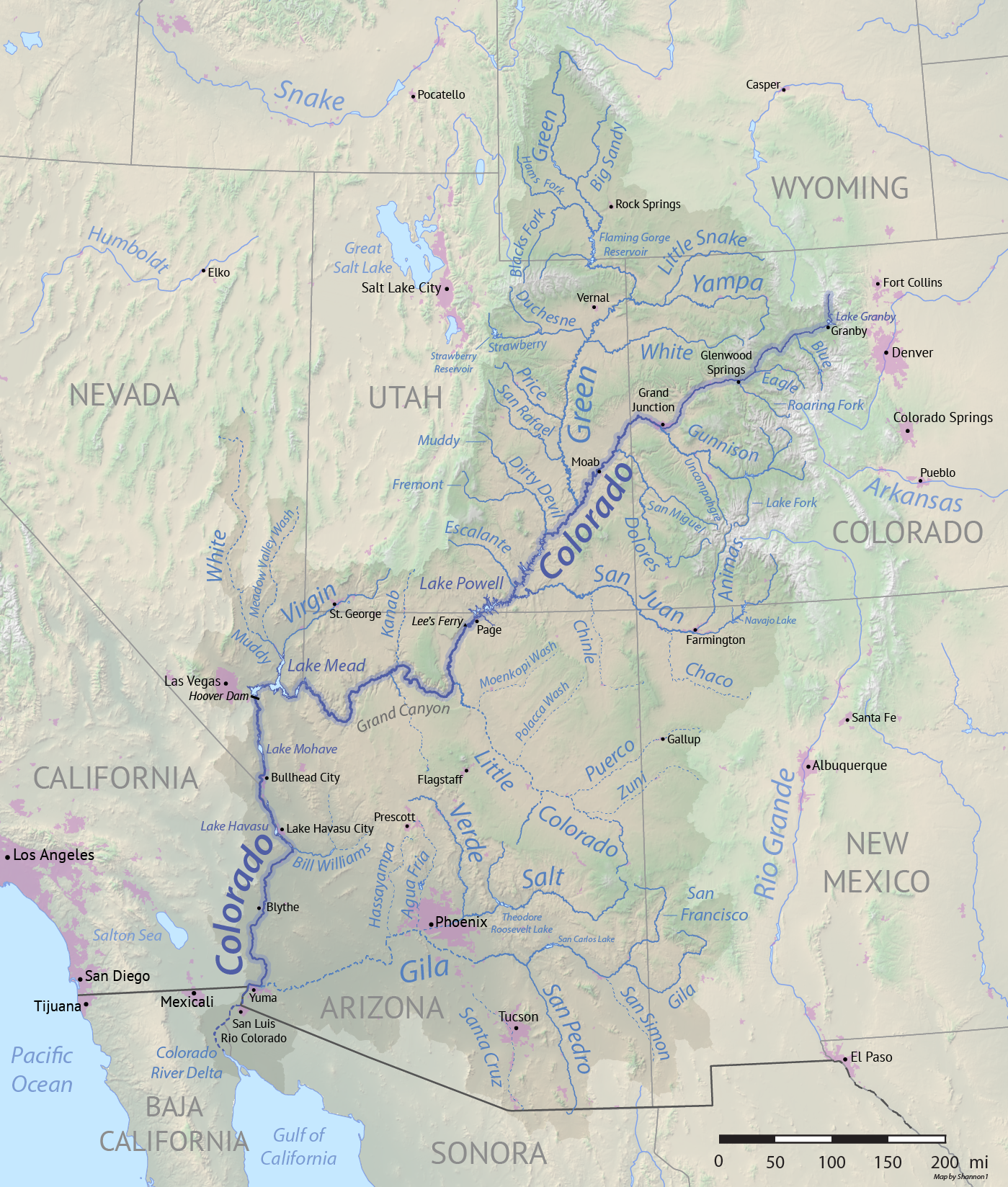
Map of the Colorado River drainage basin, created using USGS data. By Shannon1 – Own work, CC BY-SA 4.0, https://commons.wikimedia.org/w/index.php?curid=65868008