#ColoradoRiver ‘positive’ for invasive zebra mussels as wildlife officials hunt for source — #ColoradoNewsline #COriver

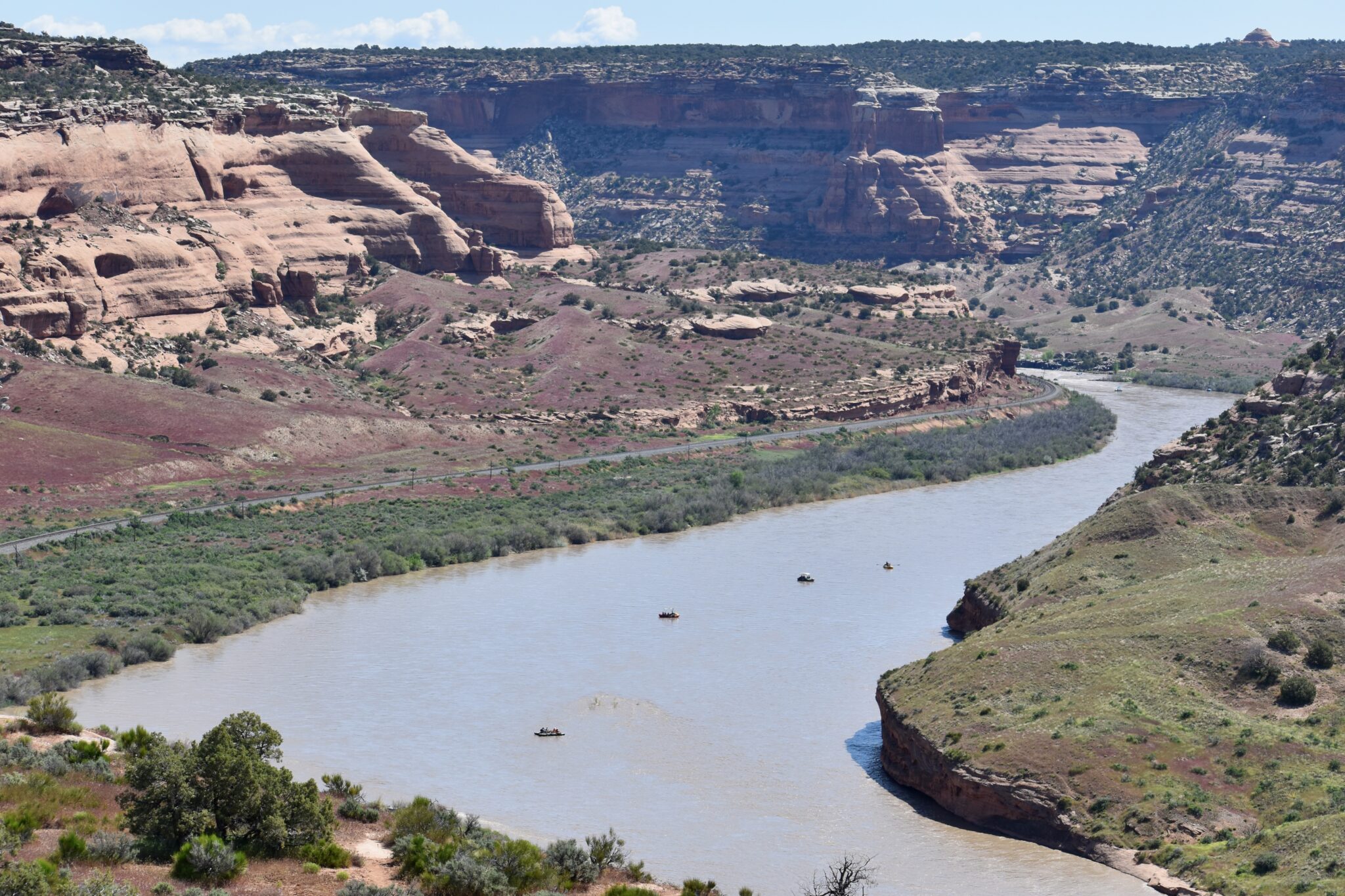
Rafters float down the Colorado River in Horsethief Canyon near the Colorado-Utah border on May 15, 2023. (Chase Woodruff/Colorado Newsline)

Click the link to read the article on the Colorado Newsline website (Chase Woodruff):

August 22, 2024

Colorado Parks and Wildlife officials have launched an extensive monitoring and public outreach plan following the detection of invasive zebra mussel larvae in several locations along the Colorado River near Grand Junction last month. But their next steps will depend on what they learn about the extent and the source of the invasive population, which could pose an “extreme risk” to local ecosystems and water utilities.

“If they are in a small pond, as an example, there is a completely different arsenal of tools that we may have in our tool belt to try to address that situation than if they are in an open water system like the Colorado River,” Robert Walters, CPW’s invasive species program manager, told a committee of state lawmakers on Wednesday. “Until we identify the source of the population, it’s really difficult to say what those control options might be.”

Zebra mussels are dangerous to water ecosystems because they strip plankton, an essential food source, from the water. Additionally, they can threaten water supplies and irrigation systems by impeding or stopping water flows and attaching to infrastructure, causing millions of dollars in damages and increased maintenance costs.

The fingernail-sized mussels, which are native to the Black and Caspian seas, are “almost impossible to eradicate” once a population is established, CPW officials say. The species has impacted ecosystems in the Great Lakes region since the late 1980s, and has subsequently spread throughout many parts of the United States by attaching to boats and other aquatic equipment.

Walters said that after additional sampling in the last few weeks, the agency now considers the Colorado River to be “positive” for zebra mussels. CPW previously deemed the river and the Government Highline Canal, a 55-mile-long irrigation project that diverts some of the river’s water to farms in the Grand Valley, “suspect” after initial testing detected zebra mussel DNA in early July. The total number of locations where the species has been detected is now seven.

“Our focus now is really on the monitoring,” Walters said. “We want to know where these are coming from and how far they have spread here in the state, as that is going to influence our long-term planning.”
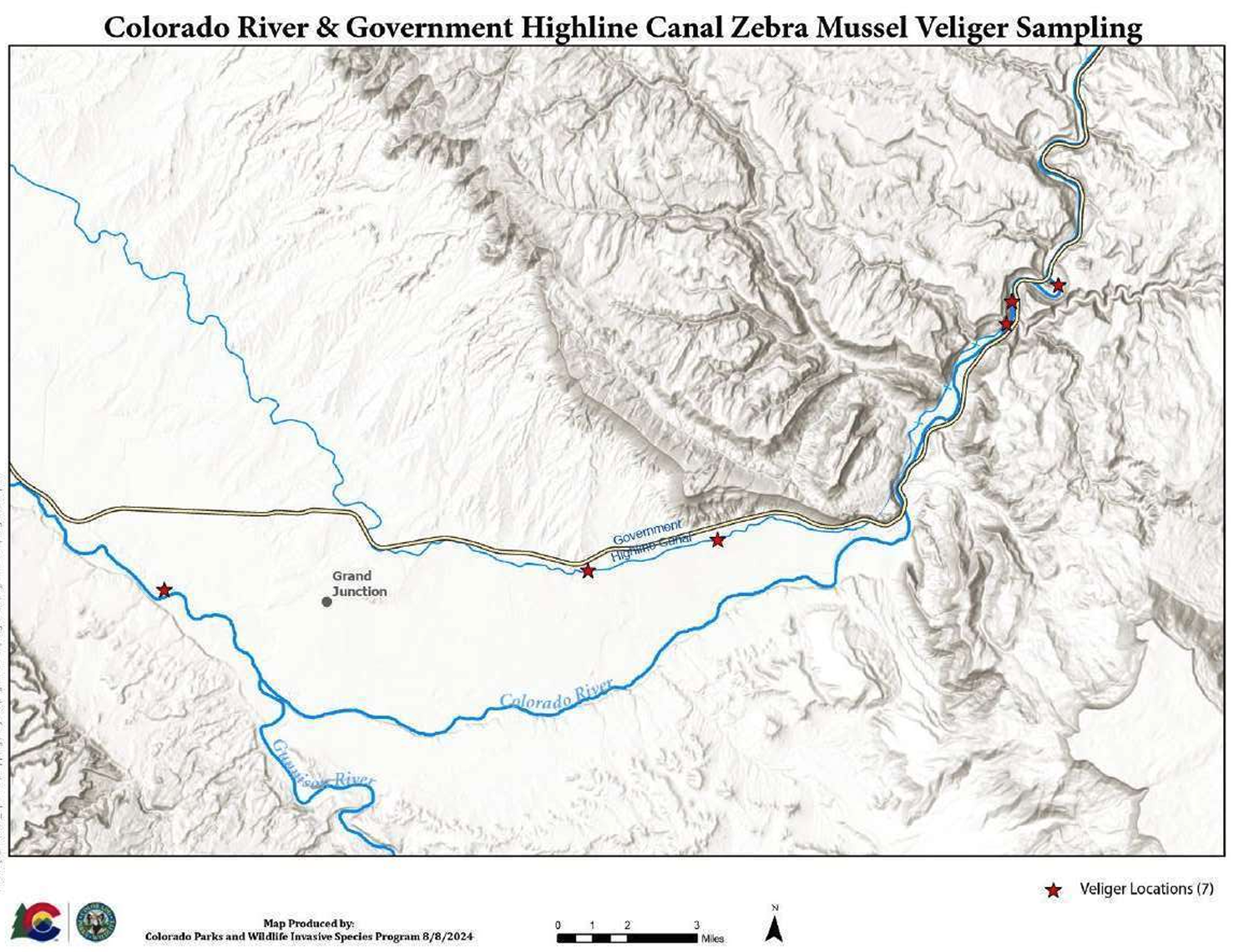
A Colorado Parks and Wildlife map shows the locations where zebra mussel DNA has been detected along the Colorado River and Government Highline Canal. (CPW)

The agency is coordinating its response with the U.S. Fish and Wildlife Service and the U.S. Bureau of Reclamation, which owns the Highline Canal, along with the Army Corps of Engineers, which is conducting a “west-wide boater movement study” to identify how and where contaminated boats may have entered Colorado waterways. Public awareness campaigns and a network of inspection and decontamination stations at popular boating sites are key prevention strategies, Walters said. A 10-second high-pressure spray of hot water is enough to kill and remove zebra mussels that have attached to a boat.

CPW urges anyone using the Colorado River to clean, drain, and dry their vessels and equipment — including boats, rafts, kayaks, paddle boards and fishing equipment — after they leave the water.

So far, no adult zebra mussels have been found in the Colorado River, Walters said — only so-called veligers, the species’ larval form. Public education and awareness will be critical to minimizing the impacts of what for now is a “very low density of veligers that we are detecting,” he said.

“We have had zero positive detection since those last ones in the middle of July,” Walters added. “That doesn’t mean we aren’t continuing to look. We are out there every single week collecting additional samples, trying to identify where these are coming from.”


Bicycling the Colorado National Monument, Grand Valley in the distance via Colorado.com

National Renewable Energy Laboratory Advances Method for Recyclable Wind Turbine Blades: Resin Made From Biomass Enables Chemical Recycling at End of Useful Lifespan #ActOnClimate

sSeptember 26, 2023 – Small cubes of the PolyEster Covalently Adaptable Network (PECAN) resin used to understand their depolymerization kinetics. (Photo by Werner Slocum / NREL)

Click the link to read the release on the NREL website:

August 22, 2024

Researchers at the U.S. Department of Energy’s National Renewable Energy Laboratory (NREL) see a realistic path forward to the manufacture of bio-derivable wind blades that can be chemically recycled and the components reused, ending the practice of old blades winding up in landfills at the end of their useful life.

The findings are published in the new issue of the journal Science. The new resin, which is made of materials produced using bio-derivable resources, performs on par with the current industry standard of blades made from a thermoset resin and outperforms certain thermoplastic resins intended to be recyclable.

The researchers built a prototype 9-meter blade to demonstrate the manufacturability of an NREL-developed biomass-derivable resin nicknamed PECAN. The acronym stands for PolyEster Covalently Adaptable Network, and the manufacturing process dovetails with current methods. Under existing technology, wind blades last about 20 years, and afterward they can be mechanically recycled such as shredded for use as concrete filler. PECAN marks a leap forward because of the ability to recycle the blades using mild chemical processes.

The chemical recycling process allows the components of the blades to be recaptured and reused again and again, allowing the remanufacture of the same product, according to Ryan Clarke, a postdoctoral researcher at NREL and first author of the new paper. “It is truly a limitless approach if it’s done right.”

He said the chemical process was able to completely break down the prototype blade in six hours.

The paper, “Manufacture and testing of biomass-derivable thermosets for wind blade recycling,” involved work from investigators at five NREL research hubs, including the National Wind Technology Center and the BOTTLE Consortium. The researchers demonstrated an end-of-life strategy for the PECAN blades and proposed recovery and reuse strategies for each component.

“The PECAN method for developing recyclable wind turbine blades is a critically important step in our efforts to foster a circular economy for energy materials,” said Johney Green, NREL’s associate laboratory director for Mechanical and Thermal Engineering Sciences.

The research into the PECAN resin began with the end. The scientists wanted to make a wind blade that could be recyclable and began experimenting with what feedstock they could use to achieve that goal. The resin they developed using bio-derivable sugars provided a counterpoint to the conventional notion that a blade designed to be recyclable will not perform as well.

“Just because something is bio-derivable or recyclable does not mean it’s going to be worse,” said Nic Rorrer, one of the two corresponding authors of the Science paper. He said one concern others have had about these types of materials is that the blade would be subject to greater “creep,” which is when the blade loses its shape and deforms over time. “It really challenges this evolving notion in the field of polymer science, that you can’t use recyclable materials because they will underperform or creep too much.”

Composites made from the PECAN resin held their shape, withstood accelerated weatherization validation, and could be made within a timeframe similar to the existing cure cycle for how wind turbine blades are currently manufactured.

While wind blades can measure the length of a football field, the size of the prototype provided proof of the process.

“Nine meters is a scale that we were able to demonstrate all of the same manufacturing processes that would be used at the 60-, 80-, 100-meter blade scale,” said Robynne Murray, the second corresponding author.

The other coauthors, all from NREL, are Erik Rognerud, Allen Puente-Urbina, David Barnes, Paul Murdy, Michael McGraw, Jimmy Newkirk, Ryan Beach, Jacob Wrubel, Levi Hamernik, Katherine Chism, Andrea Baer, and Gregg Beckham.

The U.S. Department of Energy jointly funded the research through its Advanced Materials and Manufacturing Technologies Office and Bioenergy Technologies Office and their support of the BOTTLE Consortium. Additional research and funding will allow the investigators to build larger blades and to explore more bio-derived formulations.

NREL is the U.S. Department of Energy’s primary national laboratory for renewable energy and energy efficiency research and development. NREL is operated for DOE by the Alliance for Sustainable Energy LLC.

The Crossing Trails Wind Farm between Kit Carson and Seibert, about 150 miles east of Denver, has an installed capacity of 104 megawatts, which goes to Tri-State Generation and Transmission. Photo/Allen Best

Northern #Colorado aerial cloud-seeding program suspended for now — Fresh Water News

Captain Kirk Hamilton snapped the above photo in the early morning hours of Feb. 3, 2021 on one of his aerial cloud seeding missions in the North Platte River Basin as part of the Jackson County pilot program over the Never Summer mountain range. (Kirk Hamilton, Weather Modification International)

Click the link to read the article on the Water Education Colorado website (Sidney Barbier):

August 14, 2024

An experiment to use a potentially more effective form of cloud-seeding in the North Platte Basin has been postponed indefinitely due to a shortage of planes and funding. 

Cloud-seeding from airplanes is able to target specific storms, increasing the technology’s ability to generate more water, but it’s expensive and can cost up to three times more than ground-based programs, according to Andrew Rickert, weather modification program manager with the Colorado Water Conservation Board.

According to Barbara Vasquez, representative from the North Platte Basin to the Colorado Water Conservation Board, the North Platte is the only basin in Colorado where aerial cloud seeding has been conducted so far. Aerial cloud seeding has taken place in the Medicine Bow Range and the Sierra Madre mountains in Wyoming and Colorado, and in Colorado’s Never Summer range. 

Rickert said such programs, despite their funding difficulties, are important in building a range of tools to increase water supplies. “With where the state is heading with climate change and drought, it is important for Colorado to do everything we can to bolster our snowpack. You can do as much storage and conservation as possible, but cloud seeding is the only way to physically add water to a system which is something we need to constantly be focused on.” 

Cloud-seeding graphic via Science Matters

 Cloud seeding involves dispersing a small amount of silver iodide into the atmosphere. The chemical acts as a “dust” particle allowing for water droplets or ice crystals to form in clouds and increase precipitation. Silver iodide is a naturally occurring compound that proponents of cloud seeding claim has no known harmful environmental effects.  

The Jackson County Water Conservancy District partnered with the State of Wyoming and Colorado to take on a pilot project in the Never Summer Mountain Range from Cameron Pass to Willow Creek Pass in 2019. 

The decision to suspend the North Platte aerial cloud-seeding program is partly due to limited availability of the aircraft from Wyoming, which supplied the plane for Colorado.

“We were working with the Wyoming [Water] Development Office which was paying to house the plane in Wyoming, so one of the problems we ran into was when there were seedable storms in both states, Wyoming always got preference,” Rickert said. “We were OK with that because we weren’t paying as much as them, but we were always playing second fiddle.” 

Barry Lawrence, deputy director of planning with the Wyoming Water Development Office, said it was important for Wyoming to have first shot at airplane use. “It was written into our contract that the second priority was to go into Colorado if conditions were right.”

But Lawrence also said there are important benefits to the collaboration between the two states. “It’s important to start thinking watershed wide and not to bar political boundaries/state lines, but to think about the watersheds and what we can do to make the system whole.” 

An additional reason for ending the pilot program is funding. In 2018, the Colorado Water Conservation Board approved a three-year, $150,000 grant for the aerial cloud seeding. It was renewed in 2021 for $225,000.

But that’s not much money when it comes to aerial cloud-seeding. 

In 2022-2023, Wyoming spent $873,353.00. The Jackson County Water Conservancy District provided an additional $84,000.00 for operations conducted in Colorado’s Never Summer Mountains.

Jimmer Baller, president of the Jackson County water district, says that the program is just too costly right now for the county to take on without future funding from the state, but a revival of the program is not out of the question. 

The CWCB’s Rickert said he is already working on increasing cloud seeding operations in the state and is considering how to support aerial seeding. 

At the same time, the CWCB has seven permitted ground-based cloud seeding programs in the state from Vail to Grand Mesa, Rickert said. 

More by Sidney Barbier

Cloud seeding ground station. Photo credit H2O Radio via the Colorado Independent.

On Trump’s dystopian Agenda 47, Freedom Cities — Jonathan P. Thompson (The Land Desk)

Even AI can’t capture the absurdity of Agenda 47’s “Freedom Cities.” Credi: Jonathan P. Thompson/The Land Desk

Click the link to read the article on The Land Desk website (Jonathan P. Thompson):

August 2, 2024

The News: Agenda 47 — the Trump campaign’s platform — promises to develop 10 “Freedom Cities” on “empty” public lands in the Western United States if he is elected president.

Context: After Trump lost the 2020 election, the ultra-right-wing Heritage Foundation, along with help from dozens of former Trump administration staffers, set about to create Project 2025, a “playbook” for Trump just in case he managed to win this November’s presidential election. 

Suffice it to say, Project 2025 is downright terrifying, as this excellent analysis by Michelle Nijhuis and Erin X. Wong reveals. In fact, it’s so weird — and so unpopular — that Trump has scrambled to distance himself from the whole endeavor, even claiming he doesn’t know anything about it or the people pushing it. That’s despite having praised the plan during a speech to the Heritage Foundation in 2022, despite the fact that many of the plan’s architects were in his administration, and despite the fact that his VP candidate J.D. Vance wrote the foreword to Heritage Foundation President Kevin Roberts’ new book. 

But it doesn’t really matter, because Trump has his own authoritarian plan. It’s called Agenda 47, and serves as a template for the only slightly less creepy sounding Republican Party Platform. Agenda 47 is a bit shorter and less detailed than the 900-page Project 2025, which maybe makes it slightly more palatable to certain voters, but is equally nuts and just as scary. It vows to protect freedom of speech and cut funding for any school that teaches “inappropriate racial, sexual, or political content.” If elected, Trump and company would also “deport pro-Hamas radicals and make our college campuses safe and patriotic again.” Nothing fascist about that! 

When it comes to public lands and the environment, Trump plans to do more of what he did last time he was in the White House — which is to say eviscerate environmental, health, safety, and worker protections in the name of “energy dominance” and corporate profit. The GOP platform also calls for using federal land for housing development. In theory this would bolster supplies of housing, thereby reducing prices and alleviating the housing crisis. The theory is deeply flawed, however, and though it may sound well-intentioned, ultimately it is just another ploy to privatize public land.

On this and other initiatives both Agenda 47 and the GOP platform (which are near-mirrors of each other) are scant on details. Hoping to learn more, I delved into Trump’s Agenda 47 archives and … holy crapoli! I had to wonder if Trump’s running for president or for the mayor of Crazytown — he’s the hands-down favorite for the latter.

Last March the Trump campaign unveiled its Agenda 47. Apparently it wanted to modernize the old “make America great again” slogan, so it went instead with:

Agenda47: A New Quantum Leap to Revolutionize the American Standard of Living.

Despite making no sense, you gotta give them credit for having a forward-looking slogan rather than the backward-looking one (which they have since reverted to, by the way). Indeed, it’s so forward-looking that they would “create a new American future.” Silly ol’ me thought that the future was always new on account of being, you know, the future and all.

And what will this new future look like? Freedom Cities!  

You’re probably thinking: Why the hell would anyone want to build ten new cities in the drought-stricken West when there’s not enough water to go around now? What’s the point anyway? To make a few real estate developers incredibly rich? To realize a megalomaniac demagogue’s dream of building new cities to match some bizarre ideological vision? Will Trump resurrect Albert Speer to design the new cities?

Apart from the big picture flaws, this whole thing is riddled with wrong from start to finish. Let’s break it down:

  • “… open up the American frontier.” Are you friggin’ kidding me? Is this from the Trump campaign or the Andrew Jackson’s Corpse campaign? Referring to the Western U.S. as the “frontier” was racist and ignorant in the 19th century. It was intended to portray the region — and the Indigenous people who live there — as a wild and savage place that needed to be tamed and/or killed by EuroAmerican invaders so they could steal the land and put it into the public domain so some dumbass could come along and build some Freedom Cities there a couple centuries later so they could create a new American future. Using the term now is still ignorant and racist and just downright stupid. 
  • “Hundreds of millions of these acres are empty.” Oh, really? Well, let’s see, the Bureau of Land Management oversees about 248 million acres and the Forest Service another 193 million acres. So, basically, Trump’s saying that at least half of America’s public lands are “empty.” This is age old code (also see “underutilized”) for describing landscapes that haven’t been industrialized, drilled, mined, grazed to death, or otherwise ruined. Of course, none of the public lands are actually empty, but I think y’all know that. 
  • Trump assures us these cities won’t be built on “national parks or other natural treasures.” Thing is, if Trump and his ilk get their way, there will be precious few natural parks or monuments or ‘natural treasures’ remaining. Certainly you remember how the Trump administration eviscerated Bears Ears and Grand Staircase-Escalante National Monuments. There’s zero reason to expect him not to do the same if he were elected again — only to a further degree.

If this whole Freedom Cities thing sounds like something a couple sixteen year olds would dream up while getting stoned while sitting on some desert butte (Free Doritos for everyone, brah!), then just read on. Trump would also “modernize transportation,” not by building trains and buses or even electric cars, but by bolstering efforts to develop “vertical-takeoff-and-landing vehicles for families and individuals.” And to help make these and all of America’s cities “beautiful,” they’ll build “towering monuments to our true American heroes.” Does anyone else catch a whiff of Nicolae Ceausescu or even Albert Speer while reading this?

So these brand new cities, built on public land, would be swarming with people-carrying quad-copters swerving to miss one another and the monumental statues of Donald Trump and Andrew Jackson and Tucker Carlson. And how will they people these cities after carrying out the “largest deportation in American history”? They’ll offer “‘Baby Bonuses’ for young parents to help launch a new baby boom.”

If that seems zany, now imagine having one of these metropolises plopped down smack dab in one of your favorite swaths of “empty” public lands. Eek! Sounds like fodder for a dystopian horror film, working title: Agenda 47.


⛏️Mining Monitor ⛏️

Sign in the Lisbon Valley of southeastern Utah. Jonathan P. Thompson photo.

When two trucks hauling uranium ore rumbled out of Energy Fuel’s Pinyon Plain Mine near the Grand Canyon Tuesday on their way to the White Mesa Mill in Utah, Navajo Nation President Buu Nygren sent law enforcement officers to stop them. The trucks managed to get off tribal land before the police could catch them, but the next shipments are likely to be stopped. It’s the latest episode in a long-simmering battle between the tribe and the uranium industry — and a test case for tribal sovereignty. 

Whether the U.S. uranium mining industry is experiencing a full-on renaissance or is merely having zombie-dream twitches isn’t yet clear. But the ore shipments represent the clearest sign of life, yet, since it is the first time freshly mined ore will be processed in years. Tribal nations, advocates, and lawmakers have pushed back against both the mine and the mill for years due to the potential for contaminating groundwater aquifers. 

In 2012, the Navajo Nation banned uranium shipments across tribal lands. But it is not clear whether it applies to the federal and state highways used by Energy Fuels’ trucks.

Energy Fuels had previously agreed to give the Navajo Nation and other stakeholders a two-week notice before shipping any ore; they actually didn’t notify anyone until after the trucks left the mine. Arizona Attorney General Kris Mayes got involved, and issued a statement reading: “Hauling radioactive materials through rural Arizona, including across the Navajo Nation, without providing notice or transparency and without providing an emergency plan is unacceptable.”

And now Arizona Gov. Katie Hobbs has helped broker a pause in shipments to give the Navajo Nation and Energy Fuels a chance to work things out. 

***

The Pinyon Plain Mine and White Mesa Mill get all of the attention, but the mining industry — uranium and otherwise — is also stirring elsewhere. Some quick hits:

  • Energy Fuels is also doing work at its Whirlwind Mine right on the Colorado-Utah border above Gateway and on its La Sal Complex, which sits less than a mile away from the community of the same name — and a school. Energy Fuels is also looking to develop the Roca Honda Project on Forest Service land near Mt. Taylor in New Mexico. 
  • Utah regulators have accepted Anfield Energy’s application to restart its Shootaring Canyon mill near Ticaboo, Utah, which means the state can now begin its review. Anfield hasn’t had as much luck with its operating plan for its Velvet-Wood Mine in the Lisbon Valley: The BLM’s Monticello Field Office deemed it incomplete, and wouldn’t even consider it until Anfield filled in numerous blanks. 
  • Egad! The BLM is actually raising mining claim maintenance fees. That’s the amount one has to pay when staking, or locating, a claim and once every year after that. It was $165. Next month it will shoot up to $200 per claim (plus a $25 processing fee and $49 location fee tacked onto the initial payment). That’s a whopping 20% increase, but still seems to be a pretty darned good bargain and is unlikely to dissuade speculators. 
  • The Energy Permitting Reform Act, a bill making its way through Congress, would codify mining companies’ ability to stake mining claims on public lands to use as waste dumps and for other ancillary purposes. It’s just one of the ways the legislation, which is being pushed as a way to speed up clean energy projects, would benefit the extractive and fossil fuel industries. Originally pushed by Sens. Joe Manchin and John Barrasso, some Democrats, including Sen. Martin Heinrich of New Mexico, have signed on in support. 
  • You can find most of these projects on the Land Desk Mining Monitor Map and the Land Desk’s Uranium Mining in the Four Corners Map.