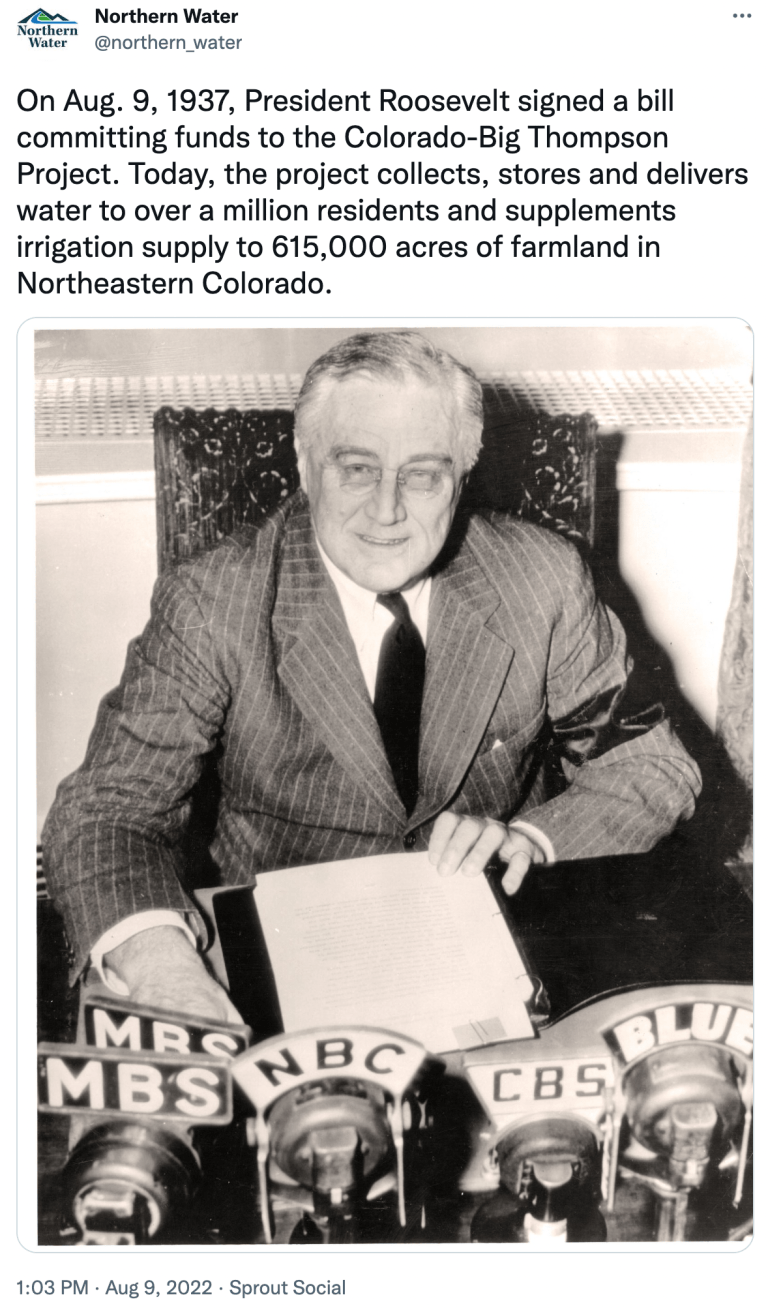
Uranium Monitoring, Testing and Modeling Continue — Northern Water E-Waternews October 2025

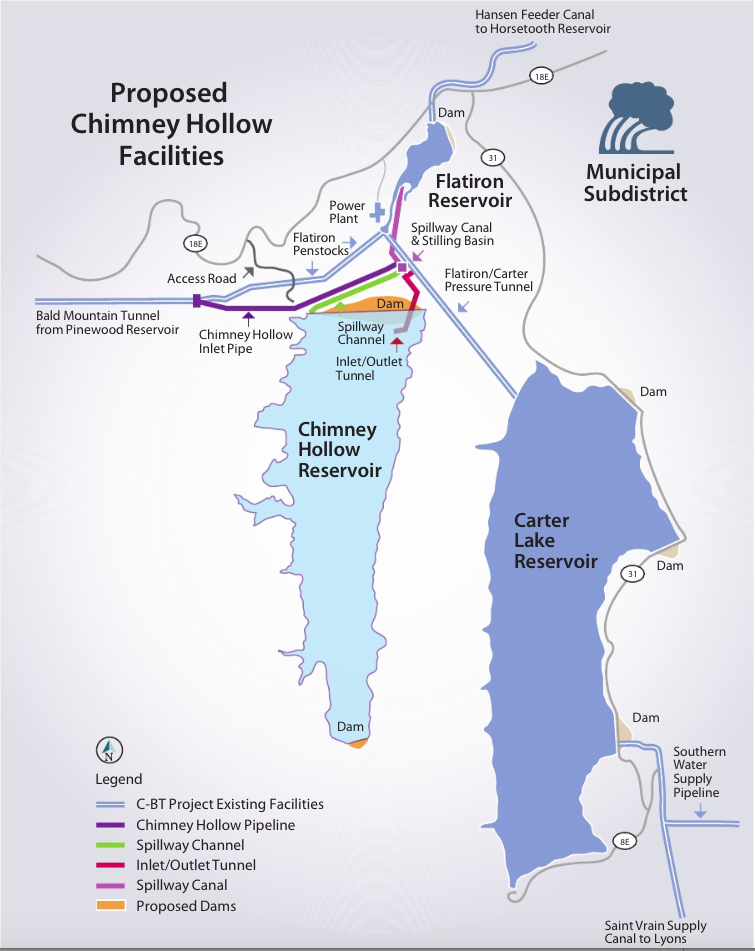
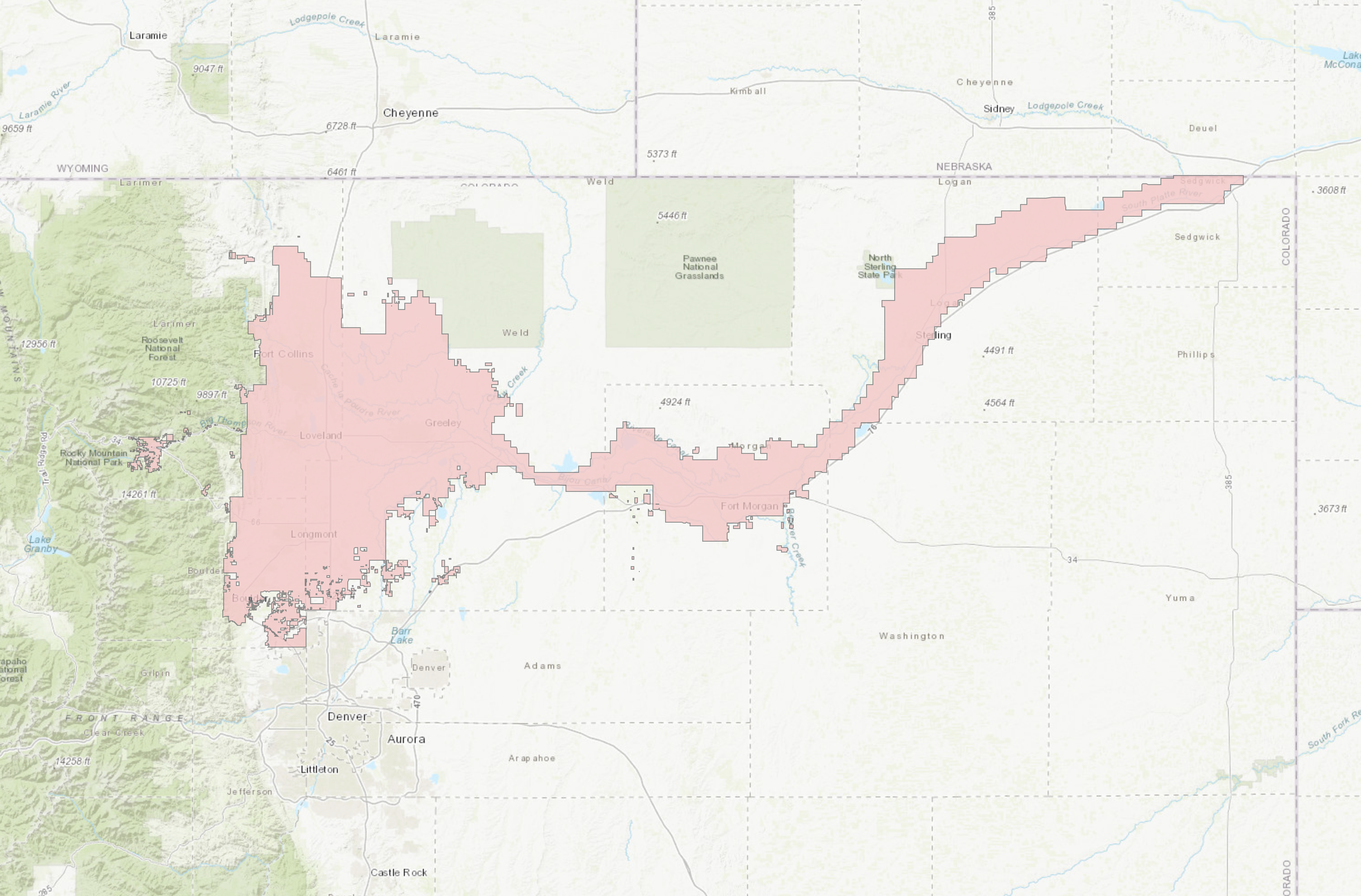
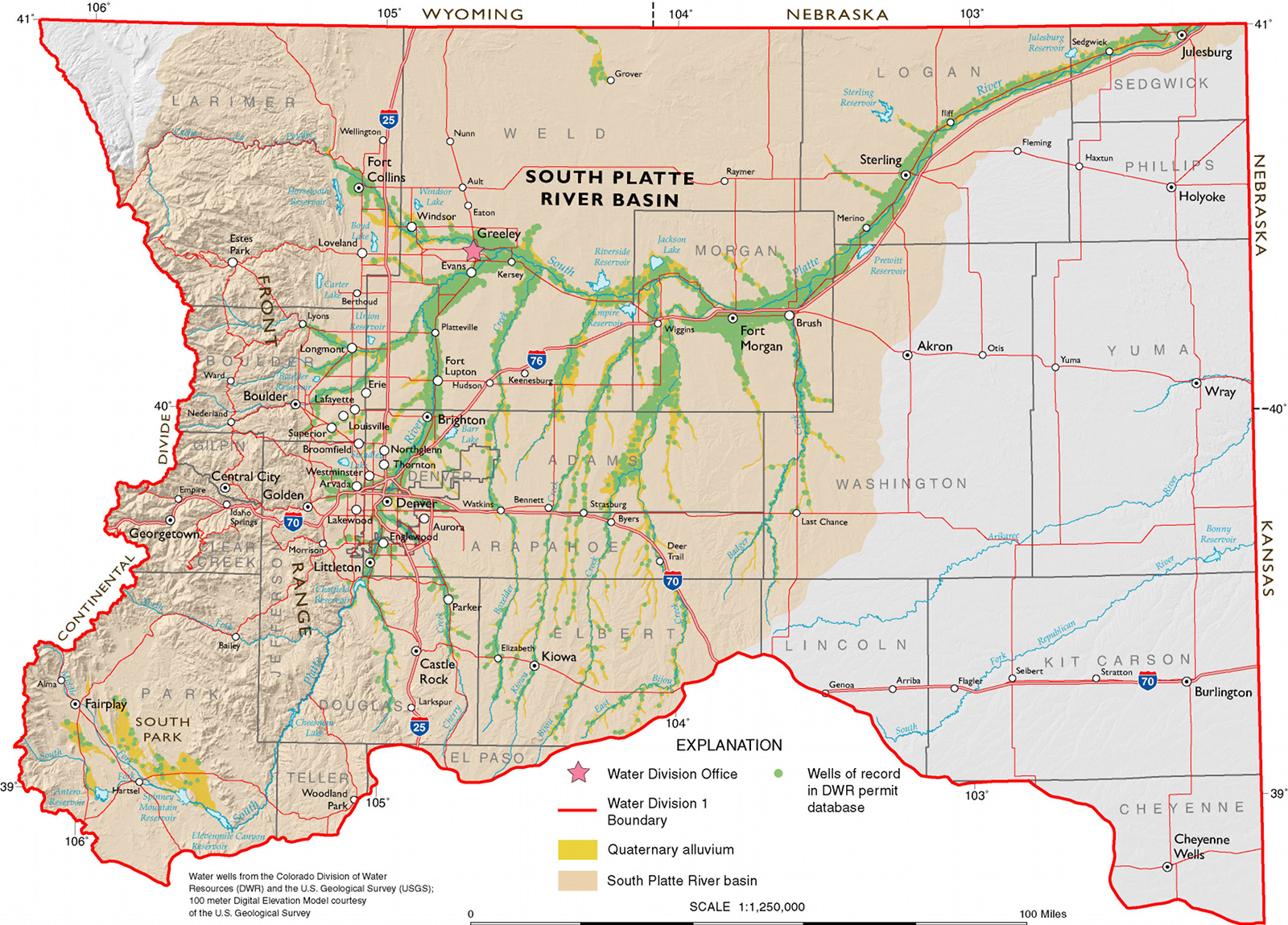
Map from Northern Water via the Fort Collins Coloradan.

From email from Northern Water:

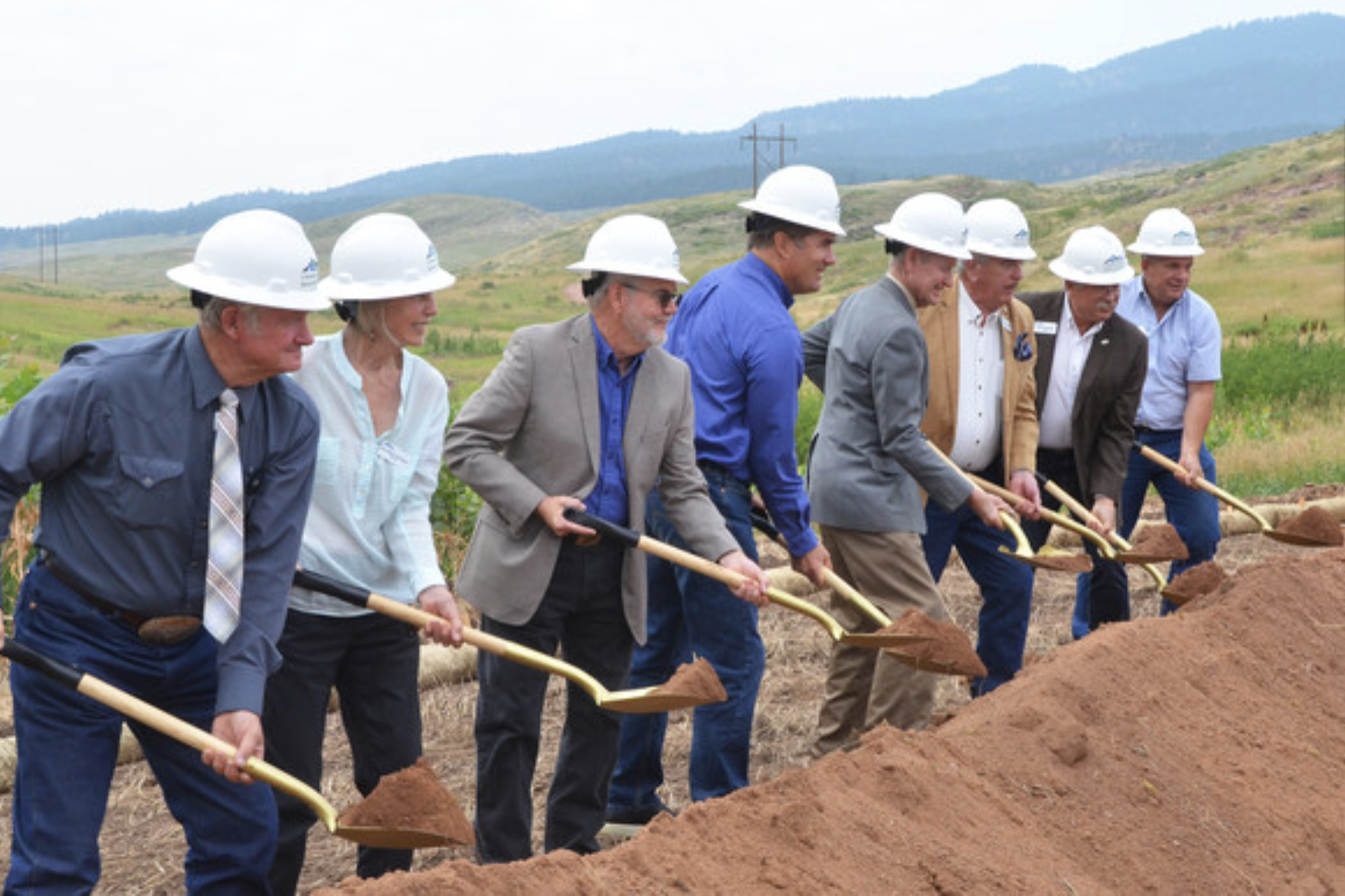
Northern Water and Chimney Hollow participants are committed to keeping our customers, stakeholders and end users, as well as the general public, informed as we gather additional information on the discovery of uranium at the Chimney Hollow Reservoir construction site. Collecting data and modeling are crucial steps in the development of mitigation strategies, and we are actively working to learn more by evaluating test results from field investigations and modeling scenarios.   

Before making mitigation decisions, we want to make sure we have all the information to evaluate operational and treatment options. We are following a rigorous process, starting with geochemical characterization and scoping studies, to inform mitigation alternatives analyses and ultimately select a final approach. Following these steps allows us to make informed decisions, evaluate trade-offs and determine the best path forward.   

Northern Water has been testing how the uranium minerals leach into water and what concentration to expect when the reservoir fills and its operation begins. To allow time for additional data collection and investigations to advance, we have elected not to fill the reservoir as quickly as initially planned. A small amount of water (less than 2 percent of total capacity) will be moved into Chimney Hollow Reservoir in November 2025. During this time, additional water quality data will be collected and used to evaluate the performance of model simulations, and required dam safety monitoring will begin. Even as the reservoir fills, no water will be released as further assessments are underway and mitigation options continue to be evaluated.  

Because the mineralized uranium is coming from materials quarried at the site, excess (unused) rock from construction has been buried under a layer of water-sealing clay. The clay cap will effectively minimize uranium leaching from these materials.  

We expect uranium leaching from the dam to decrease over time because there is a finite quantity of soluble uranium at the site. The duration of the leaching process is not yet fully understood and will depend on how the reservoir is operated over time. While the discovery of mineralized uranium has caused Northern Water and the Chimney Hollow participants to modify our plans, it is an issue that can be safely managed. The new reservoir remains an important part of securing water supply needs for Northern Colorado and its future. Please visit the Water Quality page on our website for more information and a list of Frequently Asked Questions.

$4 million in federal funds restored for Upper #ColoradoRiver Basin watersheds damaged by fire, overgrazing — Jerd Smith (Fresh Water News) #COriver #aridification

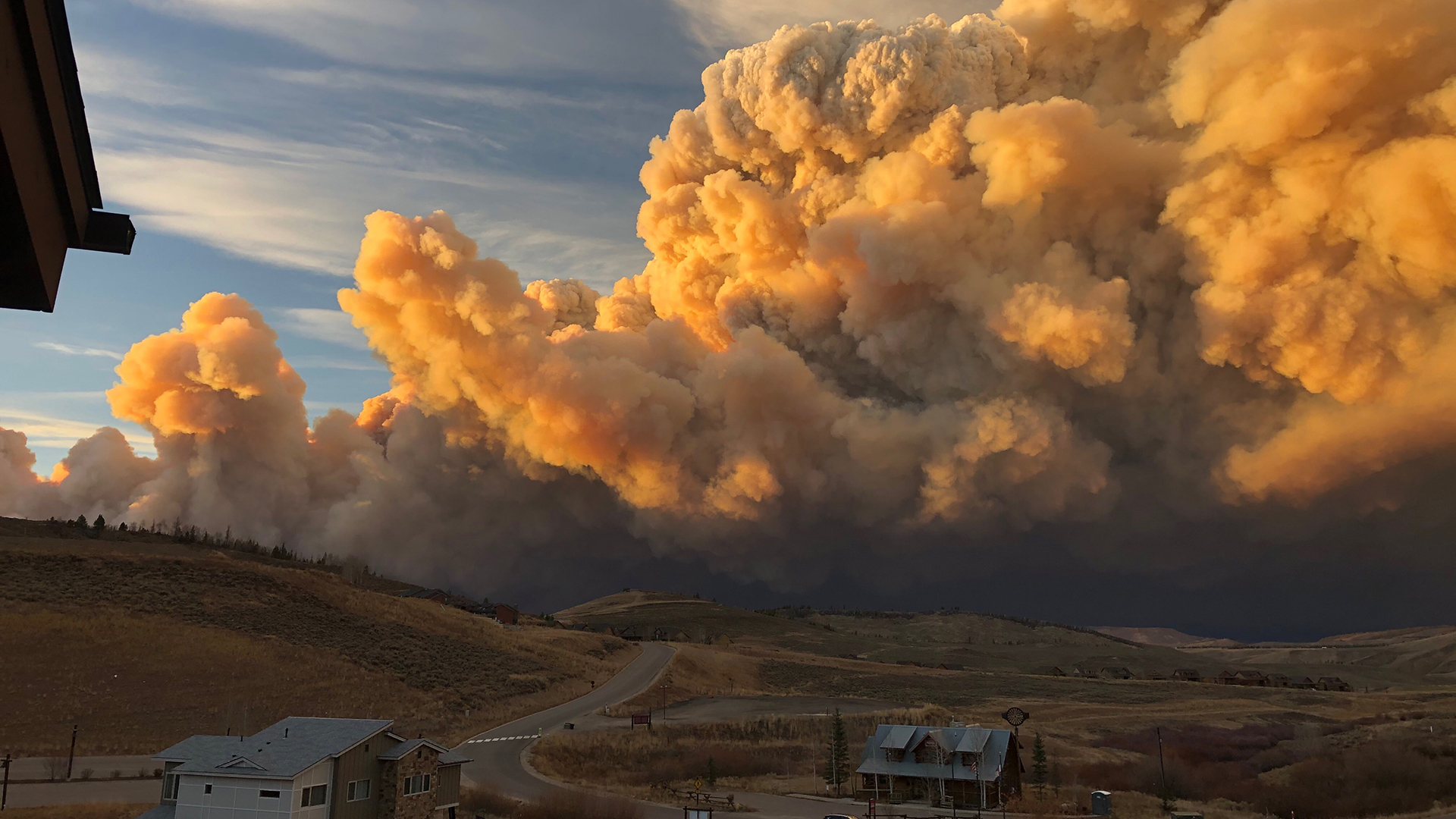
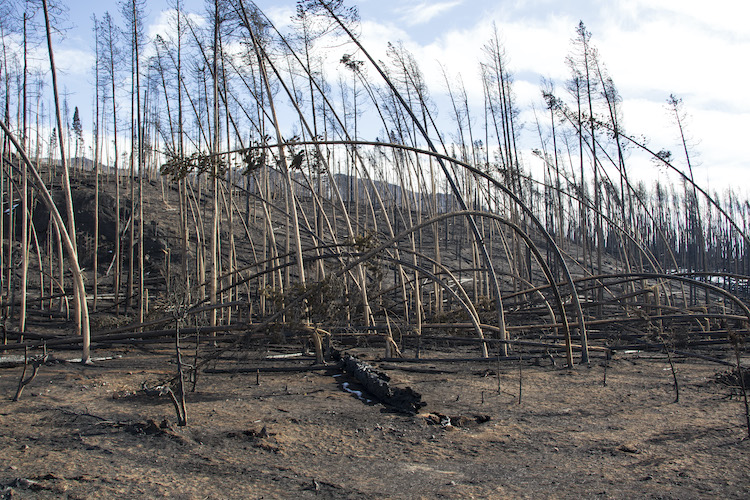
Lands in Northern Water’s collection system scarred by East Troublesome Fire. October 2020. Credit: Northern Water

Click the link to read the article on the Water Education Colorado website (Jerd Smith):

July 10, 2025

Millions of dollars in federal funding has been released to continue restoring lands and streams in the fire-scarred Upper Colorado River Basin watershed in and around Grand Lake and Rocky Mountain National Park.

The roughly $4 million was frozen in February and released in April, according to Northern Water, a major Colorado water provider and one of the agencies that coordinates with the federal government and agencies such as the U.S. Forest Service to conduct the work. 

Esther Vincent, Northern Water’s director of environmental services, said the federal government gave no reason for the freeze and release of funds.

The amounts and timing of the freeze and release are being reported here for the first time.

U.S. Congressman Joe Neguse, who represents Grand County, did not respond to a request for comment regarding the funds.

The news comes as tens of millions of dollars in federal grants and budget allocations are being cut in Colorado and across the country as part of the Trump administration’s reorganization of federal agencies and associated budget cuts.

In June, Gov. Jared Polis’ office released an accounting of federal money that has flowed to state agencies. That analysis showed the agencies were able to retain $282 million in funding, but that $76 million had been lost, and another $56 million is at risk.

It’s unclear how much funding that flows through federal agencies to other Colorado entities and nonprofits such as those in the Upper Colorado River Basin, has been lost.

The U.S. Forest Service did not respond to a request for comment. The U.S. Bureau of Reclamation declined to comment on the funding actions.

In Grand County, $761,000 has been released from the U.S. Bureau of Reclamation to help move forward on a broad-based effort by the Kawuneeche Valley Restoration Collaborative, according to Northern Water. The valley has been damaged by drought, failing irrigation systems and overgrazing by wildlife and is a critical piece of the Colorado River’s upper watershed. The collaborative, established in 2020, is a major partnership of seven entities, including Northern Water, Grand County, the Nature Conservancy and Rocky Mountain National Park. 

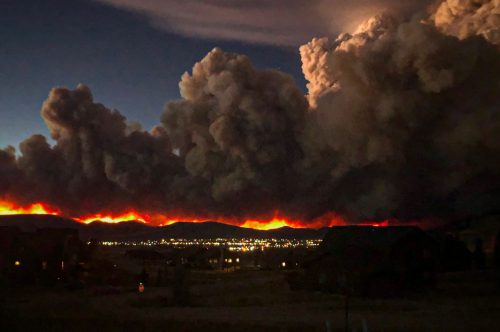
East Troublesome Fire. Photo credit: Northern Water

The $3.3 million in East Troublesome fire funding that has been released through the U.S. Forest Service will help restore the watershed around Grand Lake and land in Rocky Mountain National Park. The fire began in October 2020 and burned nearly 200,000 acres, making it the second largest fire in Colorado history.

The fire burned land that constitutes a sprawling water collection area for Northern Water, a major water provider that pipes Colorado River water from Grand County, under the Continental Divide and east to the Front Range, where it serves roughly 1 million residents of northern Colorado and hundreds of farms.

Steve Kudron, former mayor of Grand Lake who now serves as its town manager, said restoration work in both projects is critical to the economy and health of the historic tourist town, which lies at the western edge of Rocky Mountain National Park.

“The biggest concerns that we had were closing parts of the forest because there hasn’t been sufficient cleanup. Some mountainsides are unstable,” he said. “It’s the funding that makes it safe for the public to go into those areas. That’s why it was important to get the funding back.”

More by Jerd Smith

Colorado-Big Thompson Project map. Courtesy of Northern Water.

Regional Pool Allocation Set at  23,000 Acre-feet; Sealed Bids Due 2 p.m. Thursday, May 22, 2025 — Northern Water

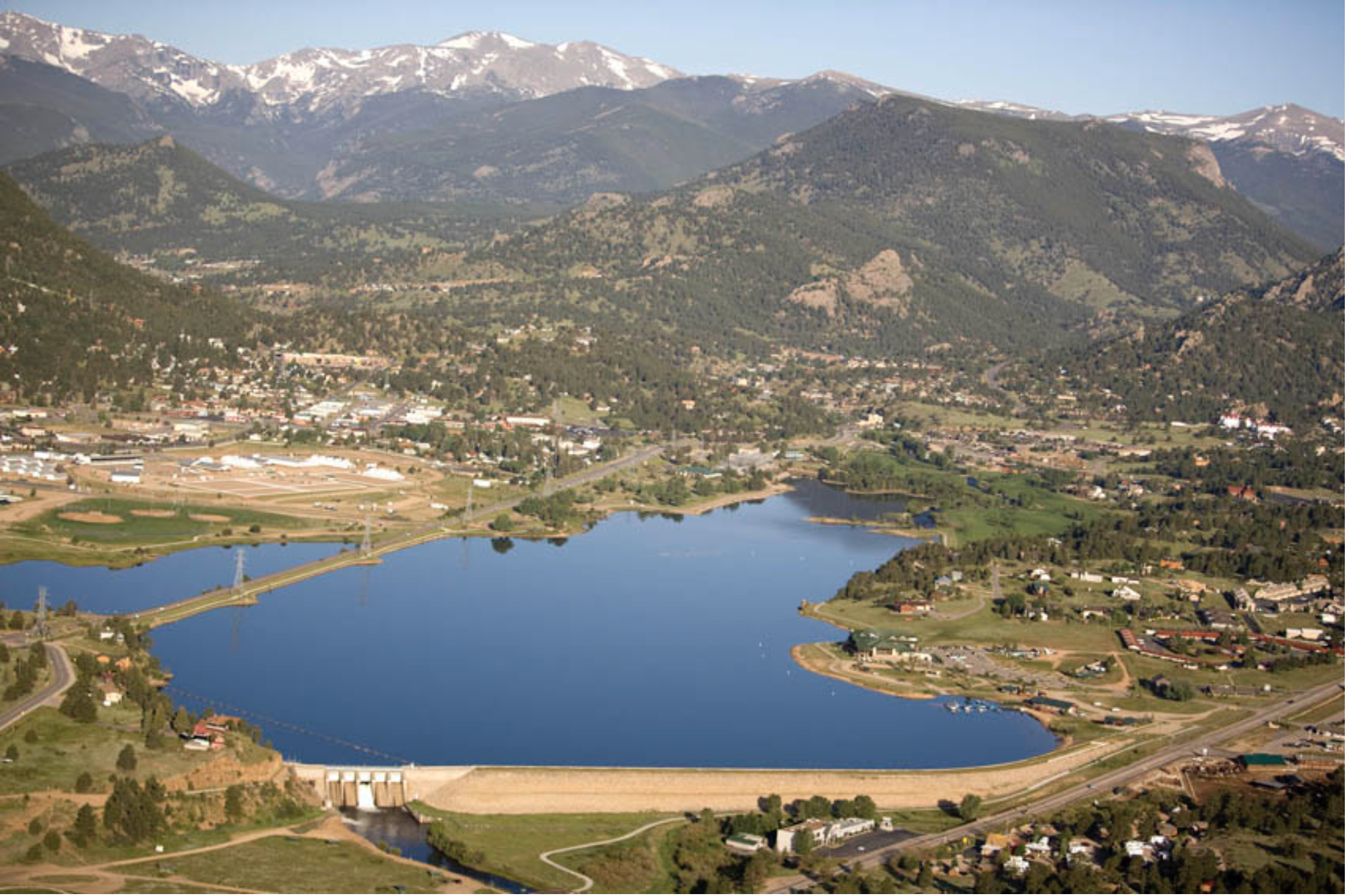
Aerial view of Lake Estes and Olympus Dam looking west. Photo credit Northern Water.

From email from Northern Water (Jeff Stahla):

May 9, 2025

The Northern Water Board of Directors allocated 23,000 acre-feet of Regional Pool Program (RPP) water during its May 8, 2025, Board meeting. RPP water is available for lease by eligible Northern Colorado water users, with sealed bids due 2 p.m. May 22, 2025. Bid prices per-acre-foot must be greater than or equal to $33.80, a floor price the Board selected based on the 2025 agricultural assessment rate. Late bids will not be considered.

The allocation will be available to bidders from two subpools of 11,500 acre-feet each; one that delivers water from Horsetooth Reservoir, and a second that delivers to water users south of Horsetooth Reservoir, including the Big Thompson River, St Vrain Creek and Boulder Creek.

The following forms are required to submit a bid: 

  • Pre-Approval Form – To confirm eligibility, interested bidders must email or mail the Pre-Approval Form to Northern Water. A new Pre-Approval Form is required each year.   
  • Carrier Consent Form – If the RPP water will be delivered by a carrier, such as a ditch or reservoir company, bidders and their carriers must complete the Carrier Consent Form or provide a signed agreement stating that the carrier will deliver the RPP water to the bidder. This form must also be emailed or mailed to Northern Water.  
  • Bid Form – Sealed bids will be accepted at Northern Water’s headquarters through a “self-serve” process. Bidders will sign in at a kiosk in the Building A lobby at Northern Water, 220 Water Ave., Berthoud, and print a bid label for their sealed bid envelope. The label will identify the bidder name, date and time stamp, and bid number. Bidders are then asked to secure the label to the bid envelope and place it in the drop box. Sealed bids may also be mailed to Northern Water, but bids must be received before the deadline.  

Sealed bids are due by 2 p.m. Thursday, May 22, at Northern Water’s headquarters, 220 Water Ave., Berthoud, CO 80513. As described above, sealed bids can be mailed or hand delivered; email and fax bid forms will not be accepted. RPP leases within each subpool will be awarded based on highest bids per acre-foot. Sealed bids will be opened at 2:10 p.m. Thursday, May 22, in the Grand Lake Conference Room of Building A at Northern Water.

Questions regarding the Regional Pool Program and bid submittal can be emailed to regionalpool@northernwater.org or by calling Sarah Smith at 970-622-2295 or Water Scheduling at 970-292-2500.

Windy Gap Reservoir nearly crashed an aquatic ecosystem. A $33 million water project is undoing the damage — Fresh Water News #ColoradoRiver #COriver #SouthPlatteRiver

The $33 million Colorado River Connectivity Channel diverts the river around the Windy Gap Dam to improve river health, fish passage and habitat in the upper headwaters of the Colorado River. (Northern Water, Contributed)

Click the link to read the article on the Water Education Colorado Website (Shannon Mullane):

October 17, 2024

With the snip of a ribbon Tuesday, Colorado water managers officially opened a new waterway in Grand County that reconnects a stretch of the Colorado River for the first time in four decades to help fish and aquatic life.

The milelong waterway, called the Colorado River Connectivity Channel, skirts around Windy Gap Reservoir, where a dam has broken the natural flow of the river since 1985. The $33 million project’s goal is to return a stretch of the river to its former health, a river where aquatic life thrived and fish could migrate and spawn. But getting to the dedication ceremony Tuesday took years of negotiations that turned enemies into collaborators and can serve as a model for future water projects, officials say.

“It speaks to the new reality of working on water projects, which is that it doesn’t have to be an us-versus-them situation,” Northern Water spokesperson Jeff Stahla said. “People can get together and identify things that can help not only the water supply, but also help the environment.”

Windy Gap Reservoir and the new channel are just off U.S. 40 near Granby, a few miles southwest of popular recreation areas around Lake Granby and Grand Lake.

The reservoir was designed to deliver an average of 48,000 acre-feet of water per year from Grand County through numerous reservoirs, ditches, canals and pipelines to faucets in homes and sprinklers on farms across northeastern Colorado. One acre-foot roughly equals the annual water use of two to three households.

But soon after construction finished in 1985, locals and fly fishermen started noticing problems — starting with the bugs.

Drivers used to cleaning insects out of their radiators suddenly had one less chore as certain types of mayflies, stoneflies and caddisflies disappeared. In 2011, state biologists calculated a 38% loss in diversity between the early 1980s and 2011.

The dam blocked fish passage, and the reservoir became a breeding ground for whirling disease, a deadly condition for local trout caused by a microscopic parasite.

Windy Gap Reservoir before construction started for the Colorado River Connectivity Channel. The dam, built in 1985, blocked the Colorado River and inhibited a healthy fishery. The new channel around the reservoir will improve the health of the Upper Colorado River. (Northern Water, Contributed)

It choked seasonal high flows. Without the flows to flush the sediment from between small rocks, the habitat for a fundamental food source, small organisms called macroinvertebrates, diminished. The sculpin, a small fish that often serves as an indicator of river health, disappeared entirely.

Macro Invertebrates via Little Pend Oreille Wildlife Refuge Water Quality Research

“The ecosystem started crashing,” said Kirk Klancke, a longtime conservationist in the area. “It didn’t die out completely, but it certainly started crashing. We lost all the sensitive, most important macroinvertebrates.”

The fishery’s gold medal status was threatened, and losing that would have been a blow to the local economy, he said.

The reservoir also couldn’t reliably serve its main purpose: catching water and pumping it 6 miles to Lake Granby to eventually reach the Front Range. When the lake is filled to the brim in wet years, it can’t store Windy Gap’s water, leaving northeastern communities in the lurch, according to Northern Water.

Restoring a river channel in the Upper Colorado Basin. Graphic credit: Northern Water

The new channel is the fix.

To create the channel, the Northern Colorado Water Conservancy District started work in 2022, draining Windy Gap Reservoir and cutting its size in half. The result is a smaller reservoir and a floodplain through which the channel flows.

Crews built a new diversion headgate — the main focus of the dedication this week — that manages how much water enters the reservoir from the channel. They removed a small, upstream dam crossing the Fraser River that blocked fish passage.

After vegetation is established, the channel will open to fishing and recreation, likely around 2027.

Water has been flowing through the channel for about a year, and officials are already seeing benefits: Colorado Parks and Wildlife said Tuesday that the sculpin has been detected in that stretch for the first time in 20 years.

“Seeing the project come to fruition, and then getting the bonus of having wildlife biologists tell you, ‘Yep, we’re already seeing signs of biological healing,’ was just mind blowing,” said Tony Kay, former president of Trout Unlimited who has been working on connecting the river for 26 years.

It was emotional. Not everyone who started this process was able to see it through to the end, like Bud Isaacs, a downstream landowner who was one of the first to raise the alarm and who passed away in 2022, Kay said.

“We never actually thought that this would happen,” he said.

The channel is also one facet of a sweeping, multimillion-dollar plan to fix multiple problems in one go.

Through the Windy Gap Firming Project, growing Front Range communities will have more reliable water storage in the form of Chimney Hollow Reservoir, which is under construction near Loveland and will work in tandem with Windy Gap to provide water supplies.

The effort to build the connectivity channel has seemed slow moving at times, but officials, environmentalists and urban areas are celebrating it as an example of hard-won collaboration.

“It was a gamble to partner with Front Range water diverters. There were a lot of people who told us you can’t do deals with the devil. You’re going to end up really regretting it,” Klancke said. “The connectivity channel has proved we went down the right road.”

It’s also just one step in addressing chronic low-flow issues along the upper Colorado River caused by drought and massive water diversions to Colorado’s Front Range, Klancke said.

In five years time, Kay hopes to see a healed river through the new channel and farther downstream. He’ll be saying “thank you” every time he drives past that stretch of the river.

“Bud would be over the moon,” he said.

More by Shannon Mullane

Colorado transmountain diversions via the State Engineer’s office

Messing w/ Maps: #ColoradoRiver Plumbing edition — Jonathan P. Thompson #COriver #aridification

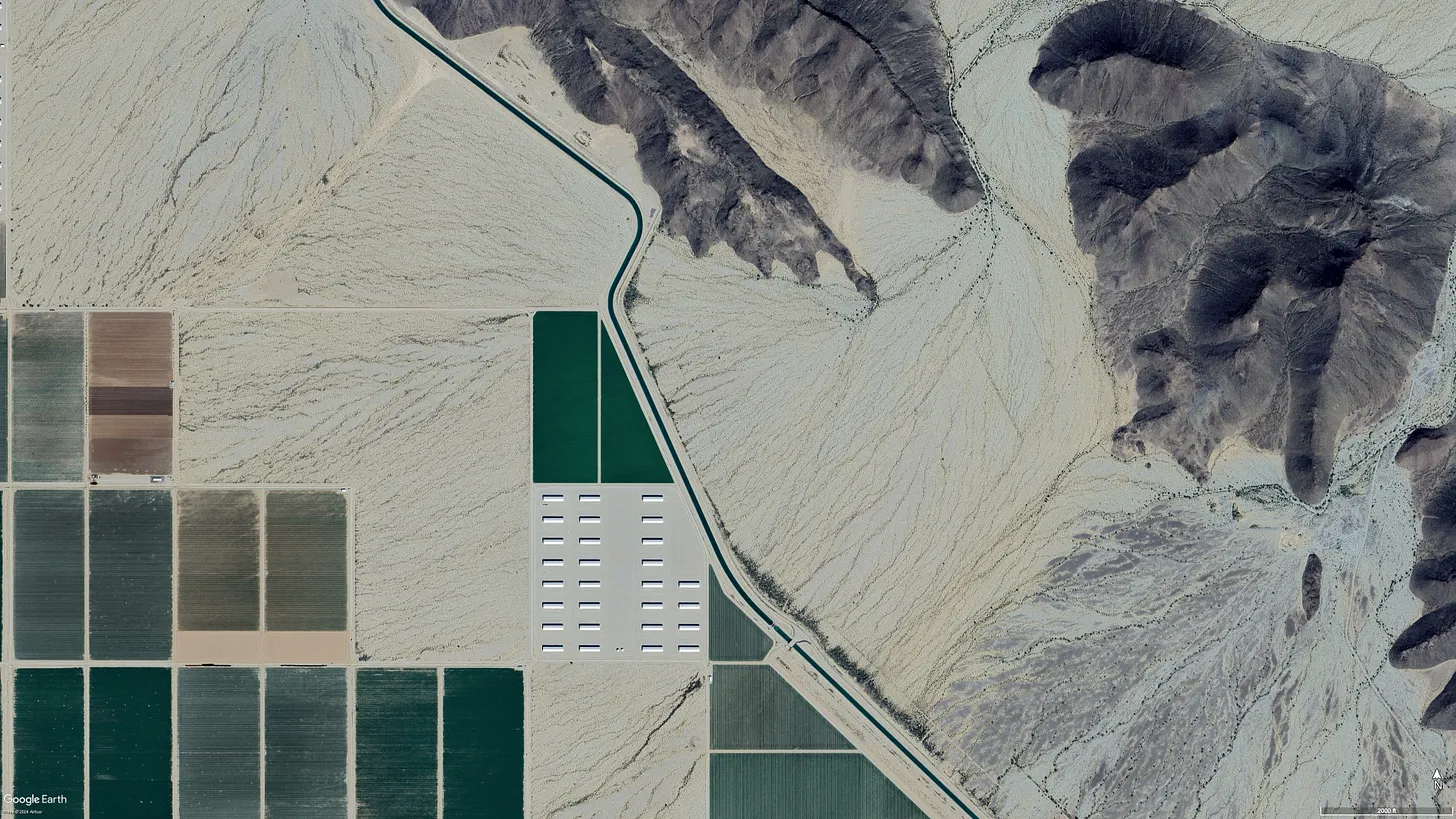
The Central Arizona Project canal passes alfalfa fields and feedlots in La Paz County, Arizona. The fields are irrigated with pumped groundwater, not CAP water. Source: Google Earth.

Click the link to read the article on The Land Desk website (Jonathan P. Thompson):

August 16, 2024

🗺️ Messing with Maps 🧭

Imagine that you’ve set off for a hike in the desert of western Arizona, hoping to get up high so you can get a view of the juxtaposition of alfalfa fields against the sere, rocky earth. But you somehow get disoriented, the sun reaches its apex and beats down on you, the temperature climbing into the triple digits. The ground temperature becomes so hot you can feel it through the soles of your Hoka running shoes. Your water bottle is empty. Feeling certain you are going to die you pick a direction and stagger in as straight a line as you can manage, rasping for help. And then, just when you’re about to curl up under a rock and surrender, you see, coming straight out of a hillside, a virtual river. It must be a mirage, you think, or a hallucination, you run toward it, climb the fence, and dive into the cool, deep water. 

This is not a fantasy scenario. There is, in fact, a place in the western Arizona desert where a lost traveler could stumble upon a giant canal emerging from the earth.

The Central Arizona Project’s Mark Wilmer pumping plant at Lake Havasu. The 14 plants on the CAP system push water across more than 300 miles with a vertical gain of 3,000 feet. Moving water requires enormous amounts of power, making the CAP the state’s largest single electricity user, with annual power bills totaling $60 million to $80 million. Source: Google Earth.
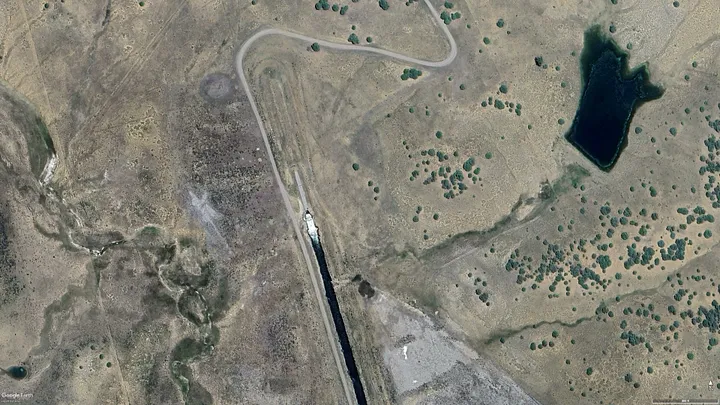
Central Arizona Project canal daylighting at the Buckskin Mountain Tunnel. Source: Google Earth
The outlet of the San Juan Chama Project runs into Willow Creek west of Los Ojos before running into Heron Lake. Source: Google Earth
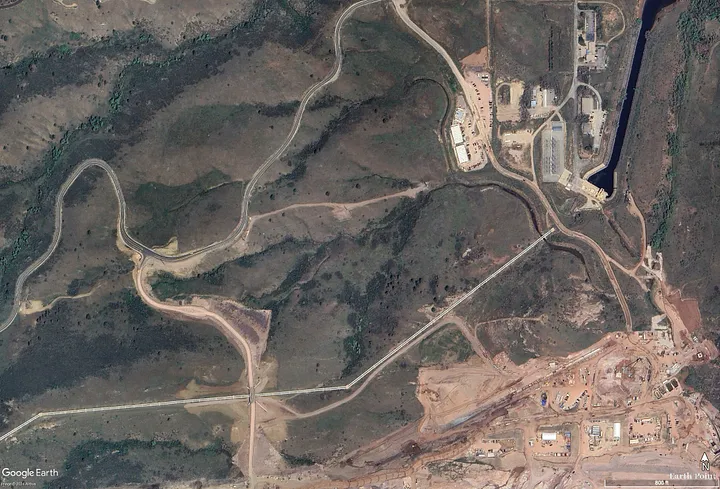
The Rio Blanco intake for the San Juan-Chama Project, which takes water from three upper San Juan River tributaries and ships it across the Continental Divide to the Chama River watershed and, ultimately, the Rio Grande. Source: Google Earth

It’s just one of the crazy plumbing projects along the Colorado River and its tributaries. And they can look pretty weird when you stumble upon them in remote places. That’s what happened to me the other day — virtually. I was using Google Earth to chart the 1776 Escalante-Dominguez expedition’s path when, near Chama, I came across a large volume of water emanating from an arid meadow. After some thought I realized it was the outlet for the San Juan-Chama Project that diverts about 90,000 acre-feet of water annually from three tributaries of the San Juan River, sends it through the Continental Divide via a tunnel, and delivers it to Willow Creek and Heron Reservoir. From there it can be released into the Chama River, which runs into the Rio Grande, which is used by Albuquerque and Santa Fe to supplement groundwater and the shrinking Rio Grande.

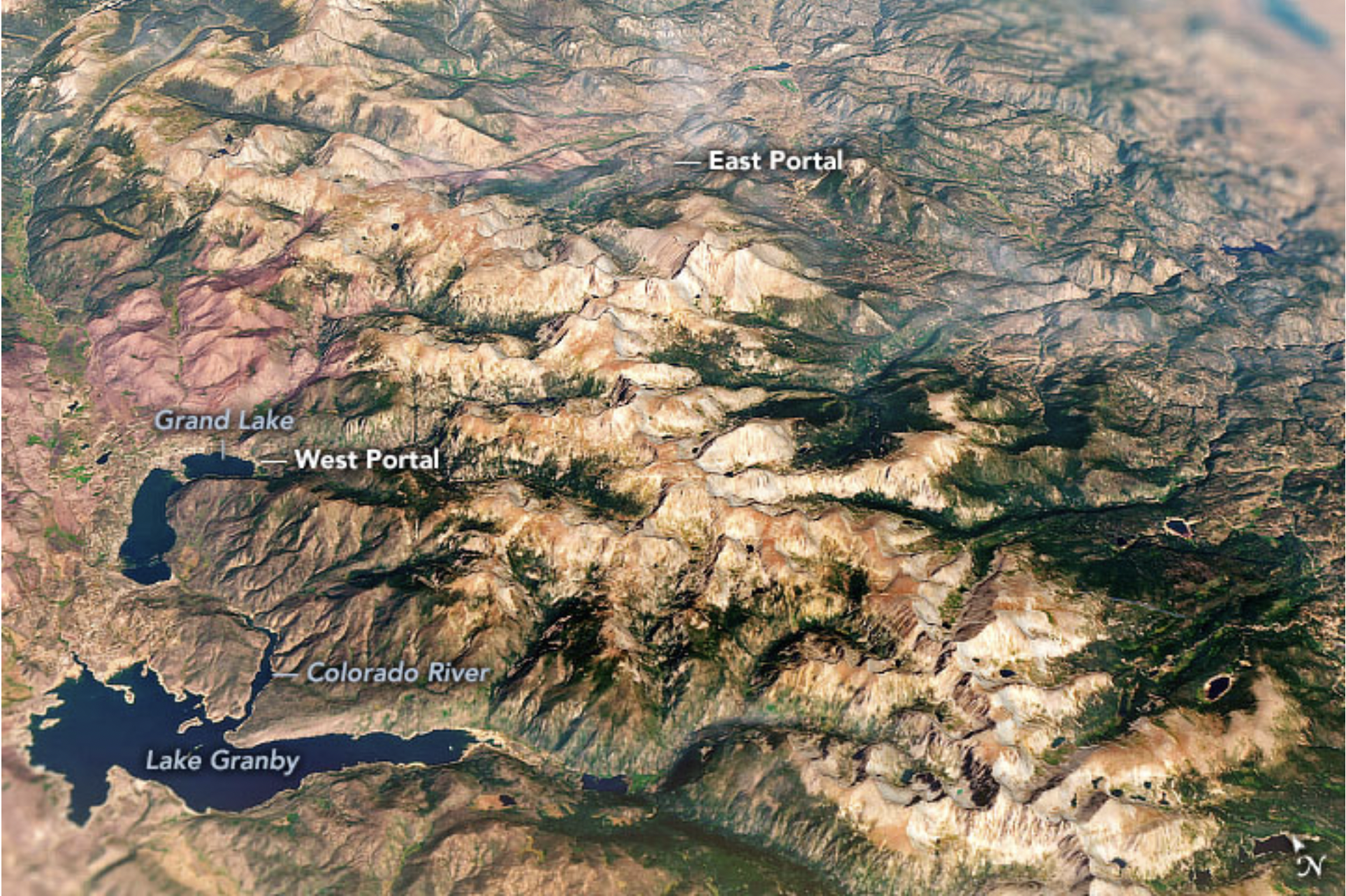
The Big Thompson Project sucks water out of the Colorado River near its headwaters and siphons it through the mountains via the Alva Adams Tunnel. The water feeds reservoirs that feed Front Range cities and is used to generate hydropower. Adams tunnel inlet at Grand Lake. Source: Google Earth
The Big Thompson Project sucks water out of the Colorado River near its headwaters and siphons it through the mountains via the Alva Adams Tunnel. The water feeds reservoirs that feed Front Range cities and is used to generate hydropower. Penstocks and powerplant at Flatiron reservoir on the right. Source: Google Earth

These things aren’t only unsettling in a visual way, but in a conceptual way as well. One would expect cities and agricultural zones to rise up around where the water is and to grow according to how much water is locally available. Instead, cities rise up in places of limited water and grow as if there were no limits, importing water (and power and other resources) from far away. 

The Julian Hinds pumping station, near Desert Center, California, lifts water from the Colorado River Aqueduct 441 feet as it makes its way toward Los Angeles. Source: Google Earth
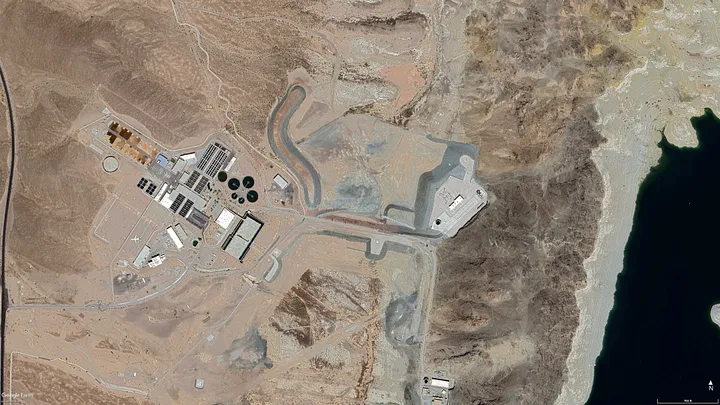
The Southern Nevada Water Authority was forced to build a third water intake from Lake Mead that was able to draw water as the reservoir continued to shrink. The pumping plant is pictured. Source: Google Earth

Northern Water Board Increases #Colorado-Big Thompson Quota Allocation (70% to 80%) #drought #ColoradoRiver #SouthPlatteRiver

Map of the Colorado-Big Thompson Project via Northern Water

Click the link to read the release on the Northern Water website (Jeff Stahla):

August 14, 2025

In response to a flash drought that has developed throughout the northern Front Range, the Board of Directors of the Northern Colorado Water Conservancy District has increased the quota allocation of the Colorado-Big Thompson Project by 10 percentage points. 

In a unanimous vote, the Board on August 14, 2024, increased the quota from 70 percent to 80 percent, meaning an approximate 31,000 acre-feet of water will be made available to allottees of the Project. 

According to the U.S. Drought Monitor, a large area of eastern Boulder and Larimer counties have entered severe drought status in July, and an area of drier conditions in the Longmont-Boulder area has worsened into extreme drought conditions, putting at risk the ability of farmers to finish production of their crops for 2024. 

Water storage levels in the Project are adequate to meet the additional quota declaration.  

Northern Water’s Board typically sets an initial quota in November and a supplemental quota in April, but there have been occasions in which additional quota has been allocated, including in 2020 and 2022. In April, the Board set the quota at 70 percent, which allowed project allottees to access seven-tenths of an acre-foot for each allotment contract unit they own. 

Colorado Drought Monitor map August 6, 2024.

Water that used to irrigate #Granby hay fields to return to #ColoradoRiver and Grand County lakes — Sky-Hi News #COriver #aridification

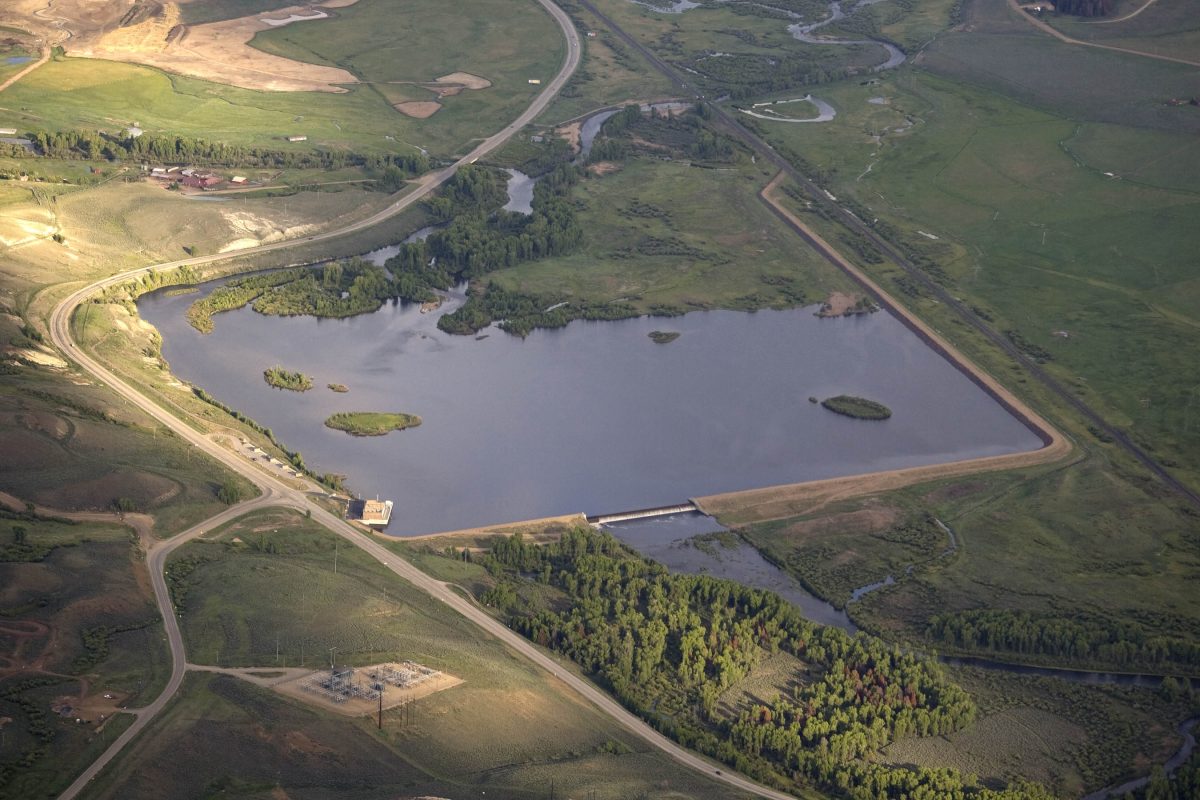
Willow Creek Reservoir.

Click the link to read the article on the Sky-Hi News website (Emily Guitierrez). Here’s an excerpt:

May 7, 2024

Grand County and Northern Colorado Water Conservancy District, otherwise known as Northern Water, have agreed to work together on an operational framework that will give Grand County’s waterways as much as 7,000 acre-feet of additional controllable water from the Colorado-Big Thompson Project for stream enhancement. The volume available for streamflow improvement will be dependent on annual river conditions and C-BT Project storage levels. The agreement was approved by the Grand County Commissioners on April 23.

Water made available under this agreement to the county will be released to the Willow Creek Reservoir or the Colorado River. This water will supplement existing flows and could accumulate to nearly 40,000 acre-feet over the course of a decade, according to a joint news release from Grand County and Northern Water…Prior to 2005, this water was used for irrigation of hay fields near the town of Granby. However, the lands have since been converted for residential and commercial development. This additional water will benefit Grand County’s recreation and agriculture industries.

New Agreement to Improve River Flows in Grand County — @Northern_Water

Willow Creek, at the headwaters of the Colorado River, on April 2, 2021. Photo/Allen Best

Here’s the release from the Northern Colorado Water Conservancy District (Christine Travis and Jeff Stahla):

April 23, 2024

Grand County and Northern Colorado Water Conservancy District (Northern Water) have agreed to a unique and first-of-its-kind Operational Framework that provides Grand County with the ability to have as much as 7,000 acre-feet of additional controllable water to release from the Colorado-Big Thompson (C-BT) Project for stream enhancement and other purposes that will benefit Grand County’s recreation and agriculture industries. The volume available for streamflow improvement will be dependent on annual river conditions and C-BT Project storage levels.

Approved Tuesday [April 23, 2024] by the Grand County Commissioners, the agreement outlines a methodology to determine the water that will be available to the County each year. Water made available under this agreement to the County will be released to Willow Creek, or to the Colorado River, will supplement existing flows, and could accumulate to nearly 40,000 acre-feet over the course of a decade. Prior to 2005, this water was used for irrigation of hay fields near the Town of Granby. Since that time, the underlying lands have been removed from agricultural production and converted to residential and commercial development. Without this agreement, the water will continue to be captured by the C-BT Project and available to Northern Water for uses in Northeastern Colorado.

“The Operational Framework Agreement will provide the County with an additional water management tool to improve and enhance flows on the Colorado River,” said Grand County Commissioner Chair Merrit Linke. “The Colorado River is the life blood to sustaining our agriculture and recreation industries that are critically important to our local economy as well as all of the West Slope.”

Grand County and Northern Water will, in coming months, consult and coordinate with the U.S. Bureau of Reclamation regarding the implementation of the agreement.

From farms to cities: Analysis shows #Colorado-Big Thompson water right ownership changes — The #FortCollins Coloradoan #ColoradoRiver #SouthPlatteRiver #COriver #aridification

First water through the Adams Tunnel. Photo credit Northern Water.

Click the link to read the article on the Fort Collins Coloradoan website (Ignacio Calderon). Here’s an excerpt:

February 29, 2024

On Wednesday [February 28, 2024], 96 Colorado-Big Thompson water shares and 154 acres of farmland from the Carlson Family Trust were auctioned for $5,473,600 and $990,000, respectively. It was the second such water auction in February. Earlier this month, Carol Oswald Yoakum sold her 90 shares of Colorado-Big Thompson water for an average of $52,481 per share...In recent years, around 95% of Colorado-Big Thompson shares that were transferred went from farms to municipalities and water districts, a Coloradoan analysis found…

When Colorado-Big Thompson water changes hands, it is recorded in the Northern Water Board’s monthly meetings agenda. The Coloradoan manually compiled every document available online, with records going back to June 2019, to understand this trend.  The analysis focused on the transfers where there was a change in contract class. This excludes transfers where water is kept in the same use, like when shares are passed down in a family farm. Different contract classes allow for different water uses…During the time period covered by the analysis, the Coloradoan found 237 transfers, which moved 4,396 shares. The 10 biggest receivers, which were all water districts or municipalities, accounted for nine out of every 10 shares. However, that doesn’t necessarily mean most water is being used by cities…

“When we look at the data of where water is delivered, we see that on average it’s a little more than 50% that goes to municipal use, but municipal ownership is about 75%,” said Jeff Stahla, spokesperson for Northern Water, referring to water use from the Colorado-Big Thompson Project…Christopher Goemans, an associate professor in the Department of Agricultural and Resource Economics at Colorado State University, said “we’ve seen this shift in the ownership of rights from agricultural to municipal uses. And yet the vast majority of the water is still diverted and used in agriculture.”

[…]

On the other hand, the cost of acquiring water is driven in large part by the market for water rights. Wednesday’s auction averaged around $57,000 per Colorado-Big Thompson water share — several orders of magnitude higher than it cost when the project began. In 1960, three years after the project first started delivering water to users, the cost per share was $1.50.

Colorado-Big Thompson Project map. Courtesy of Northern Water.

2024 #COleg: #Colorado lawmakers approve resolution backing efforts to restore #GrandLake’s clarity — Fresh Water News

Grand Lake and Mount Craig. CC BY 2.5, https://commons.wikimedia.org/w/index.php?curid=814879

Click the link to read the article on the Water Education Colorado website (Jerd Smith):

Colorado lawmakers OK’d a measure this week backing efforts to restore Grand Lake, the state’s deepest natural lake once known for its clear waters.

Advocates hope the resolution will help fuel statewide support for the complicated work involved in restoring the lake and give them leverage with the federal government to secure funding for a new fix.

The resolution is largely symbolic and doesn’t come with any money, but it adds to the growing coalition of water interests on the Western Slope and Front Range backing the effort.

After more than a year of work, Mike Cassio, president of the Three Lakes Watershed Association, said he is hopeful the resolution will create a new path forward after years of bureaucratic stalemate. The association advocates on behalf of Grand Lake, Shadow Mountain and Lake Granby.

“It’s been a long process, but this resolution puts the state legislators in support of what we are trying to do and we will be able to take that to our congressional representatives,” Cassio said.

The measure was carried by Sen. Dylan Roberts, a Democrat from Frisco, and House Speaker Julie McCluskie, a Democrat from Dillon.

“I’m really encouraged with all the work that has been done in the past few months and I think it will hopefully lead to more progress,” Roberts said.

Colorado-Big Thompson Project map. Courtesy of Northern Water.

Owned by the U.S. Bureau of Reclamation and operated by Northern Water, what’s known as the Colorado-Big Thompson Project gathers water from streams and rivers in Rocky Mountain National Park and Grand County, and stores it in Lake Granby and Shadow Mountain Reservoir. From there it is eventually moved into Grand Lake and delivered via the Adams Tunnel under the Continental Divide to Carter Lake and Horsetooth Reservoir, just west of Berthoud and Fort Collins, respectively.

On the Front Range, the water serves more than 1 million people and thousands of acres of irrigated farmlands. But during the pumping process on the Western Slope, algae and sediment are carried into Grand Lake, clouding its formerly clear waters and causing algae blooms and weed growth, and harming recreation.

Advocates have long been frustrated at the failure to find a permanent fix to the lake’s clarity issues, whether it’s through a major redesign of the giant federal system or operational changes.

The Bureau of Reclamation, Northern Water, Grand County and other agencies and local groups have been working since 2008 to find a way to keep the lake clearer, and Northern Water and others have experimented with different pumping patterns and other techniques to reduce disturbances to the lake’s waters.

Now an even broader coalition has come together, Cassio said, led by Grand County commissioners and Northern Water’s board of directors.

“Northern Water is fully committed to the continued and collaborative exploration of options to improve clarity in Grand Lake and water quality in the three lakes,” said Esther Vincent, Northern Water’s director of environmental services.

Last year, a technical working group reconvened, and is now studying new fixes that may be possible, including taking steps to reduce algae growth and introduce aeration in Shadow Mountain, a shallow artificial reservoir whose warm temperatures, weeds and sediment loads do the most damage to Grand Lake, Cassio said.

Though much more work lies ahead, the work at the legislature is critical, he said.

“This resolution is one piece of the puzzle,” Cassio said. “We’re at the finish line and everybody is coming together. It’s a wonderful thing.”

More by Jerd SmithJerd Smith is editor of Fresh Water News. She can be reached at 720-398-6474, via email at jerd@wateredco.org or @jerd_smith.

#Colorado farmers find plenty of sweet deals at $4.7 million Front Range water auction — Fresh Water News #ColoradoRiver #SouthPlatteRiver #COriver #aridification

Horsetooth Reservoir

Click the link to read the article on the Water Education Colorado website (Jerd Smith):

February 21, 2024

LONGMONT: It is 10:16 a.m. on Valentine’s Day. More than 100 people are gathered in a sprawling room at the Boulder County Fairgrounds. Pencils, notebooks, calculators, auction catalogs and heart-shaped chocolates lie on tables as buyers begin bidding for some of the most sought-after and pricey water in Colorado.

In less than an hour, they will have spent some $4.7 million to buy shares of water in the Colorado-Big Thompson (C-BT) Project, a federal water system whose construction began after the Dust Bowl, which now serves more than 1 million people on the northern Front Range and which helps irrigate thousands of acres of farmland in the South Platte River Basin. It is operated by Northern Water.

This liquid, in some ways, is the Saks Fifth Avenue of water — high quality, clean, neatly packaged and easily delivered within the boundaries of Northern Water’s eight-county district. Another major attraction is that transactions involving C-BT shares don’t have to be approved by Colorado’s water courts, as most water sales do.

Under the contract between Northern Water and the U.S. Bureau of Reclamation, transfers of C-BT Project shares are instead approved by the Northern Water Board of Directors.

Some 90 shares were for sale on that morning, a tiny fraction of the 310,000 shares that comprise the entire project, according to Jeff Stahla, a spokesman for Northern Water, which operates the system for the U.S. Bureau of Reclamation.

And the sales prices were low, averaging just over $52,000 per share, well below the $70,000-plus the water has fetched in recent years, Stahla said.

Jim Docheff is a retired dairyman from Weld County. He sits in the front row, in a Western red felt jacket and tan cowboy hat, one of his sons by his side.

Ultimately he will buy six shares of the water. “It’s all I could afford,” he said, smiling.

How much water is conveyed in a share of the Colorado-Big Thompson system varies from year to year and is tied to how much water the system gathers from the headwaters of the Colorado River and how much irrigators need, Stahla said. Each spring, Northern’s board decides how much water will be allotted to its shares, which are designed to supplement native supplies in the South Platte River Basin.

Some years, the board sets a quota as high as 100% per share, which is one-acre foot. The lowest it has set is 50%. In a dry year, the board might set the quota higher to help growers, and in a wet year, it may be lower because less water is needed.

An acre-foot of water equals about 326,000 gallons.

This purchase will add water security to Docheff’s dairy operations for years to come, he said, as his sons continue the work the family has been doing for 89 years.

But the deal must be approved by Northern Water, which will certify that the water will stay in its district, that it will be put to beneficial use, and that it will serve as a supplemental rather than a sole source of water, a requirement under its federal operating rules.

Docheff and others were surprised by the numbers. “Honestly, I thought the prices were low,” Docheff said.

In recent years, Colorado-Big Thompson shares have topped $70,000. And in fact, one share did sell for $79,200 on Valentine’s Day, but most sold for less, trading in the $50,000 to $72,600 range, according to Scott Shuman of Hall and Hall Auctions, which ran the morning’s proceedings.

And that was good news for farmers, who dominated the bidding. They were able to afford to buy shares in a system in which fast-growing cities from Broomfield north to the Wyoming state line once dominated the sales, often pricing farmers out.

“I think it actually speaks to the fact that there is a robust market for agriculture and you have producers who are looking to firm up their [water] portfolios,” Stahla said.

The lower prices may also be tied to a softening in the housing market in northern Colorado, Shuman said.

“We had an auction in 2019 and we had tons of cities participating,” Shuman said. But not this time around.

“In 2019 there were new subdivisions being built everywhere and we’re not seeing that kind of building now,” he said.

Throughout the proceedings, Carol Yoakum and her family, the sellers of the C-BT shares, sat at the back of the room, watching bid prices post on a huge screen behind the auctioneer.

“I think it went just fine,” she said, after the bidding closed. “I hope it makes everybody happy.”

More by Jerd SmithJerd Smith is editor of Fresh Water News. She can be reached at 720-398-6474, via email at jerd@wateredco.org or @jerd_smith.

Colorado-Big Thompson Project map. Courtesy of Northern Water.

Auction of #ColoradoRiver water nets $4.7 million: Bidders paid an average of $74,600 per acre-foot — @AspenJournalism #SouthPlatteRiver #COriver #aridification

Auctioneer Scott Shuman, right, with Hall and Hall, helped sell 90 units of Colorado-Big Thompson Project water on Wednesday. Bidders had to be cleared to participate in the auction by the Northern Colorado Water Conservancy District, which manages and delivers the water to cities and farms on the Front Range. CREDIT: HEATHER SACKETT/ASPEN JOURNALISM

Click the link to read the article on the Aspen Journalism website (Heather Sackett):

February 16, 2024

Longmont dairy farmer Jim Docheff has been in the dairy business for all of his 88 years, and his son Joe grows the corn and alfalfa for the dairy cows on the farm east of the city. On Wednesday, Docheff acquired six units of Colorado River water to use on his family farm by outbidding other would-be buyers in a water auction.

“I came with the idea of buying up to 10 units, but I only got so many dollars to spend,” Docheff said.

Colorado-Big Thompson Project map. Courtesy of Northern Water.

Docheff was one of 42 registered bidders who gathered at Barn A of the Boulder County Fairgrounds for a chance to buy some of the 90 units for sale of Colorado-Big Thompson Project water. The transmountain diversion project, built by the U.S. Bureau of Reclamation in the 1940s, takes water from the headwaters of the Colorado River in Grand County and transports it via a system of tunnels, pipes and canals to farms and cities in northeastern Colorado.

The first bid for one unit of C-BT water hit a high mark of $72,000, but prices soon stabilized at around $46,000 per unit. After a bidder won the round, they said how many units they wanted to buy, with some people scooping up two, five or 10 units. A buyer’s premium of 10% was added to the high bid to get the total purchase price, which averaged $52,488 per unit.

After all 90 units had a high bid, auctioneer Scott Shuman with auction company Hall and Hall offered the crowd a last chance to outbid their neighbors and reopen bidding on any of the units, or to buy the entire 90 shares.

“If you didn’t get as much water as you thought you would, here’s your opportunity to add something to it,” he said. “I do not want to say ‘sold’ and then have anybody meet me in the parking lot saying ‘I really wanted to get a couple of those units; I would have given you more for it.’”

But no bidders raised their hands.

“All right, happy Valentine’s Day, ladies and gentlemen, we sold all the water units,” Shuman told the crowd. “Give yourselves a hand, give the Yoakum family a hand.”

When all was said and done, the auction netted a total sale price of about $4.7 million for about 63 acre-feet of water. The seller was longtime Longmont farmer Carol Oswald Yoakum.

Credit: Laurine Lassalle/Aspen Journalism

C-BT water regulated

It’s common for shares of C-BT water to change hands, but a large-scale sale by auction like the one held on Wednesday is rare. The last one was in 2019.

But not just anyone can own C-BT water. It is highly regulated and there are rules about its use. To participate in the auction, would-be buyers had to meet criteria set by the Northern Colorado Water Conservancy District, which manages and delivers the water to users. Northern does not allow more than three acre-feet of C-BT water per irrigated acre, and it’s best if a bidder is an existing water user like an irrigator or municipality within Northern’s delivery area who already has water from a different source since C-BT water is only meant to be used as a supplemental supply. And out-of-state investors looking to speculate get turned down immediately.

First water through the Adams Tunnel. Photo credit Northern Water.

“If they don’t have a farm, if they don’t have a beneficial need for the water, then there’s a very high probability that (Northern) would not approve a contract for them,” said Sherri Rasmussen, contracts manager with Northern Water. “I’ve had calls from New York people wanting to buy C-BT and my first question is: What do you want C-BT for? And they’re like, ‘Well, for investment, what do you think?’ And it’s like no, you don’t qualify.”

The C-BT project provides supplemental water to farms and cities along the northern Front Range and eastward along the South Platte River. Northern delivers this water to 33 municipalities and 120 ditch, reservoir and irrigation companies, according to its website. The project diverts about 200,000 acre-feet a year from the Colorado River basin.

Each year in April, Northern Water’s board determines the amount of water that users will get for each unit depending on whether it’s a drought year and how much water is available. The board most commonly settles on 7/10 of an acre-foot. That means Wednesday’s buyers paid an average of $74,600 per acre foot to own the water in perpetuity. That’s up from an average of $36,300 per acre-foot buyers were paying for C-BT water in 2015, according to WestWater Research, a water market research firm.

According to Adam Jokerst, a regional director with WestWater, C-BT unit prices are simply a function of supply and demand.

“Population growth largely drives water prices on the Front Range and in areas with the fastest population growth in the northern Front Range, that’s where we see the highest water prices,” he said.

But not all the buyers Wednesday were cities looking to transfer water from agriculture to support their continued growth. According to Shuman, of the 15 buyers, six were farmers; four were dairies; two were developers; two were municipalities and one was a farm foundation.

According to Jeff Stahla, public information officer for Northern Water, dairy farming in the district has been growing in recent years.

“That’s one of the takeaways from today: A lot of this water is staying in agriculture,” he said.

Another water auction is set to take place on Feb. 28 in Ault, east of Fort Collins. The Carlson Family Trust will sell 96 units of C-BT water and 154 acres of land.

This story ran in the Feb. 18 edition of The Aspen Times, the Vail DailySummit DailySkyHi News.

‘A finite supply’: Ex-landowner sells 90 shares of Colorado-Big Thompson water at auction — The #FortCollins Coloradoan #ColoradoRiver #SouthPlatteRiver #COriver #aridification

Colorado-Big Thompson Project map. Courtesy of Northern Water.

Click the link to read the article on the Fort Collins Coloradoan website (Pat Ferrier). Here’s an excerpt:

February 14, 2024

Through the years, [Carol Oswald] Yoakum acquired 900 acres of farmland north of Longmont…A couple hundred acres went for a 20-home subdivision, 575 acres were put into a conservation easement with Boulder County so the views [of Long’s Peak] she lived with for 57 years would always be protected. She retained 175 acres…Now 91, Yoakum sold Meadow Green Farm in March 2023. On Wednesday, the last links to the property — 90 shares of Colorado-Big Thompson water — were auctioned at Boulder County Fairgrounds in Longmont. Fifteen buyers paid an average of $52,481 per share, or $4.72 million, making the water that once nourished the farm as valuable as the land itself.

The relatively rare water auction within Northern Water boundaries was the first of two this month that will ultimately see 186 shares of Colorado-Big Thompson water transition to new hands and new uses. On Wednesday, Yoakum’s 90 shares went to ditch companies, developers, farmers, ranchers and one municipality that will use it to add to their water holdings, supply water to new subdivisions and irrigate some farmland…Michael Markel of Markel Homes bought five shares at $49,500 each (including a 10% seller’s fee that goes to the auction house) to help provide water to homes in a 420-unit subdivision in Lafayette. “This will just cover a fraction” of the project, Markel said. Although the price per share opened at a high of $72,000, most shares sold for $46,000, plus seller’s fee. Water was sold in one to five units but could be combined for more shares. The largest share of water, 12 units, sold for $46,000 per share plus fees…Sterling Zehnder, who farms about 110 acres near Kersey, bought four shares at $53,000 each for irrigation.

On Feb. 28, the Carlson Family Trust will auction its 154-acre family farm in Eaton and 96 shares of Colorado-Big Thompson water. Markel said he may be among the bidders at that sale, too.

To buy Colorado-Big Thompson water, which is owned by the U.S. Bureau of Reclamation and jointly operated and managed by Northern Water, a buyer has to represent a municipality or already own some shares; the water has to be used within district boundaries; and it can’t be the sole source of water. “C-BT is intended to supplement” an existing water supply, said Jeff Stahla, spokesperson for Northern Water.

First Water Flows Through #ColoradoRiver Connectivity Channel — @Northern_Water #COriver #aridification

Restoring a river channel in the Upper Colorado Basin. Graphic credit: Northern Water

Click the link to read the article on the Northern Colorado Water Conservancy District website:

November 7, 2023: In what’s been described as “the largest aquatic habitat connectivity project ever undertaken in state history,” crews successfully tested the new Colorado River Connectivity Channel (CRCC) at the end of October. The new channel around Windy Gap Reservoir hydrologically and ecologically now reconnects two segments of the Colorado River for the first time in approximately 40 years.  

Northern Water staff were joined by Grand County officials, Windy Gap Project Participant Representatives, Colorado Parks and Wildlife representatives and others to watch the first flows go through the long-awaited channel. This new video captures the historic day and includes comments from the project participants and stakeholders who were present to witness the occasion.    

While water is now running through the new channel, there is still construction work to be done. Crews will continue putting the finishing touches on the project’s new dam embankment, diversion structure and other elements before winter weather brings activity to a stop in the upcoming weeks. Construction is expected to resume

next spring and wrap up later in 2024. Vegetation establishment along the channel will continue into 2025 and 2026, before the area is anticipated to open for public recreation in 2027.  

The new channel will enable fish and other wildlife to move freely upstream and downstream around what is now a smaller Windy Gap Reservoir. Meanwhile, the reservoir will continue providing a diversion point on the Colorado River for the Windy Gap Project during the high flows of spring and early summer.  

The CRCC is part of a package of environmental measures, valued at $90 million, associated with construction of Chimney Hollow Reservoir, which is ultimately where Windy Gap Project water will be stored once reservoir construction is completed.   

Coca-Cola, Upper #ColoradoRiver irrigators, water agencies join forces in Grand County — Fresh Water News #COriver #aridification

Colorado fly fishing, whitewater and other water-related recreational pursuits contribute significantly to Colorado’s $34.8 billion recreational economy. Photo courtesy of the Winter Park Convention and Visitors Bureau

Click the link to read the article on the Water Education Colorado website (Jerd Smith):

Coca-Cola, several Colorado nonprofits, as well as Denver Water, the Colorado River District, and a group of irrigators have launched a new instream flow effort to help keep the scenic headwaters of the Fraser River wetter in the fall, aiding fish and habitat in the stream near Winter Park.

The Colorado Water Trust is a nonprofit that works to match distressed streams with water right holders interested in selling, donating or leasing water that can be used to boost streamflows. It spearheaded the Fraser’s 10-year instream flow agreement. Participants also include Learning By Doing, an East Slope-West Slope partnership that works on local stream restoration projects

Coca-Cola Corporation, as well as one of its bottlers and distributors, Swire Coca-Cola, have pledged $24,000 annually to pay for the water and the restoration work, according to Tony LaGreca, Colorado Water Trust’s project manager for the Fraser program.

Erica Hansen, external communications manager for Swire, said the Coca-Cola companies have 35 environmental water projects across a 13-state region, including 10 in Colorado that are completed, underway or pending.

“We operate in several states that are high drought risk,” Hansen said. “Any drop we use we’re putting back into nature. The Fraser River project is one of the ways we do that.”

LaGreca said the new initiative represents an important step forward in restorative water management in Grand County and Colorado.

“There was a time,” he said, “when we did not have irrigation companies coming to us to find ways to put water into the river for fish. But more and more we are having successful partnerships to increase flows as part of a larger water management strategy.”

Map of the Colorado-Big Thompson Project via Northern Water
Denver Water’s entire collection system. Image credit: Denver Water.

Grand County is home to the headwaters of the Colorado River and the Fraser River, one of its tributaries. Both waterways are heavily diverted to the Front Range to serve residents and farms from Denver up to Fort Collins and out to the Nebraska border.

Over the years, as droughts have become more common and climate change has sapped flows, Grand County’s rivers have become increasingly stressed.

To help solve the problems, two of the largest transmountain diverters, Denver Water and Northern Water, among others, signed on to the Colorado River Cooperative Agreement in 2013. The agreement gives the water agencies some leeway to develop new water supplies to which they have water rights, while also funding efforts to keep rivers and wetlands in the headwaters region healthier, and to ensure mountain tourist economies have enough water to thrive.

Mike Holmes is president of the Grand County Irrigated Land Company. As part of the restorative work underway, he and his shareholders agreed to sell a portion of their water stored in a small reservoir to benefit the river. Each year the program operates, the ranchers will deliver about 50 acre-feet of water. An acre-foot equals nearly 326,000 gallons of water, the amount used by two to three average households in a year. Holmes said the growers have been working to improve the efficiency of their irrigation systems, freeing up water for the river.

“This year, with the abundant snowpack, we had the water available, and so we worked with the water trust to execute a lease and then went through a review by the Colorado River District. It’s a pretty streamlined process,” Holmes said.

Though 50 acre-feet is not a lot of water, it should make a difference in the Upper Fraser, where Denver is allowed to divert even when the river’s fall flows are already shrinking, LaGreca said.

Denver Water’s role in the restoration effort is to allow the Colorado Water Trust to use the utility’s collection system to put water into distressed stream segments in the headwaters. In turn the irrigators give Denver Water access to water stored in Meadow Creek Reservoir, farther downstream, according to Nathan Elder, Denver Water’s water supply manager.

Work on the program for 2023 wrapped up earlier this month and will begin again next September.

Scott McCaulou is director of the corporate water stewardship program at Business for Water Stewardship. The Portland-based nonprofit is funded by the Bonneville Environmental Foundation and helps connects corporations to environmental water restoration initiatives.

“This first year of the agreement between the [irrigators] and the water trust is a small step but the hope is that it grows into a longer-term partnership and helps develop more flexible water management tools in the Upper Colorado,” McCaulou said. “We see it as a good contribution to something that could grow if it is successful this year.”

Colorado River “Beginnings”. Photo: Brent Gardner-Smith/Aspen Journalism

#Boulder County cities and towns pursue solutions to future #ColoradoRiver shortages, on their own — Boulder Reporting Lab #COriver #aridification

North Lake Powell October 2022. With the Colorado River’s woes, Boulder County towns are looking to diversify their water sources Photo credit: Alexander Heilner via The Water Desk

Click the link to read the article on the Boulder Reporting Lab website (Tim Drugan):

This winter dropped a lot of snow on the mountains above Boulder. Our reservoirs are in good shape for now as Boulder Creek babbles. But that’s not our only water source. 

Boulder and many other cities along the Front Range rely, at least in part, on water from the strained Colorado River. Younger cities with fewer senior rights for local water sources — like Superior and Erie — rely on it almost entirely. 

Because every city is responsible for its own water portfolio, as the Colorado River becomes a potentially unreliable source, wholly dependent cities could be far worse off than others. This isn’t a far-fetched idea. A Colorado State University study shows that for every degree Fahrenheit of global warming, flows of the Colorado River decrease by 4%. And already, the Windy Gap Project — responsible for supplying a portion of Colorado River water to Front Range cities — sometimes doesn’t provide any water at all. 

Yet for now, many municipalities in the Boulder County area seem reluctant to even discuss sharing water. 

“Right now, we’re all trying to do the best job for our [own] residents and our customers,” said Melanie Asquith, the water resources manager for the City of Lafayette. “Everybody’s situation is different. Everybody’s storage is different. Everybody’s rights are different.”

Interviews with water managers across the county revealed potential stage-setting for a “Mad Max” situation. Each municipality is concerned only with securing water rights for its own residents. This means that unless the mindset in Colorado changes to one of greater collaboration, it’s safe to assume future droughts will hit some communities harder than others. And those hard-hit communities may be on their own. 

“The citizens and businesses of Louisville are paying their water bills to ensure their supplies are covered — not necessarily Lafayette’s or Broomfield’s or anybody else in the region,” said Cory Peterson, the City of Louisville’s deputy director of utilities. “There’s not a regional or state presence that would do those types of activities. That’s just the way the system is set up.”

Where do Boulder County communities get their water from?

Peterson of Louisville said a foreshadowing of droughts’ impacts in Boulder County happened in 2001. 

“You had some communities that were doing very aggressive water restrictions, had very low water supplies, and were really struggling to make it through,” Peterson said. “And you had other communities that had very light restrictions and had, I don’t want to say an easy time, but they were able to manage through those impacts.” (We saw a lesser instance of this last summer when Lafayette imposed year-round water restrictions while Boulder didn’t.)

This has led to water resource managers up and down the Front Range to chase water diversity to ensure they’re not the worst off. If one water source fails, it’s good to have another to lean on. 

“Our biggest gift is our diversity, that we are not wholly dependent on the [Colorado River], that if we had to rely only on eastern water, we could do it,” Asquith of Lafayette said.

Age matters for water rights

Because of the way Colorado water rights work, it pays to be old. The “prior appropriation doctrine” — summed up as “first in time, first in right” — heavily favors cities that started getting water for their residents earlier. Being first has landed them “senior” water rights from local sources like Boulder Creek or St. Vrain Creek. 

“Longmont is fortunate that a majority of the water rights in our water rights portfolio are very senior water rights,” said Wes Lowrie, a water resources analyst for the City of Longmont. “We feel very strong in our ability to meet our future demands for Longmont.”

Boulder, Louisville and Longmont have senior rights to local creeks, requiring them to get only a third of their water from the Colorado River. That insulates them from future uncertainty on the Colorado River and provides some resilience against climate change through diversification. Lafayette gets less than a quarter of its water from the Colorado River. 

Pretty much all of Erie’s water, on the other hand, comes from the Colorado River. All of Superior’s does as well.

California, Nevada and Arizona recently reached an agreement to temper their use of water from the Colorado River. With federal assistance, the worst repercussions of overuse from the river will hopefully be avoided, for now. But Colorado wasn’t a part of the recent Colorado River agreement, because Colorado is part of the Upper Basin states: those using water above parched Lake Powell. Unlike the Lower Basin, Upper Basin states have thus far used less water than is available to them. But that could change as the river reduces more. 

Looking west across the 445 acre-foot Windy Gap Reservoir, which straddles the Colorado River (Summer 2011). Photo By: Jeff Dahlstrom, NCWCD via Water Education Colorado

When a water source is diminishing, you want a senior right on that source to make sure you get your water before it runs out. Yet some of the water coming from the shrinking Colorado River to the Front Range isn’t even close to a senior right. The Windy Gap project, a water right that provides some cities with a considerable chunk of their water, only dates back to 1968 — very young by Colorado River standards.

“The Windy Gap water right is a very junior water right on the Colorado River,” said Jeff Stahla, a public information officer at Northern Water, which manages Windy Gap. “The Windy Gap Project in some years yields zero water.”

The project — which includes a diversion dam and reservoir on the Colorado River — is just one of the water rights allotting Colorado River water to eastern cities. Originally funded by Boulder, Estes Park, Fort Collins, Greeley, Longmont and Loveland to cope with booming populations, the project started delivering water across the Continental Divide in the 1980s.

Today, some Front Range municipalities are investing further in Windy Gap water. By building a new reservoir in southern Larimer County, the cities hope to store Windy Gap water from wet years to get them through the dry ones when Windy Gap may provide no water.

Site of Chimney Hollow Reservoir via Northern Water.

Called the Chimney Hollow Reservoir, the project broke ground in 2021 and is on track to cost upwards of $700 million. A dozen different water districts are funding the reservoir to add an additional fail-safe to their water supply. Involved cities include Louisville, Lafayette, Longmont, Erie and Superior. Broomfield is leaning especially heavily on the new reservoir, voting in 2021 to foot $176.4 million of the bill. (Boulder is not involved in the Chimney Hollow project.)

According to City of Broomfield staff, this investment will increase Broomfield’s reliance on Colorado River water from 60% of their source water to 70%. Broomfield’s water not delivered by Northern Water comes from Denver Water, which also gets a portion of its water from a tributary of the Colorado River. Piped through the Moffat Tunnel, water previously destined for the Colorado River is stored in Gross Reservoir that recently began a controversial expansion project.

Yet Windy Gap water isn’t the only water coming from the Colorado River. The Colorado-Big Thompson Project, or C-BT, has been pumping water east since 1947. With its right dating to the 1930s, that water “is much more guaranteed,” according to Stahla.

Almost all cities who get Windy Gap water also get a portion of C-BT water. 

Pete Johnson, a water attorney for the town of Erie, said the town’s water comes from a mix of C-BT water and Windy Gap water with an investment in the Chimney Hollow project — all Colorado River water.

“The long term goal is to diversify the town’s portfolio,” Johnson said.

But C-BT water isn’t infallible either. “The CB-T water right, I don’t want to say it’s junior, junior,” Stahla said. “But certainly a 1930s water right is not senior in the state of Colorado.”

Water stored in Colorado’s Denver Basin aquifers, which extend from Greeley to Colorado Springs, and from Golden to the Eastern Plains near Limon, does not naturally recharge from rain and snow and is therefore carefully regulated. Courtesy U.S. Geological Survey.

Setting up a Mad Max future

Robert Crifasi, a former City of Denver hydrologist and Boulder Open Space and Mountain Parks water resources administrator, and author of a new book “Western Water A to Z: the History, Nature and Culture of a Vanishing Resource,” said one of the most important steps to avoiding a Mad Max future is ensuring water availability before building new developments. Because of overzealous development companies, Crifasi said, some Denver suburbs are now reliant on nonrenewable Denver Basin groundwater. What will those communities do when the aquifer runs dry? Rely on the Colorado River?

“There is no magic bullet in any of this,” Crifasi said. “But I do think the most important action is to legislatively require vigorously integrated water and land-use planning.”

Kim Hutton, the City of Boulder’s water resources manager, said in addition to conservation and planning, there’s a need for collaboration and coordination among municipalities around water. As it currently stands, it’s every city for itself.

“Right now, with the water rights system, individual water users really are responsible for developing a supply to meet their needs,” she said.

Lowrie of Longmont, for instance, said that Longmont has always required that developers prove a reliable water source before moving forward into construction. “And that planning has served us well,” he said.

When asked if Longmont had talked about possibly sharing with other municipalities that might, in the future, not have enough water for their residents, he suggested that long-term aid would be viewed very differently than short-term aid.

 “The decision to share water on an ongoing basis might be a different conversation than if there was an emergency situation, like if somebody’s water treatment plant went out,” he said. “That’s a different scenario than saying, ‘Hey, we didn’t plan as well as Longmont, and now we don’t have enough supply.’”

Boulder Reporting Lab is a nonprofit newsroom serving Boulder County. Sign up for their newsletter here.

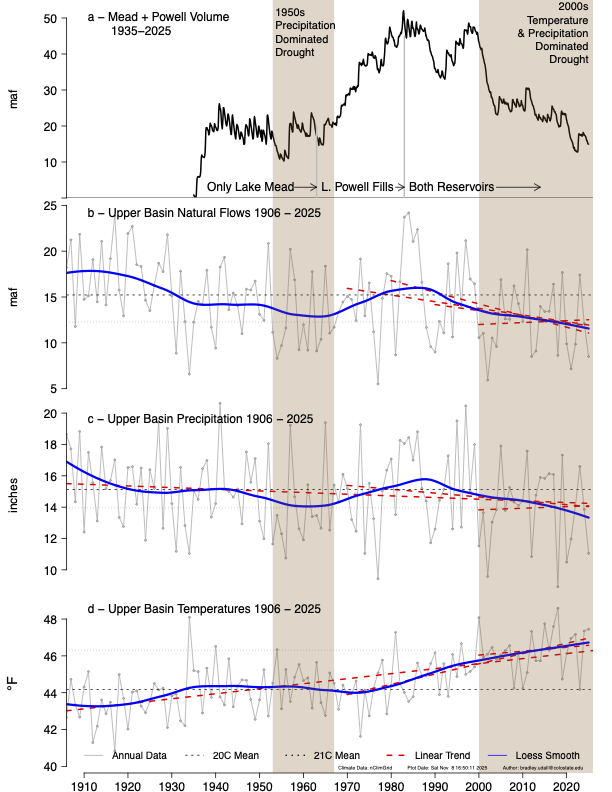
Updated Colorado River 4-Panel plot thru Water Year 2022 showing reservoirs, flows, temperatures and precipitation. All trends are in the wrong direction. Since original 2017 plot, conditions have deteriorated significantly. Brad Udall via Twitter: https://twitter.com/bradudall/status/1593316262041436160

April 1 Brings Start of 2023 Canal Deliveries of Colorado-Big Thompson Project #Water — @Northern_Water #ColoradoRiver #SouthPlatteRiver

Click the link to read the article on the Northern Water website:

How many people does it take to get the Colorado-Big Thompson Project ready for the peak delivery season? For the Northern Water Operations Division, the answer is … just about everyone.

Crews have been working throughout the winter to maintain the 80-year-old infrastructure and make the necessary repairs. Sometimes just decades of freeze-thaw action will create the need for repairs and replacements.

Why work so hard in the winter? Because water users expect consistent and reliable deliveries throughout the spring, summer and fall, meaning there isn’t room on the schedule to make repairs during warm, long days.

Map of the Colorado-Big Thompson Project via Northern Water

The latest “E-Waternews” newsletter is hot off the presses from @Northern_Water #snowpack #runoff

The sun sets over the Never Summer Range in the headwaters of the Colorado River in 2020. Photo credit: Northern Water

From email from Northern Water (click to subscribe):

Strong winter snowpack has water managers optimistic

A parade of snowstorms through the American West this winter has water managers across the region cautiously optimistic about the near-term water supply.

According to data from the Natural Resources Conservation Service, the Upper Colorado River watershed is at about 113 percent of its annual average for precipitation. Further downstream in the Colorado River Basin, other tributaries such as the Gunnison River and San Juan River are showing even larger snowpack totals compared to historic averages. For communities throughout the basin, that is great news.

The above-average snowpack in the Upper Colorado River Basin means there is a strong chance that the Colorado-Big Thompson (C-BT) Project reservoirs will fill this summer, too. That’s good news for residents of Northern Colorado who depend on the supplemental water supply that it delivers, but it’s not as good for Windy Gap Project participants. They have an agreement with the U.S. Bureau of Reclamation that allows them to use available capacity in Lake Granby to store Windy Gap water for future delivery, but if Lake Granby is full of C-BT Project water, no storage capacity is available for Windy Gap water.

With the construction of Chimney Hollow Reservoir, Windy Gap Firming Project participants will have the opportunity to capture and store water for multiple-year deliveries with greater frequency and flexibility in years when Lake Granby would otherwise be full of C-BT Project water. The construction of reservoirs helps moderate the ups and downs of annual precipitation and has enabled Colorado’s population and food production systems to grow and prosper for more than a century.

Map of the Colorado-Big Thompson Project via Northern Water

@Northern_Water increases #Colorado-Big Thompson quota to 70 percent #SouthPlatteRiver #ColoradoRiver #COriver

Water from the Colorado-Big Thompson Project is delivered to water users north of Horsetooth Reservoir in this photo from summer 2018. Photo credit: Northern Water

Here’s the release from Northern Water (Jeff Stahla):

The Northern Water Board of Directors voted Thursday to increase its 2023 quota allocation for the Colorado-Big Thompson Project to 70 percent. Members voted 8-4 to increase the allocation from the 40 percent initial quota set in October.

Board members discussed the combination of this year’s above-average snowpack and streamflow projections contrasted against the lowest East Slope non-C-BT reservoir levels since 2013 and below-average soil moisture readings throughout much of the district.

Luke Shawcross, manager of the Water Resources Department at Northern Water, outlined water modeling showing the predicted storage levels in the project through the end of 2023 and into 2024, and he also discussed the available water supplies in regional reservoirs. Water Resources Specialist Emily Carbone and Water Scheduling Department Assistant Manager Sarah Smith also provided Board members with current water supply and availability data.

Public input was also considered in the Board’s decision.

While current soil moisture conditions on Northeastern Colorado farmland prompted several Board members to ask for consideration of a higher quota, others cited the uncertainty of future hydrology to support their approach this year.

The Board has been setting C-BT quota since 1957 and 70 percent is the most common quota declared. It was also the quota set for the 2021 water delivery season. In 2022, the final quota was 80 percent. Quotas are expressed as a percentage of 310,000 acre-feet, the amount of water the C-BT Project was initially envisioned to deliver to project allottees each year. A 70 percent quota means that the Board is making 0.70 acre-feet of water available for each C-BT Project unit, or collectively, 217,000 acre-feet.

The quota increases available C-BT Project water supplies by 93,000 acre-feet from the initial 40 percent quota made available in November 2022. Water from the C-BT Project supplements other sources for 33 cities and towns, 120 agricultural irrigation companies, various industries and other water users within Northern Water’s 1.6 million-acre service area. According to recent census figures, more than 1 million residents now live inside Northern Water’s boundary. To learn more about Northern Water and the C-BT quota, visit www.northernwater.org.

Screenshot of the Colorado-Big Thompson Project boundaries via Northern Water’s interactive mapping tool , June 5, 2019.

Northern Water Begins New Source #Water Protection Program

Graphic credit: Northern Water

Click the link to read the release on the Northern Water website:

Northern Water is embarking on a new source water protection program to safeguard the high-quality water that comes from the watersheds that supply water to the Colorado-Big Thompson (C-BT) and Windy Gap projects, as well as the Northern Integrated Supply Project, and to reduce the risk of contamination of our water sources. Our source water program includes an initial planning phase, and we have begun the process of developing a strategic source water protection plan (SWPP) to help guide our efforts. 

By developing a SWPP, we will be part of a state and nationwide effort to protect water sources from the ground up. At the state level, Colorado’s Source Water Assessment and Protection (SWAP) Program is a voluntary program designed to help public water systems take preventative measures to keep their sources of drinking water free from potential contaminants. The SWAP program came about due to the 1996 Safe Drinking Water Act amendments.

By developing a SWPP, we will be part of a state and nationwide effort to protect water sources from the ground up. The typical development of a SWPP involves identifying a source water protection area(s), creating an inventory of potential contaminants to the water sources, and subsequently developing best management practices to help mitigate those potential contaminants. We anticipate that the SWPP development and process will span a few years and are currently kicking off the first phase with outreach to key constituents. Following the completion of our SWPP, we will move into the implementation phase which will involve execution of the BMPs identified in our SWPP. 

We will be communicating with various stakeholders throughout the process and providing periodic updates of the plan throughout various channels. Once the SWPP is finalized, it will be made available to the public via our website.  

If you have any questions or comments about this process, please contact Kimberly Mihelich, Source Water Protection Specialist by emailing kmihelich@northernwater.org or calling 970-622-2211.

New #Colorado #wildfire report calls for continuous disaster funding, liability protection — @WaterEdCO

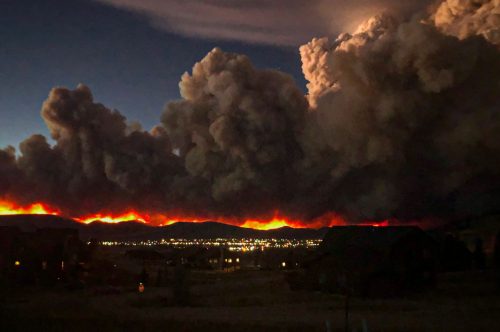
The East Troublesome Fire burns in Grand County in October 2020. Credit: Northern Water

Click the link to read the article on the Water Education Colorado website (Jerd Smith):

To help watersheds recover quickly from catastrophic wildfires, federal and state funds need to be available continuously, rather than on an as-needed basis, and water districts and local governments need to be shielded from the liability that normally comes when working with federal wildfire recovery programs, according to a new report.

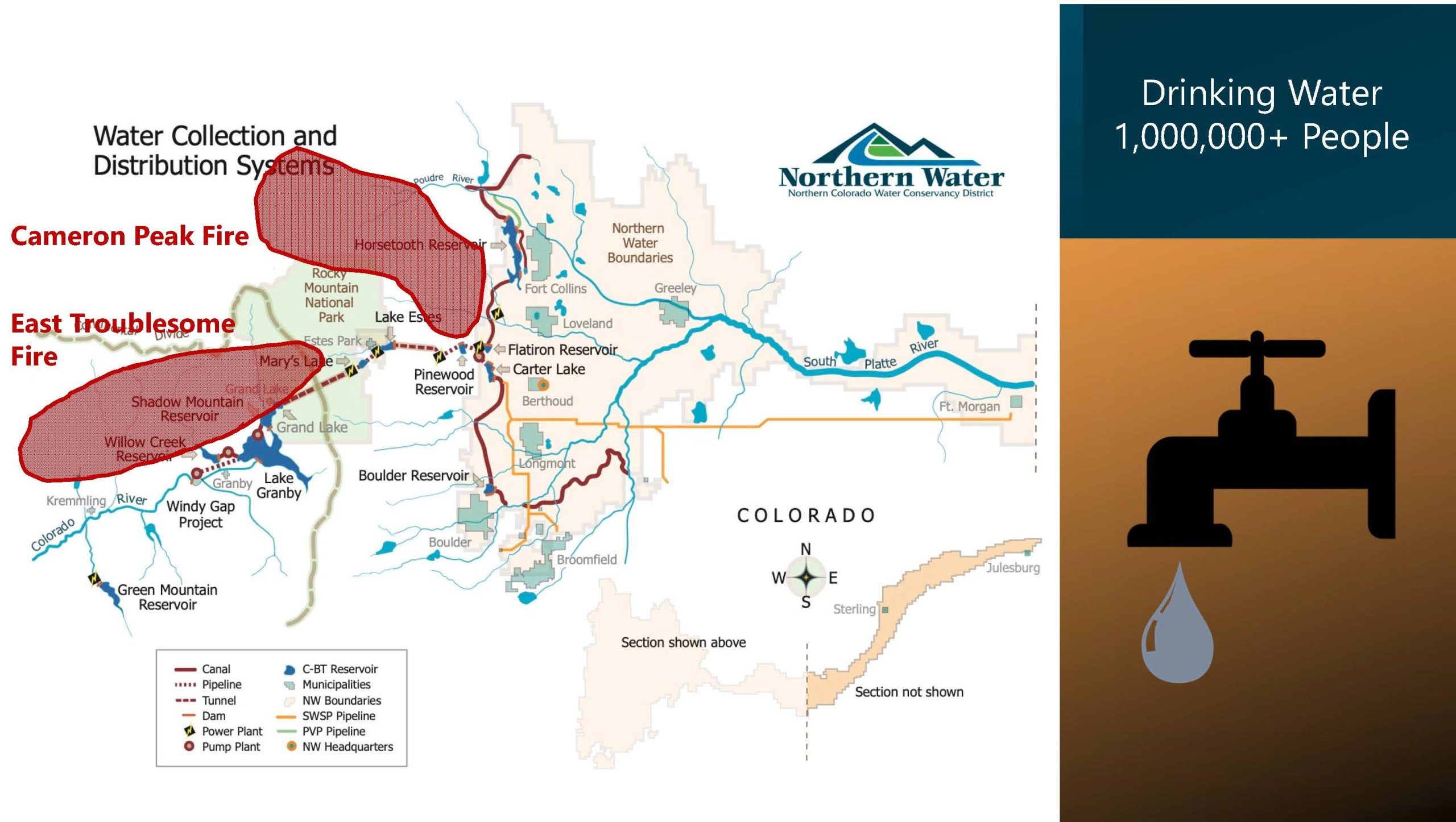
The draft report, 2020 Post-Fire Watershed Restoration: Lessons Learned, was presented two weeks ago at the annual convention of the Colorado Water Congress in Aurora. It focused on the post-fire recovery response to the East Troublesome and Cameron Peak fires in 2020. The fires are the largest in Colorado history and engulfed Northern Water’s system in Rocky Mountain National Park as well as water systems that serve Fort Collins, Larimer County and the city of Greeley. Those systems deliver water to more than 1 million people on the northern Front Range and help irrigate hundreds of thousands of acres of farmland.

Source: Northern Water

“Having predictable annual funding for wildfire recovery is urgent because these events are going to happen,” said Esther Vincent, who led the report team and who serves as director of environmental services at Northern Water.

After the two fires were contained, local communities and water districts began working quickly using funding from the U.S. Department of Agriculture’s Emergency Watershed Protection (EWP) Program. But that federal fund is replenished on an as-needed basis and is used by all 50 states when disasters occur. When it runs out, as it sometimes does, it can take years for Congress to approve more cash.

“Waiting until there is enough political will is an inefficient way to fund the EWP Program,” said Sean Chambers, who also served on the report team and who is the director of water and sewer utilities for the City of Greely. Greeley coordinated much of the recovery work on the Cameron Peak Fire.

“When we started recovering from Cameron Peak there was money available and we were able to start immediately addressing some high-risk slope stability issues on tributaries, around reservoirs, on private property. But then we ran out of money,” Chambers said.

More money was found in the EWP Program by asking other states to turn over unused funds, but it took months during a critical time window when the watershed restoration teams only had a few weeks to work before the burn scars were covered with snow and became inaccessible, Chambers said.

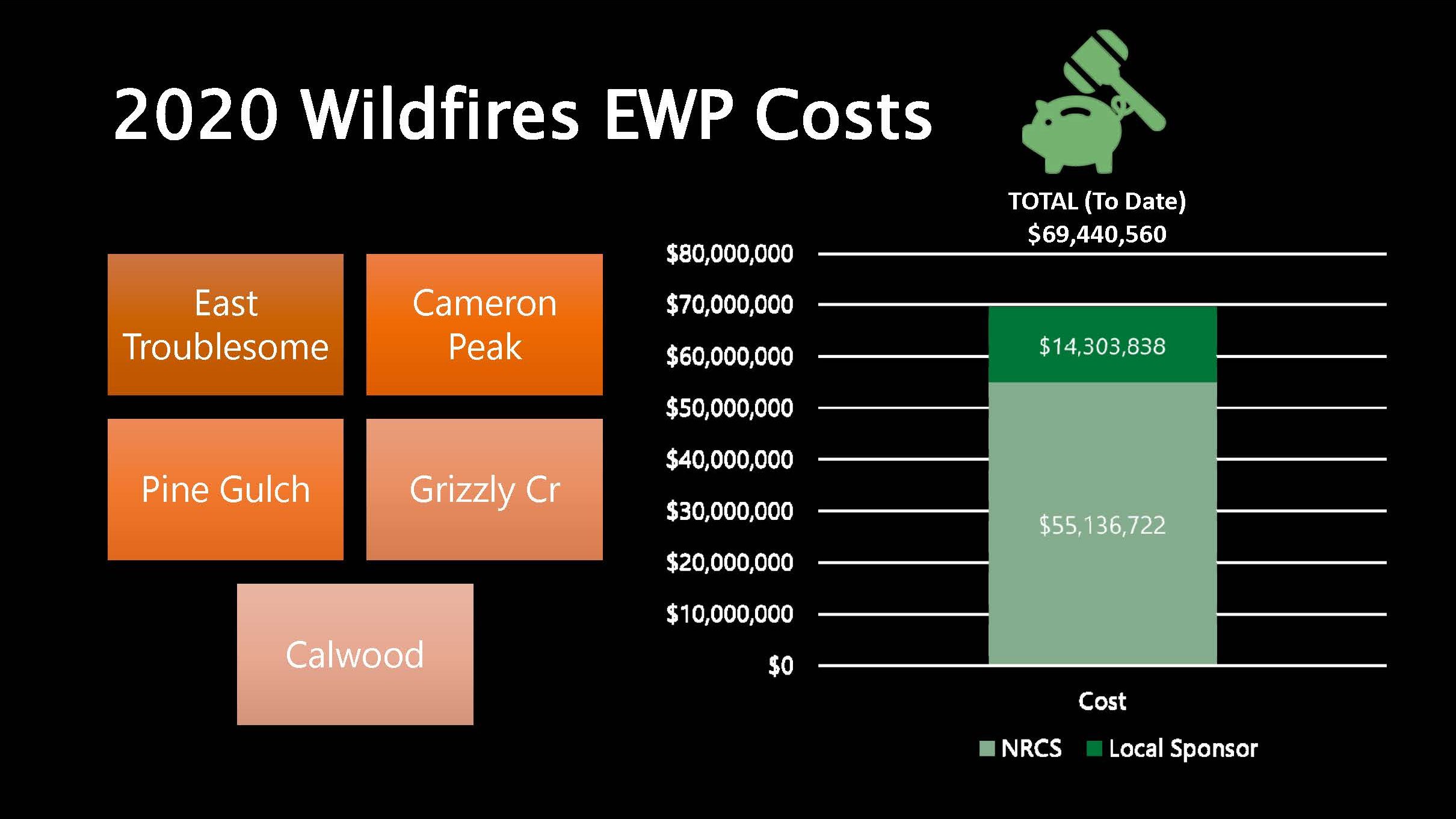
Nearly $70 million has been spent on the Emergency Watershed Protection (EWP) programs used to recover from these 2020 fires. The Natural Resources Conservation Service (NRCS) provided the majority of the funding, with local sponsors contributing matching funds. Source: Northern Water

Another issue that hampered the immediate post-fire recovery effort is the liability that must be assumed by those who partner with key federal programs that provide funding, including the EWP Program.

Northern’s Vincent said the Northern Water Board was deeply concerned about assuming the liability, which requires local partners to assume full financial responsibility for the work, which can cost millions of dollars. But ultimately the board agreed to do so.

As a result, the report recommends that Congress remove the liability requirement from its disaster contracts and also suggests that a new insurance pool be created to limit the liability of restoration partners, according to Peggy Montaño,  an attorney who serves as Northern’s legal counsel and who also served on the report team.

Todd Bolt is the state coordinator of the EWP Program and a member of the work group that wrote the report. He declined to comment on the federal funding and liability recommendations, but he said the report was “eye-opening.”

“It brought a lot of people together who have first-hand experience, state, federal, local. And it has opened everybody’s eyes that there are things we can do better with the post-fire effort in Colorado,” Bolt said.

Two additional recommendations that the report makes are to streamline data collection and modeling analyses and to refine them so that they can be used to make decisions faster. The second is to have “local navigators,” who are trained and ready to help immediately after a fire.

More than a half dozen agencies can be on the ground post-fire, gathering data and trying to understand what might happen with rain storms, sediment loads and debris flows. But agencies often use different parameters for collecting the data they use in their modeling. Some, for instance, might use only the burn area itself for modeling, when a broader watershed boundary is needed to understand what’s happening on streams above and below the burn scar.

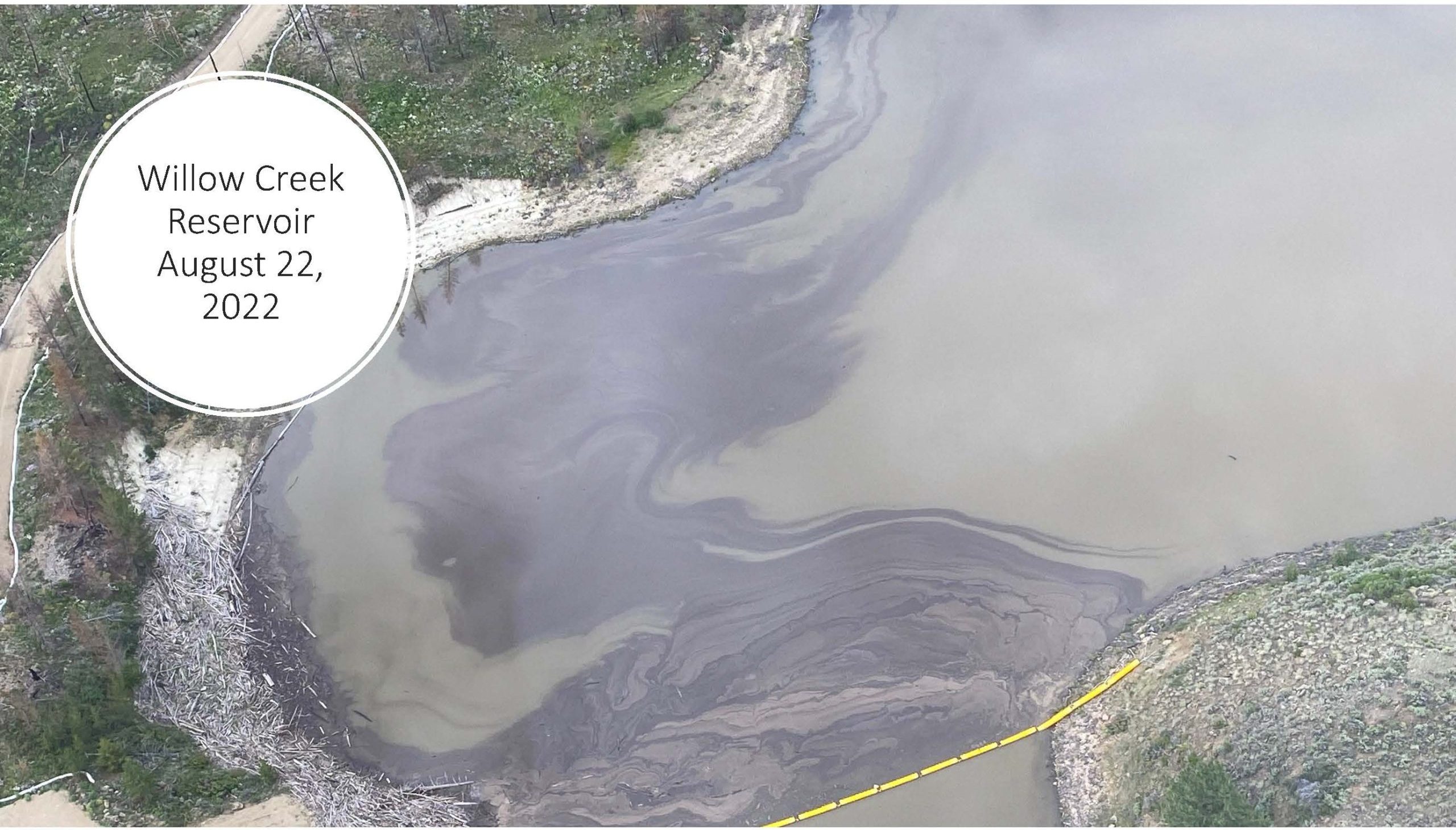
Fire-stained debris from the East Troublesome fire gathers in Willow Creek Reservoir. It is part of Northern Water’s collection system. Source: Northern Water

Northern’s Vincent said there were so many different modeling and data collection efforts underway that it made it difficult to know which would be the best to use.

“Bringing all of this information together and digesting it when you are the practitioner on the ground and you have to make decisions about what these models mean and what mitigation strategies are going to work is difficult. We were swimming in this downpour of modeling outputs, with little guidance and understanding of ‘OK this is where we have a problem. This is where we need to take action and do mitigation.’”

Bolt said that a “local navigator” program would specialize in connecting local residents and local governments with the resources they need to begin restoration work post-fire.

“Someone who could lead them through the process would be helpful,” he said.

Looking ahead, report authors plan to share their findings with lawmakers and others who are working on protecting Colorado from the wildfires they say are sure to come.

“No matter how successful we are with forest management and helping our watersheds be more resilient, it is going to take a long time to do the projects that need to occur at a landscape scale,” Vincent said. “We are still going to have devastating, large-scale megafires. We need to focus on paths to being prepared and getting better at the post-fire recovery process.”

Jerd Smith is editor of Fresh Water News. She can be reached at 720-398-6474, via email at jerd@wateredco.org or @jerd_smith.

The East Troublesome fire as it tore through the Trail Creek Estates subdivision on Oct. 21, 2020. (Brian White, Grand Fire Protection District)

Congratulations to Northern Water — The Buzz @FloydCiruli #NISP #PoudreRiver #SouthPlatteRiver

Click the link to read the post on The Buzz website (Floyd Ciruli):

The NISP project in the North Front Range has just received its critical permit from the U.S. Army Corps of Engineers in compliance with the National Environmental Policy Act. The project, which will cost $2 billion and take years to complete, will provide water to a host of cities and agricultural water districts in Larimer, Weld, Morgan, and Boulder counties.

The review by Colorado and federal environmental agencies took 20 years and added millions in additional cost to the project in scientific study and mitigation, including sending more water down the Poudre River through Fort Collins to maintain flows above what currently exist. It also adds major recreational opportunities and flatwater fishing.

Ciruli Associates provided public relations and public opinion research to the project managers to assist in the regulatory compliance.

After years of opposition and delay, some adversaries now threaten lawsuits, their success after these long environmental reviews has been limited. Most recently, they filed lawsuits to stop the Windy Gap project on the western slope and Gross Reservoir in Boulder County and failed in both.

Fortunately, the region’s water leadership maintained a steady and determined commitment to achieving the project’s approval.

The Chimney Hollow Reservoir Project hosted a groundbreaking event on Aug. 6, 2021. Photo credit: Northern Water

READ MORE: https://www.northernwater.org/Home/NewsArticle/3d7f713d-6df9-4549-bb87-37629b707b66

Nearly 400 People Learn About #Water Issues During Fall Symposium — @Northern_Water #SouthPlatteRiver #ColoradoRiver #COriver #aridification #CRWUA2022

Attendees of the 2022 Fall Symposium learn about the water supply challenges facing the region.

Click the link to read the article on the Northern Water website:

Two of the biggest current topics in water resources management drew nearly 400 people to the Embassy Suites on Nov. 15.

The Northern Water Fall Symposium offered in-depth panel discussions exploring the ongoing challenges facing users of Colorado River water and the challenges of developing housing with appropriate water-conserving landscaping.

With an overall theme of the event highlighting the physical and sociological adaptations that may be required of Northern Colorado residents into the future, the Symposium brought together water users from across many municipalities, agricultural interests and industries to hear from top experts in their respective fields.

In addition to the in-depth discussions, the Symposium offered the opportunity to meet the new director of the Colorado Water Center – John Tracy, hear about the regional outlook from the state’s climatologist, forest health initiatives and local water projects.

Planning for the Spring Water Users Meeting has already begun, and more information will be released soon.

@Northern_Water Board Sets Initial #Colorado-Big Thompson Quota at 40 Percent 

Cache la Poudre River drop structure. Photo credit: Northern Water

From email from Northern Water (Jeff Stahla):

Northern Water’s Board of Directors has set the initial 2023 quota for the Colorado-Big Thompson Project at 40 percent. 

At its meeting on Thursday, Oct. 13, the Board voted to set the quota at 40 percent in light of uncertainty regarding Colorado River Basin hydrology and Northern Water’s commitment to system resiliency. In recent years, the initial quota had been set at 50 percent. 

“This is what we need to do to protect the system for the long term,” said President Mike Applegate.  

Quotas are expressed as a percentage of 310,000 acre-feet, the amount of water the C-BT Project was initially envisioned to deliver to allottees each year. A 40 percent initial quota means that the Board is making 0.4 acre-feet of water available at the beginning of the water year (Nov. 1) for each of the 310,000 C-BT Project units. In April, the Board will assess conditions such as available local water storage levels, soil moisture, mountain snowpack and more to adjust the quota for the 2023 peak water-use season. 

Water from the C-BT Project supplements other sources for 33 cities and towns, 120 agricultural irrigation companies, various industries and other water users within Northern Water’s 1.6 million-acre service area. According to recent census figures, more than 1 million residents now live inside Northern Water’s boundaries. To learn more about Northern Water and the C-BT quota, visit www.northernwater.org

Screenshot of the Colorado-Big Thompson Project boundaries via Northern Water’s interactive mapping tool , June 5, 2019.

Register Now for Fall Symposium Set for November 15, 2022 –@Northern_Water

Map of the Colorado-Big Thompson Project via Northern Water

From email from Northern Water:

Registration has opened for Northern Water’s Fall Symposium, set for 9 a.m. to 3 p.m. Tuesday, Nov. 15, at the Embassy Suites in Loveland.

Northeastern Colorado water users will hear from multiple speakers about challenges facing the Colorado River and the intricacies of land use and water planning in times of water scarcity. A theme throughout the Symposium will highlight change and how best to adapt.

Additional presentations at the event will include a look ahead at reinvesting in our forests and protecting our source watersheds, as well as offer brief updates on the Chimney Hollow Reservoir Project and the Northern Integrated Supply Project. 

Registration is now open on our website. Spaces fill quickly for this event, so we encourage you to register no later than Nov. 1. This symposium is a great opportunity to invite your co-workers and industry professionals to learn more about the latest water challenges in our region. Doors will open at 8 a.m. for check-in and to allow attendees to network.  

If you have any questions, please email events@northernwater.org.

Interior Department Announces Next Steps to Address #Drought Crisis Gripping the #ColoradoRiver Basin #COriver #aridification

Lake Mead. Photo credit: U.S. Department of Interior

Click the link to read the release on the Department of Interior website. (release below):

As the worsening drought crisis continues to impact communities across the West, senior leaders from the Department of the Interior are outlining new and urgent actions to improve and protect the long-term sustainability of the Colorado River System.  

Secretary of the Interior Deb Haaland, Deputy Secretary Tommy Beaudreau, Assistant Secretary for Water and Science Tanya Trujillo and Bureau of Reclamation Commissioner Camille Calimlim Touton are attending the Colorado River Symposium in Santa Fe, New Mexico, this week to highlight steps the Department is taking and propose new actions to prevent the System’s reservoirs from falling to critically low elevations that would threaten water deliveries and power production. 

“The prolonged drought afflicting the West is one of the most significant challenges facing our country. As a 35th generation New Mexican, I have seen firsthand how climate change is exacerbating the drought crisis and putting pressure on the communities who live across Western landscapes,” said Secretary Deb Haaland. “We must work together to make the tough choices necessary to chart a sustainable future for the Colorado River System on which more than 40 million people depend. As we move forward, we will do so with key guiding principles, including collaboration, equity and transparency. I am committed to bringing every resource to bear to help manage the drought crisis and provide a sustainable water system for families, businesses and our vast and fragile ecosystems.”  

The actions being discussed this week build on those announced in August 2022 as part of the Bureau of Reclamation’s release of the Colorado River Basin August 2022 24-Month Study, which sets the annual operations for Lake Powell and Lake Mead in 2023. Those previously announced actions specified that Lake Powell will operate in the Lower Elevation Balancing Tier in water year 2023 and Lake Mead will operate in its first-ever Level 2a Shortage Condition in calendar year 2023 requiring reduced allocations and water savings contributions for the Lower Basin States and Mexico.  

The Department is focused on the need for continued collaboration and partnerships across the Upper and Lower Basins, with Tribes, and with the country of Mexico. The agency’s approach will continue to seek consensus support and will be based on a continued commitment to engage with diverse stakeholders to ensure all communities that rely on the Colorado River will provide contributions toward the solutions. The Department is also preparing for administrative actions necessary to ensure that the Colorado River System can sustainably deliver vital water supplies, power and other services. 

Executing on Efforts Already Underway 

During the Symposium, which brings leaders together from across the Basin, the Department leaders are outlining steps that Reclamation is taking to facilitate ongoing efforts to conserve water and protect the System. The severity of this moment requires action now as we chart a more sustainable, resilient and equitable future for the Basin.  

Department efforts include:

  • Ensuring that the Lower Basin states continue to work on developing voluntary measures and agreements to conserve water and finalizing those agreements as soon as possible. They also highlighted the need for ongoing collaboration with the Upper Basin states to develop additional conservation agreements and operational adjustments. 
  • Working with the Upper Basin states to support their five-point plan, including:   
    • development of their demand management plans   
    • reauthorization of System Conservation 
    • investment in improved monitoring and reporting infrastructure 
    • encouragement of strict water management and administration  
    • and development of a 2023 Drought Response Operations plan  
  • Making unprecedented investments in drought resilience and water management from President Biden’s Bipartisan Infrastructure Law, the Inflation Reduction Act and existing programs like WaterSMART as quickly and efficiently as possible.  

As we move forward with implementing ongoing efforts, the Department will focus on the strategic investments needed to improve the efficiency of water delivery systems that result in conservation and, ultimately, in reduced demands on the Colorado River’s shrinking supplies. 

Taking Action to Protect the System 

Department leaders will continue to affirm that action must be taken now to reduce water consumption across the Basin in light of critically low water supplies and dire hydrological projections. As the agency moves forward, it will continue to do so by utilizing the best available science, data and technology. 

These actions include: 

  • Initiating an administrative process to address operational realities under the current 2007 Interim Guidelines while we continue to develop alternatives for sustainable and equitable operations under the new guidelines.  
  • Moving forward with administrative actions needed to authorize a reduction of Glen Canyon Dam releases below seven million acre-feet per year, if needed, to protect critical infrastructure at Glen Canyon Dam. 
  • Preparing to manage elevations in Lake Powell by implementing emergency drought operations. 
  • Preparing to take action to make additional reductions in 2023, as needed, through an administrative process to evaluate and adjust triggering elevations and/or increase reduction volumes identified in the 2007 Interim Guidelines Record of Decision.  
  • Accelerating ongoing maintenance actions and studies of the bypass tubes at Glen Canyon Dam to analyze the feasibility of possible modifications to increase water delivery capacity during low reservoir levels. 
  • Ensuring that water use determinations for the Lower Basin satisfy appropriate beneficial use standards during this time of historically low reservoirs, including taking into consideration fundamental human health and safety requirements. 
  • Assessing how to account for and allocate system losses due to evaporation, seepage, and other losses.  

Additionally, as the process for developing new guidelines for Colorado River System operations is underway, Department leaders emphasized the need to develop clear alternatives that can sustain the System and work to provide reliable, sustainable and equitable water and power supplies in the coming decades.  

Implementing President Biden’s Inflation Reduction Act 

Department leaders outlined the framework under consideration for the funds as part of the Inflation Reduction Act, which includes $4 billion in funding specifically for water management and conservation efforts in the Colorado River Basin and other areas experiencing similar levels of drought. 

The Department will establish, among other funding mechanisms, a two-step process to solicit short-term conservation contributions and longer-term durable system efficiency projects.  

Longer-term projects could include initiatives such as canal lining, re-regulating reservoirs, ornamental and non-functional turf removal, salinity projects and other infrastructure or “on the ground” activities. Projects could also be related to aquatic ecosystem restoration and impacts mitigation, crop water efficiency, rotational fallowing, and marginal land idling.   

The Bureau of Reclamation will hold listening sessions on September 30, 2022, to hear directly from states, Tribes, water managers, farmers, irrigators and other stakeholders about implementation of this historic funding from the Inflation Reduction Act. 

Wildfire Recovery Efforts Continue with Additional Federal Help — Northern Water #EastTroubleSomeFire

On August 23, 2022 Sen. John Hickenlooper joined several representatives from Northern Water, as well as officials from the Natural Resources Conservation Service, U.S. Forest Service, National Park Service, Bureau of Land Management, Bureau of Reclamation, Colorado State Forest Service and Grand County at C Lazy U Ranch, from an overlook that offered a vantage point of Willow Creek Reservoir. Photo credit: Northern Water

Since fire crews were able to contain and control the East Troublesome Fire in late 2020, land managers have recognized the challenges that will confront the region for years to come: debris flows and limited forest regrowth. 

On Aug. 23, Sen. John Hickenlooper joined several representatives from Northern Water, as well as officials from the Natural Resources Conservation Service, U.S. Forest Service, National Park Service, Bureau of Land Management, Bureau of Reclamation, Colorado State Forest Service and Grand County. The group of 20-plus held discussions at C Lazy U Ranch, from an overlook that offered a vantage point of Willow Creek Reservoir and the surrounding area, which is one of the most impacted portions within the burn scar.   

Properties northwest of Willow Creek Reservoir on Colo. Highway 125 have seen numerous instances of debris flows following monsoon rains in 2021 and 2022, which have frequently led to road closure.  

Sen. Hickenlooper toured the area in the wake of the passage of the Inflation Recovery Act, which earmarks funds for projects that will enhance climate-resilience of forests and watersheds. Stakeholders had an opportunity to showcase examples of collaborative initiatives that align with the intent of the Act such as the C-BT Headwaters Partnership and the Kawuneeche Valley Ecosystem Restoration Collaborative. Funding for projects in the area will benefit the ecosystem, as well as downstream properties, infrastructure and water users downstream of the affected lands. 

Hickenlooper’s staff produced this video following last week’s stop in the East Troublesome burn area, featuring an interview with the senator from the C Lazy U Ranch site, in which he talks about how some of this funding will be put to use.

Tourist haven #GrandLake asks state to intervene in federal #water quality stalemate — @WaterEdCO

Shadow Mountain Dam, astride the main stem of the upper Colorado River. Photo: Brent Gardner-Smith/Aspen Journalism

Click the link to read the article on the Water Education Colorado website (Jerd Smith):

Fourteen years after Colorado adopted standards to restore Grand Lake, the state’s largest natural water body once known for its astonishing clarity and high water quality continues to deteriorate.

Frustrated and worried about the future, Grand Lake locals are asking the state to intervene to break through a log jam of federal and environmental red tape that has prevented finding a way to restore the lake’s clarity and water quality, despite a 90-year-old federal rule known as Senate Bill 80 requiring that the work be done.

At issue: Grand Lake serves as a key element of Northern Water’s delivery system, which provides water to more than 1 million people on the northern Front Range and thousands of acres of irrigated farmlands.

Owned by the U.S. Bureau of Reclamation and operated by Northern Water, what’s known as the Colorado-Big Thompson Project gathers water from streams and rivers in Rocky Mountain National Park and Grand County, and stores it in man-made Lake Granby and Shadow Mountain Reservoir. From there it is eventually moved into Grand Lake and delivered via the Adams Tunnel under the Continental Divide to Carter Lake and Horsetooth Reservoir, just west of Berthoud and Fort Collins respectively.

During that process, algae, certain toxins and sediment are carried into Grand Lake, clouding its formerly clear waters and causing algae blooms and weed growth, and harming recreation.

Map of the Colorado-Big Thompson Project via Northern Water

In a hearing before the Colorado Legislature’s Interim Water Resources and Agriculture Review Committee on Aug. 4, Mike Cassio, who represents the Three Lakes Watershed Association in Grand County, pleaded with state lawmakers to intervene and launch a study process that would help trigger federal action.

by Jerd Smith | Aug 10, 2022 | Climate and Drought, Colorado River, Environment, Infrastructure, Recreation, Restoration, Water Legislation, Water Quality |

Tourist haven Grand Lake asks state to intervene in federal water quality stalemate
A woman paddles on Shadow Mountain Reservoir, which is caught in federal stalemate over how to improve water quality to help improve its neighboring Grand Lake. Credit: Daily Camera

Fourteen years after Colorado adopted standards to restore Grand Lake, the state’s largest natural water body once known for its astonishing clarity and high water quality continues to deteriorate.

Frustrated and worried about the future, Grand Lake locals are asking the state to intervene to break through a log jam of federal and environmental red tape that has prevented finding a way to restore the lake’s clarity and water quality, despite a 90-year-old federal rule known as Senate Bill 80 requiring that the work be done.

At issue: Grand Lake serves as a key element of Northern Water’s delivery system, which provides water to more than 1 million people on the northern Front Range and thousands of acres of irrigated farmlands.

Owned by the U.S. Bureau of Reclamation and operated by Northern Water, what’s known as the Colorado-Big Thompson Project gathers water from streams and rivers in Rocky Mountain National Park and Grand County, and stores it in man-made Lake Granby and Shadow Mountain Reservoir. From there it is eventually moved into Grand Lake and delivered via the Adams Tunnel under the Continental Divide to Carter Lake and Horsetooth Reservoir, just west of Berthoud and Fort Collins respectively.

During that process, algae, certain toxins and sediment are carried into Grand Lake, clouding its formerly clear waters and causing algae blooms and weed growth, and harming recreation.

In a hearing before the Colorado Legislature’s Interim Water Resources and Agriculture Review Committee on Aug. 4, Mike Cassio, who represents the Three Lakes Watershed Association in Grand County, pleaded with state lawmakers to intervene and launch a study process that would help trigger federal action.

“We have the highest respect for all of our partners,” Cassio said, referring to ongoing remediation efforts involving Northern Water and the U.S. Bureau of Reclamation.

“But due to the design of the system, you have this beautiful natural lake and then you fill it up with reservoir water. Usually, in July when spring runoff is going on, Grand Lake is flowing from east to west. It is extremely clear. But as soon as Shadow Mountain’s water sits and starts to cook and grow weeds and algae, and the pumps come on, this massive plume of nitrates, inorganics, just basic muddy water flows into Grand Lake,” Cassio said.

In 2008, the Colorado Water Quality Control Commission moved to set a clarity standard, but it has since been replaced with a clarity goal and the aim of achieving “the highest level of clarity attainable.” Instead of working under a regulated water quality standard, Northern Water and others have implemented different management techniques, including changing pumping patterns, to find ways to improve water quality in all three water bodies.

In 2016, the U.S. Bureau of Reclamation took the first steps required under the National Environmental Policy Act of 1969 (NEPA) to do the scientific and engineering studies and public hearings that would be required to fix the system. But Reclamation stopped the process in 2020, saying that it could not definitively establish any structural alternatives that would work, nor could it find a way forward on funding what could be a project that would cost hundreds of millions of dollars, according to Jeff Rieker, general manager of Reclamation’s Colorado Eastern Plains office.

During last week’s hearing, lawmakers said they want more information and that Northern Water’s system is too critical to the northern Front Range to do anything without careful consideration.

“We are in a moment of time like none other,” said State Rep. Hugh McKean, a Republican who represents Loveland and other northern Front Range communities. He cited the warming climate and the effects of the massive East Troublesome fire in 2020, which engulfed lands around the three lakes and created additional water quality problems, which still impact the watershed today.

“Is this the moment to create a long-term plan, when right now our water situation is in flux? I’m resistant to say let’s stop everything and study this,” McKean said.

But Grand Lake Mayor Steve Kudron disagreed.

“This is exactly the right time,” Kudron said. “Tourism impacts my community more than almost any other community in the state. One million people visited [Fort Collins’] Horsetooth Reservoir last year. Are we getting to the time when recreation on the East Side of the [Continental Divide] is more important than the West Side?”

Grand Lake via Cornell University

Northern Water’s Esther Vincent told lawmakers at the hearing that management efforts have improved clarity somewhat. In 1941, before the Colorado Big Thompson Project began operating, clarity was measured at 9.2 meters, Vincent said.

“The [state’s] clarity goal is 3.8 meters,” she said. “We don’t hit it every year, but we’re doing a lot better. Over the past 17 years we’ve met the 3.8-meter goal 35% of the time and in the past five years we’ve hit the goal 60% of the time,” she said. “But East Troublesome complicates everything. We are still trying to wrap our heads around what this means for the system.”

Still, she said Northern was committed to finding a path forward and indeed is legally obligated to do so under the terms of its operating contract with Reclamation.

What that path may look like isn’t clear yet. Lawmakers did not recommend any action in the form of bills to authorize a study after Thursday’s hearing, according to interim committee staff.

But Grand Lake advocates say the state rightly should step in because it was the Colorado water users in Northern’s system that repaid the federal construction loans on the project.

“We have a lake unlike any lake in the country,” Kudron said. “The moment we start talking about closing the lake, it has a long rippling effect. There isn’t a Target [store] that will make up the tax dollars that would be lost. There are just 16,000 people in Grand County. If the natural resources that attract people to our county are interrupted, the county becomes interrupted. If we can’t rely on the water resource, we are in big trouble.”

Jerd Smith is editor of Fresh Water News. She can be reached at 720-398-6474, via email at jerd@wateredco.org or @jerd_smith.

On Aug. 9, 1937, President Roosevelt signed a bill committing funds to the #Colorado-Big Thompson Project — @Northern_Water

Map of the Colorado-Big Thompson Project via Northern Water

#Johnstown implements outdoor watering limits — The #Loveland Reporter-Herald

Photo credit: Consolidated Home Supply Ditch and Reservoir Company

Click the link to read the article on the Loveland Reporter-Herald website (Jocelyn Rowley). Here’s an excerpt:

Amid a sharp increase in water demand, the Johnstown Town Council voted earlier this week to enact an outdoor watering schedule for residents and businesses. Starting July 19, properties in town are required to limit outdoor watering to three days per week, before 10 a.m. or after 6 p.m. only…

The new schedule limits homes and businesses with even-numbered addresses to watering lawns and gardens on Tuesday, Thursday and Saturday. Odd-numbered addresses are limited to Monday, Wednesday and Friday. Outdoor watering is prohibited all day on Sunday.

The town also announced that it will be curtailing municipal outdoor watering, or switching to non-potable sources. Local homeowners associations are also asked to limit their water use by adhering to the schedule for even-numbered addresses.

The restrictions were implemented not due to a water shortage, but rather a shortage of water storage infrastructure in Johnstown. According to Barker, the typical demand of 1.5 million gallons per day “shoots up” to as much as 5.7 million during the months of July, August and September, depleting a system that has just 6.2 million gallons of total capacity.

“We don’t have a shortage of water,” she said. “Our water portfolio is very healthy. We’re just currently dealing with a demand on our system during the hot summer weeks where we’re reaching that capacity of treated, stored water and we’re having to handle it through this water schedule.”

Johnstown’s water is supplied from two sources — the Consolidated Home Supply Ditch and Reserve Company and the Colorado Big Thompson-Project. According to Barker, the town currently owns 4,500 acre-feet, providing 14.6 billion gallons per year or, “enough water to serve 9,000 single-family homes per year.”

Johnstown is currently in the process of expanding its capacity to store more of that 14.6 billion gallons, and hopes to have at least one piece of the puzzle in place by the end of the year — a new water tower near the Pioneer Ridge subdivision on Weld County Road 17.

A River Routed Under the Mountains — NASA #ColoradoRiver #COriver

Adams Tunnel route. Photo credit: NASA

Click the link to read the article on the NASA website:

The rugged, steep Rocky Mountains rise abruptly in the middle of Colorado, splitting the state roughly in half between the western high country and the eastern plains. The extreme contrast of these landscapes also brings an extreme disparity in water.

The Western Slope receives 80 percent of the state’s precipitation, as weather systems rising to cross the continental divide shed their loads of rain and snow before moving east. Water that falls to the west of the divide drains toward the Pacific Ocean, while water that falls to the east runs toward the Gulf of Mexico and Atlantic.

The plains of eastern Colorado, however, are semi-arid. In 1820, explorer Stephen Harriman Long—for whom Long’s Peak is named—famously dismissed it as a “Great Desert” unsuitable for agriculture. But the sandy, loamy soil can make fertile farmland when irrigated.

Grand River Ditch

In the mid- to late-19th century, the Gold Rush and the arrival of the railroad brought an influx of settlers to Colorado, including ranchers and farmers. Then in the 1880s, the plains received higher-than-average precipitation. The new settlers plowed under native drought-resistant grasses and used eastern farming techniques to grow wheat and corn, practices that would later contribute to soil erosion and the Dust Bowl.

When drier conditions returned, the residents looked to the Rocky Mountain snowpack and the Colorado River, then known as the Grand River, as a reliable source of water for irrigation. One of the first efforts to tap that supply was the Grand River Ditch. Beginning in 1900, the ditch diverted water from the Never Summer Mountains through Poudre Pass and into the Cache la Poudre River.

First water through the Adams Tunnel. Photo credit Northern Water.

In the early 1930s, during the Great Depression and the Dust Bowl drought, farmers and their representatives formed the Grand Lake Committee and conceived a more ambitious plan to divert water from the Western Slope of the Rockies and connect the Colorado and Big Thompson rivers. After much negotiation, construction of the Colorado-Big Thompson Project was begun by the U.S. Bureau of Reclamation in 1938. By the time it was completed and declared fully operational in 1957, it comprised 18 dams, 12 reservoirs, six hydroelectric plants, 95 miles (150 kilometers) of canals, and 35 miles (55 kilometers) of tunnels. The most critical of these is the tunnel that runs 13 miles (21 kilometers) under Rocky Mountain National Park and was named for U.S. Senator Alva B. Adams, who championed the project in Congress.

In 1940, two teams of workers began tunneling from either side of Rocky Mountain National Park: one from the West Portal at Grand Lake and one from the East Portal southwest of Estes Park, Colorado. In 1944, when the drilling teams met thousands of feet below the continental divide, the two sides of the tunnel were misaligned by just the width of a penny. The complex task of lining the 9.75-foot (3-meter) diameter tunnel with concrete took a few more years before first water flowed through the tunnel in 1947.

The portals are visible in the image above, which was acquired on September 2, 2021, with the Operational Land Imager (OLI) on Landsat 8 and overlain with topographic data from the Shuttle Radar Topography Mission (SRTM).

Photo credit: NASA

Snowmelt and runoff collected in Lake Granby is pumped to a canal that flows into Shadow Mountain Reservoir and Grand Lake, where it enters the West Portal of the Adams tunnel. Upon exiting the East Portal, the water flows into the Wind River toward Mary’s Lake, then proceeds through other tunnels and canals to multiple Front Range reservoirs. Between the West and East portals, the tunnel’s elevation drops 109 feet (33 meters). Driven by the force of gravity, water flows through the tunnel at a rate of 550 cubic feet (15.5 cubic meters) per second—traveling the length of the tunnel in about two hours.

It was a $160 million feat of civil engineering (roughly equivalent to $2 billion in today’s dollars). But it was not achieved without some controversy. Many residents of the Western Slope felt they were not being adequately compensated for the loss of water. Conservationists feared the project would despoil the natural beauty of Rocky Mountain National Park. The project proceeded after officials reached an agreement to construct the Green Mountain dam and reservoir to store water on the Western Slope, and to move the tunnel portals outside the boundaries of the national park.

Today, the Colorado-Big Thompson project delivers 200,000 acre-feet of water a year to northeastern Colorado, quenching the thirst of one million residents and irrigating more than 600,000 acres of farmland. Although the diversion project was initially built to irrigate farms and fields, it now also supplies water for cities and towns, industry, hydropower generation, recreation, and fish and wildlife. In Colorado, where more than 80 percent of the people live where only 20 percent of the precipitation falls, such transbasin water diversions have become a part of life.

NASA Earth Observatory images by Joshua Stevens, using Landsat data from the U.S. Geological Survey and topographic data from the Shuttle Radar Topography Mission (SRTM). Story by Sara E. Pratt.

Map of the Colorado-Big Thompson Project via Northern Water

@Northern_Water increases #Colorado-Big Thompson Project quota to 70 percent #SouthPlatteRiver #ColoradoRiver #COriver #aridification

A “rooster tail” is formed by the water descending the Granby Dam spillway on July 19, 2019. Photo credit: Northern Water

Here’s the release from Northern Water (Jeff Stahla):

The Northern Water Board of Directors voted unanimously Thursday to increase its 2022 quota allocation for the Colorado-Big Thompson Project to 70 percent.

Board members expressed their desire to take a conservative approach that protects the ability of the C-BT Project to provide a water supply to its beneficiaries while considering the current water supply conditions in the Colorado River basin and the possibility that adverse conditions persist.

Luke Shawcross, manager of the Water Resources Department at Northern Water, outlined water modeling showing the projected outcomes of several quota declaration options, and he also discussed the available water supplies in regional reservoirs. Water resources specialist Emily Carbone also provided board members with current water availability data.

Public input was also considered in the board’s decision.

While current soil moisture conditions on Eastern Plains farmland prompted several board members to ask for consideration of a higher quota, others cited the uncertainty of future hydrology to support a more-conservative approach this year.

The Board has been setting C-BT quota since 1957, and 70 percent is the most common quota declared. It was also the quota set for the 2021 water delivery season. Quotas are expressed as a percentage of 310,000 acre-feet, the amount of water the C-BT Project was initially envisioned to deliver to allottees each year. A 70 percent quota means that the Board is making 0.70 acre-feet of water available for each C-BT Project unit.

The quota increases available C-BT Project water supplies by 62,000 acre-feet from the initial 50 percent quota made available in November. Water from the C-BT Project supplements other sources for 33 cities and towns, 120 agricultural irrigation companies, various industries and other water users within Northern Water’s 1.6 million-acre service area. According to recent census figures, more than 1 million residents now live inside Northern Water’s boundaries. To learn more about Northern Water and the C-BT quota, visit http://www.northernwater.org.

Colorado-Big Thompson Project Map via Northern Water

Click the link to read “Northern Water sets allocation at 70% for the season” on the Loveland Reporter-Herald website (Ken Amundson). Here’s an excerpt:

The allocation, which is the amount of water that the district will make available to owners of shares of the Colorado-Big Thompson project, means that of the 310,000 acre feet available at 100%, 217,000 acre feet will be made available to shareholders. An acre foot of water — essentially the amount of water that would cover an acre of land one-foot deep — is about 325,851 gallons of water. The board chose what has become the typical allocation. It has the option of increasing it later if conditions permit.

Board members expressed their desire to take a conservative approach that protects the ability of the C-BT Project to provide a water supply while considering the current water supply conditions in the Colorado River basin and the possibility that adverse conditions could persist. While current soil moisture conditions on eastern plains farmland prompted several board members to ask for consideration of a higher quota, others cited the uncertainty of weather conditions to come…

As reported by Northern Water staff Wednesday and again this morning at the board meeting, the district is in good shape on water already stored in the system’s reservoirs. A total of about 563,000 acre feet is stored in Lake Granby, Horsetooth Reservoir and Carter Lake before the runoff season gets fully underway. That’s about 32,000 acre feet above average. The storage levels have been above average for the past eight years, the staff reported.

As reported Wednesday, streamflow levels are predicted to be near average, and snowpack levels are about 90% of average. Uncertain is the amount of precipitation on the Western Slope or Eastern Slope yet this spring and early summer, and whether soil conditions will remain dry.

#Snowpack and Streamflow Comparisons April 1, 2022 — @Northern_Water #runoff

Colorado-Big Thompson Project Map via Northern Water

Click the link to read the April 1, 2022 streamflow forecast on the Northern Water website.

YMCA of the Rockies inks $1.9M #water deal with #EstesPark — @WaterEdCO

Statue at YMCA of the Rockies: Wikipedia Creative Commons

Click the link to read the article on the Water Education Colorado website (Jerd Smith):

Sometimes, when you’re a small nonprofit, the high price of water is a good thing.

The YMCA of the Rockies, an historic Estes Park resort founded more than 100 years ago, has entered into a multimillion-dollar agreement with the Town of Estes Park in which it will transfer water rights valued at roughly $1.9 million to the town, in exchange for a perpetual water treatment contract.

Chris Jorgensen, the YMCA’s chief financial officer, said the agreement allows the resort to forego the high cost of building a modern water treatment plant and gives Estes Park a more robust water portfolio and delivery system that has better economies of scale.

“The cool thing about it is the collaborative nature of it,” Jorgensen said. “Our existing plant is within a mile of theirs. We’re going to go from operating two water plants to one. It speaks to good stewardship of our natural resources, and it benefits both of us.”

First water through the Adams Tunnel. Photo credit Northern Water.

The YMCA has 312 shares in the federally owned Colorado-Big Thompson (C-BT) Project water system, according to the Northern Colorado Water Conservancy District, which manages the C-BT Project. Flowing straight from the Alba B. Adams Tunnel under the Continental Divide from Grand Lake to the Front Range, the water is among the most highly valued in Colorado. Clean and easily delivered and traded, its value has skyrocketed in recent years.

Under the agreement, the YMCA is transferring 32 shares of its C-BT water to the Town of Estes Park. According to Northern Water, the value of the water varies, but recent sales have been priced at $60,000 to $65,000 per share. Just four years ago the price was closer to $30,000 per share.

That puts the water value of the deal at $1.9M with the YMCA also agreeing to pay the town $1 million over the next 10 years in system development charges.

Reuben Bergsten, Estes Park utilities director, said the town is making an effort to incorporate more small communities who lack modern water infrastructure into their treatment network.

“The town sees it as a civic duty,” Bergsten said.

What the YMCA plans to do with its remaining water rights isn’t clear yet. Jorgensen declined to comment on any other potential sales, but said the resort’s water portfolio is being used fully now to serve customers.

And Jorgensen said the value of the water isn’t the most important piece of the transaction.

“It’s a tremendous relief to be out of the water treatment business,” he said. “Now we can maximize the value of our business for our guests.”

Jerd Smith is editor of Fresh Water News. She can be reached at 720-398-6474, via email at jerd@wateredco.org or @jerd_smith.

The March 2022 Northern Water E-Waternews is hot off the presses

Screenshot of the Colorado-Big Thompson Project boundaries via Northern Water’s interactive mapping tool , June 5, 2019.

Click the link to read the newsletter on the Northern Water website. Here’s an excerpt:

Registration Full for Spring Water Users Meeting on April 13

The Northern Water Spring Water Users Meeting is now at capacity and accepting names for a waitlist. The annual meeting is from 8 a.m.-2 p.m. on April 13 at the Embassy Suites in Loveland.

The meeting includes time for water users throughout Northern Water boundaries to provide input regarding the 2022 quota level for the Colorado-Big Thompson Project. Information gathered at the meeting will be included in the data used by the Northern Water Board of Directors to set the quota at its monthly board meeting on April 14. If you would like to provide feedback regarding the quota via email, please email generaldelivery@northernwater.org by 5 p.m. on April 13.

In addition, the meeting will provide an opportunity to learn about the latest activities being carried out by Northern Water, such as the construction of Chimney Hollow Reservoir, the restoration of lands damaged by the 2020 Colorado wildfires and the future of our forested source watersheds.

To add your name to the wait list or if you have registered and are now unable to attend, please email events@northernwater.org.

Register Now for Spring #Water Users Meeting on April 13 at Embassy Suites in #Loveland — @Northern_Water

Cache la Poudre River drop structure. Photo credit: Northern Water

From email from Northern Water (Brad Wind):

On behalf of Northern Water’s Board of Directors and staff, I am pleased to invite you to return to our in-person Spring Water Users Meeting from 8 a.m. to 1:30 p.m. on Wednesday, April 13, 2022, at the Embassy Suites in Loveland.

The meeting will be an opportunity to learn about current snowpack and water storage conditions, runoff and streamflow predictions, progress on future water supply projects and more. After a discussion of the region’s water outlook, attendees will be encouraged to provide input on the Board’s pending 2022 Colorado-Big Thompson Project supplemental quota declaration. Attendees also will hear about the latest activities being carried out by Northern Water, such as the construction of Chimney Hollow Reservoir, the restoration of lands damaged by the 2020 Colorado Wildfires and the future of our forested source watersheds.

The meeting’s speakers will include Corey DeAngelis, Division 1 Engineer from the Colorado Division of Water Resources; Jeff Rieker, Area Manager for the U.S. Bureau of Reclamation’s Eastern Colorado Area Office; Monte Williams, Forest Supervisor from the U.S. Forest Service; Kevin Rein, State Engineer and Director of the Colorado Division of Water Resources; and several Northern Water staff members.

Please register for the meeting by March 30 at http://www.northernwater.org/NorthernWaterevents. Lunch is provided, but to help us with an accurate catering count please let us know if you’ll be able to join us for lunch when you register. If you are unable to register online, please feel free to call our registration line at 970-622-2234.

We look forward to seeing you for our 2022 Spring Water Users Meeting.

Register here.

#Firestone will soon treat #water at its own facility — The #Greeley Tribune

The water treatment process

Click the link to read the article on The Greeley Tribune (Ken Amundson). Here’s the excerpt:

Beginning in April, Firestone will begin to produce treated water from its new water-treatment facility, dubbed the St. Vrain Water Treatment Plant.

The plant is one part of a multi-million dollar investment into diversifying the town’s water supply that includes the water plant, surface reservoirs, subsurface water in alluvial wells, conversion of irrigation water to municipal use and reuse of some water resources…

Firestone, like several growing communities along the northern Front Range, was largely dependent upon water from the Colorado-Big Thompson water project, which draws water from the Colorado River on the Western Slope and transports it to reservoirs and a network of supply lines in Northern Colorado…

All of Firestone’s water, prior to the opening of the new treatment plant, is treated at the Carter Lake Filter Plant, which is jointly operated by regional water districts. In Firestone’s case, the Central Weld County Water District is under contract to treat and deliver C-BT water for Firestone…

The investment has not been cheap. The town has spent $76 million so far.

It issued bonds to build the treatment plant and build a storage system. Those bonds will be repaid by tap fees, a storage and infrastructure fee, and the usual monthly water bill payments from residents…

Developers who own irrigation water now can dedicate it to the town in satisfaction of the town’s water requirements for new development. The treatment plant will process that native water and reduce the town’s reliance on C-BT, he said.

Insteading of drawing the water from the creek, the town will draw water from alluvial wells — wells that are replenished from surface water — and also inject water when available back into the wells for storage, Teneyck said. The alluvial wells are relatively shallow at about 35 feet and are located north of the historic coal mines in the Carbon Valley.

The town also is a partner in the Windy Gap Firming Project and the Northern Integrated Supply Project — NISP. A reservoir to hold Windy Gap water is under construction near Carter Lake. The NISP project will include two large reservoirs when it is built…

The treatment plant, which will be operated by the St. Vrain Water Authority, an entity jointly controlled by Firestone and the Little Thompson Water District, will initially treat 1.5 million gallons of water a day. Two expansions are planned, the first of which will expand capacity to 2.25 million gallons per day, and the second expansion will bring it to 5 million gallons per day by 2050. Firestone uses 2.23 million gallons of treated water per day today…

All of this is being paid for with fee schedules meant to recover the costs of growth. Developers will pay storage and infrastructure fees while homebuilders and commercial building contractors will pay tap fees that currently sit at $13,000 each for a residential tap.

South Platte River Basin via the Colorado Geological Survey

Draft plan available for Windy Gap Bypass; Community meeting on February 22, 2022 — The Sky-Hi Daily News

A draft plan for the Colorado River Connectivity Channel, also known as the Windy Gap Bypass, is now available. Public comment will be accepted starting February 8, 2022 through March 10.
NRCS/Courtesy photo

From the NRCS via The Sky-Hi Daily News:

The public is encouraged to give feedback on the draft plan for the Colorado River Connectivity Channel, also known as the Windy Gap Bypass.

Public comment opens [February 8, 2022] and will remain open through March 10.

The US Department of Agriculture Natural Resources Conservation Service with sponsors Grand County, Trout Unlimited and Northern Colorado Water Conservancy District has presented the draft watershed plan and environmental assessment.

The project proposes ecosystem improvements along the Colorado River corridor near Windy Gap Dam. Measures are being proposed to provide connectivity and improve the riparian corridor of the Colorado River to enhance stream habitat and sediment transport while moderating elevated stream temperatures and allowing for public recreation access.

NRCS and project sponsors will hold a public meeting to provide information about the project. The meeting will be 6-7:30 p.m. Feb. 22 at the Grand Fire office in Granby or online with Zoom access available at https://www.nrcs.usda.gov/wps/portal/nrcs/detail/co/programs/farmbill/rcpp/?cid=nrcseprd1326277.

An electronic copy of the draft plan is also available at that link. Hard copies of the plan can be found at the Granby Library, Hot Sulphur Springs Library, Grand County office and Granby Town Hall.

Submit comments to Greg Allington by emailing your comment to windygap@adaptiveenviro.com or mailing them to:

Adaptive Environmental Planning, LLC
2976 E State St.
Ste 120 #431
Eagle, ID 83616

Comments must be received by March 10 to become part of the public record.

Looking west across the 445 acre-foot Windy Gap Reservoir, which straddles the Colorado River (Summer 2011). Photo By: Jeff Dahlstrom, NCWCD via Water Education Colorado

North Weld to control excess #water use by ag, commercial users — The #Greeley Tribune

North Weld County Water District service area. Credit: NWCWD

Here’s the release from the North Weld County Water District:

The Western United States has been in 22 consecutive years of drought. In just five years, reservoirs in the Colorado River Basin have dropped to their lowest levels on record. Lake Mead and Lake Powell have lost 50% of their capacity. This past summer, the U.S. government declared the first-ever water shortage at Lake Mead and initiated Tier 1 federal drought restrictions on three states and Mexico. A second round of federal water restrictions may affect Colorado in the relatively near term and potentially result in Colorado River supply curtailments.

This enduring drought situation is affecting North Weld County Water District (“NWCWD” of “District”), which is now considered to be in an extreme drought according to the National Drought Mitigation Center and Colorado Department of Natural Resources. We do not anticipate this situation to improve in the foreseeable future.

In response, NWCWD has been conducting hydrologic river modelling to evaluate our drought readiness and prepare mitigation measures. The District’s water supply portfolio is derived from Colorado Big Thompson (C-BT) units, as well as some native water rights. The majority of the native water rights are associated with irrigation ditch share ownership in the Cache la Poudre River basin and trans-basin rights. When extreme drought conditions occur for an extended period, the NWCWD water supply will be limited

Many agricultural business customers within the District currently operate using District surplus water supply. If the drought conditions continue to persist and/or Colorado River drought mitigation measures affect the amount of water available to NWCWD from the Colorado river, NWCWD’s ability to provide this surplus water will be diminished or eliminated altogether. NWCWD recommends that customers who operate on NWCWD supply begin to prepare for drought conditions and not rely solely on NWCWD water supply to supplement their allocated water.

Due to the potential severity of an enduring drought, NWCWD will be placing flow control devices on water meters to ensure that district supply is not being used to supplement demand beyond customers’ allocations. We understand that this shift in water availability may present a challenge for customers and NWCWD is willing to assist you in identifying new water allocations and potential alternatives for supply or infrastructure. However, we strongly recommend that customers hire professional services to navigate this challenge.

Please also be aware that NWCWD is making some adjustments to its fee schedule. Please refer to the NWCWD web page for updated rates and fees.

Map of the Colorado-Big Thompson Project via Northern Water

From The Greeley Tribune (Christopher Wood I):

The North Weld County Water District, which has maintained a moratorium on new water taps since last fall, will install flow-control devices on water meters to prevent agricultural and commercial users from using more than their allocation of water in times of drought.

The district announced the new policy in a Tuesday posting on its website addressed to “Agricultural Business Owners.”

“This enduring drought situation is affecting North Weld County Water District … which is now considered to be in an extreme drought according to the National Drought Mitigation Center and Colorado Department of Natural Resources,” the district stated. “We do not anticipate this situation to improve in the foreseeable future.

“If the drought conditions continue to persist and/or Colorado River drought mitigation measures affect the amount of water available to NWCWD from the Colorado river, NWCWD’s ability to provide this surplus water will be diminished or eliminated altogether.”

History of Horsetooth Reservoir: From stone quarry to quenching thirst of fields, cities — The #FortCollins Coloradoan

A view of Stout from Larimer County Highway 38E taken in June 1946, one month before construction began at Horsetooth. Highland School is on the hill in the center.
Bureau of Reclamation

From The Fort Collins Coloradoan (Miles Blumhardt). Click through and read the whole article. Here’s an excerpt:

Horsetooth Reservoir stands as one of Fort Collins’ treasured trinity that includes the Poudre River and Horsetooth Rock.

A million visitors flock annually to its water cradled in the arms of four dams and its 25 miles of shoreline while hikers, mountain bikers and climbers recreate in the scenic foothills surrounding the 6.5-mile-long jewel.

But Horsetooth Reservoir was never meant to be a recreational paradise…

Though it’s become the state’s third-most visited reservoir, Horsetooth Reservoir’s main mission from the beginning was to provide water for agricultural fields on the Eastern Plains and increasingly thirsty Front Range cities such as Fort Collins.

That mission started 71 years ago on Jan. 10, 1951, when water diverted from the Western Slope began flowing into Horsetooth Reservoir as part of the massive Colorado-Big Thompson water diversion project.

Much has changed at the reservoir as well as in surrounding area since then.

In 1951, Fort Collins’ population was about 15,000 and an acre-foot of Horsetooth water sold for $4.50…

Today, Fort Collins’s population is about 174,000 and an acre-foot of Horsetooth water goes for $100,000.

In the beginning, 99% of the water went to agricultural fields and 1% to cities.

Today, that split is closer to 50-50, which is about the split Fort Collins takes from its two water sources — Horsetooth Reservoir and the Poudre River.

Here is a short history lesson of Horsetooth Reservoir’s humble beginnings, gathered from historical books, newspapers and water manager Northern Water.

Horsetooth history starts out dry

The area under what now is Horsetooth Reservoir was once where part of a town by the name of Stout was located.

Back in the day, Stout was the center of a large sandstone quarry from which deliveries still grace buildings from Fort Collins to Denver to Omaha, Nebraska, to St. Louis. They were even used in Chicago’s World’s Fair buildings.

Remnants of the once flourishing town (now the Horsetooth Heights subdivision) are visible at the south end of Horsetooth Reservoir.

Decades after the sandstone market dried up, the thirst for a consistent source of water for agricultural fields and growing cities emerged and the Colorado-Big Thompson water diversion project was born.

It entails a series of pump plants, tunnels, pipelines and canals that move more than 200,000 acre-feet of water per year from the Upper Colorado River basin to Lake Granby and Shadow Mountain Reservoir in Grand County before pumping it to the Front Range.

The project consists of 12 reservoirs, 35 miles of tunnels and 95 miles of canals, with the 13.1-mile long Alva B. Adams Tunnel beneath the Continental Divide serving as the key to the entire project.

As part of that project, four dams and a dike were used to wall off canyons just west of Fort Collins for Horsetooth Reservoir, which is the project’s largest Front Range reservoir.

Horsetooth Reservoir timeline

Here is a timeline on the history of how Horsetooth Reservoir came to be, gathered from historical books, newspapers and Northern Water:

1870: Irrigation history begins in Northern Colorado with the Greeley colony serving as the epicenter.

1881-82: Greeley, Salt Lake and Pacific Railroad Co. (Union Pacific) builds a rail line connecting the quarries at Stout to Fort Collins, Greeley and Denver. A trestle that bridged Spring Canyon and where a dam is now located was the largest of the 32 bridges at 262 feet long and 45 feet high.

1883: Stout boasts a population of more than 900.

1884: State engineer E.S. Nettleton conducts the first preliminary survey of a possible diversion project to import Western Slope water to the Front Range.

1893: The heyday of the stone quarry has passed, but some quarrying lingers.

1900: Stout is a ghost town.

1908: Stout post office closes.

1933: Discussion of what will become the Colorado-Big Thompson water diversion project begins amid the Dust Bowl.

1936: Congress officially renames the Grand Lake Project the Colorado-Big Thompson Project.

1937: Northern Colorado Water Conservancy District forms to build and manage the C-BT project. It is now called Northern Water.

1937: Congress approves $900,000 to build the C-BT project.

1938: C-BT construction starts. Cost of the project is about $160 million.

1940: Construction begins on the Continental Divide Tunnel (later named the Alva B. Adams Tunnel) with one crew beginning from Grand Lake on the Western Slope and a second team tunneling from a location near Estes Park. When complete, the tunnel is the longest ever built from two separate headings.

1942: CB-T construction halts due to World War II.

1943: CB-T construction resumes.

1944: The two tunnel crews meet after tunneling through the Continental Divide. NBC radio broadcasts the event live to the nation. A check of the center line and grade reveals the two sides are off by the width of a penny.

1946: Gravel road (Larimer County Road 38E) is built around the south end of Horsetooth Reservoir to Masonville to aid in construction of the reservoir.

1946-49: Construction of Horsetooth Reservoir takes place at a cost of $20 million for the reservoir and canals.

1947: First CB-T water is delivered to the Front Range.

1951 (Jan. 10): First water starts spilling into Horsetooth Reservoir.

1951 (July 21): First water releases from Horsetooth Reservoir were made to the Poudre River. An estimated 500 people line the railings for the release ceremony at the Horsetooth outlet canal at the north end of the reservoir.

1954: Larimer County assumes management of recreation at Horsetooth, Carter Lake and Pinewood Reservoir. Recreational fees that year generate $1,200.

1954: Proposal made for a road along the east side of Horsetooth Reservoir from Horsetooth Dam on the north to Soldier Canyon Dam on the south. It would later become Centennial Drive.

1956: Horsetooth Reservoir reaches full capacity.

1967: Colorado Game Fish and Parks (today’s Colorado Parks and Wildlife) purchases the 2,300-acre Howard Ranch, which became Lory State Park in 1975, on the west side of the reservoir.

1972: Annual fees at Horsetooth Reservoir include $12 for boating, $5 for vehicles and $2 for a three-day pass. Fees expected to generate $70,000.

1973: First major improvements at reservoir include 75 parking spaces, 125 campsites and four boat-in campsites and new toilets completed mostly in what now is the South Bay area.

1976: A July flash flood on the Big Thompson River kills 145 people and causes more than $35 million in property damage. Flood water and debris destroy the 240-foot-long Big Thompson Siphon (visible at the mouth of the Big Thompson Canyon), halting C-BT Project water deliveries to Horsetooth Reservoir.

1977: Drought hits northeastern Colorado, resulting in Horsetooth Reservoir reaching its lowest level since it was first filled at 15,240 acre-feet. The current capacity is 156,735 acre-feet.

1980: An estimated 200,000 visitors come to Horsetooth Reservoir.

1981: Larimer County purchases the 2,100-acre Soderberg Ranch for $3 million. The site would become Horsetooth Mountain Park just west of the reservoir.

1983: BLM predicts that if one of Horsetooth Reservoir’s dams failed, a 30-foot wall of water would rush toward Fort Collins, reaching CSU, the Poudre River and Interstate 25 in less than hour, Timnath in two hours, Windsor in three hours and Greeley in five hours.

1986: Horsetooth Rock Trail to the top of Horsetooth Rock is completed.

1987: About half of the two roads along the south and east sides of the reservoir are paved.

1988: Proposal to turn Horsetooth, Carter and Pinewood reservoirs and Horsetooth Mountain over to the state to become state parks dies.

1988-89: Horsetooth Reservoir’s Horsetooth, Soldier Canyon, Dixon and Spring Canyon dams raised 3 to 8 feet, increasing the reservoir’s ability to store water from major flood events and address safety concerns. It had been discovered in 1984 that the original dam faces had settled 3 feet. Cost of the project is $1.8 million.

1992: In February, a 9News helicopter crashes into the reservoir in heavy fog, killing two people and leaving pilot Peter Peelgrane, 46, fighting for his life.

1992: Horsetooth Falls Trail is built.

1996: First flush toilets installed at reservoir.

2001-03: Northern Water Conservancy District (now Northern Water) and the U.S. Bureau of Reclamation work to modernize Horsetooth Reservoir’s four 50-year-old dams to make the structures more earthquake resistant and reduce seepage. Cost of the project is $77 million. The work required the water level to be reduced by 70 feet to to “dead pool” storage — about 7,000 acre feet, or roughly 5% capacity.

2021: Construction of the 90,000-acre-foot Chimney Hollow Reservoir begins west of Loveland with completion of the project expected in 2025. It’s Northern Colorado’s first new reservoir in about 70 years and is expected to relieve some of the recreational pressure from Horsetooth Reservoir.

Screenshot of the Colorado-Big Thompson Project boundaries via Northern Water’s interactive mapping tool , June 5, 2019.

2021 Brings Flurry of Activity to Northern #Water

The Chimney Hollow Reservoir Project hosted a groundbreaking event on Aug. 6, 2021. Photo credit: Northern Water

Click here to read the newsletter. Here’s an excerpt:

Several noteworthy undertakings in 2021 led to a number of achievements for Northern Water, the Municipal Subdistrict, project participants and water users. Milestones include the start of construction on a new reservoir, fire recovery efforts, campus development projects and more. 

January kicked off with the connection of the Southern Water Supply Project pipeline into the new Eastern Pump Plant. The plant, located near Platteville, increases capacity of the SWSP pipeline to meet the growing demands of users benefitting from the supply.  

In March, two projects earned awards from the Colorado Contractors Association. The Poudre River Drop Structure earned an award in the best Open Flow Concrete Structure category, and the Cottonwood Siphon earned an annual award as the Best Slipline Project under $6 million.

The Chimney Hollow Reservoir Project hosted a groundbreaking event on Aug. 6, 2021.

April 21 marked an exciting milestone for the Chimney Hollow Reservoir Project, as the Municipal Subdistrict reached an agreement with environmental groups to settle ongoing litigation over the project. The $15 million settlement will ultimately fund aquatic habitat enhancements in Grand County. It also allowed construction of Chimney Hollow Reservoir in Larimer County to begin. 

Northern Water also began construction on multiple aspects of its campus development efforts in May on both the Berthoud campus and new West Slope facility. With growth to our operations and throughout the region, we are in need of additional facilities to meet our collection and delivery efforts, as well as the advancement of new water projects. Phase I construction commenced on May 13 at the Berthoud headquarters and includes new buildings to house the Operations Division, fleet storage, a parking lot expansion and other campus improvements. The West Slope’s Willow Creek Campus near Willow Creek Reservoir will include 41,000 square feet of offices, fleet maintenance space and a control room. The new facility will replace much of the existing office and shop facilities at Farr and Windy Gap pump plants. The project is making significant progress and we expect it to open its doors in August 2022. 

In June, the first public electric vehicle charging station in Berthoud was installed at our headquarters. The station can provide a full charge to a standard EV in just three to four hours. Northern Water also opened a temporary office at the Grand Lake Center to better serve Grand County residents affected by the 2020 East Troublesome Fire. This location allowed us to work with landowners and assist with watershed recovery efforts. 

The implementation of our fire recovery efforts took full effect in July. Debris booms were placed in Grand Lake and Willow Creek Reservoir to intercept floating debris from the East Troublesome Fire burn area. Aerial seed and mulch treatments also began at Willow Creek Reservoir. This 15-minute recap video offers a look at the projects completed this year while describing future recovery needs.   

August found its way into our historical records when Northern Water’s Municipal Subdistrict celebrated the groundbreaking for Chimney Hollow Reservoir on Aug. 6. The ceremony culminated an extensive permitting process that began in 2003. The project includes the construction of a 90,000 acre-foot reservoir situated behind a 350-foot dam – the tallest to be built in the United States in 25 years – all to add resilience to the water supply for more than 500,000 Northeastern Colorado residents.  

Northern Water was honored with two more awards during October and November, including the 2021 WaterSense Partner of the Year Award and the Colorado Waterwise Gardener Award. Promoting water-efficient products, homes and gardens and continually educating individuals and organizations on the importance of water conservation continues to be a growing part of our mission.  

As population growth in Northern Colorado persists, we will continue to manage and pursue water projects to ensure an adequate supply of reliable water well into the future.

First of its kind #water sharing agreement between the St. Vrain and Left Hand Water Conservancy District (SVLHWD) and the Left Hand Water District

The South Platte River Basin is shaded in yellow. Source: Tom Cech, One World One Water Center, Metropolitan State University of Denver.

From email from Sean Cronin:

The St. Vrain and Left Hand Water Conservancy District (SVLHWD) and the Left Hand Water District have announced a new agreement that will allow sharing Colorado-Big Thompson (“C-BT”) project water for the next decade.

The agreement allows the Left Hand Water District to receive critical water supplies for the growing number of people it serves and provide drought protection. This is the first long-term water sharing agreement between the districts.

“Our number one goal is to ensure safe, reliable water for our customers and this helps continue that,” said Christopher Smith, General Manager of the Left Hand Water District. “Water sharing is the future and I am proud of this mutually beneficial agreement that could serve as a model for others,” he added.

The Left Hand Water District will make an annual payment for the option to lease water from St. Vrain and Left Hand Water Conservancy District. In years that the option is exercised, an additional payment based on the amount of available water would be made.

“When the voters approved 7A last year, they said they wanted to protect drinking water,” said Sean Cronin, Executive Director of the St. Vrain and Left Hand Water Conservancy District. “This creative solution reflects what our constituents want: smart, local solutions and partnerships that ensure reliable drinking water for our local communities”.

About the St. Vrain and Left Hand Water Conservancy District

St. Vrain and Left Hand Water Conservancy District (District) was formed in 1971. For fifty years the District has facilitated and implemented water programs and services and takes a comprehensive look at how all these components work together. Specifically, the District protects water quality and drinking water sources, safeguards and conserves drinking water, supports growing of local food, identifies creative solutions for storing water for dry years, and works with partners and leads in efforts to maintain healthy rivers and creeks.
As a local government, non-profit agency formed at the request of our community under state laws, the District serves Longmont and the surrounding land area or basin that drains into both the St. Vrain and Left Hand Creeks.

About the Left Hand Water District

The Left Hand Water District was originally created in 1962 as a private non-profit water supply company and was then established as a division of local government under Title 32 of the Colorado Revised Statutes (CRS) in 1989. With a 7 member Board of Directors and a staff of 27 employees, the District serves a population of over 20,000 people in a 100 square mile area of Boulder and Weld Counties. Of the nearly 7800 individual taps, over 90% serve single and multi-family residential properties.

Regional Agencies Closely Monitor Water Quality in C-BT Reservoirs — @Northern_Water #ColoradoRiver #COriver #aridification

Willow Creek Reservoir algae bloom August 2021. Photo credit: Northern Water

From Northern Water:

Northern Water, the U.S. Forest Service, the U.S. Bureau of Reclamation, Grand County and additional regional health, water and recreation officials are closely monitoring a potentially harmful algal bloom that developed at Willow Creek Reservoir in July, a component of the Colorado-Big Thompson Project in Grand County.

In late July, monitoring teams found the presence of blue-green algae (cyanobacteria), which can sometimes produce toxins (cyanotoxins) that can be harmful to humans and animals. With this discovery, the U.S. Forest Service’s Arapaho National Forest placed restrictions on water contact recreation and posted signs informing the public of the issue.

Recent tests indicate the concentration of cyanotoxins in the two samples collected to be nearly negligible. However, because of evidence of algae in other parts of the reservoir where sampling has not occurred the reservoir remains under the existing restrictions for contact recreation.

Willow Creek Reservoir is part of the collections system for the Colorado-Big Thompson Project, which gathers water in the headwaters of the Colorado River for delivery to cities, farms and industries in northeast Colorado.

In the East Troublesome Fire of 2020, as much as 90 percent of the watershed that feeds into the reservoir sustained damage. This summer, the arrival of monsoonal moisture has increased the delivery of nutrients from the burn scar to the reservoir, and made these nutrients available to support increased growth of all kinds of algae. However, the vast majority of algae species are not harmful. Water recreation enthusiasts can learn more by viewing the Colorado Parks and Wildlife video and visiting the Colorado Department of Public Health and Environment links available from Grand County.

Water from Willow Creek Reservoir is pumped intermittently into Lake Granby to make room in Willow Creek Reservoir should future flooding occur. However, with a maximum capacity of 10,600 acre-feet, Willow Creek Reservoir is dwarfed by the 540,000 acre-foot Lake Granby, meaning the overall impact to the region’s water supply is negligible. In addition, water quality testing equipment installed in the aftermath of the East Troublesome Fire will be able to monitor key water quality metrics in the Colorado-Big Thompson Project. A monitoring program has been implemented to watch for algae blooms and potential toxins in the Three Lakes, as well as in Willow Creek Reservoir. Agencies will continue to review data and monitor the issue until the bloom disappears.

For information about water recreation opportunities on the Arapaho National Forest, visit http://www.fs.usda.gov/arp.

A joint press release among Northern Water, U.S. Forest Service, U.S. Bureau of Reclamation and Grand County.

#EstesPark: Town Board talks water resources — The Estes Park Trail-Gazette

Aerial view of Lake Estes and Olympus Dam looking west. Photo credit Northern Water.

From The Estes Park Trail-Gazette (Tim Mosier):

The one item on the agenda was Ordinance 11-21 (passed unanimously) which amends chapter 13.24 of the Estes Park Municipal Code (MC) regarding agreements to provide raw water.

According to a memo to the board from Utilities Director Rueben Bergsten and Water Superintendent Chris Eshelman, the amendment is to assure the responsible management of water resources by requiring Town Board approval for raw water agreements lasting more than a year.

“The responsible management of our raw water resources, I think we would all agree, is becoming more and more important,” [Rueben] Bergsten said at the meeting….

The question for the state as a whole, and Estes Park itself, is how many entities to allow access to our water resources and for how much?

“We do anticipate, as time goes by, more and more and more property owners are going to be coming to the Town of Estes Park asking for what’s called replacement water,” Bergsten told the board. “We do this for a lot of people. It’s a matter of keeping the local economy healthy.”

A typical client seeking replacement water is someone using well water, or river water for irrigation and have water needs that still outweigh their supply.

“The Town owns 300 acre-feet of Windy Gap water rights. Windy Gap water can fulfill augmentation plan requirements for replacement water,” the memo said. “The Town has occasionally entered into long-term agreements with entities to supply replacement water.”

The most recent agreements made were: Preuss in July 2020, Idlewild in April 2019, and Cheley Camp in May 2012.”

Bergsten and Eshelman believe these raw water lease agreements are beneficial to the local economy and the surrounding communities; however, they tie up the town’s water rights.

“Town Staff foresee an increase in the number of replacement water requests as the State Water Commissioner increases their effort to audit augmentation plans,” the memo said. “Their audits included private wells.”

While requiring Town Board approval for raw water agreements lasting more than a year does have advantages such as reducing the administrative workload required to account for water use and augmentation, and supporting the responsible management of the town’s water, Bergsten and Eshelman are mildly concerned they may appear to be over reaching.

“Requiring properties to connect to our system might appear heavy-handed; however, their alternative requires them to pay an engineering firm to develop an augmentation plan, hire a lawyer to process the augmentation through water court, and secure replacement water from the Town,” the memo explains.

Chimney Hollow Reservoir poised for construction — @Northern_Water #ColoradoRiver #COriver #SouthPlatteRiver #aridification

Members of the Northern Water Municipal Subdistrict Board of Directors turn ground at the site of Chimney Hollow Reservoir on Friday, Aug. 6. From left are directors Don Magnuson, Sue Ellen Harrison, David Nettles, Todd Williams, Vice President Bill Emslie, President Dennis Yanchunas, Mike Applegate and Dale Trowbridge. Photo credit: Northern Water

Here’s the release from Northern Water (Jeff Stahla):

Northern Water’s Municipal Subdistrict celebrated the groundbreaking for Chimney Hollow Reservoir on Friday, culminating a 20-year permitting process to add resilience to the water supply for more than 500,000 northeastern Colorado residents.

The groundbreaking also triggers a host of environmental efforts that will occur in the headwaters of the Colorado River on the West Slope. Those include construction of the Colorado River Connectivity Channel to reconnect portions of the river located above and below Windy Gap Reservoir, wastewater treatment plant upgrades in the Fraser River Valley, environmental improvement projects through the Learning By Doing coalition, and other work providing water and storage that can be used for environmental purposes.

“Today marks a long-awaited milestone that required years of hard work and cooperation among many groups with diverse interests to achieve a project that has benefits for everyone in Colorado,” said Northern Water General Manager Brad Wind.

The addition of water storage is a key component of the Colorado Water Plan. Our population continues to grow as climate change brings higher temperatures and greater precipitation variability to the Colorado River headwaters. Construction of Chimney Hollow Reservoir gives the regional Windy Gap Firming Project participants a reliable water supply during dry years.

Since the Windy Gap Project was envisioned, water managers have recognized the need for additional storage specifically dedicated to storing Windy Gap water. Currently the Windy Gap Project depends on Lake Granby to store water when the project’s water rights are in priority. However, Lake Granby’s first priority is to store Colorado-Big Thompson Project water.

Chimney Hollow Reservoir is a key component for these Windy Gap Firming participants: Broomfield, Platte River Power Authority, Loveland, Greeley, Longmont, Erie, Little Thompson Water District, Superior, Louisville, Fort Lupton, Lafayette and Central Weld County Water District. Each of the reservoir project participants that provide residential water service has committed to reduce per capita water supply through water conservation.

Northern Water’s Municipal Subdistrict and Larimer County cooperated to purchase the Chimney Hollow property in 2004 from Hewlett-Packard. Chimney Hollow Reservoir will provide a much-needed outdoor recreational opportunity that can be enjoyed by everyone in Northern Colorado.

In recent weeks crews have been preparing the site for construction by bringing water and power to temporary administrative offices. In addition, the Western Area Power Administration relocated a high voltage power line from the footprint of the reservoir to a location up the hillside to the west.

Full dam construction activities are planned to begin Aug. 16. Barnard Construction Co. Inc. of Bozeman, Montana, is the general contractor for the four-year project. The cost of dam construction is estimated at $500 million, with the complete project including West Slope improvements at $650 million. The 12 project participants are paying its cost.

This graphic, provided by Northern Water, depicts Chimney Hollow Reservoir, located southwest of Loveland, after it is built.

When the dam is built, it will rise about 350 feet off the dry valley floor. The dam incorporates a technology common in Europe but less so in the United States. Its water-sealing core will consist of a ribbon of hydraulic asphalt instead of the clay that serves that purpose at the Carter Lake and Horsetooth Reservoir dams. Geologists discovered there wasn’t enough high-quality clay material within the footprint of Chimney Hollow Reservoir, and instead of bringing it in from elsewhere, the hydraulic asphalt core option was chosen. The dam’s rock-fill shoulders will use material mined from the reservoir footprint, which will reduce costs, pollution and increase storage capacity.

This new storage project allows us to supply clean water reliably, even in times of drought, to the people of northeastern Colorado from the existing Windy Gap Diversion. Starting construction on Chimney Hollow Reservoir is a major step to address water supply shortages for our growing population, much like our visionary predecessors did for us, while demonstrating that modern storage projects can also improve the environment.

For more information, go to http://www.chimneyhollow.org.

Site of Chimney Hollow Reservoir via Northern Water.

From The Greeley Tribune

More than 500,000 Coloradans across the Front Range can look forward to a more resilient water supply in the near future, after a groundbreaking Friday set in motion a $650 million project that will give water providers more reliable access to a vital resource that’s become increasingly scarce due to growing populations and climate change.

A crowd of about 200 gathered Friday morning for the groundbreaking of the Chimney Hollow Reservoir, a 90,000 acre-foot reservoir at least 20 years in the making. The reservoir will be located west of the Flatiron Reservoir in Larimer County.

A dozen municipalities, water providers and a power authority are participating in the Northern Water project, which boasts a price tag of $650 million, $500 million of which is for the dam construction. Other costs are going to environmental and water quality improvements in collaboration with affected communities. Adding in things like permitting costs, project manager Joe Donnelly said the total program costs were about $690 million.

Greeley is one of the participants, making up about 10% of the project. Other participants include Longmont, Fort Lupton, Central Weld County Water District, Broomfield and more. Greeley Water and Sewer director Sean Chambers said the city is putting about $57 million toward the construction…

The project had relied on Lake Granby to store water when the project’s water rights were in priority, but the lake’s first priority is to store Colorado-Big Thompson water. Over time, it became clear Front Range water providers would need a way to store Windy Gap water because the water wasn’t available when Front Range communities needed it the most…

Northern Water cooperated with Larimer County to purchase the Chimney Hollow property from Hewlett-Packard in 2004…

Drager and other speakers detailed numerous setbacks, including years of federal litigation after environmental groups filed a 2017 lawsuit. A judge in December dismissed the lawsuit, according to BizWest. The biggest setback, according to Drager, was needing to get a 1041 permit from Grand County. State officials also took issue when project officials hadn’t developed a mitigation plan with the state.

“We kind of argued a little bit, but we came to the conclusion that to really make this thing work, we would have to give something,” Drager said.

Restoring a river channel in the Upper Colorado Basin. Graphic credit: Northern Water

In a meeting with a Division of Wildlife official, they eventually settled on stream restoration for the Colorado River — one of many environmental considerations and concessions that helped pave the way for the partnerships that made the project possible…

Though some environmental work is being done at the site, most is at the headwaters of the Colorado River, according to Northern Water spokesman Jeff Stahla. The environmental mitigation and improvements will cost more than $90 million, including about $45 million to provide water for the river when it’s running low. Other improvements include helping the town of Fraser upgrade its wastewater treatment plant and stream restoration projects.

“These are things that wouldn’t have happened if this project doesn’t get built,” Stahla said. “By doing these things, it’s … mitigation and enhancement, because we’re not just mitigating for the effects of this project, but we’re enhancing what’s already there.”

The site will also serve as an outdoor recreational opportunity managed by Larimer County.

Map of the Colorado-Big Thompson Project via Northern Water

How a step forward is also a step back in headwaters of the #ColoradoRiver — Big Pivots #COriver #aridification

The confluence of the Fraser River and the Colorado River near Granby, Colorado. By Jeffrey Beall – Own work, CC BY 4.0, https://commons.wikimedia.org/w/index.php?curid=50012193

From Big Pivots (Allen Best):

Settlement involving Windy Gap yields $15 million for science-based work

In the early 1980s, when a dam on the Colorado River near its headwaters was proposed and Andrew Miller was a writer for the Winter Park Manifest, he wrote an editorial called “Requiem for a Cottonwood Grove.”

The headline was premature because the dam at Windy Gap, where the Fraser River flows into the Colorado, had not yet been constructed. But it soon was, causing the cottonwood trees to be felled and allowing water from the new reservoir to be pumped uphill to Grand Lake. From there the water flows into diversion under the Continental Divide called the Alva Adams Tunnel to be distributed among cities and some farms in the northern Front Range.

But that story almost 40 years later continues, as news of a settlement suggests. The Grand Foundation will soon receive $15 million remediation for work in Grand County, where the Colorado River originates. The money will be used to try to create strategies for preserving trout and other aquatic life in the warming but ever-more shallow waters.

The big story here is of incremental depletions of the Colorado River at its headwaters by growing Front Range cities now colliding with the impact of the warming climate, hotter and drier. The two, each powerful, leave in doubt how long cold water-loving trout can survive.
“Trout need water temperatures below 70 degrees, and we are regularly bumping up against 70 degrees in our rivers,” says Miller, now a contractor and president of the Upper Colorado River Watershed Group.

The $15 million will come from the municipal subdistrict of the Northern Colorado Water Conservancy District responsible for this incremental diversion. The district built Windy Gap to divert the waters to the northern Front Range. A subsequent project spurred by the distressing drought of 2002 and those of later years yielded an expansion of the diversions at Windy Gap.

This graphic, provided by Northern Water, depicts Chimney Hollow Reservoir, located southwest of Loveland, after it is built.

The additional water will be stored, in part, at a new reservoir snuggled among the foothills rising from the Great Plain southwest of Loveland. The dam to create that 90,000-acre-foot reservoir, called Chimney Hollow, has not yet been constructed.

The political subdivision responsible for the new diversion consists primarily of towns and cities, from Broomfield, Superior and Fort Lupton on the south to Loveland and Greeley on the north.

Save the Colorado and the Sierra Club, among other groups, in 2017 had sued Northern, arguing that the process used to review the impacts was deficient in failing to adequate address cumulative impacts. In December 2020 a federal court ruled in favor of Northern, but the environmental groups appealed.

In April, a compromise was announced. The environmental groups dropped the lawsuit and Northern agreed to the $15 million settlement in what Northern described as a productive alternative to costly litigation.

The financial documents of the settlement agreement are to be signed by directors of Northern on Aug. 6 and by the Grand Foundation on Aug. 10. Because of delays in signing, Northern will transfer the first payment totaling $5 million immediately after the Grand Foundation signs, says Gary Wockner, of Save the Colorado and an allied group, Save the Poudre.

Administering the $15 million grant will be the Grand Foundation, which is to consist of three members from Miller’s organization, the Upper Colorado River Watershed Group. In addition to Miller, Dave Troutman the treasurer, and Geoff Elliott, the staff scientist, will be on the committee responsible for overseeing allocation of the grant. Northern Water has authority to name the three other members.

“Our charge over the next 10 years is to spend $15 million in ways that improve Grand County’s watershed in a collaborative process,” explained Miller. “In some ways, we are on opposite sides of the fence,” he said, referring to the Northern District’s appointment members. “But in many of the important ways we are on the same side. We both depend upon high-quality water, Northern almost more than us.”

Other measures in the agreement address water quality and provide more water for Western Slope users.

Restoring a river channel in the Upper Colorado Basin

Separately, Northern plans to create a new channel around Windy Gap Dam, to allow the Colorado River to flow without impoundment. The channel is intended to allow fish, macroinvertebrates, nutrients and sediment in the river to bypass the dam and reservoir. The project is called the Colorado River Connectivity Channel. The bypass channel will be the result of a settlement negotiated by Trout Unlimited and others, says Wockner. No draft environmental assessment has been released. “It remains to be seen if the channel will be permitted, funded or built,” he says.

Because of its proximity to the northern Front Range farms and cities and its relative plentitude of water-producing snow, Grand County has been the go-to place for trans-mountain diversions since the late 1880s. The two most significant are those accomplished by the 6.2-mile pioneer bore of the Moffat Tunnel, which allowed diversions from the Winter Park and Fraser area to begin in 1936; and the 13.1-mile Adams Tunnel, which began delivering water to the Estes Park area in 1947.

Miller sees pressing task of the foundation set up to administer the settlement funds will be to lay down a baseline of existing conditions. The existing data, says Miller “really aren’t that good.”

Beyond that, the challenge will be more difficult, perhaps impossible.

“Basically we need to figure out how to run a watershed when we only have 30% of the natural water, which is about all we have left after the diversions by the Front Range.”

In addition to the stepped-up diversions by Northern Water, Denver Water also wants to take additional water through the Moffat Tunnel for impoundment in an expanded Gross Reservoir.

By at least some estimates, 70% of the native water of eastern Grand County currently gets exported to the Front Range. With these new diversions, exports will increase to 80%.

When these incremental diversions were first conceived not quite 20 years ago, the science of global warming was firming up but the effects were not yet evident, at least not like now. Even a decade ago, after significant drought had begun and temperatures had clearly started rising, the big picture was more tentative.

Miller’s group contends no water remains available from the Grand County headwaters of the Colorado River for additional diversion.

“I don’t think anybody realized how persistent this drought would be,” says Miller. “It could be a forever thing. We have created a new climate, and we will never see the rainfalls and snow we have in the past.”

Growing small towns along #Colorado’s Front Range plan for less #water — The Cronkite News #SouthPlatteRiver #ColoradoRiver #COriver #aridification

1st Street in Severance. By Jared Winkler – Own work, CC BY-SA 4.0, https://commons.wikimedia.org/w/index.php?curid=66581912

From KUNC (Jodi Petersen) via The Cronkite News:

Birdsong fills the air on a sunny May morning along Severance’s cottonwood-lined main street – but it’s soon drowned out by the roar of a backhoe.

The former farm town is replacing crumbling old water lines that serve a rapidly growing population. Severance, which is about an hour’s drive north of Denver, has seen its population double in the past five years, as home buyers thwarted by soaring prices in larger Front Range cities look for more affordable options.

“(We’re) a very quickly growing community in northern Colorado, I think a really good community, but definitely have seen a lot of growth,” said the town’s community development director, Mitch Nelson.

One of the biggest challenges Severance faces as its population climbs toward 8,000 is securing enough water for continued growth.

That wasn’t something Severance had to worry about just a decade ago. Now, as drought strains much of the state and tens of thousands of newcomers move to the bustling Front Range each year, places like Severance are thinking about growth – and water usage – in ways they never have before.

“In the past, the town’s future goals, from a land use standpoint, weren’t discussed alongside water conservation,” Nelson said. “That was the first step.”

As growing towns compare their existing water supplies to the needs of the new residents and businesses coming their way, they expect they’ll need more water. But figuring out where this new water will come from is the question. Large cities on the Front Range have senior water rights and long-established supplies, whereas small towns like Severance usually don’t.

Screenshot of the Colorado-Big Thompson Project boundaries via Northern Water’s interactive mapping tool , June 5, 2019.

Severance gets its water from the Northern Weld County Water District, which in turn draws on the Colorado-Big Thompson project. The CBT, as it’s called, delivers water to more than 1 million Front Range residents each year. That water comes from the state’s Western Slope, where snowmelt in the headwaters of the Colorado River is diverted through a tunnel through the Continental Divide.

However, the cost of one unit of CBT water is approaching $65,000, double the cost just a few years ago, thanks to rapidly escalating demand and shrinking supplies due to a 20-year drought. A unit, which is enough to serve two average households in northern Colorado for one year, sold for $1,500 in 1990.

The burgeoning costs mean that towns have a financial incentive to conserve their existing water instead of simply trying to buy more. Lindsay Rogers, the Colorado Basin program manager for the WaterNow Alliance, says the choice is obvious…

Conserving water also is cheaper for homeowners; their rates don’t have to be increased to cover expensive new water sources. But conservation alone can’t meet all of a town’s future needs, Nelson said.

“You have to do both,” he said. “You have to acquire the potable water because that is what people use to drink, and reduce the usage of water for irrigation.”

That reduction in irrigation water is mostly going to happen in new developments, as Severance and similar towns work to integrate water planning into their land use planning.
Making growth water-smart from the start provides more bang for the buck…

Colorado towns can get help with planning from the state, and through such nonprofits as the Babbitt Center, the WaterNow Alliance and the Sonoran Institute. Severance participated in WaterNow’s training last winter and will get ongoing support from the group’s experts. In January, town officials approved an updated comprehensive plan.

The final plan, which will guide Severance’s land use code, incorporates water conservation throughout and is in line with state objectives for water planning. The plan identifies such opportunities as adopting water-efficient regulations for landscaping, requiring developers to secure their own water supplies for new subdivisions, and working with the Northern Weld County Water District to develop a fee structure that will encourage conservation…

Other small Front Range towns, such as Frederick, Johnstown and Evans, have created similar maps and plans. They’ve implemented water efficiency improvements and passed conservation ordinances. And they’ve bought out farms to use the water rights for more subdivisions.

Nelson said Severance is trying to avoid that.

“I think the goal is to maintain those historic uses and not dry this area up,” he said, “but allow for small scale farming all the way up to the standard agriculture operations we’ve seen historically.”

Chimney Hollow, Northern #Colorado’s biggest new reservoir, will likely be one of its last — The #FortCollins Coloradoan #ColoradoRiver #COriver #aridification

From The Fort Collins Coloradoan (Jacy Marmaduke):

Northern Colorado is getting its biggest new reservoir in about 70 years, at the cost of diminished Colorado River flows.

Construction of Chimney Hollow Reservoir will begin in August southwest of Loveland, just west of Carter Lake. An April legal settlement between project proponent Northern Water and environmental advocacy groups cleared the way for the project, which began the permitting process in 2003.

The 90,000-acre-foot reservoir is the main component of the Windy Gap Firming Project, a plan to increase the reliability of Colorado River water rights in the Windy Gap Project. The project’s 12 participants include Platte River Power Authority, Loveland, Broomfield, Longmont and Greeley. Construction is expected to take until August 2025, after which it will take about three years to fill the reservoir.

The reservoir’s water will come from the Colorado River, decreasing flows below Lake Granby by an annual average of 15%. Most diversions will take place in May and June.

The 18-year journey toward construction demonstrates the extensive maneuvering required to build new reservoirs in Colorado as rivers become increasingly stressed from climate change and heavy diversions as growing Front Range communities seek to shore up their water supplies. Northern Water won approval from key government agencies and some advocacy groups with a suite of mitigation measures and spending commitments for areas impacted by the project.

Map from Northern Water via the Fort Collins Coloradan.

Northern Water spokesman Jeff Stahla described Chimney Hollow as “in the right place at the right time.” The reservoir site has a few qualities that have helped Northern Water avoid some common setbacks for new water project construction: It’s near existing Colorado Big Thompson Project infrastructure, so Northern Water won’t have to build much new infrastructure for water deliveries, and there are no homes or businesses at the site, which Northern has owned since the 1990s.
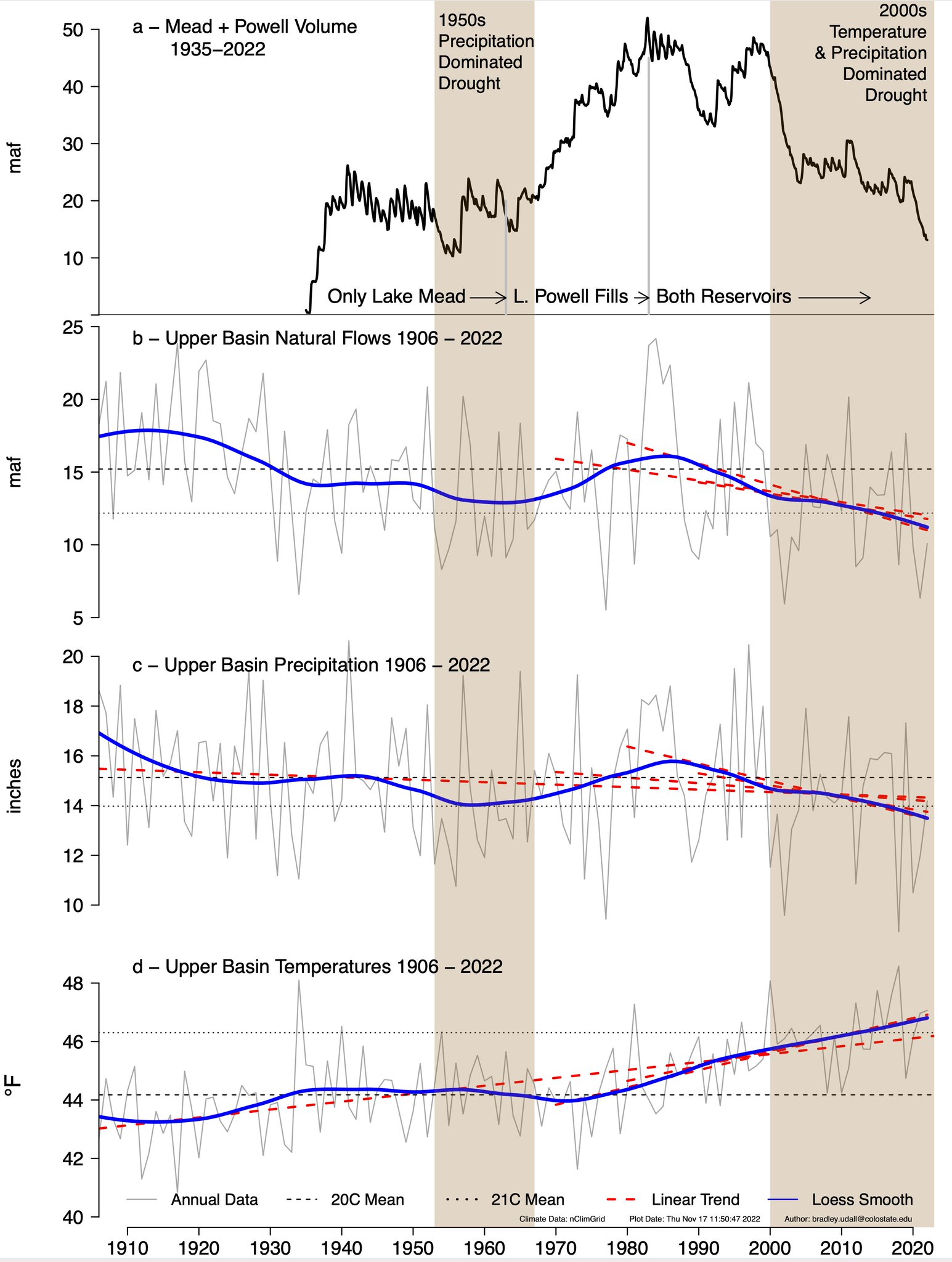
“The one assumption you have to make is that water storage is part of the future way that we’re going to provide water,” Stahla said, and he thinks it is. “If you get past the ‘Do we need storage’ question, this ends up being an incredible site that will meet lots of needs, including the ancillary needs of recreation, into the future.”

[…]

Northern Water Engineering Director Jeff Drager acknowledged the new reservoir’s impact on Colorado River flows, but he said the project’s targeted mitigation efforts still offer a major value and are a key reason why it crossed the regulatory finish line.

Restoring a river channel in the Upper Colorado Basin

One of the most significant mitigation measures, known as the Colorado River connectivity channel, will involve shrinking the existing Windy Gap Reservoir in Grand County to about half its current size and building a new channel around it. The Windy Gap dam currently blocks the Colorado River, preventing movement of fish, silt and sediment.

The connectivity channel will allow the river below the reservoir to act more like “a stream without a reservoir on it” when Northern Water’s water rights aren’t in priority, Drager said. The mitigation measures will also open up a mile of stream to public fishing in an area where private landowners possess most of the land adjacent to riverbanks…

During wetter years, Lake Granby can overflow and the water that would’ve been delivered to Windy Gap users flows downstream. During drier years, Northern Water is often unable to divert the full extent of its water right because it is a junior right, meaning more senior water users get access to water first. During the 23-year period between 1985 and 2008, for example, no Windy Gap water was delivered for seven of those years.

A conversation with Brian Werner, recently retired from @Northern_Water — @WaterEdCO

Eric Wilkinson, left, and Brian Werner, on the job. Photo: Brent Gardner-Smith/Aspen Journalism

From Water Education Colorado (Jacob Tucker):

Although Brian Werner has served on the WEco Board of Trustees for just over a year, he was involved with helping found the organization nearly 20 years ago. Now retired from his 38-year career as the Communications Department Manager and Public Information Officer at Northern Water, and still a life-long water historian, Brian has written and given hundreds of presentations on the role of water in the settlement and development of Colorado and the West. We spoke with Brian about Northern Water’s storage, the impacts of fire on water storage, permitting, and more.

How long have you been on the WEco board?

I’ve been involved with WEco since WEco has been around. I was involved with the first couple incarnations of water education efforts in Colorado in the late 80’s and early 90’s, and then I helped when WEco came into being in 2002. I was never on the board, until a couple of years ago. It was something I wanted to do towards the end of my career and I retired just last year in January 2020. Luckily I was appointed to the board and I’ve truly enjoyed it.

What kind of experience do you bring to the group?

I think the fact that I had a 38-year career in the water business with Northern Water is an asset. At Northern Water, I’d established relations with people from all over the state and I also coordinated probably 150 to 200 different children’s water festivals, so clearly I was into education. I’m really a big believer in the trickle up theory of water knowledge. Where if you can educate the kids, that knowledge is going trickle up to mom and dad, and those kids will somebody be parents themselves. Ultimately, I’ve been trying to build that ethic in what I’ve been about for most of my career.

How would you describe your experience being on the board?

I’ve really enjoyed being on the board. I’ve watched it and been very much involved for a long time. Both Nicole Seltzer and Jayla Poppleton worked with me at Northern Water, so I have a personal vested interest in them succeeding, and they really have. Nicole moved the organization in a wonderful direction and Jayla has just been top-notch in where she has taken WEco. It has been really interesting because we have a diverse board, and I have enjoyed getting to know people who I didn’t know previously.

Screenshot of the Colorado-Big Thompson Project boundaries via Northern Water’s interactive mapping tool , June 5, 2019.

I understand you recently retired from Northern Water, can you tell me what your role with them was and maybe what Northern Water does in a general sense?

Northern Water is the largest water conservancy district in the state of Colorado and operates a large Bureau of Reclamation project that is one of the largest in the entire western United States; the Colorado-Big Thompson project. It brings a quarter-million acre-feet a year from the West Slope into Northeastern Colorado to supplement both urban and rural supplies, meaning that it is both a municipal as well as an agricultural water supply. Now there are well over a million people that get a portion of their water supply from that project, but back in 1937, there were only 50,000 people living within Northern Water’s boundaries. So, nobody could have foreseen the growth that occurred since then. This growth has brought all sorts of issues and concerns, but Northern Water is one of the top water agencies in the state and I certainly had a wonderful career there and couldn’t have asked for anything better.

Personally, I was a public information officer for 35 of those 38 years. My role, in essence, was to be the public face of Northern Water and so I talked about Northern Water and its activities all the time. I was able to use my historical training, I have a master’s degree in history, to discuss the historical background of both water development and Northern Water. I focused very much on education, but ultimately, I spent my entire career talking all things water, which was a lot of fun.

I was also the manager of our communications department as we expanded and grew. As we grew, we brought on writers and pushed publications and annual reports, and then we got into the social media craze. So, for some time I managed that department. But really, it was about telling people what Northern Water was all about.

Perhaps a topical question, but how have the numerous forest fires affected the work that Northern Water does in trying to ensure water storage?

That is going to be Northern Water’s principal focus this coming year. Both of our major watersheds burned last year, the Upper Colorado with the East Troublesome wildfire, and then the Poudre watershed with the Cameron Peak wildfire. And both of these watersheds are where we get the vast majority of our water. Luckily, Northern Water had been looking at forest water management for years. Northern Water has been working with the U.S. Forest Service, the counties, the Bureau of Reclamation, and the National Parks Service. It wasn’t that these fires hit us and Northern Water had no idea what to do. We learned quite a lot from Denver Water after the Hayman Fire, with all of the issues that they had centering around water quality. Northern Water isn’t pleased, but we are certainly going to see some water quality impacts because of these fires.

We went in with our eyes open and with some plans in place for post-fire activities. We always said, ‘it’s not if, it’s when those fires hit.’

What do these fires mean for water supply and water quality now, as well as moving into the future?

One of the things that we see from these fires is a greater level of awareness in terms of forest management, not just if you have a house in a forest or nearby, but for those people living in major metropolitan areas, too. Those people in Denver, Fort Collins, and Colorado Springs are all paying attention now, because they saw the two largest fires in Colorado history and what it did to our environment. And I think now there will be a lot more attention focused on the post-fire impacts, which obviously include water. People will certainly be paying attention to the water piece of the post-fire mitigation and clean-up. Overall, I think moving into the future we will have a better awareness, which is always a good thing. There is no way around it, it is going to take money, and where we are at with COVID-19 that discussion is not easy, but the state is making a concerted effort to put monetary resources and people into handling the situation.

First water through the Adams Tunnel. Photo credit Northern Water.

How the present or future storage planning is different than what the state has done historically?

One thing I would point out is that the Federal government is no longer in the water storage building business. For years Reclamation, which had been established in 1902 helped jumpstart and build water projects, as they did the Colorado-Big Thompson Project in the 1930s, ’40s and ’50s. The Federal government neither has the resources nor are they paying for water storage anymore. Now, water storage is something that is having to be more or less self-funded. Meaning that the growing cities are trying to figure out how they can finance additional water for their future citizens.

We are also now looking at the multiple uses of water. Nowadays, water is being used for environmental purposes, which means that we are looking to make sure that there is enough to release into the rivers to help the aquatic habitat. This is a much larger part of the picture today. At a base level of awareness, we want people to understand why we need storage reservoirs. It is a dry year, and it sure looks like we are only getting drier, and when you have the drier years you better make sure that you store when you have the wetter periods to carry you through. I think we are going to have difficulties trying to match up the storage, which we are going to continue to need, with all the environmental issues and issues surrounding the development of water infrastructure.

Northern Integrated Supply Project (NISP) map July 27, 2016 via Northern Water.

In the past 20 years, Northern has been in permitting so can you talk about that process?

We say water project permitting works at a glacial pace. When I started working on the Northern Integrated Supply Project permitting at Northern Water, I told my wife that I thought we would have a permit in around 5 years … I’m now retired. Northern Water is going on 17 years later, and they still haven’t received that permit. That’s frustrating. This wasn’t for lack of energy; I mean we were really working hard to secure that permit. These things take much longer than you would probably expect. You have to have a lot of perseverance because the process can really drive you crazy, but my hope is that in the future this process will become much better for all parties involved.

@GreeleyWater: Dive into a look at the city’s water rights — The #Greeley Tribune

Seaman Reservoir upstream of confluence of the North Fork of the Cache la Poudre River. Photo credit Greg Hobbs.

From The Greeley Tribune (Trevor Reid):

In the past year, Greeley officials purchased about 1,000 acre-feet of water, equivalent to about 1,000 football fields covered in a foot of water. Adam Jokerst, deputy director of water resources for the city, said it’s more water than city had acquired in the past 10 years. Jokerst, who manages the water acquisition program, said the program has about a $9 million budget this year…

What is a water right?

Colorado’s waters are owned by the state and all its citizens, but water rights dictate the right to use the water. Water decrees, issued by water courts, confirm water users’ rights to that water.

Older water decrees were simple, Jokerst said, giving the example of a decree for the city’s senior direct rights, meaning the city has priority to divert water for direct application to beneficial use. Throughout the year, the city can use 12.5 cubic feet per second. That’s about it, he said.

Newer decrees can range from dozens to hundreds of pages, detailing how the water is to be diverted, measured and accounted for.

“Greeley owns a portfolio made up of many different water rights,” Jokerst said. “Some of those water rights are direct diversions from the Poudre River. Some are ownership in irrigation companies.”

Irrigation companies that historically provided irrigation water to farmers can issue shares of stock, basically selling a piece of the water rights held by those companies. The city converts that water from agricultural to municipal use to change the water right, though the city does rent some water rights to agricultural users, maintaining the historic use.

The city also owns water through the Colorado-Big Thompson and Windy Gap projects, as well as water diverted from the Laramie River. With a lot of variability across these different sources, the city’s water experts always plan for the worst case scenario: How much water could we provide to our customers in a drought situation?

Through the current plan, the city can provide about 40,000 acre-feet per year to its customers, well above the roughly 25,000 acre-feet of demand the city sees in a typical year. In a wet year, the city could potentially deliver up to 70,000 acre-feet, to give an idea of the impact of the planned drought.

When the city can, it rents a lot of that water to agricultural partners, renting about 20,000 acre-feet in the past year. In addition to maintaining historic use, this provides a source of revenue and supports Greeley’s agricultural economy, Jokerst said.

Jokerst said he’d consider the city’s “Big Three” sources to be:

  • Senior direct rights from the Poudre River
  • Ownership in the Greeley-Loveland Irrigation Company, which feeds the city’s Boyd Lake System
  • Colorado-Big Thompson (C-BT) and Windy Gap projects
  • Jen Petrzelka, water resources operations manager, added the direct and C-BT water is available year round, whereas a lot of the ditch directs only come in during irrigation season, which typically starts about now to early May and runs through the end of September or into October.

    Accounting for the city’s diverse portfolio

    The city must account for its water on a daily basis, submitting a monthly report to the state. Petrzelka said they manage about 10 different spreadsheets for all the city’s water right decrees…

    Petrzelka keeps an eye on the city’s water supply to help prevent the need for watering restrictions. In all, the city has four engineers and scientists who manage the various decrees and operations, plus three workers out in the field, according to Jokerst.

    The state ensures water users aren’t causing injury to other users’ water rights, with local river commissioners dedicated throughout the state. Jokerst compared the commissioners to a referee in a sports game.

    “Any time we change the way we’re operating, whether that be our releases or operating an exchange, we have to get their approval,” Petrzelka said.

    When agricultural water rights are changed, Jokerst said, some water is owed back to the river, just as the water historically returned to the river and groundwater after agricultural use.

    “A lot of what we do is add water back to the river to compensate for those irrigation rights that we changed,” he said.

    In addition to enforcement by river commissioners, everybody watches their neighbors, keeping track of what other users are doing on a day-to-day basis. Part of that monitoring happens in water court, where decisions about decrees are settled…

    Greeley has a steady stream of water court cases the city must defend in court, according to Jokerst, as well as cases involving other entities in which the city enters opposition to protect its water rights. As of this past week, the city was involved in 32 water court cases.

    “Water court cases are really just a structured negotiation where the applicant and the opposers reach agreement on whatever it is the applicant is trying to do,” Jokerst said. “All the parties involved negotiate an outcome that protects all their water and gets the applicant what they need.”

    Petrzelka and Jokerst estimated the city’s water court costs at about $500,000 this year, mostly covering the costs of outside attorneys and engineers. Internal legal counsel also helps guide the department, Jokerst said.