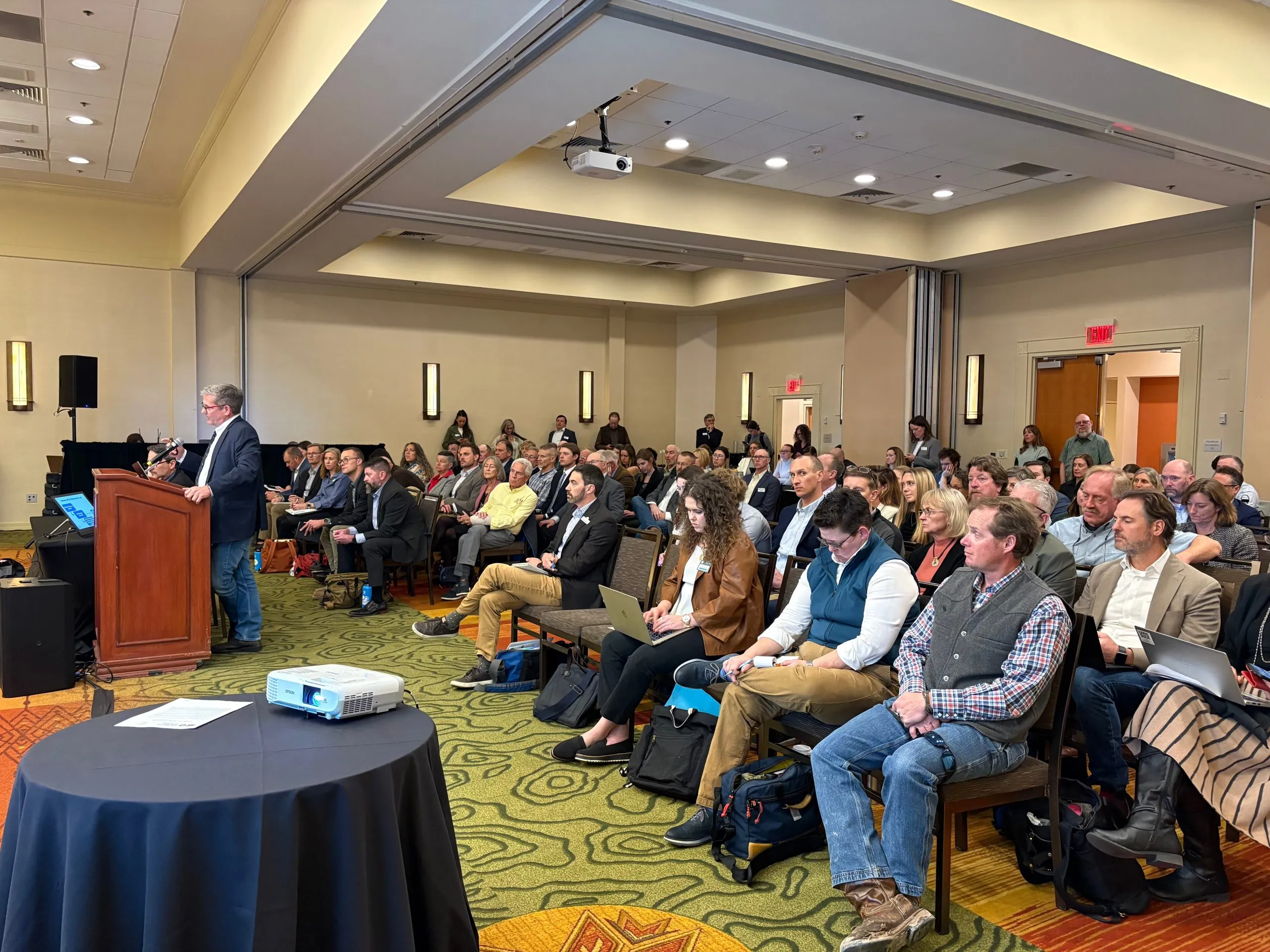
River District General Manager Andy Mueller speaks to the Colorado Water Conservation Board in front of a packed house Wednesday. The board voted unanimously to accept water rights tied to the Shoshone hydropower plant to benefit the environment. CREDIT: HEATHER SACKETT/ASPEN JOURNALISM
In a historic move Wednesday evening, the state water board voted unanimously to accept water rights tied to the Shoshone hydropower plant, a major step toward securing those flows in perpetuity for the Western Slope.
The Colorado Water Conservation Board said the Shoshone water rights, which are some of the oldest and most powerful on the mainstem of the Colorado River, can be used to benefit the environment.
“The Shoshone acquisition makes a lot of sense to me, and I’m very proud to be a part of the work that everybody’s put into it,” said Mike Camblin, who represents the Yampa, White and Green river basins on the CWCB. “I hope that our children and our grandchildren look back and realize we made the right decision on this.”
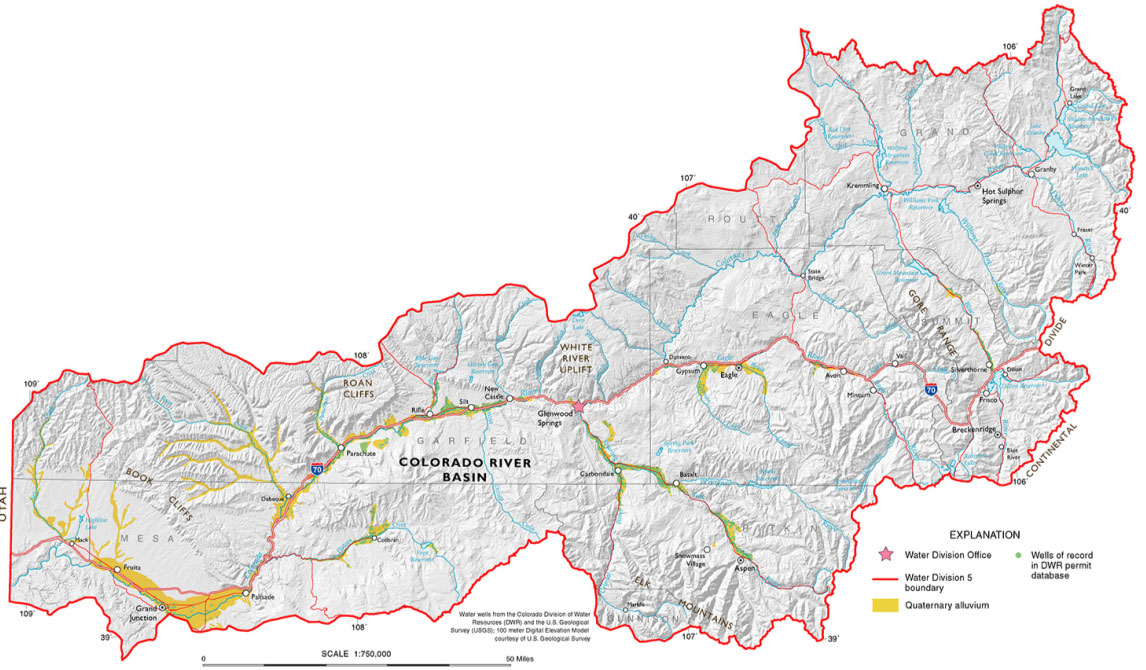
The Glenwood Springs-based Colorado River Water Conservation District plans to purchase the Shoshone water rights for $99 million from Xcel Energy, but the district first needed the approval of the CWCB, which is the only entity in the state allowed to hold instream-flow water rights to benefit the environment. Because the water is returned to the river after it runs through the hydroplant’s turbines, downstream cities, irrigators, recreators and the environment all benefit.
River District General Manager Andy Mueller called it a fantastic day in Colorado history.
“I think that was the right decision for the Colorado River and the right decision for our whole state,” Mueller said. “I think the state for generations to come, centuries in the future will benefit from having that water in the Colorado River.”
Importantly, the instream-flow agreement approved by the board says that the Western Slope, along with the CWCB, will retain some control over exercising the rights. The River District and its constituents drew a hard line in the sand regarding this point and said they would walk away from the deal if they had to cede control solely to the CWCB.
Though not totally unprecedented, co-management is a departure from the norm, as the CWCB has never shared management of an instream-flow water right this large or this powerful with another entity.
In attendance at Wednesday’s CWCB meeting in Golden were representatives of ditch companies, elected officials and water managers from across the River District’s 15-county area. Some of the attendees said during their public comments that if the River District didn’t retain some control over the water rights, they would pull their funding and withdraw their support from the Shoshone campaign.
Mesa County Commissioner Bobbie Daniel said the joint-management proposal is a safeguard that ensures that Western Slope interests are not pushed aside. Mesa County has committed $1 million toward the purchase of the water rights.
“The Shoshone call is one of the great stabilizing forces on the river, a heartbeat that has kept our valley farms alive, our communities whole and our economy steady, even in lean years,” Daniel said. “If a joint management is not adopted, Mesa County will withdraw its support for this acquisition. It’s not out of anger or politics, but because anything less would fail the people that we serve.”
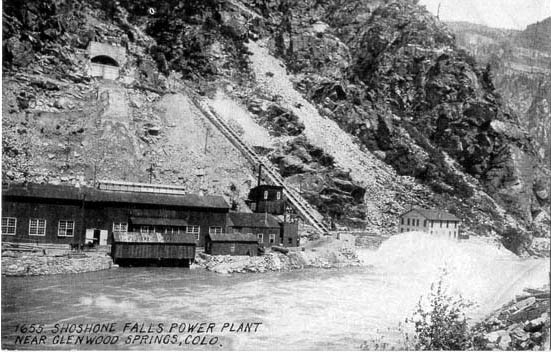
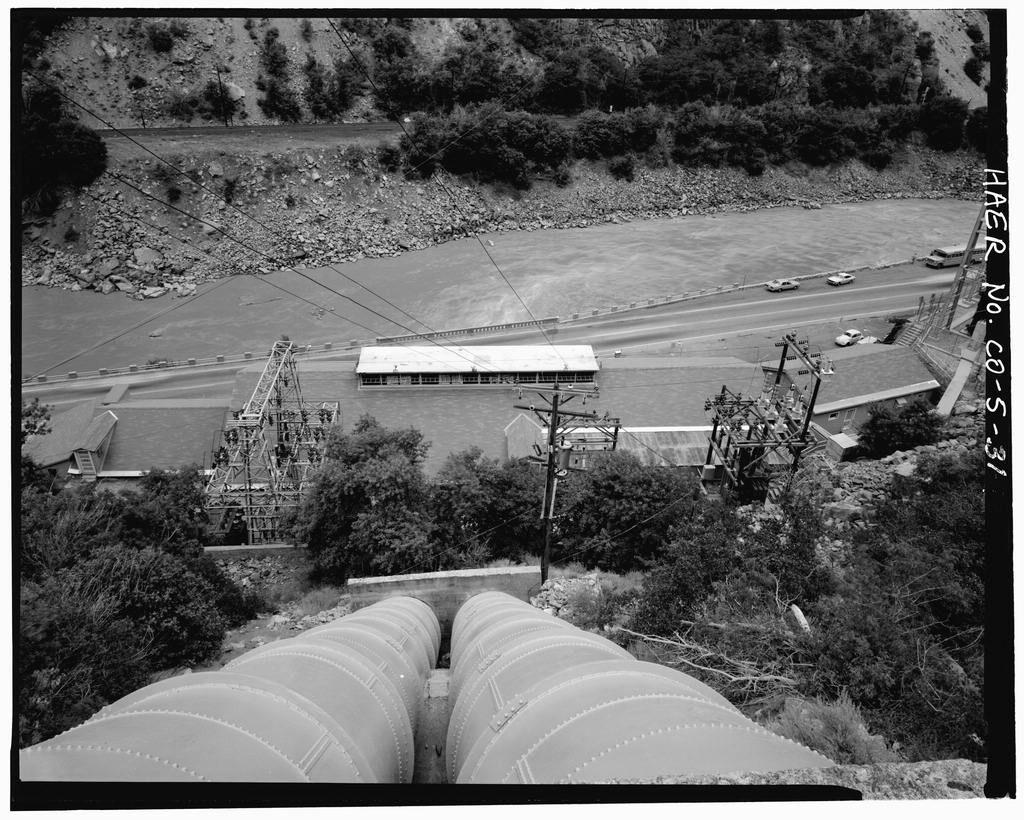
The Shoshone hydropower plant in Glenwood Canyon has some of the oldest and most powerful nonconsumptive water rights on the Colorado River. A broad coalition of Western Slope entities support the River District purchasing the rights. CREDIT: HEATHER SACKETT/ASPEN JOURNALISM
Blow to the Front Range
The CWCB’s decision was a blow to Front Range water providers, who objected to the River District’s having a say over how to manage the water rights, even though they supported the overall goal of protecting flows for the environment. Denver Water, Northern Water, Aurora Water and Colorado Springs Utilities argued that the CWCB has exclusive authority over the rights, according to state statute.
Critically, because the Shoshone plant’s water rights — one that dates to 1902 for 1,250 cubic feet per second and another that dates to 1929 for 158 cfs — are senior to many other water users, they have the ability to command the flows of the Colorado River and its tributaries upstream all the way to the headwaters. This means that the owners of the rights can “call out” junior Front Range water providers with younger water rights that take water across the Continental Divide via transmountain diversions and force them to cut back.
The fact that Front Range water providers take about 500,000 acre-feet annually from the headwaters of the Colorado River is a sore spot for many on the Western Slope, who feel the growth of Front Range cities has come at their expense. These transmountain diversions can leave Western Slope streams depleted.
The Shoshone call pulls water west much of the time. But the Front Range parties wanted assurances that during extreme droughts or emergency situations, the call would be “relaxed,” allowing them to take more water to their cities’ millions of customers.
Alex Davis, assistant general manager with Aurora Water, said the CWCB should retain the ability to relax the call as a “backstop” under extremely rare circumstances.
“It is asking that in those emergency situations, the board has the ability to step in and say: We’re going to do what we think is best for the state of Colorado,” Davis said.
The agreement approved by the board lays out a collaborative process to consider a call relaxation, with a stakeholder panel of water managers from both sides of the divide. The specific wording of this agreement was hashed out during Wednesday’s meeting, with lawyers representing the CWCB and River District conferencing to tweak language and make edits.
Colorado Water Conservation Board member representing the Arkansas River basin Greg Felt, left, talks with River District General Manager Andy Mueller Wednesday after the board voted to accept the Shoshone water rights for instream flow purposes. The move represents a major step toward securing those rights in perpetuity for the Western Slope. CREDIT: HEATHER SACKETT/ASPEN JOURNALISM
The CWCB had been set to decide on the Shoshone rights at its meeting in September, but the River District granted an eleventh-hour 60-day extension so they could address issues raised by the board and try to negotiate a consensus with the Front Range parties.
Despite all the detailed arguments laid out by the parties, thousands of pages of technical and legal documents, and hours of testimony and public comment over the September and November CWCB meetings, the board’s scope of decisionmaking remained narrow: Should the CWCB accept a perpetual interest in the Shoshone water rights and will these rights preserve the natural environment to a reasonable degree?
In the end, the board decided yes, and also determined that it did, in fact, have the authority to allow the River District to co-manage the Shoshone water rights alongside it.
“I really think it’s pretty incredible that there’s no objection to the environmental aspects of this flow and the purpose of this water right for environmental purposes,” said CWCB Director Taylor Hawes, who represents the mainstem of the Colorado River where the Shoshone plant is located. “(The River District is) donating that water right. It seems like they should have a say. And while I realize this case is unique, I don’t see anything in the statute or the rules that prohibits us from doing this.”
But the fight to keep Shoshone flowing west is not over for the River District. The CWCB, River District and the water rights’ current owner, Xcel, now plan to file a joint application in water court to make the deal official by adding the instream-flow use to the water rights.
The water court process will decide another contentious issue that is sure to again highlight disagreement between the Western Slope and Front Range as they compete for the state’s dwindling water resources: precisely how much water is associated with the water rights, a number based on the plant’s past use.
“I also very much understand the concerns of both sides of the divide in not wanting the other side to have a windfall,” Hawes said. “That has been kind of the heart of all of this. And I hope we can all trust that the water court’s process will give us a result where we don’t have to worry about that. Everyone’s concerns will be addressed in that process.”
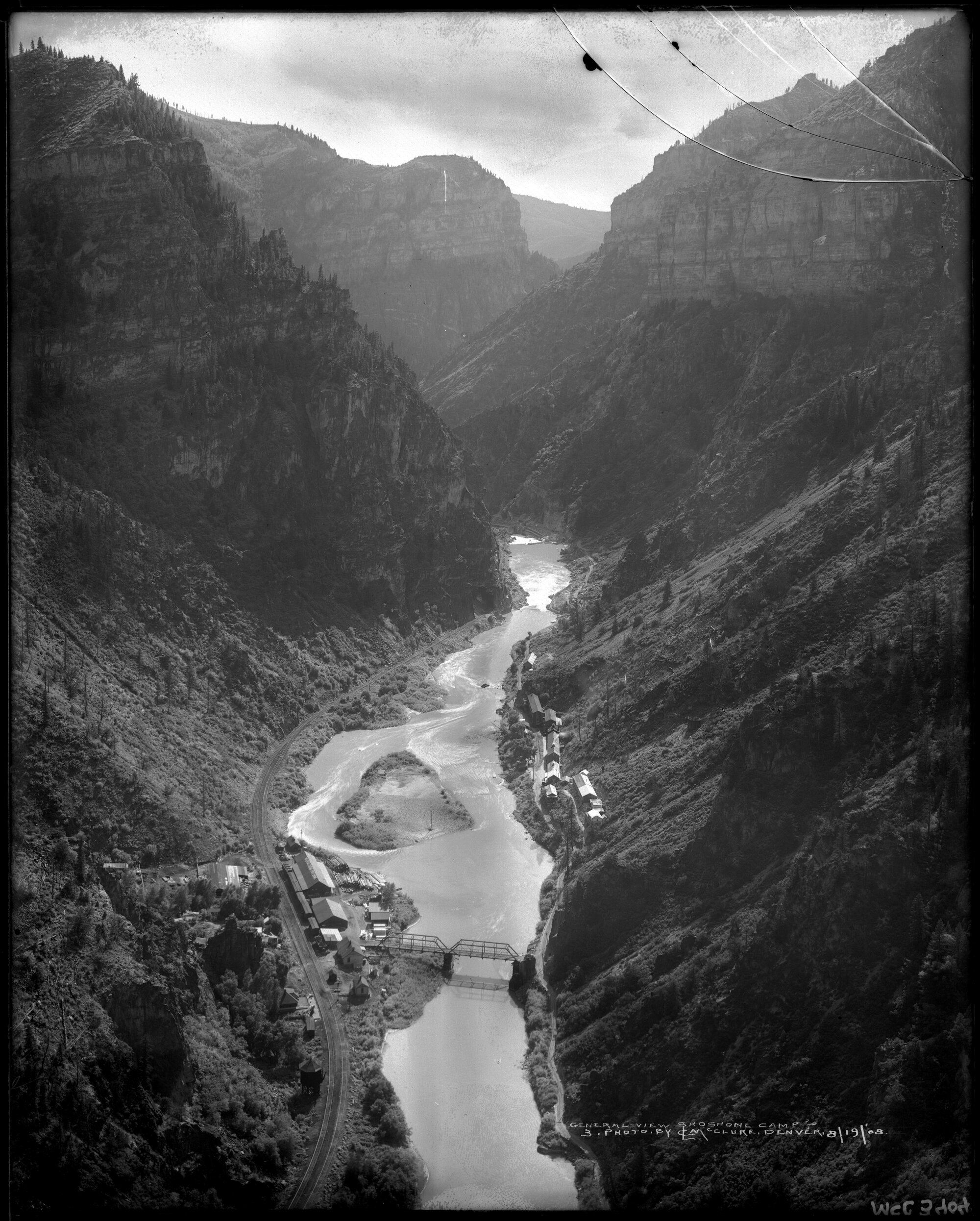
View of Shoshone Hydroelectric Plant construction in Glenwood Canyon (Garfield County) Colorado; shows the Colorado River, the dam, sheds, a footbridge, and the workmen’s camp. Creator: McClure, Louis Charles, 1867-1957. Credit: Denver Public Library Digital Collections
In a momentous decision for the Western Slope, state water officials unanimously approved a controversial proposal to use two coveted Colorado River water rights to help the river itself.
Members of the Colorado Water Conservation Board voted to accept water rights tied to Shoshone Power Plant into its Instream Flow Program, which aims to keep water in streams to help the environment.
The decision Wednesday is a historic step forward in western Colorado’s yearslong effort to secure the $99 million rights permanently. But some Front Range water providers pushed back during the hearings, worried that the deal could hamper their ability to manage the water supply for millions of Colorado customers.
For the state, the two water rights will be a crown jewel in its five-decade environmental effort to help river ecosystems. It’s one of several steps in the agreement process, and it could take years before the river feels that environmental benefit.
“The Shoshone acquisition makes a lot of sense to me, and I’m very proud of the work that everybody’s put into it,” said Mike Camblin, who represents the Yampa and White river basins on the Colorado Water Conservation Board. “I hope that our children and our grandchildren look back at this and realize we made the right decision.”
Over 100 Colorado water professionals and community members gathered in Golden for a six-hour hearing about the environmental proposal, brought forward by the Colorado River District, which represents 15 counties on the Western Slope.
The small hydropower plant off Interstate 70 near Glenwood Springs has used Colorado River water to generate electricity for over a century. But the aging facility has a history of maintenance issues, and Western Slope water watchers have long worried about what happens to the rights if it were to shut down for good.
The Colorado River District wants to add the environmental use as part of a larger plan to maintain the “status quo” flow of water past the power plant, regardless of how long it remains in operation.
Western Slope communities, farms, ranches, endangered species programs and recreational industries have become dependent on those flows over the decades and broadly supported the district’s proposal.
From left, Hollie Velasquez Horvath, Kathy Chandler-Henry, and Andy Mueller, general manager of the River District, at the kickoff event Tuesday [December 19, 2023] for the Shoshone Water Right Preservation Campaign in Glenwood Springs. CREDIT: HEATHER SACKETT/ASPEN JOURNALISM
“I’m good. I’m much more relaxed now,” Andy Mueller, the district’s general manager, said after the vote Wednesday. “The reality is, we have set up our state, through this instream flow agreement, for success for centuries on the Colorado River.”
Some powerhouses in Colorado water support the general permanency effort but oppose parts of the agreement. Northern Water, Colorado Springs Utilities, Denver Water and Aurora Water said the proposal would give the Colorado River District too much sway in decisions that would impact them.
These water managers and providers are responsible for delivering reliable water to millions of people, businesses, farms and ranches across the Front Range. Any change to Shoshone’s water rights could have ripple effects that would affect over 10,000 upstream water rights, including some held by Front Range water groups.
The negotiations over the agreement continued throughout the meeting. Board members had about 24 hours to review a stack of documents marked with tweaked phrasing and proposed edits.
Both sides are concerned that the other could get a water windfall through the agreement, said Taylor Hawes, who represents the Colorado River on the board. Those concerns can be addressed in the next step of the process: Water Court.
“That has been the heart of all of this,” Hawes said. “I hope we can all trust that the water court’s process will give us a result where we don’t have to worry about that.”
Who will control the flow of water?
The Colorado Water Conservation Board was supposed to make its final ruling on the environmental use proposal in September. Then Public Service Company of Colorado, the Xcel subsidiary that owns the rights, and the Colorado River District filed an 11th-hour extension to delay until the meeting Wednesday.
That’s, in part, because they needed more time to address a central conflict in the agreement: Who makes the final decisions when managing the powerful rights?
Shoshone uses two rights to access the Colorado River: one for 1,250 cubic feet per second that dates back to 1905, and a right to 158 cubic feet per second that dates back to 1940.
They amount to a big chunk of water. Plus, these rights can be used year-round, and they supersede more recent, junior rights like several held by Front Range water providers.
Under the agreement, the water rights will be co-managed by the Colorado River District and the Colorado Water Conservation Board.
Western Slope parties were adamant about this. Several speakers said they would pull their funding, and there would be no agreement if the River District did not have a say in how the water rights would be used.
“If joint management is not adopted, Mesa County will withdraw its support for this acquisition,” Bobbie Daniel, Mesa County Commissioner, said. “It’s not out of anger or politics, but because anything less would fail the people that we serve.”
The Front Range groups said the state should make the final decision if Colorado River District staff and CWCB staff disagreed over how to manage the water rights. They argued the board has exclusive authority under state law.
Alex Davis with Aurora Water said her team was pushing for a “hammer” — an entity, preferably the state, that could force water providers on either side of the Continental Divide to come to the negotiating table or that could make the final decision, especially in times of crisis.
Aurora pulls about 25,000 acre-feet of water from the Western Slope, through mountain tunnels and into its water system each year, she said. (An acre-foot of water is about what two to three households use in a year.) But when Shoshone is using its 1905 water right to its fullest, nearly all of Aurora’s transmountain diversions are turned down or turned off.
The city might want to ask Shoshone to use less water to provide some relief in an emergency. The agreement seems to give the Colorado River District a veto, Davis said.
“By the River District having that decision-making power, it may lead to less incentive on the West Slope side in those emergency situations,” Davis said in an interview with The Sun. “That’s what we were worried about.”
Colorado Water Conservation Board members decided to continue with the co-management approach, saying they were not giving up authority or working outside of state statute by doing so.
Mueller said the agreement is a win for the river and the entire state. It will protect endangered fish and a critical 15-mile stretch of habitat near Grand Junction. It includes exceptions that will protect cities during multi-year droughts and emergency situations, he said.
“The CWCB and the River District can act together for the best interest of the state,” Mueller said in an interview. “We’ll have to earn some trust in that realm over the years, but I’m quite convinced we can do it.”
About that $99 million bill…
The Colorado River District has entered into a $99 million agreement with Xcel Energy to buy the Shoshone water rights.
The state’s decision to accept Shoshone’s water rights into its environmental program met one of four key closing conditions of that purchase agreement, Amy Moyer, chief of strategy for the Colorado River District, said.
The deal still needs approval by Colorado’s Public Utilities Commission. It’ll be weighed in Water Court, where Western Slope and Front Range representatives will wade through another thorny issue: What has Shoshone’s “status quo” water use been over the last century?
The Colorado River District and its Western Slope supporters need to pay up. Although they’ve pulled together over half the asking price, they’re still waiting to hear about whether a request for federal funding will be approved.
If the deal passes those hurdles, then the resulting purchase and instream flow agreement will go on indefinitely. It will provide more predictability for water users across the state, and it will continue to factor into how Colorado communities grow, officials said Wednesday. “We’re making some very far-reaching decisions here,” Nathan Coombs, the board’s Rio Grande Basin representative, said. “I still think this is the right choice right now with the information we have.”
Colorado is in its first year of responding to a zebra mussel infestation in a big river, the Colorado River. State staff say they have what they need to handle the high-priority needs — they just need their funding to stay off the chopping block.
The fast-reproducing mussels, or their microscopic stage called veligers, were first detected in Colorado in 2022. Since then, the state’s aquatic nuisance species team and its partners have been working to monitor water, decontaminate boats, and educate the public to keep the mussels from spreading. That effort logged a serious failure this summer when state staff detected adult zebra mussels in the Colorado River, where treatment options are limited.
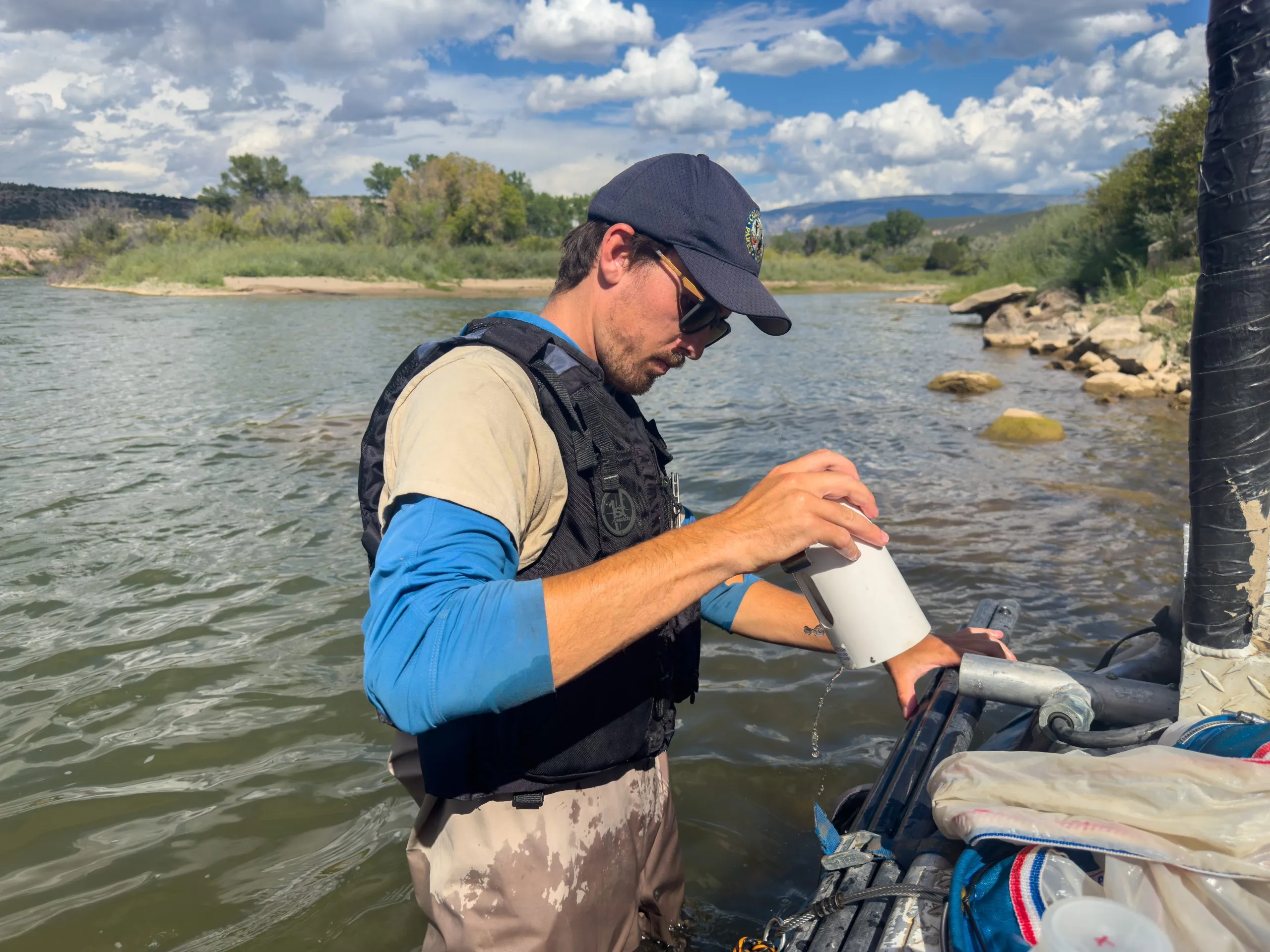
CPW sampling on the Colorado River found zebra mussel veligers. The river is now considered “positive” for zebra mussels from its confluence with the Roaring Fork River to the Utah state line. CREDIT: PHOTO COURTESY OF COLORADO PARKS & WILDLIFE
“We’re continuing to sample the Colorado from below the Granby Dam all the way out to the [Utah-Colorado] state line,” said Robert Walters, who manages the invasive species program for Colorado Parks and Wildlife.
Adult zebra mussels, about the size of a thumbnail with a zebra-striped shell, reproduce quickly and can clog up pipes, valves and parts of dams, costing millions of dollars to remove. They also suck up nutrients, out-eating other native aquatic species, and their razor sharp shells cause headaches for beachgoers.
The state’s first adult zebra mussel showed up in Highline Reservoir near Grand Junction in 2022. But even after the lake was drained and treated, the mussels appeared again.
Colorado has been working to keep these invasive species out of its waters since 2007, when a task force was created to coordinate management efforts.
In 2008, Colorado approved a law that makes it illegal to possess, import, export, transport, release or cause an aquatic nuisance species to be released.
Now, the program completes over 450,000 inspections each year, according to Colorado Parks and Wildlife’s website. The teams have intercepted 281 boats with zebra or quagga mussels attached.
But their treatment options are limited on the Colorado River. CPW does not intend to treat the main stem of the Colorado River due to multiple factors, including risk to native fish populations and critical habitat, the length of the potential treatment area and complex canal systems, the agency said in a mid-September news release.
The goal continues to be educating the public — including lawmakers who are scheduled to hear an update on the zebra mussel issue during the Oct. 29 Water Resources and Agriculture Review Committee meeting.
“What I think that we really need to help us more effectively tackle this issue is a higher level of public awareness,” Walters said.
The first year of infestations
For invasive species teams, the first year involves a lot of monitoring, according to Heidi McMaster, the invasive species coordinator for the U.S. Bureau of Reclamation.
Quagga mussels were discovered in Lake Mead, Lake Mojave and Lake Havasu on the Colorado River in January 2007. The mussels were later confirmed in Lake Powell in 2013, according to the Bureau of Reclamation.
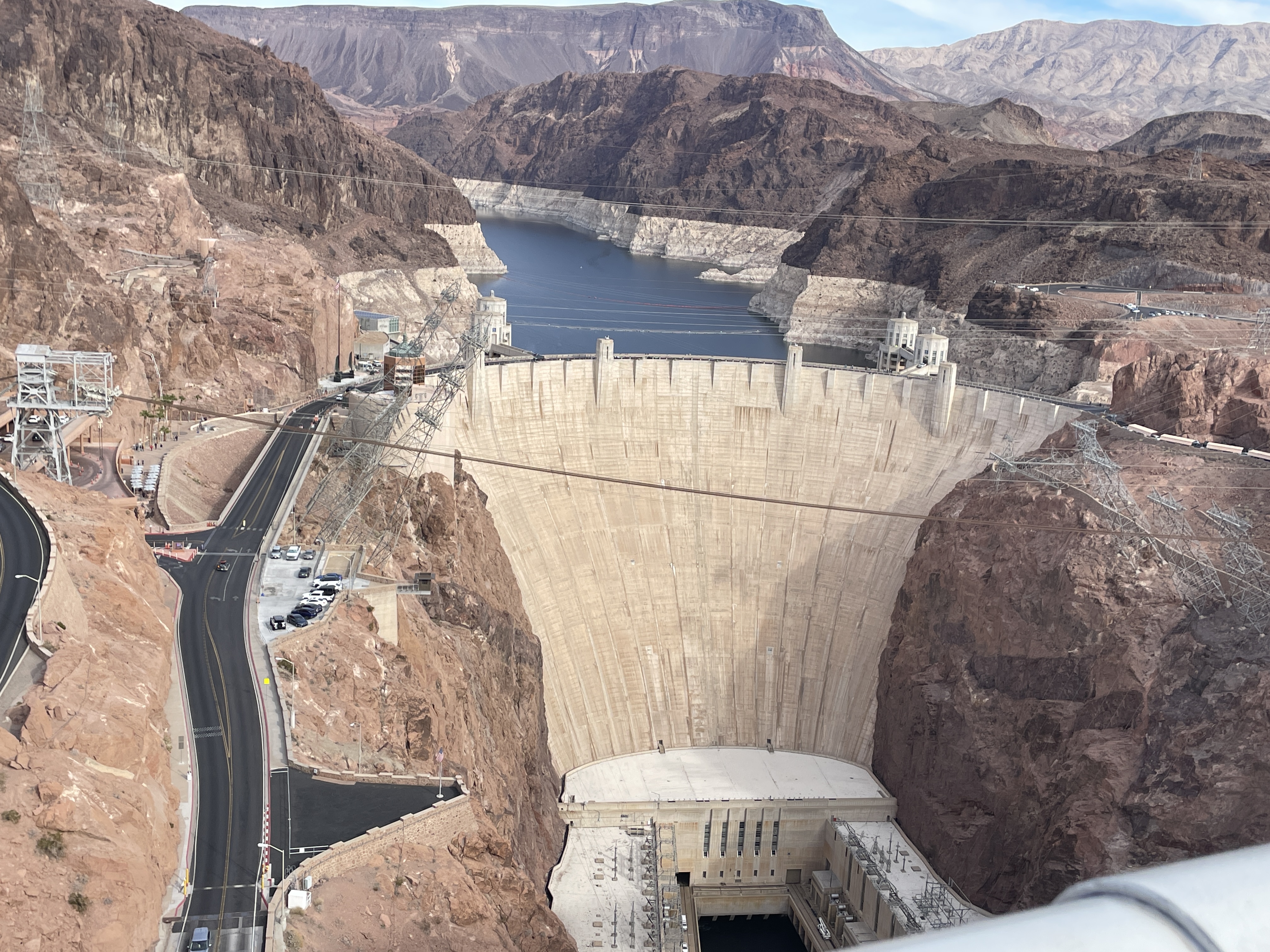
Hoover Dam with Lake Mead in the background December 3, 2024.
Colorado River water from Colorado’s mountains eventually collects in Lake Powell before flowing through the Grand Canyon to downstream states, Lake Mead and Mexico.
“I would think that the first response is probably panic, especially if people are not prepared for it,” McMaster said. “Once that initial panic wears off, it is tapping into the existing resources, the preparedness plans that state or managers have on how to deal with it.”
During the first year, specialists are looking at existing rapid response plans, vulnerability assessments and communication plans. They take samples and track life cycles to try to understand how the mussels reproduce, how environmental conditions impact breeding and what kinds of treatments might work to stop the spread.
In the Southwest and along the Colorado River, the temperature of the water allows invasive species to breed multiple times a year, McMaster said. Each one can produce a million larvae. Not all survive: There are turbulent waters, areas with fewer nutrients, and other threats, like predators. But if they grow to adulthood they can layer on top of each other on underwater surfaces.
If left unchecked, invasive mussels could clog up pipelines that carry cooling water to turbines used to generate hydroelectric power. Without the cooling effect of the water, the turbine would “burn up” and power generation would shut down, McMaster said.
The goal at the end of the first year is mainly to inform the public. That means repeating the “clean, drain, dry” refrain as often as possible to anyone moving watercraft from one body of water to another, she said.
After that, a successful first-year response will also include setting up inspection and decontamination stations. Then, specialists move onto treatment options, McMaster said.
At Hoover Dam and Lake Mead, on the Nevada-Arizona border, managers took an aggressive treatment approach to avoid damage to the dam, she said. They used UV lights to stun and temporarily paralyze the microscopic veligers so they cannot attach inside the dam.
“Prevention is still the No. 1 goal,” McMaster said.
It’s the cheapest and least risky option, she said. Once an invasive mussel species arrives in an area, however, the costs can ramp up exponentially into the millions of taxpayer dollars. The goal is always to keep them at bay as much as possible, she said.
“They might be in the state of Colorado,” McMaster said, “but if you look at the overall percentage of uninfested areas, that’s still a lot of maintenance that’s not having to happen.”
Pest control on a private lake
On July 3, Colorado Parks and Wildlife staff discovered adult zebra mussels in a privately owned lake in western Eagle County, according to a news release.
CPW also identified additional zebra mussel veligers in the Colorado River near New Castle, Highline Lake and Mack Mesa Lake at Highline Lake State Park, the release said.
There were too many mussels in the Eagle County lake to count, Walters said in late August. Any hard structure in the lake and any underwater rocks were relatively covered in adult mussels, he said.
An invasive species specialist said in July that they believed the lake was an upstream source of the mussels in the Colorado River, and that an outlet from the lake was bringing zebra-mussel-infested water into the Colorado River, according to news reports.
Walters said that has not been confirmed.
“We are just continuing to try to monitor,” Walters said during an interview Aug. 29. “What I can say is that, to the best of our knowledge, there currently is no connection from this privately owned body of water into any of the river systems of the state.”
The state’s team spent about eight hours on Aug. 25 treating the lake with a copper-based molluscicide, a substance used to kill mollusks, he said.
Staff also sampled the private lake’s water Aug. 27 to make sure the treatment’s concentration was at the right level and planned to continue monitoring and treating the water throughout September, Walters said.
No boats or other watercraft were entering or exiting the lake, he said.
“It’ll be a long time before we know if it was truly effective at eradicating the zebra mussels,” he said.
Zebra mussels. Photo credit: Colorado Parks & Wildlife
The state focuses its monitoring efforts on public waters, mainly those with high recreational use. Motorboats and other types of boats are the main way the mussels spread, he said.
However, that doesn’t mean the teams don’t survey private ponds and lakes, Walters said.
After the state discovered zebra mussel veligers in the Colorado River and Grand Junction area, they started asking landowners if they could survey private lakes, ponds, gravel pits and more near the river. They often survey privately owned recreational areas, like water skiing clubs, he said.
“We have been trying to work with those private landowners to allow us access to come out and sample them for invasive species,” Walters said.
We need to keep our existing funding
But with thousands of private and public water bodies in the state, CPW alone is never going to be able to monitor all of them as frequently as the high-risk water bodies, he said.
The staff normally work in teams of two to inspect reservoirs and lakes. They pull fine mesh nets through the water to try to find microscopic veligers. They do shoreline surveys to look for razor sharp shells and other signs of invasive species.
On a small pond, the process can take one to two hours. On a big reservoir like Blue Mesa, Colorado’s largest reservoir, it would take six to eight hours, he said.
“I don’t think that there is ever going to be capacity to monitor every public and private body of water in the state of Colorado. And I don’t think that that’s ever going to be our expectation,” Walters said.
The aquatic nuisance species program has more resources than ever, but there’s always room for more, Walters said.
“At this time, we feel like we do have a good amount of resources to be able to sample the waters that we consider to be the highest priority,” he said.
Formerly, the team was based in Denver. Now, the state has established a traveling team to cover the Western Slope and another focused on the Grand Junction area.
They don’t need more authority to monitor private water bodies, he said.
“What we need is to continue to receive the funding that we are receiving today, and hope that does not get threatened if there’s any sort of budget cuts that are considered,” Walters said.
Aquatic nuisance species stamp sales cover about $2.4 million, or 50%, of the program’s annual funding needs. All motorboats and sailboats must have this stamp before launching in state waters, according to the CPW website.
Colorado state law calls on federal agencies, like the Bureau of Reclamation and U.S. Forest Service, to cover the other half of the funding needs since many high-risk waters in Colorado are federally owned or managed.
How are other water providers responding?
Zebra mussels go with the flow. They naturally move downstream with the river’s current, but boats traveling from one lake to another can carry them upstream.
That has upstream water managers, like Northern Water and Denver Water, keeping a close eye on developments along the Colorado River.
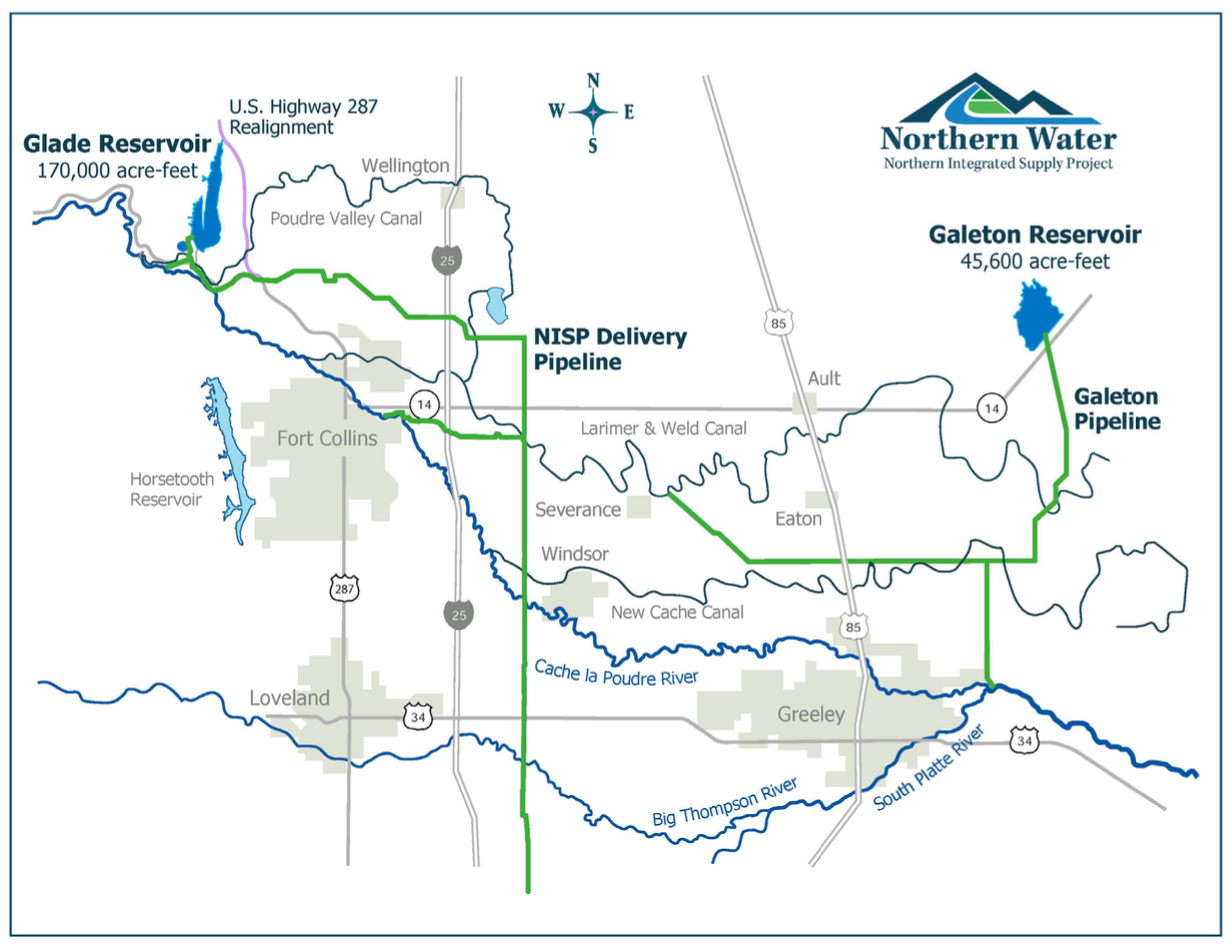
The Northern Colorado Water Conservancy District works with the federal government to transfer Colorado River water on the Western Slope through a series of reservoirs, pump stations and tunnels — called the Colorado-Big Thompson Project — to farmland and over 1 million residents from Fort Collins across northeastern Colorado.
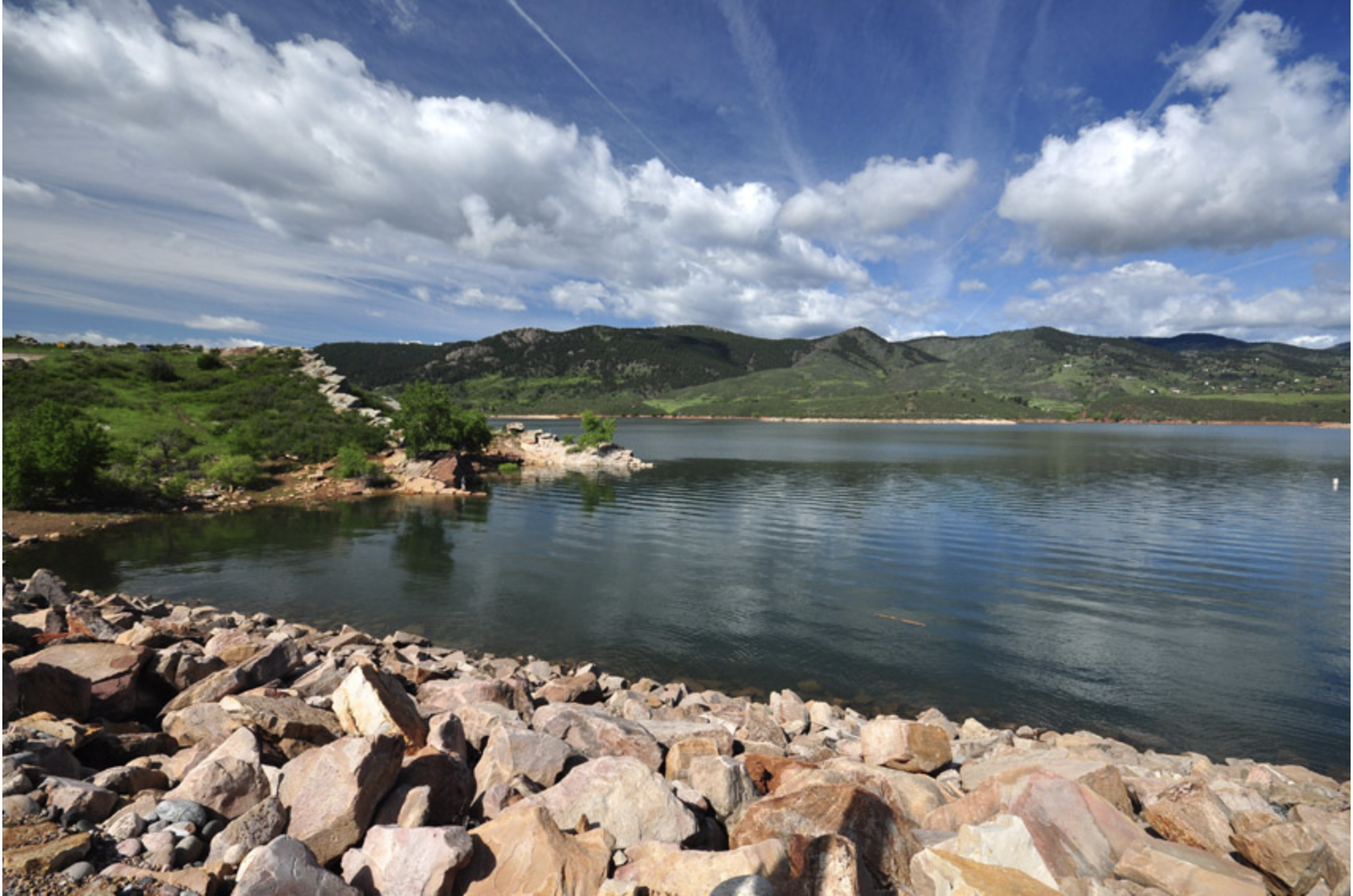
Horsetooth Reservoir looking west from Soldier Dam. Photo credit: Norther Water.
Zebra mussels are such prolific reproducers they can clog up water delivery pipelines, the main concern for a water manager like Northern Water, spokesman Jeff Stahla said.
The C-BT project is no stranger to invasive species. In 2008, quagga mussels showed up in several reservoirs, including Grand Lake, Lake Granby and Shadow Mountain Reservoir. Another reservoir, Green Mountain, was also positive for quagga mussels in 2017.
All of the lakes are mussel-free and delisted, Stahla said. Now they’re tightening up security.
“The biggest task we can right now is to inspect those boats going into the reservoirs to make sure that they’re not going to be causing the problem,” he said.
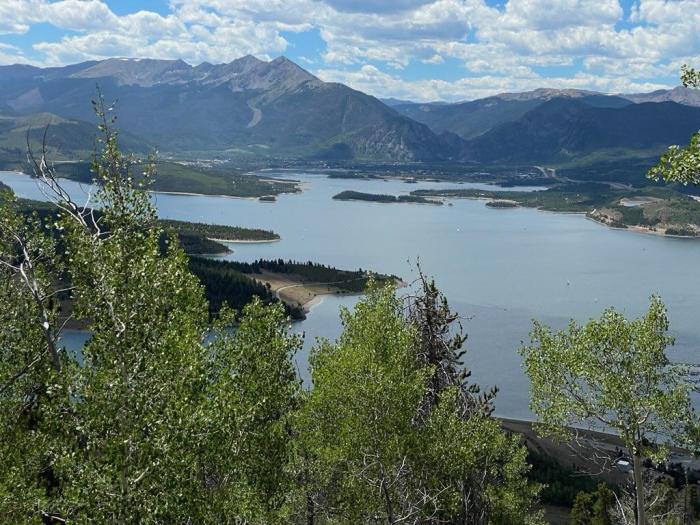
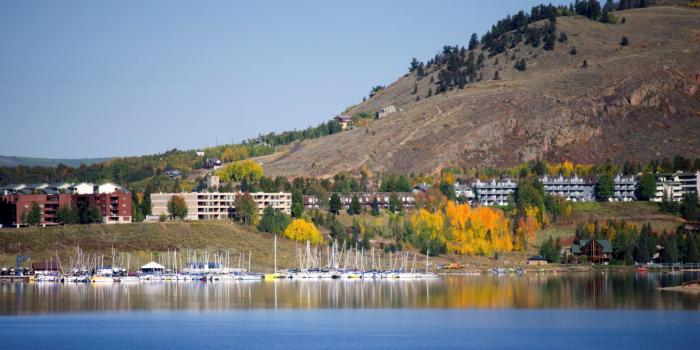
Dillon Reservoir in Summit County is Denver Water’s largest reservoir. Photo credit: Denver Water.
Denver Water, which serves 1.5 million people in Denver and nearby suburbs, is also focused on inspecting and decontaminating boats.
“It’s a little unnerving. That’s for sure,” Brandon Ransom, recreation manager for Denver Water, said. “It’s certainly not welcome news that anybody in the state wants to see.”
The water provider also transfers Colorado River water through mountain tunnels and ditches to Front Range communities. Not only are the invasive mussels a concern for gates, valves, pipes and tunnels, they also cause problems for recreation. The shells are sharp enough to cut feet and the decaying mussels and old shells “smell to all heck,” Ransom said.
They haven’t launched new prevention efforts in response to zebra mussels reports, but that’s because the provider and its partner agencies already had fairly controlled boat launch and inspection procedures, he said.
A view of part of Eleven Mile State Park in Park County, Colorado. The view shows the Eleven Mile Canyon Dam and part of the Eleven Mile Canyon Reservoir. By Jeffrey Beall – Own work, CC BY 4.0, https://commons.wikimedia.org/w/index.php?curid=154086653
They already intercepted adult zebra mussels on boats this year, he said. The latest catch was at Eleven Mile Reservoir in early October.
They’re trying to get the word out to people to make sure their boats and gear are clean, drained and dry. The zebra mussels like to hide in dark cavities, particularly around motors.
The good news is that Denver Water’s reservoirs, pipelines and tunnels on the Western Slope are upstream from the main infested areas, Ransom said.
“It doesn’t help me sleep at night, let’s put it that way,” he said. “We know that it’s closer and closer, and we’re trying to be extra vigilant when it comes to prevention in our waters.”
The snow season in Colorado’s high country is off to a slow start, but snowmaking at the ski resorts? That’s going gangbusters.
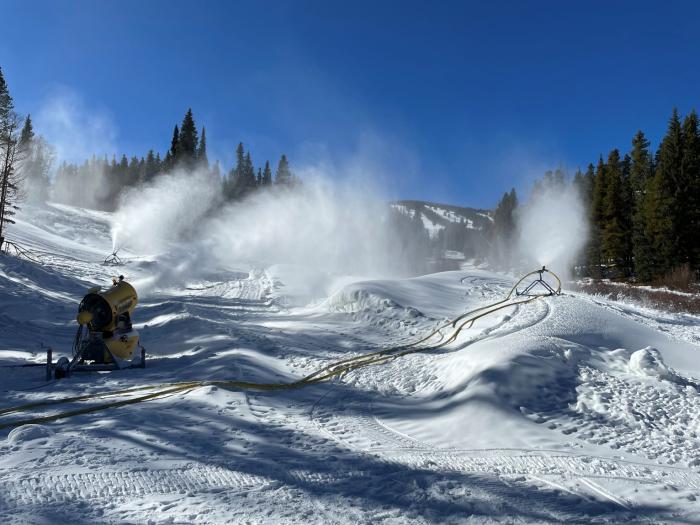
As October draws to a close, ski resorts are cranking out the snow due to a combination of the resorts’ annual race to opening day, this year’s unusually compressed window for the right meteorological conditions, and long-standing water supply agreements with Denver Water.
Snowmaking underway on the slopes at Breckenridge Ski Resort, one of six ski resorts in Denver Water’s watershed with agreements in place to use some of the utility’s water to make snow in the winter. Photo credit: Denver Water.
This year’s race to be the first ski resort to open ended over the weekend, when Keystone opened Saturday for three hours of afternoon skiing, followed by Arapahoe Basin, which opened for a full day of skiing on Sunday.
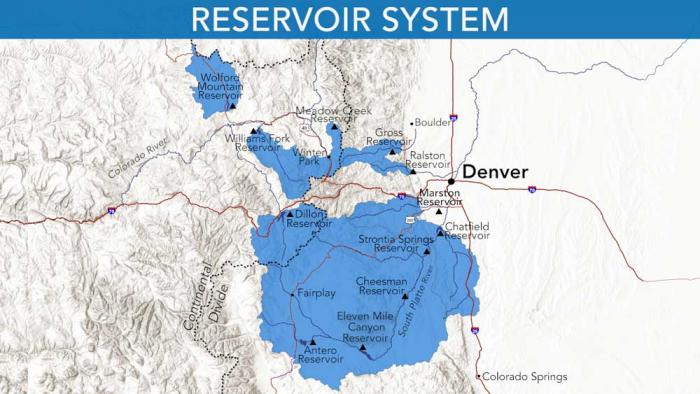
Denver Water collects water from across 4,000 square miles of mountain watershed, an area that’s also home to six major ski resorts: Arapahoe Basin, Breckenridge, Copper Mountain, Frisco Adventure Park, Keystone and Winter Park.
And stream gauges operated by Denver Water act as a proxy measure for snowmaking activity.
For example, the gauges monitoring streams affected by snowmaking at Winter Park and Keystone showed big overnight dips in recent days, as the resorts diverted water from the streams to their snowmaking equipment to get a head start on the ski season.
“The snow guns are blasting — and we can really see it reflected in those stream gauges,” said Nathan Elder, manager of water supply for Denver Water. “This appears to be one of the bigger starts to snow-making at the resorts as they gear up for opening day.”
The series of big drops in the amount of water flowing through the Moffat Tunnel last week indicates water being diverted to make snow at Winter Park Resort. Image credit: Colorado Water Conservation Board, Division of Water Resources.
It’s a reference to the impact of evaporative cooling in the dry Colorado air. In essence, the low humidity of the cold and dry air allows resorts to make snow even if the actual air temperature is above freezing.
“These ‘wet bulb’ conditions that are ideal for snowmaking have come later in the year than usual, so the resorts have had less time to make snow and are going strong now,” Elder said.
Water managers can see the activity in places like gauges on the Snake River, where overnight on Oct. 21, the stream that was flowing at 21 cubic feet of water per second plunged down to 6 cubic feet per second for several hours, then jumped back up to 32 cfs when the snowmaking at Keystone stopped the next day.
Importantly, the snowmaking machines couldn’t work their magic without the water the ski resorts are able to divert from high country streams. And the resorts can do that thanks to agreements with Denver Water that get the most use out of every drop of water.
Denver Water has very senior water rights in Grand and Summit counties, dating back to the 1920s and 1940s, before the ski resorts were open or made snow.
Agreements between Denver Water and the six ski resorts — Arapahoe Basin, Breckenridge, Cooper Mountain, Frisco Adventure Park, Keystone and Winter Park —allow the resorts to capture and use water for snowmaking, helping get the ski season off to an earlier start than they likely would be able to do otherwise.
The resorts use water that would otherwise get collected and stored in Denver Water reservoirs.
But it all evens out in the end. When the machine-made snow melts, it will flow downstream and wind up in the utility’s reservoirs on its way to customer taps next spring and summer.
Providing water for snowmaking is just one way Denver Water helps improve recreation in our collection system.
And those agreements are crucial this year, due to a late start to the snowfall season.
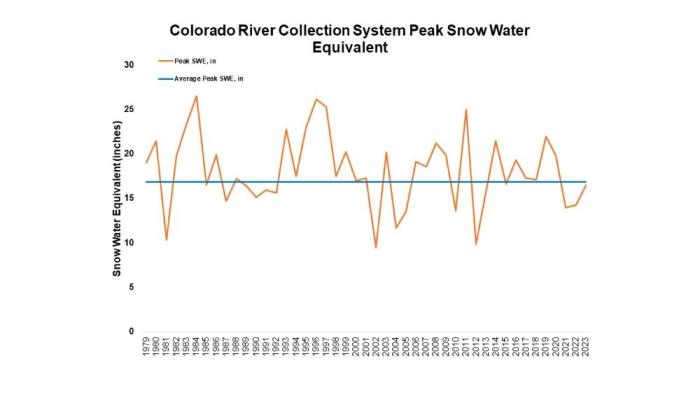
The average amount of snow measured at mountain tracking sites (called SNOTELs) as of Oct. 23 was 0 inches. There have only been seven other years, in the 46 years since SNOTELs began tracking data in 1979, when the average measurement was zero that late in October.
However, says Elder, do not despair.
A slow October roll-out does not automatically translate to a bad snow year overall.
“A slow start does not mean the peak snowpack in April will be low,” he said. “In some of those years the peak was well above average.”
And forecasts indicate that ‘wet-bulb’ temperatures are looking good for the remainder of this week, meaning more snowmaking will be underway.
So, if you haven’t already, get ready to break out those skis.
Denver Water relies on a network of reservoirs to collect and store water. The large collection area provides flexibility for collecting water as some areas receive different amounts of precipitation throughout the year. Image credit: Denver Water.
Denver Water and Save the Colorado must enter mediation at the end of the month to see if a deal is possible on the mid-project challenge to the water utility’s $531 million dam raising underway at Gross Reservoir in Boulder County, according to an order from the U.S. Court of Appeals.
A federal trial judge initially halted construction on the nearly finished dam, saying the U.S. Army Corps of Engineers permits for Denver Water violated U.S. environmental laws and that the water level at Gross could not be raised. Judge Christine Arguello later lifted the injunction on construction, for safety reasons, while Denver Water appealed the permit issues to the 10th Circuit Court of Appeals.
The 10th Circuit will take briefs from both sides of the dam dispute in November, and is now ordering a mediation session for Oct. 30. The conference is to “explore any possibilities for settlement” and lawyers for both sides are “expected to have consulted with their clients prior to the conference and have as much authority as feasible” on settlement questions, the court order says.
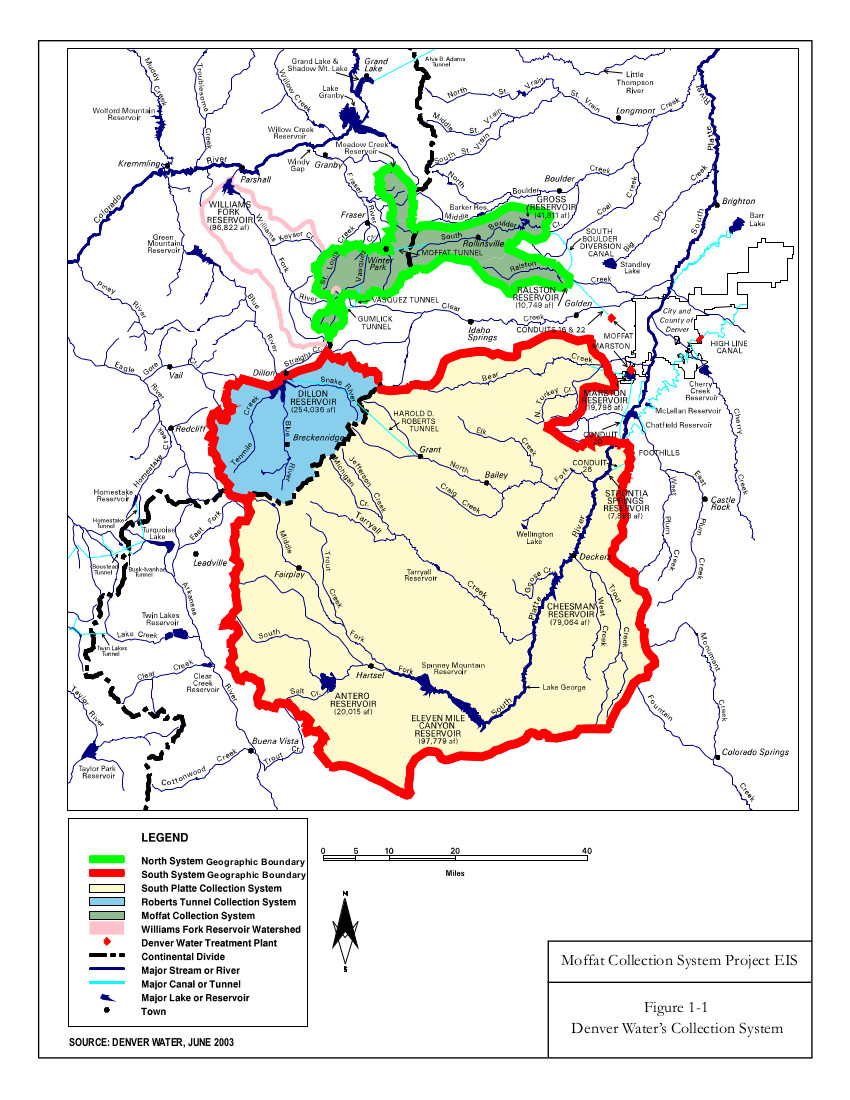
Construction has continued since the injunction was lifted, with Denver Water pouring thousands of tons of concrete to raise the existing dam structure on South Boulder Creek. Denver Water has argued it needs additional storage on the north end of its sprawling water delivery system for 1 million metro customers, to balance extensive southern storage employing water from the South Platte River basin.
Denver Water’s collection system via the USACE EIS
Save the Colorado and coplaintiffs the Sierra Club, WildEarth Guardians and others argue too much water has already been taken from the Colorado River basin on the west side of the Continental Divide, and that the forest-clearing and construction at Gross is further destructive to the environment. Gross Reservoir stores Fraser River rights that Denver Water owns and brings through a tunnel under the divide into South Boulder Creek.
“We look forward to having a constructive conversation with Denver Water to find a mutually agreeable path forward that addresses the significant environmental impacts of the project,” Save the Colorado founder Gary Wockner said.
When securing required project permits from Boulder County, Denver Water had previously agreed to environmental mitigation and enhancements for damages from Gross construction. But Save the Colorado and co-plaintiffs sued to stop the project at the federal level, and Arguello agreed that the Army Corps had failed to account for climate change, drought and other factors in writing the U.S. permits.
Denver Water declined comment Tuesday on the mediation order.
The halt and restart of the Gross Dam raising came in what has turned out to be a tumultuous year for major Colorado water diversion and storage projects.
While the Gross Dam decisions were underway, Wockner was finishing negotiations with Northern Water over $100 million in environmental mitigation funding to allow the $2.7 billion, two-dam Northern Integrated Supply Project to move forward. Once the 15 communities and water agencies subscribed to NISP water shares saw the increasing price tag, some began pulling out.
Northern Water reviewed the scale of NISP with engineers, then said it planned to move forward at the previously announced scale. The consortium’s board has asked all 15 initial members to indicate by Dec. 31 where they stand with the project and its price tag.
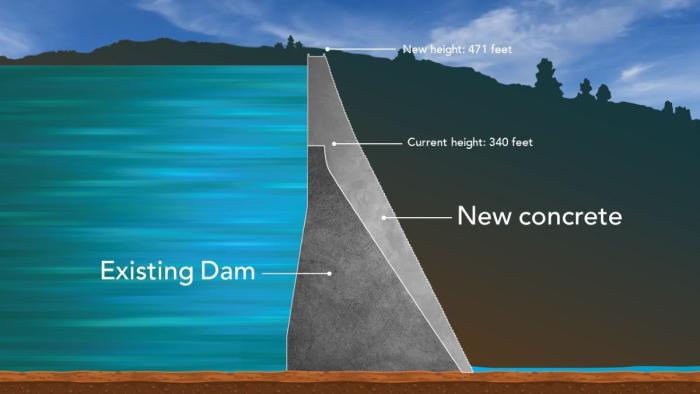
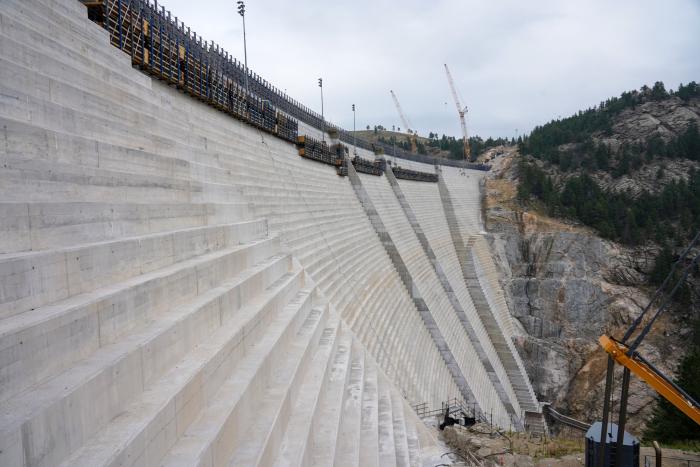
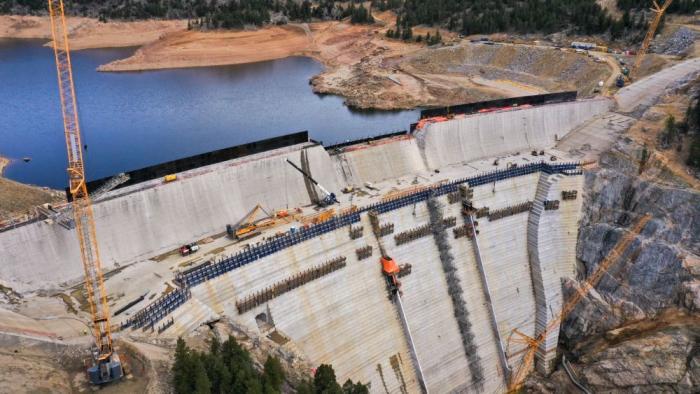
Roller-compacted concrete will be placed on top of the existing dam to raise it to a new height of 471 feet. A total of 118 new steps will make up the new dam. Image credit: Denver Water.
A core element of Denver Water’s mission is ensuring the large, complex system that collects, cleans and delivers drinking water for 1.5 million people is prepared to meet future challenges.
And with more than 100 years of operations under its belt, Colorado’s largest water provider, which serves about 25% of Colorado’s population, is in the biggest period of capital investment in its history. Denver Water expects to invest about $1.7 billion into the system during the next 10 years.
“The work we do provides the critical water supply that the community we serve needs to thrive and grow,” said Denver Water CEO/Manager Alan Salazar.
“Continuing to maintain and invest in the system that supports our water supply will ensure that we — Denver Water as well as our customers — are ready for what lies ahead, from a warming climate to the potential for new regulations, while keeping rates as low as good service will allow,” Salazar said.
Since 2022, Denver Water has replaced an average of 97,000 feet of water mains per year. Photo credit: Denver Water.
Responsibility to maintain and protect the state’s largest water system, along with a desire to encourage water conservation, keep essential indoor water use affordable and ensure the utility is financially stable, were incorporated into the Oct. 22 decision by Denver’s Board of Water Commissioners to approve new water rates for 2026.
Denver Water is protecting and preparing the complex system and its customers for the future in many ways, including:
The Lead Reduction Program, which started in 2020, is protecting customers from the risk of lead in their drinking water and to date has replaced more than 35,000 old, customer-owned lead service lines at no direct cost to customers.
The new Northwater Treatment Plant, which began operations in 2024, can clean up to 75 million gallons of water per day and can be expanded when needed to 150 million gallons per day.
The Gross Reservoir Expansion Project, which began construction in 2022, is designed to nearly triple the reservoir’s storage capacity.
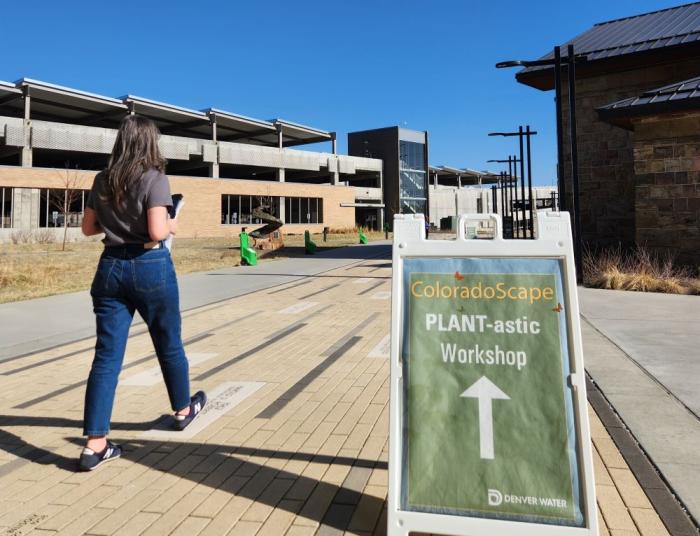
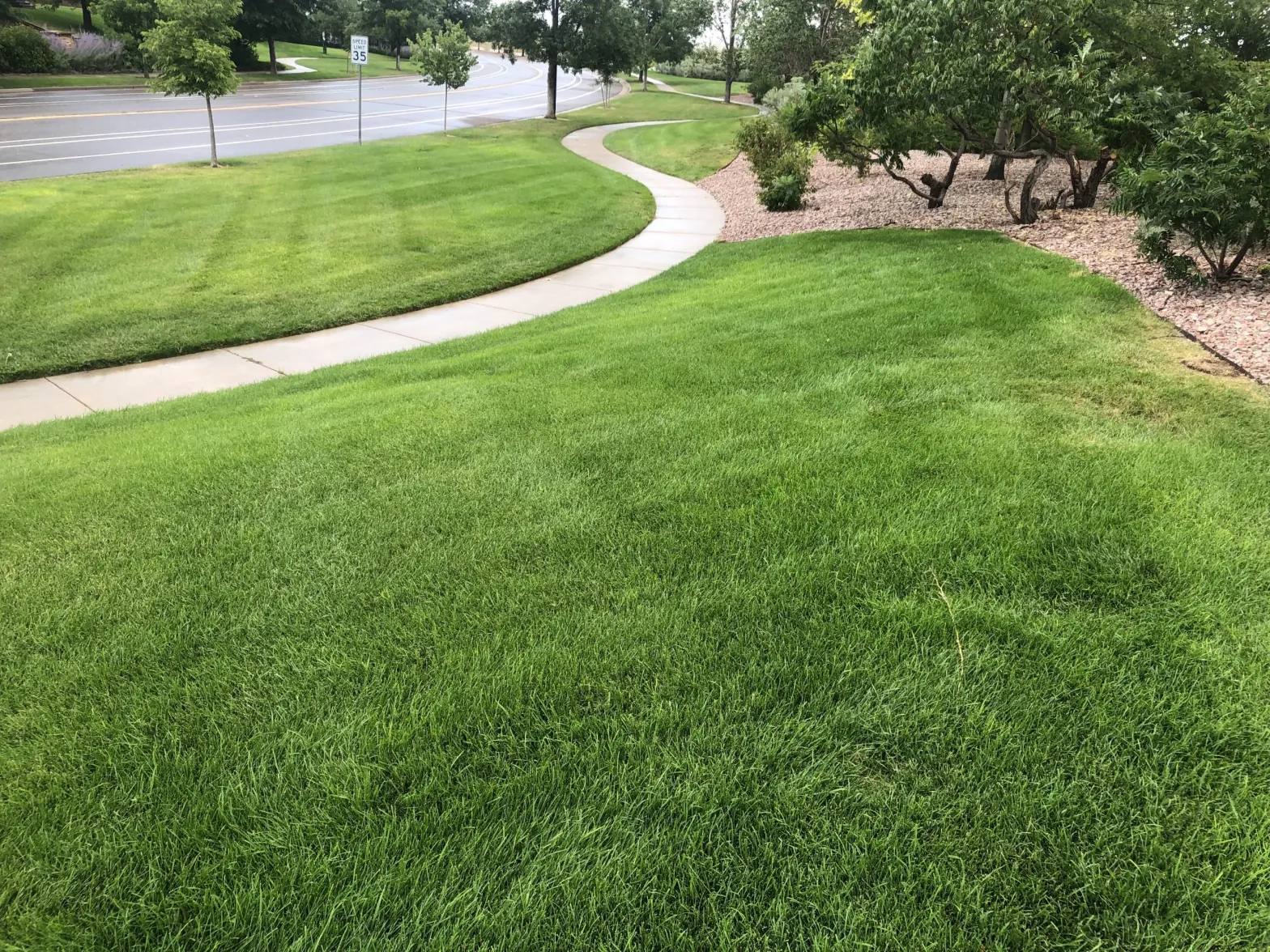
The Landscape Transformation Program, which helps customers remodel landscapes dominated by water-intensive Kentucky bluegrass into water-wise, climate-resilient ColoradoScapes.
And ongoing work to replace aging water mains, upgrade infrastructure on the utility’s southern collection and treatment system, and reach a net-zero carbon emissions goal by 2030.
Overall, Denver Water expects to invest $1.7 billion over the next 10 years in projects that will maintain, repair, protect and upgrade the system, and make it more resilient and flexible in the future.
In addition to rates paid by customers, funding for Denver Water’s infrastructure projects, day-to-day operations and emergency expenses like water main breaks comes from bond sales, cash reserves, hydropower sales, grants, federal funding and fees paid when new homes and buildings are connected to the system.
The utility does not receive tax dollars or make a profit. It reinvests money from customer water bills and fees to maintain and upgrade the water system.
And the utility is committed to delivering a safe, clean and affordable water supply to its customers while managing the impacts of the larger economy, from inflation to supply chain issues.
How the 2026 water rates will affect individual customer bills will vary depending on where the customer lives (either in Denver or in one of the utility’s suburban distributor districts) and how much water they use.
And major credit rating agencies recently confirmed Denver Water’s triple-A credit rating, the highest possible, citing the utility’s track record of strong financial management.
Monthly bills for single-family residential customers are comprised of two factors: a fixed charge, which helps ensure Denver Water has a more stable revenue stream to continue the necessary water system upgrades to ensure reliable water service, and a volume rate for the amount of water used.
Combining both of those factors, a typical single-family residential customer who uses 104,000 gallons of water annually will see their monthly bill increase by an average of $2.45 to $3.30 over the course of the year, depending on where the customer lives (in Denver or in one of the utility’s suburban distributor districts) and the type of service the customer’s suburban distributor district receives from Denver Water.
(See the infographic below for information about Denver Water’s suburban distributor districts, types of service and rates.)
The monthly bill example above includes an increase to the fixed monthly charge, which is tied to the size of the meter. For most single-family residential customers with a 3/4-inch meter, the fixed charge will increase by $1.85 in 2026, to $20.91 per month.
The more you use, the more you pay
After the fixed monthly charge, Denver Water’s rate structure for residential single-family customers has three tiers based on the amount of water used. The tiers are designed to keep essential indoor water use affordable while encouraging water conservation outdoors. (See additional details about the 2026 rates for the three tiers in the infographic below.)
The first tier is charged at the lowest rate and covers essential indoor water use for bathing, cooking and flushing toilets. Each customer has their individual first tier determined by the average of their monthly water use as listed on bills that arrive in January, February and March — when there is very little or no outdoor watering.
The second tier is for water consumption, typically used for outdoor watering, that is above the customer’s first tier and up to 15,000 gallons of water per month. Water use in this tier is considered to be an efficient use of water outdoors.
The third tier is for water use of more than 15,000 gallons per month. It is priced at the highest level to signal potentially excessive water use and encourage conservation efforts by larger-lot customers.
Bills in the summer months can be higher if customers use water to irrigate their outdoor landscapes.
Need help?
Denver Water offers one-time payment assistance to customers who may qualify. The utility’s Customer Care representatives also can help customers navigate payment options and unique circumstances. Customers can reach them via denverwater.org/ContactForm or by calling 303-893-2444.
What customers can do to save water, money
Denver Water encourages all customers to conserve water where they can indoors and out.
Finding and plugging leaks inside the home can be done year-round, and the utility offers rebates for qualified water-saving toilets and sprinkler equipment.
To help customers remodel their lawns to create a more vibrant, diverse ColoradoScape, Denver Water in 2026 will again offer a limited number of customer discounts on Resource Central’s popular turf removal service and its water-wise Garden In A Box plant-by-number kits. Photo credit: Denver Water.
Outside, Denver Water encourages customers to conserve water by remodeling unused areas of water-intensive Kentucky bluegrass into more diverse, water-wise ColoradoScapes that fit naturally into our dry climate and are interesting to look at through all seasons. These drought-resistant and climate-resilient ColoradoScapes include tree canopies and plants that help maintain vibrant urban landscapes and benefit our communities, wildlife and the environment.
Using less water also means more water can be kept in the mountain reservoirs, rivers and streams that fish live in and Coloradans enjoy. It also can lower monthly water bills, saving money.
Note 1: An individual customer’s monthly water bill will vary depending on where they live in Denver Water’s service area (in Denver or in one of the utility’s suburban distributor districts), the types of service the suburban distributor district receives from Denver Water, and how much water the customer uses.
Note 2: The difference in volume rates (in the infographic above) for Denver Water customers who live inside Denver compared to those who live in the suburbs is due to the Denver City Charter (see Operating Rules), which allows permanent leases of water to suburban water districts based on two conditions: 1) there always would be an adequate supply for the citizens of Denver, and 2) suburban customers pay the full cost of service, plus an additional amount.
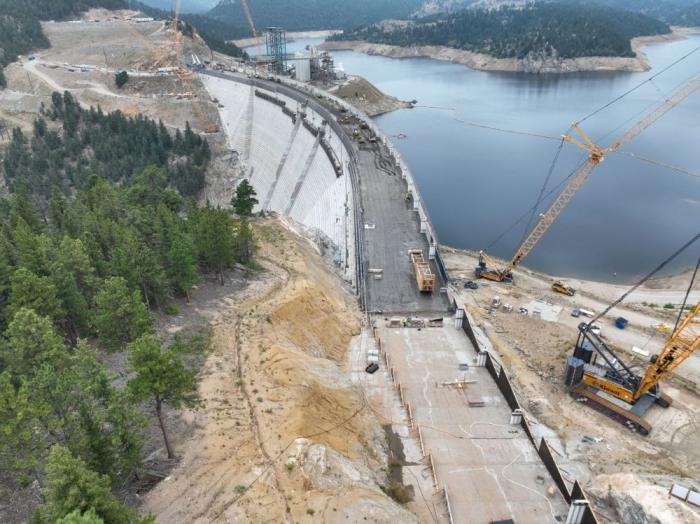
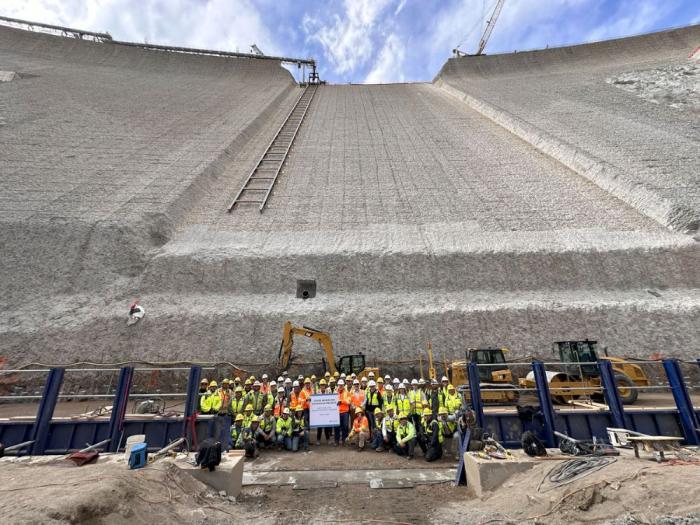
As of Sept. 5, crews had raised the dam by 60 feet. The project is designed to increase the water storage capacity of Gross Reservoir, which supplies water to 1.5 million people in the Denver metro area.
“Over the past two years, we’ve been working on the original dam to prepare it for the enlarged height and width,” said Casey Dick, Denver Water’s deputy program manager for the project.
“At the end of June, the concrete work reached the original crest, so now all the concrete placements are above the existing structure.”
A dump truck fills up with concrete at the top of Gross Dam. The trucks drive across the top of the dam and place the concrete in layers to raise the dam higher. Photo credit: Denver Water.
Once completed, Gross Dam will be 471 feet tall and around 2,000 feet wide.
As the dam has gone up, it has become easier to see some of the differences between the original dam, which was completed in the 1950s, and the newly renovated structure.
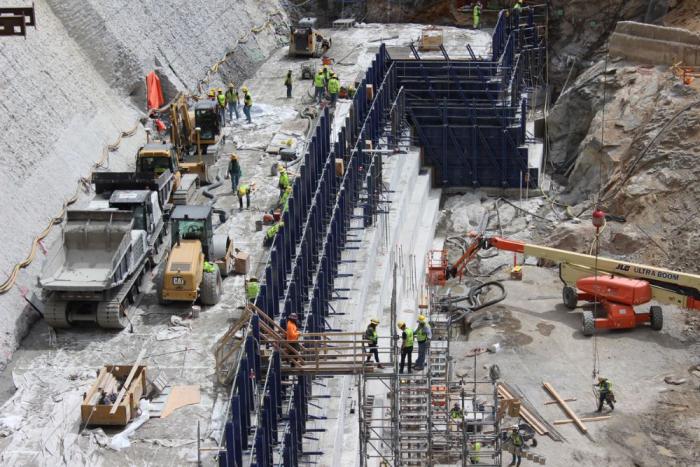
For instance, the original surface of the downstream side of the dam was smooth. Now, the downstream side of the dam is a series of stair steps. The steps were an integral part of the construction process and supported the trucks that deposited layers of concrete onto the original structure of the dam.
This picture was taken from roughly the crest of the original dam. The dam has been raised 60 feet as of Sept. 5. The new face of the dam features a stepped design, which was needed for the construction process. Photo credit: Denver Water.
The renovated dam will also take on a new shape.
“The original structure was built as a ’curved gravity’ dam,” Dick said. “Now, we’re taking advantage of that curved geometry in the middle portion of the dam to create what’s called a ‘thick arch’ dam in the center of the canyon.”
The middle section of the dam is arched to give the dam strength as water pushes up against the structure. Photo credit: Denver Water.
Arches are used in dam construction because the force of the water in the reservoir pushes up against the arch and into the canyon walls. This gives an arched dam more strength compared to a flat structure.
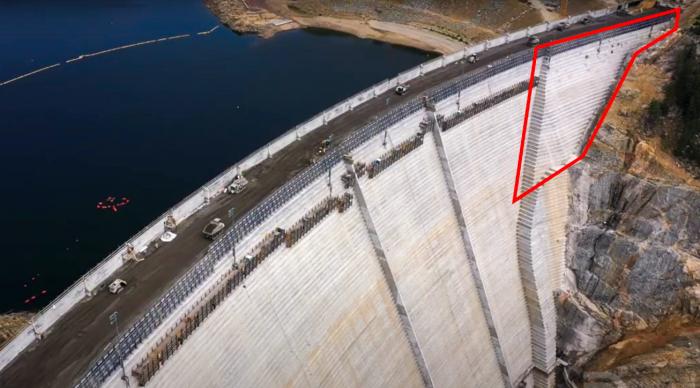
“We’ve also built what are called ’thrust blocks’ on the sides of the original dam,” Dick said. “These give the dam additional support by essentially extending the canyon walls upward to support the arch.”
The “thrust blocks,” highlighted in red, extend out from the canyon wall. The blocks provide additional strength where the arch of the dam meets the rock. Photo credit: Denver Water.
As work has risen above the original crest of the dam, workers have built formwork, or temporary molds, on both the upstream and downstream sides of the dam. The temporary structures hold the freshly placed concrete in the proper shape until it hardens and cures.
Workers build formwork, or temporary molds, on the top of the dam. The forms hold new concrete in place until it cures. Photo credit: Denver Water.
With the new added concrete added during the project, Gross Dam is now much steeper than the original structure. At the base, the dam is 300 feet thick, but it gets skinnier as it goes up. At the top, the dam will be just 25 feet thick. Crews have had to adjust to the smaller work area to maneuver their equipment as the project progressed.
Work to raise the dam will continue as late as possible into 2025, until weather conditions make it too cold to place concrete.
“We’d like to thank all the men and women out here from Kiewit-Barnard and the other contractors out here,” Dick said. “They are working around the clock and as fast as they can to complete this project.”
Roller-compacted concrete will be placed on top of the existing dam to raise it to a new height of 471 feet. A total of 118 new steps will make up the new dam. Image credit: Denver Water.
View of Shoshone Hydroelectric Plant construction in Glenwood Canyon (Garfield County) Colorado; shows the Colorado River, the dam, sheds, a footbridge, and the workmen’s camp. Creator: McClure, Louis Charles, 1867-1957. Credit: Denver Public Library Digital Collections
Click the link to read the article on the Aspen Times website (Ali Longwell). Here’s an excerpt:
September 20, 2025
The battle over one of the Colorado River’s oldest, non-consumptive water rights continued this week during a 14-hour Colorado Water Conservation Board hearing over whether the rights could be used for the environment. The Colorado River District is seeking to acquire the Shoshone water rights — tied to a hydropower plant on the Colorado River in Glenwood Canyon — from Xcel Energy for $99 million. The River District, a governmental entity representing 15 Western Slope counties, is proposing to add an instream flow agreement to the acquisition, which would allow a certain amount of water to remain in the river for environmental benefits. While the state’s water board — the only entity that can hold an instream flow water right in Colorado — was set to decide on the proposal this week, this was pushed to November after the parties agreed to take more time to reach a consensus on the proposal.
“The exercise of the Shoshone water rights impacts almost every Coloradan,”said Davis Wert, an attorney speaking on behalf of Northern Water.
Northern Water is contesting the instream flow agreement alongside Denver Water, Aurora Water, and Colorado SpringsUtilities. These providers rely on transmountain diversions from the Colorado River basin to supply water to their customers…While the hearing did include some back and forth, the entities west and east of the Continental Divide agreed on a few things during the hearing. First, adding an instream flow agreement to the Shoshone right will preserve and improve the natural environment. Second, they want to maintain the status quo on the Colorado River…Michael Gustafson, in-house counsel for Colorado Springs Utilities, said the provider did not oppose the change of the senior Shoshone water right for instream flow purposes “to provide for permanency of the historic Shoshone call and maintenance of the historical Colorado River flow regime…
With that, however, there were a few sticking points during the hearing: who should manage the instream flow agreement — and have the authority to make decisions on Shoshone calls — and how much water has historically been granted as part of the right. The historic flow regime has been highly contested between the parties but will ultimately be determined in the Colorado Water Court proceedings that will conclude the River District’s acquisition. Wert acknowledged this as the Front Range entities presented a historic use analysis that contrasted the preliminary analysis obtained by the River District…The Colorado River District’s proposed instream flow agreement includes a “co-management strategy,” while the contesting Front Range providers want the sole management authority to reside with the Colorado Water Conservation Board.
Up until late August, this summer has been particularly dry, both for the Denver region and for the West Slope, the source of half of Denver Water’s supply. And that combination has translated into a heavy workload for the utility’s largest reservoir, the 257,000-acre-foot Dillon Reservoir in Summit County.
Dillon Reservoir in Summit County is Denver Water’s largest reservoir. Photo credit: Denver Water.
A summer largely bereft of the monsoon rains (which bolster our water supply and reduce water use by our water-smart customers) combined with long stretches of days above 90 degrees pushed up demand among the 1.5 million people Denver Water serves.
The dry summer situation also triggered calls for more water from farmers and ranchers who have senior water rights that put them at the front of the line for receiving water from the South Platte River system. Denver Water’s supplies are also constrained on the north side of its system, as ongoing work on the Gross Reservoir Expansion Project requires the utility reduce the amount of water it stores in that reservoir during the project.
Dillon Reservoir provides Denver Water with a supplemental supply to use when the amount of water available from its south system source, the South Platte River, is not enough to meet demands.
That all combined to make Denver Water more heavily reliant on Dillon Reservoir than usual, forcing the utility to push higher volumes from Dillon through the Roberts Tunnel to the Front Range.
“A lot of factors combined to see us lean hard into our Dillon supplies this summer,” said Nathan Elder, manager of supply for Denver Water. “We know this impacts recreation, both what we release into the Blue River below the reservoir and the water levels for the marinas at Dillon Reservoir. We try very hard to maintain good conditions for recreation at Dillon, but this summer posed challenges.”
The Dillon Marina at Dillon Reservoir. Photo credit: Denver Water.
Overall, the amount of water flowing into Dillon was at just 70% of normal in the April-through-July stretch. July alone saw just 48% of typical flows into the reservoir — that’s 20,000 acre-feet below average, about the capacity of Antero Reservoir west of Fairplay.
The situation serves as a reminder for Denver Water customers to stay smart about water use.
Especially amid a hot, dry summer, customers should make sure to follow watering rules and skip irrigation during rainy periods. And they should consider landscape changes that replace thirsty turfgrass with plants that need less water.
Yet, despite relentless dry periods covering July and most of August, Denver Water customers did a good job managing irrigation. They used water at a rate of just about 2% above the five-year average, and just 1.6% above the longer term, 2000-2024 average.
These plants from Resource Central’s Garden In A Box program are water-wise and interesting throughout the year. Photo credit: Denver Water.
But even as Denver Water customers kept demands low by historical standards, the combination of conditions saw water levels in Dillon fall below levels optimal for the marinas at the reservoir by the end of August.
Typically, Denver Water tries to keep the surface of Dillon Reservoir at 9,012 feet in elevation through Labor Day. But this year, levels will fall a few feet below that.
And water volumes flowing out of Dillon into the Blue River — flows important to rafters and anglers — also fell significantly. Since late July, those outflows were about 100 cubic feet per second, about half of normal for this time of year. In August they dropped even further, to 75 cubic feet per second.
The overall picture began to improve slightly in late August, as the state benefited from a cooling trend and bursts of rainfall. The cooler, wetter weather in the metro area cut Denver Water customers’ demand for water in the Denver region, easing the need to pull as much water from Dillon.
Even so, the tough summer means Denver Water will likely enter the new, 12-month water year, which begins Oct. 1, with its reservoirs, including Dillon, at below-average elevations.
That puts the onus on the upcoming winter season to come through with a good snowpack, never a sure thing.
“We’ll hope to see water demands fall in September and then look to a good snowpack in the winter and spring,” Elder said.
“But we’ll be starting from behind. We hope we can make up the gap in reservoir storage with a wet winter and spring. And we’ll need our customers to help us with smart water practices.”
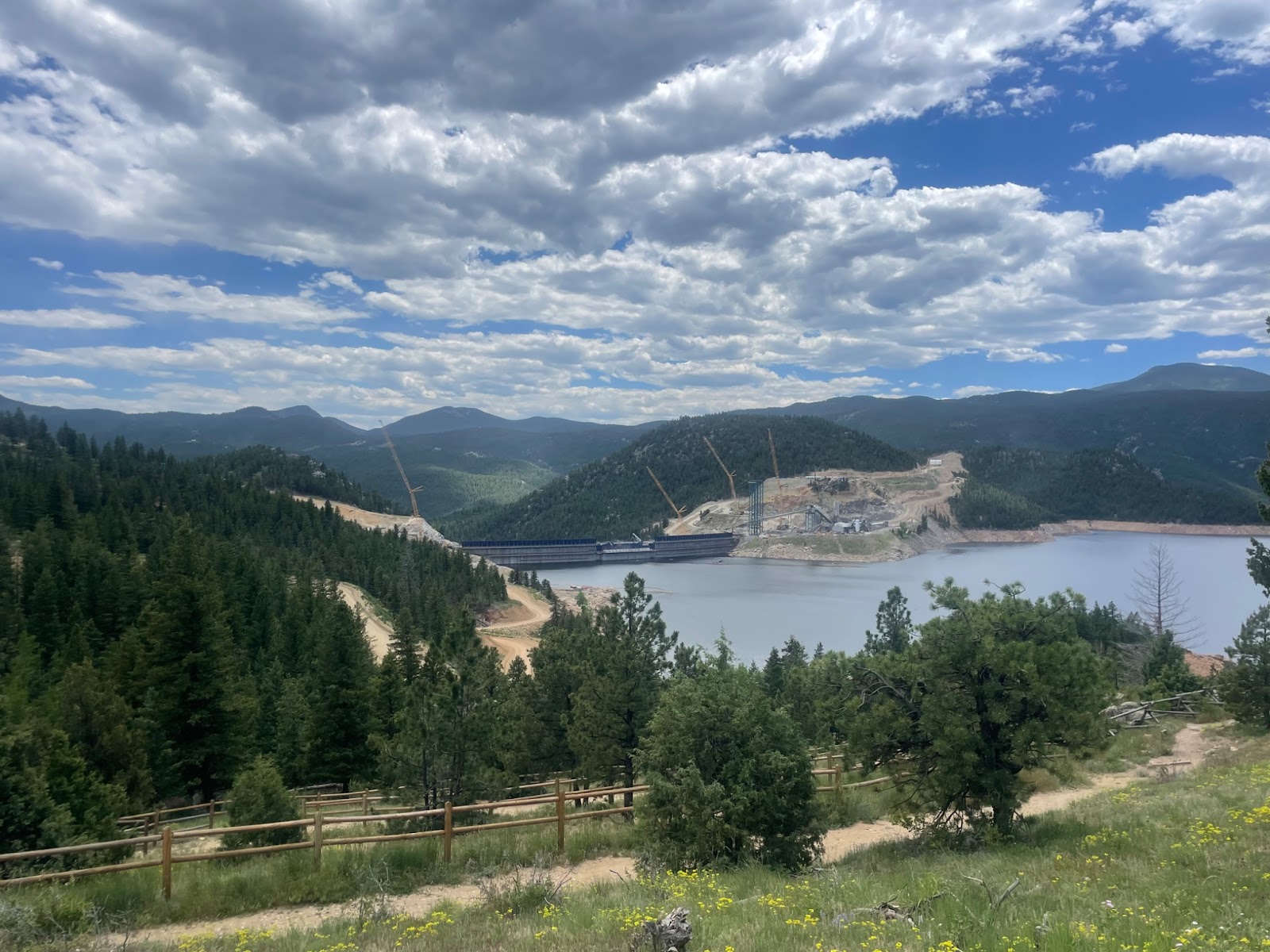
Cranes and construction equipment line the shore at Gross Reservoir on June 19, 2025 in Boulder County, Colorado. The construction is part of an expansion project that will supply water to Denver’s residents. (Cassie Sherwood/The Water Desk)
Pieter Strauss used to love hosting stargazing parties at his house in the Lakeshore Park neighborhood up Flagstaff Road southwest of Boulder. The hobbyist astronomer would fire up the barbecue and spend hours showing his neighbors the night sky through his observatory and telescopes.
Strauss’s house sits looking directly over Gross Reservoir, which provides water to Denver residents.
But when a project to significantly raise the reservoir’s dam began construction in 2022, those moments of neighborhood tranquility were lost for some residents. For Strauss the biggest impact was the bright construction lights used to keep work moving overnight.
“It became impossible to sit on the deck before sunrise and after sundown, astrophotography was impossible. They lit up the skies,” with powerful floodlights, Strauss said.
For over 20 years, residents and various environmental groups have protested the project, which suffered a series of legal blows this year. Construction on the massive dam ground to a halt in April amidst the courtroom wrangling, and subsequent decisions have cast a new level of uncertainty over large-scale water projects that propose to draw on the beleaguered Colorado River.
However, by the end of May, federal courts ruled that construction could continue due to concerns surrounding uncompleted construction and potential flooding possibilities, but that the reservoir could not be filled.
The Gross Reservoir Expansion Project involves raising the height of the existing dam by 131 feet. The dam will be built out and will have “steps” made of roller-compacted concrete to reach the new height. Image credit: Denver Water
Raising the dam
Gross Reservoir’s dam is owned and operated by Denver Water. The utility built it in the 1950s, with two other building phases planned to accommodate future water needs. The current dam expansion will raise the height of the dam 131 feet, tripling the current capacity of the reservoir, and providing more water for Denver Water customers.
The construction was spurred by “a combination of demands in our system, as well as concerns about climate and concerns about the needs for greater resilience in our system,” said Jessica Brody, general counsel for Denver Water.
The need for the expansion is similar to a bank savings account, Brody said. Tripling the capacity of the reservoir is a savings account that can be drawn on in circumstances of an emergency.
“If we have an extreme drought event, we want to have more water banks that we can help smooth the impacts to our customers,” Brody said.
When the utility initially announced plans to begin moving forward with a dam expansion, residents of the area were concerned. Environmental threats and the disruptions from the massive construction project topped the list of worries. They attended meetings at town halls with county commissioners. They organized with other residents in and around Coal Creek canyon.
While some residents fought the expansion, others anticipated it. When the dam was initially constructed, the utility planned to expand further down the line.
Since construction began in 2022, residents have experienced noise and light pollution. Five neighbors have moved from the Lakeshore Park neighborhood. Pieter Strauss, at whose house they once held stargazing gatherings, was among them.
Beverly Kurtz, member of TEG, on Pieter Strauss’s former porch overlooking Gross Reservoir on June 19, 2025. Once construction began, Strauss was no longer able to host neighborhood stargazing parties due to light pollution. (Cassie Sherwood/The Water Desk)
“The most valuable thing to all the people who have moved up here is that they had a quiet nature sanctuary. But then when you take that away, is it worth it?” said Anna McDermott, another resident of the area.
“We sleep with our windows open. Not one house has air conditioning, so you sleep with your windows open in the summer months,” she said. “You hear these giant backup beepers crashing, grinding all night long. Even with earplugs, I can’t sleep.”
The Environmental Group (TEG) is an organization of residents in the Lakeshore Park neighborhood and surrounding residents, focused on engaging the community in action when environmental issues arise. Along with Save the Colorado, The Sierra Club, and other environmental organizations, TEG has fought the expansion. Beverly Kurtz, former president of TEG, has worked to hold Denver Water and the companies working on the dam, Kiewit Corp. and Barnard Construction Company Inc., accountable during construction.
Heavy duty trucks are required to use a different road to access the dam rather than the paved road up Flagstaff Mountain due to fire concerns. Large semi-trucks have slid off the road due to the steep grade, which can cause traffic jams and road closures.
“At one point they had one of the two roads down this mountain closed for five months,” Kurtz said. “It wasn’t until we called the sheriff out here and he realized the safety concern that they opened the road back up.”
Legal snares slow construction
In October 2024, two years after construction began, Save the Colorado, along with other environmental groups, won a lawsuit against Denver Water. U.S. District Court judge Christine Arguello found the utility’s dam construction permit violated the Clean Water Act and the National Environmental Policy Act. At the time, construction was able to continue and Arguello ordered the groups to work out an agreement regarding damages.
In April 2025, the judge ordered a temporary halt on construction. The initial lawsuit argued that the U.S. Army Corps of Engineers, who provided the project permitting, did not fully consider climate change impacts when it approved the dam’s expansion.
A month later, Arguello ruled that Denver Water could finish construction on raising the dam, but that the reservoir could not be filled until the Army Corps reissued the permits.
“If you stop the construction of a dam when it is partially built, the dam doesn’t function as it was ultimately designed to function,” said Denver Water’s Brody. “That was a big concern of ours and the Federal Energy Regulatory Commission.”
The utility has also been ordered to not remove any additional trees surrounding the dam until the proper permits are obtained. The project proposes the removal of over 200,000 trees.
Arguello’s opinion also called into question the underlying water rights Denver Water would rely on to fill the newly enlarged reservoir when construction finished. Gross Reservoir is filled with water from the headwaters of the Colorado River, which has experienced steep declines in water supply amid a long-term warming and drying trend in the Rocky Mountains.
“The Environmental Impact Statement didn’t even look at the fact that the flows of the Colorado River are in decline. Most of the science suggests they will continue to decline further,” said Doug Kenney, Western Water Policy Program director at the University of Colorado Boulder’s Natural Resources Law Center. Acquiring new permits will require Denver Water to redefine the project’s purpose and evaluate the environmental damage, he said.
The case is more than a local water project. Diverting more water across the western slope of Colorado has created concerns for ecosystems throughout the overappropriated watershed and for communities downstream in California, Nevada and Arizona.
“It makes it more difficult to ensure that there’s sufficient flow downstream as a result,” Kenney said. “We have got to stop this practice of taking more and more water out of the upper reaches of the Colorado River because it just increases the stress on a river that is already under a tremendous amount of stress.”
By calling into question the project’s potential to have downstream impacts, the decision could add a new legal hurdle future water development infrastructure will have to clear.
“Historically, agencies in recent decades have not done enough to consider climate change in decisions,” Kenney said. Cases like this one need to happen in natural resource law more generally, he said, as they help establish precedents for future projects that could potentially put the environment at risk.
Denver Water is appealing the court decisions that bar the expansion. That could result in a reissue of the permits with a redefined purpose or a dismissal of the court rulings made earlier this year.
“We think that the district court made some misjudgements or misinterpretations when it found the Army Corps committed these errors,” Brody said.
Learning to live alongside it
Amid the stops and starts of Gross Reservoir construction, nearby residents are not ready to let go of what they used to have.
Kurtz and McDermott recall their old activities along the reservoir’s north shore. A handful of neighbors would walk their dogs everyday along the hiking trail that connected the reservoir to their neighborhood. The trail has since been widened significantly, to allow for excavating equipment. They would host Memorial Day parties along the water’s edge.
Beverly Kurtz and Anna McDermott, longtime residents of the Lakeshore Park neighborhood pose in front of Gross Reservoir on June 19, 2025. They are members of TEG, an environmental group involved in a lawsuit against Denver Water. (Cassie Sherwood/The Water Desk)
Now they minimize their excursions to the shore as much as they can. At this point they’re more than ready for construction to be completed, exhausted from the daily disruptions, explosions and drilling.
“Now clearly, when the work is done, the things which negatively impacted my life would go away. But I couldn’t last them out,” Strauss said. He recently relocated to the Boulder area. “It was just my bad luck that my golden years coincided with the worst effects of the project.”
Some residents found that the expansion project has renewed their sense of community in Lakeshore Park.
“In a weird way a lot of us have gotten even closer because we were in the battle together,” Kurtz said. “We feel like at this point we won the battle, but we’ve lost the war.”
“They will get the permits to eventually fill this reservoir following the expansion,” she said.
However, federal courts requiring the proper permits to continue construction is a win in her and TEG’s book, as it sets a precedent for any large construction processes that occur in the future. It will ensure that the proper environmental permits are obtained before construction can begin on a project.
“If nothing else, we hope that precedent still stands. Because it will help somebody else,” she said.
This story was produced by The Water Desk, an independent journalism initiative at the University of Colorado Boulder’s Center for Environmental Journalism.
The Shoshone hydro plant in Glenwood Canyon. The Shoshone hydropower plant in Glenwood Canyon. The CWCB will hold a hearing on the water rights associated with the plant in September. Credit: Heather Sackett/Aspen Journalism
Front Range asked for Colorado Water Conservation Board neutrality on historic use of Shoshone water rights
In an effort to head off concerns about the state’s role in a major Western Slope water deal, a Western Slope water district has offered up a compromise proposal to Front Range water providers.
In order to defuse what Colorado River Water Conservation District General Manager Andy Mueller called “an ugly contested hearing before the CWCB,” the River District is proposing that the state water board take a neutral position on the exact amount of water tied to the Shoshone hydropower plant water rights and let a water court determine a final number.
“Although we believe this would be an unusual process, the River District believes it would address the primary concern (i.e., avoiding the state agency’s formal endorsement of the River District’s preliminary historical use analysis) that we heard expressed by your representatives at the May 21, 2025 CWCB meeting regarding the Shoshone instream flow proposal,” Mueller wrote in an email to officials from the Front Range Water Council.
The River District worked with CWCB staff to draft the proposal, but it may not go far enough to address Front Range concerns.
The River District, which represents 15 counties on the Western Slope, is planning to purchase some of the oldest and largest non-consumptive water rights on the Colorado River from Xcel Energy for nearly $100 million. The water rights, which are tied to the Shoshone hydropower plant in Glenwood Canyon, are essential for downstream ecosystems, cities, endangered fish, and agricultural and recreational water users. As part of the deal, the River District is seeking to add an instream flow water right to benefit the environment to the hydropower water rights.
The effort has seen broad support across the Western Slope. The River District has raised $57 million toward the purchase from at least 26 local and regional partners. The project was awarded a $40 million Inflation Reduction Act grant in the waning days of the Biden administration, but those funds have been frozen by the Trump administration.
“These water rights are foundational to the Colorado River,” said Amy Moyer, chief of strategy at the River District. “It’s the number one project for the Western Slope. It’s the top priority to move forward.”
Critically, because its water rights are senior to many other water users — they date to 1902 — Shoshone can force upstream water users to cut back. The Shoshone call has the ability to command the flows of the Colorado River and its tributaries upstream all the way to the headwaters.
The twin turbines of Xcel Energy’s Shoshone hydroelectric power plant in Glenwood Canyon can generate 15 megawatts. The River District is proposing that the CWCB remain neutral on the issue of the plant’s historic water use. Credit: Heather Sackett/Aspen Journalism
Putting a precise amount on how much water the plant has historically used is a main point of contention between the River District and the Front Range Water Council, a group that includes some of Colorado’s biggest municipal water providers: Denver Water, Colorado Springs Utilities, Aurora Water and Northern Water. These entities take water that would normally flow west, and bring it to farms and cities on the east side of the Continental Divide through what are called transmountain diversions. About 500,000 acre-feet of water annually is taken from the headwaters of the Colorado River and its tributaries to the Front Range.
Estimates by the River District put the Shoshone hydro plant’s average annual use at 844,644 acre-feet using the period between 1975 and 2003 — before natural hazards in the narrow canyon began knocking the plant offline regularly in recent years.
But Front Range Water Council members say this estimate is flawed and could be an expansion of the historical use of the water right. They have requested a hearing at the September CWCB meeting to hash out their concerns.
“The preliminary analysis that has been presented appears to expand historic use and creates potential injury,” Abby Ortega, general manager of infrastructure and resource planning at Colorado Springs Utilities told the CWCB at its May meeting.
Determining past use of the Shoshone water rights is important because it will help set a limit for future use. While changing the use of a water right is allowed by going through the water court process, enlarging it is not. The amount pulled from and returned to the river must stay the same as it historically has been.
As part of the River District’s deal to buy the water rights, the CWCB — which is the only entity in the state allowed to hold an instream flow water right — must officially accept the water right and then sign on as a co-applicant in the water court change case.
But Front Range water providers said that doing so would amount to an endorsement of the River District’s historical use estimate, which would mean taking a side in the Front Range versus Western Slope disagreement.
“If you agree to accept the right and as I understand it, the instream flow agreement, you’re agreeing to be a co-applicant, which risks you accepting their analysis,” said Alexandra Davis, an assistant general manager with Aurora Water, at the CWCB’s May meeting.
Some members of the Front Range Water Council have asked that the CWCB remain neutral during the water court change case. In May 9 and June 9 letters to the CWCB from Marshall Brown, general manager of Aurora Water, he said the CWCB shouldrefrain from endorsing any specific methodology or volume of water.
“… [T]he CWCB should remain neutral in the water court proceedings and defer to the court’s determination of the appropriate methodology and volumetric quantification,” the May 9 letter reads.
The River District’s offer does just that: It proposes that the CWCB should not take a position regarding the determination of historical use of the Shoshone water rights.
“We heard the issues that are most front and center from these entities,” Moyer said. “And so we are trying to find a path forward that works for everyone.”
But even if Front Range Water Council members are in favor of the proposal, it is unlikely to result in a cancellation of the hearing. CWCB Executive Director Lauren Ris said in an email that under the board’s rules, they are required to hold a hearing. And Jeff Stahla, public information officer at Northern Water, said they will still be asking for the hearing to proceed.
Spokespeople from Colorado Springs Utilities, Aurora Water and Denver Water all declined to comment on the River District’s proposal because it was marked as confidential.
Some members of the Front Range Water Council have concerns beyond CWCB neutrality that could be addressed at the September hearing.
In a May 14 letter to the CWCB, Denver Water’s CEO Alan Salazar said the water provider also wants to carry over some provisions from existing agreements like the Shoshone Outage Protocol. This agreement has an exception in cases of extreme drought that allows Denver Water to keep taking water if its reservoirs fall below certain levels and streamflows are low. Denver Water added that by omitting the last two decades of Shoshone water use, the River District’s study period is skewed, and that using an upstream stream gauge to measure historical use is improper.
The hearing is scheduled for the next CWCB board meeting Sept. 16-18. The board can approve or disapprove the acquisition of the water rights, or make changes to the proposal and adopt the amended proposal. The board is required to take action at the September hearing unless the River District approves an extension. Pre-hearing statements are due by Aug. 4.
CWCB board members Brad Wind, who is general manager of Northern Water, and Greg Johnson, manager of resource planning at Denver Water, recused themselves from the July 17 CWCB board meeting discussion of the Shoshone water rights and plan to recuse themselves from future Shoshone discussions and decisions.
Map of the Colorado River drainage basin, created using USGS data. By Shannon1 Creative Commons Attribution-Share Alike 4.0
In early July, Denver Water’s reservoirs filled nearly to the brim, holding the most water they’ll hold this year.
Nearly full reservoirs are certainly good news for Denver Water and the 1.5 million people who rely on the water stored in them every day. But for the utility’s water watchers, 2025’s “peak storage” moment was a letdown — and even a warning of sorts.
Dillon Reservoir, Denver Water’s largest reservoir is a popular spot for recreation. Photo credit: Denver Water.
Why?
Initial forecasts had suggested more water might run downhill, enough to fill the reservoirs and also provide extra water that could spill and boost river flows. But dry conditions in Colorado’s high country during April, May and June sapped that extra runoff, as drier soils and warmer air soaked up the potential excess.
“We thought we were going to have some excess water to play with this year,” said Nathan Elder, Denver Water’s manager of water supply. “But as it turned out we just barely saw enough runoff to fill our reservoirs.”
This year’s quick turn from abundant supplies to just-enough-to-almost-fill is another reminder that even in years when overall snowpack is reasonably good, such as this past winter, we can’t take water supplies for granted. That’s even more apparent in an era of climate change, when warming temperatures and longer dry spells can quickly shrink projected water supplies.
And as the hot summer irrigation season begins on the Front Range, it’s a reminder to residents to be thoughtful with outdoor water use: Adhere to watering rules, turn off irrigation systems during wet stretches, and think about changes to your landscape that, over time, will reduce watering needs.
And, keep in mind, half of Denver Water’s supply comes from the West Slope, where a dry spring is making supplies tight.
“Back on April 1, we thought we were going to be ‘filling and spilling,’” Elder said. “But we saw streamflow forecasts really drop and even in the Colorado River Basin, where we had a solid snowpack, it did not translate into the supplies we expected.”
The Snake River as it flows through Keystone toward Dillon Reservoir. Photo credit: Denver Water.
At least one key reason for the swift turn from a forecast for “filling and spilling” to just enough runoff to fill Denver Water’s reservoirs was lack of precipitation — just 50% to 70% of normal — in April, May and June in the mountainous counties of Park, Grand and Summit where Denver Water collects supplies.
That dry spell helped drive runoff down, especially in the South Platte Basin. The amount of spring runoff flowing to Strontia Springs southwest of Denver has been only 46% of normal, below an already weak forecast of 60%. Inflows into Dillon have also been lower than expected, just 75% of normal after forecasts of 100%.
As a result, Denver Water’s supply reservoirs peaked July 1, at just 95% of capacity and are now being drawn down as summer watering season gets into full swing. (One caveat: The peak storage number would have been a bit higher, closer to 97%, but for a storage limitation at Gross Reservoir while construction activities continue on the expansion project there.)
Denver Water hopes to see its reservoirs hit 100% of their storage capacity every year. This year’s shortfall across the reservoir system was about 7,500 acre feet, enough water to supply more than 15,000 households for a year.
“We missed filling by a relatively small amount, but we never know if this is a short-term situation or the start of the next drought,” Elder said. “We have filled up those saving accounts and now our reservoirs only go down from here with the peak of the heat season. So, we ask customers to stick to our rules and water with care.”
In addition to the lower-then-expected peak storage numbers, Denver Water also faces another “substitution year” on the West Slope.
That is a technical way of saying Denver Water must release water from its West Slope reservoirs to make up for a shortage of water in the federally operated Green Mountain reservoir downstream from Dillon Reservoir. The water will serve downstream water users on the Colorado River.
Substitution years are uncommon, usually required once or twice per decade. But, at least in recent years, that’s changing, with such “water refunds” from Denver Water required in 2021, 2022 and now, 2025.
“That is another thing that, like the spring dry-up in the mountains, we didn’t expect this year,” Elder said.
But other aspects of the state’s weather in recent months have been more positive.
Big rains in the metro region in May and June kept water usage down and sent a lot of water down the South Platte River to farmers and communities. That supply boost helped reduce calls for Denver Water to bypass additional water, leaving it in the streams, to meet those downstream demands.
“Those storms really helped us out; we haven’t had to run big exchanges and send our reservoir water down to meet those needs,” Elder said.
The wet weather locally also cut down on outdoor watering, as customers paid attention to weather and shut off sprinklers. June water use in Denver Water’s service area was just 94% of average, a system-wide water savings of 1,600 acre feet compared to anticipated demands during June.
Finally, as water watchers do every year about this time, we look to the monsoon season to bring helpful afternoon rainstorms in July and August, which can also drive down water demand.
“The less we can draw on our reservoirs,” Elder said, “the better chance we can fill up again next season.”
Shoshone Falls hydroelectric generation station via USGenWeb
Click the link to read the article on The Denver Post website. (Elise Schmelzer). Here’s an excerpt:
July 2, 2025
Four major Front Range water providers — Denver Water, Aurora Water, Colorado Springs Utilities and Northern Water — will present their concerns about the purchase of the Shoshone Power Plant water rights by the Colorado River District during a hearing in September before the Colorado Water Conservation Board. The board during a special meeting Tuesday decided to hold the hearing to hash out the urban utilities’ concerns about how much water should be allocated to the right. The board must decide by September whether to approve the new use of the water right proposed by the district…The Colorado River District, a taxpayer-funded agency that works to protect Western Slope water, in 2023 announced a $99 million deal to buy the water rights from Xcel Energy, which owns the power plant. The purchase — a decades-long effort by the district — will ensure that water will continue to flow west past the plant tucked into Glenwood Canyon and downstream to the towns, farms and others who rely on the Colorado River even if the century-old power plant were decommissioned.
Each of the Front Range utilities have said they do not oppose the purchase itself. They do, however, question the river district’s calculations of how much water has been used historically under the rights. Under Colorado water law, that number will determine how much water must flow through the plant in the future. The district’s calculations are too high, the four utilities argue, and would leave them with less water from the Colorado River for their own uses. The river district has repeatedly said it plans to maintain the status quo and will not use more water than has been used in the past. Disputes about the amount of water historically used under a water right should be settled in water court, the district’s general manager Andy Mueller said Tuesday in a statement.
“We are deeply concerned that the Front Range entities requesting this contested hearing are asking the CWCB to encroach on the jurisdiction of water court,” Mueller said. “… We believe maintaining public trust relies on following the right path and avoiding political intrusion.”
Colorado transmountain diversions via the State Engineer’s office
Roller-compacted concrete will be placed on top of the existing dam to raise it to a new height of 471 feet. A total of 118 new steps will make up the new dam. Image credit: Denver Water.
Afederal judge will allow Denver Water to continue work on a $531 million project to raise a dam in Boulder County, dealing a blow to environmentalists who had hoped to stop the construction.
However, Senior U.S. District Judge Christine Arguello in her ruling May 29 prohibited Denver Water from filling Gross Reservoir until federal environmental permits can be rewritten by the Army Corps of Engineers.
“There is no evidence that there would be additional environmental injury resulting from completion of the dam construction. In fact, the opposite is true,” Arguello wrote. “There is a risk of environmental injury and loss of human life if dam construction is halted for another two years while Denver Water redesigns the structure of the dam and gets that re-design approved by” the Federal Energy Regulatory Commission.
FERC is involved because of the hydroelectric plant at the base of the dam.
Denver Water’s general counsel, Jessica Brody, said Friday her agency was pleased the judge recognized the safety issues in leaving the dam half-built.
“We’re relieved that the judge understood and appreciated the safety issues. We are relieved as well that she understood the impact to Denver Water’s customers,” Brody said.
The construction is expected to be completed this year, she said. In the meantime, she said, her agency will move forward in asking a federal appeals panel to rule on whether key environmental permits need to be rewritten, as Arguello has ordered.
If the permits are redone, it could mean that the U.S. Army Corps of Engineers will determine that the metro Denver water provider, which serves 1.5 million people, needs less water from the Fraser River to fill an expanded Gross Reservoir than the original permit authorized.
Save The Colorado, one of the plaintiffs in the case, said Friday morning that it will defend the portion of the Thursday ruling that could prevent or reduce additional diversions from the Fraser River, a key tributary in the Upper Colorado River system.
“Importantly,” said Save The Colorado’s Gary Wockner, “her original 86-page ruling still stands … so they can’t cut trees and they can’t put water in it until it is all resolved.”
Denver Water is helping ensure its future water security with the Gross Reservoir Expansion Project. When the project is complete, it will nearly triple the Boulder County reservoir’s capacity to 119,000 acre-feet. CREDIT: HEATHER SACKETT/ASPEN JOURNALISM
How the case progressed
In her April 3 ruling, Arguello said Denver Water had acted recklessly in proceeding with construction in 2022, knowing that important legal questions were being challenged by Save The Colorado, the Sierra Club and others.
The massive construction project to raise the dam 131 feet and triple the capacity of Gross Reservoir has sparked fierce opposition in Boulder County and prompted several legal challenges from Save The Colorado, a group that advocates on behalf of rivers. Though its early lawsuits failed, the group in 2022 won an appeal that put the legal battle back in play. Despite months of settlement talks, no agreement was reached.
Denver Water first moved to raise Gross Dam more than 20 years ago when the water provider began designing the expansion and seeking the necessary federal and state permits. Denver Water has said raising the dam and increasing capacity of the reservoir is necessary to ensure it has enough water throughout its delivery system and to help with future water supplies as climate change continues to reduce streamflows.
After years of engineering, environmental studies and federal and state analyses, Denver received a permit from the U.S. Army Corps of Engineers, and construction began in 2022.
Arguello’s April 3 ruling said, in part, that the Army Corps should have considered whether ongoing climate change and drought would leave the Colorado River and Western Slope waterways too depleted to safely allow transfer of Denver Water’s rights into a larger Gross Reservoir for Front Range water users.
At the same time, she ordered a permanent injunction prohibiting enlargement of the reservoir, including tree removal and water diversion, and impacts to wildlife.
Almost immediately, Denver Water filed for temporary relief from the order, saying, in part, that it would be unsafe to stop work as the incomplete concrete walls towered above Gross Reservoir.
Arguello granted that request, too, allowing Denver to continue work on the dam considered necessary for safety.
The Airborne Snow Observatories plane prepares for takeoff at the Eagle County Regional Airport in April 2023. Photo credit: Mark Schwab, Airborne Snow Observatories Inc.
If you want to know about the snow, the sky is the limit when it comes to collecting data about the mountain snowpack.
That’s why Denver Water, the Colorado Water Conservation Board and other water providers across the state are investing in a high-tech program to measure snowpack using lasers from a plane.
And in mid-May, Colorado Gov. Jared Polis signed a bill to formally incorporate the program into the Colorado Water Conservation Board. The board’s mission is to conserve, develop, protect and manage Colorado’s water for present and future generations.
Monitoring the mountain snowpack is critical for Denver Water because once the snow melts, it becomes the water supply for the 1.5 million people the utility serves in Denver and surrounding suburbs.
Traditionally, Denver Water has tracked the snowpack by sending crews to collect and measure snow samples on the ground and monitoring data from automated backcountry weather stations called SNOTELs.
In 2019, to help improve water supply forecasts, Denver Water began working with Airborne Snow Observatories Inc., or ASO for short, to gain a fuller picture of the snowpack. The company uses advanced technology developed at NASA to measure the snowpack that’s built up across entire watersheds.
“Getting this high-tech information about the snowpack from ASO before the snow starts to melt improves the accuracy of our spring runoff and water supply forecasts for the coming year,” said Nathan Elder, Denver Water’s manager of water supply.
“Having the ASO information in the spring helps us manage our water resources and gives us a better idea of if we’ll need to have watering restrictions for our customers in the summer. The data also gives us a very good idea of how the spring runoff in the rivers could impact aquatic habitat and recreation.”
Space age tech
ASO planes fly with two key pieces of technology and equipment onboard: a lidar and an imaging spectrometer.
The ASO plane uses lidar (the front laser beam under the wings) to measure the depth of the snow. The spectrometer (the rear beam near the tail) measures the amount of solar energy that is reflected by the snowpack. Image credit: Airborne Snow Observatories.
The spectrometer measures how much solar energy is reflected by the snow. This information is used to help determine how fast the snowpack will melt.
Lidar, which stands for light detection and ranging, uses beams of light to measure distance. To determine snow depth, the plane flies over a watershed in the summer and uses lidar to scan the earth’s surface when it’s free of snow.
Then in the spring, when the landscape is covered with snow, the ASO team flies over the same territory again and measures the distance from the plane to the snow surface below. By comparing the differences in elevation, the ASO team can accurately calculate the depth of the snow.
Digging it old school
To supplement the data collected from the plane, ASO also incorporates three “old-school” sources of data. It uses information collected by automated weather stations called SNOTELs, from snow samples collected and measured by crews at predetermined locations in watersheds, and data from samples collected by the ASO team or partners from snow pits dug in the same watersheds the plane flies over.
Denver Water crews use a special tube [Federal Sampler] to gather snow samples near Winter Park as part of pre-set snow courses. ASO uses these ground measurements to supplement data collected from the planes to determine how much water is in a watershed. Photo credit: Denver Water.
This ground-based data helps to verify the airborne snow-depth measurements. The ground data also provides snow density information, which is used to calculate the volume of water in the snowpack, called the snow water equivalent, or SWE.
“We’re able to use the traditional methods in combination with our next generation technology to measure the mountain snowpack to an accuracy that has never before been possible,” said Jeffrey Deems, ASO’s co-founder.
Cara Piske, an ASO operations scientist, collects a sample of snow from a pit dug in Mayflower Gulch near Copper Mountain in Summit County. The sample is weighed to determine its density, which is used to calculate the amount of water frozen in the snow, called the snow water equivalent. Photo credit: Denver Water.
Deems said the data from the ASO flights is incredibly valuable because the plane can accurately measure the snow across an entire watershed and at high elevations that don’t have automated weather stations and are inaccessible to people.
ASO snow depth measurements in the Blue River Basin above Dillon Reservoir in April 2021. Photo credit: Jeffrey Deems, Airborne Snow Observatories.
In 2023, ASO flew over eight regions in Colorado (including Denver Water’s watersheds in the Upper South Platte, Blue, Fraser and South Boulder Creek river basins.)
During the first set of flights in April, which aimed to capture the peak snowpack, the ASO team calculated that there was 108,000 acre-feet of water packed into the snow in the Upper South Platte Basin, 175,000 acre-feet of water in the Blue River Basin which feeds into Dillon Reservoir, and 104,000 acre-feet of water in Denver Water’s Moffat Collection System located in the Fraser River Basin.
A second round of flights were conducted in late May and early June to capture any new snow and to see how fast the snow melted.
Elder said the ASO snowpack estimates in 2023 turned out to be a very strong prediction of the actual streamflow during that year’s spring runoff.
The ASO plane flew over the Blue River Basin in Summit County in early May. Scanning the entire watershed takes three to six hours. Photo credit: Kat McNeal, Airborne Snow Observatories.
“Having ASO really helps reduce uncertainty and improve decision making for our water planning, and each flight uncovers new insight into the snowpack that is otherwise unmeasurable,” Elder said. “Our first charge is to ensure we have an adequate water supply for our customers, and the sooner we can make that determination the better.”
Having the additional data helps water planners because traditional snowmelt forecasts can have significant errors or wide ranges, which makes it more challenging to manage water supplies.
Building a statewide program
Recognizing the value of building a statewide ASO effort, in 2021, Denver Water helped coordinate and develop the Colorado Airborne Snow Measurement program or CASM.
The CASM program includes agricultural and municipal water providers such as Denver Water, as well as environmental groups and nonprofits with support from the Colorado Water Conservation Board and federal agencies.
In 2025, Colorado Gov. Jared Polis signed H.B. 1115 into law, which formally integrated the CASM program into the Colorado Water Conservation Board. The bill created a dedicated staff member to administer the program to help coordinate ASO flights, distribute data and manage funding statewide.
ASO flew over eight regions in 2023 as part of the Colorado Airborne Snow Measurement, or CASM, program. Two rounds of flights were conducted in April, May and June. Image credit: CASM.
“Having accurate water supply data helps all water users,” said Taylor Winchell, climate adaptation specialist at Denver Water. “Our goal with CASM has always been to create a sustainable statewide program, and this new legislation is a major step in making that goal a reality.”
The Colorado Water Conservation Board will formally coordinate CASM’s planning team, which includes Denver Water, Colorado River District, San Luis Valley Water Conservancy District, Northern Water, St. Vrain & Left Hand Water Conservancy District, Upper Gunnison Water Conservancy District, and the Dolores Water Conservancy District, along with ASO and LRE Water.
Benefits today and tomorrow
Winchell said one of the big benefits of the ASO flights is that the data is available within a few days of collecting it, so water managers have a better estimate of how much water supply they’ll have for the coming year — and when to expect the water to end up in mountain streams.
The other benefit is having a wealth of high-quality data covering thousands of square miles to monitor the effects of climate change.
“As our snowpack changes with the changing climate, being better able to measure that snowpack becomes more important as more snow falls as rain, as the timing of the spring melt changes and as snow falls at ever-higher elevations because of warming,” Winchell said.
“We can’t rely as much on historical snowpack datasets to understand the new snowpack reality.”
ASO, which also conducts data collection flights in California, Wyoming, Oregon and internationally, also continues to develop its technology and modeling to help water providers get the information they need.
“We’re really proud of what we’re doing,” Deems said. “We love the snow and feel like we’re making a difference in helping our society better understand our mountain snowpack reservoir.”
Members of the ASO team, (left to right) Jeffrey Deems, Kate Burchenal and Cara Piske, teamed up with Denver Water’s Taylor Winchell (in the black jacket) to dig a snow pit in Summit County. Photo credit: Denver Water.
On its surface, floating solar appears to conserve water while generating carbon-free electricity. River managers are cautious, but some say the West can’t afford to wait.
GILA RIVER INDIAN RESERVATION, Ariz.—About 33 miles south of Phoenix, Interstate 10 bisects a line of solar panels traversing the desert like an iridescent snake. The solar farm’s shape follows the path of a canal, with panels serving as awnings to shade the gently flowing water from the unforgiving heat and wind of the Sonoran Desert.
The panels began generating power last November for the Akimel O’otham and Pee Posh tribes—known together as the Gila River Indian Community, or GRIC—on their reservation in south-central Arizona, and they are the first of their kind in the U.S. The community is studying the effects of these panels on the water in the canal, hopeful that they will protect a precious resource from the desert’s unflinching sun and wind.
In September, GRIC is planning to break ground on another experimental effort to conserve water while generating electricity: floating solar. Between its canal canopies and the new project that would float photovoltaic panels on a reservoir it is building, GRIC hopes to one day power all of its canal and irrigation operations with solar electricity, transforming itself into one of the most innovative and closely-watched water users in the West in the process.
The community’s investments come at a critical time for the Colorado River, which supplies water to about 40 million people across seven Western states, Mexico and 30 tribes, including GRIC. Annual consumption from the river regularly exceeds its supply, and a decades-long drought, fueled in part by climate change, continues to leave water levels at Lake Powell and Lake Mead dangerously low.
Covering water with solar panels is not a new idea. But for some it represents an elegant mitigation of water shortages in the West. Doing so could reduce evaporation, generate more carbon-free electricity and require dams to run less frequently to produce power.
But, so far, the technology has not been included in the ongoing Colorado River negotiations between the Upper Basin states of Colorado, New Mexico, Utah and Wyoming, the Lower Basin states of Arizona, California and Nevada, tribes and Mexico. All are expected to eventually agree on cuts to the system’s water allocations to maintain the river’s ability to provide water and electricity for residents and farms, and keep its ecosystem alive.
“People in the U.S. don’t know about [floating solar] yet,” said Scott Young, a former policy analyst in the Nevada state legislature’s counsel bureau. “They’re not willing to look at it and try and factor it” into the negotiations.
Several Western water managers Inside Climate News contacted for this story said they were open to learning more about floating solar—Colorado has even studied the technology through pilot projects. But, outside of GRIC’s project, none knew of any plans to deploy floating solar anywhere in the basin. Some listed costly and unusual construction methods and potentially modest water savings as the primary obstacles to floating solar maturing in the U.S.
A Tantalizing Technology With Tradeoffs
A winery in Napa County, California, deployed the first floating solar panels in the U.S. on an irrigation pond in 2007. The country was still years away from passing federal legislation to combat the climate crisis, and the technology matured here haltingly. As recently as 2022, according to a Bloomberg analysis, most of the world’s 13 gigawatts of floating solar capacity had been built in Asia.
Unlike many Asian countries, the U.S. has an abundance of undeveloped land where solar could be constructed, said Prateek Joshi, a research engineer at the National Renewable Energy Laboratory (NREL) who has studied floating solar, among other forms of energy. “Even though [floating solar] may play a smaller role, I think it’s a critical role in just diversifying our energy mix and also reducing the burden of land use,” he said.
This February, NREL published a study that found floating solar on the reservoirs behind federally owned dams could provide enough electricity to power 100 million U.S. homes annually, but only if all the developable space on each reservoir were used.
Lake Powell could host almost 15 gigawatts of floating solar using about 23 percent of its surface area, and Lake Mead could generate over 17 gigawatts of power on 28 percent of its surface. Such large-scale development is “probably not going to be the case,” Joshi said, but even if a project used only a fraction of the developable area, “there’s a lot of power you could get from a relatively small percentage of these Colorado Basin reservoirs.”
The study did not measure how much water evaporation floating solar would prevent, but previous NREL research has shown that photovoltaic panels—sometimes called “floatovoltaics” when they are deployed on reservoirs—could also save water by changing the way hydropower is deployed.
Some of a dam’s energy could come from solar panels floating on its reservoir to prevent water from being released solely to generate electricity. As late as December, when a typical Western dam would be running low, lakes with floating solar could still have enough water to produce hydropower, reducing reliance on more expensive backup energy from gas-fired power plants.
Joshi has spoken with developers and water managers about floating solar before, and said there is “an eagerness to get this [technology] going.” The technology, however, is not flawless.
Hoover Dam with Lake Mead in the background December 3, 2024.
Paddling Powell. Photo by Jonathan P. Thompson.
Solar arrays can be around 20 percent more expensive to install on water than land, largely because of the added cost of buoys that keep the panels afloat, according to a 2021 NREL report. The water’s cooling effect can boost panel efficiency, but floating solar panels may produce slightly less energy than a similarly sized array on land because they can’t be tilted as directly toward the sun as land-based panels.
And while the panels likely reduce water loss from reservoirs, they may also increase a water body’s emissions of greenhouse gases, which in turn warm the climate and increase evaporation. This January, researchers at Cornell University found that floating solar covering more than 70 percent of a pond’s surface area increased the water’s CO2 and methane emissions. These kinds of impacts “should be considered not only for the waterbody in which [floating solar] is deployed but also in the broader context of trade-offs of shifting energy production from land to water,” the study’s authors wrote.
“Any energy technology has its tradeoffs,” Joshi said, and in the case of floating solar, some of its benefits—reduced evaporation and land use—may not be easy to express in dollars and cents.
Silver Buckshot
There is perhaps no bigger champion for floating solar in the West than Scott Young. Before he retired in 2016, he spent much of his 18 years working for the Nevada Legislature researching the effects of proposed legislation, especially in the energy sector.
On an overcast, blustery May day in southwest Wyoming near his home, Young said that in the past two years he has promoted the technology to Colorado River negotiators, members of Congress, environmental groups and other water managers from the seven basin states, all of whom he has implored to consider the virtues of floating solar arrays on Lake Powell and Lake Mead.
Young grew up in the San Francisco Bay area, about 40 miles, he estimated, from the pioneering floating solar panels in Napa. He stressed that he does not have any ties to industry; he is just a concerned Westerner who wants to diversify the region’s energy mix and save as much water as possible.
But so far, when he has been able to get someone’s attention, Young said his pitch has been met with tepid interest. “Usually the response is: ‘Eh, that’s kind of interesting,’” said Young, dressed in a black jacket, a maroon button-down shirt and a matching ball cap that framed his round, open face. “But there’s no follow-up.”
The Bureau of Reclamation “has not received any formal proposals for floating solar on its reservoirs,” said an agency spokesperson, who added that the bureau has been monitoring the technology.
In a 2021 paper published with NREL, Reclamation estimated that floating solar on its reservoirs could generate approximately 1.5 terawatts of electricity, enough to power about 100 million homes. But, in addition to potentially interfering with recreation, aquatic life and water safety, floating solar’s effect on evaporation proved difficult to model broadly.
So many environmental factors determine how water is lost or consumed in a reservoir—solar intensity, wind, humidity, lake circulation, water depth and temperature—that the study’s authors concluded Reclamation “should be wary of contractors’ claims of evaporation savings” without site-specific studies. Those same factors affect the panels’ efficiency, and in turn, how much hydropower would need to be generated from the reservoir they cover.
The report also showed the Colorado River was ripe with floating solar potential—more than any other basin in the West. That’s particularly true in the Upper Basin, where Young has been heartened by Colorado’s approach to the technology.
In 2023, the state passed a law requiring several agencies to study the use of floating solar. Last December, the Colorado Water Conservation Board published its findings, and estimated that the state could save up to 407,000 acre feet of water by deploying floating solar on certain reservoirs. An acre foot covers one acre with a foot of water, or 325,851 gallons, just about three year’s worth of water for a family of four.
When Young saw the Colorado study quantifying savings from floating solar, he felt hopeful. “407,000 acre feet from one state,” he said. “I was hoping that would catch people’s attention.”
Saving that much water would require using over 100,000 acres of surface water, said Cole Bedford, the Colorado Water Conservation Board’s chief operating officer, in an email. “On some of these reservoirs a [floating solar] system would diminish the recreational value such that it would not be appropriate,” he said. “On others, recreation, power generation, and water savings could be balanced.”
Colorado is not planning to develop another project in the wake of this study, and Bedford said that the technology is not a silver bullet solution for Colorado River negotiations.
“While floating solar is one tool in the toolkit for water conservation, the only true solution to the challenges facing the Colorado River Basin is a shift to supply-driven, sustainable uses and operations,” he said.
Denver Water’s sustainability operations include generating energy from solar power panels installed on the roof of its Administration Building, parking garage and over its visitor’s parking lot at its Operations Complex near downtown. Photo credit: Denver Water.
Some of the West’s largest and driest cities, like Phoenix and Denver, ferry Colorado River water to residents hundreds of miles away from the basin using a web of infrastructure that must reliably operate in unforgiving terrain. Like their counterparts at the state level, water managers in these cities have heard floatovoltaics floated before, but they say the technology is currently too immature and costly to be deployed in the U.S.
Lake Pleasant, which holds some of the Central Arizona Project’s Colorado River Water, is also a popular recreation space, complicating its floating solar potential. Credit: Jake Bolster/Inside Climate News
In Arizona, the Central Arizona Project (CAP) delivers much of the Colorado River water used by Phoenix, Tucson, tribes and other southern Arizona communities with a 336-mile canal running through the desert, and Lake Pleasant, the company’s 811,784-acre-foot reservoir.
Though CAP is following GRIC’s deployment of solar over canals, it has no immediate plans to build solar over its canal, or Lake Pleasant, according to Darrin Francom, CAP’s assistant general manager for operations, power, engineering and maintenance, in part because the city of Peoria technically owns the surface water.
Covering the whole canal with solar to save the 4,000 acre feet that evaporates from it could be prohibitively expensive for CAP. “The dollar cost per that acre foot [saved] is going to be in the tens of, you know, maybe even hundreds of thousands of dollars,” Francom said, mainly due to working with novel equipment and construction methods. “Ultimately,” he continued, “those costs are going to be borne by our ratepayers,” which gives CAP reason to pursue other lower-cost ways to save water, like conservation programs, or to seek new sources.
An intake tower moves water into and out of the dam at Lake Pleasant. Credit: Jake Bolster/Inside Climate News
The increased costs associated with building solar panels on water instead of on land has made such projects unpalatable to Denver Water, Colorado’s largest water utility, which moves water out of the Colorado River Basin and through the Rocky Mountains to customers on the Front Range. “Floating solar doesn’t pencil out for us for many reasons,” said Todd Hartman, a company spokesperson. “Were we to add more solar resources—which we are considering—we have abundant land-based options.”
GRIC spent about $5.6 million, financed with Inflation Reduction Act grants, to construct 3,000 feet of solar over a canal, according to David DeJong, project director for the community’s irrigation district.
Young is aware there is no single solution to the problems plaguing the Colorado River Basin, and he knows floating solar is not a perfect technology. Instead, he thinks of it as a “silver buckshot,” he said, borrowing a term from John Entsminger, general manager for the Southern Nevada Water Authority—a technology that can be deployed alongside a constellation of behavioral changes to help keep the Colorado River alive.
Given the duration and intensity of the drought in the West and the growing demand for water and clean energy, Young believes the U.S. needs to act now to embed this technology into the fabric of Western water management going forward.
As drought in the West intensifies, “I think more lawmakers are going to look at this,” he said. “If you can save water in two ways—why not?”
If all goes according to plan, GRIC’s West Side Reservoir will be finished and ready to store Colorado River water by the end of July. The community wants to cover just under 60 percent of the lake’s surface area with floating solar.
“Do we know for a fact that this is going to be 100 percent effective and foolproof? No,” said DeJong, GRIC’s project director for its irrigation district. “But we’re not going to know until we try.”
The Gila River Indian Community spent about $5.6 million, with the help of Inflation Reduction Act grants, to cover a canal with solar. Credit Jake Bolster/Inside Climate News
GRIC’s panels will have a few things going for them that projects on lakes Mead or Powell probably wouldn’t. West Side Reservoir will not be open to recreation, limiting the panels’ impacts on people. And the community already has the funds—Inflation Reduction Act grants and some of its own money—to pay for the project.
But GRIC’s solar ambitions may be threatened by the hostile posture toward solar and wind energy from the White House and congressional Republicans, and the project is vulnerable to an increasingly volatile economy. Since retaking office, President Donald Trump, aided by billionaire Elon Musk, has made deep cuts inrenewableenergy grants at the Environmental Protection Agency. It is unclear whether or to what extent the Bureau of Reclamation has slashed its grant programs.
“Under President Donald J. Trump’s leadership, the Department is working to cut bureaucratic waste and ensure taxpayer dollars are spent efficiently,” said a spokesperson for the Department of the Interior, which oversees Reclamation. “This includes ensuring Bureau of Reclamation projects that use funds from the Infrastructure Investments and Jobs Act and the Inflation Reduction Act align with administration priorities. Projects are being individually assessed by period of performance, criticality, and other criteria. Projects have been approved for obligation under this process so that critical work can continue.”
And Trump’s tariffs could cause costs to balloon beyond the community’s budget, which could either reduce the size of the array or cause delays in soliciting proposals, DeJong said.
While the community will study the panels over canals to understand the water’s effects on solar panel efficiency, it won’t do similar research on the panels on West Side Reservoir, though DeJong said they have been in touch with NREL about studying them. The enterprise will be part of the system that may one day offset all the electrical demand and carbon footprint of GRIC’s irrigation system.
“The community, they love these types of innovative projects. I love these innovative projects,” said GRIC Governor Stephen Roe Lewis, standing in front of the canals in April. Lewis had his dark hair pulled back in a long ponytail and wore a blue button down that matched the color of the sky.
“I know for a fact this is inspiring a whole new generation of water protectors—those that want to come back and they want to go into this cutting-edge technology,” he said. “I couldn’t be more proud of our team for getting this done.”
DeJong feels plenty of other water managers across the West could learn from what is happening at GRIC. In fact, the West Side Reservoir was intentionally constructed near Interstate 10 so that people driving by on the highway could one day see the floating solar the community intends to build there, DeJong said.
“It could be a paradigm shift in the Western United States,” he said. “We recognize all of the projects we’re doing are pilot projects. None of them are large scale. But it’s the beginning.”
This historical photo shows the penstocks of the Shoshone power plant above the Colorado River. A coalition led by the Colorado River District is seeking to purchase the water rights associated with the plant. Credit: Library of Congress photo
Denver, Aurora, Colorado Springs and Northern Water voiced opposition Wednesday to the Western Slope’s proposal to spend $99 million to buy historic water rights on the Colorado River.
The Colorado River Water Conservation District has been working for years to buy the water rights tied to Shoshone Power Plant, a small, easy-to-miss hydropower plant off Interstate 70 east of Glenwood Springs. The highly coveted water rights are some of the largest and oldest on the Colorado River in Colorado.
The Front Range providers are concerned that any change to the water rights could impact water supplies for millions of people in cities, farmers, industrial users and more. The Front Range providers publicly voiced their concerns, some for the first time, at a meeting of the Colorado Water Conservation Board, a state water policy agency.
The proposed purchase taps into a decades-old water conflict in Colorado: Most of the state’s water flows west of the Continental Divide; most of the population lives to the east; and water users are left to battle over how to share it.
“If this proposal were to go forward as presented in the application, it could harm our ability to provide water for essential use during severe or prolonged drought. I think it’s important for the board to understand that,” Jessica Brody, an attorney for Denver Water, told the 15-member board Wednesday.
Denver Water, the oldest and largest water provider in Colorado, delivers water to 1.5 million residents in the Denver area.
The Colorado River District, which represents 15 Colorado counties west of the Continental Divide, wants to keep the status quo permanently to support river-dependent Western Slope economies without harming other water users, district officials said.
The overstressed and drought-plagued river is a vital water source for about 40 million people across the West and northern Mexico.
“That right is so important to keeping the Colorado River alive,” Andy Mueller, Colorado River District general manager, said during the meeting’s public comment period. “This is a right that will save this river from now into eternity … and that’s why this is so important.”
Over 70 people, nearly twice the usual audience, attended the four-hour Shoshone discussion Wednesday, which involved 561 pages of documents, over 20 speakers and a public comment period.
The Western Slope aims to make history
The water rights in question, owned by Public Service Company of Colorado, a subsidiary of Xcel, are some of the most powerful on the Colorado River in Colorado.
Using the rights, the utility can take water out of the river, send it through hydropower turbines, and spit it back into the river about 2.4 miles downstream.
One right is old, dating back to 1905, which means it can cut off water to younger — or junior — upstream water users to ensure it gets its share of the river in times of shortage. Some of those junior water rights are owned by Denver Water, Aurora, Colorado Springs Utilities and Northern Water.
The rights are also tied to numerous, carefully negotiated agreements that dictate how water flows across both western and eastern Colorado.
Bicycling the Colorado National Monument, Grand Valley in the distance via Colorado.com
Over time, Western Slope communities have come to rely on Shoshone’s rights to pull water to their area to benefit farmers, ranchers, river companies, communities and more.
The Colorado River District wants to buy the rights to ensure that westward flow of water will continue even if Xcel shuts down Shoshone (which the utility has said, repeatedly, it has no plans to do).
They’ve gathered millions of dollars from a broad coalition of communities, irrigators and other water users. The state of Colorado plans to give $20 million to help fund the effort.
Supporters sent over 50 letters to the Colorado Water Conservation Board before Wednesday’s meeting.
“I wanted to just convey the excitement that the river district and our 30 partners have, here on the West Slope, to really do something that is available once in a generation,” Mueller said.
The Front Range water providers all said they, too, wanted to maintain those status quo flows. They just don’t want to see any changes to the timing, amount or location of where they get their supplies.
Under the district’s proposal, the state would be able to use Shoshone’s senior water rights to keep water in the Colorado River for ecosystem health when the power plant isn’t in use.
The Colorado Water Conservation Board is tasked with deciding whether it will accept the district’s proposal for an environmental use. The meeting Wednesday triggered a 120-day decision making process.
“Any change to the rights will have impacts both intended and unintended, and it is important for the board to understand those impacts to avoid harm to existing water users,” Brody said.
The water provider plans to contest the Colorado River District’s plan within that 120-day period.
How much water is at stake?
The Front Range providers voiced another concern: The River District’s proposal could be inflating Shoshone’s past water use.
Water rights come with upper limits on how much water can be used. It’s a key part of how water is managed in Colorado: Setting a limit ensures one person isn’t using too much water to the detriment of other users.
For those who have a stake in Shoshone’s water rights — which includes much of Colorado — it’s a number to fight over.
The River District did an initial historical analysis, which calculated that Shoshone used 844,644 acre-feet on average per year between 1975 and 2003. One acre-foot of water supplies two to three households for a year.
Denver Water said the analysis ignored the last 20 years of Shoshone operations. Colorado Springs, Northern Water and Aurora questioned the district’s math. Northern was the first provider to do so publicly in August.
“We think the instream flow is expanded from its original historic use by up to 36%,” said Alex Davis, Aurora Water’s assistant general manager of water supply and demand.
She requested the board do its own study of Shoshone’s historical water use instead of accepting the River District’s analysis — which would mean the state agency would side with one side of the state, the Western Slope, against the other, Davis said.
The River District emphasized that its analysis was preliminary. The final analysis will be decided during a multiyear water court process, which is the next step if the state decides to accept the instream flow application.
Water court can be contentious and costly, Davis said.
“This could be incredibly divisive if we have to battle it out in water court, and we don’t want to do that,” Davis said.
North Fork Snake River. Melted snow is the primary source of drinking water for the 1.5 million people who rely on Denver Water every day. Photo credit: Denver Water.
News headlines this spring offered a bleak picture of Colorado’s snowpack heading into the spring runoff season. But, as always with headlines, it is best to also read the story that follows.
Because the story for Denver Water isn’t quite so dour.
Snowpack woes hit Colorado’s southern half hard. For Denver Water, positioned farther north, the water supply looks better.
First, let’s do the numbers.
Denver Water had a weak showing in the South Platte River Basin, with peak snowpack hitting just 84% of normal and — most unhelpful of all — peaking on April 6, 19 days earlier than typical.
The news was far better in the Colorado River Basin (north of the South Platte River Basin), which accounts for the other half of Denver Water’s supply. There, peak snowpack clocked in at 109% on April 25, right on the mark for a typical peak date.
“Overall, not great, but not terrible either,” summed up Nathan Elder, water supply manager for the utility.
The best news for Denver Water: The utility is starting the runoff and reservoir-filling season with existing storage levels about 2% above average.
That’s a credit to its customers’ efforts to conserve water and translates into a good chance that Denver Water will be able to fill its storage reservoirs that help 1.5 million people get through the summer hot season.
But “fill” doesn’t mean “spill.” That is, there won’t be excess water to spill into rivers in what can make for dramatic visuals and provide an extra boost to river flows.
“We hope to fill our reservoirs right to the brim, but that’s where it stops,” Elder said.
Denver Water’s planners are concerned about a hot-and-dry trend taking hold in May, and emphasize the need for residents to adhere to the utility’s annual summer watering rules that allow irrigation only in the evening and morning hours (between 6 p.m. and 10 a.m.) and limit irrigation to no more than three days a week — preferably just one or two days when springtime temperatures are lower.
And watch the skies. When we do get a good rainstorm, turn your sprinkler dial to “off” for a few days.
The generally poor snowpack and early runoff in much of the state, including in the South Platte River Basin, also stokes concerns for a rough fire season, as 9News meteorologist Chris Bianchi pointed out in a May 13, 2025, story:
“This year’s snowpack levels resemble those recorded in 2018, 2012, 2002 and 1992. All of which were marked by intense wildfire activity. Three out of those four years saw large-scale fires, raising concerns that 2025 could follow a similar trajectory unless weather patterns shift dramatically.”
And, on a too-long-didn’t-read basis, here’s Bianchi’s tweet that summed up the story:
Denver Water’s watershed experts agree that conditions could increase wildfire risk.
“The risk of wildfire is relatively low when there is snow on the ground. When snowpack melts rapidly, vegetation can dry out quickly and become susceptible to wildfire ignitions,” said Madelene McDonald, a watershed scientist and wildfire specialist for Denver Water.
Though McDonald notes that experts anticipate “average” wildfire behavior in Colorado in 2025, that still means thousands of fires that could collectively affect more than 100,000 acres in the state.
“It’s important to stay vigilant and prepared to experience wildfire under any snowpack conditions or fire outlook scenarios,” she said.
An April pivot
The current outlook is a pivot from what had been looking like a normal year for snowpack as recently as April 1, Elder said.
“For Denver Water, April is typically a month where we build snow,” he said.
But that didn’t happen this year, and by mid-May the snowpack had shriveled to half its typical percentage.
The tepid spring in the South Platte River Basin also highlights the importance of Denver Water’s Gross Reservoir Expansion Project, which recently has been slowed in federal court. (Read Denver Water’s recent statement on a May 6 court hearing.)
That project will expand the reservoir and add roughly 80,000 acre-feet of water storage capacity in the utility’s north system, which gathers snowmelt from the Upper Colorado River Basin. That additional water storage will provide a buffer to protect the utility’s customers from the effects of years when the snowpack is weaker, like this year, in Denver Water’s separate and unconnected south system.
“Our system is robust but suffers from significant imbalance,” Elder said.
“We rely too heavily on our south system, on the South Platte, which accounts for 90% of our storage,” he said. “Increasing storage to the north will give Denver Water far more flexibility to handle these weaker snowpack years on the South Platte.”
And years marked by a weaker snowpack in the South Platte River Basin have become more common.
In four of the last five years, the South Platte snowpack above Denver Water’s collection system has peaked below normal. And in that fifth year — last year — it barely cleared the “normal” bar at 101%. All of which amplifies the need for the Gross Reservoir Expansion Project.
Raising Gross Dam, seen here on April 8, 2025, will nearly triple the water storage capacity of the reservoir behind it. The project has been in the permitting and review process for 23 years. Photo credit: Denver Water.
Now, as June approaches, water managers will turn their focus to runoff levels, temperatures and fire potential. And come summer, they will once again — as always — hope for a big dose of monsoonal moisture.
Those big rainstorms not only deliver a boost to rivers and reservoirs but prompt attentive customers to turn off their irrigation system and let their grass and plants drink up nature’s soaking bounty.
Remember, the less you pour, the more your water utility can store.
And it’s never a bad time to consider transforming your landscape, or even parts of it.
Denver Water has a new guide to help: the DIY Landscape Transformation Guide, and it includes ways to eradicate grass in the areas where you want to remodel your landscape with native plants and other changes.
Denver Water relies on a network of reservoirs to collect and store water. The large collection area provides flexibility for collecting water as some areas receive different amounts of precipitation throughout the year. Image credit: Denver Water.
Following a day of testimony on May 6, Denver Water has been asked by U.S. District Court Judge Christine Arguello to provide the court with the utility’s final summary highlighting its position following the witness testimony and exhibits. There isn’t a specific timetable set for this yet.
The focus of the hearing was for the judge to determine if construction can safely stop while Denver Water moves forward on an additional permitting review as the court ruled on April 3. Here is Denver Water’s statement on the risk presented by delaying construction:
Denver Water has already started the appeal process with the 10th Circuit Court of Appeals. As part of this, the project has been allowed to continue (under a temporary stay) while legal proceedings are underway.
Roller-compacted concrete will be placed on top of the existing dam to raise it to a new height of 471 feet. A total of 118 new steps will make up the new dam. Image credit: Denver Water.
The Palisades Fire, photographed here from Palisades Drive, ignited Jan. 7, 2025, in the Santa Monica Mountains of Los Angeles County. It spread rapidly because of hurricane-force Santa Ana winds, burning for 24 days, consuming more than 23,000 acres and destroying 6,837 structures. Photo credit: Ariam23, Wikimedia Commons, CC BY 4.0
One of the initial concerns during the series of tragic Los Angeles wildfires that burned in January 2025 was whether fire hydrants were ready to combat the inferno that left so much destruction in its wake.
To be clear, and as Denver7 highlighted in January, public water systems are designed to help firefighters battle urban fires.
For instance, Denver Water’s system includes built-in redundancies to ensure it can meet water demand, and the utility continually invests in the system to keep it that way.
Denver Water’s distribution system includes 31 treated water storage tanks across the metro area (many of which have been upgraded in recent years), more than 3,000 miles of pipe and 22,000 fire hydrants, along with dedicated mechanics who focus on maintaining those hydrants and keeping them in top condition.
During a fire in the Denver Water service area, its operators can analyze and adjust the operation of the distribution system so that firefighters have the water pressure they need to fight the blaze. The utility also will send experts to the scene to help maintain pressure.
The system of hydrants is not designed, however, to provide sufficient flows for a long enough period to effectively battle long-lasting, wind-driven, large-scale wildfires. Hydrants are pressurized and are crucial to fighting structure fires, but they can only do so much. And when many hydrants are in use in the same area at the same time, water pressure is going to weaken.
While Denver Water can store millions of gallons of drinking water in dozens of large water storage tanks around town to accommodate increases in demand, there are limits — like being able to provide enough water to fight a wildfire.
Fortunately, much of Denver Water’s service area is in a different environment compared to Los Angeles. But that doesn’t mean the area is immune, as there are portions that blend wildland environments with urban communities.
In fact, just last summer a string of wildfires ignited during the same week in the foothills along the Front Range. The fires required aggressive coordination from fire departments up and down the corridor, alongside state and federal agencies, to extinguish, with a focus on wildland firefighting. Wildland fire responders cleared fire lines and fought the fires from the air.
A plane pulls in water from Chatfield Reservoir to help fight the Quarry Fire, a wildfire that ignited in summer 2024 in Jefferson County, Colorado. The fire required a multi-jurisdictional effort to extinguish. Photo credit: Colorado Parks and Wildlife.
Urban fire hydrants were not the focus.
Ultimately, when a fire like the tragic blazes in Los Angeles occurs, it is always going to require a coordinated, multijurisdictional effort, often across city, state and even international lines.
So, what can be done?
Colorado Public Radio in January spoke with Colorado State Forest Service wildfire mitigation program specialist Chad Julian, who discussed the importance of focusing on the right topics when analyzing any fire.
“If we focus on increasing budgets, more water storage, more fire trucks, it’s not going to change the outcome of the next event. It would take the engagement of homeowners to really work on the resistance to ignition and hardening those buildings, the vegetation and the yards,” he said.
“Ninety-five percent of it was likely still caused by land use patterns, how we build, how we interact with the ecosystem, whether we adapt to it or not. And unfortunately, that’s not the focus at the moment,” he said.
But this was the focus in Colorado after the devastating Marshall Fire of 2021, leading to new legislation:
In Louisville, an ordinance took effect in December 2024 requiring implementation of wildfire-resistant measures in buildings. (Boulder is considering something similar.)
Many new construction sites in Denver include 5-foot vegetation barriers around new structures in their landscape planning.
The Wildfire Resilient Homes Grant Program, created by Colorado’s state legislature, encourages homeowners to make their properties more resistant to wildfire.
Julian says these are the types of changes that can make a real difference.
Denver Water has long focused on investing in the resiliency of its watersheds and system, and plans to invest about $1.8 billion over the next 10 years.
When customers pay their water bill, the money goes to building a reliable system, which includes regular infrastructure inspection and maintenance programs to ensure pipes, hydrants and storage tanks are ready to protect communities during urban fires.
Water bills also fund watershed resiliency projects that protect the lands and facilities that collect and store Denver’s drinking water.
The From Forests to Faucets partnership alone has committed more than $96 million to reduce wildfire risk in critical areas, from 2010 through planned work into 2027. Half of that money has come from Denver Water. The risk of wildfire in Denver Water’s watersheds remains the greatest risk to Denver’s water supply, making this investment crucial to the resilience of the system.
A Ponsse tree harvester works to thin a 40-acre section of forest in Breckenridge in August 2020, as part of the From Forests to Faucets partnership. Photo credit: Denver Water.
Denver Water’s 10-year investment plan also includes expanding Gross Reservoir in western Boulder County, which will improve water supplies on the north side of the metro area and make the system more balanced and resilient in the face of increasing impacts from climate change, drought and wildfire.
This improvement on the north side of the metro area will prove pivotal should wildfire inhibit resources that deliver water on the south side of the region, via the South Platte River, where wildfires have struck consistently over the past 20 years.
These are just a few examples of investments and partnerships already underway, but challenges lie ahead.
As Salazar noted in his column published in The Denver Post (which can also be found on Denver Water’s TAP news site), climate change continues to impact the environment and, as the wildland-urban interface continues to merge, even more investment and collaboration will be crucial.
Denver Water is helping ensure its future water security with the Gross Reservoir Expansion Project. When the project is complete, it will nearly triple the Boulder County reservoir’s capacity to 119,000 acre-feet. CREDIT: HEATHER SACKETT/ASPEN JOURNALISM
Adam engineer who designed a major expansion of Gross Reservoir Dam in Boulder County told a federal judge Tuesday that the raising of the dam, facing a potential halt due to an April federal court ruling, needs to proceed to protect public safety.
Mike Rogers, the civil engineer who designed the $531 million expansion of the dam, said bad weather could create flood conditions that would lead to a catastrophic failure similar to what occurred with the Oroville Dam failure in California in 2017.
But Stephen Rigbey, a Canadian dam safety expert testifying for Save The Colorado, said any issues with putting the construction project on hold, even in its partially-complete state, could be addressed, and that the risk of a catastrophic failure was “negligible.”
Workers from Denver Water and contractor Kiewit Barnard stand in front of Gross Dam in May 2024 to mark the start of the dam raise process. Photo credit: Denver Water.
Rogers’ and Rigbey’s testimony Tuesday came during a federal hearing in Denver, after which U.S. District Court Judge Christine Arguello will determine whether to allow construction to move forward on the Denver Water project or whether the construction will be paused until new federal reviews she has ordered are completed and legal questions are answered.
But at the end of Tuesday’s hearing, Arguello said the parties to the case had not provided enough information for her to make a decision and ordered them to submit more data later this month.
The massive construction project has raised fierce opposition in Boulder County and prompted several legal challenges from Save The Colorado, a group that advocates on behalf of rivers. Though its early lawsuits failed, in 2022 the river defenders won an appeal that put the legal battle back in play. Despite months of settlement talks, no agreement was reached.
Boulder County Commissioner Ashley Stolzmann was unmoved by Rogers’ testimony, saying she hopes the judge halts the work to prevent further environmental damage in Boulder County and to protect the Fraser River, a tributary to the Upper Colorado River. The Fraser has served as the source of water for Gross Reservoir since the 1950s, when it was built.
“It’s incredibly disappointing that Denver has chosen to move forward,” Stolzmann said. “With climate change, it really is a time for different entities to work together to repair the climate. I want to see Denver seek alternative solutions.”
Denver Water first moved to raise Gross Dam more than 20 years ago when the water provider began designing the expansion and seeking the necessary federal and state permits. Denver Water has said raising the dam and expanding the reservoir is necessary to ensure it has enough water throughout its delivery system and to help with future water supplies as climate change continues to reduce streamflows.
The Gross Reservoir Expansion Project involves raising the height of the existing dam by 131 feet. The dam will be built out and will have “steps” made of roller-compacted concrete to reach the new height. Image credit: Denver Water
After years of engineering, environmental studies and federal and state analyses, Denver received a permit from the U.S. Army Corps of Engineers and construction began in 2022. It has involved taking apart a portion of the original dam and raising its height by 131 feet to nearly triple the reservoir’s storage capacity to 119,000 acre-feet from 42,000 acre-feet.
The case took center stage again April 3, when Judge Arguello put a temporary halt to construction of the higher dam, at Save The Colorado’s request.
In that high-profile ruling, Arguello said, in part, that the Army Corps should have considered whether ongoing climate change and drought would leave the Colorado River and Western Slope waterways too depleted to safely allow transfer of Denver Water’s rights into a larger Gross Reservoir for Front Range water users.
At the same time, she ordered a permanent injunction prohibiting enlargement of the reservoir, including tree removal and water diversion, and impacts to wildlife.
Almost immediately, Denver Water filed for temporary relief from the order, saying, in part, that it would be unsafe to stop work as the incomplete concrete walls towered above Gross Reservoir.
Arguello granted that request, too, allowing Denver to continue work on the dam considered necessary for safety.
Denver Water has also filed an appeal with the U.S. 10th Circuit Court of appeals, seeking to permanently protect its right to continue building the dam. The appeals court is expected to wait for the lower court to rule, before considering Denver Water’s request.
Udall/Overpeck 4-panel Figure Colorado River temperature/precipitation/natural flows with trend. Lake Mead and Lake Powell storage. Updated through Water Year 2024. Credit: Brad Udall
Workers from Denver Water and contractor Kiewit Barnard stand in front of Gross Dam in May 2024 to mark the start of the dam raise process. Photo credit: Denver Water.
A federal judge on Tuesday ordered Denver Water to share information with the environmental groups who successfully challenged a reservoir expansion project in Boulder County, as both sides prepare for a hearing to determine how much additional construction is necessary to stabilize the structure…Days later, Arguello allowed for necessary construction to temporarily resume, and the U.S. Court of Appeals for the 10th Circuit has since extended that window while it reviews Arguello’s order. However, last Wednesday, the groups that challenged the project’s legality asked Arguello to intervene on another issue related to the upcoming hearing about how much stabilizing work is warranted…In response to the groups’ questions about risk management plans, spillway capacity and failure modes — plus a request for project documents — Denver Water told the petitioners that disclosure “poses Dam security risks.”
“The fact remains that Denver Water is the only party that currently has available to it extensive documentation that bears directly on the specific safety issues that this Court ordered all parties to address at the hearing,” the environmental groups added in their court filing.
The dam raise process begins at the bottom of the dam using roller-compacted concrete to build the new steps that will go up the face of the dam. Photo credit: Denver Water.
Denver Water vowed this week to take the high-stakes battle over a partially built dam in Boulder County to the U.S. Supreme Court if necessary to defend what it sees as its well-established right to continue construction and deliver water to its 1.5 million metro-area customers.
“It would be irresponsible not to do that,” Denver Water’s General Manager Alan Salazar said in an interview Tuesday as a tense month of legal maneuvering continued.
Senior U.S. District Court Judge Christine Arguello on April 3 put a halt to construction of the $531 million Gross Reservoir Dam raise nearly four months after Denver Water and the river-defending nonprofit Save the Colorado failed to negotiate a settlement that would add new environmental protections to the project. When settlement talks stalled, Save the Colorado asked for and was granted an injunction.
Almost immediately, Denver Water filed for temporary relief from the injunction, saying, in part, that it would be unsafe to stop work as the incomplete concrete walls towered above Gross Reservoir in western Boulder County.
Arguello granted that request, too.
Now the water agency, the largest utility in the Intermountain West, has filed an emergency request with the federal appeals court, seeking to permanently protect its right to continue construction as the legal battle continues.
A decision could come as early as this week as a 10th Circuit Court of Appeals panel considers Denver Water’s emergency request, according to environmental advocate Gary Wockner. Wockner leads Save The Colorado, a group that has financed and led litigation against Denver Water and many other agencies seeking new dams or river diversions. Wockner said he is ready to continue the fight as well.
“We are prepared to defend the district court’s decision,” Wockner said, referring to the construction halt.
Alan Salazar, who became Denver Water CEO/Manager in August 2023 Photo credit: Denver Water
The high-profile dispute erupted in Denver just weeks after Northern Water agreed to a $100 million settlement with Save The Colorado and its sister group, Save The Poudre, to allow construction of the Northern Integrated Supply Project, or NISP, to proceed.
The money will be used to help restore the Cache la Poudre River, including moving diversion points and crafting new agreements with diverters that will ultimately leave more water in the river. Northern Water, which operates the federally owned Colorado-Big Thompson Project for the U.S. Bureau of Reclamation, is overseeing the permitting and construction of NISP.
But two years of talks and negotiations between Save The Colorado and Denver Water failed to yield a similar environmental settlement over the Gross Reservoir Dam expansion project. It was after the talks failed that Federal District Court Judge Arguello agreed to halt construction on the dam.
Whether a new environmental deal will be forthcoming now isn’t clear. Both sides declined to comment on whether settlement talks had resumed.
Salazar also declined to discuss whether a deal similar to the $100 million NISP settlement would emerge over the Gross Reservoir lawsuit.
“I don’t want to get into the cost of a settlement,” Salazar said. “But the impact on ratepayers would be significant.”
Case sets the stage for future water projects in Colorado
Across the state, water officials are closely watching the case play out.
For fast-growing Parker Water and Sanitation, the preliminary injunction to stop construction, though temporary, is worrisome.
Its general manager, Ron Redd, said he wasn’t sure how his small district, which is planning a major new water project in northeastern Colorado, would cope with a similar injunction or a U.S. Supreme Court battle.
“In everything permitting-wise you need consistency in how you move projects forward,” Redd said. “To have that disrupted causes concern. Is this going to be the new normal going forward? That bothers me.”
Denver Water first moved to raise Gross Dam more than 20 years ago when it began designing the expansion and seeking the federal and state permits required by most water projects.
After years of engineering, studies and federal and state analyses, construction began in 2022. It has involved taking part of the original dam, built in the 1950s, and raising its height by 131 feet to nearly triple the reservoir’s storage capacity to 119,000 acre-feet from 42,000 acre-feet. An acre-foot of water equals 326,000 gallons, enough to serve up to four urban households each year.
The giant utility has said it needs the additional storage to secure future water supplies as climate change threatens stream flows in its water system, a key part of which lies in the Fraser River, a tributary to the Upper Colorado River in Grand County. The expansion was also necessary to strengthen its ability to distribute water from the northern end of its system, especially if problems emerged elsewhere in the southern part of its distribution area, as occurred during the 2002 drought.
And the judge agreed climate change is a factor but she said it’s not clear the water would ever even materialize as flows shrink. She overturned Denver Water’s permits because she said the Army Corps had not factored in Colorado River flow losses from climate change, and whether Denver would ever actually see the water it plans to store in an expanded Gross. Arguello also ruled the Army Corps had not spent enough time analyzing alternatives to the Gross Reservoir expansion.
Wockner said forcing Denver Water and the U.S. Army Corps of Engineers to re-analyze water projections under new climate change scenarios, as his group has asked, is critical to helping protect the broader Colorado River and stopping destructive dam projects.
Whether the questions the case raises about permitting and environmental protections ultimately make their way to the U.S. Supreme Court isn’t clear yet.
But James Eklund, a water attorney and former director of the Colorado Water Conservation Board, the state’s lead agency on water planning and funding, said Denver Water has the expertise and financial muscle to take it there.
“They have really sharp people over there,” he said. “I would say they are not only willing, they would have the facts to present a case they believe would be successful.”
The Gross Reservoir Expansion Project involves raising the height of the existing dam by 131 feet. The dam will be built out and will have “steps” made of roller-compacted concrete to reach the new height. Image credit: Denver Water
On a picture perfect, late-March bluebird day in the Colorado mountains, Rob Krueger and Jay Joslyn gear up for a unique job at Denver Water — venturing into the wilderness to measure snowpack.
Boots? Check. Gloves? Check. Hats? Check. Jackets? Check. Very special metal tube and a scale? Check, check. All of it is loaded into their winter travel vehicle, a snowcat.
Denver Water owns a snowcat that is used to access facilities and remote locations during the winter months in Grand County. Photo credit: Denver Water.
“We’re heading up to Vasquez Creek to one of our snow courses,” Krueger says as he fires up the Tucker 2000XL and starts rolling. “It’s around 10 miles up to our destination, and it takes about 30-40 minutes in the snowcat.”
The journey starts at Denver Water’s Grand County office just west of Fraser and heads into the Arapaho National Forest.
“The snowcat is kind of like a truck with tank-like tracks on it,” Krueger said. “We use it throughout the winter to reach our remote buildings and dams and to get to our snow courses.”
The journey would be impossible in a regular car or truck. But the snowcat, designed to tackle this type of terrain, easily powers over the snow.
“We’re a 24/7 operation so we need a vehicle like this in the winter,” he said. “Whether it’s snowing, sleeting, raining or we have 60-mile-per-hour winds and it’s negative 6 degrees out, we still have to get around. So that’s what makes the snowcat such an important piece of equipment for us.”
Rob Krueger drives the snowcat through a snow-covered road near Winter Park. Photo credit: Denver Water.
Krueger drives the snowcat through the trees on a snow-covered U.S. Forest Service road and into Denver Water’s collection system.
The collection system is the area where Denver Water captures melting snow during the spring runoff. The water then flows through creeks, canals, tunnels and reservoirs to treatment facilities on the Front Range where it’s cleaned for delivery to 1.5 million people in metro Denver.
After reaching their destination, Krueger and Joslyn get ready for their task of measuring the snowpack.
Snowshoes are strapped on and equipment, including a snow measuring tube, is assembled for the trek across Vasquez Creek to reach a “snow course.”
“A snow course is basically a preset path where we take samples to measure the snowpack,” Joslyn said. “We do these same courses four times over the winter.”
The courses are set up across Colorado’s mountains and managed by the U.S. Department of Agriculture’s National Resources Conservation Service, also known as the NRCS, to monitor snowpack. The data from these courses are used by cities, farmers, ranchers, water utilities and recreationists to help predict the amount of water that will flow down the mountains during the spring runoff.
Joslyn and Krueger snowshoe across Vasquez Creek to reach the snow course. Photo credit: Denver Water.
Denver Water partners with the NRCS to do snow courses in Grand, Park and Summit counties where the utility collects its water.
In Grand County, there are five locations where Denver Water samples snow.
The Vasquez snow course starts a few feet from the creek and is surrounded by a canopy of spruce and fir trees. On this trip, the snow on the course ranged from 4 to 5 feet deep.
Joslyn stabs the snow with the measuring tube to collect a snow sample. Photo credit: Denver Water.
Joslyn carries the measuring tube [Federal Snow Sampler], then stabs it into the snow and checks the reading. He calls out “53,” which is the depth of the snow in inches. Then he takes a closer look at the slots on the tube and calls out a second number; this one is the length of the snow core captured inside.
Next up, Joslyn uses a handheld scale to weigh the tube with the snow inside. “42,” he calls out. This time referring to the weight in ounces.
Krueger records this number, then subtracts the weight of the empty tube from the total, which gives the water content in inches of the snow core sample. They also calculate the density of the snow.
Joslyn weighs the tube with the snow inside. The process is used to determine the water content and density of the snowpack. Photo credit: Denver Water.
The pair does the same process 10 times at 25-foot intervals on the course. On this trip, the snowpack was in good shape, coming in at 118% of normal for the end of March 2025.
“Denver Water has a long history in this valley, and we’ve been doing snow courses in Grand County dating back to 1939,” Krueger said. “With decades worth of data, we can get a really good idea of how much water we’ll see during the spring runoff.”
The data is sent to Denver Water’s planning department and the NRCS. Planners combine the snow course information with data from SNOTEL sites and high-tech flights over the mountains to predict how much water will flow into the utility’s reservoirs where water is stored for customers.
“The information from the snow courses is critical to our planning, as it gives us boots-on-the-ground information about the snowpack,” said Nathan Elder, water supply manager at Denver Water. “Our crews in the mountains often have to brave a lot of harsh weather to get the data we need, so we’re thankful for their hard work.”
Working for Denver Water in Grand County involves a variety of jobs that change throughout the seasons, with the snow courses being one of the most unique.
“The snow courses are interesting and of course being out in the snow and driving the snowcat is pretty fun,” Krueger said. “Our work feels valuable to Denver Water as a whole to understand what kind of water resource we have to send to the city.”
The construction site at the bottom of Gross Dam with equipment used to place concrete and build the new steps. Photo credit: Denver Water.
Click the link to read the article on The Denver Post website (Elise Schmelzer). Here’s an excerpt:
April 7, 2025
The state’s largest water utility will have two weeks to complete any necessary work on its $531 million dam expansion project before a court-ordered construction halt takes effect, a federal judge ruled Sunday. The granting of a temporary window for construction follows an order late Thursday by U.S. District Court Judge Christine Arguello blocking Denver Water’s expansion of Gross Reservoir outside Nederland and barring further construction work to raise the height of the dam…In response to the order, Denver Water asked the judge to allow dam construction to continue while the utility appealed her decision.
“Denver Water faces enormous irreparable harm from the order stopping ongoing project construction, which may threaten the safety of the half-constructed dam; require Denver Water to quickly lay off hundreds of construction workers; impose millions in additional materials and equipment costs on Denver Water and its ratepayers; and increase the risk of water shortages,” lawyers for the utility wrote in their request.
Arguello denied the utility’s request to allow construction to continue during the appeal but granted the 14-day stay on her order blocking all construction. After a yet-to-be-scheduled hearing, she will decide exactly how much more construction to allow to make the existing dam structurally sound…Arguello in her Sunday order reiterated her criticism of Denver Water’s decision to start construction even though it faced challenges to the legality of the project.
“The financial concerns argued by Denver Water do not outweigh the irreparable injury of environmental harm,” the judge wrote. “Denver Water took a calculated risk when it decided to move forward with construction despite the lawsuit.”
Roller-compacted concrete will be placed on top of the existing dam to raise it to a new height of 471 feet. A total of 118 new steps will make up the new dam. Image credit: Denver Water.
From email from Denver Water:
April 4, 2025
Denver Water is gravely concerned about this ruling and its ramifications for the future of metro Denver and its water supply. We plan to appeal and seek an immediate stay of this order that leaves a critical project that is 60% complete on hold and puts at risk our ability to efficiently provide a safe, secure and reliable water supply to 1.5 million people. Denver Water will do everything in its power to see this project through to completion.
It’s impossible to reconcile the judge’s order with what is clearly in the broader public interest.
We view this decision as a radical remedy that should raise alarm bells with the public, not only because of its impacts to water security in an era of longer, deeper droughts, catastrophic wildfire and extreme weather, but because it serves as an egregious example of how difficult it has become to build critical infrastructure in the face of relentless litigation and a broken permitting process. In this case, the order is even more appalling with the project so deep into construction.
Denver Water will abide by the judge’s order and temporarily halt construction on the dam pending a hearing with the judge and will rapidly appeal the decision. Work for the spring season was scheduled to begin April 10, and the final part of the dam raise was to be completed this year. Leaving the project incomplete creates ongoing safety and water supply issues, as Denver Water cannot fill the reservoir to capacity during construction and, as we have testified to the judge, the original gravity dam has been deconstructed and its foundation excavated, exposing steep rock slopes that depend on bolts to temporarily shore them up. These are among the issues that we will address with the judge in an upcoming hearing.
This order is also exacting a significant human cost, as it comes just as Denver Water and its contractors were preparing for spring construction season. With an extended freeze on construction, hundreds of men and women will be thrown out of work, many with specific skillsets who relocated to the region to work on this specific project. It also required enormous effort over years from Denver Water and its contractors to build the workforce for this complex project. All of that now stands in jeopardy, causing immediate harm to our valued workers, their families, the dozens of business partners, and our local economy.
It’s crucial to understand that Denver Water was granted all required local, state and federal permits to move ahead with the project after a regulatory oversight process stretching over nearly two decades, dating to 2002. Further, Denver Water has committed more than $30 million to over 60 environmental mitigation and enhancement projects on the Front Range and West Slope. The utility proceeded with construction on the expansion in 2022, under an order from the Federal Energy Regulatory Commission to complete the project by 2027.
On top of that legally binding FERC order, Denver Water has an enormous sense of urgency surrounding the project, considering increasingly variable weather and water supply patterns, how close we have come to falling short of water on the north side of our system in years past, our harrowing experiences with the threats and impacts of wildfire in our collection area and the need for system flexibility to ensure we can provide a critical public resource under crisis conditions.
To be clear, these are not theoretical matters. Denver has seen the impact of drought and catastrophic wildfire before. The starkest example came in 2002, when extended drought and fast-moving wildfire struck the region in dramatic fashion. Denver Water came very close to being unable to provide our northern customers with safe, clean drinking water – an absolute human health and safety priority, and the responsibility of this utility, as the region’s water provider.
Denver Water is also missing opportunities to store additional, critical water supplies. Had the expansion been complete in 2013, for example, Denver Water could have easily filled Gross Reservoir, including storing additional storm water during the catastrophic flooding that year. In 2015, water flowed out of state because existing Denver Water reservoirs were full and there was no place to capture and store it. In the hot, dry 2018 summer, we would have been able to provide extra water to the Fraser River or Williams Fork River basin to help enhance the conditions of these dry rivers.
The expansion of Gross Reservoir is intended to protect the people who rely on us, now and in the future. The Gross Reservoir expansion reduces the significant pressure on our southern system, which delivers 80% of our water supply, depends heavily on the South Platte River and has seen a series of wildfires that threaten water delivery, water quality and water treatment. In both 1996 and 2002, sediment loads from deluges following the Buffalo Creek and Hayman fires created impacts to our southern system that challenged our ability to ensure water supply to our customers; we are still addressing these impacts to this very day.
Denver Water is responsible for providing a safe and secure water supply for 1.5 million people in Denver and portions of the surrounding metro area and has understood the urgency of the Gross Reservoir expansion since the 1990s, when the environmental community recommended expansion of the reservoir as part of a plan to address future supply and water security.
To repeat: The utility began working on permitting for this project in 2002, more than 20 years ago. The project has been analyzed and permitted in various forms by no fewer than seven state and federal environmental agencies, and Denver Water has consulted extensively with environmental organizations, nonprofits, the public and other stakeholders to identify efforts to enhance and reasonably restore resources on both the West Slope and Front Range. Denver Water is operating under a legally mandated deadline for project completion in 2027 from the Federal Energy Regulatory Commission, which is not part of this current lawsuit.
Throughout the permitting process, Denver Water has been driven by these values: the need to do this expansion the right way and the safe way, by involving the community; upholding the highest environmental standards; providing a sustainable, high-quality water supply to our customers; and protecting and managing the water and natural environment that define Colorado. In keeping with these values, Denver Water designed and implemented the project to provide a net environmental benefit to impacted local watersheds.
Denver Water looks forward to working with the agencies and the courts to move this critical project toward completion.
Chances are when you’ve watched your favorite weather person on the local news you may have seen them put up a map of Colorado that shows the statewide snowpack.
If you’re a curious person you may wonder: Why do they show the map? What is snowpack? And where do they get all that information?
We’re here to help answer these questions.
First off, snowpack is the amount of water stored in the snow that blankets the mountains across our state. It’s important to measure the snowpack because the snow is where Colorado gets about 80% of its water supply for household and agricultural uses.
So now to answer the final question: Where does information about the snowpack come from? The data comes from SNOTELs.
OK, so what’s a SNOTEL?
Well, SNOTEL is short for “snow telemetry.” Think of it as just a fancy way of describing an automated weather station in a remote location that beams information back to a database.
9News meteorologist Cory Reppenhagen talks about the statewide snowpack during an evening weathercast. Image credit: 9News.
“In Colorado, we have 117 SNOTEL sites, and there are over 900 sites across 13 western states,” said Brian Domonkos, a hydrologist with the U.S. Department of Agriculture’s Natural Resources Conservation Service. “These sites have been around since the late 1970s and provide critical information about the amount of water in the snowpack.”
SNOTELs use “snow pillows” to measure the water content.
Snow pillows are rubber bladders on the ground that are filled with water and ethanol (to prevent the water from freezing). The pillow then weighs the snow, like when you stand on a scale to get your weight.
This SNOTEL site is located on the top of Berthoud Pass in Grand County. The snow pillow is covered in snow in front of the shed. Photo credit: Denver Water.
The pressure on the pillow pushes an equal amount of the antifreeze liquid into a measurement tube, which converts the weight of the water contained in the snow into inches of water content. This measurement is the snowpack, which is technically called the Snow Water Equivalent, and also known as SWE.
A sensor reads the SWE from the tube and sends the data to the NRCS’s central database.
The same SNOTEL site at Berthoud Pass in the summer shows the gray snow pillows located in front of the shed. Photo credit: Natural Resources Conservation Service.
“Generally speaking, here in Colorado, 10 inches of snow melted down equals roughly about 1 inch of water,” Domonkos said. “The data is used to predict how much water will flow into rivers and streams when the snow melts in the spring.”
The information from the SNOTELs is used by farmers, ranchers, water utilities, environmental groups and recreationists. Communities also use the information to be aware of the potential for flooding during the spring runoff.
There are 16 SNOTELs in Denver Water’s collection area that are viewed daily by the utility’s water planning team.
“The SNOTEL network is the most important source of information we have to manage our water supply, and I honestly can’t image how we’d get by without them,” said Nathan Elder, Denver Water’s manager of water supply.
This chart uses SNOTEL data to determine the Snow Water Equivalent in the area of the Colorado River Basin where Denver Water collects its water. Note the left side that shows the inches of water content in the basin. Image credit: Denver Water.
This map shows the 16 SNOTEL sites located in areas where Denver Water collects water for 1.5 million people in the metro area. Image credit: Natural Resources Conservation Service.
Elder’s team uses the data to make informed decisions about reservoir management and whether any water restrictions for Denver Water customers may be needed in addition to the regular summer watering rules.
Denver Water also monitors 115 SNOTEL sites upstream of Lake Powell to keep an eye on conditions in the Upper Colorado River Basin. Denver Water collects half of its water supply from rivers and streams that feed into the Colorado River.
“We use the SNOTEL data to provide insight into potential water rights calls that may impact our operations,” Elder said. “The earlier we have information, the better decisions we can make with our water supply.”
Denver Water also relies on manual snowpack readings collected on snow courses and from data collected in the spring from an Airborne Snow Observatory. Learn about these methods in this TAP story.
This map shows snowpack information collected from SNOTEL sites in river basins across the western U.S. Image credit: National Resources Conservation Service.
Domonkos said the SNOTELs are also critical in monitoring long-term weather trends across the western U.S.
“When you’re watching the news, you’ll see the various river basins showing a certain percent of the normal amount of snowpack for that date,” Domonkos said. “We always like to see the snowpack in the 100% to 120% range so it’s not too high that could lead to flooding and not too low that could lead to water shortages.”
Along with measuring the snowpack, the SNOTEL sites also measure all other forms of precipitation like rain, hail and ice. They also measure air temperature, soil moisture and soil temperature.
Brian Domonkos checks out weather data at the Berthoud Pass SNOTEL site in Grand County. Photo credit: Denver Water.
“These sites are very important for not only day-to-day weather information, but also for comparing snowpack year to year so we can keep track of any emerging trends,” Domonkos said.
All of the information is available for free on the NRCS website, which has a variety of data from each SNOTEL site. The information can be found on the NRCS website.
More than a year after an environmental group sued to stop a $2 billion northern Colorado water project, whispers of a settlement are being heard as the case winds its way through U.S. District Court in Denver.
Last January, Save The Poudre sued to block the Northern Integrated Supply Project, a two-reservoir development designed to serve tens of thousands of people in northern Colorado. The suit alleged that the Army Corps of Engineers had not adequately weighed the environmental impacts and less harmful ecological alternatives to the project…
Colorado-Big Thompson Project map. Courtesy of Northern Water.
Northern Water, which operates the federally owned Colorado-Big Thompson Project for the U.S. Bureau of Reclamation, is overseeing the permitting and construction of NISP. The agency also declined to comment on any potential settlement. Northern Water serves more than 1 million Front Range residents and hundreds of growers in the South Platte River Basin.
“We’re still moving forward with what we need to do on the litigation,” Northern spokesman Jeff Stahla said.
Northern Water’s board discussed the litigation in a confidential executive session last week at a study retreat and it is scheduled to discuss it in another private executive session Feb. 13 at its formal board meeting, according to the agenda.
Sources told Fresh Water News and The Colorado Sun that those discussions are related to the potential multimillion-dollar settlement.
Key developments this past year
In October, a federal judge delivered a favorable ruling to Wockner’s Save the Colorado on a case involving Denver Water’s Gross Reservoir expansion project. Now [envisonmental groups] are seeking an injunction to force Denver Water to stop construction of the dam, which began in 2022.
Workers from Denver Water and contractor Kiewit Barnard stand in front of Gross Dam in May to mark the start of the dam raise process. Photo credit: Denver Water.
Raising the Boulder County dam by 131 feet will allow Denver Water to capture more water from the headwaters of the Upper Colorado River on the Western Slope. In its ruling, the federal court said the U.S. Army Corps of Engineers had failed to consider the impact of climate change on the flows in the Colorado River.
What impact that ruling may have on the NISP case isn’t clear, but [the environmental group that sued Denver Water] said they believe it will give his organization more leverage to push for changes in NISP.
In addition, the City of Fort Collins has dropped its formal opposition to NISP. And Stahla said Northern has continued to push forward with key parts of the development, including the design work needed to relocate a 7-mile stretch of U.S. 287 northwest of Fort Collins.
Fort Collins Mayor Jeni Arndt said the city changed its stance because most of its environmental concerns had been met through the 21-year federal permitting process.
“The EPA had signed off, and the Corps of Engineers had signed off,” she said. “It was obvious that this was not going to be another Two Forks,” referring to a massive dam proposed in the 1970s by Denver Water on the South Platte River near Deckers. It was rejected by the EPA due to environmental concerns.
Arndt said the city also planned to use a later review process, known as a 1041 review, to address other environmental concerns that might arise.
If NISP is ultimately built, and most believe it will be, it will provide water for 15 fast-growing communities and water districts along the Interstate 25 corridor, including the Fort Collins-Loveland Water District, Fort Morgan, Lafayette and Windsor.
The largest participant in the giant project is the Fort Collins-Loveland District. Board member Stephen Smith said he believes NISP will move forward one way or another and that it is critical to serving the water-short region.
“NISP is going to get built and it will provide water to Fort Collins by 2033,” he said.
The Northern Integrated Supply Project, currently estimated at $2 billion, would create two new reservoirs and a system of pipelines to capture more drinking water for 15 community water suppliers. An environmental group is now suing the Army Corps of Engineers over a key permit for Northern Water’s proposal. (Save the Poudre lawsuit, from Northern Water project pages)
Click the link to read the article on the Denver Water website (Cathy Proctor and Jay Adams):
October 23, 2024
Preparing a water system to meet future challenges means investing in a flexible, resilient operation that’s ready for just about anything — such as a warming climate, pandemics, population growth, periodic droughts, competition for water resources, security threats and changing regulatory environments.
From meeting day-to-day challenges to addressing long-range issues, Denver Water is building and maintaining just such a system, one that stretches from the mountains to homes and businesses across the Denver metro area.
The goal: Ensuring a clean, safe, reliable water supply for 1.5 million people, about 25% of Colorado’s population, now and in the future.
To continue meeting that goal, Denver Water expects to invest about $1.8 billion into its water system during the next 10 years, from large projects to regular inspection and maintenance programs designed to ensure the system is flexible, resilient and efficient.
In addition to rates paid by customers, funding for Denver Water’s infrastructure projects, day-to-day operations and emergency expenses, like water main breaks, comes from bond sales, cash reserves, hydropower sales, grants, federal funding and fees paid when new homes and buildings are connected to the system. The utility does not make a profit or receive tax dollars.
Here’s an overview of some of Denver Water’s recently completed and ongoing work:
Northwater Treatment Plant
Denver Water in 2024 celebrated the completion of the new, state-of-the-art Northwater Treatment Plant next to Ralston Reservoir north of Golden. The new treatment plant was completed on schedule and under budget.
The treatment plant can clean up to 75 million gallons of water per day and the plant’s design left room for the plant to be expanded to clean up to 150 million gallons of water per day in the future as needed.
A major feature of the site visible from Highway 93 is the round, concrete tops of two giant water storage tanks. Most of the two tanks are buried underground; each tank is capable of holding 10 million gallons of clean, safe drinking water.
The plant is a major part of Denver Water’s North System Renewal Project, a multi-year initiative that included building a new, 8.5-mile pipeline between the Northwater Treatment Plant and the Moffat Treatment Plant. The new pipe, completed in 2022, replaced one that dated from the 1930s.
The Moffat Treatment Plant, which also started operations in the 1930s, is still used a few months during the year and will eventually transition to a water storage facility.
Lead Reduction Program
The water Denver Water delivers to customers is lead-free, but lead can get into drinking water as the water passes through old lead service lines that carry water from the water main in the street into the home.
The Lead Reduction Program, which launched in January 2020, is the biggest public health campaign in the utility’s history and considered a leader in the effort to remove lead pipes from the nation’s drinking water infrastructure.
Denver Water crews dug up old lead service lines from customers’ homes for years of study that led to the utility’s Lead Reduction Program. Denver Water has replaced more than 28,000 old, customer-owned lead service lines at no direct cost to the customer. Photo credit: Denver Water. Photo credit: Denver Water.
The program reduces the risk of lead getting into drinking water by raising the pH of the water delivered and replacing the estimated 60,000 to 64,000 old, customer-owned lead service lines at no direct cost to the customer. Households enrolled in the program are communicated with regularly and provided with water pitchers and filters certified to remove lead to use for cooking, drinking and preparing infant formula until six months after their lead service line is replaced.
To date, Denver Water has replaced more than 28,000 customer-owned lead service lines at no direct cost to the customers. The program received $76 million in federal funding in 2022 to help accelerate the pace of replacement work in underserved communities, resulting in thousands of additional lines being replaced during 2023 and 2024.
Water storage
Work on the Gross Reservoir Expansion Project, the subject of more than 20 years of planning, got underway in April 2022. Expected to be complete in 2027, the project will raise the height of the existing dam by 131 feet.
The higher dam will nearly triple the amount of water that can be stored in Gross Reservoir, providing Denver Water with more flexibility to manage its water supply in the face of increasingly variable weather and snowpack patterns.
Check out the work done on Gross Dam during summer 2024:
After two years of preparation and foundation work, Gross Dam’s new look began to take shape in 2024 when workers began placing new, roller-compacted concrete at the base of the Boulder County dam in early May.
Raising the dam involves building 118 steps on the downstream side of the dam. Each step is 4 feet tall with a 2-foot setback.
At the height of construction, there will be as many as 400 workers on-site, and when complete the dam will be the tallest in Colorado.
Ongoing investments for the future
As the metro area grows and changes, it’s often an opportunity for Denver Water to upgrade older elements of its system.
Denver Water is continuing its investment in replacing about 80,000 feet of water mains under streets every year while also installing new water delivery pipe where needed. The utility has more than 3,000 miles of pipe in its system, enough to stretch from Seattle to Orlando.
In early 2025, Denver Water will wrap up a major project: replacing 5 miles of 130-year-old water pipe under East Colfax Avenue, from Broadway to Yosemite Street. The pipe replacement work was done in advance of the East Colfax Bus Rapid Transit project. That effort, led by the Denver Department of Transportation and Infrastructure, broke ground in early October.
In addition to replacing the water mains under Colfax, Denver Water crews are replacing any lead service lines they encounter during the project.
Changing our landscapes
In recognition of the drought in the Colorado River Basin, Denver Water and several large water providers across the basin in 2022 committed to substantially expanding existing efforts to conserve water.
Among the goals outlined in the agreement is the replacement of 30% of the nonfunctional, water-intensive Kentucky bluegrass in our communities — like the decorative expanses of turf grass in traffic medians — with more natural ColoradoScapes that include water-wise plants and cooling shade trees that offer more benefits for our climate, wildlife and the environment.
Denver Water supported a new state law passed in 2024 designed to halt the expansion of nonfunctional, water-thirsty grass by prohibiting the planting or installation of high-water-using turf in commercial, institutional, or industrial property or a transportation corridor. The bill takes effect Jan. 1, 2026. The new law doesn’t affect residential properties.
To help customers remodel their landscapes to create diverse, climate-resilient ColoradoScapes, Denver Water offered two workshops this year and is planning additional workshops in 2025. Photo credit: Denver Water.
Denver Water also is working with partners — including local governments, fellow water providers and experts in water use and landscapes — to develop programs that will help transform our landscapes and expand our indoor and outdoor conservation efforts.
The utility in 2024 held water-wise gardening workshops and offered a limited number of customer discounts on Resource Central’s popular Garden In A Box water-wise garden kits and turf removal services.
Get tips and information about rebates available for conserving water indoors and out at denverwater.org/Conserve.
The utility also has started work transforming its own landscapes, including about 12,000 square feet around its Einfeldt pump station near the University of Denver. It’s Youth Education program has helped Denver-area students remodel landscapes at their schools.
And it’s supporting partners, such as Denver’s Parks and Recreation Department, which is replacing 10 acres of water-intensive Kentucky bluegrass covering the traffic medians on Quebec Street south of Interstate 70. The project is replacing the homogenous expanse of turf with a closely managed, water-wise Colorado prairie meadow filled with grasses and wildflowers that provide habitat to pollinators.
These projects are examples of how Denver Water is planning for a warmer, drier future by partnering with our community. Together, we can build a system and a landscape that supports our customers and creates a thriving, vibrant community now and in the future.
Denver Water’s collection system via the USACE EIS
A “water year” with two troubling features — a slow start to winter’s mountain snowpack and a very hot, very dry summer — wound up in surprising ways.
In short, despite those two big factors, supplies for Denver Water remained strong and the 2023-24 water year, having opened with drama, closed as a quiet success.
Strontia Springs Dam, seen here about 6 miles up Waterton Canyon, received enough water to fill in 2024, with extra spilled into the South Platte River. Photo credit: Denver Water.
What’s a water year? It’s that span from Oct. 1 through Sept. 30 that water utilities, hydrologists and other experts use to track the flow of annual precipitation, from early snowfall through runoff and the months of water use on farm fields and in cities.
And the water year ending last month, on Sept. 30, 2024, clocked in as a good one for Denver Water.
After the slow start, snowpack improved over late winter and spring, reservoirs filled and spilled and customers mostly stuck to watering rules, even amid a scorching, low-rain summer in Denver Water’s service area.
Some high notes from the past 12 months:
It marked the first year since 2019 that peak snowpack in both of Denver Water’s key river basins was above normal: 101% in the South Platte River basin and 124% in the Colorado River basin.
Denver Water’s reservoirs hit capacity, always an important outcome. And a two of those — Cheesman and Strontia Springs — spilled with excess water for the first time since 2019. Two others, Dillon and Williams Fork, spilled for the second straight year.
Supplies were so strong on the Front Range that Denver Water kept Roberts Tunnel — the conveyance that brings water from Dillon Reservoir on the West Slope — turned off for six months, from January to mid-July. The Moffat Tunnel that brings water from the Fraser River to Gross Reservoir was offline for three weeks in June.
It marked a remarkable turnaround from some big obstacles earlier in the year.
By mid-January 2024, anemic snowpack was ranked among the five worst totals for that time of year on record.
After a slow start to the year, a series of snowstorms boosted the snowpack, supporting recreation on Denver Water’s reservoirs, including paddleboarding on Dillon Reservoir, throughout the summer. Photo credit: Denver Water.
And a tough summer awaited. Denver Water’s records put the summer of 2024 as the fifth-hottest in the region. And precipitation was weak, ranking fourth worst in the utility’s service area.
But after that slow start, the snowpack rallied. Big snows occurred in late January, followed by normal snows in February and a big March storm that pushed snowpack numbers up, especially in the North Fork of the South Platte River.
Then, in a big surprise, the storms kept coming. Not only in April but in May, also, weeks beyond the point snowpack typically stops building.
More good news followed. Spring soil moisture was in good shape, so water stayed in streams and filled reservoirs instead of soaking into bone-dry ground, a frequent problem in recent years.
Then, customers did their part, largely adhering to watering rules that kept water use stable even amid such a hot and dry summer.
Daily use in Denver Water’s service area never soared above average and total summer demand from customers hewed close to normal.
“Customers continue to understand the basics: Don’t water in the heat of the day, turn off your irrigation after rainstorms. Keep your watering to two or, at most, three days a week,” said Nathan Elder, Denver Water’s manager of water supplies.
More customers are remodeling their yards and replacing water-needy Kentucky bluegrass with water-wise ColoradoScapes like this one that thrives in our semi-arid climate. Photo credit: Denver Water.
For Elder, the success story of the 2024 water year was how well Denver Water was able to manage its system to maximize flows for recreation and the environment.
Healthy supplies meant more water releases from Dillon that bolstered rafting in the Blue River. Good supplies also helped support rafting on the North Fork for the annual BaileyFest event. It also kept reservoir elevations high for flatwater recreation, such as boating and paddleboarding.
It also allowed releases to help aquatic environments, such as keeping stream temperatures in a safe range for fish in the Fraser River and providing flushing flows to improve fish habitat on the South Platte.
Supplies also helped ensure Denver Water could provide water downstream on the Colorado River to support endangered fish above Grand Junction.
“After a nerve-wracking start, the water year improved in a hurry,” Elder said. “Full reservoirs and good runoff give us the flexibility to move water around in a way that helps a lot of interests while serving our customers.”
Now, as the new water year kicks off, the watch for precipitation begins.
And we enter the new water year with good news: Denver Water reservoirs begin the 2024-25 water year with good supplies. But a dry summer in the region has left dry, thirstier soils that could drink up melting snow next spring. That could make 2025 trickier.
The wait, and watch, is on.
With the 2023-24 water year now in the books, Denver Water’s planners are eyeing the weather patterns to see what the winter storms will bring. Mountain snowpack, captured and stored in mountain reservoirs such as Strontia Springs (pictured) supplies most of Denver’s water. Photo credit: Denver Water.
Workers from Denver Water and contractor Kiewit Barnard stand in front of Gross Dam in May to mark the start of the dam raise process. Photo credit: Denver Water.
Click the link to read the article on the InkStain website (John Fleck):
October 18, 2024
A federal judge this week criticized the federal government for failing to consider the risk of a Colorado River Compact call in its environmental review of the planning for Denver Water’s expansion of Gross Reservoir in Boulder County.
Wrangling over the risk of a compact call – which the judge said could force water use reductions in the Upper Basin if the Upper Basin states fail to deliver enough water past Lee Ferry to the Lower Basin – has been a key point in current negotiations between the two basins over future Colorado River operations.
The ruling, in a lawsuit against Gross Reservoir expansion by Save the Colorado River and others, allows construction to proceed, but criticizes the project’s planners for not considering the fact that the risk of a compact call means there might not be enough water to fill it. (Here’s Elise Schmelzer’s article about the decision.)
In the decision, federal judge Christine Arguello noted that the Army Corps of Engineers environmental review of the project “rests on the assumption that there will be no compact call…. However, considering the American West’s last few decades of severe aridity, such an assumption warrants considerable scrutiny.”
Here’s the full language from Arguello’s ruling. I’ve bolded the key bits:
The dam raise process begins at the bottom of the dam using roller-compacted concrete to build the new steps that will go up the face of the dam. Photo credit: Denver Water.
Click the link to read the article on The Denver Post website (Elise Schmelzer). Here’s an excerpt:
October 17, 2024
The U.S. Army Corps of Engineers violated the Clean Water Act and the National Environmental Policy Act when approving permits for the construction of the dam, U.S. District Court Judge Christine Arguello found in the ruling, issued Wednesday. The federal agency failed to sufficiently consider other options that could be less environmentally damaging than dam expansion, Arguello wrote in her order. Arguello did not order Denver Water to stop construction on the dam, in part because the utility already plans to halt construction in November for the winter season. An abrupt halt to the project could also affect the integrity of the dam, she wrote. The defendants and plaintiffs will now work to create a remedy for the improperly issued permits. Each side must submit briefs on proposed solutions to Arguello by Nov. 15. In a statement, Denver Water said it still hopes “to move the project toward completion.”
[…]
Denver Water argued in its filings that the issues raised were moot since construction had already begun and one of the permits in question already used. Arguello, however, dismissed that argument, as the reservoir had not yet been expanded and the 400 acres of land and 500,000 trees it would drown still remained above water…
One of the Army Corps of Engineers’ failures was its lack of analysis of how climate change could impact the project. As climate change shrinks the amount of water available in the Colorado River system, Arguello asked, is it practical and reasonable to build a reservoir to store water that doesn’t exist? The lack of analysis shows that the USACE did not fully analyze the practicality of the dam project, as required by law, she wrote.
Last year in this space, we asked “Whatever happened to the September swoon?” as we noted the fact that Septembers — once the month for a gentle, luscious cooldown as we eased into autumn — have become August 2.0.
Story update for 2024: September was hot. Again. Breaking-records hot for Denver, in fact.
Chris Bianchi, a meteorologist at 9News, included this list of hottest Septembers in recent years in a tweet on X.
National Weather Service data shows September’s average temperature (across both the daytime and nighttime) for Denver was 70 degrees. That beats the old record of 69.4 degrees set back in 2015, not even 10 years ago.
Experts suggest the rising average temperatures are a key indicator for climate change in Colorado, as the trend seems to have solidified. Four of the last six Septembers have been the four hottest on record.
These hot Septembers are creating ripples for the environment and for water managers.
“The hot September trend is concerning. It means less natural streamflow in the rivers that provide Denver Water’s supply as more water is lost to evaporation and taken up by thirstier plants,” said Nathan Elder, Denver Water’s manager of supply.
That’s also affecting Denver Water’s collection system. Natural streamflow in September has fallen below the system’s long-term average every year since 2014.
Hot Septembers also mean Denver Water customers are using more water on their landscaping during the month. Since 2017, customers’ outdoor usage during September has been roughly 20% higher compared to September usage between 2000 and 2016.
So, what do we do about it? It’s another reason we make water conservation and efficiency a high priority for the 1.5 million people we serve.
Oct. 1 marked the end of summer watering rules, so first and foremost it’s time to dial back on the watering and let your lawn and plants prepare for winter dormancy.
Denver Water’s annual summer watering rules ended Oct. 1, meaning it’s time to dial it back on the watering to allow your lawn and landscapes to ease into winter dormancy. Photo credit: Denver Water.
Better yet, start to think about long-term landscape changes that would reduce your need for higher summer watering. Purchasing a Garden In A Box kit through Resource Central is one great avenue to explore.
Small steps are a perfect way to start, too. There’s no need to tear out all your grass or make giant changes all at once. Taking it slow and learning as you go works too.
Denver Water’s sustainability operations include generating energy from solar power panels installed on the roof of its Administration Building, parking garage and over its visitor’s parking lot at its Operations Complex near downtown. Photo credit: Denver Water.
Denver Water’s mission is water, but efforts to cut energy use and carbon emissions have become more front and center over the last decade.
After all, climate change threatens water supplies, so water utilities need to do their part to reduce the fossil-fuel ingredients that are warming the atmosphere and jeopardizing snowfall and river flows. [ed. emphasis mine]
Already, Denver Water powers its main Administration Building with solar panels, harnesses the power of water to generate enough hydroelectricity to juice 6,000 homes and employs a system that uses water, not air, to heat and cool its headquarters, making it easier and cheaper to keep temperatures comfortable.
But it’s not stopping there.
Always on the lookout for new sustainability features, Denver Water last year set a goal to cut its energy use by one gigawatt-hour. That’s 1 million kilowatt-hours — a ton of electricity (or, in some cases, the equivalent amount of fuel, like gasoline) — enough to power 750,000 homes for one hour, or roughly 100 homes for a year.
And, in the last 12 months, the utility accomplished its goal.
Employees scoured the organization for low-hanging fruit, the relatively easy fixes that could be done at little or no cost or would provide a rapid payback by quickly cutting energy expenses.
It takes all kinds of passionate people to ensure a clean, safe water supply for 1.5 million people. Join the team at denverwater.org/Careers.
And it unleashed its in-house expertise, including personnel specializing in electrical, HVAC, plumbing, information technology, vehicle fleet, dams, reservoirs and the network of pipes that moves water through the city.
Teams pinpointed energy savings that could be snared by closing unused facilities that were still drawing power, replacing outdated boilers in the utility’s Winter Park facilities, updating old lighting, reducing the idling of fleet trucks (which wastes gas and diesel) and adding its first batch of electric vehicles — among other steps.
“This was an energy treasure hunt,” said Adam Hutchinson, an energy management specialist and part of Denver Water’s Sustainability Team. “We’ve focused on energy efficiency for many years now, but we wanted to take another hard look across the organization for relatively quick and easy energy-saving opportunities.”
Hunt they did, and Denver Water employees put their expertise to work to find savings large and small.
A new, more efficient boiler saves some 300,000 kilowatt-hours of electricity per year. Photo credit: Denver Water.
Some of the finds were big, like taking out a problem boiler used to heat a key Denver Water facility in Winter Park, home to workers and a fleet of heavy equipment that helps keep things running in the high country.
The new equipment installed in Winter Park was more energy efficient, with an efficiency rating of 96% (compared to the old boiler’s 80% efficiency), and the switchover saved some 300,000 kilowatt-hours of electricity per year.
“We installed a more efficient boiler that uses flue gas that would otherwise be expelled. The new equipment keeps it in the boiler to provide more heat,” said Jeffrey Gulley, who leads the trade shop for Denver Water. “We wanted to have efficiency and reliability with the frigid temperatures up there.”
The utility’s transmission and distribution employees determined that a few small, scattered facilities in the metro area could be closed and their functions consolidated. That amounted to cutting another 100,000 kilowatt-hours via reductions in heating, cooling and lighting.
Smaller changes also added up.
At Marston Treatment Plant in southwest Denver, an air bubbler keeps the water intake from freezing in winter months. Typically, the bubbler stays on constantly from November through May. But the simple addition of a temperature sensor means the bubbler can shut down when winter weather hits a warm stretch.
And boom! That simple sensor produced another 9,000 kilowatt-hours of savings — enough to pay for itself in 18 months.
Installing a temperature sensor on a water intake at Marston Treatment Plant in southwest Denver produced additional energy savings. Photo credit: Denver Water.
All told, the gigawatt project fit cleanly into the second phase of Denver Water’s Sustainability Plan, which includes a goal to reduce greenhouse gas emissions by 50% by 2025 from a 2015 baseline.
And it chips away at a broader strategy: To drive down energy usage as low as possible, then get what power you still need through renewable energy.
“All of this aligns with Denver Water’s overall push to aggressively do our part to address climate change,” said Kate Taft, the utility’s sustainability manager. “On the water planning side, we must adapt to the ongoing changes, but we can work on our operations side to reduce our own footprint. That is why we continue to move forward with change.”
And continue it does. After reaching the 1-gigawatt (that is, 1 million kilowatt-hours) goal, ongoing work has found more savings.
Denver Water is now at 1.2 million kilowatt-hours in energy savings since setting the goal a bit over a year ago.
And all of this isn’t good news only for the environment. By cutting energy costs, Denver Water can also keep expenses down.
“We’re driven on our sustainability goals,” Hutchinson said. “Along with that, we’re keeping in mind our customers and our rates.”
Denver’s City Ditch is celebrating its 150th anniversary in 2017. Learn about the Ditch’s important role in Denver’s history and how Denver Water helps out.
August 14, 2024
Long before Denver was established, residents of the area drank water directly from the South Platte River and Cherry Creek.
But the surface wells and buckets of water used as a delivery system were not an adequate means of providing the one thing these early travelers needed for survival: water. Irrigation ditches were the next step forward for the growing population spurred by the city’s Gold Rush of 1859.
But the surface wells and buckets of water used as a delivery system were not an adequate means of providing the one thing these early travelers needed for survival: water. Irrigation ditches were the next step forward for the growing population spurred by the city’s Gold Rush of 1859.
Crews work on City Ditch in this 1935 photo. Photo credit: Denver Water
“City Ditch first started flowing in 1867,” said Sarah McCarthy, Washington Park community member. “It’s a huge part of the Denver community.”
City Ditch was the vision of the Capitol Hydraulic Company, which saw an opportunity to bring more water to Denver from the South Platte River system, explained Holly Geist, Denver Water’s records management analyst.
“The Kansas Territorial Legislature allowed the company to build a ditch and use water for agricultural, mining, mechanical and city purposes,” Geist said.
The company’s first attempt to build the ditch failed in the early 1860s in part because the slope wasn’t high enough for water to flow to Denver.
According to Geist, surveyor and engineer Richard Little — the man for whom Littleton is named — was brought in to build a new flow path for the ditch that was farther up the river, closer to Waterton Canyon. Businessman John W. Smith was brought in to complete building the ditch and water began flowing into the city in 1867.
“There really was nothing in the area but scrub where Washington Park is today,” McCarthy said. “The ditch brought water for farms and homes and helped transform City and Washington parks into the urban gardens they are today.”
The city of Denver took control of the ditch in 1875, and by 1898 nearly all of the ditch within city limits had been placed in pipes. Denver Water acquired the ditch in 1918.
Community members “christen the monument with water balloons” during a celebration at Washington Park in Denver on Aug. 12, for the 150th anniversary of City Ditch. Photo credit: Denver Water
City Ditch continues to flow today, but in two sections. The southern section is managed by the city of Englewood and the northern section by Denver Water.
Denver Water’s portion of the open ditch can still be found flowing through Denver’s Washington Park. City Ditch’s primary function now is to irrigate and fill the lakes in Washington and City parks.
In an effort to conserve more river water supplies, Denver Water began using water from its Recycling Plant in 2004 for the northern section of the ditch. Stormwater also flows through it. Washington Park and the open section of City Ditch were listed on the National Register of Historic Places in 1976 and designated a Denver Landmark in 1977.
McCarthy hopes people will visit a monument at Washington Park that honors John W. Smith and the people who helped build City Ditch. The monument is located south of the playground near Smith Lake.
“If John W. Smith were here today, he’d be very proud that City Ditch is still supplying water that’s vital to our community,” McCarthy said. “We hope the anniversary raises awareness about the ditch and its history and increases our community’s pride in the city.”
Denver Water on Tuesday celebrated the completion of its new treatment plant, the Northwater Treatment Plant, after nearly a decade of planning, design and construction.
The plant, built along Highway 93 north of Golden, can clean up to 75 million gallons of water per day and was designed to be expanded if needed. Over time, the new plant will replace the utility’s Moffat Treatment Plant, which was built in Lakewood in the 1930s.
“It was time to build a plant that could replace one of our older plants,” said Nicole Poncelet-Johnson, the head of the water quality and treatment group at Denver Water.
“This new plant will help us better meet the needs of a changing regulatory environment, the impacts of climate change and the need to be more sustainable in our operations,” she said.
The Northwater Treatment Plant began operations earlier this year and was completed under budget.
Denver Water also operates the Foothills Treatment Plant, located near Roxborough and completed in 1983. It’s Marston Treatment Plant, located in southwest Denver, started operations in 1924. Both plants have been updated over their decades of operation.
The Northwater plant incorporates new technology and lessons learned from other treatment plants. Its design also allows for upgrades to be added as needed.
“The designers and contractors have worked on other conventional treatment plants along the Front Range, and you can see in this plant that they brought the best designs and ideas here to Northwater,” Poncelet-Johnson said.
Unique elements at Northwater include deeper filter beds, which are used to filter out dirt particles in water. The deeper filters at the new plant can be operated for longer periods of time between cleanings, making them better suited for treating water affected by various aspects of climate change such as wildfires or floods.
The Northwater Treatment Plant’s filter beds remove dirt particles from the water as it flows through the treatment plant. Photo credit: Denver Water.
The plant uses ultraviolet technology to help clean the water, technology that reduces the time, space and chemicals needed to disinfect the water for delivery to customers.
And a generator that harnesses power from the water flowing into the plant, when combined with other energy efficiency improvements, is capable of producing more energy than it needs for operations.
“This plant helps us be ready for the next 100 years. It’s a great investment in the future for Denver Water and its customers,” Poncelet-Johnson said.
A look back at building the Northwater Treatment Plant
With the old Moffat Treatment Plant, which started operations in the 1930s, nearing its end life, Denver Water decided to build a new treatment plant along Highway 93 north of Golden, near its Ralston Reservoir.
The project requiredinstalling a new pipeline, more than 5 feet in diameter, to carry water more than 8 miles from the new treatment plant to the site of the old Moffat Treatment Plant in Lakewood. The new pipeline replaced one that dated from the 1930s. The Moffat plant also was modified as it will transition from cleaning water to primarily storing water following the completion of the Northwater plant.
The new plant, pipeline and modifications to the Moffat facility are known as the North System Renewal project.
Installing the new water pipeline required tunneling under two railroad lines and three major highways, including Interstate 70:
Denver Water is building a new $90 million water pipeline in Jefferson County, Colorado. The pipeline replaces two existing pipelines and is needed for Denver Water’s new water treatment plant.
Construction on the Northwater Treatment Plant started in September 2018.
In the spring of 2019, the new plant was the subject of a senior capstone project for graduating civil engineering students at the University of Colorado Boulder. The students, working in teams, presented their designs for the building that houses the filter systems at the plant to Denver Water’s leaders on the project.
How did the CU Boulder students do? Watch here:
For CU Boulder engineering students, their spring 2019 capstone project revolved around Denver Water’s new state-of-the-art water treatment plant.
How construction of Denver Water’s newest treatment plant stayed on schedule in 2020, despite the COVID-19 pandemic.
The summer of 2021 saw the beginning of the massive effort to place the thousands of yards of concrete that would make up two giant concrete water storage tanks, each capable of holding 10 million gallons of clean water. The tanks, now partially buried, are most visible aspects of the plant seen from Highway 93.
Pouring the concrete floor of the first of two 10-million-gallon water storage tanks at the new Northwater Treatment Plant started at 2:30 a.m. on Friday, May 14, 2021, and continued through noon that day. Photo credit: Denver Water.
By the end of 2021, the plant had officially passed the 50% complete milestone for construction while the people working on the project had collectively dedicated 1 million hours to the effort.
The Northwater Treatment Plant received several national awards during its years of construction. Photo credit: Denver Water.
In 2022, the project received an award from the American Water Works Association, the largest organization of water supply professionals in the world. The project was the recipient of the 2022 AWWA Innovation Award, given to utilities that have inspired or implemented an innovative idea, best practice, or solution to address a challenge facing the industry.
In 2023, construction of the Northwater plant received national recognition from the American Public Works Association for its commitment and accomplishments around safety, including protecting the health of hundreds of workers on the project during the COVID-19 pandemic.
Take an animated tour of the unique construction process.
Raising the height of a dam involves many steps, literally and figuratively.
After two years of excavation and preparation work on the canyon around Gross Dam, workers in May began placing concrete, starting the three-year process of raising the height of the dam itself.
Denver Water is raising the height of Gross Dam by 131 feet as part of the Gross Reservoir Expansion Project. Once complete, the dam will be able to store nearly three times as much water in Gross Reservoir, which will add more resiliency and flexibility to Denver Water’s water storage system.
Workers from Denver Water and contractor Kiewit Barnard stand in front of Gross Dam in May to mark the start of the dam raise process. Photo credit: Denver Water.
Raising the dam is being done by building 118 steps made of roller-compacted concrete. Each step will be 4 feet wide with a 2-foot setback. The existing dam is 340 feet tall. The completed dam will be 471 feet tall.
Check out this animated video to see how the process works.
This animation shows how Denver Water plans to raise the height of Gross Dam in Boulder County, Colorado, as part of the Gross Reservoir Expansion Project. #grossreservoir#civilengineering#howtoraiseadam
The construction site at the bottom of Gross Dam with equipment used to place concrete and build the new steps. Photo credit: Denver Water.
It will take roughly three years to complete all the steps, with a final completion date set for 2027.
The dam raise process begins at the bottom of the dam using roller-compacted concrete to build the new steps that will go up the face of the dam. Photo credit: Denver Water.
Planning and permitting for the Gross Reservoir Expansion Project began in 2002. Take a look at this video to learn about the process and major accomplishments.
Denver Water is raising the height of Gross Dam in Boulder County, Colorado as part of the Gross Reservoir Expansion Project. This video looks at the history of the project and the work being done to raise the dam.
Denver Water partners with Front Range, West Slope, state and federal water managers to improve conditions for four species of endangered fish on the Colorado River. Learn about the Coordinated Reservoir Operations program also known as CROS. Learn more here: https://denverwatertap.org/2019/07/16…
Thanks to above-average snowpack this past winter in the northern and central mountains, a section of the Colorado River saw a burst of water in early-June as a group of reservoir operators teamed up with Mother Nature to improve habitat for endangered fish.
The coordinated effort is timed to match the existing natural springtime rush of water down the river from melting snow in the mountains. The flows are not higher than the amount of water that would normally occur during runoff.
The combined effort created a pulse of water that came together at a 15-mile stretch of the Colorado River near Palisade in Mesa County.
The pulse helped the river’s ecosystem, which has been affected by water being diverted from the Colorado River and its tributaries over the years.
A burst of water from the Coordinated Reservoir Operations program flows down the Colorado River near Palisade in June 2019. Photo credit: U.S. Fish and Wildlife Service.
What is CROS?
The Coordinated Reservoir Operations, also known as CROS, program began in 1995 when the water managers looked for ideas to improve conditions for four species of endangered fish; the bonytail, the Colorado pikeminnow, the humpback chub and the razorback sucker.
The 2024 effort marked the 13th time since 1995 that reservoir operators have been able to coordinate their operations on the Colorado River. The voluntary operations are coordinated by staff at the Colorado Water Conservation Board.
Before the program started, each reservoir operator had its own schedule for capturing water from the rivers and releasing extra water downstream.
Water releases from the Coordinated Reservoir Operations program are aimed at improving this stretch of the Colorado River near Palisade. Photo credit: Dale Ryden, U.S. Fish and Wildlife Service.
“Reservoir operators realized that if all of us worked together, we could do something to help these endangered fish,” said Travis Bray, an environmental scientist from Denver Water. “Improving this stretch of river was critical to the survival of all four species.”
Reservoirs that can contribute to the coordinated release of water into the Colorado River include Denver Water’s Williams Fork Reservoir along with Green Mountain, Homestake, Ruedi, Willow Creek, Wolford Mountain and Windy Gap reservoirs.
“Typically during above average snow seasons, more water comes through our reservoirs than we can store,” said Cindy Brady, water supply engineer at Denver Water. “When snow conditions allow, we are able to fill our reservoirs for water supply and send the extra water downstream to help the fish habitat.”
The amount of water varies and not all water managers are able to contribute or coordinate flows each year depending on water levels, snowpack and reservoir operating conditions.
Denver Water released water from Williams Fork Dam in Grand County as part of the Coordinated Reservoir Operations program in June 2019. Photo credit: Denver Water.
Benefits to fish habitat
When the reservoir operators coordinate their releases to hit at the same time, the extra water in the river offers improves fish habitat in several ways.
For instance, when there’s more water in the river, it flows faster.
The rushing water flushes tiny pieces of sediment from the rocks on the bottom of the river, which creates space for the fish to lay their eggs. Without these flushing flows, the sediment builds up over time and leaves no room for the eggs.
There are other benefits as well, according to Don Anderson, a hydrologist with the U.S. Fish and Wildlife Service.
“The higher water creates calm side channels for young razorback suckers to swim into,” Anderson said. “The fast-moving water also triggers the Colorado pikeminnows to swim upstream and spawn in the 15-mile stretch.”
An additional benefit, according to Anderson, is that the high flow of water scours away young vegetation that encroaches on the river channel. If left unchecked, the vegetation gradually degrades the habitat available for the fish.
Is the program working?
The coordinated release program has played an important role in restoring fish habitat.
The Fish and Wildlife Service’s recent assessment of the four endangered fish species prompted the agency to propose reclassifying two of them — the razorback sucker and the humpback chub — from “endangered” status to a less-dire “threatened” designation.
The humpback chub is one of four endangered fish species on the Colorado River that will benefit from the higher flow of water this year that came from the Coordinated Reservoir Operations program. Photo credit: Utah Division of Wildlife Resources.
“The change in status signals significant progress in the recovery of these fish,” Anderson said. “Since 2014, we’ve measured record numbers of razorback suckers using a fish ladder to bypass a large dam a few miles upstream of Palisade and access additional habitat upstream.”
The higher flow of water is spread out over several days to prevent flooding in communities along the river.
This map shows the 15-mile reach of the Colorado River near Grand Junction, home to four species of endangered fish. Map credit: CWCB
The project marks a change in how reservoirs are managed. In decades past, environmental factors were not given as much consideration as they are now.
“Denver Water participates in many different programs that help the four species of endangered fish,” Bray said. “Our goal is to get as many benefits as possible out of every drop of water and be responsible stewards of the environment.”
The rolling hills southwest of Denver offer spectacular views of the Pike National Forest, and the land is as rugged as it is beautiful.
Tucked in among the ponderosa pines, hills and rock formations is Miller Gulch, a popular recreation area for bikers and hikers near Bailey, Colorado. To the casual observer, seeing a forest dense with trees looks healthy, but it’s actually cause for concern.
That’s why in 2022, the U.S. Department of Agriculture’s Forest Service and Denver Water launched a forest health project to thin 1,500 acres of ponderosa pine and Douglas fir trees in the area.
The goal was to help return the forest to its natural structure and composition. The project wrapped up in the spring of 2024.
A look at the Miller Gulch area of the Pike National Forest after thinning work was completed. The spacing between the trees leads to a healthier forest that is less prone to large, catastrophic wildfires. Photo credit: Denver Water.
“While small fires are beneficial to the forest, large wildfires can be devastating,” said Ryan Kolling, a Forest Service Supervisory Forester. “Thinning the forest helps reduce the risk of large wildfires and helps the trees become more resilient to disease and insect infestation.”
Improving the health of the forest protects nearby homes and recreation trails from large fires. A healthier forest also offers better protection for an area that supplies water to Denver and several surrounding suburbs.
The Miller Gulch area before tree thinning shows the overly dense forest that is susceptible to large wildfires. Photo credit: Denver Water.
“Denver’s source water begins as the snow and rain that travels across the forests west of Denver,” said Madelene McDonald, a watershed scientist at Denver Water.
“As the water flows downhill into rivers and streams, the forest acts as a natural filter for what will eventually become our drinking water. That’s why forest health is critical to Denver Water and our customers.”
Forest treatments
Improving the health of the forest is done through “treatments” that reduce the amount of vegetation, or “fuels,” that could catch fire. Treatments range from using machines to remove trees and thin the forest to using prescribed fires to burn away debris on the forest floor.
Before any treatments began in the Miller Gulch area, the Forest Service conducted an analysis of the area and created a “prescription” that outlined which trees should be removed and which ones would stay. The agency partnered with the nonprofit Stewardship West to streamline the process and complete the work.
The treatment work involved a multistep process to thin the forest.
The first step involved removing selected trees with a large feller-buncher cutting machine equipped with two saws and a large “claw.”
After the trees were cut down, a machine called a “skidder” dragged them to a collection area, where another machine called a “dangle-head processor” removed the branches.
The last step involved a bulldozer-like machine called a “masticator” that works like a lawnmower, chopping up any remaining debris and spreading it across the ground.
A cutting machine, known as a feller-buncher, saws the bottom of a tree, lifts it and sets it aside on the ground for removal. Photo credit: Denver Water.
A “skidder” grabs the downed trees and drags them to a collection area. Photo credit: Denver Water.
A dangle-head processor removes branches from the downed trees and stacks the trees in piles. Photo credit: Denver Water.
A mastication machine drives around the area where trees have been removed like a lawnmower. The machine’s blades chop up debris and spread it across the forest floor. Photo credit: Denver Water.
After the treatment is complete, the forest will have openings and meadows between groups of trees, so if one tree is hit by lightning and catches fire, it will be harder for flames to jump to other trees and spread.
The area in the foreground shows the treated areas of Miller Gulch. There is more space between the trees and the forest is less dense compared to the untreated areas in the background. Photo credit: Stewardship West.
“The forest land recovers quickly after treatments. As an example, in areas around here where we’ve done treatments in the past, there are now grasses, new trees and wildflowers already coming back,” Kolling said.
“Thinning also helps stimulate new growth and gives the forest more diversity in terms of the age of trees as older ones are removed and new ones take root.”
Putting debris to good use
A key part of forest management is to make sure the removed trees are put to beneficial use.
In the Miller Gulch area, the cut trees were separated into large and small piles. The larger trees are taken to sawmills in Colorado where they’re turned into materials such as two-by-four boards and wood pallets.
Some tree piles are left on-site for the public to cut into smaller pieces for use as their own firewood. (A permit is required.)
Large trees on the left are taken to sawmills and turned into various wood products. The smaller branches and trees on the right are turned into firewood and mulch to be sold in the community. Photo credit: Denver Water.
The smaller trees and branches are used for firewood or turned into mulch and sold in the community. Other debris is scattered across the forest in areas where work was done to help the land recover.
“We’ve worked hard over the years to make sure we’re getting added benefit from our forest treatments, so these projects help the community in many ways,” Kolling said.
“The Buffalo Creek, Hayman and Hi Meadow fires were all high-intensity fires that burned on the Pike National Forest, which is in our South Platte watershed,” McDonald said.
“When these types of wildfires occur, the exposed landscape can experience significant erosion that degrades our water quality and fills up our reservoirs with sediment.”
Downed trees and debris from the 1996 Buffalo Creek fire ended up in Strontia Springs Reservoir after a flood hit the burn scar. Denver Water is trying to prevent future disasters from happening by investing in forest health to prevent major wildfires. Photo credit: Denver Water.
Denver Water has prioritized treatment in the Miller Gulch area because of its proximity to the North Fork of the South Platte River, which flows into Strontia Springs Reservoir. The reservoir is where 80% of the utility’s water passes through before heading to water treatment facilities.
“It’s very important to reduce the wildfire risk above Strontia Springs,” McDonald said.
“We’ve seen several big fires here in the past three decades that have caused significant problems to our water treatment operations and water delivery infrastructure.”
Federal help
The Pike National Forest is located in the Colorado Front Range Landscape, an area of 3.6 million acres recently identified in the Forest Service’s Wildfire Crisis Strategy as one of 21 landscapes at high risk for large wildfires. This is due to the area’s fire history, current vegetation conditions, number of homes and importance to the water supply for people across metro Denver.
The Wildfire Crisis Strategy is a 10-year plan developed by the Forest Service to dramatically increase the pace, scale and scope of forest health treatments across the Western U.S. The plan addresses wildfire risks to critical infrastructure, protecting communities and making forests more resilient.
The original From Forests to Faucets plan for Miller Gulch called for treating 419 acres. However, since the project was already in progress, it was selected for additional federal funding in 2022 and received $3.3 million from the Bipartisan Infrastructure Law and the Inflation Reduction Act. This additional funding allowed for the treatment of an additional 1,102 acres.
A section of Miller Gulch in 2023 shows how quickly the land recovers after treatment as grasses and wildflowers grow back. Photo credit: Denver Water.
“For years, Denver Water and the Forest Service have leveraged resources through the From Forests to Faucets partnership. And with support from the Wildfire Crisis Strategy, we are able to continue this proven approach and essentially triple the number of acres treated in Miller Gulch,” McDonald said.
“All of the work expands our efforts to reduce the wildfire risk in the area and helps protect our water supplies.”
Connecting landscapes
The Miller Gulch project is one of many forest health efforts that in recent years have been done in the Upper South Platte River Basin on the Pike National Forest. May of those projects are in the area of Bailey, Buffalo Creek and the Colorado Trail.
A prescribed fire along the Colorado Trail near Buffalo Creek in June 2023 is an example of other fuel reduction treatments in the Pike National Forest. Photo credit: Andrew Slack, Colorado Forest Restoration Institute.
“The goal is to connect the dots of forest treatments across the landscape,” Kolling said.
“We try to combine our treatment efforts with our partners and work with natural features like roads and rivers. This creates fuel breaks which will help us bring large-scale fires down to fighting size if one breaks out.”
Stewardship Agreements and partnerships
The Miller Gulch project is a prime example of what partnerships can accomplish by using Stewardship Agreements.
In 1999, Congress created the Stewardship Agreement tool, which gave the Forest Service the authority to work with partners collaboratively across shared landscapes. The goal is to accomplish impactful work and achieve mutually beneficial goals for the national forests.
For Miller Gulch, the Forest Service partnered with Stewardship West to speed up the treatment process and achieve shared forest health goals. Stewardship West is a nonprofit organization that is dedicated to improving forest health across the Western U.S.
“We are a boots-on-the-ground, action-focused organization with a mission of engineering heathy and resilient forests,” said Kevin Zeman, president and CEO of Stewardship West.
“The Forest Service gives us the treatment plan and we do the coordination and implementation to make the project happen. This has allowed us to treat 1,500 acres in just 2.5 years, which is really unheard of in terms of land management.”
Ryan Kolling (right), a Forest Service supervisory forester, meets with Stewardship West’s Jennifer Baker (left) and Kevin Zeman to discuss the forest treatments in Miller Gulch. Photo credit: Denver Water.
As a neighboring water provider with shared wildfire risks, Aurora Water joined forces with Denver Water and the Forest Service in 2022 to help fund the Miller Gulch project. Aurora Water works with Denver Water and also uses Strontia Springs Reservoir to deliver water to its customers.
Denver Water’s collection system spans more than 4,000 square miles of forest land, so working with other agencies is critical, according to McDonald.
“We rely on our regional, state and federal partners to help protect our watersheds,” McDonald said.
“It really is a team effort, and the Miller Gulch project is a great example of how we can ensure a reliable water supply and improve the forest health at the same time.”
The snow that piled up in Denver Water’s collection system brought good numbers and big surprises this spring.
The numbers were strong: A peak at 100% of average in the South Platte River Basin and a peak at 124% in the Colorado River Basin.
The Continental Divide, shown here in Grand County, was buried in a wealth of snow this year (2024). Photo credit: Denver Water.
Those figures translate to a good snow year and a strong water supply for the warm months ahead.
The bigger surprise was how late into spring the snow stacked up.
In the portion of the Colorado River Basin where Denver Water collects its water, peak didn’t hit until May 15 — three weeks after the typical April 24 high point for snowpack.
Such a late peak is good news for water supplies.
Can you sing the summer watering rules? The Splashstreet Boys, with “I Water That Way.”
It means higher streamflows in the warmer months and reduces wildfire risk, among many other benefits. It often means a boost for recreation, too, with more water available for rafting season and elevated reservoirs deeper into the summer.
“Most importantly, it means water availability coincides with water demand,” said Nathan Elder, Denver Water’s manager of supply. “We don’t see big water demands from our customers in April and May, so if the snowpack peaks later and runs off later in June and July, it keeps our reservoirs stable, sustaining our savings account, so to speak.”
This year, May packed a big punch, delivering a whopping 10% of the snowpack in the Colorado River Basin portion of Denver Water’s system.
“That volume of May snowfall is rare,” Elder said. “We typically see snowpack losses in May and this year it gained.”
A good snowpack and a late runoff often boosts recreation on and downstream of storage reservoirs, like Dillon Reservoir above, during the summer months. Photo credit: Denver Water.
The season produced another quirk: snowpack peaked April 10 in Denver Water’s South Platte system, creating a 35-day stretch between peaks in the two basins.
That kind of gap has only occurred once in 44 years of data. That was in 1983, when the peaks were separated by 36 days (April 15/May 21).
Know before you go: Check denverwater.org/Recreation for updates and information about recreation on Denver Water reservoirs.
“This gap makes for a big deviation from the norm, which typically sees both basins hit peak within a couple of days of each other, in late April,” Elder said. “It’s another sign of how variable snowfall patterns can be in Colorado.”
Even so, both basins came in with strong snowpack numbers, bringing Denver Water a second straight year of healthy water supply.
The wealth of snow also means Denver Water will need to spill water from some of its reservoirs, an uncommon situation. The utility prefers to keep water in storage if it can, but a big runoff can force it to release water downstream to make room for more snowmelt coming off the high country.
In some years, a big snowpack can lead to Denver Water spilling some water from its storage reservoirs, like Strontia Springs in Waterton Canyon, to make way for the spring runoff. Photo credit: Denver Water.
Strontia Springs, located about 6 miles up Waterton Canyon southwest of Denver, along with Cheesman Reservoir further up the South Platte, began spilling in mid-May.
The healthy winter also means average reservoir storage was at 88% in early May.
That translates to a big splash of additional water — 35,000 acre-feet, greater than the capacity of Chatfield Reservoir south of Denver — above what is typically stored in Denver Water’s reservoirs at this point in the year.
Finally, a cool and wet spring have helped reduce customer demand for water. That, in turn, helps keep water in reservoirs and streams for later use.
“Our customers continue to watch the weather and be smart with their irrigation practices,” Elder said. “They play a big part in the water supply picture.”
April is a big month for water watchers. That’s when Colorado’s snowpack typically reaches its highest level before the big melt-out that follows.
The watchers call this moment “peak snowpack.” And it can be a useful measure to predict water supplies for the warm months to come.
The snow-covered Continental Divide, seen from Loveland Pass. Melted snow, captured and stored in mountain reservoirs, is the source of nearly all the water Denver Water provides to customers every day. Photo credit: Denver Water.
Peak moments that fall earlier on the calendar can mean a spring runoff that ends too soon and reservoirs that don’t fill. Conversely, late peaks can mean reservoirs spill and high-water flows that can overtop riverbanks.
Indeed, a closer look at “peak” numbers over the last several decades reveals some big surprises when the timing of the maximum snowpack falls outside the late April norm. Such off-rhythm peaks can lead to watering limits or, in the other extreme, raging runoff that can do damage to land and property.
For Denver Water, this year’s peak snowpack numbers look good.
A mid-to-late April high point appears likely, and a healthy amount of water in the snow supports the utility’s forecast for full reservoirs for the upcoming irrigation season.
In short, it’s what Denver’s water watchers might call “a typical year.”
In fact, though, the timing of the peak snowpack and how much frozen water the snow holds at that point is a highly variable condition and can leave water supply managers scrambling. This variability can be easy to forget when most years follow the script, or don’t veer far from it.
“As a water manager, if I only had one piece of data to determine how water supply was looking for a given year, it would be peak snowpack,” said Nathan Elder, who manages the tricky business of water supply for Denver Water.
“Snowpack peaks can be highly variable in quantity and timing, and those factors indicate what the runoff and water supply situation will look like.”
Take a look at the following graphs, which show the wide variability in the amount of water frozen in the snow at the point of “peak snowpack” over the past 45 years. The range in both the Colorado and South Platte river basins where Denver Water collects water can stretch from 10 inches to more than 25 inches of water in the snow.
The amount of water frozen in the snow at the moment of “peak snowpack” over the last 45 years in the Colorado River Basin, where Denver Water collects water. Image credit: Denver Water.
The amount of water frozen in the snow at the moment of “peak snowpack” over the past 45 years for the South Platte River Basin, where Denver Water collects water. Image credit: Denver Water.
Denver Water gets its water from parts of two major river basins — the South Platte and the Colorado. Both tend to hit peak snowpack in late April (the 23rd and the 25th respectively) and hit an average of about 12 and 17 inches of “snow-water equivalent,” or SWE, a fancy way of saying amount of water in the snowpack.
But some years Mother Nature has ignored those averages by frightening margins.
One of the scariest was 2012, when peak snowpack for Denver Water collection areas in both basins came not in mid-to-late April, but early March — March 5 in the South Platte and March 6 in the Colorado.
That was about seven weeks ahead of average and it forced Denver Water to implement outdoor restrictions as reservoirs failed to replenish.
Then there was the infamous spring of 2002, when snow-water totals for Denver Water collection areas at peak were a mere 50% of average in the South Platte Basin and 56% in the Colorado — another example, like 2012, of terrible numbers striking both of Denver Water’s collection basins in the same year.
The spring 2002 peak snowpack contained some of the lowest amount of water in the snow over the last 45 years of records.
My kids and their friends built a small terrain park in front of their house near Sloans Lake after the March 2003 St. Patrick’s Day blizzard.
That early 2000s drought hung on until the following spring in 2003, when it was busted — fantastically and famously — with a late March blizzard that dropped 7 feet of wet snow in the foothills, 3 feet of snow in the city and put an end to 19 months of below-average precipitation in Denver.
“Liquid Gold,” blared the banner headline of the now-closed Rocky Mountain News. Anyone living in Denver more than 20 years remembers the storm.
Peak snowpack has also offered surprises on the opposite end of the spectrum, bringing late peaks and a wealth of water.
In 2015, the peak snowpack date in both basins came a month later than normal, on May 23. That meant a more compressed runoff season and flooding challenges, particularly along the South Platte.
Watch this video about the epic spring runoff of 2015:
In 1997, the South Platte’s peak snowpack hit a stunning 203% of average. In all, that was 24 inches of water in the snow, twice the average level in a basin that fills four major reservoirs for Denver Water.
Another mark experts like to track is date of melt-out — the date when the last of the snow melts at various measuring spots in the high country. In both basins that typically happens in early June. But, like peak snowpack, melt-out dates can surprise too.
Way back in 1981, a terribly dry year, the South Platte basin saw melt-out April 27 — about the time when Denver Water would typically see peak snowpack! Scary stuff.
Alas, in 1995, the South Platte went to different extremes, with the final melt recorded July 4, an entire month later than average.
During the 1983 Colorado River flood, described by some as an example of a “black swan” event, sheets of plywood (visible just above the steel barrier) were installed to prevent Glen Canyon Dam from overflowing. Source: Bureau of Reclamation
In the Colorado River Basin, the latest such melt-out stretched to July 12, in 1983. That year is famous for the swollen river flows all the way to Lake Powell, where Glen Canyon Dam nearly overtopped.
That runoff season was memorialized in the “The Emerald Mile,” a remarkable book that chronicled attempts to take advantage of record river flows to set speed records boating through the Grand Canyon.
All of it is a reminder that average years are just another way nature leaves room for surprises.
So, let’s be satisfied this spring with an “average” peak and a solid water supply for 2024.
Excavation and foundation preparation at Gross Dam wrapped up in April. The far side of the photo shows the new footprint of the dam. Photo credit: Denver Water.
“Over the past two years we’ve excavated 260,000 cubic yards of rock and placed 27,000 cubic yards of concrete to get the existing dam and the rock around it ready for expansion,” said Doug Raitt, Denver Water’s construction project manager for the Gross Reservoir Expansion Project.
The next phase of the multiyear project begins in May, when crews will begin the process of building 118 new concrete “steps” that will create the higher dam. Construction on the expansion project began in April 2022 and is scheduled to wrap up in 2027.
Roller-compacted concrete will be placed on top of the existing dam to raise it to a new height of 471 feet. A total of 118 new steps will make up the new dam. Image credit: Denver Water.
The steps will be made of roller-compacted concrete and around 800,000 cubic yards of concrete will be needed to build them.
So, to prepare for raising the dam, a team from Kiewit Barnard is building a sophisticated concrete batch plant near the top of the dam. At the plant, cement, fly ash, sand and aggregates will be mixed together to make the specific type of concrete mixture used to build the steps.
The batch plant will produce roller-compacted concrete on-site using rock quarried from around Gross Reservoir. Photo credit: Denver Water.
“Producing the roller-compacted concrete on-site really makes for an efficient process so we don’t have to haul it in from off-site,” Raitt said. “We’re also crushing rock that we quarried on-site as well.”
Learn more about the Gross Reservoir Expansion Project at grossreservoir.org.
Crews are also building an elaborate conveyor system that will carry the concrete from the batch plant to the dam.
Workers are building a conveyor system that will move concrete from the batch plant to the dam. Photo credit: Denver Water.
Once conveyed over the top of the dam, the concrete will slide to the bottom via a chute system, which also will be built this spring.
At the bottom of the dam, workers are creating a flat surface that will be the base for the new roller-compacted concrete steps.
Workers are building the base of the dam that will serve as a platform for the roller-compacted concrete steps. Photo credit: Denver Water.
“It’s an exciting time as we get ready for the actual dam raise phase of the project,” Raitt said. “Once the roller-compacted concrete process begins, it will take about three years to complete the expansion.”
Colorado transmountain diversions via the State Engineer’s office
Governor Jared Polis signs non-functional turf law. Photo credit: Allen Best
Click the link to read the article on the Big Pivots website (Allen Best):
March 18, 2024
Bill signed into law on Friday makes thirsty imported grasses a no-no in new road medians and other public places that rarely see human feet. Native grasses OK.
The remarks in the office of Colorado Gov. Jared Polis on Friday afternoon were brief, befitting the bill that was soon to be signed into law, the state’s most aggressive effort yet to curb water allocated to urban landscaping.
“We want folks to be part of the solution around water and to reduce the water needs of their non-functional turf, ranging from Colorado-scaping and xeriscaping to lower-water solutions with different types of grasses that may require less water,” said Polis of SB24-005.
Taking the lectern, Sen. Dylan Roberts, a prime sponsor and a Democrat who represents much of northwestern Colorado, noted an irony. It had snowed hard the previous day along the northern Front Range, where about 75% of Coloradans live, and the snow was extremely wet, even for March.
“It’s funny, with all the snow right now, you might not think that we have to deal with a lot of water scarcity, but we do,” said Roberts, a Frisco resident.
“We know that in Colorado we face a historic drought and we need to put in place every single common-sense tool to save water that we can. And this is one of those.”
Colorado in 2022 began incentivizing removal of what is commonly called non-functional turf. The phrase means imported grass species with high water requirements that typically get almost no use. A legislative allocation of $2 million resulted in grants to about three-dozen communities across Colorado but especially in Front Range cities where 85% of the state’s residents live.
In September 2023, the Colorado Water Conservation Board awarded a $1.5 million grant to Boulder-based Resource Central. The nonprofit was formed in 1976 to encourage conservation. In 2023, it completed 604 lawn-replacement projects along the Front Range. Its marquee program, Garden In A Box, provides low-water plants and has partnerships with several dozen municipalities along the Front Range. The state grant will allow Resource Central to expand its programming to the Western Slope.
In October 2023 a year-round legislative water committee that is chaired by Roberts heard a proposal from Denver Water, Western Resource Advocates and others. That proposal was the basis for the new law.
Instead of incentives to change, the new law draws lines of restraint. Beginning in 2026, local governments can no longer allow the installation, planting or placement of non-functional turf, artificial turf, or invasive plant species. This applies to commercial, institutional, and industrial properties, but also common-interest community property. Read that as HOAs.
Also verboten will be planting of non-functional turf in street rights-of-way, parking lots, median or transportation corridors.
Non-functional turf planted with thirsty imported species will be banned from new road medians and other public and commercial places in Colordo that see few human feet beginning in 2026, a year earlier in projects of state government. Photo/Allen Best
The law applies to new or redeveloped state facilities beginning in 2025.
Imported species such as Kentucky bluegrass can use twice as much water as native grass. Native species such as buffalo and blue gamma or species hybridized for arid conditions will be allowed.
Several Colorado jurisdictions have gone further. Aurora and Castle Rock in 2022 both adopted limits to residential water use for landscaping. The state law does not touch water use at individual homes. The two municipalities both expect substantial population growth but have limited water portfolios for meeting new demand.
Other municipalities and water providers from Broomfield to Grand Junction have also adopted laws crowding out water-thirsty vegetation. Their motives vary but all are premised on Colorado’s tightening water supplies. Cities use only 7% of the state’s water, and roughly half of that goes to landscaping.
Yet developing new sources of water requires going farther afield, usually converting water from agriculture, and can become very expensive. Consider plans by Parker Water and Sanitation District and Castle Rock. They are planning a pipeline to the Sterling area in coming years with a new if smallish reservoir near Akron. In this case, the project has support from an irrigation district in the Sterling area, but all this new infrastructure comes at a great expense.
The bill faced no major opposition in the Legislature, although most House Republicans — nearly all from rural areas — voted against it.
During her time at the microphone, Rep. Karen McCormick, a Democrat from Longmont, emphasized the need to define what constitutes non-functional turf.
“Coming up with those terms of functional versus non-functional turf was really important so that the people of Colorado understand that the choices that we have in these spaces (can result in) beautiful, Western drought-tolerant grasses and bushes and flowers.” she said.
State Rep. Barbara McLachlan, a Democrat from Durango, emphasized cost savings as well as water savings. “If you’re not having a picnic on that little piece of turf or having a soccer game, you probably don’t need to be spending the water and money it takes to keep that alive.”
Sen. Cleave Simpson, a Republican from Alamosa who represents much of southwestern Colorado and the fourth prime sponsor, was not present for the bill-signing.
Rep. Karen McCormick of Longmont said that urban landscapes of great beauty can be created that need less water. Photo/Allen Best
Those present for the bill signing included Denver Water’s Alan Salazar, the chief executive, and Greg Fisher, the manager of demand planning.
A Denver Water staff member decades ago had invented the word “xeriscaping” but the agency had never put much muscle into curbing water use. After all, it had a flush water portfolio. The thinking as explained in Patty Limerick’s book about Denver Water, “A Ditch in Time,” was that if drought got bad enough, the agency could always squeeze residential use for water, as it did in the severe drought summer of 2002.
With new leadership and a worsening story in the Colorado River Basin, Denver had altered its thinking. The city – which provides water for about 1.6 million people, including many of the city’s suburbs – gets roughly half of its water from transmountain diversions. That statistic holds true for the Front Range altogether. Denver’s water rights are relatively senior, but they’re junior to the Colorado River Compact of 1922.
That compact assumed far more water in the river than occurred in most of the 20th century. Flows during the 21st century have diminished, at least in part due to intensifying heat. That heating – and drying – will very likely worsen in coming decades. While Colorado accurately claims that it has not used its full allocations under river compacts, there’s the underlying and shifting hydrology that argues against any certainty.
The city this year will partner with Resource Central, a first, to encourage transformation of front yards with high water demands into less-needy landscapes.
Lindsay Rogers, a water policy advisor for Western Resource Advocates, said the key work during the next couple of years will be to work with local jurisdictions to implement the new law.
“Not only that, they’ll need to figure out how they’re going to enforce their new landscaping standards. And if they do that well, this bill will be hugely impactful.”
She said this bill should be understood as being part of a “growing understanding that everyone needs to do their part to conserve. There are lots and lots of opportunities across the land-use development spectrum.”
At least some of those ideas can be found in a report by a state task force issued in late January. Polis had appointed the 21-member group a year before and gave it the job of examining what steps Colorado could take to reduce water devoted to urban landscaping.
After seven meetings, the task force issued a report in late January that concluded that “the time to rethink our landscapes is now.” It provided 10 recommendations.
Topping the recommendations was a statement in accord with the new law. The task force also called for continued support of turf replacement in existing development, promotion of irrigation efficiency and encouragement of pricing mechanism that steer decisions that promote water conservation.
Considering that it took well more than a century to install the existing urban landscapes, this shift will not be accomplished in a few short years. The climate could shift to produce more water for Colorado, but the warming atmosphere would almost certainly steal those gains.
In short, the water scarcity driving this new law is not going away.
See also this five-part series in 2023 published in collaboration with Aspen Journalism:
South Platte River at Goodrich, Colorado, Sunday, November 15, 2020. Photo credit: Allen Best
From email from the Colorado Water Conservation Board (Katie Weeman):
March 13, 2024 (Denver, CO) – The Colorado Water Conservation Board (CWCB) approved 52 Water Plan Grant applications today, which will distribute $17.4 million to fund critical projects to manage and conserve water, improve agriculture, spark collaborative partnerships, and much more. This funding cycle, CWCB received a record 70 applications requesting $25.6 million—$8.2 million more than is currently available.
“Water is on the top of many Coloradans’ minds. And the projects this program funds are critical to meet and mitigate our state’s most critical water challenges,” said Lauren Ris, CWCB Director. “We received significantly more applications than we had funding for this cycle of Water Plan Grants, showing just how much demand there is for this important funding, and how critical it is that we continue to fuel this effort.”
Every year, the Water Plan Grant Program provides millions of dollars of funding for projects in five key categories: Water Storage & Supply, Conservation & Land Use, Engagement & Innovation, Agricultural Projects, and Watershed Health & Recreation. Water Plan Grants support the Colorado Water Plan, and funded projects are wide-ranging and impactful to the state, focusing on enhancing water infrastructure, restoring ecosystems, supporting education and community collaboration, boosting water conservation and efficiency, guiding resilient land use planning, and more.
During this fiscal year, the CWCB awarded 83 grants totaling $25.2 million. CWCB’s Water Plan Grants run on two application cycles: the December application deadline receives final Board approval during the March Board Meeting, and the July deadline receives votes in September. On March 13, 2024, the Board voted to approve December’s 34-project cohort.
This cycle’s project applications are diverse in scope and location. A few examples include:
South Platte River Basin Salinity Study (Agricultural, $464,361): Colorado State University will conduct a comprehensive study on salinization across seven regions in the South Platte River Basin, to understand the severity and variability of salinity in water and land resources.
Denver One Water Plan Implementation Phase 2 (Conservation & Land Use, $200,000): Mile High Flood District will continue Phase 2 of Denver’s One Water Plan, which promotes coordination and collaboration among various city departments, organizations, and agencies in charge of managing all aspects of the urban water cycle.
Watershed PenPal Program (Engagement & Innovation, $136,947): Roaring Fork Conservancy will connect communities across the Roaring Fork Valley and Front Range, fostering understanding of water challenges through discussion, letter writing, and shared experiences.
Park Creek Reservoir Expansion (Water Storage & Supply, $1,750,000): The North Poudre Irrigation Company will expand the Park Creek Reservoir, increasing water storage capacity by 3,010 acre-feet to benefit agricultural use and water management.
South Boulder Creek Watershed Restoration Phase 3 (Watershed Health & Recreation, $1,000,000): Colorado Trout Unlimited will build upon previous phases of this project to support final design and permitting for multiple in-stream diversion structures in South Boulder Creek in Boulder, Colorado.
Looking forward, the CWCB hopes to continue and advance the Water Plan Grant program for decades to come. Projects funded and supported through this program address water-related challenges by harnessing the latest research, tapping into community engagement, and developing innovative solutions that allow water partners, agencies, and Coloradans to work together.
Denver Water crews measure snow at 11 locations throughout the winter in Grand, Park and Summit Counties. Learn why these surveys are so important to Denver Water customers.
Storms that dumped several feet of snow in Park, Summit and Grand counties in January and February left behind great skiing conditions and a sorely needed boost to the mountain snowpack.
Entering 2024, the snowpack in the areas of the South Platte and Colorado river basins where Denver Water captures snow for its water supply were well below normal due to relatively dry weather in November and December 2023.
But storms in mid-January and early February boosted mountain snowpack in the two river basins to nearly normal for this point in the season.
A snowboarder enjoys the fresh snow at Copper Mountain on Jan. 19. Copper Mountain received 60” of snow in January. The resort is in Denver Water’s collection area, so snow that falls on the slopes flows into Dillon Reservoir. Photo credit: Denver Water.
As of Monday, Feb. 5, the snowpack in Denver Water’s collection areas stood at 106% of normal in the South Platte Basin and 98% of normal in the Colorado River Basin.
“January was great in terms of our water supply. In fact, the snowpack accumulation was nearly double the average for the month,” said Nathan Elder, water supply manager at Denver Water.
“We are right at normal for the season, and we’re hopeful the stormy weather pattern continues as we head into the snowier months of the year.”
The blue line on the charts below shows how a few big storms can quickly boost a very low snowpack (close to the bottom of the grey area) up to the black or “normal” line:
Image credit: Denver Water.
Image credit: Denver Water.
Monitoring the snow
Denver Water pays close attention to the snowfall in the mountains because snowmelt provides 90% of the water supply for 1.5 million people in its service area across metro Denver.
The utility monitors the snowpack in multiple ways through the season.
Once a month, January through April, Denver Water crews snowmobile and snowshoe through the snow to collect about a dozen samples of the snowpack along preestablished paths through the wilderness called “snow courses.”
Denver Water employees John King (left) and Conor Peters get ready to head out on a snow course to check the status of the snowpack in late January 2024. Photo credit: Denver Water.
Denver Water has snow courses at 11 locations in Grand, Park and Summit counties.
Capturing snow samples looks like spear-fishing. Crews jab a specially designed hollow pole into the snow until it hits the ground. The pole measures the snow depth and weight which is then used to determine the snow’s density.
This information is then used to calculate the snow water equivalent, or SWE. In simple terms, it’s the depth of water that would cover the ground if all the snow melted.
Denver Water crews measure mountain snowpack at 11 locations in Grand, Park and Summit counties from January through April. Photo credit: Denver Water.
“Ski areas love that champagne powder, but we like to see snow with lots of water inside,” said Rick Geise, a facility operator at Dillon Reservoir in Summit County. “The more water packed into the snow, the more water that flows into our reservoirs in the spring when all the snow melts.”
Denver Water shares the data collected from its snow courses with the National Resources Conservation Service, which puts out statewide snowpack and water supply information.
Donald McCreer, facility operator at Denver Water, checks the weight of the snow inside a special, hollow tube used to calculate snow density at a snow course on Vail Pass. Photo credit: Denver Water.
Most of us have a slate of hope for the New Year. Denver Water does too!
We’re hoping for a bump in the snowpack as winter unfolds.
A half-frozen North Saint Vrain creek gurgles through Wild Basin in Rocky Mountain National Park, where warm temperatures and spotty snowpack in early January signaled a slow start to the snow season. Photo credit: Denver Water.
We entered January with ho-hum conditions, with snowpack in the mid-60s in terms of percentage of normal in Denver Water’s two water supply river basins — the South Platte and the Colorado.
That is not a banner start to the 2024 snowpack.
The last time the Colorado River snowpack started off near the current level was in 2013. For the South Platte however, snowpack is close to where it was last year.
“I’d rather be ahead than behind, but there’s still plenty of time for improvement,” noted Nathan Elder, Denver Water’s manager of supply. “The deficits we see currently can still be made up with one big storm.”
In the mountain watersheds where Denver Water collects its water supply, the percentage of water held in the snowpack (called the snow water equivalent or SWE), was far below normal as of Jan. 7, 2024, but additional mountain snow is in this week’s forecast. Image credit: USDA National Resources Conservation Service.
Another way to look at the snowpack so far this season is by plotting current snow water equivalent percentages against the normal trajectory through the winter and spring. This graphic looks at Colorado’s snow water equivalent percentages in early January 2024 compared to normal.
This image shows the natural rhythm of Colorado’s snowpack, the state’s frozen water reservoir, as it builds from winter to spring and then melts in the spring runoff. The black line shows Colorado’s snow water equivalent, or SWE, on Jan. 3, 2024, as compared to normal (the green line), and the historical minimum and maximum of snowpack peaks in the spring. Image credit: USDA Natural Resources Conservation Service.
There’s another point that can be made to push back on any early pessimism: Reservoir storage levels are the best since 2019 for Denver Water, at 86% of average versus the 83% that is typical this time of year. Statewide, too, reservoirs are in good shape following a good snow (and rain!) year in 2023.
Last year’s boost in reservoir levels is critical, as the extra water could help nurse water providers through a tough year should conditions remain underwhelming during the next four months of 2024.
Notably, reservoir conditions on the Eastern Plains are strong, too, boosted by a snowstorm that hit northeast Colorado the day after Christmas. Having high water storage levels for farmers and ranchers is always important because that reduces the potential that Denver Water might need to send more water downstream to meet the demands of older, more senior water rights holders.
“Below-normal snowpack is always concerning. Recent storms brought a little improvement and we continue to watch the weather and plan for this year’s spring runoff — while hoping for more snow,” Elder said.
Now is a good time to check for water leaks inside your home, because indoor use in the wintertime matters. Every bit we save in these colder months is water available to us when the warm months arrive.”
A proposed state law would take aim at thirsty turf varieties planted along streets and roads in new developments. This housing project, Leyden Rock in Arvada, has less space devoted to front-yard turf than many older subdivisions. CREDIT: ALLEN BEST/BIG PIVOTS
The deepening troubles of the Colorado River, a significant source of water for most of Colorado’s 5.9 million residents, has implications for the types of grasses we grow in our yards and in street medians.
Speaking in Las Vegas recently, former Arizona Gov. and former U.S. Interior Secretary Bruce Babbitt recalled warnings of worsening drought and imbalances between supplies and demand. “There’s going to be a day of reckoning,” Babbitt, 85, told Politico’s E&E News, referring to the warnings of scientists during past decades. “Here we are. The crisis has arrived.”
Colorado’s mounting efforts to limit new expanses of thirsty turf won’t solve the Colorado River problems. Colorado is just one of seven states in the basin. And even within Colorado, agriculture consumes roughly 90% of Colorado’s water and cities about 7%. Exterior use, such as for watering thirsty Kentucky bluegrass yards, consumes 40% to 60% of municipal water.
But if this water use is on the margins, it’s one that many water managers believe must be addressed. A bill that originated in the Water Resources and Agriculture Review Committee in October has the support of two of the state’s largest cities and has sponsors from both political parties from across Colorado.
This proposal would preclude the installation of nonfunctional turf as well as artificial turf in commercial, institutional or industrial properties or in transportation corridors, such as along streets or in road medians. Nonfunctional turf is defined as grasses that are predominantly ornamental — and that few will ever walk on unless to mow, yet still require heavy watering. Think, for example, of those giant carpets of green grass that commonly surround business parks such as the Denver Tech Center or Broomfield’s Inverness business park.
The bill, however, does not address residential water use.
Many urban landscapes in Colorado are planted in Kentucky bluegrass and other thirsty species that require close to double what the semiarid climate delivers. Native grasses such as blue gramma and even some imported species can survive with far less or even no supplemental water.
Continued population growth also adds pressure to city water utilities. The Colorado Water Plan projects growth of the state’s current population to at least 7.7 million by 2050, mostly along the Front Range.
Legislators have been advised by the state’s Colorado River Drought Task Force to bump funding to $5 million per year for turf removal. In 2022, they allocated $2 million, which has now been exhausted in grants to local jurisdictions.
Also informing Colorado’s path forward will be recommendations from another task force, appointed by Gov. Jared Polis last January, to investigate opportunities for an accelerated transformation in use of water in urban landscapes. The 21 committee members were drawn from the ranks of local governments, academia, environmental advocacy groups and developers.
At their eight meetings, committee members wrestled with what should be the proper mix of incentives and mandates and ultimately just how far the state should push into matters of local land use. One member suggested that banning new turf in road medians was a no-brainer. Another member urged flexibility for local jurisdictions to achieve state goals. “We’re going to be on this journey for a long time,” said Catherine Moravec of Colorado Springs Utilities. “Less controversy will help keep us together.”
In final meetings, now concluded, members agreed on the need to support state legislation. The Colorado Water Conservation Board, which oversaw the process, emphasizes that the task force’s report will have no direct connection to legislation. The task force’s pending report “may be used by decision-makers at state, local or even neighborhood scales,” said Jenna Battson, the agency’s outdoor water conservation coordinator. “It’s a resource.” The task force recommendations are expected to be released in late January after review – and perhaps tweaking – by Polis.
Northern Water maintains a demonstration garden at its headquarters in Berthoud that illustrates various landscaping alternatives.
CREDIT: ALLEN BEST/BIG PIVOTS
Changing the status quo
Water scarcity underlies all these discussions. Specific circumstances vary. Some jurisdictions, most notably those between Denver and Colorado Springs, depend upon receding underground aquifers for most of their water. They get very little or no Colorado River water.
Most other jurisdictions do rely upon the Colorado River. Ambiguity has long dogged the Colorado River Compact, the agreement reached by delegates from the seven basin states in 1922. What if runoff declined substantially? The river since 2000 has delivered an average 12.3 million acre-feet per year, far short of the 20 million acre-feet that delegates had assumed.
Must Colorado and the three other upper-basin states — New Mexico, Utah and Wyoming — leave more water to flow downstream if runoff declines even more? That would cause curtailment of diversions with water rights after 1922. A study commissioned by the Glenwood Springs-based Colorado River Water Conservation District found that 96% of Front Range water use could be subject to curtailment.
That includes diversions by Denver Water. “It is possible that Denver Water’s deliveries of Colorado River basin supplies could be curtailed for a period of time,” advised a statement from Denver Water issued in August 2022 when the utility was issuing new water bonds.
That statement was issued the same month that Denver Water and 30 other utilities from Colorado to California that rely upon Colorado River Basin water committed to removing urban turf, with a goal of 75 million square feet in the case of Denver Water. That’s an area roughly equivalent in size to 1,800 football fields. At the current rate, that will be achieved in 100 years, according to Denver Water.
Even so, that was a sharp reversal for Denver Water, a utility that delivers water to 1.5 million people in Denver and 17 other municipalities in the metro area. Even after severe drought 20 years before, Denver made no move to remove turf. If drought got bad enough, the agency reasoned, it could ask customers to stop watering their yards. The utility now plans a pilot program in 2024 in conjunction with Resource Central to cost-share lawn removal with customers.
Greg Fisher, Denver Water’s manager of demand planning and efficiency, told legislators in October that spending money to help remove turf makes no sense if thirsty nonnative turf species are simultaneously being planted elsewhere.
“Ultimately, success for us is changing the status quo, creating a new cultural landscape that will benefit Colorado’s environment and save water at the same time,” he said. Fisher cited the ancillary benefit of providing habitat for pollinators, which is not provided by imported grasses. Denver supports the bill.
The proposed state law up for consideration in the 2024 session would also preclude artificial turf in lieu of grass. The bill says artificial turf releases harmful chemicals into watersheds and exacerbates the heat island effect compounded by rising temperatures in coming decades.
Colorado is famously a local-control state. Its towns and cities, many of them operating under home-rule charters, jealously guard local prerogatives. They, not the state, decide the speed limits on their streets and don’t like the state telling them what to do, particularly in land use. Always, there is tension.
But in water, the state has already adopted efficiency requirements. Any toilet sold in Colorado must consume no more than 1.2 gallons per flush. Colorado law also requires the most efficient pop-up sprinklers.
Should state law also override local authority in deciding landscaping choices? If still a sensitive area, even cities normally inclined to tell legislators to butt out are now more inviting of state engagement or at least inclined to remain neutral.
“Aurora will typically be one of the communities that shows up and says don’t do anything at the state level that impedes our local control,” Marshall Brown, general manager of Aurora Water, told the legislative committee in October in support of the ban on planting new vegetation with high water needs. This proposal, he added, retains local control while providing strong guidance from the state.
Real estate developers in Aurora typically created lavish areas devoted to turf along streets, including this one, but a 2022 law dramatically reduced what is permitted in future developments.
CREDIT: ALLEN BEST/BIG PIVOTS
When Aurora changed its mind
For many years, Aurora tried voluntary programs for turf removal, in order to stretch its water. It made no sense if others then planted large amounts of grass. “We didn’t have success until we mandated a ban on nonfunctional turf,” Brown said.
In September 2022, Aurora City Council adopted a wide-ranging ordinance that is among the most aggressive in Colorado. It bans Kentucky bluegrass and other thirsty cool-weather grass in front yards of new residential developments. New golf courses are allowed, but not with thirsty grasses. They must have grasses that use less water. New ornamental water features, such as fountains, are also banned.
Several decades ago, Aurora had gained a reputation for lacking greenery due to the mostly treeless landscape of newer subdivisions.
“I would ask those people to go east of Aurora and see what they see,” said Tim York, water conservation manager for Aurora. “They won’t see turf and they won’t see very many trees. Although we aren’t against trees. We definitely need trees. Just be sure to put them in the right places.”
Aurora, now with a population of 400,000, for many decades believed it needed well-watered turf in its urban landscapes. Even in the late 1980s, the city water department had just one employee devoted to conservation.
“In retrospect, installing landscapes for aesthetic purposes that require over 2 feet of water per year was probably not the right way to do it,” said York.
US Drought Monitor June 25, 2002.
The 2002 drought forced a new reckoning. That hot, dry, windy year revealed the inadequacy of Aurora’s portfolio of water rights and storage, both for that intense drought but also in regard to projected population growth. The city’s utility manager warned of dire reductions if snow didn’t arrive. It did the next spring, on St. Patrick’s Day of 2003, but the episode revealed the city’s vulnerabilities.
Both reuse and conservation became an active part of the municipal agenda. Since then, per-capita water use has declined by 36%. The population during that time has grown by 30%. The city offered rebates to residents willing to replace their thirsty turf.
In 2022, though, the city recognized the fallacy of creating a bigger problem that would have to be addressed later.
York, a landscape architect by training with experience in Las Vegas, contends that pleasant urban landscapes can be created with lesser volumes of water. It just takes more thoughtfulness about the function.
“That function should not be that ‘It looks pretty’ and that is all that it does,” York said. “A water-wise landscape, done correctly with species variation, can be far more attractive than the monotonous green carpet turf found in most places.”
Aurora Mayor Mike Coffman said homeowners resisted the ban at first, as did some members of the City Council, who saw it as going too far. They were convinced by Coffman that taking action now may prevent more dramatic actions in the future if the Colorado River situation deteriorates further. Aurora gets 25% of its water from multiple sources in the Colorado River basin.
There were also arguments that water-wise landscaping is ugly.
“I don’t think it’s ugly,” Coffman said in an interview. “What is ugly is when homeowners, because of the cost of water, give up on their yards. That’s ugly. But anyway, it’s the new reality we live in, and people have to get used to it.”
Native grasses use far less water than Kentucky bluegrass and other imported species but can look bedraggled, as was evident in September at this site near the Colorado State University Spur Campus in Denver.
CREDIT: ALLEN BEST/BIG PIVOTS
Down the Colorado River
Nevada and California have adopted far more significant restrictions.
A century ago, when the Colorado River Compact was crafted, Las Vegas had a population of little more than 2,000. The compact allocated only 300,000 acre-feet to Nevada, compared with 4.4 million acre-feet for California.
By 1996, Las Vegas was becoming a metropolitan area, and lawns replicating those found in Midwestern towns were still being planted in an environment of soaring summer heat and only 4 inches of average precipitation. The Southern Nevada Water Authority began offering incentives for turf removal. That program has since then cost $285 million, according to a January 2023 report prepared for the Colorado Water Conservation Board.
In 2021, with the notion of an empty Lake Mead becoming an all-too-real possibility, Nevada banned all ornamental turf dependent upon Colorado River water. Ornamental in this case applies to grass used in street medians, entrances to developments and office parks — in general, places where people rarely set foot except to mow. This covers about 31% of all the grass in the Las Vegas area.
California also took a very aggressive step in 2023. The law, Assembly Bill 1572, prohibits using drinking water for purely decorative grass in medians and outside business and in common areas of homeowner association neighborhoods, the Los Angeles Times reported in September. The ban will take effect in phases between 2027 and 2031. It exempts sports fields, parks, cemeteries and residences.
Metropolitan Water, the agency that supplies wholesale water to most of Southern California, estimates that the bill will save 300,000 acre-feet. That’s equal to Nevada’s Colorado River allocation.
Sterling Ranch may be Colorado’s best example of judicious water use. The development of more than 3,000 houses lies in the southwest corner of metropolitan Denver. The developer set out to do better than 0.75 acre-feet annually per single-family residence, which is Douglas County’s requirement. It aimed for 0.4 acre-feet but has come in at 0.2 acre-feet. The developer expects an apartment complex will yield even less consumption, at 0.14 acre-feet per unit.
Andrea Cole, general manager of Dominion Water & Sanitation District, the water provider at Sterling Ranch, said “conservation” is not used in messaging “because it implies that it was yours to use and we are asking you to please use less.” At Sterling Ranch, she said, developers combined demand-management techniques — including higher rates for outdoor water use — with land-use planning to dial down water use.
Several Colorado jurisdictions have taken more-limited action in the past several years. In August, for example, Broomfield adopted a code limiting new turf grass to 30% of front and side yards of detached single-family homes and commercial properties. Turfgrass must primarily consist of low-water grasses. Both a city and a county, Broomfield has 77,000 people but with expectations of growing to 125,000 as land is developed.
In Edgewater, a municipality of moderately dense neighborhoods west of downtown Denver, redevelopment will be the primary target of regulations adopted in November. The regulations limit Kentucky and other cool-weather grasses to 25% of residential areas. It also has limitations in commercial and other areas similar to what is proposed in the proposed state law.
Paige Johnson, sustainability director for Edgewater, said the primary goals are saving water and creating and sustaining robust and diverse natural ecosystems.
In Castle Rock, areas surrounding a football field are planted with native grasses that use less water. Waterwise regulations typically exempt athletic fields, parks and other common and higher-use areas from prohibitions against imported grasses.
CREDIT: ALLEN BEST/BIG PIVOTS
And in Castle Rock
Castle Rock gets virtually no water from the Colorado River except for a tiny bit of reused water. It was a late bloomer among cities of metro Denver with fewer than 4,000 residents in 1980. The limited water from Plum Creek combined with wells drilled into aquifers of the underling Denver Basin were just fine.
It now has 80,000 residents but plans for 142,000 in decades ahead. In anticipation of that much larger population, it has been offering rebates of $1.50 per square foot for replacement of water-thirsty grasses with native species that use less water. Those who replace grass with concrete or artificial turf can get only $1. Both exacerbate heat-island effects of high temperatures and create more runoff problems during rains.
Castle Rock calls these less-thirsty yards “ColoradoScapes.” Such areas must have 75% vegetation to qualify.
In October 2022, after several years of outreach, Castle Rock adopted regulations that lifted the bar several notches higher. No thirsty grasses can be planted in front yards. Backyards, where families tend to gather, can have a maximum of 500 square feet. Castle Rock also banned new ornamental turf — grass that no one actually walks on — in road medians and at entrances to housing projects.
Mark Marlowe, director of Castle Rock Water, emphasizes cost in justifying the restrictions. Building water-treatment plants and distribution to meet peak demand during the hot days of summer bears a large price tag. Getting additional water from more distant places is also expensive.
Castle Rock residents today use 118 gallons per capita on average daily. “If we can get our community below 100 gallons per capita a day, we can save upward of $70 million in long-term water rights and infrastructure,” Marlowe said.
Similar to other Colorado cities, 50% of Castle Rock’s water was devoted to outdoor landscaping. That has declined to 42%. Marlowe projects it will continue to drop as Castle Rock Water has set a goal of removing 30% of the current non-functional grass turf in the municipality and replacing it with Coloradoscape by approximately 2050.
Limiting water devoted to outdoor landscaping helps Castle Rock in another way. Water applied to outdoor landscapes mostly disappears into the atmosphere, while about 90% of water used indoors gets treated. In many places in Colorado, this treated water is released into streams and rivers to satisfy those with water rights downstream.
Because it draws the water from the aquifers, Colorado water law allows Castle Rock to reuse that water repeatedly, to “extinction.” Overall, the city hopes to achieve 75% renewable water by midcentury, reserving use of the Denver Basin aquifers to droughts.
Denver has a very different situation. A century ago, when Castle Rock was a small ranch town of fewer than 500 residents, Denver already had 256,000 people. Envisioning a far larger city, civic leaders had laid plans for Colorado’s first major transmountain diversion to take water from the Fraser River via the Moffat Tunnel.
Now, the city is landlocked, able to grow upward but not outward. Water use has leveled off. The city has a strong water portfolio but wants to help residents learn how to use less water for landscaping.
“You don’t have to have wall-to-wall grass to have an inviting city,” said Denver Water’s Fisher. He cautioned against pointing fingers at those with cool-weather turf. “I do think we’re trying to slowly change how people approach their landscapes and make that connection back to water,” he said.
Only trees get watered at the Hugo Golf Club, located in Lincoln County in eastern Colorado. The fairways consist of buffalo grass, cactus and sand.
CREDIT: COURTESY PHOTO/LINCOLN COUNTY ECONOMIC DEVELOPMENT CORPORATION
A golf course without water hazards
In Colorado Springs, the state’s second-largest city, overall water demand has remained relatively flat since the mid-1980s. During that time, the city’s population has nearly doubled. Most of that 40% decline in per-capita water use has occurred since 2001. Other Front Range cities similarly report substantial declines of 35% to 40%.
Colorado Springs Utilities has championed the use of native grasses in urban landscaping but also paid careful attention to the efficiency of preinstalled irrigation systems as it plans for a population of 800,000 in coming decades. It’s now at 500,000.
The city also wants to help residents maintain their yards using water-wise techniques. Between 25% and 30% have stopped irrigating their yards. That neglect “has a significant, negative impact on our collective quality of life and economic vitality,” said Colorado Springs Utility in a statement. “Our work is to reach those customers as well.”
The changing climate also poses challenges. Julia Galluci, supervisor of water conservation for Colorado Springs, said the city expects to have water resources available for outdoor watering about one day a week by 2050. “We are trying to implement the kinds of landscapes that can survive in that kind of climate and environment,” she said.
Colorado Springs has been moving slowly, only this year moving into its messaging of the more general population. “It’s not a quick fix,” said Galluci.
Of course, if the Colorado River situation deteriorates rapidly, city and state policies may accelerate. After last winter’s strong snowpack, the big reservoirs— Mead and Powell — rebounded slightly after dropping to perilously low levels. In April 2022, railroad tracks on a ledge of the canyon wall that had been abandoned upon completion of the Glen Canyon Dam re-emerged after being underwater since soon after the dam was completed in 1966. Those artifacts are underwater again, but no one knows for how long.
As for new golf courses, they may look different in the future. Aurora’s recent commitment to restrictions was triggered by a golf course approved long before. The golf course has been granted authority to move ahead after agreeing to use a grass variety that will cause it to use 250 acre-feet annually instead of the 400 acre-feet that would be needed by more conventional grass.
Developers of the golf course will tap an aquifer with a projected 50-year supply. When that aquifer goes dry, they will not seek to use city water, Other golf course developers may also want to study new hybrid species of grass. A new type of Bermuda grass, for example, uses 50% to 75% less water.
Colorado has two golf courses that use no more water than comes from the sky. One is a nine-hole municipal course at Springfield, in southeast Colorado. The other lies 100 miles east of Aurora, near Hugo. The Hugo Golf Club falls under the heading of “pasture golf.” It has 300 trees that get watered, but the fairways where bison once grazed now consist of native buffalo grass, cactus and sagebrush. For greens, it has sand. Naturally, it has no water hazards.
Of course, if the Colorado River situation deteriorates rapidly, city and state policies may accelerate. After last winter’s strong snowpack, the big reservoirs— Mead and Powell — rebounded slightly after dropping to perilously low levels. In April 2022, railroad tracks on a ledge of the canyon wall that had been abandoned upon completion of the Glen Canyon Dam re-emerged after being underwater since soon after the dam was completed in 1966. Those artifacts are underwater again, but no one knows for how long.
As for new golf courses, they may look different in the future. Aurora’s recent commitment to restrictions was triggered by a golf course approved long before. The golf course has been granted authority to move ahead after agreeing to use a grass variety that will cause it to use 250 acre-feet annually instead of the 400 acre-feet that would be needed by more conventional grass.
Developers of the golf course will tap an aquifer with a projected 50-year supply. When that aquifer goes dry, they will not seek to use city water, Other golf course developers may also want to study new hybrid species of grass. A new type of Bermuda grass, for example, uses 50% to 75% less water.
Colorado has two golf courses that use no more water than comes from the sky. One is a nine-hole municipal course at Springfield, in southeast Colorado. The other lies 100 miles east of Aurora, near Hugo. The Hugo Golf Club falls under the heading of “pasture golf.” It has 300 trees that get watered, but the fairways where bison once grazed now consist of native buffalo grass, cactus and sagebrush. For greens, it has sand. Naturally, it has no water hazards.
Click the link to read the release on the AWWA website:
A collaborative agreement among several water partners will increase flows and improve the health of stretches of the Fraser River in Grand County, Colorado, popular for recreational activities.
Several years of discussion and analysis led to the agreement, which stipulates that Colorado Water Trust, a nonprofit organization, will pay Grand County Irrigated Land Company (GCILC) to release water from the Meadow Creek Reservoir to increase flows in a section of the Upper Fraser River. This 10-mile stretch, between the cities of Winter Park and Tabernash, is a popular spot for fly fishing and an area where brown trout spawn in the fall.
The water released from the reservoir will go to Denver Water’s Moffat Collection System. In exchange, Denver Water will divert about five cubic feet per second less water from the Jim Creek collection point. The Coca-Cola Company and Swire Coca-Cola (Coca-Cola’s distributor in the western United States) are funding the transaction.
The agreement is for one year, but all parties involved hope to extend the agreement as part of a long-term solution to increase Fraser River flows.
“Historically, the Upper Fraser River near Winter Park has seen low flows, particularly in August and September when resident trout are starting their fall spawning migration,” said Tony LaGreca, project manager for the Colorado Water Trust, in a press release. Since 2001, the nonprofit has restored nearly 21 billion gallons of water to 600 miles of Colorado’s rivers and streams by developing and implementing voluntary, water sharing agreements.
“Boosting flows at this time can help those fish have successful spawning runs and keep this valuable recreational fishery healthy,” LaGreca said. “We are fortunate to have an excellent partner in GCILC and we look forward to working with them long into the future to keep the Fraser River flowing strong.”
GCLIC, located in Granby, Colorado, operates an irrigation ditch that transports water to shareholders and leasing properties.
“By partnering with the Water Trust, GCILC hopes the releases of water from Meadow Creek Reservoir will, in a small way, help to mitigate the impacts to the watershed from the trans-mountain diversions, and be consistent with the Colorado River Cooperative Agreement,” said Mike Holmes, president of GCILC.
“Water in Colorado is complex, and this project has a lot of different entities involved to make sure Denver Water is kept whole in terms of water,” said Nathan Elder, manager of water supply at Denver Water. “Denver Water has the infrastructure to make it happen, Grand County Irrigators brought the water and Colorado Water Trust brought the money. All those made it work together.”
Colorado River Basin in Colorado via the Colorado Geological Survey
Colorado fly fishing, whitewater and other water-related recreational pursuits contribute significantly to Colorado’s $34.8 billion recreational economy. Photo courtesy of the Winter Park Convention and Visitors Bureau
Coca-Cola, several Colorado nonprofits, as well as Denver Water, the Colorado River District, and a group of irrigators have launched a new instream flow effort to help keep the scenic headwaters of the Fraser River wetter in the fall, aiding fish and habitat in the stream near Winter Park.
The Colorado Water Trust is a nonprofit that works to match distressed streams with water right holders interested in selling, donating or leasing water that can be used to boost streamflows. It spearheaded the Fraser’s 10-year instream flow agreement. Participants also include Learning By Doing, an East Slope-West Slope partnership that works on local stream restoration projects
Coca-Cola Corporation, as well as one of its bottlers and distributors, Swire Coca-Cola, have pledged $24,000 annually to pay for the water and the restoration work, according to Tony LaGreca, Colorado Water Trust’s project manager for the Fraser program.
Erica Hansen, external communications manager for Swire, said the Coca-Cola companies have 35 environmental water projects across a 13-state region, including 10 in Colorado that are completed, underway or pending.
“We operate in several states that are high drought risk,” Hansen said. “Any drop we use we’re putting back into nature. The Fraser River project is one of the ways we do that.”
LaGreca said the new initiative represents an important step forward in restorative water management in Grand County and Colorado.
“There was a time,” he said, “when we did not have irrigation companies coming to us to find ways to put water into the river for fish. But more and more we are having successful partnerships to increase flows as part of a larger water management strategy.”
Map of the Colorado-Big Thompson Project via Northern Water
Grand County is home to the headwaters of the Colorado River and the Fraser River, one of its tributaries. Both waterways are heavily diverted to the Front Range to serve residents and farms from Denver up to Fort Collins and out to the Nebraska border.
Over the years, as droughts have become more common and climate change has sapped flows, Grand County’s rivers have become increasingly stressed.
To help solve the problems, two of the largest transmountain diverters, Denver Water and Northern Water, among others, signed on to the Colorado River Cooperative Agreement in 2013. The agreement gives the water agencies some leeway to develop new water supplies to which they have water rights, while also funding efforts to keep rivers and wetlands in the headwaters region healthier, and to ensure mountain tourist economies have enough water to thrive.
Mike Holmes is president of the Grand County Irrigated Land Company. As part of the restorative work underway, he and his shareholders agreed to sell a portion of their water stored in a small reservoir to benefit the river. Each year the program operates, the ranchers will deliver about 50 acre-feet of water. An acre-foot equals nearly 326,000 gallons of water, the amount used by two to three average households in a year. Holmes said the growers have been working to improve the efficiency of their irrigation systems, freeing up water for the river.
“This year, with the abundant snowpack, we had the water available, and so we worked with the water trust to execute a lease and then went through a review by the Colorado River District. It’s a pretty streamlined process,” Holmes said.
Though 50 acre-feet is not a lot of water, it should make a difference in the Upper Fraser, where Denver is allowed to divert even when the river’s fall flows are already shrinking, LaGreca said.
Denver Water’s role in the restoration effort is to allow the Colorado Water Trust to use the utility’s collection system to put water into distressed stream segments in the headwaters. In turn the irrigators give Denver Water access to water stored in Meadow Creek Reservoir, farther downstream, according to Nathan Elder, Denver Water’s water supply manager.
Work on the program for 2023 wrapped up earlier this month and will begin again next September.
Scott McCaulou is director of the corporate water stewardship program at Business for Water Stewardship. The Portland-based nonprofit is funded by the Bonneville Environmental Foundation and helps connects corporations to environmental water restoration initiatives.
“This first year of the agreement between the [irrigators] and the water trust is a small step but the hope is that it grows into a longer-term partnership and helps develop more flexible water management tools in the Upper Colorado,” McCaulou said. “We see it as a good contribution to something that could grow if it is successful this year.”
Colorado River “Beginnings”. Photo: Brent Gardner-Smith/Aspen Journalism