State ramps up water measurement on Western Slope: Grant program will fund measuring devices as state anticipates compact administration, further scarcity — Heather Sackett (AspenJournalism.org)

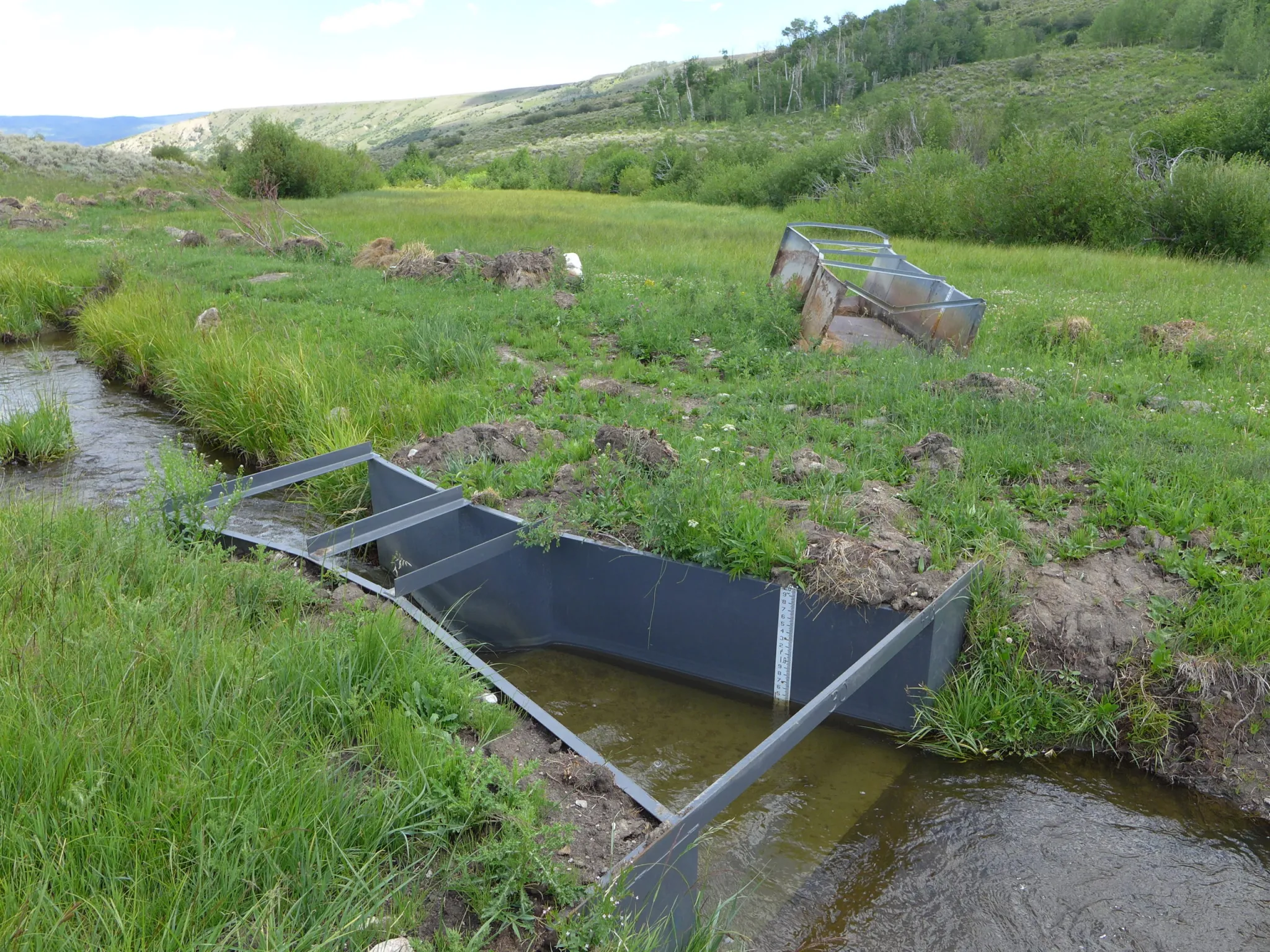
This Parshall flume measures the water in the Alfalfa Ditch on Surface Creek near Cedaredge. The Colorado Division of Water Resources estimates there are 2,800 diversions of more than 1 cfs without measuring devices across the Western Slope. CREDIT: HEATHER SACKETT/ASPEN JOURNALISM

Click the link to read the article on the Aspen Journalism website (Heather Sackett):

December 5, 2025

The state of Colorado is ramping up an effort to measure water use on the Western Slope, developing rules and standards and rolling out a grant program to help water users pay for diversion measurement devices.

With input from water users, officials from the Colorado Division of Water Resources are creating technical guidance for each of the four major Western Slope river basins on how agricultural water users should measure the water they take from streams. The state is now doling out $7 million from the U.S. Bureau of Reclamation to eligible water users with faulty or missing devices to install structures such as flumes, weirs and pumps at their point of diversion. 

Map of the Gunnison River drainage basin in Colorado, USA. Made using public domain USGS data. By Shannon1 – Own work, CC BY-SA 4.0, https://commons.wikimedia.org/w/index.php?curid=69257550
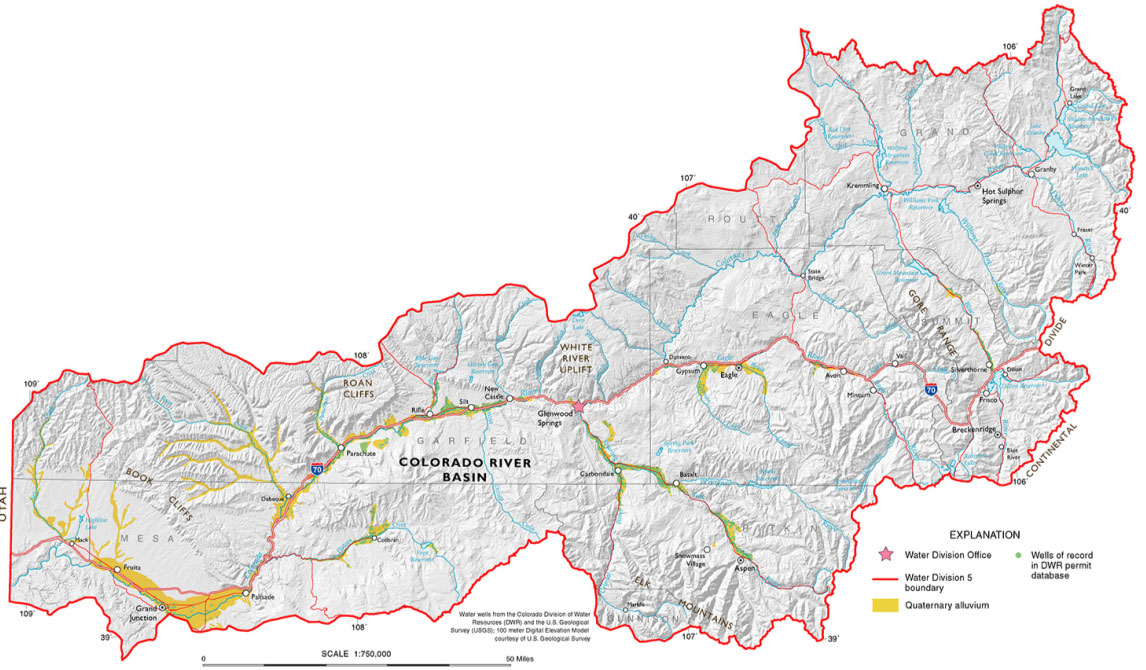
Colorado River Basin in Colorado via the Colorado Geological Survey
Yampa River Basin via Wikimedia.
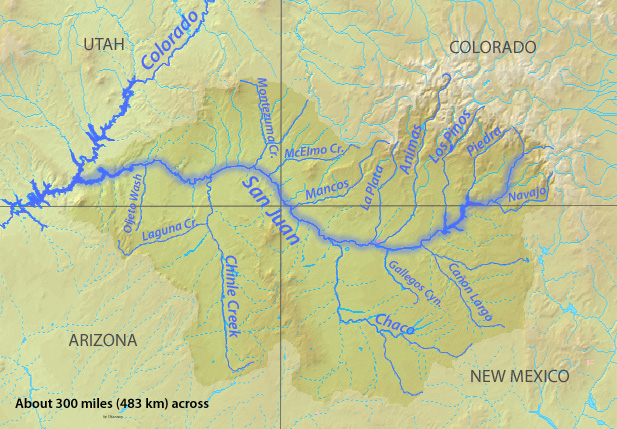
San Juan River Basin. Graphic credit Wikipedia.
Dolores River watershed
White River Basin. By Shannon1 – Own work, CC BY-SA 4.0, https://commons.wikimedia.org/w/index.php?curid=69281367
Green River Basin

Twenty-five percent of the funding is earmarked for each of the four river basins: Gunnison (Division 4); Colorado River mainstem (Division 5); Yampa-White-Green (Division 6); and San Juan-Dolores (Division 7). The first round of funding will go to Divisions 6 and 7, and applications close at the end of January. The goal is to have all the projects complete by 2029.

Measurement rules for Divisions 6 and 7 have been finalized and are in effect; rules for Division 4 are in the draft phase, and state officials are accepting comments until Dec. 19 on the draft rules in Division 5.

With thousands of diversions from small tributaries across rural, remote and mountainous areas, figuring out precisely how much water is used in Colorado has historically been challenging. According to state officials, there are about 2,800 diversions of more than 1 cubic foot per second from Western Slope rivers and streams that are not currently being measured. Historically, the state has required measuring devices on only diversions that have been involved in calls. When a downstream senior water rights holder is not getting the full amount of water they are entitled to, they can place a “call,” which forces junior upstream water users to cut back.
This Parshall flume measuring device is being installed on a ditch on Morrisania Mesa near Parachute. The state of Colorado has $7 million in federal funds to distribute to water users to install measuring devices on their diversions from waterways. CREDIT: HEATHER SACKETT/ASPEN JOURNALISM

Compact compliance

The push for more-accurate measurement comes at a time when there is increasing competition for dwindling water supplies, as well as growing pressure on the Colorado River’s Upper Basin states (Colorado, New Mexico, Utah and Wyoming) to conserve water. Whether through forced cuts under the terms of the 1922 Colorado River Compact or through a voluntary conservation program that pays water users to cut back, the state will almost certainly face future cuts to its water use.   

According to Jason Ullmann, who is the state engineer and director of the division of water resources, accurate and consistent water measurement is a prerequisite for making basinwide cuts related to the compact.

“While we’ve always been in compliance with the [1922 Colorado River] compact, we haven’t had to do a West Slope-wide administration,” Ullmann said. “We just don’t want to be in the position of having to do that on an emergency basis. We want to be proactive and provide people consistent and reliable standards for what we expect and work with them to get to a point where we do have that more accurate measurement network before that happens.”

Although the Colorado River Compact splits the river’s water evenly between the Upper Basin and the Lower Basin (California, Arizona and Nevada) with 7.5 million acre-feet each annually, the agreement says nothing about what happens when there’s not enough water to meet these allocations. A “compact call” is a theoretical legal concept, whose definition is hotly debated among water managers. 

One way it could play out is that the Upper Basin states would have to cut off some water users in order to send enough water downstream to meet their obligations to the Lower Basin. If that happens, Colorado would need a plan for who gets cut off first. Under the strict application water law known as prior appropriation, the oldest water rights get first use of rivers and junior water rights are the first to be cut. 

Michael Cohen, a senior fellow at the Pacific Institute, where he has written about the uncertainties of water use and measurement in the Upper Basin, said collecting better data will help water managers figure out where cuts should come from.

“Moving forward, it looks more and more likely that there’s going to be some kind of compact call,” Cohen said. “Then the state of Colorado, as well as the other Upper Basin states, need to figure out how they’re going to enforce that kind of call.”
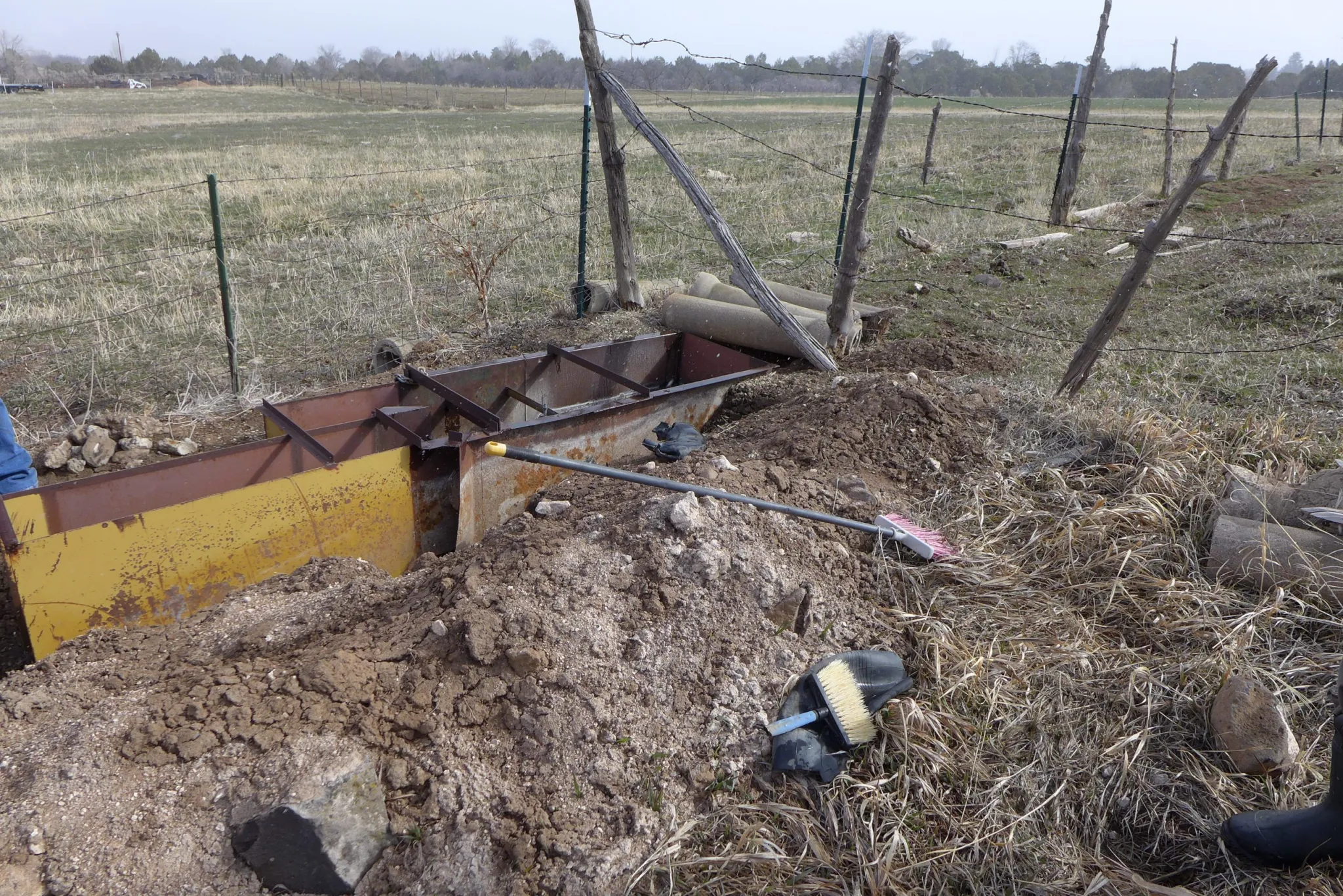
This Parshall flume was installed in the Yampa River basin in 2020 and replaced the old rusty flume seen in the background. The state of Colorado is working toward creating measurement rules and installing measurement devices across the Western Slope. CREDIT: HEATHER SACKETT/ASPEN JOURNALISM

Managing scarcity

But compact compliance is not the only reason that water measurement is needed. Scientists have shown that climate change has contributed to a 20% decline in flows from the 20th century average, and that every 1 degree Celsius of warming results in a 9% reduction in flows. The combination of climate change and a historic drought means that rivers that had never before experienced shortages or calls have started experiencing them in recent years. In the past few years, the Yampa and White rivers, in the northwest corner of the state, have had first-ever calls and have been designated “over-appropriated,” meaning there’s more water demand than supply at certain times. 

“Even if you toss the compact situation out, it’s just the practical reality that we’re seeing less snowpack and we have more calls,” Ullmann said. “We’re just in need of improving that measurement accuracy because of the need for administration.”

John Cyran, an attorney who worked on developing the measurement rules for the South Platte River basin and is now a senior attorney with the Healthy Rivers department of Boulder-based environmental group Western Resource Advocates, uses the analogy of a pizza party with too-few pizzas where hungry partygoers are allowed only two slices each to illustrate how measurement is needed in times of scarcity. 

“Just like sharing a shrinking pizza or Thanksgiving pie, our water supply is declining,” Cyran said. “The pie is getting smaller. So it is increasingly important to make sure that people don’t take more than their share. But we can’t manage what we don’t measure.”

Tightening up water measurement across the Western Slope could also help Upper Basin water managers as they grapple with a future conservation program that pays water users to cut back and then stores that water in a pool in Lake Powell. A criticism of past pilot programs was that the saved water was not tracked to Lake Powell. Water users downstream of a conservation project could pick up the extra water, with no guarantee that any of it reached the reservoir. Measurement rules and devices could help ensure that this conserved water is “shepherded” to Lake Powell.

Measurement is the first step toward management of a scarce public resource, Cyran said.

“The first step is measuring how much water is being diverted,” Cyran said. “The next step is management – making sure that folks only divert their share and that water we conserve stays in the stream and is not diverted by another user.”

Colorado River Basin map via the Babbit Center for Land and Water Policy/Lincoln Institute of Land Policy

Revisiting the Near Past — George Sibley (SibleysRivers.com) #ColoradoRiver #COriver #aridification

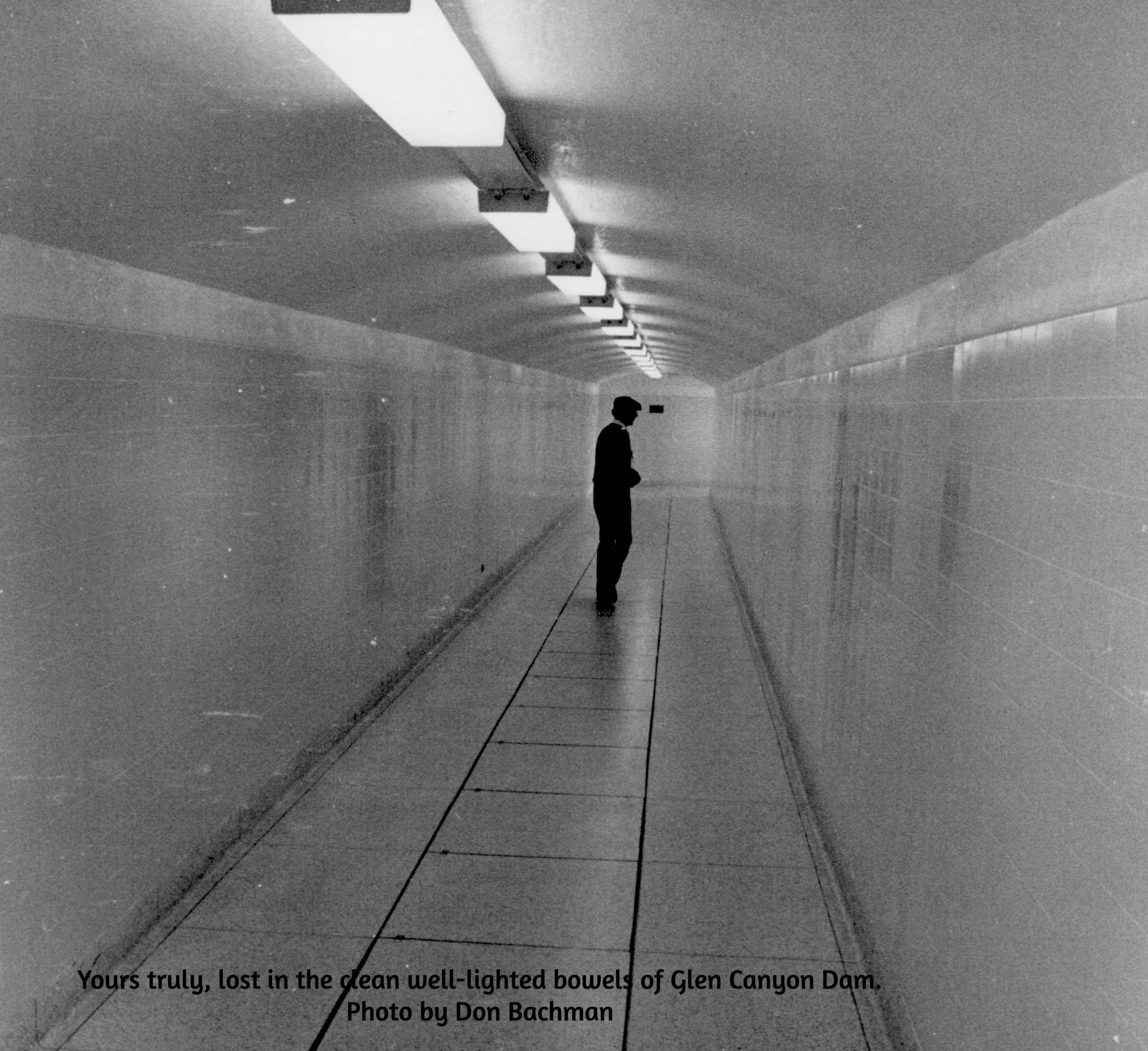
George visiting Glen Canyon Dam

Click the link to read the article on the Sibley’s Rivers website (George Sibley):

November 18, 2025

The Bureau of Reclamation’s November 11 deadline for the seven states to present a plan for the management of the Colorado River has passed with no white smoke from the chimney – no smoke at all in fact, black or white; the meetings have been so secretive that one wonders if the Magnificent Seven have really been meeting at all.

So there being no news on that front, rather than adding to the copious media analysis of no news, I’m going to step back for the usual longer look – this time backward, to acknowledge an anniversary: this post marks the completion of the fourth year of this ongoing commentary on our lives with our rivers, mostly the Colorado River; the first post was November 22, 2021. About that, I’ll just say I’ve enjoyed this, and learned a lot on top of what I already knew about the river, hydrology, riparian sociology and economy, et cetera; and I do appreciate the handful of people who read it and comment, often teaching me something. I want to express my gratitude to a friend and mostly retired attorney who underwrites this website, and to Rob Strickland of Midnight Marketing, who created and manages the website.

Actually remembering this anniversary, for a guy who tends to forget birthdays, even his own (willfully), makes it a good time to check up on myself, and my work these past four years: am I doing what I started out wanting to do? An inquiry I might as well do transparently, with you still reading this ongoing bloviation. So here is my first post, from November 22, 2021, with some interlinear comments in italics:

Sibley’s Rivers? What, Why and – Why Not?

The first thing I want to say about ‘Sibley’s Rivers’ is to not be misled by the name; it’s not going to be all about rivers – although because the West will be the locus of focus, the rivers that run through it (or don’t) will be frequent topics. Especially the Colorado River, which is so ominously interesting these days.

What you’ll find, should you decide to visit ‘Sibley’s Rivers’ from time to time, is mostly going to be ‘rivers of words’ about learning to live in the Anthropocene. The Anthropocene: this new epoch in the eternal evolution of the planet, precipitated by changes that we humans, purposefully or inadvertently, have imposed on the planet’s basic systems, changes which are now altering the conditions of existence for all life on the planet. [ed. emphasis mine]

Most of the scientific community accepts this as a fact of life we now have to learn to live with, and measure up to. We – all of us, just in the way we daily live – are a major change agent acting on the planet, on a global scale, which means that what we do now, or stop doing, carries a major responsibility for the continuity of much of the life on earth – certainly for the continuity of our own species. This is what the president means when he calls it an ‘existential challenge’: our very existence is at stake.

I think I’ve been a little ‘lite’ in this. I write primarily about the Colorado River because I see it as ‘the First River of the Anthropocene’ – the natural phenomenon most dramatically and obviously changed by human actions. But I need to make that more thematic.

Are we up for this? As the rational, problem-solving species we tell ourselves we are? We humans tell each other stories, mythologies, about ourselves and the world we live in – our origins, our development, our relationship with other living things and with the planet itself – and we want our stories to show us as a positive force in the world, in the systems we impose on the nature of things around us. These stories are part of who we are.

Most of us probably grew up, as I did, on the ‘Ascent of Humankind’ story: We humans emerged as a poor little species with little going for us except a big active brain; for hundreds of thousands of years we crept around slipping into niches as foragers and hunters in all kinds of ecosystems, and somehow we managed to survive. Then around 10,000 years ago, we improved our lives with the invention of agriculture, bringing our food sources together under our control; we settled in towns rather than wandering around the landscape following the food. Success in that gradually led us to gather in larger and wealthier cities; we learned to write, developed the sciences and creative arts, created beautiful things and useful things that we traded with each other, and with other advanced city-states; we learned to make good wine and spirits. We became a civilization, the highest ascent of the species; we spread our light through the conquest and enlightenment of less well developed peoples. An originally insignificant little species became the dominant species on the planet. We are not yet perfect in all our systemic efforts to address the challenges to civilization, both internal and external, but we are, always, steadily improving. This is the mythos of Western Civilization, now the global civilization, in the Holocene, this lovely mellow 10 or 20 thousand year epoch that brackets the ‘Ascent’ story.

So what does the dawning of the Anthropocene do to the Holocene’s ‘Ascent’ mythos? If we go by the classical definition of ‘tragedy’ – knowledge gained by the protagonists too late to save them – then our foundational myth turns from a tale of triumph to a tragedy if it were to end now with the end of the Holocene. So of course it can’t end now. But how do we extend, amend or otherwise carry the story forward? Or do we need a new story to tell ourselves about ourselves and our evolving relationship with our planet? 

The fact is, we are not yet displaying any real capacity for executing a transition into the responsibilities we’ve imposed on ourselves in creating the Anthropocene. In this nation we have a president who seems to get the urgency of it, but he is stymied in acting by a political cult that promotes nothing positive and seeks only his failure. Even worse, a solid 40 percent of the American electorate is in vigorous denial about the challenge – and many of them are threatening violent armed insurrection if pushed too far on this and other issues. Self-defense, you know.

The nations of the world (most of them) just assembled in Scotland for the United Nations’ ‘COP26’ gathering, which was designed for a rational species confronting a problem to be solved, but everyone went home with no more than vague pledges offered and no specific missions to accomplish by a specific time, in addressing what everyone seemed to agree is a ticking time bomb. The fossil fuel producers had several hundred lobbyists there to make sure that nothing too productive happened on the carbon issue.

As I write this, the nations – the Council of Parties – are gathered in Belem, Brazil for COP 30. Carbon emissions have continued to go up every year since 2021; brave but vague promises are made very year, with rich nations making commitments to help poorer nations transition to affordable futures, commitments seldom more than partially fulfilled.

I followed COP26 on the internet through the adventures of a young Colorado woman, Sarah Johnson, at the COP26 conference. A freelance environmental educator from Carbondale, she wangled an ‘observer’ badge to the Glasgow event, and made frequent posts from there, providing a different look at what was going on there than one got from the mainstream media. Based just on her accounts, I would say that one positive thing that might come from COP26 will be a lot of young people from everywhere who now know each other, and know of each other, and are the ones who will not shrink from inheriting the whirlwind the current crop of poohbahs is probably going to leave in their laps after a few more years of harrumphing.  (Sarah’s COP26 postings are at https://www.wildroseeducation.com/uncop.html.)

‘We are desperate for a new story,’ Sarah said in one of her posts, ‘a promising narrative, words of encouragement grounded in our history of tenacity, strength, and determination.’

Trying to find elements of that story for the Anthropocene is as close as I can come to a statement of purpose for this site, and I hope for exchange and input from people like Sarah, and anyone else who has read this far. 

I think cautionary elements of that story exist in the wrestling I’ve done with the Colorado River and its fantasy-ridden management, and I’ve gotten insightful comments from readers, for which I’m grateful. But the new story remains elusive.

My perspective here is what I think of as ‘Medial West’: the perspective of one caught between an Old West and a New West, and not really comfortably at home in either. The Old West has been a culture of resource appropriation and development – at its worst, the rip-and-run mining of minerals, timber, grass and water; at its best the evolution of multi-generational ranching and farming communities, in for the long haul. The New West is most visibly a culture of industrial recreation, auto tourismand real estate development dependent on an aesthetically inspiring natural environment. 

I’ve not pointed out enough that an ‘aesthetically inspiring natural environment’ is no more sustainable than an oil well, when we start filling it up with people, monstrous houses and the other artifacts of high civilization.

But the dominant culture of both the Old and New West has been and is the Industrial Revolution – a huge system for employing the population in the myriad acts of converting nature’s resources into goods and services to be bought and sold in as many forms as possible. The basic difference between Old West and New West industries: Old West industries move the products to the people; New West industries move the people to the products. Just in the moving, both contribute significantly to the greenhouse gas challenge that tipped us into the Anthropocene.

I’ve personally been too involved with both the Old and New West to choose either over the other unconditionally. My mother’s grandparents homesteaded a modest farm in the valley of the North Fork of the Gunnison River in the 1880s, driven by dreams that weren’t very industrial at all, but also weren’t very well articulated; I’ve come to know the fourth and fifth generations of farmer-ranchers here in the Upper Gunnison Basin who are a lot like what I know of my great-grandparents, and who seem to see their lives more as a heritage culture than an economic industry – even though they sell their cattle into the global industrial market.

Access to that market is thanks to people like my mother’s father, who was a civil engineer in the Gunnison River Basin making sure the railroad got to every community – the Industrial Revolution’s first efficient vehicle for vacuuming the resources of the West for the nation’s growing industrial cities – including eventually its human resources, its offspring.

I came to the Gunnison River Basin from the urban-industrial mainstream eighty years after my grandparents, thinking I was fleeing it, but instead went right to work in the incipient industries of the New West. When I realized that I was basically making straight in the wilderness the way for the fullblown advent of the remodeled Industrial Revolution, I tried to pull back, but still had to make enough of a living to keep the family functional, and what else was there?

Nevertheless, I did manage to work my way into two ‘counterrevolutionary’ situations. One was running a small sawmill on the edge of civilization, producing rough-sawn lumber entirely for a local market. The other was two decades of slightly subversive work for a regional college here, trying to develop niche programs to wake the children of the Industrial Revolution up the possibility that life could and should be more than an economy in which we must labor all our lives. My success was about par for the two and a half centuries of that counterrevolution’s steady retreat before the industrial revolutionaries – not much, but hope abides. More about that in future posts – rethinking our conventional sense of our history may help us succeed in the Anthropocene.

My ‘Medial West’ perspective values the work ethic and attachment to place of the Old West people who have stayed long enough to have a story of their own here, but also values – and shares – the aesthetic appreciations of the New West people and the growing effort to find re-creation beyond recreation – probably an essential transition in learning to live in the Anthropocene. My energy for earnestly tackling the challenges of the Anthropocene dissipates if not frequently infused with the sight of the blue sky out the window, and its invitation to spend some time later today out under that sky, in meditation with the axe and the woodpile.

Okay – there’s still work to do with the First River of the Anthropocene – but rather than beating on the dead horse of 20th-century mismanagement to try to make it get up and slog on, I’ll make a more disciplined effort to find Sarah Johnson’s story that would make us want to live constructively in the Anthropocene. Meanwhile, there’s again wood to be split for the winter. Allons, friends!

“First River of the Anthropocene” — George Sibley. Colorado River “Beginnings”. Photo: Brent Gardner-Smith/Aspen Journalism

A weird water year so far: Abundant rain, sparse snow: Plus: National park shenanigans in #Utah — Jonathan P. Thompson (LandDesk.org) #snowpack

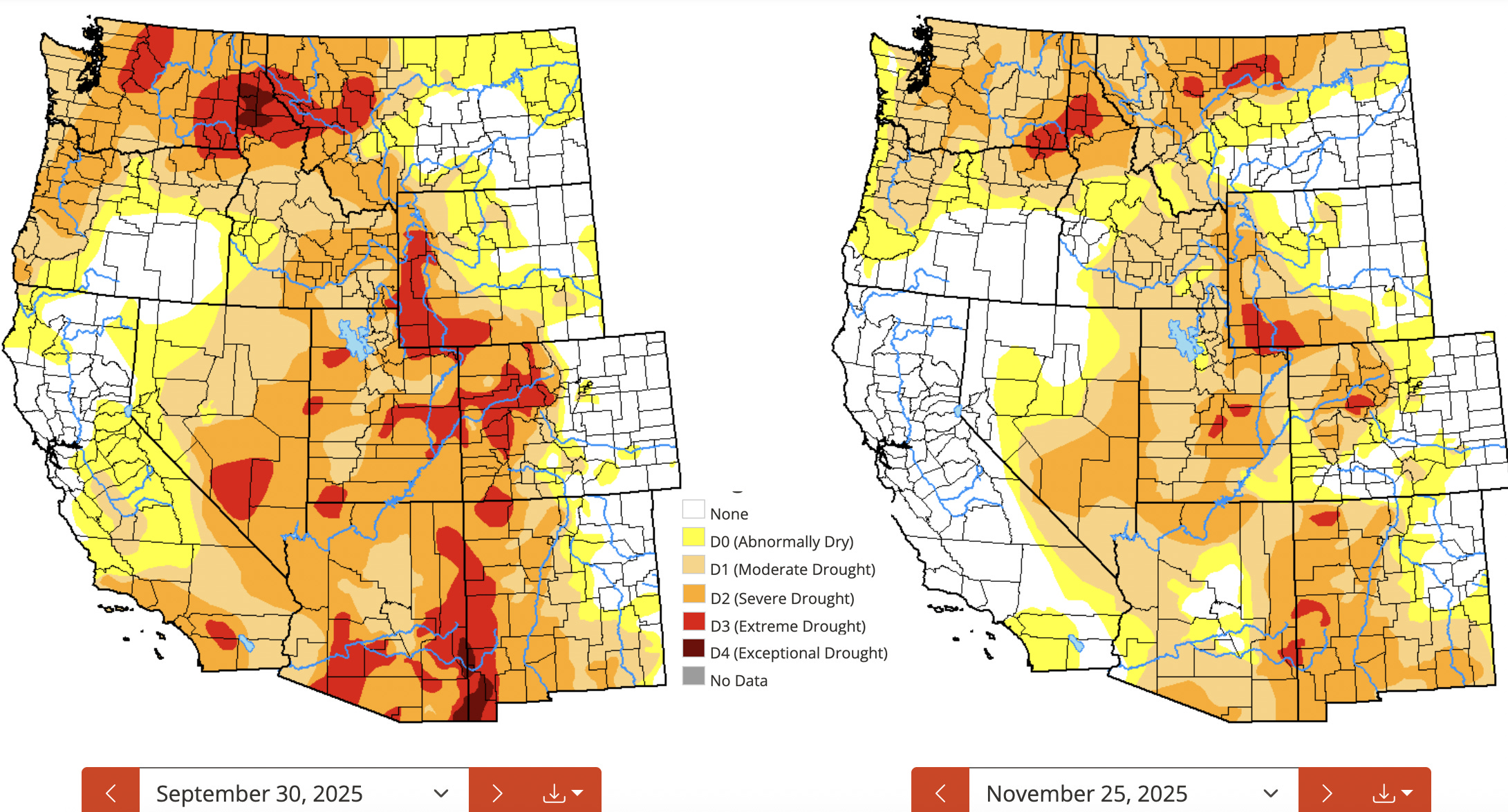
The drought situation has improved markedly in the Southwest since the end of the last water year, especially in the Four Corners area. Source: National Drought Monitor.

Click the link to read the article on The Land Desk website (Jonathan P. Thompson):

December 2, 2025

⛈️ Wacky Weather Watch⚡️

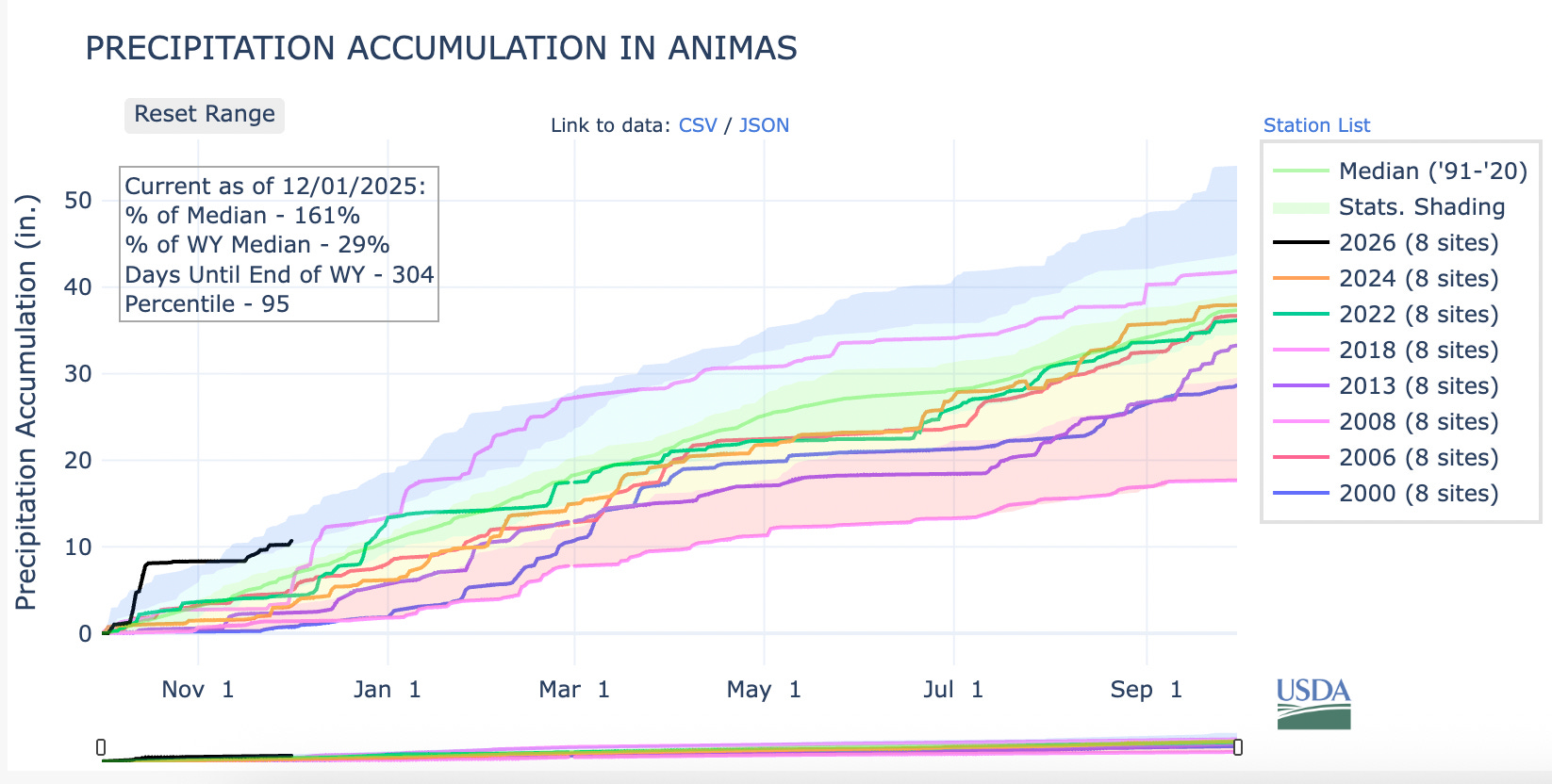
We are now two months into the water year — and a couple of days into meteorological winter — and so far both are pretty weird. On the one hand, much of the West is covered by one of the scantest snowpacks for early December in decades. On the other, it’s also been one of the wettest beginnings to the water year in recent memory.

Graph of 2026 water year snowpack levels for the Animas River watershed (which this year reflects that for most of western Colorado and the Upper Colorado River Basin), along with every year since 2000 that has started as sparsely or more so than this year. Note that the 2008 snowpack in the Animas was just as meagre in early December as it is this year. Then the snows came with a vengeance, leading to one of the biggest winters on record as well as a very healthy spring runoff that lasted well into July.
While snow levels are paltry, the weather gods have delivered plenty of precipitation to the region. While that has helped ease drought conditions, it is no substitute for a healthy snowpack.

Adding to the uncanniness has been the wave of generous storms that have dumped up to a foot of snow on Colorado ski areas and snarled traffic, leading to at least two multi-car pileups on I-70 and shutting down other arteries — yet still failing to bring snowpack levels to anywhere near “normal.”

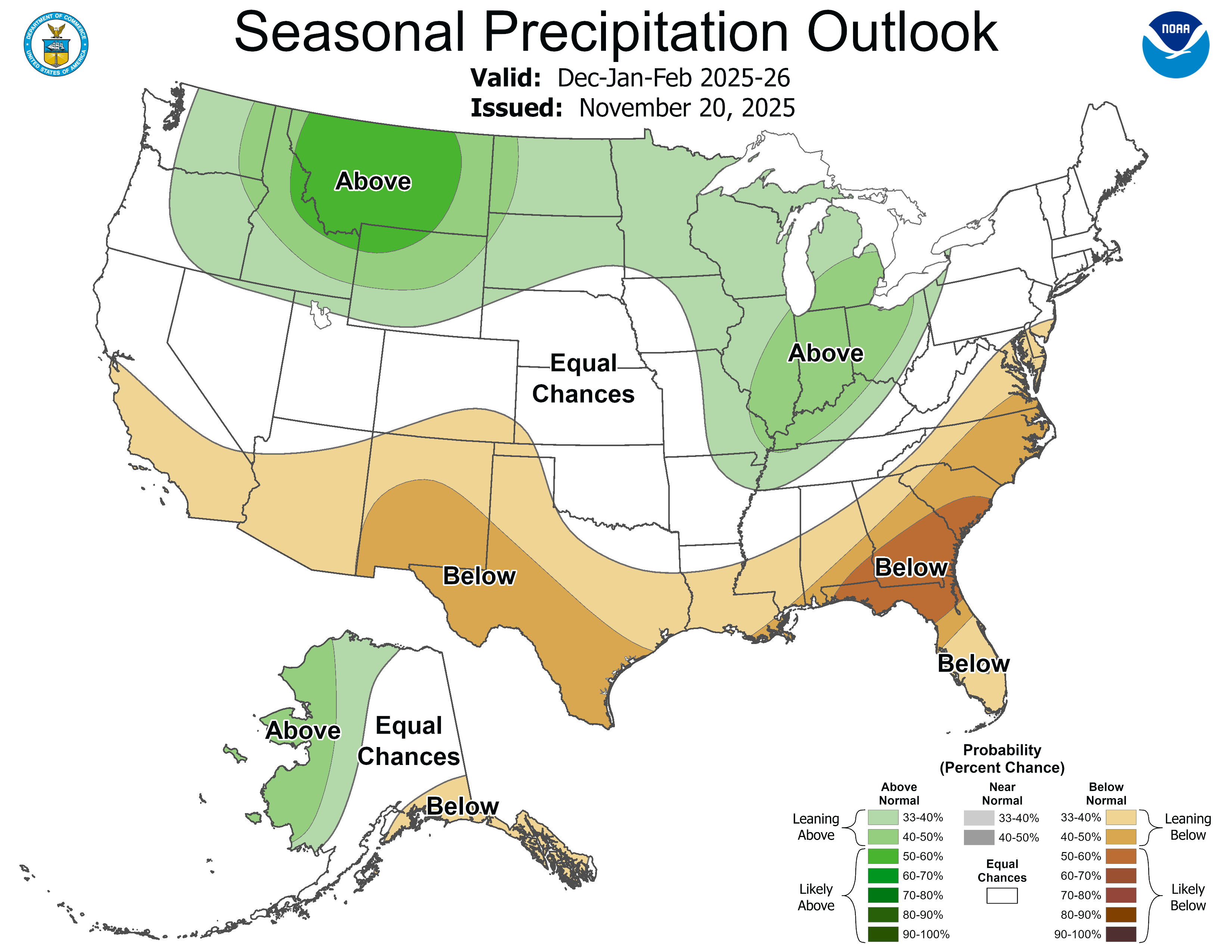
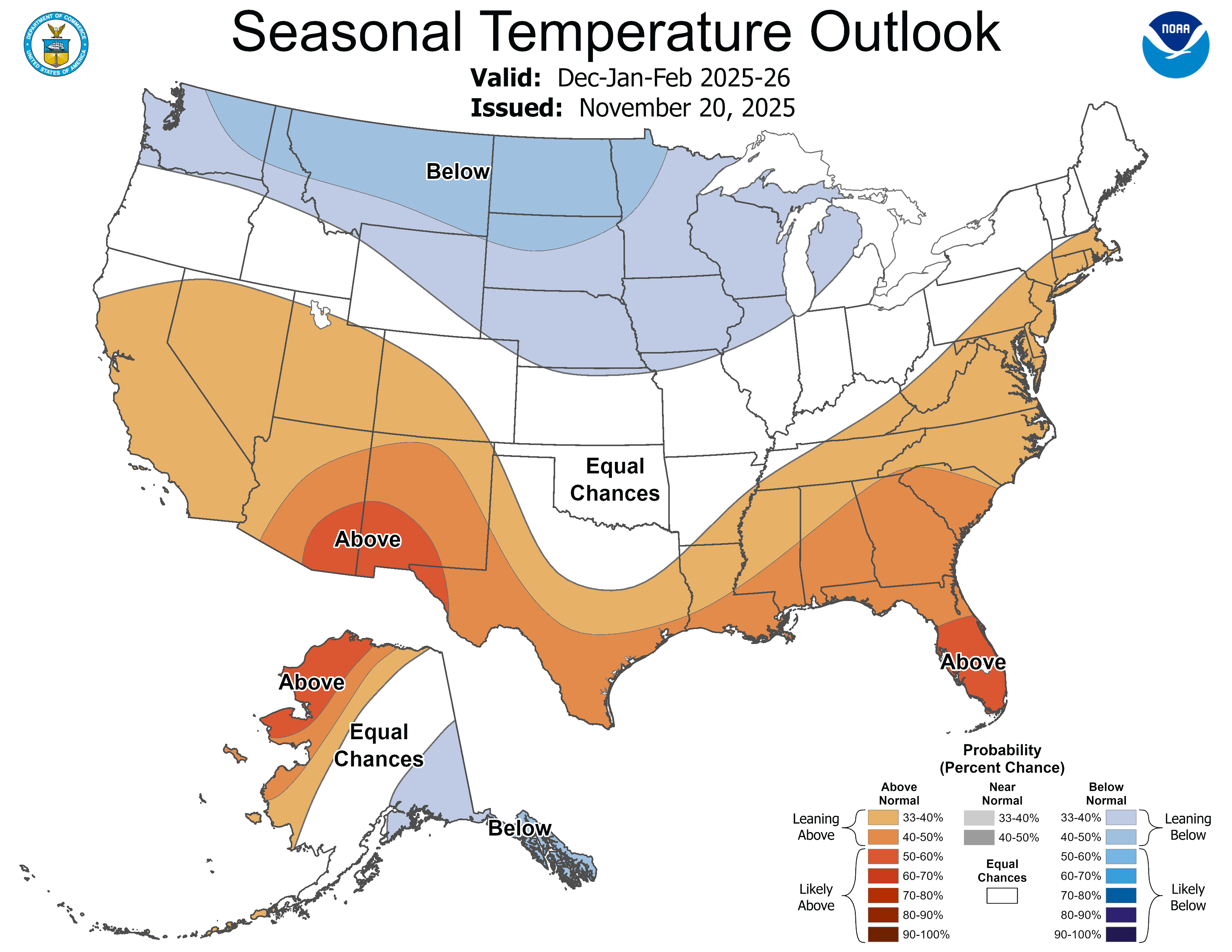
It’s a big ol’ mixed bag, in other words. The big October deluges eased the drought in much of the region, but the warm temperatures and snow drought don’t bode well for next spring’s runoff. Meagre early winter snowpacks can make and have made dramatic comebacks (e.g. water year 2008 in southwestern Colorado), and another storm is moving into the region as I write this, yet the National Weather Service’s is predicting an abnormally warm and dry winter for much of the Southwest.


🌵 Public Lands 🌲

The Grand County commissioners’ “Access and Capacity Enhancement Alternative” plan aimed at increasing visitation at Arches National Park was just the tip of an iceberg, it seems. Yesterday (Dec. 1), Commissioner Brian Martinez presented the plan to a group of state and federal officials at a closed State of Utah and National Park Service Workshop in Salt Lake City.


Moab seeks bigger crowds? — Jonathan P. Thompson


The meeting’s purpose, according to the official agenda, is:

This may sound fairly innocuous (and maybe it is). But given some of the players, it may also be the latest volley in Utah’s long-running effort to seize control of public lands. The meeting was run by the Interior Department’s associate deputy secretary, Karen Budd-Falen, and Redge Johnson, who leads Utah’s Public Lands Policy Coordinating Office.

Budd-Falen built her legal career on fighting federal agencies, including the Interior Department, and was part of the Sagebrush Rebellion and the Wise Use movements that endeavored to turn federal land over to states and counties and to weaken regulations on the extractive industries. Johnson, meanwhile, was a driving force behind the state’s effort to take control of 18.5 million acres of Bureau of Land Management land in the state.


A Sagebrush Rebel returns to Interior — Jonathan P. Thompson

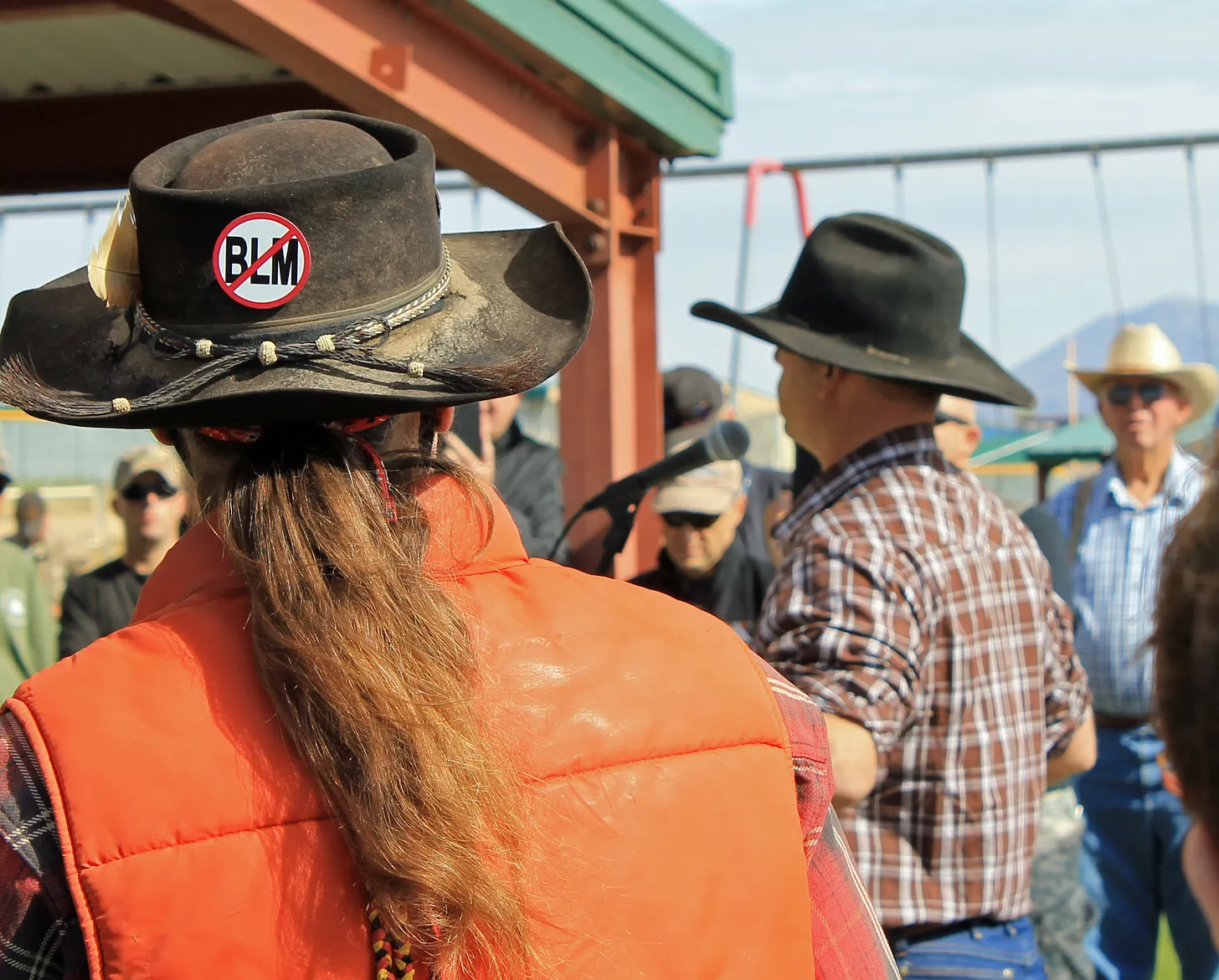
An anti-BLM sticker (referring, presumably, to the federal land agency, not the Black Lives Matter movement) at another Phil Lyman rally against “federal overreach” and motorized travel closures in southeastern Utah back in 2014. Photo credit: Jonathan P. Thompson/The Land Desk

It’s not clear what is meant when they say the meeting is aimed at achieving Trump’s agenda. As far as national parks go, the administration has been rather chaotic: Freezing hiring, laying off thousands of staff (only to rehire some of them), slashing budgets, and allowing visitors to run roughshod over the parks during the government shutdown.

It sure looks like they are trying to cause the parks to fail, which would give them an excuse to further privatize their functions. Private for-profit corporations already run the lodges, campgrounds, and other services inside many parks. That’s why, during the shutdown, concessionaire-run campgrounds within parks continued to operate, while all of the government-run functions, such as entrance-fee-collection, were shuttered. In this way a false contrast was created between the functional privately-run operations and the dysfunctional public ones; visitors during that time would be excused for preferring the former.

The timing of this meeting, purportedly to receive input from gateway communities, is kind of odd. I have to wonder whether the Interior Department consulted local elected officials before raising entry fees for foreign visitors to $100 at Zion and Bryce Canyon National Parks in Utah, along with Grand Canyon, Acadia, Everglades, Glacier, Grand Teton, Rocky Mountain, Sequoia & Kings Canyon, Yellowstone, and Yosemite National Parks.

The Southwest’s tourism industry is highly reliant on international visitors. Visitation from abroad is already down, thanks mostly to the Trump administration’s “America First” creed and its general hostility to the rest of the world. Singling out foreign travelers for these higher fees — even if only at the most popular parks — is likely to dampen visitation from abroad even more, which will ripple through Western economies.

Grand County’s bid to cram even more visitors into Arches National Park won’t be too effective if would be visitors don’t even make it to the United States …


🗺️ Messing with Maps 🧭

This is just another old map that caught my attention, in part because it’s a reminder of how extensive the railroad network was, even in the rugged parts of Colorado, back in the late 1800s and early 1900s. This one shows the Denver & Rio Grande rail lines in 1893.