#Drought news December 11, 2025: Despite snow falling across the Rocky Mountains, many stations continue to report that the snow water equivalent (SWE) is below the 30th percentile

Click on a thumbnail graphic to view a gallery of drought data from the US Drought Monitor website.

Click the link to go to the US Drought Monitor website. Here’s an excerpt:

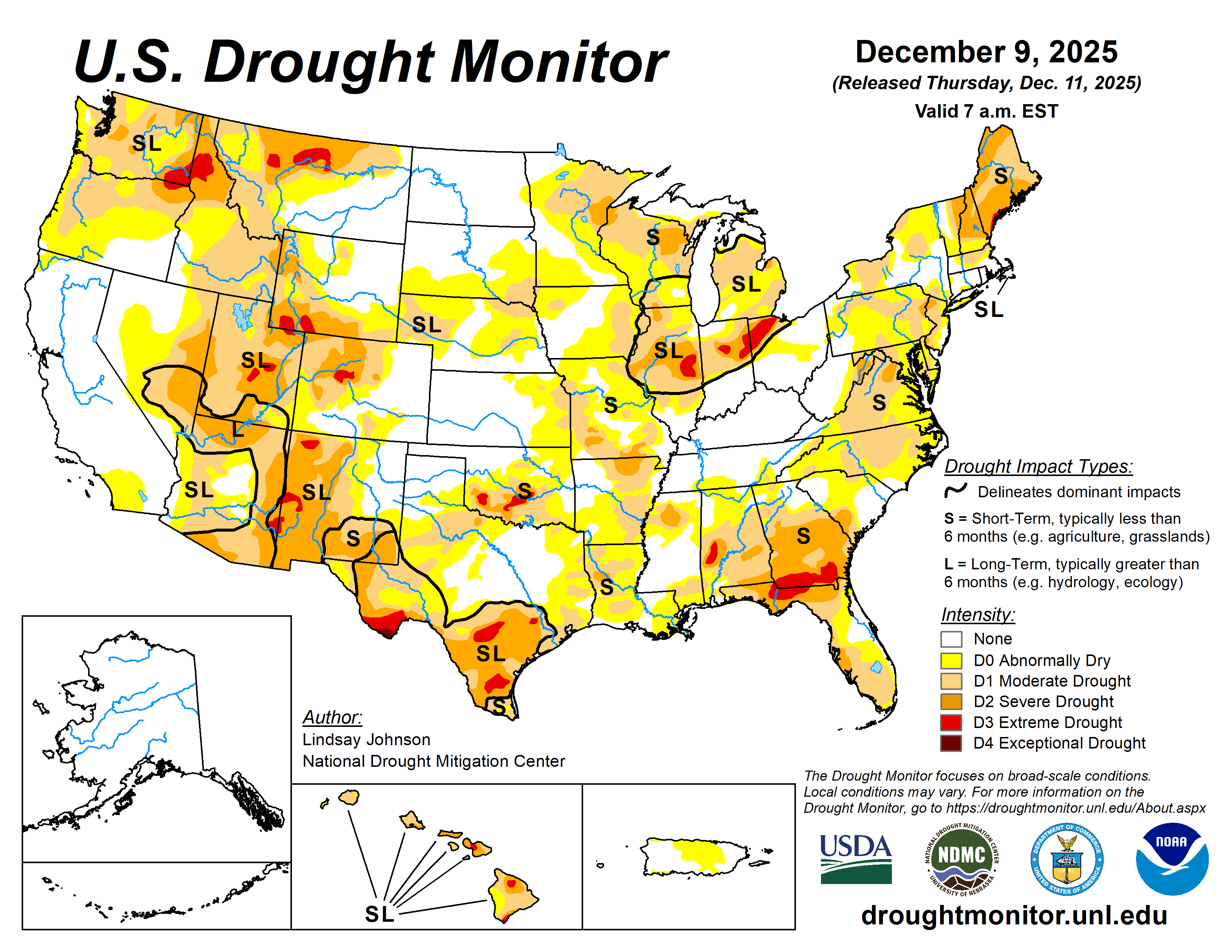
This Week’s Drought Summary

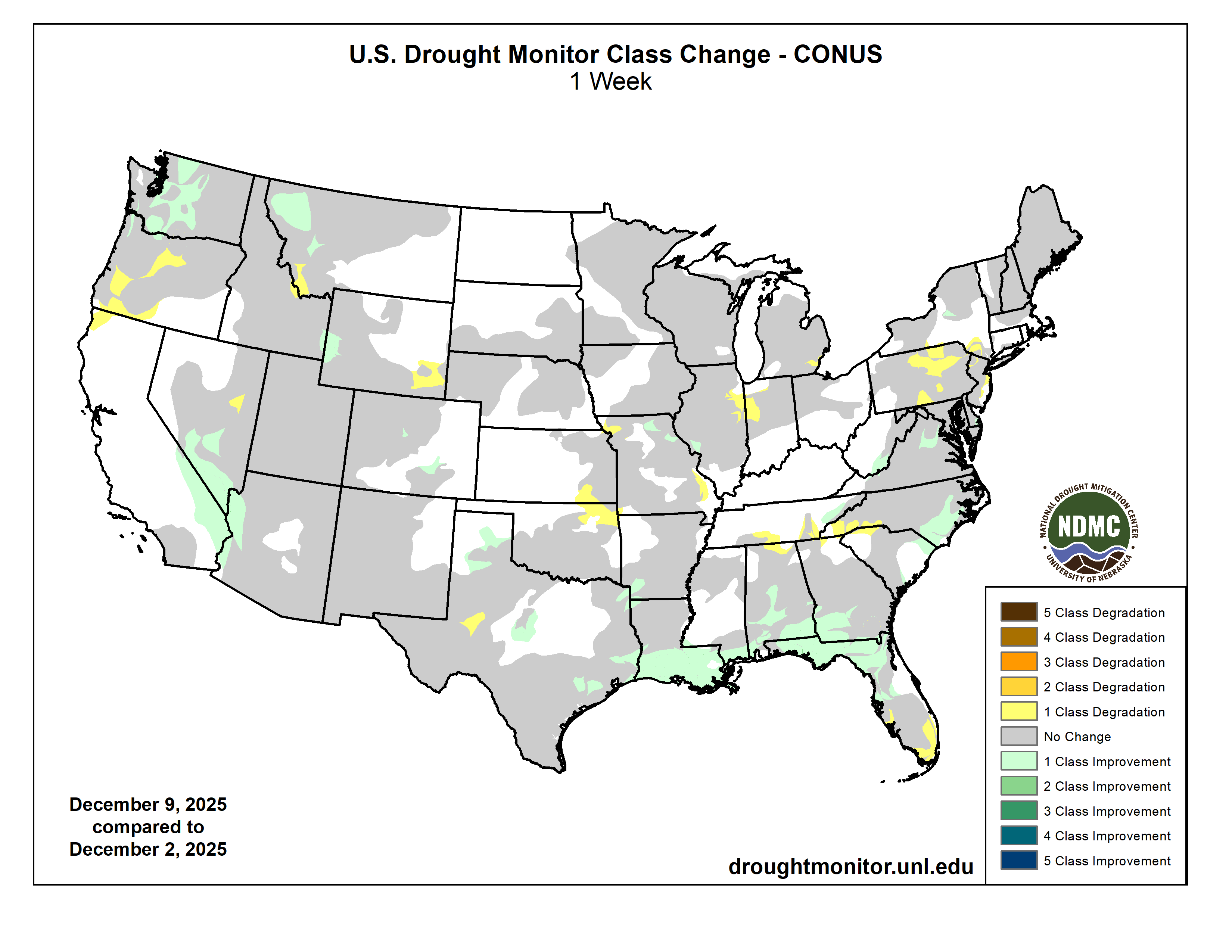
This U.S. Drought Monitor week saw both improvements and degradations across the country, shaped largely by uneven precipitation and widespread colder-than-normal temperatures. Much of the nation was colder than normal, with the sharpest departures in the Midwest and Northeast, where most of the week’s moisture fell as snow and offered limited short-term help for soils and streams. In the West, storm systems delivered substantial rain and mountain snow to the Pacific Northwest and northern Rockies, improving conditions in parts of Washington, northwest Oregon, western Montana and eastern Idaho. However, areas that missed the heaviest precipitation—especially central and southern Oregon, central Idaho and southwestern Montana—saw drought expand as snowpack remained well below normal. Parts of the Southwest, including southeastern California and western Arizona, continued to improve as moisture from earlier storms worked through the hydrologic system, while east-central Nevada saw worsening drought due to very low snowpack and long-term precipitation deficits. 

The central and southern Plains did not see any meaningful precipitation this week, leading to conditions remaining largely unchanged outside of localized areas. Short-term dryness worsened in southeastern Kansas and northeastern Oklahoma, where precipitation deficits continue to accumulate. In the east, several areas along the Gulf Coast and Southeast received 1 to 3 inches of rain, leading to widespread improvement short-term dryness and drought in southern Alabama, southern Georgia, the Florida Panhandle and portions of the Carolinas. Despite moderate precipitation in southern Florida and parts of the interior Southeast, longer-term precipitation deficits led to dryness continuing to intensify. In the Midwest and Northeast, cold temperatures and predominantly frozen precipitation led to limited improvements and degradations in areas that missed precipitation…

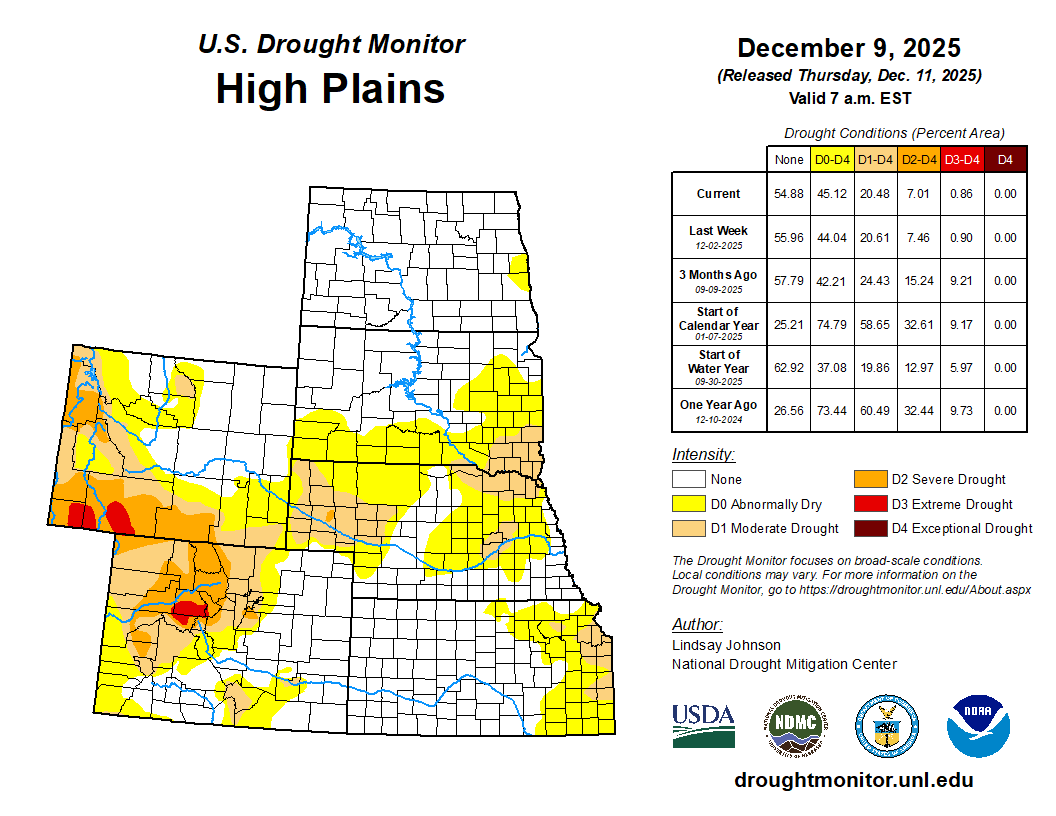
High Plains

Conditions across the High Plains changed very little this week as much of the region received only light precipitation and remained colder than normal. The Dakotas saw little meaningful moisture, and Nebraska saw none, leaving drought conditions unchanged. In Kansas, a lack of precipitation combined with continued short-term dryness led to an expansion of abnormal dryness (D0) that stretched into northeastern Oklahoma. 

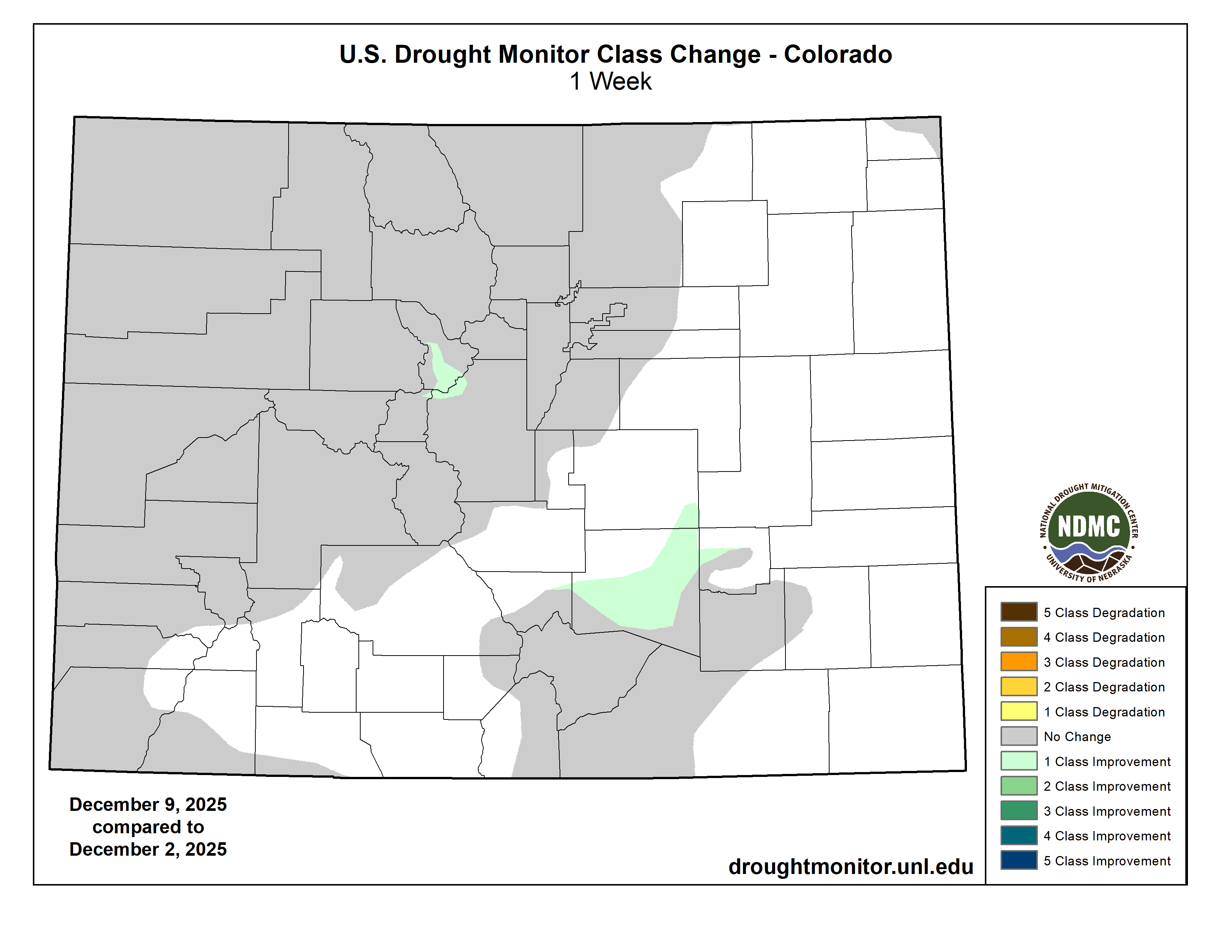
In eastern Wyoming, dryness increased where precipitation was limited, resulting in some expansion of abnormal dryness. In eastern Colorado, light snowfall helped ease small pockets of abnormal dryness, though most areas saw little change…

Colorado Drought Monitor one week change map ending December 9, 2025.

West

Out West, there was a mixture of improvements and degradations. Improvements were seen in the Southwest despite no precipitation this week. Prior weeks’ moisture has made its way into the hydrologic cycle, as seen in improving streamflows and soil moisture. Despite snow falling across the Rocky Mountains, many stations continue to report that the snow water equivalent (SWE) is below the 30th percentile. Snowpack levels in the northern Rockies are doing better, with many stations showing snowpack at 100 percent for this time of year, which was further improved with 1 to 2 feet of snow falling across western Montana and eastern Idaho. This moisture led to areas of improvement in northwest Montana. Improvements were also seen along the Idaho-Wyoming border where up to 2.5 feet of snow fell. Southwestern Montana and central Idaho, which are experiencing below-normal snowpack, missed out on the snow and saw the expansion of moderate drought (D1) across the border. Over the Pacific Northwest, storms brought upwards of 6 to 8 inches of precipitation, where many stations in the Cascades are reporting below snowpack below 50 percent of normal. Areas in central Washington into northwest Oregon saw improvements as some short-term metrics were more aligned with moderate drought (D1) conditions rather than severe drought (D2). Central and southern Oregon, which missed out on the heaviest precipitation, saw the expansion of abnormal dryness (D0) and moderate drought (D1)…

South

The South saw mostly improvements this week following a mixture of below-normal temperatures and heavy rainfall. One-class improvements were seen from far eastern Texas to Mississippi where 1.5 to 3 inches of rain fell, with parts of southern Louisiana recording 5 to 6 inches of rain. Areas of central Texas and the Panhandle that improved last week, continued to see improvements in soil moisture and streamflows, leading to further improvements this week. Isolated degradation did occur in Texas’ southwestern Panhandle as well in northeastern Oklahoma as lack of precipitation continues to stress soils and lead to lower streamflows…

Looking Ahead

According to the National Weather Service’s 5-day quantitative precipitation forecast (valid from Dec. 11 -16) the heaviest precipitation is forecast across the Pacific Northwest, especially along the coastal ranges of Washington, Oregon, and far northern California, where totals may exceed 5 to 10. Moderate precipitation is also expected across the northern Rockies and into the northern Plains and Upper Midwest, with widespread amounts between 0.5 and 2 inches and localized areas of higher amounts where terrain enhances moisture, such as elevation and lake-effect snow. Across the South and Southeast, a broad area of lighter but steady rain is anticipated from eastern Texas through the Gulf Coast states and into the Carolinas, generally ranging from 0.5 to 2 inches. The Northeast is also expected to pick up around 1 to 2 inches. In contrast, much of the Interior West—including the Great Basin, Southwest and central Rockies—shows little to no precipitation. 

The Climate Prediction Center’s 6 to 10 day outlook (valid Dec. 16–20) favors widespread above- normal temperatures across most of the Lower 48, with the highest likelihood for above-normal temperatures centered over the Four Corners region and extending across the western and southern U.S. Much of the Midwest, Great Lakes and Northeast also lean warmer than average, while only a small pocket of near-normal temperatures is suggested in parts of the northern Plains. Cooler-than-normal conditions are limited to coastal New England and portions of Alaska, where the highest chances for below-normal temperatures appear. Precipitation patterns show more divide with wetter-than-normal conditions favored across the Pacific Northwest, the northern Rockies, the Upper Midwest and parts of Hawaii. In contrast, drier-than-normal conditions are likely across the central and southern Rockies, the central Plains and much of the Southeast, with the strongest dry signal centered over Arizona, New Mexico and western Texas. Near-normal precipitation is expected across broad sections of the Midwest, Mid-Atlantic and Interior West.

US Drought Monitor one week change map ending December 9, 2025.

CSU’s The Audit: Yellow snow isn’t the only kind we should avoid, #Colorado State University snow hydrologist says — Stacy Nick (Source.ColoState.edu)

Megan Sears and Wyatt Reis both research assistants in the Ecosystem Science and Sustainability Department in the Warner College of Natural Resources take snow hydro and depth probe samples at a research site near Chambers Lake in the Colorado mountains. January 10, 2022. Photo credit: Colorado State University

Click the link to read the article on the Colorado State University website (Stacy Nick):

November 18, 2025

We’ve all heard the phrase, “Don’t eat the yellow snow.” But are there other things in snow that aren’t so obvious? 

Colorado State University snow hydrologist Steven Fassnacht says absolutely. 

Snow has more surface area than rain, so it can pull more contaminants out of the air, Fassnacht recently said on CSU’s The Audit podcast. That can be anything from forever chemicals to heavy metals and dust. 

Professor Steven Fassnacht’s research focuses on studying water availability by looking at how snow and related environmental factors change over time and across different locations. Photo credit: Colorado State University

“The big ones that we see around here are nitrogen and sulfur-based,” he said. “They come out of the tailpipe, out of the smokestack, et cetera. So, if you’re downwind from a major industrial source of these, then the likelihood that you have these in the snowpack is a lot higher.” 

While it’s less obvious than a billowing smokestack, microplastics are another contaminant that researchers are studying in snow. 

“There are just so many little bits and pieces of plastic around,” Fassnacht said. “Think about going out in the snow. You’ve got plastic ski boots on and plastic skis and poles, and your jacket and all your equipment, that’s all plastic. Any breakdown of that – which will happen over time – is going to put  microplastics onto the snowpack.” 

But all of this doesn’t mean you should never catch another snowflake on your tongue, he said. Just be aware of where that snow is coming from. 

Fassnacht recommends avoiding snow from nearby roadways or industrial areas. Likewise, if there’s been a recent forest fire or dust storm. 

“There is a lot of physics and chemistry involved in what you get within the snowpack itself and where it comes from,” Fassnacht said. “So, do you want to eat the snow? Maybe. That’s not an answer that people want to hear. They want to hear “yes” or “no.” Most of the time you’re probably OK, but you want to really be aware of where you are eating this snow from.”

Listen to this and other episodes of CSU’s The Audit here or wherever you get your podcasts.

Audio transcript  (Lightly edited for clarity) 

INTRO: We’ve all heard the phrase, “Don’t eat the yellow snow.” But with all the atmospheric contaminants out there – including forever chemicals from manufacturing facilities, heavy metals from car emissions and microplastics from virtually everything – should we really be eating any snow? 

To find out, we talked to Colorado State University snow hydrologist Steven Fassnacht. A professor with the Warner College of Natural Resources, Fassnacht’s research focuses on studying water availability by looking at how snow and related environmental factors change over time and across different locations. 

We asked him about what contaminants are making their way into snow and how and where to find the cleanest snow if you decide to partake on an icy treat. 

HOST: So, really should we be eating any snow, not just avoiding the yellow kind? 

FASSNACHT:We really should be looking at the snow visually; that’s often the marker, so don’t eat the yellow snow. And for other obvious visual  contaminants, things like dust and airborne pollutants and sand and things like that which are pretty obvious. Needles, you don’t want to eat pine needles. But in terms of what you can find in the snow that you should really be concerned about, those are ones that we cannot see. So, that is more of an understanding of where you are and what the sources of some of those contaminants could be. 

The big ones that we see around here are nitrogen and sulfur-based. So, things that we call our NOx – our nitrates, nitrites – and our SOx – sulfates, sulfites, et cetera. We have our phosphorus-based equivalents as well, and these all come from emissions. They come out of the tailpipe, out of the smokestack, et cetera. So, if you’re downwind from a major industrial source of these, then the likelihood that you have these in the snowpack is a lot higher. There is a lot of physics and chemistry involved in what you get within the snowpack itself and where it comes from. So, do you want to eat the snow? Maybe. That’s not an answer that people want to hear. They want to hear “yes” or “no.” Most of the time you’re probably OK, but you want to really be aware of where you are eating this snow. 

HOST: As you mentioned, a lot of contaminants are invisible to the naked eye, but things like dust can also be an issue. That’s something that actually impacts snow melt and runoff rates too, correct? 

FASSNACHT: Dust on snow and other things that are dark on the snowpack really affect the melt rates. Here in Colorado, most of our snow melt is driven by the sun. We have 300-plus sunny days. We’re here in Colorado because we love the weather. We know that from the sunburns we get because the sun’s coming at us and is reflecting off the really shiny snow. But at the same time, then you add dust, ash and black carbon from industrial sources, and that lowers the reflectivity of the surface, how shiny it is. Technically, we call that albedo. Our snowpack here in Colorado, that melt is really driven by the albedo, by the reflectivity. When we have dust coming in, that can lower it and make the snow melt a lot faster. The sources of dust are typically from the Four Corners area, the Colorado Plateau. So, in Northern Colorado, you see it a little less than you will in the San Juans, for example. 

HOST: So, is shinier snow better snow? 

FASSNACHT: Not necessarily. Shinier snow is just newer snow. Does that mean that it’s better quality? Not necessarily. If you have dust on the snow, that’s going to be obvious. The snow, once it’s on the ground, is going to become less shiny because it’s just changing. Think of the snowflake that you cut out when you were in kindergarten, that piece of paper, that delicate nature of snow. Well, the snow doesn’t last like that for very long. It’s going to end up being rounded, it’s going to melt, so it may be less shiny, but it still could be of good quality. By that I mean you could still eat it without having a lot of contaminants in it. 

HOST: We also talk a lot about microplastics and forever chemicals in our drinking water. I’m assuming those can also be found in snow. 

FASSNACHT: Definitely. That is a relatively new area that people have been exploring. We see all this in our water. We see things like caffeine; we see things like pharmaceuticals. Those make a bit more sense to be in our water because of our water treatment plants. Whereas in the snow it’s a little bit different in terms of pharmaceuticals or things that go through the human body. But we can have microplastics; we can have other forever chemicals. It depends on how they get there. So, that is part of the process as well. We typically think of dust and fine particles in the clouds when those snowflakes are forming. That’s the core of a snowflake that’s coming down. But then as the snow falls, because think of the snow again, it’s your kindergarten cut out of the piece of paper and all those different angles and all those shiny bits. That means that snow has a lot of surfaces. If you compare that to rain, rain is a ball, and the snow has many more surfaces. When it falls through the atmosphere, it can then pick up a lot more particles that are in the air. So, if you have anything that’s airborne – I think about the Cameron Peak fire of 2020 and how yellow and brown the air was – if you had rain and even more effectively if you had snow that was falling, it would wash all of those things out of the air and that then would end up in our snowpack. How do the forever chemicals and microplastics get into snow? That is not exactly known. The microplastics, there are just so many little bits and pieces of plastic around. We have the huge issue of the garbage island, the plastic island floating around the Pacific. Well, that’s big chunks of plastic, but microplastics can be anything. Just think of all the plastic we have in our lives. It can break off from whatever, and then you get these little, tiny bits. They’re pretty light, and so they can easily end up in the air. Do you have a big cloud of microplastics? Probably not. But do you have those microplastics in the air? Sure. They come off of tires, they come off of car parts, they come off your Gore-Tex coat, et cetera. There’s lots of sources. Think about going out in the snow. You’ve got plastic ski boots on and plastic skis and poles, and your jacket and all your equipment. That’s all plastic. Any breakdown of that – which will happen over time – is going to put microplastics onto the snowpack. Where do we have microplastics? Well, probably lots of places. Where do they come from? It’s not quite as obvious as a big smokestack and something being blown downwind. 

HOST: What about the effects that those kinds of contaminants can have on the body when ingested? I’m guessing you’d have to eat a lot of snow to have it have an impact, but what could that possibly mean? 

FASSNACHT: Our snow in Colorado is still good quality. We don’t have huge industrial sources that are bringing in all of these contaminants. So, can we eat the snow? Probably. What does that mean? Usually not very much. Microplastics tend to just go through your body or they bioaccumulate. But it’s not like mercury in fish. These are things that are not as hazardous, at least as far as we know now. I am not a microchemist. I’m not a microbiologist. I don’t know how this actually will impact the body, but if you don’t have many, then it’s going to be a bit less of a hazard. It doesn’t mean you’re not going to have them. If you’re going to go out and eat snow all the time and have that as your water source, then you want to think about how you can filter some of these things out. Microfiltration is one of the better methods of taking out a lot of these constituents, but you need to know what’s in there before you can know what to take out. 

HOST: I recently saw a video on social media of a woman from the Appalachian region, and she was making snow cream, which was a dessert made by mixing snow with milk, sugar and vanilla. She made a point that it needed to be fresh snowfall. But I’m wondering, one, is that a good idea, and, two, does having fresh snowfall really make that much of a difference? Her point was that it needed to be really fresh, like within the last hour or so. 

FASSNACHTThat’s not going to make a difference. I’m now familiar with snow cream. I was out in the field last winter with some students, and one of the students brought a big bowl and brought some powdered sugar and some condensed milk. I don’t remember the vanilla part of it, but I’m sure you could add that. It was really tasty. Are you eating gallons and gallons? No, because think about the brain freeze, the ice cream headache you would have if you ate gallons and gallons of that, and how much sugar there would be in there. But getting back to the snow itself, to me it would be more of a texture issue. The texture of fresh snow, the characteristics, and the shape of that snow  compared to older snow. And it’s just a bit more fun and it’s a bit more joyous and festive. This doesn’t have to be a holiday thing but being out in the woods and eating some of the snow, it just feels better to have this light fluffy powder. But from a contamination perspective, it’s not going to make that big a difference. The density of fresh snow is much less than that of older snow. We think of the really light fluffy powder, the stuff you can blow off your hand or blow off your windshield. It’s going to be a lot less dense and because of that you’re not necessarily having as much  contaminant per unit mass, so to speak. But it’s more about texture, it’s a feeling. Chemical wise, it’s not really going to change anything. 

HOST: So, is there a stratum where you want to eat the top layer of snow versus the middle layer of snow versus near the bottom? Do the contaminants sink? 

FASSNACHT: The dissolved contaminants do get washed through the snow – our nitrogen, and phosphorus products, sulfur products. When the snow starts to melt, those get washed out first. So, if the snowpack is melting, those actually appear in the stream, and you see this big pulse of whatever’s in the snowpack. Any of the larger particles that don’t dissolve, our sand, our dust, et cetera, those stay within the snowpack, and what actually happens is the snowpack will melt down to them. We have a big dust storm in March that covers the landscape. Well, if we’re high enough up, we’ll get multiple snowstorms after that, and that’ll cover that dust layer. But then as the snow melts, it melts down to those physically visible layers. So, we get  accumulation that way. Are you going to eat that snow? Not really. So yeah, later in the season, and maybe this goes back to the woman’s idea of eating fresh snow. It’s not going to have that accumulation where you’ve combined different layers of dust and whatnot. 

HOST: Better or worse from an atmospheric contaminant perspective, catching a raindrop on your tongue or a snowflake? 

FASSNACHT: It’s likely that the raindrop is going to be cleaner than the snow. But it just depends on what’s in the air. It depends on what was in the clouds when the raindrop versus the snowflake formed, and then what is below the clouds. So, if it’s a nice clean day and you don’t have a lot of chemicals in the air, then it doesn’t really matter because you’re not pulling out those chemicals when it’s raining or when it’s snowing. I can’t give you a solid answer. The conditions of what’s in the air are going to be a function of the temperature. Think of the front range and think of when do we have the haze, when do we have that brown cloud. There is some seasonality to it, so I’d be aware of that. I’d look around and think, what were the conditions when these clouds were forming? And what’s in the air? 

HOST: You mentioned earlier the idea of kids cutting out the snowflake, and the raindrop is the ball, and the snowflake has a lot more surface area. Does that have an impact? 

FASSNACHT: Yes. So, think of a ball. A ball is round and doesn’t have a lot of surface area to mass. A polar bear is a big round ball of fur with legs so that they minimize how much heat loss they have. And then if you think about the  raindrop, that’s the same thing. Versus a snowflake which is a millipede, because it has all of these different arms. That’s a bad analogy, but I think you know where I’m going with this. It just has a lot more area per unit of mass, orders of magnitude, a hundredfold or maybe even a thousandfold, depending on how ornate the snow is. So, if there are things in the air, there’s just more surfaces to pick up whatever those chemicals are. But if you don’t have the chemicals in the air, if you’re in a clean atmosphere, then it’s not really a problem. The physics of what happens and then adding in the chemistry gets really complicated. You can have snow forming in the clouds, but then if it falls through a warm atmosphere, then it’s going to melt. It’s going to start as snow but end up as rain. Is that different than if that snow didn’t melt and you caught it with your tongue? Probably not. Again, depending on what it falls through. You can have the opposite too if you have rain forming in the clouds and then it freezes. If you have an inversion where the ground is colder than the air – it doesn’t happen that often – then it would freeze. But that’s the same as hail. Do you want to capture balls of hail on your tongue? 

HOST: Ouch. I don’t think so. 

FASSNACHT: I don’t think so either. 

HOST: If you were going to eat snow, where would you go? Where would the safest, cleanest snow be? 

FASSNACHT: I would go further away from the Front Range because the Front Range has a lot of people living here; we have a lot of industry. And if the wind is blowing up the hill, we often get upslope events where they’re coming from the east and blowing up the hill, then that’s going to be bringing those chemicals into the air and into our snowpack. Research from Niwot Ridge behind Boulder and research from Loch Vale in Rocky Mountain National Park has shown that there’s elevated nitrogen and sulfur constituents there. Not all year round, but part of the year. They’re downwind from these industrial sources, from the cars, from where all the tailpipes and the smokestacks are. So, I would shy away from areas like that. Can you eat a handful of snow? Yes. Do you want to subsist on snow coming out of the tailpipe of your car? No. If I were to go and pick a place, I’d go further away from industrial sources. I wouldn’t go right to the side of the road because you have tailpipes. I’d hike a hundred or two hundred feet in where you’re a little bit further away. 

HOST: Knowing everything you know, do you ever eat snow? 

FASSNACHT: I do eat snow. I take a lot of water with me when I’m out in the field, but I’ll eat a handful of snow. Yeah, I’ll eat fresh snow. For me it’s a texture thing. That density, the fresh snow is so light that you can take a handful, and you’re not getting a lot of water. Realistically, if you want a lot of water, you should stick your hand into the snow and get the older, rounder snow because you’ll have a lot more water for a handful than you would for fresh snow. 

HOST: As a snow hydrologist, has your line of work changed how you see snow? Maybe while the rest of us are thinking about skiing or sledding or even shoveling, are you calculating snowpack properties and thinking about runoff rates? Does knowing so much about snow ruin the magic of it for you? 

FASSNACHT: It’s a different magic. There’s science magic. There’s curiosity. There’s the questioning. During the pandemic, I told my spouse that I was going to shovel off the deck. She was looking for me a few hours later, and only half the deck – and the deck is 10 feet by 10 feet, like this is pretty small – but only half the deck was actually shoveled off because I was on my hands and knees measuring the snow properties because there were some really interesting melt features. I wanted to look at how the density and that amount of water changed because you had preferential melt, and there were certain areas in the shadows. So, yeah, I’m looking at snow from a science perspective, but there’s the curiosity, maybe not magic, but the curiosity. I spend a lot of time enjoying the snow, but from a different perspective than other people. 

HOST: Well, now I think our listeners will probably be looking at it from a different perspective, too. Stephen, thank you so much for your time. I really appreciate it. 

FASSNACHT: Yeah, you’re welcome. Thanks for chatting with me. 

OUTRO: That was CSU snow hydrologist Steven Fassnacht speaking about the contaminants found in snow. I’m your host, Stacy Nick, and you’re listening to CSU’s The Audit. 

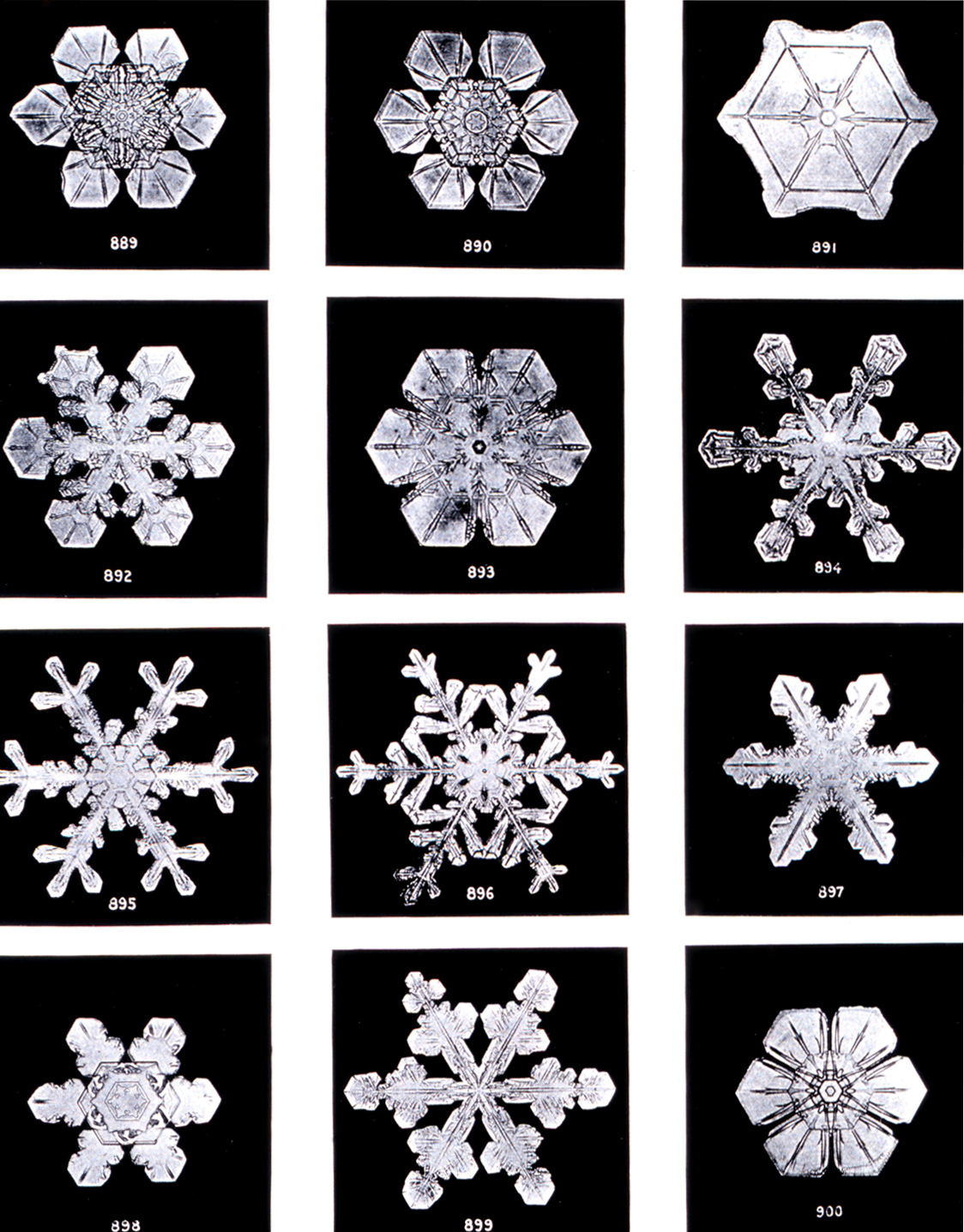
Snowflake photos by Snowflakes Bentley (Wilson Bentley), c. 1902, By Wilson Bentley – Plate XIX of “Studies among the Snow Crystals … ” by Wilson Bentley, “The Snowflake Man.” From Annual Summary of the “Monthly Weather Review” for 1902., Public Domain, https://commons.wikimedia.org/w/index.php?curid=22130

The Year in Water, 2025 – Power Shift — Brett Walton (circleofblue.org) #ColoradoRiver #COriver #aridification

Click the link to read the story map on the Circle of Blue website (Brett Walton). Here’s the Colorado River section:

December 9, 2025

The year is ending with the Colorado River at a critical juncture.

The big reservoirs Mead and Powell remain perilously low and the seven states that share the basin have been unable to agree on cuts that would reduce their reliance on the shrinking river.

Reservoir operating rules expire at the end of 2026. If no agreement is reached the federal government could step in, or the states could take their chances in court. It’s a risky move that no one in principle seems to want. Yet brinkmanship and entrenched positions have stymied compromise.

The basin’s Indian tribes, which collectively have rights to more than a quarter of its recent average annual flow, are adamant that their interests – and more broadly, the river itself – be protected. “Any progress made in the negotiations to date is merely rationing a reduced supply, not actively managing and augmenting it as a shared resource with strategies and tools that can benefit the entire basin,” the leaders of the Gila River Indian Community wrote on November 12.

The Colorado River Indian Tribes, whose riverside reservation includes lands in Arizona and California, voted in November to extend legal personhood to the river under tribal law.

Native America in the Colorado River Basin. Credit: USBR

Think Natural Flows Will Rebound in the #ColoradoRiver Basin? Think Again — Jonathan Overpeck and Bradley Udall #COriver #aridification

From the report Colorado River Insights, 2025: Dancing With Deadpool (Jonathan Overpeck and Bradley Udall):

  • Jonathan Overpeck is a climate scientist and Dean of the School for Environment and Sustainability at the University of Michigan; prior to moving to Michigan, he lived and worked in Colorado and Arizona for over 25 years.
  • Bradley Udall is a Senior Water and Climate Research Scientist/Scholar, Colorado Water Center, Colorado State University.

Basin status update

Back in 2017, we published a peer-reviewed research paper (Udall and Overpeck, 2017) asserting that climate warming was a principal cause of the then eighteen-year Colorado River drought, a drought that had already seen a 17% reduction in natural flows of the river. We expressed confidence that warming would continue to eat away at these flows until the warming (due to greenhouse gas emissions, high confidence) ceased and suggested that increases in precipitation would likely not be able to compensate for the long-term impact of rising temperatures. We used the term “Hot Drought” to distinguish this period from the “Dry Droughts in the 20th century. This important concept continues to be researched and confirmed (King et al, 2024, Zhuang et al, 2024). Now, eight years later, as the warming has continued unabated and may be accelerating (Hansen et al, 2025, Ripple et al., 2025), it has become clearer than ever that precipitation declines have also played an important role in causing the worst drought in at least 1200 years (Williams et al., 2022). More troubling, however, is new evidence that human caused climate change is not only driving a steady increase in temperature but is also the main culprit behind the precipitation declines as well.

This is clearly bad news, but there is a silver-lining. But first, let’s review where we are with respect to the unprecedented 21st century Colorado River drought, and the new evidence suggesting the situation is worse than we first thought.

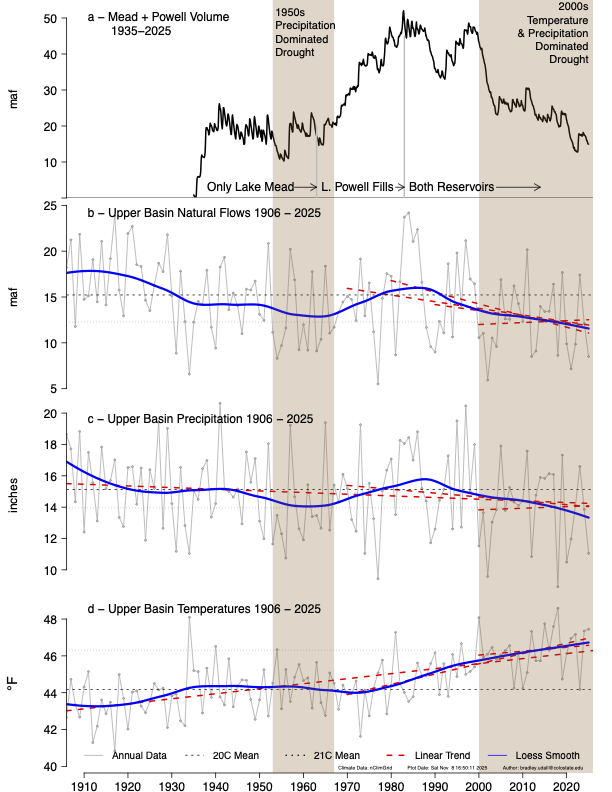
Figure 1 Udall/Overpeck 4-panel Figure Colorado River temperature/precipitation/natural flows with trend. Lake Mead and Lake Powell storage. Updated through Water Year 2025. Note the tiny points on the annual data so that you can flyspeck the individual years. Credit: Brad Udall

Each year one of us updates a figure3 that was first published in our 2017 paper showing the status of the Colorado River drought and its climate drivers. We’ve included this figure here, updated through the September 30th end of the 2024-25 water year (Figure 1). The combined volume of water stored in Lakes Mead and Powell has continued its decline to less than 15 maf (million acre-feet), the 26-year average naturalized flow of the Colorado River at Lees Ferry is now 12.2 maf, well below the 16.5 maf mainstem apportionments assigned to the seven Colorado River Basin states and Mexico. Critically, the 6 years since 2020 have averaged 10.8 maf/year, the same as the then-unprecedented low flows during 2000-05 at the start of this record-setting drought.

Matching the long slow decline in naturalized flows over the last century has been a similar long slow decline in precipitation in the Upper Basin of the Colorado (Figure 1, Panel C). Superimposed on this long trend are two notable drought periods with lower-than-average precipitation: one in the 1950’s-60’s and now the on-going current drought, at 26-years and counting, a multidecadal “megadrought” and the longest drought in the Colorado River Basin instrumental record. Mirroring the century-long declines in precipitation and naturalized flows is a long-term warming trend that started to accelerate in the 1970’s and that is clearly linked to on-going global warming (Williams et al., 2020, Masson-Delmotte et al., 2021). Whereas the former drought of record, in the 1950’s and 60’s, was defined almost entirely by precipitation deficit (Figure 1, left gray shaded area), the current megadrought is being driven by a precipitation deficit compounded by relentless warming (Figure 1, right gray shaded area).

The impact of a warming climate

As we highlighted in earlier peer-reviewed papers (e.g., Vano et al., 2014, Udall and Overpeck, 2017), warming exacerbates drought in multiple ways. A warming atmosphere can hold progressively more water, and thus as the atmosphere warms it can evaporate more water. At the same time, a warmer atmosphere can cause soils and vegetation to lose more water to the atmosphere via evapotranspiration, especially as the warming atmosphere also causes the growing season in the Upper Basin of the Colorado to become longer (Das et al., 2011; Udall and Overpeck, 2017). Hot, dry springs in the basin bring on early melt and green-up (Hogan and Lundquist, 2024, Lin et al., 2022). Drier soils and vegetation thus mean less water that can eventually end up in the river, and incidentally also explains why the West I experiencing more wildfire (Abatzoglou and Williams, 2016). Atmospheric warming also leads to snow loss, a shorter snow-cover season, and an associated loss of solar radiation reflectivity – this drives further warming and yet more evapotranspiration (Milly and Dunne, 2020; Ban et al., 2023).

Large changes in groundwater supplies in both the Upper and Lower Colorado River Basins have been noted from soil moisture to deeper layers since 2002 (Abdelmohsen et al., 2025, Chandanpurkar et al., 2025). It is becoming increasingly clear that dry summer soils can persist into the fall and winter soaking up snowmelt the following spring thereby reducing runoff (Das et al., 2011, Lapides et al, 2022).

Precipitation declining

Estimates vary, but it appears that up to half of the observed roughly 20% reduction in Colorado flows are likely related to the steadily warming temperatures of the Colorado River headwaters region (Udall and Overpeck, 2017; Xiao et al., 2018; Milly and Dunne, 2020, Bass et al, 2023). Moreover, since 2017 it has become increasingly clear that the other major cause of the flow reductions is a sustained decrease in precipitation (Figure 1, Panel C). Until recently, the big question is whether the observed 7% post-1999 decrease in precipitation relative to the 20th century average was due primarily to natural multidecadal climate variability or human-caused climate change.  We now have good reasons to suspect the latter, and this translates to mostly bad news.

Megadrought country

It is now more clear than ever that the southwest United States, including the headwater regions of the Colorado River, is megadrought country. Tree-ring and other paleoclimatic sources reveal that multiple droughts lasting two or more decades took place over the last 2000 years (Meko et al, 2007; Gangopadhyay et al., 2022), and a good case has now been made for the current drought being among the most severe in at least 1200 years in large part because of the unprecedented amplifying effect of warming temperatures during the current sustained period of reduced precipitation (Williams et al., 2020; 2022).

However, there is another important lesson to be gleaned from the rich paleoclimatic record of pre-20th Century droughts and megadroughts. Given that global temperatures were likely significantly cooler prior to the last 50 years then they are now (PAGES 2k Consortium, 2019), it follows that themany long Upper Colorado Basin droughts that took place over the last 2000 years preceding the current drought were likely due much more to precipitation deficits alone. This means that we have good evidence that precipitation deficits exceeding those of the current on-going drought in both magnitude and duration are not rare, and that the current drought could see not just warmer temperatures in the future (a sure bet), but also even larger and longer precipitation deficits. It is thus critical that we consider what is presently causing the precipitation decline in the headwaters region of the Colorado River, and from that get a better sense of what’s most likely ahead. And for motivation, since we wrote our 2017 paper, new evidence has emerged that drought-dominated periods – likely driven mostly by precipitation declines for the reason noted above – as long as 80 years have occurred in the last 2000 years in the Upper Basin of the Colorado River (Gangopadhyay et al., 2022).

The cause of precipitation decline

Could we be in for an even longer period of reduced precipitation than the last quarter. century in the years to decades ahead? The answer depends on knowing the cause of the on-going precipitation decline, and there are two primary possibilities. The first is natural climate variability in the climate system, which can cause periods of lower precipitation to oscillate irregularly with periods of higher precipitation. Thus, if the recent period of low precipitation is due to natural climate variability, there could be periods of greater precipitation returning to the Colorado headwaters, although these wet periods would be increasingly unlikely to offset the drying impact of the steadily increasing temperatures. The second potential cause of on-going precipitation deficit is an anthropogenically-forced trend in precipitation decline due to increasing human emissions of greenhouse gases and reductions in Asian, mostly Chinese, aerosols to the atmosphere.5 Such an anthropogenic trend would likely portend continued low precipitation into the future, in synch with continued warming.

One well-known source of natural variability in precipitation in the Colorado River Basin is decadal and longer variation in the sea-surface temperature patterns of the North and tropical Pacific Ocean, giving rise to what is called the Pacific Decadal Oscillation (PDO). A peer-reviewed research paper just published (Klavans et al., 2025) reviews the scientific literature and notes that decadal and longer variability in the PDO has long been thought to have arisen from atmosphere-ocean interactions internal to the natural climate system and has in turn caused decadal and longer precipitation variability downstream over western North America. The PDO is strongly correlated with La Nina, and both are known to be associated with a dry Southwest US (Seager and Ting, 2017; Lehner et al., 2018; Hoerling et al., 2023, Seager et al., 2023). Klavans et al., 2025 also presents convincing new evidence that anthropogenic forcing in the form of human emissions of greenhouse gases and reductions in atmospheric aerosols is now the primary driver of the same elevated sea-surface temperatures and this forcing is thus the primary cause behind the precipitation decline that has been observed since the start of the on-going Colorado River megadrought. In other words, human-driven climate change has caused the PDO oscillation to lock into its negative dry phase and this situation is likely to persist into the future.

A second new paper (Todd et al., 2025) highlights that higher Northern Hemisphere temperatures from about 11,000 to 6,000 years ago, in this case due to well-understood changes in the Earth’s orbit, caused a negative PDO-like Pacific warming that in turn forced western U.S. precipitation to lock into a multi-millennia-long dry phase. This new research thus provides yet more confidence that the odds will favor lowered precipitation in the Colorado River headwaters for as long as human-caused warming persists. Both new research papers (Todd et al., 2025; Klavans et al., 2025) also note that state-of-the-art climate models underestimate the role of human-caused climate change in driving persistent drought in the region containing the headwaters of the Colorado River. Natural decadal and longer climate variability clearly caused the many droughts and megadroughts of the last 2000 years, but looking ahead today, it appears that human-caused climate change is likely to exert a stronger influence, and this will mean a higher likelihood of continued lower precipitation in the headwaters of the Colorado River into the future.

Photo Credit: Kathryn Sorensen

Conclusion: bad news, good news

To sum it up, since 2017 we now know quite a bit more about how climate change is altering the flows of the Colorado River. Whereas eight years ago we were able to confidently anticipate that human-caused atmospheric warming alone would continue to reduce flows in the river, we now have a better, though still emerging, understanding of how human emissions of greenhouse gases are likely to also cause a continued reduction in precipitation in the headwaters of the Colorado River. Whereas we have known since 2017 that additional future climate warming will cause continued and even larger flow reductions, two new carefully crafted studies strongly suggest we are in for extended dry periods in the Colorado headwaters in the decades ahead.

As we hinted earlier, is important to recognize that the news is not all bad, and there is indeed a silver-lining to our improved understanding of why the natural flows of the Colorado are declining, and what this means for the future. We can say with confidence that human-caused emissions of greenhouse gases are having an increasingly negative impact on the flows of the Colorado River, a river that serves over forty million people and region that has an annual economy in excess of $1.4 trillion (James et al., 2014). This climate change impact will continue to worsen, but because humans cause it, humans can halt it. This is good to know as we work to reduce the greenhouse gas emissions to the atmosphere that are causing the climate change. The Colorado River will benefit. 

Photo Credit: Kathryn Sorensen

Literature Cited

Abatzoglou, J. T., & Williams, A. P. (2016). Impact of anthropogenic climate change on wildfire across western US forests. Proceedings of the

National Academy of Sciences, 113(42), 11770–11775. https://doi.org/10.1073/pnas.1607171113

Abdelmohsen, K., Famiglietti, J. S., Ao, Y. Z., Mohajer, B., & Chandanpurkar, H. A. (2025). Declining Freshwater Availability in the Colorado River

Basin Threatens Sustainability of Its Critical Groundwater Supplies. Geophysical Research Letters, 52(10), e2025GL115593. https://doi.org/10.1029/2025GL115593

Ban, Z., Li, D., & Lettenmaier, D. P. (2023). The Increasing Role of Seasonal Rainfall in Western U.S. Summer Streamflow. Geophysical Research

Letters, 50(9), e2023GL102892. https://doi.org/10.1029/2023GL102892

Bass, B., Goldenson, N., Rahimi, S., & Hall, A. (2023). Aridification of Colorado River Basin’s Snowpack Regions Has Driven Water Losses Despite

Ameliorating Effects of Vegetation. Water Resources Research, 59(7), e2022WR033454. https://doi.org/10.1029/2022WR033454

Chandanpurkar, H. A., Famiglietti, J. S., Gopalan, K., Wiese, D. N., Wada, Y., Kakinuma, K., Reager, J. T., & Zhang, F. (2025). Unprecedented

continental drying, shrinking freshwater availability, and increasing land contributions to sea level rise. Science Advances, 11, eadx0298

Das, T., Pierce, D. W., Cayan, D. R., Vano, J. A., & Lettenmaier, D. P. (2011). The importance of warm season warming to western U.S. streamflow

changes: WARM SEASON WARMING STREAMFLOW CHANGES. Geophysical Research Letters, 38(23), https://doi.org/10.1029/2011GL049660

Gangopadhyay, S., Woodhouse, C. A., McCabe, G. J., Routson, C. C., & Meko, D. M. (2022). Tree Rings Reveal Unmatched 2nd Century Drought in

the Colorado River Basin. Geophysical Research Letters, 49(11), e2022GL098781. https://doi.org/10.1029/2022GL098781

Hansen, J. E., Kharecha, P., Sato, M., Tselioudis, G., Kelly, J., Bauer, S. E., Ruedy, R., Jeong, E., Jin, Q., Rignot, E., Velicogna, I., Schoeberl, M. R., Von

Schuckmann, K., Amponsem, J., Cao, J., Keskinen, A., Li, J., & Pokela, A. (2025). Global Warming Has Accelerated: Are the United Nations and the

Public Well-Informed? Environment: Science and Policy for Sustainable Development, 67(1), 6–44. https://doi.org/10.1080/00139157.2025.2434494

Hoerling, M., & Kumar, A. (2003). The Perfect Ocean for Drought. Science, 299(5607), 691–694. https://doi.org/10.1126/science.1079053

Hogan, D., & Lundquist, J. D. (2024). Recent Upper Colorado River Streamflow Declines Driven by Loss of Spring Precipitation. Geophysical

Research Letters, 51(16), e2024GL109826. https://doi.org/10.1029/2024GL109826

IPCC, 2021: Climate Change 2021: The Physical Science Basis. Contribution of Working Group I to the Sixth Assessment Report of the

Intergovernmental Panel on Climate Change [Masson-Delmotte, V., P. Zhai, A. Pirani, S.L. Connors, C. Péan, S. Berger, N. Caud, Y. Chen, L. Goldfarb,

M.I. Gomis, M. Huang, K. Leitzell, E. Lonnoy, J.B.R. Matthews, T.K. Maycock, T. Waterfield, O. Yelekçi, R. Yu, and B. Zhou (eds.)]. Cambridge

University Press, Cambridge, United Kingdom and New York, NY, USA, 2391 pp. doi:10.1017/9781009157896.

James, P. T., Evans, D. A., Madly, E., & Kelly, C. (2014). THE ECONOMIC IMPORTANCE OF THE COLORADO RIVER TO THE BASIN REGION. L.

William Seidman Research Institute, W. P. Carey School of Business, Arizona State University.

King, K. E., Cook, E. R., Anchukaitis, K. J., Cook, B. I., Smerdon, J. E., Seager, R., Harley, G. L., & Spei, B. (2024). Increasing prevalence of hot drought

across western North America since the 16th century. Science Advances, 10(4), eadj4289. https://doi.org/10.1126/sciadv.adj4289

Klavans, J. M., DiNezio, P. N., Clement, A. C., Deser, C., Shanahan, T. M., & Cane, M. A. (2025). Human emissions drive recent trends in North

Pacific climate variations. Nature, 644(8077), 684–692. https://doi.org/10.1038/s41586-025-09368-2

Lapides, D. A., Hahm, W. J., Rempe, D. M., Whiting, J., & Dralle, D. N. (2022). Causes of Missing Snowmelt Following Drought. Geophysical

Research Letters, 49(19), e2022GL100505. https://doi.org/10.1029/2022GL100505

Lehner, F., Deser, C., Simpson, I. R., & Terray, L. (2018). Attributing the U.S. Southwest’s Recent Shift Into Drier Conditions. Geophysical Research

Letters, 45(12), 6251–6261. https://doi.org/10.1029/2018GL078312

Lin, Y., Takano, Y., Gu, Y., Wang, J., Zhao, B., Liou, K., & Fu, R. (2022). Investigation of Springtime Cloud Influence on Regional Climate and Its

Implication in Runoff Decline in Upper Colorado River Basin. Earth and Space Science, 9(1), e2021EA002059. https://doi.org/10.1029/2021EA002059

Meko, D. M., Woodhouse, C. A., Baisan, C. A., Knight, T., Lukas, J. J., Hughes, M. K., & Salzer, M. W. (2007). Medieval drought in the upper Colorado

River Basin. Geophysical Research Letters, 34(10). https://doi.org/10.1029/2007GL029988

Milly, P. C. D., & Dunne, K. A. (2020). Colorado River flow dwindles as warming-driven loss of reflective snow energizes evaporation. Science,

367(6483), 1252–1255. https://doi.org/10.1126/science.aay9187

PAGES 2k Consortium, Neukom, R., Barboza, L. A., Erb, M. P., Shi, F., Emile-Geay, J., Evans, M. N., Franke, J., Kaufman, D. S., Lücke, L., Rehfeld,

K., Schurer, A., Zhu, F., Brönnimann, S., Hakim, G. J., Henley, B. J., Ljungqvist, F. C., McKay, N., Valler, V., & Von Gunten, L. (2019). Consistent

multidecadal variability in global temperature reconstructions and simulations over the Common Era. Nature Geoscience, 12(8), 643–649. https://doi.org/10.1038/s41561-019-0400-0

Ripple, W. J., Wolf, C., Gregg, J. W., Rockström, J., Mann, M. E., Oreskes, N., Lenton, T. M., Rahmstorf, S., Newsome, T. M., Xu, C., Svenning, J.-C.,

Pereira, C. C., Law, B. E., & Crowther, T. W. (2024). The 2024 state of the climate report: Perilous times on planet Earth. BioScience, 74(12),

812–824. https://doi.org/10.1093/biosci/biae087

Seager, R., & Ting, M. (2017). Decadal Drought Variability Over North America: Mechanisms and Predictability. Current Climate Change Reports,

3(2), 141–149. https://doi.org/10.1007/s40641-017-0062-1

Seager, R., Ting, M., Alexander, P., Liu, H., Nakamura, J., Li, C., & Newman, M. (2023). Ocean-forcing of cool season precipitation drives ongoing

and future decadal drought in southwestern North America. Npj Climate and Atmospheric Science, 6(1), 141. https://doi.org/10.1038/s41612-023-00461-9

Todd, V. L., Shanahan, T. M., DiNezio, P. N., Klavans, J. M., Fawcett, P. J., Anderson, R. S., Jiménez-Moreno, G., LeGrande, A. N., Pausata, F. S. R.,

Thompson, A. J., & Zhu, J. (2025). North Pacific ocean–atmosphere responses to Holocene and future warming drive Southwest US drought.

Nature Geoscience, 18(7), 646–652. https://doi.org/10.1038/s41561-025-01726-z

Udall, B., & Overpeck, J. (2017). The twenty-first century Colorado River hot drought and implications for the future. Water Resources Research,

53(3), 2404–2418. https://doi.org/10.1002/2016WR019638

Vano, J. A., Udall, B., Cayan, D. R., Overpeck, J. T., Brekke, L. D., Das, T., Hartmann, H. C., Hidalgo, H. G., Hoerling, M., McCabe, G. J., & others.

(2014). Understanding Uncertainties in Future Colorado River streamflow. Bulletin of the American Meteorological Society, 95(1), 59–78.

Williams, A. P., Cook, B. I., & Smerdon, J. E. (2022). Rapid intensification of the emerging southwestern North American megadrought in 2020–

2021. Nature Climate Change, 12(3), 232–234. https://doi.org/10.1038/s41558-022-01290-z

Williams, A. P., Cook, E. R., Smerdon, J. E., Cook, B. I., Abatzoglou, J. T., Bolles, K., Baek, S. H., Badger, A. M., & Livneh, B. (2020). Large contribution

from anthropogenic warming to an emerging North American megadrought. Science, 368(6488), 314–318. https://doi.org/10.1126/science.aaz9600

Xiao, M., Udall, B., & Lettenmaier, D. P. (2018). On the Causes of Declining Colorado River Streamflows. Water Resources Research, 54(9),

6739–6756. https://doi.org/10.1029/2018WR023153

Zhuang, Y., Fu, R., Lisonbee, J., Sheffield, A. M., Parker, B. A., & Deheza, G. (2024). Anthropogenic warming has ushered in an era of temperature-

dominated droughts in the western United States. Science Advances, 10(45), eadn9389. https://doi.org/10.1126/sciadv.adn9389


Footnotes

3 https://coloradoriverscience.org/Current_conditions#The_Colorado_River_.274-panel_plot.27

4 NOAA’s nClimGrid dataset indicates that over the Upper Colorado River Basin there has been a 7% annual precipitation reduction during 2000-26 compared to 1897-1999. This reduction is not evenly spread over the seasons, however; reductions in the fall (SON), winter (DJF), spring (MAM) and summer (JJA) are 3%, 0%, 11% and 12%, respectively. Fall and winter precipitation for snowpack has thus been close to normal while spring and summer has been much reduced.

5 Sulfate aerosols are emitted in large quantities when sulfur in fossil fuels is burned. These shiny particles can end up high in the atmosphere where they reduce anthropogenic warming by reflecting sunlight. But near the surface their sulfur-based precursors cause serious human health problems and thus many countries in the last few decades have tried and succeeded in reducing these emissions. China, notably, has made great strides in reducing these emissions but the unfortunate side effect is increased warming, especially in the Pacific Ocean downwind. It is believed that this aerosol cleanup (also underway in ocean shipping) is causing at least some of the accelerated global heating now underway including the additional heating in the northern Pacific contributing to precipitation reductions in the Southwest US.

Map credit: AGU