With stakes sky high, 3 takeaways from this year’s #ColoradoRiver conference — The Las Vegas Review-Journal #CRWUA2025 #COriver #aridification

Left to right: Becky Mitchell, Tom Buschatzke, Brandon Gebhart, John Entsminger, Keith Burron, Gene Shawcroft, JB Hamby, Estevan López. Photo credit: Yes To Tap via X (Twitter)

Click the link to read the article on the Las Vegas Review-Journal website (Alan Halaly). Here’s an excerpt:

December 19, 2025

The single most important gathering of Colorado River Basin officials came and went — with no significant announcements regarding the often frustrating yet crucial seven-state negotiations for how to divvy up the river over the next 20 years…Here are three takeaways as the states wrestle with basinwide overuse of water, declining river flows due to a warming world and how to meet the federal government’s Valentine’s Day deadline for a consensus-based deal.

States far from deal — with less than 60 days left

Unlike last year’s conference, the seven states agreed to sit on a panel that was added to the agenda for the last day. The ballroom was still packed for the early morning session. That’s because the stakes are high for states to meet Burgum’s Feb. 14 deadline for a seven-state agreement. Should they not deliver one, Burgum could intervene and states are likely to sue. The Lower Basin states have agreed to shoulder the brunt of a massive deficit the system faces that totals 1.5 million acre-feet, or almost 489 billion gallons. However, the Upper Basin states of Colorado, Utah, New Mexico and Wyoming say they don’t have more water to give should cuts in their jurisdictions become necessary. Conflicts exist with state laws, too…

Temporary deal could be on the table to avoid courtroom

Nevada’s governor-appointed negotiator, John Entsminger, spoke last on the panel and called out the other six states for failing to cede any ground on further conservation in their remarks. Without some compromise from each state on these long-standing arguments, the negotiations are “going nowhere,” he said. While the states have been expected up until this point to deliver a 20-year deal, Entsminger suggested on the panel that a temporary, five-year deal could be on the table to comply with the Feb. 14 deadline.
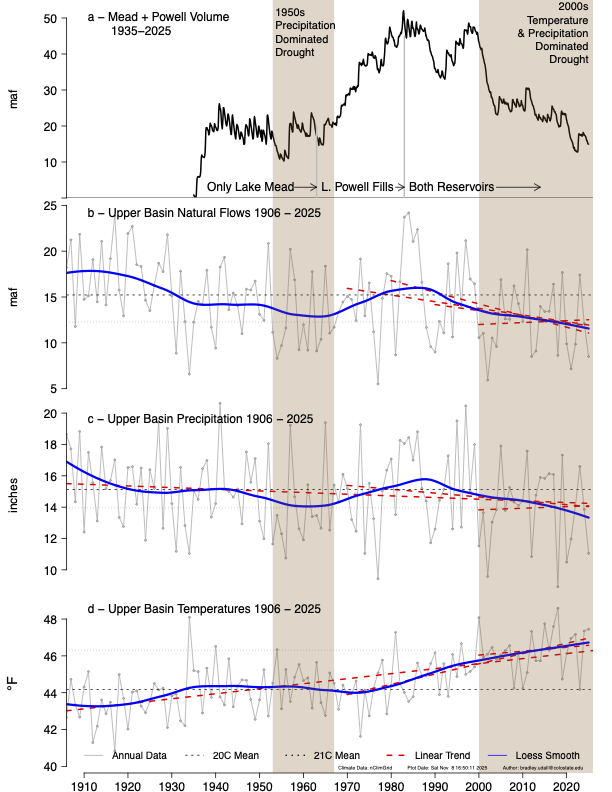
Udall/Overpeck 4-panel Figure Colorado River temperature/precipitation/natural flows with trend. Lake Mead and Lake Powell storage. Updated through Water Year 2025. Note the tiny points on the annual data so that you can flyspeck the individual years. Credit: Brad Udall

Poor outlook sending shockwaves throughout basin

The underlying issues of the Colorado River are making this moment much more precarious. Several experts presented a dismal picture for the system at large. Carly Jerla, senior water resource program manager at the Bureau of Reclamation, said the agency’s most recent projections place flows into Lake Powell anywhere between 44 percent to 73 percent of average this upcoming year. And since 2006, that replenishment of the reservoir has declined about 15 percent because of poor snow years, evaporative losses and more…

The back of Glen Canyon Dam circa 1964, not long after the reservoir had begun filling up. Here the water level is above dead pool, meaning water can be released via the river outlets, but it is below minimum power pool, so water cannot yet enter the penstocks to generate electricity. Bureau of Reclamation photo. Annotations: Jonathan P. Thompson

Jack Schmidt, who leads the Center for Colorado River Studies at Utah State University, has published several papers this year alongside a group of experts throughout the basin. By his estimation, should snowpack in the Rocky Mountains fail to impress again this winter, water managers may be blowing through a crucial buffer that ensures water can be released from Lake Powell into Lake Mead — and that hydropower generation can continue.

Map of the Colorado River drainage basin, created using USGS data. By Shannon1 Creative Commons Attribution-Share Alike 4.0

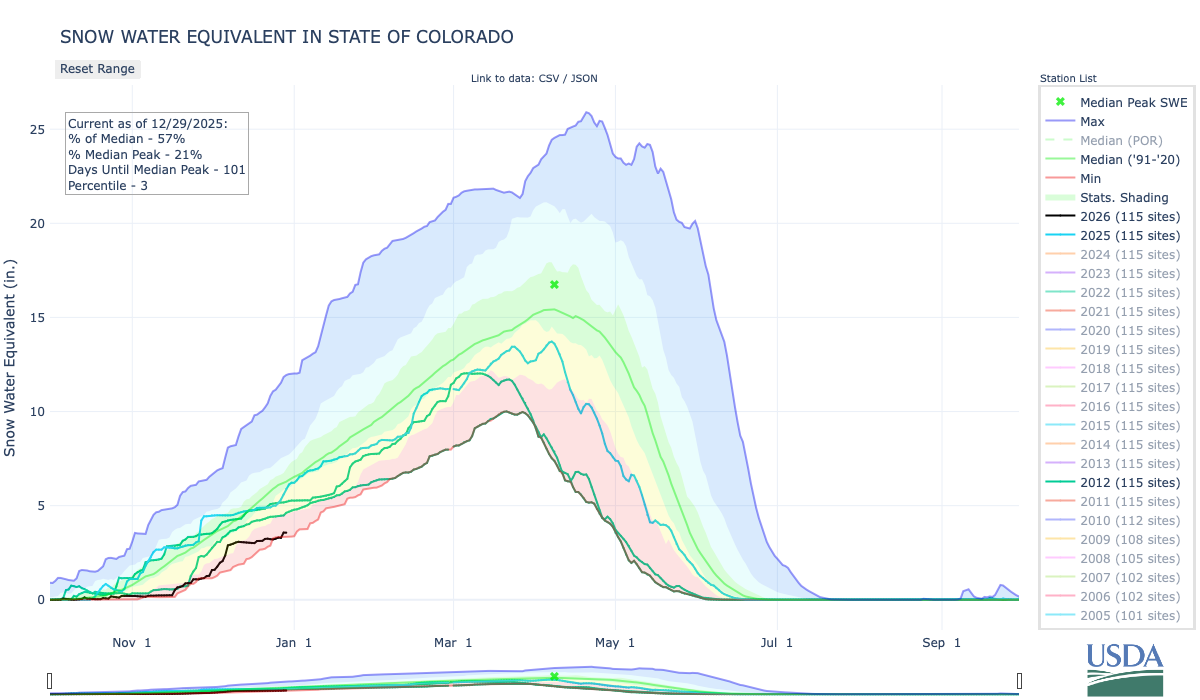
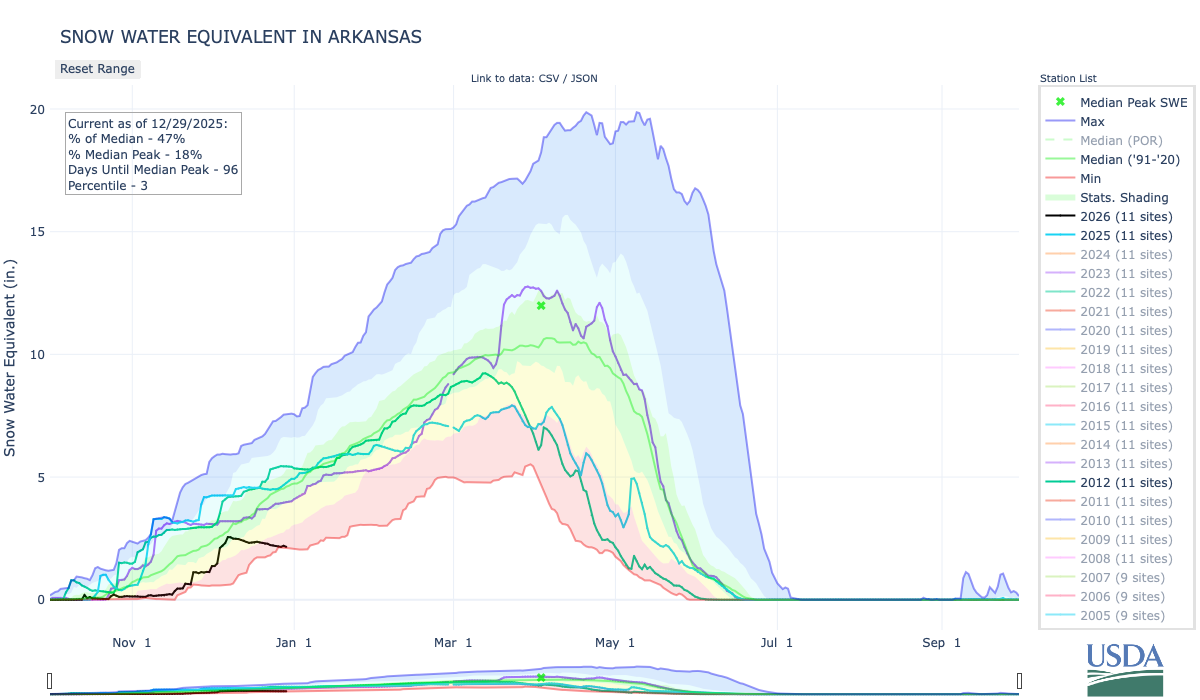
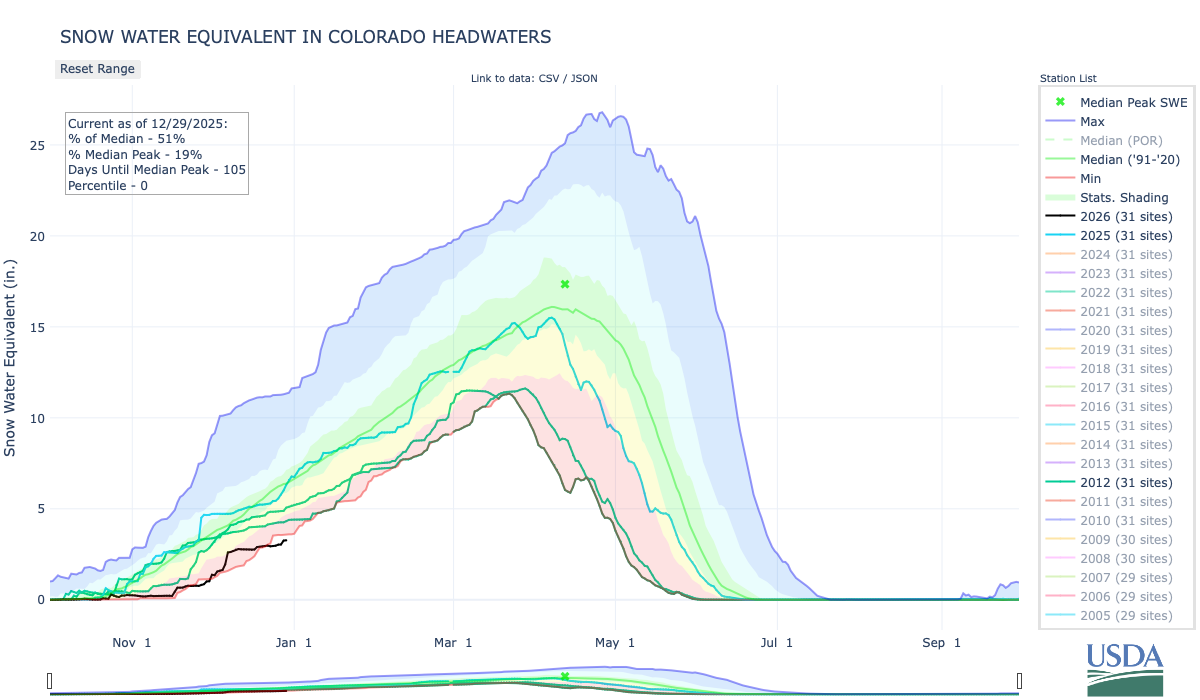
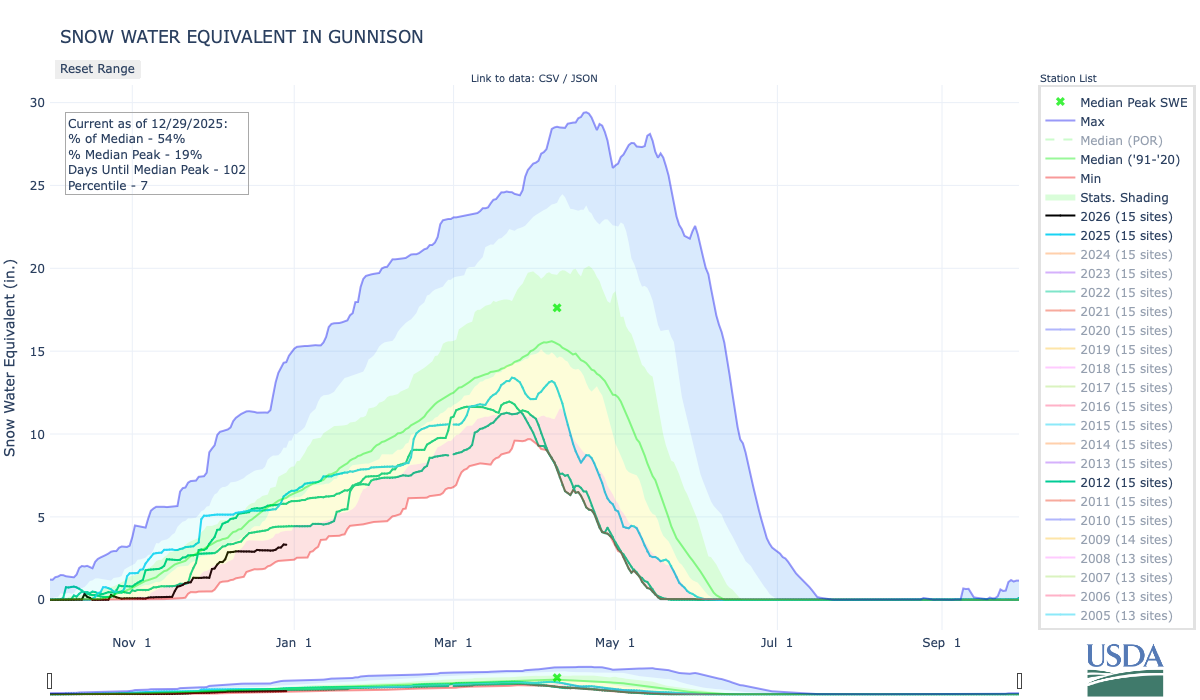
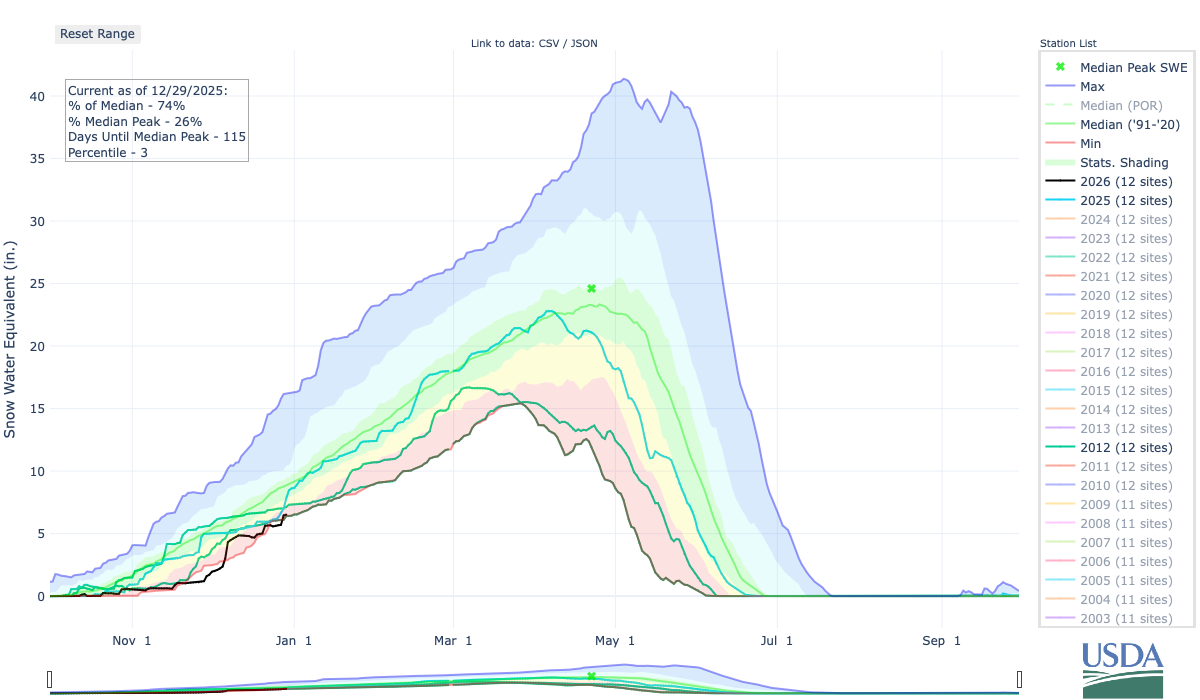
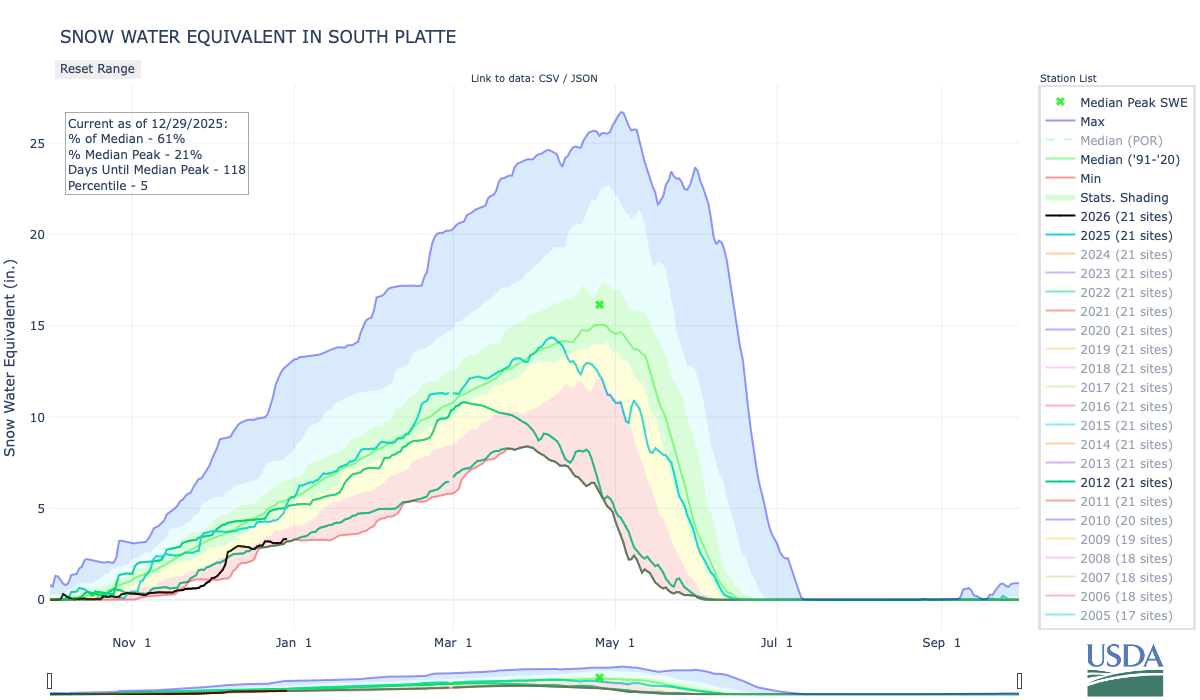
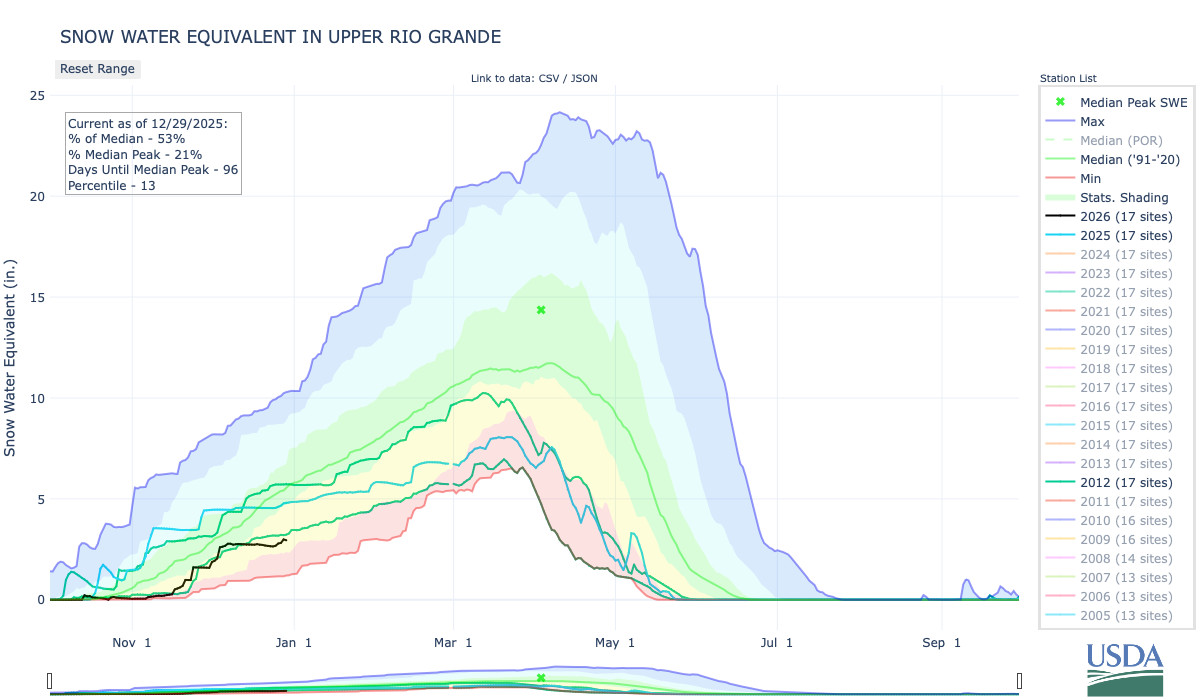
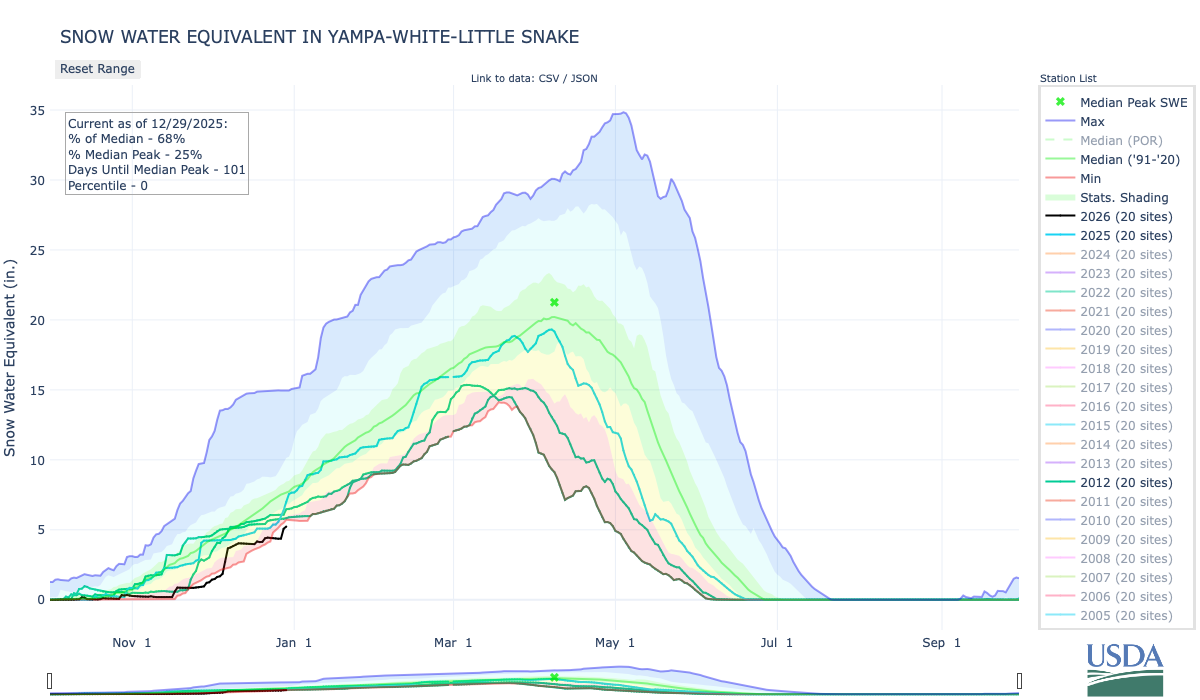
#Snowpack news December 29, 2025: Why hasn’t it snowed much this year, and what does that mean for #Colorado? — Daniel Strain (Colorado University #Boulder News)

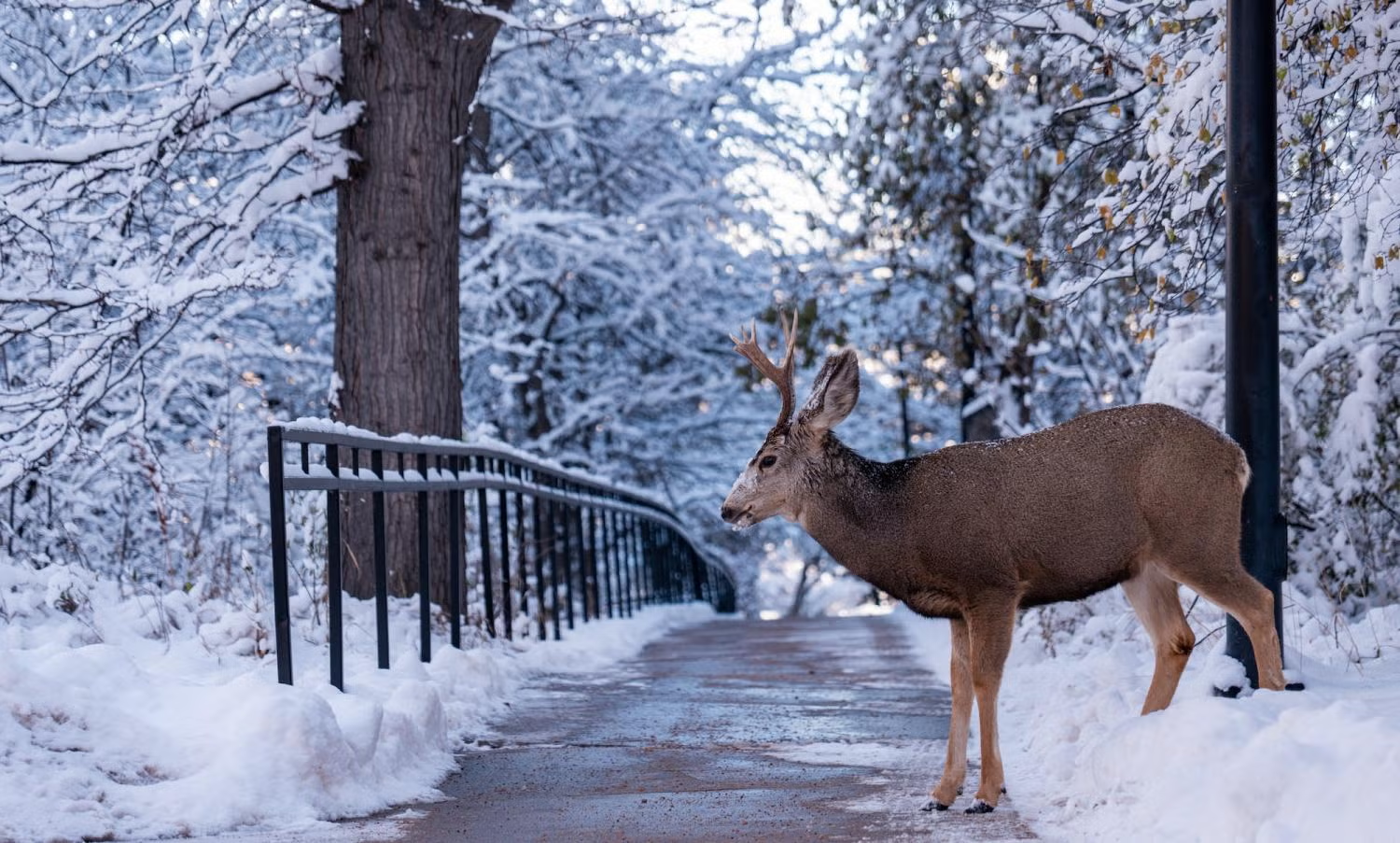
A deer on the CU Boulder campus on Dec. 3, 2025, during a short-lived dusting of snow. (Credit: Patrick Campbell/CU Boulder)

Click the link to read the article on the University of Colorado website (Daniel Strain):

December 18, 2025

ICUriosity, experts across the CU Boulder campus answer questions about humans, our planet and the universe beyond.

Jennifer Kay, professor of atmospheric and oceanic sciences and fellow at the Cooperative Institute for Research in Environmental Sciences (CIRES) at CU Boulder, talks about why this winter has been so dry.

Jennifer Kay has a message for the skies above Colorado: “Let it snow.”

Kay is an atmospheric scientist who, in her free time, likes to go cross-country skiing in the Rocky Mountains.

But this year, the season’s typical white-out blizzards haven’t arrived.

Denver didn’t get its first snow—a wimpy dusting of just 0.2 inches—until Nov. 29, the second latest first snow on record. Temperatures around the Front Range have also been downright balmy, drawing close to or even setting record highs.

Could the late start to the winter be a bad omen for Colorado’s ski industry and its future water supplies?

Kay weighs in on the question from CU Boulder’s East Campus with a view of the Flatiron Mountains behind her. They’re almost completely dry, with almost none of the sprinkling of white that usually marks them this time of year.

She says it’s not time to panic—yet.

“It’s also really early in the season still, so people shouldn’t be too worried about what’s going to happen with the ski season or water,” says Kay, a fellow at the Cooperative Institute for Research in Environmental Sciences (CIRES) at CU Boulder. “There are still a lot of different ways this season could unfold.”

In 2021, for example, Denver didn’t see its first snow until Dec. 10 (the latest on record). But snowfall totals inched closer to normal in the months that followed.

Kays says it’s not possible to predict how much snow will come to Colorado in an individual winter season months ahead of time. 

A lot of that stems from a phenomenon known as the jet stream. That’s the name for a narrow band in the atmosphere above North America where winds reach tremendous speeds, sometimes over 250 miles per hour. When this band hovers above Colorado, it tends to bring big, rumbling storms to the state.

“When the jet stream brings storms to us, we get…a lot of wet, snowy days,” Kay said. “If the jet stream goes another direction, maybe to the north or south of us, we don’t get as many snowstorms.”

But, she adds, any number of complex factors can make the jet stream wiggle from month to month—although meteorologists can often predict what the jet stream will do several days in advance.

Recently, the jet stream has stuck mostly to the north of Colorado, crossing over states like Montana and the Dakotas.

This year’s less-than-snowy winter has Kay thinking about what the future may hold.

With warming, she says, many storms that might normally produce snow may instead bring rain. That could have a wide range of consequences for the state.

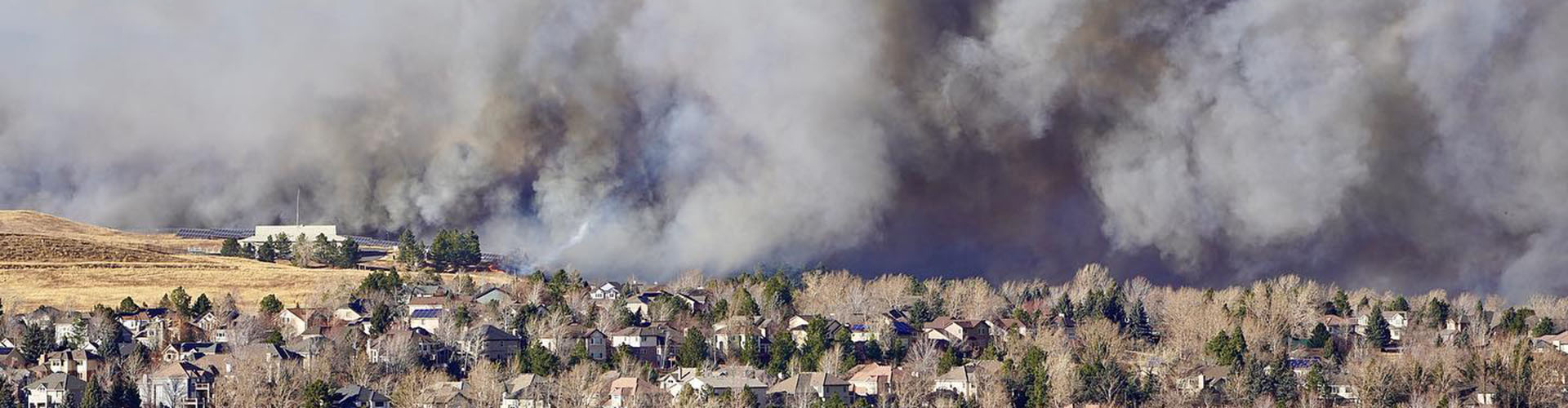
Marshall Fire December 30, 2021. Photo credit: Boulder County

A thick blanket of snow on the ground, for example, can keep wildfires from starting and spreading. The Marshall Fire, which devastated parts of Boulder County in December 2021, erupted at a time when the ground was relatively dry, and winds were especially fierce.

Kay believes it’s important for Coloradans to prepare themselves for hotter and dryer weather.

She lives in Boulder and keeps a go-bag packed at all times, even during the winter months. It includes a change of clothes, important documents, chargers for electronic devices and contact information for her neighbors. 

“I have already adapted to the reality of more fires as we get hotter and drier in Colorado,” she says. “Understanding what’s happening around you and having a plan for extreme events like the strong wind events we have along the Front Range is important.”

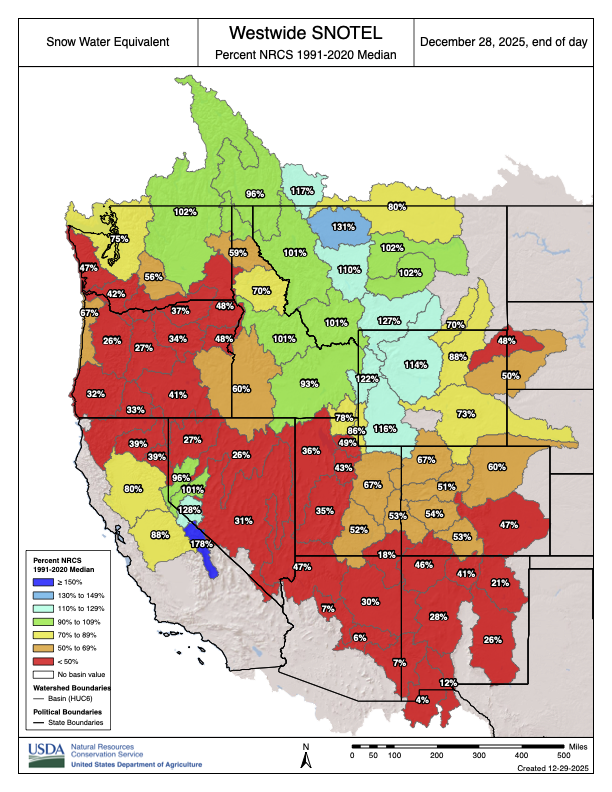
Westwide SNOTEL basin-filled map December 28, 2025.
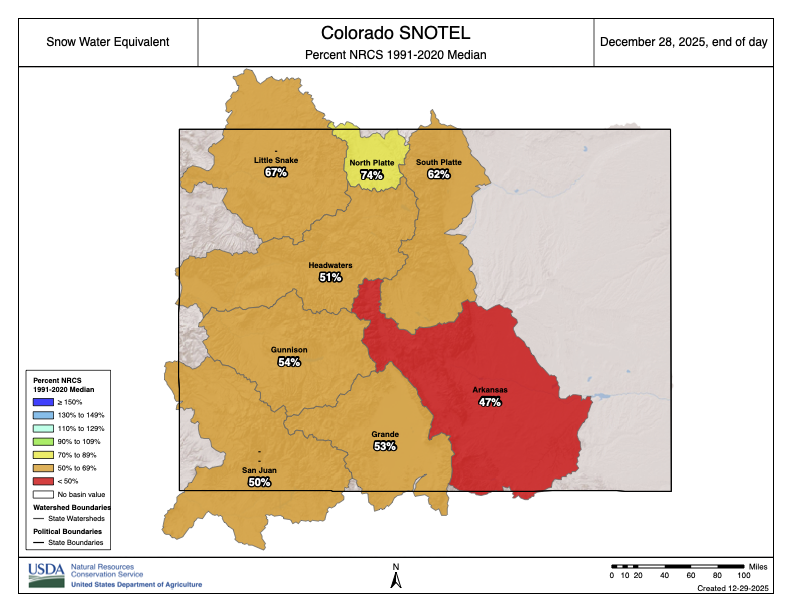
Colorado snowpack basin-filled map December 28, 2025.