

Click the link to read the article on the Las Vegas Review-Journal website (Alan Halaly). Here’s an excerpt:
December 19, 2025
The single most important gathering of Colorado River Basin officials came and went — with no significant announcements regarding the often frustrating yet crucial seven-state negotiations for how to divvy up the river over the next 20 years…Here are three takeaways as the states wrestle with basinwide overuse of water, declining river flows due to a warming world and how to meet the federal government’s Valentine’s Day deadline for a consensus-based deal.
States far from deal — with less than 60 days left
Unlike last year’s conference, the seven states agreed to sit on a panel that was added to the agenda for the last day. The ballroom was still packed for the early morning session. That’s because the stakes are high for states to meet Burgum’s Feb. 14 deadline for a seven-state agreement. Should they not deliver one, Burgum could intervene and states are likely to sue. The Lower Basin states have agreed to shoulder the brunt of a massive deficit the system faces that totals 1.5 million acre-feet, or almost 489 billion gallons. However, the Upper Basin states of Colorado, Utah, New Mexico and Wyoming say they don’t have more water to give should cuts in their jurisdictions become necessary. Conflicts exist with state laws, too…
Temporary deal could be on the table to avoid courtroom
Nevada’s governor-appointed negotiator, John Entsminger, spoke last on the panel and called out the other six states for failing to cede any ground on further conservation in their remarks. Without some compromise from each state on these long-standing arguments, the negotiations are “going nowhere,” he said. While the states have been expected up until this point to deliver a 20-year deal, Entsminger suggested on the panel that a temporary, five-year deal could be on the table to comply with the Feb. 14 deadline.
Poor outlook sending shockwaves throughout basin
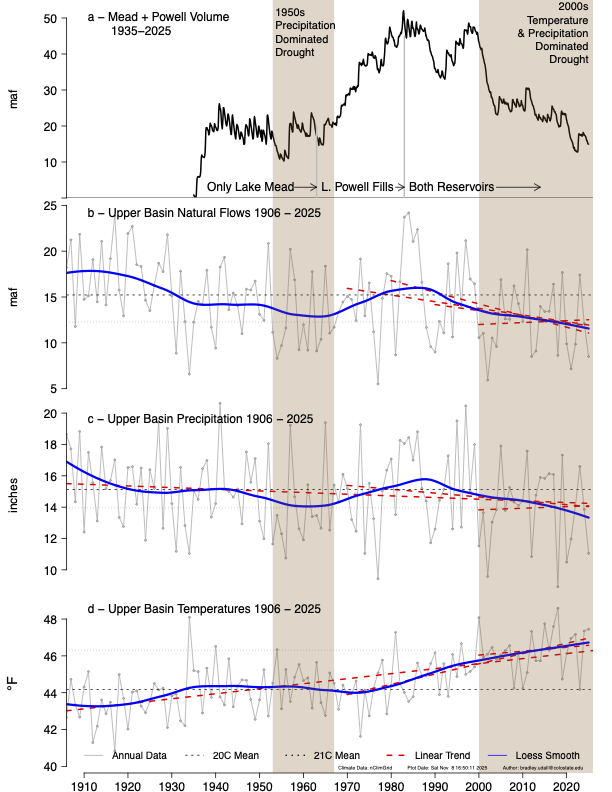
The underlying issues of the Colorado River are making this moment much more precarious. Several experts presented a dismal picture for the system at large. Carly Jerla, senior water resource program manager at the Bureau of Reclamation, said the agency’s most recent projections place flows into Lake Powell anywhere between 44 percent to 73 percent of average this upcoming year. And since 2006, that replenishment of the reservoir has declined about 15 percent because of poor snow years, evaporative losses and more…

Jack Schmidt, who leads the Center for Colorado River Studies at Utah State University, has published several papers this year alongside a group of experts throughout the basin. By his estimation, should snowpack in the Rocky Mountains fail to impress again this winter, water managers may be blowing through a crucial buffer that ensures water can be released from Lake Powell into Lake Mead — and that hydropower generation can continue.
