
Click the link to read the article on the Denver Water website (Todd Hartman):
July 8, 2025
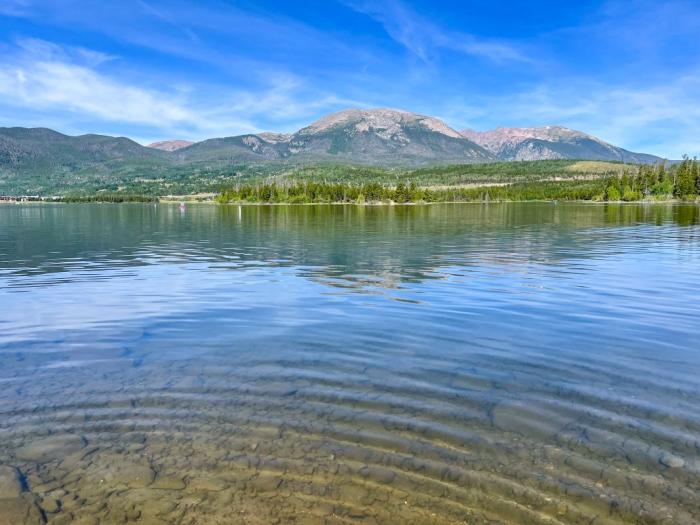
In early July, Denver Water’s reservoirs filled nearly to the brim, holding the most water they’ll hold this year.
Nearly full reservoirs are certainly good news for Denver Water and the 1.5 million people who rely on the water stored in them every day. But for the utility’s water watchers, 2025’s “peak storage” moment was a letdown — and even a warning of sorts.
Why?
Initial forecasts had suggested more water might run downhill, enough to fill the reservoirs and also provide extra water that could spill and boost river flows. But dry conditions in Colorado’s high country during April, May and June sapped that extra runoff, as drier soils and warmer air soaked up the potential excess.
“We thought we were going to have some excess water to play with this year,” said Nathan Elder, Denver Water’s manager of water supply. “But as it turned out we just barely saw enough runoff to fill our reservoirs.”
This year’s quick turn from abundant supplies to just-enough-to-almost-fill is another reminder that even in years when overall snowpack is reasonably good, such as this past winter, we can’t take water supplies for granted. That’s even more apparent in an era of climate change, when warming temperatures and longer dry spells can quickly shrink projected water supplies.
And as the hot summer irrigation season begins on the Front Range, it’s a reminder to residents to be thoughtful with outdoor water use: Adhere to watering rules, turn off irrigation systems during wet stretches, and think about changes to your landscape that, over time, will reduce watering needs.
And, keep in mind, half of Denver Water’s supply comes from the West Slope, where a dry spring is making supplies tight.
“Back on April 1, we thought we were going to be ‘filling and spilling,’” Elder said. “But we saw streamflow forecasts really drop and even in the Colorado River Basin, where we had a solid snowpack, it did not translate into the supplies we expected.”

At least one key reason for the swift turn from a forecast for “filling and spilling” to just enough runoff to fill Denver Water’s reservoirs was lack of precipitation — just 50% to 70% of normal — in April, May and June in the mountainous counties of Park, Grand and Summit where Denver Water collects supplies.
That dry spell helped drive runoff down, especially in the South Platte Basin. The amount of spring runoff flowing to Strontia Springs southwest of Denver has been only 46% of normal, below an already weak forecast of 60%. Inflows into Dillon have also been lower than expected, just 75% of normal after forecasts of 100%.
As a result, Denver Water’s supply reservoirs peaked July 1, at just 95% of capacity and are now being drawn down as summer watering season gets into full swing. (One caveat: The peak storage number would have been a bit higher, closer to 97%, but for a storage limitation at Gross Reservoir while construction activities continue on the expansion project there.)
Denver Water hopes to see its reservoirs hit 100% of their storage capacity every year. This year’s shortfall across the reservoir system was about 7,500 acre feet, enough water to supply more than 15,000 households for a year.
“We missed filling by a relatively small amount, but we never know if this is a short-term situation or the start of the next drought,” Elder said. “We have filled up those saving accounts and now our reservoirs only go down from here with the peak of the heat season. So, we ask customers to stick to our rules and water with care.”
In addition to the lower-then-expected peak storage numbers, Denver Water also faces another “substitution year” on the West Slope.
That is a technical way of saying Denver Water must release water from its West Slope reservoirs to make up for a shortage of water in the federally operated Green Mountain reservoir downstream from Dillon Reservoir. The water will serve downstream water users on the Colorado River.
Substitution years are uncommon, usually required once or twice per decade. But, at least in recent years, that’s changing, with such “water refunds” from Denver Water required in 2021, 2022 and now, 2025.
“That is another thing that, like the spring dry-up in the mountains, we didn’t expect this year,” Elder said.
But other aspects of the state’s weather in recent months have been more positive.
Big rains in the metro region in May and June kept water usage down and sent a lot of water down the South Platte River to farmers and communities. That supply boost helped reduce calls for Denver Water to bypass additional water, leaving it in the streams, to meet those downstream demands.
“Those storms really helped us out; we haven’t had to run big exchanges and send our reservoir water down to meet those needs,” Elder said.
The wet weather locally also cut down on outdoor watering, as customers paid attention to weather and shut off sprinklers. June water use in Denver Water’s service area was just 94% of average, a system-wide water savings of 1,600 acre feet compared to anticipated demands during June.
Finally, as water watchers do every year about this time, we look to the monsoon season to bring helpful afternoon rainstorms in July and August, which can also drive down water demand.
“The less we can draw on our reservoirs,” Elder said, “the better chance we can fill up again next season.”