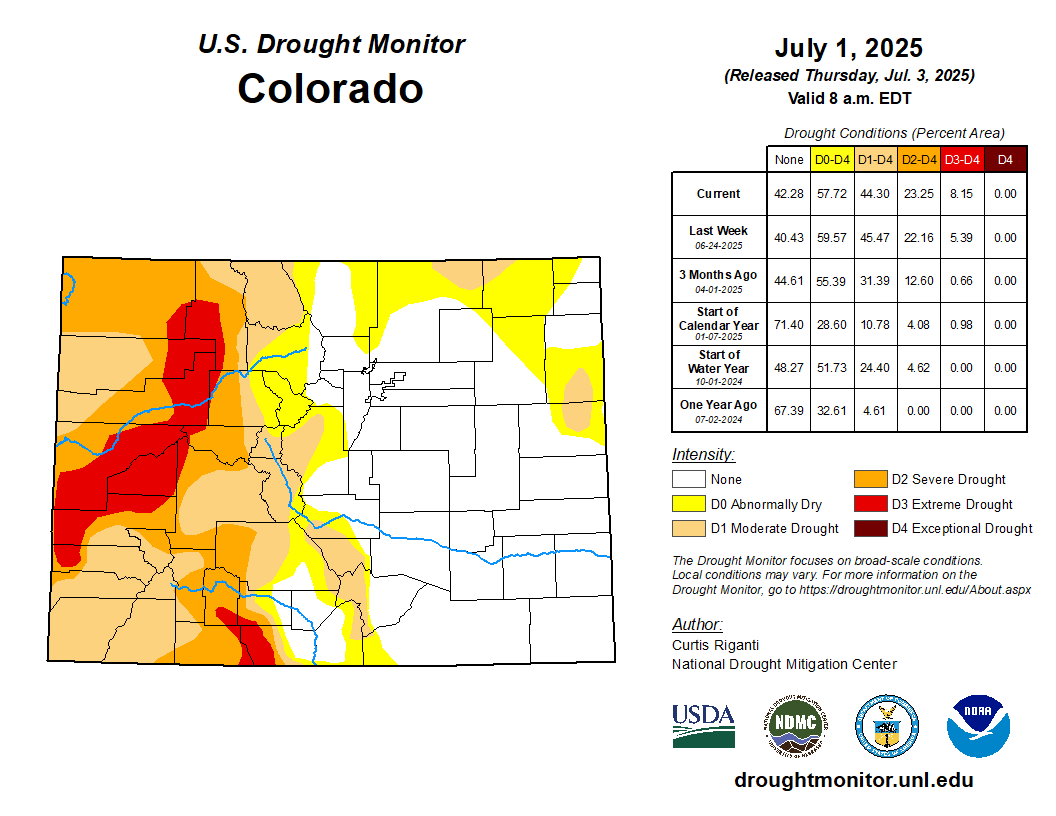
#Drought news July 3, 2025: Primarily dry weather occurred west of the Continental Divide of the Americas in #Colorado and #Wyoming where degradations occurred due to soil moisture and streamflow deficits amid growing precipitation deficits

Click on a thumbnail graphic to view a gallery of drought data from the US Drought Monitor website.
Click the link to go to the US Drought Monitor website. Here’s an excerpt:

This Week’s Drought Summary

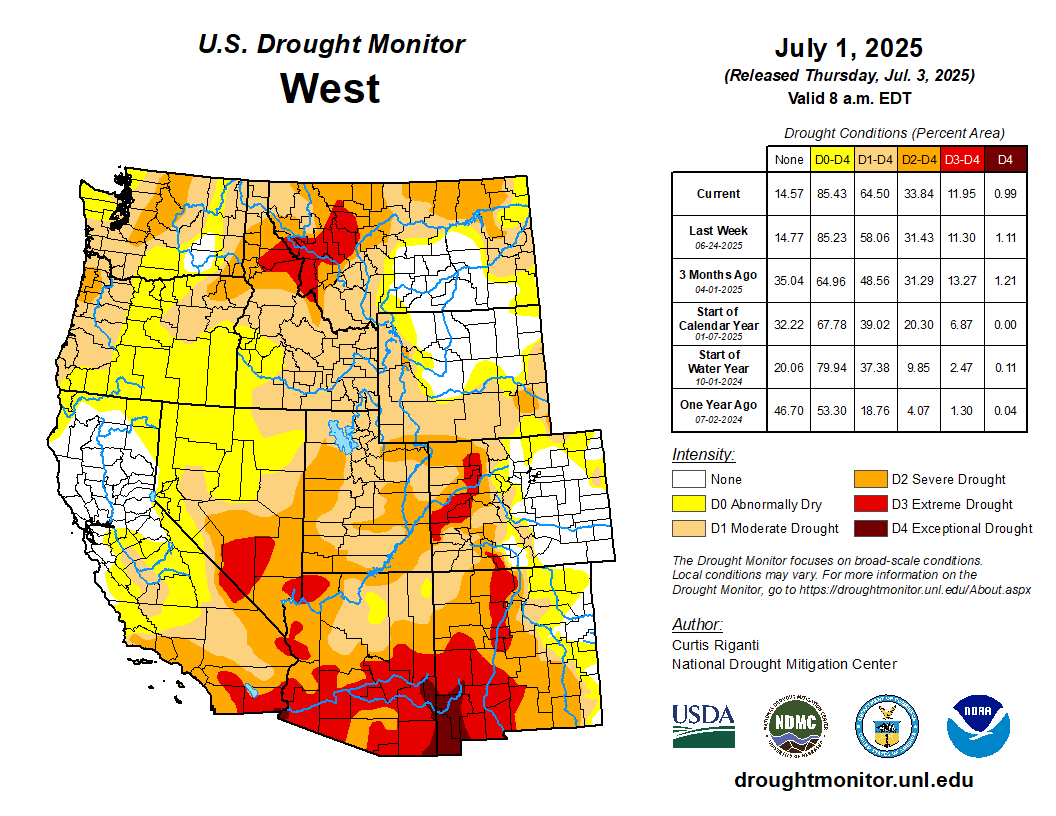
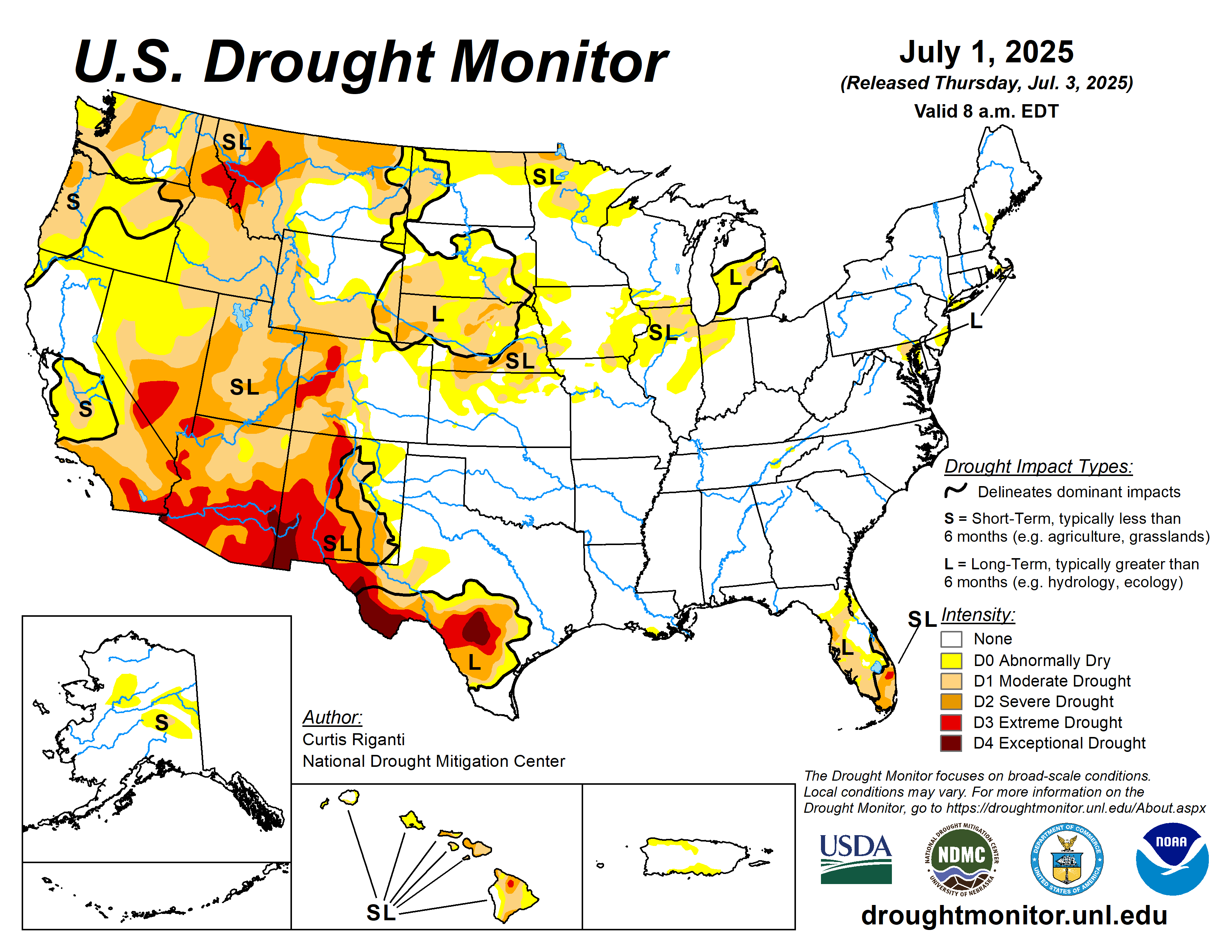
Over the past week, scattered heavy rains fell over parts of the central Great Plains and Upper Midwest. Rain amounts were especially heavy in parts of Nebraska and Minnesota, where locally 8 or more inches of rain fell. These rains helped to alleviate drought and abnormal dryness in some areas. A few areas of the Dakotas, Minnesota, Indiana and Illinois that missed heavier rains saw localized degradations. Heavy monsoonal rain and thunderstorms also occurred in parts of west Texas and New Mexico, leading to some improvements to ongoing drought and abnormal dryness there. Meanwhile, most areas west of the Continental Divide remained dry or mostly dry. This continued dry weather led to further degradation in drought and abnormal dryness, especially in the Northwest, where severe and extreme drought developed or expanded in coverage. Conditions in the Southeast and central Gulf Coast were mostly quiet this week, though a few areas in east Tennessee and southern Louisiana saw localized abnormal dryness develop given short-term precipitation deficits and declining soil moisture. Heavier rains fell across parts of Florida, leading to some reduction in drought and abnormal dryness coverage in the Florida Peninsula. Well-above-normal temperatures occurred in the Ohio Valley, Mid-Atlantic and Lower Great Lakes regions, where temperatures ranging from 4-8 degrees above normal, and locally 10 degrees hotter than normal, were common. The Northwest was also warmer than normal this week, with most areas checking in with warm anomalies of 2-6 degrees. Southeast New Mexico and west Texas finished the week 2-8 degrees cooler than normal owing to rain and clouds from the North American Monsoon, which became much more active this week.

A mix of improvements and degradations occurred across Hawaii, where vegetation and streamflows responded to recent rainfall or lack thereof.

Scattered heavier showers fell across parts of Alaska, while some locations that missed out saw fire danger increase, leading to a mix of improvements and degradations.

Short-term rainfall deficits continued to build in north-central and south-central Puerto Rico, leading to localized increases in abnormal dryness coverage…

High Plains

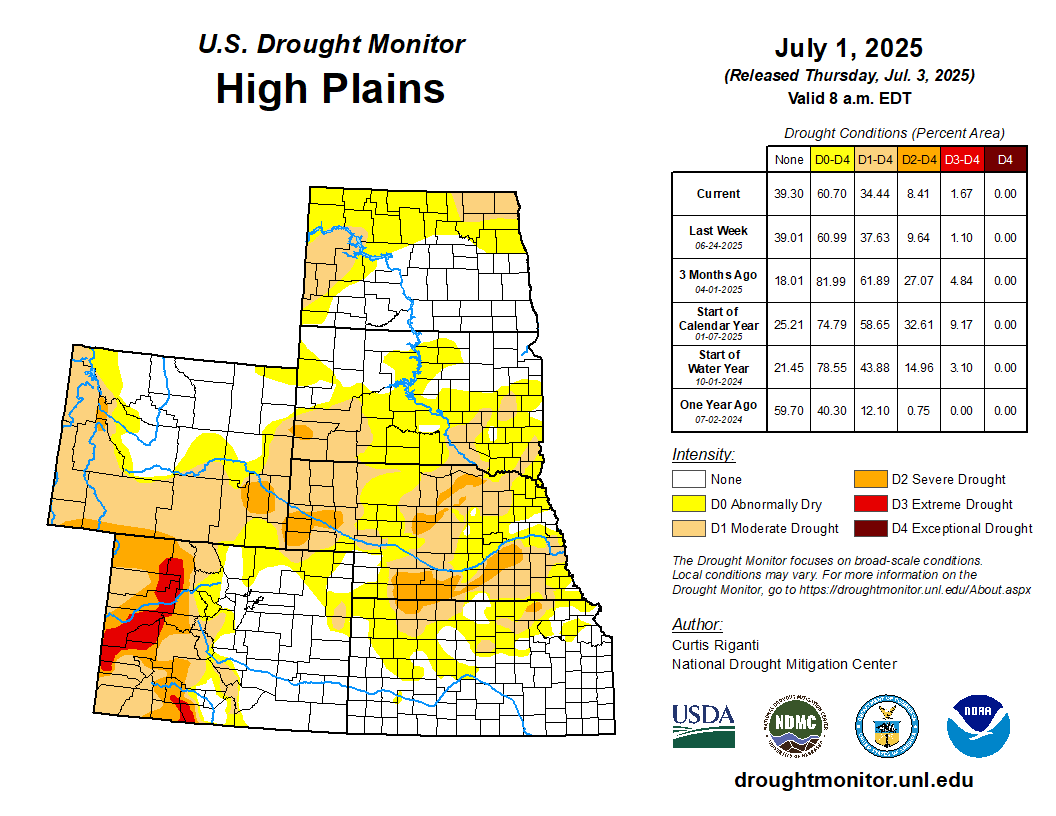
Very heavy rain fell across parts of southwest and central Nebraska, which extended into portions of northern Kansas (north of Interstate 70) and portions of west-central and eastern South Dakota. Significant flash flooding occurred from rain amounts locally exceeding 8 inches in Grand Island, Nebraska, while very heavy rain, locally in excess of 5 inches, fell in parts of eastern South Dakota, where significant tornadoes also occurred on June 28. Heavier rain amounts fell in parts of south-central and northeast Colorado as well, though most of the heavier totals were in the 1-3 inch range. Primarily dry weather occurred west of the Continental Divide in Colorado and Wyoming. Temperatures across the region were mostly near normal to 2-4 degrees above normal, though parts of the eastern Dakotas were a few degrees cooler than normal. In areas that received heavy rain, soil moisture and precipitation deficits were alleviated and widespread improvements to ongoing drought or abnormal dryness occurred, including a two-category improvement in central Nebraska where some of the week’s heaviest rains fell. Meanwhile, degradations occurred in northwest Colorado and western Wyoming, where soil moisture and streamflow deficits mounted amid growing precipitation deficits…
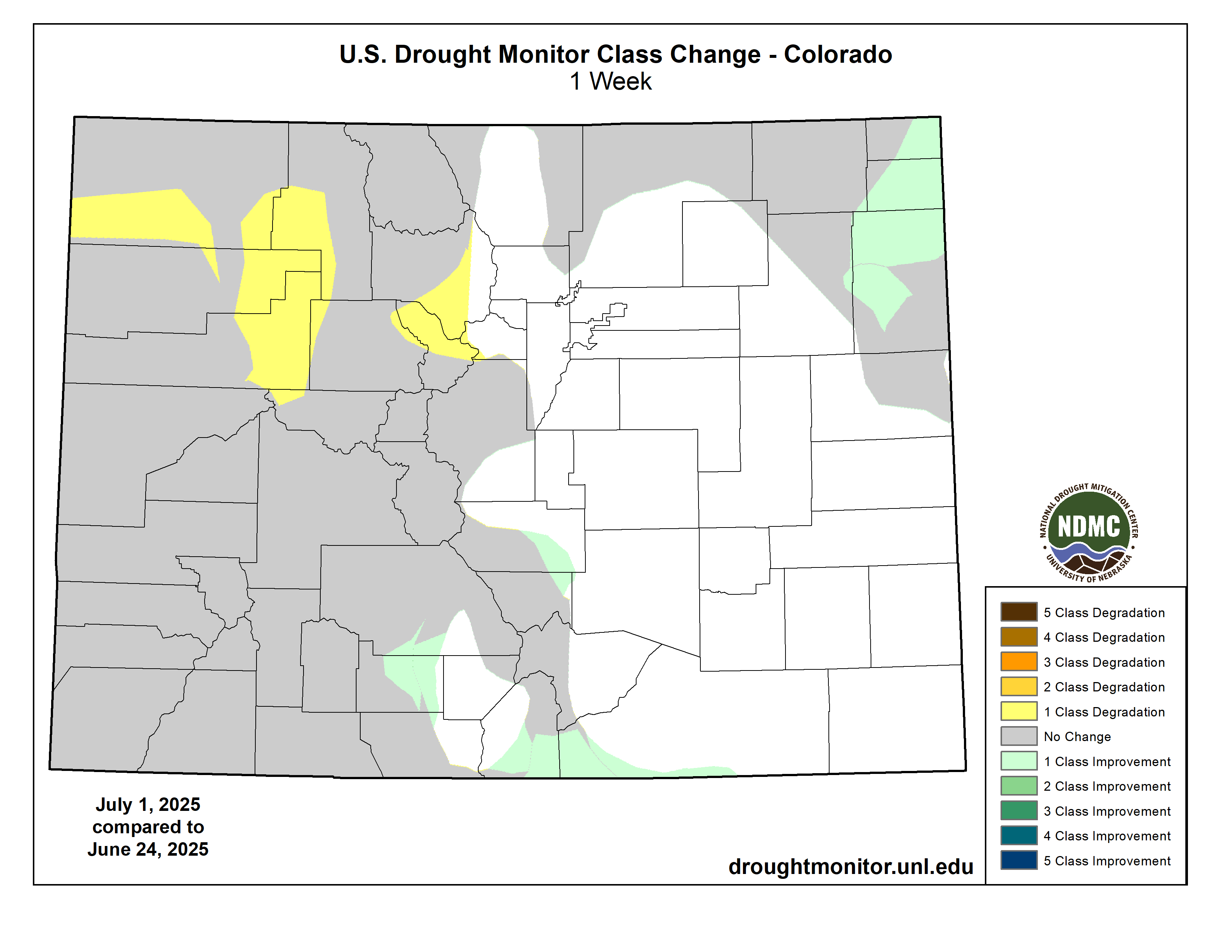
Colorado Drought Monitor one week change map ending July 1, 2025.

West

Heavy monsoonal rains fell this week in parts of New Mexico, excluding the far northwest. Elsewhere, this week’s weather was almost entirely dry. Combined with warmer-than-normal temperatures (mostly by 2-6 degrees) in the Northwest states, this led to widespread degradation in drought and abnormal dryness for central and northern Utah, Idaho, parts of northern and much of western Montana, and Washington. Very low streamflows and large short-term precipitation deficits contributed to widespread expansion of severe and extreme drought in western Montana and adjacent Idaho. Short-term severe drought also occurred in parts of central and north-central Washington, where deficits in precipitation and streamflow continued to grow. In much of New Mexico, excluding the far west and northwest portions, near- or below-normal temperatures were common this week along with some heavier rainfall amounts exceeding 2 inches (locally exceeding 5 inches). The improved soil moisture and lessened precipitation deficits led to widespread improvements to ongoing drought and abnormal dryness in southeast, southwest and north-central New Mexico. Exceptional drought expanded slightly along part of the Arizona-New Mexico state line where deficits in groundwater and precipitation continued to mount…

South

Heavy monsoonal rains fell this week across portions of west Texas, with local amounts of 2-3 inches or more. Heavy rains of 2-3 inches or more also fell across parts of northeast Oklahoma, and southwest Tennessee. Elsewhere, rainfall amounts of at least 2 inches were less common, while southern Arkansas and northern Louisiana, northwest Oklahoma and portions of central Texas saw mostly dry weather this week. In west Texas, under the monsoonal rainfall, temperatures were 4-8 degrees cooler than normal in some areas. Elsewhere across the region, temperatures were mostly 2-4 degrees warmer than normal in Arkansas and northern Mississippi, while temperatures were mostly 2-6 degrees warmer than normal in Tennessee. Outside of Texas, the South region remained almost entirely free of drought or abnormal dryness. However, around a few localized areas of short-term precipitation and soil moisture deficits, a few small areas of abnormal dryness developed in southern Louisiana and eastern Tennessee. In west Texas, heavy rains from the North American Monsoon helped to partially alleviate short- and long-term precipitation deficits and improve soil moisture quantity…
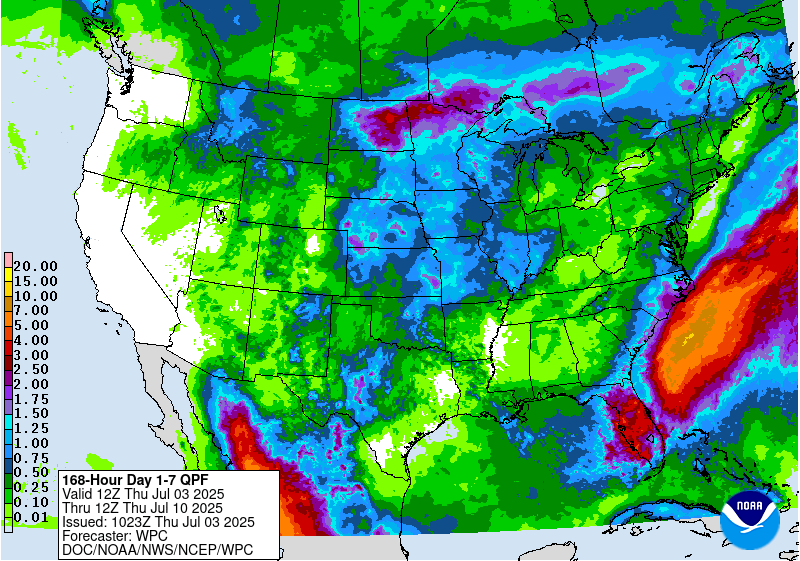
Looking Ahead

The National Weather Service Weather Prediction Center is forecasting a few areas of rainfall exceeding 1 inch for the period through the evening of Monday, July 7. Localized 1-inch or greater totals are possible in locations in New Mexico, northwest Texas, central and eastern Oklahoma, northern Kansas and Nebraska into the Upper Midwest and northern Great Plains, western Montana, and the Florida Peninsula, perhaps extending to the Southeast’s Atlantic coastline as a weather disturbance moves through. Heavy rain amounts exceeding 3 inches are forecast in portions of the Florida Peninsula, especially along much of its Gulf coast. Mostly dry weather is expected from the Intermountain West to the Pacific Ocean and across much of south Texas, Mississippi, Alabama, Georgia and the southern Mid-Atlantic.

For July 8-12, the National Weather Service Climate Prediction Center forecast strongly favors warmer-than-normal temperatures in the western Contiguous U.S., especially west of the Continental Divide. Warmer-than-normal temperatures are also favored in the eastern U.S., especially from Virginia southward to Florida. Near- or below-normal temperatures are favored for parts of the southern and central Great Plains and western portions of the Midwest. Below-normal precipitation is favored from northern Arizona across Utah, Nevada, southern Idaho, much of Oregon and southwest Washington. Above-normal precipitation is slightly favored in southern Arizona and southern and eastern New Mexico eastward across much of the Contiguous U.S.

In Alaska, above-normal precipitation is favored across much of the state, especially in the eastern half and excluding the far west reaches. Cooler-than-normal temperatures are favored across most of Alaska, especially central and eastern portions of Alaska.

In Hawaii, warmer-than-normal temperatures are favored from Molokai westward. Above-normal precipitation is favored throughout Hawaii.
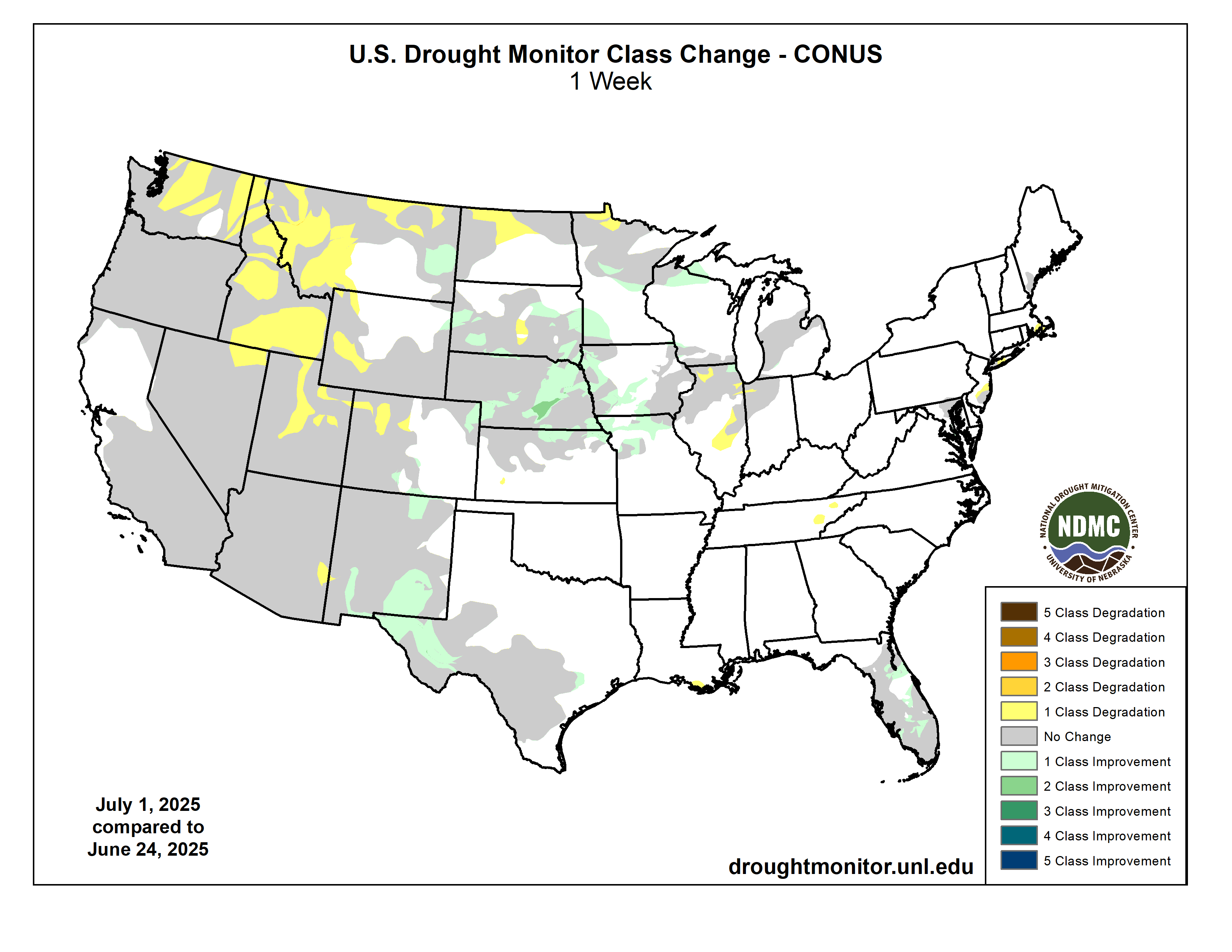
US Drought Monitor one week change map ending July 1, 2025.

Riparian restoration on Rifle ranch marks 10 years: John Powers hopes #RifleCreek project can be living lab for improving habitat — Heather Sackett (AspenJournalism.org)

Rifle ranch owners John Powers, left, and plant ecologist Lisa Tasker talk about the Rifle Creek restoration project at a tour of the property on June 3. The project has replaced invasive species with native plants. CREDIT: HEATHER SACKETT/ASPEN JOURNALISM

Click the link to read the article on the Aspen Journalism website (Heather Sackett):

June 18, 2025

The banks of a previously degraded 1-mile stretch of Rifle Creek are now thick with willows and cottonwoods, and have signs that deer, elk and beavers are once again frequent visitors. 

This summer marks 10 years since an ambitious, multiphase riparian restoration project began on John Powers’ ranch, located north of Rifle and off Colorado 325. Since 2016, the property has been a worksite of the Colorado Natural Heritage Program, which has cataloged species; replaced invasive Russian olive, thistles and weeds with native trees, flowers, shrubs and grasses; and trained the next generation of scientists and conservationists on how to restore the health of a stream. 

On June 3, Powers, who is a self-described lover of the outdoors, along with friend and associate Janna Six, as well as interns from CNHP, hosted a public-outreach day with conservation professionals who worked on the project, including representatives from local governments, agencies and nonprofit organizations, for a tour of the project. Powers called it a living lab for education and hopes it can serve as a demonstration project for other ranches in the area that want to control erosion. 

A decade ago, the banks of the creek were severely eroded — bare of vegetation in places and steep. Part of the reason for these conditions is the upstream Rifle Gap Reservoir, which was completed in 1967. Sediment collects behind the dam, meaning the water released downstream is clean and erosive, cutting into the streambanks. The three-phase project sought to remedy that.

ā€œRifle Creek used to be shallow, allowing horse-drawn hay wagons to cross it,ā€ Powers said in a written response to questions from Aspen Journalism. ā€œAfter the Rifle Gap Reservoir was built, severe erosion occurred downstream, making creek banks vertical and 12-15 feet deep.ā€

Powers said the goals of the project are to improve the habitat for songbirds, pollinators and wildlife; increase carbon sequestration, including cultivating healthy soil and minimizing erosion; and maintain the economic benefits of a working ranch while enhancing the ecological condition of the riparian area.

Small cottonwoods and other native trees have fencing to protect them from wildlife and livestock until they get established. The riparian restoration project on the Powers Ranch near Rifle planted thousands of native trees, shrubs and grasses. CREDIT: HEATHER SACKETT/ASPEN JOURNALISM

The thousands of native plants were put in over a three-year intensive effort by volunteers and interns, led by plant ecologist Lisa Tasker. Some are protected by fencing from wildlife and livestock until they become established, and are watered with a drip irrigation system. 

ā€œMy hope is that I live long enough that I won’t be able to see one side of the creek from the other side of the creek,ā€ Powers told tour participants.

David Anderson, director and chief scientist at CNHP, said conditions on the ranch have changed dramatically for the better over the past decade due to the restoration work.

ā€œWe’re seeing a lot more birds now that there’s some woody structure,ā€ he said. ā€œThere’s just a whole different suite of wildlife that can utilize the riparian area there now.ā€

Anderson added that with the new vegetation providing shade to cool the stream, conditions for native fish will improve.

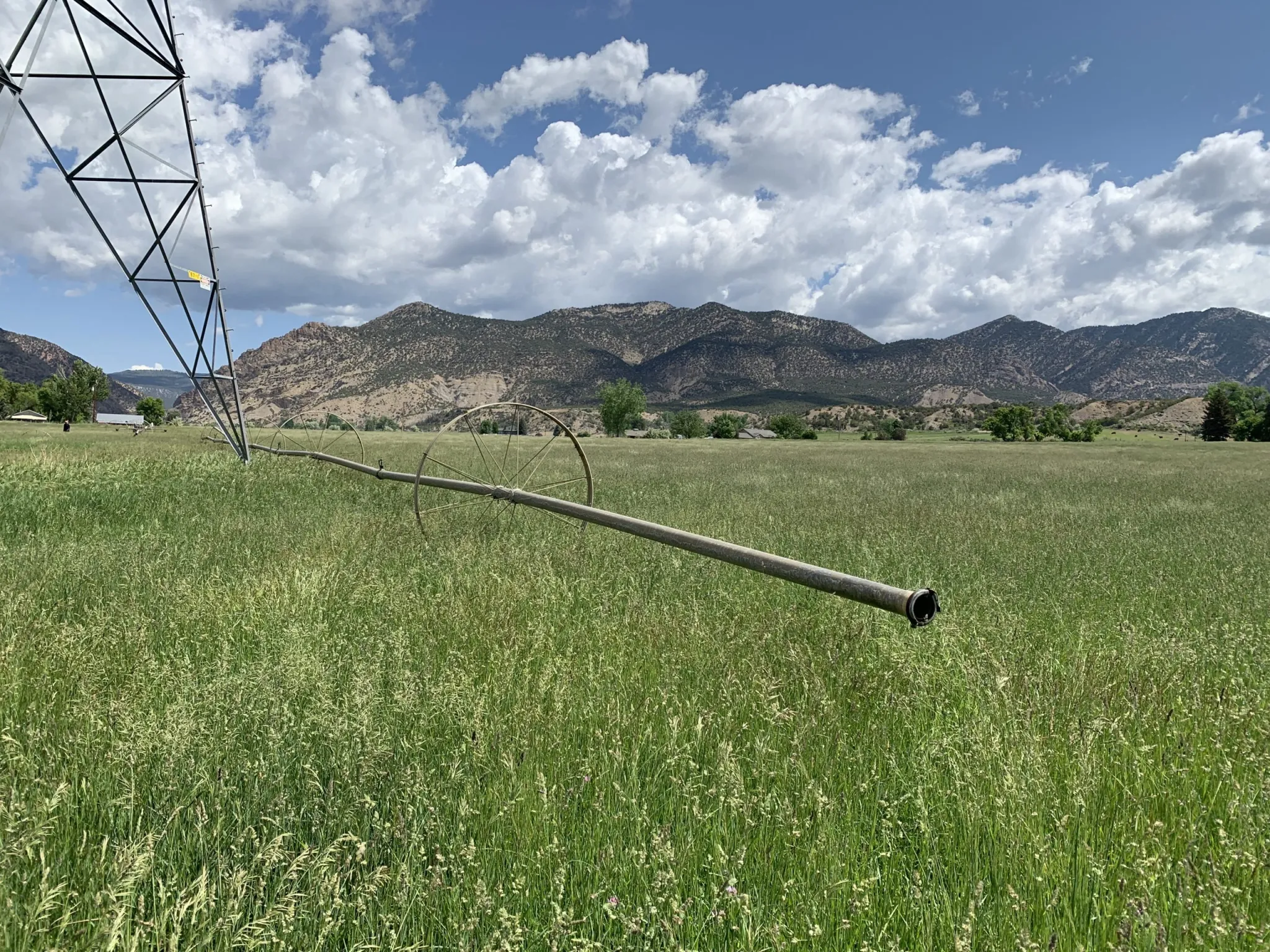
Sprinklers have replaced flood irrigation on part of the Powers Ranch property near Rifle. This summer marks the 10th year since the beginning of a creek restoration project on the ranch. CREDIT: HEATHER SACKETT/ASPEN JOURNALISM

Restoration tactics take time

Rivers and wetland habitats comprise a small amount of Colorado’s land area, but they are of outsize importance to wildlife. Improving the health of Rifle Creek is a focus of the Middle Colorado Watershed Council, a nonprofit organization that works to protect and improve watershed health. Between 2015 and 2019, the creek was the subject of a watershed assessment, which looked primarily at water quality. 

The council has also been implementing the goals of its Riparian Restoration Implementation Plan, which spans the entire Colorado River watershed from Glenwood Springs to DeBeque. But the stretch of Rifle Creek from below Rifle Gap Reservoir to its confluence with the Colorado River is a main concern. 

ā€œWe won’t be able to restore the whole thing right away,ā€ said Kate Collins, executive director of the council, referring to plans to conduct additional restoration work along Rifle Creek beyond the Powers ranch. ā€œBut what we want to do is identify certain projects that are either the most urgent or perhaps they are the most low-hanging fruit — in other words, there’s the best opportunity for restoration.ā€ 

The health of many streams across the Western Slope is impacted by erosion, invasive species and agriculture. Collins said the tactics for fixing them are often low-tech, such as replacing invasives with native plants. 

ā€œSome of these techniques are being widely used, and this Rifle Creek project could be a model for others,ā€ she said, referring to the Powers ranch restoration project.

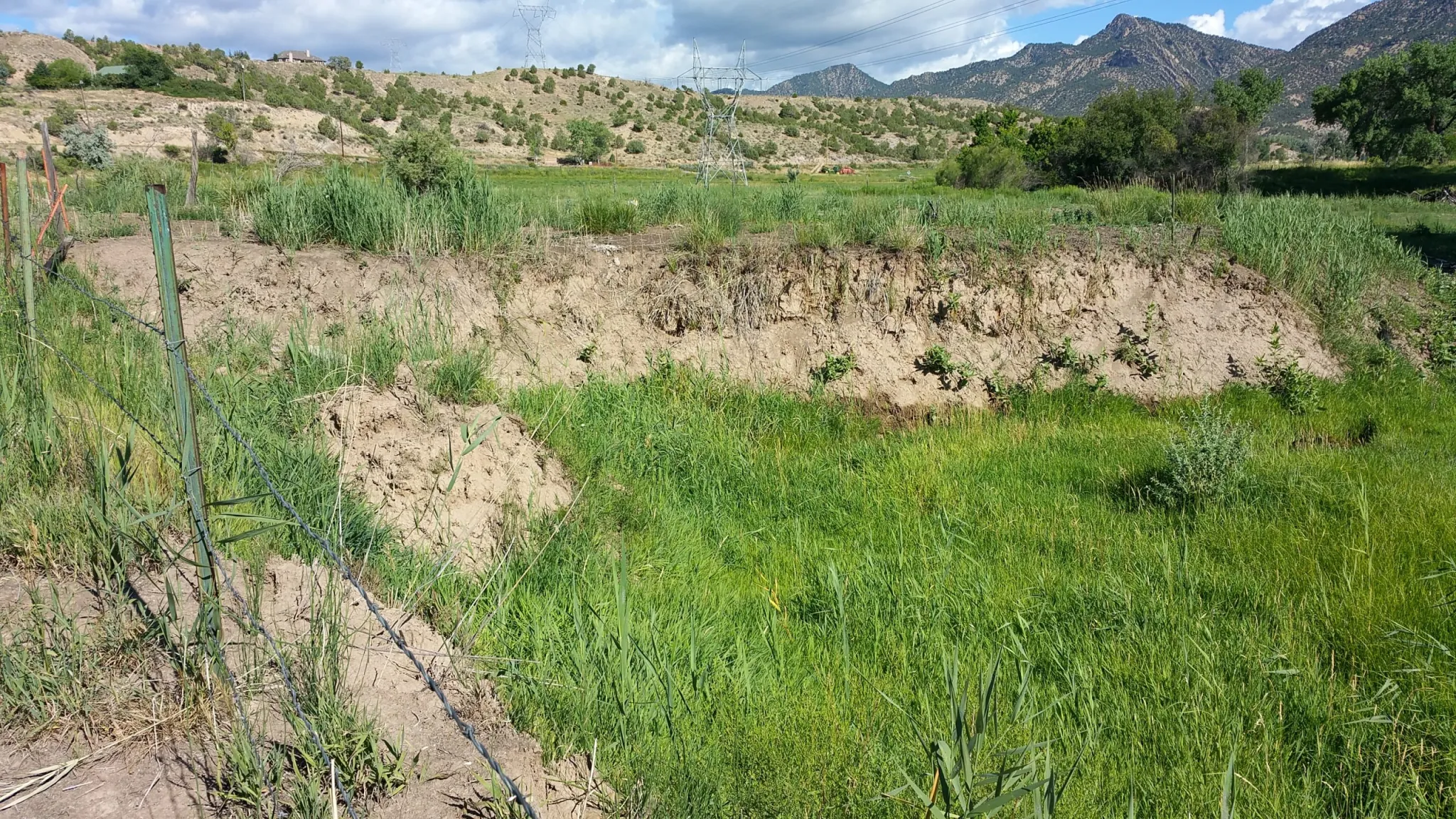
Rifle Creek in 2015 before the riparian restoration project. The banks of the creek were severely eroded. CREDIT: JOHN POWERS

Future plans for the ranch include another bio blitz in 2026 in which CNHP interns will document as many species of plants and animals on the ranch as possible over a 24-hour period and compare the results to their bio blitzes in 2016 and 2017. 

Powers and Anderson are also interested in potentially building what are called beaver dam analogs (BDAs), which are human-made structures that mimic beaver dams, helping to slow streamflow and keep water on the landscape. These temporary wood structures usually consist of posts driven into the streambed with willows and other soft materials weaved across the channel between the posts. Environmental groups and local governments are using BDAs to improve stream health and wildlife habitat.

ā€œWe’re really interested in doing some of those,ā€ Anderson said. ā€œI hope that maybe next year or in another subsequent year that we’ll work with the interns to build some of those structures right in Rifle Creek.ā€

For Powers, the Rifle Creek restoration on his ranch has been a passion project that keeps a riparian area thriving, as well as adapting to climate change and a future with less water. Collins sees the project as a step toward reconnecting the community to its local waterway.

ā€œ(Rifle Creek) is a vital part of what runs through that town and that community, and it’ll be exciting to see what positive ecological changes those bring about to virtually everything else,ā€ Collins said…

This story ran in the June 23 edition of theĀ Grand Junction Daily Sentinel.

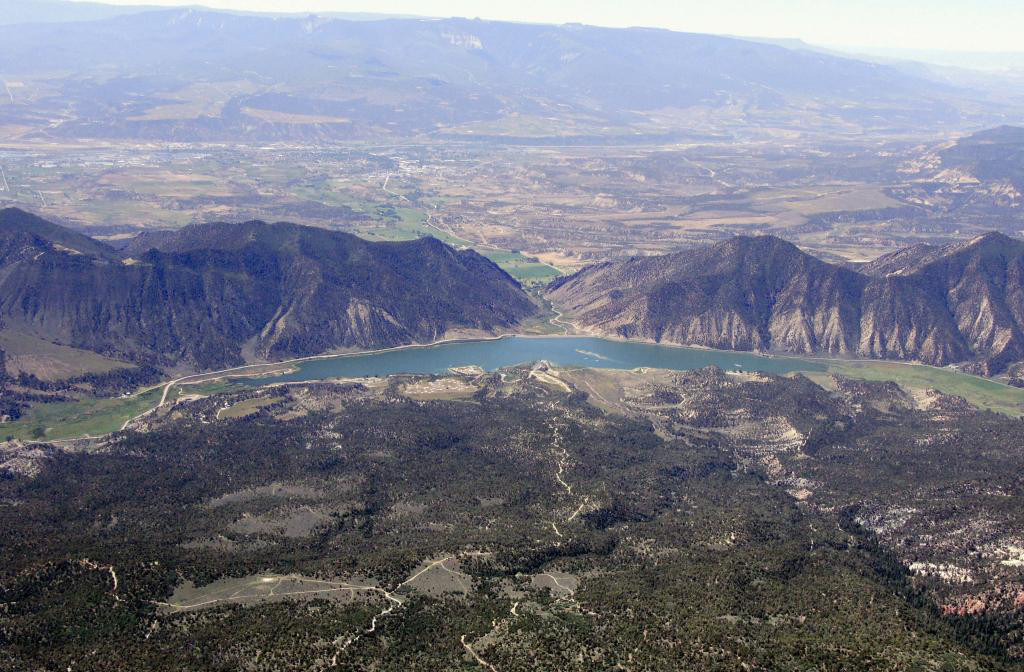
Rifle Gap Reservoir via the Applegate Group

Front Range concerns over purchase of Colorado River rights on Western Slope to get hearing: #ColoradoRiver District wants to buy Shoshone Power Plant rights to protect water flows — The #Denver Post #COriver #aridification

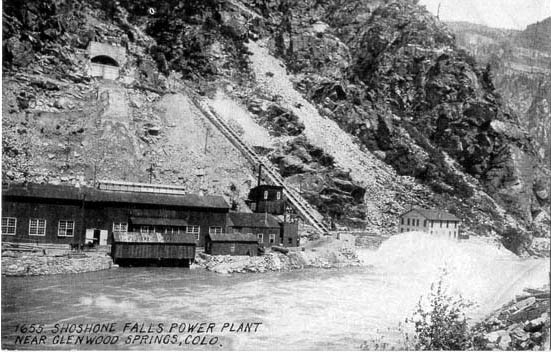
Shoshone Falls hydroelectric generation station via USGenWeb

Click the link to read the article on The Denver Post website. (Elise Schmelzer). Here’s an excerpt:

July 2, 2025

Four major Front Range water providers — Denver Water, Aurora Water, Colorado Springs Utilities and Northern Water — will presentĀ their concerns about the purchaseĀ of theĀ Shoshone Power PlantĀ water rights by the Colorado River District during a hearing in September before the Colorado Water Conservation Board. The board during a special meeting Tuesday decided to hold the hearing to hash out the urban utilities’ concerns about how much water should be allocated to the right. The board must decide by September whether to approve the new use of the water right proposed by the district…The Colorado River District, a taxpayer-funded agency that works to protect Western Slope water,Ā in 2023 announced a $99 million dealĀ to buy the water rights from Xcel Energy, which owns the power plant. The purchase — a decades-long effort by the district — will ensure that water will continue to flow west past the plant tucked into Glenwood Canyon and downstream to the towns, farms and others who rely on the Colorado River even if the century-old power plant were decommissioned.

Each of the Front Range utilities have said they do not oppose the purchase itself. They do, however, question the river district’s calculations of how much water has been used historically under the rights. Under Colorado water law, that number will determine how much water must flow through the plant in the future. The district’s calculations are too high, the four utilities argue, and would leave them with less water from the Colorado River for their own uses. The river district has repeatedly said it plans to maintain the status quo and will not use more water than has been used in the past. Disputes about the amount of water historically used under a water right should be settled in water court, the district’s general manager Andy Mueller said Tuesday in a statement.

ā€œWe are deeply concerned that the Front Range entities requesting this contested hearing are asking the CWCB to encroach on the jurisdiction of water court,ā€ Mueller said. ā€œā€¦ We believe maintaining public trust relies on following the right path and avoiding political intrusion.ā€

Colorado transmountain diversions via the State Engineer’s office

More Coyote Gulch coverage of the Shoshone plant.