

Click the link to read the article on the KUNC website (Alex Hager):
July 15, 2025
This story is part of ongoing coverage of water in the West produced by KUNC and supported by the Walton Family Foundation.
If you’re going to build a new reservoir, you better be dam sure it’s safe.
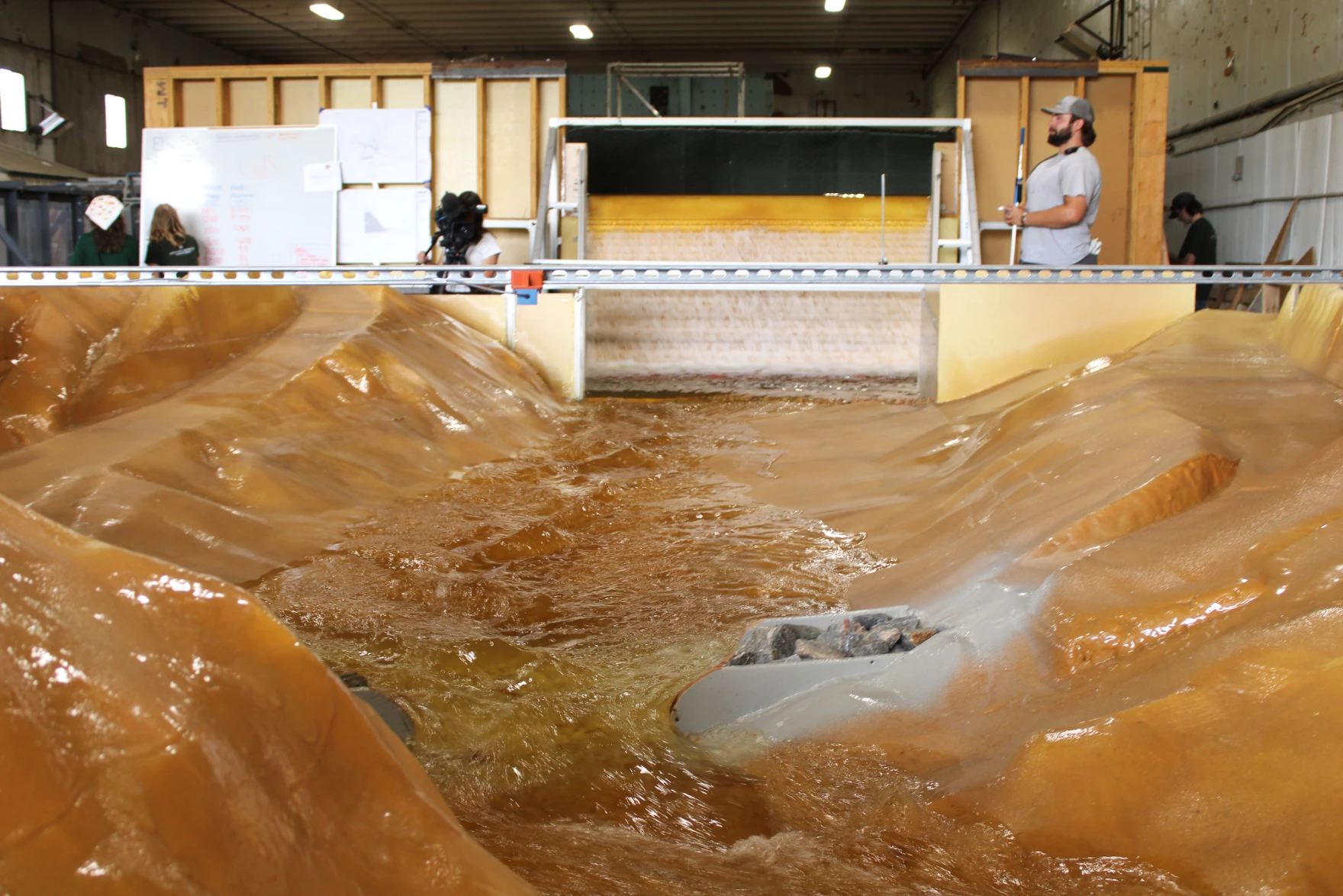
Engineers at Colorado State University are doing exactly that by running tests on a giant model of a dam that will soon be built near Fort Collins. In an airy warehouse at CSU’s foothills campus, they’re sending water through a 24:1 scale mockup of the dam that will hold back an expanded Halligan Reservoir.
“It just gives us assurances on so many different levels that our design is sound, that it is going to be constructable, and that it is going to perform when it’s built, as expected,” said Darren Parkin, Halligan Water Supply Project Manager with the City of Fort Collins.
The new dam will be built to survive a one-in-ten-million year precipitation event — or 72 inches of rain — which is required to get building permits. For comparison, the devastating Spring Creek flood of 1997 was caused by 14.5 inches of rain.
Running that test, even on a dam that’s a fraction of the size of the real one, requires a huge pulse of water. It tumbles and whooshes through the manmade river with so much force that it’s hard to hear the person standing next to you.
When engineering students switch on the model, a large tank fills behind the dam. First, it spills down the stairstep-like face of the structure with a gentle trickle. Before long, it’s hitting the base as roiling whitewater. That’s exactly where most of this team’s research has been focused.
They built a series of “baffles” to slow that water down and prevent it from bashing the dam and eroding its base. They are essentially large blocks that change the speed and direction of water cascading over the dam. The engineers working on the dam say they were able to figure out precisely the best place to put those baffles, how many to install, and how far apart they should be because they were running tests on this model instead of a computer program.

“We can easily change things in a physical model,” said Jeff Ellis, who manages the hydraulics lab where the model is housed. “We can move things by an inch and just keep on retesting, and it’s really optimizing performance.”
The City of Fort Collins is nearing construction on the dam, which will enable them to expand Halligan Reservoir’s storage capacity. City officials say that it’s necessary to supply water to the growing city in the future. Work on the new dam, about 25 miles northwest of Fort Collins, is expected to start in early 2027 and finish in late 2029 or early 2030.
Ellis said the project serves another function, too. It’s giving engineering students a new kind of experience.
“It’s super rewarding,” he said. “A lot of time in class, you’re doing a lot of theoretical work, it’s not hands-on. Where this, they’re actually doing design and they’re helping solve these real world problems.”

Students helped build the intricate model, which is shaped exactly like the area around Halligan Reservoir, and they operate the data-gathering equipment that helps engineers form conclusions from their testing. Catherine Lambert, an undergraduate senior studying Environmental Engineering, said the experience was fun and exciting, but would also help prepare her for a career.
“It’s really cool to see all of our hard work actually translate into the real world,” she said, “We’re very proud of what we do here.”

