Increased sampling efforts result in additional zebra mussel detections in Western #Colorado — Colorado Parks & Wildlife #ColoradoRiver #COriver

Zebra mussels. Photo credit: Colorado Parks & Wildlife

Click the link to read the release on the Colorado Parks & Wildlife website (Rachael Gonzales):

On Thursday, July 3, Colorado Parks and Wildlife (CPW) Aquatic Nuisance Species (ANS) staff discovered a large number of adult zebra mussels in a privately owned body of water in western Eagle County. 

“This news is a direct result of increased sampling efforts, ” said CPW Director Jeff Davis. “This discovery is a significant step toward identifying a potential source of zebra mussels and advancing our efforts for eradication. It would not have been possible without the commitment to protect Colorado’s bodies of water by our Aquatic Nuisance Species staff.”

During the survey, staff discovered evidence of and collected samples of suspected adult zebra mussels in various locations. Visual identification of the samples was performed by ANS Staff and samples were sent to Aquatic Animal Health Lab (AAHL) for DNA confirmation. 

CPW staff is currently evaluating options for the next steps in eradicating zebra mussels from the body of water.

“Understanding the current extent of zebra mussels in western Colorado is a critical step in stopping their spread into new locations,” said CPW Invasive Species Program Manager Robert Walters. “Every new detection puts us one step closer to achieving this desired outcome.” 

CPW, in collaboration with our partners at the local, state and federal levels, will continue our increased sampling and monitoring efforts. We also appreciate the willingness of private businesses and individuals who allow our staff to access their properties to conduct surveys.

In addition to the discovery found in western Eagle County, CPW also identified additional zebra mussel veligers in the Colorado River near New Castle, Highline Lake and Mack Mesa Lake at Highline Lake State Park.

Colorado River
On July 3, CPW Aquatic Animal Health Lab (AAHL) confirmed three additional zebra mussel veligers in samples collected in the Colorado River between Glenwood Springs and Silt. Samples were collected on June 16 and taken to the ANS laboratory where the additional zebra mussels veligers were found. These samples were then sent to AAHL for DNA confirmation.

With the additional detections in sample results, the Colorado River is now considered “positive” for zebra mussels from the confluence of the Roaring Fork River to the Colorado-Utah border.

Since sampling efforts resumed in May, CPW has collected 225 water samples from various locations along the Colorado River, stretching from the headwaters in Grand County to the Colorado-Utah border. In addition to the samples from the Colorado River, ANS staff has collected 25 samples from the Eagle River and nine samples from the Roaring Fork River. There have been no detections of zebra mussel veligers in the samples from the Eagle and Roaring Fork rivers. To date, no adult zebra mussels have been detected in the Colorado, Eagle or Roaring Fork rivers. 

Highline Lake
On June 10, CPW ANS staff collected plankton samples from the patrol dock and inlet at Highline Lake as part of routine increased sampling efforts. ANS laboratory technicians identified one suspected zebra mussel veliger in each sample. The samples were sent to AAHL where they were genetically confirmed as zebra mussels.

“While we had maintained hope that our eradication efforts at Highline Lake would be successful, we have always known this was a lofty goal. This is the primary reason we have continued the implementation of the containment watercraft inspection and decontamination program at Highline Lake,” said Walters.

With Highline’s current designation as an infested body of water, boaters are reminded of the following protocols in place since 2023.

  • Boats launching​ at Highline Lake will be subject to inspection and decontamination protocols before launching. 
  • All boats must be clean, drained and dry before launching at Highline Lake, or they will be decontaminated.
  • Upon exiting the lake, all boats will be inspected and decontaminated, and boaters will be issued a green seal and a blue receipt​ indicating the boat was last used on a body of water with a known aquatic nuisance species. 

Mack Mesa
On June 10, CPW ANS staff collected plankton samples in the area near the fishing pier at Mack Mesa Lake, located at Highline Lake State Park. ANS laboratory technicians identified one suspected zebra mussel veliger in the sample. The samples were sent to AAHL where the zebra mussel veliger was genetically confirmed.

On July 8, additional samples collected from Mack Mesa indicated additional zebra mussel veligers. With these additional detections, Mack Mesa is now considered “positive” for zebra mussels.

CPW is continuing to evaluate options for the future management of Highline Lake and Mack Mesa based on the latest sampling results.

Prevent the spread: Be a Pain in the ANS
Everyone has a part to play in preventing the introduction and spread of invasive species in Colorado. Simple actions like cleaning, draining and drying your motorized and hand-launched vessels — including paddleboards and kayaks — and angling gear after you leave the water can make a big difference to protect Colorado’s waters.

Learn more about how you can prevent the spread of aquatic nuisance species and tips to properly clean, drain and dry your boating and fishing gear by visiting our website. Tips for anglers and a map of CPW’s new gear and watercraft cleaning stations are available here.

CPW also encourages those who use water pulled from the Colorado River and find any evidence of mussels or clams to send photos to Invasive.Species@state.co.us for identification. It is extremely important to accurately report the location in these reports for follow-up surveying.

Colorado Parks and Wildlife (CPW) is an enterprise agency, relying primarily on license sales, state parks fees and registration fees to support its operations, including: 43 state parks and more than 350 wildlife areas covering approximately 900,000 acres, management of fishing and hunting, wildlife watching, camping, motorized and non-motorized trails, boating and outdoor education. CPW’s work contributes approximately $6 billion in total economic impact annually throughout Colorado.
In the Sweltering Southwest, Planting Solar Panels in Farmland Can Help Both Photovoltaics and Crops — Tina Deines (InsideClimateNews.com)

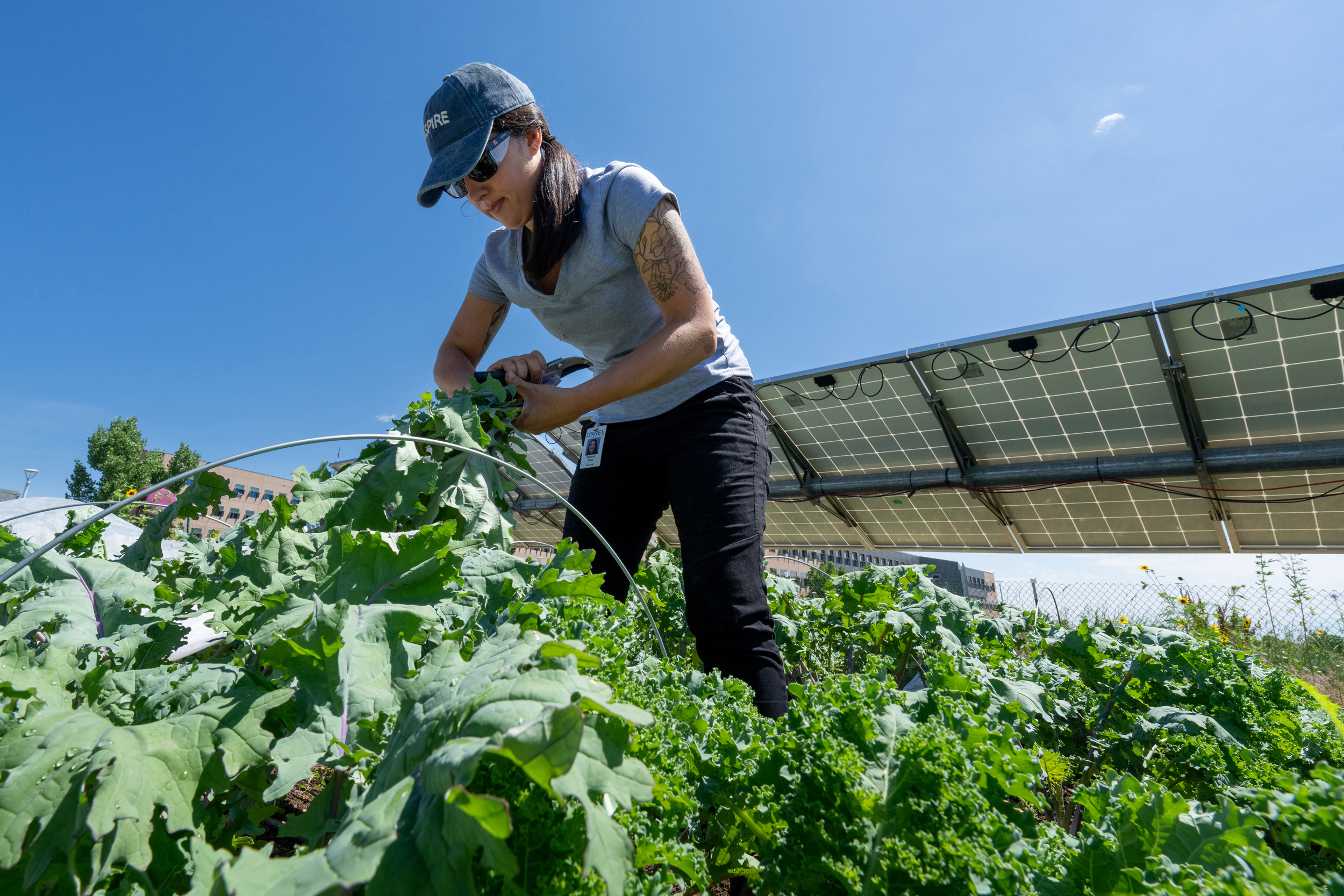
July 20, 2023 – National Renewable Energy Laboratory (NREL) market research analysis researcher Brittany Staie gather samples of vegetables that are being grown at the at the Photovoltaic Central Array Testing Site (PV-CATS) and agrivoltaics/solar garden near NREL’s parking garage. Staie was part of a crew that was checking for differences between plants grown in full sunlight, compared to those vegetables that were grown between the solar panels. The solar garden is part of the Innovative Site Preparation and Impact Reductions (InSPIRE) agrivoltaics project, which is studying the effects that solar panels and crops have on each other. (Photo by Werner Slocum / NREL)

Click the link to read the article on the Inside Climate News website (Tina Deines):

July 10, 2025

Agrivoltaic solar arrays can shade crops from sun while moisture from vegetation cools the panels to increase their productivity, researchers and farmers have found.

“We were getting basil leaves the size of your palm,” University of Arizona researcher Greg Barron-Gafford said, describing some of the benefits he and his team have seen farming under solar panels in the Tucson desert.

For 12 years, Barron-Gafford has been investigating agrivoltaics, the integration of solar arrays into working farmland. This practice involves growing crops or other vegetation, such as pollinator-friendly plants, under solar panels, and sometimes grazing livestock in this greenery. Though a relatively new concept, at least 604 agrivoltaic sites have popped up across the United States, according to OpenEI

Researchers like Barron-Gafford think that, in addition to generating carbon-free electricity, agrivoltaics could offer a ray of hope for agriculture in an increasingly hotter and drier Southwest, as the shade created by these systems has been found to decrease irrigation needs and eliminate heat stress on crops. Plus, the cooling effects of growing plants under solar arrays can actually make the panels work better.

But challenges remain, including some farmers’ attitudes about the practice and funding difficulties. 

Overcoming a Climate Conundrum

While renewable electricity from sources like solar panels is one of the most frequently touted energy solutions to help reduce the carbon pollution that’s driving climate change, the warming climate itself is making it harder for solar arrays to do their job, Barron-Gafford said. An optimal functioning temperature for panels is around 75 degrees Fahrenheit, he explained. Beyond that, any temperature increase reduces the photovoltaic cells’ efficiency. 

“You can quickly see how this solution for our changing climate of switching to more renewable energy is itself sensitive to the changing climate,” he said.

This problem is especially pertinent in the Southwest, where historically hot temperatures are steadily increasing. Tucson, for instance, saw a record-breaking 112 days of triple-digit heat in 2024, according to National Weather Service Data, and the U.S. Environmental Protection Agencyreports that every part of the Southwest experienced higher average temperatures between 2000 and 2023 compared to the long-term average from 1895 to 2023.

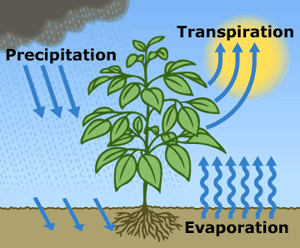
Evaporation and transpiration graphic via the USGS

However, planting vegetation under solar panels—as opposed to the more traditional method of siting solar arrays on somewhat barren land—can help cool them. In one set of experiments, Barron-Gafford’s team found that planting cilantro, tomatoes and peppers under solar arrays reduced the panels’ surface temperature by around 18 degrees Fahrenheit. That’s because plants release moisture into the air during their respiration process, in which they exchange oxygen for carbon dioxide. 

“This invisible power of water coming out of plants was actually cooling down the solar panels,” Barron-Gafford said.

Throwing Shade

While Barron-Gafford said some laughed him off when he first proposed the idea of growing crops in the shade of solar panels, this added sun shield can actually help them grow better, especially in the Southwest, where many backyard gardeners already employ shade cloths to protect their gardens from the blazing heat. 

“Many people don’t understand that in Colorado and much of the West, most plants get far too much sunlight,” said Byron Kominek, owner/manager of Jack’s Solar Garden in Boulder County, Colorado, which began implementing agrivoltaics in 2020. “Having some shade is a benefit to them.”

Jack’s Solar Garden has integrated 3,276 solar panels over about four acres of farmland, growing crops like greens and tomatoes. Meg Caley with Sprout City Farms, a nonprofit that helps with farming duties at Jack’s Solar Garden, said they’ve been able to produce Swiss chard “the size of your torso.” 

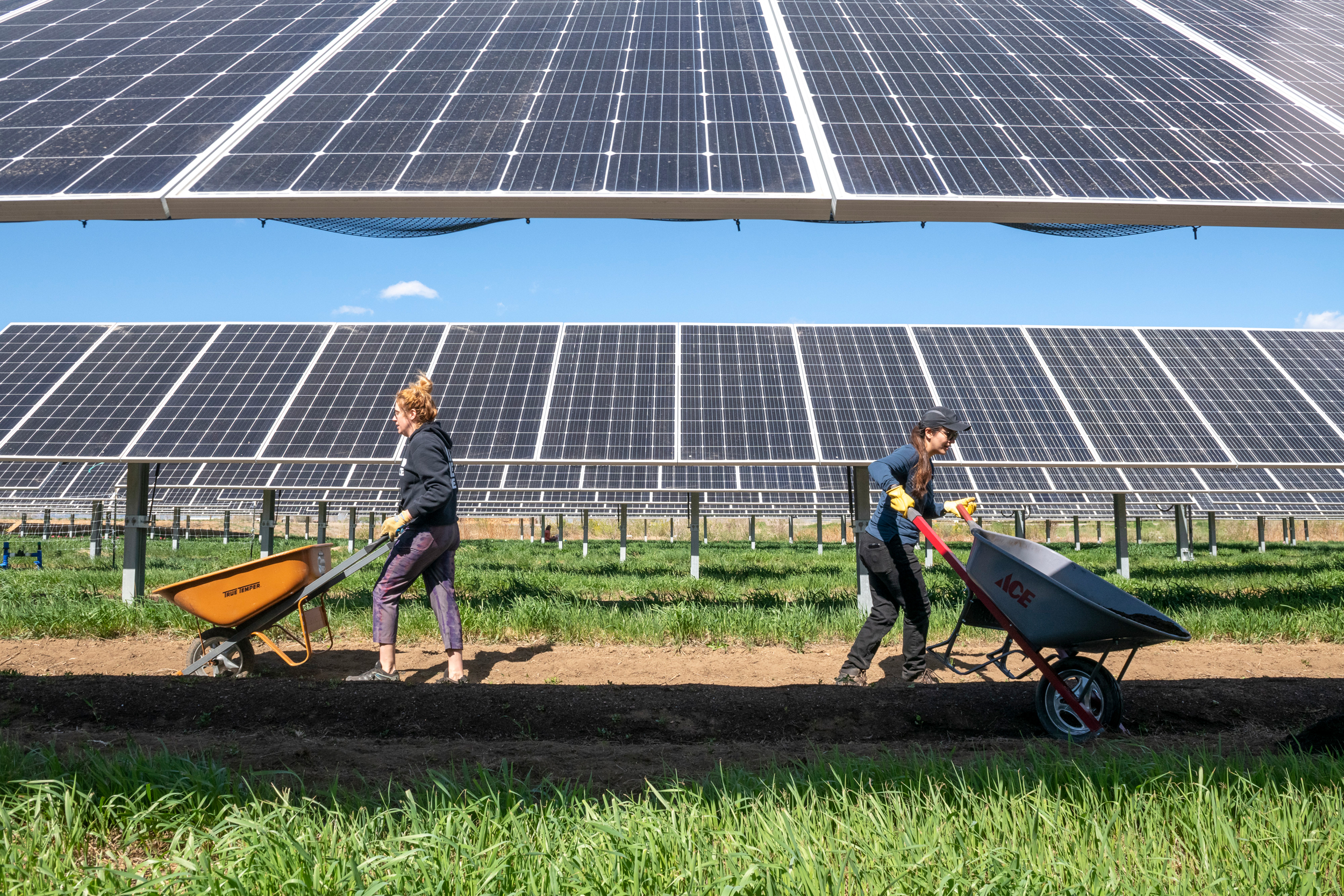
May 6, 2023 – Volunteers with the National Renewable Energy Laboratory’s (NREL’s) ESCAPES (Education, Stewardship, and Community Action for Promoting Environmental Sustainability) program lend a hand to Jack’s Solar Garden in Longmont, Colo. Bethany Speer (left) goes back for more while Nancy Trejo distributes her wheelbarrow load to the agrivoltaic plots. (Photo by Bryan Bechtold / NREL)

“The greens just get huge,” she said. “You have to chop them up to fit them in your refrigerator.”

She added that the shade seems to improve the flavor of the vegetables and prevents them from bolting, when plants prematurely produce flowers and seeds, diverting energy away from leaf or root growth.

“Plants when they’re stressed out can have more of a bitter flavor,” she explained. “So the arugula that we grow is not as bitter or spicy. It’s sweeter. The spinach is sweeter too.”

Barron-Gafford and his team are seeing the same thing in Arizona, where they grow a variety of produce like beans, artichokes, potatoes, kale and basil.

“We’ve grown 30-plus different types of things across different wet winters and dry winters and exceptionally hot summers, dry summers, average or close to average summers,” he said of the solar-shaded crops. “And across everything we’ve done, we’ve seen equal or greater production down here in the Southwest, the dry land environments, where it really benefits to get some shade.”

As in Colorado, some of those crops are growing to epic proportions. 

“We’ve made bok choy the size of a toddler,” Barron-Gafford said.

All that shade provides another important benefit in a drought-stricken Southwest—lower water requirements for crops. Because less direct sunlight is hitting the ground, it decreases the evaporation rate, which means water stays in the soil longer after irrigation. Barron-Gafford and his team have been running experiments for the last seven or so years to see how this plays out with different crops in an agrivoltaic setting. 

“What is the evaporation rate under something that’s big and bushy like a bean or potato plant versus something thinner above ground, like a carrot?” is one of the questions Barron-Gafford said they have tried to answer. “For the most part, I would say that we are able to cut back our irrigation by more than half.”

They are partnering with Jack’s Solar Farm on water research in Colorado and have so far found similar results there. 

This shade has another benefit in a warming world—respite for farmworkers. Heat-related illnesses are a growing concern for people who work outside, and one recent study predicted climate change will quadruple U.S. outdoor workers’ exposure to extreme heat conditions by 2065.

But with solar arrays in the fields, “if you really carefully plan out your day, you can work in the shade,” a factor that can help increase worker safety on hot days, Caley said.

The AgriSolar Clearinghouse performed skin temperature readings under solar panels and full sun at a number of sites across the United States, finding a skin temperature decrease of 15.3 degrees in Boulder and 20.8 degrees in Phoenix.

“I Don’t Know What the Future Holds”

Despite the benefits of agrivoltaics, the up-front cost of purchasing a solar array remains a barrier to farmers. 

“Once people see the potential of agrivoltaics, you run into the next challenge, which is how do you fund someone getting into this on their site?” Barron-Gafford said. “And depending on the amount of capital or access to capital that a farmer has, you’re going to get a wildly different answer.”

While expenses are dependent on the size of the installation, a 25 kilowatt system would require an upfront cost of around $67,750, according toAgriSolar Clearinghouse. For comparison, the median size of a residential solar array in 2018 was around 6kW, the organization stated, which would cost around $16,260 to install.

Kominek said the total initial cost of implementing a 1.2 megawatt capacity agrivoltaics setup on his farm in Colorado was around $2 million, but that the investment has paid off. In addition to the revenue he earns from farming, all of the energy produced by the arrays is sold to clients in the community through a local utility company, earning the farm money.

The Rural Energy for America program has been one resource for farmers interested in agrivoltaics, offering loans and grants to help install solar. However, it’s unclear how this program will move forward amid current federal spending cuts.

Meanwhile, some of the federal grant programs that Barron-Gafford has relied on have suddenly come to a halt, he said, putting his research in danger. But, as federal support dries up, some states are charging on with their own funding opportunities to develop farm field solar projects. For instance, Colorado’s Agrivoltaics Research and Demonstration Grant offers money for demonstrations of agrivoltaics, research projects and outreach campaigns.

There are other challenges as well. Caley, for instance, said farming around solar panels is akin to working in an “obstacle course.” She and her team, who mostly work manually, have found ways to work around them by being aware of their surroundings so that they don’t accidentally collide with the panels or strike them with their tools. This job is also made easier since Kominek invested between $80,000 and $100,000 to elevate his farm’s panels, which better allows animals, taller crops and farming equipment to operate beneath.

Still, a 2025 University of Arizona study that interviewed farmers and government officials in Pinal County, Arizona, found that a number of them questioned agrivoltaics’ compatibility with large-scale agriculture.

“I think it’s a great idea, but the only thing … it wouldn’t be cost-efficient … everything now with labor and cost of everything, fuel, tractors, it almost has to be super big … to do as much with as least amount of people as possible,” one farmer stated.

Many farmers are also leery of solar, worrying that agrivoltaics could take working farmland out of use, affect their current operations or deteriorate soils.

Those fears have been amplified by larger utility-scale initiatives, like Ohio’s planned Oak Run Solar Project, an 800 megawatt project that will include 300 megawatts of battery storage, 4,000 acres of crops and 1,000 grazing sheep in what will be the country’s largest agrivoltaics endeavor to date. Opponents of the project worry about its visual impacts and the potential loss of farmland.

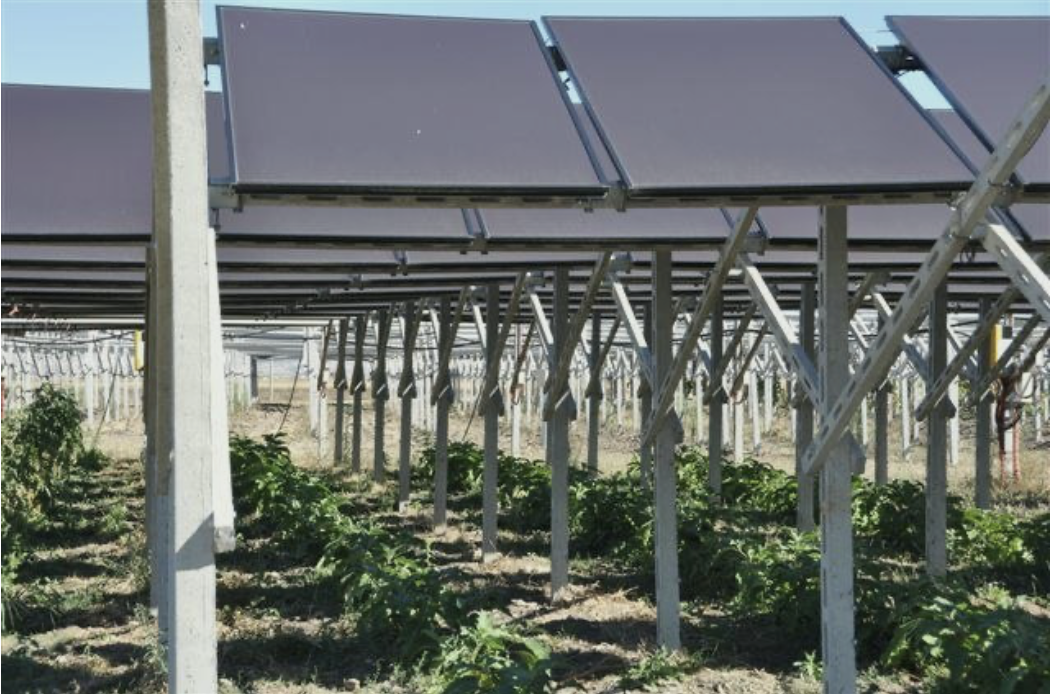
Row crops underneath solar panels. Photo credit: Colorado Farm & Food Alliance