
Click the link to view the job posting on the State of Colorado Job Opportunities website.

Click the link to view the job posting on the State of Colorado Job Opportunities website.

Click the link to read the article on The Land Desk website (Jonathan P. Thompson):
July 8, 2025
🥵 Aridification Watch 🐫
If Lake Powell is like a big thermometer gauging the hydrologic health of the Upper Colorado River Basin, then it’s running a high fever.
In one case, the fever analogy is a bit too literal: The National Park Service has detected high concentrations of cyanotoxins in the reservoir around the mouth of Antelope Canyon, and is warning folks to limit their exposure to the water. Warm water is one of the drivers of cyanotoxin growth.
The surface level peaked out on June 19 at 3,562 feet above sea level, with about 7.8 million acre-feet of storage (or about one-third of its capacity). That means the big, white “bathtub” ring on the sandstone cliffs has grown by about 27 feet in the past year, re-revealing some landforms and rendering some boat ramps unusable. Levels will continue to drop throughout the summer.
This is because more water is leaving the reservoir via downstream releases and evaporation than is flowing into it. Reservoir inflows during June were a mere 883,000 acre feet, or about 41% of the median inflows. That’s far lower than the last two years and is only marginally higher than in 2002, 2018, and 2021, some of the worst years on record. And with the water year three-fourths of the way done, only 4.2 million acre-feet has flowed from the Colorado River and its upstream tributaries into the reservoir, setting the stage for a water year total of just about 5.5 million acre-feet — or 2 million acre-feet less than the minimum release from Glen Canyon Dam.
The only good news is that temperatures at the reservoir mostly have been in the 80s or 90s for the past several weeks, which is about normal for this time of year. Oh, and another sorta-kinda silver lining: As the reservoir levels drop, the surface area decreases, reducing the rate of evaporation. Yay?

Meanwhile, many of the Colorado River’s users continue under the illusion that the Colorado River Compact and the Law of the River will trump nature and the reality of diminishing flows.
Take the Imperial Valley in southern California. The Imperial Irrigation District is the single largest water user on the river, consuming some 2.3 million acre-feet during the 2024 calendar year to grow various food crops and a lot of alfalfa. That’s about seven times more Colorado River water than all of southern Nevada’s casinos, hotels, golf courses, and homes consume.
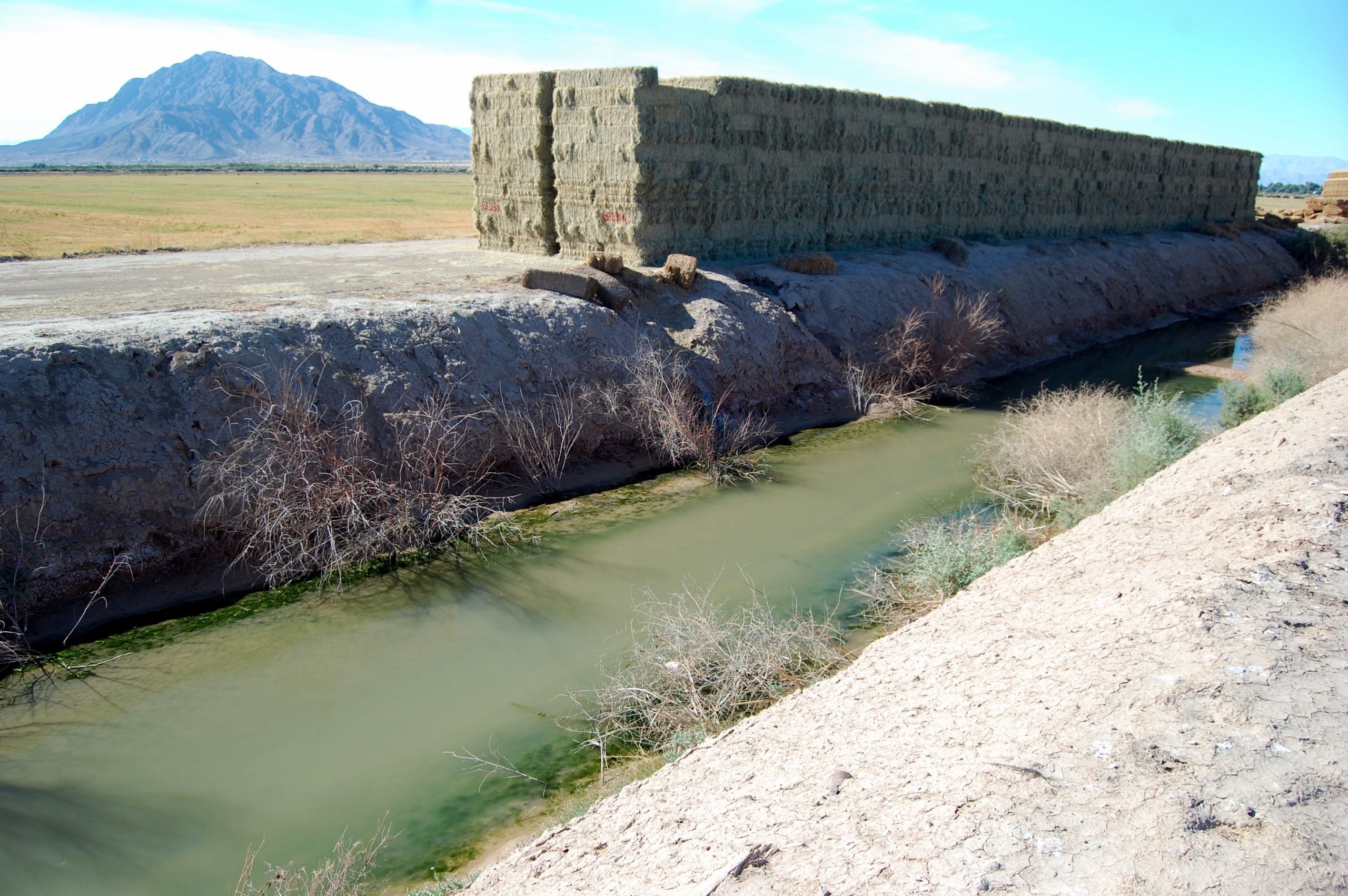
But it’s also about 200,000 acre-feet less than the irrigation district consumed in 2013. That’s in part because some farmers are being paid to not irrigate or to irrigate less, often meaning they must fallow their fields, at least temporarily. And some of those farmers have chosen to lease their land — about 13,000 acres — to solar companies for utility-scale energy installations, allowing them to continue to make money off the land without further depleting the Colorado River.

That irks the Imperial Irrigation District’s board, which recently passed a resolution“opposing the continued expansion of utility-scale solar projects on active or historically farmed agricultural land” in the district. “Our identity and economy in the Imperial Valley are rooted in agriculture,” said IID Board Chairwoman Gina Dockstader, in a written statement. “Solar energy has a role in our region’s future, but it cannot come at the cost of our farmland, food supply, or the families who depend on agriculture. This resolution is about protecting our way of life.”
The resolution doesn’t carry any legal weight, but the IID has a lot of influence, and could easily push the county to ban or heavily restrict solar installations on farmland as dozens of other counties across the nation have done.
Meditations on solar, Joshua trees, and the movement to kill clean energy — Jonathan P. Thompson
Granted, taking land out of agriculture and irrigation has consequences. It can become a weed-choked, dust-spawning expanse. In the Imperial Valley, irrigation runoff feeds the Salton Sea. And, of course, you lose food production and farmworker jobs.
Nevertheless, the resolution seems somewhat short-sighted. It is based on the assumption that the IID will be able to flex its senior water rights in perpetuity, and never have to give up significant amounts of irrigation. It robs farmers of their private property rights, their ability to diversify their income sources, and an opportunity to conserve increasingly scarce water.
And, if the solar installations aren’t built there, they are likely to end up on public land in desert tortoise and other wildlife habitat that could require the removal of hundreds or even thousands of Joshua trees. Worse, it might result in new natural gas or even coal plants to meet the burgeoning demand for power driven by the proliferation of energy- and water-intensive data centers.
A Dog Day Diatribe on AI, cryptocurrency, energy consumption, and capitalism — Jonathan P. Thompson
🏠 Random Real Estate Room 🤑
And on that note, there’s Kanab, in south central Utah. I’ve driven through Kanab many a time, but usually I just roll on through, finding more of interest in Ordervilleor Fredonia or even Colorado City and Hildale. I mean, Orderville does have “Ho-Made Pies,” or so the sign declares, and was founded as a bastion of the United Order, the tenets of which were communalism, cooperation, and equal distribution of wealth.
Kanab, meanwhile, was notable to me only as the home of former Utah state representative Mike Noel, who was a Wise Use/Sagebrush Rebel leader of the early 2000s, and I wasn’t going to stop in for a cup of coffee — er, a soda — with the guy. So I failed to notice that the little community was not only growing, but sprawling into the surrounding red-rock desert in the form of upscale resorts and housing communities and even a brand new town. A friend sent me this video, which enthusiastically offers details:
- There is, for example, Catori Canyon “a premium housing development & luxury gated community” that “redefines modern indoor-outdoor living.” Prices start at $450,000 — for a bare lot. It also predictably has a pickleball court, which is what I think they mean when they say it “isn’t just home — it’s a lifestyle.” I call that real estate propaganda.
- And Ventana Resort, which is on state trust lands and is described by the Utah Trust Lands Administration as an “ambitious project that includes townhomes, affordable housing, nightly rentals, single-family homes, and even a hotel.” The Kane County Water Conservancy District, headed by the aforementioned Mike Noel, had hoped to build a golf course on the land, but pickleball — yes, the development has courts — and four swimming pools won out, apparently. The townhomes are expected to begin at $650,000, according to the Southern Utah News.
- The new town? It was originally just a huge subdivision called Willow Preserve Estates, which received county approval (after the county had denied its proposed public infrastructure district). But apparently the developers weren’t content with the limits of the subdivision approval, so they petitioned the state to incorporate their own municipality called Willow, which would allow them to approve their own PID with higher housing density. Kane County commissioners are miffed. If the state approves the municipality, it will include 1,200 to 1,400 home sites along with commercial areas on a big parcel of land east of Kanab and just south of Hwy 89.
That’s a lot of homes; Kanab has about 2,000 households, and that doesn’t count Catori Canyon or Ventana Resorts, let alone Willow. And, if you’re like me, you’re wondering where these folks — along with the other developments with their swimming pools and lawns — are going to get their water.
It appears the answer is: wells. Kanab currently supplies its 5,000 residents with several groundwater wells and springs. Willow will likely get its water from Kane County Water Conservancy District’s Johnson Canyon system, which is also fed primarily by groundwater. Which is to say, they aren’t taking it directly out of the Colorado River system, but they are taking it indirectly from the system, since groundwater and surface water is all connected. Plus, aquifers all over the Colorado River Basin are being depleted by over-pumping. Pulling more out of them is not sustainable.
But that’s not all. Kanab is also about to be home to two new ultra-exclusive resorts in a similar vein as Amangiri, the posh place frequented by the Kardashians and located just outside the (past and possibly present) polygamist community of Big Water, Arizona.
Canyon Country, my friends, is rapidly being gentrified.
Kaia, by Outdoor Citizen, bills itself as a “new ultra-luxury RURAL EB-5 investment opportunity.” That is, if you’d like to migrate to America, just fork out a million or so bucks for one of the 40 planned residences in Johnson Canyon outside Kanab and, voila!, you have permanent U.S. residency. In Europe they call that a “golden passport.” The project’s developer is FirstPathway Partners, whose sole purpose is to facilitate these EB-5 visas.
Kaia, by Outdoor Citizen, bills itself as a “new ultra-luxury RURAL EB-5 investment opportunity.” That is, if you’d like to migrate to America, just fork out a million or so bucks for one of the 40 planned residences in Johnson Canyon outside Kanab and, voila!, you have permanent U.S. residency. In Europe they call that a “golden passport.” The project’s developer is FirstPathway Partners, whose sole purpose is to facilitate these EB-5 visas.
Kaia’s website says the development …


Yeah, the BLM land might be protected for now. But a warning to the rich folks that might want to invest: Utah politicians are leading the charge to turn that lovely “Greenbelt” of public land over to housing developers. So instead of those fetching red rocks, you might one day have a view of a subdivision out your giant front window. And if Sen. Mike Lee and his ilk can’t sell the public land straight out, the Trump administration might just fast-track a uranium or coal mine, AI-crunching data center, or oil and gas development in that greenbelt just a few hundred meters from your luxury home.

The Rundown
- President Trump’s budget bill targets a few water projects while eliminating some climate and environment programs.
- Agencies move to constrain environmental reviews under NEPA.
- EPA says it will loosen wastewater pollution rules for thermal power plants later this summer.
- GAO reviews NASA’s major projects, including the third generation of a water-tracking satellite.
- EPA intends to take public comments on its idea to narrow state and tribal reviews under Section 401 of the Clean Water Act.
- White House orders higher fees for foreign tourists visiting national parks.
And lastly, EPA’s internal watchdog notes the risks of rising seas to federally owned Superfund sites.
“If contaminants from federal facility Superfund sites are released into the surrounding communities, the health, jobs, and environment of millions of U.S. residents may be threatened. Further, the federal funds expended to implement those remedies would have been wasted.” – Report from the EPA Office of Inspector General that identifies 49 federally owned Superfund sites at risk of flooding from rising seas and increased storm surge.
By the Numbers
$658 Million: Expected baseline cost of the third generation of NASA’s satellite mission that measures changes in the planet’s water storage. The GRACE-C mission is scheduled for July 2029, according to a Government Accountability Office review of NASA’s major projects. Operating for more than two decades, the GRACE satellites have been instrumental in tracking global groundwater depletion.
News Briefs
NEPA Overhaul
Cabinet and other agencies – including the Interior Department, U.S. Department of Agriculture, and Army Corps of Engineers – announced they will revise their rules for environmental reviews of major projects and prioritize shorter and quicker assessments of potential harms.The agencies are shortening the administrative timeline for implementing a new rule, arguing that the standard notice-and-comment process would be an unnecessary delay and “contrary to the public interest.”
The Council on Environmental Quality, the White House arm that traditionally oversees NEPA, revoked its regulations in April in response to an executive order promoting domestic energy production. The agencies, now seeking faster, more efficient reviews, are establishing their own rules.
Besides the arrival of the new administration, recent legal rulings have also rearranged the playing field for environmental reviews.
In justifying its action, each agency cited the U.S. Supreme Court’s ruling in May in Seven County Infrastructure Coalition v. Eagle County, Colorado. That ruling, in a case which centered on a railroad line in Utah for crude oil, allowed for narrowly focused environmental reviews that assess only a specific project and not the actions – like upstream oil drilling and downstream oil refining – it would enable.
Budget Bill
The budget reconciliation bill, which could add $3 trillion to the national debt over the next decade, barely mentioned water directly.Among the few call outs: The bill delivers $1 billion for surface water storage and water conveyance in the western United States. The money is for projects that increase or restore capacity of Bureau of Reclamation water conveyance systems or increase their use. Increasing reservoir storage capacity – such as raising Shasta Dam, a Republican-driven idea that’s been on the table for years – is also acceptable. The money is available through September 30, 2034.
More broadly, climate and environment programs were chopped. Unobligated Inflation Reduction Act funds – those not yet committed to a recipient – were yanked back for programs on climate data, environmental justice block grants, reducing air pollution at schools, and more.
National Parks Fees
President Trump ordered the Interior Department to increase national park entry fees for foreign visitors. The additional revenue would be channeled to infrastructure improvements at the parks or to increase park access.Still Storm Watching, For Now
NOAA said it would delay by one month the termination of certain storm-tracking satellite data, the Associated Press reports.Studies and Reports
Superfund Sites at Risk from Rising Seas
The federal government owns 157 Superfund sites. Forty-nine of those sites are at risk of flooding from rising seas and increased storm surge.The assessment comes from the EPA’s internal watchdog, which published the report to draw attention to federal liabilities related to climate change and the nation’s most toxic sites.
The at-risk Superfund sites are clustered at military sites around Chesapeake Bay, Puget Sound, and San Francisco Bay.
Arizona Groundwater Assessment
The U.S. Geological Survey published a report on water quality in the Coconino aquifer in northern Arizona, where it could be a water source for the Hopi Tribe and Navajo Nation.On the Radar
Water Quality Permitting
The EPA is considering a rulemaking that would narrow the scope of Clean Water Act reviews undertaken by states and tribes.These Section 401 reviews have been a target of the Trump administration. Energy companies complain that states have used their review authority to block fossil fuel infrastructure such as natural gas pipelines.
Before the rulemaking, the EPA is asking for public input. The agency opened a docket for written submissions, and it will hold two online events at a time to be announced.
File written comments at www.regulations.gov using docket number EPA-HQ-OW-2025-0272. The deadline is August 6.
Another Slogan Commission
Through an executive order, President Trump established the President’s Make America Beautiful Again Commission.The commission’s objectives – “promote responsible stewardship of natural resources while driving economic growth; expand access to public lands and waters for recreation, hunting, and fishing; encourage responsible, voluntary conservation efforts; cut bureaucratic delays; and recover America’s fish and wildlife populations through proactive, voluntary, on-the-ground collaborative conservation efforts” – in some ways conflict with the administration’s desire to cut budgets and greenlight fossil fuel projects.
One of the commission’s charges is to recommend to the president “solutions to expand access to clean drinking water and restore aquatic ecosystems to improve water quality and availability.” Stay tuned.
Power Plant Wastewater
Lee Zeldin, EPA administrator, said his agency later this summer will relax wastewater pollution rules for thermal power plants that burn fossil fuel and nuclear fuel.The Biden administration placed stricter limits on these wastewater discharges last year. In a press release, Zeldin said compliance deadlines would be extended. The agency will also reconsider technological requirements for preventing polluted discharges.
Federal Water Tap is a weekly digest spotting trends in U.S. government water policy. To get more water news, follow Circle of Blue on Twitter and sign up for our newsletter.