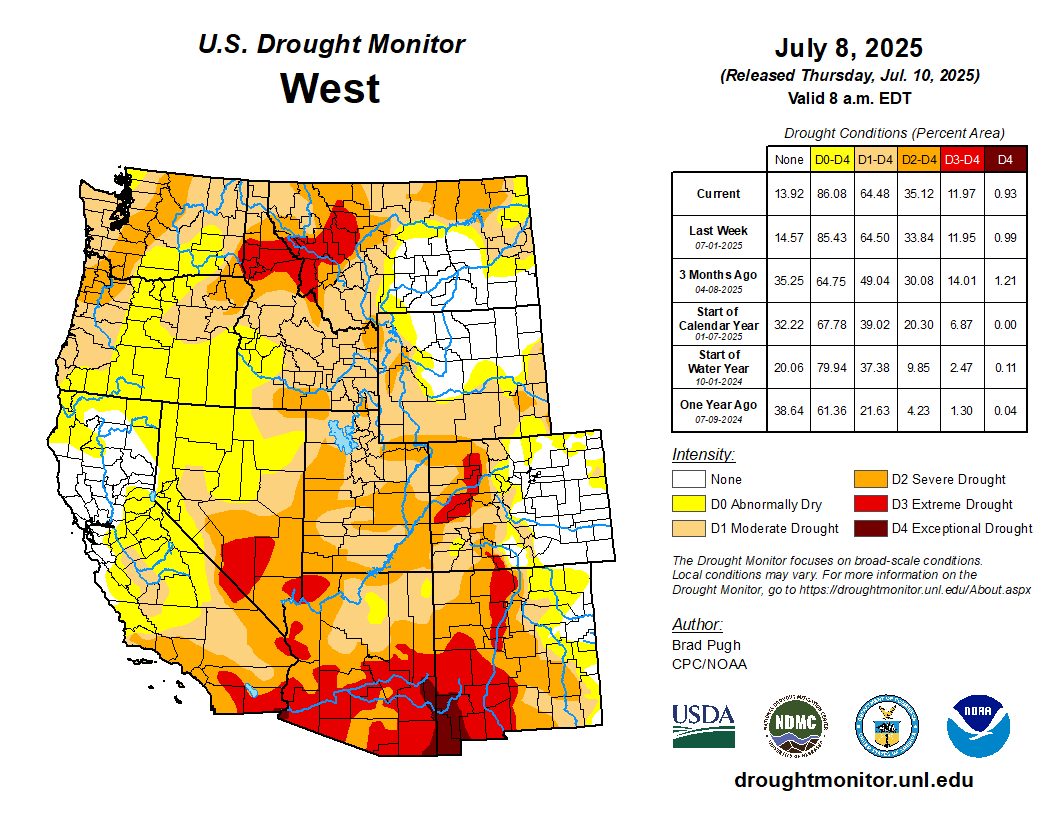
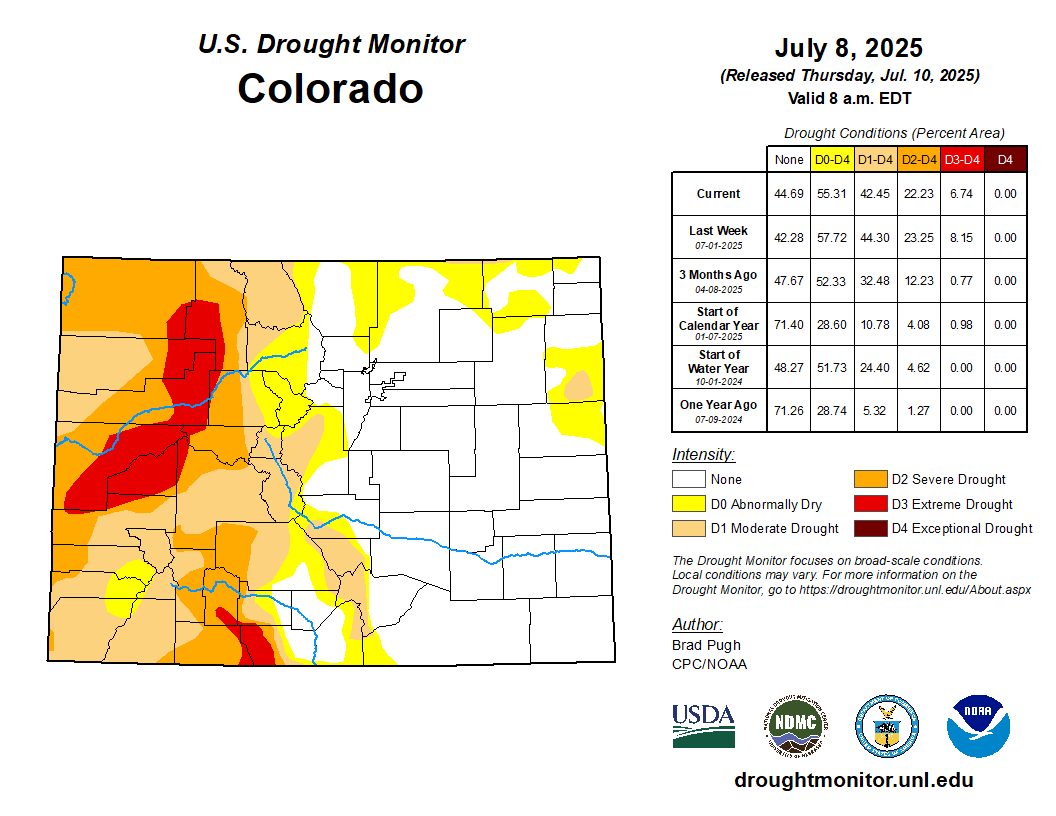
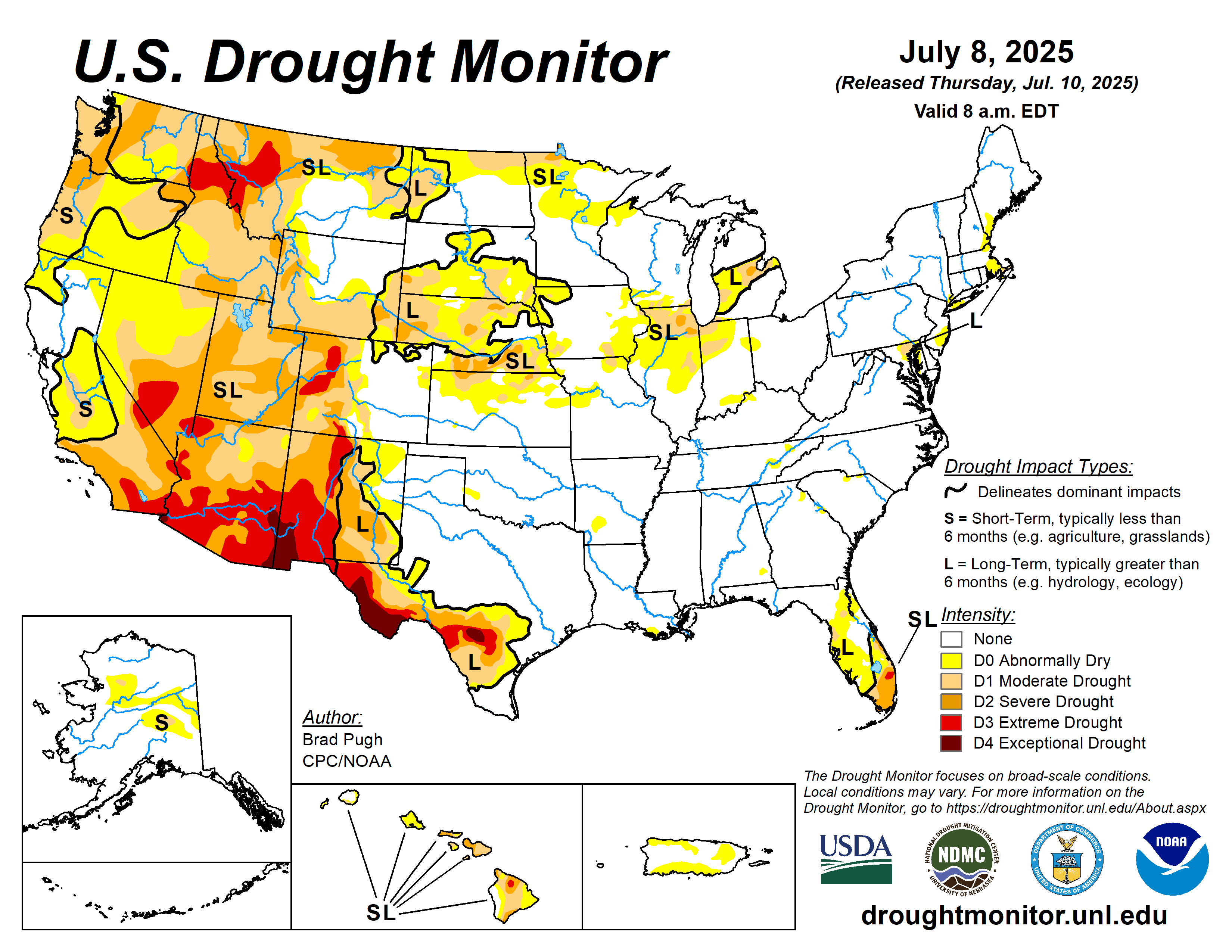
#Drought news July 10, 2025: Improving drought conditions were made to parts of #NewMexico, S.W. #Colorado, and #Arizona, 90-day precipitation, valid April 9-July 7, avg. more than 150 percent of normal for much of #Nebraska, E. Colorado, and E. #Wyoming.

Click on a thumbnail graphic to view a gallery of drought data from the US Drought Monitor website.
Click the link to go to the US Drought Monitor website. Here’s an excerpt:

This Week’s Drought Summary

Drought coverage and intensity continued its decline throughout the Great Plains since the spring with additional heavy rainfall during the first week of July. Despite the extremely heavy rainfall and flash flooding this past week, long-term drought dating back multiple years remains across south-central Texas. Improving drought conditions were made to parts of New Mexico, southwestern Colorado, and Arizona, while drought expanded and intensified across the Pacific Northwest and Northern Intermountain West. Much of the Corn Belt and Midwest remains drought-free, but a continued lack of adequate precipitation led to worsening drought for northern Illinois. Following another week of summertime thunderstorms with heavy rainfall, drought ended for most of the central to southwestern Florida Peninsula. Nearly all of the East, Ohio and Tennessee Valleys, and Lower Mississippi Valley are drought-free. 7-day temperatures (July 1-7), averaged 2 to 4 degrees F above normal across the Pacific Northwest, Northern Great Plains, Midwest, and New England. Cooler-than-normal temperatures were limited to the Southern Great Plains and portions of the Southwest. Parts of northwestern Alaska and the Yukon River Valley are designated with short-term drought, while drought of varying intensity continues for Hawaii. Although Puerto Rico currently remains drought-free, short-term precipitation deficits have increased…

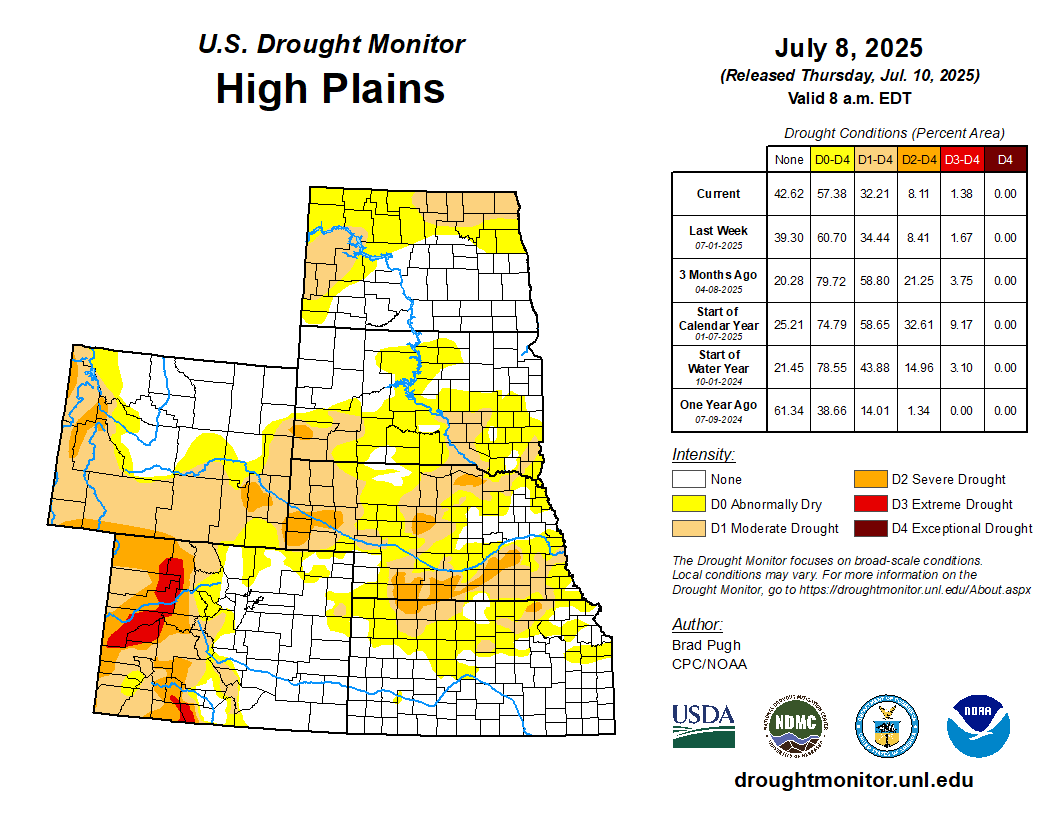
High Plains

Another round of heavy rainfall (1 to 2 inches, locally more) supported a 1-category improvement to parts of the Northern and Central Great Plains. April through early July is a wet time of year and 90-day precipitation, valid April 9-July 7, averaged more than 150 percent of normal for much of the Dakotas, Nebraska, eastern Colorado, and eastern Wyoming. Conversely, moderate drought (D1) across northeastern North Dakota was expanded westward due to another dry week and above-normal temperatures. The D1 is supported by the 30 to 60-day SPIs along with soil moisture indicators. Eastern Kansas has missed out on the heavy rainfall recently and abnormal dryness (D0) was added to that part of the state. Although precipitation was not that heavy across southwestern Colorado, enough precipitation along with support from SPIs at multiple time scales and the NDMC drought blends warranted small 1-category improvements…
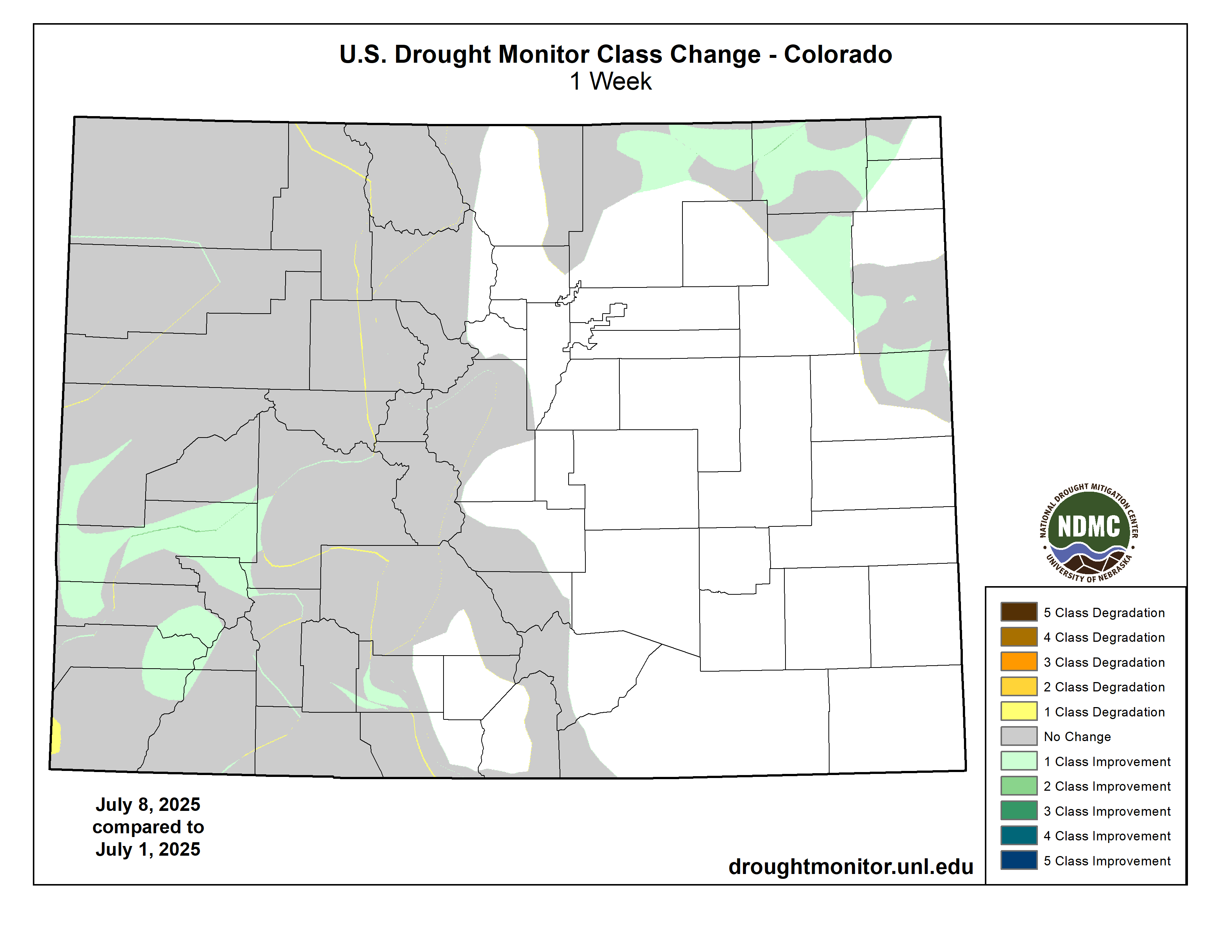
Colorado Drought Monitor one week change map ending July 8, 2025.

West

Based on rapidly declining soil moisture and low 28-day average streamflows, additional degradations were warranted this week for the Pacific Northwest with an expanding coverage of moderate (D1) to severe (D2) drought across Oregon and Washington. Farther to the east, extreme drought (D3) was expanded to include more of northern Idaho. Parts of Utah also had a few areas with degradations based on 28-day streamflow, soil moisture, and high evaporative demand recently. A drier end to the wet season, 60 to 90-day SPI, and low soil moisture supported an expansion of abnormal dryness (D0) across northern to central California. Following recent beneficial precipitation along with timely wetness back to the late spring, improvements were warranted for parts of north-central and eastern Montana. Drought intensity remained nearly steady for the Desert Southwest although locally heavier Monsoon showers led to a small reduction in extreme drought (D3) for eastern and southern Arizona…

South

A broad one to two-category improvement was made this past week to much of the ongoing long-term drought areas of Texas along with parts of New Mexico. The heaviest precipitation (5 to 10 inches, or more) occurred across the Edwards Plateau and south-central portions of Texas. According to CoCoRaHS gauge measurements from July 1-7, precipitation amounts ranged from 12 to 18 inches in eastern Burnet and western Williamson counties of Texas. Although 1 to 2-category improvements were made, a long-term drought dating back multiple years with low groundwater and reservoir levels continue. Therefore, an area of long-term drought (D1+) was maintained. The Edwards Aquifer Authority’s long-term observation wells at Medina and Uvalde counties remain in extreme (D3) to exceptional (D4) drought levels. Elsewhere, across the Southern Great Plains and Lower Mississippi Valley, no short-term or long-term drought is designated…
Looking Ahead

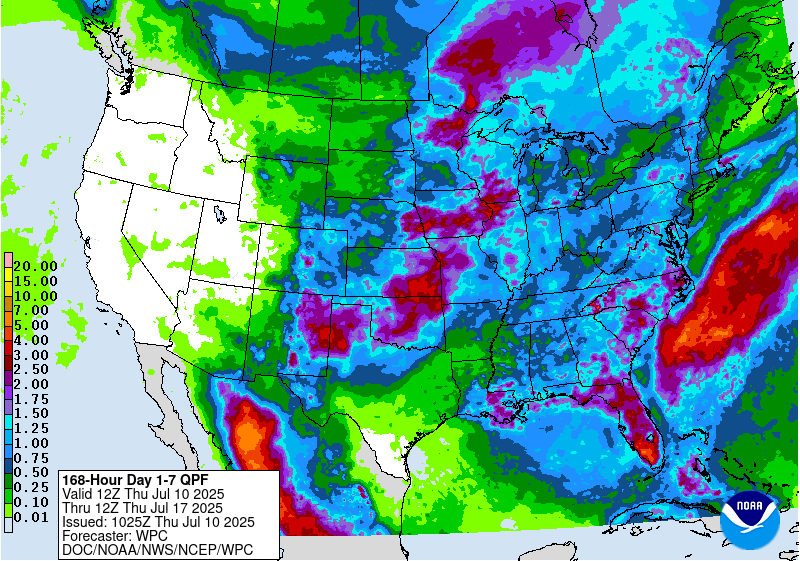
From July 10 to 14, a cold front is forecast to shift southeast across the central U.S. and provide the focus for thunderstorms. The most widespread, heavy precipitation (more than 1.5 inches) is forecast across the Upper Mississippi Valley and Western Corn Belt, but locally heavy precipitation is expected as far south and west as the Southern Great Plains and eastern New Mexico. Daily convection with locally heavy precipitation is forecast across the Mid-Atlantic and Southeast, especially east of the Appalachians. A lull in the Monsoon will be accompanied by above-normal temperatures across the Desert Southwest. Dry weather and increasing heat are likely for the interior Pacific Northwest.

The Climate Prediction Center’s 6-10 day outlook (valid July 15-19, 2025) favors above-normal precipitation across the eastern two-thirds of the contiguous U.S., most of Alaska, and the western Hawaiian Islands. The largest above-normal precipitation probabilities (more than 50 percent) are forecast for the Florida Panhandle, western Texas, and eastern New Mexico. Increased below-normal precipitation probabilities are limited to the Pacific Northwest. Above-normal temperatures are favored throughout the Pacific Northwest, Great Basin, eastern Texas, Lower Mississippi Valley, and the East. Increased chances for below-normal temperatures are forecast for the Great Plains. The outlook leans cooler (warmer)-than-normal for southern (northern) Alaska.

US Drought Monitor one week change map ending July 8, 2025.

Safeguarding the sagebrush’s rich wet meadows, one #Wyoming gulch at a time: Simple erosion-control technique named after scientist Bill Zeedyk fortifies ecologically valuable riparian zones all around the western U.S — Mike Koshmrl (WyoFile.com)

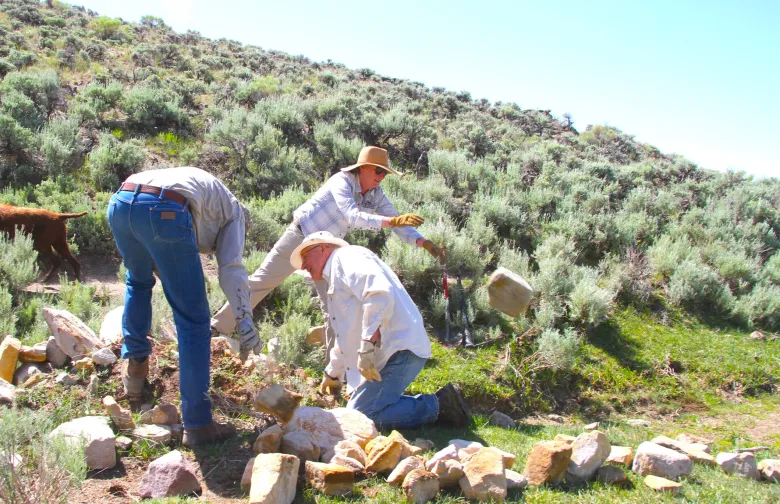
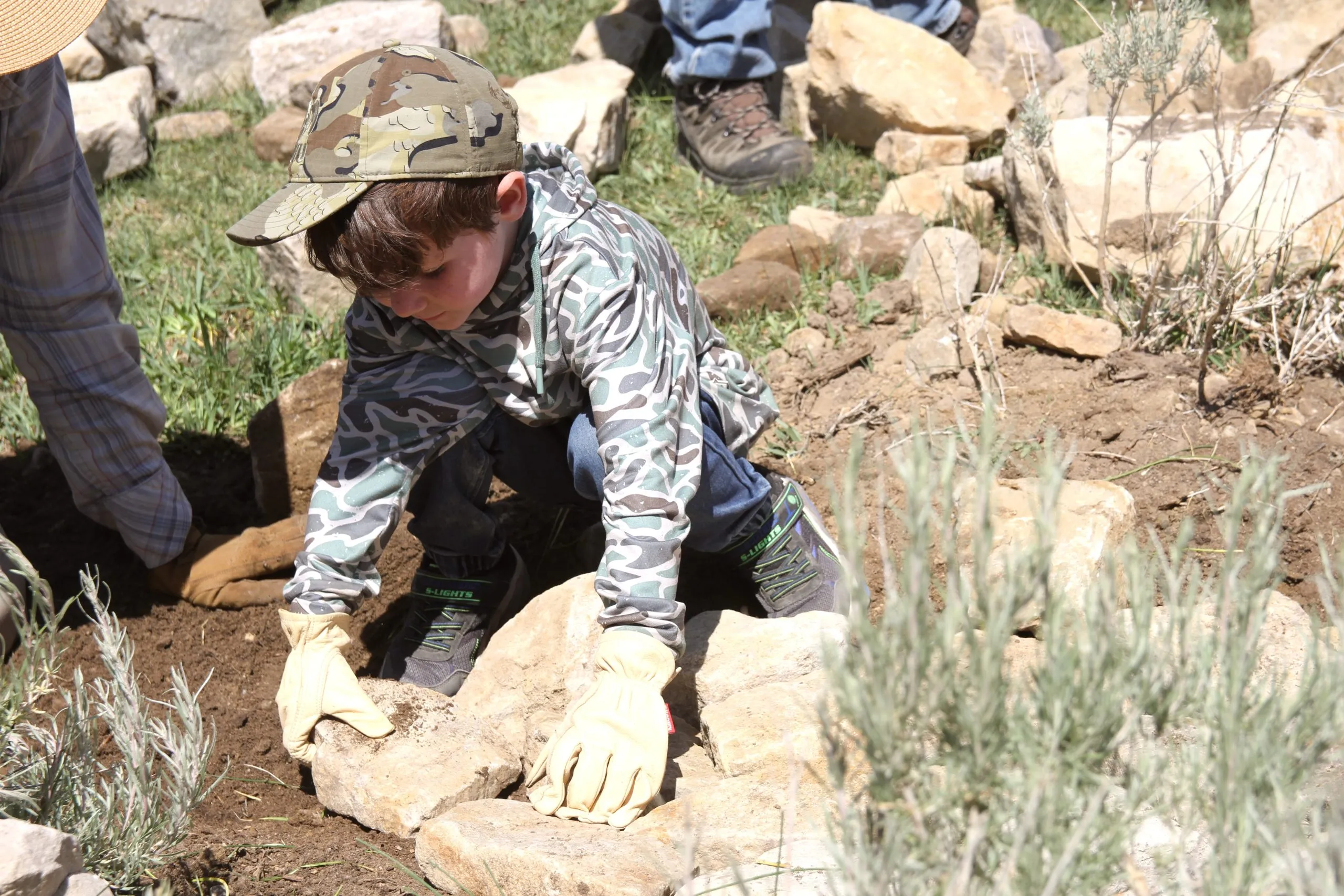
Cooper Fieseler places stones intended to prevent erosion during a June 2025 Zeedyk structure-building outing on the White Acorn Ranch. (Mike Koshmrl/WyoFile)

Click the link to read the article on the WyoFile website (Mike Koshmrl):

Tom Christiansen drew a parallel to the human body as he described the purpose of the low-tech rock structures he’s been building for years within the creases of western Wyoming’s sagebrush sea. 

The malady? Erosion. The treatment: A carefully placed stone.  

ā€œEach of these is a stitch on what we don’t want to become a sucking chest wound,ā€ Christiansen told a group of rock-moving volunteers on Saturday in late June. 

The group was assembled on the White Acorn Ranch, a picturesque cattle operation south of the Lander Cutoff Road that’s within the spectacular Golden Triangle ā€” a 367,000-acre region along the flanks of the Wind River Range that houses the best remaining sagebrush habitat on Earth.

In a June 2025 outing near South Pass, Tom Christiansen, Mark Kot and Lindsey Washkoviak distribute stones that will be positioned into Zeedyk structures intended to protect wet meadows. (Mike Koshmrl/WyoFile)

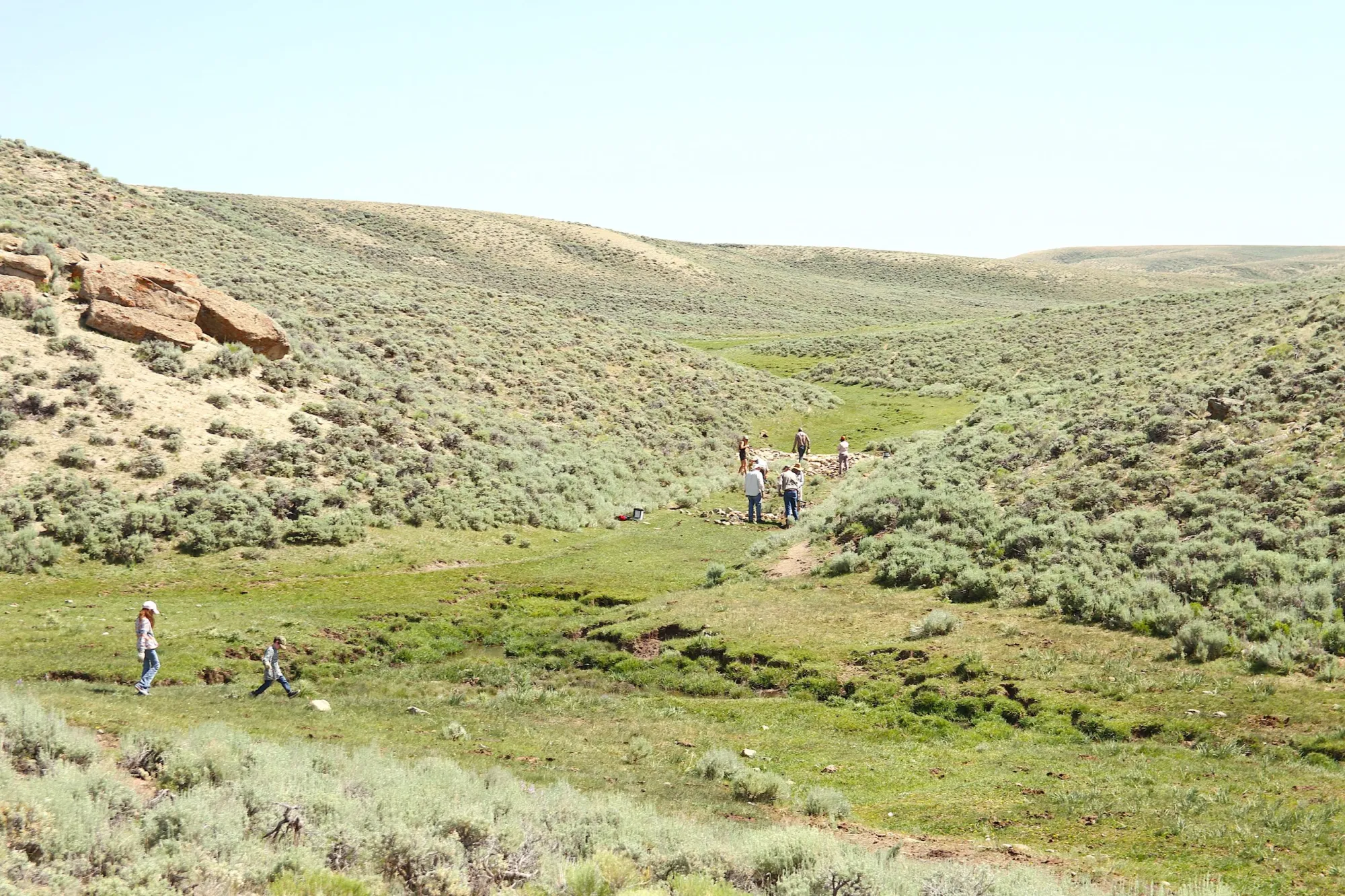
The high desert’s sagebrush-steppe has enormous ecological value. That’s evidenced by the struggling species that depend upon the embattled biome. But it’s an arid environment, and certain nooks and crannies play an outsized role in nourishing the landscape’s native and domesticated inhabitants. High on that list are the grassy wet meadows that convey precious water, like arteries pump blood, through the contours of the sagebrush-covered hills.

ā€œThese areas are pretty small, but they’re very important,ā€ said Christiansen, a retired sage grouse coordinator for the Wyoming Game and Fish Department. ā€œThese are the grocery stores.ā€ 

Youngsters Cooper Fieseler and Camryn Christiansen-Fieock check out a mega-sized Zeedyk structure built to address an especially broad ā€œheadcutā€ that was eroding into the green grass uphill. (Mike Koshmrl/WyoFile)

But those bottomlands can become barren of the biomass that feeds insects, sage grouse chicks and on down the food chain. Erosion, although a natural phenomenon, can be hastened by factors like overgrazing and extreme weather events made more likely by climate change. When erosion runs out of control into grassy gulches, they become incised gullies. Out goes the vegetation. 

That’s where the simple rock structures come in. 

The same spot before the mega-sized Zeedyk structure went in. (Tom Christiansen)

ā€œPrevent that erosion, get more water into the soil, keep the water table up, keep the green vegetation — that’s the intent of these structures,ā€ Christiansen said. 

Known as Zeedyk structures, after their inventor, Bill Zeedyk, the stone assemblies come in different shapes and sizes. At the White Acorn Ranch and numerous other corners of the West, there are ā€œone rock dams,ā€ ā€œzuni bowls,ā€ ā€œrock mulch rundownsā€ and other hand-built structures intended to arrest vertical ā€œheadcutsā€ in ephemeral streambeds.

By facilitating the flow of water and slowing it down, the structures can prevent erosion from spreading uphill. Although the ecological do-gooding tactic relies on simple concepts and materials — essentially well-placed rocks — building it out requires hard physical labor. 

Mark Kot listens to a discussion about Zeedyk structures in June 2025. (Mike Koshmrl/WyoFile)

A bevy of volunteers flocked to South Pass on June 21 to erect new Zeedyk structures and shore up old ones. 

Jared Oakleaf, Liz Lynch and Lindsey Washkoviak ventured up from Lander. Mark Kot, bad back and all, came from Rock Springs to move rock. Christiansen made the drive from Green River alongside his granddaughter, Camryn Christiansen-Fieock, of Big Piney. On a day off, Wyoming Game and Fish Department habitat biologist Troy Fieseler made the trek from Pinedale and with his son, Cooper. 

A group of volunteers building Zeedyk structures in June 2025 aims to preserve the grassy bottoms pictured in this photo on the White Acorn Ranch. (Mike Koshmrl/WyoFile)

The rocks were donated, too. Robert Taylor, an avid sage grouse hunter from Washington state, ponied up for the materials the volunteers carefully placed. 

Several of the bunch devoting their Saturday to moving rocks up on South Pass were seasoned. Fieseler even learned the ropes from the technique’s namesake himself. 

ā€œThe very first time I did it, we had Bill Zeedyk come out,ā€ he said. ā€œHe taught us to read the landscape.ā€

Troy Fieseler motions while talking with fellow volunteers during a June 2025 Zeedyk structure-building outing on the White Acorn Ranch. (Mike Koshmrl/WyoFile)

That 2021 workshop, held at Seedskadee National Wildlife Refuge, imparted Fieseler with lessons he hasn’t forgotten. Protecting uneroded wet meadows is a far more efficient use of time and resources than trying to restore those that have already washed out, he recalled.

Over the last decade, Zeedyk’s erosion-control tactics have gained traction in Wyoming and well beyond. The Natural Resources Conservation Service’s Sage Grouse Initiative gave the concept its legs, Christiansen said. Now there are thousands of structures dispersed across hundreds of projects, he said.

ā€œEach of these, what’s its significance?ā€ Christiansen said. ā€œAn individual one, it’s not so much, but when you start doing thousands of these across the West, there is significance.ā€

Zeedyk structures in action helping to control erosiion and retain moisture on a gulch in the White Acorn Ranch. (Tom Christiansen)

Enough time has passed since the technique’s inception that restoration specialists know it works, thanks to long-term monitoring

The White Acorn Ranch’s Zeedyk structures also have proven hardy and able to withstand the worst that the harsh Wyoming environment can throw their way. Christiansen and his fellow volunteers labored in a corner of the state that got walloped during the winter of 2022-’23 by an unusually hefty snowpack. 

ā€œThis ensured the runoff from the heavy snow,ā€ Christiansen said. ā€œThey dealt with a lot of energy, and handled it. Very few rocks moved.ā€

Christiansen spoke of the rock structure’s resilience on the front end of a day of labor. From a section of state land, he motioned down a draw. 

ā€œThere’s over 20 structures between here and where that slope toes off,ā€ he said. 

Every one of them had been erected by Christiansen, the crews of Zeedyk structure-building volunteers and agency folks that have also chipped in.

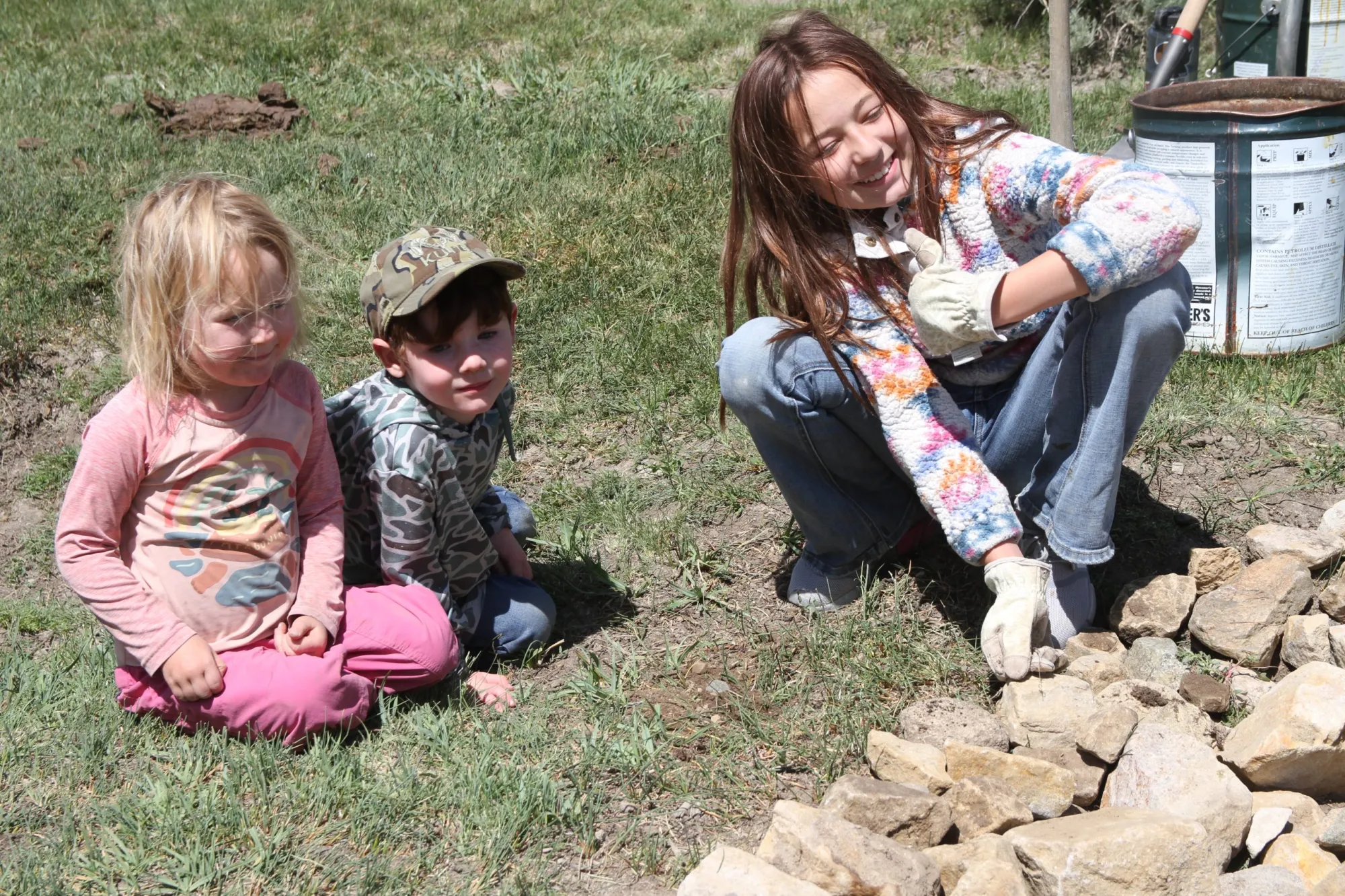
Frances Brennan, Cooper Fieseler and Camryn Christiansen-Fieock pose after a couple hours of playing and moving rocks that went into Zeedyk structures on the White Acorn Ranch. (Mike Koshmrl/WyoFile)

R.I.P. John Stulp

John Salazar, Governor Hickenlooper, and John Stulp at the 2012 DNR Drought Conference

From email from the Colorado Water Congress (Christine Arbogast):

The Colorado water family has lost a giant and a gentleman. Ā To be able to stand by John’s side was an honor, as he exhibited such knowledge, integrity and humility in all he did.

Obituary from Peacock Funeral Home:

A memorial service is pending for longtime Lamar resident John R. Stulp, Jr.

John was born on December 27, 1948 at Yuma, CO to John and Nina (Dunafon) Stulp Sr. and passed away on July 7, 2025 at the age of 76 at the Prowers Medical Center in Lamar with his family by his side.

John is survived by his wife Jane Stulp of the family home in Lamar; children John (Lyndsey) Stulp, III of Fort Collins, CO; Janea (Sunit) Bhalla of Fort Collins, CO; Jason (Megan) Stulp of Fruit Heights, UT; Jeremy (Christi) Stulp of Granada, CO; and Jensen (Annessa) Stulp of Lamar, CO; grandchildren Jackson, Cooper, and Eli Stulp; Brady, Kaitlyn, and Tyson Bhalla; Ethan, Nathan, and Addison Stulp; Mark and Brynn Stulp; and Zeke, Trenton, and Anneston Stulp.

He is also survived by his sisters, Clydette (Charles) DeGroot of Cabris, France and Patty Stulp of Denver, CO; his aunt Leta Smith of Joes, CO; his brothers-in-law Bill Ragsdale of Santa Clarita, CA; John Ragsdale of Santa Clarita, CA; and David Ragsdale of Fort Collins, CO; his sisters-in-law Cindy Stulp of Yuma, CO; Renel Ragsdale of Santa Clarita, CA; Judy (Gary) Barham of Halfway, MO; and Jean Ragsdale of Bolivar, MO; as well as many cherished nieces, nephews, cousins, and a host of friends.

He is preceded in death by his parents, his brothers D.V. Stulp and Tim Stulp, his parents-in-law Howard and Mary Ragsdale, and his brother-in-law Bob Ragsdale.

More Coyote Gulch posts mentioning John Stulp.

Assessing the U.S. #Climate in June 2025 — NOAA

Click the link to read the report on the NOAA website:

Key Point:

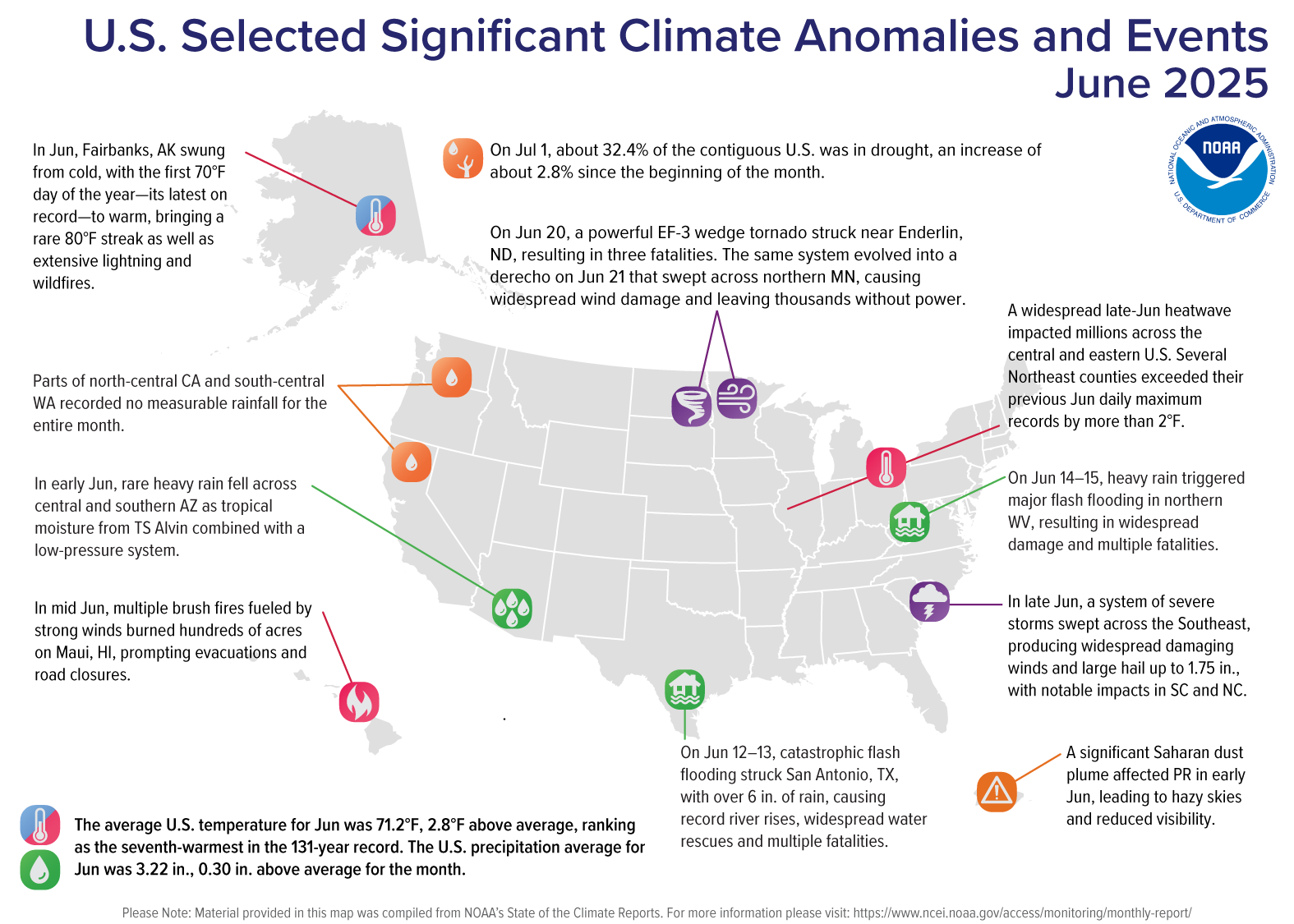
A widespread late-June heatwave impacted much of the central and eastern U.S., and brought record-setting temperatures. More than 100 million people across 726 counties experienced record heat from June 22–25.

Map of the U.S. selected significant climate anomalies and events in June 2025

Other Highlights:

Temperature

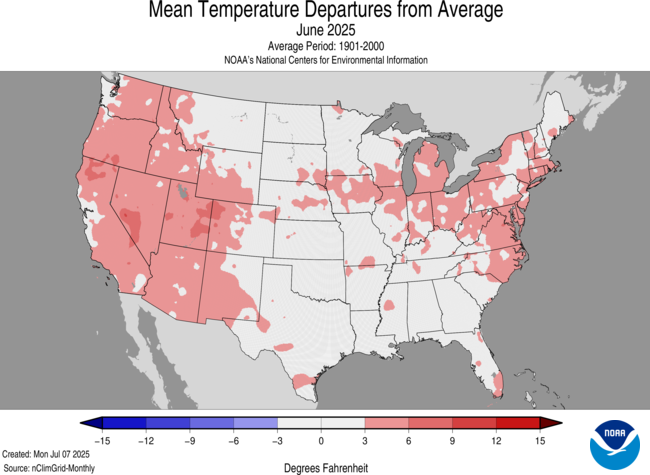
June 2025 U.S. Mean Temperature Departures from Average Map

The average temperature for the contiguous U.S. (CONUS) in June 2025 was 71.2°F, 2.8°F above the 20th-century average, and ranked seventh warmest in the 131-year record. Temperatures were above average across most of the Lower 48, with much-above-average warmth affecting large areas of the western third of the country, along with parts of the Florida Peninsula, Mid-Atlantic, Northeast and Great Lakes regions. Rhode Island saw its second-warmest June on record and its warmest for nighttime minimum temperatures, which were 5.8°F above average.

Alaska’s average temperature for June was 50.8°F, 1.6°F above the long-term average and ranking in the warmest third of the 101-year record. While parts of the southeast Panhandle were slightly cooler than average, the North Slope was notably warm at more than 3 degrees above average.

The average temperature for the CONUS during the first half of 2025 (January–June) was 49.6°F, 2.1°F above the 20th-century average, ranking in the warmest third of the 131-year record. All states recorded temperatures above their long-term averages for the six-month period, with much-above-average warmth observed across parts of the West, Southwest and portions of the East Coast. Alaska’s year-to-date average temperature was 26.8°F, 5.5°F above its long-term average, tying as the fourth-warmest January–June in the 101-year record.

Precipitation

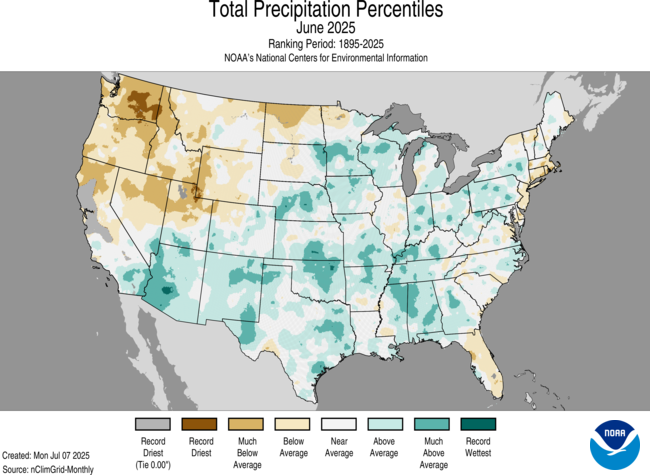
June 2025 U.S. Total Precipitation Percentiles

The average precipitation for the contiguous U.S. in June was 3.22 inches, 0.30 inch above the long-term average, ranking in the wettest third of the 131-year record. Much of the Southwest, the southern and central Plains, the middle and upper Mississippi Valley, parts of the Ohio Valley and Great Lakes region and areas of the Deep South recorded above-average rainfall. In contrast, drier-than-average conditions prevailed from the central West Coast through the Northwest and into the Rockies. The Northwest region experienced its third-driest June on record—and driest since 2003—with Washington and Oregon each receiving less than half an inch of rain for the month. Parts of north-central California and south-central Washington recorded no measurable rainfall for the entire month.

For the January–June period, the CONUS averaged 15.70 inches of precipitation, 0.40 inch above the long-term average, ranking in the middle third of the 131-year record. Most of the western half of the country, along with a narrow band from the central Plains through the mid-Mississippi Valley and parts of the Southeast, were drier than average. Above-average precipitation was recorded from the southern Plains through the lower Mississippi and Ohio Valleys into the Northeast, as well as in parts of the northern Plains and upper Mississippi Valley.

Alaska received 2.32 inches of precipitation in June, which was near the long-term average. Conditions were drier than average across the eastern interior and North Slope but wetter than normal in the western and southwestern parts of the state. For the first half of the year, Alaska recorded 16.58 inches of precipitation, 2.96 inches above average, marking its fifth-wettest start to the year on record.

Drought

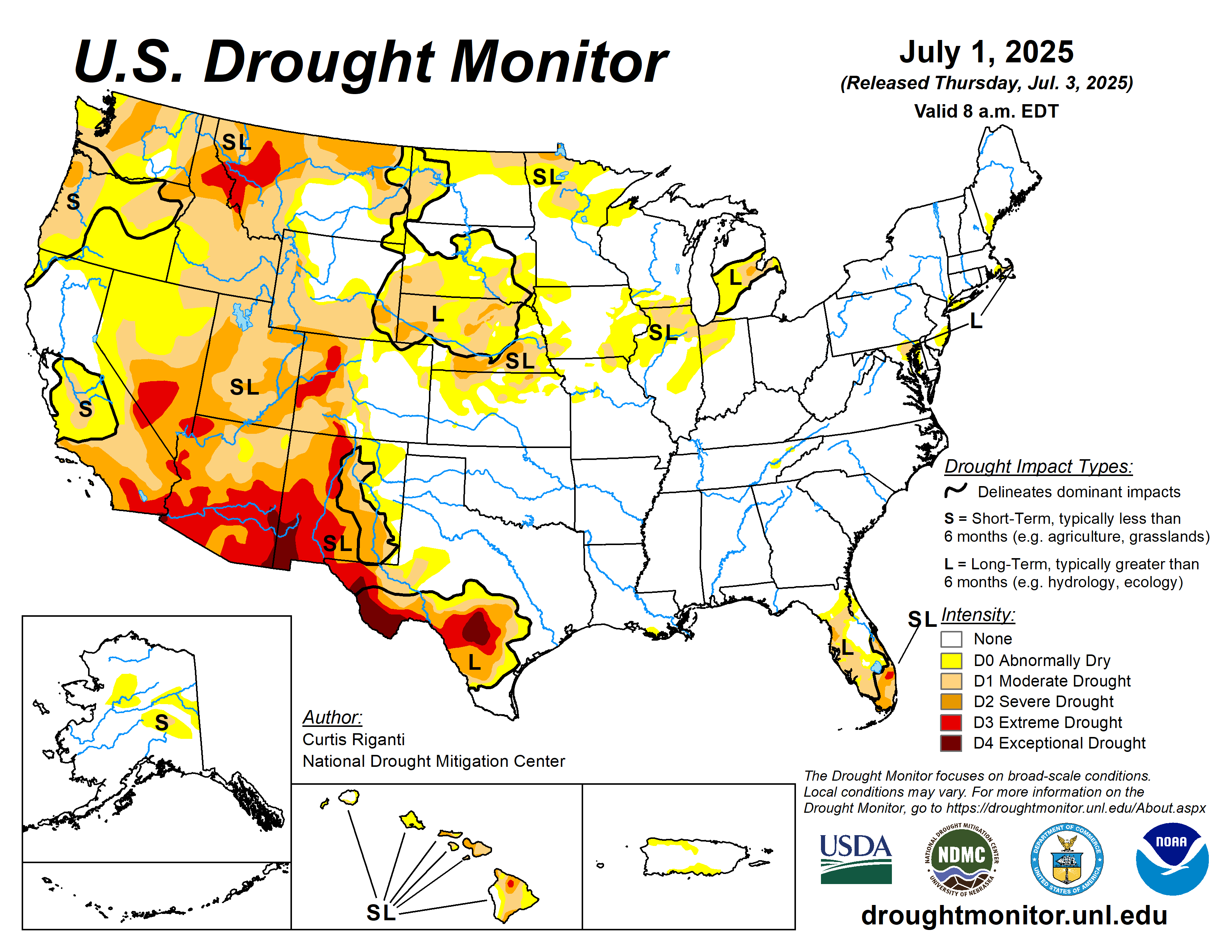
US Drought Monitor map July 1, 2025.

According to the July 1Ā U.S. Drought Monitor report, about 32.4% of the contiguous U.S. was in drought, an increase of approximately 2.8% since the beginning of the month. Drought developed or intensified across much of the Northwest through the Rocky Mountains and in small areas of the Alaskan interior. Conversely, drought contracted or was reduced in intensity across parts of the Southwest and southern Texas, the central and northern Plains, the upper Mississippi Valley and parts of Florida.

Monthly Outlook

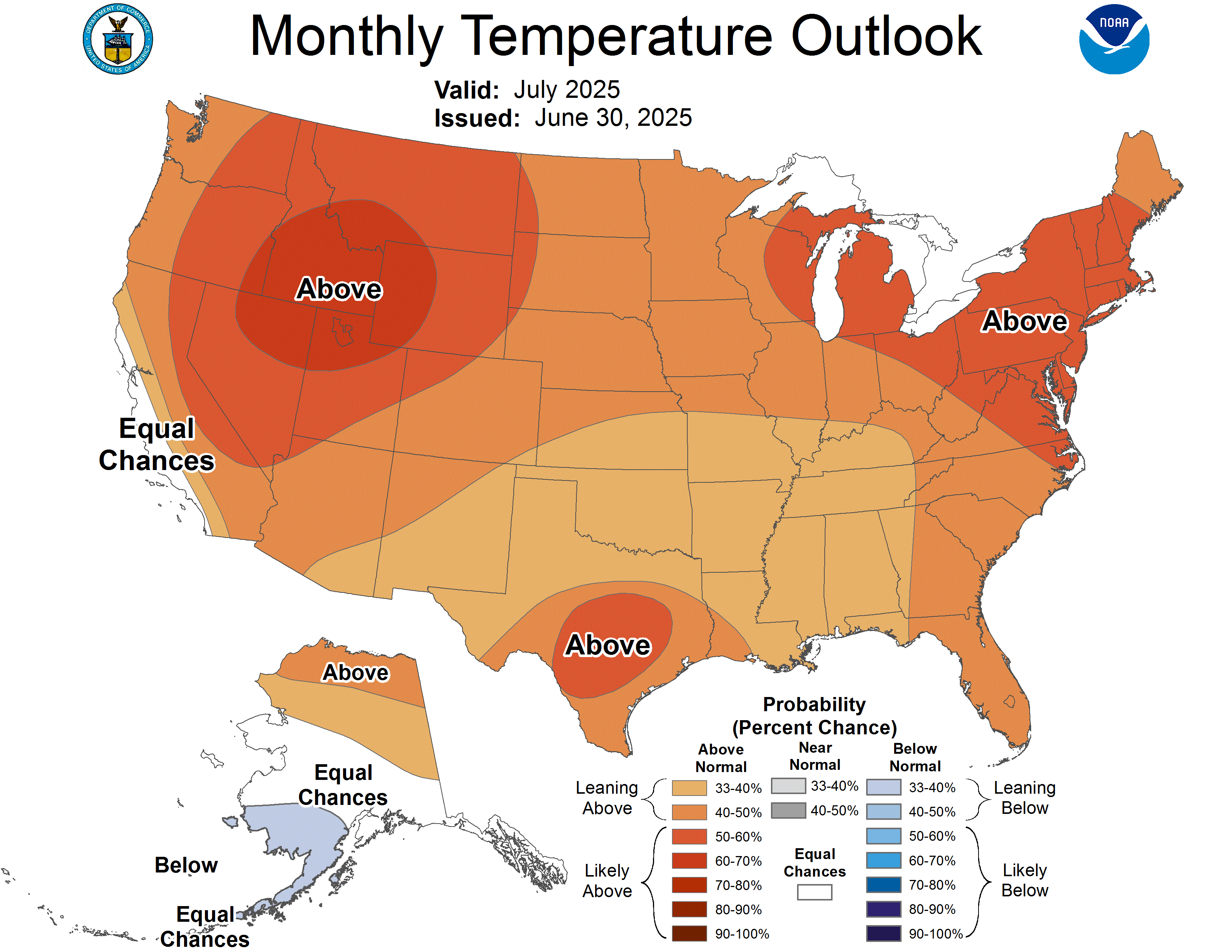
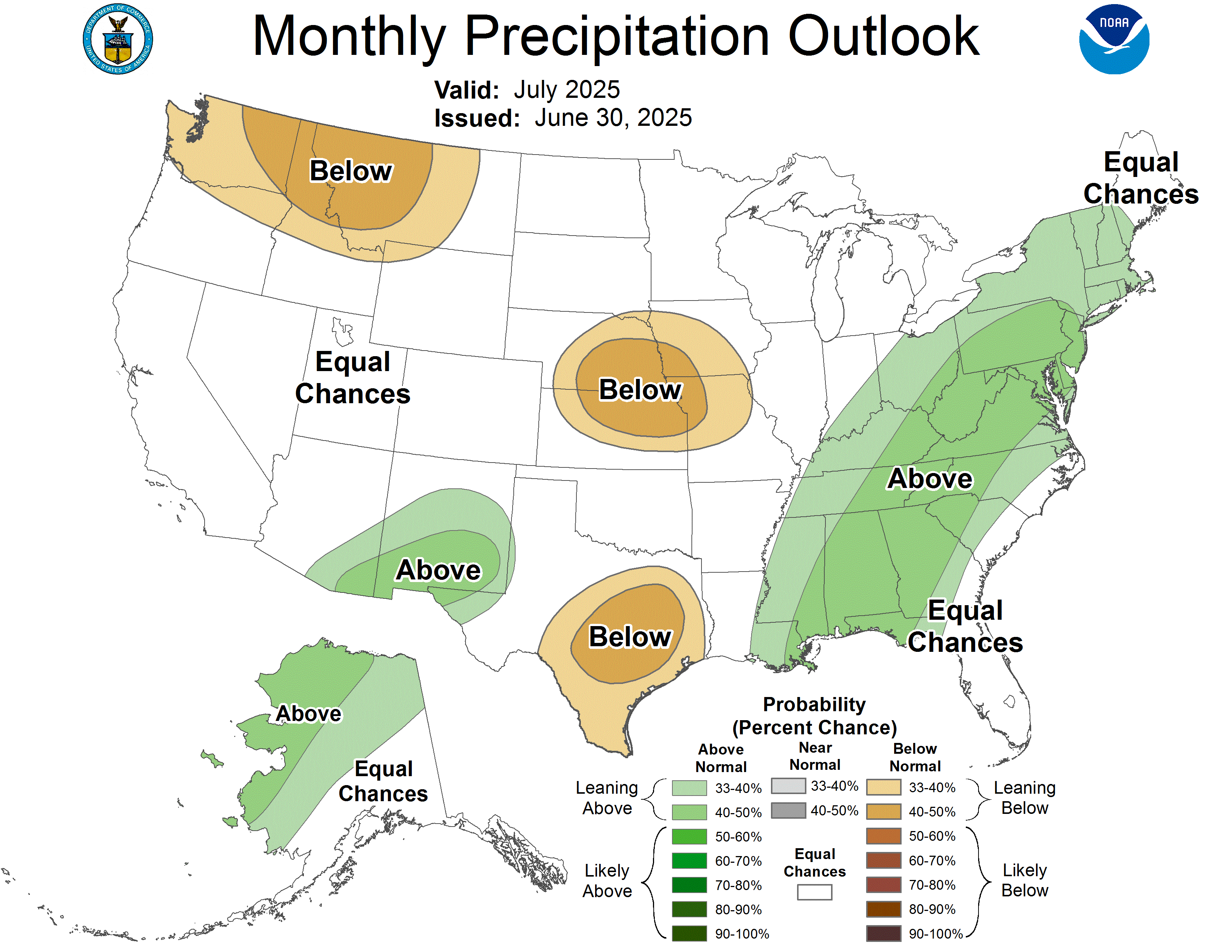
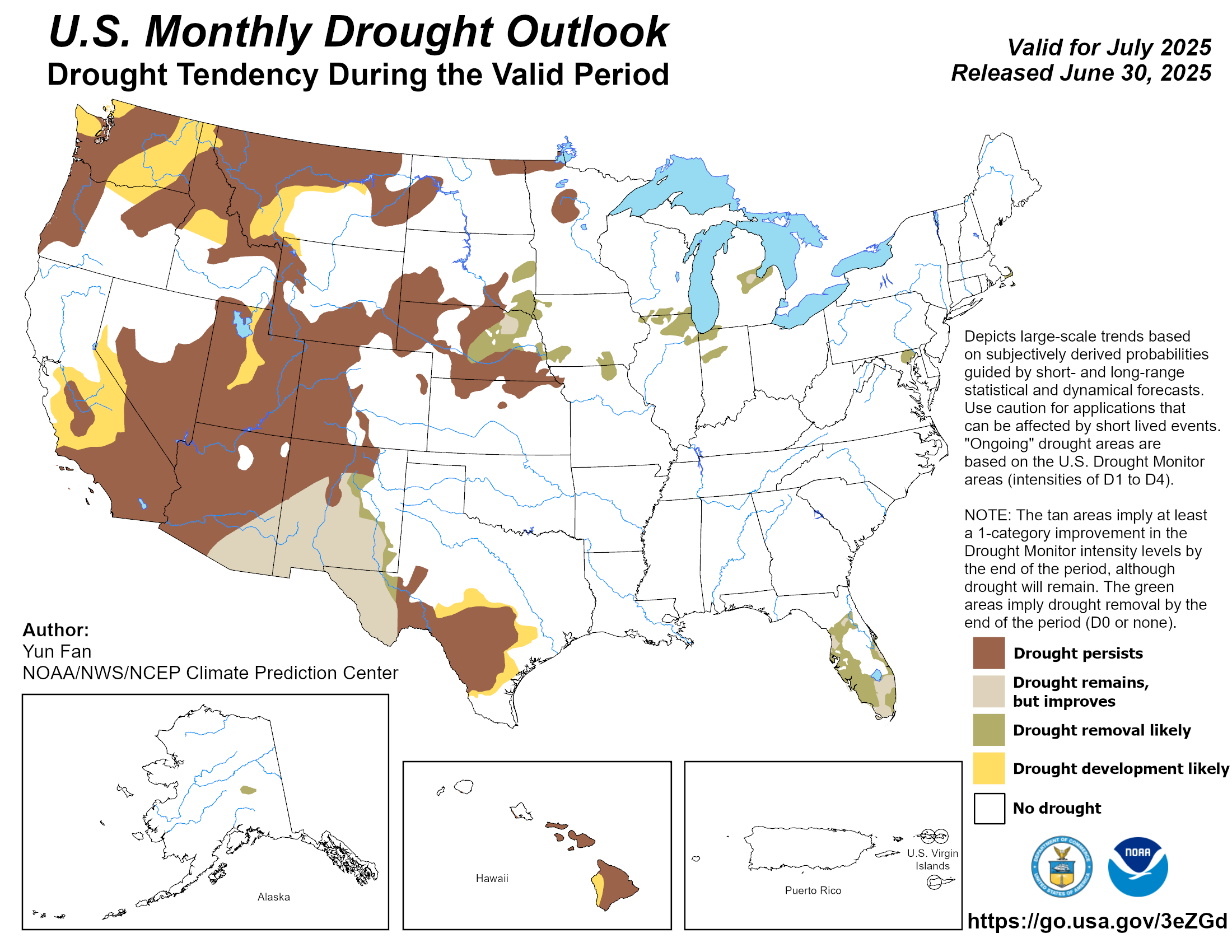
July temperatures are expected to be above normal across the entire contiguous U.S., with the highest likelihood of warmer-than-average conditions in the Mountain West, southern Texas and throughout much of the Great Lakes and the Northeast. For rainfall, parts of the Northwest and the southern and central Plains are expected to be drier than normal, while the interior East is favored to have a wetter-than-average July. Drought is likely to persist across much of the western U.S. in July, with some further development in the Northwest, while improvement is expected across southeastern Arizona, southern New Mexico and far West Texas, where above-average rainfall is favored.

Visit the Climate Prediction Center’s Official 30-Day Forecasts and U.S. Monthly Drought Outlook website for more details.

Significant wildland fire potential is above normal for July across the Northwest, Hawaii and Puerto Rico. For additional information on wildland fire potential, visit the National Interagency Fire Center’s One-Month Wildland Fire Outlook.

For more detailed climate information, check out our comprehensive June 2025 U.S. Climate Report scheduled for release on July 14, 2025. For additional information on the statistics provided here, visit the Climate at a Glance and National Maps webpages.