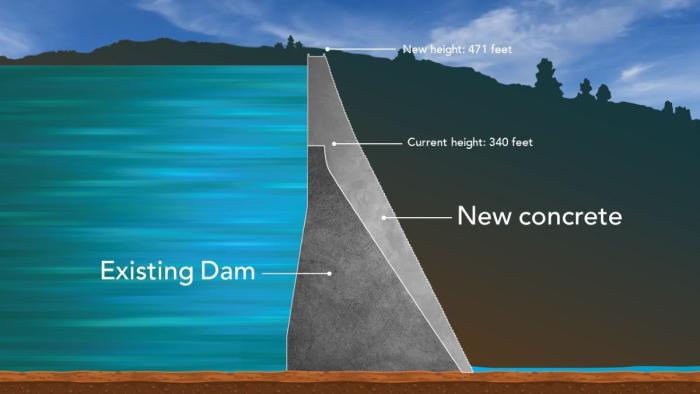
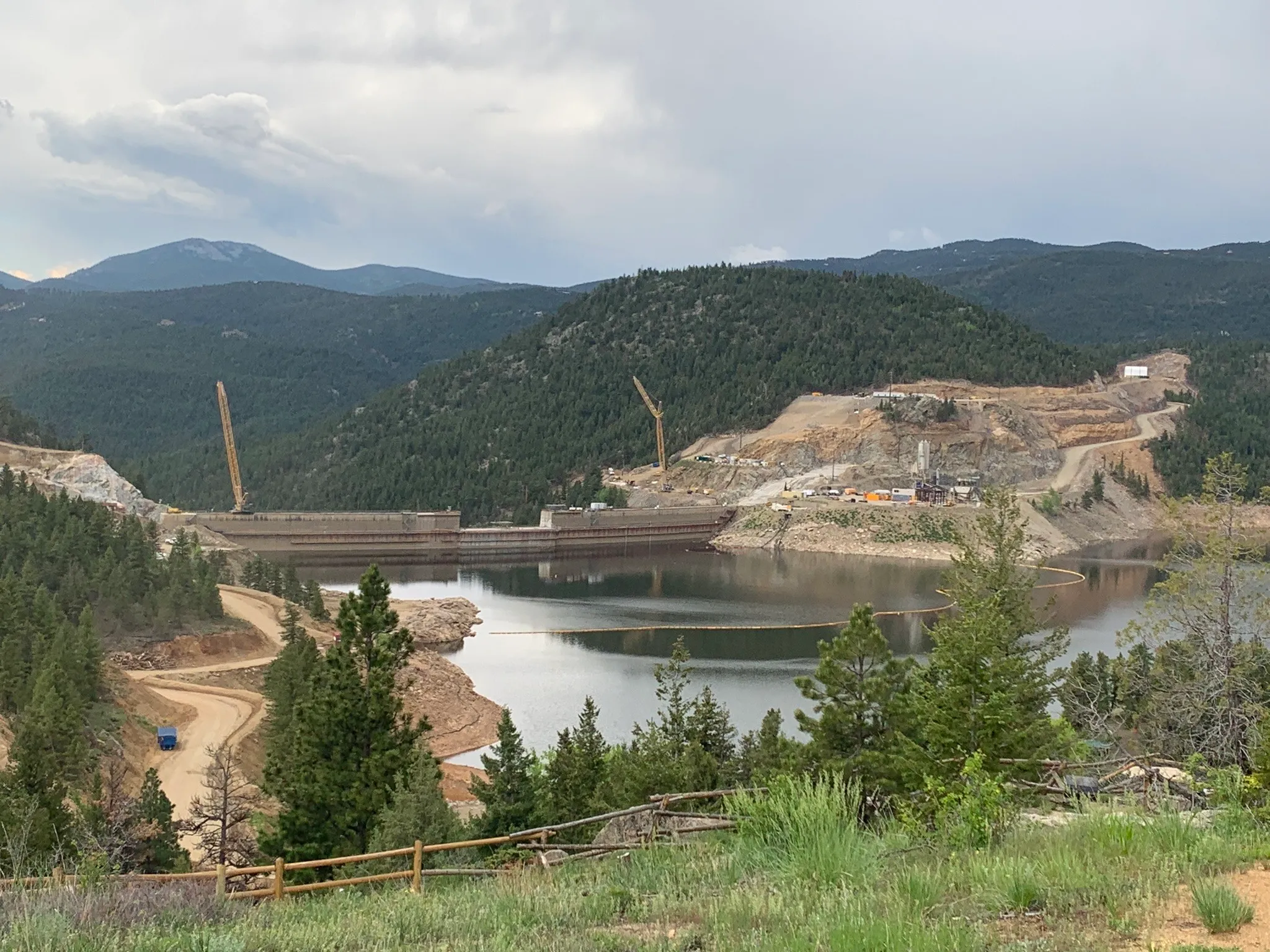
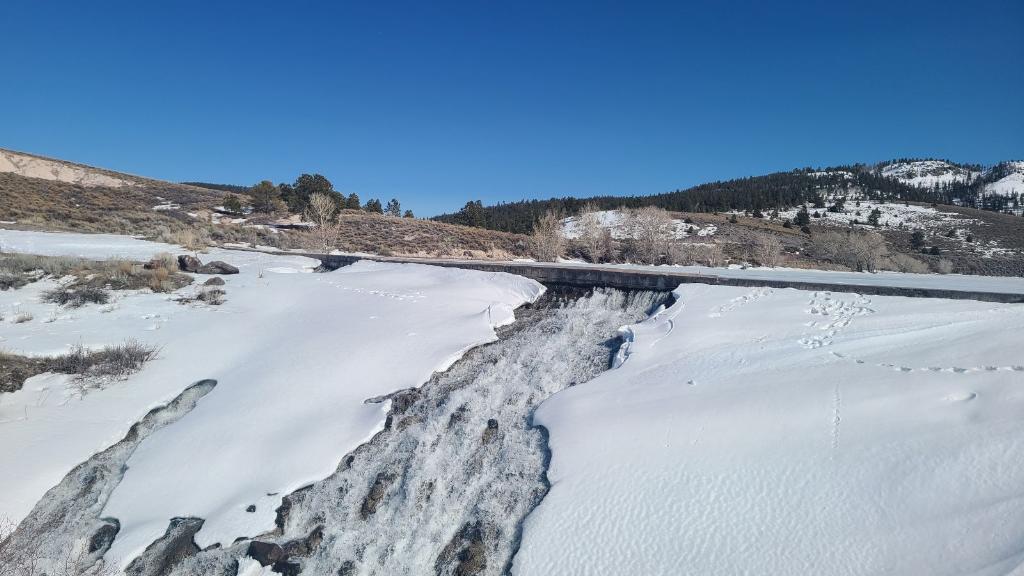
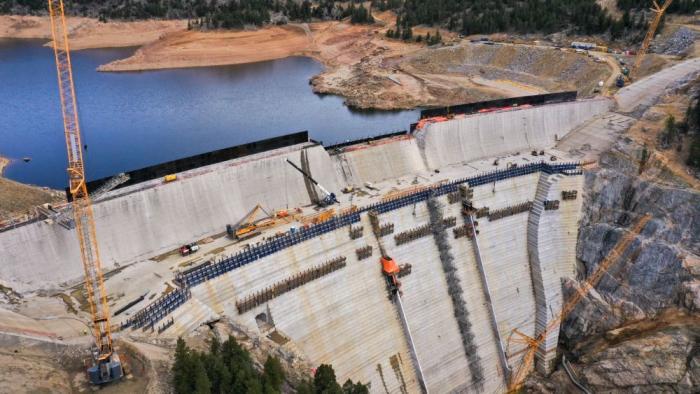
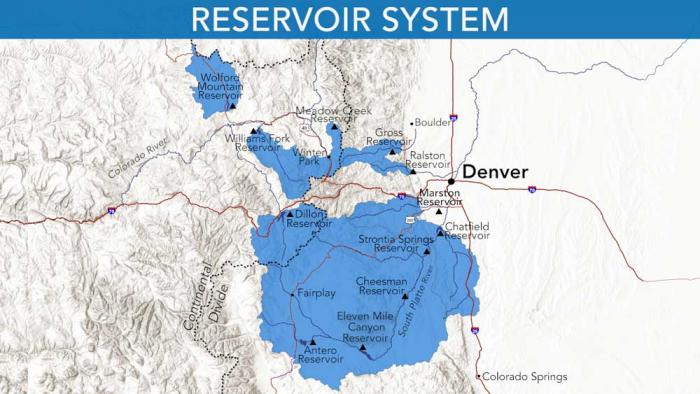
Roller-compacted concrete will be placed on top of the existing dam to raise it to a new height of 471 feet. A total of 118 new steps will make up the new dam. Image credit: Denver Water.
Afederal judge will allow Denver Water to continue work on a $531 million project to raise a dam in Boulder County, dealing a blow to environmentalists who had hoped to stop the construction.
However, Senior U.S. District Judge Christine Arguello in her ruling May 29 prohibited Denver Water from filling Gross Reservoir until federal environmental permits can be rewritten by the Army Corps of Engineers.
“There is no evidence that there would be additional environmental injury resulting from completion of the dam construction. In fact, the opposite is true,” Arguello wrote. “There is a risk of environmental injury and loss of human life if dam construction is halted for another two years while Denver Water redesigns the structure of the dam and gets that re-design approved by” the Federal Energy Regulatory Commission.
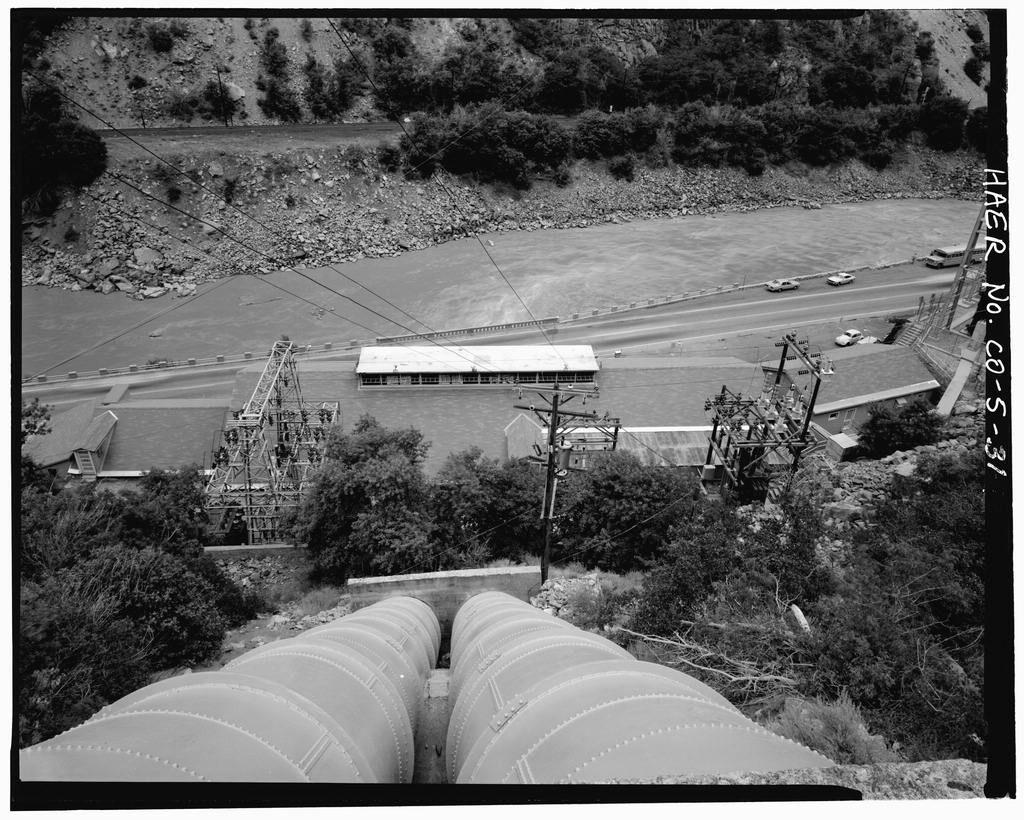
FERC is involved because of the hydroelectric plant at the base of the dam.
Denver Water’s general counsel, Jessica Brody, said Friday her agency was pleased the judge recognized the safety issues in leaving the dam half-built.
“We’re relieved that the judge understood and appreciated the safety issues. We are relieved as well that she understood the impact to Denver Water’s customers,” Brody said.
The construction is expected to be completed this year, she said. In the meantime, she said, her agency will move forward in asking a federal appeals panel to rule on whether key environmental permits need to be rewritten, as Arguello has ordered.
If the permits are redone, it could mean that the U.S. Army Corps of Engineers will determine that the metro Denver water provider, which serves 1.5 million people, needs less water from the Fraser River to fill an expanded Gross Reservoir than the original permit authorized.
Save The Colorado, one of the plaintiffs in the case, said Friday morning that it will defend the portion of the Thursday ruling that could prevent or reduce additional diversions from the Fraser River, a key tributary in the Upper Colorado River system.
“Importantly,” said Save The Colorado’s Gary Wockner, “her original 86-page ruling still stands … so they can’t cut trees and they can’t put water in it until it is all resolved.”
Denver Water is helping ensure its future water security with the Gross Reservoir Expansion Project. When the project is complete, it will nearly triple the Boulder County reservoir’s capacity to 119,000 acre-feet. CREDIT: HEATHER SACKETT/ASPEN JOURNALISM
How the case progressed
In her April 3 ruling, Arguello said Denver Water had acted recklessly in proceeding with construction in 2022, knowing that important legal questions were being challenged by Save The Colorado, the Sierra Club and others.
The massive construction project to raise the dam 131 feet and triple the capacity of Gross Reservoir has sparked fierce opposition in Boulder County and prompted several legal challenges from Save The Colorado, a group that advocates on behalf of rivers. Though its early lawsuits failed, the group in 2022 won an appeal that put the legal battle back in play. Despite months of settlement talks, no agreement was reached.
Denver Water first moved to raise Gross Dam more than 20 years ago when the water provider began designing the expansion and seeking the necessary federal and state permits. Denver Water has said raising the dam and increasing capacity of the reservoir is necessary to ensure it has enough water throughout its delivery system and to help with future water supplies as climate change continues to reduce streamflows.
After years of engineering, environmental studies and federal and state analyses, Denver received a permit from the U.S. Army Corps of Engineers, and construction began in 2022.
Arguello’s April 3 ruling said, in part, that the Army Corps should have considered whether ongoing climate change and drought would leave the Colorado River and Western Slope waterways too depleted to safely allow transfer of Denver Water’s rights into a larger Gross Reservoir for Front Range water users.
At the same time, she ordered a permanent injunction prohibiting enlargement of the reservoir, including tree removal and water diversion, and impacts to wildlife.
Almost immediately, Denver Water filed for temporary relief from the order, saying, in part, that it would be unsafe to stop work as the incomplete concrete walls towered above Gross Reservoir.
Arguello granted that request, too, allowing Denver to continue work on the dam considered necessary for safety.
State health officials will face tighter deadlines and more scrutiny of a water quality permitting program that has been plagued by massive backlogs and criticized by some small communities who say they can’t afford their state-mandated water treatment systems.
The changes will come under a new bipartisan law Senate Bill 305 approved last month. Gov. Jared Polis is expected to sign the bill this week, according to state Sen. Jeff Bridges, a Democrat from Greenwood Village who is one of the bill’s sponsors and chairs the Joint Budget Committee.
“This bill is a reset in the relationship between the Colorado Department of Public Health and Environment (CDPHE) and local governments that both sides believe will result in better communication, collaboration and ultimately better water quality,” Bridges said this week.
The permits are required under the federal Clean Water Act and are designed to protect Colorado’s rivers and streams from contaminants contained in wastewater. The state is required to enforce the federal law.
The measure is designed to help the CDPHE battle a permitting backlog that has left dozens of communities without a current wastewater discharge permit. Those communities can still discharge under a special administrative rule, but the backlog means the communities aren’t complying with the most current wastewater treatment standards that seek to reduce the various contaminants, such as ammonia and nitrates, being discharged into streams.
Earlier this year, as the state sought to fast-track permit approvals, small towns revolted, saying the new permits that were issued were too tough and that it was too expensive to upgrade treatment systems to comply.
The controversy comes as climate change and drought reduce stream flows and cause water temperatures to rise, and as population growth increases the amount of wastewater being discharged to Colorado’s rivers.
In response to the towns’ concerns, the CDPHE water quality control division took the unusual step in March of holding off on taking enforcement action against at least some of the towns that say they can’t comply with the new regulations.
Senate Bill 305 will allow communities to hire outside engineers and consultants to help speed permit processing times and it also requires the CDPHE to develop new rules establishing clear timeframes for granting or denying different types of permits by Dec. 31, 2027.
In addition, according to Nicole Rowan, director of the Water Quality Control Division, they will set a schedule by Dec. 31, 2026, for reducing the backlog.
The changes aren’t likely to help Ault, a community of 2,350 people on the Eastern Plains that finally received a new permit in March. The permit, however, contains standards the town’s 9-year-old wastewater treatment plant can’t meet. The CDPHE has agreed to suspend any enforcement action against the community until it can do additional analysis to see if it can comply with the new rules simply by upgrading its treatment plant, according to Grant Ruff, who oversees the town’s treatment system.
The town still owes $1.2 million on the existing plant. Building a new one would likely cost more than $20 million, Ruff said.
“We hope it is feasible [to comply] by making minor upgrades,” he said. “Otherwise we will have to spend $20 million to $30 million.”
That won’t be the case for towns seeking new permits in the years ahead.
“The new standards will be tremendously helpful in the future because the state will have to take into consideration the community’s ability to pay,” he said.
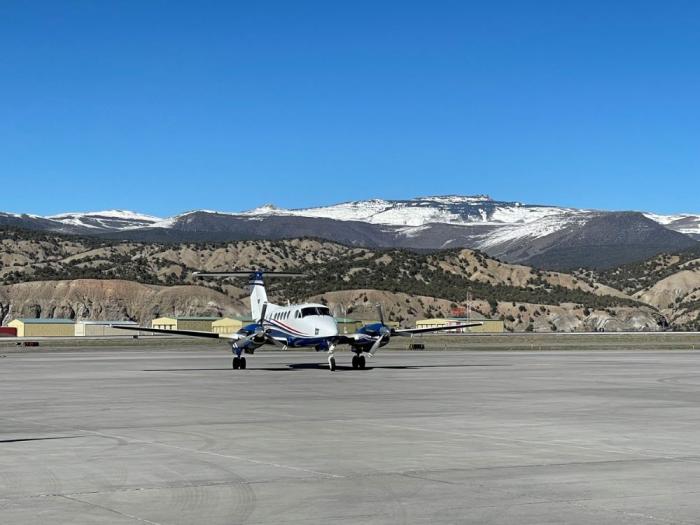
The Airborne Snow Observatories plane prepares for takeoff at the Eagle County Regional Airport in April 2023. Photo credit: Mark Schwab, Airborne Snow Observatories Inc.
If you want to know about the snow, the sky is the limit when it comes to collecting data about the mountain snowpack.
That’s why Denver Water, the Colorado Water Conservation Board and other water providers across the state are investing in a high-tech program to measure snowpack using lasers from a plane.
And in mid-May, Colorado Gov. Jared Polis signed a bill to formally incorporate the program into the Colorado Water Conservation Board. The board’s mission is to conserve, develop, protect and manage Colorado’s water for present and future generations.
Monitoring the mountain snowpack is critical for Denver Water because once the snow melts, it becomes the water supply for the 1.5 million people the utility serves in Denver and surrounding suburbs.
Traditionally, Denver Water has tracked the snowpack by sending crews to collect and measure snow samples on the ground and monitoring data from automated backcountry weather stations called SNOTELs.
In 2019, to help improve water supply forecasts, Denver Water began working with Airborne Snow Observatories Inc., or ASO for short, to gain a fuller picture of the snowpack. The company uses advanced technology developed at NASA to measure the snowpack that’s built up across entire watersheds.
“Getting this high-tech information about the snowpack from ASO before the snow starts to melt improves the accuracy of our spring runoff and water supply forecasts for the coming year,” said Nathan Elder, Denver Water’s manager of water supply.
“Having the ASO information in the spring helps us manage our water resources and gives us a better idea of if we’ll need to have watering restrictions for our customers in the summer. The data also gives us a very good idea of how the spring runoff in the rivers could impact aquatic habitat and recreation.”
Space age tech
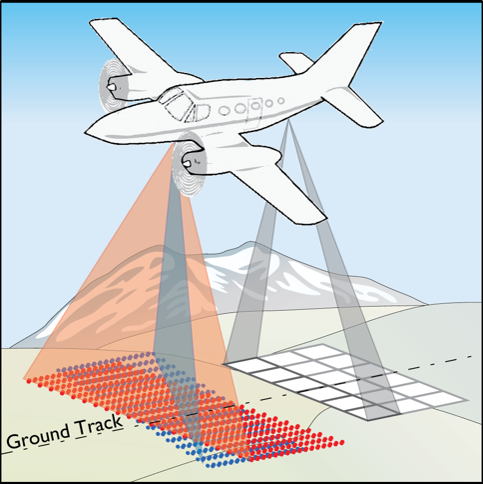
ASO planes fly with two key pieces of technology and equipment onboard: a lidar and an imaging spectrometer.
The ASO plane uses lidar (the front laser beam under the wings) to measure the depth of the snow. The spectrometer (the rear beam near the tail) measures the amount of solar energy that is reflected by the snowpack. Image credit: Airborne Snow Observatories.
The spectrometer measures how much solar energy is reflected by the snow. This information is used to help determine how fast the snowpack will melt.
Lidar, which stands for light detection and ranging, uses beams of light to measure distance. To determine snow depth, the plane flies over a watershed in the summer and uses lidar to scan the earth’s surface when it’s free of snow.
Then in the spring, when the landscape is covered with snow, the ASO team flies over the same territory again and measures the distance from the plane to the snow surface below. By comparing the differences in elevation, the ASO team can accurately calculate the depth of the snow.
Digging it old school
To supplement the data collected from the plane, ASO also incorporates three “old-school” sources of data. It uses information collected by automated weather stations called SNOTELs, from snow samples collected and measured by crews at predetermined locations in watersheds, and data from samples collected by the ASO team or partners from snow pits dug in the same watersheds the plane flies over.
Denver Water crews use a special tube [Federal Sampler] to gather snow samples near Winter Park as part of pre-set snow courses. ASO uses these ground measurements to supplement data collected from the planes to determine how much water is in a watershed. Photo credit: Denver Water.
This ground-based data helps to verify the airborne snow-depth measurements. The ground data also provides snow density information, which is used to calculate the volume of water in the snowpack, called the snow water equivalent, or SWE.
“We’re able to use the traditional methods in combination with our next generation technology to measure the mountain snowpack to an accuracy that has never before been possible,” said Jeffrey Deems, ASO’s co-founder.
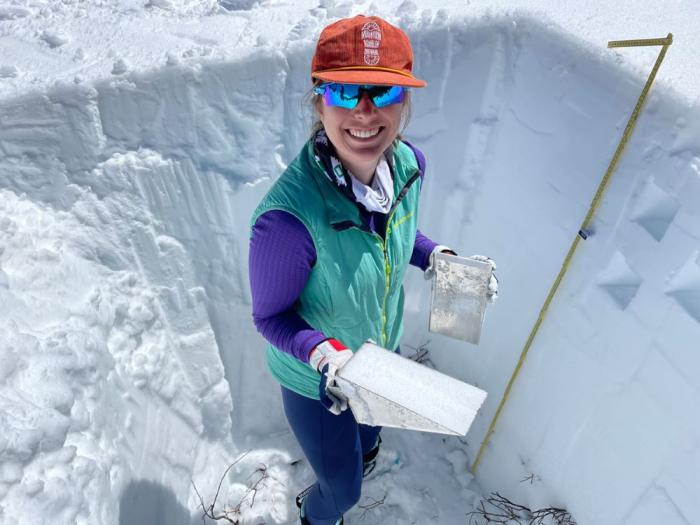
Cara Piske, an ASO operations scientist, collects a sample of snow from a pit dug in Mayflower Gulch near Copper Mountain in Summit County. The sample is weighed to determine its density, which is used to calculate the amount of water frozen in the snow, called the snow water equivalent. Photo credit: Denver Water.
Deems said the data from the ASO flights is incredibly valuable because the plane can accurately measure the snow across an entire watershed and at high elevations that don’t have automated weather stations and are inaccessible to people.
ASO snow depth measurements in the Blue River Basin above Dillon Reservoir in April 2021. Photo credit: Jeffrey Deems, Airborne Snow Observatories.
In 2023, ASO flew over eight regions in Colorado (including Denver Water’s watersheds in the Upper South Platte, Blue, Fraser and South Boulder Creek river basins.)
During the first set of flights in April, which aimed to capture the peak snowpack, the ASO team calculated that there was 108,000 acre-feet of water packed into the snow in the Upper South Platte Basin, 175,000 acre-feet of water in the Blue River Basin which feeds into Dillon Reservoir, and 104,000 acre-feet of water in Denver Water’s Moffat Collection System located in the Fraser River Basin.
A second round of flights were conducted in late May and early June to capture any new snow and to see how fast the snow melted.
Elder said the ASO snowpack estimates in 2023 turned out to be a very strong prediction of the actual streamflow during that year’s spring runoff.
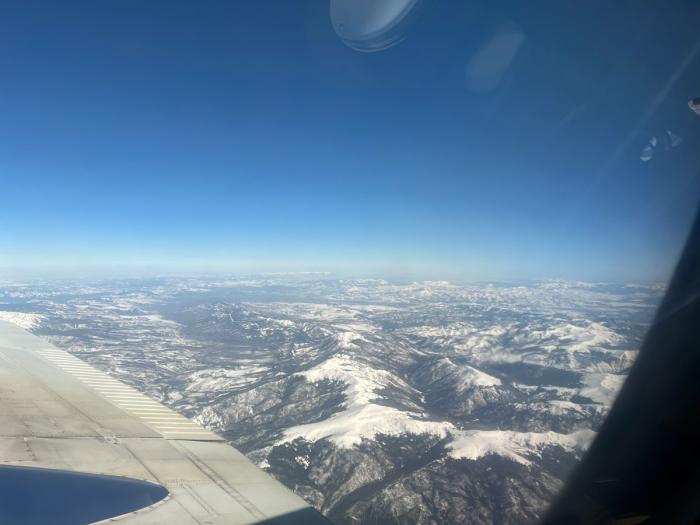
The ASO plane flew over the Blue River Basin in Summit County in early May. Scanning the entire watershed takes three to six hours. Photo credit: Kat McNeal, Airborne Snow Observatories.
“Having ASO really helps reduce uncertainty and improve decision making for our water planning, and each flight uncovers new insight into the snowpack that is otherwise unmeasurable,” Elder said. “Our first charge is to ensure we have an adequate water supply for our customers, and the sooner we can make that determination the better.”
Having the additional data helps water planners because traditional snowmelt forecasts can have significant errors or wide ranges, which makes it more challenging to manage water supplies.
Building a statewide program
Recognizing the value of building a statewide ASO effort, in 2021, Denver Water helped coordinate and develop the Colorado Airborne Snow Measurement program or CASM.
The CASM program includes agricultural and municipal water providers such as Denver Water, as well as environmental groups and nonprofits with support from the Colorado Water Conservation Board and federal agencies.
In 2025, Colorado Gov. Jared Polis signed H.B. 1115 into law, which formally integrated the CASM program into the Colorado Water Conservation Board. The bill created a dedicated staff member to administer the program to help coordinate ASO flights, distribute data and manage funding statewide.
ASO flew over eight regions in 2023 as part of the Colorado Airborne Snow Measurement, or CASM, program. Two rounds of flights were conducted in April, May and June. Image credit: CASM.
“Having accurate water supply data helps all water users,” said Taylor Winchell, climate adaptation specialist at Denver Water. “Our goal with CASM has always been to create a sustainable statewide program, and this new legislation is a major step in making that goal a reality.”
The Colorado Water Conservation Board will formally coordinate CASM’s planning team, which includes Denver Water, Colorado River District, San Luis Valley Water Conservancy District, Northern Water, St. Vrain & Left Hand Water Conservancy District, Upper Gunnison Water Conservancy District, and the Dolores Water Conservancy District, along with ASO and LRE Water.
Benefits today and tomorrow
Winchell said one of the big benefits of the ASO flights is that the data is available within a few days of collecting it, so water managers have a better estimate of how much water supply they’ll have for the coming year — and when to expect the water to end up in mountain streams.
The other benefit is having a wealth of high-quality data covering thousands of square miles to monitor the effects of climate change.
“As our snowpack changes with the changing climate, being better able to measure that snowpack becomes more important as more snow falls as rain, as the timing of the spring melt changes and as snow falls at ever-higher elevations because of warming,” Winchell said.
“We can’t rely as much on historical snowpack datasets to understand the new snowpack reality.”
ASO, which also conducts data collection flights in California, Wyoming, Oregon and internationally, also continues to develop its technology and modeling to help water providers get the information they need.
“We’re really proud of what we’re doing,” Deems said. “We love the snow and feel like we’re making a difference in helping our society better understand our mountain snowpack reservoir.”
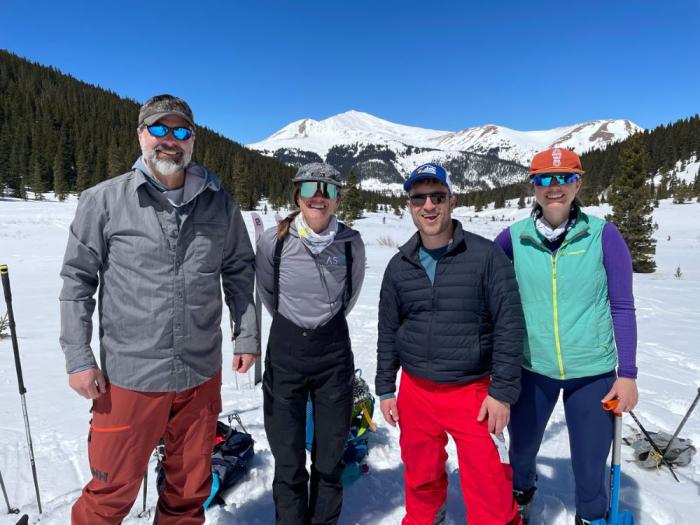
Members of the ASO team, (left to right) Jeffrey Deems, Kate Burchenal and Cara Piske, teamed up with Denver Water’s Taylor Winchell (in the black jacket) to dig a snow pit in Summit County. Photo credit: Denver Water.
In a 36-page ruling, Supreme Court justices said the Surface Transportation Board, a federal agency that oversees rail transit, had sufficiently considered the proposal’s environmental impacts when it approved the plan in 2021. Justice Brett Kavanaugh, writing the opinion for the other justices, said the board “identified and analyzed numerous ‘significant and adverse impacts that could occur as a result’ of the railroad line’s construction and operation — including disruptions to local wetlands, land use, and recreation.”
[…]
The plan had been on hold after a lower appeals court in 2023 ruled in favor of a lawsuit brought by Eagle County and five environmental groups that claimed the transportation board’s review had underestimated the railway’s environmental impact. The lawsuit garnered support from a coalition of local governments, including Pitkin, Routt, Grand and Boulder counties, the cities of Basalt, Avon, Minturn, Red Cliff, Crested Butte, Glenwood Springs and Grand Junction, and the Northwest Colorado Council of Governments…
At the heart of the lawsuit and the question before the Supreme Court was whether the transportation board had sufficiently followed the National Environmental Policy Act, or NEPA, when it approved the railway…The 55-year-old law requires federal agencies to consider the environmental impacts of their decisions, and the transportation board issued a 3,600-page environmental analysis as part of that review.
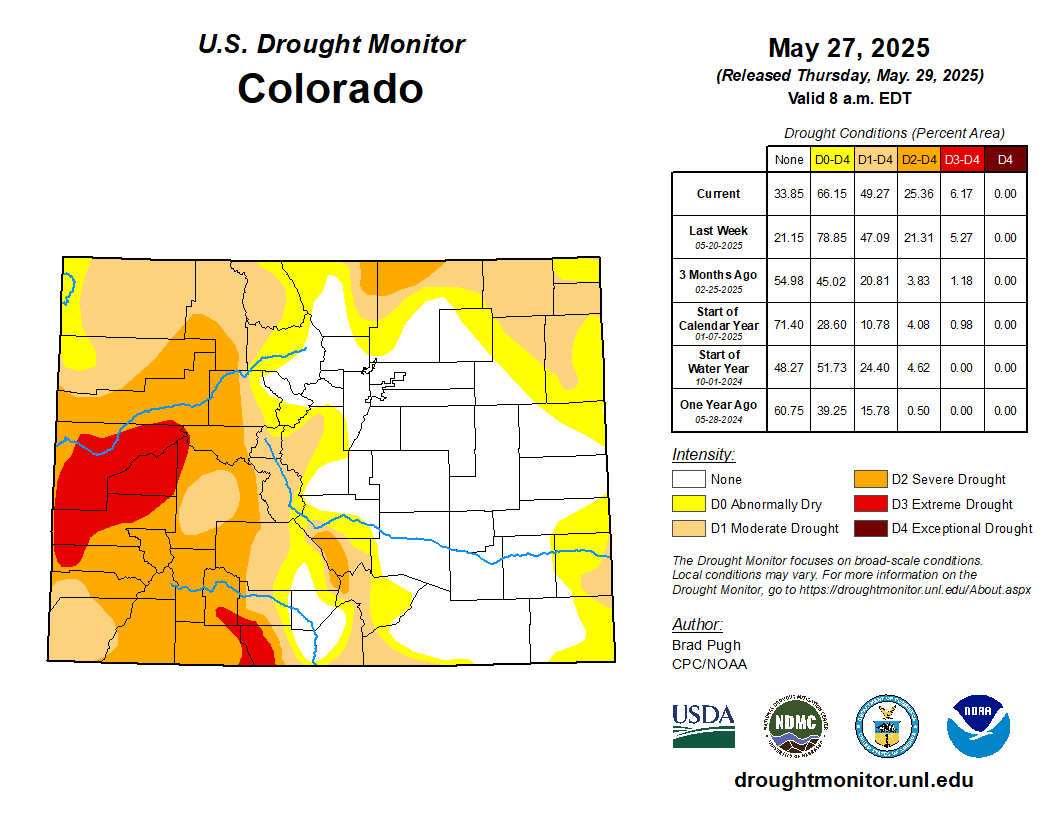
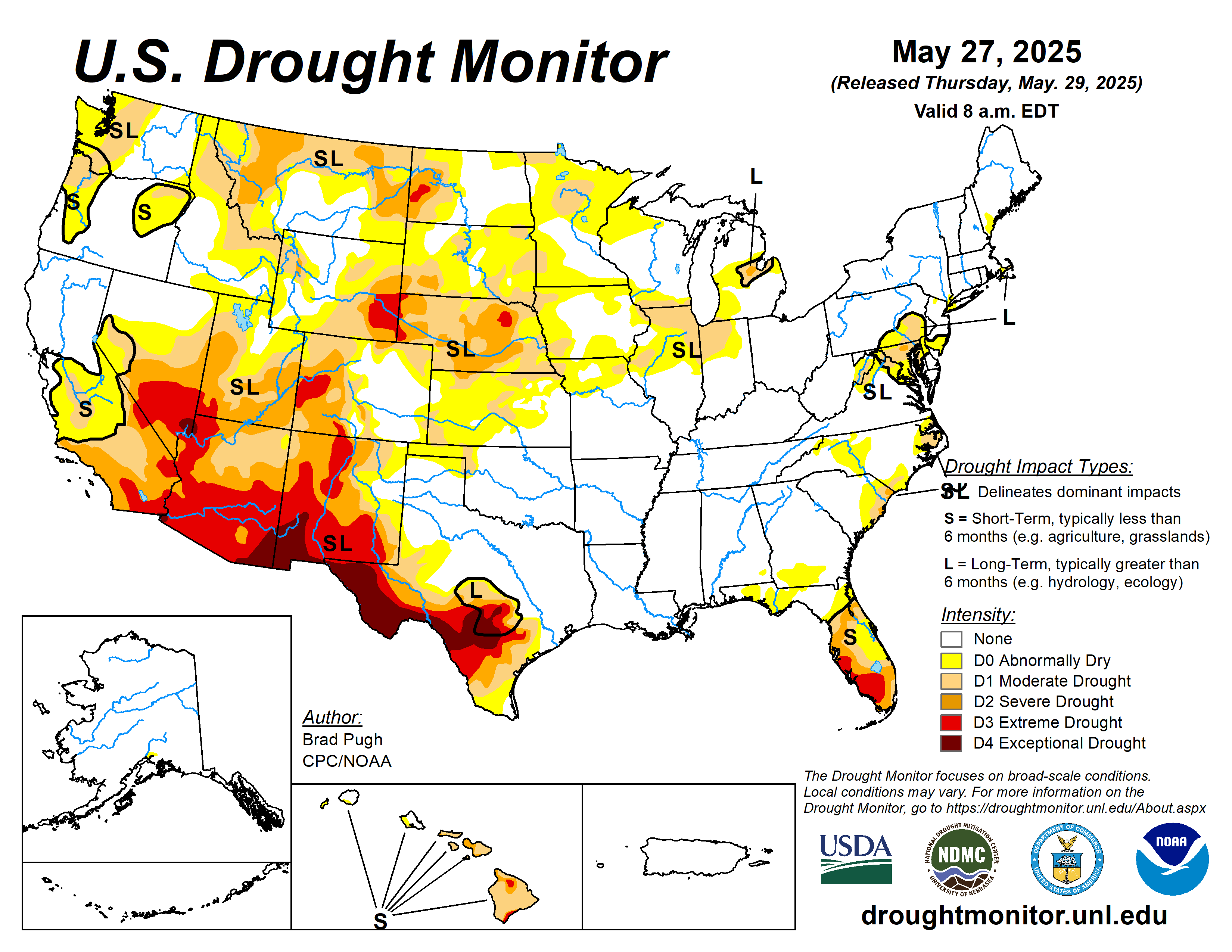
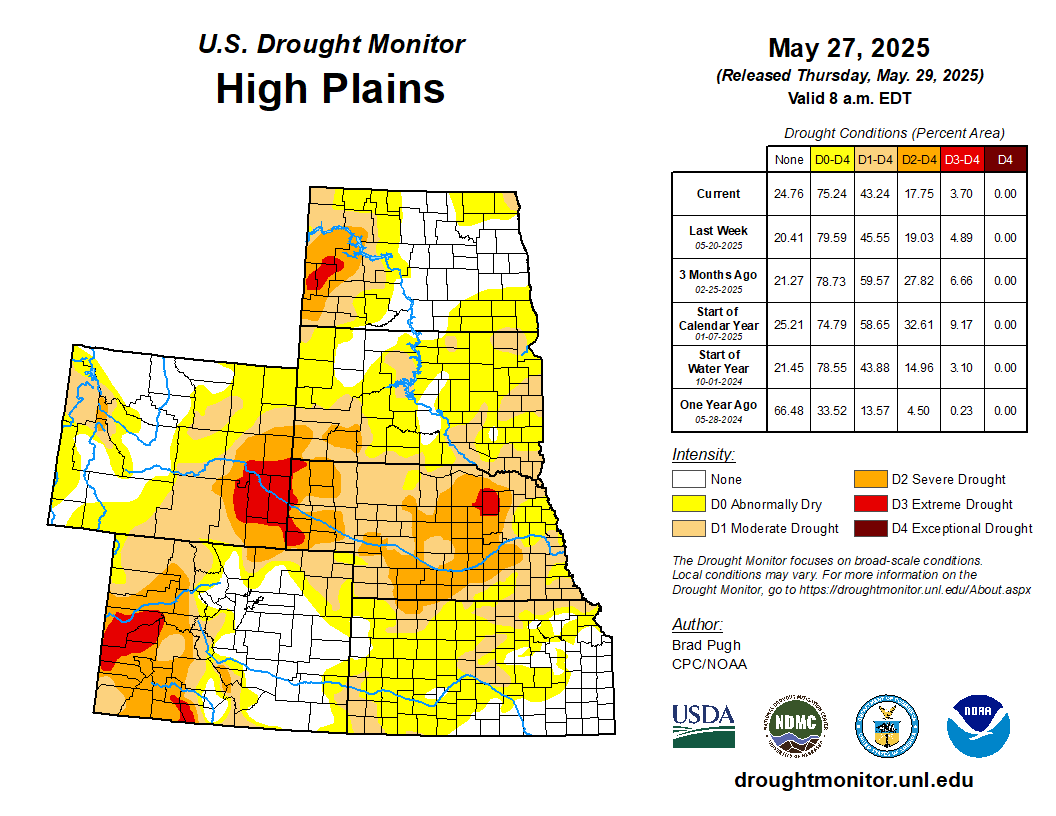
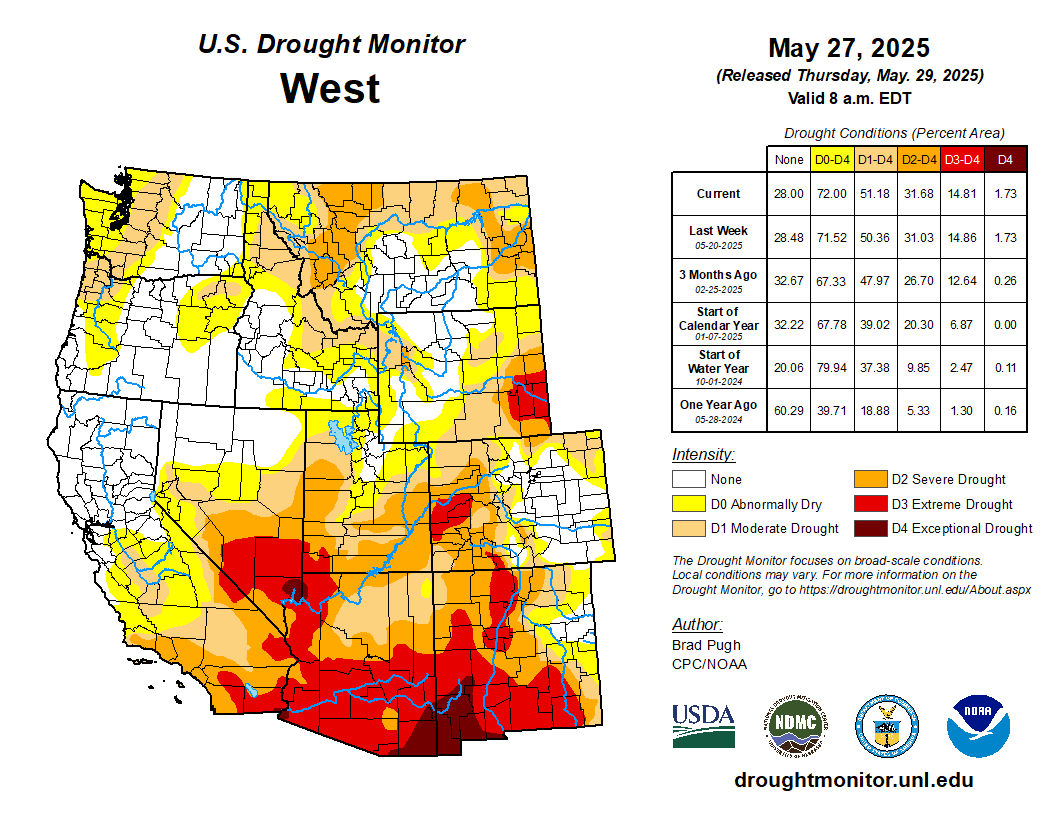
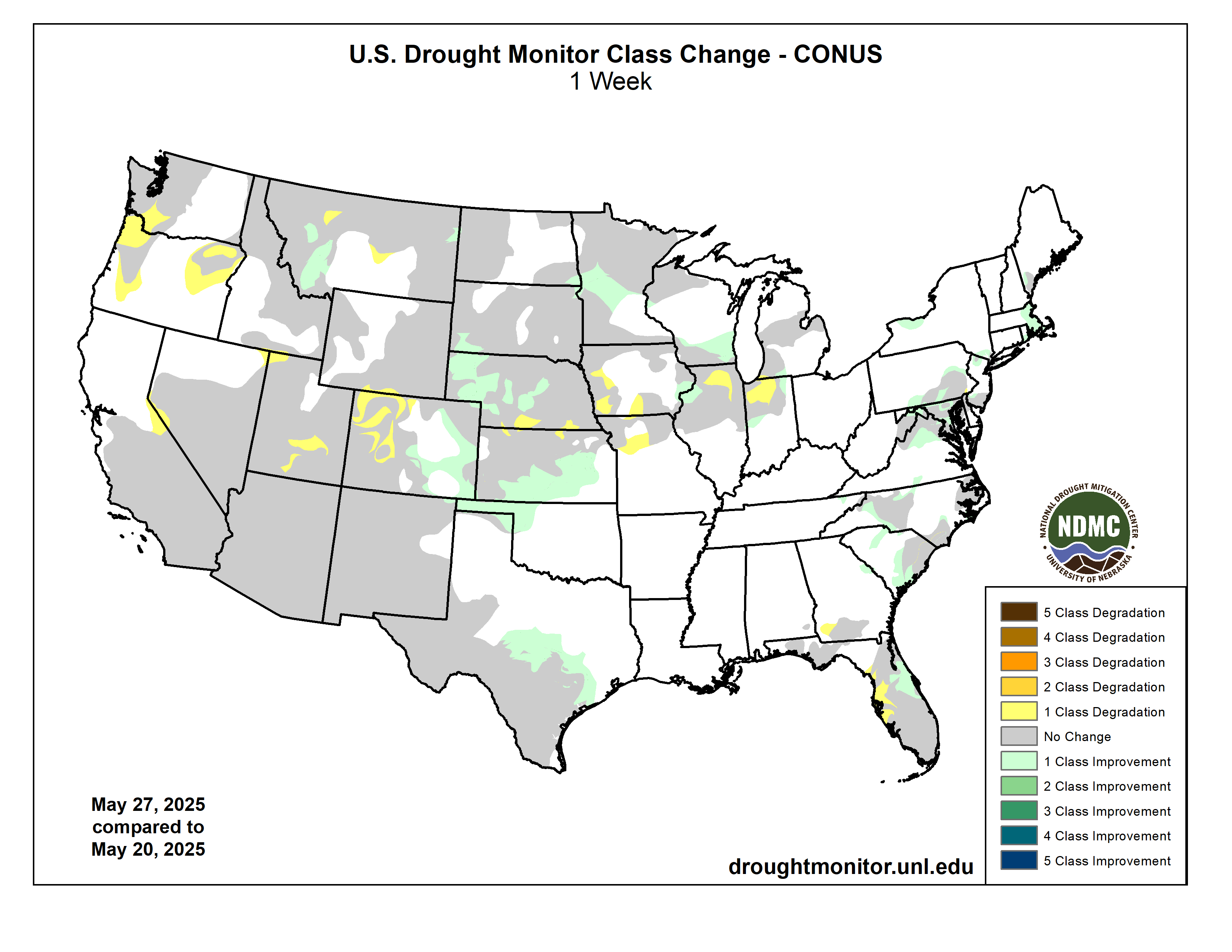
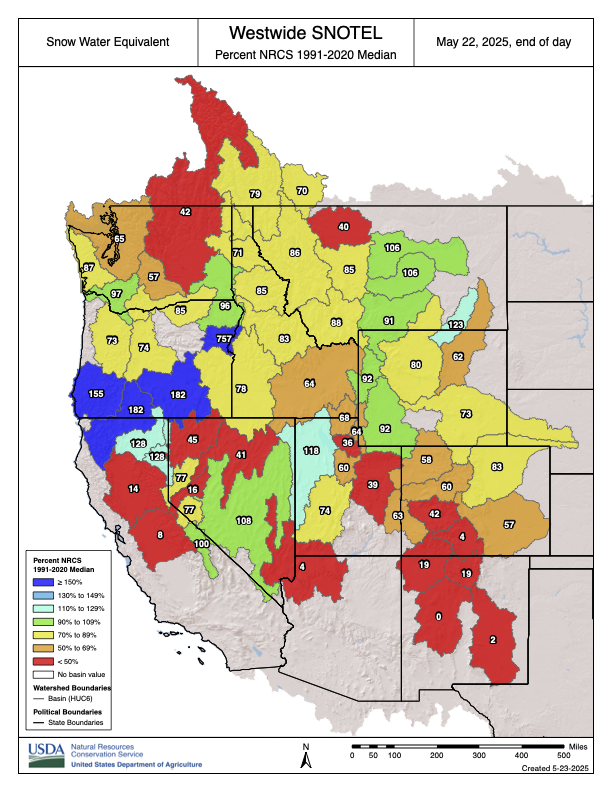
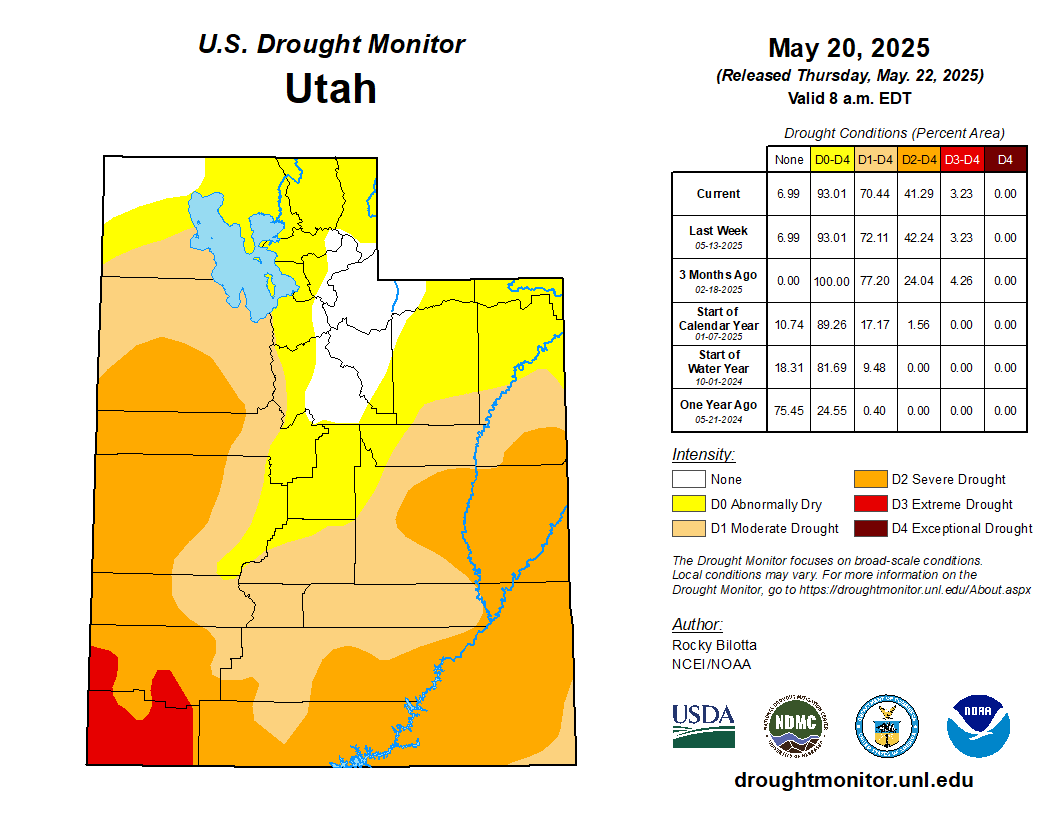
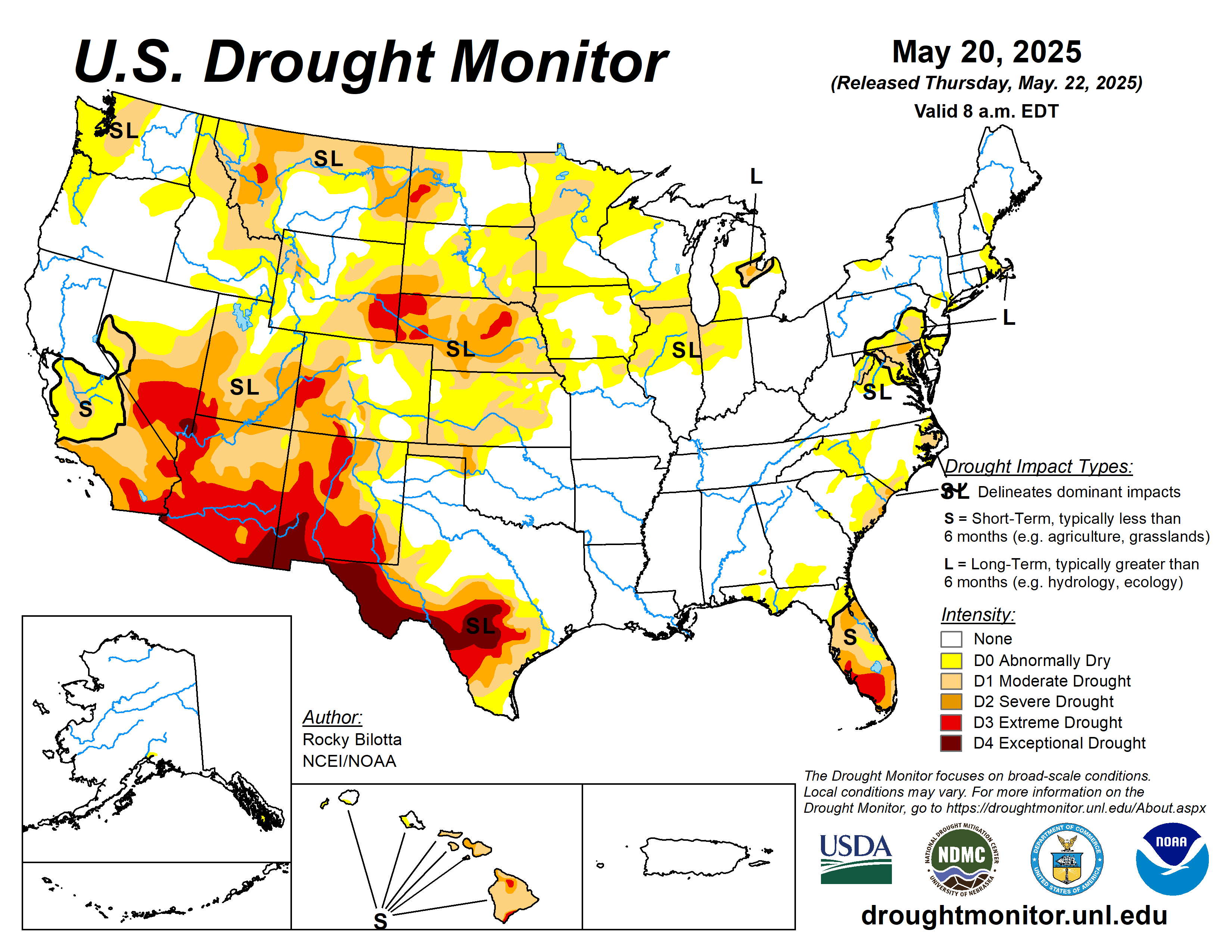
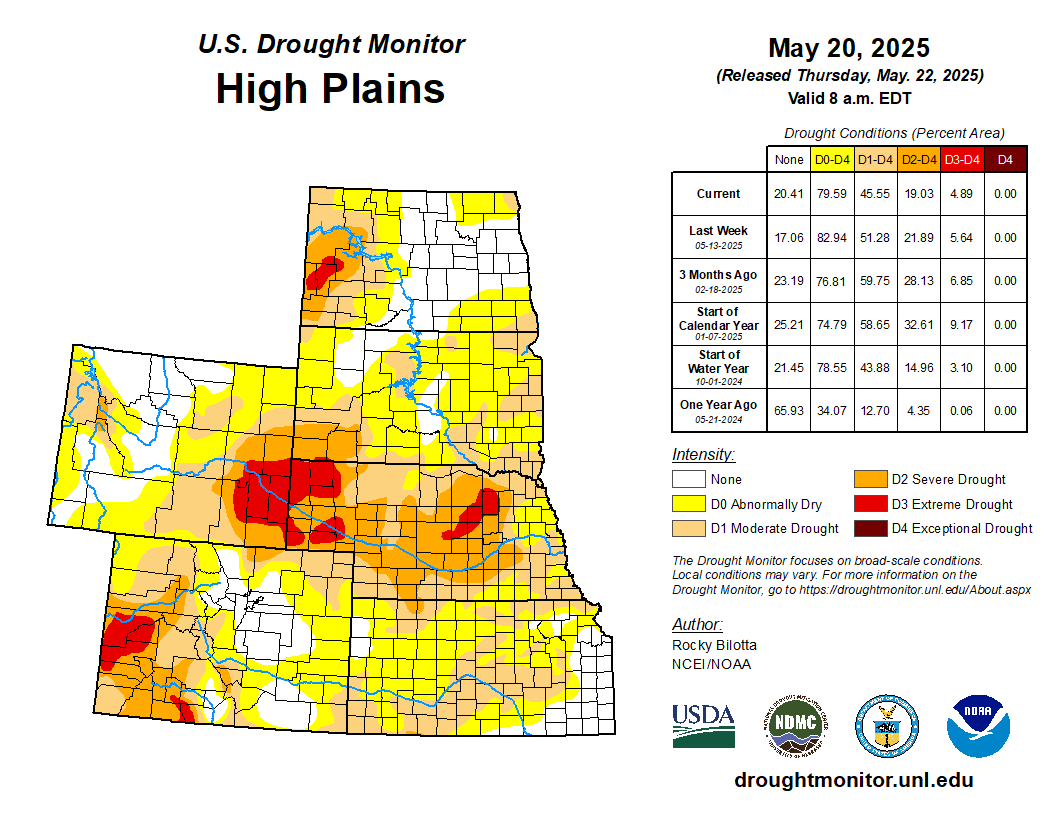
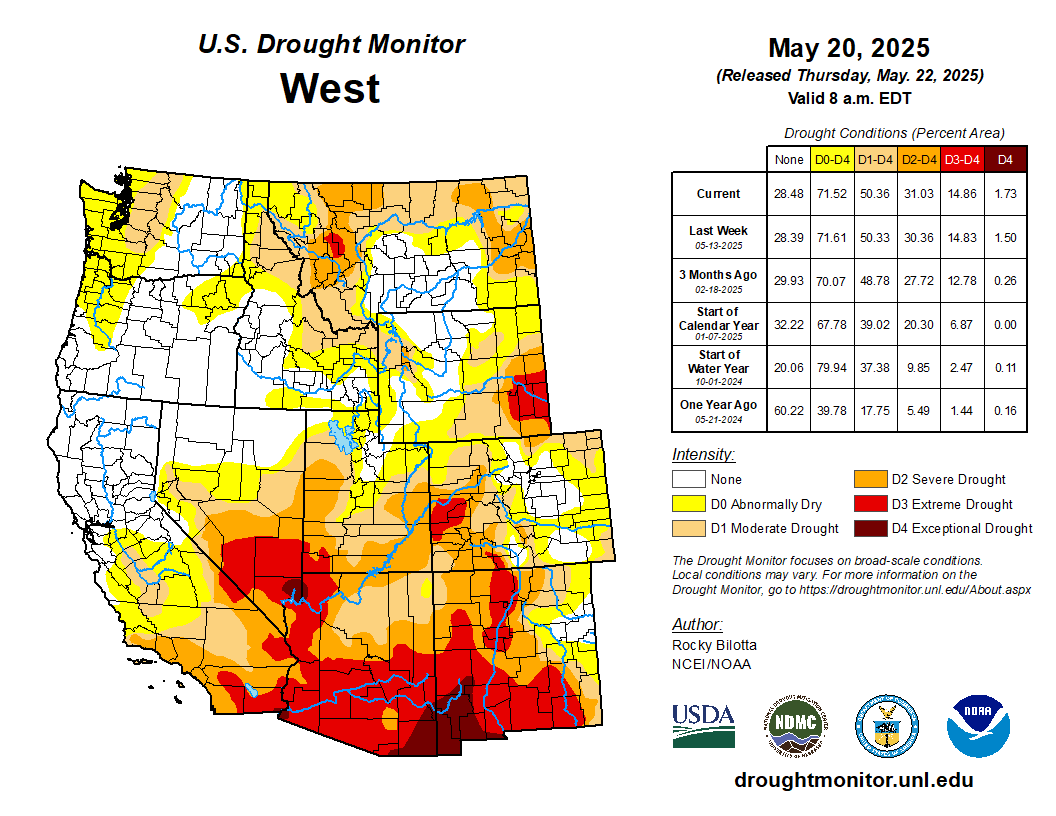
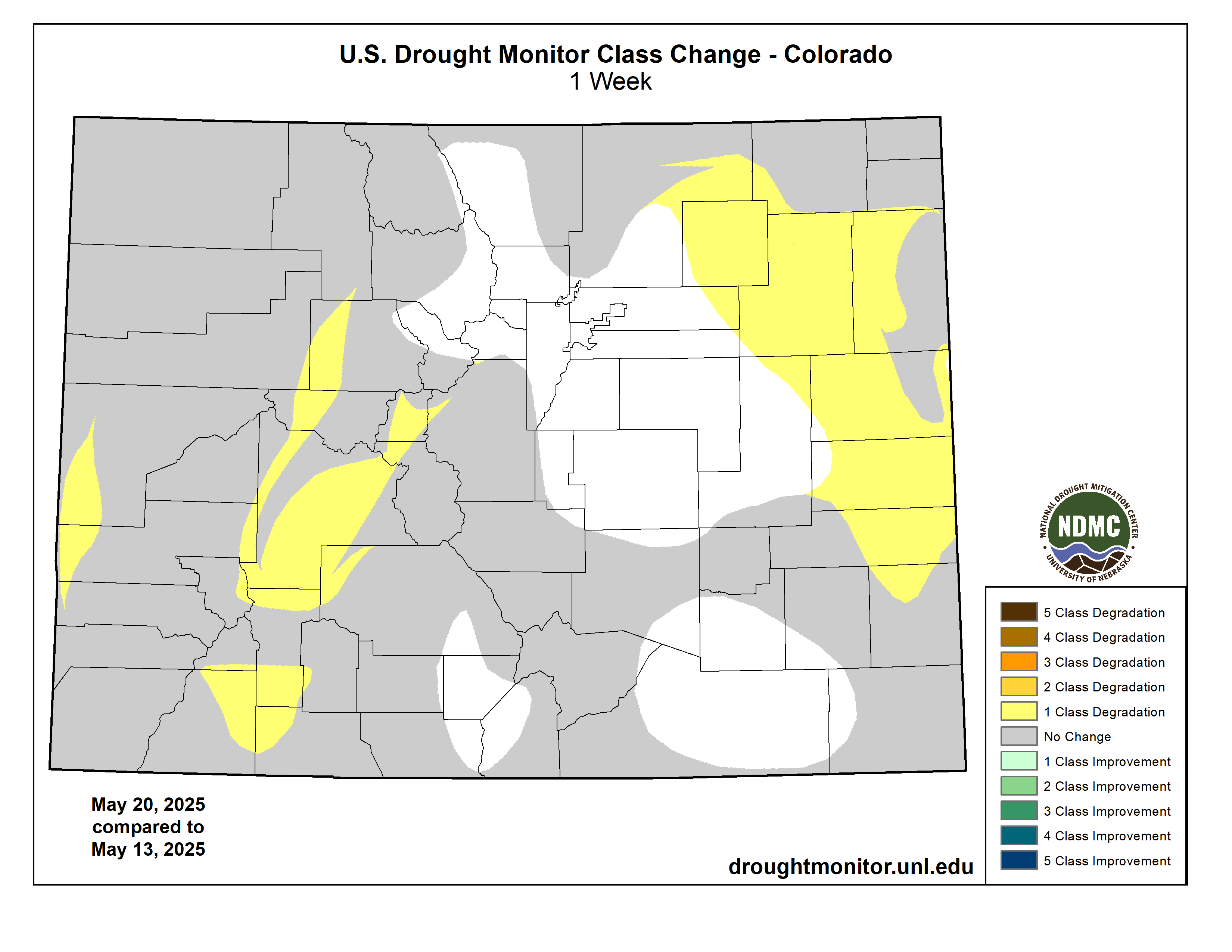
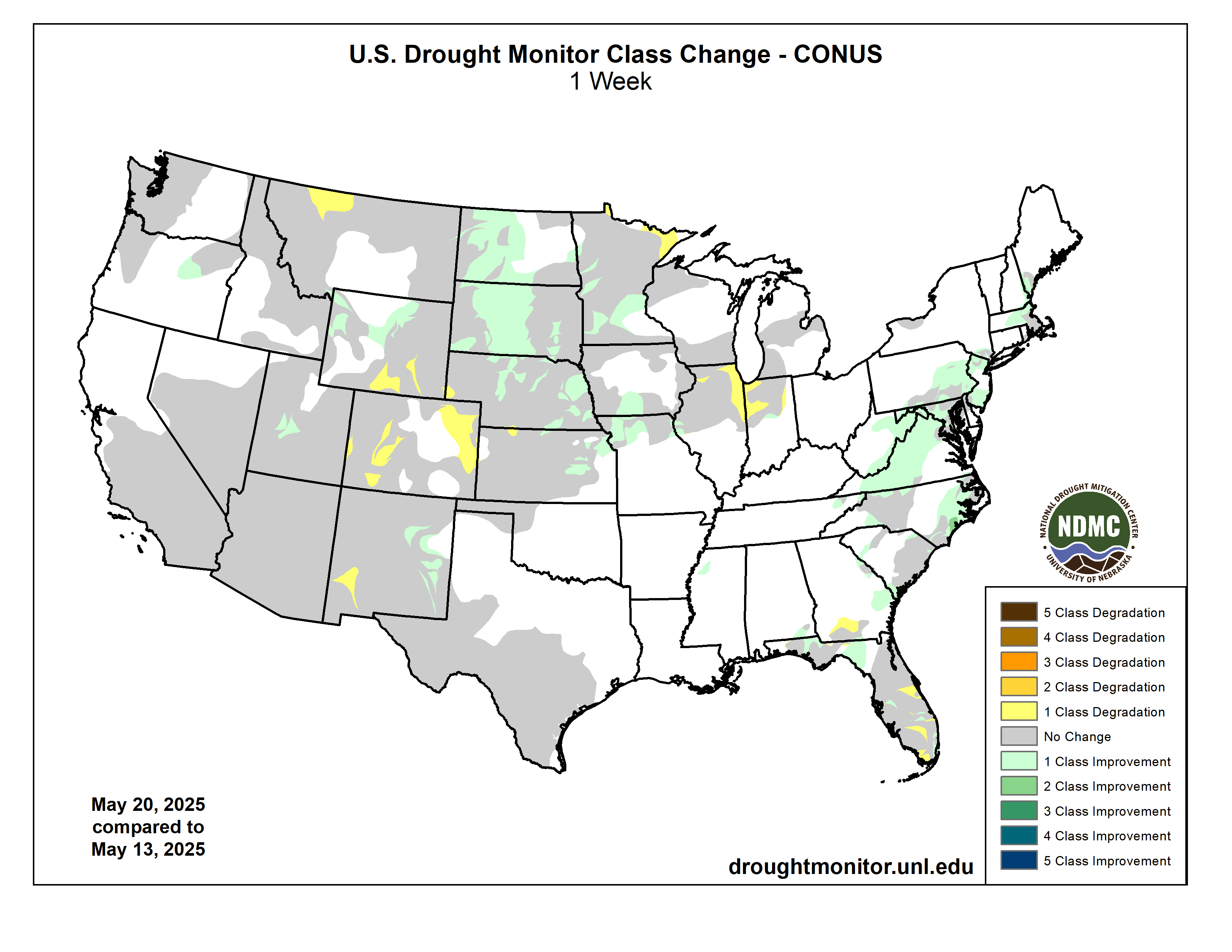
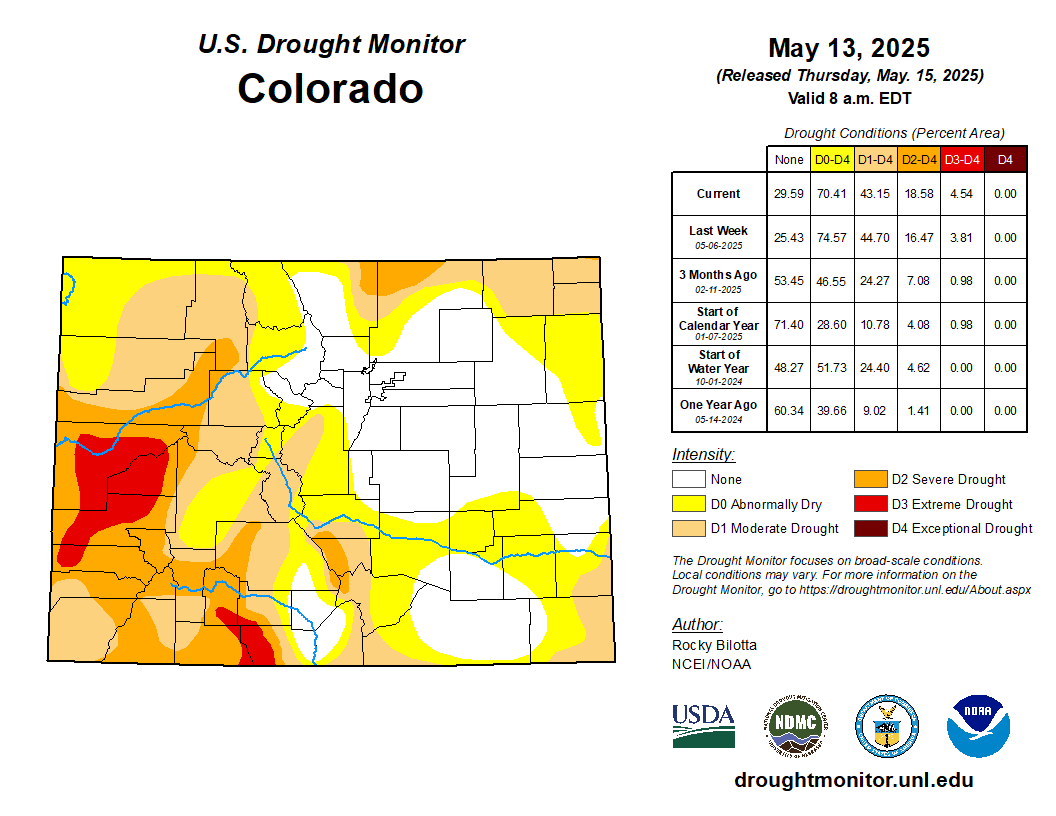
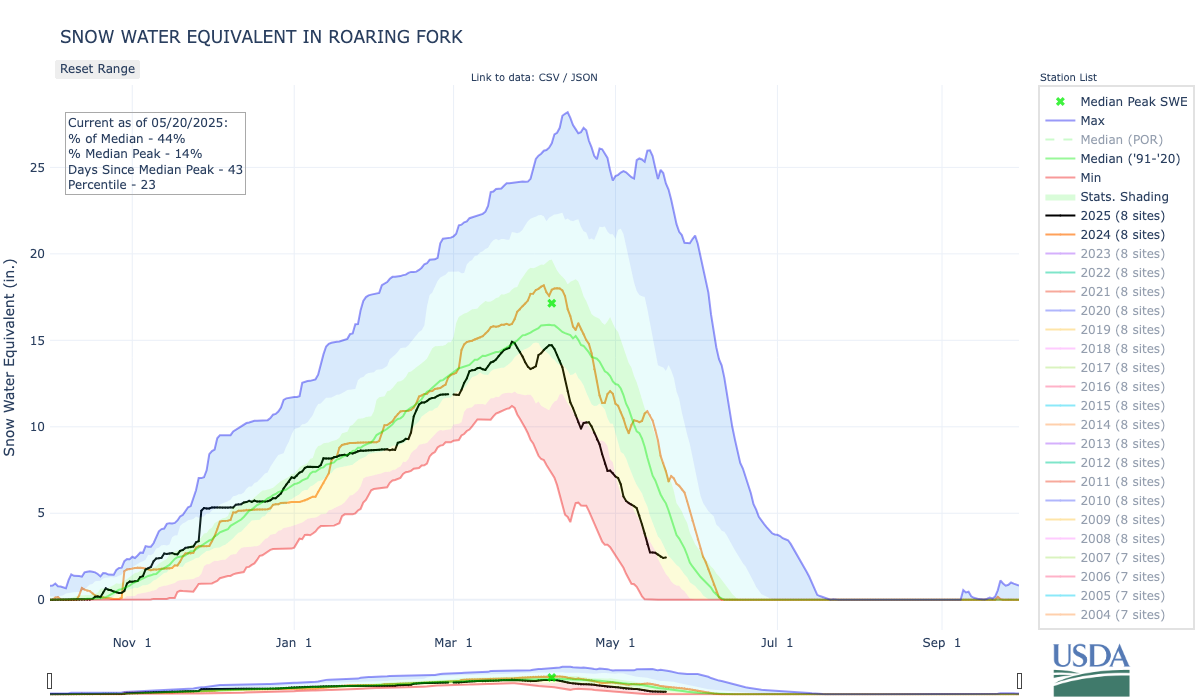
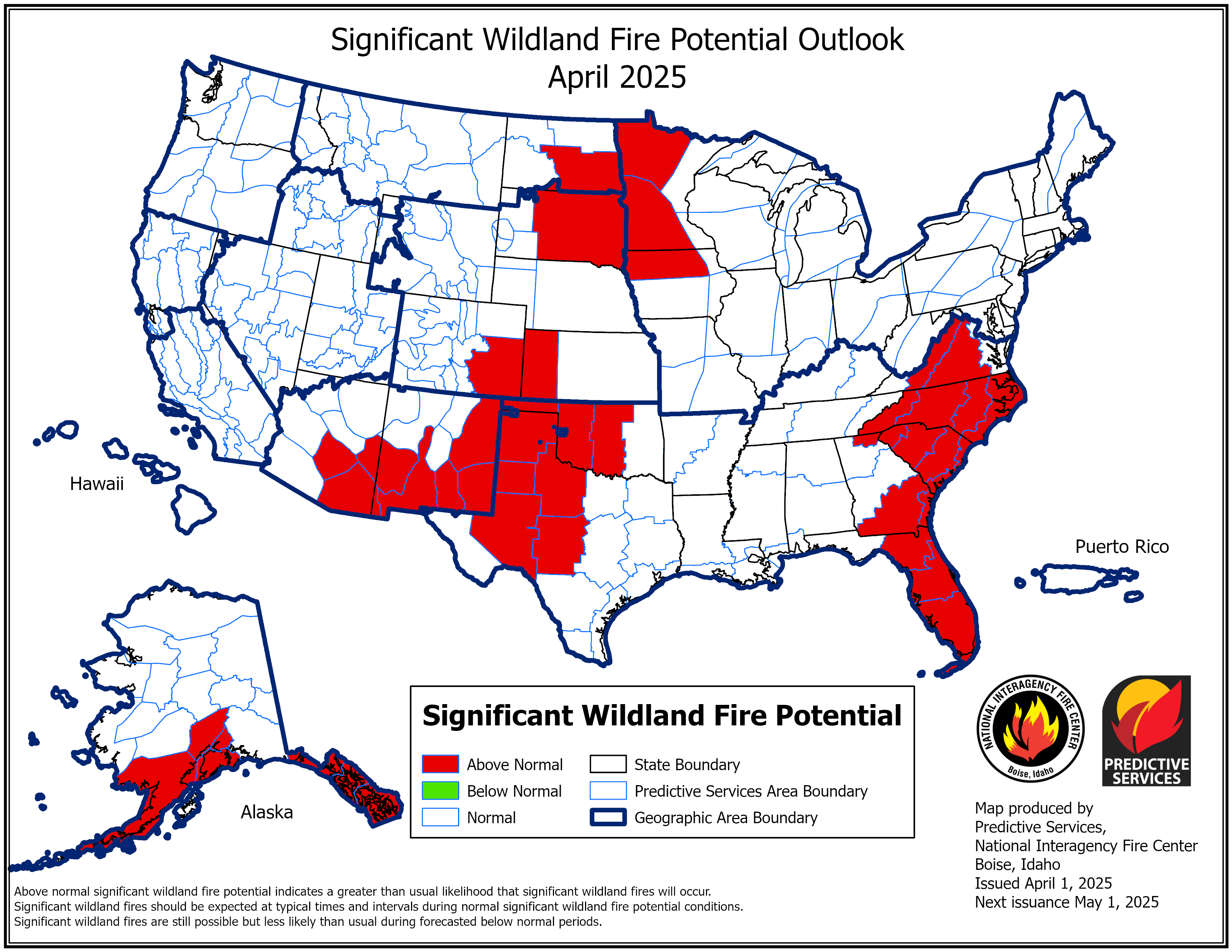
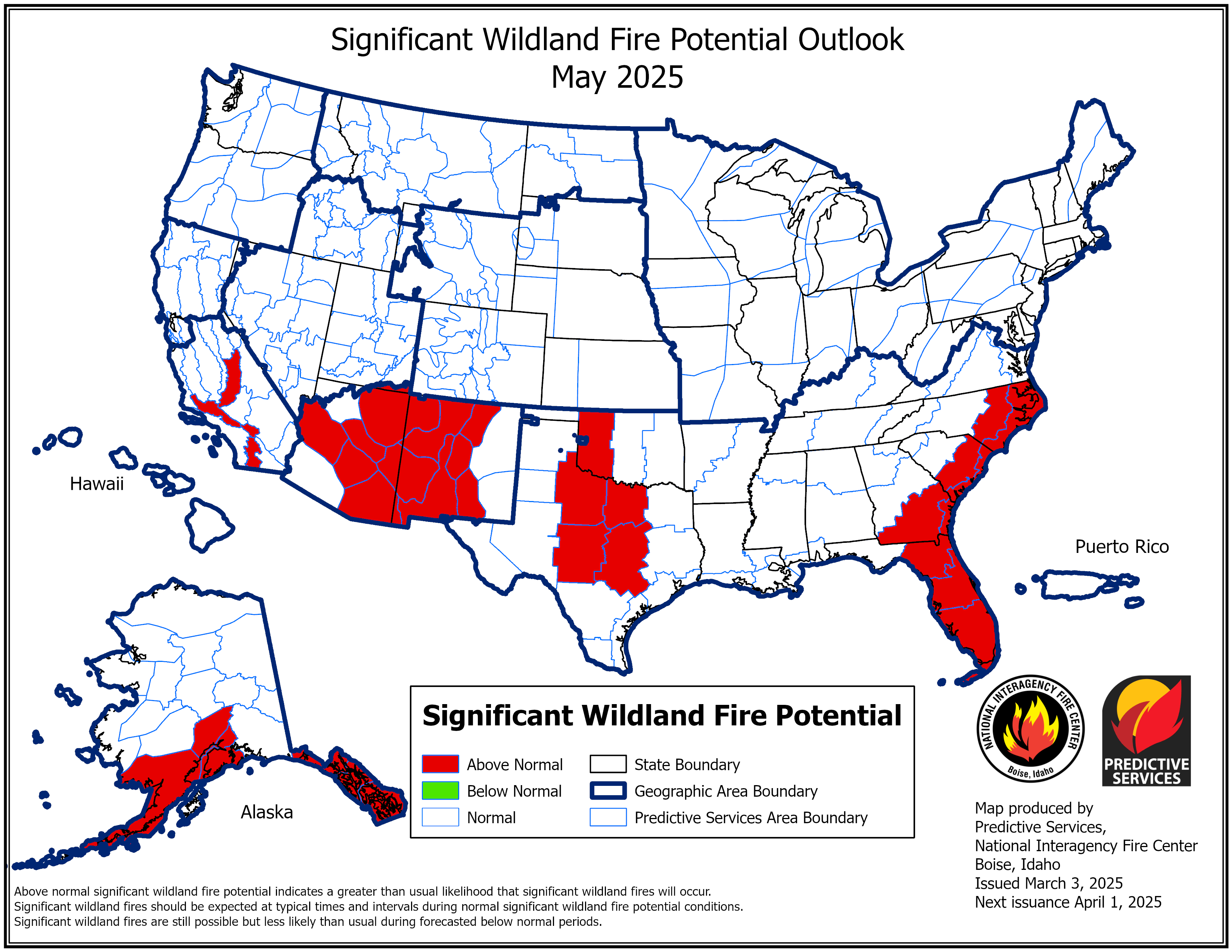
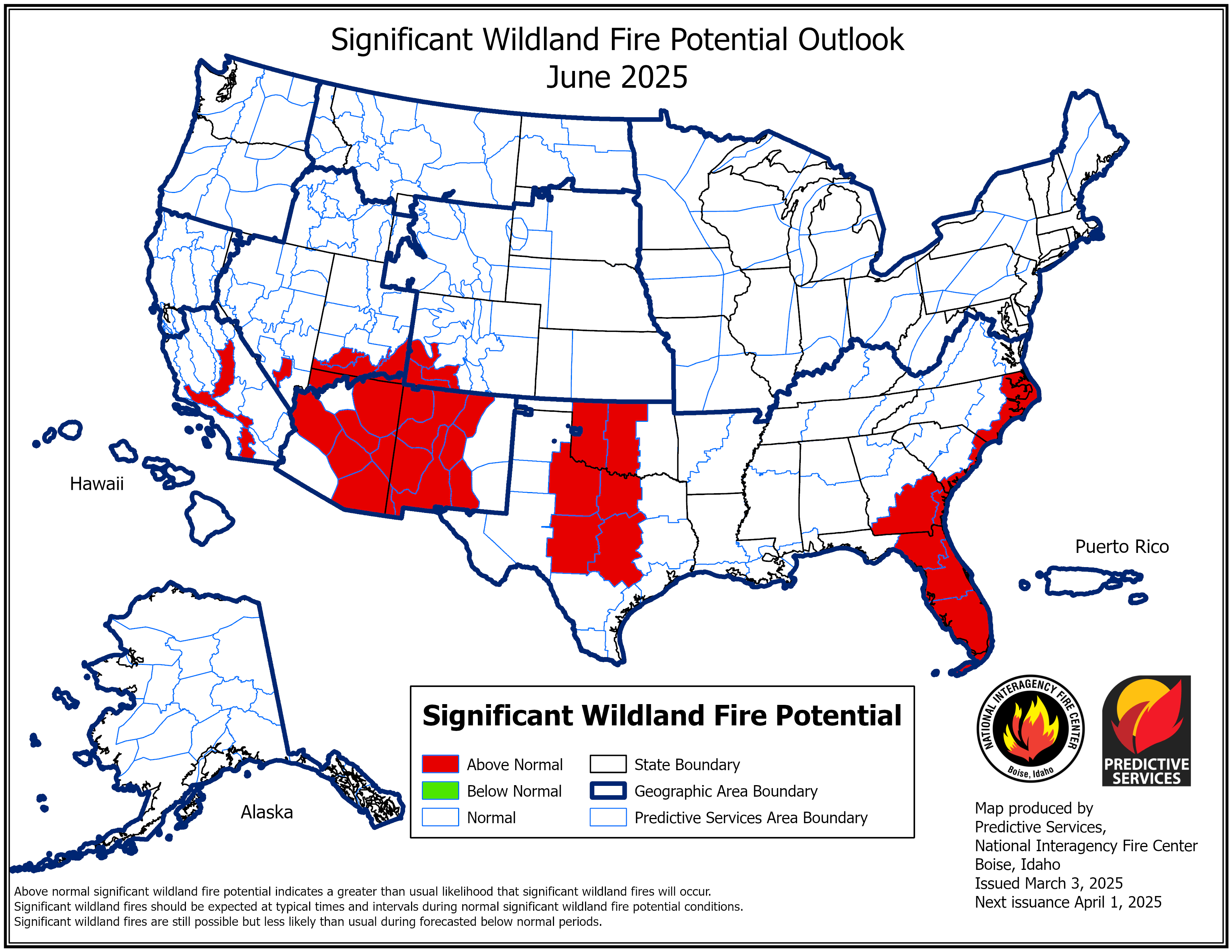
Pockets of Colorado remain in drought as federal forecasters expect an unusually hot and dry summer, which could lead to an uptick in fire activity, according to data from the National Integrated Drought Information System. The data, released May 20, show that drought conditions across Colorado, Utah, New Mexico, Arizona and Wyoming have worsened over the last two months, driven by a warm dry spring. Nearly all of Arizona is experiencing some form of drought; Utah declared a drought emergency in late April for over a dozen counties. In Colorado, high temperatures in April and May rapidly melted snow in the mountains, pushing the state’s snowpack levels to well below normal, compared to past years. Coupled with below-average precipitation in April, summer water supplies in the Colorado River basin are expected to decline, according to data from NOAA stations. Water supply forecasts are also declining through June for the Rio Grande basin.
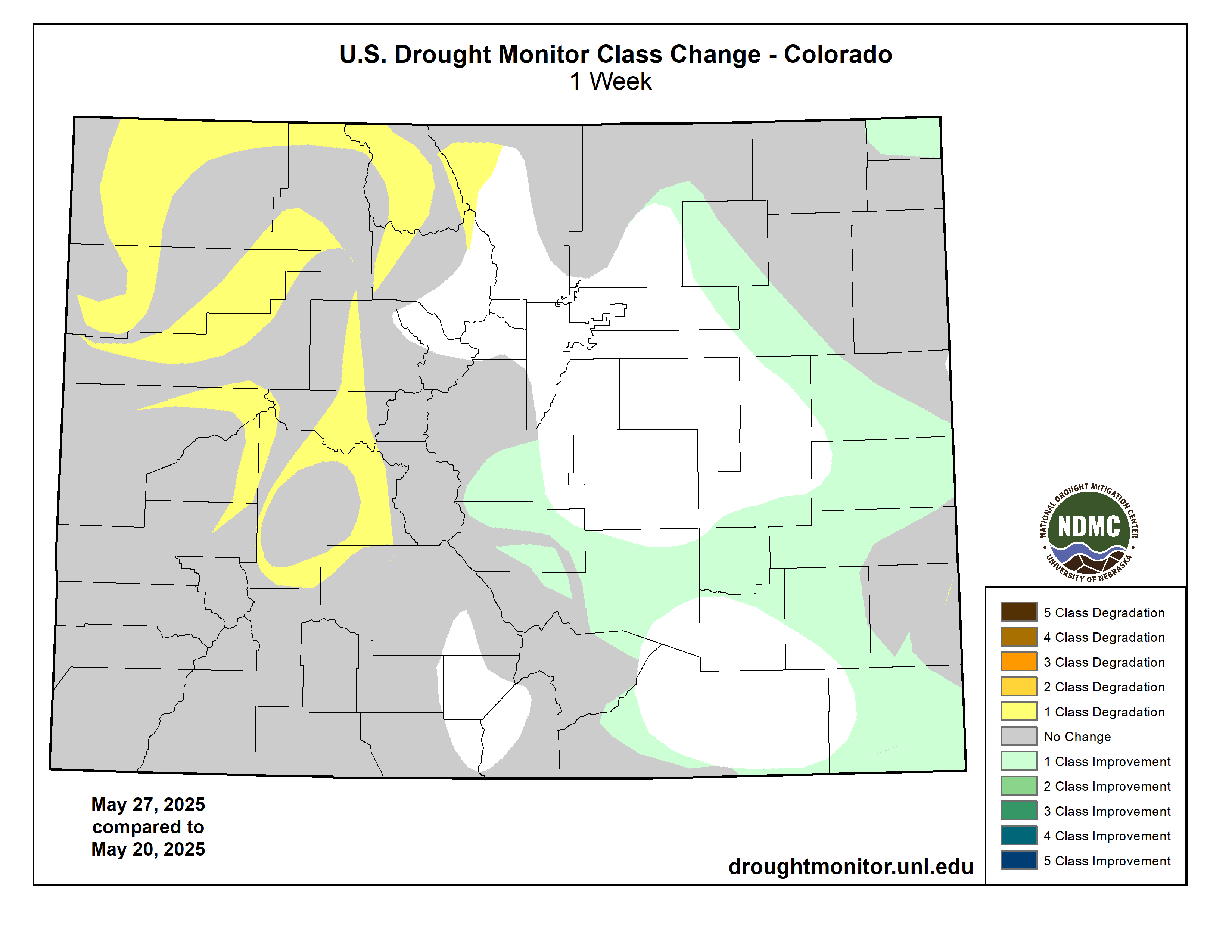
Colorado Drought Monitor map May 27, 2025.
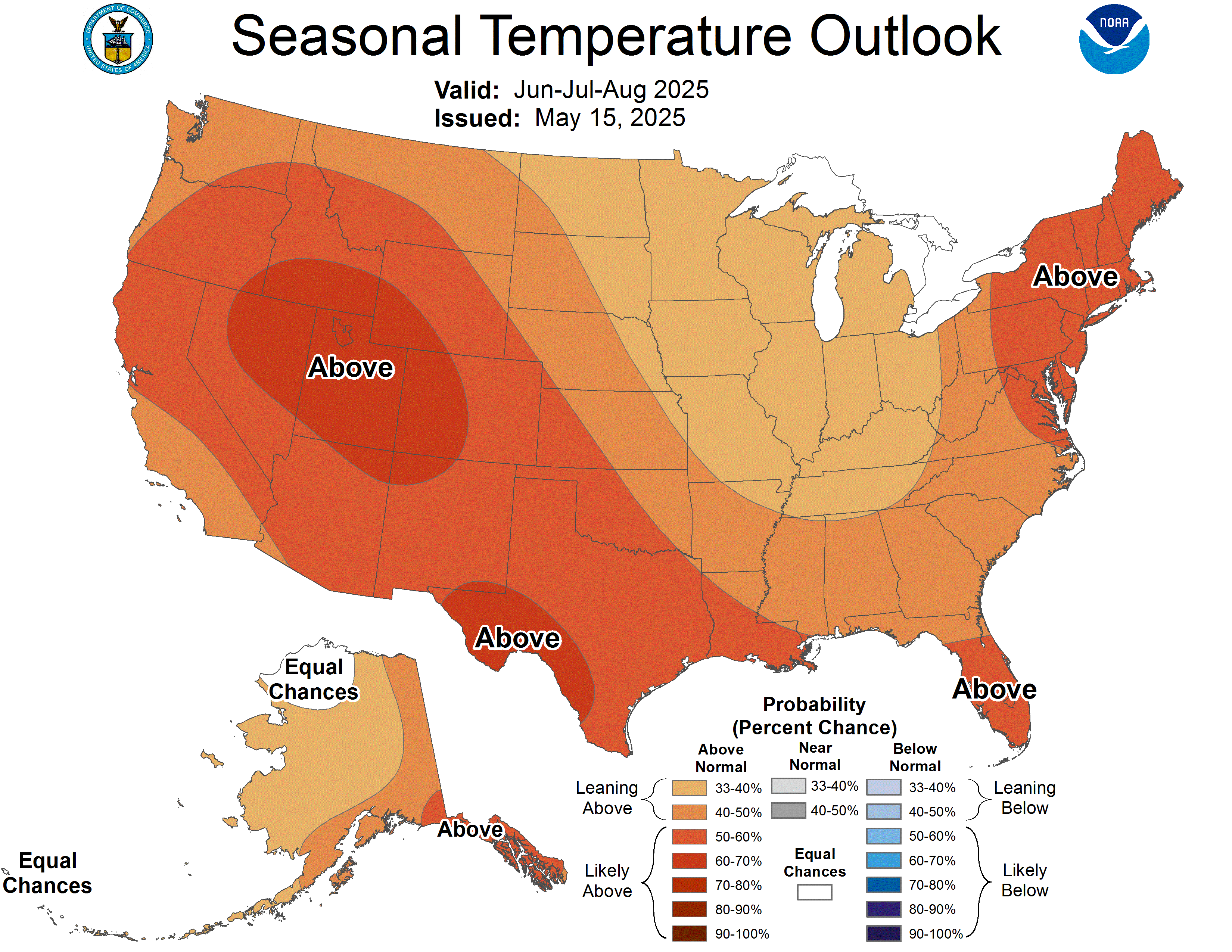
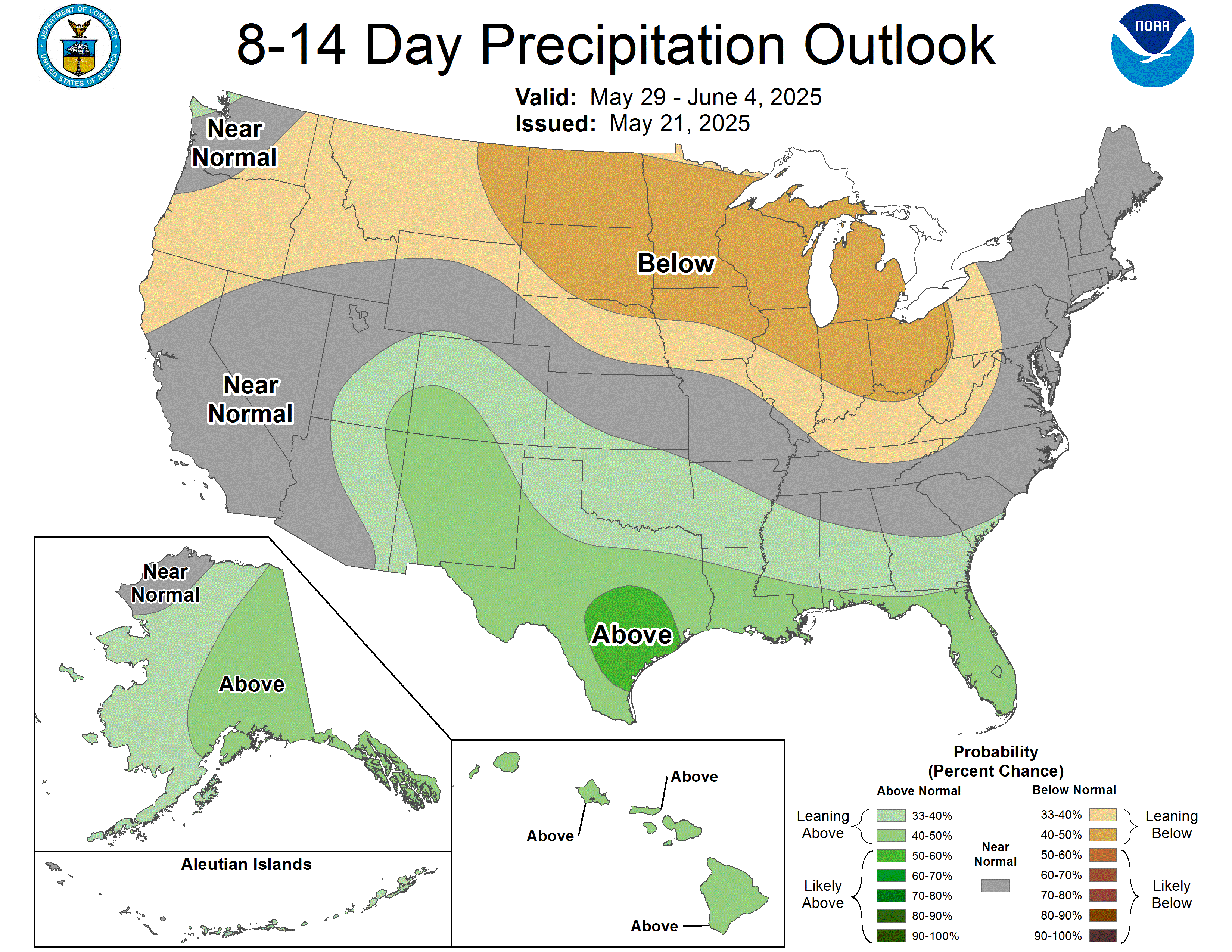
Federal forecasts indicate that hotter-than-normal temperatures will likely continue through the summer in Colorado. That means that drought conditions, particularly on the Western Slope, will likely get worse. There may be some relief – federal data indicate that there may be an above-average monsoon season from July – September in the Southwest. If that forecast pans out, those summer rainstorms could ease the state’s drought and tamp down wildfire risk.
A long-awaited restoration project along the Roaring Fork River in Glenwood Springs is officially complete. City officials, project partners and community members gathered [May 21, 2025] to mark the opening of a newly rehabilitated stretch of parkland near the Atkinson Trail — a site once plagued by erosion, invasive plants and deteriorating irrigation infrastructure.
“This project shores up a resource that was starting to wash away,” Glenwood Springs City Manager Steve Boyd said. “It’s a very valuable little park. It’s been years in the making, but we’re super glad it’s finally finished.”
Planning for the project began in 2019, with input and support from the city’s River Commission and several environmental groups. Years of grant writing, design changes and budgeting followed before construction could begin. City Engineer Ryan Gordon said the goal was to preserve the riverfront area’s natural look while solving multiple safety and environmental problems…Behind the fence where officials gathered Wednesday, the Atkinson Ditch has been filled in and replanted. Once a half-full water channel that bred mosquitoes and collected trash, the ditch was also home to an old head gate with sharp metal remnants from deteriorated culverts…Further upstream, crews removed invasive Russian olive trees, stabilized approximately 700 linear feet of riverbank and reinforced eroding areas that had begun to threaten the trail. In doing so, they protected both the public recreation area and the surrounding habitat. Long Range Principal Planner and River Commission liaison Jim Hardcastle said the project addressed persistent seepage and standing water issues that turned the area into “a festering mosquito log.”
The sun shines on homes in Phoenix, Arizona on October 19, 2024. A significant portion of the Colorado River basin’s groundwater losses came from Arizona, but the new study says those losses might have been worse without state regulations. Experts are now calling for more regulations around groundwater pumping to stem further depletion. Alex Hager/KUNC
Click the link to read the article on the KUNC website (Alex Hager):
June 2, 2025
This story is part of ongoing coverage of water in the West, produced by KUNC in Colorado and supported by the Walton Family Foundation. KUNC is solely responsible for its editorial coverage.
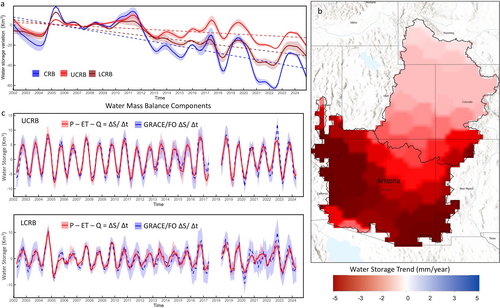
The Colorado River basin has lost huge volumes of groundwater over the past two decades according to a new report from researchers at Arizona State University.Researchers used data from NASA satellites to map the rapidly-depleting resource.
The region, which includes seven Western states, has lost 27.8 million acre-feet of groundwater since 2003. That’s roughly the volume of Lake Mead, the nation’s largest reservoir.
Udall/Overpeck 4-panel Figure Colorado River temperature/precipitation/natural flows with trend. Lake Mead and Lake Powell storage. Updated through Water Year 2024. Credit: Brad Udall
The findings add a layer of complication for the already-stressed Colorado River. As demand for its water outpaces supply, more users may be turning to groundwater instead, which is often less regulated than water from above-ground rivers and streams.
The majority of water conservation work throughout the Colorado River basin has been focused on cutbacks to surface water use. Some river experts say the focus should be broader.
Brian Richter analyzes water policy and science as president of Sustainable Waters. He was not an author of the study but says its findings show the need for a “holistic perspective” on water management from the region’s leaders.
“It suggests that we have to become more aggressive and more urgent in our reduction of our overall consumption of water,” he said.
Creating a balance of water that’s taken from aquifers and water that replenishes aquifers is an important aspect of making sure water will be available when it’s needed. Image from “Getting down to facts: A Visual Guide to Water in the Pinal Active Management Area,” courtesy of Ashley Hullinger and the University of Arizona Water Resources Research Center
The study found that groundwater losses in the Colorado River basin were 2.4 times greater than the amount of water lost from the surfaces of Lake Powell, Lake Mead, and a number of other smaller reservoirs that store Colorado River water. The study highlights agriculture’s outsized water use in the Colorado River basin, and said that industry could suffer some of the greatest consequences if the region keeps sapping limited water supplies.
Most of the losses happened in the river’s Lower Basin states of Arizona, California and Nevada. The study says Arizona’s “Active Management Areas,” which the state set up to regulate groundwater withdrawal, may have helped slow depletion.
Kathleen Ferris, an architect of Arizona’s groundwater laws, said much more work is needed to protect groundwater.
“We are not on track,” said Ferris, who was not involved in the study. “We are way behind the eight ball, and I’m really sad that nothing seems to get done. We should have been thinking about this issue 25 years ago.”
Ferris is now a senior research fellow at Arizona State University’s Kyl Center for Water Policy.
As experts call for more robust groundwater management policies, Richter said this study presents a small silver lining: scientists are producing better data than ever before, giving policymakers a better sense of the region’s water problems.
“From a public policy standpoint, this is bad news,” he said. “This tells us that it’s worse than we thought, because now we understand what’s going on underground as well. From a science perspective, this kind of study is good news, because it says that we are now much more capable of accurately describing a water problem like what we’re experiencing in the Colorado River system.”
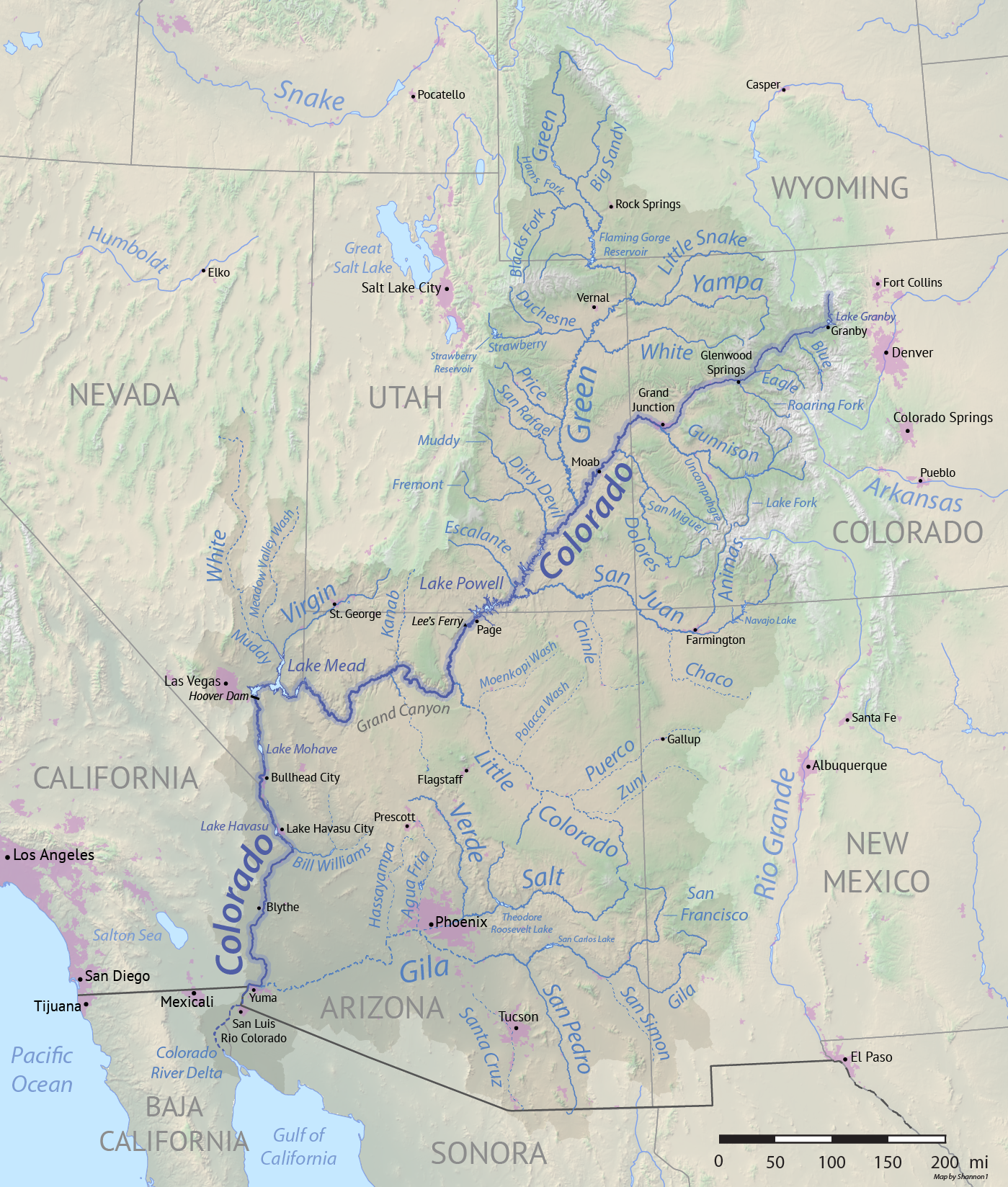
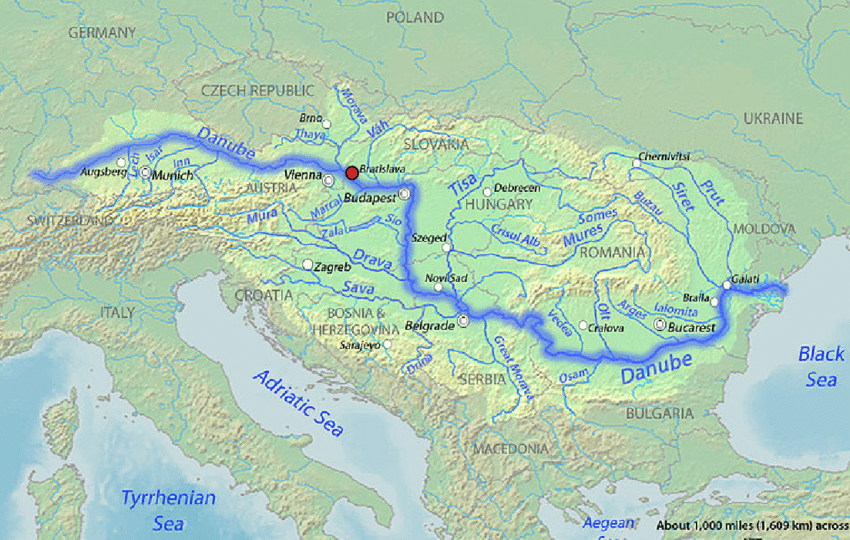
Map of the Colorado River drainage basin, created using USGS data. By Shannon1 Creative Commons Attribution-Share Alike 4.0
Utah has some of the best infrastructure in the country when compared to other states, although its canals and levees are in need of repair.
That’s according to the American Society of Civil Engineers’ report card, released Thursday, which gives the Beehive State an overall C+ grade. That’s tied with Georgia and Wisconsin for the highest score of all U.S. states and territories.
“A C+ means our infrastructure is meeting the needs of Utahns, but there’s still room for improvement,” said Craig Friant, a civil engineer who worked on the report. “This is a sign that we’re doing things well here in Utah.”
While the state has one of the highest grades, the rest of the country is not far behind. The national grade is C, and most states and territories received a C or C- grade — South Carolina and Louisiana each received a D+, West Virginia received a D and Puerto Rico received a D-, the lowest grade.
According to the American Society of Civil Engineers, or ASCE, an A grade is defined as exceptional and fit for the future; B is good and adequate for now; C is mediocre, requiring attention; D is poor and at risk; and F is failing, requiring critical attention and unfit for purpose.
The report lists 12 separate areas of infrastructure for each state. Consider Utah’s report:
Aviation: C+
Bridges: B
Canals: D+
Dams: C+
Drinking water: B-
Hazardous waste: C+
Levees: D-
Roads: B+
Solid waste: B-
Stormwater: C
Transportation: B-
Wastewater: C
The 28-mile Jordan & Salt Lake City Canal conveyed up to 150 cfs of Utah Lake water to Salt Lake City in 1882. Credit: slcdocs.com
The majority of the state’s levees and canals are old, according to the report — most levees are more than 60 years old, and many of the state’s canals were built in the 19th century for irrigation purposes.
The report also noted that data isn’t readily available for levees and canals, which poses another risk.
“These are systems that protect households and businesses from flooding, yet we don’t know their condition in many cases, which is a major public safety hazard,” said Friant, who pointed to outdated levees in Salt Lake County that protect residential areas from flooding during runoff or storms.
These levees don’t currently meet the Army Corps of Engineers standards, putting them at risk of being delisted — if that happens, the Federal Emergency Management Agency, or FEMA, could eventually reclassify the land surrounding the Salt Lake City International and Provo City airports as flood plains, according to the report. That could “drastically” alter how the land is assessed and insured, engineers say.
Recommendations for improving Utah’s infrastructure
What can the state do to boost its grade? The report gives several recommendations, including more analysis and better funding when it comes to infrastructure.
“Specifically, detailed written plans are critical for the areas of water resources, canals, transportation, transit, and waste management,” the report reads. “The state should be providing consistent financial support for project improvements, maintenance, resiliency, and risk reduction through reliable funding streams year after year that facilitate this planning.”
Prioritizing funding for bridges is another recommendation. Even though Utah received a B, engineers say many of the state’s bridges are nearing the end of their “service lives.”
The state should also increase funding for its Dam Safety Program. Utah currently has hundreds of dams considered “high hazard,” which means if they fail, it would cause severe damage and loss of life.
That includes the Panguitch Lake Dam, which showed signs of seepage last year after cracks appeared near the top, likely the result of ice pushing up against the concrete. The roughly 1,700 residents of Panguitch were put on notice to prepare for evacuation, but crews were able to break the ice away and stabilize the dam.
To avoid a repeat scenario, the report recommends the state dump at least $10 million each year into the Dam Safety Program and try to rehabilitate all dams within 50 years. “An increase to $20 million per year would allow faster repairs but could still require 25 years for all required repairs,” the report reads.
Bolstering “multi-modal” transportation options — like expanding bus or train networks —is another recommendation as the state deals with rapid population growth.
And lastly, Utah should make sure the Great Salt Lake reaches and remains at healthy levels — replacing canals with pipelines will help reduce evaporation, and could ultimately result in more water flowing to the lake, according to the report.
Click the link to read the article on The Denver Post website (Elise Schmelzer). Here’s an excerpt:
May 31, 2025
Concerningly low amounts of water are flowing from Rocky Mountain snowpack this spring, a summer of drought looms across swaths of the West, and the negotiators tasked with devising a sustainable long-term water plan for the 40 million people who rely on the Colorado River are running out of time. Commissioners from the seven states in the Colorado River Basin — Colorado, New Mexico, Wyoming, Utah, Arizona, California and Nevada — must create a plan that will govern how those states divvy up the river’s water after the current guidelines expire at the end of 2026. As the river shrinks due to drought and climate change, the negotiators must decide who will take less water — and they need to do so in the next few months.
“The way the law of the river is set up, this is a decision that takes the seven states, and there are so many stakeholders and users who depend on that,” said Jennifer Pitt, Colorado River program director at the National Audubon Society. “We are really at their mercy and we are just about out of time.”
Udall/Overpeck 4-panel Figure Colorado River temperature/precipitation/natural flows with trend. Lake Mead and Lake Powell storage. Updated through Water Year 2024. Credit: Brad Udall
Those who depend on the river are already dealing with uncertainty: this season’s mountain snowpack is expected to deliver about half the median amount of water to the system’s two major reservoirs, which are already two-thirds empty. Years of drought not balanced by decreases in water consumption have drained Lake Mead and Lake Powell, and aridification fueled by climate change is expected to continue to reduce the flow of the river that makes modern life possible across the Southwest. The Colorado River irrigates more than 5 million acres of farmland — including water supplies for much of the nation’s winter vegetables — and comprises large portions of many Western cities’ water portfolio, said Brad Udall, senior water and climate research scholar at Colorado State University’s Colorado Water Institute.
Corn ethanol, also known as grain alcohol, has been burned in gasoline engines and human stomachs since before Henry Ford was born. It’s hard on both, so until 35 years ago it never caught on much, at least not for engines.
But in 1990, Congress amended the Clean Air Act, requiring gasoline to be spiked with an oxygen-containing compound to reduce carbon monoxide. With the help of corn-belt farmers and public officials, the oxygenate of choice became corn-based ethanol. Now, most gasoline sold in the United States contains at least 10 percent ethanol, also called “gasohol.”
Fifty ethanol plants produced 900 million gallons of ethanol in 1990. In 2024, 191 ethanol plants produced a record 16.22 billion gallons. From the corn belt, ethanol production has spread West. Today, ethanol is produced in Oregon, Idaho, Colorado, New Mexico, Wyoming, Arizona and California.
Though it is hyped as an elixir for what ails the earth, ethanol has long been a disaster that we can’t seem to remedy. Calling it wasteful and inefficient doesn’t begin to list its drawbacks: It costs more to produce than gasoline, reduces mileage, corrodes gas tanks and car engines, pollutes air and water, and, by requiring more energy to produce than it yields, increases America’s dependence on foreign oil.
While gasohol releases less carbon monoxide than gasoline, it emits more smog-producing volatile organic compounds. And ethanol plants produce more pollutants than oil refineries, including high levels of carcinogens, thereby routinely violating already relaxed pollution permits. In 2007, under industry pressure, ethanol plants were exempted from the EPA’s most stringent pollution regulations.
Of all crops grown in the United States, corn demands the most massive fixes of herbicides, insecticides, and chemical fertilizers, while creating the most soil erosion. Producing each gallon of ethanol also results in 12 gallons of sewage-like effluent, part of the toxic, oxygen-swilling stew of nitrates, chemical poisons and dirt that gets excreted from corn monocultures.
From Kentucky to Wyoming, this runoff pollutes the Mississippi River system, harming aquatic animals all the way to the Gulf of Mexico, where it expands a bacteria-infested, algae-clogged, anaerobic “Dead Zone.” In 2024, this Dead Zone was about the size of New Jersey.
Thanks to billions of dollars in tax credits, rebates, grants and other subsidies pumped into corn ethanol production, farmers are motivated to convert marginal ag land to corn plantations. Some farmers even drain wetlands, the most productive of all wildlife habitats.
Cornell University professor David Pimentel, who died in 2019, was the first agricultural scientist to expose ethanol production as a boondoggle. While his data are old, they provide a snapshot of our current situation and a valuable model for groups like the Environmental Integrity Project, a nonprofit “holding polluters and government agencies accountable under the law,” as it digs out the real costs of gasohol.
Without even factoring in the fuel required to ship ethanol to blending sites, Pimentel found that it takes about 70 percent more energy to produce ethanol than we get from it. Then, figuring in state and federal subsidies, he found that ethanol costs $2.24 a gallon to produce, compared with 63 cents for gasoline.
Pimentel determined that allocating corn to ethanol production also raises ethical questions: “Abusing our precious croplands to grow corn for an energy-inefficient process that yields low-grade automobile fuel amounts to unsustainable, subsidized food burning.”
And Pimentel chided the U.S. Department of Agriculture for taking planting and yield data only from states with the best soils and productivity. The Department also didn’t fully take into account fossil-fuel expenditure for operation and repair of farm machinery or for production of fertilizers made from natural gas.
What stymies reform? Agricultural communities have built valuable support from the bottom up—from local agricultural communities and regional politicians to U.S. presidents such as Ronald Reagan, Barack Obama, Joe Biden and Donald Trump. The beneficiaries of America’s ethanol addiction have become behemoths that get bigger and hungrier with each feeding.
If President Trump really wants to cut wasteful and inefficient spending, decrease our dependence on foreign oil and prove that he wants America to have “among the very cleanest air and cleanest water on the planet,” he needs to end what now amounts to government-forced gasohol use.
Ted Williams is a contributor to Writers on the Range, writersontherange.org, an independent nonprofit dedicated to spurring lively conversation about the West. He is a longtime environmental writer.
Arriving at the Barcelona rail station June 1, 2025.
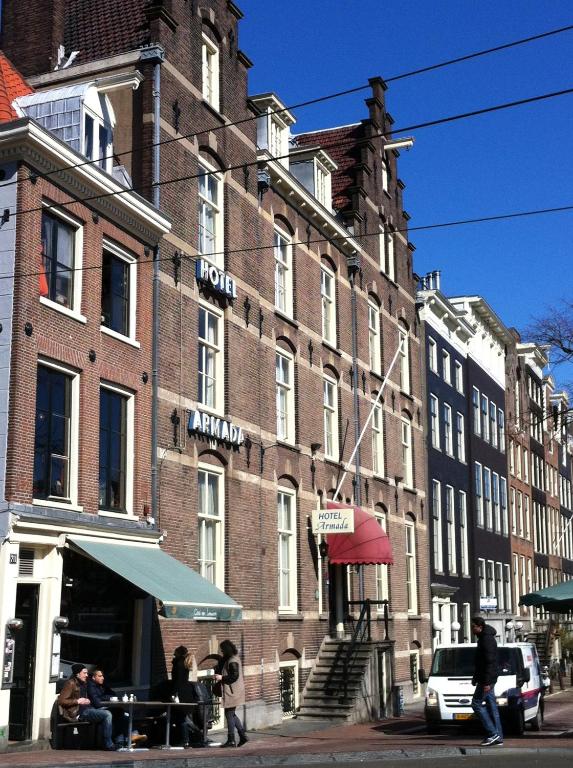
We arrived in Barcelona in the afternoon from Paris. After a short walk from our hotel we enjoyed a delicious dinner at Honest Greens. It was bittersweet to return to Barcelona knowing that by coming full circle the great vacation in Europe was coming to the end.
The view from our hotel June 1, 2025. Parc de la Ciutadella with the Mediterranean in the background.
Green parrots at the Parc de la Ciutadella in Barcelona June 1, 2025. Barcelona is known for its large population of green parrots, primarily monk parakeets (Myiopsitta monachus). These birds, which are native to South America, are now an established part of the city’s urban ecosystem. They arrived in the mid-1970s, likely from an escaped shipment to the Barcelona zoo, and have since thrived in Barcelona’s climate.
On its surface, floating solar appears to conserve water while generating carbon-free electricity. River managers are cautious, but some say the West can’t afford to wait.
GILA RIVER INDIAN RESERVATION, Ariz.—About 33 miles south of Phoenix, Interstate 10 bisects a line of solar panels traversing the desert like an iridescent snake. The solar farm’s shape follows the path of a canal, with panels serving as awnings to shade the gently flowing water from the unforgiving heat and wind of the Sonoran Desert.
The panels began generating power last November for the Akimel O’otham and Pee Posh tribes—known together as the Gila River Indian Community, or GRIC—on their reservation in south-central Arizona, and they are the first of their kind in the U.S. The community is studying the effects of these panels on the water in the canal, hopeful that they will protect a precious resource from the desert’s unflinching sun and wind.
In September, GRIC is planning to break ground on another experimental effort to conserve water while generating electricity: floating solar. Between its canal canopies and the new project that would float photovoltaic panels on a reservoir it is building, GRIC hopes to one day power all of its canal and irrigation operations with solar electricity, transforming itself into one of the most innovative and closely-watched water users in the West in the process.
The community’s investments come at a critical time for the Colorado River, which supplies water to about 40 million people across seven Western states, Mexico and 30 tribes, including GRIC. Annual consumption from the river regularly exceeds its supply, and a decades-long drought, fueled in part by climate change, continues to leave water levels at Lake Powell and Lake Mead dangerously low.
Covering water with solar panels is not a new idea. But for some it represents an elegant mitigation of water shortages in the West. Doing so could reduce evaporation, generate more carbon-free electricity and require dams to run less frequently to produce power.
But, so far, the technology has not been included in the ongoing Colorado River negotiations between the Upper Basin states of Colorado, New Mexico, Utah and Wyoming, the Lower Basin states of Arizona, California and Nevada, tribes and Mexico. All are expected to eventually agree on cuts to the system’s water allocations to maintain the river’s ability to provide water and electricity for residents and farms, and keep its ecosystem alive.
“People in the U.S. don’t know about [floating solar] yet,” said Scott Young, a former policy analyst in the Nevada state legislature’s counsel bureau. “They’re not willing to look at it and try and factor it” into the negotiations.
Several Western water managers Inside Climate News contacted for this story said they were open to learning more about floating solar—Colorado has even studied the technology through pilot projects. But, outside of GRIC’s project, none knew of any plans to deploy floating solar anywhere in the basin. Some listed costly and unusual construction methods and potentially modest water savings as the primary obstacles to floating solar maturing in the U.S.
A Tantalizing Technology With Tradeoffs
A winery in Napa County, California, deployed the first floating solar panels in the U.S. on an irrigation pond in 2007. The country was still years away from passing federal legislation to combat the climate crisis, and the technology matured here haltingly. As recently as 2022, according to a Bloomberg analysis, most of the world’s 13 gigawatts of floating solar capacity had been built in Asia.
Unlike many Asian countries, the U.S. has an abundance of undeveloped land where solar could be constructed, said Prateek Joshi, a research engineer at the National Renewable Energy Laboratory (NREL) who has studied floating solar, among other forms of energy. “Even though [floating solar] may play a smaller role, I think it’s a critical role in just diversifying our energy mix and also reducing the burden of land use,” he said.
This February, NREL published a study that found floating solar on the reservoirs behind federally owned dams could provide enough electricity to power 100 million U.S. homes annually, but only if all the developable space on each reservoir were used.
Lake Powell could host almost 15 gigawatts of floating solar using about 23 percent of its surface area, and Lake Mead could generate over 17 gigawatts of power on 28 percent of its surface. Such large-scale development is “probably not going to be the case,” Joshi said, but even if a project used only a fraction of the developable area, “there’s a lot of power you could get from a relatively small percentage of these Colorado Basin reservoirs.”
The study did not measure how much water evaporation floating solar would prevent, but previous NREL research has shown that photovoltaic panels—sometimes called “floatovoltaics” when they are deployed on reservoirs—could also save water by changing the way hydropower is deployed.
Some of a dam’s energy could come from solar panels floating on its reservoir to prevent water from being released solely to generate electricity. As late as December, when a typical Western dam would be running low, lakes with floating solar could still have enough water to produce hydropower, reducing reliance on more expensive backup energy from gas-fired power plants.
Joshi has spoken with developers and water managers about floating solar before, and said there is “an eagerness to get this [technology] going.” The technology, however, is not flawless.
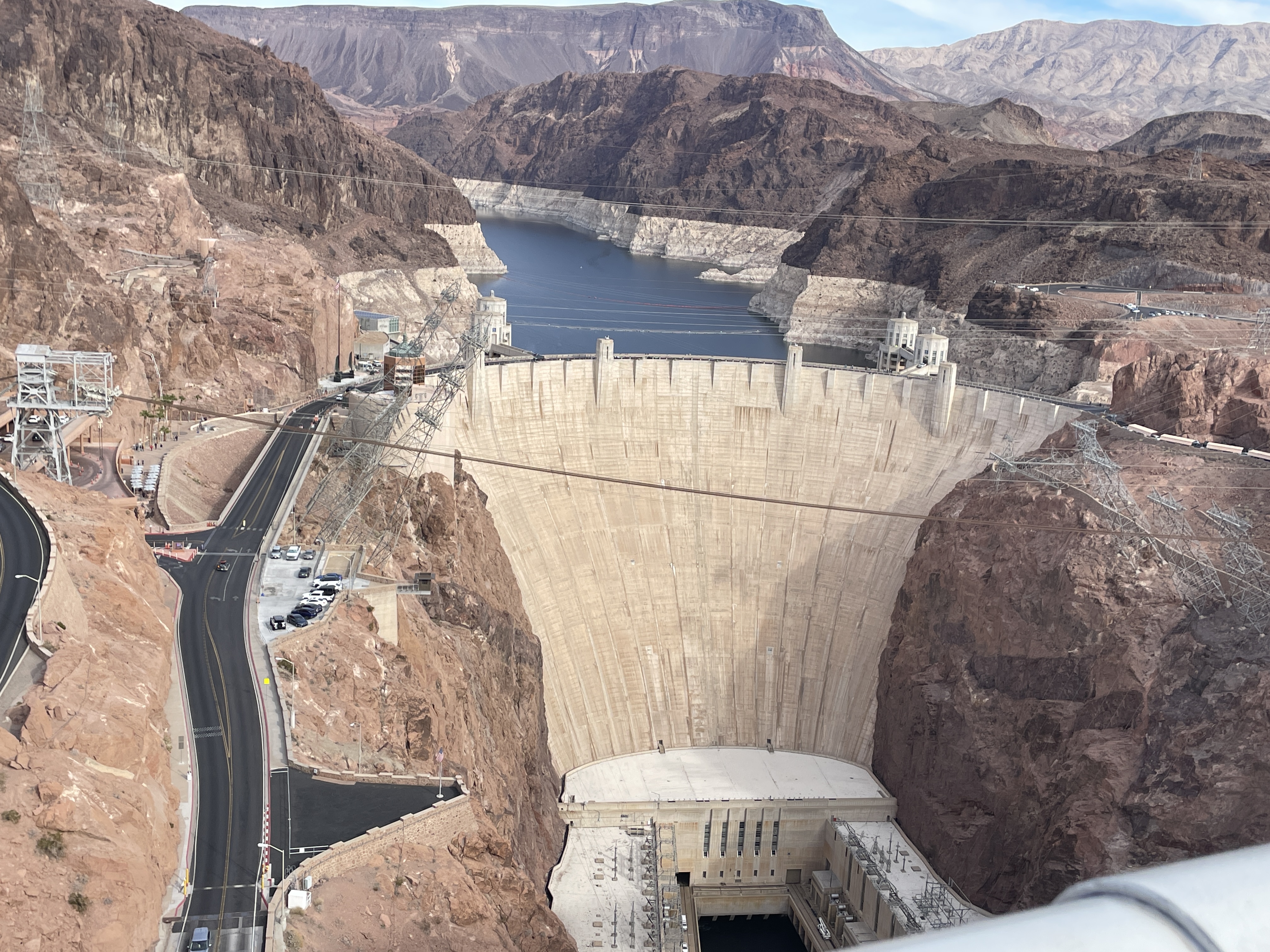
Hoover Dam with Lake Mead in the background December 3, 2024.
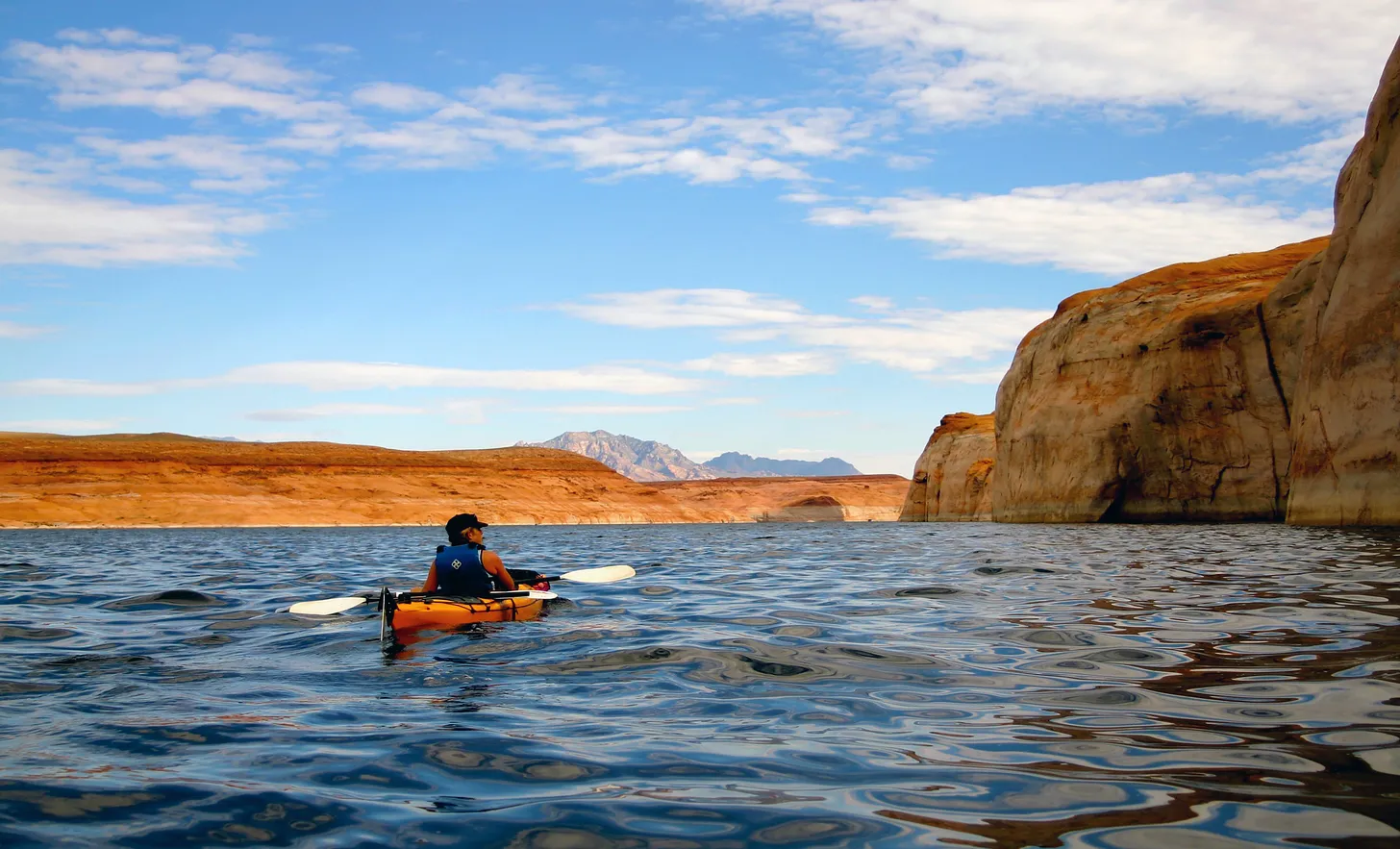
Paddling Powell. Photo by Jonathan P. Thompson.
Solar arrays can be around 20 percent more expensive to install on water than land, largely because of the added cost of buoys that keep the panels afloat, according to a 2021 NREL report. The water’s cooling effect can boost panel efficiency, but floating solar panels may produce slightly less energy than a similarly sized array on land because they can’t be tilted as directly toward the sun as land-based panels.
And while the panels likely reduce water loss from reservoirs, they may also increase a water body’s emissions of greenhouse gases, which in turn warm the climate and increase evaporation. This January, researchers at Cornell University found that floating solar covering more than 70 percent of a pond’s surface area increased the water’s CO2 and methane emissions. These kinds of impacts “should be considered not only for the waterbody in which [floating solar] is deployed but also in the broader context of trade-offs of shifting energy production from land to water,” the study’s authors wrote.
“Any energy technology has its tradeoffs,” Joshi said, and in the case of floating solar, some of its benefits—reduced evaporation and land use—may not be easy to express in dollars and cents.
Silver Buckshot
There is perhaps no bigger champion for floating solar in the West than Scott Young. Before he retired in 2016, he spent much of his 18 years working for the Nevada Legislature researching the effects of proposed legislation, especially in the energy sector.
On an overcast, blustery May day in southwest Wyoming near his home, Young said that in the past two years he has promoted the technology to Colorado River negotiators, members of Congress, environmental groups and other water managers from the seven basin states, all of whom he has implored to consider the virtues of floating solar arrays on Lake Powell and Lake Mead.
Young grew up in the San Francisco Bay area, about 40 miles, he estimated, from the pioneering floating solar panels in Napa. He stressed that he does not have any ties to industry; he is just a concerned Westerner who wants to diversify the region’s energy mix and save as much water as possible.
But so far, when he has been able to get someone’s attention, Young said his pitch has been met with tepid interest. “Usually the response is: ‘Eh, that’s kind of interesting,’” said Young, dressed in a black jacket, a maroon button-down shirt and a matching ball cap that framed his round, open face. “But there’s no follow-up.”
The Bureau of Reclamation “has not received any formal proposals for floating solar on its reservoirs,” said an agency spokesperson, who added that the bureau has been monitoring the technology.
In a 2021 paper published with NREL, Reclamation estimated that floating solar on its reservoirs could generate approximately 1.5 terawatts of electricity, enough to power about 100 million homes. But, in addition to potentially interfering with recreation, aquatic life and water safety, floating solar’s effect on evaporation proved difficult to model broadly.
So many environmental factors determine how water is lost or consumed in a reservoir—solar intensity, wind, humidity, lake circulation, water depth and temperature—that the study’s authors concluded Reclamation “should be wary of contractors’ claims of evaporation savings” without site-specific studies. Those same factors affect the panels’ efficiency, and in turn, how much hydropower would need to be generated from the reservoir they cover.
The report also showed the Colorado River was ripe with floating solar potential—more than any other basin in the West. That’s particularly true in the Upper Basin, where Young has been heartened by Colorado’s approach to the technology.
In 2023, the state passed a law requiring several agencies to study the use of floating solar. Last December, the Colorado Water Conservation Board published its findings, and estimated that the state could save up to 407,000 acre feet of water by deploying floating solar on certain reservoirs. An acre foot covers one acre with a foot of water, or 325,851 gallons, just about three year’s worth of water for a family of four.
When Young saw the Colorado study quantifying savings from floating solar, he felt hopeful. “407,000 acre feet from one state,” he said. “I was hoping that would catch people’s attention.”
Saving that much water would require using over 100,000 acres of surface water, said Cole Bedford, the Colorado Water Conservation Board’s chief operating officer, in an email. “On some of these reservoirs a [floating solar] system would diminish the recreational value such that it would not be appropriate,” he said. “On others, recreation, power generation, and water savings could be balanced.”
Colorado is not planning to develop another project in the wake of this study, and Bedford said that the technology is not a silver bullet solution for Colorado River negotiations.
“While floating solar is one tool in the toolkit for water conservation, the only true solution to the challenges facing the Colorado River Basin is a shift to supply-driven, sustainable uses and operations,” he said.
Denver Water’s sustainability operations include generating energy from solar power panels installed on the roof of its Administration Building, parking garage and over its visitor’s parking lot at its Operations Complex near downtown. Photo credit: Denver Water.
Some of the West’s largest and driest cities, like Phoenix and Denver, ferry Colorado River water to residents hundreds of miles away from the basin using a web of infrastructure that must reliably operate in unforgiving terrain. Like their counterparts at the state level, water managers in these cities have heard floatovoltaics floated before, but they say the technology is currently too immature and costly to be deployed in the U.S.
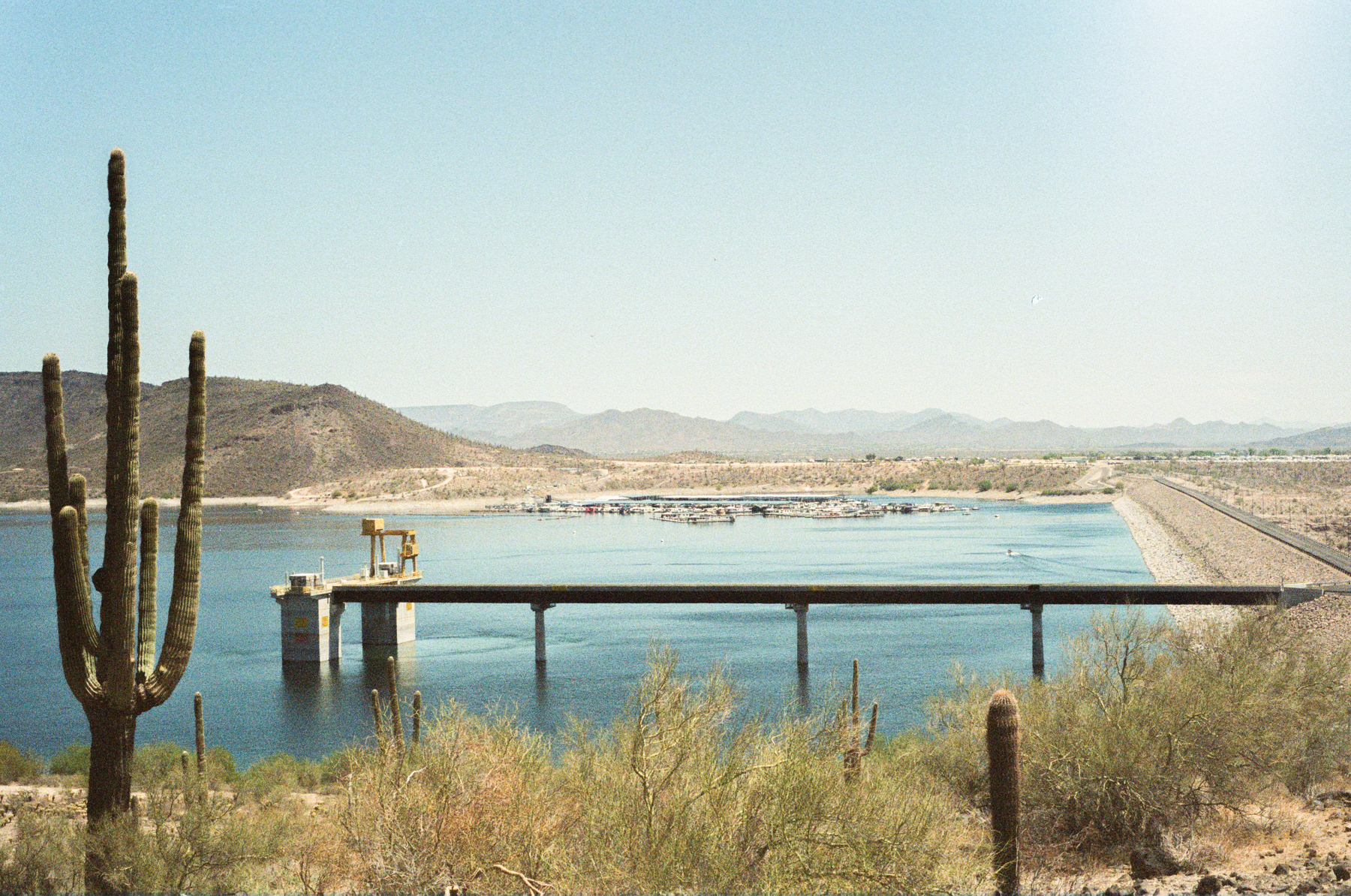
Lake Pleasant, which holds some of the Central Arizona Project’s Colorado River Water, is also a popular recreation space, complicating its floating solar potential. Credit: Jake Bolster/Inside Climate News
In Arizona, the Central Arizona Project (CAP) delivers much of the Colorado River water used by Phoenix, Tucson, tribes and other southern Arizona communities with a 336-mile canal running through the desert, and Lake Pleasant, the company’s 811,784-acre-foot reservoir.
Though CAP is following GRIC’s deployment of solar over canals, it has no immediate plans to build solar over its canal, or Lake Pleasant, according to Darrin Francom, CAP’s assistant general manager for operations, power, engineering and maintenance, in part because the city of Peoria technically owns the surface water.
Covering the whole canal with solar to save the 4,000 acre feet that evaporates from it could be prohibitively expensive for CAP. “The dollar cost per that acre foot [saved] is going to be in the tens of, you know, maybe even hundreds of thousands of dollars,” Francom said, mainly due to working with novel equipment and construction methods. “Ultimately,” he continued, “those costs are going to be borne by our ratepayers,” which gives CAP reason to pursue other lower-cost ways to save water, like conservation programs, or to seek new sources.
An intake tower moves water into and out of the dam at Lake Pleasant. Credit: Jake Bolster/Inside Climate News
The increased costs associated with building solar panels on water instead of on land has made such projects unpalatable to Denver Water, Colorado’s largest water utility, which moves water out of the Colorado River Basin and through the Rocky Mountains to customers on the Front Range. “Floating solar doesn’t pencil out for us for many reasons,” said Todd Hartman, a company spokesperson. “Were we to add more solar resources—which we are considering—we have abundant land-based options.”
GRIC spent about $5.6 million, financed with Inflation Reduction Act grants, to construct 3,000 feet of solar over a canal, according to David DeJong, project director for the community’s irrigation district.
Young is aware there is no single solution to the problems plaguing the Colorado River Basin, and he knows floating solar is not a perfect technology. Instead, he thinks of it as a “silver buckshot,” he said, borrowing a term from John Entsminger, general manager for the Southern Nevada Water Authority—a technology that can be deployed alongside a constellation of behavioral changes to help keep the Colorado River alive.
Given the duration and intensity of the drought in the West and the growing demand for water and clean energy, Young believes the U.S. needs to act now to embed this technology into the fabric of Western water management going forward.
As drought in the West intensifies, “I think more lawmakers are going to look at this,” he said. “If you can save water in two ways—why not?”
If all goes according to plan, GRIC’s West Side Reservoir will be finished and ready to store Colorado River water by the end of July. The community wants to cover just under 60 percent of the lake’s surface area with floating solar.
“Do we know for a fact that this is going to be 100 percent effective and foolproof? No,” said DeJong, GRIC’s project director for its irrigation district. “But we’re not going to know until we try.”
The Gila River Indian Community spent about $5.6 million, with the help of Inflation Reduction Act grants, to cover a canal with solar. Credit Jake Bolster/Inside Climate News
GRIC’s panels will have a few things going for them that projects on lakes Mead or Powell probably wouldn’t. West Side Reservoir will not be open to recreation, limiting the panels’ impacts on people. And the community already has the funds—Inflation Reduction Act grants and some of its own money—to pay for the project.
But GRIC’s solar ambitions may be threatened by the hostile posture toward solar and wind energy from the White House and congressional Republicans, and the project is vulnerable to an increasingly volatile economy. Since retaking office, President Donald Trump, aided by billionaire Elon Musk, has made deep cuts inrenewableenergy grants at the Environmental Protection Agency. It is unclear whether or to what extent the Bureau of Reclamation has slashed its grant programs.
“Under President Donald J. Trump’s leadership, the Department is working to cut bureaucratic waste and ensure taxpayer dollars are spent efficiently,” said a spokesperson for the Department of the Interior, which oversees Reclamation. “This includes ensuring Bureau of Reclamation projects that use funds from the Infrastructure Investments and Jobs Act and the Inflation Reduction Act align with administration priorities. Projects are being individually assessed by period of performance, criticality, and other criteria. Projects have been approved for obligation under this process so that critical work can continue.”
And Trump’s tariffs could cause costs to balloon beyond the community’s budget, which could either reduce the size of the array or cause delays in soliciting proposals, DeJong said.
While the community will study the panels over canals to understand the water’s effects on solar panel efficiency, it won’t do similar research on the panels on West Side Reservoir, though DeJong said they have been in touch with NREL about studying them. The enterprise will be part of the system that may one day offset all the electrical demand and carbon footprint of GRIC’s irrigation system.
“The community, they love these types of innovative projects. I love these innovative projects,” said GRIC Governor Stephen Roe Lewis, standing in front of the canals in April. Lewis had his dark hair pulled back in a long ponytail and wore a blue button down that matched the color of the sky.
“I know for a fact this is inspiring a whole new generation of water protectors—those that want to come back and they want to go into this cutting-edge technology,” he said. “I couldn’t be more proud of our team for getting this done.”
DeJong feels plenty of other water managers across the West could learn from what is happening at GRIC. In fact, the West Side Reservoir was intentionally constructed near Interstate 10 so that people driving by on the highway could one day see the floating solar the community intends to build there, DeJong said.
“It could be a paradigm shift in the Western United States,” he said. “We recognize all of the projects we’re doing are pilot projects. None of them are large scale. But it’s the beginning.”
Colorado River Connectivity Channel. Photo credit: Colorado Parks & Wildlife
Click the link to read the article on the Colorado Parks & Wildlife website (Rachael Gonzales):
May 2025
Colorado Parks and Wildlife (CPW) saw an increase in the native fish population numbers more quickly than anticipated in the recently completed Colorado River Connectivity Channel (CRCC) project at Windy Gap Reservoir, located near Granby, Colo.
In early May, CPW Aquatic biologists completed the first-ever raft electrofishing survey to estimate the trout population in the CRCC. Biologists estimated that approximately 848 brown trout and 221 rainbow trout over 6″ in length live within a one-mile reach of the newly constructed river channel.
“It was very exciting to see a healthy number of adult trout occupying all of this new habitat,” said Jon Ewert, CPW Hot Sulphur Springs Area Aquatic Biologist. “Especially considering that we have not stocked a single fish into the channel.”
As a result of the improved habitat, trout from connected river sections both upstream and downstream have been able to re-establish in the newly reconnected section of the Colorado River. CPW biologists also observed extensive brown trout spawning activity in the channel last fall and moderate rainbow trout spawning activity this spring.
“Seeing such positive results with water flowing through this new river section for just over a year, we anticipate that this fish population will continue to grow,” said Ewert.
This is the second time CPW has documented positive signs of native fish repopulating the CRCC earlier than anticipated. In the fall of 2024, CPW’s aquatic research team found evidence of native sculpin returning to the upper Colorado River and the CRCC after several decades of absence in nearly 30 miles of their former habitat. Sculpin found in the CRCC and downstream in the Colorado River included fish that were spawned and hatched in 2024.
During the survey, researchers documented one adult and 11 juvenile sculpin within the CRCC and a single juvenile sculpin in the Colorado River below the channel. Based on these sampling results, aquatic biologists and researchers from CPW believe that young sculpin are now able to take advantage of the new habitat and are dispersing downstream from healthy populations located upstream of the CRCC.
“The rapid colonization of the CRCC by this unique native fish species and its return to the Colorado River below Windy Gap is an important conservation milestone and a good indication that the channel is starting to improve the ecological health of the river,” said Dan Kowalski, CPW Aquatic Research Scientist.
While the beneficial effects of the CRCC may take years to be fully realized, the results from the fish surveys conducted in May 2025 and fall 2024 represent significant milestones in the efforts to enhance habitat conditions in the upper Colorado River. These findings suggest that the health of the river may be improving more quickly than expected.
Completed in the fall of 2023, the Colorado River Connectivity Project is one of the largest aquatic habitat improvement initiatives ever undertaken in Colorado. This project reconnects aquatic habitats that were fragmented by the construction of the Windy Gap Reservoir in 1985. Currently, the new river section is closed to public fishing access. It is expected to open after the area has had sufficient time to fully revegetate, which will take a couple more growing seasons. To learn more about the Colorado River Connectivity Channel Project, visit the project’s page on Northern Water’s website.
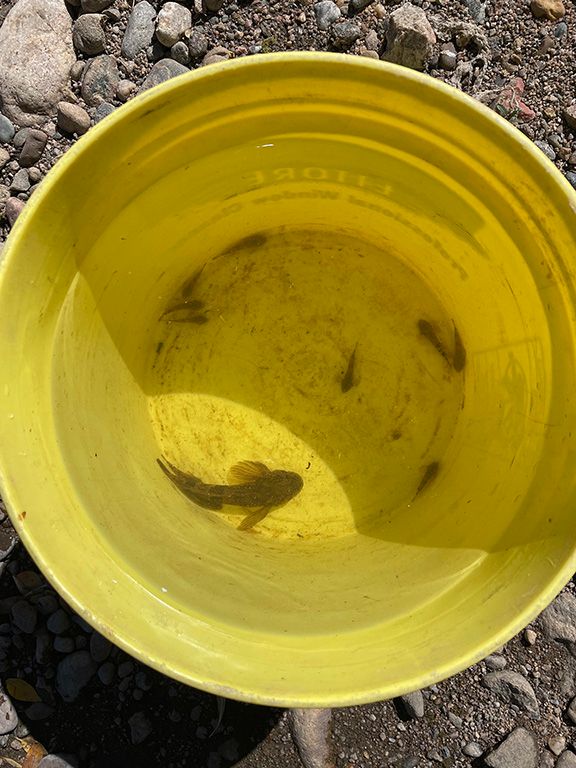
Sculpin from the Colorado River Connectivity Channel swim in a bucket during a fish survey in fall 2024. Photo credit: Colorado Parks & Wildlife
A CPW aquatic research technician holds a juvenile sculpin documented below the Colorado River Connectivity Channel during a fish survey in fall 2024. Photo credit: Colorado Parks & Wildlife
A close-up of a juvenile sculpin documented below the Colorado River Connectivity Channel during a fish survey in fall 2024. Photo credit: Colorado Parks & Wildlife
We travelled from Amsterdam to Paris via the train. What a great way to travel. The train was fast, smooth, and much quieter than an airplane. I have taken the train in the U.S. and Europe is way ahead.
From The New York Times (Ed Mackey): “Paris Saint-Germain thrashed Inter Milan 5-0 in Munich to win the Champions League for the first time. Former Inter player Achraf Hakimi opened the scoring for PSG, but it was the 19-year-old French forward Desire Doue who stole the show. He doubled PSG’s lead with a deflected effort before scoring a wonderful second goal after the half-time break. Khvicha Kvaratskhelia added a fourth and the 19-year-old substitute Senny Mayulu smashed home another to complete the rout.
Tomorrow it’s back to Barcelona and the flight (ugh!) back to Denver where Mrs. Gulch’s landscape is waiting.
Photos via my son May 31,2025. He said that the flowers are loving the rain in Denver.
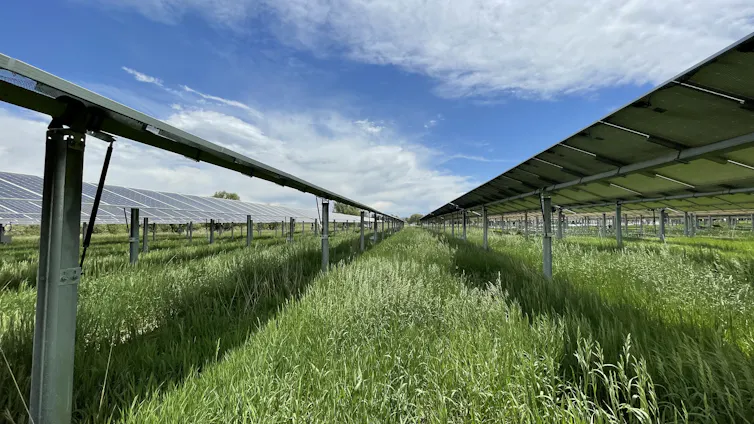
Grasses growing in the shade of a solar array were only a little less productive than those growing nearby in open grassland during years of average and above-average rainfall – but in a dry year, the shaded plants grew much better than those growing in full sun. That’s the result of a four-year study we conducted in a semi-arid grassland of northern Colorado.
When choosing a location for generating solar power, consistent sunlight and interconnection to the electric grid are key criteria. In Colorado the combination of new electrical transmission infrastructure, abundant sunlight and short vegetation that is easy to maintain have made grasslands a prime target for solar development.
Grasslands, like those that dominate the eastern plains of Colorado, provide important habitat for wildlife and serve as a critical food source for livestock. Although these grasslands have long been productive despite their normally arid environment, a warmer climate has increased the potential for more frequent and severe drought. For instance, a recent global study found that previous research likely underestimated the threat of extreme drought in grasslands.
Semi-arid grassland near Cheyenne, Wyo., with close-ups of flowers of some of the plants that grow there. Matthew Sturchio, CC BY-ND
At Colorado State University, biology professor Alan Knapp and I started the ecovoltaics research group to study the effects of solar development in grasslands. Our primary goal is to ensure an ecologically informed solar energy future.
Solar panels create microclimates
Strings of solar panels redirect rain to the edge of panels. Because of this, small rain events can provide biologically relevant amounts of water instead of evaporating quickly.
Simultaneously, solar panels shade plants growing beneath them. Some arrays, including the ones used in our study, move the panels to follow the path of the Sun across the sky.
This results in a combination of sun and shade that is very different from the uninterrupted sunlight beating down on plants in a grassland without solar panels. In turn, patterns of plant stress and water loss also differ in grasses under solar arrays. https://www.youtube.com/embed/Up4HoJYVbR4?wmode=transparent&start=0 A time-lapse video shows how a single-axis tracking solar array at Jack’s Solar Garden modifies patterns of sunlight availability.
How grasses respond to a solar panel canopy
To get a handle on how these different conditions affect grasses, we measured plant physiological response during the early stages of our study. More specifically, we tracked leaf carbon and water exchange throughout daylight hours, 9 a.m. to 5 p.m., over 16 weeks in summer 2022 at Jack’s Solar Garden, a solar array over grassland in Longmont, Colorado.
In general, plants that are adapted to full sun conditions, including most grasses, might not be expected to grow as well in partial shade. But we suspected that growth benefits from reduced water stress could outweigh potential reductions in growth from shading. We call this the “aridity mitigation potential” hypothesis.
Sure enough, we found evidence of aridity mitigation across multiple years, with the most pronounced effect during the driest year.
When water is scarce, increases in grassland productivity are more valuable because there isn’t as much around. Therefore, increasing grassland production in dry years could provide more available food for grazing animals and help offset some of the economic harm of drought in rangelands.
Informing sustainable solar development in grasslands
So far, our research has been limited to a grassland dominated by a cool season grass: smooth brome. Although it is a perennial commonly planted for hay, fields dominated by smooth brome lack the diversity of life found in native grasslands.
Future work in native shortgrass prairies would provide new information about how solar panels affect plant water use, soils and grazing management in an ecosystem with 30% less precipitation than Jack’s Solar Garden. We’re beginning that work now at the shortgrass ecovoltaic research facility near Nunn, Colorado. This facility, which will be fully operational later in 2025, was constructed with support from the U.S. Department of Agriculture, through the wider SCAPES project.
Testing the effects of solar panels over grasslands in a native ecosystem with even greater aridity will help us develop a clearer picture of ways solar energy can be developed in concert with grassland health.
Matthew Sturchio, Postdoctoral Research Associate in Natural Resources and the Environment, Cornell University; Faculty Afffiliate in Ecology, Colorado State University
“The Milkmaid” (Dutch: Het Melkmeisje) by Johannes Vermeer, created around 1657–1658. It is one of Vermeer’s most iconic works, depicting a domestic kitchen maid pouring milk in a quiet, intimate moment. The painting is renowned for its exquisite use of light, texture, and detail, capturing the serenity and dignity of everyday life.The Milkmaid (1658–1661). By Johannes Vermeer – Google Arts & Culture — AHrw. Z3. Av6. Zhjg 9. AHrw. Z3. Av6. Zhjg, Public Domain, https://commons.wikimedia.org/w/index.php?curid=13408941
We visited the Rijks Museum yesterday to take in the works of Dutch Golden Age painting, particularly Vermeer and Rembrandt, painters that I’ve heard about. At the Salvador Dali Museum the other day Vermeer was named as an influence. What a treat to be able to view so many beautiful and inspiring works of art in one location.
“The Syndics of the Drapers’ Guild” (Dutch: De Staalmeesters) by Rembrandt van Rijn, completed in 1662. It is housed in the Rijksmuseum in Amsterdam and is one of Rembrandt’s most celebrated group portraits. The painting depicts five drapers and their servant as they assess the quality of cloth, giving a glimpse into the civic and commercial life of 17th-century Amsterdam.
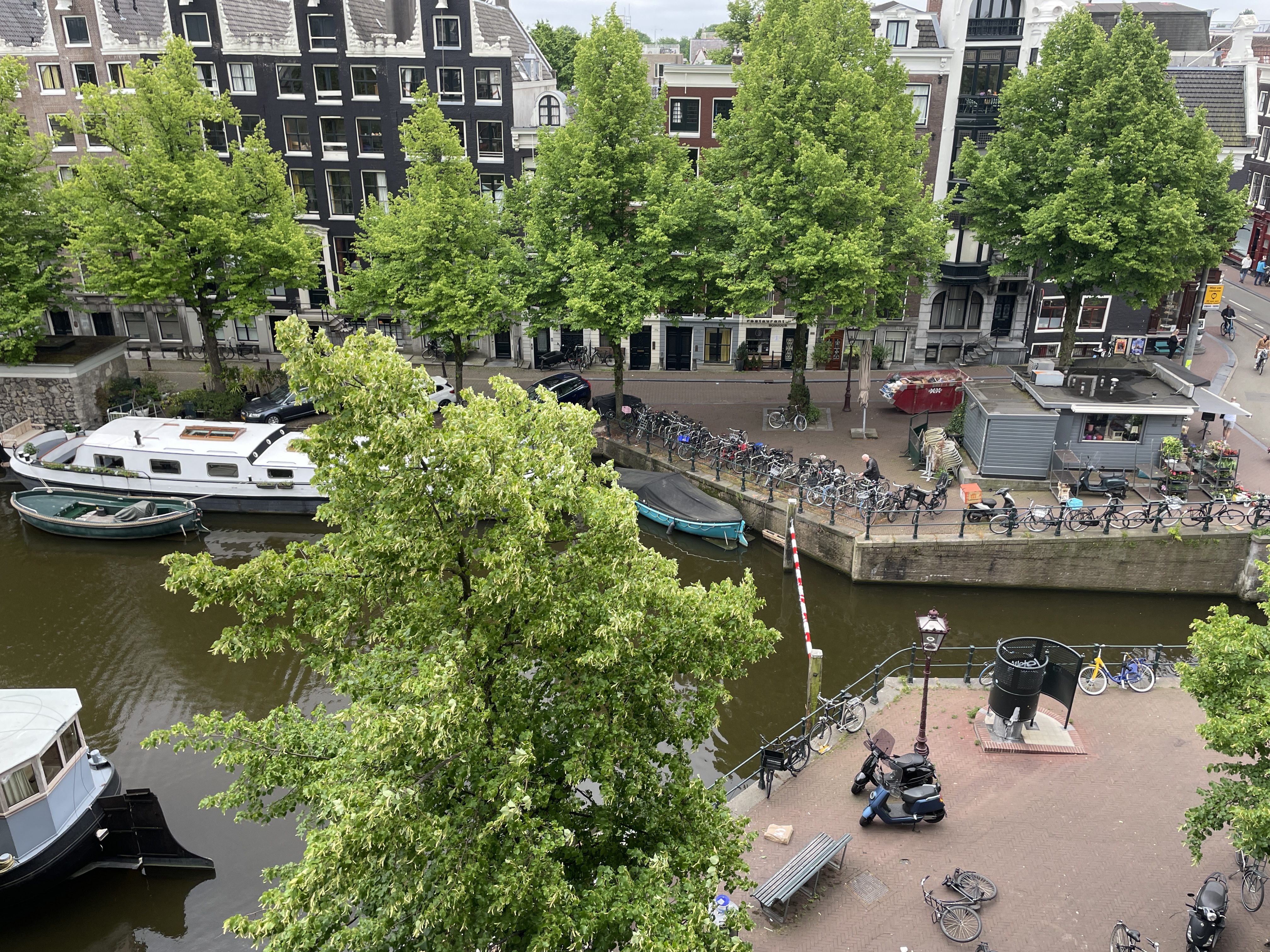
We rented electric bicycles for the journey from out hotel to the museum. Of course I had read about bicycle-friendly Amsterdam but seeing the sheer number of folks on bicycles was fantastic. Moms with children on their bicycles and riding beside them, a seemingly endless stream of bicycles up and down the bikes lanes that lined nearly every thoroughfare, along with a good number of electric bicycles of all types.
Rented electric bicycles near our hotel May 29, 2025.
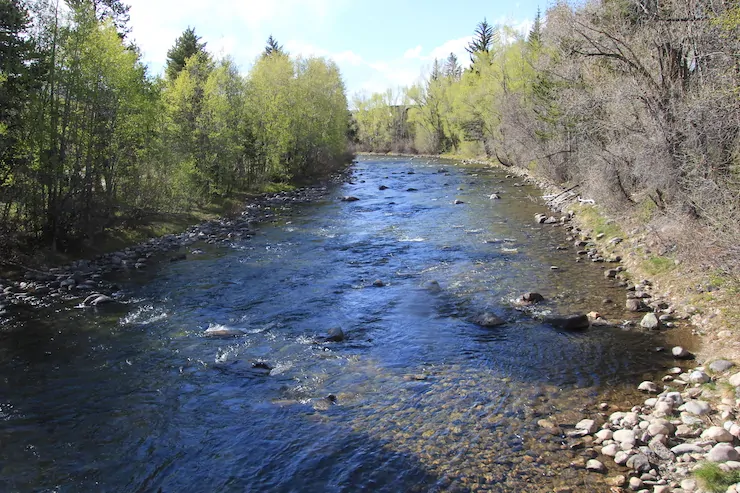
The Blue River flows through Silverthorne on May 22 on its way to the Colorado River. Photo/Allen Best
Click the link to read the article on the Big Pivots website (Allen Best):
May 29, 2025
Even-steven. That was the intent of delegates from the seven basin states in 1922 when they met near Santa Fe to forge a compact governing the Colorado River.
But what exactly did they agree upon? That has become a sticking point in 2025 as states have squared off about rules governing the river in the drought-afflicted and climate-changed 21st century. The negotiations between the states, according to many accounts, have been fraught with tensions. Becky Mitchell, Colorado’s lead negotiator, delivered a peek into that dispute at a forum on May 22 in Silverthorne along the headwaters of the river.
The Colorado River Compact was a quid pro quo. California, in particular, but also Arizona, was ready to see the highs and lows of the rivers smoothed out. They, as well as Nevada, wanted a giant reservoir in Boulder Canyon near the small town of Las Vegas, which then had a population of 2,300. Those Southwestern states couldn’t do it alone, though. They needed the federal government to build the dam later called Hoover. For that, they needed the support of Colorado and the three other upper-basin states.
Colorado, represented by Delph Carpenter, and the three other headwaters states realized that they had best reach a compromise, as they would more slowly develop the rivers. If the doctrine of prior appropriation that they had all adopted within their own states prevailed on the Colorado River, the water would be gone by the time they found need for it.
This was the foundation for Article III of the Colorado River Compact. It apportions 7.5 million acre-feet in perpetuity for the exclusive beneficial consumption by each of the two basins. On top of this 15 million acre-feet, they knew there would be water lost to evaporation, now calculated at 1.5 million acre-feet annually, plus some sort of delivery obligation to Mexico, which later turned out to be 1.5 million acre-feet.
In Santa Fe, delegates had assumed bounteous flows in the river, as had occurred in the years prior to their meeting. And so, embracing that short-term view of history, they believed the river would deliver 20 million acre-feet.
Source: Colorado River Water Conservation Board.
It has not done so routinely. Even when there was lots of water, during the 1990s and even before, as Eric Kuhn and John Fleck explained in their 2019 book, “Science be Dammed,” troubles ahead could be discerned. And by 1993, when the Central Arizona Project began hoisting water to Phoenix and Tucson, the river ceased absolutely to reach the ocean.
Then came the 21st century drought. Those framing the compact understood drought as a temporary affliction, not the multi-decade phenomenon now perplexing the states in the Colorado River Basin.
Nor did they contemplate a warming, drying climate called aridification. Similar to drought in effects, it is rooted in accumulating atmospheric gases. Unlike drought, it has little to no chance of breaking.
Now, faced with creating new rules governing the sharing of this river, delegates from the seven states are at odds in various ways, but perhaps none so much as in their interpretation of compact’s Article D. It says that the upper-division states “will not cause the flow of the river at Lee Ferry to be depleted below an aggregate of 75,000,000 acre-feet for any period of ten consecutive years.”
The lower division states have so far received 75 million acre-feet over every revolving 10-year period. The upper-basin states have not fully developed their apportionment, although Colorado has come close. In the last 25 years, the upper-basin states have been using 3.5 million to 4.5 million acre-feet. The lower-basin states that a decade ago were still using 10 million acre-feet have cut back their use to 7.5 million acre-feet.
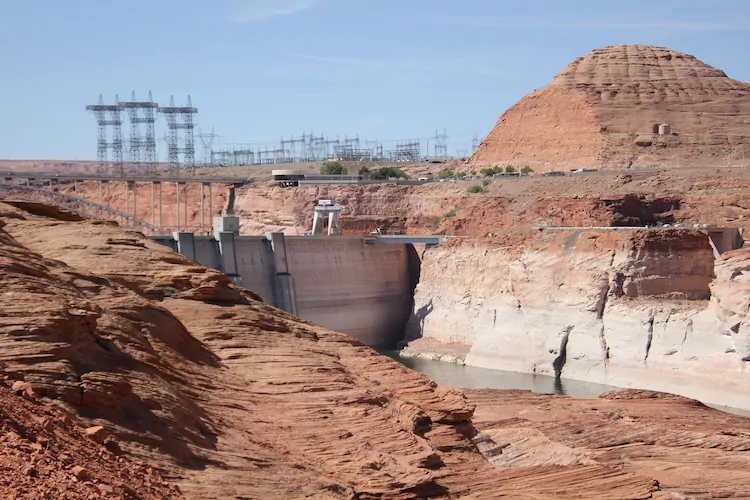
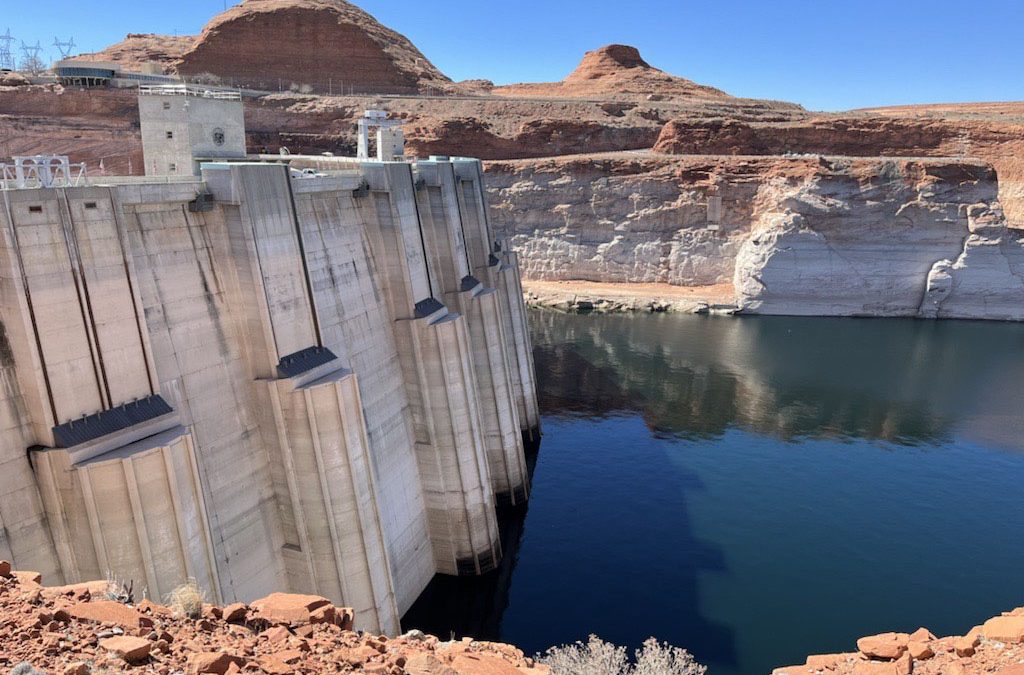
In May 2022, water levels at Glen Canyon Dam were dropping so rapidly as to make relevant discussions about potential loss of hydroelectricity. Photo credit: Allen Best/Big Pivots
Lake Powell serves as a water bank for the upper basin states. The storage in 2022 had declined to 22%, although a good snow winter in 2022-23 restored levels somewhat. Today, the two reservoirs are at a combined 34% of full.
“That means 66% empty,” said Mitchell at the forum along the Blue River in Silverthorne at a “state of the river” forum organized by the Colorado River Water Conservation District.
Mitchell, an engineer by training, has a large on-stage presence. She’s spunky, not one to mince words, sometimes straying into the colloquial. This outspokenness is more evident when she speaks exclusively to a home-town crowd. Silverthorne certainly counted as one.
Shared risk is at the heart of the dispute. Colorado and other upper-basin states want the lower-basin states to accept that the river will not always satisfy all needs.
“How do we handle drought? We know how to do that in the upper basin, and most of the people in this room know that you get less,” said Mitchell, Colorado’s representative on the Upper Colorado River Commission. “That hasn’t been the case in the lower basin.”
The two basins differ in three fundamental ways. One is the pace of development. The lower basin developed quickly. The upper basin still has not used its full allocation. From the upper-basin perspective, that does not mean that the lower-basins states should expect something beyond a 50-50 split.
“The main thing that we got from the compact was the principle of equity and the ability to develop at our own pace,” said Mitchell. “We shouldn’t be punished because we didn’t develop to a certain number. The conversation now, she added, is “what does equity look like right now?”
Another difference is that the upper basin has thousands of individual users. Sure, there are a few big ones, like Denver Water and the other Front Range transmountain water diverters who collectively draw 400,000 to 450,000 acre-feet annually across the Continental Divide. The lower basin has just a handful of diverters, and the diversions are massive.
Also different — as alluded to by Mitchell — is that the lower basin has the big reservoirs lying upstream. The largest is Mead, with a capacity of almost 29 million acre-feet, followed closely by Powell at a little more than 25 million acre-feet. Mead was created expressly to meet needs of irrigators and cities in the desert southwest.
Source: Colorado River Water Conservation Board.
Powell was created essentially to ensure that the upper-basin states could meet their delivery obligations. Mitchell shared a telling statistic: More water has been released from Powell in 8 of the last 10 years than has arrived into it.
Upper-basin states must live within that hydrologic reality, said Mitchell. If it’s a particularly bad snow year in the upper basin, the farms and ranches with junior water rights and even the cities can get shorted. The lower basin states? Not a problem. They always get their water — at least so far. But the two big reservoirs have together lost 50 million acre-feet of stored water.
“We’re negotiating how to move forward in a way different place than we were negotiating 20 years ago,” said Mitchell.
Upper-basin states have managed to deliver the 75 million acre-feet across 10 years that the compact specifies, but what exactly is the obligation? That has long been a gray area.
At a forum two days before Mitchell spoke in Colorado, her counterpart in Arizona, Tom Buschatzke, reiterated at a conference in Tucson that they see the compact spelling out a clear obligation of upper-basin states to deliver 75 million acre-feet plus one-half of the water obligated to Mexico.
What if the water isn’t there? That’s the crux of this dispute as the upper and lower basin states negotiate in advance of a September deadline set by the Bureau of Reclamation.
Denver Water sends diversions from the Ffaser River and other headwater tributaries through the Moffat Tunnel at Winter Park. Photo/Allen Best
In theory, if the situation were dire enough, Colorado could stop all its post-1922 diversions to allow the water to flow downstream. But is that what those gathered in Santa Fe in the shortening days of November 1922 had in mind?
Will lawsuits toss this into the court system for resolution? That process might take decades and, if it ended up at the Supreme Court, it might not yield a nuanced outcome. Mitchell didn’t address that directly, although she did say everybody on the river wants to avoid litigation.
The situation described by Mitchell and other upper-basin proponents is perhaps analogous to a divorce settlement. The settlement may call for a 50-50 split of all earnings between the partners, but what if one becomes destitute and has no money to pool?
Upper-basin states do have reservoirs to help buffer them from short-term droughts. Altogether, however, they don’t come close to matching the capacity of Powell.
Again, from the perspective of upper-basin states, California and Nevada have a sense of entitlement. Not that the upper basin states are angelic, said Mitchell. It’s because they have no choice.
“I say we use three to four million acre-feet less than our apportionment. It varies. You know why? Because hydrology varies. And so we respond to hydrology. It’s all based on snowpack and it’s all gravity. Most of it is gravity dependent. We don’t have those two big reservoirs above us like the lower basin does. We don’t have those reservoirs to equal out the flows or allow us to overuse. We have to live with variable hydrology, and we take cuts every single year.”
Upper-basin states want a willingness in this settlement for agreement that focuses on the water supply, not the demand. “Common sense would tell you, maybe Mother Nature should drive how we operate the system.” That, she said, is the bedrock principle of the proposal from the upper division.
With plentiful snowfall, greater releases from Powell might be possible, said Mitchell, and in times of extreme duress, water from Flaming Gore and perhaps the Blue Mesa and Navajo too. She said there might be room for greater conservation measures in the upper basin states.
But there must be “real work happening down in the lower basin,” she said.
The audience in Silverthorne was comprised of many “rookies” to the water world. Some who might have attended, those more knowledgeable about the negotiations, would have wanted more: What are the deal breakers; what are the red lines, what are the issues they intend to kick down the road?
As the session in Silverthorne neared its end, time remained for one last question, and I asked it:
“I have to wonder about who we have in the White House right now, and how the President might alter the negotiations on the Colorado River. Any thoughts you might be willing to share?
“No!” she barked back without hesitation. “Allen, you know better than that.”
I laughed heartily, and so did many others.
Given what we’ve seen since January, though, I must continue to wonder.
Postscript: Before her remarks in Silverthorne, Becky Mitchell offered the opportunity for an in-depth interview with Big Pivots sometime later in June. I intend to take up that offer.
Delph Carpenter’s original map showing a reservoir at Glen Canyon and one at Black Canyon via Greg Hobbs
The wet May pattern continued to alleviate or bring an end to drought across the Northeast. Severe to extreme drought persists for central to south Florida although locally heavy showers fell across the east-central Florida Peninsula as the rainy season begins to ramp up. Widespread precipitation (2 inches or more) supported improvements to the Central and Southern Great Plains. During recent weeks, drought developed across portions of southwestern Iowa, northern Illinois, and northwestern Indiana. Short-term drought expanded across the Pacific Northwest and intensified for southern Utah and northwestern Colorado during mid to late May. From May 20-26, above-normal temperatures were limited to the southern tier of the contiguous U.S. 7-day temperatures averaged 4 to 10 degrees F below normal across the Northeast, Corn Belt, and Northern to Central Great Plains. Alaska and Puerto Rico are drought-free, while drought of varying intensity continues for parts of Hawaii…
From May 24-26, widespread precipitation (1 to 3 inches, locally more) resulted in a 1-category improvement to portions of southwestern South Dakota, Nebraska, Kansas, and northeastern Colorado. Much cooler temperatures accompanied this widespread precipitation which contributed to topsoil moisture recharge. Based on multiple indicators such as the SPI at various time scales and soil moisture, severe (D2) to extreme (D3) drought was reduced in coverage across central to western Nebraska along with adjacent areas of southwestern South Dakota. Although precipitation was lighter across southeastern Colorado, SPIs at multiple time scales, soil moisture, and VegDri no longer support any D1. Southern Nebraska and northern Kansas missed out on this past week’s precipitation and a couple of small 1-category degradations were made. A 1-category degradation was also warranted for western Colorado based on 90 to 180-day SPI…
Colorado Drought Monitor one week change map ending May 27, 2025.
Based on 6-month SPI, water-year-to-date (October 1, 2024 to May 26, 2025) precipitation deficits, and 28-day average streamflow, moderate drought (D1) was expanded to include more of southwestern Washington. Increasing 30 to 90-day precipitation deficits, low 28-day average streamflows, and declining soil moisture led to the introduction of D1 to parts of northwestern and northeastern Oregon. The 6-month SPI supported the expansion of severe drought (D2) coverage across southwestern Utah. Although precipitation was light this past week, SPIs dating back 120 days along with more favorable soil moisture indicators led to improvements across southwestern and eastern Montana. Conversely, in northwest Montana, D1 was degraded to D2 based on 120-day SPI and declining soil moisture. To the east of the Sierra Nevada Mountains, abnormal dryness (D0) was expanded to the south of Lake Tahoe due to drier-than-normal conditions since April…
Heavy rainfall (2 inches or more) prompted a 1-category improvement to ongoing drought areas of south-central and southeastern Texas. Despite this recent heavy rainfall, levels in the long-term monitoring wells of Bexar and Medina Counties remain at all-time lows. In addition, many of the 28-day average USGS streamflows are below the 5th percentile, supporting the D3-D4 depiction. Since the SPIs dating back 6 months are neutral and considering the major impact is hydrological, the drought impact was changed to long-term only. With drought improvement for northwestern Oklahoma this past week, nearly all of Oklahoma and northern to eastern Texas are drought-free. The Lower Mississippi Valley and Tennessee Valley are also drought-free with surplus 30 to 90-day precipitation…
Looking Ahead
A low pressure system and trailing front are forecast to maintain the wet pattern along the East Coast with the Weather Prediction Center depicting 1 to 2 inches of precipitation from the Mid-Atlantic north to England through June 2. Much-needed precipitation (locally more than 1 inch) is expected for the Florida Peninsula. From May 29 to June 2, mostly dry weather is forecast across the Midwest. By June 2, a low pressure system is forecast to develop and bring another round of precipitation to the Northern and Central High Plains. Much above-normal temperatures and potential record heat are predicted to affect California and the Great Basin to end May.
The Climate Prediction Center’s 6-10 day outlook (valid June 3-7, 2025) favors above-normal precipitation for the Florida Peninsula, Middle to Upper Mississippi Valley, and Great Plains. The precipitation outlook leans towards above-normal precipitation for much of the West. Elevated below-normal precipitation probabilities are forecast across the Mid-Atlantic and Northeast. Alaska and Hawaii are favored to be on the wetter side during the first week of June. Above-normal temperatures are favored from the Mississippi Valley to the East Coast, while below-normal temperatures are more likely throughout the West and Alaska. A slight lean towards above-normal temperatures are forecast for most of Hawaii.
US Drought Monitor one week change map ending May 27, 2025.
We’re in Amsterdam. Day 6 was a travel day from Linz to Amsterdam via Vienna in the Danube Valley. Low hills and farms dominated the view. We enjoyed a wonderful dinner at the restaurant Ali Ocakbaşı in Amsterdam.
View from the Armada Hotel, Amsterdam, May 30, 2025.
In Sequoia and Kings Canyon National Parks in California, trees that have persisted through rain and shine for thousands of years are now facing multiple threats triggered by a changing climate.
Scientists and park managers once thought giant sequoia forests nearly impervious to stressors like wildfire, drought and pests. Yet, even very large trees are proving vulnerable, particularly when those stressors are amplified by rising temperatures and increasing weather extremes.
Nate Stephenson, from the U.S. Geological Survey, talks about the fire damage at Redwood Mountain Grove in the Kings Canyon National Park, Calif., in 2021. AP Photo/Gary Kazanjian
To protect these places, which are valued for their natural beauty and the benefits they provide for recreation, clean water and wildlife, forest and land managers increasingly must anticipate risks they have never seen before. And they must prepare for what those risks will mean for stewardship as ecosystems rapidly transform.
Traditional management approaches focus on maintaining or restoring how ecosystems looked and functioned historically.
However, that doesn’t always work when ecosystems are subjected to new and rapidly shifting conditions.
Ecosystems have many moving parts – plants, animals, fungi and microbes; and the soil, air and water in which they live – that interact with one another in complex ways.
When the climate changes, it’s like shifting the ground on which everything rests. The results can undermine the integrity of the system, leading to ecological changes that are hard to predict.
To plan for an uncertain future, natural resource managers need to consider many different ways changes in climate and ecosystems could affect their landscapes. Essentially, what scenarios are possible?
Preparing for multiple possibilities
At Sequoia and Kings Canyon, park managers were aware that climate change posed some big risks to the iconic trees under their care. More than a decade ago, they undertook a major effort to explore different scenarios that could play out in the future.
It’s a good thing they did, because some of the more extreme possibilities they imagined happened sooner than expected.
While these extreme events came as a surprise to many people, thinking through the possibilities ahead of time meant the park managers had already begun to take steps that proved beneficial. One example was prioritizing prescribed burns to remove undergrowth that could fuel hotter, more destructive fires.
The key to effective planning is a thoughtful consideration of a suite of strategies that are likely to succeed in the face of many different changes in climates and ecosystems. That involves thinking through wide-ranging potential outcomes to see how different strategies might fare under each scenario – including preparing for catastrophic possibilities, even those considered unlikely.
For example, prescribed burning may reduce risks from both catastrophic wildfire and drought by reducing the density of plant growth, whereas suppressing all fires could increase those risks in the long run.
Strategies undertaken today have consequences for decades to come. Managers need to have confidence that they are making good investments when they put limited resources toward actions like forest thinning, invasive species control, buying seeds or replanting trees. Scenarios can help inform those investment choices.
Constructing credible scenarios of ecological change to inform this type of planning requires considering the most important unknowns. Scenarios look not only at how the climate could change, but also how complex ecosystems could react and what surprises might lay beyond the horizon.
Scientists at the North Central Climate Adaptation Science Center are collaborating with managers in the Nebraska Sandhills to develop scenarios of future ecological change under different climate conditions, disturbance events like fires and extreme droughts, and land uses like grazing. Photos: T. Walz, M. Lavin, C. Helzer, O. Richmond, NPS (top to bottom)., CC BY
Key ingredients for crafting ecological scenarios
To provide some guidance to people tasked with managing these landscapes, we brought together a group of experts in ecology, climate science, and natural resource management from across universities and government agencies.
1. Embracing ecological uncertainty: Instead of banking on one “most likely” outcome for ecosystems in a changing climate, managers can better prepare by mapping out multiple possibilities. In Nebraska’s Sandhills, we are exploring how this mostly intact native prairie could transform, with outcomes as divergent as woodlands and open dunes.
2. Thinking in trajectories: It’s helpful to consider not just the outcomes, but also the potential pathways for getting there. Will ecological changes unfold gradually or all at once? By envisioning different pathways through which ecosystems might respond to climate change and other stressors, natural resource managers can identify critical moments where specific actions, such as removing tree seedlings encroaching into grasslands, can steer ecosystems toward a more desirable future.
3. Preparing for surprises: Planning for rare disasters or sudden species collapses helps managers respond nimbly when the unexpected strikes, such as a severe drought leading to widespread erosion. Being prepared for abrupt changes and having contingency plans can mean the difference between quickly helping an ecosystem recover and losing it entirely.
Over the past decade, access to climate model projections through easy-to-use websites has revolutionized resource managers’ ability to explore different scenarios of how the local climate might change.
What managers are missing today is similar access to ecological model projections and tools that can help them anticipate possible changes in ecosystems. To bridge this gap, we believe the scientific community should prioritize developing ecological projections and decision-support tools that can empower managers to plan for ecological uncertainty with greater confidence and foresight.
Ecological scenarios don’t eliminate uncertainty, but they can help to navigate it more effectively by identifying strategic actions to manage forests and other ecosystems.
Lorelei Cloud, Vice-chair of the Southern Ute Tribal Council, and Southwest Colorado’s representative of the Colorado Water Conservation Board, which addresses most water issues in Colorado. Photo via Sibley’s Rivers
The Colorado Water Conservation Board, Colorado’s top water policy agency, has a new leader: Southern Ute tribal member Lorelei Cloud.
The 15-member board sets water policy within the state, funds water projects statewide and works on issues related to watershed protection, stream restoration, flood mitigation and drought planning. On May 21, board members elected Cloud to serve a one-year term as chair, making her the first Indigenous person to hold the position since the board was formed in 1937.
Cloud said her new role gives Indigenous people a long-sought seat at the table where water decisions are made.
“This is history,” Cloud said during the meeting. “What a moment. What a great moment for the state of Colorado.”
In 2023, Gov. Jared Polis appointed Cloud for a three-year term, making her the first known tribal member to hold a seat on the board. Cloud also served as the board’s vice chair for a year starting in May 2024.
Part of the Colorado Water Conservation Board’s purpose is to protect Colorado’s water interests in dealings with other states, like the water sharing agreements among seven states in the Colorado River Basin.
She represents the San Miguel-Dolores-San Juan basin in southwestern Colorado, which is part of the larger Colorado River Basin, a key water source for about 40 million people across the West.
The Colorado River Basin’s water supply has been strained by over two decades of prolonged drought, rising temperatures and an unyielding demand for water.
The rules that govern how water is stored and released from the basin’s reservoirs are set to expire in 2026, leaving officials with the difficult task of negotiating a new set of management rules that will last for years to come.
The seven basin states have been at odds over how water should be managed in the basin’s driest possible conditions. Tribal officials have been working to ensure their priorities are considered in the high-stakes negotiations.
“This moment isn’t just about me or about the Indigenous people — it’s about all of the people in this room,” Cloud said, adding that the board is “making decisions that aren’t just about today. It’s about our future.”
Decision-makers in the Colorado River Basin have a history of excluding tribal nations that dates back to the 1922 Colorado River Compact.
The compact laid the foundation for how water is shared between the Upper Basin — Colorado, New Mexico, Wyoming and Utah — and the Lower Basin — Arizona, California and Nevada. The agreement includes one line about tribal water, and tribal nations were not involved in the negotiations.
Native America in the Colorado River Basin. Credit: USBR
Tribal water is a key issue in the basin: The 30 basin tribes have recognized rights to over 25% of the Colorado River’s average flow.
Cloud said her new role is “part of the reconciliation that we’ve all been waiting for as Indigenous people.”
“Having an Indigenous person in a position that makes water management decisions — it’s a seat at the table that we’ve been wanting for such a long time, and it’s finally here,” Cloud said. “It’s a joyous moment.”
Cloud has twice served as vice chairman of the Southern Ute Tribal Council. She has also held leadership positions in The Nature Conservancy Colorado, the Indigenous Women’s Leadership Network, the Ten Tribes Partnership, and the Water and Tribes Initiative.
As board chair, Cloud will run the meetings, ensure fair voting and represent the board as spokesperson when needed. She will continue to represent the southwestern basin, which reaches 10 counties and includes cities like Cortez, Durango and Telluride.
The Southern Ute Indian Tribe and the Ute Mountain Ute Tribe — the two federally recognized tribes with reservation land in Colorado — are also located in the southwestern basin.
“I’ve been lucky to witness Chair Cloud’s rise as a leader in the Colorado water community,” said Dan Gibbs, Department of Natural Resources executive director. “No one is more deserving or better positioned to chair the CWCB in this critical moment.”
The deck after the last cable car ride up to the “Top of Innsbruck” May 28, 2025.
Wednesday morning in Innsbruck we had the good fortune to go the the “Top of Innsbruck“. I’ve lived my entire life within sight of the Rocky Mountains and climbed many of them so today was a real treat. You take three separate cable cars to get to the last bit of a walk to the summit. Mountains show up in every direction from the top with the City of Innsbruck down below.
The City of Innsbruck from the “Top of Innsbruck” May 28, 2025.
GRACE TWS trend map. (a) The time series of nonseasonal GRACE/FO TWS (km3/year) over UCRB and LCRB for the period (4/2002–10/2024). (b) Spatial variation in TWS trends for the Colorado River Basin for the investigated period (mm/year) (c) Time series comparison of the change in storage ΔS/Δt derived from the water balance equation (Equation 1) and GRACE/FO. ΔS/Δt calculated from GRACE/FO TWS anomalies in km3. The light shading represents uncertainties.
New research based on satellite data shows the depletion of groundwater in the Colorado River Basin far exceeds losses from the river’s reservoirs.
Scientists say overpumping is leading to alarmingly rapid declines in groundwater at a time when climate change is putting growing strains on the Southwest’s water supplies.
Scientists at Arizona State University examined more than two decades of satellite measurements and found that since 2003 the quantity of groundwater depleted in the Colorado River Basin is comparable to the total capacity of Lake Mead, the nation’s largest reservoir. The researchers estimated that pumping from wells has drained about 34 cubic kilometers, or 28 million acre-feet, of groundwater in the watershed since 2003 — more than twice the amount of water that has been depleted from the river’s reservoirs during that time.
“The Colorado River Basin is losing groundwater at an alarming rate,” said Karem Abdelmohsen, the lead author and a researcher at ASU’s School of Sustainability.
[…]
Groundwater movement via the USGS
The losses are being driven largely by heavy pumping to supply agriculture, he said. At the same time, prolonged drought and rising temperatures have sapped river flows and decreased the amount of water percolating underground and recharging aquifers.
“As surface water becomes less dependable, the demand for groundwater is projected to rise significantly,” the researchers wrote in the study, which was published Tuesday in the journal Geophysical Research Letters. “Groundwater is a crucial buffer … but it is rapidly disappearing due to excessive extraction.”
I live in Jackson County, in northern Colorado, where hundreds of inactive and abandoned oil wells litter the landscape. Not only are they an ugly sight, they are also just a few of the estimated 2.6 million unplugged wells across the country that leak methane, benzene and other toxic substances.
The reality is that long after I’m gone, most or all of those wells will remain unplugged. The companies and people who once owned them will have been allowed to walk away from their responsibility to clean up their mess.
Uncapped wells are what happens when the federal government enables the fossil-fuel industry to dominate energy policies, as is happening again now, both in the Interior Department and Congress. The policies emerging would allow companies, including many foreign ones, to profit from public lands and minerals that all Americans own. They would also leave taxpayers holding the bag for cleaning up leaking wells.
These abandoned wells already have consequences for wildlife, air, water and rural people. Kirk Panasuk, a rancher in Bainville, Montana, said: “I have personally experienced serious health scares after breathing toxic fumes from oil and gas wells near my property. And I’ve seen too many of my friends and neighbors in this part of the country have their water contaminated or their land destroyed by rushed and reckless industrial projects.”
Republicans and Democrats in previous administrations and Congresses took pains to reform this historically biased federal energy system because of the damage done to rural communities and American taxpayers. Now, the federal government is rolling back those reforms.
Recently, the Interior Department announced that “emergency permitting procedures” were necessary when carrying out NEPA, the National Environmental Policy Act. Timelines for environmental assessments for fossil-fuel projects were changed from one year to 14 days, without requiring a public comment period. The timeline for more complicated environmental impact statements was cut from two years to 28 days, with only a 10-day public comment period.
In May, the House Natural Resources Committee unveiled its piece of the House budget bill, which enables the federal government to expedite oil, gas, coal and mineral development. It gives Americans basically no say on whether those projects should move ahead, while keeping taxpayers from receiving a fair return on the development of publicly owned lands and minerals.
Both the House bill—just passed and now before the Senate—and the Interior Department’s policies, ignore the long-standing mandate to manage public lands for multiple uses. Instead, the new policies:
Drastically reduce the public’s role in the permitting process.
Allow large corporations to pay to evade environmental and judicial review.
Exempt millions of acres of private lands with federal minerals and thousands of wells on these lands from federal permitting and mitigation requirements.
The House bill would also slash the royalty rate for oil and gas production from 16.67% to 12.5%, depriving state and local governments of funding they depend on for schools, roads and other essential services. An analysis by Resources for the Future found that the proposed lower royalty rates would result in a loss of nearly $5 billion in revenue over the next decade.
The Interior Department’s emergency permitting procedures and the House bill are assaults the federal government has waged on public lands since January. The public has been shoved to the side as oil and gas drillers enjoy their energy dominance throughout our public lands.
Barbara Vasquez. Photo credit: CWCB
Now, it’s up to the Senate to strip out these gifts to the fossil fuel industry, and it’s up to us tell our elected Senate representatives that these policies ignore the wishes of Westerners. We have told pollsters innumerable times that we support conservation, not exploitation of public lands for private interests. What’s happening now is radically wrong.
Barbara Vasquez is a contributor to Writers on the Range, writersontherange.org, an independent nonprofit dedicated to spurring lively conversation about the West. A retired PhD biomedical researcher and semiconductor engineer, she is board chair of the Western Organization of Resource Councils and a board member of the Western Colorado Alliance.
Atlas cedar University of Bern Botanical Garden May 27, 2025.
We’re in Innsbruck, Tyrol, Austria tonight after a beautiful drive over the Jura Mountains from Saint Claude. We stopped for souvenirs and had a nice conversation with a couple who had just re-opened the store. Hellchild scored a bottle of wine that the owner said required an educated taste and that he didn’t like when he first tried it at 18. His wife said, “Then he married a country girl!” Later we ate lunch in Bern (Quiche Lorraine) and stretched our legs with a walk around the University of Bern Botanical Garden and a little “botanizing”.
Northern Alps from the highway between Bern and Innsbruck May 27, 2025.
Heading east towards Zurich we got our first glimpse of the northern Alps.
Click the link to read the article on the InkStain website (John Fleck):
May 26, 2025
The Bureau of Reclamation has released its May 24-Month Study. It confirms that 2025 will be another very dry year and the consequences will be significant. Under the minimum probable forecast, active storage in Lake Powell will fall to an elevation of 3530’ (5.8 maf), only about 9 feet higher than the February 2023 low of 3521’ (5.3maf). Just as alarming, under the “most probable” scenario, 2027 is projected to be another year for a 7.48 maf release from Glen Canyon Dam. This means that the ten-year flows at Lee Ferry are projected to fall well below the 82.0 maf tripwire – the point at which the basin states’ disagreement over interpreting the Colorado River Compact’s Lee Ferry delivery/non-depletion requirement could trigger interstate litigation.
The May 1st “most probable” forecast for unregulated April to July inflow to Lake Powell was 3.5 maf, down from an April 1 st forecast of 4.3 maf. Since May 1st. However, the runoff forecast has continued to decline, down another ~400kaf as we write this (May 26, 2025). No one should be surprised if we end up with an actual inflow closer to the May 1st “minimum probable” forecast of 2.6 maf.
Even with continued crop fallowing programs, storage in Lake Mead also continues to decline, dropping to an elevation of 1047’ at the end of Water Year 2026 under the “most Probable” forecast and to elevation 1041’ under the “minimum probable” forecast.
cloudy forecast, part II
Lower Basin use continues to run well below long term averages, with this year’s consumptive use by Arizona, California, and Nevada forecast at 6.3maf, well below the legal paper water allocation of 7.5maf. Yet Mead keeps dropping. The latest analysis of total reservoir storage from our colleague and collaborator Jack Schmidt (here’s Jack and colleagues from March, with an update expected later this week) clearly shows that we are once again failing to rebuild reservoir storage. We’re draining the system.
Of course, the 2007 Interim Guidelines expire after 2026, so we do not know what the rules will be for Glen Canyon Dam releases in Water Year 2027. Lacking any better information, the Bureau of Reclamation has assumed a continuation of the 2007 Interim Guidelines rules. Another approach would be for the Bureau of Reclamation to assume that absent an agreement among the states, the Secretary of the Interior could return to an annual release of 8.23 maf from Glen Canyon as set by the 1970 Long-range Operating Criteria. And curiously, under the “minimum probable” scenario, assuming a continuation of the 2007 Interim Guidelines, the projected 2027 annual release at Glen Canyon Dam reverts to 8.23 maf. Under a quirk in the 2007 Interim Guidelines, if the December 31, 2026, projected elevation of Lake Powell is below 3525’ and the projected elevation of Lake Mead is below 1075,’ the release reverts to 8.23 maf. This was referred to as the “sacrifice Lake Powell to save Lake Mead” strategy (seriously!).
Unless the 2025-26 winter is very wet or the Basin States can find consensus, the choices facing the Basin are stark: sacrifice Lake Powell for Lake Mead and perhaps keep ten-year Lee Ferry flows above the tripwire (no guarantee) or reduce annual releases from Glen Canyon Dam to maintain a balanced but small amount of storage in both reservoirs, which risks pushing cumulative 10-year flows past Lee Ferry across the tripwire.
City walls with defending towers at Avignon. This is a view of the walls between the Porte de L’Oulle and the Porte du Rhône. The Petit Palais is just visible in the distance above the wall. By Henk Monster, CC BY 3.0, https://commons.wikimedia.org/w/index.php?curid=57881754
We’re in Saint-Claude, Bourgonne-Franche-comté, France after the drive from Avignon.
We drove around Avignon this morning checking out the walls of the Palais des Papes (Palace of the Popes). From Wikipedia: “The walls of Avignon (French: Les Remparts d’Avignon) are a series of defensive stone walls that surround the city of Avignon in the south of France. They were built in the 14th century during the Avignon papacy and have been continually rebuilt and repaired throughout their subsequent history…From the 1350s during the Hundred Years’ War the town became vulnerable to pillage by marauding bands of mercenaries and in 1357 under Innocent VI, the fifth Avignon pope, work began on the construction of a new set of city walls to enclose the expanded town. The walls took nearly 20 years to complete. The walls stretch for 4.3 km (2.7 mi) and enclose an area of 150 ha (370 acres). There were originally twelve gates controlling access to the city but this number was reduced to seven when the fortifications were modified between 1481 and 1487 during the French Wars of Religion. There are now 15 vehicular entrances and 11 pedestrian entrances…The town had always been subject to flooding by the Rhône. In November 1840 the river reached a height of 8.32 metres (27.3 ft), the highest that has ever been recorded. It caused severe flooding in the town with most streets under water. In some areas the water reached the first floor level of the houses. The flooding lasted for over three weeks and deposited large quantities of mud in the streets.Following this event the town decided to make better use of the town walls as a flood barrier and to install sluice gates on all the canals and drains. Each of the city gates was modified to facilitate the construction of a temporary cofferdam to prevent the river water entering the town. A pair of vertical slots were cut into the limestone blocks on either side of the opening. The slots were separated by a distance of between 0.5 m to 1 m and were designed to accommodate wooden planks which could be placed across the gate entrance. The gap between the sets of planks was filled with a mixture of earth and straw to create a dam.
From Wikipedia: “The Palais des Papes (English: Palace of the Popes; lo Palais dei Papas in Occitan) in Avignon, Southern France, is one of the largest and most important medievalGothic buildings in Europe. Once a fortress and palace, the papal residence was a seat of Western Christianity during the 14th century. Six papal conclaves were held in the Palais, leading to the elections of Benedict XII in 1334, Clement VI in 1342, Innocent VI in 1352, Urban V in 1362, Gregory XI in 1370 and Benedict XIII in 1394. The older area of Avignon is inside the walls and our hotel was located there.
Rows of trained Sycamores in Vienne May 26, 2025.
Coyote Gulch and Hellchild with the Rhone River in the background May 26, 2025 in Vienne.
The drive to Saint-Claude is up the Rhone Valley most of the way. Farms are everywhere, mountains in the distance most of the time. We stopped for lunch Vienne. From Wikipedia: “Vienne (French: [vjɛn]; Arpitan: Vièna) is a town in southeastern France, located 35 kilometres (22 mi) south of Lyon, at the confluence of the Gère and the Rhône. It is the fourth-largest commune in the Isèredepartment, of which it is a subprefecture alongside La Tour-du-Pin. Vienne was a major centre of the Roman Empire under the Latin name Vienna. Vienne was the capital of the Allobroges, a Gallic people, before its conquest by the Romans. Transformed into a Roman colony in 47 BC under Julius Caesar, it became a major urban centre, ideally located along the Rhône, then a major axis of communication. Emperor Augustus banished Herod the Great‘s son, the ethnarchHerod Archelaus to Vienne in 6 AD.
The view downriver (Bienne) from our hotel in Saint-Claude May 26, 2025.
From Wikipedia: “Saint-Claude (French pronunciation: [sɛ̃ klod]) is a commune and a sous-préfecture of the Juradepartment in the Bourgogne-Franche-Comtéregion in eastern France. It lies on the river Bienne…The town was originally named Saint-Oyand after Saint Eugendus. However, when St. Claudius had, in 690, resigned his Diocese of Besançon and died in 696 as twelfth abbot, the number of pilgrims who visited his grave was so great that, since the 13th century, the name “Saint-Claude” came more and more into use and has today superseded the other. It was the world capital of wooden smoking pipes crafted by hand from the mid 19th century to the mid 20th century. During WWII the town came under German occupation, yet still remained a haven for Jews escaping to Switzerland due to its proximity to it (about 8 km away, as the crow flies). As a punishment to the locals for consistently assisting and harbouring the fleeing Jews, the Nazis executed all of the town’s males of service age in the town centre.”
The view upriver (Bienne) from our hotel in
Saint-Claude May 26, 2025.
At its May Board meeting in Steamboat Springs this week, the Colorado Water Conservation Board (CWCB) elected Lorelei Cloud as Chair and Barbara Vasquez as Vice Chair.
“It’s a privilege to serve as the CWCB Director under the leadership of these two exceptional women,” said CWCB Director Lauren Ris. “I’m honored to support them as they step into these roles—and proud that this moment marks history. Chair Cloud is the first Indigenous person to lead Colorado’s state water board, and it’s powerful to see three women at the center of these important conversations.”
Lorelei Cloud. Photo credit: Allen Best/Big Pivots
Lorelei Cloud of the Southern Ute Reservation has served as CWCB Vice Chair for the past year and now succeeds Nathan Coombs as Chair. She represents the San Miguel–Dolores–San Juan drainage basin. Cloud also brings a wealth of experience in energy, water and leadership roles across the state and region. She is actively involved with the Water and Tribes Initiative, the Indigenous Women’s Leadership Network and has served on the Southern Ute Tribal Council as the Treasurer and Vice Chairman.
“Having an Indigenous person in a position to make decisions about water, having a seat at the table, is something we’ve been working toward for a long time,” said Chair Cloud. “This is a joyous moment. Colorado has always been a trailblazer, and this isn’t just about me—it’s about all of us. We’re here together, making decisions as a team, and I’m honored to be a part of this group.”
Barbara Vasquez. Photo credit: CWCB
Barbara Vasquez of Cowdrey, Colorado, will serve as Vice Chair. She represents the North Platte drainage basin and brings extensive experience in public land resource management and water issues. Vasquez has served on the Bureau of Land Management’s Northwest Colorado Resource Advisory Council and has been a representative on the North Platte Basin Roundtable since 2006.
“I look forward to supporting Chair Cloud and continuing to strengthen our partnerships across the state over the next year,” said Vice Chair Vasquez. “I’m committed to ensuring that the voices of rural communities and local water users are heard as we navigate the complex challenges ahead.”
“I couldn’t be more honored and excited to have Lorelei Cloud serving as the Chair of the Colorado Water Conservation Board and Barbara Vasquez as Vice Chair” said Dan Gibbs, Executive Director, Department of Natural Resources. “I’ve been lucky to witness Chair Cloud’s rise as a leader in the Colorado water community. No one is more deserving or better positioned to Chair the CWCB in this critical moment. Combined with Vice Chair Vasquez we are very fortunate to have CWCB members who are excellent representatives engaged in Colorado water policy.”
Cloud, Vasquez, and outgoing Chair Nathan Coombs were all appointed to the CWCB in March 2023 and have now each held leadership roles on the Board. Board Chair appointments are for one-year terms. The 15-member Board includes nine representatives from each major Colorado river basin as well as the Denver metropolitan area. Members are appointed by the Governor and confirmed by the Colorado State Senate. Collectively, they bring expertise in water resource management, engineering, law, finance, agriculture and more.
Grays and Torreys, Dillon Reservoir May 2017. Photo credit Greg Hobbs.
Click the link to read the article on the Summit Daily website (Ryan Spencer). Here’s an excerpt:
May 25, 2025
Both the Dillon Reservoir and the Green Mountain Reservoir are expected to reach capacity this summer, Colorado Division of Water Resources division engineer James Heath said at the State of the River in Silverthorne on Thursday, May 22…An about-normal snowpack in Summit County this winter means both reservoirs are expected to “fill and potentially spill,” Heath said. While the snowpack levels were close to normal, the runoff has been slightly below normal because the county went into last winter with dry soils, he said…
The snowpack in the Colorado River Headwaters Basin peaked April 7, about a week earlier than normal, Heath said. At 89% of the 30-year-median…The Blue River Basin [peaked] April 8, at 108% of the 30-year-median, Heath said…
.Dillon Reservoir should reach an elevation of 9,012 feet by June 18, allowing both the Dillon and Frisco marinas to be fully operational by that time. Outflows…should exceed 500 cubic feet per second — the level ideal for rafting the Blue River — around the third week in June and continue until around the Fourth of July weekend, he said.
Green Mountain Reservoir. Photo credit: Colorado Parks & Wildlife
When President Donald Trump took office earlier this year, climate advocates were confident that while the federal government would certainly no longer be tackling the issue of climate change, states wouldhelp pick up some of the slack. There was a sense of hope in that — at least some of this vital work would continue. This prospect has recently been put into question, because the Trump administration is now trying to prevent states from doing much of anything to limit the impacts of climate change.
The Department of Justice is currently suing the states of New York and Vermont to stop them from enforcing laws passed last year that would make fossil fuel companies liable for some of the costs of dealing with climate change. It is also suingHawaii and Michigan over their climate-related lawsuits against fossil fuel companies. Finally, the Trump administration is working to end California’s stringent motor vehicle emissions standards and its cap-and-trade program. (Republicans in the Senate recently moved to end Califonria’s vehicle emission standards.)…The first set of lawsuits pertain to climate “superfund” laws. These are laws based on legislation passed in the 1980s that forced chemical and petroleum companies to pay for the cleanup of hazardous waste. In this scenario, the idea is to force fossil fuel companies to pay for the costs of the damaging effects of climate change. New York and Vermont passed climate superfund laws last year. Numerous states — from Maine to Tennessee — have expressed interest in passing laws like these in recent years…
“They’re going to try to impose some liability — some fees — on these companies as a way of forcing them to internalize the cost of past activities,” Rachel Rothschild, an assistant professor of law at the University of Michigan and an expert on superfunds, tells Rolling Stone. “The companies that would be deemed responsible parties under the bills are those companies that have produced, extracted or sold fossil fuel products above a certain threshold during the time period that the bills are going to impose this retroactive liability.”
[…]
Rothschild says it’s “pretty unprecedented” for the federal government to file lawsuits to block this kind of environmental legislation and that states have historically had the authority to address environmental issues that affect public health. These laws are only just starting to be implemented, so it’s also quite early to be filing lawsuits against them.
“This seems to be part of a larger effort to not only do nothing when it comes to climate change but to actively dismantle the climate science and climate accountability enterprise that is being built in response to the costs of climate change that are manifesting in everyone’s daily lives,” says Justin Mankin, a climate scientist at Dartmouth College. “These costs from climate change — we are just beginning to confront them, and they are astounding.”
Crossed the Rhone River and now we’re in Avignon, Vaucluse, France for the night in a cool hotel in the old part of the city. It looked like we were driving into a castle on the way here. I’ll know better tomorrow when it is light out. The hotel is very old school, including steep winding steps up two floors to the rooms ,with no parking, so the vehicle in on the street a couple of blocks away.
La Sagrada Família Cathedral, Barcelona.
We spent some time this morning and into the afternoon in Barcelona checking out La Sagrada Família Cathedral, purchasing some souvenirs (I got an FC Barcelona hat), and dining on paella. As we approached Figueres Hellchild noticed a sign for the Salvador Dali Museum. While not on the official Coyote Gulch travel plan she insisted on stopping and a few hours later we were back on the road. What a fine experience.
“It’s so imspirational and hopeful knowing that someone can create so much beauty” — Hellchild
The year is off to a warm and dry start, even with some welcome moisture in May. Snowpack across the Gunnison River basin is well below the median at 44% (May 20, 2025) and April was unusually warm.
Dive into the details in our latest climate update, with a focus on the winter that in some ways wasn’t.
Temperatures
In western Colorado April was a month with above average temperatures. For most of Delta county it was the top 20 warmest April’s since 1895.
In fact, many places across Colorado had record-setting temperatures on April 13th, 2025. This excerpt from the Colorado Climate Center explains more about this event:
Snowpack
Warm temperatures contributed to early snowpack melt throughout April, and below-average precipitation did little to replenish the losses. All CO basins finished the month with snowpack below the 1991-2020 median levels, but the situation continues to be most dire across the state’s southernmost river basins, foreshadowing a challenging summer for water supply. The Gunnison river basin is at 31% snow water equivalent as of May 15, 2025.
Gunnison River Basin Reservoir Levels
The major reservoir for the Gunnison River Basin, Blue Mesa, is currently just above average for this time of year. This is a recovery from the record low capacity of 30% in 2021.
Lake Powell and Lake Mead are still at the low capacity of just 10%. According to the Colorado Basin River Forecast Center, runoff into Lake Powell is expected to be just 67% of normal, or 4.3 million acre-feet.
Snow Water Equivalent Gunnison River
The Snow water equivalent for the Gunnison and the North Fork of the Gunnison are unusually low and we have had an early snow melt. A dry winter and warm April have contributed to the low water conditions.
Snow water equivalent for the Gunnison River
Colorado Drought Monitor map May 20, 2025.
Drought conditions worsened throughout April and May for most parts of the state. Along the West Slope, a new area of D3 (extreme drought) was introduced across Mesa, Delta, and Montrose counties. As of May 13, ~44% of the state is experiencing drought conditions (up from 31% at the beginning of April).
Weather predictions for the Summer
With all this early snow melt and hot spring temperatures, what can we expect for the Summer?
“Looking farther out, there is a mix of good and bad news. NOAA’s Climate Prediction Center just released their latest monthly and seasonal outlooks. The outlook for June is for hotter and drier than average conditions across Colorado, and if that is what happens, it will only worsen the drought in the state. But the outlook for July through September hints at an active North American Monsoon season in the southwestern US”. – Russ Schumacher from the Colorado Climate Center
“Naturally, there is a lot of concern for the wildfire potential when we see such low snowpack and growing drought across Colorado, as drought years are when we have also seen intense wildfires. The drought situation this year is not looking quite as bad as 2002, 2012, or 2018, which were all extremely active wildfire years—but it’s at least in the same conversation. A hot and dry June would increase the wildfire risk, as mid-late June is when we saw big wildfires in these years. But if the monsoon is active, that can help to keep the fire season shorter. Predictions of the monsoon a few months in advance always have a lot of uncertainty, but we can keep a little hope that well-timed summer rains might keep the wildfire risk down” — Russ Schumacher from the Colorado Climate Center
Let’s hope for rain in the summer and a good monsoon year. But we need to start adapting to these low water conditions now. Mulch your plants, plant drought-tolerant species, use shade covers, plant fast-ripening plant varieties, and do anything else you need to do to prepare for the irrigation water to run out early this year.
Right now, Congress is working on a giant, fast-track bill that would make historic cuts to basic needs programs to finance another round of tax breaks for the wealthy and big corporations.
As the Communications and Policy Director for the Rural Democracy Initiative, I’ve been hearing from rural leaders across the country about the devastating impacts this bill would have.
The good news is it’s not too late. But there’s little time to spare.
This dangerous, unpopular bill would increase costs for rural working families by thousands of dollars per year, leaving millions hungry and without health care — all to provide tax breaks and handouts to the wealthy and special interests.
Here are just six of the worst provisions.
1. It guts rural healthcare.
The bill would drastically cut Medicaid and impose new barriers to care. It would take healthcare away from 13.8 million Americans and increase the cost for millions more. In some states, 50 percent of rural children get healthcare from Medicaid. Millions more rely on access to clinics and hospitals that would likely close because of these cuts.
2. It takes food off the tables of rural people.
The plan includes approximately $290-$319 billion in cuts to SNAP (the Supplemental Nutrition Assistance Program, formerly known as food stamps) even as the cost of groceries continues to escalate. More than 15 percent of families in small towns and rural areas rely on this support to feed their families.
3. It shifts costs to states and local governments.
State and local governments in rural areas depend more on federal funding from programs like SNAP and Medicaid than other states. Slashing federal funding to states would create new burdens for rural states that are already struggling to provide critical public services like health care, transportation, and emergency response services to local communities.
4. It takes away local control.
Landowners have fought to stop the use of eminent domain for carbon pipelines by passing bans and moratoria, as well as enacting county setbacks and safety requirements to protect their communities.
But this bill would overrule state and local laws and ordinances, override local voices, and deprive residents of a fair opportunity to evaluate the adverse impacts of pipelines. It also sets up a “pay to play” system under which companies can simply pay for pipeline, mining, and drilling permits — and avoid public comment and legal challenges.
5. It ends clean energy and infrastructure funding.
The bill would phase out existing tax credits for wind, solar, batteries, geothermal, clean energy, and advanced manufacturing. It would also take away $262 million in funding for energy efficiency and conservation grants as well as transportation infrastructure.
Ending these tax credits will increase household energy costs, which are already higher in many rural communities. These changes would also reduce new clean energy projects — and jeopardize billions in rural investments in clean energy manufacturing.
6. It gives handouts to agribusiness and mega farms.
Leaders in Congress are using the budget reconciliation process to give big farms a $50 billion windfall. Add the heightened pressures and instability caused by the Trump administration’s erratic trade policy and more family farmers would lose their farms — while Big Ag consolidates more of the market.
In short, this bill would make it harder for rural people to meet their basic needs — all so the wealthy and corporations can avoid paying their fair share of taxes like the rest of us do.
Lawmakers have already heard from the giant corporations who helped write the bill. Now, they need to hear from the rest of us. It’s up to us to alert our communities and tell our lawmakers: Don’t sell rural America out to big corporations and the wealthy.
Drought is starting to creep back into Utah on the heels of an average winter, with long-term forecasts pointing to an abnormally hot summer.
According to the three month seasonal outlook from the National Weather Service, the Beehive State is expected to have above average temperatures through August. Meanwhile, the service says it’s unclear whether there will be above or below average precipitation this summer — according to its models, there’s an equal chance of both.
“Hotter doesn’t always mean drier. We are right now showing for most of the state at about equal chances of average precipitation,” said Joel Williams, deputy director of the Utah Division of Water Resources, speaking to lawmakers earlier this week.
Those three month outlooks are not an exact science — but they do come amid increasingly bleak water conditions for much of the state. Despite an average snow year for northern Utah, the southern regions had a “dismal” winter, Williams said.
Westwide SNOTEL basin-filled map May 22, 2025 via the NRCS.
The snowpack for some basins in the southwest veered into unprecedented territory this winter and according to the Natural Resource Conservation Service, much of southern Utah remained below 45% of normal moisture.
Utah Drought Monitor May 20, 2025.
And across the state, drought is starting to rear its head again after two good years. This time last year, about 25% of the state was considered abnormally dry, while just 0.2% was in moderate drought — now, 39% of Utah is in severe drought, with 3% in extreme drought, according to data from the U.S. Drought Monitor.
Just the high elevation areas of Utah, Salt Lake, Wasatch, Summit and Morgan counties, and a sliver of Box Elder County, are in the clear. The rest of the state is facing at least abnormally dry conditions.
Most of Washington County is in extreme drought, extending into parts of Iron County. And Tooele, Juab, Millard, Beaver, Iron, Kane, Garfield, San Juan, Grand and Uintah counties all have areas in severe drought.
“The last two years of above average snowpack helped us but now we’re starting to see the drought creep back in. And as we say in Utah, we’re either in drought or preparing for the next one,” Williams said.
Eligible farmers can apply for seven-year loans of up to $100,000 each, with two years of no interest and 2.75% interest thereafter, according to the department. Applications for the loans will be accepted until Oct. 23.
The good news, Williams said, is Utah’s reservoirs are in healthy shape. Across the state, reservoir levels are about 20% higher than normal, with nearly every reservoir in northern Utah above 80% capacity. Utah Lake, Strawberry, Jordanelle, Deer Creek, Rockport, Smith and Morehouse, Pineview and Starvation reservoirs are all around 95% or higher.
“Those full reservoirs that we have, those could really help us if we’re heading into another drought,” said Williams.
Glen Canyon Dam during high flow experimental release about a decade ago. These occasional releases are just about the only time the river outlet works (where water is gushing out above) operate. Photo credit: Jonathan P. Thompson/The Land Desk
Click the link to read the article on the AZCentral webiste (Brandon Loomis). Here’s an excerpt:
May 23, 2025
Story Summary
Federal officials have confirmed that they will not flood the Grand Canyon this spring, citing ongoing work on Glen Canyon Dam and in the Colorado River downstream.
Colorado River advocates say failing to flood the Canyon will hurt efforts to restore beaches and preserve the environment below Glen Canyon Dam.
Some river advocates say the government’s decision may run afoul of the Grand Canyon Protection Act, which requires the feds to preserve ecological and recreational aspects of the Canyon.
Federal officials have rejected a plan to release floodwaters from Lake Powell to restore Grand Canyon beaches this spring, frustrating river advocates who question the government’s commitment to protecting the canyon’s environment…With repeated decisions not to open the floodgates even when the sand is available, some are questioning whether the Glen Canyon Dam Adaptive Management Program is preserving Grand Canyon’s ecology and recreation as required under the Grand Canyon Protection Act of 1992…
“We are failing,” said Ben Reeder, a Utah-based river guide who represents the Grand Canyon River Guides on a technical work group that considers management options for the Reclamation Bureau.
Reclamation officials said in April that they would recommend that new Interior Secretary Doug Burgum not authorize the flood because a National Park Service contractor was excavating in a slough downstream of the dam to disrupt its use as a spawning bed by non-native fish, including smallmouth bass. Work on relining the bypass tubes to protect their steel pipes also interfered…The floods cost perhaps $1 million or $2 million in lost hydroelectric production, according to Leslie James, who represents mostly rural and tribal power consumers in the program as executive director of the Colorado River Energy Distributors Association. Last year, when there was no major flood but the dam managers regularly pulsed cold water through the bypass tubes to keep the river inhospitable to bass spawning, the agency said the cost in lost power production was $19 million. The losses deplete a fund that pays for dam maintenance and environmental programs, James noted, and drawing more from that fund this year could cause delays in maintenance.
This historical photo shows the penstocks of the Shoshone power plant above the Colorado River. A coalition led by the Colorado River District is seeking to purchase the water rights associated with the plant. Credit: Library of Congress photo
Denver, Aurora, Colorado Springs and Northern Water voiced opposition Wednesday to the Western Slope’s proposal to spend $99 million to buy historic water rights on the Colorado River.
The Colorado River Water Conservation District has been working for years to buy the water rights tied to Shoshone Power Plant, a small, easy-to-miss hydropower plant off Interstate 70 east of Glenwood Springs. The highly coveted water rights are some of the largest and oldest on the Colorado River in Colorado.
The Front Range providers are concerned that any change to the water rights could impact water supplies for millions of people in cities, farmers, industrial users and more. The Front Range providers publicly voiced their concerns, some for the first time, at a meeting of the Colorado Water Conservation Board, a state water policy agency.
The proposed purchase taps into a decades-old water conflict in Colorado: Most of the state’s water flows west of the Continental Divide; most of the population lives to the east; and water users are left to battle over how to share it.
“If this proposal were to go forward as presented in the application, it could harm our ability to provide water for essential use during severe or prolonged drought. I think it’s important for the board to understand that,” Jessica Brody, an attorney for Denver Water, told the 15-member board Wednesday.
Denver Water, the oldest and largest water provider in Colorado, delivers water to 1.5 million residents in the Denver area.
The Colorado River District, which represents 15 Colorado counties west of the Continental Divide, wants to keep the status quo permanently to support river-dependent Western Slope economies without harming other water users, district officials said.
The overstressed and drought-plagued river is a vital water source for about 40 million people across the West and northern Mexico.
“That right is so important to keeping the Colorado River alive,” Andy Mueller, Colorado River District general manager, said during the meeting’s public comment period. “This is a right that will save this river from now into eternity … and that’s why this is so important.”
Over 70 people, nearly twice the usual audience, attended the four-hour Shoshone discussion Wednesday, which involved 561 pages of documents, over 20 speakers and a public comment period.
The Western Slope aims to make history
The water rights in question, owned by Public Service Company of Colorado, a subsidiary of Xcel, are some of the most powerful on the Colorado River in Colorado.
Using the rights, the utility can take water out of the river, send it through hydropower turbines, and spit it back into the river about 2.4 miles downstream.
One right is old, dating back to 1905, which means it can cut off water to younger — or junior — upstream water users to ensure it gets its share of the river in times of shortage. Some of those junior water rights are owned by Denver Water, Aurora, Colorado Springs Utilities and Northern Water.
The rights are also tied to numerous, carefully negotiated agreements that dictate how water flows across both western and eastern Colorado.
Bicycling the Colorado National Monument, Grand Valley in the distance via Colorado.com
Over time, Western Slope communities have come to rely on Shoshone’s rights to pull water to their area to benefit farmers, ranchers, river companies, communities and more.
The Colorado River District wants to buy the rights to ensure that westward flow of water will continue even if Xcel shuts down Shoshone (which the utility has said, repeatedly, it has no plans to do).
They’ve gathered millions of dollars from a broad coalition of communities, irrigators and other water users. The state of Colorado plans to give $20 million to help fund the effort.
Supporters sent over 50 letters to the Colorado Water Conservation Board before Wednesday’s meeting.
“I wanted to just convey the excitement that the river district and our 30 partners have, here on the West Slope, to really do something that is available once in a generation,” Mueller said.
The Front Range water providers all said they, too, wanted to maintain those status quo flows. They just don’t want to see any changes to the timing, amount or location of where they get their supplies.
Under the district’s proposal, the state would be able to use Shoshone’s senior water rights to keep water in the Colorado River for ecosystem health when the power plant isn’t in use.
The Colorado Water Conservation Board is tasked with deciding whether it will accept the district’s proposal for an environmental use. The meeting Wednesday triggered a 120-day decision making process.
“Any change to the rights will have impacts both intended and unintended, and it is important for the board to understand those impacts to avoid harm to existing water users,” Brody said.
The water provider plans to contest the Colorado River District’s plan within that 120-day period.
How much water is at stake?
The Front Range providers voiced another concern: The River District’s proposal could be inflating Shoshone’s past water use.
Water rights come with upper limits on how much water can be used. It’s a key part of how water is managed in Colorado: Setting a limit ensures one person isn’t using too much water to the detriment of other users.
For those who have a stake in Shoshone’s water rights — which includes much of Colorado — it’s a number to fight over.
The River District did an initial historical analysis, which calculated that Shoshone used 844,644 acre-feet on average per year between 1975 and 2003. One acre-foot of water supplies two to three households for a year.
Denver Water said the analysis ignored the last 20 years of Shoshone operations. Colorado Springs, Northern Water and Aurora questioned the district’s math. Northern was the first provider to do so publicly in August.
“We think the instream flow is expanded from its original historic use by up to 36%,” said Alex Davis, Aurora Water’s assistant general manager of water supply and demand.
She requested the board do its own study of Shoshone’s historical water use instead of accepting the River District’s analysis — which would mean the state agency would side with one side of the state, the Western Slope, against the other, Davis said.
The River District emphasized that its analysis was preliminary. The final analysis will be decided during a multiyear water court process, which is the next step if the state decides to accept the instream flow application.
Water court can be contentious and costly, Davis said.
“This could be incredibly divisive if we have to battle it out in water court, and we don’t want to do that,” Davis said.
Due to decreased water flow from Stagecoach Reservoir, Colorado Parks and Wildlife (CPW) will implement a mandatory full-day fishing closure on a 0.6-mile stretch of the Yampa River between the dam at Stagecoach State Park downstream to the lowermost park boundary.
To avoid and minimize fish mortality within this tailwater fishery, a closure will take effect beginning Monday, May 19, until further notice.
“We are trying to be proactive in protecting the outstanding catch-and-release fishery we have downstream of Stagecoach Reservoir,” said Marisa Eley, CPW Steamboat Springs Area Aquatic Biologist. “This closure is an effort to protect the resource by giving the fish a bit of a reprieve as they are prone to increased stressors related to these low-flow conditions.”
When water flows are minimal, fish become concentrated in residual pool habitat and become stressed due to increased competition for food resources. The fish become much easier targets for anglers, an added stressor that can result in increased hooking mortality.
CPW works closely with the Upper Yampa Water Conservancy District (UYWCD), which owns and operates Stagecoach Reservoir, to stay informed on reservoir releases.
“We are grateful for our partnership with UYWCD,” said Stagecoach State Park Manager Craig Preston. “Their dedication to keeping us updated on water flows in and out of the reservoir greatly contributes to protecting this unique fishery for current and future generations.”
“We will continue to closely monitor the inflow at Stagecoach Reservoir,” said Andy Rossi, UYWCD General Manager. “If we see increased inflow, we can respond quickly to adjust outflow and work with CPW to determine if the closure could be lifted.”
Like many rivers and streams in Western Colorado, the Yampa River offers world-class fishing and attracts thousands of anglers every year.
For more information or current fishing conditions at Stagecoach State Park, call 970-736-2436.
For more information about fishing in Colorado, including current fishing conditions and alternative places to fish, visit the CPW website.
The Northern Integrated Supply Project, currently estimated at $2 billion, would create two new reservoirs and a system of pipelines to capture more drinking water for 15 community water suppliers. An environmental group is now suing the Army Corps of Engineers over a key permit for Northern Water’s proposal. (Save the Poudre lawsuit, from Northern Water project pages)
You might have read recently about how the Northern Integrated Supply Project, or NISP, is contributing $100 million to a fund for projects to improve the Cache la Poudre River in northeastern Colorado. That funding is part of an agreement between the Northern Colorado Water Conservancy District, known as Northern Water, and the nonprofit group Save the Poudre that will conclude a federal lawsuit against the project.
It’s an outcome that both sides can accept because of the importance of both the Poudre River and a much-needed water supply to communities throughout the region.
The agreement should catch the attention of Denver metro-area water providers that are looking to export existing irrigation water supplies out of northeastern Colorado to serve their future customers.
Brad Wind of Loveland is the general manager of Northern Water, which supplies water to more than 1 million people in northeastern Colorado.
For background, NISP was conceived in the 1990s and early 2000s to provide water to the emerging communities of the northern Front Range. The project will consist of two off-channel reservoirs, one located northwest of Fort Collins and one north of Greeley. It also anticipates exchanges of water with nearby farmers eliminating the dry-up of some agricultural land in the future.
Throughout the lengthy permitting process for NISP, the public has had many opportunities to offer comments and concerns to federal, state and local officials. Some of the concerns were incorporated into mitigation and improvement requirements associated with the project, and all written comments were addressed specifically in the final Environmental Impact Statement produced by the U.S. Army Corps of Engineers.
The $100 million settlement of the federal litigation identifies even more improvements that can be made in the region beyond those required by permitting agencies.
Unfortunately, actions by certain Denver metro-area water providers that anticipate removing water from northeastern Colorado do not undergo such robust scrutiny. Oftentimes, advocates for water resources in the region learn about potential water transfers only when an item appears on a meeting agenda of a metro-area water provider. By then it is too late to consider the regional economic, environmental and social impacts that such a change could produce.
Frequently, these water deals are brokered by third parties who quietly accumulate water and land assets to present them behind closed doors in neat and tidy packages to thirsty cities. There are few, if any, opportunities to discuss how these water transfers will impact local communities in northeastern Colorado or how these impacts could be mitigated by those who seek to move water to the Denver metro area.
The half-million residents who receive water from NISP participants are going to pay billions of dollars to develop water resources for their communities while addressing concerns in the Poudre River watershed. At the same time Denver metro communities are working to undercut the existing supplies that previous northeastern Colorado residents have invested in and relied upon for decades.
Water providers in the Denver area need to be part of the long-term solution to how our northeastern Colorado communities remain vibrant, not distant parties to single point-in-time transactions that provide a perpetual benefit to communities beyond the horizon.
If native water supplies must depart for the Denver metro area from northeastern Colorado, it is appropriate that the new water user should not just pay for the costs to acquire water but also offset the impacts to northeastern Colorado’s degraded quality of life, and diminished regional economy.
All of our futures are diminished by the loss of water from our region. Public processes and mitigation can lessen, to a degree, the perpetual impacts such a loss will endure.
This week, widespread precipitation impacted much of the U.S., with heavier amounts (exceeding 1 inch) observed from the northern Rockies eastward to the East Coast, and in portions of the Pacific Northwest, Hawaii, and southern Alaska. Specifically, much of the High Plains reported 2 to 10 inches of rain, while similar totals (2 to 8 inches) were seen across parts of the South, Midwest, and along the East Coast. This above-normal precipitation supported drought improvements across large portions of the High Plains and Northeast, parts of the Midwest and Southeast, and smaller pockets of the West and South. Conversely, below-normal weekly precipitation occurred in parts of the western U.S., the Midwest, and Southeast, leading to the expansion or intensification of drought and abnormal dryness in western High Plains, eastern West, and parts of the Midwest and Southeast. Temperatures were above normal across much of the U.S. this week. The southern U.S., from Texas to Mississippi, saw temperatures up to 10 degrees F above normal. In contrast, below-normal temperatures, with departures up to 10 degrees F below normal, were observed across much of the West and western High Plains, with the largest departures noted in the Dakotas and interior West…
Temperatures varied across the High Plains this week, with departures ranging up to 8 degrees F above normal, while cooler-than-normal temperatures were observed along the western and northern portions of the region. Heavy precipitation fell across much of the region this week, with areas from North Dakota to northern Nebraska reporting weekly precipitation totals between 400% to 600% above normal. These beneficial rains (2 to 8 inches above normal) justified widespread moderate to extreme drought (D1-D3) improvements in the Dakotas and Nebraska. Additionally, improvements of moderate to severe drought (D1-D2) and abnormal dryness (D0) occurred in northern Wyoming and eastern Kansas, where rainfall amounts were up to 3 inches above normal for the week. Conversely, dry conditions resulted in the expansion of extreme drought (D3) in southwest Nebraska and western Wyoming, while severe (D2) and moderate drought (D1) expanded in southern Wyoming and Colorado. Abnormal dryness was also expanded in eastern Colorado this week…
Colorado Drought Monitor one week change map ending May 20, 2025.
Cooler temperatures dominated the West this week, with departures ranging between 1 to 10 degrees F below normal. Much of the interior West experienced temperatures between 4 to 10 degrees below normal. In contrast, above-normal temperatures were observed across the eastern portions of the Southwest and in parts of Montana, eastern Utah, southern Nevada, and northern California. Precipitation varied across the region this week, with beneficial amounts falling in parts of the Southwest and northeastern Oregon. Moderate to extreme drought (D1-D3) were improved in eastern New Mexico, while moderate to severe drought (D1-D2) were trimmed back in western Utah and abnormal dryness (D0) was improved in Oregon. Conversely, below-normal precipitation resulted in the expansion of exceptional drought (D4) in southwestern New Mexico and moderate drought (D1) in northern Montana this week…
Warmer temperatures dominated the South this week, with departures ranging up to 10 degrees F above normal. However, parts of Texas and Oklahoma observed temperatures near or below normal this week. Precipitation varied across the region this week, with heavier amounts (2 to 8 inches) falling across much of Arkansas, eastern Oklahoma, and in parts of Tennessee, northern Mississippi, and small parts of Texas. Unfortunately, not many improvements were made due to rain falling over areas already free of drought and abnormal dryness, but conditions prevent existing drought from expanding or intensifying. Moderate drought (D1) was removed from eastern Tennessee this week, while abnormal dryness (D0) was removed from Mississippi and improved in eastern Tennessee. Arkansas, Louisiana, and Mississippi are free of drought and abnormal dryness this week…
Looking Ahead
During the next five days (May 20–24, 2025), As the medium range period begins Tuesday, a surface low pressure system over the Mid-Mississippi Valley supported by strong upper-level energy will provide ample lift and instability for rain and thunderstorms in the Mississippi and Ohio Valleys. The low is forecast to track east and spread rain and thunderstorm chances to the Mid-Atlantic in particular on Wednesday, and shifting into the Northeast later week as the low pivots northward. Elsewhere, some weak troughing aloft and frontal systems tracking through the Northwest next week could produce rounds of modest precipitation there. Most precipitation should be rain aside from the highest peaks. Warm to hot temperatures are likely across the southeastern U.S. as the subtropical upper ridge reaches the region. Southern Texas in particular will remain hot into Tuesday, with temperatures well into the 100s. The Florida Peninsula should see warm temperatures in the mid 90s. Both areas could see record or near record warm lows and highs. Meanwhile, a trough will promote below normal temperatures across the northern tier, with highs only reaching the 50s in the north-central Plains on Tuesday. As the trough tracks east, cooler than average temperatures are likely in the eastern third of the U.S. under it, moderating temperatures in the South. But upper ridging poking into the southwestern U.S. will raise temperatures to above normal there, expanding east across the Four Corners states by Thursday and into the southern Plains late next week. Highs will be well into the 100s in the Desert Southwest with temperatures nearing 100 in parts of Texas eventually.
The Climate Prediction Center’s 6-10 day outlook (valid May 25–29, 2025) favors above-normal precipitation across most of the U.S., with near-normal precipitation favored from southern California to Montana, as well as parts of the Midwest, northern New England, and northwest Alaska. Below-normal precipitation favored in portions of the Midwest, from northern Minnesota to northern Michigan. Increased probabilities for above-normal temperatures are forecast for Hawaii, much of the West, and along the Gulf, while below-normal temperatures are favored from the central Plains to the Northeast, and in parts of Alaska.
US Drought Monitor one week change map ending May 20, 2025.
Winterized tents house researchers atop the Greenland Ice Sheet at the East Greenland Ice-Core Project. A black geodesic dome and a red mechanic’s garage can be seen in the distance. Photo courtesy of Tyler Jones.
A new study from Chloe Brashear, Tyler Jones and others suggests abrupt warming events were preceded by periods of unusually stable temperatures during the last ice age. The researchers point toward shifting sea ice as a potential driver of the phenomenon.
On July 21, 2019, Chloe Brashear carried another disc of ice through the underground ice cave at the East Greenland Ice-Core project. The cave lay a few meters below the surface of the sprawling Greenland ice sheet, more than 200 miles inland from the coast. Brashear loaded the disc onto a hot aluminum plate and then stepped into the sampling room, where the melt water was pumped through an array of equipment that would filter it, vaporize it and produce a readout of its chemical contents.
Despite the sub-freezing temperatures in the cave, space heaters and an array of whirring instruments kept the sampling room hot. Brashear cast off her parka and got to work.
In most ways, it was a typical day of late-summer field work, but this day was also special. Brashear and her colleagues were analyzing samples extracted from deep within the ice sheet—more than 2,000 meters below the surface. The scientists estimated that the ice was more than 40,000 years old. Later that night, they would celebrate over drinks and grub.
Chloe Brashear poses in the drill trench at the East Greenland Ice-Core Project. Photo courtesy of Chloe Brashear.
New Insights
Five years later, Brashear—now a PhD candidate at Utrecht University in the Netherlands—has teamed up with her former mentor, INSTAAR fellow Tyler Jones, and others to publish new insights from their 2019 expedition. Their new study takes a fresh look at some of the most dramatic climate upheavals in Earth’s history: abrupt warming events that punctuated the last ice age, between 11,000 and 50,000 years ago.
The data revealed something unexpected. On average, the colder periods between warming events displayed variable temperatures—it might be very cold one decade and much warmer the next. But, during the few hundred years before an abrupt warming event, this volatility flattened out. Each rapid warm-up was preceded by centuries of unusually stable temperatures.
“Variability would start to decrease first at decadal and multi-year scales,” Jones said. “Then, a few hundred years later, on average, there would be an abrupt warming event.”
It was as if the climate system was holding its breath before suddenly exhaling in a burst of warmth. But why?
The new paper proposes that shifting sea ice conditions in the North Atlantic may be the missing puzzle piece. If their hypothesis is correct, it could reshape our understanding of Earth’s climate system—especially in times of abrupt change.
Ice age heat
If the phrase “abrupt warming event” makes you think of modern climate change, you’re not wrong. But, the events that Brashear and Jones focused on in their latest paper, known as Dansgaard–Oeschger events, were actually much more intense. Researchers estimate that, in the most extreme version of their projections, temperatures in Greenland may have risen by as much as 29 degrees Fahrenheit in less than a decade.
“As an analogy, imagine you live in Northern Maine when you start college, and by the time you finish college it feels like you’re living in Southern Arizona,” Jones said.
Freshly-drilled ice cores are stored in the ice cave, where they await processing and analysis. Photo courtesy of Tyler Jones.
That changed when Jones and his colleagues, including INSTAAR faculty Bruce Vaughn, Valerie Morris and James White, developed a new methodology for analyzing ice cores: continuous flow analysis. Instead of chopping an ice core into chunks and analyzing each separately, continuous flow analysis melts the core tip to tail, extracting a near-unbroken record of past temperatures. This allows scientists to study changes in climate on a millimeter-by-millimeter scale. In the case of this project, continuous flow analysis allowed Brashear to interpret temperature data for distinct intervals of 7 to 15 years of ancient history.
“If you continuously sample the ice core, you capture all this detail that you are losing with discrete sampling,” she said.
This technique provided the new paper’s biggest insight: the stable temperatures that preceded each of the Dansgaard–Oeschger events. It also provided Brashear with a powerful dataset to compare to sea ice models.
The comparison once again produced an intriguing result. The changes in temperature variability were highly correlated with modeled changes in sea ice variability. In the new paper, Brashear provides a hypothesis: the leading edge of North Atlantic sea ice may have become more stable, which would have decreased its influence on short-term temperature fluctuations in Greenland.
If true, the finding could influence scientists seeking to refine models of Earth’s climate and gain insights into the modern era.
“This result doesn’t directly apply to the modern changes we’re seeing, because they are unprecedented,” Jones said. “But, our hope is that we can shed light on the mechanisms that gave rise to this lead-lag relationship in variability and temperature, and then pass those results on to the modeling community.”
The next chapter
The researchers are cautious to not overstate their results. After all, the sea ice hypothesis is just one of several possible explanations. More evidence is needed.
Some of that evidence may come soon. Jones’ lab has secured funding to reanalyze an ice core extracted in the late 1980s and early 1990s from a site 200 miles south of the East Greenland Ice-Core Project. Using continuous flow analysis, they hope to confirm the patterns Brashear identified and gain further insight into these ancient climate shifts.
“We’re hoping we can replicate the result and push further into modeling,” he said.
The final chapter of Brashear’s research at INSTAAR is now over, but the experience of working in the remote scientific encampment atop the Greenland ice sheet remains vivid. She looks back with fondness on long days in the underground lab, neverending Arctic sun and nights spent celebrating new discoveries with international collaborators.
“It’s awesome to be able to look at a dataset and then have these memories associated with it,” she said. “It helps you stay motivated… I’m still pursuing a career in science, so you could say it had a positive impact.”
A line of national flags waves in the arctic wind. 15 Institutes from 14 different countries participate in research at the East Greenland Ice-Core project. Photo courtesy of Tyler Jones.
The May 1st forecast for the April – July unregulated inflow volume to Blue Mesa Reservoir is 460,000 acre-feet. This is 72% of the 30 year average. Snowpack in the Upper Gunnison Basin peaked at 93% of normal. Blue Mesa Reservoir current content is 527,000 acre-feet which is 64% of full. Current elevation is 7483.4 ft. Maximum content at Blue Mesa Reservoir is 828,00 acre-feet at an elevation of 7519.4 ft.
Based on the May forecasts, the Black Canyon Water Right and Aspinall Unit ROD peak flow targets are listed below:
Black Canyon Water Right
The peak flow target is equal to 2,360 cfs for a duration of 24 hours.
The shoulder flow target is 300 cfs, for the period between May 1 and July 25.
Aspinall Unit Operations ROD
The year type is currently classified as Moderately Dry.
The peak flow target is 4,585 cfs for a duration of 1 day (based on a May 15 forecast of 430 Kaf)
There are no half bankfull duration or peak duration targets.
Pursuant to the Aspinall Unit Operations ROD, releases from the Aspinall Unit will be made in an attempt to match the peak flow of the North Fork of the Gunnison River to maximize the potential of meeting the desired peak at the Whitewater gage, while simultaneously meeting the Black Canyon Water Right peak flow amount. The latest forecast for flows on the North Fork of the Gunnison River shows a period of high and near peak flows beginning on May 29th.
Therefore ramp up for the spring peak operation will begin on Saturday, May 24th, with the intent of timing releases with this potential higher flow period on the North Fork of the Gunnison River. Releases from Crystal Dam will be ramped up according to the guidelines specified in the EIS, with 2 release changes per day, until Crystal begins to spill. The release schedule for Crystal Dam is:
Crystal Dam will be at full powerplant and bypass release on May 28th and Crystal Reservoir will likely begin spilling by the next day. The peak release from Crystal Dam should be reached on May 29th and the peak flow on the Gunnison River at Whitewater should be reached on May 30th.
The current projection for spring peak operations shows flows in the Gunnison River through the Black Canyon peaking around 3700 cfs in order to achieve the desired peak flow at Whitewater. Actual flows will be dependent on the downstream contribution of the North Fork of the Gunnison River and other tributaries. Lower tributary flows could lead to higher releases from the Aspinall Unit and vice versa. Once the peak target has been reached, details of the ramp down operation will be released.
Black Canyon July 2020. Photo credit: Cari Bischoff
We are an empire now, and when we act, we create our own reality…. And while you’re studying that reality—judiciously, as you will—we’ll act again, creating other new realities, which you can study too, and that’s how things will sort out.’
That is indeed the way things seem to be sorting out today, in imperial America, under the imperious Trump, breakers of things. ‘The administration’ breaks a law in the process of creating Trump’s still vaguely formulated imperial reality. Citizen groups bring suit against his action, and the action is studied by judges in the context of the Constitutional rule-of-law, part of our existing (recently existing?) triumvirate reality of legislate-execute-evaluate, checks-and-balances, et cetera.
The judges tell Trump that he is exceeding his Constitutional authority, and he must undo most of what he has done. But by then he has distracted us from that by breaking something else in his chainsaw massacre of 250 years of American evolution, another action the judges must study and pass judgment on, thanks to suits brought by groups faithful to Constitutional reality.
But Trump ignores all of their judgments by appealing them, as he continues to commit actions reshaping reality and warranting further judicial study. And the Constituttional reality we’ve taken for granted for 250 years suddenly begins to seem somewhat less real than it was back in good old 2024. When we should have known better – but those damn grocery prices, and Trump promised that on day one…. Well, fool us once, shame on the fool; fool us twice (or fifty or a hundred times), shame on us.
So on to damage control. Today I want to look at the unfolding situation with the nation’s public lands – always a sore spot with many true conservative Republicans from western states as well as Trump’s Repugnicans. The map below shows the situation – more than 630 million acres of public land, most of it by far in the West: small dots and patches of it east of the Great Plains, but vast swaths west of the plains. This land is our land, as the song says, but how the composite ‘we the people’ can or should relate to and live with this land has been an ongoing debate at all levels of governance for more than 250 years.
You’ll quickly note from the map above that public land is almost half of what we call the ‘Intermountain West’ – the region between (and including) the Rocky Mountains on the east and the Sierra-Cascade ranges on the West. The importance of these particular public lands and their resources extends well beyond their actual geography. Most all of the water for the Colorado River, for example, starts on public lands in the green areas (National Forest lands) in the states of Colorado, New Mexico, Utah and Wyoming, and nurtures the entire River Basin and some out-of-basin extensions all the way to southern California. Coal trains continue to rumble eastward from Wyoming, Utah and Colorado carrying low-sulphur coal to the remaining back-east coal-fired power plants – and the Trumpsters want to make coal great again (‘clean, coal’ of course). Trucks roll down from the public’s mountain forests carrying 150-year-old spruce logs like we will not see again for four or five generations, if then, destined for suburban housing – and the Trumptsters want to increase logging from those lands by 25 percent.
But what I want to focus on today is the yellow land on the map, the Bureau of Land Management (BLM) land that makes up around half of the Intermountain West, and a large portion of the Colorado River Basin, mostly below 8,000 feet elevation. The BLM is a bureaucracy in the Interior Department, I’ll remind you, charged with managing all of the public lands that have not yet been designated for more specific uses, like National Forests or National Parks.
This gets the BLM nicknamed the ‘Bureau of Leftover Management,’ but that misses the real picture. The BLM lands do include a lot of brown or just barren land that makes one think nature is still trying to figure out what to do with it. But the BLM lands also include a very diverse and often spectacularly beautiful array of ecological landscapes from which areas are regularly designated (and sometimes undesignated then redesignated) as National Monuments (28 of them now on former BLM land), Wilderness Areas (221), and more than 600 others areas designated as part of the National Conservation Lands, including National Scenic Rivers, National Scenic and Historic Trails, and,refuges for various threatened and endangered species. There are treasures yet to be discovered, and either used or protected from use, in the BLM lands.
Significant segments of this land made the news recently when my congressman, Jeff Hurd of Colorado’s Third District (the West Slope, headwaters of the Colorado River), introduced a bill for a ‘Productive Public Lands Act.’ Rep. Hurd, I will note, occasionally behaves more like a true Republican than a Repugnican. He was one of the few Republican congressmen brave enough to voice disapproval of Trump’s pardon of all the January Sixth rebels. Most recently, he was the only Republican to vote against the suspicious sale of some BLM lands in the vicinity of ‘growth hot spots’ in Nevada and Utah. He has shown some spine in not drinking all of the Trump koolaid.
But the ‘Productive Public Lands Act’ bill, and the language used to sell it, are pure Trumpish bullshit. I will let Congressman Hurd speak first for it: ‘This bill would force the Bureau of Land Management to reissue nine Biden-era Resource Management Plans (RMPs) which locked up access to viable lands throughout Colorado and the West. A reissuance of [the Trump-era] RMPs will put us on a path to energy dominance allowing for a more secure and prosperous United States.’
A colleague in the Western Republican Caucus, California Congressman Doug LaMalfa, chimes in: ‘The Biden Administration was hell-bent on locking up public lands, threatening the prosperity of rural economies across the country…. Fortunately, a new era has dawned, and we have the opportunity to reverse these lockups and reinstate the multiple-use mandate on America’s public lands.’
That’s raw meat to the Trump base, but it’s also disinformation of the sort that sounds good to the uncommitted but under-informed – and most of us are somewhat under-informed on the public lands. ‘Multiple use’ – who can object to that? Especially if Joe Biden was trying to ‘lock up’ the pubic lands and threatening our rural prosperity!
But as usual the barefoot lie has legs and runs off in all directions while the truth is still pulling on its support hose. The nine Resource Management Plans in question were not created by President Biden and his ‘deep state’ cronies in Washington; they were created in accord with the rule of law, in this case, the Federal Land Policy and Management Act. (FLMPA), passed in 1976 in a couple of remarkable decades of what might be called ‘eco-populism’: a nation of people deeply concerned about the growing impacts of a century of unbridled industrial capitalism supercharged by fossil-fuel technology – acid rain killing the forests, industrial pollution killing the rivers, out-of-sight-out-of-mind buried barrels of unidentified stuff killing people drinking from aquifers. The people elected Congresses in the 1960s and 70s that – imagine this! – actually addressed the people’s concerns with legislation that began to change the game; tempering the enthusiastic power to change the planet with a growing sense of responsibility for the changes being wrought, and their consequences.
American Progress (1872) by John Gast is an allegorical representation of the modernization of the new west. Columbia, a personification of the United States, is shown leading civilization westward with the American settlers. She is shown bringing light from east to west, stringing telegraph wire, holding a book, and highlighting different stages of economic activity and evolving forms of transportation. By John Gast – This image is available from the United States Library of Congress’s Prints and Photographs division under the digital ID 09855.This tag does not indicate the copyright status of the attached work. A normal copyright tag is still required. See Commons:Licensing for more information., Public Domain, https://commons.wikimedia.org/w/index.php?curid=373152
Passage of the FLMPA in 1976 marked a major step in the evolution of public land management – which did not even exist overall until after World War II. From the 1780s until 1946, all of the new nation’s undesignated lands were under the U.S. General Land Office, which essentially had one purpose: to get as much of that land as possible into private hands as soon as possible, through vehicles like the 1864 Homestead Act, the 1872 General Mining Act, and others going back the 1787 Northwest Ordinance. The American expansionist vision was a land full of rugged American individuals, farming, mining, logging, stockgrowing, all with their own piece of land, and all living in modest decentralized self-sufficient communities that would be the safely dispersed foundation of American democracy.
But by 1900 we were beginning to take ever-larger segments of the public lands out of Land Office control, realizing that cheap land was often getting treated cheaply. Congress began setting aside National Parks and Monuments, beginning with Yellowstone in 1872. In the 1890s presidents began establishing ‘Forest Reserves’ to protect valuable forest land from ‘timber miners’; early in the 20th century these became National Forests, and were moved administratively to the Department of Agriculture, with rangers to protect them and set up grazing fees and timber sales.
Charging for uses on the unclaimed public lands that had basically been used free was not popular (still isn’t), but there was a grudging acknowledgment that management was probably necessary. This was affirmed in the 1930s when a group of Colorado ranchers worked with their congressman Edward Taylor to create the 1934 Taylor Grazing Act, and 80 million acres were withdrawn from General Land Office disposition to be managed by a new Grazing Service – with fees for users.
That paralleled another big cultural change happening in America through the first half of the 20th century: rural Americans were moving to the cities; around 1920 the growing urban population passed the declining rural population, and while the nation still paid lip service to the ‘family farm,’ there were few people going out to homestead on the public lands. Instead, an increasingly well-off and mobile urban ‘middle class,’ with two-week paid vacations, rediscovered the public lands as a resource for recreation, relaxation and renewal; they wanted the public lands to stay forever beautiful, spectacular, adventuresome – and accessible.
These two changes led to the Grazing Service and the General Land Office being quietly combined in 1946 into the Bureau of Land Management – with the Land Office gradually fading into irrelevance: the United States were no longer in the business of selling off national treasures cheap.
What we see in this evolution is a nation of people gradually waking up to the reality of needing to begin taking responsibility for the consequences of a century of enthusiastic exploitation. The final step came 30 years later with the Federal Land Management and Planning Act in 1976 noted earlier – following the foundational National Environmental Policy Act of 1970. NEPA mandated that any project involving federal funding would be preceded by a full environmental impact analysis: we will look before we leap. And if it involved public land, it would have to fit in with developed Resource Management Plans, and some larger projects would have to do their own RMP. This was tedious, difficult, often contentious work – but essential to serious democratic governance. Impatience with this hard work is the first seed of submission to tyranny.
The Resource Management Plans for public lands are all required to have two components. One is planning for multiple uses – all the uses practiced or potentially practiced on the land in question had to be fit into the overall purposes of each plan. The other requirement is public participation at every stage of the process, from all groups with a practical or potential use interest in that land.
‘Multiple use’ does not mean ‘everything going on everywhere’; it means determining how much of every use represented at the table can go on with reasonable accommodation to every other use, and where in the planning area it should happen. There are land and resource uses that are compatible with other uses, and there are uses destined to be the only thing happening in specific places. Mining/drilling, logging, and intensive farming are obviously single uses on any given piece of land, while grazing and hiking and some conservation uses can all go on in the same area, with reasonable accommodations to each other. And the ‘mandated’ public participation means that all would-be users will be heard from in the planning process – participate or shut up.
A Gunnison sage-grouse hen leads her chicks in the Gunnison basin during the summer of 2019. Some private landowners have undertaken habitat restoration projects on placed conservation easements on their property in an effort to protect the bird. Photo credit: Greg Petersen via Aspen Journalism
I can’t speak to all nine of the Resource Management Plans that Hurd and LaMalfa want to repeal, but I am quite familiar with one of them: ‘The Gunnison Sage-Grouse Record of Decision and Approved Resource Management Plan Amendment, dated October 2024.’ This is a RMP to try to save a species of Sage Grouse that has been listed as ‘Threatened’ by the U.S. Fish and Wildlife Service, under the Endangered Species Act. Without going into the multiple decades of detail, this plan was worked out among ranchers, outdoor recreational users (both motorized and unmotorized), fishermen, environmental organizations, scientists, local government representatives, state and federal agencies, industrial reps when relevant, and citizens just interested.
There are places in the basin where some of the single-use land users are indeed ‘locked out’ for restoration needs, but this is not ‘Joe Biden locking them out’; this is the people establishing priorities based on difficult efforts to balance economic and ecological needs, in places at least as dependent on recreational uses as extractive uses. Biden’s only relationship with the whole process was to give the rule of law (FLMPA/NEPA) his blessing, and the time and space it warrants to get it hashed out down on the ground where the problem shapes lives.
To hammer the point home, in case you don’t get it – This is not an absence of ‘multiple use planning’; it is a stellar example of it. The RMP has been worked out over the past two decades by multiple users of landscapes shared with a threatened species who are all willing to try to live with the plan – the kind of local governance that was once celebrated by ‘Main Street Republicans’ (as opposed to ‘Wall Street Republicans’). I expect the other eight plans have somewhat the same rooted authenticity.
So long as we have the legal mandate to do this, and the local patience and will to work it out in our down-on-the-ground reality, we have not yet fully succumbed to the imperial ‘created reality’ that Trump and our local Congressman want to impose on us.
The next logical step here is to ask whether the poor oppressed oil and gas industry, which the Repugnicans want to ‘liberate’ through the Productive Public Lands Bill, really needs liberating – which requires looking at what they can and cannot do now, and whose fault that is or isn’t. But I’ve taken so long here in providing some background for that discussion that it’s time to give you a breather. I’ll be back with the rest of the story in a couple weeks. Stay tuned.
Meanwhile, I’ll leave you with this irrelevant reflection on Trump’s rejection of the low-flow showerhead:
An anti-BLM sticker (referring, presumably, to the federal land agency, not the Black Lives Matter movement) at another Phil Lyman rally against “federal overreach” and motorized travel closures in southeastern Utah back in 2014. Photo credit: Jonathan P. Thompson/The Land Desk
North Fork Snake River. Melted snow is the primary source of drinking water for the 1.5 million people who rely on Denver Water every day. Photo credit: Denver Water.
News headlines this spring offered a bleak picture of Colorado’s snowpack heading into the spring runoff season. But, as always with headlines, it is best to also read the story that follows.
Because the story for Denver Water isn’t quite so dour.
Snowpack woes hit Colorado’s southern half hard. For Denver Water, positioned farther north, the water supply looks better.
First, let’s do the numbers.
Denver Water had a weak showing in the South Platte River Basin, with peak snowpack hitting just 84% of normal and — most unhelpful of all — peaking on April 6, 19 days earlier than typical.
The news was far better in the Colorado River Basin (north of the South Platte River Basin), which accounts for the other half of Denver Water’s supply. There, peak snowpack clocked in at 109% on April 25, right on the mark for a typical peak date.
“Overall, not great, but not terrible either,” summed up Nathan Elder, water supply manager for the utility.
The best news for Denver Water: The utility is starting the runoff and reservoir-filling season with existing storage levels about 2% above average.
That’s a credit to its customers’ efforts to conserve water and translates into a good chance that Denver Water will be able to fill its storage reservoirs that help 1.5 million people get through the summer hot season.
But “fill” doesn’t mean “spill.” That is, there won’t be excess water to spill into rivers in what can make for dramatic visuals and provide an extra boost to river flows.
“We hope to fill our reservoirs right to the brim, but that’s where it stops,” Elder said.
Denver Water’s planners are concerned about a hot-and-dry trend taking hold in May, and emphasize the need for residents to adhere to the utility’s annual summer watering rules that allow irrigation only in the evening and morning hours (between 6 p.m. and 10 a.m.) and limit irrigation to no more than three days a week — preferably just one or two days when springtime temperatures are lower.
And watch the skies. When we do get a good rainstorm, turn your sprinkler dial to “off” for a few days.
The generally poor snowpack and early runoff in much of the state, including in the South Platte River Basin, also stokes concerns for a rough fire season, as 9News meteorologist Chris Bianchi pointed out in a May 13, 2025, story:
“This year’s snowpack levels resemble those recorded in 2018, 2012, 2002 and 1992. All of which were marked by intense wildfire activity. Three out of those four years saw large-scale fires, raising concerns that 2025 could follow a similar trajectory unless weather patterns shift dramatically.”
And, on a too-long-didn’t-read basis, here’s Bianchi’s tweet that summed up the story:
Denver Water’s watershed experts agree that conditions could increase wildfire risk.
“The risk of wildfire is relatively low when there is snow on the ground. When snowpack melts rapidly, vegetation can dry out quickly and become susceptible to wildfire ignitions,” said Madelene McDonald, a watershed scientist and wildfire specialist for Denver Water.
Though McDonald notes that experts anticipate “average” wildfire behavior in Colorado in 2025, that still means thousands of fires that could collectively affect more than 100,000 acres in the state.
“It’s important to stay vigilant and prepared to experience wildfire under any snowpack conditions or fire outlook scenarios,” she said.
An April pivot
The current outlook is a pivot from what had been looking like a normal year for snowpack as recently as April 1, Elder said.
“For Denver Water, April is typically a month where we build snow,” he said.
But that didn’t happen this year, and by mid-May the snowpack had shriveled to half its typical percentage.
The tepid spring in the South Platte River Basin also highlights the importance of Denver Water’s Gross Reservoir Expansion Project, which recently has been slowed in federal court. (Read Denver Water’s recent statement on a May 6 court hearing.)
That project will expand the reservoir and add roughly 80,000 acre-feet of water storage capacity in the utility’s north system, which gathers snowmelt from the Upper Colorado River Basin. That additional water storage will provide a buffer to protect the utility’s customers from the effects of years when the snowpack is weaker, like this year, in Denver Water’s separate and unconnected south system.
“Our system is robust but suffers from significant imbalance,” Elder said.
“We rely too heavily on our south system, on the South Platte, which accounts for 90% of our storage,” he said. “Increasing storage to the north will give Denver Water far more flexibility to handle these weaker snowpack years on the South Platte.”
And years marked by a weaker snowpack in the South Platte River Basin have become more common.
In four of the last five years, the South Platte snowpack above Denver Water’s collection system has peaked below normal. And in that fifth year — last year — it barely cleared the “normal” bar at 101%. All of which amplifies the need for the Gross Reservoir Expansion Project.
Raising Gross Dam, seen here on April 8, 2025, will nearly triple the water storage capacity of the reservoir behind it. The project has been in the permitting and review process for 23 years. Photo credit: Denver Water.
Now, as June approaches, water managers will turn their focus to runoff levels, temperatures and fire potential. And come summer, they will once again — as always — hope for a big dose of monsoonal moisture.
Those big rainstorms not only deliver a boost to rivers and reservoirs but prompt attentive customers to turn off their irrigation system and let their grass and plants drink up nature’s soaking bounty.
Remember, the less you pour, the more your water utility can store.
And it’s never a bad time to consider transforming your landscape, or even parts of it.
Denver Water has a new guide to help: the DIY Landscape Transformation Guide, and it includes ways to eradicate grass in the areas where you want to remodel your landscape with native plants and other changes.
Denver Water relies on a network of reservoirs to collect and store water. The large collection area provides flexibility for collecting water as some areas receive different amounts of precipitation throughout the year. Image credit: Denver Water.
Click the link to read the update on the NIDIS website:
May 20, 2025
Record-Breaking Snowpack Melt Out Across the West
Key Points
Above-normal temperatures and below-normal precipitation continued to rapidly melt western U.S. snowpack. Nearly all western basins are now in late season snow drought, despite many stations reaching near to above-average peak snow water equivalent (SWE) during the snow accumulation season. Some stations, including some in Nevada, Colorado, Utah, and New Mexico, saw record early melt out.
The rapid depletion of snow, coupled with increased evaporative demand (the “thirst” of the atmosphere), can rapidly dry soils and vegetation, which can lead to an early start to the fire season.
Snowmelt this time of year is common, but such rapid melt rates are not normal. In some instances, above-normal temperatures such as these can cause snow to sublimate (transition from a solid to a gas) and reduce runoff into streams and reservoirs.
Tracking snow drought during the snowmelt season is important, because the rate and disappearance of snow can cause flooding and impact water supply, soil moisture, ecosystems, recreation, and wildfire potential.
Water supply forecasts for the Colorado River Basin, Rio Grande Basin, and Columbia River Basin declined compared to April 1 forecasts due to well-below-average April precipitation.
This update is based on data available as of Thursday, May 15, 2025 at 12:00 a.m. PT. We acknowledge that conditions are evolving.
Current Conditions
Tracking snow drought during the snowmelt season is important because the rate and disappearance of snow can cause flooding and impact water supply, soil moisture, ecosystems, recreation, and wildfire potential.
Across many basins in the West, late season snow drought (snow water equivalent in the bottom 20% of historical conditions) developed amid above-normal temperatures and a very dry April and early May. Several significant melt out events impacted nearly every major mountain range. Some stations, including some in Nevada, Colorado, Utah, and New Mexico, saw record early melt out. Snowmelt this time of year is common, but such rapid melt rates are not normal. In some instances, above-normal temperatures such as these can cause snow to sublimate (transition from a solid to a gas) and reduce runoff into streams and reservoirs.
Median snowpack values are lower in late spring. As a result, even small precipitation events can cause large changes in percent of median values at this time of year without significantly increasing overall seasonal snowpack totals.
Columbia River Basin
In the Columbia River Basin, May-to-date precipitation has been below 50% of normal across large portions of the state. The Yakima River Basin and some other basins already had long-term precipitation deficits, and multiple years of drought prompted Washington to declare a drought emergency.
Earlier-than-normal snowmelt could deplete reservoir systems earlier in the season than is typical across Idaho. These lower reservoirs could lead to minimal water in storage for next year’s demands. Low reservoir levels could deepen Idaho’s reliance on ample snow next winter to meet water supply. The Middle Snake River Basin saw snow water equivalent (SWE) drop from the 70th percentile to the 30th percentile in a two-week period beginning late April.
Colorado River and Rio Grande Basins
The Colorado River Basin and other portions of the central Rockies in Colorado and Utah that had above-median snowpack at the beginning of April rapidly melted later that month. Snow water equivalent (SWE) in the Colorado Headwaters Hydrologic Unit Code (HUC) 6 Basin dropped from the 30th percentile to the 10th percentile in a 7-day period in mid-April. On April 24, Utah declared a drought emergency in 17 southern Utah counties in response to low streamflow forecasts, increased water demand as temperatures rise, and drought.
As of May 4, parts of Wolf Creek Pass were snow-free, meaning they melted nearly 3-4 weeks early. The SNOTEL station at Wolf Creek Pass entered near-record low SWE totals for this time of year. The Baldy Mountain SNOTEL site in Arizona (9,210-foot elevation) remained mostly snow-free throughout the winter.
Looking Ahead
Low Water Supply Forecast
Water supply forecasts for the Colorado River Basin, Rio Grande Basin, and Columbia River Basin declined compared to April 1 forecasts due to well-below average April precipitation. The northern Rockies in the headwaters of the Missouri River Basin also experienced rapid melt out and early peak snow water equivalent (SWE). With 50% of the Missouri River Basin in drought, persistent dry conditions coupled with early peak SWE have reduced water supply forecasts.
Warm Temperatures, Near-Normal Precipitation Support Early Snowmelt
The NOAA Climate Prediction Center’s June outlook favors above-normal temperatures and below-normal precipitation across most of the West. California, Nevada, Arizona, and southwest Utah have equal chances of above-, below-, or near-normal precipitation. Conditions are favorable for earlier-than-normal snow meltout. Melt out is common this time of year. However, the rapid depletion of snow at higher elevations, coupled with increased evaporative demand, can rapidly dry soils and vegetation. This can lead to an early start to the fire season.
Drought Likely to Persist
The seasonal drought outlook from the Climate Prediction Center favors drought development or expansion across the northern Rockies of Idaho and Montana, which includes some areas that received above-average snowpack earlier in the season but melted rapidly. The southern Rockies saw low snowpack throughout most of the season, and drought is expected to persist across these areas, including southern California, Nevada, Utah, and Colorado, along with Arizona, New Mexico, and a portion of Washington.
Heightened Fire Risk for Parts of the West
Late season snow drought from rapid snowmelt and early melt out, above-normal temperatures, and below-normal precipitation led to significant wildland fire potential. In Arizona and New Mexico, record low snowpack this winter and substantial long-term deficits favor above-normal wildland fire potential in May.
National Interagency Fire Center outlooks for Junefavor above-normal wildland fire potential in areas with significant snow drought, including Arizona and New Mexico. Increased fire potential extends into the southern portions of Nevada, Utah, and Colorado. June outlooks also favor above-normal fire potential in eastern Washington, northern Idaho, and the Sierra Nevada of California.
In July and August, significant wildland fire potential is favored across nearly all of Washington, Oregon, Montana, and Idaho. Significant portions of California, northern Nevada, and northeast Wyoming are also predicted to have increased fire potential.
Late Season Snow Drought Developed Across the West
Spring Heat Wave Rapidly Melts Snow
Rapid Snowmelt Led to Rapid SWE Losses in the Colorado Headwaters Basin
Rapid Snowmelt Led to Rapid SWE Losses in the Middle Snake-Boise Basin
* Quantifying snow drought values is an ongoing research effort. Here we have used the 20th percentile as a starting point based on partner expertise and research. Get more information on the current definition of snow drought. Note that reporting of SWE by Snow Telemetry (SNOTEL) stations may be unavailable or delayed due to technical, weather or other issues, which may affect snow drought depiction in this update.
Grand County is home to numerous lakes, reservoirs and rivers. Currently, the county is sitting better than other areas in Colorado in terms of drought. But as a dry, hot summer is forecast, the Grand County Drought Preparedness Committee declared a drought watch. This is the lowest level of the four drought stages. According to the committee, the county has experienced its two driest decades in history. The drought committee includes stakeholders across the county who look at environmental indicators to determine droughts levels and give recommendations for water conservation…In a news release, the committee states the drought watch is spurred by significant snowmelt that’s occurred since early April. The Upper Colorado River Basin’s snowpack levels were at 67% of median on May 8, the release states…
Foulk said that the preparedness committee will reconvene on May 27 to review the county’s drought indicators. Based on precipitation levels and other factors, the county could move up to Stage 1 drought warning, or go back down from the current drought watch. For each drought stage, the preparedness committee recommends specific water reduction actions. Regardless of the current level of drought, residents are encouraged to conserve water as normal practice. Small steps in community members’ homes and yards can have big impact on the waters that flow through Grand County.
Click the link to read the article on the Summit Daily website. Here’s an excerpt:
May 15, 2025
The Colorado River District will hold one of its 11 “State of the River” events in Silverthorne on Thursday, May 22. The event, held in partnership with the Blue River Watershed Group, will be held at the Silverthorne Pavilion from 6 p.m. to 8 p.m., according to the Colorado River District’s website…
Presentations will cover topics including current river conditions and seasonal forecasts, updates on the Colorado River system, local water projects affecting the Blue River in Summit County, updates on the Shoshone River water rights efforts, conservation efforts in the region and updates on recent legislative efforts. Registration is required. To register for the “State of the River” event visit ColoradoRiverDistrict.org/state-of-the-river-meetings-2025
The central mountains of Colorado, including Aspen, are currently experiencing a snowpack that is only 42% of the seasonal average, a dramatic shortfall that is already producing consequences for river flows, drought conditions, and fire risk across the region. Meteorologist Kris Sanders with the National Weather Service in Grand Junction confirmed the snowpack is not only low, but melting rapidly.
“We peaked at pretty close to normal — around 80% — but normally we see the snowpack last a little longer,” he said. “It has been melting quicker.”
The zero snow water equivalent, a measurement of the amount of water contained in snowpack, is projected by the end of May, Sanders said. In other words, there soon won’t be any water content left in the central mountains’ snowpack…Sanders noted that recent precipitation will offer only short-term relief. He said the Roaring Fork Valley received up to less than one inch of rain, and four to eight inches of snow in the higher elevations, with close to a foot at the highest…He added that the central mountains are forecasted to remain abnormally dry, with moderate drought conditions likely persisting through the summer…[Matthew Anderson]pointed to current Roaring Fork River flows at Glenwood Springs, which are around 900 cubic feet per second (cfs) due to recent cold. The Colorado Basin River Forecast Center expects peak flows to reach 2,000 cfs within 10 days, a steep drop from the usual 6,000 cfs typically seen in early June.