Simple strategies to save water at home: From faulty flappers to shorter showers, every drop counts during #drought — Jay Adams (DenverWater.org)

March 24, 2026

Colorado is in a severe drought, and simple indoor water conservation measures can lead to big savings when everyone pitches in.

Free and easy

  • Turn the water off while brushing your teeth or washing your face.
  • Limit showers to 5 minutes (or try to shorten them by 1-2 minutes).
  • Only run your dishwasher and washing machine with a full load.
  • Turn off the kitchen faucet when handwashing dishes.

“A drought is a great time to teach kids, or anyone, about the importance of conserving water,” said Greg Fisher, Denver Water’s manager of demand planning. “Simple lifestyle changes can become lifelong habits.”

Fixing leaks

Across the U.S., Americans waste about 1 trillion gallons of water every year through water leaks and spend about 10% of their water bill on wasted water, according to the EPA.

The biggest water waster in the home is the toilet. The EPA reports that an average leaking toilet can waste about 200 gallons of water every day.

Learn more about finding and fixing toilet leaks.
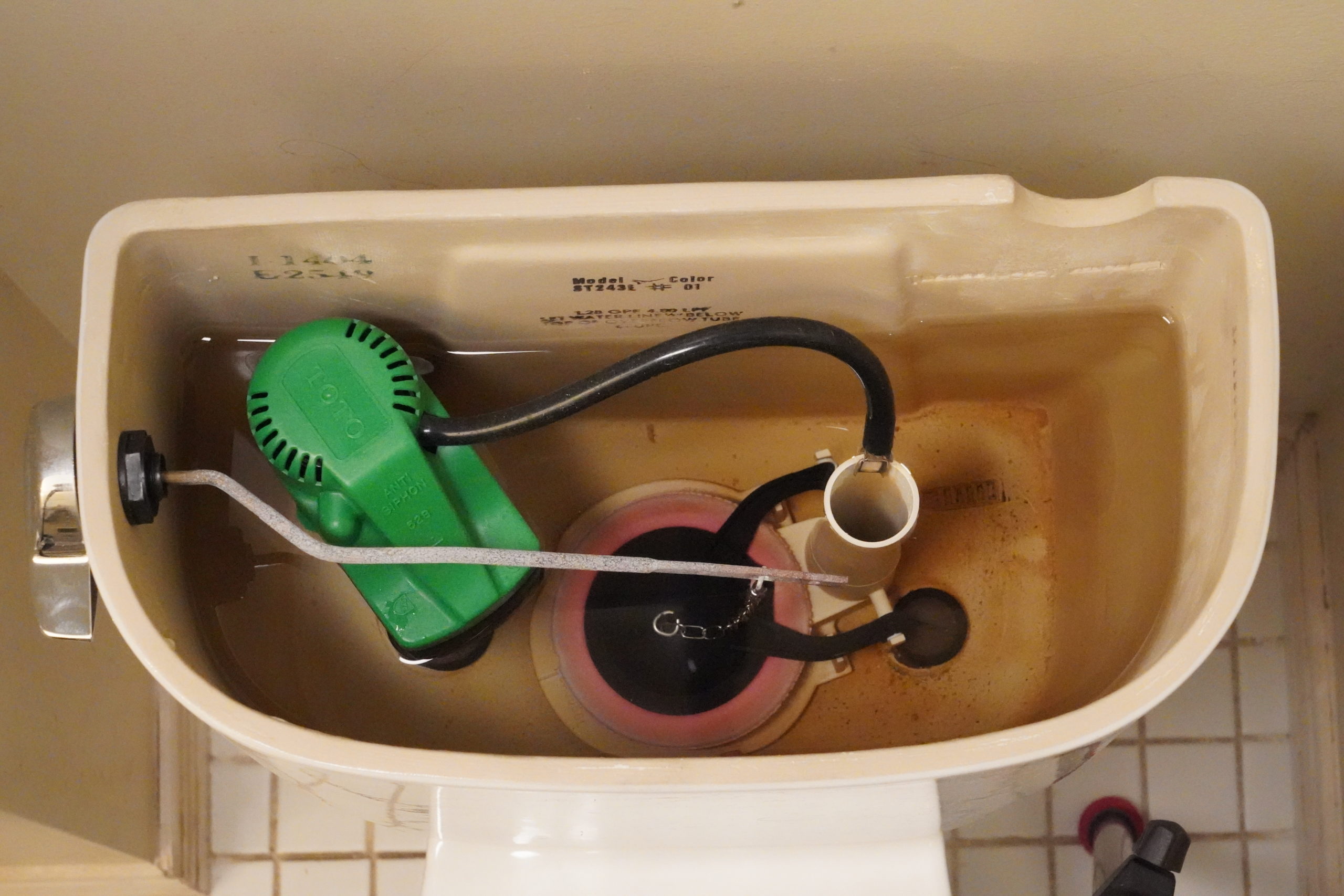
This toilet has a small, almost undetectable leak through its pink, circular flapper on the bottom of the tank. Some leaks can be detected by listening to hear if water is coming into the tank after it’s done filling. Faulty flappers are a leading cause of toilet leaks. Photo credit: Denver Water. Photo credit: Denver Water.

In addition to checking for toilet leaks, inspect all water sources in your home, including faucets, showers, water supply lines for dishwashers, washing machines, swamp coolers and ice machines.

Small leaks can add up over days and weeks. A small leak of 10 drops per minute can waste 300 gallons of water per year. Not only can these leaks add to your water bill, but they can also damage your home.

Find out how to do a self-audit of your home’s plumbing to help find and fix leaks.

Denver Water also encourages customers to review their monthly water bills. Unusually high water usage could indicate you have a leak.

Toilet rebates for low-flush toilets

Older toilets are another big water waster.

Some older toilets can use anywhere from 3.5 gallons to 7 gallons per flush, while newer toilets on the market use as little as 0.6 gallons per flush.

A family of four using 3.5 gallons per flush can use 26,000 gallons of water per year, compared to 11,000 with a newer, efficient model.

If you are interested in replacing an older toilet with a more efficient one, check out Denver Water’s toilet rebate program.

Denver Water offers rebates to help customers replace old toilets with newer, more efficient models that can save thousands of gallons of water every year. Image credit: Denver Water.

Replace old fixtures and appliances

While many water-saving fixes are free or relatively inexpensive to do, the EPA says the average family can save 13,000 gallons of water by updating older washing machinesdishwashersshowerheadsfaucets, and aerators with more efficient models.

When buying new appliances and fixtures, purchase products that carry an Energy Star or WaterSense label, an indication that the product uses less energy or water compared to products that don’t carry those labels.
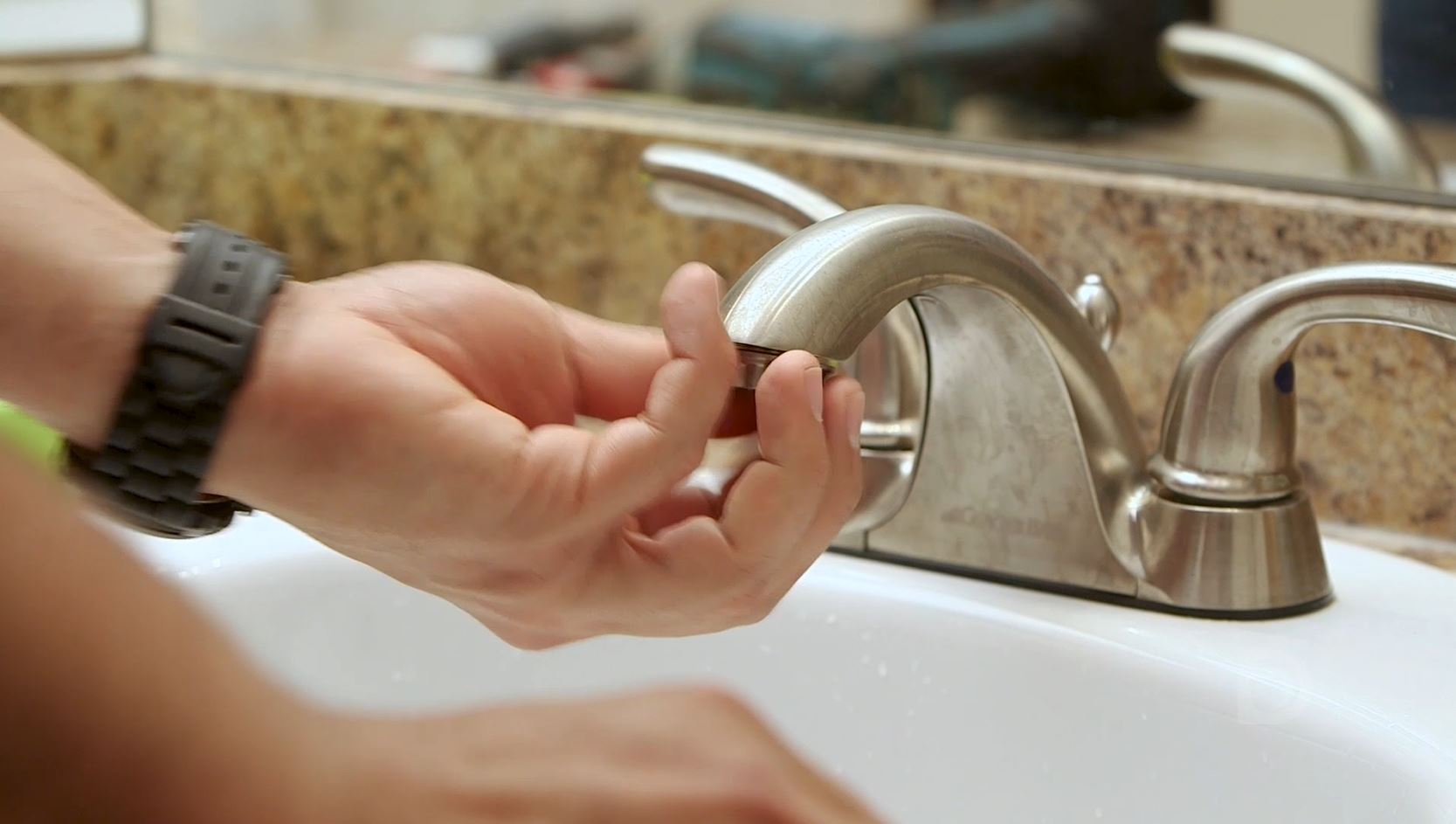
Replacing faucet aerators is an easy way to save water. New aerators slightly reduce the flow of water without impacting the performance of the faucet. Photo credit: Denver Water.

Mountain #snowpack should be peaking around now. This year, it’s almost gone — Russ Schumacher (#Colorado Climate Center) #runoff

Click the link to read the article on the Colorado Climate Center website (Russ Schumacher):

April 2, 2026

We’ve reached April 1, which is a key date in assessing where things stand with snow in the mountains, which then informs the likely water supply in streams and rivers later in the spring and summer. The peak in snowpack actually tends to arrive a bit later than April 1 at higher elevations and the northern part of the state, but April 1 is when manual snow course measurements have historically been made, so it serves as a useful point of long-term comparison. There’s no sugar-coating the data right now: after the record-smashing heat in March, the mountain snowpack is in historically bad shape for April 1.

First, a few updates on the March heat

As of our last blog post about the March heat wave, the statewide March temperature record had been tied, but not broken. It only took a couple more days for that to happen. The previous March record of 96°F from Holly in 1907 was broken with highs of 99°F at Burlington on the 25th and at Campo on the 26th. (Temperatures at Springfield and Walsh also exceeded the previous March record, reaching 98 and 97 respectively.)

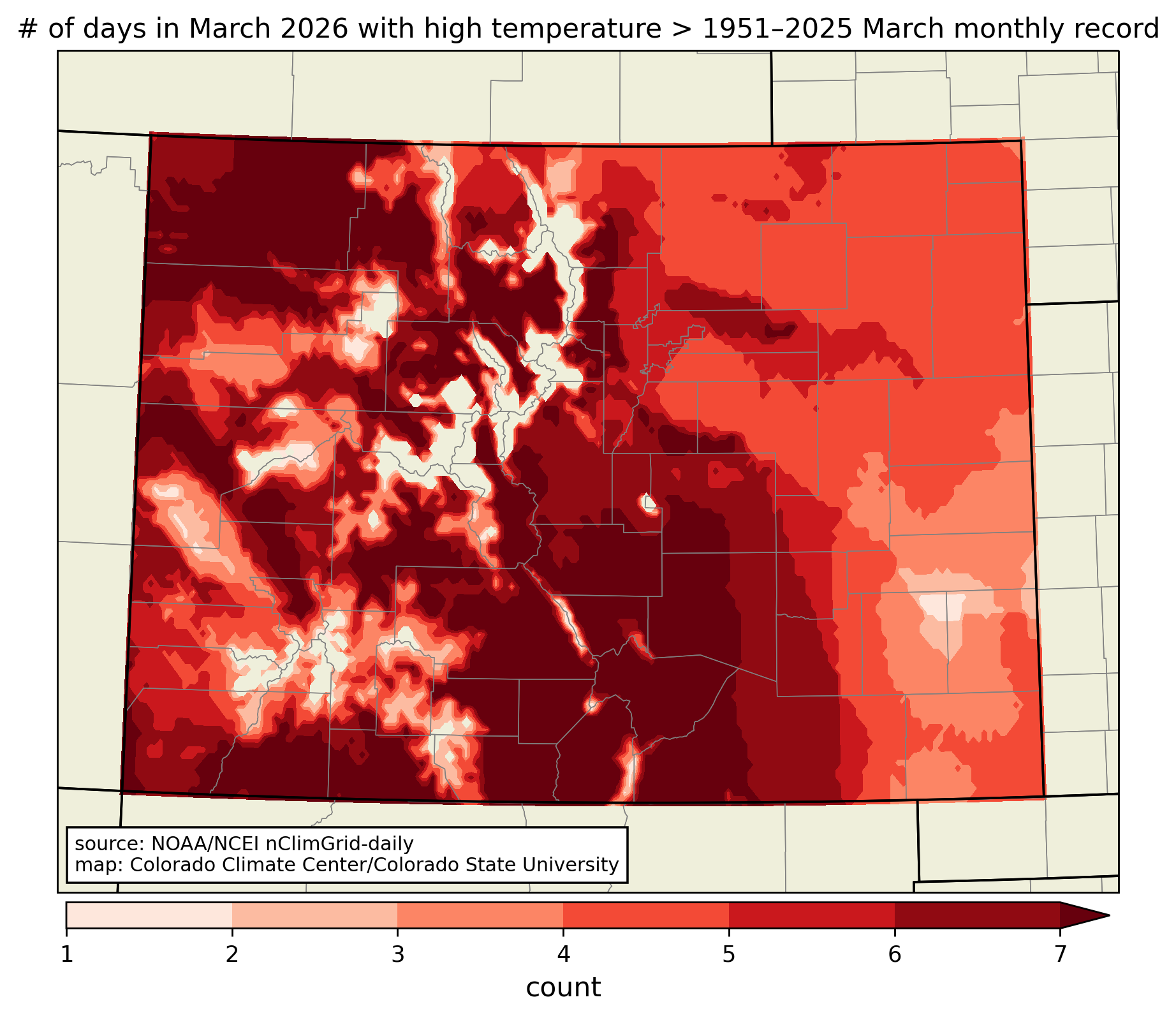
Here’s one more way to look at how extreme and prolonged the heat was in March. This map shows that broad swaths of Colorado had more than 7 days with high temperatures warmer than any March temperature from 1951-2025. That’s right: a whole week’s worth of days that were warmer than any March day in the last 75 years. On the Eastern Plains, it was “only” 2-5 days warmer than previous March records. The one exception in this dataset is the highest elevations in the mountains. There’s not a lot of reliable temperature data up above treeline, so we’re not sure whether this is correct or not.

Map showing the number of days in March 2026 that had a high temperature warmer than any March high temperature during 1951-2025. Data source: NOAA/nClimGrid-daily

We’ll round up more of the records in our monthly summary that will go out next week. (If you’re subscribed to get these posts via email, you’ll get those summaries too. If you aren’t subscribed, the sign-up box is at the bottom of the page!) But there’s no question that this will go down as the warmest March on record for Colorado—around 3-4°F warmer than any other March in the last 132 years—once all the numbers are tallied.

We wish the snowpack numbers were an April fool’s joke

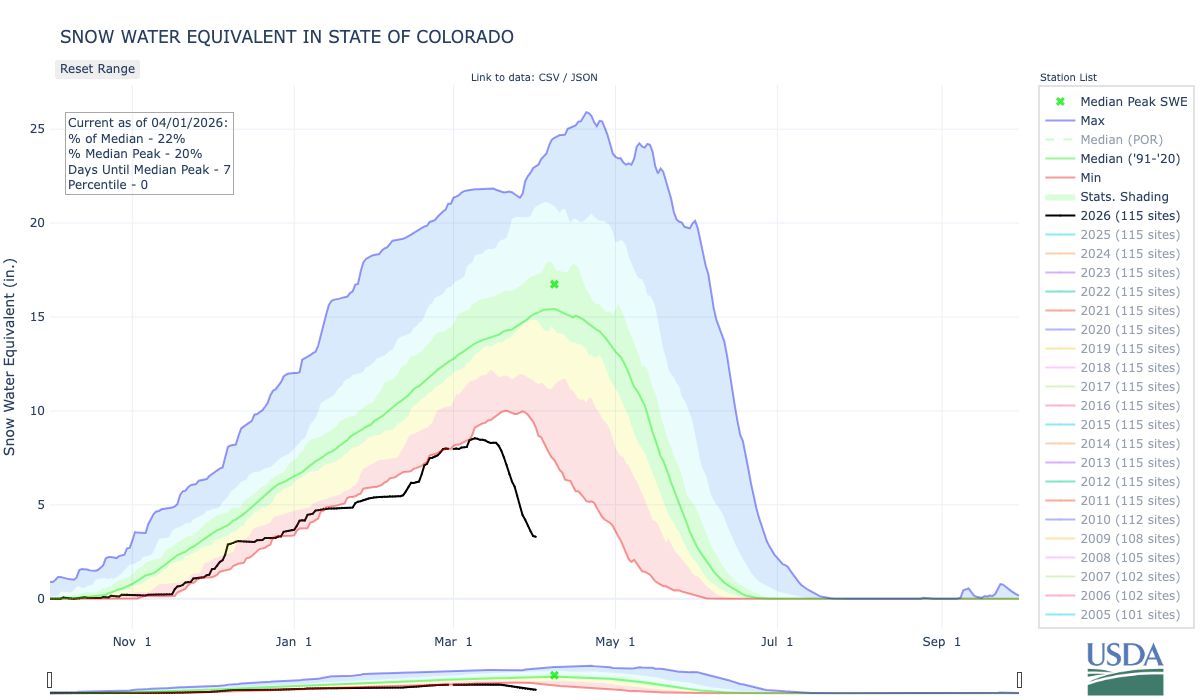
If you’ve read anything about the mountain snowpack this year, you might be sick of seeing this graph. But it’s worth another close look because of how incredible it is, and not in a good way.

Statewide snow water equivalent based on the SNOTEL network as of April 1, 2026. The black line shows statewide snow water equivalent for Water Year 2026 in comparison to all other years since 1987. From USDA/NRCS.

As of April 1, the snow water equivalent (the amount of liquid water stored in the snow) averaged across the 115 SNOTEL stations in Colorado was 3.3 inches, just 22% of the 30-year median. The previous low in the SNOTEL era (back to 1987) on April 1 was in 2012, which had 9.1″ on April 1. That means that we currently have less than 40% of the water in the snow than the previous lowest year.

Amid the record-shattering heat in the 2nd half of March, statewide snowpack declined by nearly 5 inches. Previously, the fastest decline in a 2-week period before April 1 was 2.3″ in 2012, one of the worst years for spring snowpack. Only two times has the SWE dropped by more than 5″ in two weeks before the end of April, in 1987 and 1989 which were both years with above-average peaks that started melting on the early side.

The peak SWE this year, again averaged across the SNOTEL stations in Colorado, was 8.55″ on March 9. That peak is just 51% of the median peak, nearly a month earlier than average, and is the lowest peak of the SNOTEL era.

As discussed in previous posts, the other key points of comparison for past snow droughts were 1977 and 1981, when SNOTEL stations either didn’t yet exist (1977) or were not as widely distributed as they are now (1981). In some of the southern mountain ranges, the peak SWE in early March this year may have been slightly higher than it was in those years. But in both of those years—like nearly every other year—the SWE increased substantially between March 1 and April 1. We know that’s not what happened this year. This year’s April 1 SWE was lower than those years almost everywhere in the state. It’s now safe to conclude that this has been the worst year for Colorado snowpack in recorded history.

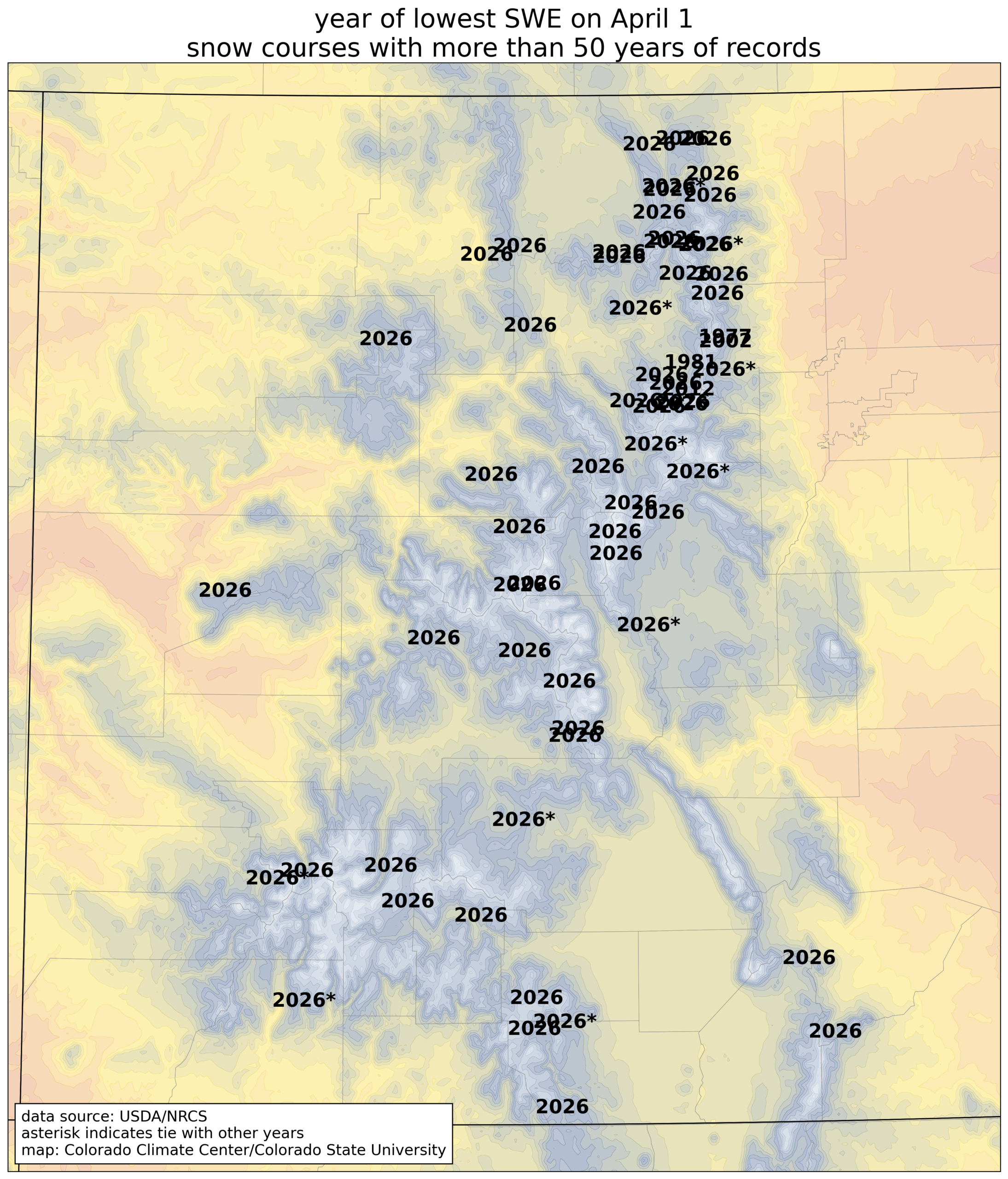
Many of the April 1 snow course measurements are now in, and at 60 of the 64 sites with at least 50 years of data, the SWE in 2026 was the lowest or tied for the lowest on record.

Map showing the water year with the lowest April 1 snow water equivalent at snow course sites with more than 50 years of records. Asterisks indicate years where 2026 was tied with one or more other years for record low. Data obtained from USDA/NRCS. Shaded map background is elevation.

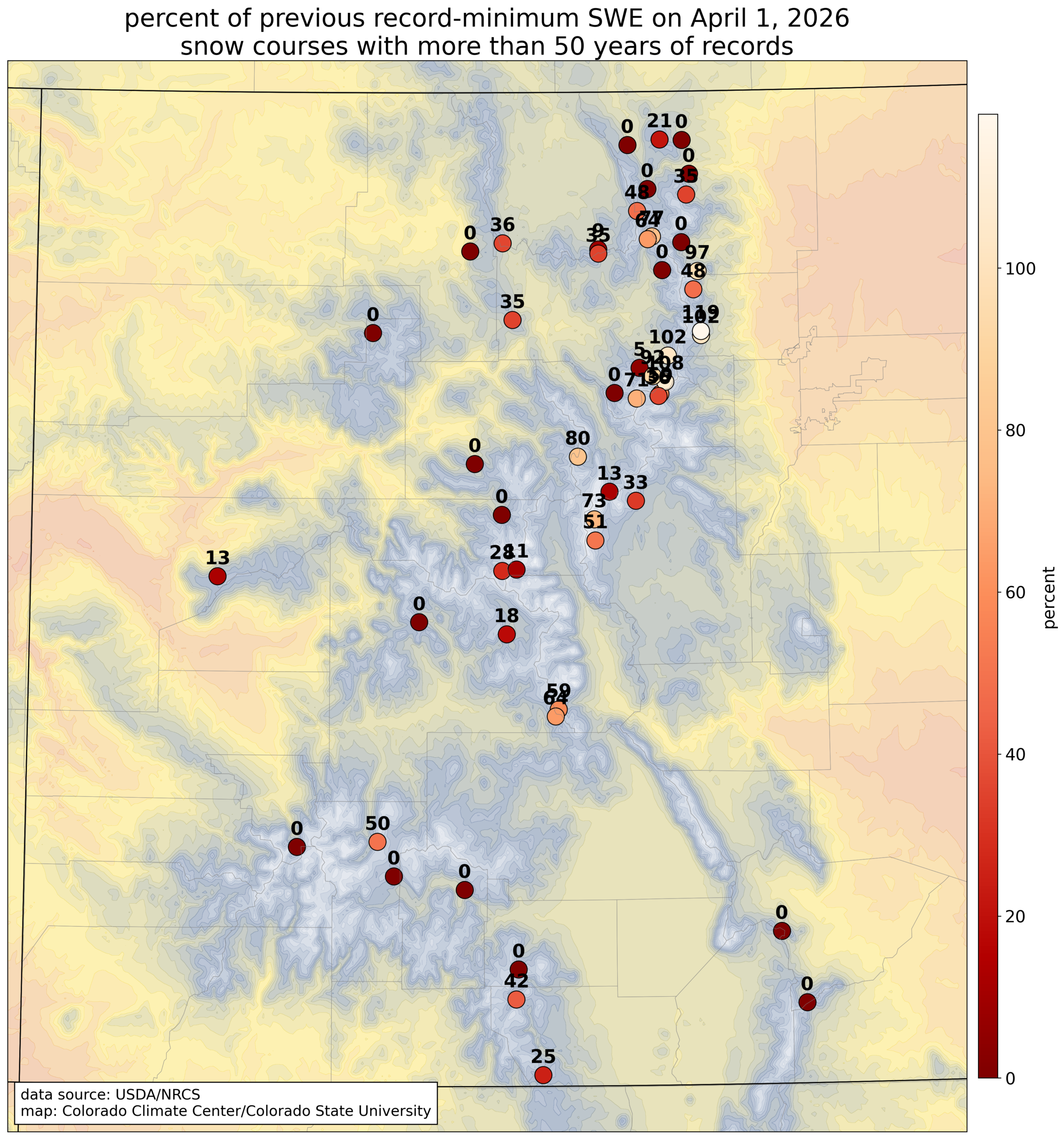
Perhaps more shocking is how much less SWE there was than in any previous years. The map below shows the percent of the previous record low at sites with more than 50 years of data. Most locations have less than half of the previous record low, and several locations that have never before had less than 5 or 6 inches of SWE on April 1 have no snow on the ground this year. Eighteen of the 64 snow course sites observed zero SWE this year and had never previously been snow-free on April 1st.

Map showing the percent of the previous record-low April 1 SWE that was observed on April 1, 2026. Locations where the previous record low was zero not shown. Data obtained from USDA/NRCS.
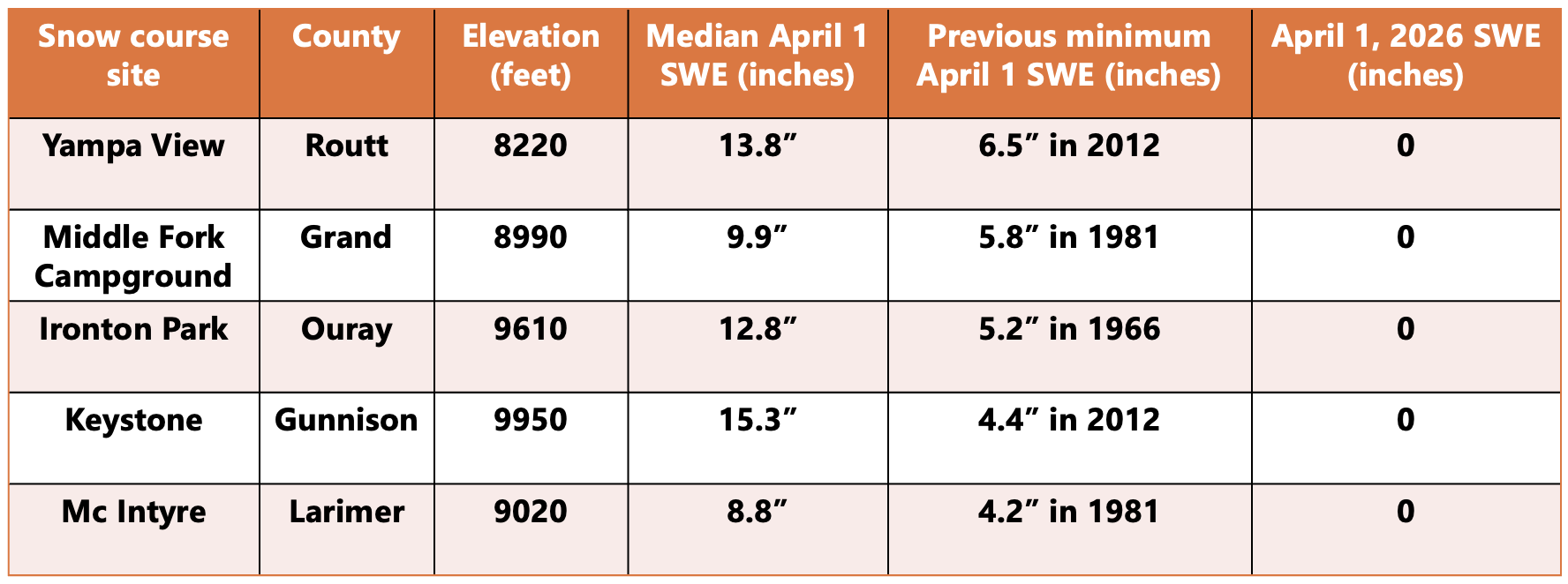
Five snow courses that had a previous record low of more than 4″ of SWE on April 1, and observed zero SWE on April 1, 2026. All of these sites have at least 64 years of observations (Middle Fork Campground has 90 years). Fourteen other sites also reported zero SWE this year and had never previously been snow-free on April 1.

The long-term measurement site at the Rocky Mountain Biological Laboratory in Gothic estimated that the spring snowpack in parts of the Gunnison Basin was unprecedented, with a return period of hundreds of years. The Colorado Dust on Snow program (CODOS) has numerous photos of the poor snowpack on their blog.

Drought conditions and what to expect in April

Now, it’s important to remember that not all of the water that was in the snow earlier in the winter has disappeared (though some of it did, to sublimation). That water is going into the soils and the rivers now. The rivers will therefore also be peaking very early: rivers that typically have peak flow in late May or early June will likely peak sometime in April. This means extremely low flows in summer are likely, unless there’s an unusually wet late spring.

This week’s US Drought Monitor summarizes the effects of the recent conditions across Colorado. Almost the entire northwestern quarter of the state is now in D4 (exceptional) drought, going back to a dry spring and summer in 2025 and a terrible winter and early spring this year. The D4 coverage of 21.59% is the largest since February 2021.

US Drought Monitor for March 31, 2026 for Colorado. The entire state has at least D0 (abnormally dry) conditions, with extreme to exceptional drought in most of western Colorado. From https://droughtmonitor.unl.edu/.

The one bit of good news is that April has started off like April, rather than whatever the March-June hybrid was that we just went through. Widespread precipitation fell in western Colorado, with snow in the mountains and rain at lower elevations. Some locations in southwestern Colorado that had zero precipitation in March, received well over an inch of precipitation between Tuesday and Wednesday. (Note that the Drought Monitor map shown above only includes data through early Tuesday morning, so the recent storm is not reflected.) Some of the mountain SNOTEL sites that had gone snow-free at the end of March have snow on the ground again!

This storm didn’t come anywhere near alleviating the snowpack and water deficits that have arisen in the last few months. But any water from the sky is very welcome at this point! The outlook for the rest of the month does appear to be April-like as well: probably warmer than average, but with more active weather than March had. This should help to slow down the melting of the little snow that remains, and perhaps give some temporary increases in snowpack that at the very least keep the situation from degrading as quickly as it has been.

Even if Coloradans slash water use, their bills will likely rise due to new drought fees — Jerd Smith (Fresh Water News)

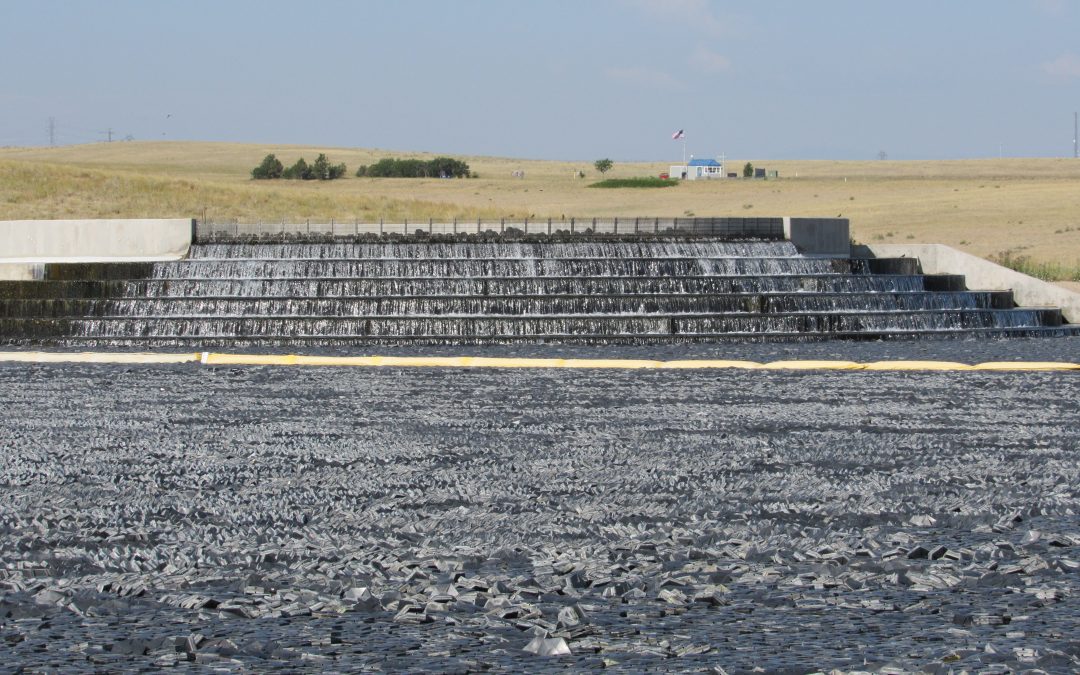
Wastewater is aerated as it flows over steps at Aurora’s Prairie Waters Project, which treats wastewater to drinking water standards. Credit: Jerd Smith

Click the link to read the article on the Water Education Colorado website (Jerd Smith):

April 2, 2026

Colorado homeowners and businesses are already planning for a brutally dry summer. They should also be planning for an expensive one, as Denver and other cities prepare to impose drought fees to encourage conservation and to buffer their budgets against millions of dollars in lost water sales as customers cut back.

Denver Water, which announced Stage 1 drought restrictions last week, said its preliminary estimates suggest $30 million to $70 million may be lost as a result of restrictions. It has annual revenue of $488.5 million. Denver Water is Colorado’s largest water utility, serving more than 1.5 million people in the city of Denver and across the southern and western suburbs.

The agency said its surcharges will be designed to penalize high-volume outdoor water use, while keeping the price for drinking, cooking and bathing water unchanged.

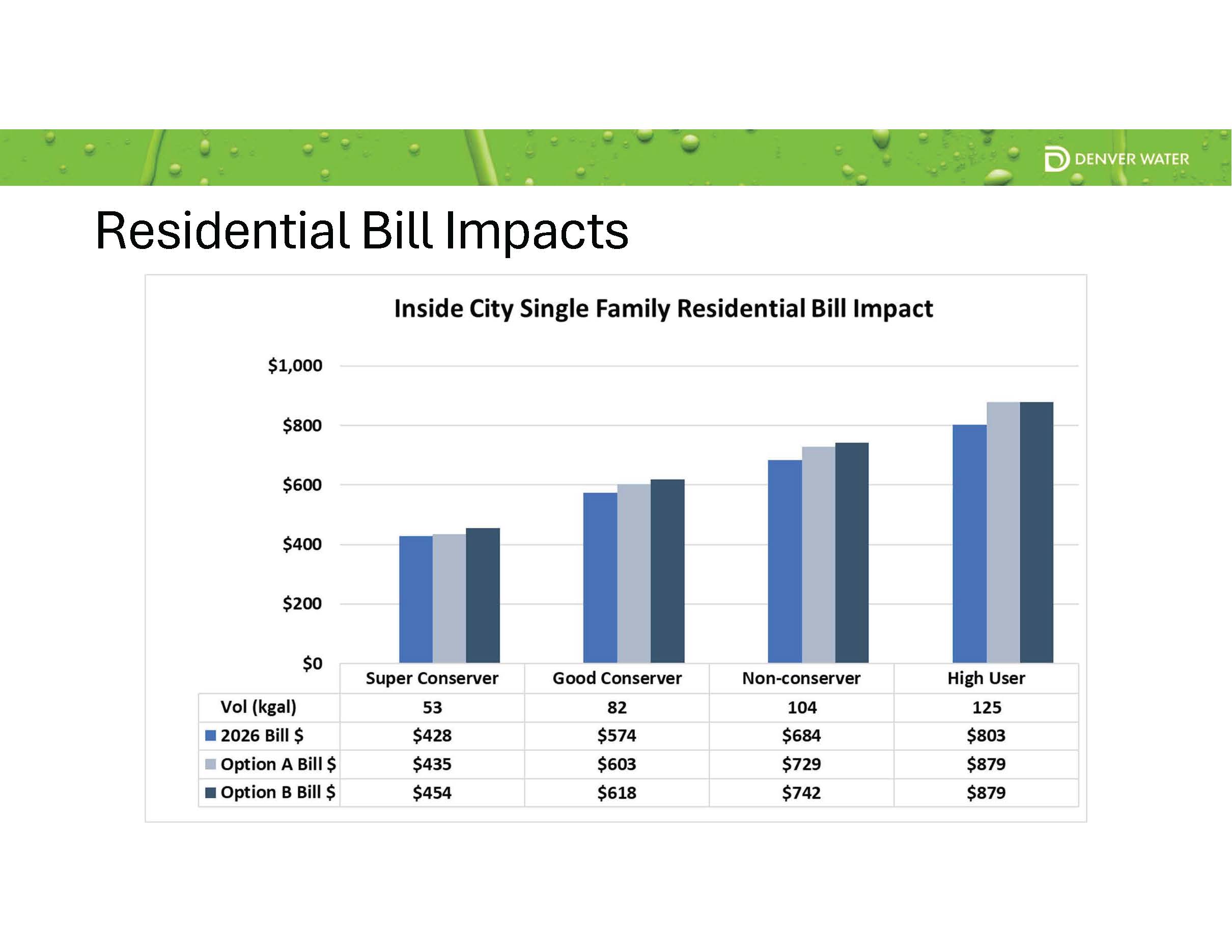
ts surcharge prices, if approved by the board this month, will vary depending on how homeowners and businesses use water indoors and outside. A low surcharge for a conservation-minded homeowner who doesn’t do much, if any, outdoor watering might be just $7 per bill, according to the agency, but the drought fee could rise to $76 a month on a residential bill where outdoor water use is high.

Denver Water spokesperson Todd Hartman said via email that the agency will use a portion of its cash reserves to offset the lower water sales and other costs associated with the drought. It has also taken steps to reduce other costs, such as leaving job vacancies open longer.

Colorado experienced record-low mountain snows this year and a scorching hot spring, which has the thin snowpack melting sooner than normal. Reservoir storage is stable for this year, at roughly 80% of average across the state. But heavy water use could drain those reservoirs too quickly, potentially causing major shortages next year if this winter is as dry as last winter’s was, officials have said.

To protect reservoir storage, cities want customers to reduce water use by 10% to 20%. 

They’re hoping the surcharges will help them reach those goals.

Chris Goemans, a professor in the agricultural and resource economics department at Colorado State University, said the drought fees are an important tool in water conservation, and can have a lasting impact on water use if they go on for a long period of time.

For several years after the deep drought Colorado experienced in 2002, for instance, water providers saw a lingering “drought shadow” where users continued to tighten their spigots, even after the drought fees were removed, according to research by Goemans, and others.

“They can promote lasting change,” he said.

Not every city will use the fees. Colorado Springs has permanent three-day-per-week watering rules and does not plan to impose a surcharge, at least not this year, spokesperson Jennifer Jordan said. She said the city’s drought plan allows surcharges only when reservoir storage is below 1.5 years on April 1. Right now, the system has three years of storage available.

And Aurora has only used them once before, in 2023, but took them off almost immediately when big rains came, according to Aurora Water spokesperson Shonnie Cline.

Cline said the severity of this drought is forcing the city to gear up for unprecedented times.

“We always thought that 2002 was the worst possible year, but we are expecting something worse this year,” she said.

Castle Rock will impose surcharges, if its council approves them in the coming weeks, but it is taking a different approach because its customers live with a water system based on what are known as water budgets, according to Mark Marlowe, director of Castle Rock Water. 

Its customers already are limited every year in how much water they can use during the lawn-watering season, an amount that is based on home and lot size. A small home with a small yard is allocated less water each year and typically has a smaller bill than a large home with a large yard, which is given more water and pays a larger bill. 

This year, Castle Rock will reduce everyone’s water budget. If homeowners exceed those lower budgets, they will be hit with a higher fee than normal. 

To help offset that and keep its conservation message top of mind, Castle Rock envisions drought surcharges of $6.91 per thousand gallons initially and rising to $10.31 if the drought deepens, Marlowe said. 

Is there any good news here? Maybe. City officials said if customers cut back as much as they are being asked to, say 10% to 20%, their bills might not change at all because they are using less water.

More by Jerd Smith

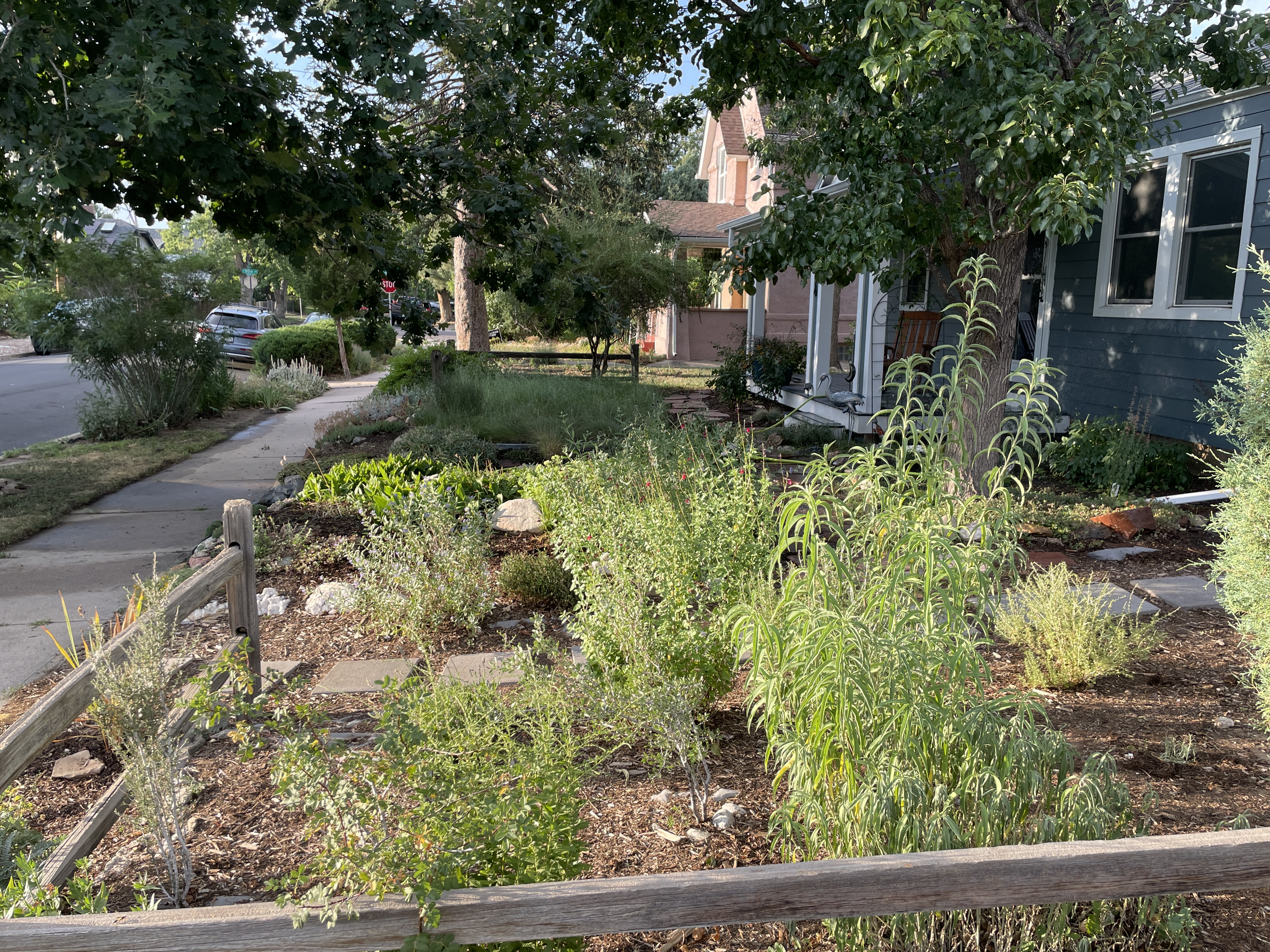
Mrs. Gulch’s landscape August 6, 2025.

#Denver Water, Xcel enact plan to ease shortages: Shoshone call relaxation allows Front Range water provider to divert more until May 20 — Heather Sackett (AspenJournalism.org) #ColoradoRiver #COriver #aridification

An Xcel truck outside the Shoshone hydropower plant in Glenwood Canyon. Denver Water has enacted with water rights owner Xcel to implement a call reduction agreement, which lets the Front Range water provider divert more water for a limited time. CREDIT: BRENT GARDNER-SMITH/ASPEN JOURNALISM

Click the link to read the article on the Aspen Journalism website (Heather Sackett):

March 31, 2026

Facing an abysmal snowpack and spring runoff, the state’s largest Front Range water provider has enacted an agreement that lets it take more water from the Western Slope for a limited time.

On March 18, Denver Water put the Shoshone call reduction agreement into effect with water rights owner Xcel Energy, which allows Denver Water to divert more water from the headwaters of the Colorado River in an attempt to alleviate shortages. The agreement reduces the call at the Shoshone hydroelectric plant in Glenwood Canyon by half, from 1,408 cfs to 704 cfs. 

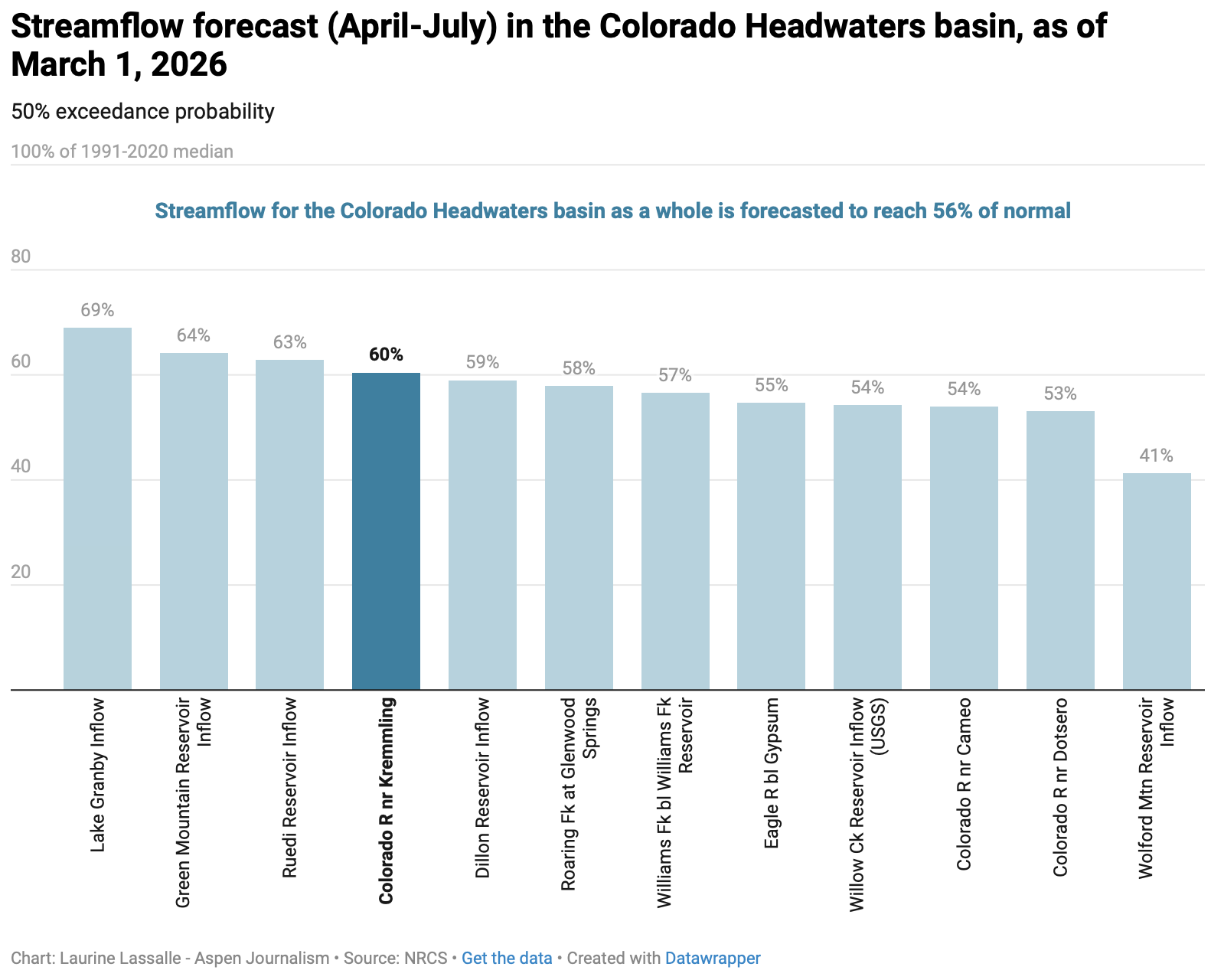
The call reduction can only be implemented when two drought conditions are met: an April to July streamflow forecast for the Colorado River measured at the Kremmling stream gauge must be at 85% or less than average and the forecasted storage for the 10 largest Denver Water reservoirs for July 1 must be at or below 80% full.  

The March water supply outlook from the National Resources Conservation Service for the Colorado headwaters from Kremmling to Glenwood Springs was 56% of normal. Experts expect conditions to have worsened when the April forecast comes out next week.

This winter is shaping up to be one of the worst on record and since water supplies depend on snowmelt, municipal water providers have been quick to implement cutbacks this spring. Last week, Denver Water declared a Stage 1 Drought and will impose two-day-a-week outdoor watering restrictions this summer.

“In the wake of the worst snowpack conditions in some 50 years of records at Denver Water, we began exercising the Shoshone Relaxation Agreement with Xcel Energy starting March 18,” Denver Water’s Media Relations Coordinator Todd Hartman said in an email. “We have taken this step only one other time under the 2007 agreement with Xcel (2013) and we don’t do so lightly.” 

According to the agreement, Denver Water will be able to divert additional water until May 20.

The water provider, which serves about 1.5 million people on the Front Range, gets roughly 50% of its supply from the Colorado River basin and brings it across the Continental Divide through a highly engineered system of tunnels and reservoirs that facilitate the so-called transmountain diversions. 

The Shoshone water rights, which date to 1902, are some of the largest and most powerful on the mainstem of the Colorado River in the state. They can command the river’s flows all the way to its headwaters, ensuring water keeps flowing downstream on the Western Slope. 

When the plant’s turbines are spinning, it can “call” for its full water right, effectively forcing upstream water users with junior rights – like Denver Water – to cut back. And because the water is returned to the river after it runs through the plant’s turbines, Shoshone benefits downstream cities, irrigators, recreators and the environment on the Western Slope.

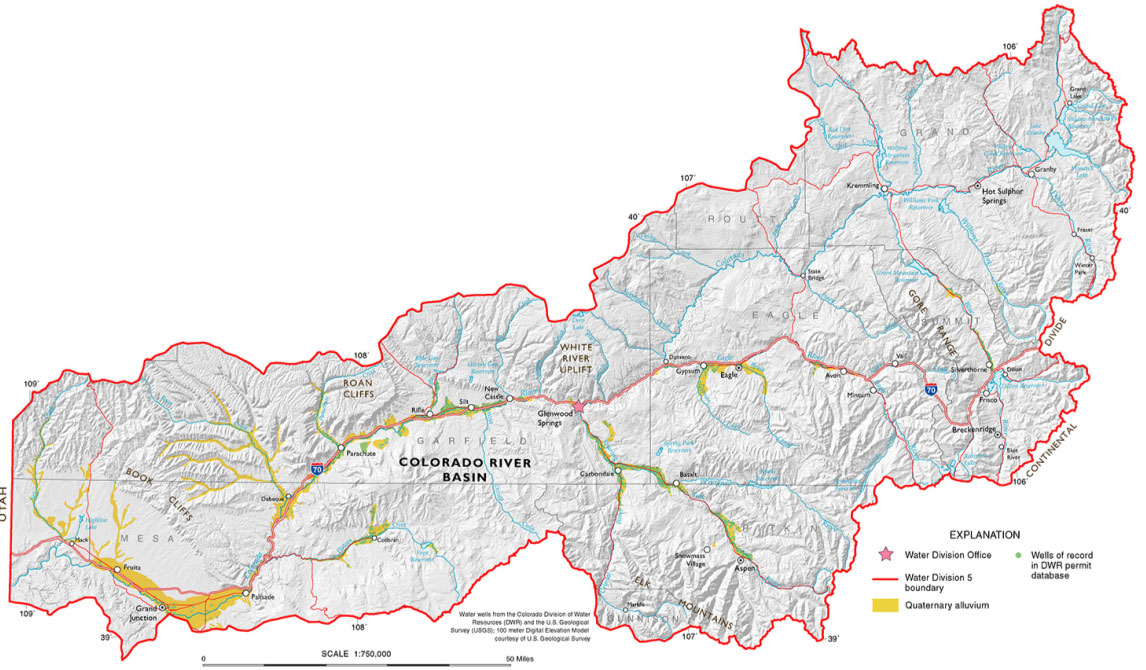
Colorado River Basin in Colorado via the Colorado Geological Survey