Upper #ColoradoRiver Basin States’ Governors Release Statement on Proposed Draw Down of #FlamingGorge and Upper Basin Reservoirs

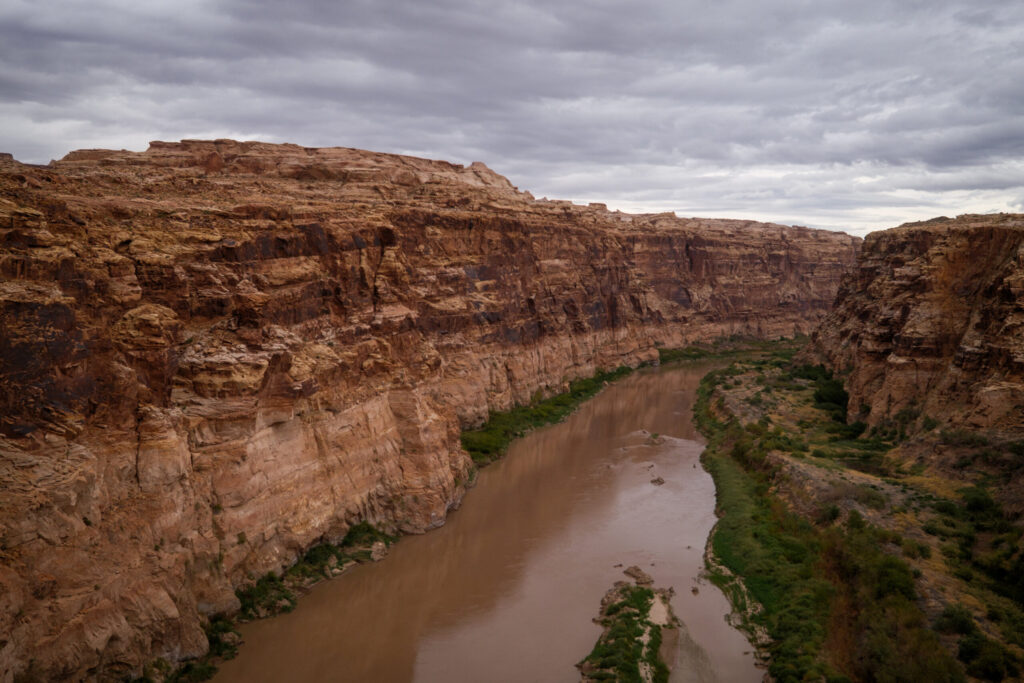
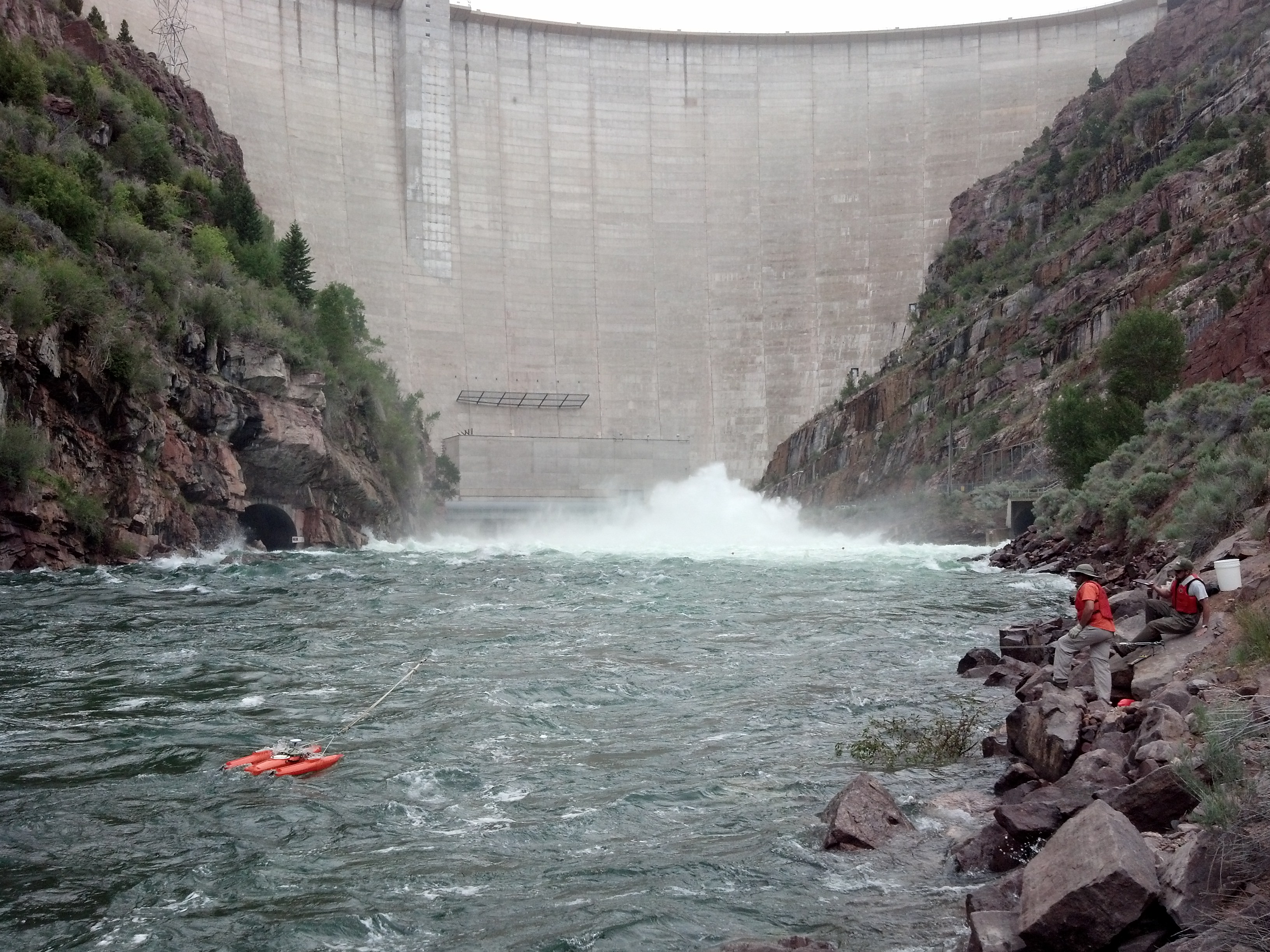
View below Flaming Gorge Dam from the Green River, eastern Utah. Photo credit: USGS

Click the link to read the release on Governor Polis’ website:

April 9, 2026

Today, Governors Jared Polis (D-Colo.), Mark Gordon (R-Wyo.), Michelle Lujan Grisham (D-N.M.) and Spencer Cox (R-Utah) released a statement on the proposed draw down of Flaming Gorge and other upper basin reservoirs: 

“This is an unprecedented year on the Colorado River, and likely will be one of the worst on record. A dry year like this reminds us of why it is critical that all who rely on this resource learn to live within its means and adapt our uses accordingly. 

The Upper Division States of Colorado, New Mexico, Utah, and Wyoming, are actively and strictly regulating water uses. Because of such diminished runoff, existing state laws in the Upper Division States require water users to face cuts to water rights dating back to the 1800s – these cuts are mandatory, uncompensated, and will have significant impacts on water users, including Upper Basin Tribes, and local economies. 

It is critical that any releases made by the federal government from Flaming Gorge and other upstream reservoirs are in compliance with existing agreements, particularly the 2019 Drought Response Operations Agreement between the Bureau of Reclamation and the Upper Division States and governing law and done for the purpose of protecting Lake Powell. We must have a clear understanding of how these proposed releases will effectively protect elevations at Lake Powell. Once the releases conclude, we expect that all water released from Flaming Gorge and other upstream reservoirs will be fully recovered. 

Further, any releases must be appropriately sized. Years like this one remind us that appropriate water storage helps us survive the dry years, and that we must be prepared not only for this year but future dry years, as well as average years. 

As we continue to comply with commitments to our water users and the Law of River, we recognize the impacts of water shortages and water releases from Upper Basin reservoirs on local communities – not only related to future water supply availability, but also how they affect jobs and local recreational and other economies. We recognize the need to live within the available supply and expect other communities to do so as well.” 

#ClimateChange doesn’t care about your bandwidth: Crises abound these days, that doesn’t mean the global warming menace has abated — Quentin Young (ColoradoNewsline.com)

The Colorado River is pictured where if flows near Hite, just beyond the upper reaches of Lake Powell, on Friday, Sept. 19, 2025. (Photo by Spenser Heaps for Utah News Dispatch)

Click the link to read the commentary on the Colorado Newsline website (Quentin Young):

April 9, 2026

So many crises threaten society these days. Daily news about war, the emergence of AI, runaway costs of living, the threat of new pandemics, the growing dangers of fascism in Washington — it’s a deluge of worry, and it can be hard to think about much else.

But the pile of troubles in recent years has diverted attention from the long-term crisis of climate change, arguably humanity’s supreme challenge, which is not going away just because it gets less attention. Some commentators have suggested that no one has the bandwidth anymore to think about climate change. But climate change doesn’t care about your bandwidth, and conditions in Colorado prove the point. [ed. emphasis mine]

The state just had its warmest winter on record by almost 2 degrees Fahrenheit, and average temperatures from December through February were more than 8 degrees above the 20th century average, as Newslinereported last month. Cities up and down the Front Range saw record-high numbers of 60-degree days this winter. The state is also fantastically dry, part of an aridification process driven by global warming.

As reporter Chase Woodruff wrote, “Hotter, drier conditions in Colorado have stressed water supplies, made the state’s forests more vulnerable to insects and diseases, and greatly increased wildfire risk.”

Waterways in Colorado this year are universally expected to see below-normal flows, including the Colorado River, which is forecast to run at just 68% of normal. The Colorado River, a vital resource for 40 million people, this century has experienced critical streamflow depletions. The river is down 20% from historic annual averages. Some projections suggest Lake Powell, a crucial reservoir on the river, could dropfor the first time below the minimum level needed for it to produce hydropower at the Glen Canyon Dam, energy generation relied on by almost 6 million people.

Low snowpack that’s contributing to streamflow shortages is also a blow to the Colorado ski industry, which generates $4.8 billion a year and supports more than 46,000 jobs across the state. At the current trajectory, the industry will disappear by the end of the century. Climate modeling shows the ski season could be shortened by more than a month by 2050 and more than two months by 2090. And it’s not just less snow — climate change is to blame for increasingly poor snow.

The latest forecasts suggest Coloradans should brace for more brutal wildfires this year. Hot and dry conditions, along with low moisture content in vegetative fuels, are already at levels on the Front Range typical of peak fire season. Worsening conditions as summer unfolds will further increase the state’s vulnerability to wildfires. Tinderbox conditions are becoming the norm: The three largest wildfires in Colorado history all occurred in 2020, and the state’s 20 biggest fires have all occurred in the past 20 years.

There is no scientific doubt that climate change contributes to bigger, fiercer wildfires and other extreme ecological events, and there is no scientific doubt that the primary cause of climate change is the human combustion of fossil fuels.

Yet government policies, especially as guided by MAGA priorities, reject the science. In February, the Trump administration revoked the so-called endangerment finding, which recognized the dangers of greenhouse gas emissions and allowed climate regulations under the Clean Air Act. The administration is forcing coal-fired power generation in Colorado to persist past a planned retirement date, apparently to accommodate coal business interests.

Climate change so far has not figured prominently in 2026 statewide elections. The platforms of the top Democratic candidates for governor, U.S. Sen. Michael Bennet and Attorney General Phil Weiser, both mention climate change as a problem to confront. But Bennet touts a “market-based path to cut emissions” that resembles the disappointing carrot-over-stick approach of the administration of Gov. Jared Polis, under whom the state has failed to meet its own greenhouse gas emission reduction targets. 

Many Coloradans fear the federal government, and they’re struggling to pay for housing, health care and other necessities, while national and world events seem ever more alarming. But, though it usually doesn’t produce spectacular daily headlines, climate change threatens eventually to leave whole regions of the Earth uninhabitable.

The worst effects of climate change can still be avoided, but only if voters insist leaders address it with the emergency response it demands.

Colorado statewide annual temperature anomaly (°F) with respect to the 1901-2000 average. Graphic credit: Colorado Climate Center

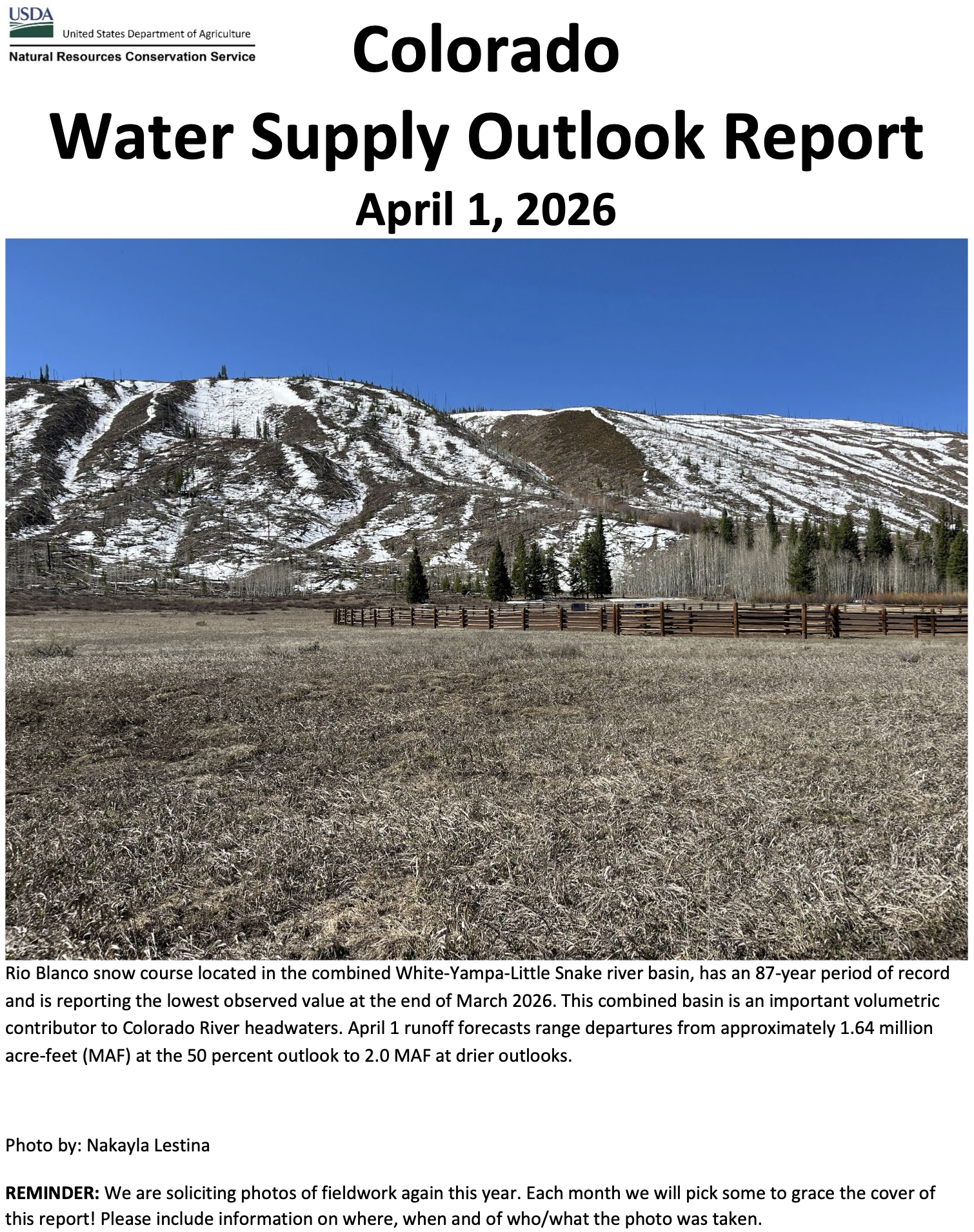
The April 1, 2026 #Colorado Water Supply Outlook Report is hot off the presses from the NRCS

Click the link to read the report on the NRCS website and to drill down into your favorite Colorado major basin summary. Here’s an excerpt:

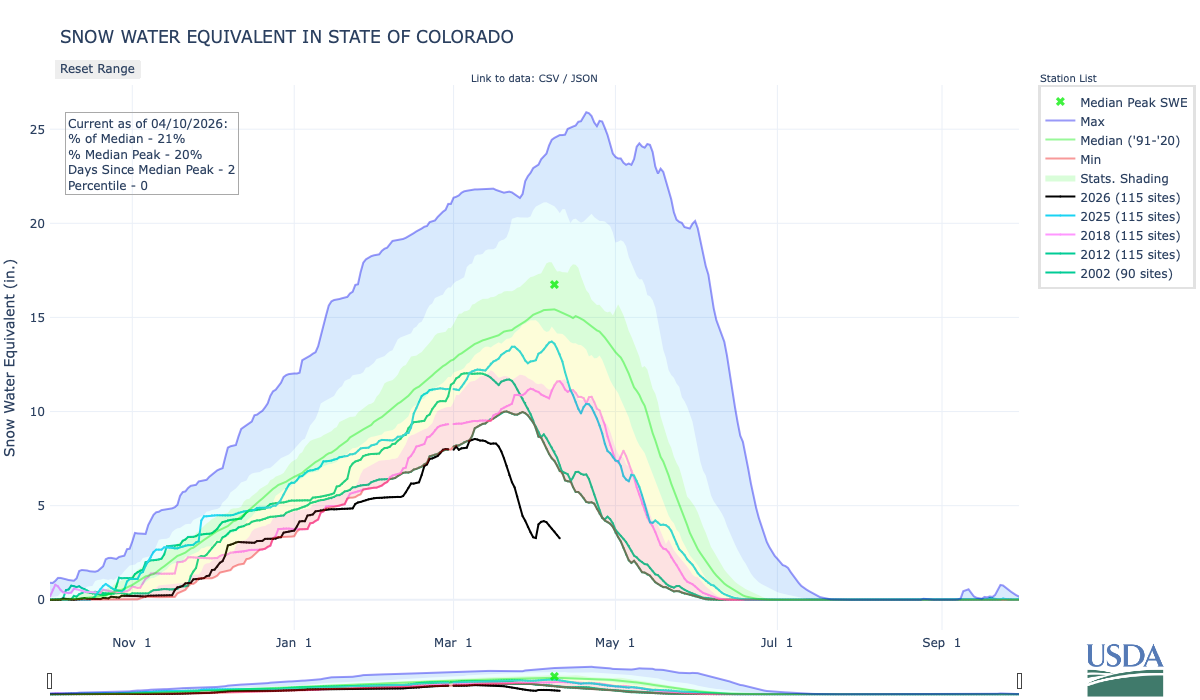
An Early Start to #Runoff and Reduced Seasonal Volume: #Colorado #snowpack peaked in late February to mid-March across basins and declined through March. As of April 9, 2026, statewide snowpack is 22 percent of median. April-July runoff volumes are well below median — NRCS

San Juan Mountains April 2026. Photo credit: NRCS

Click the link to read the release on the NRCS website:

April 9, 2026

In a typical year, early April marks the transition into peak snowpack. Accumulation is still ongoing, particularly across the central and northern mountains, and runoff has yet to fully begin. This year, that sequence has shifted. Snowpack peak snow water equivalent (SWE) timing occurred early, with many basins reaching maximum SWE in late-February to mid-March. In the San Juan Mountains, peak SWE was largely driven by a late February storm, after which snowpack shifted into net melt through March rather than functioning as a late-season accumulation period.  

As of April 9, 2026, statewide SWE is 22 percent of median, following a brief increase to 26 percent after early April storms. While beneficial at the site level, these storms did not change conditions and sites have resumed melt-out patterns.  

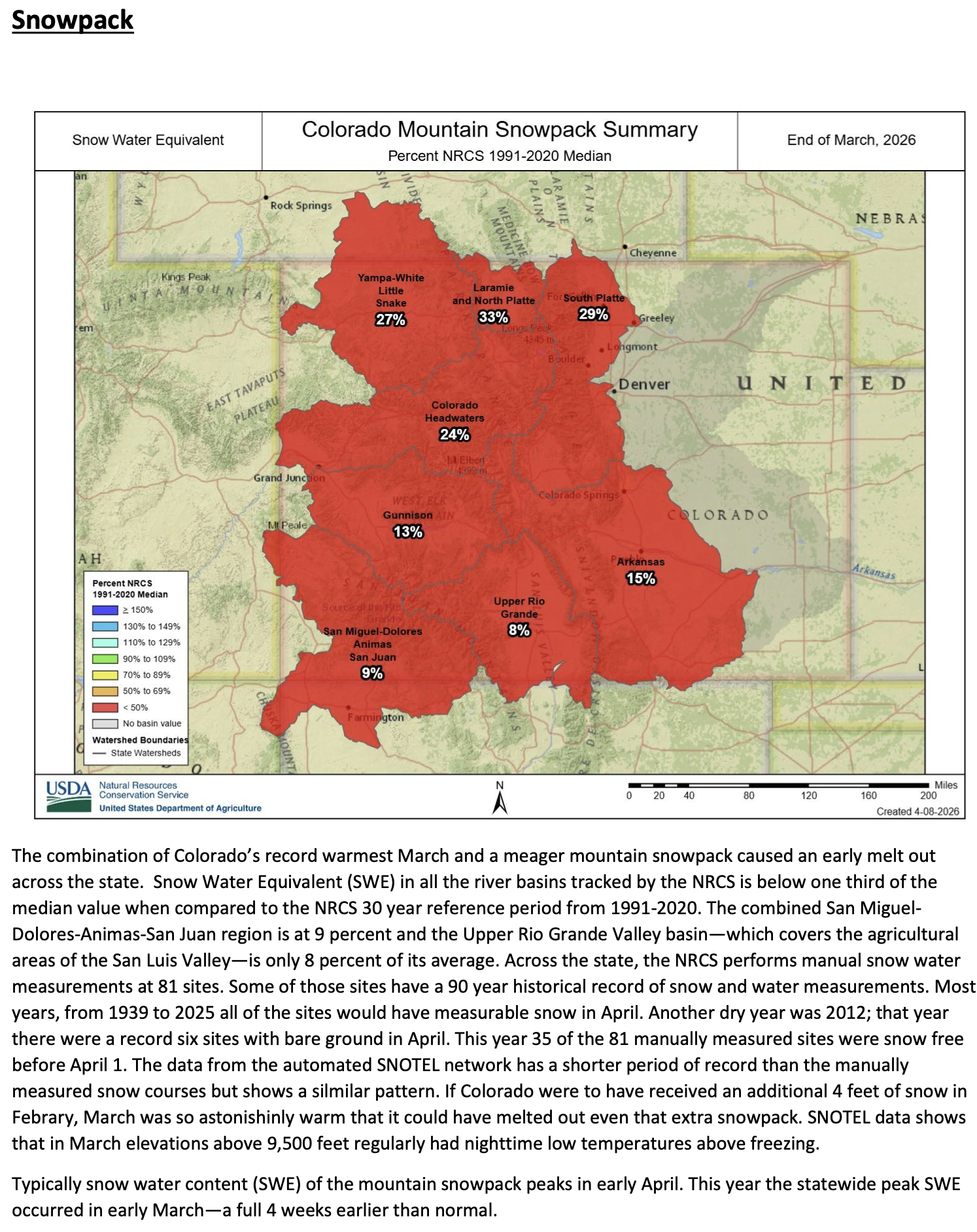
Statewide SWE declined from 60 percent of median from March 1, 2026 to 20 percent of median by April 1, 2026. The most rapid decline occurred during a concentrated melt period from mid to late March, when sustained record temperatures drove accelerated depletion across the network. During this interval, SWE declined at an average rate of 0.25 inches per day. March temperature data averaged roughly 9°F above normal, with 26 days exceeding median. Rather than intermittent melt cycles, snowpack experienced sustained energy input, accelerating SWE loss across elevations, including high-elevation zones that typically remain stable into April.  

Across the Colorado monitoring network, snowpack is clustered at the lower end of the observing SNOTEL period. As of the end March, 103 of 117 sites are reporting values at or near the 0th percentile with 95 percent of sites at the lowest or second lowest values. This pattern extends beyond Colorado, with SNOTEL sites across the Intermountain West averaging near the 12th percentile at the end of March.  [ed. emphasis mine]

March streamflow observations are above median across much of Colorado. Outside of the eastern Sangre de Cristo Mountains, where flows are closer to 58 percent of median, many basins are averaging 140 percent above median. Under normal conditions, above median runoff would indicate strong water supply. This reflects a shift in timing and a reduction in total volume. Snowmelt that would typically contribute to April through July runoff (primary period) is now entering into river systems. Several headwater locations are approaching or have reached seasonal peak streamflow flow timing weeks earlier than average. Early flows may appear favorable in the short term, but in this case may represent a compression of the runoff period rather than an increase in total seasonal supply.  

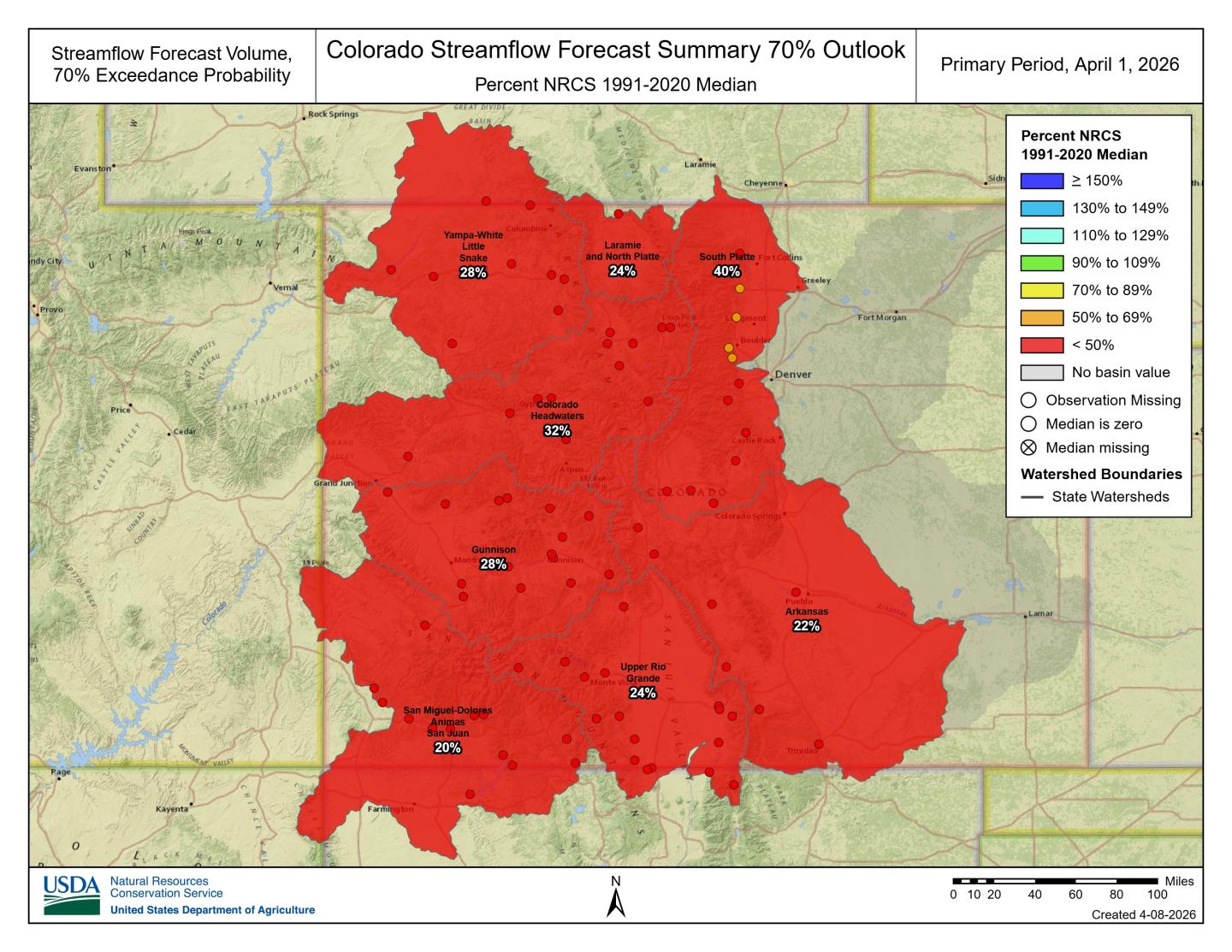
At the 50 percent outlook, primary period runoff is expected to fall 11.4 million acre-feet (MAF) below median runoff volume statewide, with 9.4 MAF of that deficit concentrated in western slope basins, including the Colorado Headwaters, Gunnison, Yampa-White-Litte Snake and San Miguel-Dolores-Animas-San Juan (SMDASJ) basins. The 30 percent forecast remains well below median, while the 70 and 90 percent forecasts reduce volumes further, with Colorado Headwaters ranging from 3.5 to 4.8 MAF below median across the outlook range.  

Figure 1. Primary period streamflow forecast at the 70 percent exceedance probability (NRCS 1991-2020 median). Basin-scale runoff departures exceed 4 MAF below median in the Colorado Headwaters and more than 2 MAF in the Gunnison. 56 of 80 points fall at or near the lowest values.

April-July runoff forecasts at the 50 percent exceedance probability are in the range of 27-35 percent of median depending on basin, with continued degradations from prior outlooks. The South Platte basin is higher relative to other basins, with a forecast at 54 percent of median. At the 70 percent exceedance streamflow forecast and 90 percent exceedance streamflow forecast, a majority of points fall near the lowest values in their period of record. Figure 1 highlights the lower range of outcomes. Many of these gauges have observing periods exceeding 100 years, placing drier projections at the bottom in the historical record.  

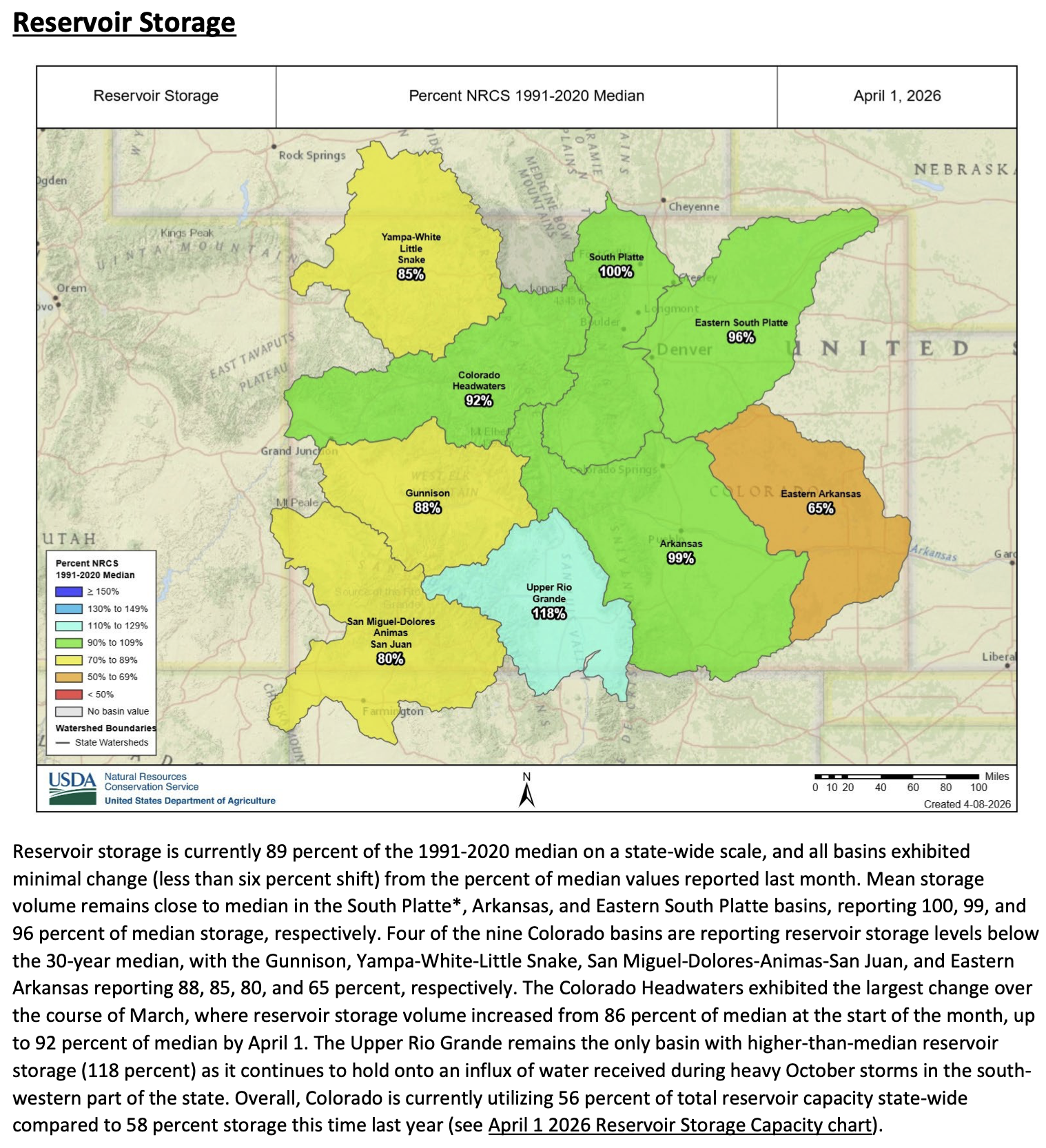
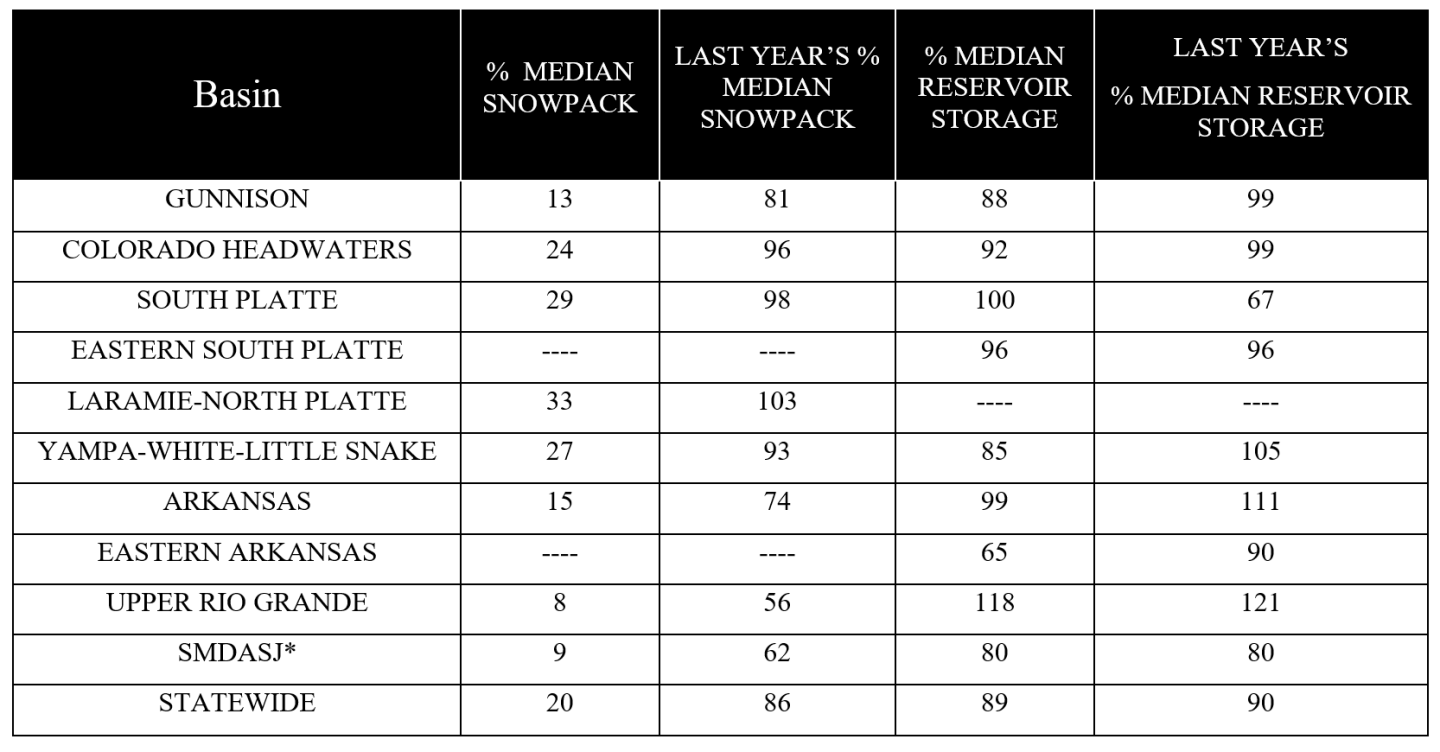
October brought above-normal precipitation, particularly in southern basins where a significant portion fell as rain and contributed directly to runoff and reservoir storage. Since then, precipitation has remained well below normal across the state and has limited snowpack development during the primary accumulation window. Statewide reservoir storage is near average at 89 percent of median. A portion of this year’s runoff has already occurred during March, and the snowpack entering April is substantially below normal. These conditions limit the volume available for the rest of the runoff period, consistent with projected runoff volumes well below median. Short-term forecasts indicate above average precipitation, which may provide temporary increases in snowpack. Conversely, seasonal Climate Predication Center outlooks favor above-normal temperatures and below-normal precipitation. Forecasts remain centered below median and are trending toward the lower exceedance range. 

Colorado’s Snowpack and Reservoir Storage as of April 1, 2026

* San Miguel-Dolores-Animas-San Juan River basin

For more detailed information about mountain snowpack refer to the Colorado Water Supply Outlook Report. For the most up to date information about Colorado snowpack and water supply related information, refer to the Colorado Snow Survey website.