Borrego Springs: A cautionary tale about groundwater use in the California desert

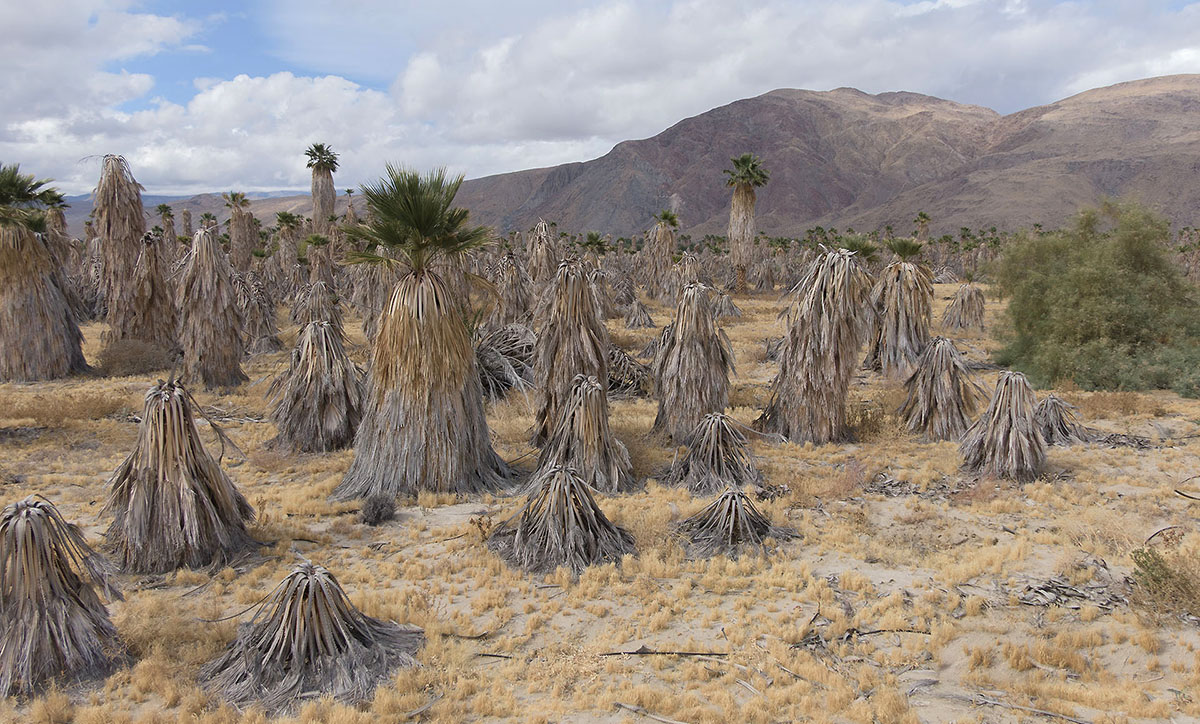
A landscape featuring a grove of dry palm trees with their fronds hanging down, surrounded by brown grass and mountains in the background under a cloudy sky.
A dessicated palm grove northeast of Borrego Springs, CA. Photo by Robert Marcos.

by Robert Marcos, photojournalist

For decades, the desert town of Borrego Springs – in eastern San Diego County, thrived upon what appeared to be an unlimited supply sunshine and groundwater. Lacking an alternative supply of water this isolated community was entirely dependent on the prehistoric groundwater that was lying beneath it. This finite resource acted as the lifeblood for two competing interests: a flourishing agricultural sector and a steady expansion of residential and resort development.1

The valley’s economic foundation was laid by industrial-scale agriculture. Beginning in the mid-20th century, farmers realized that the high water table and intense desert sun created perfect conditions for citrus, grapes, and nursery crops. Water was pumped aggressively to transform the arid landscape into a lush production hub. At its height, agriculture accounted for roughly 70% of the valley’s water consumption, providing the jobs and revenue that initially put Borrego Springs on the map.

Parallel to the farming boom, the town marketed itself as a serene, upscale getaway, leading to significant residential growth. Developers built golf courses, luxury resorts, and sprawling retirement communities that promised a “green” lifestyle in the middle of the desert. These amenities required massive amounts of groundwater to maintain verdant fairways and private pools. For years, the abundance of the aquifer made it easy to ignore the fact that the community was growing far beyond the environment’s natural recharge rate.2

However, the “golden age” of water use eventually hit a breaking point as the aquifer began to rapidly decline. Decades of extracting more water than the earth could replace caused the water table to drop by more than 100 feet in some areas. As the ground sank and the cost of pumping from deeper depths rose, the sustainability of the valley’s twin economies came into question. The very resource that invited growth became the primary limiting factor for its future.3

Today, Borrego Springs stands as a cautionary tale of desert over-extraction. Under California’s Sustainable Groundwater Management Act, the community has been forced to implement drastic water reductions, leading to the fallowing of many farms and strict mandates for residents. While the groundwater once fueled a dream of limitless desert prosperity, its depletion now dictates a new era of conservation, proving that growth without replenishment is ultimately a race toward an empty well.4

Meeting #Climate Targets Requires Humanity to Reorient Its Relationship With Nature, New Study Says — Jake Bolster (InsideClimateNews.org)

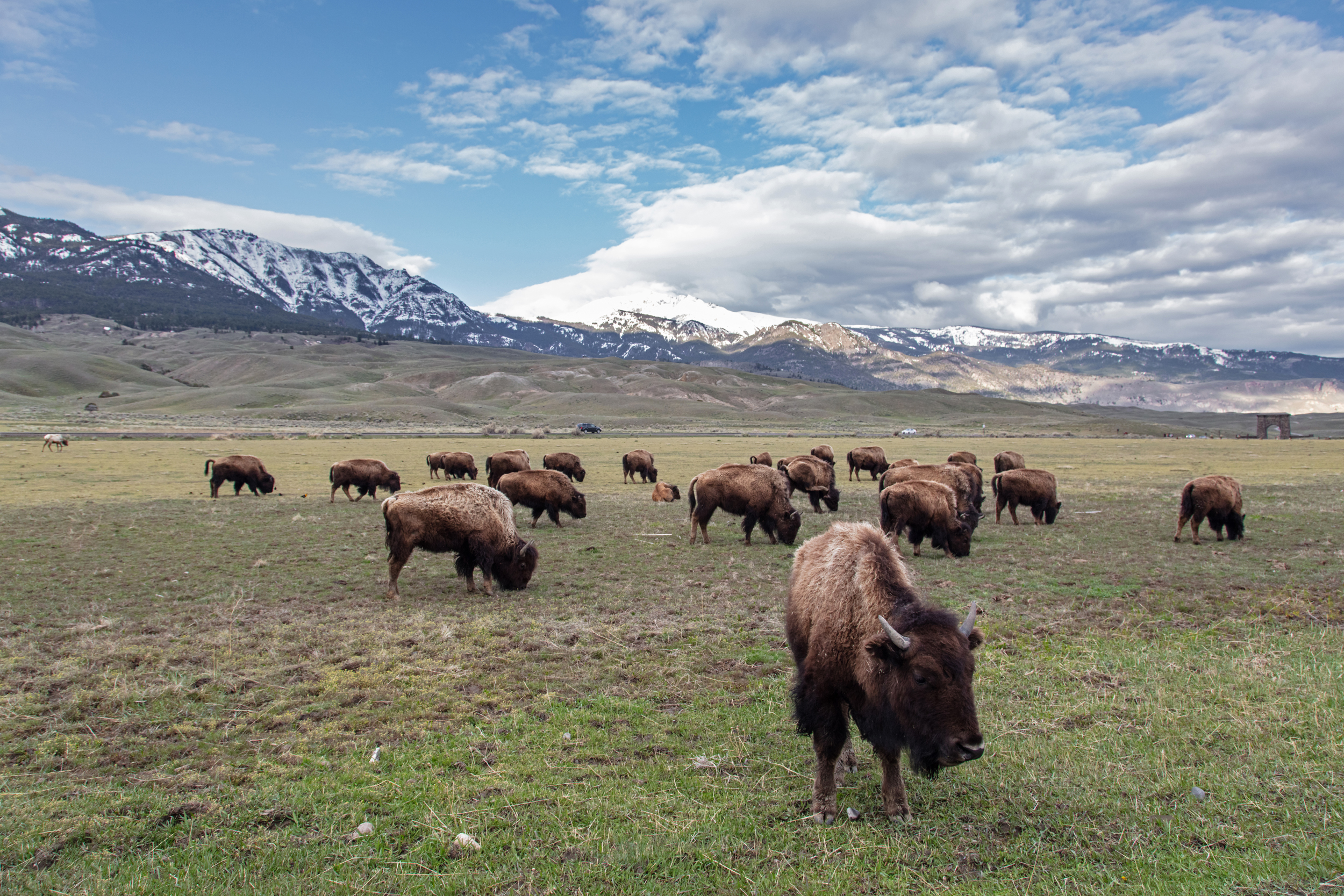
Bison graze near the North Entrance of Yellowstone National Park. Credit: Jacob W. Frank/NPS

Click the link to read the article on the Inside Climate News website (Jake Bolster):

April 9, 2026

A team including scientists, Indigenous people and conservationists point to the ecosystem connecting Yellowstone and the Yukon as an example of a region where humans and nature are flourishing together.

Governments cannot reach their climate goals without rethinking humanity’s relationship to the Earth. 

That is the overarching takeaway from a new paper published [April 9, 2026] in Frontiers in Science by a global team of scientists, conservationists and Indigenous people. The authors examined a set of climate targets from around the world, including the Paris Agreement, through the lens of a “Nature Positive” approach to climate change, in which biodiversity loss is halted and reversed by 2030 compared to a 2020 baseline.

They found that climate progress cannot happen without widespread attempts to increase biodiversity, protect intact ecosystems and reverse ecological damage from centuries of consumption.

For too long, humanity—particularly in the Global North—has viewed the environment as either a resource to mine, or a hindrance to economic growth, said Harvey Locke, the paper’s lead author and a co-founder of the Yellowstone to Yukon Conservation Initiative.

“Nature is essential to the functioning of the Earth system, which is in turn essential to people, and people are essential to the economy,” he said. “That is the hierarchy, nothing else.”

The paper characterized the present global economic order as occurring in the “sweet spot” between competing environmental, societal and economic interests, but says that trichotomy has occurred at the expense of other species and the planet. To maintain a habitable planet, humanity must nest its economy within the limits of Earth’s environment, the authors said.

One of the most severe examples of the current imbalance is climate change, Locke said. 

“We’ve wildly exceeded the planetary boundary for putting CO2 into the atmosphere and we’re wildly destabilizing the Earth system through the destruction of nature,” he said. “Everyone in humanity loses—everyone—if we continue to destabilize the Earth system. And everyone wins if we work toward stabilizing it.”

As an example of how economies can grow while ecosystems are preserved and biodiversity is restored, Locke pointed to the Rockies in North America, particularly the region spanning Yellowstone to Yukon.

According to the National Park Service, the greater Yellowstone ecosystem is “one of the largest nearly intact temperate-zone ecosystems on Earth.”

“We have a wider distribution of bears and wolves and bison today than we did thirty years ago. We have more protected areas now than we did thirty years ago. And meanwhile the human population has flourished in that landscape,” Locke said, “in big measure because people value nature.”

The greater Yellowstone area’s growth has not been without its pains. As more people settle in the mountains, urban and suburban enclaves sprawl into forests, increasing fire risks. Grizzly bears and wolves, while magnates for tourists and their dollars, have also become political lightning rods, with some arguing that their rising populations are exceeding the capacity that the growing human settlements in the area will accept.

“If we don’t grow wisely, we will kill the goose that’s laying the golden egg,” Locke acknowledged. 

The idea that humans are just one cog in nature’s fabulously complex and interconnected machine is an Indigenous premise, said Leroy Little Bear, one of the paper’s authors and a member of the Kainaiwa tribe that resides near the border of Canada and Montana.

If Indigenous groups across the world had more stewardship over ecosystems, species and land management decisions, it would go a long way toward restoring biodiversity and creating societies and economies that are better tailored to Earth’s environment, Little Bear said.

“We come from and operate on the basis of relationships,” he continued. “When you’re related to everything else in the environment, everything out there—the water, the rocks, the trees, the birds—are all animate. So if they’re animate then they all have the same kind of spirits as you have. How would I treat my relatives?” 

But European settlers and their descendents have taken a different approach, he said. “In Western thought, we separate ourselves from nature and to a very large extent, we take the Biblical view that everything is made for the benefit of humans.”

To make their point, the authors collected an “enormous number of references to previous work,” said Cara Nelson, a professor of restoration ecology at the University of Montana who was not involved with the paper. By Daniel Case – Own work, CC BY-SA 3.0, https://commons.wikimedia.org/w/index.php?curid=63321074

“I felt they did a really great job of identifying this inherent property of life on Earth: interconnection and interdependency,” she said.

To help change human economies’ relationship to natural systems, Locke said the Yellowstone to Yukon Conservation Initiative is exploring creating natural asset companies, where the value of the organization is tied to the preservation of nature, not its destruction, so private capital can spur conservation. 

“You basically think about nature like gold. It’s gonna go up in value because it’s perceived to have value,” Locke said. “And we’re not making any more of it.”

Sheep Slot Rapids Firth River Ivvavik National Park Yukon Territory. By Daniel Case – Own work, CC BY-SA 3.0, https://commons.wikimedia.org/w/index.php?curid=63321074

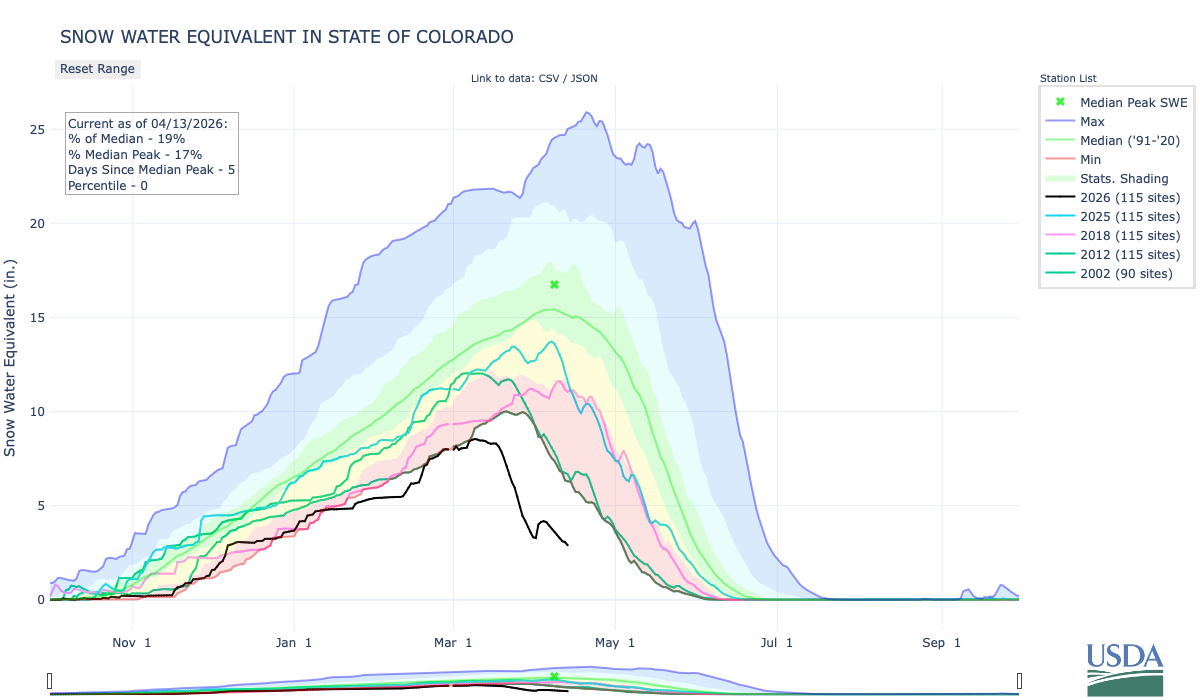
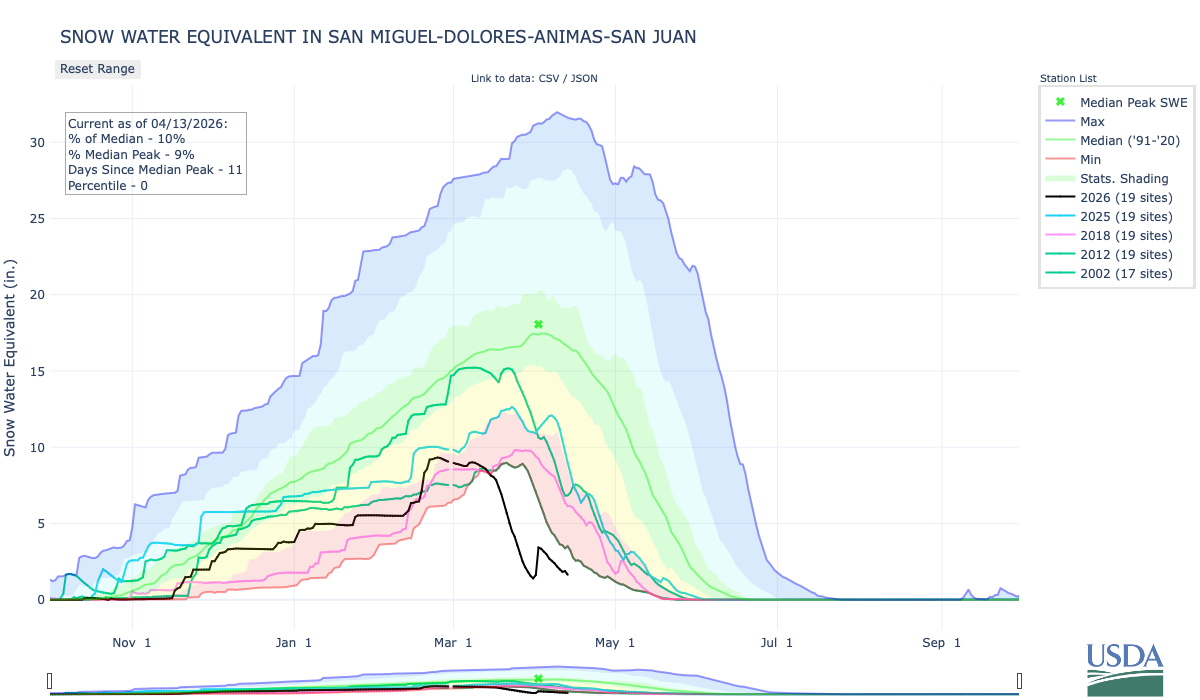
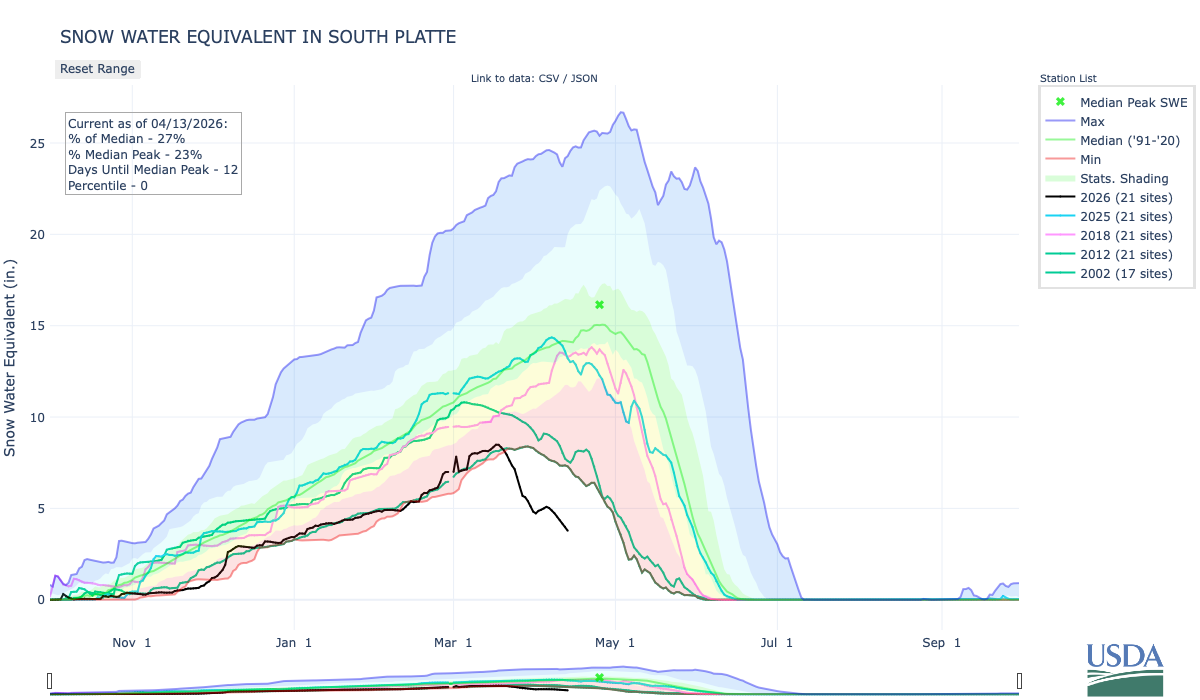
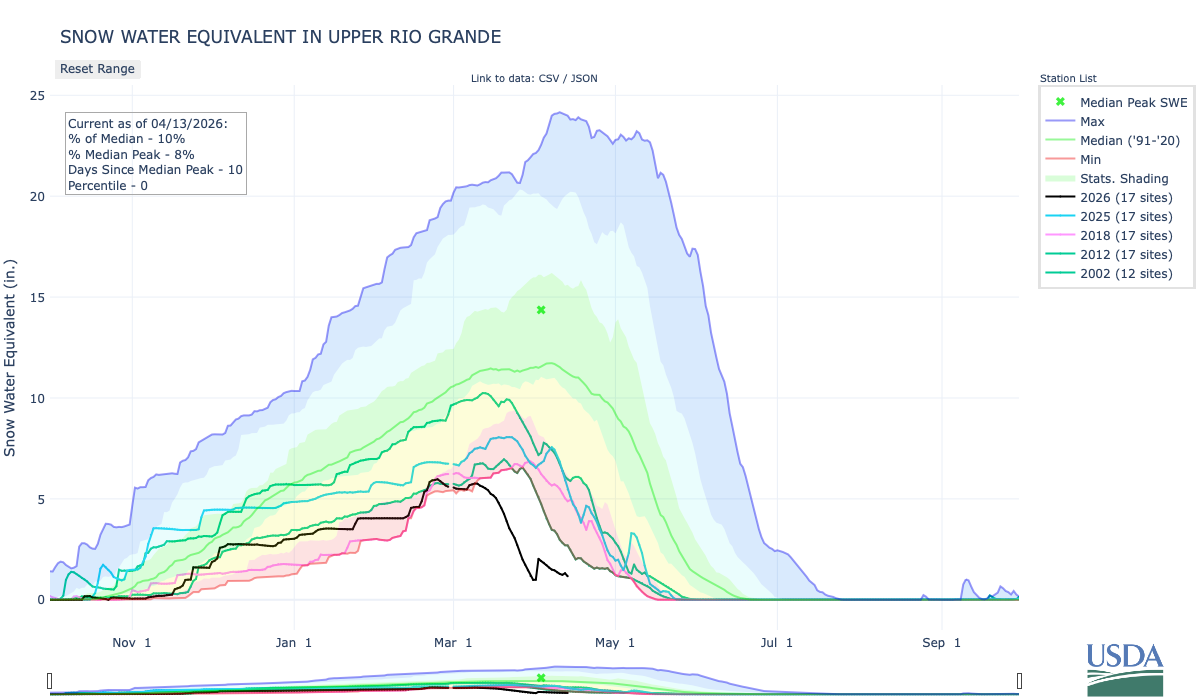
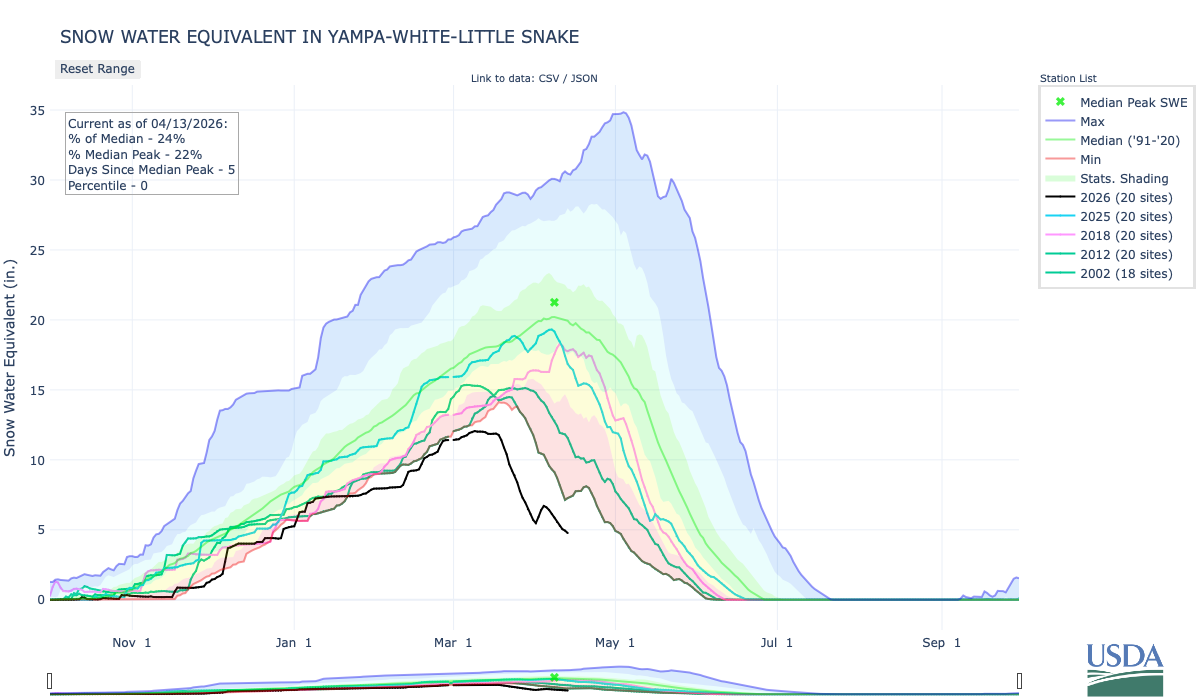
#Snowpack news April 13, 2026

Westwide SNOTEL basin-filled map April 12, 2026.
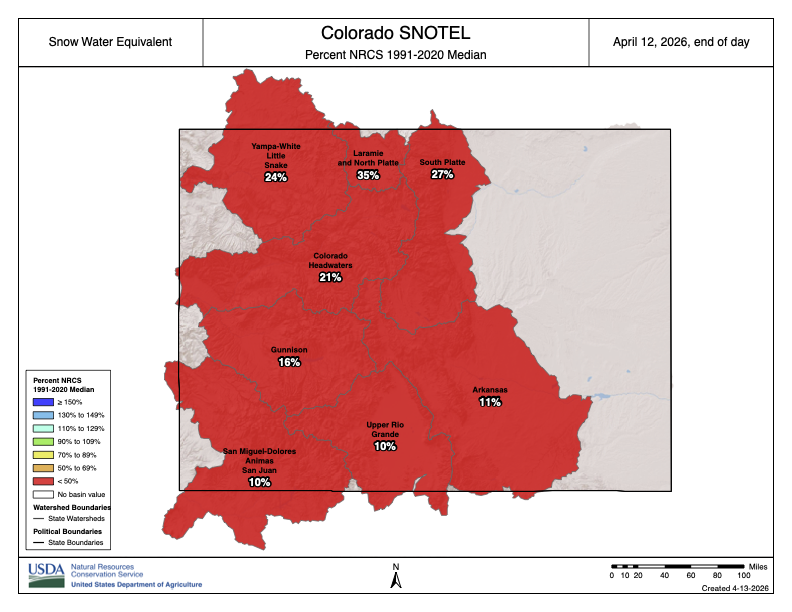
Colorado SNOTEL basin-filled map April 12, 2026.

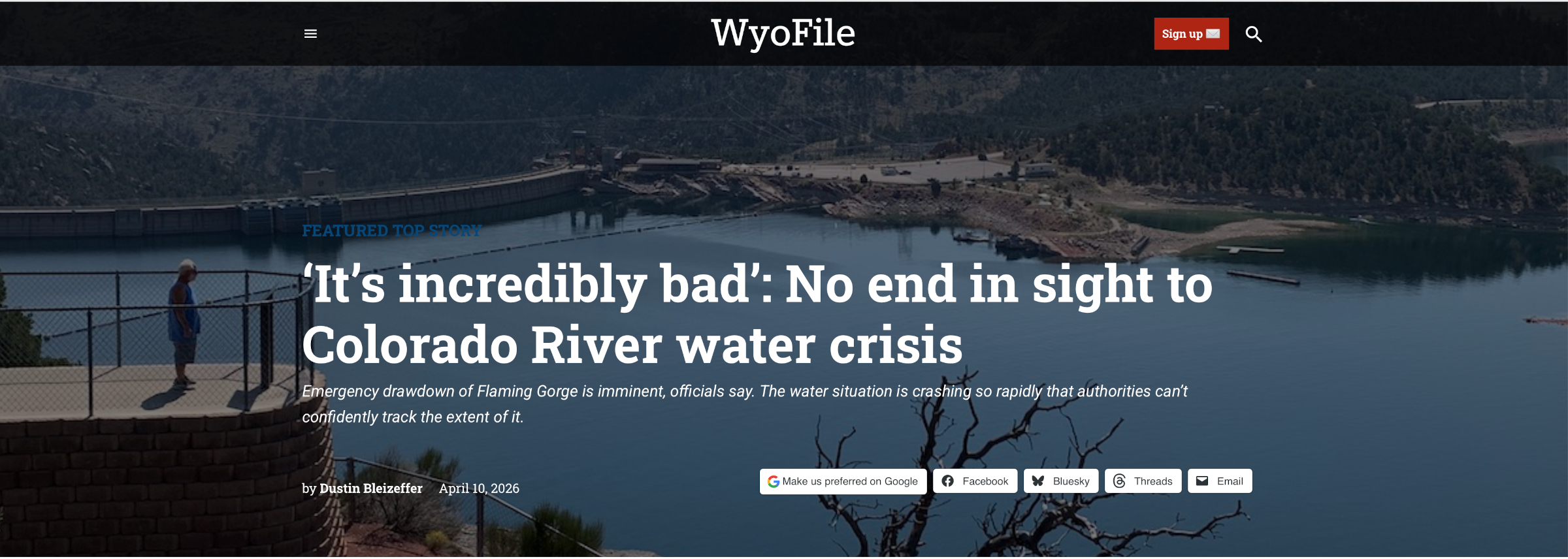
‘It’s incredibly bad’: No end in sight to #ColoradoRiver water crisis. Emergency drawdown of #FlamingGorge is imminent, officials say. The water situation is crashing so rapidly that authorities can’t confidently track the extent of it — Dustin Bleizeffer (WyoFile.com) #COriver #aridification

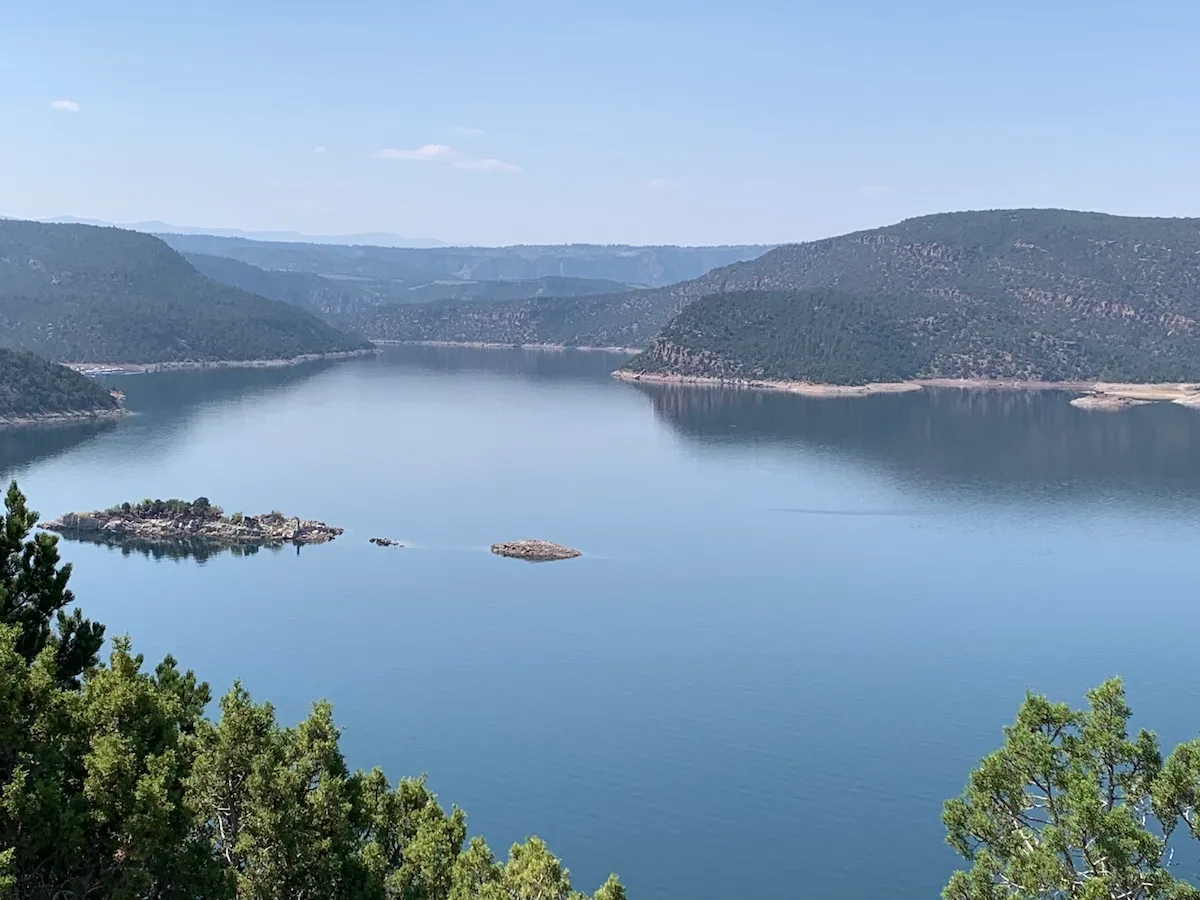
A tourist visits the lower reaches of Flaming Gorge Reservoir in Utah in September 2021. (Dustin Bleizeffer/WyoFile)

Click the link to read the article on the Wyofile website (Dustin Bleizeffer):

April 10, 2026

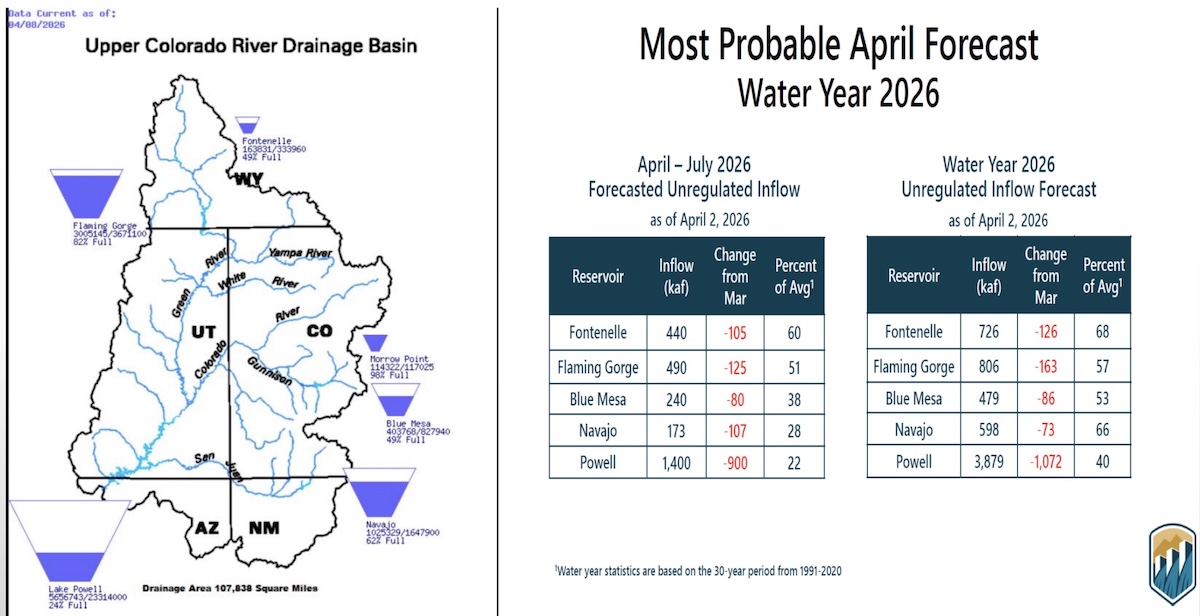
The outlook for the Colorado River, and Lake Powell in particular, continues to worsen due to an historically warm winter and dismal snowpack.

Projections show that Lake Powell on the Utah-Arizona border could drop low enough this year that it stops producing hydroelectric power at the Glen Canyon Dam. If it drops even lower, the dam is in danger of structural failure.

Wyoming relies on some of that hydroelectric power, according to state officials. The state will also play a major, legally obligated role in trying to help prevent such a catastrophe. Primarily, the Bureau of Reclamation will release extra water from Flaming Gorge Reservoir — potentially 1 million acre feet, which is more than a quarter of its storage capacity of about 3.8 million acre-feet.

In addition to recreation and economic impacts at Flaming Gorge on the Wyoming-Utah border — boat ramps may be rendered inoperable — Wyoming officials worry about potential mandatory water use reductions in the southwest corner of the state, as well as potential legal entanglements over a seven-state negotiation that has so far failed to resolve how stakeholders will share the pain of a declining Colorado River.

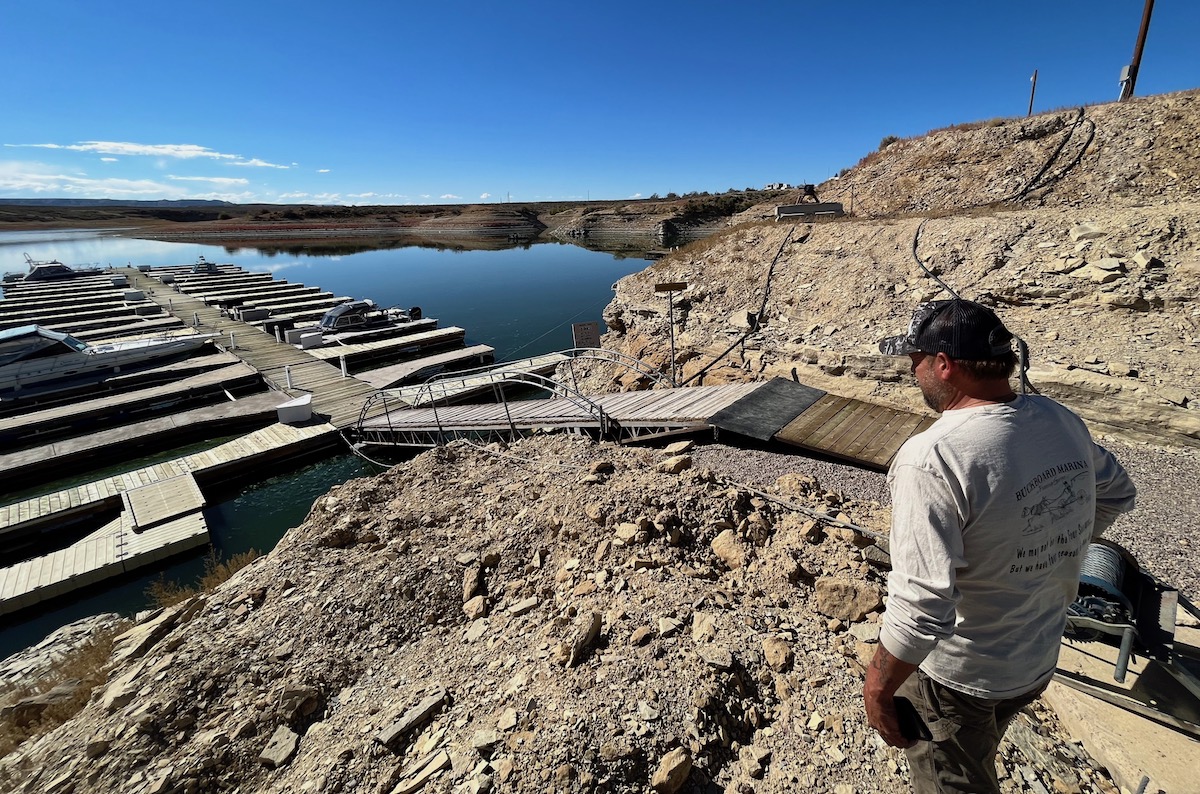
Buckboard Marina owner Tony Valdez, seen here Sept. 26, 2022, says he’s made continual adjustments to boat docks to keep up with lowering water levels at Flaming Gorge Reservoir. (Dustin Bleizeffer/WyoFile)

Adding to frustrations and fears, the water crisis is so severe and crashing so rapidly that stakeholders can’t even track — with confidence — its extent.

“Even though these projections are painting an incredibly dire picture for us, we need to be mindful that runoff might even be worse than what’s being projected,” Wyoming Senior Assistant Attorney General Chris Brown said Friday, adding that dry soil throughout the region is a wildcard in water calculations. “It’s bad. It’s incredibly bad what we’re seeing in the Upper [Colorado River] Basin right now.”

Brown joined Wyoming State Engineer Brandon Gebhart Friday at a Wyoming Colorado River Advisory Committee meeting to provide an update on the crisis (click here to see a slidedeck presented at the meeting).

“The information we’re getting is evolving just about as quickly as the hydrology is declining, so we’re trying to react to what we’re seeing in almost real time,” Brown said. “We don’t know what’s actually going to happen.”

This graphic depicts the “probable” water year for the Colorado River Basin in 2026. (Bureau of Reclamation)

An extra release from Flaming Gorge, which will begin on or before May 1, is a certainty, according to Wyoming water officials. That’s because the reservoir was specifically built to serve as a sort of water bank to ensure legally obliged deliveries to downstream states Nevada, Arizona and California. Among four storage reservoirs in the upper basin, Flaming Gorge has the most — and the most legally unrestricted – water to send downstream to Lake Powell.

“It’s the low-hanging fruit,” Brown said. “It’s the biggest, by far, and it’s got the most available water.”

The reservoir also played a vital backup role for Lake Powell a few years ago. Colorado River authorities released an extra volume of about 465,000 acre-feet of water from Flaming Gorge in 2023.

But this year, even considering decreased releases from Lake Powell to help maintain Glen Canyon dam’s functionality, “anything we do as far as upstream [extra water] releases is not going to be enough,” Brown said.

Flaming Gorge Reservoir on the Utah side near the dam in September 2021. (Dustin Bleizeffer/WyoFile)