Hydropower at risk as #ColoradoRiver outlook grows more dire — AZCentral.com #COriver #aridification

A high desert thunderstorm lights up the sky behind Glen Canyon Dam — Photo USBR

Click the link to read the article on the AZCentral website (Debra Utacia Krol). Here’s an excerpt:

April 17, 2026

Key Points

  • The Colorado River system’s water storage has dropped to 36% of its capacity due to a warm winter and ongoing drought.
  • Water levels in Lake Powell are projected to fall below the minimum needed for hydropower generation by this fall.
  • Federal officials are considering moving water from other reservoirs and reducing downstream releases to prevent a shutdown at Glen Canyon Dam.

Within charts listing projections of water levels, inflow and outflow, and anticipated releases for 15 reservoirs in the Colorado River Basin, one message was clear: The river is in dire straits and conditions likely won’t get better anytime soon. The warmest winter on record, coupled with an ongoing drought, has produced dismal conditions for the West’s water lifeline, conditions reflected by the Bureau of Reclamation in its April 24-month report. The system’s storage has plunged to about 36% of its capacity, the agency said in a statement. More alarming in the near term is the threat to hydropower production at Glen Canyon Dam. Water levels in Lake Powell would drop too low to operate the turbines by fall, according to the latest projections, unless the federal government steps in…The situation at Lake Powell raised red flags: The giant reservoir’s “minimum probable inflow,” a measure of winter runoff, is projected to total just 2.78 million acre-feet, or 29% of the historical average, one of the lowest on record, the agency said. By September, projections show the reservoir could decline to below 3,490 feet above sea level, the minimum needed to power the turbines at Glen Canyon Dam that supply electric service to about 5.8 million households and businesses in the region…

Reclamation said it would consider all tools that are available to avoid water levels below 3,500 feet, including a plan to move water from Flaming Gorge Reservoir in Utah and reduce downstream releases from Powell. Flaming Gorge would give up between 660,000 acre-feet up to 1 million acre-feet over the next year. Lake Powell will release about 1.48 million acre-feet less than planned. The move will lower water levels in Lake Mead and potentially reduce Hoover Dam’s hydropower generating capacity by as much as 40%, and would impact recreation throughout the Lower Basin…

The Arizona Department of Water Resources said in its March drought report that most of the state’s snowpack is gone, melted during Arizona’s warmest March on record. The Arizona Drought Monitoring Technical Committee also published its latest three-month drought map, which showed most of the state listed as enduring exceptional drought conditions, the driest level.

Engineering students aim to improve household drinking water — Jennifer Dimas (#Colorado State University)

Undergraduate research students in Civil and Environmental Engineering collaborage with an employee at the Fort Collins Water Treatment Facility near the CSU Foothills Campus. The students are creating a piece of equipment to better evaluate water for treatment levels. Water samples at the treatment facility flow directly from the Horsetooth Reservoir.

Click the link to read the article on the Colorado State University website (Jennifer Dimas):

April 20, 2026

Editor’s note: The FlocBot team will display its work during CSU’s Engineering Days celebration, called E-Days. The event, held by the Walter Scott, Jr. College of Engineering, showcases undergraduate senior design projects. It will run 9 a.m. to 3 p.m. Thursday, April 23, in the Lory Student Center ballroom and on the Student Center Plaza at CSU. Students from the CSU team are available for interviews during the  2026 E-Days event on April 23 at the Lory Student Center on campus.

The future of safe drinking water might be found in the engineering school at Colorado State University.

Here, a student team has invented a device that automates water sampling and data analysis for the chemical treatment used to produce safe drinking water. Not only have the engineering students developed the technology, but they also have founded a startup company to perfect and commercialize it. Their target market: the utilities that treat municipal water to ensure its safety and quality for household use.

The invention is called FlocBot – named for a process called flocculation. During this process, water treatment plants add coagulants to raw water, causing particles and microorganisms, or “floc,” to clump for easier filtration.

Now, treatment plants perform flocculation and associated data collection manually. FlocBot builds upon existing technologies to automate the process, allowing operators to use their plant’s computer-based infrastructure to receive real-time data; this, in turn, allows them to determine their water’s optimal coagulant dose.

FlocBot will allow plants to more accurately dose coagulating chemicals to optimize floc clumps for filtration. Too few chemicals can allow pollutants to get through filters into drinking water. Too many can also impact drinking water quality, while wasting expensive chemicals and wearing down pipes and filters.

“Our goal is to allow water treatment plants and local governments to produce cleaner, more reliable drinking water while minimizing the environmental impact and saving taxpayer dollars,” said Josh Kates, a CSU senior studying civil engineering. He is co-leader of the 14-member FlocBot team. All are students in CSU’s Walter Scott, Jr. College of Engineering.

The student team visited more than 20 water treatment plants in the span of six months to understand the best way to engineer FlocBot. They have tested the device at the Fort Collins water treatment plant.

FlocBot is a senior design project for the students, who have worked on the project since the start of the academic year last fall. They will present their work alongside dozens of other projects during a campus event called Engineering Days, or E-Days, on April 23.

They have already won a business pitch competition called the I4E Startup Spotlight, sponsored by CSU’s Institute for Entrepreneurship.

As the FlocBot students complete their senior year of engineering studies, they are also building their company to commercialize their technology.

“Starting a business is always risky, but we’re fully committed,” Hugh McCurren, team co-leader, said. “We want to make a positive environmental impact in this industry. Based on conversations with numerous plants and possible customers, we’re optimistic about FlocBot’s potential.”

Aside from #Florida, nearly the entire contiguous U.S. has experienced earlier than average first plant blooms in 2026 — Zack Labe

Aside from Florida, nearly the entire contiguous U.S. has experienced earlier than average first plant blooms in 2026. Earlier springs can cause longer allergy seasons, accelerate wildfire risk, increase pests/mosquitoes, and lead to less reliable snow-fed water.Map: http://www.usanpn.org/data/maps/sp…

Zack Labe (@zacklabe.com) 2026-04-19T19:57:09.003Z

The state of #solar: Despite partisan rhetoric, the industry is still booming — Rebecca Egan McCarthy &  Kate Yoder (Grist.org)

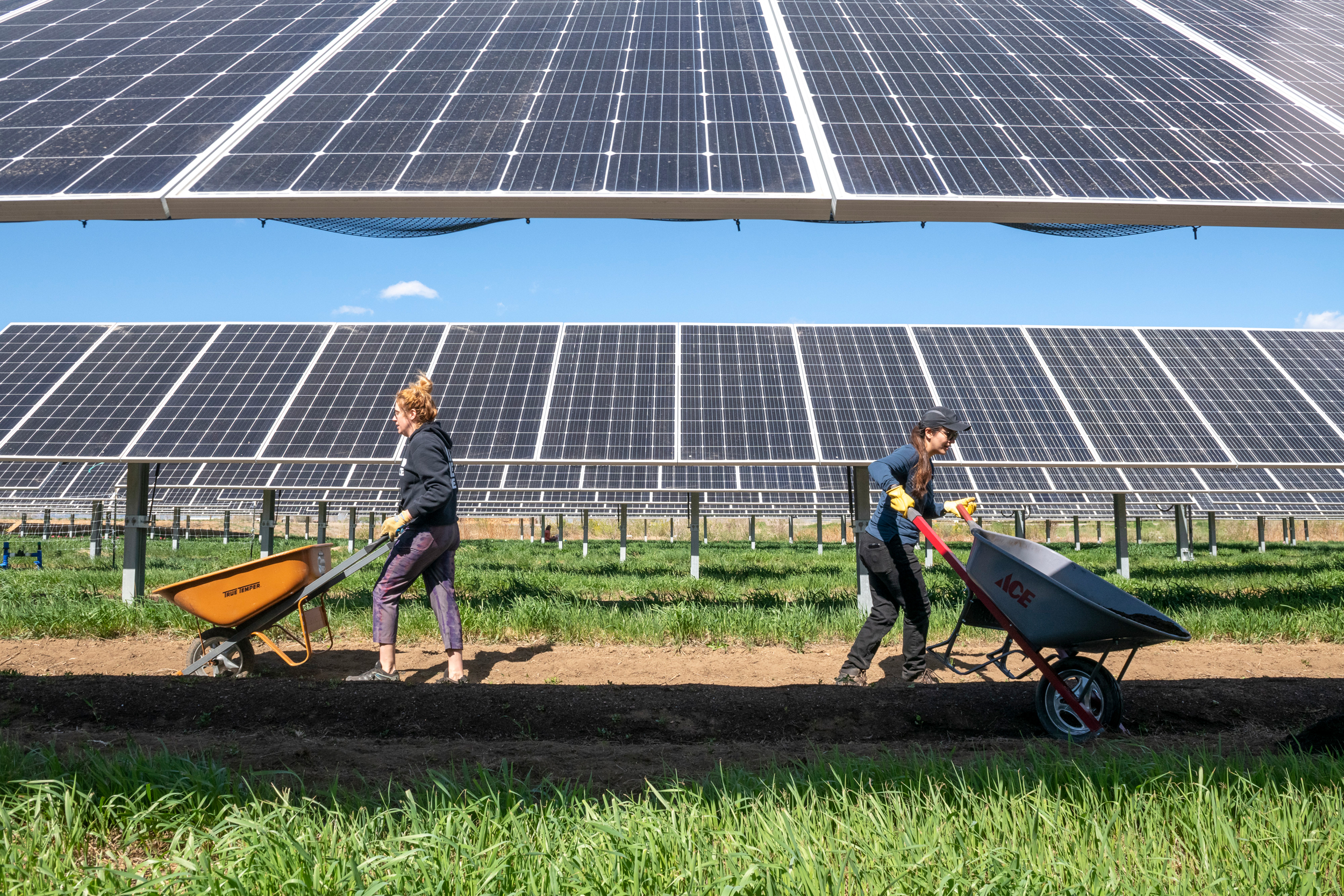
May 6, 2023 – Volunteers with the National Renewable Energy Laboratory’s (NREL’s) ESCAPES (Education, Stewardship, and Community Action for Promoting Environmental Sustainability) program lend a hand to Jack’s Solar Garden in Longmont, Colo. Bethany Speer (left) goes back for more while Nancy Trejo distributes her wheelbarrow load to the agrivoltaic plots. (Photo by Bryan Bechtold / NREL)

Click the link to read the article on the Grist website (Rebecca Egan McCarthy &  Kate Yoder):

April 20, 2026

Solar power is cheap, fast, and in demand as data centers consume more and more electricity.

The future looked dire for renewable energy in the United States last spring. Republicans in Congress started gutting the Inflation Reduction Act, forcing its generous tax credits for wind and solar into an early retirement. The Interior Department then rolled out a series of byzantine regulations aimed at restricting clean energy on federal land. Some feared those regulations would curb wind and solar development on private land, too.

Although these restrictions do seem to have hindered the wind industry, there are some signs that its fortunes are changing. But a year later, solar continues to boom. MAGA influencers are promoting it, there’s hope for legislation that would speed up approvals for new projects, and the industry has continued to expand over the last year as energy requirements from data centers demand fast, cheap power. The Trump administration has even signed off on some big solar projects: In February, the administration announced that it would allow several solar projects that had been blocked by the new Interior regulations to move forward. 

“I feel like there has been so much written that’s like, ‘The Trump administration is delaying this stuff. It’s holding it all up in red tape. Nothing’s getting built,’” said Hannah Hess, director of the Rhodium Group’s Clean Investment Monitor team. “When we look at the data, that’s not true.” Combined, solar and battery storage (which banks excess energy for use when the sun’s not shining) accounted for 79 percent of power generation brought online in 2025 and are expected to continue to grow by 49 percent before the Inflation Reduction Act tax credits expire at the end of 2027. 

Support for solar among rank-and-file-conservatives has fallen in recent years, caught up in partisan culture wars, but it could gain more traction in the party if it’s paired with affordability concerns. Some 69 percent of Republicans say they are supportive of solar, provided it lowered electricity costs, according to a recent poll from the research organizations GoodPower and NORC at the University of Chicago. The Solar Energy Industries Association, the industry’s primary lobbying group, has emphasized that its industry aligns with President Donald Trump’s “energy dominance” agendaand lowers energy costs for families and businesses. “Conservative voters are drawing a clear distinction between rhetoric and practical solutions that lower costs,” read a blog post from the association in February.

Even prominent conservative figures seem to be softening toward solar. Katie Miller, a former Trump administration official and the wife of Stephen Miller, the White House’s deputy chief of staff for policy, has gone so far as to herald solar as the “energy of the future.” In February, she posted to X: “Giant fusion reactor up there in the sky — we must rapidly expand solar to compete with China.” That same month, Energy Secretary Chris Wright, who had been a vocal critic of solar power, started saying it could be beneficial. “Is there a commercial role for solar power that can add to the grid affordable, reliable energy?” he said. “Certainly there is.” 

Data center developers have begun looking to solar as a complement to oil and gas, rather than a competitor. The incoming demand “feels crazy,” said Jim DesJardins, executive director of the Renewable Energy Industries Association of New Mexico. “It’s scary, almost. Five years ago, we were talking about an increase in load from EVs and building electrification — we’re not talking about that anymore. It’s all data centers and how are you going to power them.” This year marked the first time, said DesJardins, that the New Mexico Oil and Gas Association reached out to sponsor the renewable energy association’s annual conference.

Solar is, by far, the cheapest and fastest way to bring energy online, especially as the shortage of gas turbines — internal combustion engines that convert fuel into a steady, reliable energy — in the U.S. creates yearslong delays to build new power plants that run on natural gas. [ed. emphasis mine] The technology is crucial for data centers that need to run 24 hours a day, seven days a week. “The backlog alone [for turbines] is five to nine years,” said Mike Hall, CEO of Anza Renewables, an energy intelligence and procurement platform based in California. “Then you’ve got to permit it. Then you’ve got to be near a gas pipeline for fuel, and then you’ve got the climate and the carbon issues.” A recent study from the analytics company Sightline Climate found that half of data center deals were expected to be delayed due to power constraints and local opposition, and developers are beginning to realize that waiting in line for a gas turbine could spell doom for their operation. 

There are still some obstacles ahead for solar power, however. “We’ve definitely seen examples from our developer customers where the Department of Interior rules are creating challenges for their projects on federal land, but we haven’t seen that it’s really slowed down development on private land,” said Hall. “The bottlenecks are typically still local permitting and interconnection with utilities — those are still major challenges, and we haven’t seen a lot of improvement in either area yet.”

Shortly before Congress adjourned for its winter recess in December, the House passed the Standardizing Permitting and Expediting Economic Development Act, also known as the SPEED ACT, a bipartisan bill that would streamline the permitting process for energy, infrastructure, and transportation projects by overhauling the National Environmental Policy Act, or NEPA. Signed by President Nixon in 1970, NEPA requires federal agencies to consider how proposed infrastructure projects or drilling permits would affect the environment before approving them. Permitting reform is the rare, bipartisan issue that has sparked real enthusiasm on both sides of the aisle. 

After a scuffle over the Trump administration’s decisions to shut down offshore wind projects, which judges ruled invalid, Democratic senators Martin Heinrich and Sheldon Whitehouse are coming back to the negotiating table to hammer out a deal. “Right now, we’re leaving electrons on the table thanks to Trump’s deliberate attacks on clean energy — forcing Americans to pay higher electricity bills,” Heinrich’s office told Grist. “To lower costs, this administration needs to stop stalling and slow walking clean energy projects and take the politics out of permitting reform.”

The war in Iran, which has caused oil prices to skyrocket, may serve to boost interest in solar power even more — especially as a way to combat rising electricity costs and promote energy independence. “Energy poverty has always been a problem in the U.S., and it’s gotten significantly worse in recent years,” said Brad Townsend, vice president of policy and outreach at the Center for Climate and Energy Solutions, an environmental policy nonprofit. He pointed to a study from the nonprofit RMI, formerly the Rocky Mountain Institute, that found 1 in 3 households were struggling to pay their utility bills. “I think folks in the administration are increasingly becoming aware of the fact that we can’t turn away renewable energy.” 

In terms of the geopolitical reasons to support solar, “no one has fought a war over the sun,” DesJardins told Grist. “Not yet, anyways.” 

Indian Peaks Band of the Paiute Indian Tribe of #Utah Files to Protect Tribal Water Rights — Native American Rights Fund

Click the link to read the article on the Native American Rights Fund website:

April 17, 2026

On April 1, 2026, the Indian Peaks Band of the Paiute Indian Tribe of Utah, represented by the Native American Rights Fund, filed a Notice of Appeal and Petition for Stay with the U.S. Department of the Interior, Office of Hearings and Appeals, Interior Board of Land Appeals (IBLA), challenging the Bureau of Land Management’s March 2, 2026, approval of the Pine Valley Water Supply Project.

The filing seeks review of BLM’s decision authorizing a large‑scale groundwater extraction and pipeline project in southern Utah and asks the IBLA to stay the project approvals while the appeal is pending. The Band argues that the decision violates federal law, including the National Environmental Policy Act, and unlawfully threatens the Band’s federally reserved water rights and culturally significant resources.

The Band’s former Reservation, which is on the ancestral lands of the Band, is located just a few miles west of the Pine Valley Water Supply Project’s proposed wellfield. The amount of water that the Cedar Valley Water Conservancy seeks to extract from the Pine Valley exceeds the amount of water available and will harm the Band’s water resources.

“These water resources are fundamental to our Band’s history, culture, and future,”said Chairwoman Tamra Borchardt-Slayton of the Indian Peaks Band of the Paiute Indian Tribe of Utah. “Federal law is clear that the Band’s water rights must be protected, and we are asking the Interior Department to do just that.”

The Indian Peaks Band holds federally reserved water rights associated with its former reservation lands under longstanding federal law. Those rights, which predate many other uses of water in the region, remain protected today and cannot be impaired by federal agency action. The appeal asserts that BLM failed to adequately consider these rights or uphold its federal trust responsibility to Tribal Nations before approving the project.

“Federal agencies have both a legal and moral obligation to protect Tribal water rights,” said NARF Staff Attorney Tom Murphy. “This appeal seeks to ensure that those obligations are honored for the Band’s water rights.”

The appeal and petition for stay were filed pursuant to 43 C.F.R. Part 4, which governs administrative appeals of BLM decisions. If granted, the stay would preserve the status quo and prevent construction or further project commitments while IBLA considers the merits of the appeal.