How Guaranteed Utility Profits are Draining Ratepayer Wallets

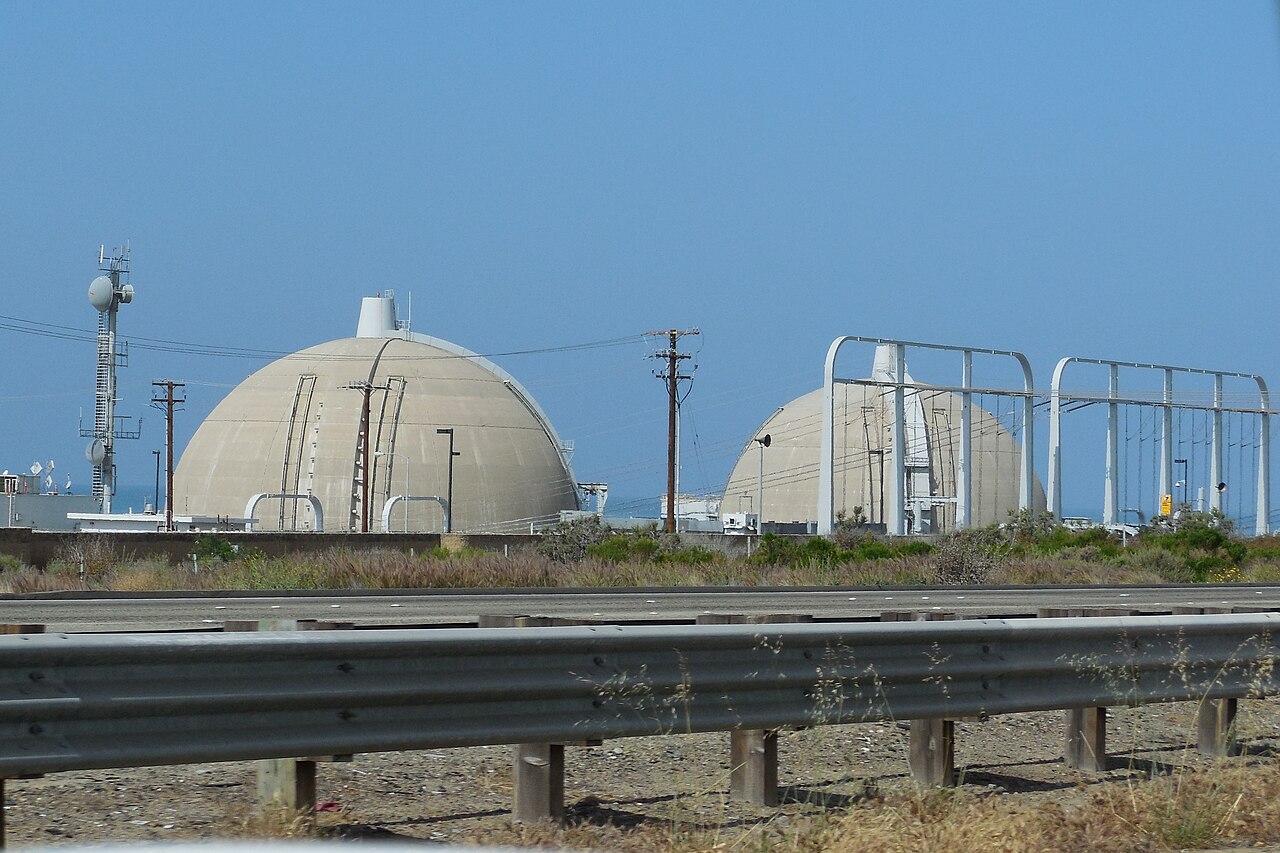
Two large dome-shaped structures of a power plant, with communication towers and power lines in the foreground, under a clear blue sky.
IllaZilla, CC BY-SA 4.0 https://creativecommons.org/licenses/by-sa/4.0, via Wikimedia Commons

by Robert Marcos

In 2013 Southern California’s San Onofre Nuclear Generating Station was retired eleven years ahead of schedule. This was because of severe, premature wear in the tubes of its replacement steam generators that led to a radioactive leak and made the cost and regulatory uncertainty of a full repair unfeasible for its operators.1 Worse, the closure occurred just after ratepayers in San Diego, Orange, and Riverside Counties had spent $1.88 billion for an overhaul of the plant.2 A year later the California Public Utilities Commission approved a $4.7 billion settlement where ratepayers were made responsible for approximately $3.3 billion of the plant’s closing costs, to be paid over a 10-year period.3

Ratepayers continued to pay for “undepreciated net investments” in the retired nuclear plant—essentially paying off the remaining debt for construction and equipment that had not yet been fully depreciated before the early shutdown. Even after the shutdown, utilities were allowed to collect funds for maintaining safety and security at the retired site.4

The San Onofre debacle illustrates how utilities use regulatory “cost recovery” and “stranded asset” mechanisms to pass billions in losses from failed or retired facilities onto ratepayers. Nationally, this system allows investor-owned utilities to maintain profits even after large projects fail, as seen with coal plant retirements and canceled transmission lines.5

How Ratepayers get Soaked for closed power generation facilities

Utilities nationwide use several key tactics to recover costs from assets that no longer produce power:

Stranded Asset Recovery: When a plant like San Diego’s San Onofre Nuclear Power Plant shuts down prematurely, utilities often seek to recover their remaining “undepreciated investment”. For San Onofre, a controversial settlement originally placed $3.3 billion of the $4.7 billion shutdown cost on ratepayers over 10 years.6

Guaranteed Returns on Failed Investments: Utilities typically enjoy built-in profit margins (often around 9-10%) on their infrastructure investments. Even after a plant is shuttered, they may continue to collect these returns. In the San Onofre case, regulators eventually reduced the shareholder return to less than 3% for the retired assets, which still left customers paying for the principal investment.

Replacement Power Costs: When a major facility goes offline, utilities must buy electricity from elsewhere. Ratepayers often bear these “purchased power” costs. San Diego and Southern California customers saw estimated costs of $350 million to $1.1 billion just for replacement electricity following the San Onofre outage.

Decommissioning Surcharges: Long-term cleanup and waste storage costs are frequently funded through special ratepayer-backed accounts. Decommissioning San Onofre is estimated to cost $4.7 billion, much of which was pre-funded by customers during the plant’s operating years.

The “Uneconomic Dispatch”

This model extends beyond nuclear power to fossil fuels and infrastructure:

Coal Plant “Uneconomic Dispatch”: Utilities nationwide continue to run expensive coal plants that cannot compete with cheaper gas or renewables because they can recover fuel and operation costs from customers. This “uneconomic dispatch” cost U.S. consumers an estimated $24 billion from 2015 to 2024.

Securitization: Some states use “securitization”—issuing low-interest bonds to pay off a utility’s remaining investment in a closed plant. While this can lower customer bills compared to standard utility returns, it still ensures the utility is paid in full for a non-working asset.

Failed Infrastructure: Similar to the faulty steam generators at San Onofre, ratepayers have been held responsible for abandoned projects like PG&E’s scrapped transmission line to Canada ($20 million) and Duke Energy’s retired Crystal River nuclear plant in Florida ($1.3 billion in bonds).
The Pagosa Area Water and Sanitation District approves updated #drought plan — The #PagosaSpringsSun #SanJuanRiver

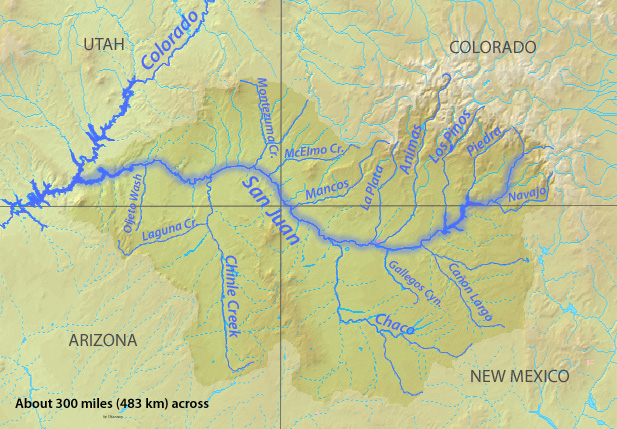
San Juan River Basin. Graphic credit Wikipedia.

Click the link to read the article on The Pagosa Springs Sun website (Josh Pike). Here’s an excerpt:

April 22, 2026

At an April 9 meeting, the Pagosa Area Water and Sanitation District (PAWSD) Board of Directors approved revisions to the district’s drought management plan. District Engineer Justin Ramsey opened discussion of the plan, which he explained was a complete rewrite of the previous plan and was adopted in 2020 with a stipulation that it be reexamined in 2026. He added that the district also had to implement the plan in 2025 due to dry conditions, which gave additional insights into how the plan functions. He explained that he recently reconvened the committee that drafted the plan, including PAWSD board members, water experts in the community, business owners and other community members. Ramsey stated that, although there were some changes recommended to the plan, it has, overall, been highly successful. He explained that the drought stages outlined in the plan are entered based on triggers, which are different depending on the time of year.

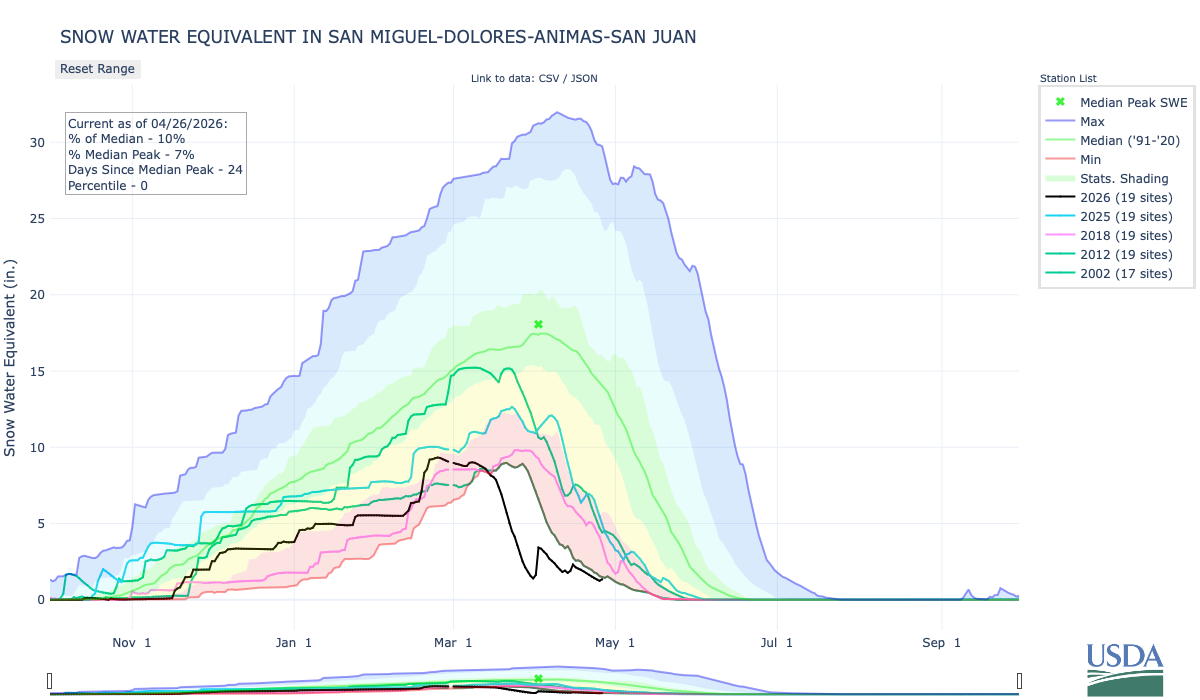
Early in the year, he stated, the triggers are the snowpack in the mountains, measured by the amount of snow water equivalent (SWE) at the U.S. Natural Resources Conservation Service SNOwpack TELemetry Network (also commonly known as SNOTEL) station on Wolf Creek Pass and the date when the district’s water supply is cut off on Four Mile Creek due to other senior water users diverting water…If specific SWE levels or a call on Four Mile do not occur by specific dates in the spring, the plan shifts to a different set of drought triggers based on water levels in Lake Hatcher (one of PAWSD’s primary reservoirs), water flows in the San Juan River and the drought stage for Archuleta County designated by the National Integrated Drought Information System (NIDIS). He explained that the amount of water in Lake Hatcher is weighted the most heavily, with flows in the San Juan being the next most influential factor and drought designation being the least. He added that the different drought stages come with different drought surcharges and water rate adjustments…He explained that the first drought stage (voluntary drought) aims to cut water use by 10 percent, while the most severe drought stage (stage four) is intended to cut water use by 50 percent.

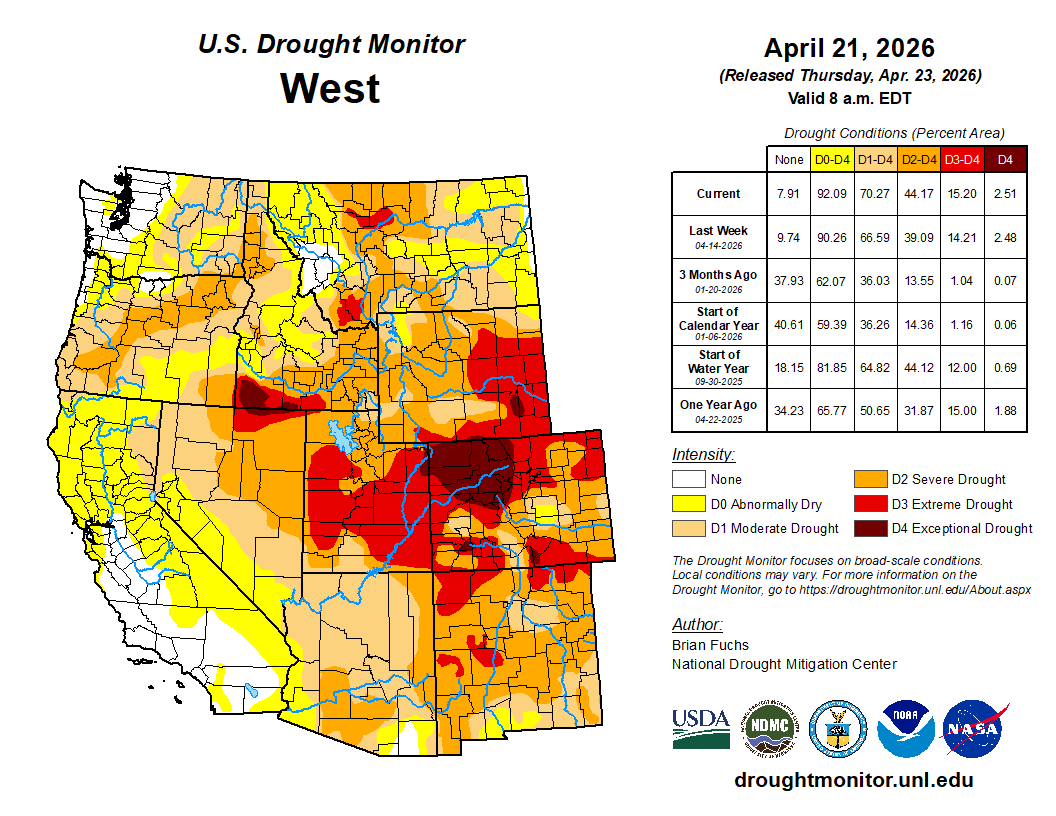
West Drought Monitor map April 21, 2026.

The Pagosa Area Water and Sanitation District enters Stage 1 #Drought: New watering restrictions imposed — The #PagosaSprings Sun #SanJuanRiver

Click the link to read the article on the Pagosa Springs Sun website (Josh Pike). Here’s an excerpt:

April 22, 2026

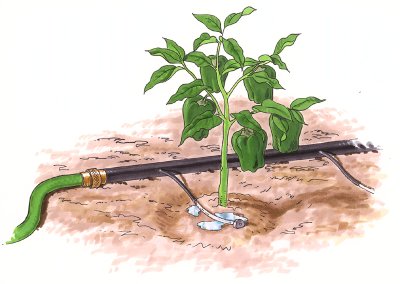
On April 22, the Pagosa Area Water and Sanitation District (PAWSD) entered stage one drought under its drought mitigation plan, imposing new restrictions on irrigation and rate multipliers for high water use. The district’s drought plan calls for Conservation Service SNOwpack TELemetry Network (SNOTEL) site reaches zero between April 17 and May 1. SWE fell to zero on April 22, triggering stage one drought, according to PAWSD District Engineer Justin Ramsey. During drought stage one, irrigation is permitted only between 6 p.m. and 9 a.m., and residential customers who use more than 5,000 gallons of water a month will have a 1.25 times rate multiplier applied to their water bills. According to the PAWSD website, the imposition of this multiplier will begin to impact customer bills received in May, although the irrigation restrictions will start immediately. The plan notes that gardens may be hand watered using a hose or drip irrigation.

Drip irrigation graphic via Sonoma County Nurseries Resource