
The Ship Needs a Captain: A call for leadership in the #ColoradoRiver Basin —  Page Buono and Sinjin Eberle (AmericanRivers.org) #COriver #aridification

Banks of Lake Powell, Arizona in March 2026 | Page Buono

Click the link to read the article on the American Rivers website (Page Buono and Sinjin Eberle):

March 18, 2026

The situation is clear: the precipitation outlook in the Colorado River Basin is dire, the river cannot sustain the demands placed on it, and this year we’re likely to face unprecedented management decisions with potentially catastrophic consequences.

Despite decades of warnings and years of negotiations, there remains no clear blueprint for how the West can live with less water. That future is no longer hypothetical—it is already here.

Lake Powell’s drastically low water levels are evident in the discoloration of ancient cliffs that were submerged for decades, often referred to as “the bathtub ring” in March 2026 | Page Buono

We often talk about the Colorado River and drought in ways that can feel removed, impersonal, abstract, and buried in jargon. But beneath the stories, there are real lives, livelihoods, ecosystems, and traditions that make the region what it is, and that are very much at stake. 
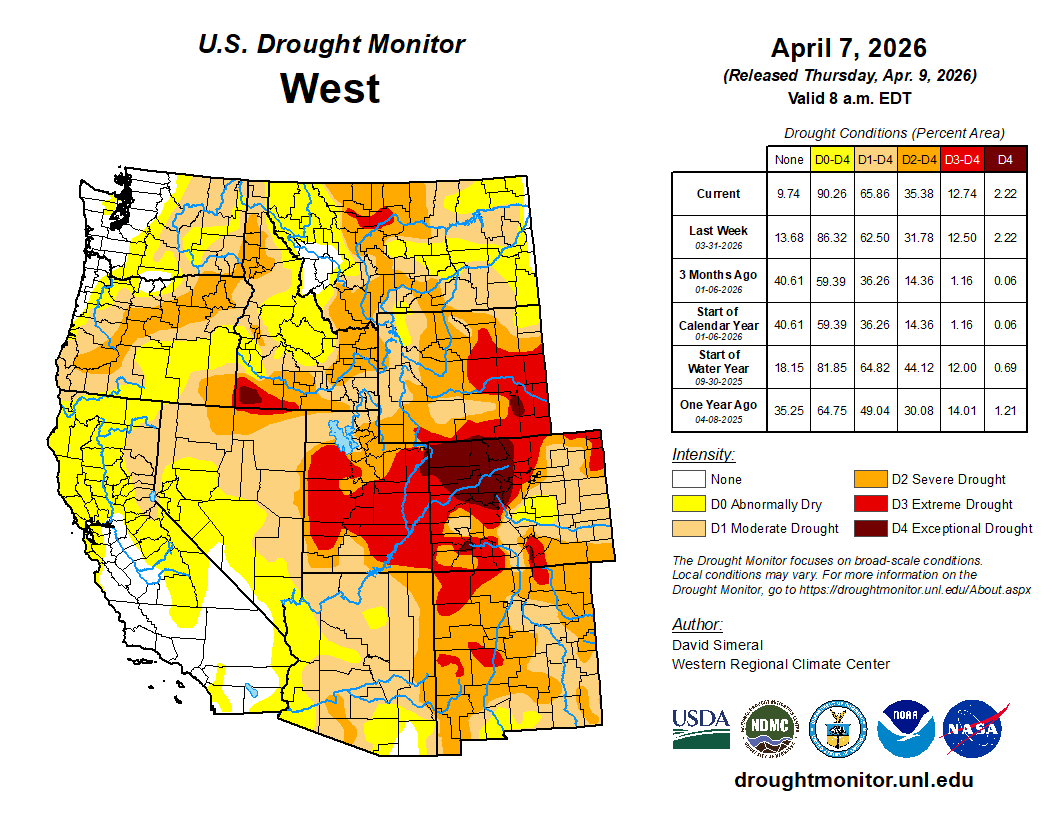
West Drought Monitor map April 7, 2026.

On March 3, for example, the US Drought Monitor released their latest report, revealing that “snow water equivalent” is less than 70% of normal across the Central Rockies, and less than 50% in the Four Corners. 

Snow water equivalent is essentially how the water in the snow translates to real, wet water – the kind rivers and people rely on. By some accounts, the prediction for this year’s total is now on par with – and potentially worse than – 2002, which previously held the record for one of the worst water years on the Colorado River. For those who live in the region, the catastrophic wildfires of 2002 are not abstract: the Hayman fire burned for over a month, killed six people, destroyed more than 600 homes, and amounted to estimates of $42 million worth in damages. That same year, Arizona experienced the Rodeo-Chediski fire, which burned nearly half a million acres.

But it isn’t just one fire in one year – throughout the Southwest and in California, regions are experiencing some of the largest, most catastrophic wildfires in history, and they’re occurring much more frequently.

Map of the Colorado River drainage basin, created using USGS data. By Shannon1 Creative Commons Attribution-Share Alike 4.0

The Salton Sea is a Paradox

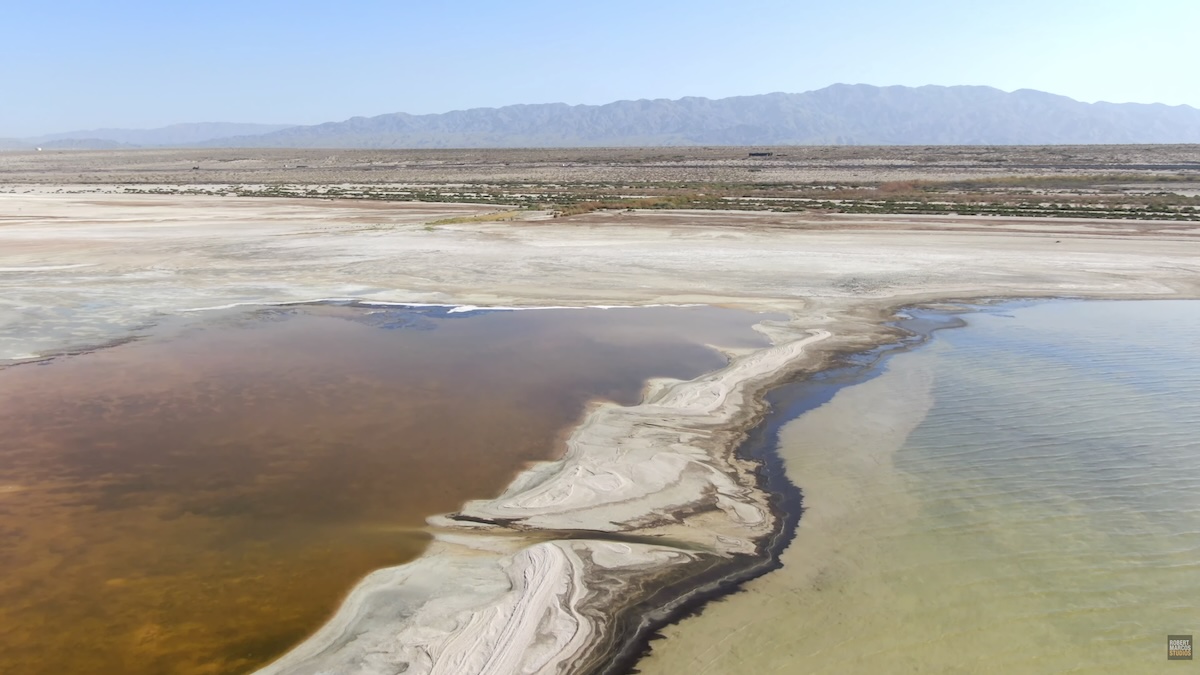
Aerial view of a salt flat with contrasting colors of water and land, surrounded by mountains in the distance.
Algae blooms colorize Salton Sea water along its northern shore, at Salt Creek. Aerial photo by Robert Marcos.

by Robert Marcos, photojournalist

The Salton Sea is a paraodox for a multitude of reasons. The most striking is that the Salton Sea can exist only as long as the Imperial Valley continues to drain 1.3 million acre feet of salt and pesticide-laden runoff into it, annually. That’s exactly how much the Sea loses to evaporation every year. So ironically, the more Colorado River water that’s conserved by Imperial Valley’s farmers the faster the Salton Sea is going to dry up.1

Fact: In 1924 the federal government officially designated the Salton Sea as a permanent repository for agricultural drainage, which authorized the Imperial Irrigation District to use it as a drainage basin for irrigation runoff. This was necessary because increasing salt levels in the soil were threatening to put thousands of acres of highly-productive farmland out of production.2

The Imperial Valley functions as a critical “winter salad bowl” for the United States, yet this massive agricultural output creates a severe environmental health paradox for its residents. While intensive farming produces millions of tons of vegetables, it relies on practices like agricultural burning and heavy pesticide application that release fine particulate matter and toxic chemicals into the air. This pollution is compounded by a shrinking Salton Sea, which acts as a basin for agricultural runoff; as it dries, it exposes toxic lakebed dust containing arsenic and pesticides that wind then carries into local communities. Consequently, children in the Imperial Valley suffer from asthma at rates nearly double the California state average, with roughly one in five children diagnosed—a direct cost of the region’s agricultural success borne by its most vulnerable residents.3

The Salton Sea’s Top 10 Contradictions

  1. It’s a vital yet highly-polluted refuge: The Sea acts as a critical Pacific Flyway habitat for millions of birds, yet it is highly contaminated with agricultural toxins, heavy metals, and selenium.
  2. Sustained by Wastewater: The lake requires constant inflow of polluted farm drainage (tailwater) to survive; restricting this agricultural runoff is necessary for water quality but speeds up its drying.
  3. Agriculture vs. Air Quality: Farming irrigation sustains the lake, but as water efficiency increases, less water reaches the sea, accelerating the exposure of dry lakebed (playa) and the resulting toxic dust storms.
  4. Species Management vs. Habitat Collapse: State agencies work to protect endangered species, but the increasing salinity is killing the fish and food sources those species need.
  5. Environmental Destruction as Restoration: Major restoration projects often involve breaking up existing, albeit shrinking, habitats to create smaller, managed ponds.
  6. Terminal Lake Reality: It is a closed basin that cannot flush itself, meaning all contaminants from decades of agriculture are trapped and concentrated indefinitely.
  7. Water Transfers vs. Regional Health: The Quantification Settlement Agreement (QSA) transfers water to urban areas, reducing inflows to the sea and damaging local communities’ health for external economic gain.
  8. Natural vs. Artificial Conflict: It is managed as a wildlife refuge but was created entirely by a catastrophic engineering failure of a canal, resulting in a fragile “artificial” ecosystem.
  9. Salinity vs. Stability: Efforts to reduce nutrient inflow (to curb algae) can lead to faster shrinking, while allowing nutrients causes massive fish die-offs and odor.
  10. The “Green” Paradox: Developing the area for green energy—namely lithium extraction—requires long-term stability in a region deemed too dangerous for human health due to toxic air.