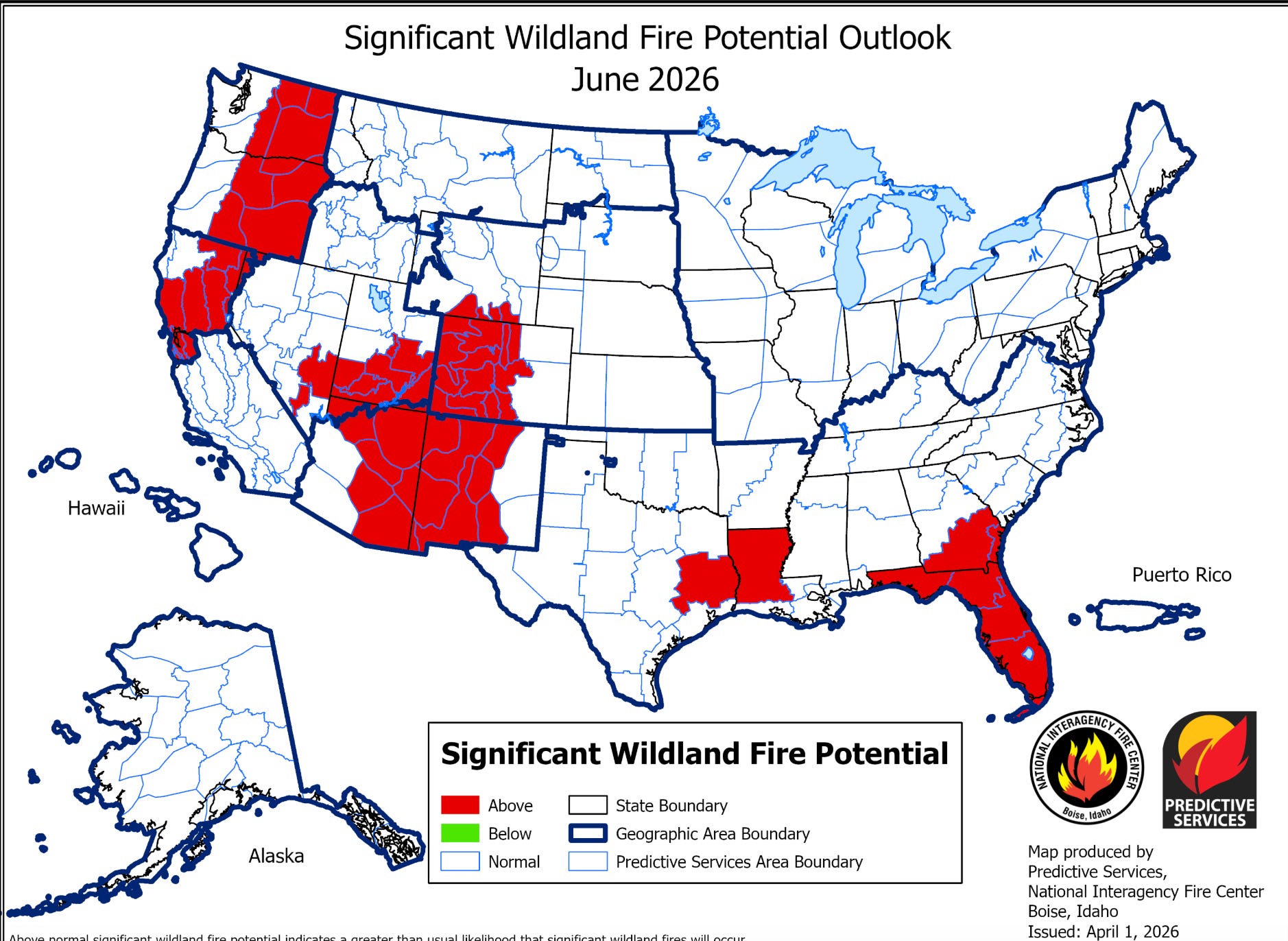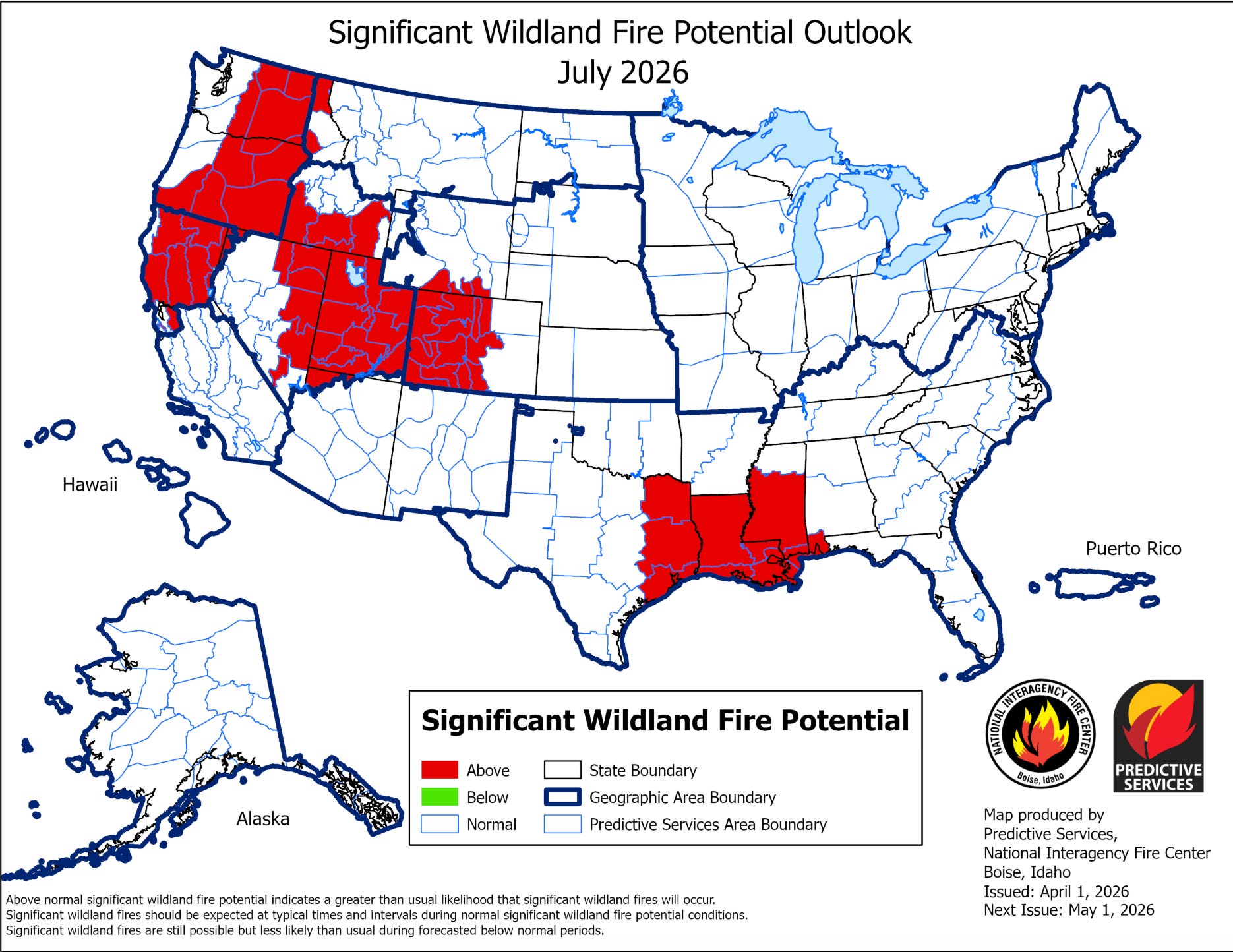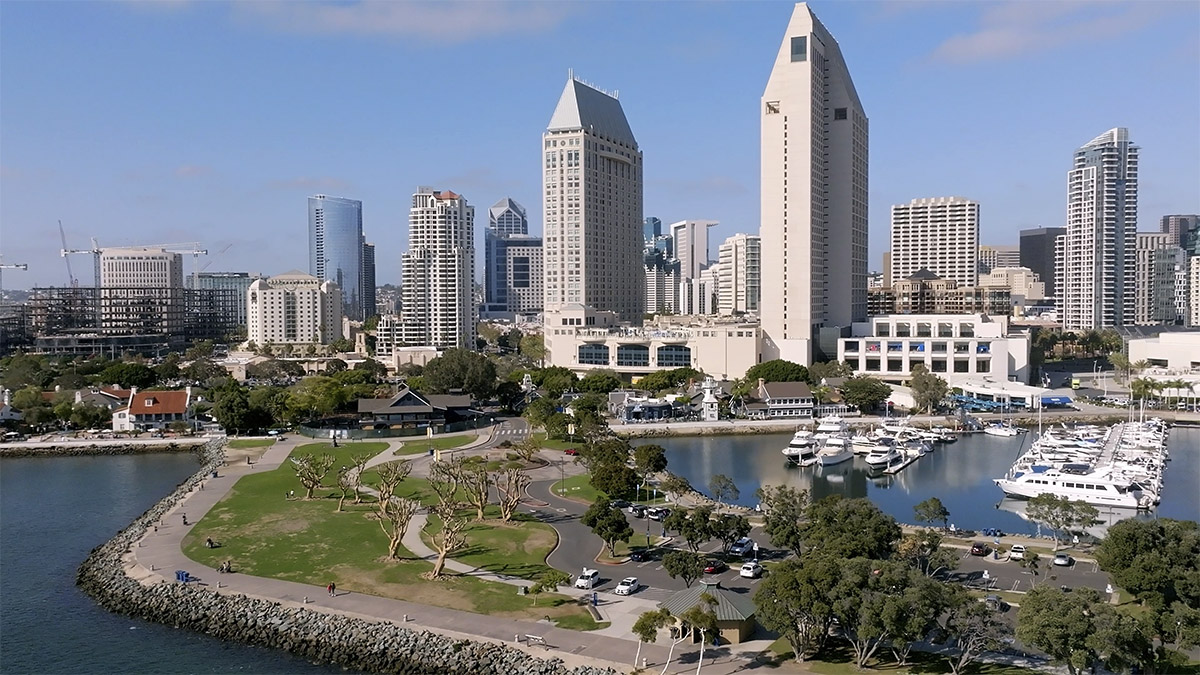
San Diego’s Embarcadero Park. Photo provided by Storyblocks.
by Robert Marcos
There’s a 33-to-1 disparity in the cost of Colorado River water that’s being utilized by the residents of San Diego, versus the residents of Brawley – both of which are in Southern California and are just 97 miles away from each other. The disparity stems from differences in two primary areas: water rights and conveyance. San Diego’s municipal water rates – which are the fourth highest for a major city in the United States, are also inflated by the city’s massive investment in recycling and desalination.
Brawley’s Senior Water Rights
Residents of Brawley are served by the Imperial Irrigation District, which holds some of the most senior water rights on the Colorado River, in particular among major users. The IIDs rights predate the 1922 Colorado River Compact and fall under “present perfected rights” which make them an exceptionally high-priority. The IID holds rights to approximately 3.1 million acre-feet of Colorado River water annually, making them the largest single user of Colorado River water.1
It’s also worth noting that the IID pays nothing for the 3.1 million acre feet of water they’re entitled to. They do however pay multiple-millions of dollars for the operation and maintenance of California’s Imperial Dam, and the All-American Canal. Farmers and residents of the Imperial Valley pay only $20 per acre-foot for the water itself, since they only need to cover local delivery costs.2 Meanwhile San Diego, which does not have senior rights must buy water at market rates. Beginning in 2026 San Diego pays the Metropolitan Water District $671 per acre-foot of water—33 times what Brawley pays for the same water.
Infrastructure and Transportation
The city of Brawley is adjacent to the All-American Canal, so it requires a minimal amount of infrastructure to move the water into town. Whereas San Diego’s imported water utilizes two large canal systems: The Edmund G. Brown California Aqueduct from the State Water Project, and the Colorado Aqueduct that travels 242 miles from Lake Havasu in the east. San Diego – in the face of chronic drought and the increased stress of climate change on imported water sources, has made long-term commitments to making water conservation a permanent way of life. Historically dependent on importing up to 90% of its water from the Colorado River and Northern California, the region is now aggressively diversifying its water portfolio to ensure sustainability: aiming to reduce demand through mandated restrictions, turf replacement programs, and widespread public education.
San Diego is preparing for a drier future
San Diego has launched massive and innovative infrastructure projects, most notably the “Pure Water San Diego” program which aims to produce nearly half of the city’s water locally by 2035, with the use of advanced water purification technology that will convert recycled wastewater into high-quality drinking water.
In 2015 the region pioneered the use of desalination with the Claude “Bud” Lewis Carlsbad Desalination Plant, which is the largest desalination plant in the United States. The plant produces up to 54 million gallons of high-quality drinking water per day, which is about 10% of the water San Diego needs, at a cost of about $3,800 per acre foot.
But the stability that these projects promise comes at a high price. Residents who were already frustrated with high energy bills now face skyrocketing water bills too. Water rates in San Diego have seen steep increases, with projections showing a 14.7% hike in 2026, followed by another 14.5% in 2027. These are largely to pay for the Pure Water program in addition to higher costs for imported water. Residents and critics have expressed frustration that water rates could rise by 44% over four years, causing many to question the rising cost of living in the region.
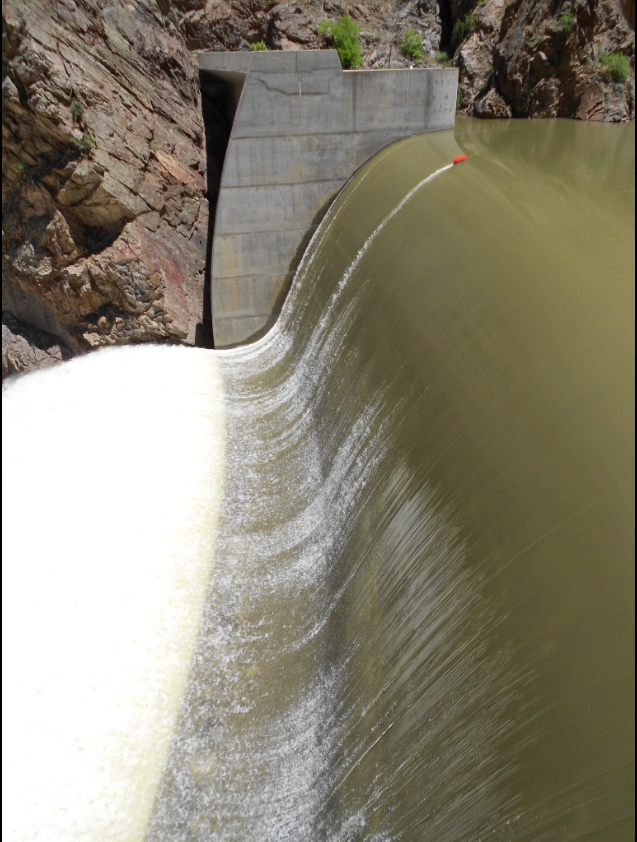
Crystal Dam, part of the Colorado River Storage Project, Aspinall Unit. Credit Reclamation.
From email from Reclamation (Andrew P. Limbach):
April 14, 2026
Meeting date changed to Monday, April 20th, 2026 at 1:00 pm.
In an effort to better coordinate with the upper initial unit work groups and ongoing DROA discussions, the upcoming Aspinall Unit Coordination Meeting for the Aspinall Unit & Gunnison River has been changed to Monday, April 20th, 2026 at 1:00 pm. Sorry for the short notice and any inconvenience this may cause.
This meeting will still be held virtually via Microsoft Teams. There will not be an in-person meeting location for this meeting. The link to the Teams meeting is below.
Contact Andrew Limbach (alimbach@usbr.gov or 970-248-0644) for more information regarding Aspinall operations or the Operation Group meeting.
Denver Water’s collection and service areas continue to face severe drought conditions, with historically low snowpack and concerns about the diminished spring runoff that will be available to meet customer’s water needs in the future.
As a result, at its meeting today, the Denver Board of Water Commissioners adopted a resolution approving the implementation of temporary drought pricing on outdoor water use. The drought pricing will apply starting with May water use (reflected in June bills) and will be in effect through April 30, 2027, or until further action by the board.
Under the temporary drought pricing, residential customers will see a drought charge on Tier 2 water use of $1.10 per 1,000 gallons. Tier 3 will have a drought charge of $2.20 per 1,000 gallons. The temporary drought charges will be added on top of the customer’s existing 2026 water rates.
Tier 1, which covers essential indoor water use, is exempt from drought pricing.
“Implementing temporary drought pricing is not a step we take lightly. It is one of many tools Denver Water has available — when needed — to respond to drought conditions, encourage customers to conserve our water supply, and ensure our ongoing ability to operate and maintain the system that delivers clean, safe water to 1.5 million people,” said Alan Salazar, Denver Water’s CEO/Manager.
“Drought charges signal to our customers the premium value of water in a drought, while exempting essential indoor water use. We haven’t needed to use this tool in more than 20 years — since the historic drought of 2002-04 — and conditions surrounding this year’s snowpack and potential runoff are shaping up to rival, and possibly be worse than, those years,” Salazar said.
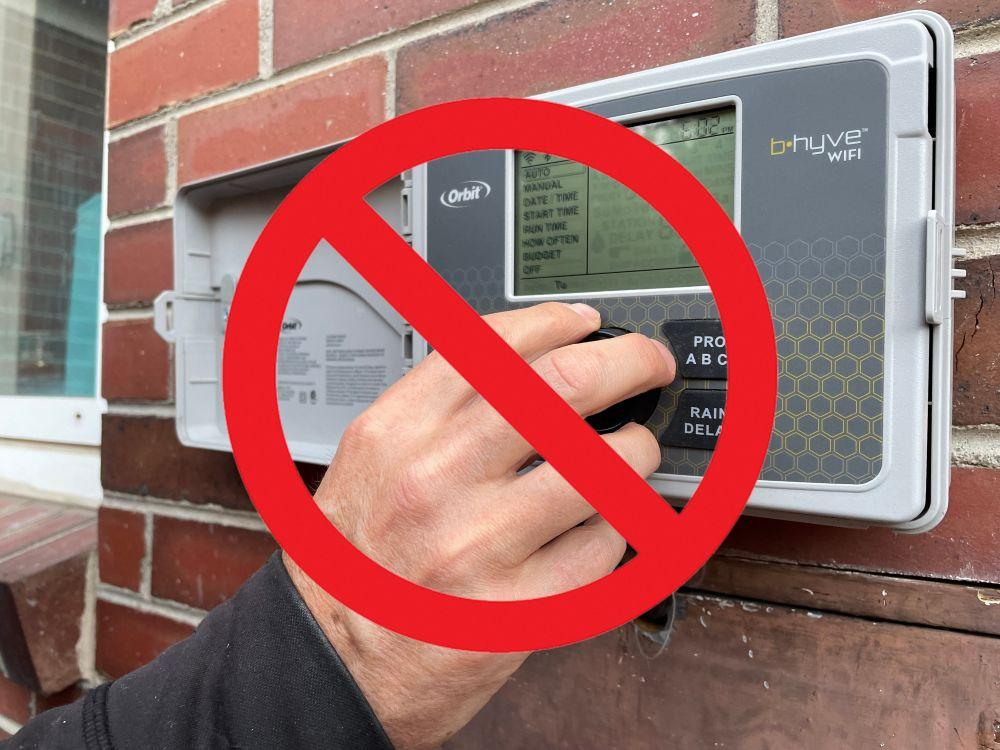
Please keep sprinklers OFF until mid-to-late May, or later if it rains, to help stretch the water supplies we have. Hand water trees and shrubs if needed. It’s a drought. Use Only What You Need. Photo credit: Denver Water.
Under the temporary drought pricing approved by the board, for Denver Water residential customers in Denver and the suburbs:
e first tier will be exempt from the temporary drought charge. This tier is charged at the lowest rate and covers essential indoor water use for bathing, cooking and flushing toilets. Each customer has their individual first tier determined by the average of their monthly water use as listed on bills that arrive in January, February and March — when there is very little or no outdoor watering.
The second tier will have a temporary drought charge of $1.10 per 1,000 gallons added on top of their 2026 water rates. This tier is for water consumption, typically used for outdoor watering, that is above the customer’s first tier and up to 15,000 gallons of water per month. Water use in this tier is considered to be an efficient use of water outdoors.
The third tier will have a temporary drought charge of $2.20 per 1,000 gallons of water added on top of their 2026 water rates. Tier 3 is for water use above the second tier each month. It is priced at the highest level to signal potentially excessive water use and encourage conservation efforts by larger-lot customers.
The board’s decision to impose temporary drought charges on outdoor water use follows its March 25 declaration of Stage 1 drought. The declaration seeks a 20% reduction in water use effective immediately, with the goal of preserving water supplies and to help avoid the need for Denver Water to take further actions later this summer if conditions don’t improve. Read the March 25, 2026, drought declaration.
The snowpack, which supplies the water Denver Water captures, stores, treats and delivers to customers, is at historically low levels despite recent storms that brought some much-needed precipitation to the mountains and city last week.
It’s a drought. Image credit: Denver Water.
“We welcome the storms that do come, while knowing that this year’s snowpack is at historically low levels and hopes for a Miracle May snowstorm are dimming. And Denver Water has made a number of tools available to help customers reduce their water use — whether it’s a normal year or a drought year. We encourage our customers to take steps to conserve water for this drought and be better prepared to manage through future dry times,” Greg Fisher, Denver Water’s manager of demand planning and efficiency.
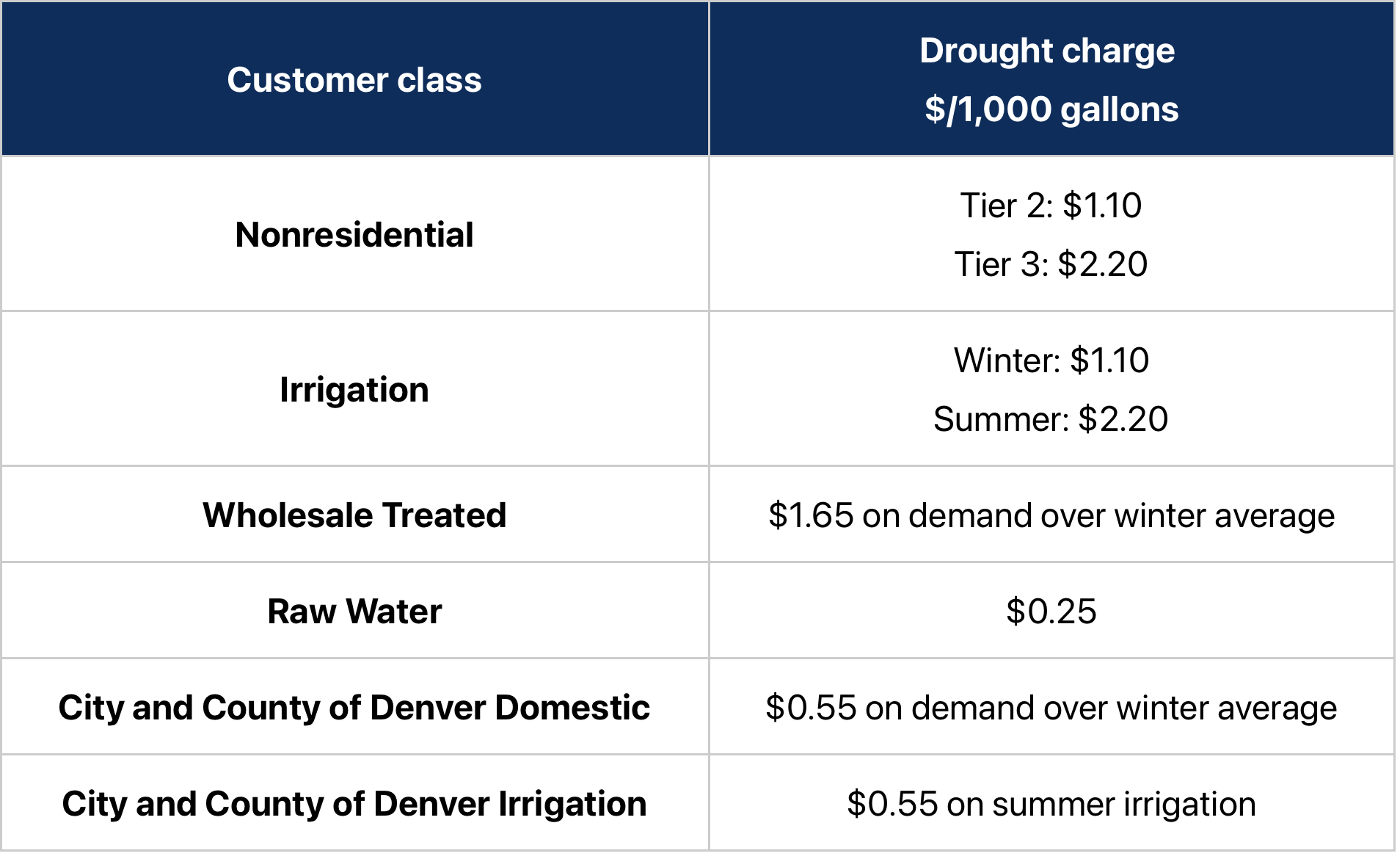
Denver Water’s temporary drought pricing charges a premium for outdoor water use and covers several classes of customers, including residential, large irrigation, wholesale and raw water customers. (See the chart at the bottom of this story for additional information on nonresidential customers.)
An individual residential customer’s monthly water bill will vary depending on where they live in Denver Water’s service area (in Denver or in one of the utility’s suburban distributor districts) and how much water they use. Drought charges are expected to incentivize customers to reduce outdoor water use.
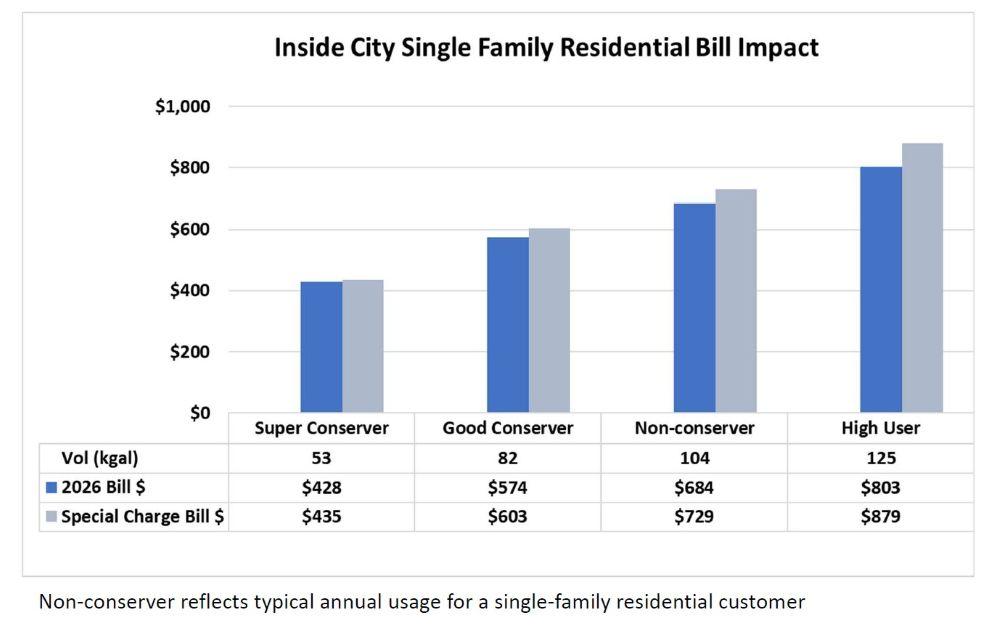
The following two charts illustrate the potential impact of the temporary drought charges on an annual water bill for residential customers living inside the city of Denver and, below that, in a Total Service suburban distributor district.
Examples of the impact of temporary drought charges on an annual water bill for Denver Water customers living inside Denver. In this example, “super conservers” will see their bills increase by roughly $7 annually. High users who do not conserve will see their bills increase by roughly $76 in one year. Individual bills will vary. Image credit: Denver Water.
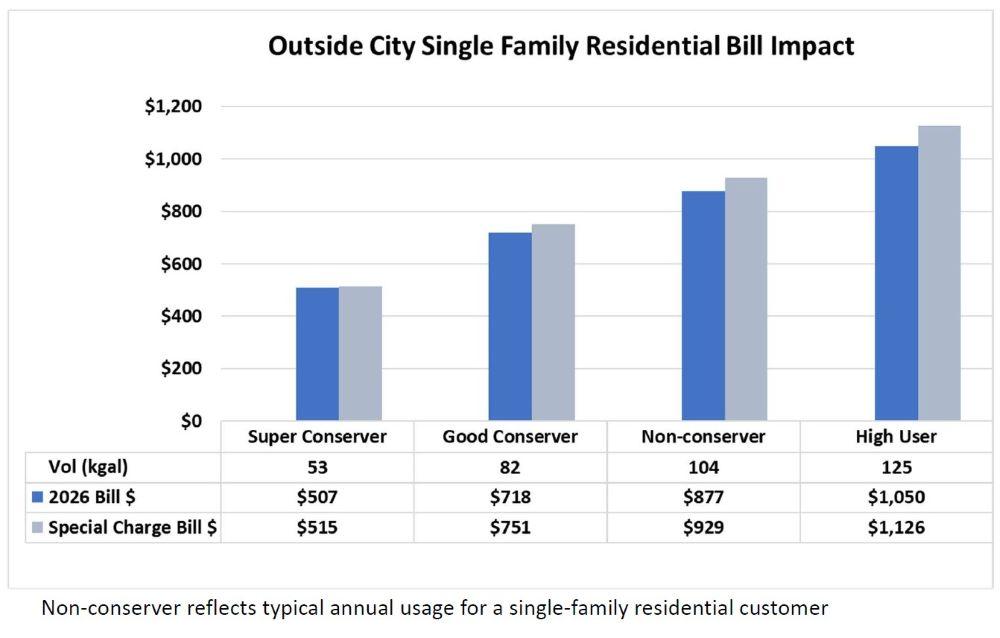
In these charts, the categories are:
“Super conserver”: A customer who has very little outdoor water use, maybe only watering trees and shrubs throughout the year.
“Good conserver”: An average customer who reduces their annual water use by 20%, from 104,000 gallons (the average use by residential customers in an average year) to 82,000 gallons.
“Non-conserver”: An average Denver Water residential customer who uses 104,000 gallons of water over the course of the year (the average use by residential customers in an average year) and doesn’t respond to Denver Water’s call to reduce water use by 20%.
“High user”: A customer in the top 25% of residential water users.
The following chart illustrates temporary drought charges impacts for residential customers who live in one of Denver Water’s Total Service distributor districts in the suburbs. (Learn more about Denver Water’s suburban customers.)
Examples of the impact of the temporary drought charges on an annual water bill for Denver Water customers living in one of Denver Water’s Total Service suburban distributor districts. “Super conservers” will see their bills increase by roughly $8 annually. High users who do not conserve will see their bills increase by roughly $76 in one year. Individual bills will vary. Image credit: Denver Water.
“This is not Denver Water’s first drought. We know our customers strive to be efficient in their water use, and we know we are asking them to use less to stretch the water supplies we have in this drought. We also know that success in reducing water use will result in reduced revenue for our organization. We have tools to address reduced revenue and ensure the organization maintains its financial foundation for when this drought is over,” said Angela Bricmont, Denver Water’s chief financial officer.
If customers comply with Denver Water’s request to reduce water use by 20%, the utility estimates 2026 revenue to fall by a commensurate amount. While drought pricing can offset a portion of that reduction, the utility will rely on cash reserves and budget reductions to cover the majority of the gap.
Denver Water has proactively reduced its spending, taking steps that include enacting a hiring freeze and reviewing maintenance and other projects to see which ones could be deferred.
Now is the time to replace non-native plants with with drought-tolerant plants. Photo credit: Denver Water
To help customers Use Only What They Need indoors and outdoors, Denver Water offers a range of tools, including:
Aerial image of entrenched meanders of the San Juan River within Goosenecks State Park. Located in San Juan County, southeastern Utah (U.S.). Credits Constructed from county topographic map DRG mosaic for San Juan County from USDA/NRCS – National Cartography & Geospatial Center using Global Mapper 12.0 and Adobe Illustrator. Latitude 33° 31′ 49.52″ N., Longitude 111° 37′ 48.02″ W. USDA/FSA, Public domain, via Wikimedia Commons
From email from Reclamation :
April 14, 2026
Reminder Navajo Reservoir Spring Operations MTG Tuesday April 21st from 1-3pm. The meeting will be entirely virtual; members of this list should have received a Teams invite. If you did not and would like to attend email cfelletter@usbr.gov for a meeting invite.
Reclamation conducts Public Operations Meetings three times per year to gather input for determining upcoming operations for Navajo Reservoir. Input from individuals, organizations, and agencies along with other factors such as weather, water rights, endangered species requirements, flood control, hydro power, recreation, fish and wildlife management, and reservoir levels, will be considered in the development of these reservoir operation plans. In addition, the meetings are used to coordinate activities and exchange information among agencies, water users, and other interested parties concerning the San Juan River and Navajo Reservoir.
Phoenix had native water, but expansive growth, among the fastest in the nation, has been enabled by imported Colorado River water since the 1990s. Photo/Allen Best
Click the link to read the article on the KJZZ website (Alex Hager). Here’s an excerpt:
April 13, 2025
A new article by an Arizona State University water expert argues that existing conservation measures are a step in the right direction, but may not be effective enough in the face of climate change. Dave White, director of ASU’s Global Institute of Sustainability and Innovation, says city leaders around the Colorado River basin need to think bigger to plan for a future in which the river has less water to go around.
“We have to think about a reset, a recalibration,” White told KJZZ, “to have an economy and a lifestyle in the southwest that lives within the means of the new normal of water availability in the Colorado River.”
White, alongside The Pennsylvania State University’s Renee Obringer, wrote that cities such as Phoenix, Denver and Las Vegas have made major strides in saving water among homes and businesses. In Phoenix, conservation programs led to a 20% reduction in water use over 20 years, while the population grew by about 40%…Even under aggressive conservation measures, though, the new report explains that demand management practices “won’t be able to keep up” with the kind of hot, dry conditions that fueled the current 26-year megadrought and will likely continue for years in the future…New technologies will likely be a big part of cities’ drought response going forward. White pointed to the need for water reuse programs, desalination facilities and reductions to the amount of water consumed for electricity generation. While Central Arizona cities are already looking to some of those technologies, White said changes may be needed sooner than they can be deployed.
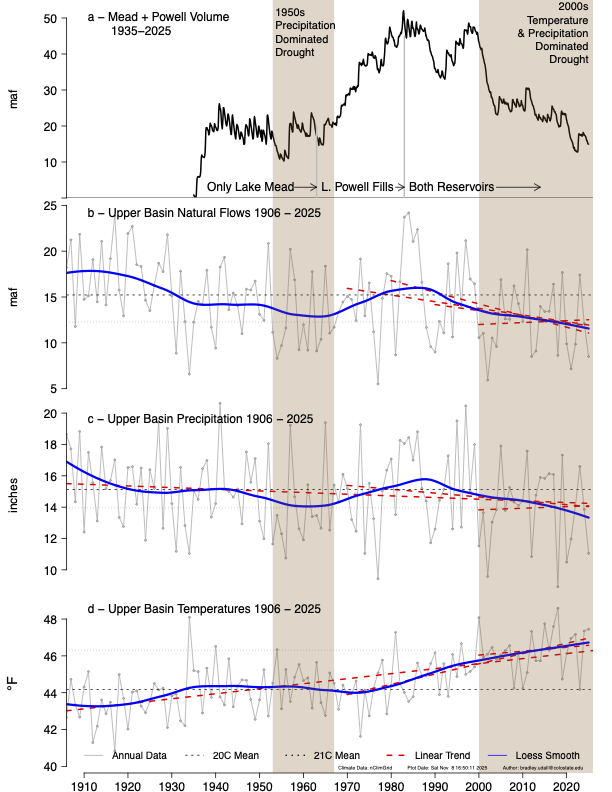
Udall/Overpeck 4-panel Figure Colorado River temperature/precipitation/natural flows with trend. Lake Mead and Lake Powell storage. Updated through Water Year 2025. Note the tiny points on the annual data so that you can flyspeck the individual years. Credit: Brad Udall
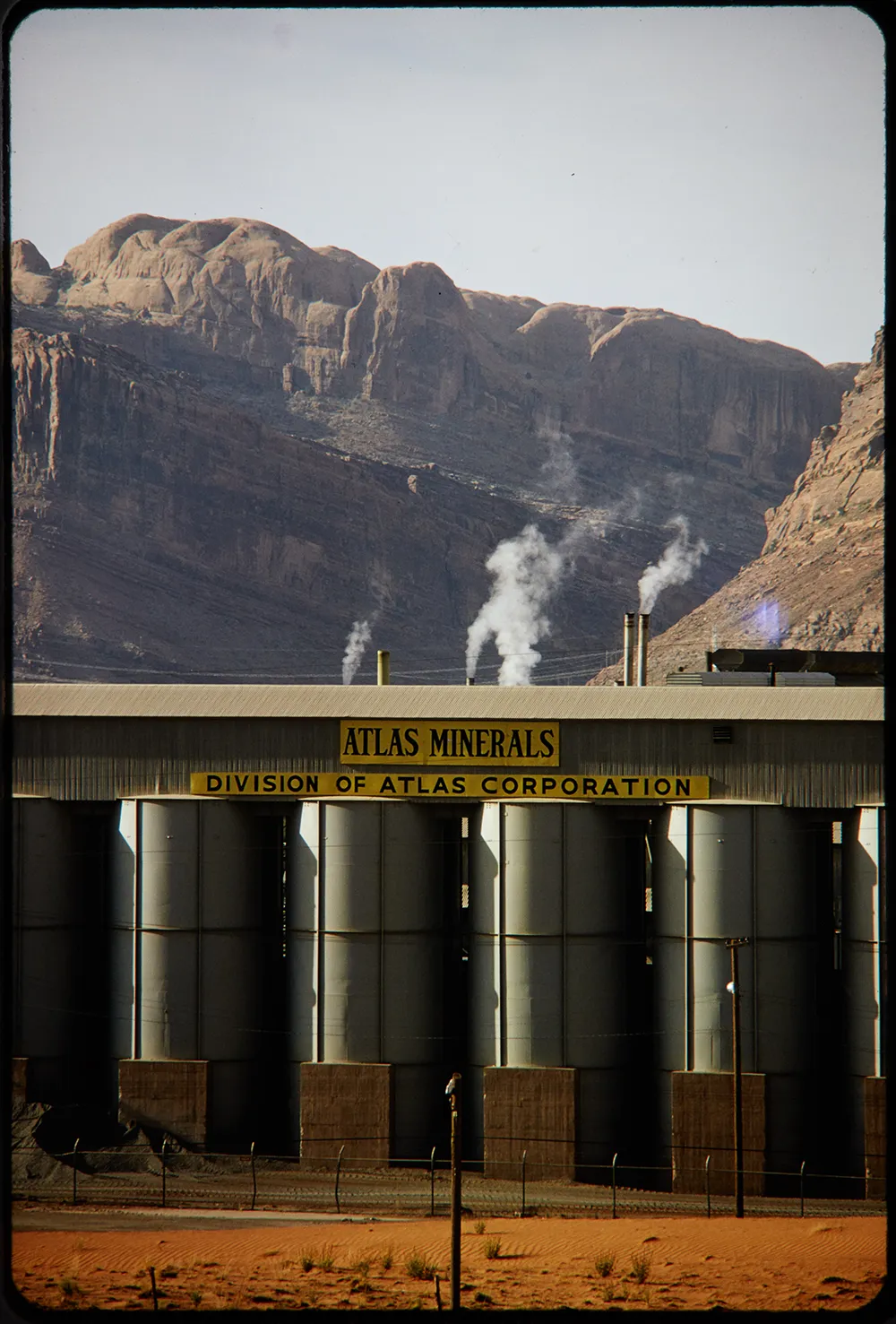
The Atlas Uranium Mill near Moab as it appeared in May of 1972. Source: DOCUMERICA: The Environmental Protection Agency’s Program to Photographically Document Subjects of Environmental Concern.
The Trump administration has formally cancelled the proposed withdrawal of more than 160,000 acres in the Upper Pecos River Watershed from new mining claims and mineral leasing.
Prompted by local advocacy and New Mexico’s congressional delegation, the Biden administration began the process of protecting the watershed and surrounding mountains east of Santa Fe in 2024. But the Trump administration nipped the process in the bud shortly after taking office by cancelling scheduled public meetings. Now it has officially ended the withdrawal.
For the past several years, Comexico LLC, a subsidiary of Australia-based New World Resources, has been working its way through the permitting process to do exploratory drilling at what it calls its Tererro mining project on more than 200 active mining claims in the watershed. It has met with stiff resistance from locals and regional advocacy groups, partly because mining has a dark history in the Pecos River watershed. In 1991, a big spring runoff washed contaminated mine and mill waste from a long-defunct mine into the upper Pecos River, killing as many as 100,000 trout. That prompted a multi-year cleanup of various mining sites.
The withdrawal wouldn’t have stopped the project outright, because it doesn’t affect existing, active, valid claims. Yet it would have stopped the company from staking more claims and would make it more difficult to develop the existing ones (especially if they haven’t established validity).
I have a saying I coined while writing River of Lost Souls that goes like this: Mining is hard. Putting the earth back together again afterwards is a hell of a lot harder.That’s probably especially true when it comes to mining and milling uranium, given that along with all the other nasty byproducts of mining, it also leaves behind radioactive material. The point was recently driven home by two events:
Meanwhile, over at the cleaned up Durango uranium mill site (now a dog park), the Department of Energy’s most recent verification monitoring report finds that natural uranium flushing in the groundwater beneath the site is happening slower than expected. There’s no reason for concern at this point: Researchers are still confident that uranium concentrations will drop below the compliance goal within the allotted 100-year time period.
I mention it here because of the time-scale involved: The Atlas mill in Moab stopped operating more than 40 years ago, and the cleanup has dragged on for close to two decades. The Durango mill shut down for good in 1963; the massive, years-long, multi-million-dollar cleanup was completed in 1991. And researchers expect it to take another 65 years for the groundwater contamination to finally get back to acceptable levels.
It’s just something to keep in mind when considering new uranium mines and mills.
The back of Glen Canyon Dam circa 1964, not long after the reservoir had begun filling up. Here the water level is above dead pool, meaning water can be released via the river outlets, but it is below minimum power pool, so water cannot yet enter the penstocks to generate electricity. Bureau of Reclamation photo. Annotations: Jonathan P. Thompson
🐟 Colorado River Chronicles 💧
One of the more frustrating things about the Colorado River crisis is that the federal government, which controls the big dams and most of the extensive plumbing system on the river, has hardly given even a clue as to what it might do when Glen Canyon Dam reaches the critical minimum power pool mark as early as this summer.
Will they shut down the hydropower turbines and route all releases through the river outlets, possibly compromising the outlet tubes’ — and the dam’s — structural integrity? Will they “defend” minimum power pool by cutting back releases, thereby putting the Upper Basin in violation of the Colorado River Compact? Or will they drain Upper Basin reservoirs in an effort to maintain minimum power pool while also keeping releases at a level that will keep Lake Mead from dropping too precipitously? Maybe they’ll use the bunker-busting bombs intended for Iran to very quickly blast bypass tunnels through the canyon walls to render the dam obsolete?
The answer is still a mystery, but Interior Secretary Doug Burgum finally hinted coyly about the government’s potential approach (Interior oversees the Bureau of Reclamation, which runs most dams). The Arizona Star’s venerable environmental reporter Tony Davis reports that Burgum told a Tucson roundtable this week:
Okay, I don’t know what that means, exactly, but at least they’re planning to do something. The last statement hints at their intent to defend the minimum power pool on Glen Canyon Dam (lest they’ll lose power generation altogether). We’ll probably learn more during the Glen Canyon Monthly Operations Call in the coming week or two. So stay tuned.
As long as we’re on the subject of the federal government doing something about the Colorado River, when’s Trump going to order his people to open the giant faucet up in Canada and send water gushing down to the Southwest?
This won’t come as a surprise to many people, but it’s now official: March 2026 was the hottest March on record by a lot in the Southwest and beyond. The Upper Colorado River Basin’s average temperature for the month was 46.5° F, or more than 13° higher than the 1895-2026 median. The graph below makes it very clear that the place has been getting hotter over the past fifty years, with the only real break coming in March 2023, when snow was piling up in the mountains.
March 2026 was the hottest March since 1895 by far in the Upper Colorado River Basin. Source: NOAA.
The March scorcher followed the warmest winter and first half of the water year (Oct-March) for most of the West.
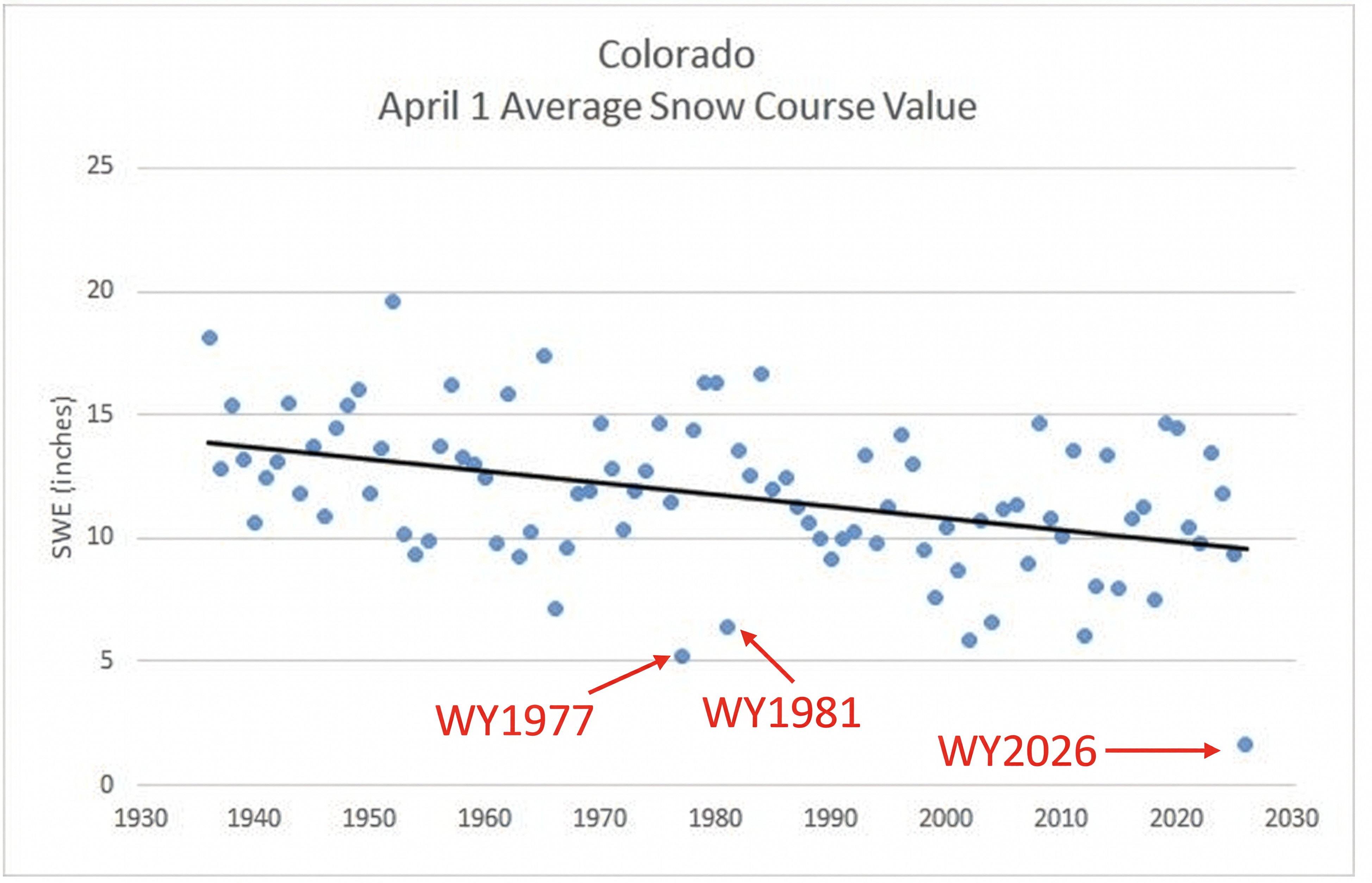
The result is clear: Even though precipitation accumulation wasn’t terribly far below normal, the snowpack was. The April 1 snowpack across Colorado was at a record low level, according to this year’s snow course, which is done by manual measurement and so goes back much farther than SNOTEL measurements.
The April 1 snowpack this year was lower than in 1977, 1981, and 2002, the worst winters of the last nine decades, at least. Source: Center for Snow and Avalanche Studies and NRCS.
Early April storms have helped keep the snow around a bit longer in the mountains, but has done little to bolster the snowpack. It’s still at historically low levels.