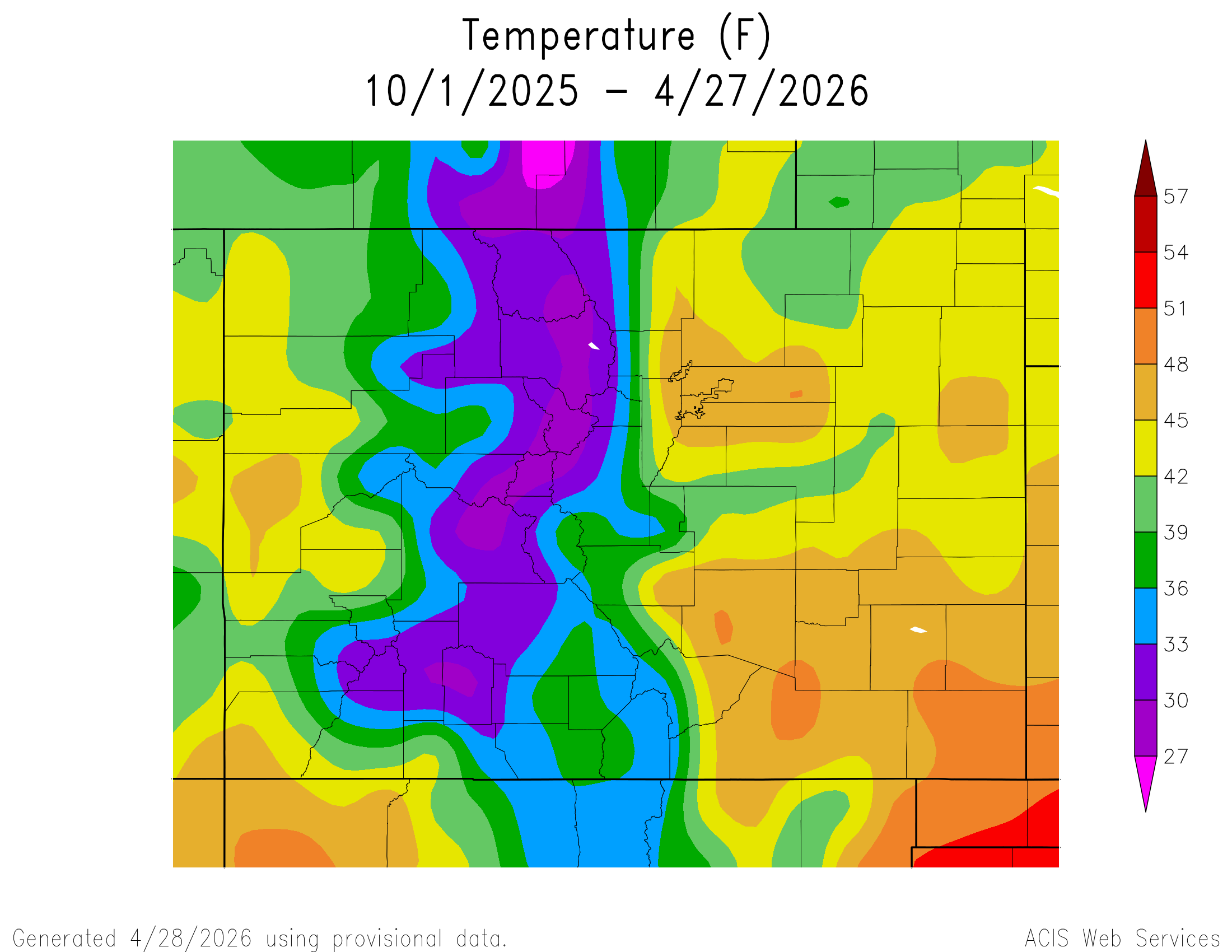
Meteorological records dating back 130 years show a handful of years with winters drier than the 2025-26 winter, said Rebecca Briesmoore, a water resources engineer with the Colorado River District.
“But it has been the warmest by far … that has really been the headline: It wasn’t the driest, but it was the warmest — and that is having a huge impact on hydrology and water resources,” Briesmoore said.
She spoke to a packed room of about 150 attendees at Thursday’s [May 21, 2026] Roaring Fork River: State of the River event hosted by the Colorado River District at the Pitkin County Library…“It’s important for people to know that this year is unprecedented . . . it’s like nothing we have ever seen before,” Briesmoore said. “Every single drop of water really, really matters. We have to think about how we are using it, and what we are going to do with very, very low water resources.”
To a room full of gasps, Briesmoore showed a graph with a star marking the 2026 winter — from October 2025 to March — high above the rest. While years including 1902, 1904, 1977, 2002 and 2018 recorded less precipitation, in terms of temperatures there’s no other year that even came close to 2026.
The Pacific Ocean is a giant climate cauldron, with a powerful heat engine that affects storms, fisheries and rainfall patterns half a world away, and scientists are watching closely to see if it’s about to boil over.
Their projections suggest the tropical Pacific is simmering toward a strong El Niño, the warm phase of an ocean-atmosphere cycle that can intensify and shift those impacts.
In a world already superheated by greenhouse gases, a strong El Niño during the next 12 to 18 months could permanently push the planet’s average annual temperature past the 1.5 degrees Celsius warming threshold enshrined in scientific documents and political agreements as a turning point for potentially irreversible climate impacts.
Climate scientists also recently published a study showing that strong El Niño events can trigger what they called “climate regime shifts,” meaning abrupt, lasting changes in heat, rainfall and drought patterns.
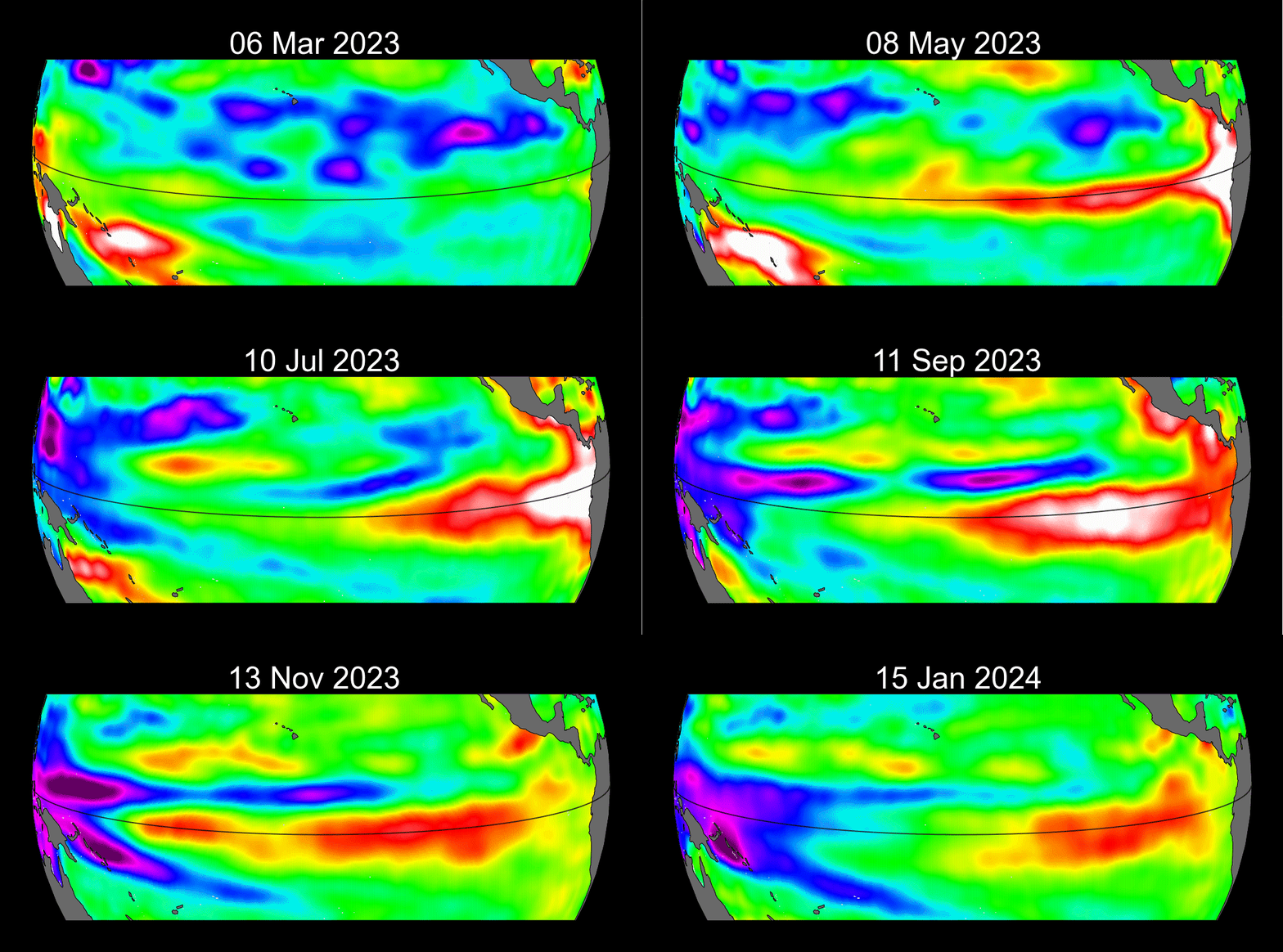
El Niño is one of the planet’s biggest natural release valves for ocean heat. The venting starts with periodic shifts of swirling ocean currents and winds over the Pacific. That causes huge stores of tropical ocean heat to surge eastward from the Western Pacific Warm Pool, roughly between Australia and Indonesia, northward to Japan. Those tropical seas are by far the warmest ocean region on Earth, and span an area four times as large as the continental United States.
When that ocean heat spreads across the equatorial Pacific, it spills into the atmosphere in pulses that tilt weather patterns, reroute powerful high-elevation winds, raise global temperatures, bleach coral reefs and disrupt fisheries and ocean ecosystems. The effects hit continents as well, intensifying rainstorms and flooding in some regions, while amplifying extreme heat, drought and wildfires in others.
In 2015, heat from the tropical Pacific helped raise the global annual average temperature irreversibly past 1 degree Celsius above the pre-industrial baseline. And in 2024, Earth experienced the hottest year recorded in human history, aided by another El Niño boost.
Even a moderately strong El Niño during the next 12 to 18 months could drive the average global temperature to about 1.7 degrees Celsius above the preindustrial level, climate scientist James Hansen told Inside Climate News. Hansen doubts the world will meaningfully cool back down to below the 1.5 degree Celsius mark after the El Niño fades.
Hot El Niño cycles in the tropical Pacific Ocean release so much energy, as heat and moisture, to the atmosphere, that it affects rainfall and drought patterns halfway around the world. Credit: NASA/JPL
Passing that threshold may not be like falling off a climate cliff, but it’s definitely the point when the edge starts crumbling, with rapid changes to relatively stable systems of forests, water, rain and temperatures that have sustained people and ecosystems for millennia.
Even below the 1.5-degree Celsius threshold, California reservoirs no longer fill in some years and overflow with extreme rainfall in others. Coral reefs from Australia to the Caribbean have bleached beyond recovery and vast tracts of forests burned up in megafires. Traditional crop calendars don’t align with seasons. Deadly nighttime heat rises in cities, killing vulnerable people in apartments that never cool.
“Super El Niño” Seen as Game Changer
Climate impacts amplified by strong El Niños keep hitting the same vulnerable regions, may be more widespread than previously thought and can persist long after the tropical Pacific cools, according to an El Niño study published December 2025 in Nature Communications.
The study concluded that “super El Niños” are not just passing weather events, but more like climate shocks that can push parts of the Earth system into new states, co-author Jong-Seong Kug wrote in an email.
The study’s definition of a super El Niño is when the sea surface temperature anomaly in the tropical Pacific “exceeds 2 standard deviations above normal”—not an ordinary fluctuation, but more of a systemic warning sign.
The impacts are clustered in areas known to be sensitive to long-distance climate connections and regions “that are already prone to climate regime shifts,” wrote Kug, a climate researcher at Seoul National University in South Korea.
There are only three super El Niños on record: in 1982-83, 1997-98 and 2015-16. All of them contributed to regime shifts in regional ocean temperatures, leading to unprecedented marine heat waves that destroyed or damaged coral reefs and caused mass die-offs and starvation among many marine organisms, from starfish to seabirds and marine mammals.
Those impacts, as well as changes in drought and extreme heat over land areas, persisted for years and could shift some regional patterns for decades, according to the study.
Kug said the main “regime-shift hotspots” in oceans include the central North Pacific, the southeastern Indian Ocean, the southwestern Pacific and the Gulf of Mexico, areas where globally linked atmospheric connections “can strongly perturb the ocean surface and, in some cases, help anomalies persist.”
Kug said the study identified super El Niño regime shifts in East Africa and the Maritime Continent—the island-rich region between the Indian and Pacific Oceans around Indonesia, Malaysia and Papua New Guinea.
Map of the Colorado River drainage basin, created using USGS data. By Shannon1 Creative Commons Attribution-Share Alike 4.0
Click the link to read the article on the Tucson.com website (Tony Davis). Here’s an excerpt:
April 26, 2026
It’s time to bring in a mediator to handle the prolonged dispute over managing the Colorado River between the Upper and Lower Colorado River Basin states, representatives of the four Upper Basin states say.
“The proposal for mediation attempts to address the current deadlock between Upper Basin and Lower Basin approaches and begin to deal with the basin’s dire hydrologic conditions.” said the Upper Colorado River Commission, which represents Colorado, New Mexico, Utah and Wyoming.
“The commissioners believe a structured mediation process can support authentic negotiations and collective action to address the Basin’s operational challenges,” the commission said in a news release last week.
The request for a mediator to handle this dispute follows about two years of fruitless negotiations among the various state representatives. There have been several major sources of dispute, but the biggest one has been over how the two basins should split the cuts in river water use that would be needed to bring human demand in line with shrinking supply…The Upper Basin states’ request comes not long before the U.S. Bureau of Reclamation is supposed to announce its plan for managing the river, in the absence of an agreement among the basin states. A new plan is necessary because the river’s current operating guidelines expire Sept. 30…
The request for mediation also comes as the river’s condition continues to deteriorate. Hot, dry weather has held down water flows in the river for most of the year, and there’s a risk that spring-summer runoff into Lake Powell will be the lowest on record since Lake Powell started filling in the 1960s.
China’s rapid rise in science has hit a milestone. The country’s investment in research and development has reached parity with – and by purchasing power measures has surpassed – that of the United States, according to a March 2026 report from the Organisation for Economic Co-operation and Development. Both nations have crossed the US$1 trillion threshold on research spending.
In contrast, China had previously spent little to nothing on research and development. Some estimates show that China was among the lowest research spenders worldwide in 1980.
The most recent reports showing that China is now outspending the U.S. on scientific and technological research is a turning point worth understanding clearly because, historically, global leadership in one sector – including technology and warfare – feeds into others. U.S. dominance is in question.
In 2024, China overtook the United States in total scientific publications – the first time any nation has displaced American dominance since the U.S. itself surpassed the United Kingdom in 1948. Researchers found that China overtook the United States in scientific output even earlier. That same year, China pulled ahead in the Nature Index, which tracks publications in the world’s most selective scientific journals, posting a 17% advantage over the U.S. in outlets long considered the gold standard of scientific excellence.
Given these milestones, it’s possible to argue that China is quickly taking the lead in global science and technology. These are not isolated data points. They mark a structural shift in where the world’s scientific frontier is being built.
More science is good – the problem lies elsewhere
China’s ascent is, in one sense, good news. More knowledge, generated by more researchers across more institutions, expands the global pool of discovery from which everyone can draw. The world benefits when science thrives.
The problem is not that China is investing, but that the U.S. is not.
First, the U.S. is divesting from basic, open science. Federal R&D spending in the U.S. peaked in 2010 at roughly $160 billion and fell by more than 15% over the following five years. Federal investment in research and development has been in a long, slow slide – from a peak of 1.86% of gross domestic product in 1964 to about 0.66% in 2021.
The federal government is no longer the largest spender in R&D: It funded about 40% of basic research in 2022, while the business sector performed roughly 78% of U.S. R&D. While not a problem in itself, industry has simultaneously withdrawn from open scientific publication over the past four decades, shifting from research toward development. The result is a shrinking pool of openly shared scientific knowledge precisely as public investment in it also contracts.
The second is the active restriction of scientific exchange: tightening access to U.S. institutions, scrutinizing international collaborations and raising barriers to foreign-born researchers. These policies, though intended as security measures, work against the openness that has historically made American science productive and attractive to global talent.
I describe this issue as an example of the stockyard paradox, in which securing research assets may weaken the very system these measures aim to protect.
Disinvestment cuts deeper than it appears
The deeper danger for the U.S. economy is that disinvestment and selective engagement in research erodes the capacity to use cutting-edge science regardless of where it is produced.
Absorbing and applying cutting-edge knowledge, whether developed in Boston or Beijing, requires maintaining research institutions and trained workforces, as well as active participation in global networks. This is not a passive process. You cannot free-ride on Chinese science if you have dismantled the institutional and human capital needed to evaluate, translate and apply it.
A nation that hollows out its research base not only falls behind but also progressively loses its ability to benefit from science, including in technologies it is already able to access.
Talent compounds the problem. The U.S. built its scientific dominance partly by being the destination of choice for the world’s most ambitious researchers. The U.S. leads the world in Nobel Prizes, but, notably, 40% of the Nobel Prizes in chemistry, medicine and physics that were awarded to Americans since 2000 were won by immigrants. The flow of foreign talent is not guaranteed. It follows opportunity, funding and openness.
China’s milestone in research funding arrives at a moment when the U.S. is deciding whether to maintain its scientific leadership.
Scientific infrastructure does not decline gradually and recover on demand. Doctoral scientists represent a decade or more of training; tacit laboratory knowledge lives in working research groups, not in documents. Once talented young researchers leave the pipeline – or international talent redirects to other countries – the capacity is very hard to rebuild. Early warning signs are already visible in the U.S. system: thousands of NIH grants terminated, a collapse in international applications and an exodus of early-career scientists.
What is at stake is not a ranking. It is whether the U.S. maintains the institutional capacity – the universities, the federal laboratories, the graduate pipelines, the culture of open inquiry – that made those returns on scientific investment possible in the first place.
China’s rise did not create this decision point, although it brings it into sharp relief. Does the U.S. still want to lead in science? The Information Technology and Innovation Foundation, a nonprofit think tank, estimates that a 20% cut in federal research and development starting in fiscal year 2026 would shrink the U.S. economy by nearly $1 trillion over 10 years and reduce tax revenue by around $250 billion. Others point out that the scientific enterprise has contributed at least half of U.S. economic growth.