
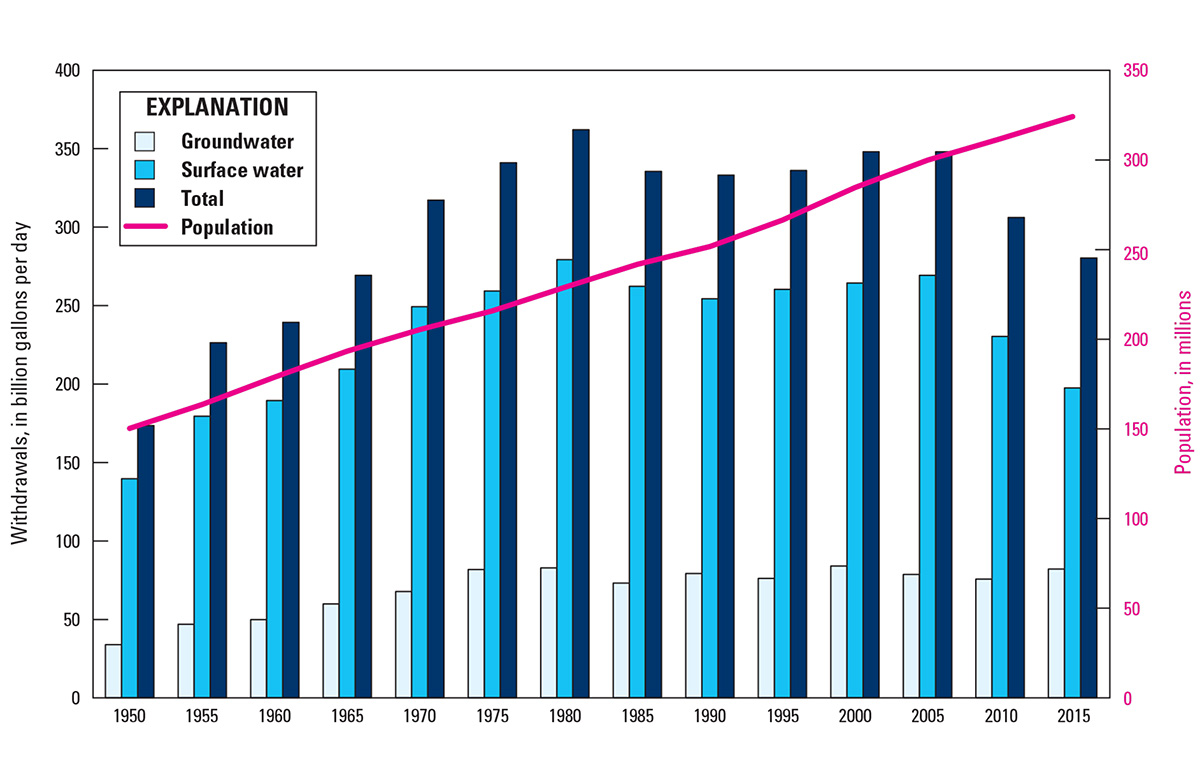
The USGS reports an overall decline in water use even as America’s population has risen

Graph illustrating water withdrawals in billion gallons per day from 1950 to 2015, with categories for groundwater, surface water, total withdrawals, and population growth.
A US Geological Survey chart from 2015 shows America’s population rising (purple) as surface water use (blue) fell.

by Robert Marcos

A landmark 2015 USGS study revealed that overall water consumption in the United States had declined even though our population had increased. A study in 2025 showed that that downward trend has continued. Scientists involved in the study reported that the decline has been driven by significant efficiency gains in the power and manufacturing sectors, and by improved household conservation.1

The EPA reported that municipal efforts to conserve water have been paying off. This includes the use of water saving faucets, toilets, and showers, plus the recycling of waste water. Meanwhile – due to climate change, other parts of the world have seen their demand for fresh water rise by as much as 40%.2

Detailed Comparison of Water Use (2015 vs. 2025)

Total Withdrawals: In 2015, the U.S. withdrew approximately 322 billion gallons per day, the lowest level reported since 1970. By 2025, total withdrawals have continued to stabilize or decline despite population increases, largely driven by significant reductions in thermoelectric power and industrial sectors.3


Wastewater Reuse: A major shift in the decade leading to 2025 was the rapid expansion of the municipal wastewater reuse market. Total reuse capacity was projected to increase by 61% by 2025, with potable reuse (treatment to drinking water quality) rising from 15% to 19% of total reuse capacity.4


Residential Consumption: The average American used 82 gallons per day at home in 2015. By 2025, widespread adoption of EPA WaterSense certified fixtures has allowed typical families to reduce this consumption by at least 20% through more efficient toilets, faucets, and showerheads.5

Positive developments in major sectors

Power generation: Electrical power generation has reduced the use fresh water by shifting from coal to renewables, like wind and solar, which require little to no water, and by implementing dry-cooling technologies. These improvements have dropped U.S. water withdrawal intensity from 14,928 gal/MWh in 2015 to 11,857 gal/MWh in 2020, as the energy mix shifts toward less water-intensive sources.6

Agricultural irrigation: Farmers have improved water efficiency by transitioning from flood irrigation to advanced pressurized systems, like drip and micro-irrigation. These systems deliver water directly to the plant’s root zone, significantly reducing losses from evaporation and runoff. Additionally, many operations now utilize precision agriculture technologies, including soil moisture sensors and GPS-guided machinery, to apply water only when and where it is needed based on real-time data. Complementary land management practices like conservation tillage (no-till) and the use of cover crops further enhance water retention by improving soil health and reducing surface evaporation.7
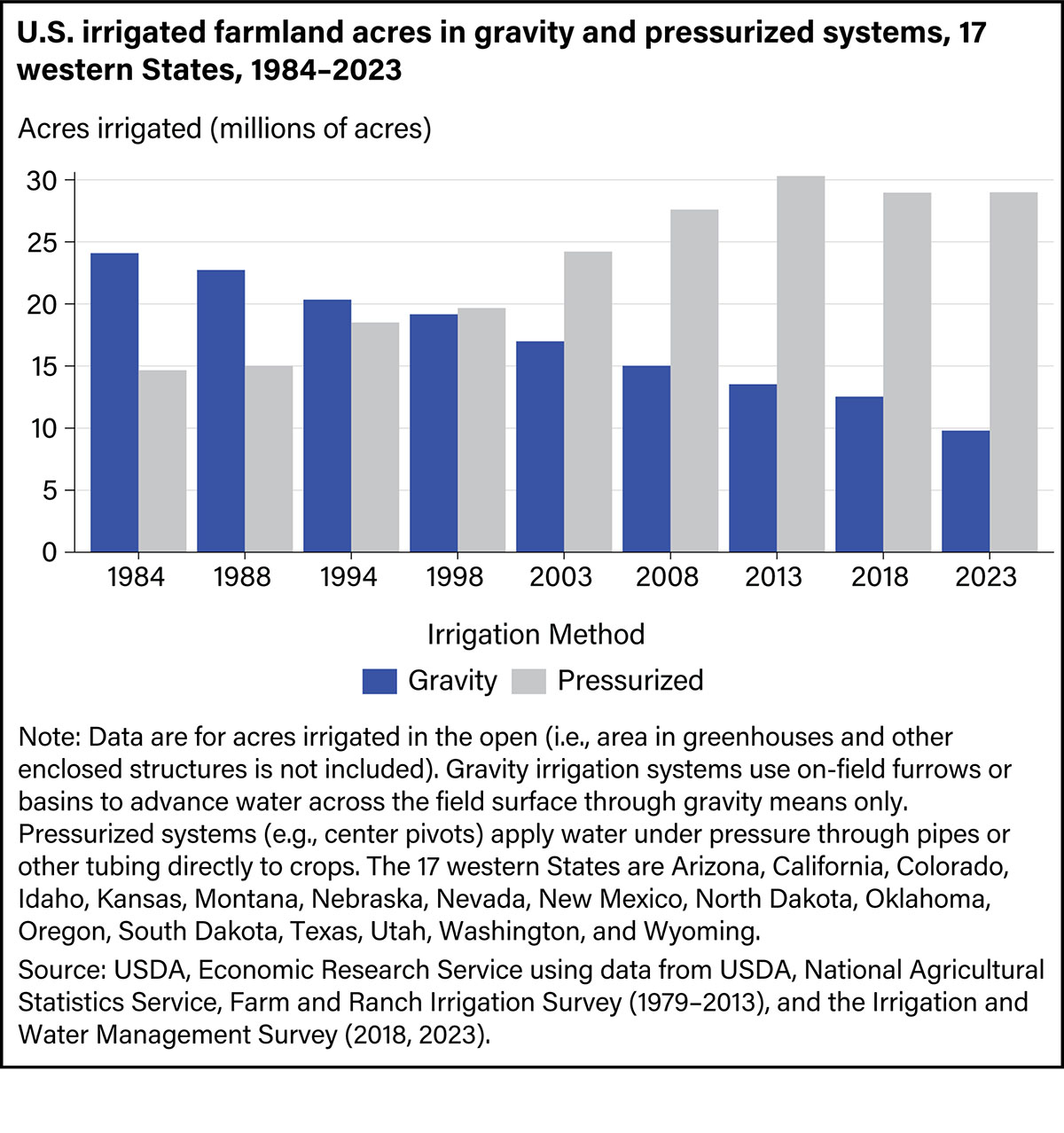
Bar graph showing U.S. irrigated farmland acreage using gravity and pressurized systems from 1984 to 2023, with data in millions of acres and color-coded for irrigation methods.

Industrial/Mining: The mining industry is conserving fresh water primarily by transitioning to closed-loop recycling systems that treat and reuse process water multiple times within a facility. Many companies are also adopting thickened tailings technology, which removes more water from waste streams before disposal, and utilizing alternative sources like desalinated seawater or treated municipal wastewater. Additionally, the shift toward dry stacking—where waste is filtered into a sandy substance—significantly reduces the water lost to evaporation or seepage in traditional storage ponds.8

Geographic and Economic Shifts

Regional Demand: By 2025, regions like the Southwest and Colorado River basin faced increased pressure due to drought, leading to a 16.9% decline in specific sectors like golf course irrigation through aggressive management.

Investment: The market for municipal reuse and wastewater infrastructure reached an estimated $11 billion by 2025, with Florida and California accounting for over 80% of this activity.

Note about groundwater use estimates

While researching this article I was concerned the accuracy of ground water use estimates. It’s widely-known that most wells are not metered and that many farmers, ranchers, and land owners, are opposed to metering the groundwater they pump. But it appears that the USGS estimates ground water use with highly sophisticated satellite technology like those below.

Satellite Monitoring Methods

GRACE, (Gravity Recovery and Climate Experiment): These twin satellites “weigh” the Earth by measuring minute changes in gravity caused by the movement of water. By subtracting surface water and soil moisture from total water storage, scientists can estimate changes in deep groundwater.


InSAR (Interferometric Synthetic Aperture Radar): This radar technology measures millimeter-level changes in land elevation. When aquifers are over-pumped, the ground above them often sinks (subsidence), which InSAR detects and uses to infer water level declines.

Landsat: This program monitors land surface characteristics, such as crop health and heat. The USGS uses this to map evapotranspiration, which helps estimate how much groundwater is being pumped for irrigation.
Satellite Telemetry: This is the most common operational use of satellites. The USGS equips thousands of physical wells with instrumentation that transmits real-time water level data directly to USGS ground stations via satellite.
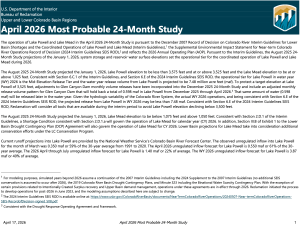
Reclamation Acts to Protect #ColoradoRiver System During Historic #Drought: The prolonged drought combined with the lowest winter #snowpack on record is requiring swift actions to protect this vital water system #COriver #aridification

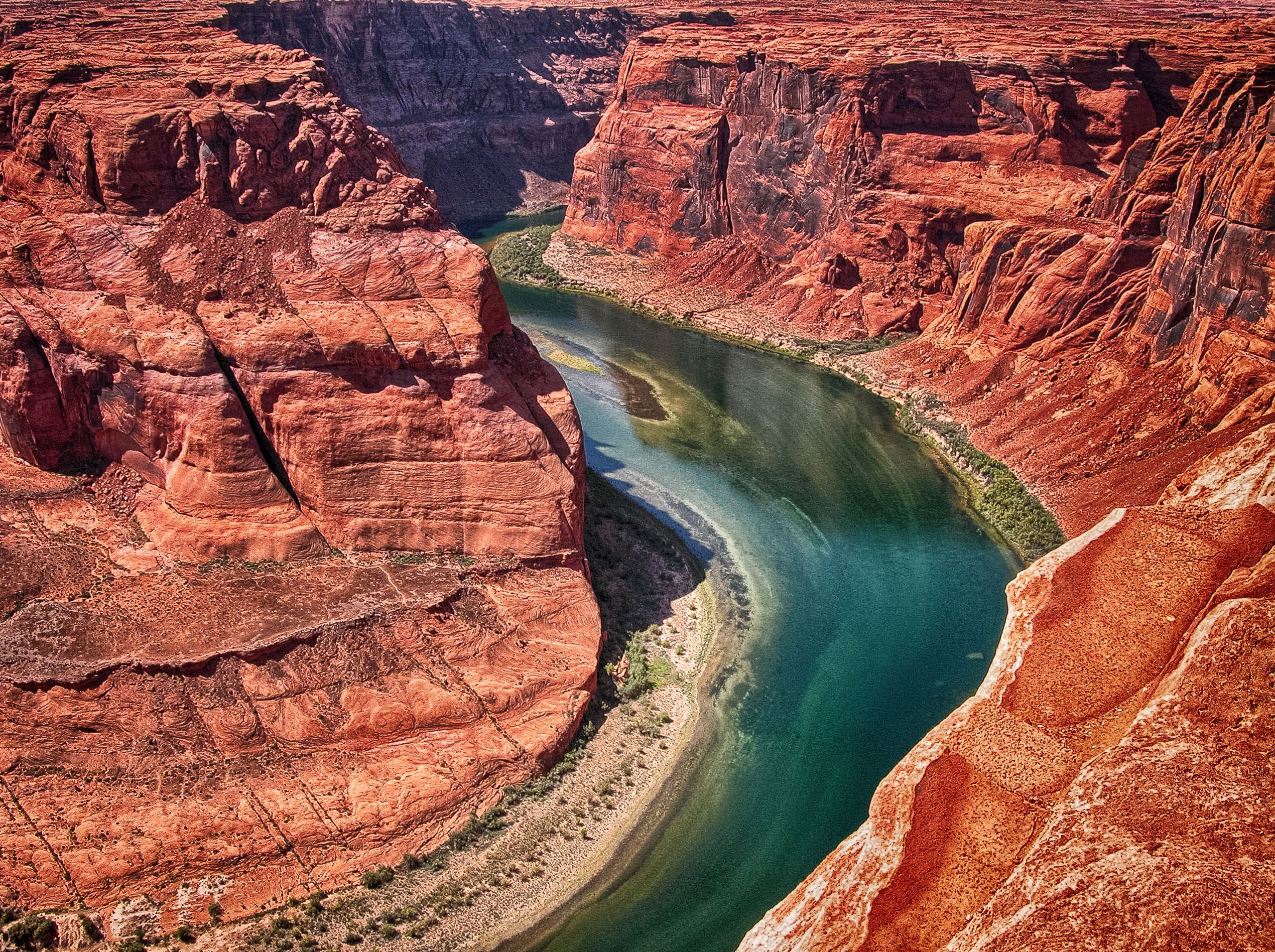
The Colorado River flows through seven states and provides water to 40 million people. Photo credit: USBR

Click the link to read the release on the Bureau of Reclamation website:

April 17, 2026

Long-term drought has reduced Colorado River system storage to about 36 percent of capacity, and the combination of the lowest snowpack on record and record-breaking March heat has further intensified drought conditions across the Basin. These compounding factors are creating elevated risks to essential water and power infrastructure that supply water to more than 40 million people, underscoring the need for immediate action.

Lake Powell’s water year minimum probable inflow is forecasted at just 2.78 million acre-feet—29% of historical average and one of the lowest on record. Reclamation’s April “24 Month Study” projects Lake Powell may decline to below 3,490 feet—the minimum power pool level—by August 2026 without major intervention. If Glen Canyon Dam declines below 3,490 feet, water releases would be only through the river outlet works, which could cause operational issues, uncertainty for users, downstream impacts, instability in regional power and water supplies, and a reduction in power generation. 

Secretary of the Interior Doug Burgum met with Governors for the seven basin states, Arizona, California, Colorado, Nevada, New Mexico, Utah and Wyoming, and their designees again today to discuss the concerning hydrology and plans for operations. 

“I am grateful for the Governors and their teams working diligently to find a solution to the complex challenges created by these unprecedented drought conditions which require immediate action,” said Interior Secretary Doug Burgum. “Interior and Reclamation continue to coordinate with the basin states, tribes, Mexico and basin stakeholders as we make the decisions necessary to operate and protect the system.” 

To stabilize the system, Reclamation is moving quickly and initial plans include adding up to about 2.48 maf of water to Lake Powell by moving water from the upstream Flaming Gorge Reservoir and by reducing releases from Lake Powell.  [ed. emphasis mine]

Through the 2019 Drought Response Operating Agreements, Reclamation is intending to release 660,000 acre-feet to 1 maf from Flaming Gorge Reservoir from April 2026 through April 2027. In addition, Reclamation is intending to reduce the annual release volume from Lake Powell to Lake Mead by 1.48 maf—from 7.48 maf to 6.0 maf—through September 2026 by utilizing section 6E of the Record of Decision from the final 2024 Supplemental Environmental Impact Statement for near-term Colorado River Operations.  

Together, these actions are expected to increase Lake Powell’s elevation by approximately 54 ft to at least elevation 3500 feet by April 2027. Through the current, ongoing DROA process, the basin states, tribes and partners continue to provide feedback related to the proposed releases. A final decision will be coming next week. 

Flaming Gorge Reservoir now holds about 3.1 maf of water, which is 83% full. These actions are expected to lower the reservoir’s elevation by roughly 35 feet over the next year to approximately 59% of capacity. This will have no effect on contracted water rights at Flaming Gorge or Lake Powell. No additional releases from the other upstream initial units of the Colorado River Storage Project Act—Blue Mesa and Navajo reservoirs—are planned at this time, due to their low water levels and poor forecasted inflows.  [ed. emphasis mine]

“Given the severity of the risks facing the Colorado River system, it is imperative that we take action quickly to protect a resource that supplies water to 40 million people and supports vital agricultural, hydropower production, tribal, wildlife, and recreational uses across the region,” said Assistant Secretary – Water and Science Andrea Travnicek. “As we weigh current conditions and prepare for future operations by working with states, tribal nations and stakeholders, the Department of the Interior and Reclamation remain fully committed to taking the actions necessary to reduce impacts on water deliveries, safeguard critical infrastructure, and preserve as much operational flexibility as possible.”   

Basin-wide impacts 

Reclamation acknowledges that the proposed reduced releases from Lake Powell will accelerate the downstream decline of Lake Mead, with the potential for up to an additional 40% reduction to Hoover Dam’s hydropower generating capacity as early as this fall. Reclamation and its lower basin partners are collaborating to conserve water in Lake Mead and maintain its water levels, even as releases from Lake Powell are planned to decrease.  

The initial proposed drought response actions may also impact recreation across multiple sites. At upstream reservoirs, boating access may be reduced earlier in the season than normal. In the Grand Canyon, lower flow rates will affect rafting conditions, and fishing may be more challenging. At Lake Mead National Recreation Area, reduced water levels may further limit boating access. Reclamation is working with reservoir recreation management partners now and as the summer progresses.  

The 2026 operational challenges come at a time of transition as the existing agreements that guided the operations of the Colorado River for the last two decades are set to expire at the end of the year. As we approach the new water year on October 1, the seven basin states have not reached consensus on a new operating framework. With time running out, there is a need for extraordinary collaboration for 2027 and beyond. In the absence of a consensus and following the completion of the NEPA process, the Interior Department will be prepared to determine operations for Post 2026 later this summer to provide certainty and stability for the Colorado River Basin.  

To learn more about the Interior Department’s or Reclamation’s activities around the Colorado River, please visit the Colorado River Basin website

Colorado River “Beginnings”. Photo: Brent Gardner-Smith/Aspen Journalism