
by Robert Marcos
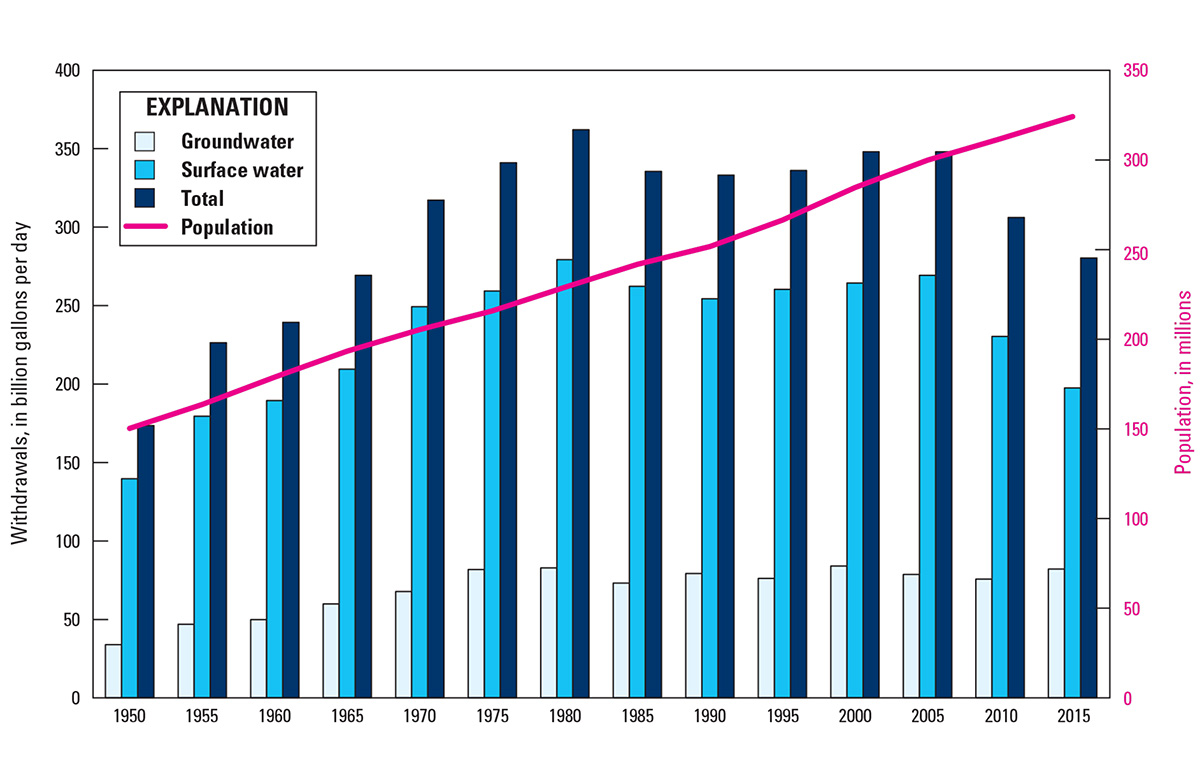
A landmark 2015 USGS study revealed that overall water consumption in the United States had declined even though our population had increased. A study in 2025 showed that that downward trend has continued. Scientists involved in the study reported that the decline has been driven by significant efficiency gains in the power and manufacturing sectors, and by improved household conservation.1
The EPA reported that municipal efforts to conserve water have been paying off. This includes the use of water saving faucets, toilets, and showers, plus the recycling of waste water. Meanwhile – due to climate change, other parts of the world have seen their demand for fresh water rise by as much as 40%.2
Detailed Comparison of Water Use (2015 vs. 2025)
Total Withdrawals: In 2015, the U.S. withdrew approximately 322 billion gallons per day, the lowest level reported since 1970. By 2025, total withdrawals have continued to stabilize or decline despite population increases, largely driven by significant reductions in thermoelectric power and industrial sectors.3
Wastewater Reuse: A major shift in the decade leading to 2025 was the rapid expansion of the municipal wastewater reuse market. Total reuse capacity was projected to increase by 61% by 2025, with potable reuse (treatment to drinking water quality) rising from 15% to 19% of total reuse capacity.4
Residential Consumption: The average American used 82 gallons per day at home in 2015. By 2025, widespread adoption of EPA WaterSense certified fixtures has allowed typical families to reduce this consumption by at least 20% through more efficient toilets, faucets, and showerheads.5
Positive developments in major sectors
Power generation: Electrical power generation has reduced the use fresh water by shifting from coal to renewables, like wind and solar, which require little to no water, and by implementing dry-cooling technologies. These improvements have dropped U.S. water withdrawal intensity from 14,928 gal/MWh in 2015 to 11,857 gal/MWh in 2020, as the energy mix shifts toward less water-intensive sources.6
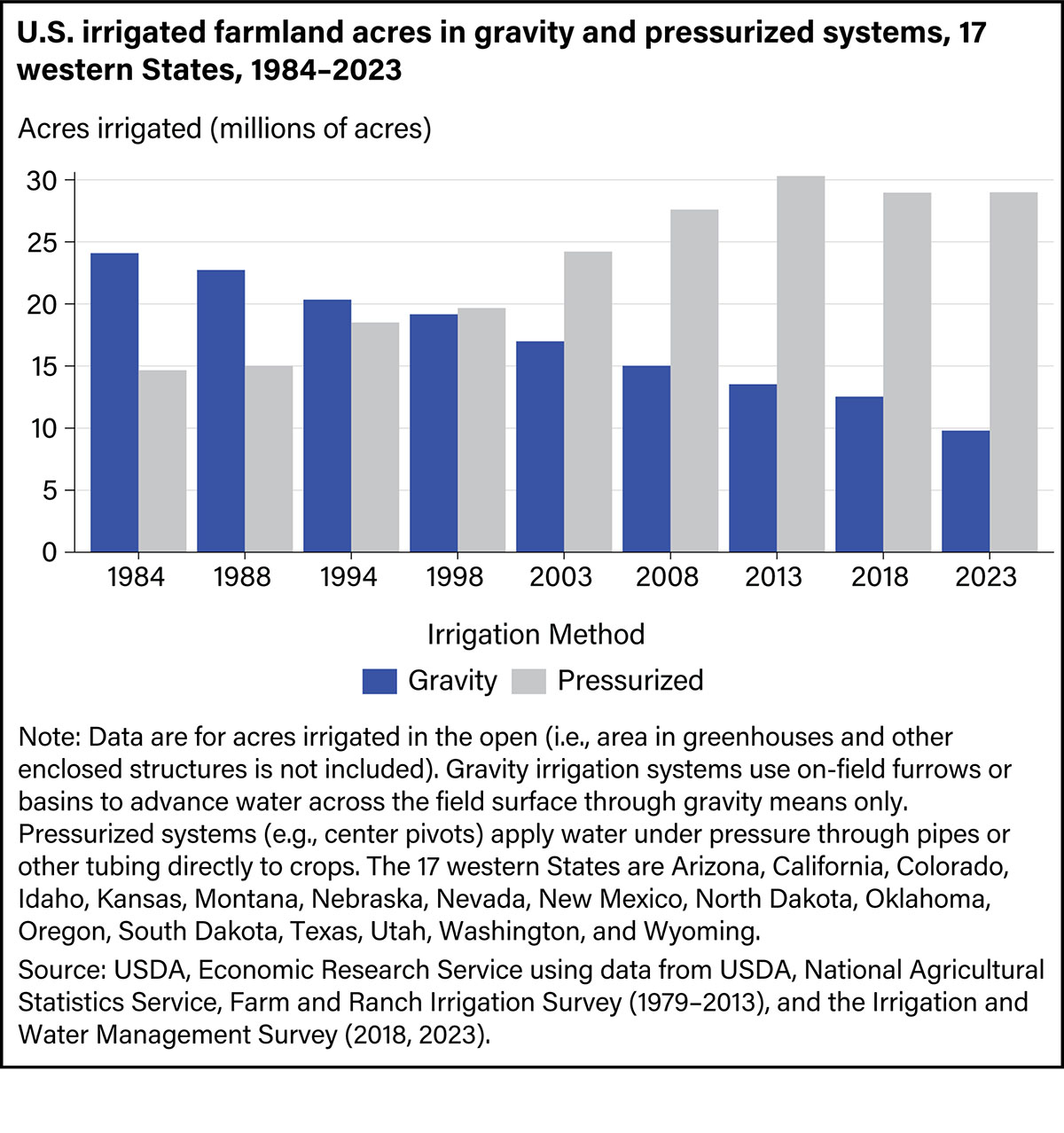
Agricultural irrigation: Farmers have improved water efficiency by transitioning from flood irrigation to advanced pressurized systems, like drip and micro-irrigation. These systems deliver water directly to the plant’s root zone, significantly reducing losses from evaporation and runoff. Additionally, many operations now utilize precision agriculture technologies, including soil moisture sensors and GPS-guided machinery, to apply water only when and where it is needed based on real-time data. Complementary land management practices like conservation tillage (no-till) and the use of cover crops further enhance water retention by improving soil health and reducing surface evaporation.7
Industrial/Mining: The mining industry is conserving fresh water primarily by transitioning to closed-loop recycling systems that treat and reuse process water multiple times within a facility. Many companies are also adopting thickened tailings technology, which removes more water from waste streams before disposal, and utilizing alternative sources like desalinated seawater or treated municipal wastewater. Additionally, the shift toward dry stacking—where waste is filtered into a sandy substance—significantly reduces the water lost to evaporation or seepage in traditional storage ponds.8
Geographic and Economic Shifts
Regional Demand: By 2025, regions like the Southwest and Colorado River basin faced increased pressure due to drought, leading to a 16.9% decline in specific sectors like golf course irrigation through aggressive management.
Investment: The market for municipal reuse and wastewater infrastructure reached an estimated $11 billion by 2025, with Florida and California accounting for over 80% of this activity.
Note about groundwater use estimates
While researching this article I was concerned the accuracy of ground water use estimates. It’s widely-known that most wells are not metered and that many farmers, ranchers, and land owners, are opposed to metering the groundwater they pump. But it appears that the USGS estimates ground water use with highly sophisticated satellite technology like those below.
Satellite Monitoring Methods
GRACE, (Gravity Recovery and Climate Experiment): These twin satellites “weigh” the Earth by measuring minute changes in gravity caused by the movement of water. By subtracting surface water and soil moisture from total water storage, scientists can estimate changes in deep groundwater.
InSAR (Interferometric Synthetic Aperture Radar): This radar technology measures millimeter-level changes in land elevation. When aquifers are over-pumped, the ground above them often sinks (subsidence), which InSAR detects and uses to infer water level declines.
Landsat: This program monitors land surface characteristics, such as crop health and heat. The USGS uses this to map evapotranspiration, which helps estimate how much groundwater is being pumped for irrigation.
Satellite Telemetry: This is the most common operational use of satellites. The USGS equips thousands of physical wells with instrumentation that transmits real-time water level data directly to USGS ground stations via satellite.