“Coyote Gulch’s Excellent EV Adventure” yesterday was a non-event yesterday (I’ve reported on this before). It took one charge for my rented Leaf (Turo), in Granby (ChargPoint) = 45 minutes or so.
Coyote Gulch’s rented Leaf from Turo straddling the Continental Divide of the Americas at Berthoud Pass August 17, 2026. I brought my bicycle along for that horrible ride from the Steamboat KOA to the Steamboat Grand along the Yampa River.
This past week, the U.S. Bureau of Reclamation posted an attention-grabbing statistic. By dropping to less than 25% of its capacity, Blue Mesa Reservoir has lost its status as the state’s largest body of water. Lake Granby, itself just 62% full, now holds the title.
Recent best seller set in Iola and the West Fork of the Gunnison River. Click the image to read about it.
The ruins of Iola, a community flooded in the creation of Blue Mesa, are now visible. Parts of the Gunnison River snake through the lakebed in imitation of its historic path before the reservoir was dammed in the 1960s.
In a different year, the water storage unit that includes Blue Mesa might have helped replenish Lake Powell, the second-largest reservoir in the U.S., which now sits worryingly close to power pool. Power pool is the threshold when water levels drop too low to produce hydroelectric power…There’s no chance of Blue Mesa contributing much to Lake Powell this year, said Steve Pope, manager of the Uncompahgre Valley Water Users Association…The Uncompahgre Valley Water Users Association relies on water stored in the Blue Mesa, which is diverted downstream through the Gunnison Tunnel to irrigate tens of thousands of acres of farmland. The communities of Montrose, Delta and Olathe also rely on raw water from the tunnel for municipal use. The association typically has a secondary water supply from the Uncompahgre River, but Pope said that source is “nonexistent” this year. In anticipation of shortages, the association already limited users to 50% of their allocations this spring. Pope said he hoped no further restrictions would be necessary before Labor Day. Large row crop producers have already fallowed 30%-60% of their land in the valley, he said…
The Bureau of Reclamation has taken steps to avoid that scenario, said Caleb Foy, senior water resources engineer at the Colorado River Water Conservation District. Water managers were already anticipating a historically dry year this spring, when the window for the mountains to accumulate snowpack passed leaving the lowest amount ever recorded. Snowpack melts in spring to produce runoff, which feeds the Colorado River Basin. If the Bureau of Reclamation and water rights holders along the Gunnison River had not put restrictions in place, Blue Mesa might have been on a trajectory to drain past power pool, Foy said. The reservoir’s generators have an 86.4-megawatt capacity, enough to generate power for about 3,400 homes.
Click the link to read the article on The Denver Post website (Elise Schmelzer). Here’s an excerpt:
August 15, 2026
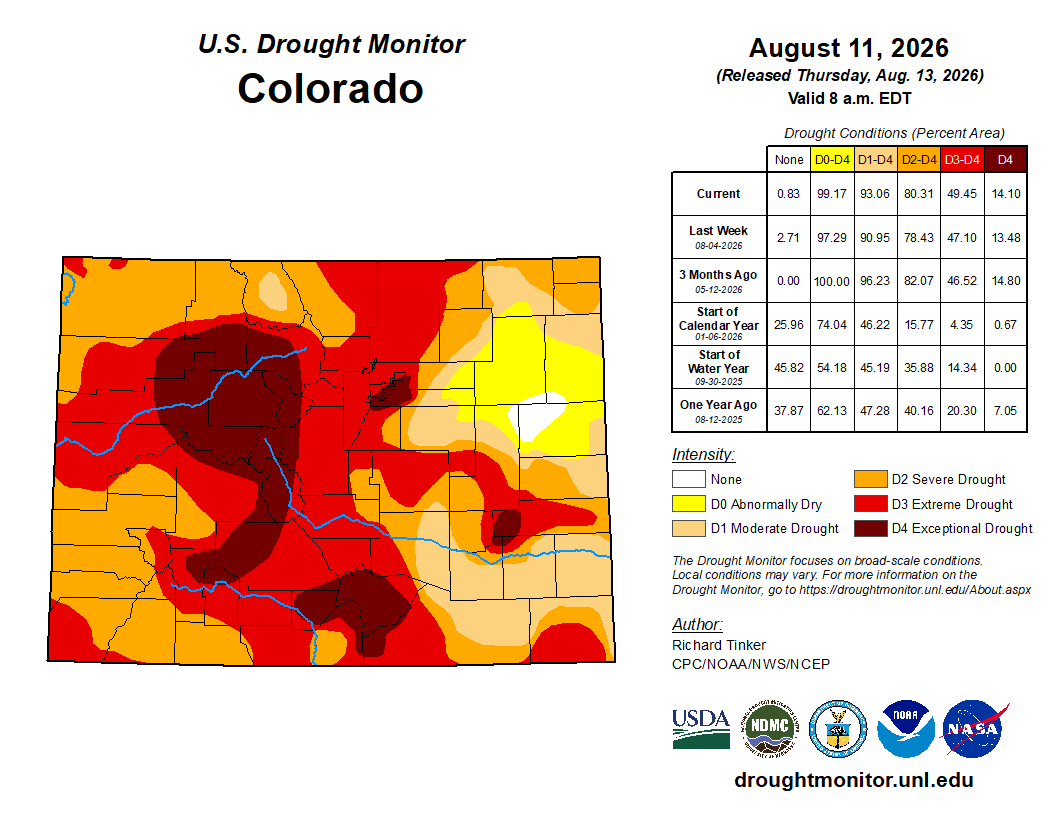
In some Front Range towns, residents still can water without inhibition despite searing drought. Nearly the entire state is in some level of drought, according to U.S. Drought Monitor data released Thursday, but the aridity is especially intense over the highly populated urban corridor and the mountains that are the source of much of Colorado’s water. The winter’s record-low snowpack translated into this summer’s anemic streamflows, moisture-sucking soil and drained reservoirs. Federal authorities describe the drought frying the Front Range with sobering words: severe, extreme, exceptional.
Despite widespread severe drought, 13 of the 25 largest cities and towns in Colorado have not implemented additional mandatory water use restrictions. The 13 communities — including the cities of Fort Collins, Pueblo and Boulder — are home to more than 1.5 million people, which is about a quarter of the state’s population. Water managers in many of the communities without additional drought restrictions have asked customers to voluntarily cut back water use, to varying degrees of success. Individual water providers set drought restrictions depending on their own portfolio of water sources and reservoirs. Communities that draw from multiple water sources, own powerful water rights and maintain large reservoir systems are best poised to ride out drought…Those differences can be confusing to customers who see headlines about extreme drought, shrinking reservoirs, other cities’ mandatory restrictions and the imperiled Colorado River system, said Kim Hutton, Boulder’s water resources manager. Denver Water and Aurora Water — along with many towns across the Western Slope — have implemented mandatory drought rules to curb water use. Pueblo, meanwhile, has neither mandatory nor voluntary restrictions in place. Boulder is under a drought watch and city leaders have asked customers to voluntarily conserve water and irrigate outdoors only twice a week. Hutton doesn’t expect to implement mandatory restrictions this year based on the amount of water they have stored…Fort Collins draws its water from the Colorado River via the Colorado Big Thompson Project, the Cache la Poudre River and the Michigan River, which is part of the North Platte River basin…Colorado Springs Utilities leaders have not implemented additional drought restrictions this year, though their customers are limited to three days a week of outdoor watering every year, regardless of drought status. The state’s second-largest city draws 70% of its water from the Colorado River, 25% from the Arkansas River and 5% from the South Platte River. The utility issued a water supply watch warning customers about drought impacts, but will not implement further restrictions until it has less than 1.5 years’ worth of water in its reservoirs, water conservation supervisor Julia Gallucci said. The city currently has 2.7 years’ worth of water in storage…
The lack of watering restrictions in some Front Range communities irked Andy Mueller, general manager of the Colorado River District, a taxpayer-funded agency that works to protect Western Slope water. Western Slope water users are working hard to conserve, he said, and farmers are fallowing fields because there is not enough to meet all the needs. It’s difficult to know that some of that conserved water ends up on the other side of the Continental Divide watering lawns in towns without any mandatory restrictions, he said.
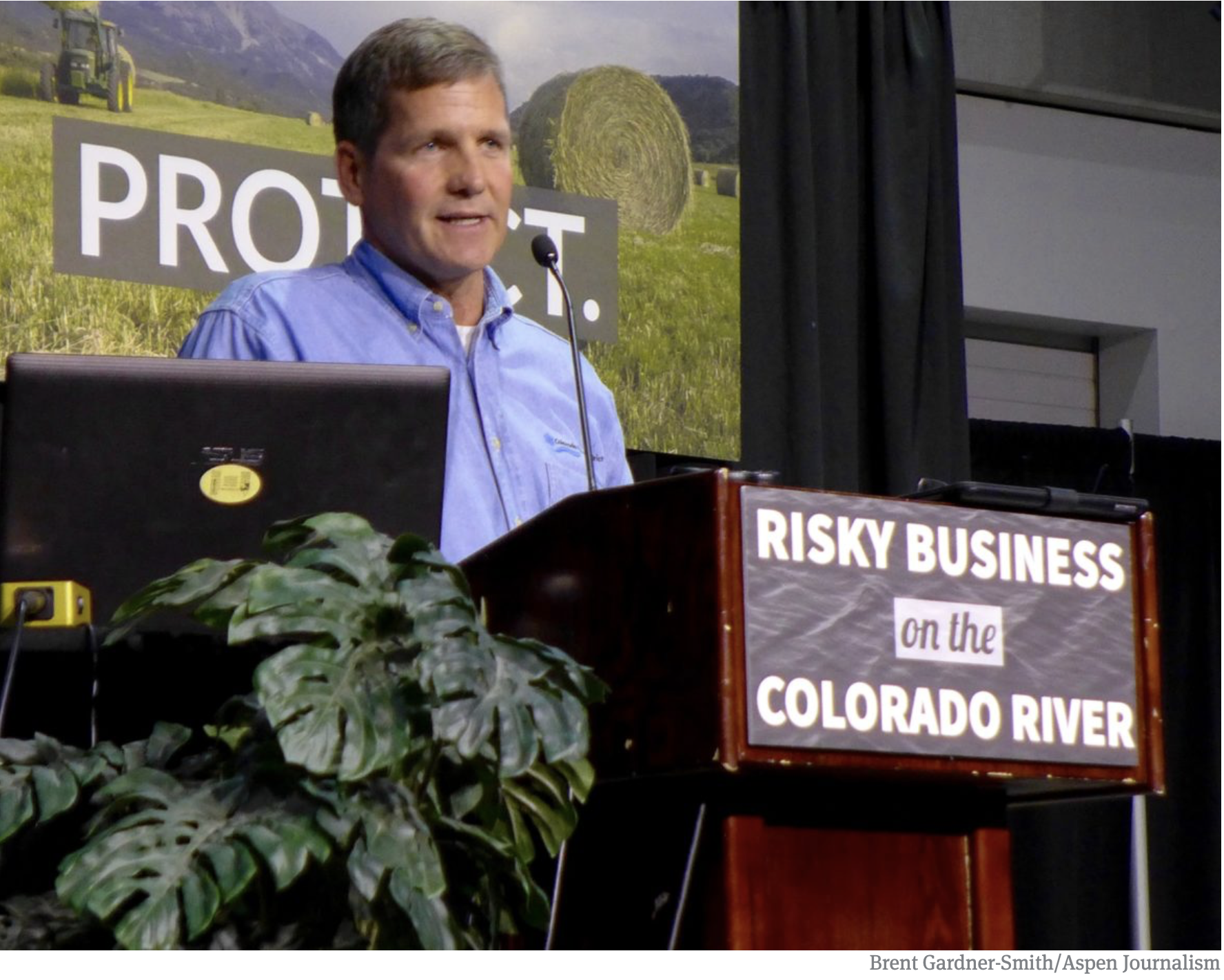
Andy Mueller, the general manager of the Colorado River District, speaking at the district’s annual seminar on the Colorado RIver, on Sept. 14, 2018 in Grand Junction. Muller expressed concerns about how the state of Colorado might deal with falling water levels in Lake Powell and Lake Mead. Photo credit: Brent Gardner-Smith/Aspen Journalism
Lake Powell’s drastically low water levels are evident in the discoloration of ancient cliffs that were submerged for decades, often referred to as “the bathtub ring” in March 2026 | Page Buono (American Rivers)
Click the link too read the article on the Colorado Politics website (Marianne Goodland). Here’s an excerpt:
August 17, 2026
In the past 10 days, both Lake Mead on the Arizona-Nevada border and Lake Powell roughly 300 miles northeast on the Utah-Arizona line have recorded their lowest water levels since the reservoirs were first filled. Lake Mead, the nation’s largest reservoir and which supplies water to Nevada, Arizona and California, measured 1,040.4 feet above sea level on Aug. 7. The level has continued to drop since then. On Monday, the reservoir measured 1,039.83 feet above sea level, nearly 190 feet below full and down about 2 feet over the past 30 days. A year ago, Lake Mead stood at roughly 1,054 feet.
Rarely seen back of the Hoover Dam prior to first fill
Hoover Dam, which created Lake Mead, was completed in 1935. The reservoir was last at full in 1983. If the reservoir loses another 4.76 feet, Hoover Dam begins to lose its ability to generate significant hydropower. At 895 feet, it reaches “dead pool” — a complete shutdown of Hoover’s hydropower system.
Lake Powell, the nation’s second largest reservoir and the water bank for Colorado, New Mexico, Utah and Wyoming, reached its lowest point in history on Sunday at 3,519.8 feet above sea level. A year ago, it stood at 3,551.33 feet above sea level.
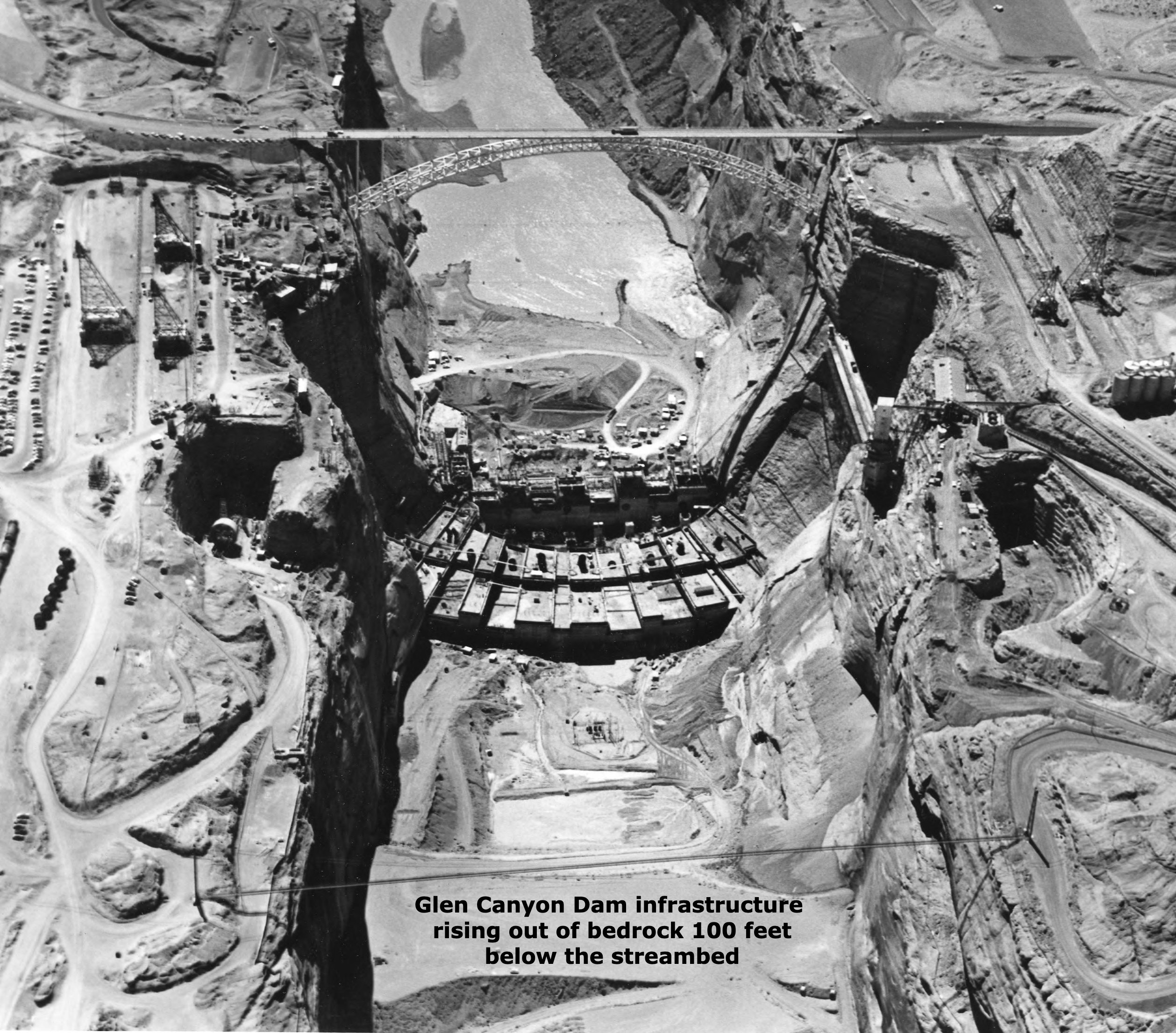
Glen Canyon Dam construction. Credit: Sibley’s Rivers
Glen Canyon Dam, which created the reservoir, was constructed in 1966. The last time Lake Powell was close to full was in 1999. At 3,490 feet, Glen Canyon Dam also begins to lose its ability to generate hydropower. At 3,370 feet, the elevation known as dead pool, hydropower production would stop entirely.
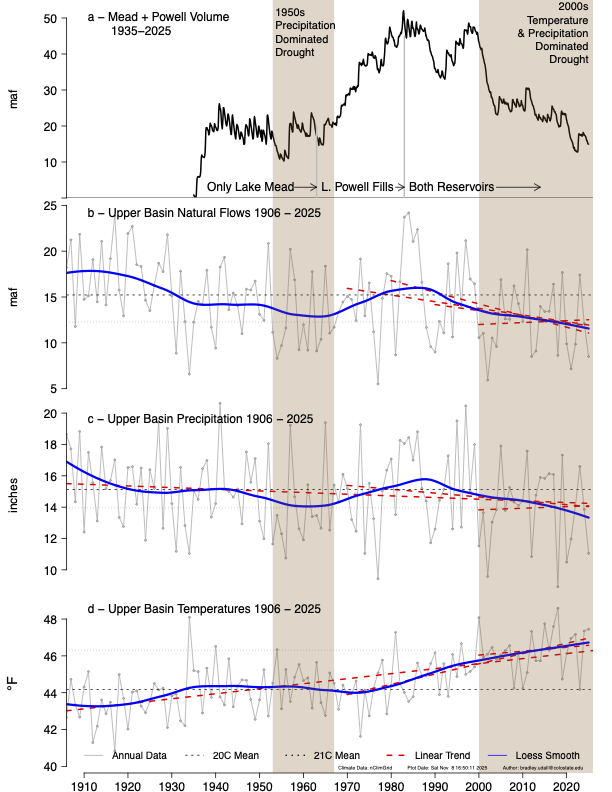
Udall/Overpeck 4-panel Figure Colorado River temperature/precipitation/natural flows with trend. Lake Mead and Lake Powell storage. Updated through Water Year 2025. Note the tiny points on the annual data so that you can flyspeck the individual years. Credit: Brad Udall
Both reservoirs are fed by the Colorado River, which has been hit by what some called a thousand-year megadrought that has cut its supply from around 15 million acre-feet per year to 12 million…This shouldn’t come as a surprise to anyone, according to Eric Kuhn, retired general manager of the Colorado River District.
“This was inevitable,” he told Colorado Politics. “All of the science has been pointing to this for 25 years.”
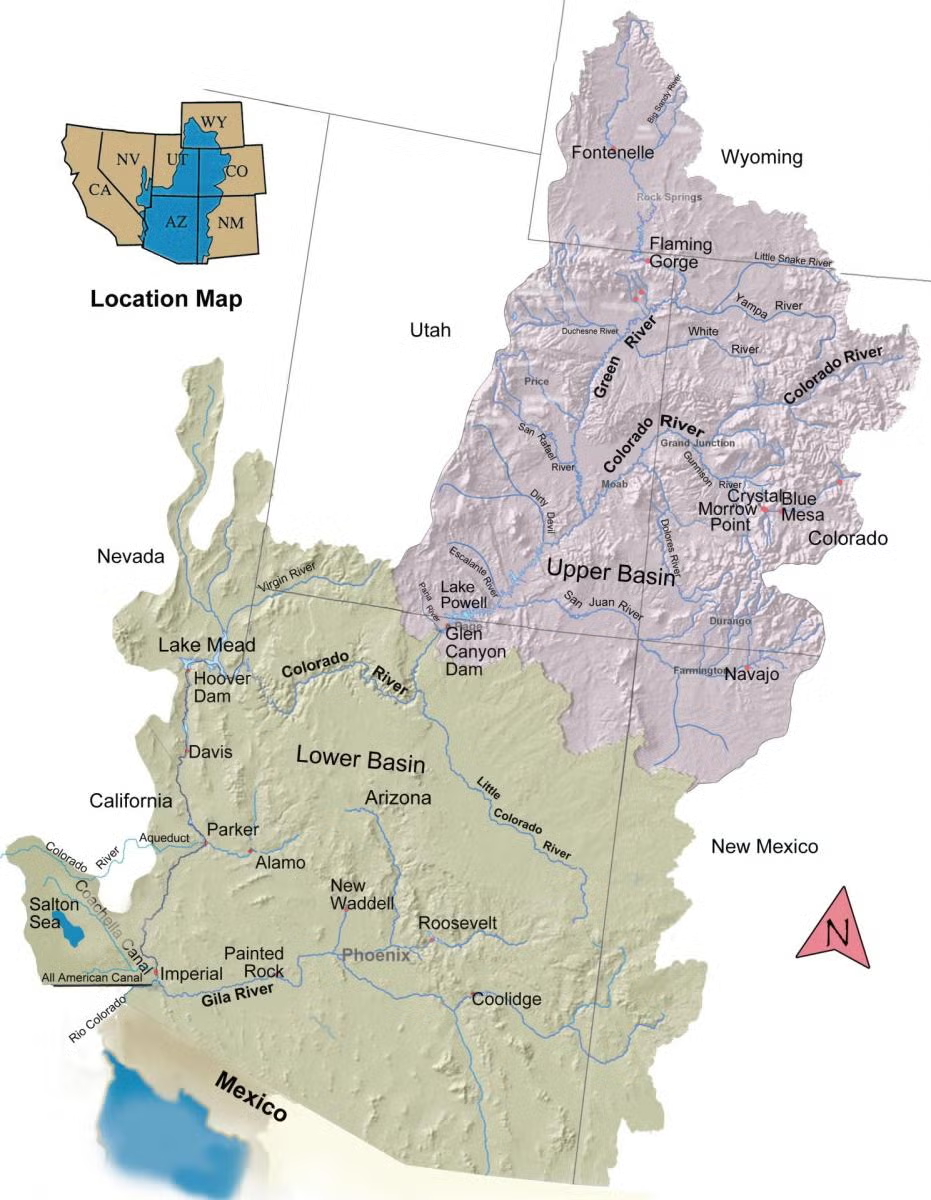
The Colorado River Basin spans seven U.S. states and is divided into Upper and Lower Basins. Lake Powell, upstream from the Grand Canyon, and Lake Mead, near Las Vegas, are the two principal reservoirs in the Colorado River water-supply system. (Bureau of Reclamation)
Climate change will almost certainly feature prominently in any multi-state litigation over the Colorado River. A court case over an almost-finished dam expansion may decide how.
Is climate change enough justification to stop the expansion of a reservoir that will take more water from the dwindling Colorado River?
That’s the central question in a lawsuit pitting the U.S. Army Corps of Engineers and Colorado’s largest water utility against a consortium of environmental nonprofits. The environmentalists say the Colorado River has no more water to give, while Denver Water, the utility whose Gross Reservoir would nearly triple in capacity, argues it is ensuring its customers can withstand droughts. The Corps contends it is not required to consider climate change or the downstream effects of its expansion of a dam to grow the reservoir.
The case in the 10th U.S. Circuit Court of Appeals has the potential to ripple through Western water management as states, tribes, cities and the federal government struggle to find a compromise on how to steeply cut water use. Some see history repeating itself, with the Gross Dam expansion emblematic of the kind of thinking that helped put the West into the very water crisis the project is meant to buffer the region against.
“Does it make sense for major water projects like this to continue to move forward?” asked Sarah Matsumoto, an associate professor of clinical law at the University of Colorado, Boulder, and director of the Getches-Green Natural Resources, Energy, and Environmental Law Clinic. “I just don’t think it does anymore, without at minimum considering impacts of climate and impacts of overappropriation on the river.”
The Corps and Denver Water appealed that decision, arguing that construction of the dam expansion is nearly complete, and topping off the reservoir behind it is in the public’s best interest. There are no other alternatives to consider, the utility asserts. The National Environmental Policy Act (NEPA), which requires evaluating the impacts of projects that need federal approval, does not require the assessment of climate change, they contend.
“We believe that considering potential climate impacts to a project goes beyond the scope of any guidelines, practicability, or NEPA reasonableness analysis,” said U.S. Department of Justice attorney Kyle Glynn, representing the Army Corps, during oral arguments for the case before the 10th Circuit Court of Appeals.
The expansion of Denver Water’s Gross Reservoir would hold an additional 77,000 acre feet of water diverted from the declining Colorado River, enough water for roughly 150,000 homes. Denver Water would get that water incrementally from an unused 1945 water right of 18,000 annual acre feet to ensure it can supply the growing metropolis of Denver and protect its water supplies during droughts.
The utility plans to only use its water right during wet years when it can stockpile water from excess supply. Of the 77,000 acre feet in diversions, 5,000 would be sequestered in an “environmental pool” that would enhance streamflows on South Boulder Creek and serve as additional storage for the cities of Boulder and Lafayette.
But environmentalists are not convinced there will be enough surplus water in the future for the utility to fill the reservoir. If the state is required to cut back its water use to address system-wide shortages on the Colorado River, reductions the seven states that depend on the river are currently negotiating, what happens to the over $800 million project, they wonder.
Those are the concerns driving the environmental groups, which sued over what they called an inadequate NEPA process and a failure to properly examine alternatives to the project. Natural resource professors watching the case share their concerns. The court’s decision, both say, could have far-reaching consequences for Southwestern states and nearly 40 million people who rely on the Colorado River, and could determine how climate change is considered in any future litigation.
Denver Water’s position is in direct contradiction with what Colorado is arguing in the current negotiations about how much water from the river states must give up, said Gary Wockner, founder of Save the Colorado, the environmental group that’s led the push against the Gross Reservoir expansion.
Colorado has maintained that it and other states close to the river’s headwaters should not have to make mandatory cuts because climate change is already limiting their supply by reducing river and stream flows. Should the negotiations over cuts to allocations from the river devolve so completely that states in the upper and lower halves of the Colorado River Basin sue one another, some water law experts believe climate change would figure prominently in the litigation.
“If the court supports Denver Water and says that Denver Water did not have to account for climate change to prove that they could operate the project, it sets a very difficult and perhaps powerful precedent, potentially undermining the state of Colorado’s position in the entire Colorado River negotiations,” Wockner said.
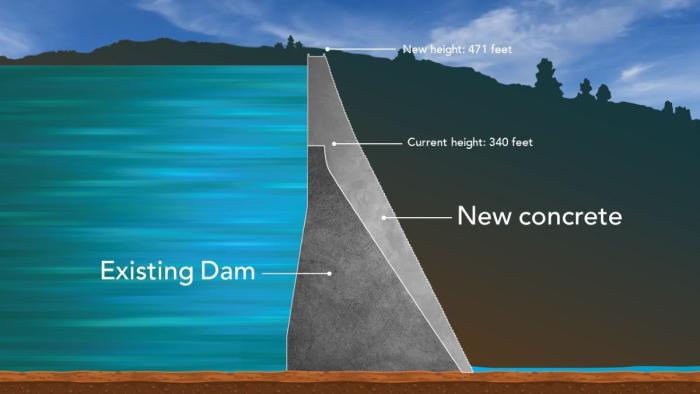
Roller-compacted concrete will be placed on top of the existing dam to raise it to a new height of 471 feet. A total of 118 new steps will make up the new dam. Image credit: Denver Water.
Can a Dam’s Progress Block Climate Considerations?
On the last day of July, attorneys for the environmental groups, Denver Water and U.S. Army Corps of Engineers gathered before three justices on the 10th Circuit Court of Appeals in a courtroom in Santa Fe, New Mexico. Their oral arguments came nearly two years after senior federal judge Christine Arguello ruled in favor of the environmentalists, saying that “the cracked foundation of the Colorado River’s management system all but demands skepticism over any proposal that will affect the hydrology of the Colorado River basin.”
Arguello’s decision didn’t stop construction to expand the dam, but forced the parties to meet and agree on remedies. Those discussions failed, however, leading Arguello to issue an injunction to stop construction in April 2025. That was lifted due to safety concerns about the dam being left incomplete, but an injunction remained preventing the clearing of the forest below to make room for the additional water, or filling the added space behind the dam.
The Gross Reservoir expansion solves a problem Denver Water has been trying to address for 23 years, said Jessica Brody, general counsel for the utility, in the 10th Circuit last month.
Denver Water has a water storage imbalance between its two collection systems with 90% of its reservoir storage located in the utility’s South System compared to 10% in its North System. This storage imbalance creates vulnerability if there is a drought, mechanical issue or emergency that affects the South System. The storage imbalance is one of the reasons Denver Water is expanding Gross Reservoir. Image credit: Denver Water.
Denver Water’s storage and delivery network is divided into north and south systems, which are unconnected and imbalanced. The south system provides 80 percent of the utility’s water supply, and if it were to go down, the north system, which includes Gross Reservoir, could run out of water in just one year. That leaves the utility’s system vulnerable in times of severe drought, wildfires or other emergencies.
Despite construction being nearly done, Brody said, Denver Water has a dam it cannot fill because of the lower court’s opinion.
That decision was an “abuse” of the court’s power, she said, as the water rights at stake are under the jurisdiction of the state, not federal agencies. Plaintiffs never sought a preliminary injunction to stop construction, although they did when later mediation failed. Jurisdiction over the cutting of trees to make room for the expanded reservoir lies with the U.S. Forest Service and the Federal Energy Regulatory Commission, not the Corps, she said.
The arguments from Denver Water and the Corps seemed to resonate with the three justices presiding over the case, largely due to the fact the dam is nearly complete.
“Poor pun: It’s water over the dam, because it’s built,” said Judge Timothy Tymkovich. “So costs, and I think climate change, are off the table now.”
William Eubanks, the attorney representing the environmental groups, disagreed. The dam expansion is part of Denver Water’s Moffat Collection System project, which requires work in addition to the Gross Reservoir project, such as felling the trees.
And there is still the question of where the water will come from.
A central point for the lawsuit, he said, is that under the Clean Water Act, water infrastructure developers have to show a project can be built and fulfill the expected need—in this case, a reservoir with more water. That wasn’t done here, Eubanks said.
“With the Moffat Collection System project, Denver Water and the Army Corps have recklessly gambled with over $800 million of ratepayer money,” Eubanks said before the court. Neither the Corps nor the utility forecasted whether there would be enough surplus water in the Colorado River for Denver Water to fill its reservoir, he argued. “In effect, they’re building a giant bathtub, even though there’s likely no water to ever fill it.”
CU Boulder professor Matsumoto is one of 11 natural resource law experts who submitted an amicus brief to the court asking it to affirm the lower court’s decision.
This case, they wrote, is a “classic example of why we need NEPA”—illustrating the consequences of an agency permitting and approving a project without a full evaluation of other alternatives and whether the project was even feasible. The foundational U.S. environmental law was designed to push agencies to “fully appreciate the consequences of their actions before they move forward with those actions,” they wrote.
The Corps violated NEPA by limiting the number of alternatives it considered for the project and only examining impacts up to 50 miles downstream, not along the full course of the river, the brief noted.
“It just doesn’t make any sense for the amount of water that they’re getting,” said Mark Squillace, a natural resources law professor at the University of Colorado in Boulder, and another one of the professors part of the amicus brief. “It’s insane.”
Udall/Overpeck 4-panel Figure Colorado River temperature/precipitation/natural flows with trend. Lake Mead and Lake Powell storage. Updated through Water Year 2025. Note the tiny points on the annual data so that you can flyspeck the individual years. Credit: Brad Udall
A Complicating Compact
Since 1922, the Colorado River has been governed by its eponymous compact, which is now widely acknowledged to have overallocated the river by millions of acre feet of water. Under the compact, both the Upper Colorado River Basin, made up of Colorado, New Mexico, Utah and Wyoming, and the Lower Basin states of Arizona, California and Nevada, are entitled to 7.5 million acre feet of water, with another 1.5 million acre feet going to Mexico. But the river has averaged closer to 11 million acre feet since 2020—more than 6 million acre feet less than the total that has been allocated, according to the most recent federal data.
Though both basins get an equal share of the river, Article III(d) of the compact specifies that the Upper Basin “will not cause the flow of the river” to be depleted below an average of 7.5 million acre feet per year over any 10-year period downstream.
Failing to meet that requirement could trigger the Lower Basin to demand more water from the Upper Basin in what is known as a “compact call.” That unprecedented action could force severe water usage curtailments in the Upper Basin, and how that would affect users like Denver Water is unclear. The system is dangerously close to the hydrological conditions that could trigger a compact call.
It’s a known risk for this project, the professors say, but one that was ignored during permitting.
Gross Reservoir is far from the only new diversion proposed in the Upper Basin, which has never used its full allocation from the river, but sees that water as key to the region’s continued economic growth and prosperity. Over 1 million acre feet of diversions have been proposed across 30 projects in the Upper Basin. Many of those may not be developed, but they have become a sticking point in negotiations over the river’s future.
“Repeating the Same Mistakes”
As the lawyers argued in Santa Fe, news of a short-term federal proposalfor managing the Colorado River rippled across the basin. In the absence of a new consensus among the states over how to allocate the water, the federal government stepped in to manage the crisis.
Its track record on the Colorado River is deeply checkered.
The compact has served as the bedrock for a web of dams, reservoirs, canals and ditches built largely with federal funding and engineering prowess to distribute water across arid Western lands. The magnitude of this diffuse system and its overreliance on diverting and impounding water, experts say, is at least partially responsible for the severity of the West’s water crisis.
Building the Gross Reservoir Dam in the 1950s. Photo credit: Denver Water.
Some believed not everyone has learned the lesson. “We’re just repeating the same mistakes,” Squillace said. “A lot of it just results from a lack of imagination about a better way to do things.”
As water supplies shift, water utilities across the West are squeezing every last drop out of their systems through a range of modifications and adjustments to their infrastructure.
After the first of the West’s deep 21st-century droughts in 2002, Denver Water, which serves 1.5 million people across Colorado’s Front Range, decided it needed to act. The utility convinced the Army Corps of Engineers, which completed the original Gross Reservoir in the 1950s, that raising the dam to triple the amount of water it could impound would be the best course of action to combat drought.
Since then, Denver Water has also invested in water efficiency, which allowed it to better endure droughts from 2002 to 2026. Despite a growing population, water use is below the benchmarks from the 1970s, said Jeff Martin, Denver Water’s program manager for the reservoir expansion.
“We’ve really capitalized on most of our customer savings at this point,” he said. “Now, we need to shore up the rest of our need with the expanded reservoir.”
But a drier future is precisely what should preclude Denver Water and the Corps from seeing this project through, said Wockner with Save the Colorado.
“It’s nonsensical to be diverting more water out of rivers anywhere in the Southwest United States,” he said. “Because in many ways the climate change bullseye in the United States is on the Southwest and Colorado River Basin.”
The Colorado River, Wockner said, has no more water to give. But Martin sees room for more improvement in how the river is managed.
“I would be the first to say something needs to change there on how we use the river for all stakeholders, including some type of cuts throughout the system,” said Martin. “I’m not that decision maker though.”
Graphic credit: RogerWendell.com
The state, he said, controls Denver Water’s rights to the river. The utility has the right to use the water that may one day fill Gross Reservoir, he said, and has been planning to do so for decades.
Despite arguments that the water isn’t available, Martin has no doubt Denver Water will be able to one day fill the reservoir—if the courts allow it.
What Comes Next
The justices have given no indication of when a ruling on the Gross Reservoir Expansion Project will land.
If Denver Water loses its current appeal, the utility claims it will be unable to ensure a reliable water supply during times of drought, and the decision may deter developers from pursuing other ambitious projects to solve the West’s water problems, from new dams to expensive desalination plants.
In the Santa Fe courtroom, Teagen Blakey sat on a wooden bench watching the lawyers argue over a project that has loomed over more years of her life than it hasn’t.
President of The Environmental Group, a nonprofit from Colorado’s Front Range and one of the lawsuit’s plaintiffs, Blakey grew up in the area around Gross Reservoir. She remembers sitting in community meetings as a teenager when the project was being permitted.
Despite the project’s impacts on Boulder County, the water won’t serve residents there, she pointed out. But the dam and reservoir expansions’ impacts will fall on the local population. At the site where Denver Water will clear the forest is a hike featuring a waterfall that would be submerged.
“It’s something you can’t quantify as a value,” she said.
With such a high cost to something so special, Blakey said, there must be certainty about the benefit it will provide.
South Platte River Basin via Wikipedia
Map of the Colorado River drainage basin, created using USGS data. By Shannon1 Creative Commons Attribution-Share Alike 4.0
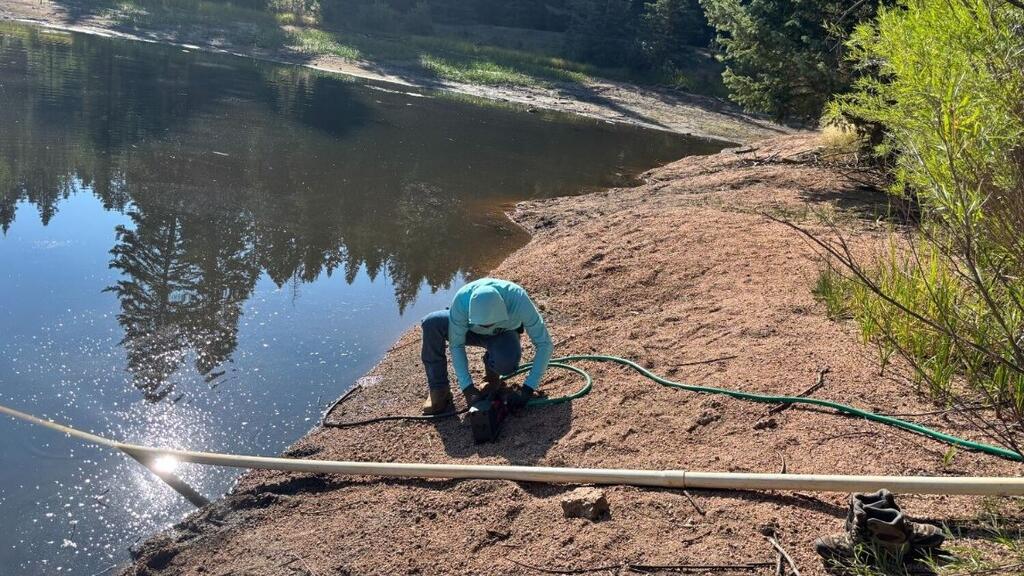
Park Resource Technician James Dilisio drains Gere Pond at Mueller State Park. The effort ensures Colorado Parks and Wildlife remains compliant with Colorado water laws as historic drought conditions continue to impact life throughout the Centennial State. CPW Photo/Brian Kerrigan
Visitors to Mueller State Park will see significantly lower water levels at two ponds as Colorado Parks and Wildlife releases water from Geer and Dragonfly ponds in response to continued drought conditions throughout the state and requirements under Colorado water law.
Most of the water has already been released from Geer Pond, a backcountry fishing location. Visitors hiking to the pond should expect to find primarily a dry pond bed with only a small amount of water remaining.
At Dragonfly Pond, located along the park’s main road and popular for children’s fishing and educational programs, park staff will release approximately three feet of water in the weeks ahead. The lower water level is expected to significantly reduce fishing opportunities at that pond for the remainder of the season.
“Visitors are definitely going to notice the change, especially at Dragonfly Pond,” said Brian Kerrigan, Mueller State Park manager. “But after the irrigation season ends, we’re hopeful a good winter will allow these ponds to refill and be available again in the spring.”
Colorado is experiencing extreme drought following low mountain snowpack, low streamflows and hot summer temperatures. Those conditions have left less water available to water-right holders across the state.
All of Mueller State Park’s ponds have water rights, but those rights are junior in priority to more senior water rights. When senior water-right holders call for water, CPW must comply with Colorado water law and allow water that otherwise would be stored in the ponds to continue downstream.
As Dragonfly water levels are reduced, water temperatures are expected to increase and create conditions unsuitable for trout. Dragonfly primarily supports stocked rainbow trout, while Geer primarily supports cutthroat trout. A fish salvage is not planned, as relatively few fish were stocked in the affected ponds this season.
Anglers still have opportunities elsewhere at Mueller State Park. Rock Pond and Brook Pond, both located in the park’s backcountry, remain available for fishing. Rock Pond is stocked with brook trout, while Brook Pond is stocked with cutthroat trout.
The impacts are expected to be temporary. Once the irrigation season ends, the park can begin retaining water in the ponds again. How quickly they recover will depend on winter precipitation and runoff.