Colorado River “Beginnings”. Photo: Brent Gardner-Smith/Aspen Journalism
Click the link to read the article on the KUNC website (Stephanie Daniel):
August 24, 2026
This story was produced by the Mountain West News Bureau, a collaboration between Boise State Public Radio, Wyoming Public Media, Nevada Public Radio, KUNR in Nevada, KUNC in Northern Colorado, KANW in New Mexico, Colorado Public Radio and KJZZ in Arizona as well as NPR, with support from affiliate newsrooms across the region. Funding for the Mountain West News Bureau is provided in part by the Corporation for Public Broadcasting and Eric and Wendy Schmidt.
Three states are being required to cut their water use under a final plan for managing the Colorado River over the next two years, while the four upstream states are being asked to voluntarily conserve water.
The U.S. Department of the Interior released the Record of Decision for managing the river over the next decade and laying out more specific rules for the next two years. The plan is intended to protect Lake Powell and Lake Mead, which have fallen to historically low levels after years of drought.
Arizona, California and Nevada will have to collectively reduce their water use by 1.25 million acre-feet per year over the next two years, with additional restrictions possible if conditions worsen, according to the plan.
Colorado, Utah, New Mexico and Wyoming are not subject to mandatory reductions; instead, those states are setting up programs to voluntarily conserve water.
“Under the proposed plan issued by the Department of the Interior, southern Nevada could lose more than 70 percent of its already meager Colorado River allocation while the Upper Basin states of Colorado, Utah, New Mexico, and Wyoming are not required to contribute a drop,” Nevada Governor Joe Lombardo said in a news release on Monday.
Upper Basin officials say their water users already face reductions when drought leaves less water available and that the federal government doesn’t have authority to impose mandatory cuts in their states. But they say the Upper Basin is willing to contribute voluntarily.
“Not because we have to, or that we feel like we legally have to,” Colorado’s river negotiator Becky Mitchell said at a conference last week in Steamboat Springs, “but because the importance of this system and the survival of this system is a responsibility for everyone.”
The federal framework envisions up to 200,000 acre-feet of water per year in Upper Basin contributions when conditions allow. The federal government is dedicating $100 million to the Upper Basin to compensate farmers, cities or other water users to use less. Colorado, Wyoming and Utah are also setting up their own state programs to facilitate participation.
Colorado officials expect applications could open this fall and projects could start next year.
“Our position has been and continues to be that we’re going to be part of the solution,” said Amy Ostdiek, section chief for the Colorado Water Conservation Board at the Steamboat conference. “We’re going to do it in the ways that we can, at the times that we can, but we can’t provide water certainty for our neighbors downstream that we don’t have ourselves.”
Criteria for selecting projects, how water users will be compensated and how the Upper Basin gains credit for conserved water are still being worked out.
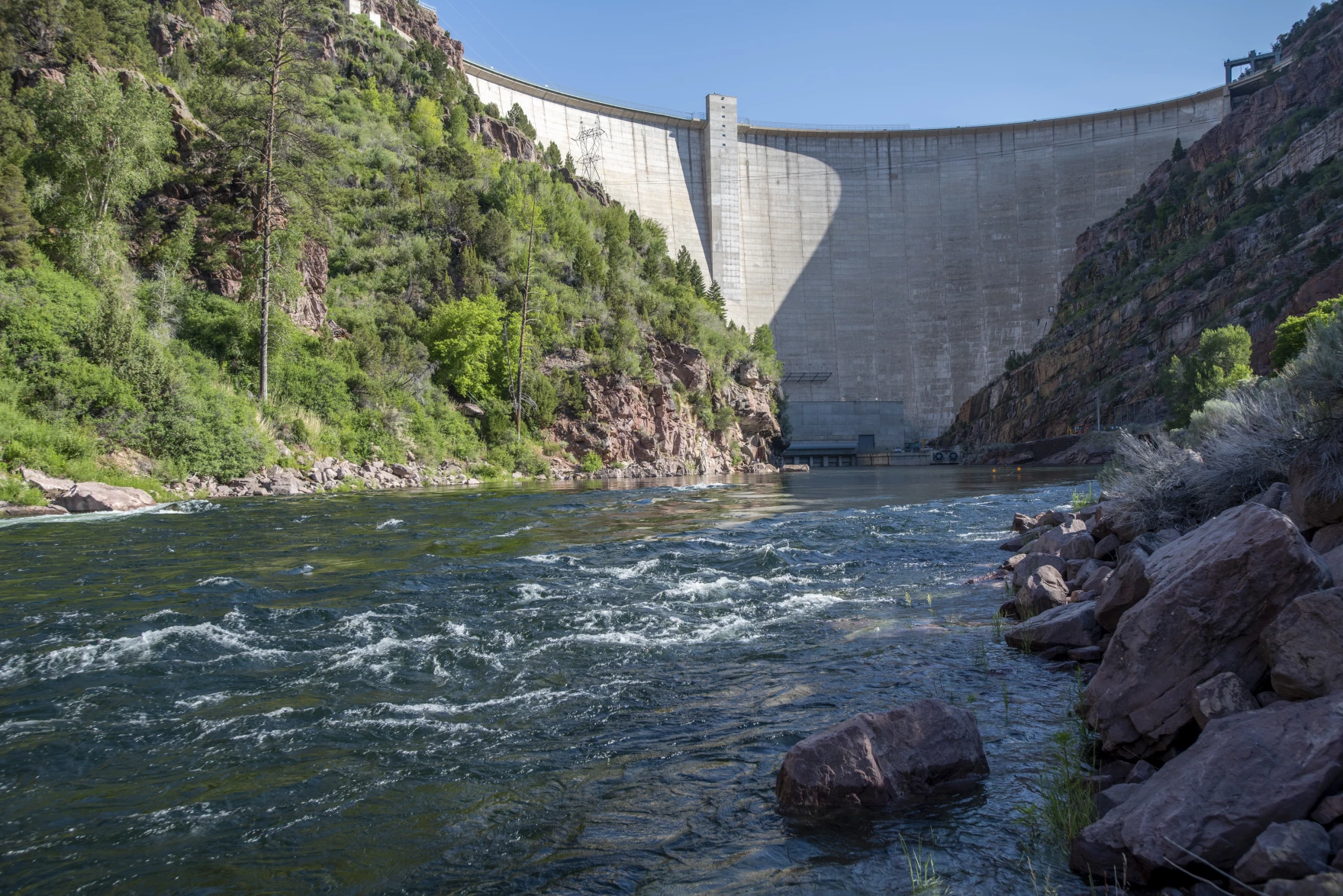
The Green River flows beneath the Flaming Gorge Dam in Utah. The federal government is sending water from the reservoir to prop up Lake Powell, something it could do in future dry years under a plan to manage the Colorado River. Ted Wood/The Water Desk
The federal plan also creates a potential “conservation pool” in Lake Powell, allowing the Upper Basin states to store a certain amount of conserved water.
John Berggren, a water policy analyst with the nonprofit Western Resource Advocates, has advocated for a conservation pool and said its inclusion in the federal framework is promising. However, exactly how it would work is not clear.
“How that pool operates, how the water is used, when it’s moved, if it’s moved, who decides that – all that is going to depend on future agreements,” he said.
Some key questions, he said, have to do with what the conserved water is credited towards, such as whether it’s used to offset shortages in the Lower Basin or help the Upper Basin fulfill their legal obligations to deliver water downstream.
The new framework also allows the Upper Basin to come to an agreement with the Interior Department to draw down a few reservoirs when Lake Powell nears getting too low for hydropower. That started happening this year, with water released from Flaming Gorge Reservoir in Wyoming.
Adult Zebra mussel. Photo credit: Colorado Parks and Wildlife
Click the link to read the article on The Aspen Times website (Ali Longwell). Here’s an excerpt:
August 25, 2026
After 2025 saw a flurry of zebra mussel detections in the Colorado River system, Colorado Parks and Wildlife’s weekly sampling this summer has led to zero new discoveries of the invasive species. This does not mean, however, that zebra mussels — notorious for their prolific reproduction and destruction of ecosystems and infrastructure — are gone from the basin or that the battle to curb their spread is over. When zebra mussels establish a presence in a body of water, they multiply quickly. A single zebra mussel can produce up to 30,000 veligers — their microscopic, free-floating larvae — in one spawning event and up to one million in a year. As they root and attach to hard surfaces — like docks, rocks and pipes — and their density increases, they can cause significant damage and clogging to water infrastructure…
This summer, Parks and Wildlife has continued weekly sampling in the Colorado River from its headwaters near Granby to the Colorado-Utah state line, according to Robert Walters, Colorado Parks and Wildlife’s invasive species program manager…Walters said the agency has taken over 500 plankton tow samples since May, not only in the Colorado River, but in its major tributaries including the Gunnison, Roaring Fork and Eagle rivers…Despite the lack of discoveries, the Colorado River, from its confluence with the Eagle River to the state border with Utah, remains one of six bodies of water that are considered infested with the highly invasive zebra mussels. A body of water is considered “infested” when adult and veliger zebra mussels have been found in it. In Colorado, for a body to no longer be considered infested, it must have five consecutive years without detections of that species, according to Walters. The five-year clock resets at each detection.
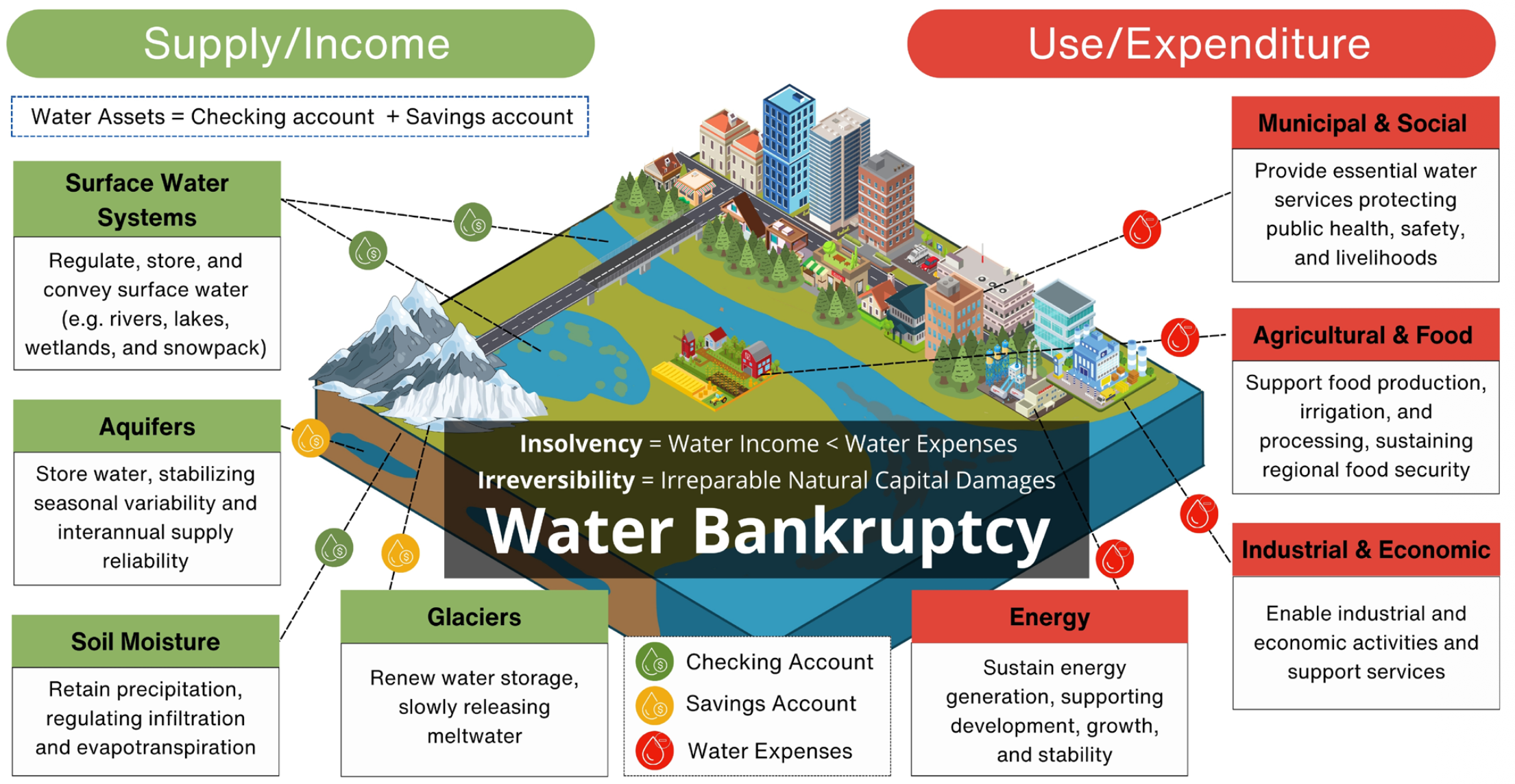
A simple illustration of water income and water expenses in a human–water system. Water bankruptcy is the outcome of both insolvency and irreversibility conditions, i.e., when water use (expenditure) exceeds water supply (renewable and non-renewable assets) for an extended period resulting in irreparable damages to the underlying natural capital that contributes to water production and stability of the hydrological cycle.
Click the link to read the article on the Sibley’s Rivers website (George Sibley):
‘Amid chronic groundwater depletion, water overallocation, land and soil degradation, deforestation, and pollution, all compounded by global heating, a UN report today declared the dawn of an era of global water bankruptcy, inviting world leaders to facilitate honest, science-based adaptation to a new reality.’
Our Colorado River made their list of exemplary global ‘hot spots’ for bankruptcy, with the observation that ‘the Colorado River and its reservoirs have become symbols of over-promised water.’
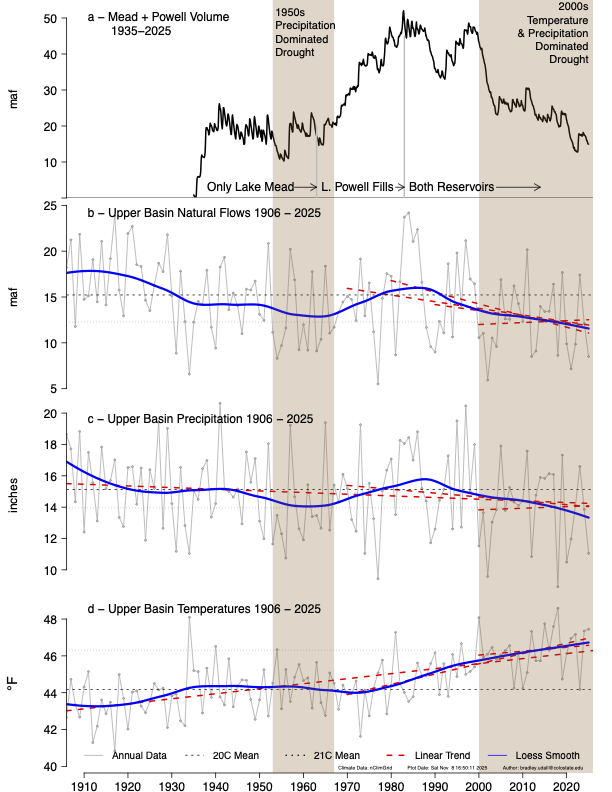
Udall/Overpeck 4-panel Figure Colorado River temperature/precipitation/natural flows with trend. Lake Mead and Lake Powell storage. Updated through Water Year 2025. Note the tiny points on the annual data so that you can flyspeck the individual years. Credit: Brad Udall
You’ve seen the word ‘crisis’ used frequently this year in the countless morbid articles about the Colorado River. But the UNU Institute director Kaveh Madani argued that we are now ‘post-crisis’: the term ‘crisis’ implies a deviation from the normal, a disruption to be dealt with in order to get back to normal, but there is now, Madani says, no going back to what passed for ‘normal’ in the last century. [ed. emphasis mine]
The study indicates that we have drained too many aquifers, resulting in subsidence that destroys the aquifers for the rest of the geological age; we have lost high-storage wetlands to gullying and lowered water tables; we have spread too much surface water out to dry under an atmosphere heating up incrementally with every additional gallon of fossil fuel we burn; desertification spreads in our wake; et cetera, et cetera. As a result:
The report makes the case for a fundamental shift in the global water agenda—from repeatedly reacting to emergencies to “bankruptcy management.” That means confronting overshoot with transparent water accounting, enforceable limits, and protection of the water-related natural capital that produces and stores water—aquifers, wetlands, soils, rivers, and glaciers—while ensuring transitions are explicitly equity-oriented and protect vulnerable communities and livelihoods.
There is in this research paper the kind of lovely naivete that one finds in most of the analyses of Big Issues today (climate change, systemic racism, corporate personhood versus people, etc.); there is an underlying conviction that when the facts are all laid out, we will rationally accept that, yes, we are indeed in a bankrupt situation. And so we will all sit down together, like rational beings would, and work out ways to resolve the ‘reality deficit’ between what has been promised and what can be delivered.
This ignores the fact that, when we are first confronted with evidence of something so big in its threat to our way of life, that its correction might require creating a whole new way of life, our first response is to say, ‘this can’t be so.’ There has to be a mistake. And a long winding road leads on, into and through a morass of denial, anger, blames cast, responsibilities denied, hopeful negotiations and underlying despair – the whole medieval pilgrim’s Slough of Despond that must be negotiated before we might actually sit down together and work out some way of resolving the ‘reality deficit.’
There is, however, a kind of honesty in coming around to realizing – and acknowledging – that a system might be bankrupt. Bankruptcy is not necessarily the end song of what has become bankrupt, although it can be (Chapter 7 bankruptcy). It can instead be a time of operational or financial reorganization, aa time for acknowledging circumstances, conditions and misconceptions not originally taken into account that, accounted for, might enable a measure of eventual recovery and even success.
The seven Colorado River Basin states, still stuck in the zomboid Colorado River Compact, are not there yet, but the Bureau of Reclamation might be getting there. On the viable assumption that the seven states will not come up with a last-minute plan before the end of September and expiration of the Interim and Interim Interim Guidelines, they are preparing to institute a temporary plan that will maintain functionality in the river storage and delivery system, with (they hope) no embarrassing ‘dead pool’ episodes – which basically means getting and keeping as much water as possible in the two big reservoirs, Mead and Powell, and that can only happen at considerable cost to users below the big reservoirs.
The Bureau plan will not be carved in stone for forever like the Colorado River Compact; the Bureau will basically be planning operations for two-year periods, through the coming decade; every two years, the parties of interest will reconvene to review and revise the operating plan as circumstances require. This ‘adaptive’ approach makes sense in a bankruptcy situation in which the future is mostly unknown. [ed. emphasis mine]
The plan really has no surprises for anyone who remembers the 2022 bolt of reality that caused Bureau Commissioner Camille Touton to tell the water leaders in the seven states to immediately plan to voluntarily cut 2-4 million acre-feet (maf) of water use – basically a quarter of river use at that time – or the Interior Department would do it for them. That – in the centennial year of the Compact – is probably a good marker for the Bureau’s acknowledgement that we were beyond crisis, and slipping into bankruptcy.
The structural deficit refers to the consumption by Lower Basin states of more water than enters Lake Mead each year. The deficit, which includes losses from evaporation, is estimated at 1.2 million acre-feet a year. (Image: Central Arizona Project circa 2019)
That 2022 siren call was met by the Lower Basin states agreeing to finally take the Lower Basin system losses (evaporation, etc.) and their half of the Mexican obligation out of their river-use shares rather than out of Mead storage until the 2027 water year – provided they would be paid to do so. The absence of ‘surplus flows’ to take care of those losses – ~1.25 maf – from the coming online of the Central Arizona Project was a principal source of the draining of the big reservoirs, the so-called ‘structural deficit,’ 30 maf of storage gifted to the Lower Basin.
(A side note on this: The Upper Basin states, since a 1970 Law-of-the-River agreement, have been regularly sending downstream their 750,000 acre-feet for the Mexican obligation and absorbing as part of their whatever’s-left-over share of the river the ~400,000 acre-feet of Upper Basin system losses. The four states have never asked for or been paid for doing that.)
But that 1.25 maf of voluntary shortages was only a large fraction of the 2-4 maf of cuts the Bureau said needed to happen. So the Bureau’s original 2027-28 plan announcement in late July included cuts of up to 40 percent for the states below Mead Reservoir (Arizona, California and Nevada) – roughly equivalent to the 2022 request for 2-4 maf in cuts. The three downriver states countered that with an offer to permanently do the same 1.25 maf cut (with payment) for 2027-28 they were doing for 2025-26, with intimations of lawsuits if the Bureau pushed too far beyond that.
Arizona has led the countercharge from the states below Mead Reservoir – being the state with the most to lose, since the junior status of the Central Arizona Project means it would be practically shut down by 40 percent cuts in usage.
A letter to the Interior Department from Tom Buschatzky, Arizona’s Director of Water Resources, castigated the Bureau plan for making no mention of the Colorado River Compact and the Law of the River (LOTR). The letter insisted that Article III(c) and (d) of the Compact be executed to the letter as stated in the LOTR 1970 agreement: that a minimum of 8.23 maf be released from Powell Reservoir every year – the Compact commitment of 7.5 maf per year on average passing Lee Ferry, plus the Upper Basin’s share of the Mexican obligation (750,000 af/year).
In their August 21 announcement of the more detailed plan for 2027-28, the Bureau backed down from the 40 percent number, and now wants a 20 percent reduction in use for the two years – more in line with the Lower Basin’s willingness to continue taking care of its own system losses and Mexican share, but requiring some additional cuts – and avoided discussion of the Compact issue raised. It will, however, probably be pushing for more cuts in the 2028 discussions for the 2029-30 plan renewal; the Bureau still feels that it needs at least 3 maf in permanent cuts to begin any hope of turning the current near-bankruptcy around, and bringing demand in line with at least current supply.
The Bureau would also like the seven states to be reviewing, revising and executing the two-year plans consensually by 2036, rather than imposing it on them. But Arizona, according to the Buschatzky letter, wants a ‘longer, more comprehensive’ plan from the states, consistent with the LOTR, and ‘does not accept a framework that gives the federal government the discretion to select from a wide range of alternatives—including catastrophic cuts to the Lower Basin—every two years for the next decade.’
‘Bankruptcy management’ would seem to argue that the Colorado River Compact should be on the table along with everything else – including the nonexistence of the 18 maf river for which the Compact was written. A detailed analysis of the current situation by the ‘River Elders’ – the Kuhn-Schmidt-Castle group – suggested that ‘Basin water users must focus on solutions to the fundamental, wet-water math problem, rather than legal arguments over paper water.’ [ed. emphasis mine]
Nonetheless, Buschatzke’s letter states that ‘Arizona reserves the right to seek the resolution of its Compact rights in an appropriate judicial forum.’ The states are not yet willing to acknowledge the bankruptcy of the Compact – a Humpty-Dumpty that not all the patches and bandaids of the Law of the River can put back together for an ever-shrinking 21st century Colorado River.
That, more or less, is where the river system’s future sits as of August 21. There will – thanks to the Bureau – be a plan for moving carefully into the future, a two-year step at time. A big question is how hard the Bureau will begin to push for the 3-4 maf in permanent cuts by users necessary to stop the march into real dead-pool bankruptcy of the system – leading to another big question: whether the Compact nostalgitarians will push the system into dead-pool bankruptcy by suing the Bureau/Interior Department over paper water, tying things up in court for another several years.
Ah, the lovely Slough of Despond. There with Henry: ‘All day the sun has shone on the surface of some savage swamp, where the single spruce stands hung with usnea lichens, and small hawks circulate above, and the chickadee lisps among the evergreens, and the partridge and rabbit skulk beneath; but now a more dismal and fitting day dawns, and a different race of creatures awakes to express the meaning of Nature there….’ Bankruptcy, the Apocalypse – only the end for those who fail to see that something else is always struggling for a chance to be born; don’t put a period where God (or Nature) would put a comma (Gracie Allen). As Henry also observed, ‘The light which puts out our eyes is darkness to us. Only that day dawns to which we are awake….’
Next post, I want to go back to the ‘desert river’ concept to think a little outside the (Compact) box.
Map of the Colorado River drainage basin, created using USGS data. By Shannon1 Creative Commons Attribution-Share Alike 4.0
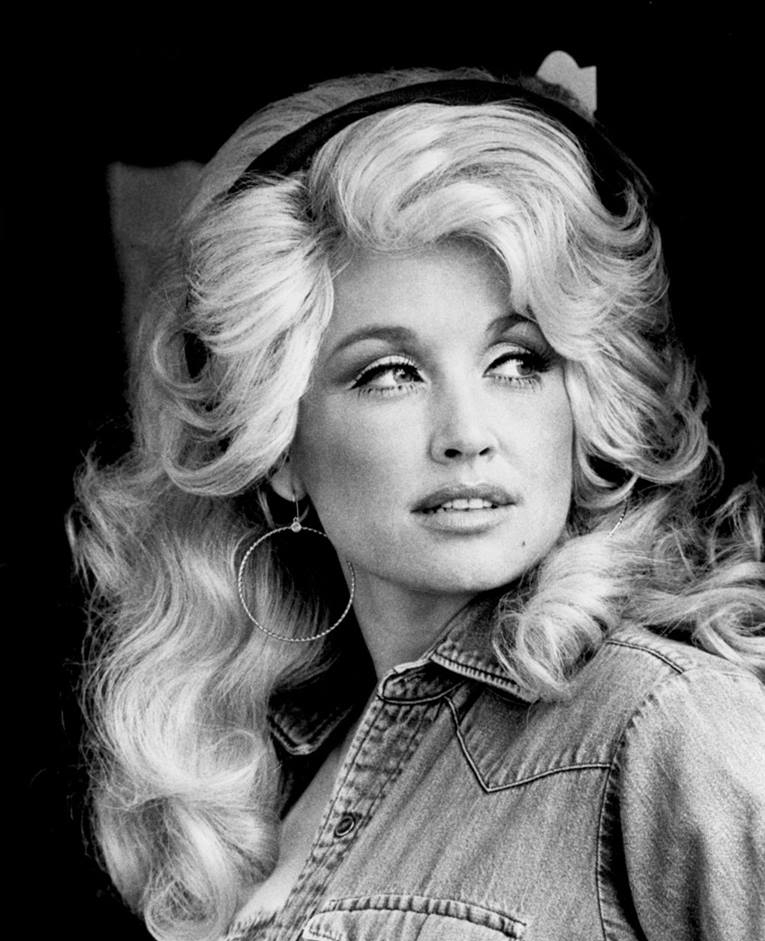
Dolly Rebecca Parton Dean (January 19, 1946 – August 25, 2026) was an American musician, actress, philanthropist, and businesswoman. She was a child prodigy, writing her first song at the age of six, performing regularly on TV at the age of ten and making her first recording at the age of 11. She became a professional songwriter at the age of 16 and, after writing hits for other artists, her debut album, Hello, I’m Dolly, was released in 1967, beginning a career spanning 60 years and 50 studio albums. Dubbed the “Queen of Country“, she was one of the most-honored female country performers and received various accolades, including 11 Grammy Awards, three Emmy Awardsand the Jean Hersholt Humanitarian Award, along with nominations for two Academy Awards, six Golden Globe Awards, and a Tony Award.
She sold more than 100 million records worldwide, making her one of the best-selling music artists ever. Parton’s music includes Recording Industry Association of America(RIAA)-certified gold, platinum and multi-platinum awards. 25 of her singles reached number one on the Billboard country music charts, tied with Reba McEntire for the most by a female artist. She had 44 career top-ten country albums, a record for any artist, and 110 career-charted singles over 40 years. Her 49th and final solo studio album, Rockstar (2023), became her highest-charting Billboard 200 album, peaking at number three.