
From The Pueblo Chieftain (Chris Woodka):
“In a few cases, clearing saltcedar has resulted in temporary, measurable increases in streamflow,” a report by the U.S. Geological Survey states. “Most studies, however, have found that although evapotranspiration may be decreased by large-scale removal of saltcedar, no significant long-term changes in streamflow are detected as a result of vegetation removal.” The report is a scientific assessment ordered under the Saltcedar and Russian Olive Control Demonstration Act of 2006. It reviews past studies in order to assess the scientific information available about tamarisks and Russian olives, while providing a common background for those applying for federal grants.
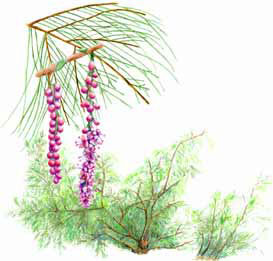
In Colorado, the Arkansas River basin is the most heavily infested with tamarisk, with 69 percent of the state’s total acreage. Many of the trees were planted in the 1900s as a means of erosion control. The trees have spread over time, taking over cottonwood stands in the river beds and colonizing upland areas as well. More than 67,000 acres are affected…
Today, the [Southeastern Colorado Water Conservancy District] is coordinating efforts throughout the valley under the Arkansas River Watershed Invasive Plant Plan. In addition to water usage, the trees have been identified as crowding out beneficial native plants and restricting flood control channels. According to the project’s website, tamarisk use 76,600 acre-feet of water per year, and infilling of partially infested areas eventually could increase that amount to 198,000 acre-feet…
The report acknowledges that tamarisk stands spread areas of vegetation into upland areas as well as along the banks, but states that simply removing the trees does not increase the water supply. Instead, the natural vegetation that replaces tamarisk may use the same amount or even more water, nullifying any water gain. Evaporation could actually increase if shading by tamarisk is reduced. Water made available to groundwater is used by other plant species, and does not increase long-term streamflow, the USGS report states.