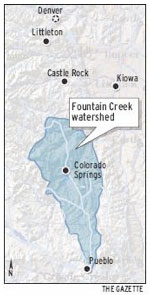
From The Pueblo Chieftain (Chris Woodka):
The district would use $300,000 from payments by Colorado Springs as part of its obligations under its 1041 permit for the Southern Delivery System from Pueblo County. The money would be matched with $100,000 from the USGS. Other partnerships are needed to fill out funding over three years, according to a draft proposal presented Friday to the Fountain Creek board. “The study would answer the questions of where to build and why to slow down the floods in the last five miles of the creek,” said Gary Barber, executive director of the district…
David Mau of the Pueblo USGS office explained that the new study would build on the work of previous research, including a $3 million Army Corps of Engineers report and the $600,000 Fountain Creek Corridor Master Plan that will be completed next year.
Barber said there are two reasons for moving ahead before all of the money is collected from Colorado Springs. The first is improvement of the creek. “When Fountain Creek decides to go, it goes,” Barber said, pointing to charts that show an increase of sediment that increases geometrically to the volume of flows. “We need to find out what to do when you go from moving 10,000 tons of sediment to 100,000 tons.”
The second is the district’s funding, which ends about one year from now. The $300,000 from Colorado Springs, along with $200,000 from the corridor plan (a joint venture of Colorado Springs and the Lower Arkansas Valley Water Conservancy District), are the district’s primary sources of funding until the balance of Colorado Springs’ $50 million kicks in. That money is due in five annual installments of $10 million, less the money already paid, when SDS is completed — 2016 at the soonest.
In the meantime, the district is working on strategies to ask voters in El Paso and Pueblo counties for a mill levy in 2012. The district is working to complete projects such as the flood control study, a $1 million demonstration project on Fountain Creek in Pueblo County, a confluence park in Pueblo or a highway realignment on U.S. 24. Because it has little money of its own, the district has signed on as partners, managed grants or simply become a “cheerleader” for efforts to improve Fountain Creek, Barber said.