Below are my notes from today’s meeting:
Taryn Hutchins-Cabibi announced that the state drought plan is finished and was approved 2 weeks ago by the Colorado Water Conservation Board (along with the flood mitigation plan). The documents have been forwarded to the Colorado Division of Emergency Management for approval then on to Governor Ritter.
Ms. Hutchins-Cabibi reported also that the task force is looking for a mechanism to bring long-term forecasts back into the agenda.
State Climatologist’s Report
Nolan Doesken reported that the temperature for the last couple of months has been, “cheating more and more on the warm side,” and that, “for most of the state the summer has been warm.”
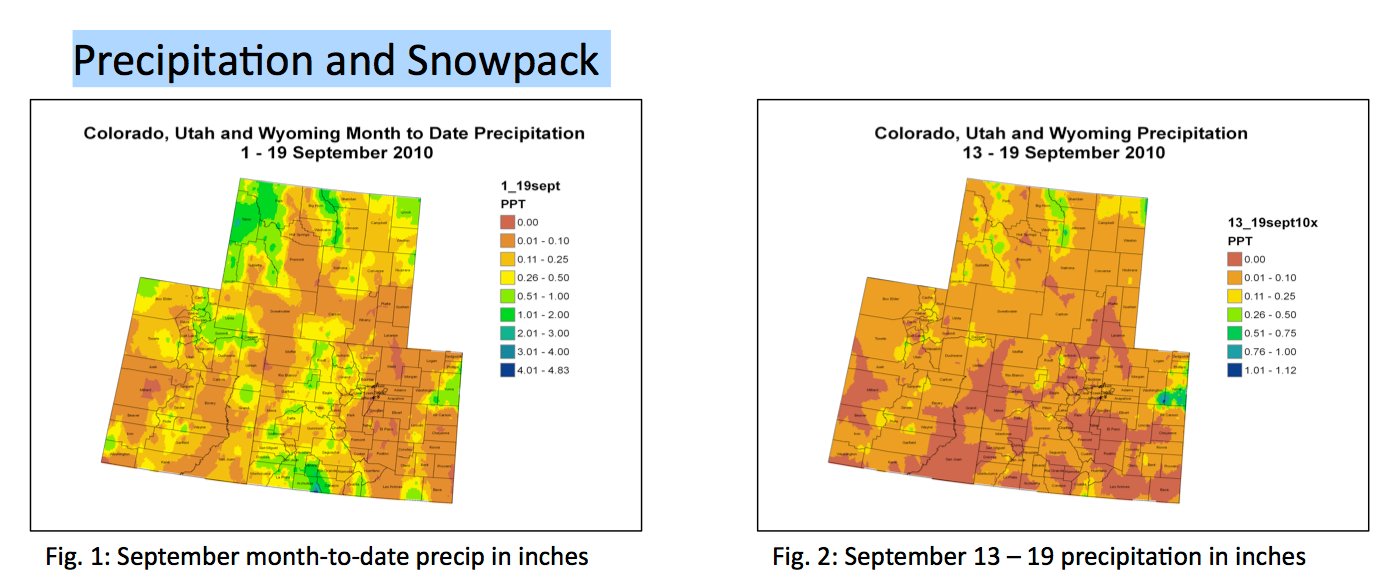
In September Colorado saw a, “drying out to the point of no precipitation in some areas,” he said.
The Southwestern Monsoon, “Doesn’t always cover the whole state, Doesken added, but, “Overall for the water year we’re seeing a near average water year through August.”
Grand Lake, “will not have its driest year on record,” after all, according to Doesken, but it is close. He added that he wonders how the location of the weather station is affecting readings and are they still representative of the area at that site.
Karen Rademacher from the Northern Colorado Water Conservancy District echoed the concern saying that, “We’re not seeing the same situation,” in Grand County. In fact, she said, if, “we have anywhere near a normal snowpack Lake Granby will spill next year.”
Montrose has had near average precipitation for the water year. Mesa Verde has seen average precipitation as well thanks to a good monsoon season. The Rio Grande Basin will end the year below average.
Burlington however has experienced the second “extraordinarily wet year,” in a row, he said. They’ve received 25 inches this water year and 20 inches last water year. This dovetails with a short report from the Colorado Department of Agriculture representative (I didn’t catch his name) saying that it has been a fantastic year for agriculture on the eastern plains.
Fort Collins should end up right at the long-term average for precipitation, according to Doesken. Boulder will have an above average water year with a, “very dry ending,” he said. He showed last week’s U.S. Drought Monitor which is showing an, “expansion of dry areas,” in northern Colorado.
Natural Resources Conservation Service report
I thought we were going to get a very short report when Mike Gillespie started his presentation by saying that there is, “still no snow to report.” He did however have a report on precipitation totals, trends and reservoir storage from around the state.
The Yampa-White precipitation is sitting at 92% of average. The Upper Colorado River Basin reservoir storage is at 92% of the long term average, he said, adding that they are, “going into the new water year in good shape.”
In the South Platte Basin precipitation is at 92% of average and reservoir storage is 112% of average which is 98% of the total in water year 2009. The basin is, “going into the new water year in good shape as well,” he said.
Down in southwestern Colorado they have a long way to go to get back to average after a, “couple of below average water years back to back,” but reservoir storage is, “slightly above average,” according to Gillespie.
The Rio Grande basin needed a good monsoon to get to precipitation up to 93% of average while reservoir storage is 84% of average. The Arkansas Basin precipitation stands at 90% of average and reservoir storage is 94% of average, he said.
Statewide water year precipitation is 92% and will not improve since, “September has definitely been a dry month,” said Gillespie. Statewide reservoir storage is 103% of average.
Lake Powell and Lake Mead
Just for grins the task force likes to keep an eye on the two big reservoirs on the Colorado River downstream from the “Rooftop of America”. Ms. Hutchins-Cabibi reported that Lake Powell is sitting at 65% of capacity while Lake Mead is at 39% of capacity and dropping. The system is at 56% of capacity which is, “slightly lower that last year at this time.”
More CWCB coverage here.