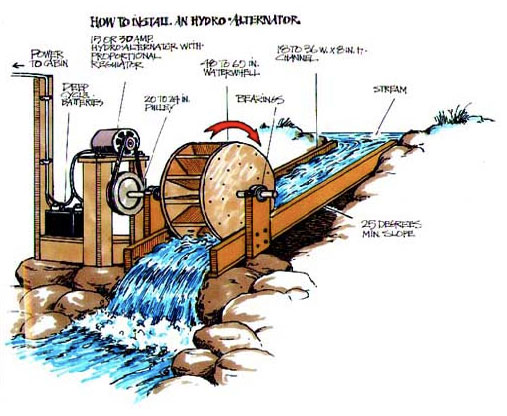
Energy policy — hydroelectric: Irrigation system low-head hydro potential

A picture named microhydroelectricplant.jpg

From RenewableEnergyWorld.com (Russel Ray):

Researchers…have made significant progress in the development of low-head turbine technologies. Today, several companies are experimenting with technologies capable of generating power from small amounts of water that drop as little as five feet. These improvements mean the rushing water in irrigation canals can now be used to produce anywhere from 100 kW to 2 MW of clean energy.

Colorado has 3 million acres of irrigated land and is the nation’s third largest irrigation state, using more than 12 trillion gallons of water a day for irrigation, according to the U.S. Geological Survey. The potential power that could be wrung from the state’s irrigation canals is being studied by Colorado State University and engineering firm Applegate Group Inc. The study, funded by a $50,000 grant from the Colorado Department of Agriculture, will identify turbines that could generate power from irrigation water that drops between five feet and 30 feet. The study calls for a survey of roughly 250 ditch companies and individual ditch operators in Colorado. “We’re identifying where hydropower could be applied in those irrigation channels,” said Dan Zimmerie, a mechanical engineering professor at CSU. “There are good places in the irrigation system that will generate significant amounts of power. But we need to explore this issue with utilities, the approval process, interconnection standards and potential revenue.”[…]

“New low-head technologies have potential at sites previously considered unfeasible for hydro development because of a lack of significant elevation drop,” [Lindsay George, a water resource engineer at Applegate] said. “Irrigation canal drop and check structures, as well as existing diversion dams and outflows, may provide the drop necessary to implement these new low-head hydro technologies.”

More low-head hydro coverage here and here. More hydroelectric coverage here and here.

Highlands Ranch: ‘Insights on Front Range Water Issues’ forum January 20

A picture named denveraquifer.jpg

From the Highlands Ranch Herald:

Denver’s dry winter has done nothing if not underscore the tenuous nature of water supplies along the Front Range. Highlands Ranch Library invites the public to participate in a timely forum, “Insights on Front Range Water Issues,” at 7 p.m. Jan. 20.

The forum will be presented by Patty Limerick of the CU Center of the American West, and John Hendrick of the South Metro Water Supply Authority. Registration is free at 303-791-7323 or DouglasCountyLibraries.org.

Limerick and Hendrick will provide a brief history of Denver Water’s development and how it became the state’s largest municipal water supplier. They will also comment on water supplies in our region and how they will serve current and future demands in Colorado.

More education coverage here.

Energy policy — nuclear: First new uranium mill in the U.S. in 25 years gets the go ahead from the Colorado Department of Public Health and Environment

A picture named conventionaluraniummill.jpg

Update: From the High Country News Goat blog (Nathan Rice):

At $11.1 million, the Piñon Ridge clean-up bond is half that of the Cotter uranium mill in Cañon City, Colo. — the only other licensed mill in the state…

Having cleared the state’s first bureaucratic bar, Energy Fuels Resources Corp. must complete a handful of other federal, state and local permits, which may be more difficult to obtain, before breaking dirt in the Uravan Mineral Belt. A county land use permit for the mill remains in litigation. But if Piñon Ridge hits its estimated opening date of 2012, the mill could kick the region’s once-thriving uranium industry out of its slumber.

Update: From The Telluride Watch:

Because Colorado is among 37 “agreement states” to which federal Nuclear Regulatory Commission transfers authority to regulate and license uranium, the mill could not be built without the state license approval. It proposes to process 500 tons of ore per day, 350 days per year, to produce uranium and vanadium oxides, for 40 years…

“We’re of course extremely disappointed, and we continue to be very concerned that this mill and the process that approved this mill will allow for pollution of clean air and clean water for the entire region, and undermine the region’s long term prosperity,” said Hilary White, executive director of the Telluride-based conservation group Sheep Mountain Alliance, which opposes the mill, in response to the news. “We think this was a rushed decision and it appears the regulators ignored hundreds of pages of comments from scientific experts that raised concerns about the mill’s impacts.” White said it would take some time for the group to review the decision document and to decide upon its response…

“We’re pleased,” with the initial decision, said Energy Fuels Chief Executive Officer Steve Antony. “We have to wade through the decision to see what they’ve asked us to do to be in compliance to decide whether or not we’re going to appeal.” In the event the company does not pursue an appeal, Antony estimated that construction could begin on the mill no earlier than fall 2011. “We still have fundraising to complete and final engineering to do before you can actually turn the dirt,” he said.

From the Colorado Independent (David O. Williams):

Hilary White, executive director of Telluride-based Sheep Mountain Alliance, which is already suing Montrose County for its special use permit approval of the project, said it’s too soon to discuss legal action against the state. But she said her organization will weigh all of its options, including appeal, after fully digesting the 432-page license decision…

White argues the state did not fully consider the potential environmental and socio-economic impacts the mill will have on the region’s air and water quality given the outdoor recreation and tourism economy that has grown in the area in the decades since the last major uranium boom in the 1950s and 60s. She pointed to a recently released study commissioned by her organization. “It’s just unfortunate that the Colorado Department of Public Health and Environment that is charged with protecting the public health and the environment of the state of Colorado chose to ignore significant — not only public health — but serious environmental and socio-economic impacts that could result from this mill,” White said.

Warren Smith, community involvement manager of the state’s Hazardous Materials and Waste Management Division, said the concerns raised by the public and groups such as Sheep Mountain Alliance that participated in the review process are addressed in the decision and the Environmental Impact Analysis. “Because Sheep Mountain Alliance has issued this reaction on the same day as our decision was announced, it is unlikely that they have actually read the 432-page decision document that we believe addresses all of these issues,” Smith said in an email. “Therefore, we do not see a reason to respond to these allegations at this time.”

More coverage from Bruce Finley writing for The Denver Post. From the article:

A 432-page state analysis concluded that Energy Fuels’ application satisfied state requirements to assess impacts on public health, rivers and groundwater. Health department reviewers decided toxic material escaping from the mill — 12 miles west of Naturita in the Paradox Valley — would be minimal, Tarlton said. Mining industry leaders called the permit a step toward energy independence. Although the U.S. is the largest consumer of nuclear energy, about 95 percent of uranium is imported, said Colorado Mining Association president Stuart Sanderson. Today, about 20 percent of the electricity Americans use comes from nuclear power plants fueled by the uranium “yellowcake” that mills produce. “There’s only one operating uranium mill in the United States, and the issuance of this license should help provide a path to bring production online from other uranium operations in Colorado and along the Colorado- Utah border,” Sanderson said. Energy Fuels would crush 500 tons a day of uranium and vanadium — if the company can line up $140 million. It’s hired a Hong Kong-based agent to hunt for capital in China, South Korea and other Asian nations where demand for uranium to fuel new power plants is growing.

More Pinon Ridge Mill coverage here. More nuclear coverage here and here.
Woodmoor District’s exchange application headed to trial

A picture named arkbasinditchsystem.jpg

From The Pueblo Chieftain (Chris Woodka):

The application for an exchange by the Woodmoor Water and Sanitation District in El Paso County will be referred to Division 2 Water Court Judge Dennis Maes at the end of February, ending a process that allows lawyers to reach settlements prior to a court hearing. Since there was not unanimous agreement to extend the negotiation period, a referral to the water judge is necessary, explained Mardell DiDomenico, Division 2 water referee. She set the deadline for Feb. 28 in order to allow time for those who still wish to settle to work out agreements…

“From our standpoint, we wish to extend the process for another six months,” Woodmoor’s attorney Veronica Sperling said during Wednesday’s status conference. An objection was raised by Pueblo Board of Water Works attorney Beth Ann Parsons, however, that abruptly ended discussions about pushing back the deadline for further settlements. “The Board of Water Works objects and requests that the case be re-referred,” Parsons said during the conference phone call. At that point DiDomenico shut down discussion of future settlement conferences…

The Pueblo water board initially objected to Woodmoor’s application, filed in late 2009, in February 2010 because it was speculative, could injure other water rights and that there is not sufficient physical capacity in the Arkansas River to complete the exchanges.

More Arkansas River basin coverage here.

Pueblo: Arkansas River levee repairs update

A picture named puebloleveearkansasriver.jpg

From The Pueblo Chieftain (Chris Woodka):

The repair project will cost nearly $500,000 and must be completed before river flows increase in March, said Gus Sandstrom, president of the Pueblo Conservancy District, which maintains the levees. “We think it’s a crisis,” Sandstrom said. “If we didn’t do the work, we think we would flood parts of Downtown.”[…]

Although the levees along the Arkansas River and up Wild Horse Creek are maintained annually, the concrete levee along the Pueblo Whitewater Park was damaged during construction of the kayak course. “We noticed two years after the course was completed that the way they changed the flow had damaged part of the levee,” Sandstrom said. The U.S. Army Corps of Engineers accepted responsibility for three of the five areas of concern on the levee, while it determined the district would have faced similar problems at two other spots if no work had been done, Sandstrom said. Repairs will address water backing up at the kayak gates, causing flows to wash away the dirt behind the levee. The repair work will cost between $300,000 and $350,000, and will include piping that will allow water to wash under the levee without carrying dirt away, Sandstrom said.

Diverting the river will cost about $100,000 and work will begin Monday. It will require constructing a small levee in the channel to steer water away from the concrete levee on the north bank. The diversion would be from Fourth Street to the Santa Fe railroad bridge, and will not diminish flows upstream or through the Historic Arkansas Riverwalk of Pueblo.

More Arkansas River basin coverage here.

2010 Colorado elections transition: Mike King to stay on at the Department of Natural Resources

A picture named coloradocapitolfront.jpg

Here’s the release from Partners for Colorado:

Gov.-elect John Hickenlooper announced today Mike King will remain Executive Director of the Department of Natural Resources.

King was appointed to the position by Gov. Bill Ritter in May 2010 after serving as Deputy Director for more than three years.

“Colorado is known for our spectacular natural beauty, abundant wildlife and unparalleled recreational opportunities,” Hickenlooper said. “Striking the right balance between resource development and conservation is what good stewardship of our natural resources is all about. Mike King has the collaborative skills needed to bring disparate interests together to responsibly manage these resources.”

King, a native of Montrose and an avid hunter and angler, became the Assistant Director for Lands, Minerals and Energy Policy in January 2006 and was appointed as Deputy Director at the Department of Natural Resources in September 2006.

He previously worked in the Policy and Regulation Section at the Colorado Division of Wildlife in various capacities for six years and was an Assistant Attorney General from 1993 to 1999.

“As a native Coloradan I have a deep respect for everything that makes our state great,” King said. “From the Western Slope to the Eastern Plains, Colorado is a land with incredible vistas. I am honored at this appointment and look forward to fulfilling Gov.-elect Hickenlooper’s promise to responsibly balance conservation and development of our natural resources.”

King, who lives in Parker, earned a bachelor’s degree in journalism from the University of Colorado, a law degree from the University of Denver and a master’s degree in Public Administration from the University of Colorado at Denver Graduate School of Public Affairs.

More 2010 Colorado elections coverage here.

2010 Colorado election transition: John Stulp to be chief water wonk, John Salazar chief farmer

A picture named superhick.jpg

Here’s the release from Partners for Colorado:

John Stulp, who has been the Colorado Commissioner of Agriculture since 2006, has been named special policy adviser on water to newly elected Gov. John Hickenlooper.

Former Congressman John Salazar of Manassa has been named the new agricultural commissioner by Hickenlooper.

In his new position, Stulp, a Prowers County farmer and rancher, will be chairman of the Interbasin Compact Committee and will continue to work with the state’s agricultural community, developing policies and solutions on how water is managed statewide.

The Interbasin Compact Committee was established by the Colorado Water for the 21st Century Act to bring representatives of the state’s river basins together to address statewide water issues. The 27-member committee encourages dialogue on water, broadens the range of those actively participating in the state’s water decisions and creates a locally driven process where the decision-making power rests with those living in the state’s river basins.

“John Stulp’s service to Colorado’s ranchers, farmers and universities is remarkable,” Hickenlooper said in a news release. “And a cornerstone of that service is his deep understanding of our water resources and the need to manage them carefully and effectively. Most importantly, John understands an age-old truth in the West: whiskey is for drinking and water is for fighting. John’s task will be to replace the fighting with collaboration.”

Salazar is a sixth generation southern Colorado farmer and rancher and was a three-time Congressman representing the state’s third district. Prior to that, he served two years in the Colorado House. While in Congress, he served on the House Agriculture Committee and played a key role in passing the 2008 Farm Bill.

“I look forward to working with Gov.-elect Hickenlooper and serving the people of Colorado as the Commissioner of Agriculture for the next four years. I am excited about the great possibilities of expanding our energy opportunities along with marketing value-added products and promoting the second-largest economy in Colorado,” Salazar said in a news release.

Hickenlooper takes office next week.

From email from Environment Colorado (Pam Kiely):

Environment Colorado applauds selection of Mike King to direct Department of Natural Resources

The following statement is by Environment Colorado Program Director Pam Kiely regarding the selection of Mike King to direct the Department of Natural Resources

“Mike King is an exceptional choice to continue to lead Colorado’s Department of Natural Resources. With the management of our state’s natural resources one of the most vital roles, it is a smart decision to keep putting Mike’s talent and experience to good use for Colorado.

“Mike is a proven leader, with a track record of success tackling some of the state’s toughest issues over his lengthy tenure at DNR. From helping manage a landmark process to balance strong protection of our land, water, wildlife and public health with traditional resource extraction, to overseeing the creation of critical uranium regulations to protect groundwater from toxic pollution, Mike has made profound progress for our environment while earning the respect and trust of stakeholders across the board.

“Serving first as Deputy Director and then Executive Director in not one, but two previous administrations, Mike has proven to have what it takes to bring people together from across the state and across constituency groups to craft smart solutions for Colorado.

“Environment Colorado applauds Governor-elect Hickenlooper for another strong choice. We look forward to continuing our work with Director King to protect and enhance Colorado’s natural environment, and help safeguard Colorado’s future.”

More coverage from Patrick Malone writing for The Pueblo Chieftain. From the article:

Gov.-elect John Hickenlooper on Wednesday named San Luis Valley native and former Rep. John Salazar Colorado’s next commissioner of agriculture. Salazar said he will stay in the role for a full term in lieu of running again for Congress. “It’s not a political job — it’s an agricultural job,” Salazar said. “I’ve always loved agriculture, and it’s great being home in Colorado. I believe I can do a good job for agriculture in the state.” Salazar said his vision for the office includes promoting value-added agricultural products like organics and all-natural foods, forging partnerships between the clean-energy sector and farmers and ranchers, and cultivating international markets for Colorado’s agricultural products. Cuba is among the nations where he hopes to peddle the state’s wares.

More coverage from Ruth Heide writing for the Valley Courier. From the article:

One of the considerations for Salazar accepting Gov.-elect John Hickenlooper’s offer to head up the state agricultural department was the agreement that he could set up a field office in the San Luis Valley and work part of the week out of Denver and the remainder “from home” in the Valley. Concluding three terms in the nation’s capital as U.S. representative for the 3rd Congressional District, Salazar said he had been looking forward to spending more time on the family ranch when he was approached by Hickenlooper to serve in his new cabinet. “I wanted to stay home for a couple of months, but it’s not going to happen,” Salazar said on Wednesday. “It was a tough decision. I love the Valley. I just love it here so much.”

In announcing Salazar’s role in the new administration on Wednesday, Hickenlooper pointed out why Salazar was the perfect candidate for the post. “A thriving agriculture sector is critical to Colorado’s economic recovery,” Hickenlooper said. “Farmers and ranchers are also leading the way as business innovators. Their prosperity helps build a foundation for all of Colorado. And no one has been a more passionate champion for agriculture and rural communities than John Salazar. We are fortunate to have his leadership at the helm of the Department of Agriculture.”

More 2010 Colorado elections coverage here.

Northern Integrated Supply Project update

A picture named nisppreferredalternative.jpg

From the Fort Collins Coloradoan (Bobby Magill):

Chandler Peter, the Army Corps’ coordinator for the study, said Tuesday he expects the study to be complete sometime in late 2011, making it more than a year late. He said he can’t predict precisely when the study will be released. “It’s just because there are things that pop up that you don’t anticipate,” Peter said. “One thing leads to another.”

Specifically, the draft study is being held up by difficulties in reconciling a hydrological analysis of NISP with corresponding analyses for the proposed Halligan and Seaman reservoir expansion projects. “We’ve been trying to pull those together and look at that with one voice,” Peter said. “That’s more complex than we anticipated.”

More Northern Integrated Supply Project coverage here and here.

Energy policy — nuclear: First new uranium mill in the U.S. in 25 years gets the go ahead from the Colorado Department of Public Health and Environment

A picture named pinonridgesite.jpg

Here’s the release from the Colorado Department of Public Health and Environment (Warren Smith):

Colorado Department of Public Health and Environment Approves Radioactive Materials License for Piñon Ridge Uranium Mill
DENVER—The Radiation Program of the Colorado Department of Public Health and Environment today announced approval of a radioactive materials license for the Piñon Ridge Uranium Mill in western Montrose County, Colo. The license is required before Energy Fuels Resources Corp. can construct a 500-tons-per-day uranium/vanadium mill approximately 12 miles west of Naturita, Colo., in the Paradox Valley. The facility will be the first new conventional uranium mill built in the United States in more than 25 years.

“Energy Fuels has demonstrated it can build and operate the mill in a manner that is protective of both human health and the environment,” said Steve Tarlton, Radiation Program manager. “Our comprehensive review considered short- and long-term impacts of the proposed mill, including radiological and nonradiological impacts to water, air and wildlife, as well as economic, social and transportation-related impacts.”

The department conducted significant outreach in 2009 and 2010 related to the radioactive materials license, and shared information with local government officials and several state agencies. The department conducted or participated in eight public meetings in Montrose and San Miguel counties, and submitted more than 400 technical questions to Energy Fuels during the 14-month-long application review process. The Montrose County Commissioners submitted comments on the Environmental Report. The department also considered hundreds of comment letters, e-mails, and cards from stakeholders in the development of the 432-page license decision.
In approving the license, the department imposed a number of conditions on Energy Fuels. Before construction can begin, the company must do the following:

• Obtain all applicable permits and other authorizations of local, state and federal agencies with authority over health, safety and environmental protection.

• Obtain Colorado Department of Public Health and Environment approval of final design and construction plans, including plans for quality assurance and quality control. Before the mill can receive any radioactive material,

• Radiation and worker protection procedures and equipment must be in place; along with personnel trained in using them;

• The company must conduct at least two emergency response exercises involving two different incident scenarios, involving off-site response agencies in one or both of the drills;

• Environmental monitoring procedures and equipment must be in place, along with personnel trained in using them. Routine operations require,

• Worker training and monitoring;

• Environmental monitoring;

• Site security;

• Documentation and reporting;

• Facility maintenance;

• Material control;

• Emergency or spill response.

Energy Fuels must remain in compliance with financial assurance requirements, including an approved financial warranty for decommissioning for $11,070,890, and a long-term care fund in the amount of $827,590 deposited in the state treasury.

Throughout the term of the license, the Colorado Department of Public Health and Environment may impose additional requirements and conditions regarding the receipt, possession, use and transfer of radioactive material to minimize risks to public health and safety or property, and to prevent loss or theft of material.

The department’s Decision Analysis and Environmental Impact Analysis, which includes a copy of the license, is available online at: http://www.cdphe.state.co.us/hm/rad/rml/energyfuels/index.htm.

For more information about the license, please see the attached Energy Fuels Piñon Ridge Uranium Mill Radioactive Materials License Approval Fact Sheet.

From the Grand Junction Free Press (Sharon Sullivan):

…[The] Colorado Department of Public Health and Environment’s Radiation Program announced today its approval of a radioactive materials license for the Piñon Ridge Uranium Mill in western Montrose County…

Radiation program manager Steve Tarlton said in a press release that “short- and long-term impacts, including radiological and nonradiological impacts to water, air and wildlife, as well as economic, social and transportation-related impacts,” were considered in making the decision.

More Pinon Ridge Mill coverage here. More nuclear coverage here and here.

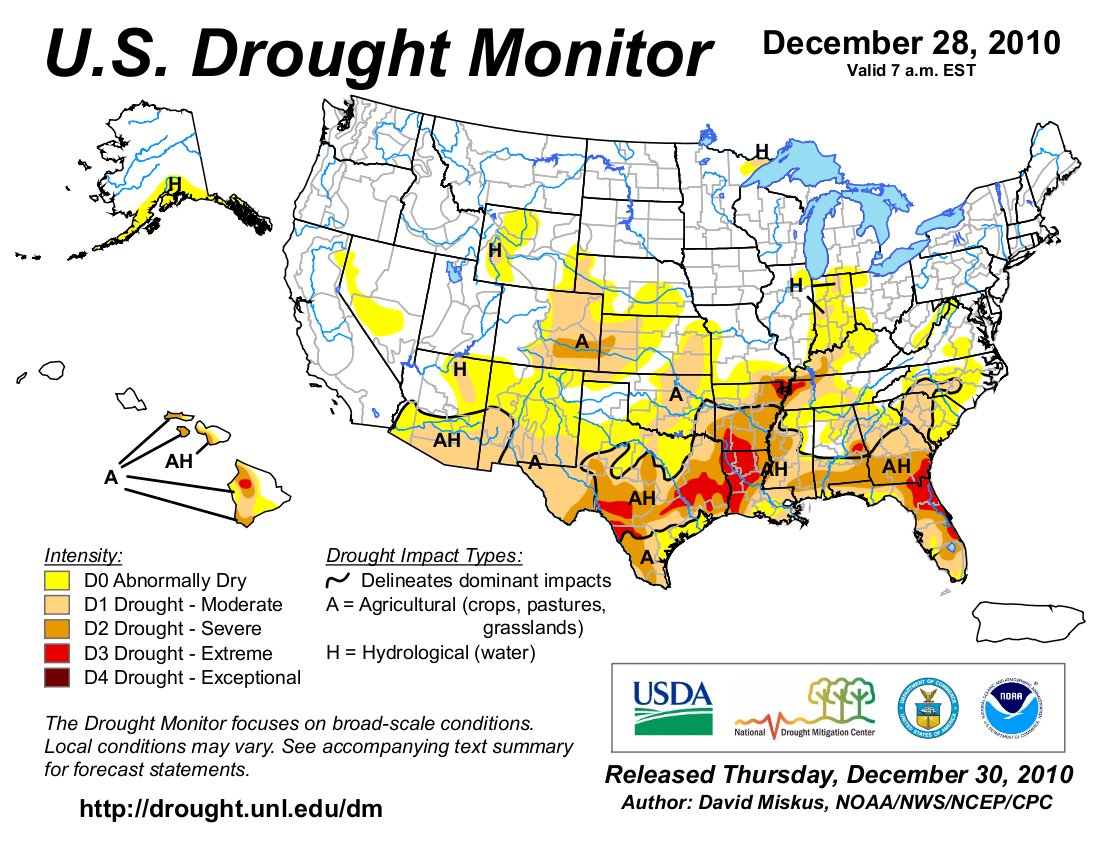
Drought tolerant corn

A picture named usdroughtmonitor12282010

DuPont may get some customers on the eastern plains the way things are going. Here’s a report from The Wall Street Journal (Ian Berry):

The offering, from DuPont subsidiary Pioneer Hi-Bred, includes five conventionally bred hybrid seeds that the company has been testing in areas of the western U.S. corn belt since 2008. It offers, on average, a 5% yield advantage over existing products, Pioneer officials said in a conference call.

Drought tolerance is seen as the next frontier for seed genetics, which in recent years have largely focused on pest-control. DuPont’s new product, released under the Optimum AQUAmax brand name, will be available throughout the U.S., but marketing will be focused on states that typically have drier weather, including Kansas, Colorado, Texas and Oklahoma.

More coverage from the Des Moines Register (Philip Brasher):

Pioneer, a unit of DuPont, is in a race with other seed giants to get corn varieties to the market that could grow in drier areas or need less irrigation. Monsanto Co. is providing an update tomorrow on its biotech corn varieties that are in development. They include drought-tolerant products. Pioneer also is working on a biotech variety, but it won’t be ready until the middle of the decade at the earliest, officials said.

More climate change coverage here and here.

Snowpack news

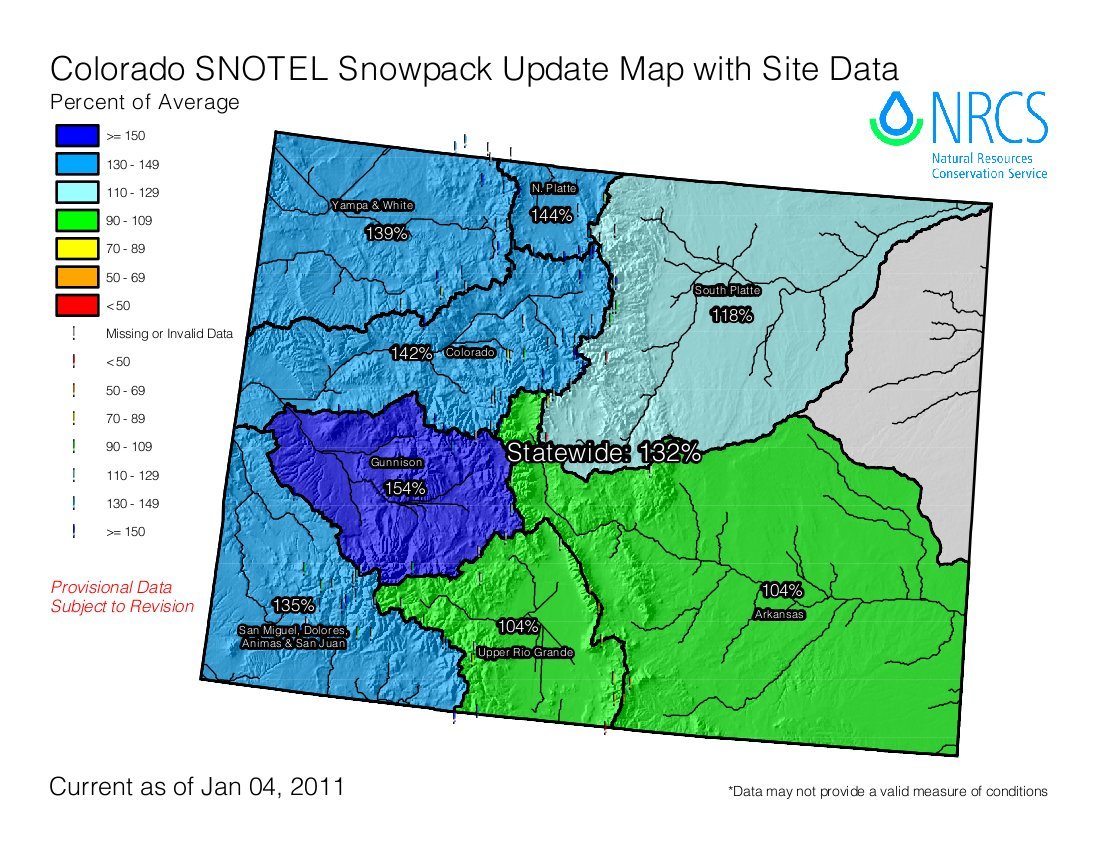
A picture named snowpackcolorado01042011

Update: From the Associated Press via the Summit Daily News:

Colorado’s overall snowpack was 136 percent of average on Jan. 1, the highest reading for that date since 1997. The federal Natural Resources Conservation Service says a series of storms last month benefited southern Colorado, where the snowpack had been below normal. It’s now at about 140 percent of average in several basins in southwest Colorado.

From the Summit County Citizens Voice (Bob Berwyn):

Both Summit County weather stations reported above normal snowfall for December, with the year-to-date readings (October – December) about 25 percent above average in Breckenridge, according weather watcher Rick Bly. The three-month total snowfall is 69.8 inches, ranking it as the 14th snowiest start to the winter season in 120 years. For December 2010, Bly measured 32.5 inches of snow on his backyard gauge, about 45 percent above the average 22.4 inches. That total left December 2010 just one spot shy of cracking the top-20 snowiest Decembers in the 120-year record…

At the Denver Water office in Dillon, the official snow reading was 23 inches for December, with measurable precipitation on 13 days…

The moisture-laden pineapple connection that brought mid-month snows zeroed in on the central part of the state, where the Gunnison Basin snowpack is now at 155 percent of average. Even the Upper Rio Grande Basin, in south-central Colorado, is now at a 106 percent of normal after lagging near 60 percent for much of the autumn. The San Miguel, Dolores, Animas and San Juan Basin, in the Four Corners area, is up to 136 percent of average and the Colorado Basin is at 143 percent.

From The Greeley Tribune (Bill Jackson):

Reservoir storage is at or slightly above normal across most of the state and combined with the good start to the snowpack, that provides optimism for the state’s water providers. Statewide, the snowpack is 36 percent above the long-term average. For the South Platte River basin, it is 26 18 percent above average and for the Colorado River, it is nearly 50 42 percent above average. [ed. note: Things can change quickly in Colorado. Click on the thumbnail graphic above and to the right for today’s snowpack update map from the NRCS.]

“This is a welcome start to the year for Colorado’s water users, and we’re hoping these conditions remain with us for the next few months,” Allen Green said in a news release. He is the state conservationist with the NRCS in Denver…

In southern Colorado, the snowpack was 57 percent of average on Dec. 16. But the weather pattern shifted, and those averages increased to 140 percent of average by Dec. 31. At one automated site on Coal Bank Pass north of Durango, storms delivered 78 inches of snow which resulted in an additional 6.7 inches of water.

Colorado Water Trust’s Breem Ditch instream flow deal

A picture named ohbejoyfulslatecreek.jpg

Here’s a look at the Colorado Water Trust’s Breem Ditch deal for instream flows in Washington Gulch from Zach Smith writing for the Summit Daily News. From the article:

One example starts with a ranch outside the high-mountain resort town of Crested Butte in western Colorado. The aging owner wanted to sell his land for subdivision and his water right along with it. The water right diverted water for irrigation from Washington Gulch, a tributary of the Slate River and eventually the Gunnison River. It was valuable because it was the most senior; during the irrigation season it could shut off other diverters upstream. And once the water reached the headgate, it took every last drop, leaving the Gulch’s stone skeleton to bleach in the sun. It was all perfectly legal, and acutely devastating. A nearby water district, looking to shore up its supply, began negotiating to purchase the water right. But the developer who had bought it wanted more money for it from the water district. It was at this point that the Colorado Water Trust got involved in the transaction…

Using this innovative tool [CWCB Instream Flow Program], the Colorado Water Trust works in the water market as a broker, making deals to acquire water from willing sellers or lessors to send water back into rivers. Seeing an opportunity in the Washington Gulch transaction, the Trust and the Board proposed funding the price difference if the water district would divert the water 2.5 miles farther downstream than the rancher had, past Washington Gulch’s confluence with the Slate, as well as grant the Board an instream flow right for the river stretch between the old point of diversion and a proposed new one. In simpler terms, the Trust asked that the water district use the natural path of the stream itself as its water delivery system. All parties agreed, and now the deal is off to water court for approval.

What did this all mean? The developer got the price he asked for. The water district got the water it needed. What’s new is that Washington Gulch will have a protected instream flow with the most senior priority on the stream. When the stream level drops, the board will place the call, and Washington Gulch and parts of the Slate will run wet. It is all legal, and wonderfully healing.

Here’s the CWT release.

More Breem Ditch coverage here. More Gunnison River basin coverage here.

Lower Arkansas Valley: New rules to prevent increased consumptive use update

A picture named dripirrigation.jpg

From The Pueblo Chieftain (Chris Woodka):

“One of the main reasons we started down this course was to get something done in a proactive way rather than responding to a crisis,” Wolfe said. “For legal and technical reasons, we decided to develop the rules now rather than wait until we had a situation like in 1985, when Kansas sued Colorado.” The state is mainly concerned about more than 100 sprinkler systems, now being used by about 70 farmers, throughout the Lower Arkansas Valley, east of Pueblo.

Of those, about 40 farmers have signed up for a plan by the Lower Arkansas Valley Water Conservancy District that the district fought to include in the rules during two years of meetings prior to their adoption. “What we are trying to do is give the softest landing possible for the farmers,” said Jay Winner, general manager of the Lower Ark district. “I don’t agree with the rules, but this way the farmers can do what they do best, which is to farm, and we do what we do best, the paperwork.”

The district has received grants from the Colorado Water Conservation Board for the engineering necessary to set up the compliance plans and developed a fee structure for participants that reduces the individual cost of complying with the new rules. The district has hired an engineering consultant to crunch the numbers. “In the future, I hope that there are 1,000 of these, because sprinklers help the farmers, mainly in saving labor costs,” Winner said…

Bill Tyner, assistant division engineer, estimated there are between 65-70 farmers with 100-120 systems irrigating with sprinklers fed by ponds. Sprinklers and drip systems dating back to 1999 are covered by the rules. There are very few drip irrigation systems fed by surface sources. Either a group compliance plan or detailed engineering reports are needed in the valley’s major agricultural areas east of Pueblo, the focus of concern in complying with the Arkansas River Compact. General permits for improvements will suffice in other areas of the Arkansas River basin, which lets the state know where improvements have been made.

More Ark Valley consumptive use rules coverage here and here.

Restoration: Should beavers have a role in river restoration?

A picture named beaverbwdrawing.jpg

Here’s the release from Kansas State University (Melinda Daniels/Jennifer Torline):

THE ECOSYSTEM ENGINEER: RESEARCH LOOKS AT BEAVERS’ ROLE IN RIVER RESTORATION

When engineers restore rivers, one Kansas State University professor hopes they’ll keep a smaller engineer in mind: the North American beaver.

Beavers are often called ecosystem engineers because they can radically alter stream or valley bottom ecosystems, said Melinda Daniels, an associate professor of geography who recently studied the connection between beavers and river restoration. Beaver dams create diverse river landscapes, she said, and can turn a single-thread channel stream into a meadow, pond or multichannel, free-flowing stream.

“Our argument is that the restoration target for streams with forested riparian zones has got to acknowledge the diversity brought to river systems by active beaver populations,” Daniels said.

Daniels and three researchers from the University of Connecticut co-authored “The River Discontinuum: Applying Beaver Modifications to Baseline Conditions for Restoration of Forested Headwaters.” The article, led by Denise Burchsted at the University of Connecticut, appears in a recent issue of BioScience, the journal of the American Institute of Biological Sciences.

While the research involves observations of several watersheds in northeastern Connecticut, the results are applicable to any forested stream, which typically have large beaver populations. Beaver populations have rebounded in recent years, Daniels said, after coming close to extinction in the early 19th century by hunters for their fur.

The ultimate goal of the research, Daniels said, is to help restore rivers in an efficient way that acknowledges ecosystem diversity and doesn’t destroy it.

“A lot of rivers are in trouble and need work and restoration, but it’s amazing how little we know about the systems we’re trying to fix,” she said. “We know they’re broken, but we don’t exactly know what they should look like because we know so little about how many of our river systems function.”

Current restoration projects often don’t consider the role of beavers as ecosystem engineers, and instead focus on creating continuous free-flowing streams, Daniels said. Such restoration can be expensive because it usually involves completely tearing down small 19th-century milldams and re-engineering an entire valley bottom.

Rather than tear down the whole milldam and radically change the surrounding ecosystem, the researchers recommend river restorers only remove part of it. This allows some ponded water to remain and mimics the role of beavers. Daniels said that in many cases if an old dam breaks and forms a gap, beavers may build their own dam to patch the gap and recreate the ecosystem that previously existed.

The researchers plan to continue river observations and collect more data to provide river restorers with insight for maintaining river ecosystem diversity.

“You can use these natural analogs to produce an ecosystem that looks a lot more like the one that was there before the colonists arrived,” Daniels said. “We can restore rivers in a way that mimics the naturally diverse beaver streams, and we can save a lot of money in the process.”

More restoration coverage here.

Pagosa Area Water and Sanitation board and the Community Water Supply Workgroup workshop recap

A picture named sanjuan.jpg

From the Pagosa Sun (Randi Pierce):

With the holiday season quickly being relegated to memory, the Pagosa Area Water and Sanitation Board and Community Water Supply Workgroup will soon continue their comprehensive look into PAWSD fees at a third work session dedicated to the topic slated to take place Jan. 4…

At the first of the work sessions, held on Dec. 9, PAWSD and CWSW members discussed a number of items with engineers Patrick O’Brien of Briliam Engineering and Mike Davis of Davis Engineering, including items needed for the engineers to update the CIP and system model:

• Determining an acceptable calculation for water demand;

• Determining a correlation between water demand and use per equivalent unit, peak day;

• Determining if the full build-out condition or population projections should be used as the basis for modeling and cost projection; and

• Reviewing operation standards relating to water pressure, fire flow and water age…

The second work session, held on Dec. 15, afforded the group a chance to review the calculation for water demand, review the correlation between demand and use per EU, discuss and define “new growth” and how account holders should be credited for assessed water availability fees, and discuss inclusions.

With some minor changes in the formula agreed upon at the previous meeting, the group agreed to the calculation of water demand, with the agreement made that the chart would be updated on a regular basis.

The discussion then turned to peak day and water loss, which brought up the topic of how much water storage exists and how long district reserves would last.

More San Juan River basin coverage here.

‘The Poudre Runs Through It: Northern Colorado’s Water Future’

A picture named cachelapoudre.jpg

Update: Here’s the release from the Community Foundation of Northern Colorado (Contact: Ray Caraway 970-488-1980 or Ray@CommunityFoundationNC.org):

WATER AND THE POUDRE RIVER: PUBLIC INVITED TO LEARN AND ENGAGE


What do we use every day, but know little about? Water! The future of the Poudre River and water for Northern Colorado is much debated, but how well do we understand the issues surrounding it?
The public is invited to join three entities providing community leadership – UniverCity Connections, Colorado State University, and the Community Foundation of Northern Colorado – in creating shared understandings of the complex topic of water in Northern Colorado. The organizers believe these shared understandings will result in a better informed and more engaged community.

The Poudre Runs Through It: Northern Colorado’s Water Future is a three-part series that begins with a public forum on Thursday, February 3 from 5:00 – 8:00 pm. The gathering will highlight the river and its social, environmental and economic impacts – past, present and future. It will take place at the Larimer County Courthouse Office Building (200 West Oak Street, Fort Collins).

Subsequent “Northern Colorado Water 101” educational programs in February and March, facilitated by the Colorado Water Institute, will offer members of the public opportunities to learn in a user-friendly format. These programs will cover a broad range of topics, including the importance of the Poudre to agriculture, the city, the environment; the water law that governs diversions from the river and its quality; various efforts to preserve and enhance the river; and objective coverage of current controversies surrounding the river. The public will gain a better understanding of potential options for securing water for future water needs including conservation, agricultural transfers, storage, reuse, and land planning strategies.

In April, public dialogue opportunities will be facilitated by the CSU Center for Public Deliberation to give community members a chance to hear from their neighbors, have their voice heard, and collaboratively work through the tough issues.

“Our region has gained well-deserved national recognition for its excellence and innovation,” Ray Caraway, president of the Community Foundation of Northern Colorado said. “How we deal with the complex issues surrounding water will shape our future and test our ability to find solutions in the midst of controversy.”

Co-sponsored by UniverCity Connections, Colorado State University, and the Community Foundation of Northern Colorado, the entire series is free and open to the public. For more information or to RSVP, visit http://www.UniverCityConnections.org or contact Chelsea DeFoort at Chelsea@CommunityFoundationNC.org.

###
UniverCity Connections, an initiative of the Community Foundation of Northern Colorado, facilitates productive conversations regarding Colorado State University, Downtown Fort Collins and the Poudre River. Colorado State University and the Colorado Water Institute are leaders in research, education, and outreach for water issues in Colorado and around the world. CSU Center for Public Deliberation enhances local democracy through improved public communication and community problem solving. The Community Foundation of Northern Colorado, founded in 1975, is a nonprofit organization that manages more than 300 individual charitable funds and $44 million in assets.

From the Fort Collins Coloradoan (Bobby Magill):

Should Glade Reservoir be built? How would it and other proposed water-storage projects affect the Poudre River? CSU and the Community Foundation of Northern Colorado will help answer those questions during a series of public forums in February, March and April…

Called “The Poudre Runs Through It: Northern Colorado’s Water Future,” the series of three forums will address how the Poudre River affects agriculture and the city of Fort Collins and how water law governs how water is used and diverted from one river basin to another. The forums are designed to help the public gain a greater understanding of Northern Colorado’s future water needs, where the water might have to come from and how the Poudre River fits into that future…

The first event will be a public forum about the river’s social, environmental and economic impacts. The forum is scheduled for 5 p.m. Feb. 3 at the Larimer County office building at 200 W. Oak St. Educational forums called “Northern Colorado Water 101” will be scheduled in March and April, followed by other forums facilitated by CSU’s Center for Public Deliberation. The series, co-sponsored by the Community Foundation, UniverCity Connections and CSU, is free and open to the public.

More Poudre River watershed coverage here and here.

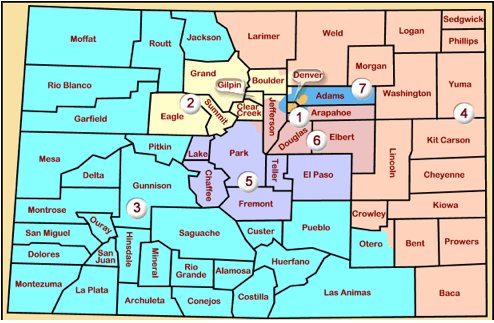
2011 Congressional re-districting

A picture named coloradocongressionaldistrictboundaries2010

State legislators are starting the re-districting process following the census last year. Here’s report from Patrick Malone writing for The Pueblo Chieftain. From the article:

The process takes place every 10 years when fresh census data are released. In hopes of keeping districts competitive and avoiding the courts deciding those boundaries, the group was created as a buffer to partisan bickering that could derail those objectives. “In large part, the communities in the 3rd Congressional District are rural,” [ate Sen. Gail Schwartz] said. “They share agricultural interests and outdoor recreational economies. It’s also important to protect the water in that district in particular.” Folding metropolitan areas along the Front Range into the 3rd Congressional District would place the coveted water of the Western Slope in peril, Schwartz said. So she opposes redrawing the 3rd Congressional District in a way that would include more urban centers. However, Schwartz contends that Pueblo by virtue of being less parched than some larger cities and more attuned to rural interests because of its neighboring farming hubs is a natural fit for the 3rd Congressional District that spans the Western Slope.

Northern Integrated Supply Project: Supplemental EIS expected, ‘…latter part of 2011’

A picture named nisppreferredalternative.jpg

From email from Save the Poudre (Gary Wockner):

The initial release for the Supplemental DEIS for NISP was supposed to be in June of 2010, and was initially delayed until the summer of 2011, but is now estimated to be delayed until the “latter part of 2011” according to an email from [Chandler Peter from the U.S. Army Corps of Engineers] to Save the Poudre.

Additionally, the Draft EIS for the new Halligan (Fort Collins) and Seaman (Greeley) dams and reservoirs on the North Fork of the Poudre was slated for the summer of 2011, but is now delayed for a half year after the release of the NISP SDEIS (according to the email from Mr. Peter), which will put them into 2012 and well beyond previous estimates.

More Northern Integrated Supply Project coverage here and here.

101 ways to conserve water in college

A picture named cutthroat.jpg

Jasmine Hall, who works with OnlineClasses.org sent this link to their document 101 ways to conserve water in college. They are trying to build awareness around the subject of conservation. I know of at least one recommendation that I’m willing to try:

10. Shower with a buddy: Waste less water from showering by doing it with a buddy. Just make sure you’re not in there too long.

Seriously, a personal conservation ethic is easy to build and will serve you well in your lifetime. You might even leave some water in the stream for all the critters.

More conservation coverage here.

IBCC: Statewide Roundtable Summit March 3

A picture named roaringfork.jpg

From email from the Colorado Water Conservation Board:

All Basin Roundtable members are invited to attend the Statewide Roundtable Summit on Thursday, March 3, 2011. The meeting is an opportunity to meet your fellow cohorts from around the state and continue connecting the activities and entities within the 1177 process.

The Summit will take place at the Doubletree Hotel in Westminster, about ten miles northwest of Denver. Attendance for all roundtable members is free and the public is invited to attend for a small cost.

Here’s the link to the announcement and preliminary agenda.

More IBCC — basin roundtables coverage here.

Moffat Collection System Project: Department of Wildlife public meeting January 20

A picture named grizzlyfishing.jpg

From email from the Colorado Division of Wildlife (Jennifer Churchill):

Commissioners Bob Streeter and David Brougham will meet with the public on Thursday, January 20 at The Ranch in Loveland to take public comment on the potential impacts of the Moffat Collection System Project.

Denver Water proposes to meet projected future water needs by developing 18,000 acre-feet per year of new, annual firm yield water that would be delivered to the Moffat Treatment Plant and raw water customers upstream of the Moffat Treatment. Denver Water’s preferred project to meet this need is to raise Gross Reservoir in Boulder County to store an additional 72,000 acre-feet of water diverted from the Fraser and Williams Fork river systems.

To learn more about the project, visit:
https://www.nwo.usace.army.mil/html/od-tl/eis/moffat-eis.html”

Additional information on the project can be found at: http://www.denverwater.org/SupplyPlanning/Planning/FutureWaterSupply/WaterSupplyProjects/Moffat/

Commissioner Streeter, who represents northern and northeastern Colorado and the public at large, is a retired wildlife professional and lives in eastern Larimer County. He represents the Colorado Wildlife Commission on the Great Outdoors Colorado (GOCO) board and is a representative to the South Platte Basin Roundtable (which includes the Republican Basin). Commissioner Streeter has an agricultural background and is an avid outdoor enthusiast, hunter and fisherman. Issues can be brought to Commissioner Streeter’s attention prior to the meeting by contacting him at 970-222-0383 or rgstreeter@gmail.com.

Commissioner Brougham is an attorney based in Denver, primarily involved in defending public entities and officials. He is a lifelong hunter and fisherman and was appointed by Governor Ritter to represent the public at-large. As a military officer he was a naval aviator and is a Vietnam veteran. In addition, he was a chief deputy district attorney in both the Second and Fourteenth Judicial Districts and a member of the Colorado District Attorney’s Council. Mr. Brougham is a member of numerous associations, including Pheasants Forever, Ducks Unlimited and the American College of Trial Lawyers.

Ken Kehmeier and Sherman Hebein, senior aquatic biologists for the northeast and northwest regions, will provide a presentation on the project and lend their expertise to the discussion.

WHAT: Public Input on Moffat Collection System Project with Wildlife Commissioners Streeter and Brougham

WHEN: Thursday, January 20, 2011, 6:30 pm to 8:30 pm

WHERE: Laporte and Timnath Rooms, Thomas McKee Building at The Ranch – Larimer County Fairgrounds and Event Complex, 5280 Arena Circle, Loveland

Questions? Please contact Jennifer Churchill, Public Information Officer for the northeast region, at 303-291-7234 or jennifer.churchill@state.co.us

More Moffat Collection System Project coverage here and here.

Ed Quillen: ‘I feel safe in offering these sure-fire predictions for the West in 2011’

A picture named oilshaledepositsutwyco.jpg

Here are Ed Quillen’s insights into the new year from the High Country News. From the article:

Petroleum prices will spike for some reason or another, perhaps political tension in the Persian Gulf or a storm in the Gulf of Mexico. Whatever the gulf, this will inspire politicians to demand the immediate development of “America’s vast oil shale reserves” in Wyoming, Utah, and Colorado. And of course they will denounce anyone who points out that to date, there is no economical method of producing petroleum from these rocks as they forget the old but true saying that “Oil shale is the fuel of the future — and always will be.”

Or my personal favorite, “Oil shale has been the next big thing in Colorado for over a hundred years.”

A picture named coloradoriverbasin.jpg

More from Ed:

The Colorado River will continue to be over-appropriated, and someone will propose supplying southern California with water via tanker ships from Siberia or towed icebergs from Alaska, thereby allowing California’s share to be used by other states. But no such water will be imported in 2011.

Climate change: Will nitrogen be the new carbon in ten years?

A picture named nitrogenultrapurewikipedia.jpg

From The Ag Journal (Candace Krebs):

“In 10 years, we won’t be talking about global warming, we’ll be talking about nitrogen,” Jay Ham, a meteorology and environmental expert in the soil and crop sciences department at Colorado State University said. “It’s a way bigger issue.” Everyone’s heard about minimizing their carbon footprint, sequestering carbon or trading carbon credits. But nitrogen, which converts into a particle capable of traveling long distances when it escapes into the atmosphere, is getting more attention in Colorado and around the country. During the Colorado Ag Classic, Ham explained that nitrogen is a greenhouse gas 300 times more efficient at trapping atmospheric radiation than carbon dioxide. It impairs visibility and interferes with plant and animal life. The level of nitrous oxide in the atmosphere has increased 20 percent over the last century…

Ham attributes half of agricultural nitrogen to concentrated animal feeding operations and another quarter of it to farm fertilizer. “In some crop and livestock systems, we’re removing 20 to 30 percent of the nitrogen we’re applying,” he said. “We can lose it to air or to water. So one thing we can do is to improve agricultural efficiency.” There are three main ways to keep nitrogen from escaping into the atmosphere, Ham said. They include reducing inputs, retaining more of the nitrogen in the finished product or storing it on-farm.

Water-smart home option now available to Colorado home buyers

A picture named suburbs.jpg

From the Associated Press via KDVR.com:

New homes in Colorado are getting a small change in 2011 — builders are now required to offer options to save water. The law taking effect Saturday requires builders to offer the option of “water-smart homes” that include options such as low-flow toilets.

More coverage from Tim Hoover writing for The Denver Post. From the article:

House Bill 1358, sponsored by Rep. Randy Fischer, D-Fort Collins, and Sen. Mike Johnston, D-Denver, would require builders of single-family, detached homes to offer customers the option of water-conserving toilets, faucets and showerheads. The bill even specifies what kinds of fixtures qualify, noting for example that “toilets shall use no more than one and 2 8/100ths of a gallon per flush.” And if builders offer upgrades for appliances and landscaping, they also will have to offer homebuyers water-thrifty dishwashers and Xeriscaping.

More conservation coverage here.

The Colorado Farm Bureau honors State Senator Bruce Whitehead

A picture named measuringwithweir.jpg

From The Durango Herald:

The Colorado Farm Bureau has awarded outgoing state Sen. Bruce Whitehead, D-Hesperus, with the 2010 Pinnacle Award in recognition of his support of the agricultural community during the 2010 legislative session…

The annual award recognizes legislators who “go above and beyond the call of duty to promote Colorado’s agricultural interests,” a bureau news release said. “This is evident through their sponsorship and co-sponsorship of bills, their leadership in defending and advocating on behalf of Colorado agriculture, their cooperation with the industry, and their voting record on Farm Bureau priority issues.”[…]

“He worked for the Colorado Division of Water Resources for 25 years and was the past executive director for the Southwestern Water Conservation District,” [the bureau’s president, Don Shawcroft] said. “We look forward to seeing what the future holds for you.” Whitehead served as chairman of the Senate Agriculture and Natural Resources Committee during the 2010 legislative session. He was appointed by Gov. Bill Ritter in 2009 to replace outgoing Sen. Jim Isgar, also of Hesperus.

Chatfield Reservoir Reallocation Project update

A picture named chatfieldreservoirreallocationprojectalternatives.jpg

From The Denver Post (Bruce Finley):

The $100 million project, intended to help sustain new growth in water-poor Denver suburbs, also will inundate 45 acres of cottonwood, willow and Russian olive groves in the park, destroying habitat for about 60 bird species. This has put the Audubon Society, Denver Field Ornithologists and other birder groups at the front of opposition to the project. “You take away all those trees, all those birds that nested in the trees aren’t going to be here,” said Joey Kellner, who coordinates Denver’s annual bird count…

“We want to make sure that the ecological benefits are captured — because there are losses,” [U.S. Army Corps of Engineers project manager Gwyn Jarrett] said. “We’re going to do as much on-site as possible. It’s imperative that the public be involved. It’s in (suburban water agencies’) interest to meet the environmental concerns, because that means less opposition.”[…]

…authorities say the dam is strong enough to hold an additional 20,600 acre-feet trapped from the South Platte and Plum Creek. That would bring the total capacity to about 48,000 acre-feet of water.
The additional water could sustain about 41,200 households…

Colorado Water Conservation Board officials asked the Army Corps of Engineers to expand the reservoir on behalf of 15 metro water-user agencies. Residents who pay monthly water bills would have to pay the $100 million if the federal engineers approve the project. The South Metro Water Supply Authority and water suppliers in Castle Rock, Centennial and other suburbs currently rely heavily on groundwater wells that in some areas are running dry.

More Chatfield Reservoir coverage here and here.

Energy policy — solar: Water requirements dictate solutions in the San Luis Valley

A picture named solarenergyphotovoltaic.jpg

From The Pueblo Chieftain (Matt Hildner):

In Alamosa County, where three plants have secured power purchase agreements with Xcel Energy since 2009, companies have chosen to use photovoltaic technology largely because of its low water requirements. “The water has been one of the main determining factors to go with photovoltaic over some other types of solar plants,” said Craig Cotten, the division engineer in the valley for the Colorado Division of Water Resources…

The water needs for the photovoltaic plants have been met by the San Luis Valley Water Conservancy District, which normally provides augmentation water for business and residential developments. The augmentation water is used to replace the depletions to the system caused by the new uses and ensure senior users are not injured. Mike Gibson, the district’s manager, said supplying the photovoltaic plants was no different than how it supplies its other clients, with the exception that additional agreements were needed with ditch companies to move the water to the plants. Moreover, the district also struck agreements with neighboring landowners to build recharge pits, where the replacement water filters back into the aquifer.

When solar companies began flooding the San Luis Valley with proposals that never made it off the drawing board, a number of them called for utilizing concentrated solar power, also known as solar thermal technology. Those types of plants gather the heat from the sun and use it to heat water to power a turbine. In the cases where those plants deploy a water cooling system, the need for water is large. And in the valley where all the water is already tied up, local water managers were uneasy with the proposals…

California-based SolarReserve had submitted a proposal to Saguache County that had originally called for their plant near Center to use up to 1,200 acre-feet per year. The company told the county in October that it would switch to a dry-cooling system, although it would still require up to 300 acre-feet per year. It has yet to offer details to the county on how it will get that amount of water.

More solar coverage here and here.

Arkansas River basin: Storage update

A picture named puebloreservoir.jpg

From The Pueblo Chieftain (Chris Woodka):

At the heart of the area’s storage system is Lake Pueblo, built in the early 1970s as part of the Fryingpan-Arkansas Project. It was the last large reservoir to be built in the Arkansas River basin. Lake Pueblo not only provides storage, but flood control and recreation as well. A full reservoir is good for recreation, but too much water would diminish its value for flood control. Storage remains the core purpose, however, and space is getting tighter…

Since 2003, municipal storage in Lake Pueblo has tripled, and half of the water in the reservoir is in temporary accounts that mainly serve cities. Pueblo, Colorado Springs, Aurora and other cities have sought long-term contracts for storage to replace the one-year contracts to provide better long-term planning. More municipal storage will be needed when the Arkansas Valley Conduit is built to serve communities east of Pueblo. “The reality of this is that it reduces the yearly available storage space in Pueblo Reservoir,” [Roy Vaughan, manager of the Fry-Ark Project] said. “This has resulted in water managers re-evaluating the need for additional water storage in the basin.”[…]

The Southeastern Colorado Water Conservancy District has led efforts for more than 10 years to study enlargement of Lake Pueblo. The Preferred Storage Options Plan looked at enlargement of Lake Pueblo and Turquoise Lake as the best ways to gain needed storage space, and agreements among the largest municipal water users to open the study were reached in 2004. Attempts to ramrod legislation through Congress were abandoned in 2005, and new rounds of talks began that brought other interests to the table. In 2007, former Sen. Ken Salazar hosted public sessions that were making progress until the Lower Arkansas Valley Water Conservancy District sued the Bureau of Reclamation in federal court for its decision to issue Aurora a long-term storage contract. The Lower Ark and Aurora reached a settlement in 2009 that could revive the PSOP legislation, although serious discussions among the as many as 12 different interests have not resumed…

It’s unlikely that any new reservoir would be built on the Arkansas River mainstem — as witnessed by the public outrage at Colorado Springs proposal to build a dam near Buena Vista in the early 1990s. Colorado Springs plans two large reservoirs on Williams Creek, a tributary of Fountain Creek, as part of its Southern Delivery System second phase. There are several gravel pits along Fountain Creek and the Arkansas River that could be converted to storage reservoirs in the future. There is abundant space in reservoirs east of Pueblo, such as John Martin in Bent County and the Plains Reservoirs in Kiowa County, but they are located downstream of the population centers to directly use them.

Click through for Mr. Woodka’s short bio of Ray Vaughan.

More Arkansas River basin coverage here.

Snowpack/Precipitation news

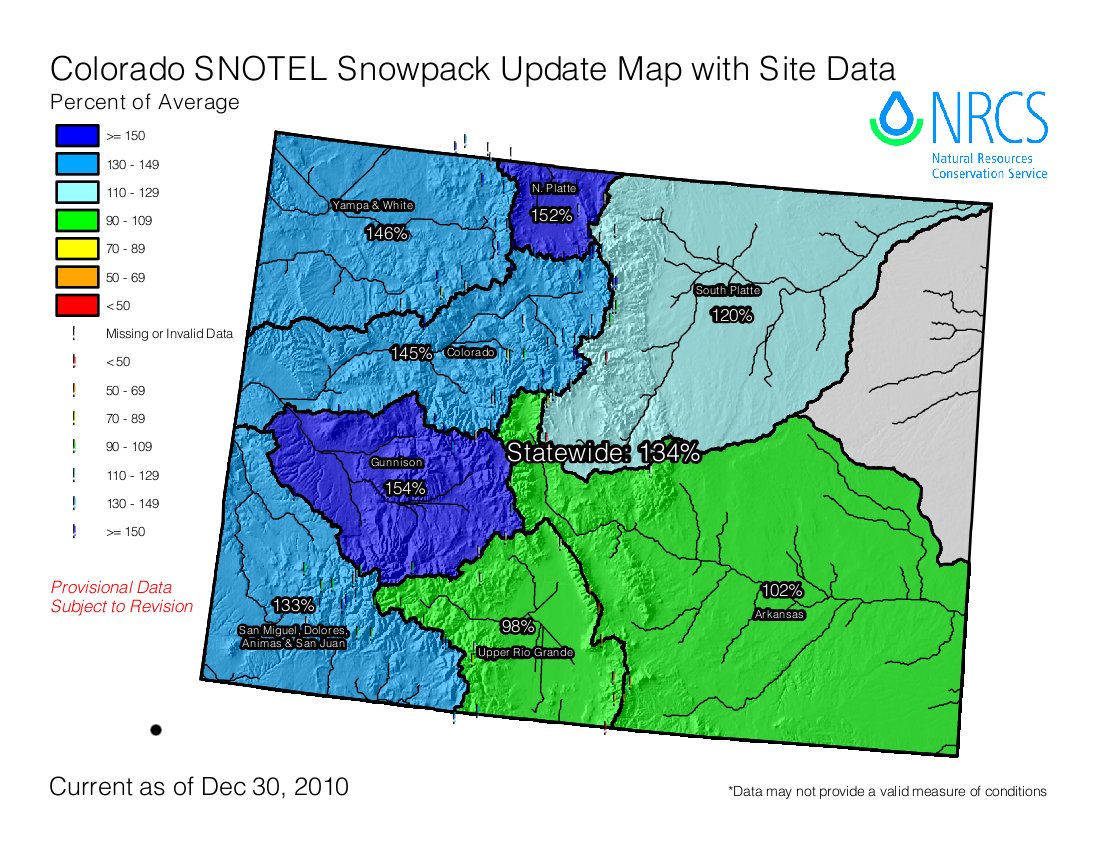
A picture named snowpackcolorado12302010

From The Pueblo Chieftain (Gayle Perez):

The frigid temperatures were ushered in with Thursday’s storm that dumped 6.6 inches of snow at the Pueblo Memorial Airport by Friday afternoon, according to Larry Walrod, a lead forecaster with the National Weather Service. “Most areas around Pueblo saw 3 to 4 inches of snow, while Pueblo West had 2 to 3 inches,” Walrod said.
Snow accumulations elsewhere in the region ranged from 1 to 2 inches near Trinidad and Lamar to 2 to 4 inches around La Junta.

Here’s a look at the NRCS’ efforts to measure snowpack and predict runoff, from Janice Kurbjun writing for the Summit Daily News. From the article:

[Mike] Gillespie and [Chris Pacheco] are the Denver-based snow survey supervisor and assistant supervisor with the Natural Resources Conservation Service. They have been doing snow surveys for 30 years, but the process — and its resulting data — has been of importance for more than a century in the West. It all started in the Lake Tahoe area, Pacheco said, where Dr. James Church realized that part of a solution to the ongoing water wars was to predict how the lake would rise each spring. In 1904, he established a snow course and began gathering data. Some of the first runoff forecasts were established in 1910 as text-based pamphlets that were mailed out to interested parties. “The western United States relies on snowpack for about three-quarters of its water,” Pacheco said. “As demand for water increases, there’s more of a need to understand the content of the snowpack … It’s a vital part of living in the West.”[…]

Municipalities and reservoir operators are also among those seeking information gleaned from the surveys, which includes snowpack depth and snow water content. The information is further synthesized into broader streamflow forecasts

The Berthoud Pass manual snow survey is the first of the 2011 season, giving the first glimpse of what water availability will be in 2011, Gillespie said. It kicks off a set of more than 100 monthly manual measurements from January to May across Colorado. They’re performed by about 50 field personnel with offices in each Colorado county. The manual survey network nearly doubles the automatic SNOTEL system of about 110 sites, which take hourly measurements each day. The SNOTEL sites are generally higher in elevation and more difficult to get to than the manual reading sites, Pacheco said. Maintaining manual readings helps defray costs of expensive SNOTEL equipment as well as provides a way to verify automatic data.

When averaged, Thursday’s Berthoud Pass measurements largely matched the day’s automatic readings at the site. Pacheco said the snow depth was 40 inches, and the snow-water content was 10.5 inches. That’s compared to 36 inches and 9.3 inches, respectively, from the SNOTEL. Both data sets show the snow has a density of 26 percent, he said…

According to SNOTEL information, the statewide snowpack is at 134 percent of average. In the Colorado River Basin, it’s at 145 percent of average, while the Arkansas River Basin is at 102 percent of average…

“The northern part of the state has been above average almost since the get-go,” Pacheco added.

From the Cortez Journal (Reid Wright):

Ten inches were reported in Cortez, just shy of a 1969 record 24-hour storm that dumped 11 inches on Cortez, making it the 20th biggest snow storm on record, said Joe Ramey, a meteorologist with the National Weather Service in Grand Junction…

The wet month, at 230 percent of normal precipitation, comes at the end of a three-year trend of wet Decembers. December 2009 saw 170 percent of normal precipitation, December 2008 saw 212 precent of normal, and December 2007 saw 278 percent of normal.

Happy New Year

A picture named fireworks.jpg

Happy New Year to you water nuts — you know who you are. I hope you win the Lottery and PowerBall this year.