Energy policy — oil and gas: Produced Water Development LLC is hoping to provide a new water source in the water short South Platte River basin

producedwaterllcgraphic.jpg

From the Northern Colorado Business Report (Steve Porter):

It’s estimated that 90 percent of the liquid brought up through drilling is ‘produced’ water while only 10 percent is oil. Until recently, that produced water has been seen as a waste product and a liability to oil and gas drilling companies, with some of the vast quantities simply reinjected back into the ground in geologically sealed wells. But there’s a company that’s aiming to take that waste product and turn it into a valuable commodity.

Produced Water Development LLC is a spinoff company of Fort Collins-based Stewart Environmental. The company is partnering with Houston-based Energy Water Solutions to marry SE’s filtering technology with EWS’ sales and marketing to create a new water resource in the always-thirsty West…

The water used for fracking must be fresh, cleaned of the inorganic salts, hydrocarbons, solids, metals, dissolved gases, bacteria and other living organisms found in produced water. Oil and gas companies can have their own produced water cleaned with the devices patented by Produced Water Development and reuse it for their fracking operations. But even if there’s too much water to reuse for their own purposes, the produced water can be sold and recycled for agricultural, industrial, even municipal drinking uses…

“Every drop of water in Colorado is spoken for,” [Dave Stewart, founder of Stewart Environmental and Produced Water Development LLC] said. “This is the only new resource for water now, and the last thing we should do is pump it down a well.” Stewart said the recently patented technology can clean produced water to the point that it can be consumed by animals and humans. “We can actually take (all contaminants) out,” he said. “We can discharge to a cold-water fishery and not have an issue.”[…]

Under Produced Water’s business plan, oil and gas companies would lease a filtering plant from the company. The date of the installation of the first filtering device into the field has not yet been confirmed, said Shasha, who notes that oil and gas companies still have a learning curve before they start lining up to use the new technology.
More oil and gas coverage here and here.

Colorado State University Water Expert Publishes Book to Help Private Industry Tackle Public Projects

waterfinanceneilgrigg.jpg

Here’s the release from Colorado State University (Emily Narvaes Wilmsen):

Neil Grigg has written a dozen books in his 30 years at Colorado State University, but his most recent is the first directed at industry’s growing role in public water infrastructure projects.

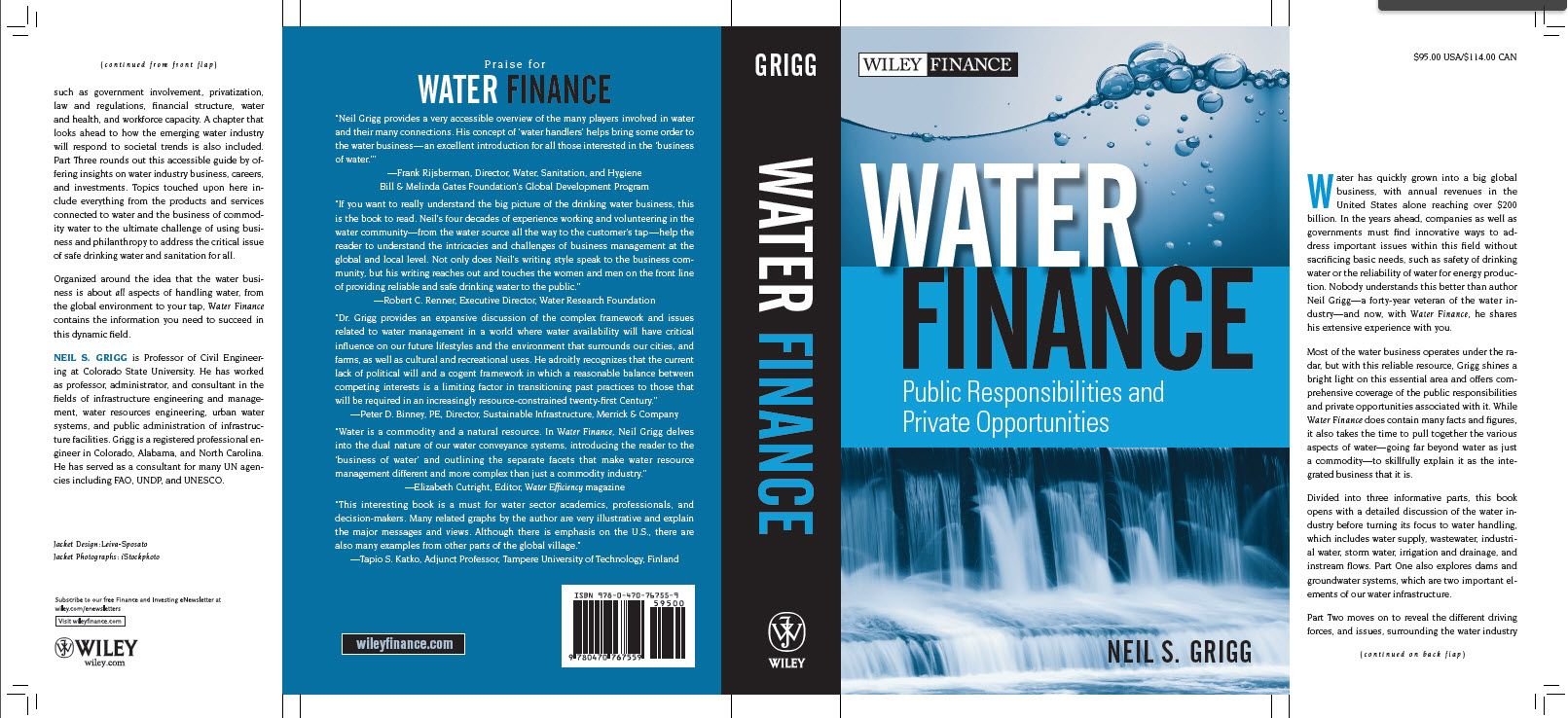
“Water Finance: Public Responsibilities and Private Opportunities,” published by Wiley, focuses on creating public/private partnerships within the water industry.

“We’ve got so many unmet infrastructure needs and water needs in the country,” Grigg said. “It’s hard to convince people to invest in these, and the government’s having a hard time all the time. The action is going to shift to the private sector.”

As an example, he pointed to the Colorado Department of Transportation, which is seeking private companies to improve congestion along the I-70 corridor.

“The government doesn’t have enough money to expand the highway, but if a private sector company can offer some way to solve the problem without raising tax money, you’ve got a win-win deal,” he said.

Closer to home in Fort Collins, industry, education and government officials have formed the Colorado Water Innovation Cluster to share information and collaborate on water-related projects. The cluster highlights the region’s water capabilities and addresses workforce gaps. The collaboration helps to identify new market opportunities, he said.

“There are a lot of opportunities for private companies to develop products and services for the water industry,” Grigg said. “The water industry is very diluted. It’s got a lot of small parts.”

Grigg is a civil engineering professor and renowned water resources engineering consultant who has been at Colorado State since 1967. He is an expert in Colorado’s water history, drought management, government water resources planning, Western water management issues and water system infrastructure engineering.

Among his other books is “Colorado’s Water: Science and Management, History and Politics,” a book that presents long-range views about Colorado’s water issues, including drought. He has authored or co-authored about 200 publications and several other books about water resources engineering and infrastructure.

Researchers have sustainably produced hydrogen gas, a potential source of clean energy, using only water and bacteria

hydrogenfromwastewaterbacteria.jpg

From Science Magazine (Sid Perkins):

Hydrogen may be the ultimate clean fuel because burning it—in chemical terms, reacting it with oxygen—yields only water vapor. Previously, researchers have produced hydrogen gas in microbial-powered, batterylike fuel cells, but only when they supplemented the energy produced by the bacteria with electrical energy from external sources—such as that obtained from renewable sources or burning fossil fuels, says Bruce Logan, an environmental engineer at Pennsylvania State University, University Park. Also, by using devices that contain large stretches of permeable membranes that separate salt water from fresh, scientists have tapped the voltage difference that exists between them. But those devices create only a voltage difference; they don’t generate the electrical current required to produce hydrogen, Logan notes. Hydrogen atoms are formed in such devices only when electrons flow into a fluid where they can combine with hydrogen ions; those atoms in turn combine with each other to create hydrogen gas.

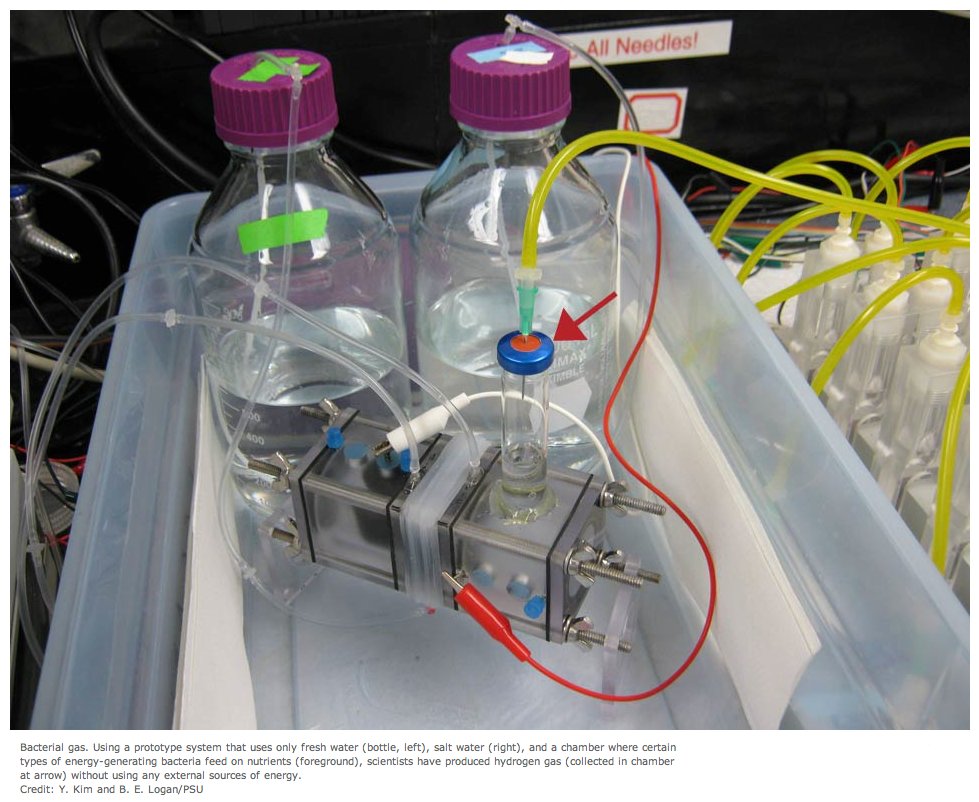
Now, Logan and Penn State environmental engineer Younggy Kim report online this week in the Proceedings of the National Academy of Sciences that they’ve done something no other team has: They’ve successfully combined the two types of devices to generate hydrogen without any external sources of energy whatsoever. The prototype device contains two small chambers—one holding the bacteria and their nutrients, the other holding salty water where the hydrogen was produced—that are separated by five stacked cells through which the researchers circulated fresh water and salt water. Together, these stacked cells generated between 0.5 and 0.6 volts—enough, the researchers say, to enable hydrogen production in the microbial fuel cell, in which bacteria feed on acetate compounds.

For each 30 milliliters of sodium acetate solution provided for the bacteria, the device generated between 21 and 26 milliliters of hydrogen gas over the course of a day. Admittedly, this is a small volume, about four times the amount of fuel in a disposable lighter, but it’s enough to prove that the hydrogen-generating concept works in the lab, the researchers contend. Although the equipment needed to produce the hydrogen is expensive, the device needs no external source of energy—and therefore no greenhouse gases are generated during the process.

‘Colorado Water 2012’ scores $25,000 from the Lower Arkansas Valley Water Conservancy District

arkansasriverbasin.jpg

From The Pueblo Chieftain (Chris Woodka):

The Lower Arkansas Valley Water Conservancy District allocated $25,000 Wednesday to help with the Colorado Water 2012 initiative in the Arkansas River basin.

The initiative is an effort by the state’s water community to commemorate several events, including the 50th anniversary of the Fryingpan-Arkansas Project, and the 75th anniversary of the Colorado Big-Thompson Project, which led to the formation of the Colorado Water Conservation Board, Colorado River Conservation District and Northern Colorado Water Conservancy District…

The Lower Ark board intends to stay involved for the planning of Colorado Water 2012 as a way to promote its mission of keeping water in the Arkansas River basin. [Perry Cabot, a research scientist with Colorado State University Extension] outlined a broad approach that builds on activities in the state and in the valley to celebrate water next year. For example, it will tie into the Southeastern Colorado Water Conservancy District’s plans to mark the 50th anniversary of Fry-Ark and the Arkansas River Basin Water Forum in Leadville next spring. There are other water education programs being initiated by CSU Extension as well.

More Colorado Water 2012 coverage here.

The City of Boulder is betting on drier and hotter conditions in the future when planning their raw water supply infrastructure

spainsunflower.jpg

From the Colorado Independent (David O. Williams):

Boulder officials are now fast-tracking funding for water infrastructure projects, including a new water pipeline that will give the city more options for potential water sources and a dam rehabilitation project to enhance the city’s water storage capacity.

Boulder and all of Colorado just experienced the hottest August ever, according to NOAA. So did five other states – New Mexico, Louisiana, Texas, Oklahoma and Arizona – and the average temperature in the United States in August was 3 degrees Fahrenheit higher that the long-term average between 1901 and 2000. Precipitation nationwide was .29 inches below the long-term average.

These statistics will no doubt provide ammo for supporters of two ballot questions in Boulder’s Nov. 1 municipal election asking voters to essentially approve a new municipal electrical utility. Proponents of the plan to kick Xcel Energy to the curb say the state’s largest utility is not shedding coal-fired power quickly enough.

More than half the electricity used in Boulder is generated by burning coal, which spews twice as much carbon dioxide as natural gas and up to 100 percent more CO2 than alternative energy sources like wind and solar. CO2 is the main component of greenhouse gases blamed for climate change, and Boulder officials have a goal of reducing those emissions to 1990 levels by 2012.

Here’s the link to a new climate change study from the City of Boulder and the National Oceanic and Atmospheric Association that assesses the vulnerability of the city’s water supply to climate change.

More infrastructure coverage here.

Glen Canyon Institute road show stop in Aspen September 27

glencanyonconst.jpg

From email from the Glen Canyon Institute:

Please join us on Tuesday, September 27th for a special presentation at the Aspen Center For Environmental Studies. The presentation will feature the stunning film, Resurrection: Glen Canyon and a New Vision for the American West, along with a reading from author Bruce Berger.

Photographer James Kay and journalist Annette McGivney document the reemergence of Glen Canyon in the ground-breaking film Resurrection: Glen Canyon and a New Vision for the American West. By combining historical video clips of Glen Canyon before the dam along with more than 100 images from the book of the same title, this beautiful film showcases the remarkable reemerging canyons of the Glen while providing a hopeful message for the future of the West and its rivers.

Author Bruce Berger will read from his book There Was a River, where he recounts the last known trip down Glen Canyon before it was dammed.

The event will be held:

Tuesday, September 27th, at 6:00 pm
Aspen Center for Environmental Studies
100 Puppy Smith Street
Aspen, CO 81611

More Colorado River basin coverage here.

2011 Colorado State Engineer’s Forum: Colorado Water — How Can Our State Agencies Cooperate?

riogranderiverstateengineersoffice.jpg

From email from the State Engineer’s Office (Pat McDermott):

The State Engineer’s Forum will be held in South Fork, CO at the Biggins Restaurant – formerly the Hungry Logger

Friday, September 30, 2011 (the Public is Invited to Attend)

State Engineer’s Forum “Colorado Water – How Can Our State Agencies Cooperate” from 8:30 a.m. to approximately 3:00 p.m. will feature keynote speaker Mike King, Director of Colorado Department of Natural Resources.

This forum will include speakers from State agencies that regulate, administer, or own water in Colorado. Invited agencies include the Division of Parks and Wildlife, Colorado Water Conservation Board, Colorado Department of Public Health and Environment, Colorado Oil and Gas Conservation Commission, Colorado State Land Board, Office of the Attorney General, and the Division of Water Resources.

Registration begins at 8:00 a.m. and your registration fee includes a delicious Mexican food buffet-style lunch.

Question and Answer session with Dick Wolfe, State Engineer and Director of the Division of Water Resources.

Please attend! This forum provides an opportunity for you to learn about how your State agencies regulate water.

Click here for their information form. Registration closes Monday, September 26.

Meeker Wenschhof hydroelectric project is ‘among the first’ to receive a permit under FERC’s new streamlined process

microhydroelectricplant.jpg

Here’s the release from the Federal Energy Regulatory Commission:

The Federal Energy Regulatory Commission (FERC) today approved the construction of a hydroelectric project in Colorado, the first issued since FERC and the state of Colorado signed an agreement last year to simplify procedures for the development of small-scale hydropower projects. As a result of the streamlined procedures, the approval of today’s project was completed in two months.

The Meeker Wenschhof hydroelectric project, to be located on an existing irrigation pipeline near the town of Meeker in Rio Blanco County, would consist of a powerhouse containing one generating unit with an installed capacity of 23 kilowatts and an average annual generation of 100,000 kilowatt hours. FERC approved the project in a two-month time span.

In signing the memorandum of understanding (MOU) with Colorado in August 2010, FERC said it had seen rising interest among entities seeking to develop small, low-impact hydropower projects. Federal surveys have identified several hundred potential small hydropower projects of smaller than 5 megawatts (MW) in Colorado with a combined capacity of more than 1,400 MW. These projects have the potential to make a significant contribution to meeting Colorado’s energy needs while helping to satisfy Colorado’s new Renewable Energy Standard and create related business opportunities.

“Small hydro is a renewable resource that has tremendous potential,” FERC Chairman Jon Wellinghoff said. “FERC and Colorado have shown their commitment to moving these projects forward knowing that, ultimately, it will benefit consumers and help create jobs. It’s a win-win for everyone.”

The MOU signed by FERC and Colorado agreed to the following:

– Colorado will develop a pilot program to test options for simplifying and streamlining procedures for authorizing conduit exemptions and small 5MW or less exemption projects while ensuring environmental safeguards;
– Colorado and FERC will identify a single point of contact for implementation of the pilot program;
-Both parties will hold quarterly teleconferences to discuss the development and implementation of the pilot program;
-Both parties will share and make publicly available all relevant economic, environmental, and technical data.
– FERC will waive certain consultation requirements when all relevant resources agencies agree to do so.

More hydroelectric coverage here and here.

Water for People: Donate to Drink $2M Challenge

donatetodring2mchallenge.jpg

Click here to make a donation. From the website:

To you, getting a drink of water is easy. Turn on your faucet and get a refreshing drink. To one in seven people worldwide, that’s impossible. Getting water is back-breaking, life-threatening work. Every. Single. Day.

They can’t drink, so neither can you. Until you donate.

Reclamation Seeks Comments on Requirements for Water Project Feasibility Studies

arcticseaicerecord962011nationalsnowicedatacenter.jpg

Here’s the release from Reclamation (Peter Soeth):

The Bureau of Reclamation is seeking public comment on the draft directive and standard for feasibility studies to formulate, evaluate and select project plans for implementation. These updated guidelines establish the responsibilities, requirements and procedures for performing detailed planning studies, including feasibility studies conducted for the purpose of recommending congressional action, including approval, authorization, or appropriations, in accordance with Executive Order 12322.

The requirements in this draft directive and standards provide direction for conducting feasibility level water resource planning studies that are consistent with the Economic and Environmental Principles and Guidelines for Water and Related Resources Implementation Studies, commonly referred to as P&G’s.

Changes to the directive and standard include:

– An extended definition of “feasibility level” to establish general expectations for data collection, technical and scientific analysis, design and cost-estimating.
– An independent review facilitated by Reclamation’s Office of Policy and Administration. This policy review process is modeled on existing procedures for DEC reviews and Title XVI feasibility study reviews.
– Criteria for considering and analyzing climate change impacts as directed by Secretarial Order 3289.

The draft directive and standard is available for review at: http://www.usbr.gov/recman/drafts/cmp09-02webdraft.pdf.

Comments or questions may be directed to Chris Perry at cperry@usbr.gov. Comments must be received by Reclamation by 5 PM on October 21, 2011.

More Reclamation coverage here.

Green Mountain Reservoir operations update: 500 cfs in the Blue River below the dam by Friday

greenmountainreservoir.jpg

From email from Reclamation (Kara Lamb):

After the weekly conference call yesterday, it was determined that releases from Green Mountain would increase. We have been releasing about 400 cfs for some time. The change will put 500 cfs in the lower Blue River. The first change was today a 9 a.m. We bumped up 50 cfs. Currently, 450 is being released to the Lower Blue. Tomorrow, Friday, we will bump up another 50 cfs around 8 a.m. By lunch, there should be 500 cfs in the river. This increase will help provide water to the critical habitat of the endangered fish of the Colorado River.

More Colorado-Big Thompson Project coverage here.

Wastewater: The Windsor Town Board approves borrowing $3.2 million loan for new headworks and lift station

wastewaterliftstation.jpg

From the Windsor Beacon (Ashley Keesis-Wood):

Upgrades to the plant, combined with a new headworks and lift station, are the next big project on tap for the Town of Windsor. The Windsor Town B approved an ordinance on Sept. 12 allowing the town to take out a $3.2 million loan from Colorado Water and Power Authority at a low interest rate to pay for the project. “This loan would address the needs out at the Great Western Industrial Park and the projected population growth,” Windsor Town Attorney Ian McCargar said…

“With this loan, we will not have to raise our existing sewer rates,” Windsor Finance Director Dean Moyer said.

More wastewater coverage here.

Homestake Reservoir is closed until October 2013

homestakereservoir2010aurorawater.jpg

From The Pueblo Chieftain (Chris Woodka):

The closure means that no water will be brought over through the Homestake pipeline into Turquoise Lake next year, as work is conducted on the gate. The gate is located in the middle of the reservoir. That should not have a significant effect on the operations of either Aurora and Colorado Springs in the Arkansas River basin. Both utilities have high water storage levels. Homestake accounts for about 15 percent of Aurora’s storage and 10 percent of Colorado Springs’ storage.

“We were 90 percent full as of last week, and we’ll be bringing more water over to keep Spinney, Aurora and Quincy reservoirs more full than usual,” [Greg Baker, spokesman for Aurora Water] said.

Aurora has a 2-3 year supply of water in storage and will rely on its newly completed Prairie Waters Project to fully reuse as much water as possible. Aurora also will be managing its Arkansas Valley water — from rights purchased when farms were dried up in Otero, Crowley and Lake counties — more closely, Baker said…

For Colorado Springs, the situation is different. It relies heavily on the Colorado River basin for the majority of its water, but has sources other than Homestake, including Twin Lakes, the Fryingpan-Arkansas Project and the Blue River diversion. Homestake provides about 14 percent of the annual supply. “We’ll try to bring over water from Homestake when we are able, but, yes, we expect it to be drawn down for a year,” [Gary Bostrom, chief of water services for Colorado Springs Utilities] said.

More Homestake Reservoir coverage here.

The Two Rivers Water Company scores 500 acre-feet per year of irrigation supplies from the Pueblo Board of Water Works

cucharasriver.jpg

From The Pueblo Chieftain (Chris Woodka):

The Two Rivers Water Co., started by Denver businessman John McKowen and managed by Gary Barber, chairman of the Arkansas Basin Roundtable, is renovating the Cucharas Reservoir dam, which has been under safety restrictions for the past 24 years. The lease will generate nearly $100,000 per year of revenue for the water board for 500 acre-feet per year. The water will be delivered to the confluence of the Huerfano River at the Arkansas River, where Two Rivers will exchange it upstream…

During many years, such as this one, precipitation in the Huerfano-Cucharas watershed is not sufficient to fill the reservoir to meet the conditions of the ditch’s water rights. Cucharas Reservoir was built in the early 1900s to meet irrigation needs by storing water during wet years. The dam breached in 1987 and storage has been restricted since that time. After repairing the existing dam, Two Rivers plans to build a new dam in the rugged canyon just downstream…

The lease with the water board is for $196.54 an acre-foot, which is lower than the board water sales under municipal and industrial leases, but higher than the water board receives on spot leases to agriculture. The lease would increase at the same rate paid by Pueblo customers.

More Pueblo Board of Water Works coverage here.

San Miguel River: The CWCB approved an instream flow right last week

sanmiguelriver1109.jpg

Here’s the release from Western Resource Advocates:

The San Miguel River has been victim to the effects of human development and water diversions to the point where the river’s health is a concern. But last week, with the help of expert testimony provided by WRA, the Colorado Water Conservation Board (CWCB) approved a significant instream flow water right for the San Miguel. This right would keep enough water in a stretch of the river to prevent the decline of fish and plant species and protect the river from future diversions.

Beginning high in the alpine environment of San Juan Mountains above Telluride, and ending in the desert at its confluence with the Dolores River, the San Miguel River is still largely free-flowing. It is also extremely important to the rural and resort economies of the communities through which it flows.

The river supports healthy populations of three fish species whose numbers are decreasing elsewhere in the basin: the roundtail chub, flannelmouth sucker and bluehead sucker. The river is also important for several globally imperiled plant species.

WRA’s testimony was key to supporting and shoring-up a CWCB staff recommendation which was strongly contested by several opposing parties. The CWCB’s approval is a tremendous victory, though the instream flow water right must be approved by a water court prior to being implemented. This win builds on WRA’s tradition of securing healthy water flows for the West’s most special waterways.

WRA also represented The Wilderness Society, and received assistance from the Sheep Mountain Alliance and noted fish biologist John Woodling in making its case before the Board. Congratulations to WRA’s water team, especially Rob Harris and Laura Belanger.

Centennial: Good planning has the city ready to meet short-term supply needs

mclellanreservoir.jpg

From the Highlands Ranch Herald (Chris Michlewicz):

Whether it was securing an agreement with the city of Englewood in 1980 to store 4,000 acre-feet of water in McLellan Reservoir or the recent discovery of a mutual benefit in loaning out some underused infrastructure to Castle Pines, the Centennial Water and Sanitation District has gradually tightened its grasp on what will only become a hotter commodity as the years pass…

Years of planning and a decision to shift from its reliance on groundwater from the Denver Basin, Denver-Arapahoe and Laramie-Fox Hills aquifers have put Centennial Water on a track that is much different than other providers in the region. But because the district is not openly touting its fortunate position, it is sometimes lumped in with other districts. Incorrect information and rumors have given some customers a wrong impression. Hendrick says it drives him nuts to hear that some believe Highlands Ranch is entirely on groundwater. “Nothing could be further from the truth,” said Sherry Eppers, community relations manager for the district.

Between McLellan and the South Platte Reservoir, there is 10,000 acre-feet of raw water storage capacity exclusively for Highlands Ranch users. Centennial Water also helped build a 400-acre-foot reservoir in Park County that has been in operation for two years. Surface water rights for Plum Creek came with the initial purchase of the ranch in 1979, but leaders have been actively seeking and developing other sources for several years…

Centennial Water continues to become involved in new endeavors, including the reallocation project that could nearly double the capacity at Chatfield Reservoir within a few years.
The district, which is part of the South Metro Water Supply Authority, is also a potential participant in the WISE program, which if approved will funnel 100,000 acre-feet of reclaimed water from Denver and Aurora to the south metro suburbs over a 10-year period…

Centennial Water wants to continue reducing its groundwater use; it takes 10 percent of the groundwater it’s entitled to, and has used only surface water over the last four years because of wetter seasons. It has even replenished some of the water it has removed from the aquifers over the years. “We’ve recharged 14,000 acre-feet over the last 20 years,” Hendrick said. “That has reduced the drain on the aquifers.”

More South Platte River basin coverage here.

The El Paso County Commissioners public work session about regulations is trying to find the sweet spot for county rules

niobrarashale.jpg

The sweet spot is somewhere between not regulating anything above what the state of Colorado does and enough regulation to protect local interests. Here’s a report from Debbie Kelley writing for The Colorado Springs Gazette. From the article:

“We can’t make somebody drill and we can’t keep them from drilling. I’m not wanting to run them through the wringer, but I think our regulations need to reflect the realities of the law and focus on the areas where the state is not regulating,” Commissioner Dennis Hisey said at Thursday’s work session.

But it will take months of additional public hearings, staff presentations and meetings with state officials before commissioners establish rules for natural resource exploration and extraction in the county.

Commissioners and some county staff will tour a working rig on Oct. 3; commissioners haven’t decided where yet. And at least two more work sessions will be held; the next is Sept. 29, following the board’s regular meeting at 27 E. Vermijo Ave.

That session will continue what county staff presented Thursday: an exhaustive analysis of 29 potential areas of regulation and how other Colorado cities and counties are addressing them…

Hisey said he doesn’t advocate “maximum extent” in every regulation, “but if the state’s not regulating to the best interests of our local interests and comfort level, we need to.” Commission chairwoman Amy Lathen said her priorities are to protect water supplies and quality and charge operators for road impacts.

More oil and gas coverage here and here.

Aurora water comes out on top (again) in a regional taste test this week at annual conference of the Rocky Mountain Section of the American Water Works Association

waterfromtap.jpg

From The Denver Post:

It was the second time in three years Aurora Water has come away with the top spot. “We employ state-of-the-art treatment technology and have a staff dedicated to providing some of the highest quality water around,” Mark Pifher, director of Aurora Water, said in a statement. “It’s a testament to the hard work of our employees when our water comes out on top in a comparative taste-test.”

More water treatment coverage here and here.

Colorado State University to Help Aurora Water, Schools with Free Rain Gauges in Training Program that Makes Science Fun

raingauge.jpg

Here’s the release from Colorado State University (Emily Narvaes Wilmsen):

Colorado State University climatologists, working in tandem with Aurora Water, will offer a free training session on monitoring precipitation to benefit Aurora schools on Wednesday, Sept. 28.

The training session, which is open to the public, will be 6:30-7:30 p.m. in the Community Room at the Aurora Central Library, 14949 E. Alameda Ave., Aurora. Reservations are recommended by calling Noah Newman at (970) 491-8545.

The training program is sponsored by the Community Collaborative Rain, Hail and Snow Network, or CoCoRaHS, which is a volunteer program now boasting 15,000 volunteers across the country. Colorado State University State Climatologist Nolan Doesken created the program in 1997 to help scientists obtain more localized rain measurements after a devastating flood hit Fort Collins.

Aurora Water has sponsored seven rain gauges for local schools. Additional fundraising efforts have been ongoing, and teachers from other area schools who pre-register and attend this training session are eligible for a free rain gauge for their school.

Participants will learn how the National Weather Service measures precipitation and why it is important for weather and climate scientists across the country. Volunteers will learn to contribute their own precipitation data that will benefit local communities and scientists.

White River Forest project is indentifying fens in the forest with an eye towards preservation of the resource

fens.jpg

From The Aspen Times (Heather McGregor):

Most grasses, shrubs and trees on Earth are rooted in soil that dries out enough between storms to allow oxygen to reach their roots. Fen species must be able to live rooted in a saturated, chilled, low-nutrient tangle of roots and slowly decaying plant material. Fens tend to occur in basins, around open water ponds, or on gentle slopes with blocked drainage. And fens form very, very slowly. A fen in the Rockies will accumulate peat at the rate of 3.5 to 18 inches per 1,000 years, [Forest botanist John Proctor] said. “Because the accumulation of peat in fens is so slow, these ecosystems are essentially irreplaceable,” he said. “Fens are relics from the glacial past. Many are more than 6,000 years old.”[…]

Fens filter and hold clean water, serving as high country reservoirs that help keep streams flowing past the runoff season. They also store high levels of carbon, helping to offset climate change. Fens also contain a climatological record of pollen, plant and insect species that can give scientists a view into the past, much like glacial ice cores…

Now that possible fens have been located in more than 5,500 sites across the 2.3-million-acre national forest, Proctor has started what will be a long process of ground-truth field surveys. Not all these areas will turn out to actually be fens. Some will be more ordinary wetlands, open ponds or meadows. Proctor worked this summer with two Forest Service technicians and a biologist with Colorado State University’s Colorado Natural Heritage Program to visit 25 possible fens. The team focused on sites that are outside wilderness areas and close to roads in the forest. This subset of possible fens would be at the highest risk for damage from development, visitation or motorized use. The ground-truth work continues this fall with biology students from the Colorado Mountain College Leadville campus. All but one of the summer’s 25 sites turned out to be high quality fens. “We’re on the right track,” Proctor said. “The only place it didn’t play out was on Middle Thompson.”[…]

On Independence Pass, the Warren Lakes area will be the site of an effort this fall to restore fens that were badly damaged in the 1930s by peat mining. The work will attempt to stop up the channels cut in the peat so the fen can fill up with water again. The hope is that once the fen is fully saturated, the peat will begin to gradually fill back in…

The overall goal for surveying and repair projects is to protect and preserve the forest’s fens as reservoirs of clean water and rare plants, and as a glimpse into the glacial past.

More restoration coverage here.

Energy policy — oil and gas: The Sierra Club presents ‘What the frack?’ in Fort Collins on Saturday

marcellushydraulicfracturing.jpg

From The Greeley Tribune:

The Sierra Club will present “What the Frack?,” a program about hydraulic fracturing used in the oil and gas industry, from 7-9 p.m. Saturday in Fort Collins.

The event will be at the Fort Collins Brewery, 1020 E. Lincoln Ave. The program will address how hydraulic fracturing, known as “fracking,” affects Larimer and Weld counties. The method of resource extraction uses high-pressure water and chemicals to release oil and gas from shale deposits deep underground.

The free event will include free beer and food. The guest speaker will be Wes Wilson, an official retired from the Environmental Protection Agency. Wilson is featured in the documentary, “Gasland,” which explores the subject of fracking.

More oil and gas coverage here.

‘Future Horizons for Irrigated Agriculture’ tour recap: Greeley and other Weld County Communities are gearing up for population growth

miltonseamanreservoiroutlettunnel07252011.jpg

Here’s an in-depth look at efforts by northern Colorado cities to water the expected growth in population from The Greeley Tribune. Click through and read the whole article and check out the photo gallery. Here’s an excerpt:

Water storage for the future is viewed as so vital to the northern Front Range that the 15 participating municipalities and water districts of the Northern Integrated Supply Project, or NISP, have spent about $10 million during the past seven years just to plan and analyze the endeavor. But there is no guarantee that NISP — a project that includes the construction of two new reservoirs in northern Colorado — will ever take shape. The federal government continues to analyze the Environmental Impact Statement…

Jon Monson, director of the city of Greeley’s Water and Sewer Department, said the city’s current supply will meet the needs of the community for only 25 more years, maybe less. In preparation, Greeley officials want to expand the Milton Seaman Reservoir, one of six high-mountain reservoirs from which the city draws its water. The reservoir holds about 5,000 acre-feet of water, and the proposed project calls for it to be expanded more than 10-fold to 53,000 acre-feet. The expansion would allow Greeley to pull 7,800 acre-feet of water off the reservoir annually, up from the 750 acre-feet it can pull now. Greeley uses about 45,000 acre-feet of water per year; demand is expected to grow to about 65,000 acre-feet by 2050. After initiating efforts in 2004, the draft Environmental Impact Statement for the project is expected by 2013, and a final EIS is expected by 2015. Afterward, construction would take two years and filling the reservoir could take another five to 10 years…

Another water storage effort is The Windy Gap Firming Project. The 25-year-old Windy Gap Project near Granby diverts water from the Colorado River to the Front Range via the Colorado-Big Thompson Project on a space-available basis. According to Monson, during wet years when water is available for Windy Gap diversions, Lake Granby is often full with little or no space for the water. During dry years, the water right can be too junior to come into priority, so no water is available to pump. Greeley is allotted 4,400 acre-feet of water annually from the Windy Gap Project, but that supply hasn’t always been available. The Windy Gap Firming Project was proposed to ensure reliable future deliveries. Nine other municipalities, including Evans, participates in the project, along with the Central Weld County Water District and two other districts. The U.S. Bureau of Reclamation is expected to publish the final Environmental Impact Statement for the Windy Gap Firming Project in November.

More Colorado Foundation for Water Education coverage here.

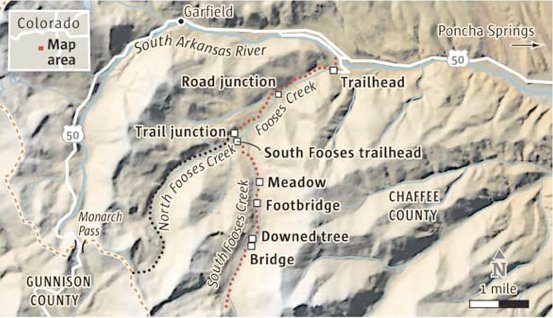
South Arkansas River: Fish habitat, riparian habitat and water quality improvement landowner meetings scheduled

southarkansasriverfoosecreek.jpg

From the Salida Citizen:

Landowner meetings will be at the Chaffee County Fairgrounds on Thursday, September 22nd at 5:30pm and Sunday, September 25th at 3:00pm. In attendance will be representatives from Trout Unlimited and the [Land Trust of the Upper Arkansas], a meeting facilitator, and aquatic experts. Snacks and beverages will be provided. To insure adequate handouts and materials please register by calling the Land Trust office at 719-539-7700 or emailing sawc@ltua.org.

More restoration coverage here.

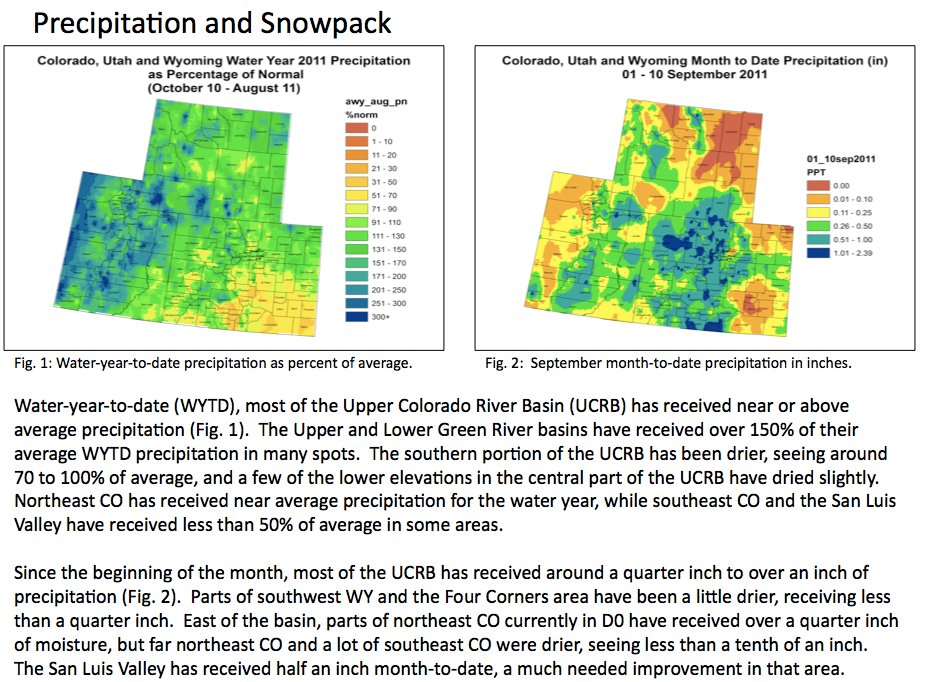
NIDIS Weekly Climate, Water and Drought Assessment Summary of the Upper Colorado River Basin and Colorado Drought Status Briefing

wyutcoprecipitation0901to102011.jpg

Here’s the link to the presentations from September 13. Click on the thumbnail graphic to the right for the precipitation roundup.

More Colorado River basin coverage here.

Castle Rock: Three water providers show up at public meeting to pitch solutions to the city’s long-term supply needs

denveraquifer.jpg

From the Castle Rock News Press (Rhonda Moore):

Years after launching an effort to plan for a long-term source of renewable water, Castle Rock put out an invitation to hear from water providers that might be able to compete with the Water, Infrastructure and Supply Efficiency program, long touted as the solution to meet the needs of Castle Rock and several south-metro area municipalities.

Among the water providers that submitted bids were Renew Strategies, headed by former Gov. Bill Owens; Stillwater Resources, which acts as a broker to match providers with municipalities like Castle Rock; and United Water, which serves public water districts such as the East Cherry Creek Valley Water and Sanitation District and the South Adams County Water District.

WISE, a project from the South Metro Water Supply Authority, was not among the providers that responded to the request for proposal. WISE has long aimed to buy its water from Aurora and Denver and store it in the Rueter-Hess reservoir. The Army Core of Engineers earlier this year notified Rueter-Hess officials that the plan violates a provision of the reservoir’s federal permit, and town councils from Aurora and Denver have yet to approve a proposal for the WISE project.

The responses included a proposal from Renew Strategies to acquire underground water from the Lost Creek Basin for between $23,000 and $24,000 per acre foot, plus infrastructure costs of up to $75 million; Stillwater’s option to purchase 4,000 acre feet of Boxelder farm water rights for about $21,000 per acre foot; and United Water’s proposal to sell South Platte surface water to Castle Rock for $23,850 per acre foot, which includes about $9 million in infrastructure costs.

More Denver Basin aquifer system coverage here.

Flaming Gorge Pipeline: Some in Routt and Moffat counties are keeping a close eye on the project

flaminggorgepipelinemillion.jpg

From the Craig Daily Press (Tom Ross):

So, if the Green River only flows through Moffat County for about 35 miles or so, why should people in Routt County concern themselves with the pipeline proposal? The decision to fund the first part of the study of the plan comes at a time when energy development is making more demands on Western Slope water. We’re seeing the beginnings of what could be a boom-let of oil wells here. And if those wells use fracturing techniques to pry the hydrocarbons out of the Niobrara shale, they’ll require large amount of precious water…

Heather Hansen, of Red Lodge Clearing House Natural Resources Law Center at the University of Colorado Boulder, zoomed in on the essential point in a recent essay published in High Country News.

Hansen pointed out that the Green River plays a major role in the obligation Colorado, Utah, Wyoming and New Mexico have to deliver 7.5 million acre feet of water annually to the lower basin states of California, Nevada and Arizona under the 1922 Colorado River Compact.

The 250,000 acre-feet the Million proposal would subtract from the Green only puts more pressure on the Yampa, White, Eagle, Roaring Fork and Gunnison rivers to meet those obligations in a future that includes a growing Front Range of Colorado.

More Flaming Gorge Pipeline coverage here and here.

Implementing the Colorado River Cooperative Agreement hangs on resolving how to operate the Shoshone right and Green Mountain Reservoir

shoshoneglenwoodcanyon.jpg

From the Associated Press via The Columbus Republic:

According to the Grand Junction Daily Sentinel (http://bit.ly/pblJYV ), western Colorado water providers want an agreement on the operation of the Shoshone power generating station in Glenwood Canyon and another on the operations of Green Mountain Reservoir.

Six months ago, officials from the Western Slope and Denver announced they had a general agreement that would resolve most of the issues, but none of the backers have signed an agreement.

More Colorado River Cooperative Agreement coverage here.

Rio Blanco County micro-hydroelectric project is ‘among the first’ to receive a permit under FERC’s new streamlined process

microhydroelectricplant.jpg

From the Associated Press via The Aurora Sentinel:

The Federal Energy Regulatory Commission signed a memorandum of understanding with Colorado last year that allows multiple agencies to review requests for hydropower projects at the same time. The Governor’s Energy Office says that can cut wait times on permits from three years down to less than two months.

The Governor’s Energy Office said Wednesday that the 23-kilowatt Meeker Wenschhof project in northwest Colorado went through the process to get a license allowing for construction and operation. The hydropower project will use water historically used for irrigation to offset the electricity used to power an irrigation sprinkler.

More hydroelectric coverage here and here.

Grand Junction: ‘Water Law In a Nutshell’ at Colorado Mesa University October 14

grandmesa.jpg

Here’s the link to the details and registration information

From email from the Water Center at Colorado Mesa University and the Mesa County Water Association (Hannah Holm):

The Water Center at Colorado Mesa University is pleased to host “Water Law in a Nutshell,” an 8-hour seminar presented by Mr. Aaron Clay, Attorney at Law and former 26-year Water Referee for the Colorado Water Court, Division 4. This seminar will cover all aspects of the law related to water rights and ditch rights as applied in Colorado. Subject matter includes the appropriation, perfection, use, limitations, attributes, abandonment and enforcement of various types of water rights. Additional subject matter will include special rules for groundwater, public rights in appropriated water, Federal and interstate compacts and more. This seminar is open to all interested persons. Fee is $69, or $114 for those seeking graduate inservice credit. Registration deadline is Oct 7, but class size is limited, and it may fill up before then.

More water law coverage here.

Energy policy — nuclear: The Town of Telluride town council approves lawsuit over operating license for the proposed Piñon Ridge mill

pinonridgesite.jpg

From The Telluride Watch:

On Tuesday, the Telluride Town Council voted unanimously to retain the legal services of a national public interest law firm, Public Justice, to litigate the case…

In January, the CDPHE issued a Radioactive Materials License to Energy Fuels Resources Corporation as a result of Colorado being an “Agreement State” under the Federal Atomic Energy Act. Shortly after it was issued, the licensing decision by CDPHE was first challenged by the Telluride-based environmental group Sheep Mountain Alliance. Following careful deliberation, members of council also expressed concerns over the potential negative impacts of an operational uranium mill in the area. According to Telluride Town Attorney Kevin Geiger and Public Justice, these possible impacts were given little or no consideration by the state in its review process.

More nuclear coverage here and here.

Flaming Gorge pipeline: Environmentalists are concerned that taxpayer dough is being spent frivolously on study

flaminggorgedrycoloradoestuary9billionbillboard.jpg

From the Grand Junction Free Press (Sharon Sullivan):

A coalition of environmental groups that include Western Resource Advocates, the Colorado Environmental Coalition and Save the Colorado, object to spending taxpayer money to study the feasibility of the trans-mountain diversion of water.

“Our concern is that it adds credibility to the project,” CEC water coordinator Becky Long said.

Ken Neubecker is director of Western Rivers Institute, past president of Trout Unlimited, and a member of the task force. The state legislature set aside money for projects like the task force study to look at what needs to be done regarding water supply and Colorado’s future, Neubecker said.

“Any significant reduction from the Green River could potentially affect all users in the basin,” said Hannah Holm, coordinator of the Water Center at Colorado Mesa University. The Water Center’s purpose is to “help communities in the upper Colorado River Basin understand how to be smart about water, do more with less to meet the needs going forward due to scarcity and tightened competition,” Holm said.

Additional water for projected shortages could come from purchase of agricultural rights, increased conservation, and alternative agricultural rights purchases — temporary arrangements with farmers so water could be obtained “without drying up the land forever,” Holm said.

The environmental coalition released a statement Wednesday protesting the vote: “While smaller, the proposal would still spend thousands of dollars in state funds to investigate a controversial and environmentally damaging project which thousands of Colorado citizens believe should not be funded at all.”

More coverage from Chris Woodka writing for The Pueblo Chieftain. From the article:

Board Chairman Eric Wilkinson castigated the environmental groups for trying to “sabotage” the study, and asked them to work with the state toward finding solutions. “The CWCB has the dirty, ugly discussions. That’s its responsibility. . . . I’m tired of all the disinformation about what the CWCB does,” Wilkinson said. “This board is trying to move the state forward, and, by golly, we’re going to turn this state around.”[…]

The CWCB approved a $72,000 grant — cut from the original $250,000 proposal — to identify statewide issues or interests from the proposed project. It would establish a task force of roundtable members from throughout the state as well as environmental representatives. The grant primarily covers the cost of 12 facilitated meetings during the process. Wilkinson asked the board to consider keeping the remainder of the money available if more discussion is warranted, but the board for now approved only the initial study. Part of the purpose of the task force would be to create a framework for studying future large projects.

The proposal was reworked Tuesday night after several environmental groups attempted to kill the project, said Jay Winner, general manager of the Lower Arkansas Valley Water Conservancy District, who represented the Arkansas Basin Roundtable at the meeting.

More Flaming Gorge pipeline coverage here and here.

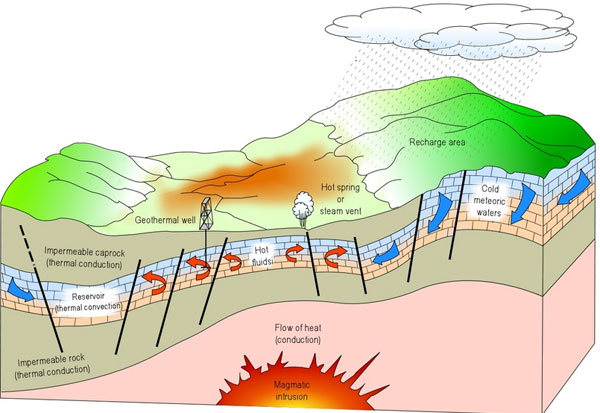
Energy policy — geothermal: No drillers responded to Aspen’s RFP for a geothermal test project

geothermalenergy.jpg

From The Aspen Daily News (Andrew Travers):

The city’s Open Space and Trails Board in July unanimously approved a temporary test-drilling site on the gravel parking lot of the city-owned Prockter Open Space, beside the Roaring Fork River and across Neale Avenue from Heron Park. The city has dedicated $150,000 to the exploration project, and also won a $50,000 grant from the Governor’s Energy Office to help fund the test drilling…

Drilling had been slated for mid-September, but no drillers responded to a city request for proposals (RFP). An Aug. 29 deadline for proposals came and went without any interested contractors coming forward.

“We didn’t get any bids, so we’re trying again,” said [Canary Initiative] director Lauren McDonnell. The city has put the project out for proposals again, with a new deadline set for this Monday, Sept. 19.

More geothermal coverage here and here.

Lamar pipeline: Former University of Colorado researcher urges in-depth analysis of the proposed project

lamarpipeline.jpg

From The Pueblo Chieftain (Chris Woodka):

“If an area is in economic decline, you want to slow the decline, you don’t want to make it worse,” said Ken Weber, an anthropologist who wrote numerous reports on economic changes in Crowley County and the Great Plains as a researcher at the University of Colorado from 1986-1996. Weber, 67, grew up in LaJunta in the 1950s, and returned to the area a few years ago to live in Pueblo after working for two federal agencies. Weber frequently attends area water meetings and had a hand in creating the Arkansas Basin Roundtable agriculture-urban transfers report and tipping-point study…

Crowley County already was in decline by the time Colorado Springs and Aurora purchased most of the remaining water rights on the Colorado Canal in the 1980s. Its population dropped to less than 3,000 in the 1980 Census, less than half of its peak in 1920. Prowers County is on a similar path. Its population peaked in 1950 at nearly 15,000. In 2010, the population dropped to its lowest point, 12,551. Irrigated agriculture in Prowers County has suffered through decades of economic turbulence, as witnessed by the sale of many farms on the Fort Lyon Canal to water developers and half of the farms on the Amity Canal to Tri-State Generation and Transmission…

Unlike past water grabs, the GP plan has included an incentive for Prowers County — a water treatment plant. Bill Grasmick, a longtime farmer whose family sold water rights to GP Water, called the plan “economic development” for Lamar. An economic analysis, prepared by GP as part of a water-service bid, says the equivalent of 41 full-time farm-labor jobs would be lost when the water is taken off 4,000 acres of ground. Those jobs would be replaced by 13 jobs in the water treatment plant and seven jobs at a gravel mining operation. The payroll would increase to $3.3 million a year with the new jobs from the existing $2 million paid annually from the present farming operation. Property taxes would go up to more than $600,000 from $15,000 on the land, with the water treatment plant and gravel operations, according to Peter Elzi, of THK Associates, a GP planning consultant…

“We can know the engineering and technical parts of a project, but not the economic and social part,” Weber said. “All of this operates in a social and historical context, and to the extent we ignore that context, our decisions are somewhat blind.”

More coverage from the Castle Rock News Press (Ashley Dieterle):

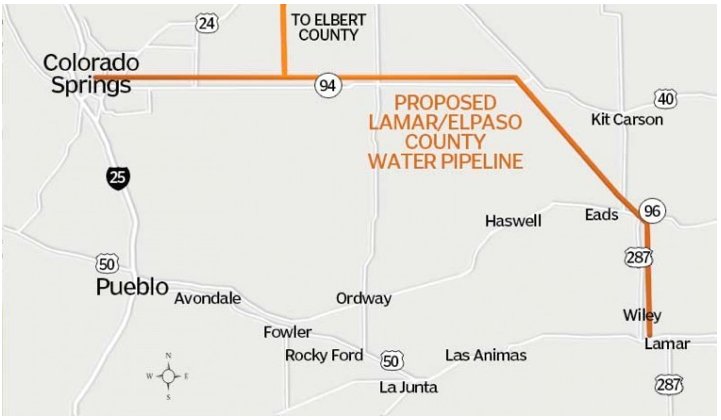
A 12-month moratorium on service plans and service-plan amendments related to water districts was passed by the Elbert Board of County Commissioners during the Sept. 14 board meeting. The moratorium also applies to water sanitation districts and metropolitan districts that provide water services. The moratorium stemmed from the application withdrawal of an amendment to the service plan for the Elbert and Highway 86 Commercial Metropolitan District during an Aug. 24 board meeting. The controversial petition, which would have allowed a 150-mile pipeline transporting water from Lamar to the county, was withdrawn when county residents were unhappy with the commissioners for allowing the petition to reach public hearing.

More Lamar Pipeline coverage here.

Fryingpan-Arkansas Project update: Reclamation is on board with compromise for the spending of project revenues

fryingpanarkansasproject.jpg

From The Pueblo Chieftain (Chris Woodka):

The plan pays off the South Outlet Works connection to Pueblo Dam, about $2 million, using revenues from 2010-11 this year, and begin paying down federal debt on the Fountain Valley Conduit and Ruedi Reservoir next year. During that time, the groups will work on a mutually acceptable plan for future years…

The new plan backs off the Southeastern’s insistence that Arkansas River basin parts of the project be paid down before Ruedi, a compensatory storage reservoir for the Western Slope above Basalt near Aspen…

The South Outlet Works delivers water from the Pueblo Dam to the Pueblo Board of Water Works, Fountain Valley Authority, Pueblo West and the future Arkansas Valley Conduit. Payment of the debt on the South Outlet Works benefits Pueblo water customers, who otherwise would have to pay about $169,000 a year over the next 12 years. More than $52 million is owed on the Fountain Valley Conduit, which serves Colorado Springs, Fountain, Security, Widefield and Stratmoor Hills. Payments for those users total $5.6 million a year, through property tax assessment. More than $32 million is owed on Ruedi, and interest payments increase the amount by $2 million annually. The reservoir was built larger than necessary at the request of Western Slope interests, and the large debt is a result of unused accounts at the reservoir.

More Fryingpan-Arkansas Project coverage here.

In a lawsuit filed last Thursday ‘Saving Our Streams’ is claiming the the City of Aspen has effectively abandoned their hydroelectric power generation right on Castle and Maroon creeks

aspen.jpg

From The Aspen Times (Andre Salvail):

Saving Our Streams, an environmental organization whose stated mission is to support local streams and to ensure that diversions of water do not compromise the health of fragile ecosystems, filed the lawsuit. The group was formed in February.

The lawsuit, which seeks to stop the city from moving forward with plans for a hydroelectric plant, was not unexpected. One of the plaintiffs, Aspen businessman Dick Butera, suggested during a City Council meeting in late June that it was likely.

Other plaintiffs are: Yasmine Depagter, Maureen Hirsch, Joseph and Sheila Cosniac, Kit Goldsbury, Elk Mountain Lodge LLC, Crystal LLC, American Lake LLC, Ashcroft LLC, B&C LLC and the Bruce E. Carlson Trust. They all own property along or adjacent to the creeks.

More coverage from Curtis Wackerle writing for the Aspen Daily News. From the article:

The suit, filed Thursday on behalf of 11 plaintiffs, claims the city has “abandoned” its water rights for hydropower. The six-page complaint, filed in state water court in Glenwood Springs by Aspen attorneys Paul Noto and Danielle Luber, cites the decommissioning of the city’s original Castle Creek hydropower station, which was in use from about 1893 until 1958. “Aspen has shown its intent to abandon the hydropower use decreed [to the Castle and Maroon creek water rights] by not using the water right for this purpose for over 50 years,” the complaint says…

City officials said the suit is without merit. Cynthia Covell, a Denver lawyer who works on water rights issues for the city, was out of town Thursday, but she has looked into questions on the validity of the city’s water rights for hydropower in the past.

“We are confident that our water rights have not been abandoned,” City Attorney John Worcester said, adding that discussions about developing hydropower again on Castle Creek “have been kicked around for the 20-plus years I’ve been here.”

The city has 20 days to respond to the suit.

The city’s water rights on the creeks date back to the 1880s in some cases. The lawsuit cites three separate water rights — the Castle Creek Flume Ditch, the Midland Flume Ditch and the Maroon Ditch — that together account for 160 cfs on Castle Creek and 65 cfs on Maroon Creek, that the city is entitled to use for domestic and hydropower purposes, among other municipal uses. These are the water rights that the city uses for its drinking water…

Saving Our Streams, a nonprofit group started by Maureen Hirsch and Yasmine Depagter, is listed as a plaintiff, as are Hirsch and Depagter individually. The other plaintiffs are: Dick Butera, Joseph and Sheila Cosniac, Kit Goldsbury, the Bruce E. Carlson Trust, B&C LLC, Elk Mountain Lodge LLC, Crystal LLC, Ashcroft LLC and American Lake LLC. The Bruce E. Carlson Trust and B&C LLC own property on Maroon Creek…

“It’s an open mystery why someone would be concerned about water being diverted eight miles downstream from them,” Aspen Mayor Mick Ireland said, noting that the water the city would take for the hydro plant would return to the river about two miles downstream after passing through the penstock and turbine.

More hydroelectric coverage here and here.

Coyote Gulch outage: I’ll see you Monday morning

coyotegulchmidnightclassic07162011.jpg

I’m on deadline at Colorado Central Magazine. I’ll see you Monday Morning bright and early.

10th annual Carbon Disclosure Project survey determines that 68% of the world’s largest firms that responded are ‘acting on climate change’

usdroughtmonitor09152011.jpg

From The Guardian:

The 10th annual Carbon Disclosure Project, which analysed responses from 396 of the 500 largest companies in the world, found more than two-thirds (68%) now say they put climate change central to their business, compared with 48% last year.

Almost half (45%) are now reporting they have cut their greenhouse gas emissions as a result of steps they have taken to tackle carbon, up from less than a fifth (19%) in 2010.

The Carbon Disclosure Project report, written by PwC, also said there was a link between higher stock market performance and action on climate change, with those that have a strong focus on the issue providing investors with approximately double the average return over the period 2005 to 2011…

The CDP report suggests that rising oil prices, risky energy supplies and growing recognition of the returns on investment in cutting emissions have made climate change a more important issue in the boardroom.

It says that 59% of companies reported that the cost of schemes to reduce emissions such as energy saving projects in buildings, installing low-carbon power and changing the behaviour of staff, were recouped within three years.

Almost three-quarters of businesses (74%) who responded to the survey now have emissions reductions targets, up from two-thirds (65%) in 2010…

The report found that the vast majority (93%) of companies who responded with information have senior executives or board members responsible for climate change.

And almost two-thirds (65%) offer financial rewards to staff for taking action on climate change.

Alan McGill, PwC sustainability and climate change partner, said: “We’re seeing the highest levels of board oversight and engagement on climate change strategy ever, with significant increases in the levels of monetary incentives linked to achieving targets.

Say hello to Uunartoq Qeqertaq, or Warming Island, one of the newest islands in the world according to the The Times Comprehensive Atlas of the World. Here’s a report from The Guardian (John Vidal). Here’s an excerpt:

If you have never heard of Uunartoq Qeqertaq, it’s possibly because it’s one of the world’s newest islands, appearing in 2006 off the east coast of Greenland, 340 miles north of the Arctic circle when the ice retreated because of global warming. This Thursday the new land – translated from Inuit as Warming Island – was deemed permanent enough by map-makers to be included in a new edition of the most comprehensive atlas in the world…

The world’s biggest physical changes in the past few years are mostly seen nearest the poles where climate change has been most extreme. Greenland appears considerably browner round the edges, having lost around 15%, or 300,000 sq km, of its permanent ice cover. Antarctica is smaller following the break-up of the Larsen B and Wilkins ice shelves.

Meanwhile, more Americans believe that human activity is responsible for climate change, according to this report from Timothy Gardner writing for Reuters. From the article:

The percentage of Americans who believe the Earth has been warming rose to 83 percent from 75 percent last year in the poll conducted Sept 8-12…

As Americans watch Republicans debate the issue, they are forced to mull over what they think about global warming, said Jon Krosnick, a political science professor at Stanford University.

And what they think is also influenced by reports this year that global temperatures in 2010 were tied with 2005 to be the warmest year since the 1880s.

“That is exactly the kind of situation that will provoke the public to think about the issue in a way that they haven’t before,” Krosnick said about news reports on the Republicans denying climate change science…

Some 71 percent of the Americans who believe warming is happening think that it is caused either partly or mostly by humans, while 27 percent believe its is the result of natural causes, the poll found.

More climate change coverage here and here.

The monster snowpack in the Upper Colorado River basin resulted in big gains in storage in Lake Powell and Lake Mead

hooverdamspilling.jpg

Update: Down in the comments Tim Hodge reminds me that it’s pretty easy to check the gage height at Lake Mead and the 73% does not agree with Bureau of Reclamation information. He adds, “Still it’s better than 42%.”

Here’s a report about the Colorado Water Congress’ Summer Meeting from Allen Best running in The Telluride Watch. Click through and read the whole thing for a good recap. Here’s an excerpt:

Last spring, Colorado was, to paraphrase Dickens, a tale of two states. In the San Juan Mountains, maximum snowfall depths were reached on March 30, eight days earlier than average. Peak accumulations were about 90 percent of average. North of the Gunnison River, however, the La Niña storms stayed strong – and then, in April and May, turned remarkable. The Gunnison River itself had flows 125 percent of average. But northward, at Crested Butte, Aspen and Vail, the spring storms were unyielding. Colorado’s most remarkable story was in the Steamboat Springs region. At Buffalo Pass, eight miles from downtown Steamboat, the snow this year surpassed the tops of the 18-foot poles assembled to measure it…

This huge water year in Colorado – rivaled during recent decades only in 1995 and 1984 – had profound consequences for the big reservoirs downstream to which the Uncompaghre, San Miguel and other rivers ultimately deliver their water. Lake Powell had risen 24 feet as of late August as compared to last year. Lake Mead, near Las Vegas, was at 73 percent of capacity once again.

How very different from last December when Mead was at 42 percent of capacity, the lowest level since 1937, soon after completion of Hoover Dam.

More Colorado River basin coverage here.

Colorado River District Annual Seminar recap: Water use has ‘caught up with the supply’

coloradoriverbasin.jpg

From KJCT8.com (Dann Cianca):

Mark Squillace, Director of the University of Colorado Law School’s Natural Resources Law Center gave a talk examining policy and river management. “We’re at a unique point in our history where the amount of water that we’re using has caught up with the supply,” Squillace said. Better-than-average precipitation this in 2011 kept river levels up on the Western Slope, but Squillace says, “what we’re really talking about is managing risk. Whether you believe in climate change or not, we know that there are risks associated with water supplies. There are droughts that occur.”[…]

“New supply is an essential part of that problem,” he says. “There are two choices for new supply: Drying up agriculture or transporting Colorado River basin water to the Front Range.” His point was to get local water managers thinking about plans that they could impose before Front Range managers came to them.

More coverage from NBC11News.com (Kelly Asmuth):

The River District says the state’s population is expected to double by 2050, with the majority of people living on the Front Range. The organization says transferring more water from the Western Slope needs to be discussed, even if it’s not a popular topic in the Grand Valley. “It’s something that truthfully a lot of people (on the Western Slope) wouldn’t want to hear, but unfortunately the reality is, we have to at least go in that direction and try and understand it,” says Colorado River District public information officer, Jim Pokrandt.

More Colorado River basin coverage here.

Energy policy — hydroelectric: The Southeastern Colorado Water Conservation District is spearheading a hydroelectric generation plant just downstream of Pueblo Dam

microhydroelectricplant.jpg

I’m a big proponent of hydroelectric power, possibly because I love technology, but also because of the low-carbon nature of hydropower. Of course, the effects on streamflow and aquatic and riparian life when a stream is harnessed, dammed, channeled, etc. are well known so I tend to favor retrofits in a stream system that has already been affected, rather than the taking of another stream life for humankind.

Here’s a report from Chris Woodka writing for The Pueblo Chieftain. From the article:

The Southeastern Colorado Water Conservancy District, Colorado Springs, Pueblo Board of Water Works and Fountain are planning on making a bid for a hydropower plant just downstream of the dam. All of the partners are Southeastern district members and other partners could be added. “We’re putting together a partnership to try to win the award,” said Jim Broderick, executive director of the Southeastern district told the district’s board Thursday. “I think this is an opportunity for the district.”

The plant would require an environmental review. It is not decided what organizational structure the group would use to build the hydropower plant. A preliminary report shows the group would make a profit on a plant generating anywhere from 4 to 8.6 megawatts of power. The cost of building the plant would be $11 million to $18.7 million, and state loans, government incentives and grants would be available to pay much of the cost, said Lindsay George of the Applegate Group…

The plant would hook onto the North Outlet Works river connection that is now being built as part of SDS. The connection includes one pipeline that goes to the Juniper Pump Station and another that would serve as the primary feed for the Arkansas River. The feed to the hydropower plant would use direct flows to spin turbines…

The hydropower plant would only be able to run from about April to September, when river releases are high enough to run turbines.

More hydroelectric coverage here and here.

Rio Grande River basin: Water supply forecasters and San Luis Valley irrigators are eyeing a beefed up snowpack measuring network

snotelsite.jpg

From The Pueblo Chieftain (Matt Hildner):

While the Rio Grande Basin Roundtable did not consider a specific funding request, a presentation from a team of federal, state and private researchers laid out improvement areas that included more snow gauges, radar and a host of smaller steps.

Improving runoff forecasts is no small matter to ranchers and farmers in the San Luis Valley, where snowmelt accounts for roughly 80 percent of stream flows…

The first drink out of the Rio Grande and Conejos rivers go toward satisfying interstate compact requirements with Texas and New Mexico and varies in size, according to the snowpack. A larger snowpack means the valley will have to send a greater portion downstream. But inaccurate forecasts can create uncertainty among water users because of the timing of when they’ll be able to divert water and the amount diverted. This year, for example, runoff was larger than predicted in the spring, forcing the state to send a larger amount of water downstream to satisfy the compact. By mid-July irrigators on the Rio Grande were forced to part with 22 percent of their allotment, while water users on the Conejos were watching 46 percent of their rightful share head downstream.

Over the past five years forecasters have come to within 4 percent of the actual runoff. They’ve also been off by as much as 24 percent…

While a pilot project could operate out of the valley as soon as December 2012, the cost of a permanent system could be as high as $10 million, [Steve Vasiloff, a researcher with the National Oceanic and Atmospheric Administration] said.

More Rio Grande River basin coverage here.

There’s a new water education center in the works at Metropolitan State College

metrostateroadrunner.jpg

From email from Sandra Haynes, PhD, Dean, School of Professional Studies and Susan Noble, Advancement and External Relations, Office of Development via Colorado Water 2012:

On September 8, the Board of Trustees of Metropolitan State College of Denver approved the establishment of the One World, One Water Center for Urban Water Education and Stewardship at Metropolitan State College of Denver (the OWOW Center), made possible through the generosity of a noted local philanthropist and conservationist.

More education coverage here.

Flaming Gorge pipeline: Conservationists are not convinced that the proposed feasibility study is worth even $72,000

lowergreenriverlake.jpg

From the Colorado Independent (David O. Williams):

“We are encouraged that the state will waste less taxpayer money on this study, but we still think it’s a complete waste of time and money even in its watered-down form,” said Gary Wockner of Save the Colorado.

“The pipeline would irrevocably harm the Green and Colorado Rivers, cost up to $9 billion, and negatively impact the West Slope’s economy. The state should spend the public’s money elsewhere.”

Here’s a joint release from Save the Colorado (Gary Wockner), the Colorado Environmental Coalition (Elise Jones) and Western Resource Advocates (Peter Roesmann):

At its Wednesday, September 14, 2011 meeting, the Colorado Water Conservation Board passed a diluted proposal to fund an exploratory study for the Flaming Gorge Pipeline. The original proposal was for $240,000 and multi-year meetings; the final proposal approved by the board funds just over $72,000 with only a few months of meetings. The watered-down proposal passed despite opposition from thousands of members of the public, a large coalition of environmental groups, taxpayer representatives, and West Slope businesses. Board members expressed many concerns, only some of which were addressed in the water-down version.

Our organizations continue to have numerous concerns about the project even in a scaled back form. While smaller, the proposal would still spend thousands of dollars in state funds to investigate a controversial and environmentally damaging project which thousands of Colorado citizens believe should not be funded at all. This week members of the Joint Budget Committee expressed their concerns over the project notably that this process seems to duplicate an existing efforts of the Interbasin Compact Committee.

Ultimately, a Flaming Gorge pipeline project entails enormous costs and infeasibility. We will continue to work with the CWCB, project proponents, water utilities and other stakeholders to further the important and difficult dialog around meeting Colorado’s future water needs, in ways that—unlike the Flaming Gorge pipeline—are cost-effective, feasible, and do-able in a short time frame.

Finally, Trout Unlimited released results today from a survey of Wyoming reaction to the proposed pipeline. From their release:

Public Opinion Strategies recently completed a statewide survey of voters throughout Wyoming regarding their perceptions of water. The survey results show that Wyoming voters are soundly opposed to a proposal to pump water from the Green River near Flaming Gorge Reservoir to Colorado communities and farms, and to eastern Wyoming. In fact, a majority are strongly opposed to the proposal, and opposition remains high even after hearing arguments in support of the project. After all additional information was provided, an overwhelming 90% of Wyoming voters reject the proposed pipeline.

Respondents in the survey and those in focus groups conducted earlier in Cheyenne indicate their opposition is founded in a concern for allowing Wyoming water to leave their state and an uncertainty over the state’s future needs due to drought or other conditions.

More Flaming Gorge Task Force coverage here.

CWCB: HB10-1051 Conservation Data Collection DRAFT Guidelines Available for Public Comment

suburbs.jpg

From email from the Colorado Water Conservation Board:

In 2010, the Colorado General Assembly adopted House Bill 10-1051, an Act Concerning Additional Information Regarding Covered Entities’ Water Efficiency Plans. The Bill requires covered entities to annually report water use and water conservation data to the CWCB to be used for statewide water supply planning. The Bill also directs the CWCB to adopt guidelines regarding the reporting of water use and water conservation by covered entities, and to report to the Legislature regarding the Guidelines.

For the past 10 months the CWCB, with the invaluable support and detailed input from two advisory groups representing a diverse group of stakeholders, including many municipal water providers around the State, has been working on a draft set of Guidelines Regarding the Reporting of Water Use and Conservation Data by Covered Entities. The process has also developed a set of accompanying documents to support the Guidelines and their implementation.

The Draft Guidelines Regarding the Reporting of Water Use and Conservation Data by Covered Entities and Appendices are posted on the CWCB website and are available for public comment. The public comment period will run for 45 days and end at 5:00pm on October 29, 2011. We encourage the public to review the Guidelines and documents and provide the CWCB with comments. Please direct any questions or comments to Veva Deheza, Section Chief, Office of Water Conservation & Drought Planning, at 303-866-3441 ext. 3226.

More CWCB coverage here.

The Colorado Water Conservation Board is set to pony up $70,000 to study feasibility of the proposed Flaming Gorge pipeline water supply project

flaminggorgepipelinemillion.jpg

From the Fort Collins Coloradoan (Bobby Magill):

“I think it’s interesting and probably good that the state is looking at it,” said Fort Collins entrepreneur Aaron Million, whose Regional Watershed Supply Project is the most advanced proposal for a Flaming Gorge pipeline now being considered. CWCB members think the project proposal is strong enough for the state to study it, Million said. “I’ve always argued for the project to be fully vetted on all environmental issues and all issues associated with it,” he said. “The more it can be looked at, the more beneficial it will be to the eventual outcome.”[…]

Environmentalists are unhappy that the state is spending money to study a pipeline they believe will be too costly both to taxpayers and the environment.

More Flaming Gorge pipeline coverage here and here.

Denver Water Board taking comments on rates adjustment for 2012

fountainpavementdrawing.jpg

Here’s the release from Denver Water (Ellen Cinchock):

Denver Water is launching a public comment period on proposed rates for 2012. The Board of Water Commissioners will vote on rates during its Sept. 28 meeting.

The proposal, a 5.5 percent increase for all customers, provides further funding for the utility’s capital projects, which include upgrades to aging infrastructure. Under this proposal, the average residential Denver customer would pay about $19 more per year.

The increase is about half of what the Board had anticipated last year. In 2011, Denver Water reprioritized projects that can be delayed a few years and implemented additional efficiency measures throughout the organization.

“We are keenly aware of our need to spend our customers’ dollars wisely,” said Angela Bricmont, director of finance. “That’s why we’ve reduced our budget for 2012 and have launched an organization-wide efficiency initiative to keep us as lean as possible.”

Next year, the utility’s major projects include protecting the watershed through its From Forests to Faucets Partnership with the U.S. Forest Service, expanding the recycled water system and stepping up the pipe rehabilitation and replacement program.

Denver Water owns and maintains more than 3,000 miles of distribution pipe — enough to stretch from Los Angeles to New York — as well as 12 raw water reservoirs, 22 pump stations and four treatment plants. Ongoing rehabilitation and replacement of infrastructure is needed throughout the water distribution system, much of which dates back to post-World War II installation or earlier.

Denver Water plans to expand its system capacity over the next decade to meet the future needs of its customers by expanding the utility’s recycled water system, enlarging Gross Reservoir by 18,000 acre-feet, developing gravel pits that store reusable water, and exploring ways to work with other water providers to bring more supplies to its system.

The effects of the proposed changes on customer bills would vary depending upon the amount of water the customer uses and whether the customer lives in Denver or is served by a suburban distributor under contract with Denver Water. The more customers use, the more they will pay. Under the current rate proposal, average Denver residential customers would see their bills increase by $19.43 a year — an average of $1.62 per month. Typical suburban residential customers served by Denver Water would see an increase of $34.11 per year — an average of $2.84 per month. Commercial, industrial and government customers also would see a 5.5 percent increase.

If the proposed adjustments are approved, they would take effect January 2012. Rates for Denver Water customers living inside the city would remain among the lowest in the metro area, while rates for Denver Water residential customers in the suburbs would still fall at or below the median among area water providers.

“Denver Water has a long history of sound financial management, fiscal responsibility and efficiency,” Bricmont said. “Our AAA bond rating is a reflection of that. It allows us to build projects at lower cost — savings we are able to pass along to our customers.”

The water department is funded through rates and new tap fees, not taxes. Its rates are designed to recover the costs of providing reliable, high-quality water service and to encourage efficiency by charging higher prices for increased water use. A significant portion of Denver Water’s annual costs do not vary with the amount of water sold and include maintenance of the system’s distribution pipes, reservoirs, pump stations and treatment plants. Denver Water also examines and adjusts its capital plan as necessary each year.

The Board is expected to vote on the proposed changes on Wednesday, Sept. 28. Please send public comment to dbwc@denverwater.org or call 303-628-6320. Public comment also will be taken during the Board meeting at 9 a.m. on Sept. 28. For more information about the Board meetings, visit www.denverwater.org/AboutUs/PublicWaterBoardMeetings.

More coverage from KWGN.tv:

Denver Water has proposed raising rates by 5.5% to help fund construction projects, including ones to upgrade aging infrastructure. That means the average residential customer would pay about $19 more per year. If approved, the rate hike would take effect in January.

More Denver Water coverage here.

Lamar pipeline: Any potential GP Water change case faces close scrutiny from the Arkansas River Compact Administration

lamarpipeline.jpg

From The Pueblo Chieftain (Chris Woodka):

Formed in 1949, after Kansas and Colorado had ratified the 1948 Arkansas River Compact, the administration has proven to be an unwieldy body when it comes to moving water. No transfer of water ever has been approved from District 67, which covers the Arkansas River and its tributaries downstream from John Martin Reservoir. Both states are committed to abide by the compact under an act of Congress, and violations are serious. A U.S. Supreme Court case filed in 1985 was the latest round in a fight that has gone on for more than a century. While the massive water district touches corners of Elbert and El Paso counties, taking water to populated urban areas would require moving water outside District 67.

The compact has “bright red letter” language that prohibits that, said Steve Witte, Division 2 engineer for the State Division of Water Resources and ARCA operations secretary. The movement of water is covered in Article V, Section H of the compact, which prohibits transferring water into other districts or upstream of John Martin Dam unless it can be proved there are no adverse effects. “It’s pretty clear you can’t change water rights in Colorado to other districts unless you can prove there are no depletions,” Witte said…

Because the commission meets only once a year and it takes the agreement of both states to pass any resolution, change in the compact is glacially slow. Kansas can stop a discussion just by not addressing the issue. In recent years, the states have started talking again, but they proceed carefully. Under procedures developed during the court case, most matters are referred to an engineering committee, and it takes action by one of the state representatives to even get the administration to hear requests…

GP Water officials have portrayed the proposed pipeline project as one which moves only the consumptive use of the water, by drying up 4,000 acres of farm ground. No change would be made in the point of diversion and returned flows would be timed to meet historic conditions.

Colin Thompson, who represents District 67 on ARCA, said he is concerned about any plans to move water along the river — including the Arkansas Valley Super Ditch — because of the potential to diminish return flows and degrade water quality…

[Matt Heimerich, who represents upstream water users on ARCA] said the compact was adopted 63 years ago, and did not anticipate that large blocks of water could be moved from agricultural to urban use. He too sees problems with how [Lower Arkansas Water Management Association] shares figure into the GP plan…

Heimerich still farms on land in Crowley County that was left behind after much of the farm water was sold to Colorado Springs and Aurora. He can relate to concerns raised by other farmers in the Granada-Lamar area about the depletion of so much water on one canal. “It is really important to keep the people who are left whole,” Heimerich said.

More Lamar Pipeline coverage here.

The August/September issue of ‘Colorado Water’ from the Colorado Water Institute is hot off the press

cwicoloradowateraugustseptember2011.jpg

Click here to download a copy.

From email from the Colorado Water Institute:

Climate, weather and water are completely intertwined. It is a fact that the most damaging extreme weather events usually involve water in some form. Already this year, the U.S. has experienced record-setting floods along the Mississippi River, deadly tornadoes in the South, and severe drought in Texas and Oklahoma. We have already seen eight $1 billion-plus disasters in the U.S. during 2011, with total damages at more than $32 billion, according to the National Oceanic and Atmospheric Administration (NOAA). As these statistics indicate, the study of climate and weather is vitally important to society. Weather and climate affect virtually every aspect of our economy and everyday life— how we live, what we grow, our ecosystems, our energy needs, how our buildings and roads are built, the services we require, and how we recreate.

As you will read in this issue of Colorado Water, CSU researchers are currently working to develop improved information in the form of climate forecasts, runoff predictions, drought monitoring, and regional vulnerability assessments needed to assist water resource decision makers.

More climate change coverage here and here.

Colorado-Big Thompson Project update: Pumping resumed September 7 from Shadow Mountain Reservoir into Grand Lake for deliveries to the South Platte Basin

secchidiskprocedure1.jpg

From the Sky-Hi Daily News (Tonya Bina):

In the shallow, “crystal clear” connecting channel of Grand Lake and Shadow Mountain Reservoir, “The day after they started pumping, you couldn’t see the bottom,” said Watershed Program Manager Ben Carver, of the Grand County Water Information Network. Secchi disc measurements back up observances…The Water Information Network’s paid field technician has been sampling clarity at 14 sites of Grand Lake three times per week this summer. In mid-July, the measurements averaged around 20 feet (6.25 meters). On Sept. 10, three days after pumping resumed, the clarity on Grand Lake had been cut nearly in half to an average 11 feet (3.25 meters). The channel became “a bottleneck for all the algae coming into Grand Lake” from shallow Shadow Mountain Reservoir, Carver said.

More Colorado-Big Thompson Project coverage here.

The Colorado Water Conservation Board votes unanimously to fund Flaming Gorge pipeline study, now whittled down to $70,000 with more dough available if project looks feasible

flaminggorgedamusbr.jpg

I just got out of staff meeting at work and I was wondering about the outcome from the CWCB meeting in Grand Junction, so I opened up Twitter. You have to love the Internet.

Here’s a tweet from @beckylong who attended the meeting, “Statements from proponents & Board members on the #FlamingGorge proposal. Say they’ve invited us [ed. conservationists and environmentalists] to dinner. Feel a little like the turkey.”

From The Denver Post (Bruce Finley):

Members of the Colorado Water Conservation Board voted unanimously to spend $70,000 on a study exploring the idea for a 570-mile pipeline — and $170,000 more if the first study deems the diversion promising, according to participants at a CWCB meeting in Grand Junction…

This morning’s CWCB decision “shows the potential value of the project” for delivering “a new water resource for Colorado,” [Aaron Million] said. “We’ve been watching from the sidelines. The project needs to be studied. This is a move-forward decision.”

Some environmental groups objected to spending state money to explore the project, saying it would hurt the reservoir and the Green River ecosystems. Western Resource Advocates, a Boulder-based law and policy group, called state pursuit of the pipeline “a colossal waste of time and energy… All interested parties should instead spend time on more realistic means to meet future water demands.”

The CWCB is charged with protecting and developing water resources for the state.

More Flaming Gorge Task Force coverage here.